A CASE STUDY EXPLORING THE “NEW LITERACIES” DURING A FIFTH-GRADE ELECTRONIC READING WORKSHOP
by
EVA LOTTA CECILIA LARSON B.A., Kansas State University, 1992 B.S., Kansas State University, 1999 M.S., Kansas State University, 2003
AN ABSTRACT OF A DISSERTATION
submitted in partial fulfillment of the requirements for the degree DOCTOR OF PHILOSOPHY
Department of Curriculum and Instruction College of Education
KANSAS STATE UNIVERSITY Manhattan, Kansas
Abstract
In today’s classrooms, literacy instruction is undergoing tremendous transformations as new technologies demand new literacies. The purpose of this qualitative case study was to examine how integration of technology supports the emergence of new literacies, within the context of an electronic reading workshop in a fifth-grade classroom.
The electronic reading workshop provided students multiple opportunities to response to e-books, both as readers and technology users. First, e-book tools allowed the participants to engage in a spontaneous response process as the plot unfolded. Second, students responded to teacher-constructed prompts in electronic literature response journals. Analysis of the journals revealed responses from three broad categories: 1) personal meaning making, 2) character and plot involvement, and 3) literary criticism.
Third, students engaged in conversational response while participating in asynchronous message board discussions. The students composed and posted their own response prompts. Analysis of the message board transcripts suggested five types of student-constructed prompts: 1) experiential prompts, 2) aesthetic prompts 3) cognitive prompts, 4) interpretive prompts, and 5) clarification prompts.
Virtual guide response projects provided a fourth opportunity for response to e-books. Working in groups, students created virtual guides to the literature in which they visually represented their personal interpretations of the e-books. The virtual guides were published as multi-modal PowerPoint presentations including sounds, images, animations, and hyperlinks. As
students conceptualized, researched, published and presented their virtual guides to the literature, they used new literacies to fully exploit the potential of the available technologies.
The electronic reading workshop provided a learning environment in which students interacted with each other as they made sense of and accessed the available information and communication technologies. In particular, socially constructed learning occurred through threaded discussions on an electronic message board and development of virtual guide response projects.
Educators must be responsive to today’s learners. This study illuminated the expanded possibilities for integrating technology and literacy within the context of an electronic reading workshop. Findings of the study suggest technology integration supports the emergence of new literacies, while the new literacies support students’ utilization of available technologies.
A CASE STUDY EXPLORING THE “NEW LITERACIES” DURING A FIFTH-GRADE ELECTRONIC READING WORKSHOP
by
EVA LOTTA CECILIA LARSON B.A., Kansas State University, 1992 B.S., Kansas State University, 1999 M.S., Kansas State University, 2003
A DISSERTATION
submitted in partial fulfillment of the requirements for the degree DOCTOR OF PHILOSOPHY
Department of Curriculum and Instruction College of Education
KANSAS STATE UNIVERSITY Manhattan, Kansas
2007
Approved by: Major Professor Dr. Marjorie R. Hancock
Copyright
EVA LOTTA CECILIA LARSON 2007
Abstract
In today’s classrooms, literacy instruction is undergoing tremendous transformations as new technologies demand new literacies. The purpose of this qualitative case study was to examine how integration of technology supports the emergence of new literacies, within the context of an electronic reading workshop in a fifth-grade classroom.
The electronic reading workshop provided students multiple opportunities to response to e-books, both as readers and technology users. First, e-book tools allowed the participants to engage in a spontaneous response process as the plot unfolded. Second, students responded to teacher-constructed prompts in electronic literature response journals. Analysis of the journals revealed responses from three broad categories: 1) personal meaning making, 2) character and plot involvement, and 3) literary criticism.
Third, students engaged in conversational response while participating in asynchronous message board discussions. The students composed and posted their own response prompts. Analysis of the message board transcripts suggested five types of student-constructed prompts: 1) experiential prompts, 2) aesthetic prompts 3) cognitive prompts, 4) interpretive prompts, and 5) clarification prompts.
Virtual guide response projects provided a fourth opportunity for response to e-books. Working in groups, students created virtual guides to the literature in which they visually represented their personal interpretations of the e-books. The virtual guides were published as multi-modal PowerPoint presentations including sounds, images, animations, and hyperlinks. As students conceptualized, researched, published and presented their virtual guides to the literature,
The electronic reading workshop provided a learning environment in which students interacted with each other as they made sense of and accessed the available information and communication technologies. In particular, socially constructed learning occurred through threaded discussions on an electronic message board and development of virtual guide response projects.
Educators must be responsive to today’s learners. This study illuminated the expanded possibilities for integrating technology and literacy within the context of an electronic reading workshop. Findings of the study suggest technology integration supports the emergence of new literacies, while the new literacies support students’ utilization of available technologies.
Table of Contents
List of Figures ... xiii
List of Tables ... xiv
Acknowledgements... xv
CHAPTER 1 - Introduction ... 1
Overview of the Issues... 3
The New Literacies ... 5
Student Engagement and Social Interaction ... 6
New Digital Divides ... 7
Statement of the Problem... 9
Purpose of the Study ... 10
Research Questions... 12
Significance of the Study... 13
Limitations of the Study ... 14
Definition of Terms ... 15
Organization of the Study ... 18
CHAPTER 2 - Review of the Literature... 19
Theoretical Foundations ... 19
Constructivist Theory... 20
A Cognitive Developmental Perspective ... 21
A Sociocultural Perspective... 22
Transactional Theory of Reader Response ... 25
Toward a Theory of New Literacies ... 28
Central Principles of New Literacies ... 29
The Reading Workshop ... 36
Principles of a Reading Workshop... 36
Key Components of a Reading Workshop... 39
Literature Conversations... 44
Project Response Options ... 48
The Electronic Reading Workshop... 52
Key Components of an Electronic Reading Workshop (ERW)... 53
ERW Literature Selection ... 53
ERW Literature Response Journals ... 57
ERW Literature Conversations ... 59
ERW Project Response Options ... 65
Summary ... 68
CHAPTER 3 - Methodology ... 70
Research Design ... 70
Pilot Study... 73
Pilot Study Literature Selection ... 74
Pilot Study Literature Response Journals ... 76
Pilot Study Literature Conversations ... 76
Pilot Study Project Response Options ... 78
Teacher/Classroom Site ... 79
School/Student Participants ... 80
Participant Biographies... 81
Role of the Researcher ... 87
Role of the Teacher... 89
ERW Implementation and Procedures... 90
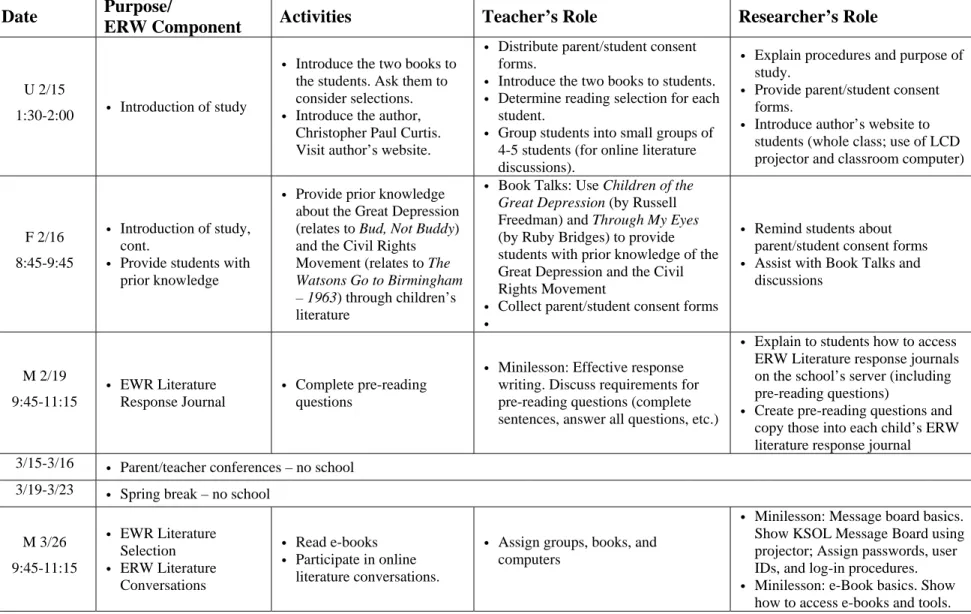
Timeline ... 90
ERW Literature Selection ... 97
ERW Literature Response Journals ... 99
ERW Literature Conversations ... 100
ERW Virtual Guide Response Projects ... 101
Debriefing ... 102
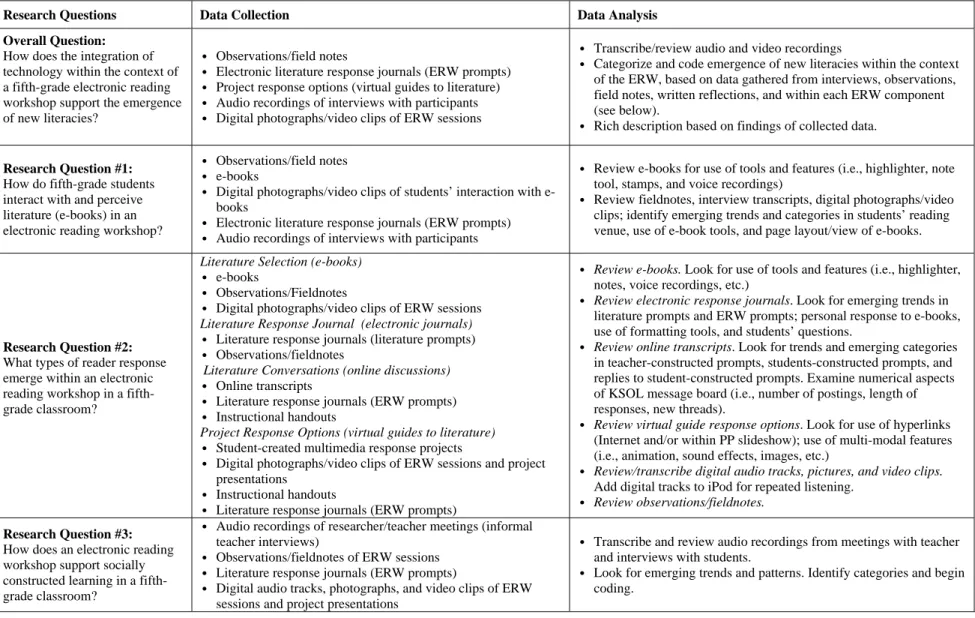
Data Collection ... 102
Digital Photographs/Video Clips ... 106
Documents and Artifacts... 107
e-Book Responses... 107
Literature Response Journals ... 107
Online Transcripts... 108
Virtual Guide Response Project... 108
Data Analysis... 109
Analysis of Field Notes... 109
Analysis of Digital Audio Recordings ... 110
Analysis of Digital Photographs/Video Clips... 111
Analysis of Documents and Artifacts ... 111
Analysis of e-Book Responses... 111
Analysis of Electronic Literature Response Journals ... 112
Analysis of Online Transcripts ... 113
Analysis of Virtual Guides Response Projects ... 113
Establishing Trustworthiness ... 114
Member Checks ... 115
Triangulation... 116
Prolonged Engagement ... 117
Rich, Thick Description ... 117
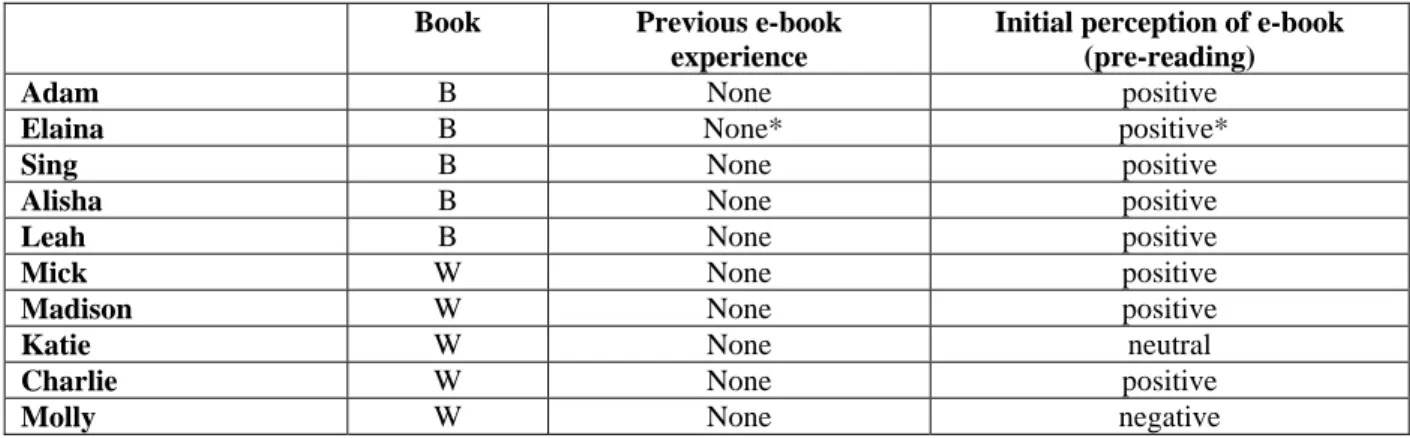
Summary ... 118 CHAPTER 4 - Results ... 119 e-Book Reading ... 121 Pre-Reading... 121 During Reading ... 123 Reading Venue... 124
Use of e-Book Tools ... 124
View/Page Layout... 131
After Reading... 134
Electronic Literature Response Journals... 141
Personal Response to e-Books ... 144
Use of Formatting Tools ... 147
Questions... 149
Online Literature Discussions... 151
Teacher-Constructed Prompts... 152
Student-Constructed Prompts ... 154
Replying to Student-Constructed Prompts... 160
Virtual Guide Response Projects ... 167
Internet Hyperlinks ... 168
Within Document Hyperlinks ... 172
Instructional Technologies and Multi-Modal Literacies... 174
Summary ... 181
CHAPTER 5 - DISCUSSION ... 183
Summary of the Study ... 183
Findings ... 185
Research Question 1 ... 186
Reading Venue... 186
Use of e-Book Tools ... 187
View/Page Layout... 189
Research Question 2 ... 191
e-Book Response Tools ... 191
Electronic Literature Response Journals... 192
Online Literature Discussions... 194
Virtual Guide Response Projects ... 197
Research Question 3 ... 199
Online Literature Discussions... 201
Virtual Guide Response Project... 205
Overarching Question ... 209
Recommendations for Future Research ... 222
Closing Thoughts ... 225
References... 228
Appendix A - NETS for Students ... 246
Appendix B - NETS for Teachers... 247
Appendix C - IRB Approval ... 249
Appendix D - Parent Letter/Letter of Informed Consent... 250
Appendix E - Pre-Reading Journal Entry Prompts ... 252
Appendix F - Electronic Literature Response Journal Prompts... 253
Appendix G - ERW Minilessons ... 256
Appendix H - Student Interest Questionnaire... 257
Appendix I - Field Notes... 258
Appendix J - Student Interview Questions ... 259
Appendix K - Prompt Writing Instructional Handout ... 260
Appendix L - Virtual Guides ... 262
List of Figures
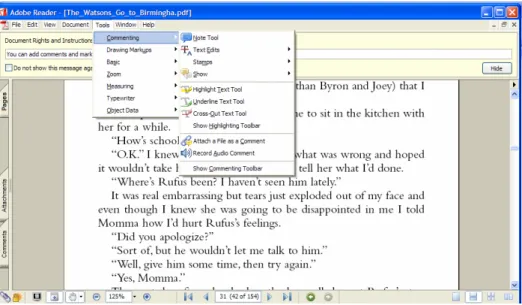
Figure 4.1 e-Book Tools Menu... 125
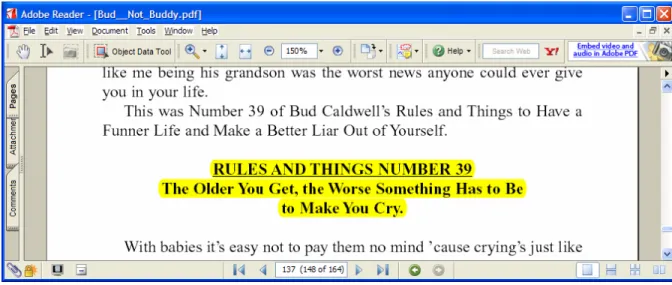
Figure 4.2 Note Tool and Highlight Text Tool... 127
Figure 4.3 Use of Highlighter Tool... 128
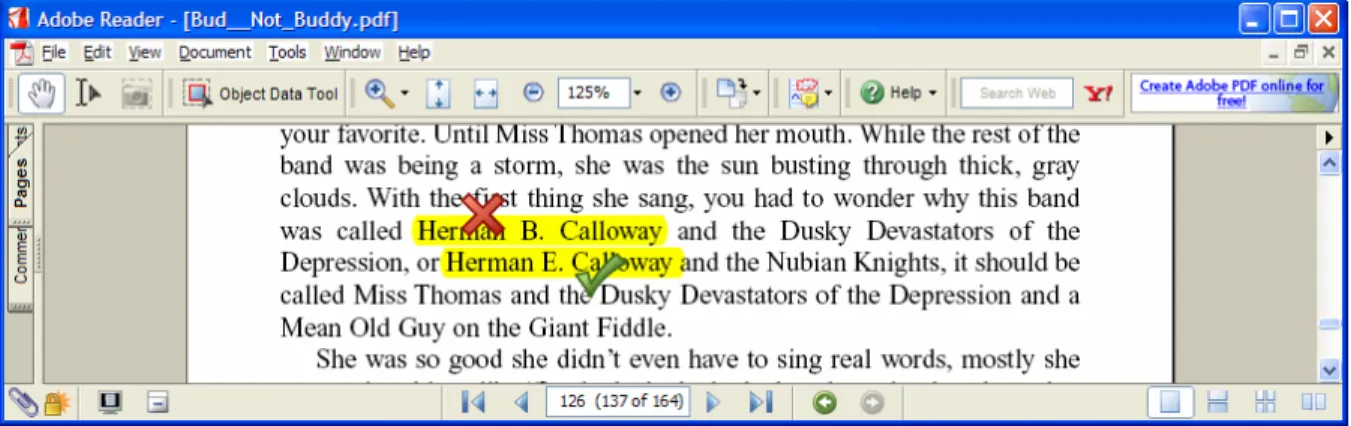
Figure 4.4 Stamps and Highlight Tool... 129
Figure 4.5 Recorded Audio Comment ... 130
Figure 4.6 Typewriter Tool and Note Tool... 131
Figure 4.7 View/Page Layout ... 132
Figure 4.8 Questioning the Chapter Titles... 140
Figure 4.9 Response Journal #1 ... 148
Figure 4.10 Response Journal #4 ... 148
Figure 4.11 Image Internet Hyperlinks ... 171
Figure 4.12 Within Document Hyperlink Destinations ... 173
Figure 4.13 Within Document Hyperlink Destinations ... 174
List of Tables
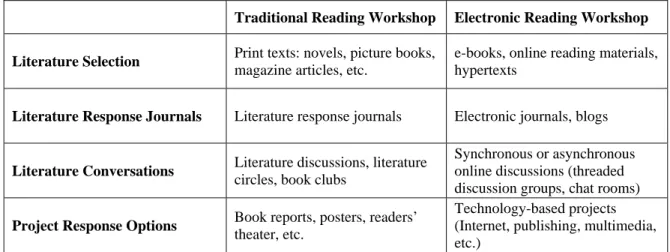
Table 2.1 The Traditional Reading Workshop Versus the Electronic Reading Workshop ... 53
Table 3.1 ERW Timeline ... 92
Table 3.2 Research Question, Data Collection, and Data Analysis... 104
Table 4.1 Students’ Initial Perception of the e-Book Experience... 122
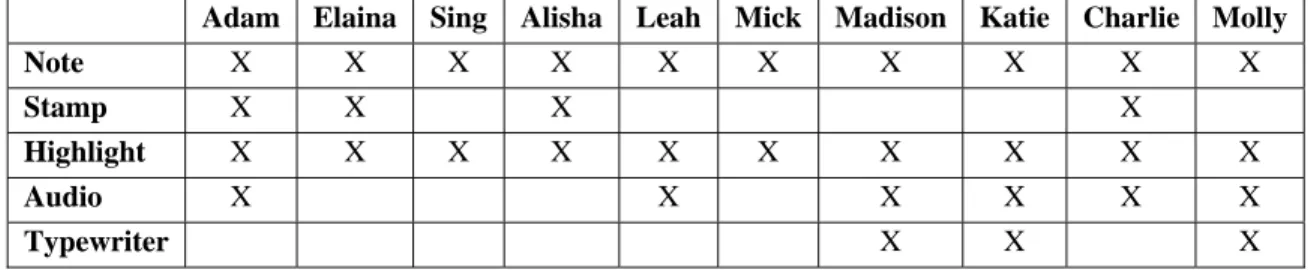
Table 4.2 Use of e-Book Tools ... 126
Table 4.3 Students’ Final Perception of the e-Book Experience ... 134
Table 4.4 Recorded Responses ... 137
Table 4.5 Electronic Literature Response Journal Prompts... 141
Table 4.6 Average Length of Responses to Literature Prompts ... 142
Table 4.7 Average Length of Responses to ERW Prompts ... 143
Table 4.8 Comparison of Responses to ERW and Literature Prompts... 144
Table 4.9 Use of Formatting Tools and Features... 147
Table 4.10 Summary of Online Literature Discussions... 154
Table 4.11 Types of Student-Constructed Prompts ... 155
Table 4.12 Replies to Student-Constructed Prompts ... 160
Table 4.13 Internet Hyperlink Destinations... 169
Table 4.14 Instructional Technologies and New Literacies during Response Project ... 175
Table 4.15 Multi-Modal Features within PowerPoint Presentations ... 179
Acknowledgements
My sincere appreciation is extended to Mrs. Kathy Stitt for once again opening her classroom doors and inviting me to stay.
My deepest thanks go out to Dr. Marjorie Hancock, my major professor and
extraordinary educator, for always bringing out the best in me. Without her wisdom, high expectations, and unwavering support, I would not be the teacher that I am today. I would also like to thank the members of my committee, Dr. Gail Shroyer, Dr. Trudy Salsberry, and Dr. Catherine Maderazo for their continued support and guidance. A special thanks to Dr. Karen Westman for serving as my outside chair.
I credit my family in Sweden for providing me the courage to embark on this journey and for teaching me to never, ever give up.
I also thank my children, Adam and Cajsa, for serving as my “new literacy” role models. Their creative use of technology inspires me to continue to explore the new literacy landscape.
CHAPTER 1 - Introduction
As a sixth-grade teacher on the eve of the twenty-first century, I constantly asked myself how to best prepare my students for a world that is rapidly changing through new technologies and “new literacies.” Teaching in a climate where literacy education had become increasingly influenced by the No Child Left Behind Act (U.S. Department of Education, 2001) with much attention placed on reading assessment and comprehension instruction, I searched for alternative ways to engage and motivate my students while preparing them for foundational literacies of paper and pencil, as well as the emerging new literacies that will define their futures. Inspired by what I had recently learned in a graduate course in which we had paired nonfiction and fiction literature with compatible websites, I embarked on a semester-long project involving integration of technology and children’s nonfiction literature. The sixth graders read books, conducted research on the Internet, engaged in interactive online activities, and produced impressive multimedia projects while socially constructing knowledge within the new literacies. Reflecting upon the success of this project, I realized that the integration of technology had provided a foundation for student motivation and engagement along with increased literacy skills.
Encouraged by these insights, I began reading works like Linking Literacy and Technology: A Guide for K-8 Classrooms (Wepner, Valmont, & Thurlow, 2000),
Teaching with the Internet: Lessons from the Classroom (Leu, & Leu, 2000); and
Handbook of Literacy and Technology: Transformation in a Post-Typographic World
While gaining skills and confidence in the field of instructional technology and the new literacies, I began sharing my newfound knowledge as a summer technology institute instructor. For three summers, I worked closely with teachers from diverse backgrounds with a wide range of skills, but with the common goal of improving their use of instructional technologies. Another commonality, it appeared, was their lack of understanding of integrating the new literacies and information and communication technologies (ICTs) into current instructional programs. Regardless of their own
technological proficiencies, most teachers I encountered tended to view technology as an additional curricular area, rather than a vehicle through which curricular content could be taught and learned.
Over the past two years as a graduate teaching assistant at Kansas State
University, my quest to support teachers in effective use of technology within the literacy curriculum has remained a focus. While teaching and supervising undergraduate students, I encourage them to integrate technology into their language-based lessons. However, much like the experienced teachers that I encountered during the summer institutes, the preservice teachers generally lack the notion of a truly integrated literacy curriculum although they acknowledge the need for using technology. To them, each technology-related activity appears an isolated incident with little connection to their literacy lessons.
As a result of rapidly emerging information and communication technologies (ICTs), students and teachers alike need new skills and new literacies. (Leu, Mallette, Karchmer, & Kara Soteriou, 2005). As a result, it becomes important to understand and foster the contemporary skills in reading, writing, and communication that these ICTs demand. Leu, et al. (2005) argued that the continuously emerging ICTs are more than a
technology issue – they are an important literacy issue – and it is essential to consider how to integrate these new literacies into the current language arts curriculum.
Furthermore, as literacy educators, we have a responsibility to provide leadership in this area.
To help teachers who are hesitant to embrace technology or unfamiliar with integrating technology into their current curriculum, I feel compelled to explore ways in which new literacies can be intertwined with tried and true literacy practices. In this study, I present a framework for conceptualizing and integrating an electronic reading workshop in which aspects of technology are integrated within all components of a traditional reading workshop. Results from this study identify ways technology integration supports the emergence of new literacies within the electronic reading workshop in a fifth-grade classroom.
Overview of the Issues
In today’s classrooms, teachers and students are faced with remarkable opportunities and challenges as new technologies provide exhilarating avenues for changing and enhancing literacy instruction. It is clear that the momentous growth and accessibility of instructional technology have significantly affected our schools and the daily lives of both teachers and students (Labbo, 1996; Leu, 2002; Valmont, & Wepner, 2000; Reinking, 1998). Reading instruction, along with the broader notion of literacy instruction, are undergoing tremendous transformations as new technologies demand new literacy skills to effectively employ their potentials.
The International Society for Technology in Education (ISTE) provides guidelines for students’ and teachers’ technology performances through the National Educational Technology Standards (NETS) for both students and teachers (see
Appendixes A and B). Teachers can use these standards and profiles as guidelines for planning technology-based activities in which students use the new literacies to achieve success in learning, communication, and life skills. Building on the NETS for Students, the NETS for Teachers define the fundamental concepts, knowledge, skills, and attitudes for applying technology in educational settings for inservice and preservice teachers.
As students and teachers turn to the Internet and other information and
communication technologies, literacy practices are being redefined. Due to their inherent characteristic of change, there is no precise definition of what the “new literacies” are (Leu, 2000, 2002; Reinking 1998; Street, 2003). This makes theory development and systematic investigation difficult, if not impossible. In order to move forward in this area, Leu, Kinzer, Coiro, and Cammack (2004) have begun to conceptualize the following definition of the new literacies:
The new literacies of the Internet and other ICTs include the skills, strategies, and dispositions necessary to successfully use and adapt to the rapidly changing information and communication technologies and contexts that continuously emerge in our world and influence all areas of our personal and professional lives. These new literacies allow us to use the Internet and other ICTs to identify important questions, locate information, critically evaluate the usefulness of that information,
synthesize information to answer those questions, and then communicate the answers to others. (p. 1572)
In this study, I seek to learn how integration of technology supports the
emergence of “new literacies” within a fifth-grade classroom in which instruction in literacy and technology are integrated through an electronic reading workshop.
The New Literacies
The new literacies change continuously as technology invites new possibilities for communication and utilization of information (Coiro, 2003; International Reading
Association, 2002; Kinzer & Leander, 2003; Leu, et al., 2004). The International Reading Association (2002) issued a position statement recognizing that current reading and writing instruction are influenced by change in even more profound ways due to the arrival of the new literacies. For example, the majority of this year’s high-school graduates began their schooling with the traditional literacies of paper, pencil, and print texts. They are now, however, finding themselves familiar with new literacies required by a wide variety of ICTs including word processors, World Wide Web browsers, e-mail, chat rooms, Web logs (blogs), multi-modal texts, and presentation software. Because of rapid and ongoing changes in technology, it is likely that students who are just entering elementary schools will face even more profound transformations as they journey through an ever-changing literacy landscape (International Reading Association, 2002; Labbo & Reinking, 1999; Leu, et al., 2004).
Student Engagement and Social Interaction
Technology holds the potential for increasing student engagement in literacy learning. In a study of reading experts (Flippo, 2001), there was undeniable agreement on the importance of literacy motivation or engagement with text. The study revealed that access to reading materials, opportunities for self-selection, and social interactions about the text foster reading engagement among students. Technology may potentially enhance these three classroom characteristics in important ways.
Access to reading materials. The Internet has drastically increased access for students and teachers to informational texts, providing students opportunities to explore topics of interest with a touch of a button (Gambrell, 2006). Technology also supports electronic books. These appear in several formats ranging from toy-inspired books, online stories (accessed online), CD-ROM storybooks, electronic textbooks, or downloadable e-books. Studies of young children’s interactions with electronic books imply that reading motivation was higher after children interacted with multi-modal texts, especially among children with reading difficulties (Glaskow, 1996/1997). Fasimpaur (2004) proposed that students find e-books to be “a new and unique medium” (p. 12) and, therefore, often read more when they have access to e-books.
Opportunities for self-selection. An important feature of technology in the literacy classroom is the opportunity for choice and self-selection of reading materials. Access to the Internet has dramatically increased the prospect for self-selection of topics, texts, and types of reading materials. When students have access to reading materials of interest, motivation and reading engagement are high (Gambrell, 2006).
Social interactions about text. Flippo’s (2001) study revealed that reading experts viewed the role of social interaction in reading as essential. Specifically, there was agreement that students should be encouraged to communicate about different kinds of reading in a variety of ways. Internet technologies have fostered innovative techniques for students to socially interact with others about texts. Online discussions (e-mail, chat rooms, Web logs, Instant Messenger programs, and threaded discussions) are becoming more common in elementary/middle schools as a means to encourage communication and learner engagement (Hamilton, 2006; Wolsey, 2004). Results of early studies support that online literature discussions have great potential for fostering literacy skills, strengthening communication, and building a sense of community (Carico, Logan, & Labbo, 2004; Grisham & Wolsey 2006; Wolsey, 2004).
New Digital Divides
The original idea of a “digital divide,” a term first coined by Lloyd Stittett, former president of the Markle Foundation, refers to a discrepancy in access to technology resources among socioeconomic groups. Recent studies find that while children from all income levels have greatly increased their Internet use, low-income students still lag behind other students in both home and school access (Corporation for Public
Broadcasting, 2003). Recently, Hobbs (2006) argued that a different sort of digital divide has emerged between teachers of different disciplines. Reading and language arts
teachers, on one hand, tend to prefer traditional print texts and more traditional literacies. On the other hand, mathematics and science teachers seem to have adopted instructional technologies to a greater extent. Hobbs (2006) hypothesized that literacy educators may
tradition of print. They may also view the written expression of e-mail or online discussions as suspicious and informal, or they may associate technology with popular culture.
Current researchers also identify cultural and linguistic divides that inadvertently limit the benefits of technology to English language learners or culturally diverse families whose values have not embraced technology (Au, 2006; Bernhardt, 2006; Edwards, 2006). In contrast, Au (2006) found that technology can be used to close the literacy achievement gap between students of diverse backgrounds and their mainstream peers if employed effectively.
Technology projects seem to work best when they present students of diverse backgrounds with challenging, generative tasks that require them to read, write, and think in new and demanding ways. The time, energy, and thought students devote to participate effectively in these projects suggest that they are readily able to take advantage of constructivist forms of instruction that give them the knowledge and strategies needed to engage with new forms of literacy and electronic media. (p. 366)
Leu, et al. (2004) suggested that social learning plays an important role in the exchange of new skills and strategies needed to interact with the new technologies. Each student, regardless of background, can contribute something unique and useful to others in a community of literacy learners. Research needs to address how the implementation of an electronic reading workshop may contribute to closing new digital divides as
literacy teachers embrace new literacies and engage students in meaningful literacy practices through socially constructed learning.
Statement of the Problem
While a precise definition of the new literacies may never be possible due to their important characteristic of change, teachers and researchers agree that today’s students need and deserve the skills and strategies to successfully function in a world of rapidly evolving information and communication technologies (Leu, 2000, 2002; Reinking 1998; Street, 2003). Zammit and Downes (2002) argued that literacy “needs to be recognized as a social activity embedded within larger practices and changing technologies,” (p. 24) rather than viewed as just a set of cognitive abilities or skills such as alphabetic script on paper. It is further emphasized that being literate in today’s society means being
multiliterate. Contemporary views of literacy must include a more complex set of texts and technologies. Reading and writing in a digital environment are very different from reading and writing paper-based texts only (Labbo & Reinking, 1999; Leu & Kinzer, 2000; Turbill & Murray, 2006).
Hobbs (2006) reported that a growing number of K-12 educators are using technologies to bring students access to online texts and other multimedia resources to help them build new literacy skills. According to the International Reading Association (2002), educators have a responsibility to effectively integrate technologies and new literacies into the current language curriculum in order to prepare students for the literacy futures they deserve. Furthermore, all students have the right to “teachers who are skilled
integrates the new literacies of ICT into instructional programs” (International Reading Association, 2002, n.p.). However, in reality, there are relatively few instances in which teachers have actualized such effective use and implementation of the new literacies (McKenna, 2006). Researchers have found that hardware and software are frequently unused, confined to lab settings, or used to occupy children in mindless activity. Literacy instructors have been slow to embrace technology and integrate it into their instruction in meaningful ways (McKenna, 2006; Pflaum, 2004).
According to Turbill and Murray (2006), teachers should operate within the paradigm that “literacy is a set of skills to be mastered and technology is a tool to be used to master those skills” (p. 93). Even though many literacy teachers are skilled in using technology in their own personal and professional lives, they seem reluctant to integrate technology into their instructional practices. In many K-8 classrooms, teachers still view technology as something for students to “play” with during “free time” or use as a
“reward” after their real “work” has been completed (Turbill & Murray, 2006, p. 93). Conceptualization and implementation of an electronic reading workshop in a fifth-grade classroom may provide a framework for teachers who wish to enhance their current literacy curriculum by integrating meaningful aspects of technology.
Purpose of the Study
The purpose of this study is to identify and describe ways integration of
technology supports the emergence of new literacies within a reading workshop in a fifth-grade classroom. To make literacy education more reactive to today’s learners,
multi-modal technologies used both within and outside the classroom (Hobbs, 2006). Leu, et al. (2004) emphasized the importance of socially constructed learning within the new literacies and the need for teachers to orchestrate learning environments in which students can work collaboratively while participating in complex contexts for the new literacies. Building on the concept of a traditional reading workshop (Atwell, 1987, 1998; Calkins 2001, Serafini, 2001), in which learning is socially constructed as students explore and discuss literature with their peers, this study considers the conception of an electronic reading workshop (ERW) by integrating aspects of technology into the traditional reading workshop. Results of the study may identify the new literacies students employ within the electronic reading workshop.
In this qualitative case study, I observe students as they engage in the new literacy practices while reading electronic books and responding to the text using e-book tools, writing in electronic response journals, participating in online literature discussions, and engaging in technology-based response projects. The study involves analysis of
electronic literature response journals, transcripts of online literature conversations, and technology-based response projects in search of emerging trends within the new
literacies. It is anticipated that the findings from this study will provide valuable information for teachers who wish to embed the new literacies and instructional technologies within already meaningful literacy practices.
Research Questions
Teachers and researchers generally recognize that current reading and writing instruction is profoundly influenced by change due to the arrival of the new literacies (International Reading Association, 2002). Yet, there are relatively few instances in which teachers have actualized effective use and implementation of the new literacies within current literacy practices (McKenna, 2006). Researchers and reading experts agree that motivation is a key ingredient in engaging readers and that technology has the potential for motivating students (Flippo, 2001; Gambrell, 2006). Furthermore,
researchers acknowledge that the continuous infiltration of technologies has the potential to narrow emerging aspects of digital divides if used effectively within the literacy classroom (Au, 2006; Bernhardt, 2006; Edwards, 2006; Hobbs, 2006). The following questions will guide the research and data analysis for this study:
How does the integration of technology within the context of a fifth-grade electronic reading workshop support the emergence of new literacies?
1. How do fifth-grade students interact with and perceive literature (e-books) in an electronic reading workshop?
2. What types of reader response emerge within an electronic reading workshop in a fifth-grade classroom?
3. How does an electronic reading workshop support socially constructed learning in a fifth-grade classroom?
Significance of the Study
This study seeks to provide valuable information for teachers and students who wish to embed new literacies and instructional technologies within already meaningful literacy practices. The rapid infiltration of technology continues to significantly affect how teachers and students view and learn literacy (Labbo, 1996; Leu, 2002; Reinking, 1998). “Traditional definitions of reading instruction will be insufficient if we seek to provide children with the futures they deserve” (Leu, 2002, p. 310). However, traditional elements of literacy will continue to be essential within the new literacies.
Leu and Kinzer (2000) argued that the ability to read text will become even more important because it allows learners to access information quickly and efficiently in a complex, networked learning environment. The ability to write text will also take on new significance as written text can be easily stored, organized, and published to generate new knowledge. In other words, the new literacies do not replace but enhance and extend established literacy practices. As reading and writing abilities become increasingly important in the new literacies, they will also undergo significant changes. Today’s students are more engaged with multi-modal texts as they make reading a more
interactive and creative process (Bearne, 2005). When used effectively, technology has the potential to open doors to teaching and learning literacy skills in ways not available from traditional print sources (Valmont & Wepner, 2000).
Teachers and researchers recognize the need to respond to the changing nature of the new literacies in order to make education more responsive to today’s learners (Hobbs, 2006). Leu, et al. (2004) emphasized the importance of socially constructed learning within the new literacies and the need for teachers to orchestrate learning environments in
which students can work collaboratively while engaging in meaningful learning contexts in which the new literacies apply. Embedding aspects of technology into a traditional reading workshop may provide students with the opportunity to engage with new literacies while emphasizing valued traditional literacies of reading and responding to text. This study has the potential to contribute to the knowledge of students’ literacy learning as it relates to the integration of traditional and new literacies.
Limitations of the Study
There are several limitations identified in this study. First, the sample size is small and limited to the context of one fifth-grade classroom. Data collection and analysis focus on only ten students which were purposefully selected to yield the most information for the research questions. Although unique in their own ways, the participating students are all considered highly proficient readers and familiar with technology. This study may help build knowledge and understanding of students’ interaction and engagement with new literacies within an electronic reading workshop, but is not intended to produce results which can be applied universally.
The inherent logistics of technology use and accessibility within an elementary-school setting contribute to several limitations. The elementary-school houses a computer lab as well as a mobile cart with laptops. Student engagement in all components of the electronic reading workshop is influenced by the specific technologies available within the school, resulting in products or findings that may not always be applicable to other schools and contexts.
Although a key component of a reading workshop is choice (Serafini, 2001) and an important feature of technology in the literacy classroom is the opportunity for self-selection of reading materials (Gambrell, 2006), the e-books used in this study are teacher selected. The selection of e-books are rather limited due to the restricted availability of appropriate e-book titles, as well as the logistics of downloading, storing, and accessing these titles on the school’s computers.
Researcher bias is another limitation in this study. I am an avid proponent of technology with extensive classroom experience involving instructional technologies and the new literacies. To minimize the effects of the researcher’s bias, the delivery of instruction to the fifth-grade students became the primary responsibility of the classroom teacher. Furthermore, weekly meetings with the classroom teacher throughout the duration of the study provided an additional perspective on the study and its progress in the classroom.
Definition of Terms
The following terms have been defined for the purpose of clarity in the presentation of this study.
Asynchronous discussion – Electronic discussion where postings/threads accumulate over time (Grisham & Wolsey, 2006).
Blog (Web log) – A website in which journal entries are posted on a regular basis; commonly consists of hypertext, digital images, and hyperlinks (Kajder & Bull,
Digital divide – Economic, cultural, linguistic, or attitudinal divides that inadvertently limit the access and/or benefits of technology (McKenna, 2006).
Dimensions of literacy – Interrelated aspects of literacy that are utilized as readers and writers construct meaning through written language. Literacy includes linguistic, cognitive, sociocultural, and developmental dimensions (Kucer, 2005).
Electronic books (e-books) - Digital chapter or picture books which can be viewed on desktop computers, laptops, or handheld devices (PDAs), and may employ multi-modal features including animation, sound, music, video, and hyperlinks (Weber & Cavanaugh, 2006).
Electronic reading workshop – A reading workshop in which aspects of technology have been integrated throughout all of its components (Term designed for the purpose of this study).
Hyperlink – Links, or connections, which allow the reader to move to another text; these texts can be sounds, images, video, as well as familiar printed texts (Bruce, 2003) Information and communication technologies (ICTs) – Technologies that provide
possibilities for and access to communication and information: Web logs (blogs), word processors, video editors, World Wide Web browsers, Web editors, e-mail, spreadsheets, presentation software, instant messaging, plug-ins for Web
resources, listservs, bulletin boards, virtual worlds, and many others. (Leu, et al., 2004)
Multiliteracies – A set if open-ended and flexible multiple literacies required to function in diverse contexts and communities. (New London Group, 2000)
Message board – A computer system set up to allow notices to be posted and viewed by anyone who has access to the network; also referred to as a bulletin board
(Roblyer, 2004)
Multimedia – Computer-based technology that integrates text, graphics, animation, audio, and video (Meskill & Swan, 1995).
Multi-modal – The integration of multiple ways of knowing and multiple modes of communication including text, images, art, music, drama, and technologies (National Council of Teachers of English, 2005).
New literacies – The new literacies of the Internet and ICTs include the skills, strategies, and dispositions necessary to successfully use and adapt to the rapidly changing information and communication technologies and contexts that continuously emerge in the world (Leu, et al., 2004).
Post – The act of posting a message on an online message board; a message posted on an online message board (Wolsey, 2004).
Reading venue – The preferred location and position chosen by a reader (Term designed for the purpose of this study).
Reading workshop – A single block of time dedicated to the exploration of literature and the development of children’s reading processes (Serafini, 2001). Commonly comprised of four components: 1) literature selection, 2) literature response journals, 3) project response options, and 4) literature conversations (Atwell, 1987; Hancock, 2007).
Synchronous discussion – Simultaneous electronic discussion, where posts occur in “real time” (Grisham & Wolsey, 2006).
Threaded discussion – An asynchronous discussion or conversation which takes place on an online message board which allows participants to read each other’s messages and reply to those messages (Wolsey, 2004).
Organization of the Study
This chapter introduced the study exploring the integration of technology and emergence of new literacies within the context of a fifth-grade electronic reading workshop. The chapter included an overview of the issues, statement of the problem, purpose of the study, research questions, significance of the study, limitations of the study, definition of terms, and organization of the study. Chapter 2 provides a review of the literature, including a theoretical framework focusing on constructivist theory, reader response theory, and an emergent theory of the new literacies. Chapter 2 also provides research of issues surrounding the concepts and components of a reading workshop and an electronic reading workshop.
Chapter 3 describes the methodology through a description of the case study methodology and research design. An overview of a pilot study that informs the
proposed study and a description of the selected research site and its participants are also included. In addition, the role of the researcher, the role of the teacher, and the
procedures for data collection and data analysis are discussed. Through rich description and visual representations Chapter 4 presents the results of the study. Finally, Chapter 5 summarizes the findings, discusses implications for educational implications, and offers recommendations for further research.
CHAPTER 2 - Review of the Literature
The purpose of this chapter is to provide an extensive review of the literature as it relates to the overall structure of integration of literacy and technology within the context of a reading workshop. First, the theoretical foundations for the study are discussed, including cognitive developmental and sociocultural perspectives of constructivist theory, reader response theory, and an emergent theory of the new literacies. Next, an overview of the literature concerning the principles and key components of a reading workshop are provided. Third, current practices and applications of the new literacies and technology integration as they relate to each component of a reading workshop are examined, providing a framework for an electronic reading workshop. This study is designed to explore and identify how the integration of technology supports the emergence of new literacies within the context of an electronic reading workshop in a fifth-grade classroom. The theoretical underpinnings, review of existing reading workshop practices, and a thorough examination of the integration of literacy and technology will provide a framework for understanding the concept of an electronic reading workshop, the methodology and data collection involved in the study, and, ultimately, the analysis of findings obtained from the study.
Theoretical Foundations
by the learner and is unique to the context and individual experiences. With the advent of the “new literacies,” there is a profound need for new theoretical perspectives and
frameworks to help researchers and educators understand the new literacies and to direct a critical future research agenda. Recognizing that it is too early to define a
comprehensive theory of new literacies, principles on which such emerging theory should be built will be identified and discussed within this chapter.
Constructivist Theory
Constructivism is a theory about knowledge and learning in which knowledge is unique to the individual learner and the resulting facet of the individual’s engagement in the cognitive learning process (Kozulin, 1998). Savery and Duffy (1996) described constructivism as a “philosophical view on how to come to understand and know” (p. 31). To help decipher the many presupposed literacy parameters of constructivism, Cambourne (2002) offered three simplified theoretical propositions of constructivism:
1. What is learned cannot be separated from the context in which it is learned.
2. The purposes or goals that the learner brings to the learning situation are central to what is learned.
3. Knowledge and meaning are socially constructed through the processes of negotiation, evaluation, and transformation. (p. 26)
These propositions suggest that the contexts and experiences in which students learn to read are critical to each student’s understanding of reading; literacy teachers must offer learning environments in which students engage in multiple encounters with
literacy; and, educators impose socially constructed meaning on the real world in which social interaction is the primary vehicle as individual learners develop knowledge and understanding (Cambourne, 2002). Richardson (1997) further emphasized the role of the teacher by pointing out that constructivists’ approaches in general consider students’ prior knowledge fundamental, but the teacher’s subscription to such prior knowledge varies greatly. Piaget’s (1969) cognitive developmental perspective views the meaning-making process as individualistic, with the purpose of teaching being to lead toward higher levels of understanding and analytic capabilities. Vygotsky’s (1986) sociocultural perspective views social aspects as instrumental, if not essential, in both the construction and appropriation of knowledge.
A Cognitive Developmental Perspective
Piaget (1969) recognized that children naturally explore and discover the world around them to build new knowledge, as they are intrinsically curious about their surroundings and active and motivated learners. As a developmentalist, Piaget (1952) described four major stages of development: sensorimotor from birth to 18-24 months; preoperational from 18-24 months to 7 years; concrete operational from 7 years to 12 years; and formal operational from 12 years on. Piaget explained that these stages allowed the child to develop and prosper in response to the learning environment. He further theorized that children build cognitive structures during all developmental states as they assimilate and accommodate new experiences and information.
In the contexts of educational technology, Papert (1980, 1999) adapted Piaget’s perspective and applied it to children engaged in utilizing technology, resulting in the development of Logo, a graphical programming language. Using popular LEGO
building blocks, children construct machines which they connect to computers and write computer programs, using Logo programming language, to control the machines
(Sargent, Resnick, Martin, & Silvermann, 1996; Resnick, Ocko, & Papert, 1988).
Building on Piaget’s work and constructivist learning theory, the National Association for the Education of Young Children (2003) declared that software for young children should be employed as an active agent for learning and extending children’s learning abilities. Similarly, the National Council of Teachers of English (2005) issued a position statement addressing multi-modal literacies, stating that even young children are sophisticated readers and producers of multi-modal work and should be invited to frequently engage in these new literacies. For example, CD-ROM storybooks may help children construct meaning by making connections between the story’s plot and characters (represented vividly on the screen) and real-life people and situations (DeJong & Bus, 2004).
Asynchronous online literature discussions may also help students construct meaning as they make connections between the text, their personal responses and interpretations, and the responses by their peers (Wolsey, 2004).
A Sociocultural Perspective
According to Vygotsky (1986), children construct knowledge by using the experiences and objects that are available to them as members of a particular culture and learning environment. Vygotsky (1978) further believed that social interactions provide the basis for higher mental processes, or thinking. Cognitive ability is not a natural entity but a sociocultural construct that emerges from a child’s interaction with the
environment. Besides learning through interaction and collaboration with peers, Vygotsky (1986) proposed that adults play a major part in moving children to a more
advanced level of knowledge. Vygotsky (1978) differentiated between children’s “actual development level” and their “level of potential development.” The distance between these two levels is known as “the zone of proximal development” and explains the distance between a child’s independent capabilities and the potential abilities under the assistance or guidance of others. In other words, children learn within a social context what they cannot achieve in isolation. As children develop as literacy learners, they constantly test hypotheses about how language works as they actively talk, read, listen, and interpret the information that surrounds them in the classroom. Vygotsky (1986) explained:
In learning to speak, as in learning school subjects, imitation is
indispensable. What the child can do in cooperation today he can do alone tomorrow. Therefore the only good kind of instruction is that which marches ahead of development and leads it; it must be aimed not so much at the ripe as at the ripening functions. It remains necessary to determine the lowest threshold at which instruction in, say, arithmetic may begin, since a certain minimal ripeness of function is required. But we must consider the upper threshold as well; instruction must be oriented toward the future, not the past. (pp. 188-189)
Vygotsky (1978) viewed reading and writing as higher order, socially-constructed psychological functions. As children engage in authentic literacy practices, including reader response (Rosenblatt, 1938/1995) and literature conversations (Cambourne, 2002;
experienced members of the learning community (teachers, capable peers, visiting adults), they develop such psychological functions.
Kucer (2005) examined the sociocultural dimension of literacy, including both texts and literacy users within the contexts in which they take place. As Vygotsky (1978) observed, humans are social beings and their minds are embedded within society. Each social group has its own rules and guidelines that frame its members’ behaviors as well as literacy habits. Literacy behaviors in schools, for example, may be quite different from those represented in students’ home environments or social groups.
No single definition of “family literacy” can do justice to the complexity of families and the multiple literacies that are part of their lives (Taylor, 1997). As personal computers and the Internet have become increasingly present in the “average” household, family literacy is rapidly changing. Educators and researchers recognize the “digital divide” which separate students from households with computer technology from those without such access. However, as more young people have access to computer
technology and/or other means of electronic communication and/or multi media (cell phones, iPods, digital cameras, etc.), the sociocultural dimensions of literacy are rapidly changing in the world of young people (Reinking, 1998).
The theory of constructivism may provide a framework for children’s learning experiences with computers as they seek to make meaning through social interactions and environmental objects (Carroll, 2004; Shamir & Korat, 2006). Through further
application of the concept of the zone of proximal development to children’s experiences with multi-modal literacies, using computers and applicable software in particular, researchers have revealed that such scaffolding processes can move children to master
skills they may not have been able to do on their own (Carroll, 2004; Klein & Nir Gal, 1992; Sheingold, 1986).
Kuhn and Stahl (2006) promoted the use of computer-assisted technology in phonics and decoding instruction in primary grades. “Bundled” software programs allow for both decoding activities and practice for targeted skills. To maximize the potential of computer technology, Kuhn and Stahl stressed the importance of not teaching words in isolation, but rather use of the software to enhance and extend already sound literacy instruction. For example, if a teacher is introducing the short “a” sound using The Cat in the Hat (Seuss, 1957), the student then spends time on the computer practicing the short “a” sound by making a series of consonant-vowel-consonant words. The lesson should conclude with the teacher reading another story emphasizing the short vowel sound.
Transactional Theory of Reader Response
Louise Rosenblatt’s transactional theory of reader response (1938/1995, 1978) supported that readers “make sense” of new situations, or reading experiences, as they apply, reorganize, revisit, or extend encounters with text and personal experiences. Central to this theory is the interaction of the reader and the text as the reader breathes life into the text through personal meaning making and prior experiences. Rosenblatt encouraged readers to transact with literature, emphasizing that meaning does not necessarily exist in a prefabricated state within the text or within the reader, but takes form during the transaction between reader and text.
Terms such as the reader are somewhat misleading, though convenient fictions. There is no such thing as a generic reader or a generic literary
work; there are in reality only the potential millions of individual readers of individual literary works . . . . The reading of any work of literature is, of necessity, an individual and unique occurrence involving the mind and emotions of some particular reader. (Rosenblatt, 2005, p. 1)
In other words, different readers may construct drastically different meanings from the same texts based on their understandings of the world, their personal
experiences, and their current knowledge of language. Rosenblatt (1978) argued that reading is understanding what one reads, not simply the ability to read words aloud or identifying words within a text.
“Texts” designates a set of series of signs interpretable as linguistic symbols… Thus in a reading situation ‘the text” may be thought of as the printed signs in their capacity to serve as symbols. . . . “Poems”
presupposes a reader actively involved with a text and refers to what he makes of his responses to the particular set of verbal symbols. (Rosenblatt, 1978, p. 12)
Rosenblatt (1978) argued that the reader performs different activities or
transactions during aesthetic and efferent readings, primarily due to the difference in the reader’s focus of attention during various reading events. In efferent reading, the reader’s attention is primarily focused on the aftermath of the reading event – the information to be obtained and the actions to be taken as a result of reading for information. In aesthetic
experience. Aesthetic reading focuses on the feelings and personal thoughts that involve the reader while emerged in the reading experience. The aesthetic stance emphasizes the sensuous, emotional, and personal meaning-making of texts, while the efferent stance pays attention to the factual, cognitive, and public aspects of meaning. In reality, most readers, during most reading experiences, oscillate to-and-fro between the efferent and aesthetic extremes on the efferent-aesthetic continuum (Rosenblatt, 2005).
Rosenblatt’s theory of reader response (1938/1995, 1978) generally refers to the transaction between the reader and printed texts. Although she did not specifically
address possible transactions between readers and digital or multi-modal texts, Rosenblatt (2004) did, however, discuss linguistic transactions in which face-to-face conversation takes place between two people, as well as the transactional writing process that occurs when a writer moves from facing a blank page to creating a purposeful composition. It may be argued that the electronic reading experience is altered due to the simple presence of a cursor, which visually reminds the reader that he or she is part of the text and
possesses the physical means of inserting text (Landow, 1997; Lanham, 1993). Lanham (1993) further suggested that because electronic text is not trapped between traditional book covers, it induces the reader to actively engage with and come close to the text each time he or she opens or retrieves the text from a hard drive, server, or disk.
Patterson (2000), an eighth-grade language arts teacher, conducted research on students developing reading strategies in order to conduct meaning from electronic text. The study expanded Lanham’s observations and compared them to Rosenblatt’s
transactional theory as readers engaged with the electronic texts. The researcher concluded that, because of its interactive nature, hypertext makes us aware of the
obscuring of the roles of both reader and author: “Book technology seems to fix our notion of authorship, while hypertext challenges us to rethink that role and the role of the reader” (Patterson, 2000, p. 76). In other words, readers of digital texts may blur their role with that of the author. Furthermore, each time readers enter a hypertext they may create a new text and, consequently, new meaning, which is not necessarily the text planned by the author (Landow, 1997; Lanham, 1993; Murray, 1997; Patterson, 2000). In this study, the concepts of reader response theory will be applied to explore possible transactions between readers and digital texts when analyzing students’ interactions with electronic books.
Toward a Theory of New Literacies
In today’s classrooms, literacy instruction is changing in profound ways as new technologies provide opportunities to enhance and extend current literacy practices. Over the past two decades, the rapid infiltration of technology has significantly affected our schools and the daily lives of both teachers and students of all ages (Labbo, 1996; Reinking, 1998; Leu, 2002; Valmont & Wepner, 2000). In addition to the more traditional literacies of paper, pencil, and literature, today’s students encounter and interact with new digital literacies, including electronic storybooks, Internet-based reading and writing, and online communication experiences. Leu (2002) addressed the importance of recognizing the constant changes that take place within the literacy classroom.
inhabit during our reading journeys with new insights about ourselves and our surroundings. Teaching a child to read is also a transforming
experiences it opens new windows to the world, creating a life-time of opportunities for that child. Change has always defined our work as literacy educators. By teaching a child to read, we change the world. (p. 310)
With the advent of the “new literacies,” today’s reading and writing instruction are influenced by change in even more profound ways (International Reading
Association, 2002). Although a precise definition of the “new literacies” may never be possible due to their inherent characteristic of change, teachers and researchers agree that today’s students need and deserve the skills, strategies, and insights to successfully exploit the rapidly changing information and communication technologies that
continuously emerge in our world (Leu, 2000, 2002; Reinking 1998; Street, 2003). Leu, Kinzer, Coiro, and Cammack (2004) argued for the appearance of new theoretical
perspectives and frameworks to help researchers and educators understand the new literacies and to direct a critical future research agenda. They also suggested that because of the changing nature of the new literacies, such theoretical perspectives must “emerge from the new literacies engendered by the requirements and possibilities of new
technologies” (p. 1572).
Central Principles of New Literacies
While it is acknowledged that a plethora of new literacies are rapidly emerging, Leu, et al. (2004) suggested that those centered around the Internet and other information
and communication technologies (ICTs) are the most essential for schools to consider as they seek to prepare their students for the new literacies. Recognizing that it is too early to define a comprehensive theory of new literacies, Leu, et al. (2004) identified ten principles on which this emerging theory should be built. Each of these will be fully explained below.
1. The Internet and other ICTs are central technologies for literacy within a global community in an information age.
2. The Internet and other ICTs require new literacies to fully access their potential. 3. New literacies are deictic.
4. The relationship between literacy and technology is transactional. 5. New literacies are multiple in nature.
6. Critical literacies are central to the new literacies.
7. New forms of strategic knowledge are central to the new literacies. 8. Speed counts in important ways within the new literacies.
9. Learning often is socially constructed within the new literacies.
10.Teachers become more important, though their role changes, within new literacy classrooms.
These principles will guide the methodology and procedures in this study as they may be especially informative in the understanding of the evolving changes in reading instruction and learning, as well as the broader notions of literacy. However, given the profound changes that constantly take place in technology and its contexts, any
What follows is a brief explanation of each of these principles as described by Leu, et al. (2004).
1. The Internet and other ICTs are central technologies for literacy within a global community in an information age. Literacy theory, research, and practice must recognize that the central technologies for a global community in an information age are shifting from the book and the printing press to the Internet and other ICTs. These technologies are promptly defining the new, future literacies. Because new skills and strategies are required in the context of Internet reading, researchers and educators must broaden the definition of reading comprehension. Coiro (2003) emphasized that reading comprehension is substantially different on the Internet.
2. The Internet and other ICTs require new literacies to fully access their
potential. To use the Internet and other ICTs effectively, readers need specific skills and strategies of the new literacies. Examples of the new literacies include using a search engine effectively; communicating electronically, including e-mail and list serves; evaluating the accuracy and utility of information; and, using a word processor effectively, including checking spelling accuracy and formatting text. Rather than
replacing foundational literacies, the new literacies build on them, and, in fact, it could be argued that the foundational literacies will become even more important as reading and writing evolve in an information age. Researchers have argued that while foundational literacies increase in importance, they will eventually become insufficient as readers fully utilize the Internet and other ICTs (Coiro, 2003; IRA 2002; Sutherland-Smith, 2002).
3. New literacies are deictic. Literacy is deictic and changes regularly over time. In the past, technological changes happened slowly, allowing literacy to change over an
extended period of time. Today, with rapidly changing technologies, the deictic nature of literacy is limited by the human ability to adapt, rather than technology itself. Teachers and researchers must keep up with these new technologies as the changing edifice of literacy will require preparing students for a very different notion of what it means to be literate.
4. The relationship between literacy and technology is transactional. As technology is used in new ways, new literacies are created in the process. Reinking (1998) argued that technology transforms the forms and functions of literacy, but literacy also transforms the forms and functions of technology. Consequently, there is a
transactional relationship between literacy and technology. When users of technology turn to the Internet and other ICTs for information and communication, the use of new literacies are required to fully exploit the potential of such electronic resources. When technology is used in new ways, the user transforms the technology itself, hence creating additional new literacies in the process. In the literacy classroom, teachers construct new curricular resources with Internet technologies and then share their work with others. In turn, such resources require additional new literacies for their effective use.
5. New literacies are multiple in nature. Scholars are beginning to recognize that changes in literacy are too complex to be captured by the singular label, literacy.
Multiliteracies, as defined by The New London Group (2000), is a set of open ended and flexible multiple literacies required to function in diverse contexts and communities. The Internet and other ICTs require a methodical understanding of the multiple literacies that exist within these many different contexts. Such multiplicity of new literacies is apparent
on at least three levels and have important implications for educators preparing students to critically understand and interpret the meaning of what they encounter on the Internet.
• Meaning is typically represented with multiple media forms. While traditional texts are comprised by only two types of media, print and two-dimensional graphics, Internet texts integrate a range of symbols, animations, video, audio, hyperlinks, and interactive features. Internet technologies compel literacy educators to broaden their definitions of literacy to encompass these new, multifaceted forms of Internet literacies.
• The Internet and other ICTs offer multiple tools for constructing multiple forms of communication. Literate individuals will need to know how to search for relevant information through the hierarchical categories of information indexed by many search engines. Similarly, in order to communicate with others asynchronously, Internet users should be literate in tools such as e-mail, listservs, and discussion boards. When seeking real-time forms of information and communication, the literate Internet user must know how to access instant messaging technologies, participate in video conferences or chat rooms, and enter other virtual
environments. The proficient Internet user must also know how to construct, design, and upload his or her own information to add to the constantly evolving body of knowledge that defines the Internet.
• The new literacies of Internet technologies include new skills demanded by our students as they more frequently encounter information in different social contexts. The global sharing of information permitted by the Internet brings new opportunities and new challenges for students who are now expected to interpret
and respond to information from multiple social and cultural contexts. It is critical that students who communicate ideas with individuals from across the globe understand that each idea is not an isolated piece of information, but rather is influenced by the social and cultural contexts in which each participant exists.
6. Critical literacies are central to the new literacies. Because the Internet permits anyone to publish anything, educators must assist students in becoming “critical consumers of the information they encounter” (Leu, et al., 2004, p. 1595). Although traditional literacy curricula have always included critical thinking and separating fact from fiction, the proficient Internet user requires richer and more complex analysis skills.
7. New forms of strategic knowledge are central to the new literacies. Each form of technology contains different contexts and resources for constructing meanings and requires different strategies for doing so (Mayer, 1997). Although the new literacies will demand many types of knowledge, they will undoubtedly include new forms of strategic knowledge needed to effectively locate, evaluate, and use the resources available within the Internet.
8. Speed counts in important ways within the new literacies. As the new literacies emerge, the speed it takes to acquire information will become an increasingly important measure of success. Educators will need to consider how to teach their students to quickly locate, evaluate, use, and communicate information. Slow readers and writers are hindered within traditional literacies; within the new literacies, these learners will be left far behind. “The gap between highly literate and literacy challenged individuals will be exacerbated by the new literacies of the Internet” (Leu, et al., 2004, p. 1597). Highly