A LONGITUDINAL STUDY OF A BILINGUAL EDUCATION PROGRAM VERSUS ENGLISH AS A SECOND LANGUAGE (ESL) PROGRAM:
A STUDY OF TWO PROGRAMS
A Doctoral Thesis Presented to the Faculty of the College of Education
University of Houston
In Partial Fulfillment of the Requirements for the Degree
Doctor of Education in Professional Leadership
by
Hedith Sauceda-Upshaw December 2015
A LONGITUDINAL STUDY OF A BILINGUAL EDUCATION PROGRAM VERSUS ENGLISH AS A SECOND LANGUAGE (ESL) PROGRAM:
A STUDY OF TWO PROGRAMS
A Doctoral Thesis for the Degree Doctor of Education
by
Hedith Sauceda-Upshaw
Approved by Doctoral Thesis Committee:
Dr. Angus MacNeil, Chairperson
Dr. Robert Borneman, Co-Chairperson
Dr. Wayne Emerson, Committee Member
Dr. Don Stockton, Committee Member
Dr. Robert McPherson, Dean College of Education
It is an honor and great privilege to graduate from the Department of Educational Leadership and Policy Studies. It has been a pleasure to study, work with, and learn alongside a great group of educational leaders. To the various professors within the Department of Educational Leadership and Policy Studies, I thank you for delivering a quality curriculum and learning experience. It is through your hard work with us, as students, that we will have a better world of education tomorrow.
I would like to thank my committee for guiding me throughout this process, especially Dr. Angus MacNeil, Dr. Wayne Emerson, and Dr. Don Stockton. I would especially like to acknowledge my chairperson, Dr. Robert Borneman. Your
encouragement and continuous assistance throughout this journey have made this lifetime opportunity possible. You kept me focused and gave me unconditional support when I needed it the most. Thank you for your leadership and contributions to the field of education. I am forever grateful to you.
Thank you to Conroe ISD for allowing me to complete my study and a special thanks to Dr. Chris Hines and Dr. Jean Stewart for guiding me through this process. To Dr. Don Stockton, a special thanks for serving on my committee. Thank you for
believing in me and giving me the opportunity to work for our great school district. Your leadership is one to be admired. To my mentors Dr. Cathy Gibson, Dr. Curtis Null, Dr. Kathy Sharples, and Mrs. Gale Drummond, thank you for giving me the opportunity to serve in several capacities within our school district to assist in the education of our students as well as our district instructional leaders. I appreciate your patience, encouragement, and confidence in making this accomplishment possible.
DEDICATION
I would like to dedicate this work to my parents, Olegario and Hermina Sauceda, who have given me life and instilled in me high ideals, values, and a respect for
dedication and hard work ethic for whatever you choose to do in life. It is because of their sacrifices, that I have been given this opportunity to make this dream a reality. To my father, “Ole”, who led a household silently behind the scenes, worked tirelessly to provide for his family, and taught his two daughters to create a life with meaning, thank you dad for making it a priority to ask me for the past two years about this journey and for encouraging me to keep working hard even when I felt that I could not get it done. To my mother, “Mina”, thank you for keeping me grounded through this process and
reminding me that with faith in our God, all things are possible.
To my husband, my love, Ethan Upshaw, I am who I am and where I am in my career because of your unconditional love and support. You have helped me grow up through the years and always offered a lending ear when I needed another perspective or an outlet. I am forever grateful for your encouragement and assurance. You are the best partner in life that I could ever wish for. Thank you for all those months and nights you led our household as a single parent while I was attending school and took countless weekends off from our family to research, study, and write. You are as deserving of this achievement as I am.
To the best accomplishment that I will ever have in my life, my twin boys, Jacob Brian and Joshua Clay, although you are too young to understand this journey, I am thankful to you for being my daily inspiration to make the world of education a better place for not only you but for others. Thank you for loving me and giving me the
v
greatest privilege in life of being your mother. May you dream big and do all things through a life of service.
A LONGITUDINAL STUDY OF A BILINGUAL EDUCATION PROGRAM VERSUS ENGLISH AS A SECOND LANGUAGE (ESL) PROGRAM:
A STUDY OF TWO PROGRAMS
An Abstract
of a Doctoral Thesis Presented to the Faculty of the College of Education
University of Houston
In Partial Fulfillment of the Requirements for the Degree
Doctor of Education in Professional Leadership
by
Hedith Sauceda-Upshaw December 2015
Sauceda-Upshaw, H. “A Longitudinal Study of a Bilingual Education Program Versus English as a Second Language (ESL) Education Program: A Study of Two Programs.” Unpublished Doctoral Thesis, University of Houston, December 2015.
ABSTRACT
The No Child Left Behind Act (NCLB) holds every state, district, and school accountable for students’ academic progress. It has also revealed the extent to which schools have failed non-English-speaking students by requiring states and districts for the first time to disaggregate their reading and math scores on annual assessments. The large achievement gap has moved educators, scholars, and policymakers to try urgently to reverse decades of neglect, and the scale of the challenge is growing exponentially (Russakoff, 2011). According to Russakoff (2011), “How to teach academic English is a growing focus of research, but there is insufficient evidence to determine which approach best raises student achievement” (p. 3).
The purpose of this study was to determine whether a statistically significant difference existed longitudinally between the reading achievements of students who participated in a bilingual program versus an English as a Second Language (ESL) program as measured by the State of Texas Assessments of Academic Readiness (STAAR). This study examined the academic achievement of 86 non-mobile, economically disadvantaged Hispanic students who were currently or previously identified as limited English proficient and were enrolled in either the content-based English as a Second language program or the English Language Acquisition Model of bilingual education. A paired samples t-test was conducted for each year of data to compare the two groups’ raw scores on the STAAR in the area of reading. Additionally, Pearson chi-square procedures were conducted to determine whether a statistically
viii
significant difference was present in the percentage of students who met the Satisfactory, Commended, or Advanced Performance standard by the type of ELL program in which they were enrolled.
The findings revealed the academic outcomes of the students enrolled in the content-based English as a Second Language program and the English Language
Acquisition Model of bilingual education and served as information for the district as to which program model was more beneficial for the instruction of English language learners. A statistically significant difference was present in the STAAR Reading scores between students enrolled in the Bilingual program and students enrolled in an ESL program for the three years in which the measure was applied. Students in the ESL program outperformed students in the Bilingual program. In addition, though not statistically significantly different, more students in the ESL program met the
Satisfactory, Commended, and Advanced Performance standard than did students in the Bilingual Education Program for the three years evaluated.
A second purpose was to survey campus principals, district teachers, and parents of LEP students to examine the beliefs of the quality of the bilingual education program versus the ESL program as well as to examine the teacher beliefs of the quality of staff development being offered to educators in the field. The data collected for campus administrators indicated a value of native language instruction support, however, a more favorable support for English language. Teacher survey responses indicated a favorable response for the bilingual program’s use to assist in the transitioning of the native language knowledge to the secondary language of English and a support for the ESL
ix
program’s ability to provide necessary support in the process of learning the English language.
Furthermore, the study found that the majority of teachers did find the staff developing favorably and believed there was benefit to the staff development offerings in the district; however, not all teachers felt that it assisted them in the classroom with their ELL students. The data collected in this study for parents of the student participants, indicated that the program was beneficial, Spanish spoken in the home was supported, and native language was not lost.
Table of Contents
Chapter Page
I. Introduction ...1
Background of the Study ...3
Statement of the Problem ...7
Purpose of the Study ...8
Significance of the Study ...9
Research Questions ...11
Research Design...12
Assumption, Limitations, and Scope ...12
Definition of Terms...13
Summary ...18
II. Review of Literature... 20
Introduction ...20
Program Placement Options for English Language Learners ...25
English-Only Instructional Programs ...26
English and Native Language Instructional Programs...31
Misconception 1 ...36
Misconception 2 ...36
Misconception 3 ...37
Misconception 4 ...37
Parent Involvement and Benefits ...40
xi
The Effects of Low Socioeconomic Status on Student Achievement ...51
Teacher Preparation ...59
Effective Instructional Strategies ...64
Oral language development ...66
Academic language ...66
Cultural diversity and inclusivity ...66
Instructional Program Models...71
III. Methodology ... 74 Introduction ...74 Research Design...75 Research Questions ...76 Setting ...77 Participants ...80 Procedures ...82 Instruments ...86 Analysis...87 Limitations ...88 IV. Results... 89 Introduction ...89 Quantitative Results ...90 Qualitative Results ...96
Campus Administrator Survey Responses ...97
Teacher Survey Responses ...99
Parent Survey Responses ...104
xii
V. Conclusion ... 110
Introduction ...110
Discussion of Results ...114
Implications on School Leadership ...117
Implications for Further Research ...123
References ... 126
Appendix A Open-Ended Responses from Campus Administrators’ Survey Question: “What do you believe the benefits of the Bilingual Program are?” ... 142
Appendix B Open-Ended Responses from Campus Administrators’ Survey Question: “What do you believe the benefits of the ESL Program are?” ... 145
Appendix C Open-Ended Responses Teacher Survey Question: “What do you believe the benefits of the Bilingual Program are?” ... 148
Appendix D Open-Ended Responses Teacher Survey Question: “What do you believe the benefits of the ESL Program are?” ... 151
Appendix E Open-Ended Comments from Parent Survey ... 154
Appendix F District Approval Letter ... 156
Appendix G IRB Approval Letter... 158
Appendix H Scripted Emails ... 160
Appendix I Consent Form ... 166
Appendix J Campus Administrators’ Survey ... 169
Appendix K Teachers’ Survey ... 171
Appendix L Parents’ Survey English ... 174
List of Tables
Table Page
1 English Language Acquisition Model (ELA Model) ...6 2 Program Placement Options for English Language Learners ...27 3 ELA Model with Dual Language Components ...72 4 Descriptive Statistics for the 2012 School Year STAAR Results by ELL
Education Program Type ...90 5 Descriptive Statistics for the 2013 School Year STAAR Results by ELL
Education Program Type ...91 6 Descriptive Statistics for the 2014 School Year STAAR Results by ELL
Education Program Type ...92 7 Frequencies and Percentages on the 2012 STAAR Reading Met Satisfactory by
ELL Education Program Type ...92 8 Frequencies and Percentages on the 2013 STAAR Reading Met Satisfactory
by ELL Education Program Type ...93 9 Frequencies and Percentages on the 2014 STAAR Reading Met Satisfactory
by ELL Education Program Type ...94 10 Frequencies and Percentages on the 2012 STAAR Reading Commended or
Advanced Performance by ELL Education Program Type ...95 11 Frequencies and Percentages on the 2013 STAAR Reading Commended or
Advanced Performance by ELL Education Program Type ...95 12 Frequencies and Percentages on the 2014 STAAR Reading Commended or
xiv
13 Which program(s) does your campus offer? ...97
14 What do you believe the benefits of the bilingual programs are?...98
15 What do you believe the benefits of the ESL programs are? ...99
16 Which of the following is your current teaching assignment? ...100
17 What do you believe the benefits of the Bilingual programs are? ...100
18 What do you believe the benefits of the ESL programs are? ...101
19 There was strong connection between the Sheltered Instruction Observation Protocol (SIOP) professional development training offered by the school district and the daily instruction I offered the English Language Learners in my classroom ...102
20 There was strong connection between the Help with ELPS professional development training offered by the school district and the daily instruction I offered the English Language Learners in my classroom ...103
21 There was strong connection between the Seven Steps to a Language Rich Interactive Classroom professional development training offered by the school district and the daily instruction I offered the English Language Learners in my classroom ...104
22 There was strong communication between you and the school/teacher during the time your student received Bilingual or ESL Program services ...105
23 There are/were systems in place at my child’s school to provide extra help with their second language needs ...105
24 How would you rate the quality of the Bilingual or ESL Program in which your child participates/participated? ...106
xv
25 I believe that the Bilingual or ESL Program is meeting or met its goal
List of Figures
Figure Page
1 NAEP 4th Grade Reading Scores of ELL and non-ELL Students
for 2007, 2009, and 2011 ...53 2 NAEP 8th Grade Reading Scores of ELL and non-ELL Students
for 2007, 2009 and 2011 ...54 3 Criteria for Participants ...83
Introduction
The presence of English language learners (ELLs) in American public schools has been an important diversity challenge (Verdugo & Flores, 2007). Batalova, Flores, and Fix (2012) stated that about 5.3 million English language learners, students whose primary language is not English and whose English language skills are not sufficient to keep up with classes conducted only in English, are enrolled in PK–12 public schools across the United States. While ELL students around the nation speak more than 150 languages, Spanish is by far the most common home or first language, according to analysis of the Census Bureau’s 2009 American Community Survey (Batalova & McHugh, 2010). As this population continues to swell, the achievement gap between ELLs and their non-ELL peers continues to widen (Herbert, 2012).
Lopez (2010) stated that one in nine of today’s public school students faces the task of learning English. The educational success for ELL students can either transform ELLs into a more productive, multilingual workforce or higher levels of academic failure and dropouts. As the number of ELL students has grown over time, so have public awareness and policymakers’ attention to their educational outcomes, increasing debate over the most effective methods of language instruction for ELLs. While Hispanic youths are among the most at-risk for academic failure with 22% dropping out of school, Hispanic ELLs are even more at-risk with 59% dropping out of school (Lopez, 2010). While research and national reports in the United States confirmed that Latino students, whether native English or Spanish speaking, were at risk of underachievement and school dropout, there was little information about various subgroups of Latinos to determine
who were not successful and why (Lindholm-Leary & Hernández, 2011). This
concentration of students places a substantial responsibility on the nation’s major urban school districts to ensure that these students succeed and their special needs are met because their skills and knowledge will form the backbone of much of America’s future (Casserly et al., 2011).
The No Child Left Behind Act of 2001, the most recent comprehensive federal education policy, requires states to assess English language proficiency and holds them accountable for ensuring that ELLs both learn English and acquire academic knowledge as their English-speaking peers (Batalova et al., 2012). Although the challenges posed by ELL students are significant, it is less clear what strategies and programs educators can use to improve the educational experiences of this population. Much of the ambiguity is due to the lack of research and information, inappropriate educational policies, and the inability of educators to understand ELL students and their background (Verdugo & Flores, 2007). Among the reasons for the dire predictions is Texas’ continuing failure to effectively educate its minority students, including the state’s large and expanding English language learner population (Cortez & Villarreal, 2009).
Throughout the course of this study, the two programs that served the English language learners in a large suburban Texas school district were examined over a seven-year span. The information collected from the research will assist the school district in (a) determining each program’s effectiveness, (b) identifying areas of professional development for teachers who teach ELLs, and (c) providing evidence of which second language program benefits our ELLs the most.
Background of the Study
In 1974, the U.S. Supreme Court ruled in Lau v. Nichols that 1,800 Chinese-speaking children in the San Francisco public schools were entitled to English-language instruction or other support to help them understand what was happening in their
classroom. Thirty-six years later, state and local responsibilities to public school children who do not speak proficient English fill an entire section of the federal Elementary and Secondary Education Act [ESEA] (Title III). However, it is a matter of serious national debate whether the vast apparatus born of Lau provides a “meaningful education” to the nation’s now five million ELLs (Russakoff, 2011). The No Child Left Behind Act (NCLB) holds every state, district, and school accountable for students’ academic progress. It has also revealed the extent to which schools have failed non-English-speaking students by requiring states and districts, for the first time, to disaggregate their reading and math scores on annual assessments. The large achievement gap has moved educators, scholars, and policymakers to try urgently to reverse decades of neglect, and the scale of the challenge is growing exponentially (Russakoff, 2011). Data from the National Assessment of Educational Progress (NAEP) showed that Hispanic fourth graders read and do math at substantially lower levels than students who are not economically disadvantaged and students who speak English (Casserly et al., 2011).
In 2011, Texas had about 832,000 ELL students, second only to California, which had 1.1 million ELLs. Seventeen percent of all students in the state’s PK–12 system were ELLs: more than twice their share in 1979 and 70% higher than the national share of ELL students in the K–12 student population (11%). In Texas, 85% of ELLs in grades K–5 and 59% of ELLs in grades 6 through 12 were born in the United States (Batalova et
al., 2012). Texas has a track record of responding to the educational needs of English language learners that dates back five decades. Over the timespan, Texas has had some mixed success in serving English language learners, which is not unique especially in its elementary level programs. Much can be learned from the Texas ELL experience (Cortez & Villarreal, 2009).
There are two broad program models for ELLs: (a) bilingual education or (b) English as a Second Language (ESL). Within these categories, a variety of approaches are used to teach English language skills and standards based-content. Bilingual education programs utilize varying degrees of native-language instruction while the student develops English-language proficiency. ESL Programs provide instruction using English as a medium (Batalova, Fix, & Murray, 2007). Texas is a state in the midst of a substantial demographic shift. The number of ELL students in Texas schools continues to increase, and as such, is presenting a challenge to Texas educators (Golsan, 2013).
The district used throughout this study is currently the 14th largest in the state of Texas and the 71st largest in the nation. Presently, the district serves approximately 55,000 students in grades Pre-K through 12, of which 6,933 are identified as limited English proficient (LEP), which constitutes 12.6% of the current student enrollment. According to the school district’s Public Education Information Management System (PEIMS), 75 languages are identified on the students’ individual home language surveys as the language spoken in the home. The district is required to provide a Spanish
bilingual education program, grades Pre-K through 6, of which 4,211 (7.7% of the district’s enrollment) participates. The remaining identified LEP students in grades
Pre-K through 12, 2,411 (4.4% of the district’s enrollment) are served through a content-based ESL instructional program.
In accordance with the No Child Left Behind law, states are required to establish English language proficiency standards aligned to state academic content standards and to assess a report the English language proficiency of all ELLs on an annual basis. There are three measures, referred to as Annual Measurable Achievement Objectives
(AMAOs). The first AMAO measures the annual increase in the number or percentage of students making progress in learning English. The second AMAO reports the annual increase in the number or percentage of students attaining English language proficiency by the end of the school year, and the third AMAO shows adequate yearly progress for the ELL subgroup in meeting grade-level academic achievement standards in English language arts and mathematics (Freeman & Freeman, 2011). In both the 2012–2013 and 2013–2014 school years, the district had not met AMAO indicator three of showing adequate yearly progress. During the 2012–2013 school year, the school district did not meet the safeguard measure of 75% on the STAAR assessment in the areas of writing, science, and social studies for students identified as English language learners. In addition, during the school year of 2013–2014, the district improved in the areas missed the year before; however, they did not meet the 79% safeguard measure for current and monitored ELLs in the areas of reading and math.
Due to the previous unsuccessful results in the bilingual education program in the district, a one-way dual language bilingual program model of instruction called the English Language Acquisition Model (ELA Model) was implemented during the 2007–
2008 school year to improve the overall performance of ELLs being served in the district’s bilingual education program. The implemented plan is illustrated in Table 1. Table 1
English Language Acquisition Model (ELA Model) Grade Level Percentage of Spanish Instruction Percentage of English Instruction Year of Implementation PK & K 50% 50% 2007–2008 1st & 2nd 50% 50% 2008–2009 2nd 40% 60% 2009–2010 3rd 40% 60% 2009–2010 (fall) 3rd 30% 70% 2009–2010 (spring) 4th 20% 80% 2010–2011 5th & 6th 10% 90% 2011–2012
The research in this study looked at the longitudinal achievement scores in reading on the STAAR and how they differ among the students who participated in the district’s bilingual education program model compared to students who participated in the ESL program. Student participants were identified as LEP, non-mobile, Hispanic, and having Spanish identified as their native language on the district’s home language survey (HLS). In addition, the students examined in this study were students who remained enrolled in the district and were currently enrolled in seventh grade for the 2013–2014 school year and members of the first cohort of the ELA Model or participated in the district ESL program during 2007–2008. The results in this study will assist in the analysis of inquiry to improved both the AMAO measures and adequate yearly progress measure for the identified ELL population of the district.
Statement of the Problem
According to Russakoff (2011), “How to teach academic English is a growing focus of research, but there is insufficient evidence to determine which approach best raises student achievement” (p. 3). Meanwhile, the percentage of what educators call English language learners–the most expensive child to teach–has grown from 13% in 2001 to 16.2% in 2012, numbering about 838,000 according to the Texas Education Agency (TEA) (Golsan, 2013). In addition, Russakoff (2011) stated that, “National standards do not exist for identifying and placing ELLs in appropriate learning settings” (p. 6). Inconsistent placement practices pose serious consequences for young children who do not receive the needed support to acquire essential foundations in reading and math. Under the current system, a child receiving services in one state could be deemed proficient and ineligible for services in another, depending on which test, criteria, or cutoff score the state uses. There are also variations with some states and even within districts in the state (Russakoff, 2011).
Urban school districts educate a considerable percentage of both Hispanic students and ELLs. We realize that the future of our cities largely depends on how well we succeed in educating this burgeoning demographic group. The initiatives, policies, and programs implemented over the past few decades have been, for the most part, reactive, fragmented, and without strategic direction. It is imperative that Hispanic youth participate in rigorous instructional programs and have greater access to educational opportunities resulting in successful educational outcomes (Casserly et al., 2011). To begin with, there is no agreement about the best instructional programs for ELL students. In fact, there is considerable debate about whether language instruction should be English
based or provided in a student’s native language (Verdugo & Flores, 2007). Research shows that native language instruction along with English in early grades significantly enhances reading achievement in English (Espinosa, 2008).
Texas bilingual programs, in which content subjects are taught in the student’s native language, usually by a native speaker of that language, include transitional and dual immersion programs; ESL programs, which generally include some support to students in their native language while instruction is conducted in English, include content-based and pull-out programs (Batalova et al., 2012). In terms of Texas students’ postsecondary trajectories, we find that Hispanic students whose parents opted to remove them from ELL classes were significantly less likely to go to college than their White counterparts, holding other factors constant (Batalova et al., 2012). In this study, a survey of parents of students who participated in a second language acquisition program, school administrators, and teachers was conducted to question their beliefs about which instructional programs they saw as most beneficial for the district’s Hispanic ELL population.
Purpose of the Study
The purpose of this study was to determine whether a statistically significant difference exists longitudinally, grades kindergarten through seventh grades between the reading achievements of students who participated in a bilingual program versus an ESL program as measured by STAAR. This study examined the academic achievement of 86 non-mobile, economically disadvantaged, Hispanic students who were currently or previously identified as LEP and were enrolled in either the content-based English as a Second Language program or the English Language Acquisition Model of bilingual
education. A paired two-tailed t-test was used to compare the two groups’ raw scores on the STAAR for each year administered from 2008–2014 in the area of reading.
Additionally, Pearson chi-square procedures were conducted to determine whether a statistically significant difference was present in the percentage of students who met the Satisfactory, Commended or Advanced Performance standard by the type of ELL program in which they were enrolled. The findings revealed the academic outcomes of the students enrolled in the content-based English as a Second Language program and the English Language Acquisition Model of bilingual education and will serve as
information for the district as to which program model is more beneficial for the
instruction of English language learners. A second purpose was to examine the beliefs of the quality of the bilingual education program versus the ESL program by surveying campus principals, district teachers, and parents of LEP students, as well as to examine the teacher beliefs of the quality of staff development being offered to educators in the field.
This study will add to the literature on the challenges of the education of ELLs at state and national levels. Both the bilingual and ESL instructional programs were examined for their results in reading performance of students who participated or
currently participate in each of the programs. It took into consideration the length of time the students spent in both programs and additionally the longitudinal benefits of offering native language support through the bilingual education program for students.
Significance of the Study
Generally, ELL students do not have access to the courses as mainstream
also tend to be less effective (Verdugo & Flores, 2007). It is almost inevitable that every teacher across the nation will encounter an ELL student during his or her career if it has not happened already (Herbert, 2012). However, only 35% of teachers of elementary-school ELLs nationally participated in even one hour of related professional development in the last year (U.S. Department of Education, 2010). According to the Government Accountability Office (2009), states and teacher-preparation programs should require prospective teachers to learn how to teach ELLs. The federal government should define what constitutes a “highly qualified” teacher of ELLs, and only one in five teacher-preparation programs in the U.S. includes a full course on teaching ELLs, while a majority of programs include at least one course on teaching students with disabilities (Government Accountability Office, 2009). Thirty-three states set standards for teachers of ELLs, but only Arizona, California, Florida, and New York require all new teachers to demonstrate competence in ELL instruction (Russakoff, 2011). According to Verdugo and Flores (2007), there are not enough qualified teachers to teach ELL students. There is a great need for certified language teachers who not only speak more than one
language but also are of the same race and ethnicity as the students they teach (Verdugo & Flores, 2007).
This study is substantial for many reasons, specifically considering the amount of ELLs in the nation and the State of Texas who are in the most need of quality instruction and receive the least qualified teachers. ELLs will soon outnumber students with
disabilities nationally (Russakoff, 2011). In addition, Rance-Roney (2009) stated that, “In many schools, the ELL specialist or ESL teacher goes at it alone” (p. 36). The ELL classroom is viewed as the one-stop shop for all the needs of English language learners—
testing, translating, counseling, editing college applications, and even health care. Mainstream school personnel may abdicate responsibility for the needs of ELLs because they believe that the specialist understands these students better (Rance-Roney, 2011). Through this study, teachers in the district who teach students in both the bilingual education and ESL programs will participate in a survey that will evaluate their overall observations on the effectiveness of the district’s programs for ELLs as well as provide feedback on the quality of the professional development offered by the district.
Research Questions
The central research questions posed by the researcher are as follow:
1. How do the reading achievement scores of students identified as Spanish speaking, non-mobile, Hispanic, and LEP differ between those who
participate in a bilingual education program and those who participate in an ESL program as measured by STAAR?
2. What are the beliefs of the quality of the bilingual education program versus the ESL program of parents of students identified as LEP who are currently served or have been served in a second language acquisition program? 3. What do campus principals believe are the benefits of the bilingual education
program versus the ESL program?
4. What do district teachers who currently teach within these programs believe are the benefits of the bilingual education program versus the ESL program? 5. What do district teachers believe regarding the professional development
offered by the district, specific to second language learners, among the district’s teachers who teach ELL students?
Research Design
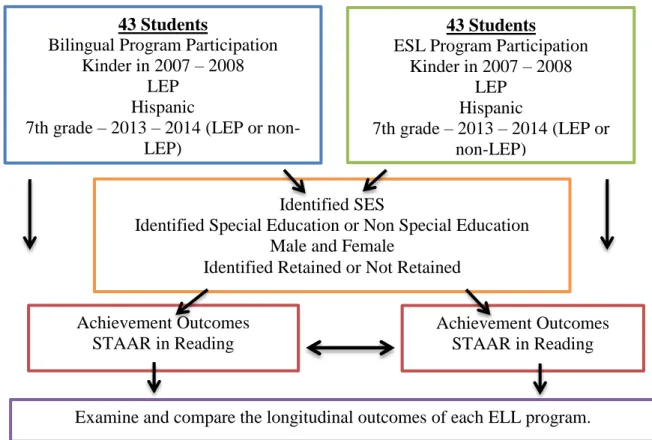
This study examined the reading performance of students who participated in or were participating in a bilingual education program or ESL program, were non-mobile Hispanic students currently or previously identified as LEP, and who were currently enrolled in seventh grade during the 2013–2014 academic school year. The
performances of the students studied were narrowed down to the sampling size of 86 students within the district in the State of Texas located in the north area of Houston. Of the 86 students, 43 participated or currently participated in a bilingual education program and 43 participated or currently participated in an ESL education program. Students were matched on a one-to-one correspondence in accordance to the criteria outline in this study. The criteria included students enrolled in kindergarten during the 2007–2008 school year, identified as LEP, identified as participating in a bilingual or ESL program, identified as Hispanic, enrolled in the school district in seventh grade during the 2013– 2014 school year, identified as non-mobile, SES or non-SES, retained or not retained, and identified as Special Education or non-Special Education. The purpose of the data was to compare the effectiveness of the schools district’s bilingual education program versus the English as a Second Language (ESL) program. The data sources used for the purpose of this study included the STAAR and the results from the survey participants that included campus administrators, teachers, and parents of the LEP students identified in the study. Assumption, Limitations, and Scope
Due to the use of the data gathered from a portion of the identified LEP student population within the school district and not the entire school district LEP population, this research may not be generalizable and therefore may not be considered by the school
district leadership stakeholders as a significant cause to implement the changes
recommended by the findings. Additionally, the lack of the evaluation of the fidelity of the implementation of both the district’s bilingual and ESL programs recommended best practices and the lack of honesty of the subjects participating in the surveys were
considered as assumptions and limitations to this study.
According to Center for Health and Safety Culture (2011), questioning the validity of survey data is often one of the first reactions when survey results are shared. It is important first to recognize this response for what it may be: an immediate reaction to information challenging someone’s existing beliefs. In addition, the Center for Health and Safety Culture (2011) stated that one way to avoid accepting the new information is to simply choose to consider it as invalid. Nonetheless, it is important to be able to understand and convey that the science behind collecting data through self-reporting methods is valid and reliable.
Definition of Terms
For the purpose of this study, terminology and abbreviations utilized throughout this study are identified and defined below.
Annual measure achievement objectives (AMAOs) – Under the Elementary and Secondary Education Act, as reauthorized under the No Child Left Behind Act of 2001, local education agencies (LEAs) that receive Title III, Part A, funding for English language acquisition programs are held accountable for their English language learners’ achievement in learning the English language (Texas Education Agency [TEA], 2013a). In the state of Texas, the Texas English Language Proficiency Assessment System (TELPAS) is used to measure against the AMAOs. The achievement of each Title
III-funded LEA’s ELL student population is measured against the state’s achievement standards known as the Annual Measurable Achievement Objectives (AMAOs). According to the TEA (2013a), AMAO’s Guide (TEA, 2013a), the Title III, Part A, accountability system includes three AMAOs for measuring student achievement as follows:
AMAO 1, Progress – Measures how many of the LEA’s ELLs have made progress in learning English; an ELL’s progress is demonstrated with an increase of at least one overall proficiency level, when his/her current year’s TELPAS Composite Rating is compared to that of the most recent prior year. AMAO 2, Attainment – Measures how many of the LEA’s ELLs have
become proficient in English; an ELL’s attainment is demonstrated when the student receives a TELPAS Composite Rating of Advanced High.
AMAO 3, ELL Accountability (System Safeguards) – Measures how many of the LEA’s ELLs have met the performance and participation targets in
Reading/English Language Arts and Mathematics as part of the state’s student academic achievement standards.
Each LEA is required to meet all the AMAOs to receive an overall “met” standard. Basic interpersonal communication skills (BICS) – Simple communication and language skills needed to interact in social situations. BICS refers primarily to context-bound, face-to-face communication, like the language first learned by toddlers and preschoolers, which is used in everyday social interaction (“Psychology,” n.d.).
Cognitive academic language proficiency skills (CALPS) – Formal academic language that is essential for students to be successful in school. This includes students
being able to listen, speak, read, and write about specific subject content material. Students performing at the CALP level of language are cognitively and academically more advanced in their language acquisition skills.
English language learner (ELL) – A school-aged student whose home language is not English and who has not yet acquired proficiency in English to succeed
academically in school. The term is used interchangeably with limited-English proficient (LEP) in this study.
ELL progress measure – The Texas English Language Learner (ELL) Progress Measure provides year-to-year performance expectations on the State of Texas
Assessments of Academic Readiness (STAAR) content-area assessments for Texas ELL students. The year-to-year STAAR expectations take into account the level of English language proficiency ELL students possess, thus providing a more meaningful gauge of annual improvement or progress for these students than the general STAAR Progress Measure (TEA, 2013c).
Hispanic – The term Hispanic and Latino are widely used interchangeably throughout educational literature; however, the term Hispanic has a narrower focus identifying individuals who come from Spanish-speaking native ancestry, while the term Latino is used to describe a group of people from Latin American origin or ancestry. Throughout this document, the term Hispanic is used to refer to a group of individuals who have Spanish-speaking backgrounds.
Limited English proficient (LEP) – The most commonly used term for school-aged students to describe an individual who is unable to communicate effectively in
English because their primary language is not English, and they have not developed fluency in the English language. The law describes LEP as
ages 3 to 21, enrolled in elementary or secondary education, often born outside the United States or speaking a language other than English in their homes, and not having sufficient mastery of English to meet state standards and excel in and English-language classroom. (NCLB Act, 2002)
A person with Limited English Proficiency may have difficulty speaking or reading English. Both the terms limited-English proficient (LEP) and English Language Learner (ELL) are used interchangeable throughout the study; however, the term English
Language Learner (ELL) is used more frequently due to its positive connotation. L1 – An acronym used in educational literature to represent the native language of a student. For the purpose of this study, Spanish is identified as the first language.
L2 – An acronym used in educational literature to represent the second language that a student is acquiring. For the purpose of this study, English is the target second language.
Performance-based monitoring assessment System (PBMAS) - A district-level, data-driven monitoring system developed and implemented annually since 2004 by Performance-Based Monitoring (PBM) staff in coordination with other TEA divisions and departments (TEA, 2013b). PBMAS is used by TEA as one part of its annual evaluation of school districts’ performance and program effectiveness.
State of Texas Assessments of Academic Readiness (STAAR) – The STAAR test represents the fifth generation of the state of Texas’ legislatively mandated
program includes annual assessments for grades 3–8 in reading and mathematics; assessments in writing at grades 4 and 7; in science at grades 5 and 8; and in social studies at grade 8; and end-of-course assessments for English I, English II, Algebra I, biology, and U.S. History (TEA, 2014a). STAAR is a more rigorous testing program. It emphasizes “readiness” standards, which are the knowledge and skills that are considered most important for success in the grade or course subject that follows and for college and career readiness (TEA, 2014a). The STAAR test continues to measure the teaching of the state-mandated curriculum, the Texas Essential Knowledge and Skills (TEKS).
Texas English Language Proficiency Assessment System (TELPAS) –The TELPAS is designed to assess the progress that limited English proficient (LEP) students make in learning the English language (TEA, 2014b). TELPAS assessments for English language proficiency assessments in grades K–12 are federally required to evaluate the progress that ELLs make in becoming proficient in the use of academic English (TEA, 2011). TELPAS is administered on an annual basis to students identified as LEP and assesses the growth or lack thereof in the student’s individual English language proficiency in the following four language domains—listening, speaking, reading, and writing. As stated in the TEA Educator’s Guide for TELPAS (TEA, 2011), the
assessment components for grades K–1 and 2–12 differ in the following ways:
Grades K–1: TELPAS includes holistically rated listening, speaking, reading, and writing assessments based on ongoing classroom observations and student interactions.
Grades 2–12: TELPAS includes multiple-choice reading tests, holistically rated student writing collections, and holistically rated listening and speaking
assessments. The listening and speaking assessments are based on ongoing classroom observations and student interactions.
The TELPAS system has been in place in the state of Texas since the 2003–2004 school year.
Summary
The true measure of a program for ELLs is not the results of an assessment while they are classified as ELL or LEP, because by definition they are not at a proficient level, but rather their results after they have reached the fluent level. If a program has been effective for them, former ELL students should demonstrate on par or better proficiency on measures of English literacy and on content-area assessments (Blasingame, 2007). This longitudinal study of students identified as LEP, enrolled in kindergarten during the school year 2007–2008 and participating in either the school district’s bilingual or ESL program will provide valuable insight on what school district program is more effective. Within this longitudinal study, evaluative studies of the different programs and the length in which the students participated can make available information for district leaders to develop a deeper understanding of where to focus the majority of state and federal funding for the education of ELLs and can alter the perception of the quality of the programs offered as well as determine the ongoing needs of hiring and training highly qualified teachers to educate the population in most need. In addition, the research in this study will further assist in identifying parental involvement and consulting strategies of programing available for their identified English-learning children.
Effective schools avoid the tendency to base instructional practices on teachers’ assumptions and stereotypes about ELL students. Rather, effective schools conduct
empirical research about the community and use that information as resources in their instruction with students and in their interactions with parents (Verdugo & Flores, 2007). Although progress has been made, there is still a long road ahead in terms of getting ELLs on target with their non-ELL peers (Herbert, 2012). Conducting the study of one large suburban Texas school district can assist with the journey to making great strides of what can become possible best practices in the education of English language learning.
Review of Literature Introduction
From their first day of kindergarten to their last day of school, Latinos, on
average, perform far below most of their peers (Gándara, 2010). They now constitute the largest minority group in the United States and the fastest-growing segment of its school-age population (Gándara, 2010). Latino students are many more times as likely as students from other ethnic groups to come from homes where parents do not speak English well—or at all—and where parental education is low (Gándara, 2010).
According to Batalova et al. (2007), students, commonly referred to as ELLs, perform at lower levels on virtually every measure from achievement scores to graduation rates than almost any other category of students. In addition, while the general student population in the United States grew just 2.6% between 1995 and 2005, the ELL student population grew 56% (Batalova et al., 2007). The National Center for Educational Evaluation (NCEE, 2014) stated the following:
A difference in language is the first thing that sets ELLs apart from their native English-speaking peers. Nearly 80 percent of ELLs come to school speaking Spanish as their first language, while the remaining 20 percent come from more than 400 different language backgrounds. In addition, ELLs are more likely than their English-proficient classmates to live in poverty, reside in large, urban settings, and have parents with low levels of formal education. ELLs also tend to be enrolled in schools struggling with low academic performance and placed in less demanding courses. (p. 1)
Increasingly, then, the academic achievement outcomes of English learners is affecting the overall education level of the nation (Gándara & Hopkins, 2010).
In 1982, the Supreme Court, in the case Plyler v. Doe, established that
undocumented students brought to this country by their parents are eligible for full access to K-12 schooling in the United States (Gándara & Hopkins, 2010). Recent immigrants may face even more challenges than other English language learners as they attempt to adjust to a new country and culture (Rance-Roney, 2009). According to data from the 2000 U.S. Census,about one in five children ages 5–17 in the United States
(approximately 10.8 million children) are from immigrant families (Capps et al., 2005). The population of children in immigrant families is growing faster than any other group of children in the nation (Hernandez, Denton, & Macartney, 2008). Most of these children, 79%, were born in the United States and are, therefore, U.S. citizens (Hernandez et al., 2008).
Considering the many challenges that ELL students face, as well as the importance of English proficiency in terms of academic success, it is important to understand what factors in the home and school environments might support the overall development of ELL children as well as the acquisition of English language proficiency among these children. Some of the factors outside of the school environment that researchers have identified as influencing the grade at which English proficiency is achieved include family socioeconomic status, parental education, neighborhood factors, the experience of discrimination, reasons for immigration (voluntary versus involuntary), social–emotional factors, length of exposure to English, and acculturation or
language is acquired include participation in early care and education programs, parental involvement in school, teacher attitudes and characteristics, the number of limited English proficient students in the school, and exposure to well-designed bilingual education programs (Halle, Hair, Wandner, McNamara & Chien, 2012).
What is the end result for ELLs? What do we want them to become and achieve? In recent years, the endgame has been defined by federal policy and local school districts as meeting achievement targets and evading the stigma of poor scores on state
assessments. Districts with large numbers of linguistically diverse students are frequently blamed for the achievement of English language learners who fail to move beyond basic levels of literacy and math (Rance-Roney, 2011). Finishing high school has become an even more difficult and impossible task in recent years with the advent of high school exit exams. According to Gándara and Hopkins (2010), 23 states require students to pass exit exams in order to graduate from high school. These high-stakes exams prevent ELL students who have successfully completed all high school coursework, but cannot pass the English-only test, from getting a diploma (Gándara & Hopkins, 2010).
As the number of English language learners grow, the concerns about how to help them succeed in school increases (Freeman & Freeman, 2011). In the United States, the high school graduation rate for English language learners is far below that for native English speakers (Kohler & Lazarin, 2007). For many students, standardized
achievement tests are the litmus test for whether they will be successful in life. Failing the test means failing at the future (Jewell, 2009). There is ample finger pointing in the blame game. School districts with large populations of English language learners who struggle to meet state assessment targets are generally reluctant to allocate resources for
postsecondary transition efforts. Savvy district administrators wanting to make adequate yearly progress typically focus on preparing the “bubble ELLs,” those with the highest potential for meeting state standards. These administrators are unlikely to spend precious resources on preparing the same students for successful college work (Rance-Roney, 2011).
Although the federal government requires school districts to provide services to English learners, it offers the state no policies to follow in identifying, assessing, placing, or instructing them (Calderón, Slavin, & Sánchez, 2011). Together, the growing numbers of ELLs, the persistent achievement gaps and barriers to access, and increasingly high sets of stakes add up to a seminal moment for people and institutions investing in school reform and the education of English learners (Grant Makers for Education, 2013).
Many English learners struggle academically, have poor educational outcomes, and never reach the levels of English proficiency needed for participation and success. Achievement data suggest that ELLs not only lag far behind their peers, but the gaps grow as students advance through the grade levels (Grant Makers for Education, 2013). The unique needs of ELL students, combined with the failure of most education systems to address their needs, have produced persistently poor educational outcomes for ELLs in most common schools and communities. Despite the efforts of the past 40 years to build programs, there has been a substantial and continuing achievement gap for ELL versus non-ELL students. ELL students continue to have disproportionately high dropout rates and low college completion rates (Grant Makers for Education, 2013).
With new federal initiatives devoted to making K–12 students’ college and career ready, the endgame is not just passing the mandated tests. To successfully compete with
newly emerging education powerhouses in Europe and Asia, the United States must make good on its promise of equal access to education and high-quality instruction for all (Rance-Roney, 2011). No silver bullet or single program can close the enormous gap between Latino students and their peers with respect to academic achievement and attainment. However, it is in all of our interests to find ways to begin the process of narrowing those gaps (Gándara, 2010).
English learners are a heterogeneous group, and needs differ from one community to another. There is no single profile of English learners, nor is there one single approach or policy that will meet educational goals and needs. They have different home language backgrounds, levels of language proficiency, socioeconomic standing, academic
expectations, academic backgrounds, and immigration status. Each of these factors impacts their experiences, needs, and success in school (Grant Makers for Education, 2013). Despite the positive changes that are taking place in some schools, there is still much to be done to improve the education of English language learners (Freeman & Freeman, 2011).
The purpose of this study was to add to the body of research on the predictive nature of ELL program placement, length of program participation, socioeconomic status, and academic achievement of non-mobile, Hispanic English language learners in reading. The intent of this literature review was to explore empirical findings related to the impact of (a) program placement, whether utilizing the native language or English only; (b) parental involvement within the schools and the knowledge of program options for the student; (c) entering characteristics, including identified economic status and mobility on longitudinal academic reading performance on our target sample, and (d) the adequacy of
teacher preparation and training. In the final section of this chapter, a bilingual program model and ESL content-based instructional program of a large Texas urban school district was examined.
To help school-based personnel (district leaders, school administrators, and teachers of ELL students) provide informed services to students and parents of ELLs, this literature review additionally includes two major focuses. The first focus includes an overview of the programs potentially available for ELL students to help school-based personnel develop a working knowledge of specific issues, beliefs, and instructional strategies in the field.
The second focus is how school-based personnel can apply this knowledge to their work with linguistically and culturally diverse families of English language learners within their schools and school districts to achieve equity. An understanding of bilingual and ESL education, related research, and recommended practices as outlined in this literature review provides details to begin the process. This chapter provides an overview of the key concepts and concerns that in the opinion of the researcher should be clearly understood by educators in the field of second language learning.
Program Placement Options for English Language Learners
Educators, parents, and legislators are concerned about the time and resources needed to educate students who are limited in English (Snowman, McCown, & Biehler, 2009). Some people advocate placing these students into all-English classes
immediately. Others feel that these students need to have a strong understanding of their own native language and of English before transitioning into regular classes (Snowman et al., 2009). Several programs can be identified that have been used to help English
language learners to gain proficiency with the English language. Some of these programs have similar features and only subtle differences, making it hard to distinguish between them in some cases (Garrett, 2010).
There are several different educational programs used to educate ELL students in the United States. These approaches include the following: English-only programs, pull-out ESL, content-based ESL, transitional bilingual programs, maintenance bilingual programs, and one-way, two-way, or dual language bilingual education programs. These approaches vary in the amount of English and native language that is used for
instructional purposes (Ochoa & Rhodes, 2005). In this review of the literature, there is a comprehensive look into the different approaches of each. Table 2 shows the similarities and differences among the types of instructional strategies and programs that serve English language learners in both the research of David and Yvonne Freeman (2011) and Jerry E. Garrett (2010).
English-Only Instructional Programs
Even though bilingual dual-language approaches teaching emergent bilinguals has shown to be more effective than English-only approaches, even though in most of the world bilingualism is the norm, and even though there are clear advantages of
bilingualism, in many schools in the United States emergent bilinguals are only being instructed in English (Freeman & Freeman, 2011). According to the research of Calderón et al. (2011) they suggest that:
Table 2
Program Placement Options for English Language Learners Type of
Program
Description English-Only or English and Native Language
Language Result Academic Result English
Emersion
English language learners are taught with mainstream students and given special services.
English-Only Subtractive –Students learn to communicate in English but lose most or all of their native language proficiency.
Show less progress in math and reading than students in ESL/bilingual programs. Highest number of dropouts in this group. Structured English Immersion English language learners are taught only in English and teachers are trained to make the input comprehensible.
English-Only Subtractive –
Students develop literacy and learn to communicate in English. Students lose most or all of their ability to use their native language.
In California after five years of structured English, students have limited conversational English and have difficulty reading and understanding grade-level texts. ESL Pullout Traditional Instruction English language learners are given support. They are taught basic vocabulary and language structure (grammar) and then integrated into all English instruction.
English-Only Subtractive –
Students develop literacy and learn to communicate in English. Students lose most or all of their ability to use their native language.
These students show little academic progress and once mainstreamed rarely catch up. Many students drop out before graduation. ESL Pullout or
Push-in Content Instruction
English language learners are given 2 to 3 years ESL content support services and then integrated into all English instruction.
English-Only Subtractive –
Students develop literacy and learn to communicate in English. Students lose most or all of their ability to use their native language.
By the end of high school, many of these students drop out or are in the lowest fourth of their class. Early Exit or Transitional Bilingual Instruction English language learners receive a portion of their content instruction in their primary language for 2-3 years and then are integrated into all-English instruction.
English and Native Language
Subtractive – Students learn to communicate and study in English only. They usually lose their first language.
At the end of high school, these students score below the 50th percentile in test of reading in English.
Late Exit or Maintenance
English language learners receive content instruction in L1 and L2 for 4 to 6 years.
English and Native Language
Additive – ELLs become bilingual and biliterate.
ELLs outperform student in English-only programs. Students achieve above the 50th percentile on standardized tests. Enriched
Immersion
Native English speakers are taught in language through content instruction in a second language. English is introduced in second grade or later.
English and Native Language
Additive – ELLs become bilingual and biliterate.
Students acquire a second language and achieve the same levels of
competence in academic subjects as peers taught all in English. Bilingual
Dual-Language (One-way and Two-way)
English language learners and native speakers of English learn language through content in both English and the first language of the English learners.
English and Native Language
Additive – Native English speakers and English learners become bilingual and biliterate.
Students from both language groups outperform students in transitional and developmental bilingual education and score above the 50th percentile on standardized tests.
Recent federal policies have had the effect of restricting the time that can be spent teaching children in their native language. Federal accountability policies and diminishing funds make it impractical for local education agencies and schools to support native language instruction. Although federal policy has neither endorsed nor opposed instruction the primary language, in recent years, policy changes have discouraged bilingual education. Among researchers, the debate between advocates of bilingual and English-only reading instruction has been fierce, and ideology has often trumped evidence on both sides of the debate. (p. 107) Being anti-immigrant and in favor of English-only policies wins votes in many economically battered areas, and so these young people are often denied access to postsecondary education and told to “go home” when in reality they have never known another home. Nonetheless, an extreme concern for the survival of English as the official language of the United States has driven many policies from educating English learners (Gándara & Hopkins, 2010).
Beginning with the passage of No Child Left Behind, language-based educational policy in the United States has shifted toward an emphasis on English language
acquisition and away from an emphasis on native language assistance. The English Language Acquisition, Language Enhancement, and Academic Achievement Act clearly mandate English language acquisition as the commanding objective of instructional programming for LEP students (Hanna, 2011). Few people would disagree that English language proficiency is necessary for academic success in U.S. schools.
Less clear, however, is the optimal pathway for helping language-minority students master English. Conflicting ideologies, competing academic theories, and
multiple metrics for comparing different approaches have rendered many schools, districts, and educators paralyzed by confusion (Clark, 2009). According to Clark (2009), in an Educational Leadership article, “The Case for Structured English
Immersion,” three states and many school districts are finding that emphasizing English language instruction offers ELLs an accelerated path to success. Several factors usually account for school and district leaders’ decisions to opt for structured English immersion. In three states (California, Arizona, and Massachusetts), the reason is straightforward: Laws passed through voter initiatives now require structured English immersion and restrict bilingual education.
In reality, the United States has no official language policy. It only has laws that provide non-English speaking students a right to acquire the English language and to have access to an equitable education while they are doing so (Gándara & Hopkins, 2010). Transitional programs seem to be grounded in the belief that English learners are language deficient because they are not native English speakers. Such programs produce “bilingual illiterates” or “nolinguals”—students who are not literate in either their native or their adopted language. Many progress through the grades, drill for high-stakes state-mandated tests in English, and graduate with a high school diploma. Too many others get left behind and believe they are incapable of succeeding academically, conclude that school is not for them, and drop out.
An approach that better supports the academic potential of ELLs, particularly Latino students, is clearly needed (Estrada, Gómez, & Ruiz-Escalante, 2009). Another factor is that most state student performance assessments are conducted in English and schools or districts that miss targets face increased scrutiny and possible sanctions. This
provides added incentive for schools to get students’ English proficiency up to speed as soon as possible (Clark, 2009).
English language learners are assessed more often than native English speakers since they are assessed both for their language proficiency and for their content area knowledge. While ELLs can be assessed on content knowledge in their native language, most often, they are assessed in English. In fact, pressures from standardized testing in English resulting from No Child Left Behind legislation has led to less content teaching in students’ first language and a decline in bilingual education programs (Crawford, 2007).
Freeman and Freeman (2011) stated the following in reference to English immersion instruction:
English immersion is not actually a program for ELLs. English immersion transpires when ELLs are taught in conventional classes with native speakers of English and given no special services. In structured English immersion programs, students are taught only in English by teachers who have received some training in strategies for teaching second language learners. Teachers working with English language learners recognize the importance of helping ELL students develop competence in English. It seems logical that the best way to develop English proficiency is to immerse learners in an environment in which they hear, speak, read, and write English all day. Although the idea that “more English leads to more English” is logical, it is not the best approach for working with bilingual students. (pp. 149 & 162)
In an article written by Krashen in 2004, “The Power of Reading: Insights from the Research,” Krashen investigated newspaper claims that tests scores in California from English immersion programs had skyrocketed; he found that test scores had gone up. As he explained:
There were no significant differences in gains between districts that kept bilingual education and those that dropped it. Missing from nearly all
discussions of the effectiveness of bilingual education is the fact that controlled studies consistently showed that bilingual education works. The Skyrocket Legend is false. (p. 39)
Krashen’s statements are supported by the 2009 Collier and Thomas study, “Educating English Learners for a Transformed World.” Collier and Thomas studied the test results of students in California after the passing of Proposition 227 and found that even students in early grades were not making the gains compared to native language speakers. They also concluded that “this program type had resulted in the lowest achievement for English learners of any program in the U.S.” (Collier & Thomas, 2009, p. 61).
English and Native Language Instructional Programs
As U.S. school populations shift and represent an increasingly diverse world of linguistic flexibility, we argue that refusing to acknowledge the language resources of students and their families limits the possibilities for students’ educational success and achievement and shuts down opportunities for the development of multilingualism (Hornberger & Link, 2012). English language learners’ previous cultural, language, and literacy experiences influence their ways of learning both English and subject-matter knowledge. Their native languages and prior knowledge are rich resources to tap into.
When teachers invite English language learners to link new knowledge to what they have already learned, learning becomes more comprehensible, meaningful, and exciting (Dong, 2009).
ELLs enter U.S. schools at varying ages and without the foundational
understanding of theEnglish language that the curriculum requires for accessing grade-level content. Their educational preparation, and particularly the strength of their language and literacy development in their home language, makes an enormous
difference in how smoothly they are able to learn English and overcome academic gaps that emerge when they do not comprehend the language of academic instruction (Grant Makers for Education, 2013).
English learner communities have disproportionately little access to quality early learning programs, and students typically start school lacking the skills, language, or readiness that set them up for success academically. As English learners move through school, they often amass academic deficits during the years they are learning English because they cannot adequately comprehend academic instruction in a language they have not yet mastered. As they progress into higher grades, the curriculum becomes more difficult to access, more conceptual, and more dependent upon abstract language. For all children, a strong foundation of language and literacy faci