Learning Probabilistic Relational Models using
co-clustering methods
Anthony Coutant, Philippe Leray, Hoel Le Capitaine
To cite this version:
Anthony Coutant, Philippe Leray, Hoel Le Capitaine. Learning Probabilistic Relational Models
using co-clustering methods. Structured Learning: Inferring Graphs from Structured and
Un-structured Inputs (SLG 2013) ICML Workshop, 2013, Atlanta, United States.
<
hal-00819031
>
HAL Id: hal-00819031
https://hal.archives-ouvertes.fr/hal-00819031
Submitted on 29 Apr 2013
HAL
is a multi-disciplinary open access
archive for the deposit and dissemination of
sci-entific research documents, whether they are
pub-lished or not.
The documents may come from
teaching and research institutions in France or
abroad, or from public or private research centers.
L’archive ouverte pluridisciplinaire
HAL
, est
destin´
ee au d´
epˆ
ot et `
a la diffusion de documents
scientifiques de niveau recherche, publi´
es ou non,
´
emanant des ´
etablissements d’enseignement et de
recherche fran¸cais ou ´
etrangers, des laboratoires
publics ou priv´
es.
Learning Probabilistic Relational Models using
co-clustering methods
Anthony Coutant
LINA (UMR CNRS 6241), KOD/GRIM Research Groups
Ecole Polytechnique de l’Université de Nantes, France
Philippe Leray
LINA (UMR CNRS 6241), KOD Research Group Ecole Polytechnique de l’Université de Nantes, France
Hoel Le Capitaine
LINA (UMR CNRS 6241), GRIM Research Group Ecole Polytechnique de l’Université de Nantes, France
ABSTRACT
Probabilistic Relational Models (PRM) are probabilistic graph-ical models which define a factored joint distribution over a set of random variables in the context of relational datasets. While regular PRM define probabilistic dependencies be-tween objects’ descriptive attributes, an extension called
PRM with Reference Uncertainty (PRM-RU) allows in ad-dition to manage link uncertainty between them, by adding random variables calledselectors. In order to avoid prob-lems due to large variables domains, selectors are associated with partition functions, mapping objects to a set of clus-ters, and selectors’ distributions are defined over the set of clusters. In PRM-RU, the definition of partition functions constrain us to learn them using flat (i.e. non relational) clustering algorithms. However, many relational clustering techniques show better results in this context. Among them, co-clustering algorithms, applied on binary relationships, fo-cus on simultaneously clustering both entities objects to use as much information available from the relationship as pos-sible. In this paper, we present a work in progress about a new extension of PRM, called PRM with Co-Reference Uncertainty, which associates, to each class containing refer-ence slots, a single selector and a singleco-partition function
learned using a co-clustering algorithm.
1.
INTRODUCTION
Many machine learning approaches assume the individu-als on their datasets as being independent and identically distributed (i.i.d.). However, multiple problems in real life break this hypothesis. For example, the probablity of a per-son to develop some genetical diseases is influenced by the history of his family’s medical issues.
Bayesian networks [19] are probabilistic graphical models which rely on the i.i.d. assumption. Probabilistic Rela-tional Models [15, 20] (PRM) extend Bayesian Networks to relational datasets defined by a relational schema. Several
problems have been addressed with PRM framework in the litterature such as recommendation [14] and clustering [23]. A recent book has also been written on the use of PRM for Enterprise Architecture Analysis [3].
In regular PRM, the learning task aims at finding general probabilistic dependencies between classes attributes values, using information about both objects inner informations and relationships between them. In this case, relationships be-tween objects are supposed to be known and are not part of the learned model.
PRM with Reference Uncertainty [11, 8, 9](PRM-RU) is an extension of regular PRM removing the need for exhaus-tive knowledge of relationships between objects. Link un-certainty for a specific object is represented as a random variable following a distribution over possible objects it can be related to. However, in order to avoid large variables problems, the possible objects are first regrouped in clus-ters thanks to the use of apartition function and the ran-dom variable simply follows a distribution over the partition function’s clusters. Learning these functions can clearly be made with clustering algorithms. Nevertheless, the parti-tion funcparti-tions’ definiparti-tion constrain us to use flat clustering algorithms.
In the clustering litterature, more and more work are focus-ing on relationships data, implyfocus-ing several heterogeneous entities, rather than flat (i.e. non relational) and homoge-neous datasets. Results [5, 7, 12] showed that, when con-sidering relationships data, represented for example as their co-occurence matrices, it was often more efficient to cluster simultaneously both individuals and features. In the case of binary relationships, the methods following this princi-ple are calledco-clusteringorbi-clustering and are of great interest in our PRM-RU learning problem.
In this article, we propose a new PRM extension, called
PRM with Co-Reference Uncertainty, which associates, for each class containing reference slots, a single selector vari-able linked to a mapping function from every tuple of ob-jects from reference slots’ ranges to a set of co-clusters. We call these mapping functionsco-partition functionsand learn them using a family of co-clustering algorithms based on non-Negative Matrix Tri-Factorization (NMTF) techniques.
The rest of the paper is organised as follows. Section 2 describes the PRM with Reference Uncertainty models, a definition of their learning algorithm and discuss their weak-ness concerning partition functions. Section 3 then proposes a brief overview of co-clustering approaches and motivates the particular choice of NMTF based algorithms. Finally, section 4 describes our newPRM with Co-Reference Uncer-taintymodel and its learning process.
2.
PROBABILISTIC RELATIONAL MODELS
WITH REFERENCE UNCERTAINTY
2.1
Relational Schema
A relational schema of a relational model M describes a set ofn classes X ={X1, . . . ,Xn}. EveryXi ∈ X is
com-posed of a set of descriptive attributesAi ={A1i, . . . ,Ami }
and a set of reference slots Ri = {R1i, . . . ,Rli} relating
the class to each other. We call slot chain of size l, a sequence (r1, . . . , rl) ∈ Rl = {R1∪. . .∪ Rn}l in which
Ran[ri−1] = Dom[ri]. We note I(M) an instance of M,
that is a set of objects xi for every class Xi ∈ X, each
object being assigned a set of specific values for its class’ attributes and reference slots.
2.2
Regular PRM
Given a relational schemaM, we are interested in finding probabilistic dependencies between its attributes. Let VA
be a set of random variables, each one being defined on the domain of a different attribute ofM. Regular PRM models are defined below.
Definition 1. [20] A regular PRM (Probabilistic Rela-tional Model) is a pair (G,Θ) where G corresponds to its graph structure and Θto its set of parameters. The graph G= (N,E) is a directed acyclic graph (DAG) containing a nodeNi∈ N for every random variableVi∈VAand an edge
e∈ E for every direct probabilistic dependencies between two random variables (two nodes can only be connected inG if there exist a slot chain between the corresponding attributes inM). Every nodeNi∈ N is then associated to a
parame-terθi ∈Θwhich describe the probability distribution of the
corresponding random variable conditionally to the random variables of its parent in the graphG.
Regular PRM allow to use information about objects re-lationships in order to predict the values of these objects attributes. However, they are based on the assumption that links between objects are known for different instances. Thus, it is not possible to make link prediction with regular PRM. In this case, we can rely on an extension calledPRM with Reference Uncertainty.
2.3
PRM-RU
In order to manage link uncertainty, we must consider more random variables than in regular PRM. LetVR, the set of
random variables being associated to the set of reference slots ofM. Thus, given a specific instance I of M, there exist for each reference slot Rij in the relational schema,
with Ran[Rij] = Xk ∈ X, a random variable VRij ∈ VR
which can take values in I(Xk), that is the set of unique
identifiers of the whole objects set of typeXk forI. It is
important to note that variables ofVR directly depend on
I and can have huge domains. Indeed, it is common to see millions (and far more) of individuals for a specific entity in a database. This leads to several problems. First, we cannot define the variables and their distributions for any instance if we keep this variables set as is. Then, it seems unreasonable to store and compute distributions over huge domains. Fi-nally, we can be skeptical about the quality of learning this kind of random variables, since it is unlikely that we will havesufficient statisticsfor this task. As a consequence, we should replaceVRby a new setVSR, describing synthetical
distribution over reduction of reference slots domains.
Definition 2. [10] A PRM with Reference Uncertainty
(PRM-RU) Π defined from M is a PRM as described in definition 1. In addition, we add for every variable v in VSR, linked to the reference slotRik, a selector node in G
associated to a partition functionψp. In PRM-RU, the
vari-ablevis defined over a set ofcclustersC={Cp1, . . . , Cpc}
and the associated partition function defines a mapping from the objects of Ran[Rik] toDom[ψp] = Dom[v] = C. The
selector nodes are each linked to a parameterθi∈Θ
describ-ing the probability distribution of the corresponddescrib-ing random variable conditionally to the random variables of its parent in the graph G.
For an instanceI(M), a PRM-RU describes a factored joint distribution which can be written as:
P(I|Π) = Y Xi∈X Y x∈I(Xi) Y Aij∈Ai P(x.Aij|P a(x.Aij)) Y Rij∈Ri, Xk=Ran[Rij] xk=x.Rij P(x.S(Rij) =ψ[xk]|P a(x.S(Rij))) |I(Xk[ψ[xk]])| , (1)
where x.S(Rij) is the value of the selector of the reference
slot Rij for x, ψ[xk] corresponds to ΨRij[xk] that is the
cluster assigned toxk by the partition function ofRij, and
|I(Xk[ψ[xk]])|is the number of objects inIof typeXk and
assigned to the same cluster asxk by the partition function
ofRij.
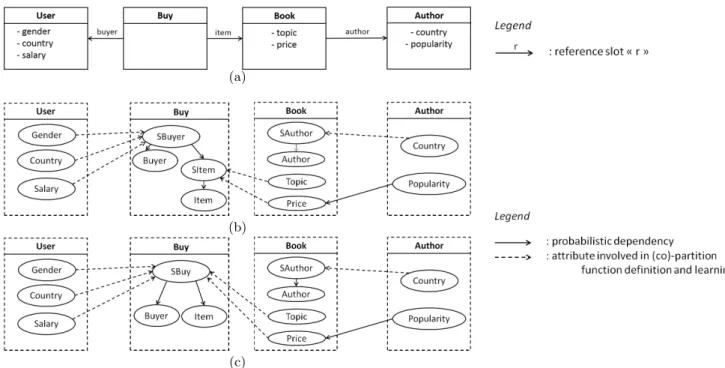
The figure 1(b) shows an example of PRM-CRU defined from the relational schema in figure 1(a).
2.4
Learning PRM-RU
PRM-RU learning algorithm shares the same principles as for Bayesian networks. The structure learning is then based on an iterative greedy search method where each iteration consists in 1) generating all possible neighbours; 2) evaluat-ing score of every PRM resultevaluat-ing from neighborhood search; 3) choose the model maximizing it. However, unlike Bayesian networks, the information coming from the relational schema is used in PRM-RU learning to constrain the choice of possi-ble parents for a node. Indeed, the neighborhood generation will favor the nodes which are ”close” to each other for the parenting relationships. The closeness of two nodes is de-fined here as the length of the slot chain between them. As usual, the algorithm continues until convergence. In
(a)
(b)
(c)
Figure 1: (a) Relational Schema (b) Example of PRM-RU structure (c) Corresponding PRM-CRU structure
Bayesian networks, the neighbourhood of a specific model is obtained with three possible operators: add, remove and reverse an edge. In PRM-RU, these operators are still avail-able (constrained by the size of slot chains between parents and children). In addition, two new operators are added to update partition functions: refine and abstract. The former re-runs the partition function learning using one more at-tribute, potentially leading to more detailed functions. The latter does the complete opposite. These operators are sub-ject to constraints limiting the choice of partition functions attributes in only one class corresponding to the range of the corresponding reference slot.
2.5
Limits of clustering in PRM-RU
PRM are made to deal with fundamentally relational data, making the information ”flow” all over the model when rea-soning with them. However, the concept of partition func-tion as described in PRM-RU is not relafunc-tional. Indeed, this concept is described as a mapping from a set of ob-jects of one specific class to a set of clusters, only using information about this set of objects, as if they were iso-lated from the other classes’ individuals. Existing literature about PRM-RU do not provide detailed information about partition function learning [11, 8, 9]. An often mentionned point is about using Cartesian product of every involved attributes values’ sets. However, it does not seem to be effi-cient if the dataset is big. The partition function definition suggests they are rather obtained through the use of regu-lar, flat clustering algorithm. This case could be the most we can do whenever we are in a class with only one reference slot. However, for classes describing relationship between several entities, and containing more than one slot, we can try to learn more interesting partition functions taking into consideration all the related objects together with the rela-tionship information and not only each entity’s object sepa-rately. In order to do that, we propose to use advantages of a
set of clustering algorithms which have known great success in the clustering community, calledco-clustering algorithms, instead of regular ones. This approach is described in the following section.
3.
CO-CLUSTERING AND PRM
3.1
Brief overview of co-clustering approaches
In the clustering community, co-clustering techniques, also called bi-clustering, have become more and more popular and have shown better results than their flat clustering coun-terparts on many experiments involving non i.i.d. datasets. We can cite examples from document mining [5], gene min-ing [13], and image processmin-ing [21] contexts. Takmin-ing a re-lationship between two entities, materialized for example as a co-occurence matrix, the idea behind co-clustering ap-proaches is to simultaneously cluster the two entities sets, us-ing both the information of the relationship itself and even-tually the inner information of entities.
Several approaches have been used to address this problem. Some methods are based on information theory. Dhillon et al. [6] see the relationship between the two entity sets as a joint distribution between random variables in the entity’s sets domains, and addresses the co-clustering problem as finding the co-clusters which approximates this joint distri-bution the best,i.e. which leads to the least mutual informa-tion loss from the original one. Banerjee et al. [1] generalize the evaluation of the best co-clusters by using a distorsion measure between the approximate joint distribution and the original one, taking this measure in a family of distorsion measure called Bregman divergences. Shan and Banerjee [22] enlarge this hard co-clustering assignment problems into soft assignment ones, using a generative model.
Different methods use relationship matrix (Laplacian matrix of a graph or directly the relationship matrix) factorization
techniques. We can cite methods based on Singular Value Decomposition [16] (SVD) or spectral clustering approaches [5]. Other interesting factorization techniques are based on non Negative Matrix Factorization approaches (NMF ap-proach is well studied in [18] and we can see some example for data-mining in [2, 4]). They focus on finding an approxi-mation of the original relationship matrixR12ofnobjects of typeX1andmobjects of typeX2, under the form of a prod-uct of two low dimension matricesG(1n×c). G
(c×m)
2 wherec represents the number of clusters andGk capture
informa-tion about assignainforma-tion ofXk individuals to clusters setCk.
They then solve the following optimization problem:
min kR12−G1GT2k, s.t. G1≥0, G2≥0 (2)
Recent method [7] have shown the interest of adding a third matrix to absorb the different scales of R12, G1 and G2, also allowing to relax the constraint of the same number of clusters for both entities. The methods based on a 3-factor decomposition are called non-Negative Matrix Tri-Factorization (NMTF) and solve the following optimization problem:
min kR12−G1SGT2k, s.t. G1≥0, G2≥0, S≥0 (3)
For the co-clustering problem, the S ≥0 constraint is re-laxed.
3.2
Integrating co-clustering in PRM learning
process
Even if many approaches exist to deal with co-clustering, most of them do not fit perfectly with the richness of in-formation available in PRM. Indeed, most of co-clustering algorithm do not use inner objects data in addition to re-lationship information, whereas we use both information to learn a PRM. As a consequence, this is one main constraint for the selection of a co-clustering algorithm to integrate with PRM.
Some recent work [12, 26, 24, 25] regularize the matrices fac-torization for co-clustering tasks, as described above, through the adding of entities information by the mean of intra-classes affinity matrices. Beyond the fact that it provides the desired advantage of intra-class information use, these co-clustering algorithms can take into consideration the topo-logical space (or manifold) of every entity, avoiding the trou-ble of always considering simple Euclidean spaces. These techniques show good results in experimentations. For these reasons, co-clustering algorithms operating on manifolds are well suited for our PRM learning problem. We briefly de-scribe their principle in the following subsection.
3.3
Co-clustering with Laplacian
regulariza-tion
LetR12be a relationship matrix between two entitiesX1and
X2. The two entities Xk withk ∈ {1,2} are described as
sets of objectsXk={x1k, . . . , x nk
k }wherenkis the number of
objects of the entityk. We can describe information between objects of the entityXkunder the form of a square affinity
matrixWk. Let now define a clusters setCk for everyXk.
The objective of co-clustering is then to find the functionsfk
mapping every objectxki ∈Xkto a clusterckj∈Ckfor every
k ∈ [1,2]. From matricesR12, W1 and W2, the algorithm targets to find the best result matricesGkandSminimizing:
J=kR−G1SG2Tk2F+ X k∈{1,2} λktr h GkTLkGk i s.t. G≥0 (4)
where k.kF is the Frobenius norm, Lk = Dk−Wk is the
graph Laplacian corresponding toXkandDkis the diagonal
degree matrix corresponding to Xk. Two results are then
useful for us. First, the matrices Gk can be interpreted
after normalization as a posterior distribution of clustering for every xki ∈ Xk. Then, the S matrix can allow us to
calculateP(C1C2), whereC1andC2 are random variables respectively defined onC1 andC2.
We can see that integrating this kind of co-clustering algo-rithm into PRM learning process requires the calculation of the right intra-class similarity matrices. The details of this integration is the object of the following section.
4.
PRM WITH CO-REFERENCE
UNCER-TAINTY
We propose here to take benefit from co-clustering approaches in order to learn PRM models using even more relational information than those used by PRM-RU. We define a new model based on this idea calledPRM with Co-Reference Un-certainty (PRM-CRU) described below.
4.1
Definition
Keeping the same definition of a relational model M as before, we update the set of random variables VS(M) =
VA∪ VSR considered. We now define the synthetical
ran-dom variablesVSRcorresponding to reference slotsRofM
as variables describing distributions over reduction of carte-sian product of several reference slots domains. We now associate for every classXi∈ X at most one partition
func-tion, which is a co-partition function if the class contains two reference slots. The formal definition of PRM-CRU is given below.
Definition 3. A PRM-CRUΠdefined fromMis a PRM
as described in definition 1. In addition, we add for every variable v ∈ VSR, linked to an entityXi ∈ X with |Ri| ∈
{1,2}, a co-selector node in G associated to a co-partition function ψi. In PRM-CRU, the variable vis defined over a
set of c co-clustersC ={Ci1, . . . , Cici} and the associated
partition function defines a mapping from I(Ran[Ri1])×
. . .× I(Ran[Riri]) toDom[ψi] = Dom[v] = C. The
selec-tor nodes are each linked to a parameterθi∈ Θdescribing
the probability distribution of the corresponding random vari-able conditionally to the random varivari-ables of its parent in the graphG.
The figure 1(c) shows an example of PRM-CRU defined from the relational schema in figure 1(a). It is important to note that, ifMcontains at least one entity with more than two reference slots, it is not possible to create a PRM-CRU on it. Relaxing this constraint will be the object of future work.
4.2
Learning PRM-CRU
PRM-CRU models do not need a change of learning algo-rithm structure, relatively to PRM-RU learning, but a re-definition of therefineandabstractoperators which con-tent will strongly depend on the choosen co-clustering al-gorithm. First, it is important to remind that many co-clustering algorithm only focus on relationship matrices (for binary cases) or equivalent in more dimension. For these algorithms, adding or removing attributes from concerned classes by the refine and abstract operators will not change anything. Thus, in this first case, learning a PRM-CRU boils down to first learning every co-partition functions once and for all, and then use only edges operators during greedy search. Secondly, for co-clustering methods using both rela-tionship and entities inner information, the input taken for the latter is under the form of similarity matrices. In this case, the refine and abstract method must trigger a three steps procedure: 1) update the set of attributesPi; 2)
com-pute the new similarity matrix for the updated entity’s ob-jects (no need to recompute these matrices for other classes of the relationship); 3) relaunch the co-clustering algorithm with updated similarities.
More formally, let consider a specific partition function ψi
in Ψ linked to the entityXi ∈ X with |Ri| = 2 (there is
no partition functionψi if|Ri|= 0; the partition function
works as in PRM-RU in the case where |Ri| = 1). Let
X=Ran[Ri1]∪Ran[Ri2], the set of classes being the range
of at least one reference slot ofXi. Let thenA= S
∀Xi∈X
Ai
the set of potential attributes forψi andPi⊂A, the set of
current used attributes byψi. Given a fixed number of
clus-tersk, the refine operator will add an attributea∈A− Pi
toPi from class Xi ∈ X, recalculate the similarity matrix
SI(Xi)and re-runs the corresponding co-clustering algorithm
to findknew clusters from all the similarity matrices of in-volved classes instances. Similarly, the abstract operator will remove an attributea ∈ A− Pi from Pi, recalculate
the corresponding similarity matrix and finally re-runs the co-clustering algorithm. Unlike for the PRM-RU case, only one constraint still hold on the two operators call: the one forbidding a refine call if every potential attribute has been added (Pi=A). Indeed, a co-clustering algorithm can still
work without any attribute since it always has the relation-ship matrix to work on.
4.3
Discussion
PRM-CRU are aimed to offer more accurate clusters to the PRM learning algorithm than in PRM-RU. The objective is to improve the probabilistic likelihood P(I|G,Ψ,Θ) we can reach with Greedy Search heuristic, since we can more accurately fit the data with co-clustering, than with flat clus-tering methods, in numerous situations. This gain comes at a cost, however, due to the limitation of co-clustering tech-niques themselves. Indeed, we can not currently work with relational schema with classes having more than two refer-ence slots, and classes with exactly two referrefer-ence slots can not have more than one descriptive attribute (otherwise, it would not be able to have a single matrix to represent the relationship data).
5.
CONCLUSION AND PERSPECTIVES
In this paper, we have presented a work in progress about a new extension of PRM, calledPRM with Co-Reference Un-certainty, which defines a single selector variable for each class containing reference slots. This variable is associated to a co-partition function, which is learned thanks to a co-clustering algorithm. We have particularly described algo-rithms based on NMF techniques and have motivated the interest of using more particularly NMTF techniques with Laplacian regularization.
It is important to note that, in its current state, our work can not be applied to all datasets since it does not sup-port every relational schema. The main limitation is due to the use of co-clustering algorithms which can only be used on binary relationships expressed as matrices. Since a rela-tional schema can involve more complex classes with more reference slots, it is important to work on generalizing this method for the case of any n-ary relationship. This could be done for example with tensor decomposition techniques [17], which seems promising. We will focus on this generalization in future work.
Another interesting task on which we will focus on is the analysis of the set of co-partition functions obtained by learn-ing the PRM-CRU. By findlearn-ing a consensus on the multiple co-partition functions obtained, we can try to reverse the problem addressed in this article: making multi-relational clustering with PRM learning algorithm after having made PRM learning using relational clustering.
6.
REFERENCES
[1] A. Banerjee, I. Dhillon, J. Ghosh, S. Merugu, and D. S. Modha. A generalized maximum entropy approach to bregman co-clustering and matrix approximation. InProceedings of the tenth ACM SIGKDD international conference on Knowledge discovery and data mining, KDD ’04, pages 509–514, New York, NY, USA, 2004. ACM.
[2] J.-P. Brunet, P. Tamayo, T. R. Golub, and J. P. Mesirov. Metagenes and molecular pattern discovery using matrix factorization.Proceedings of the National Academy of Sciences, 101(12):4164–4169, 2004. [3] M. Buschle, J. Ullberg, U. Franke, R. Lagerstr ˜A˝um,
and T. Sommestad. A tool for enterprise architecture analysis using the prm formalism. In P. Soffer and E. Proper, editors,Information Systems Evolution, volume 72 ofLecture Notes in Business Information Processing, pages 108–121. Springer Berlin Heidelberg, 2011.
[4] M. Cooper and J. Foote. Summarizing video using non-negative similarity matrix factorization. In
Multimedia Signal Processing, 2002 IEEE Workshop on, pages 25–28, 2002.
[5] I. S. Dhillon. Co-clustering documents and words using bipartite spectral graph partitioning. InProceedings of the seventh ACM SIGKDD international conference on Knowledge discovery and data mining, KDD ’01, pages 269–274, New York, NY, USA, 2001. ACM. [6] I. S. Dhillon, S. Mallela, and D. S. Modha.
Information-theoretic co-clustering. InProceedings of the ninth ACM SIGKDD international conference on Knowledge discovery and data mining, KDD ’03, pages
89–98, New York, NY, USA, 2003. ACM.
[7] C. Ding, T. Li, W. Peng, and H. Park. Orthogonal nonnegative matrix t-factorizations for clustering. In
Proceedings of the 12th ACM SIGKDD international conference on Knowledge discovery and data mining, KDD ’06, pages 126–135, New York, NY, USA, 2006. ACM.
[8] L. Getoor.Learning Statistical Models from Relational Data. PhD thesis, Stanford, 2001.
[9] L. Getoor.Introduction to statistical relational learning. The MIT press, 2007.
[10] L. Getoor, N. Friedman, D. Koller, and B. Taskar. Learning probabilistic models of relational structure. InMACHINE LEARNING-INTERNATIONAL WORKSHOP THEN CONFERENCE-, pages 170–177, 2001.
[11] L. Getoor, D. Koller, B. Taskar, and N. Friedman. Learning probabilistic relational models with structural uncertainty. InProceedings of the AAAI Workshop on Learning Statistical Models from Relational Data, pages 13–20, 2000.
[12] Q. Gu and J. Zhou. Co-clustering on manifolds. In
Proceedings of the 15th ACM SIGKDD international conference on Knowledge discovery and data mining, KDD ’09, pages 359–368, New York, NY, USA, 2009. ACM.
[13] D. Hanisch, A. Zien, R. Zimmer, and T. Lengauer. Co-clustering of biological networks and gene expression data.Bioinformatics, 18(suppl 1):S145–S154, 2002.
[14] Z. Huang, D. D. Zeng, and H. Chen. A unified recommendation framework based on probabilistic relational models. Inin Fourteenth Annual Workshop on Information Technologies and Systems (WITS, pages 8–13, 2004.
[15] D. Koller and A. Pfeffer. Probabilistic frame-based systems. InProceedings of the National Conference on Artificial Intelligence, pages 580–587. JOHN WILEY & SONS LTD, 1998.
[16] M. Lee, H. Shen, J. Z. Huang, and J. S. Marron. Biclustering via sparse singular value decomposition.
Biometrics, 66(4):1087–1095, 2010.
[17] B. London, T. Rekatsinas, B. Huang, and L. Getoor. Multi-relational weighted tensor decomposition. In
NIPS Workshop on Spectral Learning, 2012. [18] P. Paatero and U. Tapper. Positive matrix
factorization: A non-negative factor model with optimal utilization of error estimates of data values.
Environmetrics, 5(2):111–126, 1994.
[19] J. Pearl.Probabilistic reasoning in intelligent systems: networks of plausible inference. Morgan Kaufmann Publishers Inc., San Francisco, CA, USA, 1988. [20] A. J. Pfeffer and D. Koller.Probabilistic reasoning for
complex systems. Stanford University Stanford, CA, 2000.
[21] G. Qiu. Image and feature co-clustering. InPattern Recognition, 2004. ICPR 2004. Proceedings of the 17th International Conference on, volume 4, pages 991–994 Vol.4, 2004.
[22] H. Shan and A. Banerjee. Bayesian co-clustering. In
Data Mining, 2008. ICDM ’08. Eighth IEEE
International Conference on, pages 530–539, 2008. [23] B. Taskar, E. Segal, and D. Koller. Probabilistic
classification and clustering in relational data. In
Proceedings of the 17th international joint conference on Artificial intelligence - Volume 2, IJCAI’01, pages 870–876, San Francisco, CA, USA, 2001. Morgan Kaufmann Publishers Inc.
[24] H. Wang, H. Huang, and C. Ding. Simultaneous clustering of multi-type relational data via symmetric nonnegative matrix tri-factorization. InProceedings of the 20th ACM international conference on
Information and knowledge management, CIKM ’11, pages 279–284, New York, NY, USA, 2011. ACM. [25] H. Wang, F. Nie, H. Huang, and F. Makedon. Fast
nonnegative matrix tri-factorization for large-scale data co-clustering. InProceedings of the
Twenty-Second international joint conference on Artificial Intelligence - Volume Volume Two, IJCAI’11, pages 1553–1558. AAAI Press, 2011. [26] J. Yoo and S. Choi. Orthogonal nonnegative matrix
tri-factorization for co-clustering: Multiplicative updates on stiefel manifolds.Information Processing and Management, 46(5):559 – 570, 2010.