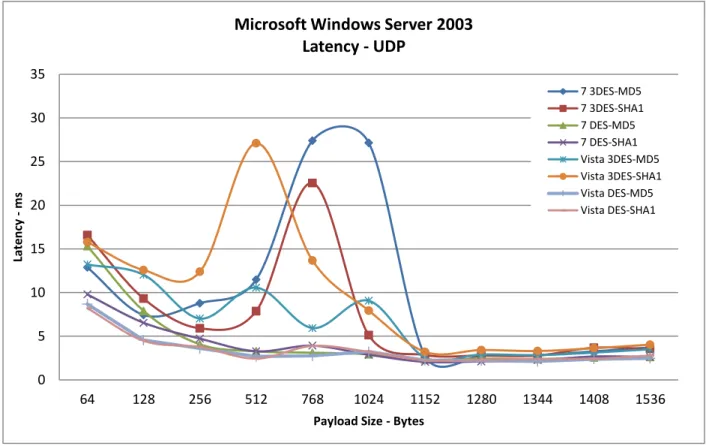
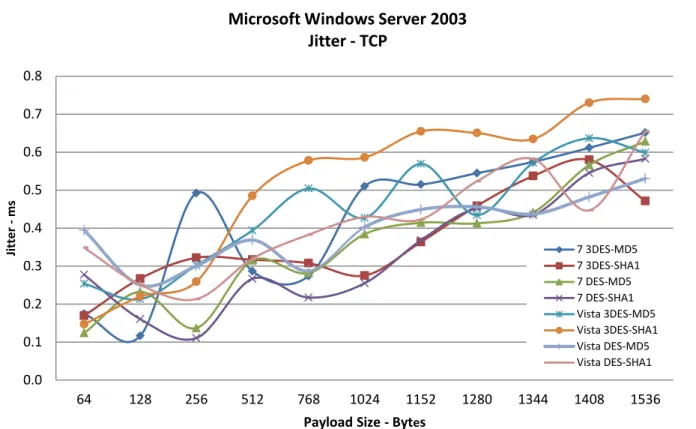
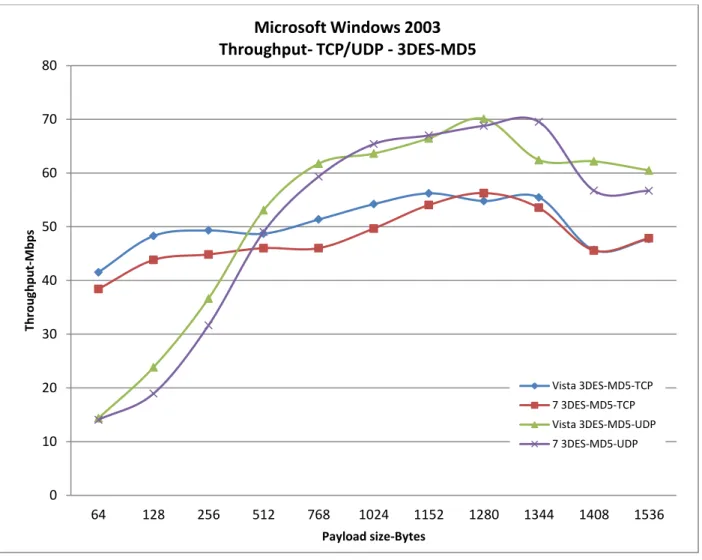
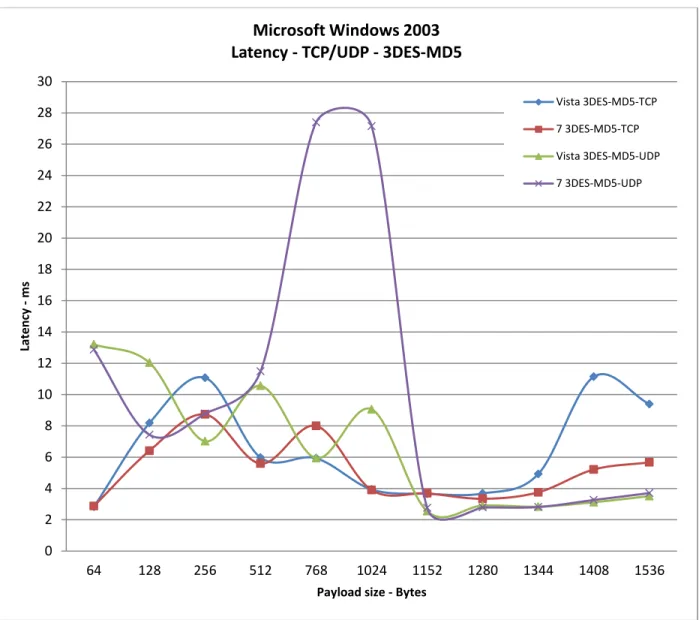
__________________________________________________________________
TCP/UDP Network Performance Evaluation of
Various IPSec Algorithms
An Empirical Test-bed Analysis of a Virtual Private Network Protocol
Rashikala Weerawarna
A thesis submitted in partial fulfillment of the requirements for the degree of
Master of Computing
UNITEC Institute of Technology, New Zealand
2013
Abstract
Internet has become ubiquitous and the default communication channel for businesses, and it continues to grow worldwide. With the prolific development of the Internet, Virtual Private Network (VPN) is the most widely used tunnel, and it uses different protocols that guarantee secure data communication between multiple sites connected via public telecommunication channels such as Internet. VPN protocols provide secure communication links with data encryption and integrity, and they are implemented with various encryption algorithms. Encryption algorithms are Data Encryption Standard (DES), Triple Data Encryption Standard (3DES), Advanced Encryption Standard 128bit (AES128), Advanced Encryption Standard 256bit (AES256) and Blowfish (BF). Authentication and data integrity algorithms are Message-Digest 5 (MD5) and Secure Hash Algorithm (SHA1).
This research empirically evaluates the impact of various Internet Protocol Security (IPSec) algorithms (DES, 3DES, AES) on the performance of Virtual Private Network for Windows operating systems (Windows Server 2003, Windows Server 2008, Windows XP and Windows Vista) and for both Transmission Control Protocol (TCP) and User Datagram Protocol (UDP). The parameters considered are throughput, jitter and latency. Results obtained indicate that IPSec algorithms do influence VPN performance and that different operating systems provide various results. Throughput, jitter and latency in a VPN tunnel can vary depending on the choice of operating system, protocol, and algorithm and packet size.
ISCG 9027 Thesis by Rashikala Weerawarna iii
Acknowledgement
Firstly I would like to acknowledge my principle supervisor Shaneel Narayan, who guided and encourage me throughout this thesis study. I appreciate the knowledge and support given to achieve this qualification. Also I would like to thank Aaron Chen, who was my co-supervisor prior to his departure from Unitec. Both of them helped me to stay focused on the study and allowed me to complete my thesis successfully within my busy schedule.
Next I would like to give my appreciation to all the lectures in the Department of Computing at Unitec who provided the background knowledge for my postgraduate studies. Their experience and guidance empowered me as an academic.
Finally I would like to thank my loving parents who have always appreciated my desire to go for further studies and encouraged me to come to this position. I would like to add my thanks to my husband Chamaka, who has always encouraged me and helped me in my studies. Without his and my parent’s blessings I would not be able to achieve the results I desired.
Abstract ... ii
Acknowledgement ... iii
Table of Contents ... iv
List of Figures ... vii
List of Tables ... ix
Chapter 1: Introduction ... 1
1.1 Overview ... 1
1.2 Motivation for this study ... 3
1.3 Research problem ... 4
1.4 Thesis outline ... 4
1.5 Chapter Summary ... 5
Chapter 2: Literature Review ... 6
2.1 Computer Networking and the Importance of a Network ... 6
2.2 Performance of a network ... 8
2.3 Relevant Researched Areas ... 10
2.3.1 Internet Protocol - IPv4 and IPv6 ... 10
2.3.2 Virtual Private Network ... 16
2.3.3 VPN Protocols ... 22
2.3.4 The Transmission Protocols - TCP and UDP ... 27
2.3.5 Cryptographic Algorithms ... 29
ISCG 9027 Thesis by Rashikala Weerawarna v
2.5 Chapter Summary ... 38
Chapter 3: Methodology ... 39
3.1 Research Methods ... 40
3.2 Research Methodology for this Study ... 41
3.3 Data Collection and Recording Methods ... 42
3.4 Network Performance Monitoring Tools ... 44
3.4 Chapter Summary ... 49
Chapter 4: Experimental Network Design ... 50
4.1 Hardware Specifications ... 50
4.2 Software Specifications ... 51
4.3 Network Configurations ... 51
4.3 Packet Payload sizes ... 52
4.5 Chapter Summary ... 52
Chapter 5: Data Analysis ... 53
5.1 Windows Server 2003 platform ... 53
5.1.1 Results for Throughput ... 53
5.1.2 Results for Latency ... 57
5.1.3 Results for Jitter ... 60
5.1.4 Results on 3DES ... 62
5.1.5 Results on DES ... 66
5.1.6 Results for algorithms ... 70
5.2 Windows Server 2008 platform ... 72
5.2.3 Results for Jitter ... 78
5.2.4 Results on 3DES ... 81
5.2.5 Results on DES ... 84
5.2.6 Results on AES ... 88
5.2.7 Results for algorithms ... 91
5.3 Windows Server 2003 VS 2008 platforms ... 92
5.3.1 Throughput ... 92
5.3.2 Latency ... 93
5.3.3 Jitter... 94
5.3.4 Results for algorithms ... 95
5.4 Chapter Summary ... 97
Chapter 6: Discussion and Findings ... 98
6.1 Performance of TCP/UDP for IPSec algorithms on VPN using Microsoft Windows Server 2003 ... 98
6.2 Performance of TCP/UDP for IPSec algorithms on VPN using Microsoft Windows Server 2008 ... 100
6.3 Cross comparison between the performances of TCP/UDP for IPSec algorithms on two Windows Server Operating Systems (2003/2008) ... 101
6.5 Chapter Summary ... 102
Chapter 7: Conclusion ... 103
7.1 Summary of findings ... 104
7.2 Future Work ... 106
ISCG 9027 Thesis by Rashikala Weerawarna vii
Figure 1 : Virtual Private Network... 1
Figure 2: TCP/IP protocol suite ... 11
Figure 3: IPv4 header format ... 14
Figure 4: IPv6 header format ... 14
Figure 5 : A VPN Connection ... 17
Figure 6: Site-to-Site VPN ... 18
Figure 7: A Remote Access VPN ... 18
Figure 8: Extranet VPN ... 19
Figure 9: UDP Datagram... 29
Figure 10: TCP Segment ... 29
Figure 11: VPN test bed ... 43
Figure 12: Sample Line Graph ... 44
Figure 13: Network Diagram of the test-bed ... 51
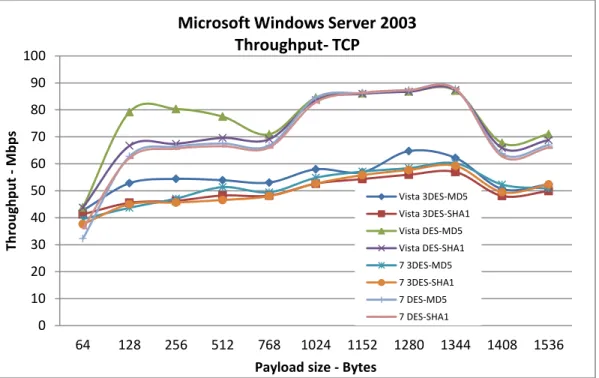
Figure 14: TCP IPv4 Throughput (IPSec Algorithms) – Microsoft Windows Server 2003 ... 54
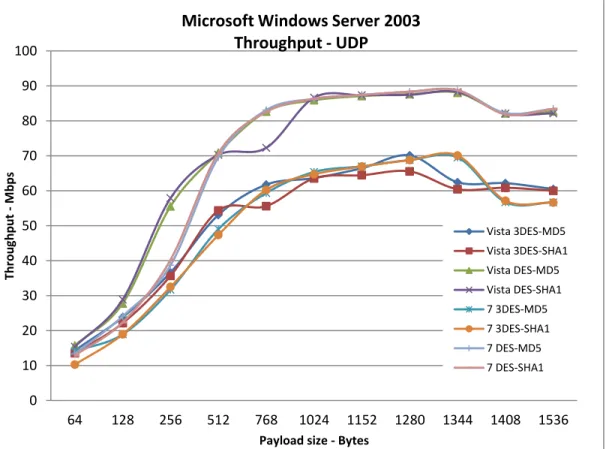
Figure 15: UDP IPv4 Throughput (IPSec Algorithms) – Microsoft Windows Server 2003 ... 55
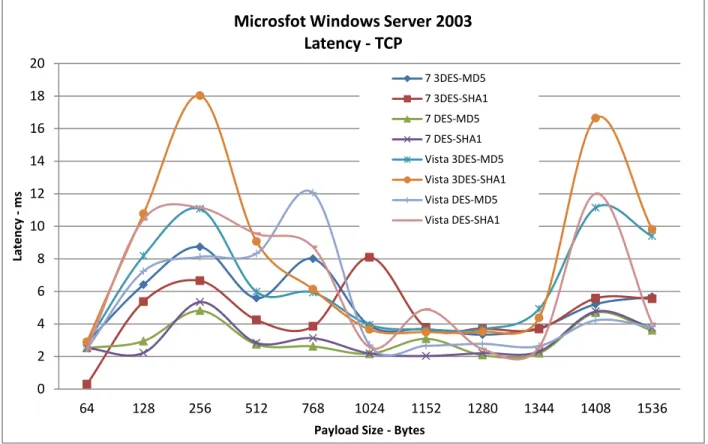
Figure 16: TCP IPv4 Latency (IPSec Algorithms) – Microsoft Windows Server 2003 ... 57
Figure 17: UDP IPv4 Latency (IPSec Algorithms) – Microsoft Windows Server 2003 ... 58
Figure 18: TCP IPv4 Jitter (IPSec Algorithms) – Microsoft Windows Server 2003 ... 60
Figure 19: UDP IPv4 Jitter (IPSec Algorithms) – Microsoft Windows Server 2003 ... 61
Figure 20: TCP and UDP IPv4 Throughput (3DES-MD5 IPSec Algorithm) – Microsoft Windows Server 2003 ... 63
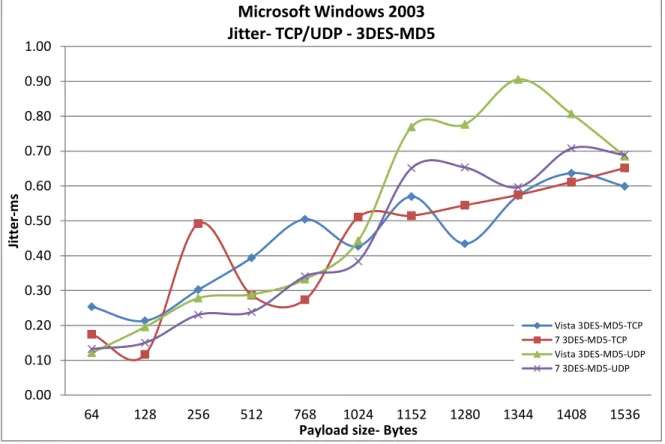
Figure 21: TCP and UDP IPv4 Latency (3DES-MD5 IPSec Algorithm) – Microsoft Windows Server 2003 . 64 Figure 22: TCP and UDP IPv4 Jitter (3DES-MD5 IPSec Algorithm) – Microsoft Windows Server 2003 ... 65
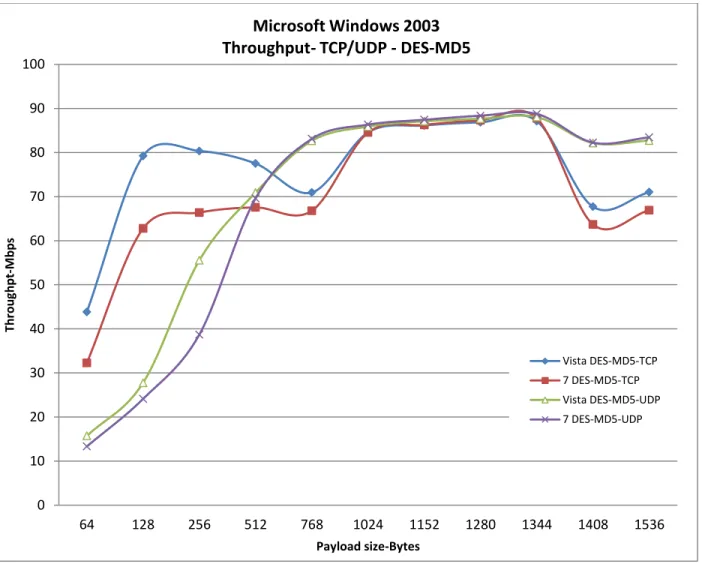
Figure 23: TCP and UDP IPv4 Throughput (DES-MD5 IPSec Algorithm) – Microsoft Windows 2003 ... 67
Figure 24: TCP and UDP IPv4 Latency (DES-MD5 IPSec Algorithm) – Microsoft Windows 2003... 68
Figure 25: TCP and UDP IPv4 Jitter (DES-MD5 IPSec Algorithm) – Microsoft Windows Server 2003 ... 69
Figure 26: Algorithm performance – TCP – IPSec - IPv4 – Microsoft Windows Server 2003 ... 70
Figure 27: TCP IPv4 Throughput (IPSec Algorithms) – Microsoft Windows Server 2008 ... 72
Figure 28: UDP IPv4 Throughput (IPSec Algorithms) – Microsoft Windows Server 2008 ... 74
Figure 29: TCP IPv4 Latency (IPSec Algorithms) – Microsoft Windows Server 2008 ... 76
Figure 32: UDP Jitter IPv4 (IPSec Algorithms) – Microsoft Windows Server 2008 ... 80 Figure 33: TCP and UDP IPv4 Throughput (3DES-SHA1 IPSec Algorithm) – Microsoft Windows 2008 ... 81 Figure 34: TCP and UDP IPv4 Latency (3DES-MD5 IPSec Algorithm) – Microsoft Windows Server 2008 .. 82 Figure 35: TCP and UDP IPv4 Jitter (3DES-SHA1 IPSec Algorithm) – Microsoft Windows Server 2008 ... 83 Figure 36: TCP and UDP IPv4 Throughput (DES-MD5 IPSec Algorithm) – Microsoft Windows Server 2008
... 85 Figure 37: TCP and UDP IPv4 Latency (DES-SHA1 IPSec Algorithm) – Microsoft Windows Server 2008 ... 86 Figure 38: TCP and UDP IPv4 Jitter (DES-SHA1 IPSec Algorithm) – Microsoft Windows Server 2008 ... 87 Figure 39: TCP and UDP IPv4 Throughput (AES256-SHA1 IPSec Algorithm) – Microsoft Windows Server
2008 ... 88 Figure 40: TCP and UDP IPv4 Latency (AES256-SHA1 IPSec Algorithm) – Microsoft Windows Server 2008
... 89 Figure 41: TCP and UDP IPv4 Jitter (AES256-SHA1 IPSec Algorithm) – Microsoft Windows Server 2008 .. 90 Figure 42: Algorithm performance – TCP – IPsec- IPv4 – Microsoft Windows Server 2008 ... 91 Figure 43: TCP IPv4 Throughput (3DES-SHA1 IPSec Algorithm) – Microsoft Windows Server 2003 vs 2008
... 92 Figure 44: TCP IPv4 Latency (3DES-SHA1 IPSec Algorithm) – Microsoft Windows Server 2003 vs 2008 ... 93 Figure 45: TCP IPv4 Jitter (3DES-SHA1 IPSec Algorithm) – Microsoft Windows Server 2003 vs 2008 ... 94 Figure 46: Algorithm performance – TCP –IPSec - Microsoft Windows Server 2003 vs 2008 ... 95 Figure 47: Algorithm performance Microsoft Windows Server 2003 vs 2008 ... 96
ISCG 9027 Thesis by Rashikala Weerawarna ix
List of Tables
Table 1 : Related research on IPv4/IPv6 performance evaluation on different operating systems ... 15Table 2 : The position of security protocols on OSI model ... 23
Table 3 : VPN protocol summary ... 24
Table 4: OSI Reference Model ... 28
Table 5 : TCP/UDP Comparison ... 28
Table 6 : Related Research 1 ... 35
Table 7 : Related Research 2 ... 36
Table 8: Comparison network performance monitoring tools ... 49
Table 9: Hardware Specification ... 50
Chapter 1: Introduction
There is a great interest in organizations to expand their businesses to larger geographical areas. As a result of this enterprise, networks need to enable mobility across wired and wireless Local Area Networks (LANs). Since the needs of Internet have increased, the ultimate challenge for network designers is to allow the targeted networks to access sensitive corporate information in a secure manner via Internet. VPN technology is a technology that has been in existence for a while and it is a proven technology that allows businesses to transmit corporate data securely and economically over a large distance. The following figure (Figure 1) illustrates the basic architecture behind the VPN. This research study focuses on TCP and UDP performance evaluation on a VPN environment with different IPSec algorithms as parameters on four different Microsoft Windows operating systems.
Figure 1 : Virtual Private Network
A brief overview will be given in the next section to introduce the research thesis.
1.1
Overview
During the past few decades the growth of the VPN has gone beyond the imagination of its original makers and has become generally used in the networking industry. It is constructed as a private network within a public network infrastructure such as the global Internet by following the properties of a point-to-point private link, which provides a secure communication channel. As VPNs continue to evolve with a growing number of options, they
ISCG 9027 Thesis by Rashikala Weerawarna Page 2
are much more attractive to small business owners for providing secured communication over a public infrastructure like Internet (Breslau, Chase, Duffield, Fenner, Mao, & Sen, 2006; Narayan, Brooking & De Vere, 2009). This unique VPN environment can be provided in many different architectural ways. Breslau et al. (2006) state that in a provider-based VPN, rather than connecting customer sites together using dedicated private lines, each customer site connects to one or more edge routers in the provider network. Such provider-based VPNs provide a scalable and secure way for a service provider to support many customers across its backbone.
One of the prime concerns about the VPN environment has been security over the private network territory. Its ability to provide secure communication by using the public network has created great interest among industries. As Breslau et al. (2006) note, VPN adds security procedures and protocols over insecure communication channels, and enterprise networks are increasingly turning to VPNs to connect geographically separate locations. Nowadays most of the organizations exist at different geographic locations and may span many geographical areas. This geographical distance challenges Information Technology (IT) infrastructure developers to think about their service security and efficiency. Narayan, Brooking & De Vere (2009) state that VPN has become a secure connection between geographically distributed network sites. In 2010 Narayan, Fitzgerald & Ram mentioned that there are numerous protocols, mechanisms and algorithms that can be used to implement VPN to encrypt and authenticate data as it travels between different locations.
Operating systems, protocols, and network media are at the core of the VPN systems that crucially facilitate better performance and security. According to earlier research, VPN provides different performance on different operating systems such as Microsoft Windows Server 2003, 2008, Microsoft XP, Vista, 7 and Linux. The VPN protocols like Point-To-Point Protocol (PPTP), Layer 2 Tunnelling Protocol (L2TP), IPSec have also been given prime observing targets with wired and wireless communication media.
All networking concepts are covered by Internet Protocol (IP). IPv4 (IP version 4) was introduced by the Internet Engineering Task Force (IETF) in the mid 70s. However, due to the
massive growth of Internet usage, IPv4 has run out of usable IP addresses, which creates a great need for another IP version. The evolution of new IP address versions has created massive research opportunities to researchers all over the world. It has become indeed a prime networking research study area.
A historical fact helps us to understand the background history and connect the present situation and how it arose in a way that everyone accepts. Since the Advanced Research Projects Agency Network (ARPANET) has been developed, researchers have worked on different networking research areas based on different networking architectures. VPN technology has been studied over a wide range of its occurrence, from performance observations of VPN protocols, payloads, and operating systems, to IP versions. Historical facts on VPNs research that I have come across have given me the motivation to conduct research on VPN that can benefit this fast moving networking industry. My motivation for this study is shown in the following section.
1.2
Motivation for this study
Realising the importance of the usage of VPN technology in industry motivated me to conduct research on this powerful and extremely important networking area. Rapid Internet growth is creating a requirement for a new IP version, which leads to a significant research opportunity for researchers. However, the complexity of converting the networking architecture to a fully IPv6 oriented platform and the inability of IPv6 to communicate with IPv4 directly have stopped further network upgrades in some business environments. Even though some networking giants like Microsoft, IBM, and Google have fully upgraded to IPv6, the IPv4 platforms are still in use. This thesis has been conducted on IPv4 and will provide information on the different performance of algorithms utilised in VPN protocol IPSec. It provides details of transmission protocols TCP/UDP and says which protocol gives the best network performance on VPN LAN and on which operating system. Research problems addresses in this research and its relevance are noted in the following section, 1.4.
ISCG 9027 Thesis by Rashikala Weerawarna Page 4
1.3
Research problem
As it is explained above, there are some research questions that have been raised that address the prime objective of this thesis study.
The main research question is:
“Which combination of IPSec algorithm and operating system give the best network performance when measured for TCP/UDP traffic?”
The sub questions that need to be answered are:
Does TCP/UDP network performance vary when implemented on a different client operating system on a Local Area Network?
Does TCP/UDP network performance vary when implemented on a different server operating system on a Local Area Network?
Which client operating system gives the best performance for IPSec cryptographic algorithm when measured for TCP/UDP traffic types?
Which server operating system gives the best performance for IPSec cryptographic algorithm when measured for TCP/UDP traffic types?
The structure of this document thesis outline will be explained in the following section.
1.4
Thesis outline
This thesis has seven Chapters along with sub topics that lead the research study in a step-by-step progression throughout the research. Chapter one provides an introduction and overview of the purpose of this research study, followed by the structure of this thesis document. The novelty of the research is presented in Chapter two by reviewing multiple threads of research on this topic and also related study areas that are discussed clearly in this Chapter. This introduces the importance of network and network performances followed by all the components related to this study such as VPN, IPv4, IPv6, VPN protocols, TCP and UDP, cryptographic algorithms, metrics and prior research and studies that have explored different operating systems. Research gaps are identified and research analysis done to reveal the
research question. The research methodology is presented in Chapter three along with the data recording methods used in the data collection phase of this study. Chapter four explains the specifications of all hardware and software employed in this research as well as the test-bed network design for this experiment. All data gathered during the experiments are shown in Chapter five with the test phases in line with the charts. The results of this research together with in depth discussions of the findings are presented in Chapter six. The research conclusions are made in Chapter seven. It summarises the research findings that provide a better solution for a VPN environment. Prospects for future work arising from the research are also discussed in Chapter Seven.
1.5
Chapter Summary
This Chapter has provided an overview of the research study by explaining the historical facts of the research area, the motivation behind the study, and the research questions that are going to be answered and its relevance. Research contributions from this study are also overviewed in this Chapter, and finally the outline of the thesis document is clearly explained.
Because of the research problem, the topic area and the purpose, previous research literature is reviewed in order to define a theoretical framework to use for the study and to understand what others have done in the same areas. Therefore, to achieve good research results a literature review of the research area is carried out in the next section, Chapter two.
ISCG 9027 Thesis by Rashikala Weerawarna Page 6
Chapter 2: Literature Review
This section gives an overview of the research domain and the prior research studies that have been explored in regards to this research stream. It considers the demands, such as what analysis has been done before, what questions have been addressed and answered before, and what results have been produced. The existing data availability with the same research theme was analysed to confirm this research distinctiveness.
Firstly, general networking and the importance of networking performance will be overviewed in terms of understanding the overall networking philosophy as a foundation for this research study. This is followed by the main components of this research, such as VPN, IPv4, IPv6, VPN protocol IPSec, TCP/UDP and algorithms that are overviewed in terms of understanding the technological philosophy. Furthermore, the research that had been done on wired VPN with different operating systems will be discussed to identify the research gaps in order to develop this research study. Literature was gathered from credible resources like IEEE Computer Society, ACM, Conference papers and books published in the networking stream. Reviewing the literature begins in section 2.1 with exploring the computer networking research stream and the importance of networking.
2.1 Computer Networking and the Importance of a Network
Since this research area is mainly wrapped around the term “network “, it is a fair beginning for the research to define and examine its industry acceptance. Ferguson & Huston (1998) state that a network consists of any number of devices which can communicate through some arbitrary method, and devices of this nature include computers, routers, printers, and may reside in geographically diverse locations. A computer network can be defined as a group of systems that are interconnected to allow sharing of resources such as files, printers, services, and that the main two aspects of a setting up a network are the hardware used to connect the system together and the software installed on the computer to allow them to communicate with each component in network (Burg & Kenny, 2000). They further mentioned that early
networking goes back one and half decades before the invention of LAN technology in the early 1970s with the US Air Force SAGE network implementation.
Information and communication (ICT) are two of the most important strategic items for the success of every enterprise system. Even though nearly every organization uses a substantial number of computers, other technological tools (printers, scanners, projectors, cameras) and communication tools (telephones, fax, personal handheld devices), still may be isolated. However, although managers today are able to use the newest applications, many departments still do not communicate and much needed information cannot be readily accessed. To overcome these obstacles in effective usage of information technology, computer networks are necessary in the ICT environment in every enterprise system. Only with the help of computer networks can a borderless communication and information environment be built that allows users to access the network in many different ways.
To cater for the demand of the networking stream there are different types of computer networks available in the world that vary in size, topology and medium. However, variations do not matter, as using the computer network concept is important regardless of the variations. According to Burg and Kenny (2000), in the mid-1990s, LAN was created with personal computers and other devices linked together, and had become the prominent computer architecture in institutions. Smith (2002) said that the “importance of computer networking is nowhere more evident than in the phenomenal growth of the World Wide Web”. The ability to access remote programs and remote databases either of the same organization or from other enterprises or public sources through a computer network makes communication faster than other facilities. Beside the above major reasons, an organization should have a computer network because of the factor of cost reduction through sharing hardware and software resources, the high reliability of multiple sources of supply, and the greater flexibility from connecting various devises from various vendors. Considering all the above, it is obvious that there is a great need for computer networking all over the enterprise systems. When networking people realised the importance of network performance it became a necessity. As a result of this understanding, network performance has been researched enormously by various
ISCG 9027 Thesis by Rashikala Weerawarna Page 8
researchers in many different domains. Previous research done in the network performance area will be reviewed in the next section, 2.2.
2.2 Performance of a network
Networking is mostly about connecting devices together to communicate in some fashion, to transmit and received data, and to share information, services, and resources. When data is sent from one place to another, a significant characteristic of any network is its speed, which determines the overall performance of a network. While network performance is a crucial task in network administration, network performance evaluation has become one of the major threads in the ICT world. Park, Kirn and Crovella (1997) stated that there are number of papers that have studied the implications of long-range dependence on traffic modelling and network performance evaluation. Also, that different aspects of network performance may vary and there are generic factors which influence the performance of a LAN.
Research studies of network performance can be done based on the different hardware, software, protocols, services, technologies, traffic information, and use within the network. Park, Kirn and Crovella (1997) classified network performance research avenues into two categories; one deals primarily with traffic characterization and modelling issues, with the other concentrating on the performance evaluation side. Hong and Li (2009) studied the impact of information on network performance and propose a general information theoretical framework which can be applied to any network. Narayan, Graham & Barbour (2009) have done a literature review on generic factors that influence the performance of LAN, mainly focusing on the performance and metrics of commonly used operating systems that have been implemented to create IT infrastructure. Their literature findings show that performance analysis, internet protocols and wireless are the major themes in literature.
Protocols and network media play a major role in a network to establish network communication channels and maintain performance. Narayan, Graham & Barbour (2009) state that IP is the basic building block used to enable information technology communication
channels and to improve the performance of the overall operating system and the network, which proves that the performance of the IP stack needs to be improved. Qiang & Nagurney (2008) published information on unified network performance measures and stated that in order to be able to evaluate the vulnerability and the reliability of a network, a measure that can quantifiably capture the efficiency or performance of a network must be developed.
Network performance has been tested by different network parameters. These parameters are called performance metrics that can be measured to evaluate the performance of a network. Many researchers have observed performance metrics such as delay, jitter, and throughput as well as Central Processing Unit (CPU) utilization when investigating performance evaluation in the real network environment. Narayan, Graham and Barbour (2009) stated that when analysing network performance for both effectiveness and efficiency, the performance metrics need to be selected carefully. They also say that in performance analysis literature, the most common evidence is throughput, round trip time (latency) and CPU utilization. Hong and Li (2009) studied the relationship between network information and network performance and stated that network information, channel state, traffic information and network topology are essential factors in a network performance. They further mentioned that the more you have network information, the more protocol will be efficient which leads more network performance. On the other hand collecting and disseminating of network information consumes more bandwidth.
Throughput is one of the valuable metrics in network performance and does the end-to-end measurement. Narayan, Graham & Barbour (2009) mentioned that “the most common metric evident in literature is throughput”, by explaining that the importance in understanding total network performance. They further said that the percentage of CPU utilization is also a valid metric in literature. Since the CPU resources are utilised by other processors running on the nodes, Narayan, Graham and Barbour (2009) mentioned that the percentage of CPU utilization of nodes also a valid metric. All the above literature statements prove that the common network performance metrics are throughput, jitter, CPU usage, TTL, and latency, which react in many different ways according to the protocols and architecture of the network.
ISCG 9027 Thesis by Rashikala Weerawarna Page 10
The following section, 2.3, reviews the previous research areas that are specifically relevant to this research in order to define a theoretical framework for this research study. It reviews IP versions, VPN technology, VPN protocol IPSec, TCP/UDP, cryptographic algorithms and finally the metrics researched.
2.3 Relevant Researched Areas
This research includes several network areas such as IPv4 and IPv6, VPN, VPN protocols, TCP, UDP, cryptographic algorithms and research metrics, which will be discussed in the next few sections.
2.3.1 Internet Protocol - IPv4 and IPv6
Components in a network cannot communicate each other unless we install software. We call such a software program a protocol, which enables the rituals of communication in a network. IP is one of the most ubiquitous features of networking, so that any of the hardware, software or any networking product needs to be generally accepted, regardless of whether it is from a computer vendor like IBM, Microsoft, Apple, Sun, Novell, Compact, Netscape. IP is capable of linking networks, which requires mainly three things. Firstly, every component in the network needs to be uniquely identified; secondly, it must be able to send and receive data to and from other components in a format that everyone can understand, and finally, data transmission need to be reliable (Loshin, 1999; Salus, 2000; Raicu & Zeadally, 2003). IP did not start becoming common until the late 1980s and early 1990s. According to Das (2008), Loshin (1999) and Salus (2000) even then it was marketed as a specialty until the 1995 Transmission Control Protocol and Internet Protocol (TCP/IP) was incorporated into personal computer products. Since then TCP/IP has become the protocol suite used by most small, medium and large networking environments and has operated across the globe as the protocol of the Internet.
TCP/IP is a full suite of protocols as shown in Figure 2, and it contains five layers called Physical, Link, Network, Transport and Application. The representation from the sender’s end to the receiver’s end uses layers which are conceptually derived from the Open System
Interconnection (OSI) model with seven layers called Physical, Data Link, Network, Transport, Session, Presentation and Application. Although OSI is the only the internationally accepted set of standards for communication, it is barely used by the manufacturers. TCP/IP was already in use and was popular among the technical community (Loshin, 1999). The entire networking philosophy is wraparound with OSI model with different architectural ways.
Figure 2: TCP/IP protocol suite
The numbers of products that incorporate IP from computer hardware and software to mobile computer devices and home entertainment products with wireless Internet connectivity, demonstrates how important IP is to the world of communication infrastructure. IP is one of the protocols in the suite which provides globally unique addresses in dotted quad notation, transmits data in packets and performs routing between IP based networks. IP is basically responsible for a unique address, connectionless communication, which means that no effort is made to set up a dedicated end-to-end virtual connection, routing, which means the process of moving data from one network to another by forwarding packets via gateways, and unicasting, broadcasting and multicasting. There are two versions of IP, Internet Protocol version 4 (IPv4) and Internet Protocol version 6 (IPv6). IPv4 was developed in the mid 70s, and IPv6 was developed in the late 90s, (Das, 2008; Loshin, 1999; Salus, 2000). IPv4 turned out to be the most widely deployed network layer protocol and the only standard internetwork-layer protocol used on the Internet. More information about the two IP versions will be explained in the next two sections.
Application Layer Transport Layer Network Layer Link Layer Physical Layer Telnet FTP TFTP TCP UDP ICMP IP ARP
Local Network Protocol Physical Transmission Media
ISCG 9027 Thesis by Rashikala Weerawarna Page 12
2.3.1.1 IPv4
Internet Protocol version 4 or IPv4 is the most widely used network layer protocol on the Internet. IPv4 is a data oriented protocol used over packet switched networks that neither guarantees the delivery nor the correctness of the data delivered. IPv4 offers 32-bit (4Bytes) address space of 232 that is equivalent to about 4,294,967,296 (4.3 billion: 232) unique addresses on the network. The IPv4 protocol is described in IETF RFC 791 (September 1981). (Loshin, 1999; Salus, 2000; Das, 2008; Narayan, Lutui, Vijayakumar, & Sodhi, 2010; Narayan & Shi, 2010; Narayan & Tauch, 2010) In 2008 total unallocated address space remained at 16% and it was commonly accepted that IPv4 would run out of addresses by the end of 2010 or 2011 (Narayan, Kolahi, Sunarto, Nguyen & Mani, 2008). Before the Internet exceeded the expectation of the original developers limit, IPv4 was the most suitable IP version for Internet without any doubt.
IPv4 limitations
Due to the tremendous growth of the Internet, public IP addresses of IPv4 exceeded the limits of the IP architecture, which led the TCP/IP engineers and designers to rethink the need for an upgrade as early as the late 1980s. The IP upgrade was mainly motivated by the IP address space crisis and also some improvements were being targeted at the same time. Although IP performed remarkably well everyone believed that there was a needed for improvement in performance, security and the auto configuration feature. However as a result of this space crunch identification, in the late 1999 IETF started an IPng (IP next generation) development. After many discussions under RFC 1550, around 1995 IETF chose the IPv6 version as the final IPng proposal, and base specifications were specified in RFC 2460. With an increasing number of networked devices, there was a real threat of address space exhaustion that was successfully prevented by the much larger address space offered by the IPv6 (Loshin, 1999; Salus, 2000;
Raicu & Zeadally, 2003). As a result of this space crunch, a new era of IP, version IPv6, has arisen. This new version’s structure and capabilities will be explained in the following section.
2.3.1.2 IPv6
IPv6 offered an address space of 2128 or approximately 5x1028 (2128) unique addresses to be used over the Internet. The IPv6 protocol is described in the IETF RFC 2460 (1998). IPv6 addresses are four times as long as IPv4 addresses: the basic representation of an IPv4 address is in the form X:X:X:X:X:X:X:X, where X refers to four digit hexadecimal integers (16 bits). IPv6 addresses are broken into two portions, the subnet prefix and the interface ID. For example 1020:0:0:0:C9B4:FF12:48AA:1A2B/60 indicates that the first 60 bits refers to a subnet prefix, for routing purposes. There are basically three types of IPv6 addresses, the unicast, multicast and anycast. Broadcast addresses are no longer available with IPv6. As per the RFC 2373, the unicast address is an identifier for a single interface, so the packet sent to a unicast address is delivered to the interface identified by that address. The multicast address is an identifier for a set of interfaces. When the packet is sent to a multicast address, it is delivered to all interfaces identified by that address. The anycast address is an identifier for a set of interfaces. (Loshin, 1999; Salus, 2000; Raicu & Zeadally, 2003; Das, 2008; Narayan & Shi, 2009). The format of the architecture of IPv6 has proved to be a valuable answer for the IPv4 space crunch because of its additional features.
2.3.1.3 IPv4 and IPv6 comparison
When the RFC 2460 the changed from IPv4 to IPv6, it expanded the addressing capabilities by improving the address size from 32 to 128, it simplified the header information by dropping or making optional of some IPv4 header information, it improved support for extension and options by changing the way IP header options are encoded for efficient forwarding, it added a new capability to enable the labelling of the packets, and it also added extensions to support authentication, data integrity and data confidentiality (Salus, 2000). Dias (2008) and Narayan & Tauch (2010) stated that the resulting IPv6 protocol offers various improvements, such as a significantly larger address space (from 232 to 2128), enhanced the user benefits, a simplified header structure, and enhanced security. It is fully interoperable and offers a smooth transition, contains provision for flexible protocol, auto configuration, multicasting, better provisions for ad-hoc networking that is required by the different wireless devices and integrated Quality of
ISCG 9027 Thesis by Rashikala Weerawarna Page 14 4-bit 4-bit 4-bit 8-bit 3-bit
Service (QoS). Govil (2007) stated that IPv6 offers many enhancements like increased addressing capacity and capabilities, built in IPSec security, mobility QoS control, and improved routing efficiency. On the next page Figure 3 illustrates the IPv4 and Figure 4 illustrates the IPv6 header format to show the difference between the header information of the two IP versions. Version Header Length Type Of Service Datagram Length
Datagram ID Flags Flag Offset
TTL Protocol Checksum
Source IP Address Destination IP Address
Options
Figure 3: IPv4 header format
Version Traffic Class Flow Label
Payload Length Next Header Hop Limit
Source IP Address Destination IP Address Figure 4: IPv6 header format
(Loshin, 1999; Salus, 2000) Even though IPv6 resolved the address space crunch, it has not succeeded in the transformation from IPv4 to IPv6 as we expected and as IETF planned. Narayan, Lutui, Vijayakumar and Sodhi (2010) stated that there are many reasons that IPv6 uptake is slow, such as that IPv4 to Ipv6 conversion is a massive undertaking due to the configuration changes of many computers on the global network and the supporting networking infrastructure hardware
8-bit 20-bit
16-bit
8-bit 128-bit 1288-bit -bit 4 0 B y tes 20 B y tes 32 bits 32 bits 16-bit 16-bit 13-bit 8-bit 16-bit 32-bit 32-bit
(Narayan, Lutui, Vijayakumar and Sodhi , 2010)
with the use of Network Address Translation (NAT). They divided this transaction mechanism into three categories;
1. Dual stack (where devices are loaded with both IPv4 and IPv6 stack to allow communication with both types of devices)
2. IPv4/IPv6 translation (accepts from one version, converts to another and then sends to destination in the desired version)
3. IPv4/IPv6 tunnelling (where IPv6 packets are encapsulated with Iov4 and then sent on conversional IPv4 network)
(Narayan, Lutui, Vijayakumar and Sodhi , 2010; Narayan, Kolahi, Sunarto, Nguyen & Mani, 2008)
Most researchers have concentrated on this building block of Internet architecture. On account of the concentration on this research thread, extensive studies have been conducted related to performance evaluation of IPv4 and IPv6 on different operating systems. Narayan, Shang and Fan (2009) have done research on performance evaluation of IPv4 and IPv6 on Windows Vista and Linux Ubuntu and concluded that IPv4 gives a slightly better throughput than IPv6 with packets sizes that are larger than 256Bytes; however, the performance is almost identical for small packet sizes. The IPv4 and IPv6 performance evaluation done in different operating systems is tabulated in Table 1.
Researcher(s) Operating System(s)
Narayan, et.al (2010) Windows 2008, Fedora, Ubuntu (IPv4, IPv6)
Narayan, Sheng & Fan (2008) Windows Vista and Ubuntu (IPv4, IPv6) Narayan, et.al (2008) Windows Server 2003 & XP (IPv4, IPv6)
Visoottiviseth&Bureenok (2008) Windows 2003, Red Hat 9.0, FreeBSD 5.3 (IPv4, IPv6) Mohamed, Buhari & Saleem (2006) Windows 2003, Red Hat 9.0, FreeBSD 4.9 ( IPv6) Ahuja & Dendukuri (2006) Windows 2000 and Linux (IPv4, IPv6)
Zeadally, Wasseem & Raicu (2004) Windows 2000, Solaris8 &Redhat 7.3 (IPv4, IPv6) Zeadally & Raisu (2003) Windows 2000, Solaris8 (IPv4, IPv6)
Anand (2000) Linux Kernal 2.4.17 (IPv6)
Ettikan (2000) FreeBSD (KAME IPv6)
Ariga, et.al (2000) FreeBSD (KAME IPv6)
Xie (1999) Windows NT (MSR IPv6 Beta)
Draves, Mankin&Zill (1998) Windows NT (MSR IPv6)
ISCG 9027 Thesis by Rashikala Weerawarna Page 16
Since IP version is a major component in every kind of networking, it gave an impetus to this VPN study. It is vital to understand the IP versions when conducting research into networking framework. However since this thesis is mainly concern with VPN technology, the next section, 2.3.2, reviews previous research done on VPN architecture.
2.3.2 Virtual Private Network
VPN utilization has become common in the business world with the exponential development of Internet. There has always been a clear division between public and private networks. A public network is a large collection of unrelated peers that exchange information freely with each other, such as Internet and public telephone systems. A private network, on the other hand is composed of computers owned by a single organization, which share information specifically with each other. While the public networks can be accessed by any given person, regardless of commonality of Internet access, private networks assure communication only between people in a specific group that has the common requirement of accessing similar information with each other. The line between public and private networks has always been drawn by the gateway router. In the early 1990s, emergence of the VPN concept blurred the line between public and private networks and moved the network technology to a new stage. Nobody stepped forward to patent the idea at the beginning, because there was neither a private nor secure connection between a server and its multiple interfaces (Scott, Wolfe, & Erwin, 1999; Bestvpnserver, 2012). However, VPN was vastly improved with the help of the biggest company, Microsoft, in the computer software industry. Therefore, the conclusion can be made is that it is worth the effort to conduct a research on this ubiquitous computing (ubicomp) technology. In the next section, a thorough VPN study begins by revealing the literature that understands the architecture and functions of VPN.
2.3.2.1 What does a VPN do?
This section gives an overview of VPN architecture by explaining its functions and features. A VPN is a way of simulating a private network over the public network that can be created using hardware, software, or combination of both. It creates a secure connection between
peers over a public network using encryption, authentication, packet tunnelling and firewalls. Since it depends on the use of a virtual connection, it is called “virtual”. The term “VPN,” or Virtual Private Network, has become almost ubiqitous in the networking industry as a secure communication technology. Scott, Wolfe, & Erwin (1999) pointed out that the main idea behind VPN is to create a private, secure point-to-point communication channel via tunnelling and/or encryption across a private or a public network like Internet. They further mentioned that secure virtual connection can be created between a machine and a network, two machines or two networks. As an example, the VPN can provide a secure connection between a salesperson’s laptop and the Intranet web server running the database. MicrosoftTechnet (2001) stated that VPN creates links across shared or public networks and it is an extension of a private network. It enables you to transfer data between two nodes across a shared or public network like Internet by following the properties of a point-to-point private link. Figure 5 illustrates how MicrosoftTechnet sees the architecture of VPN.
Figure 5 : A VPN Connection
Narayan, Kolahi, Brooking, & de Vere (2008) came up with a somewhat formal characterization of the VPN term:“VPN is a technology that provides secure communication for data as it transits through insecure regions of information technology infrastructure.” In 2009 Narayan, Kolahi, & de Vere stated that; “VPN is commonly used in business situations to provide secure communication channels over public infrastructure such as Internet. And VPN is a proven technology that does provide security strong enough for business use.” In 2010 Narayan, Fitzgerald & Ram defined VPN as “an inexpensive methodology to secure connections between network sites that exist at different geographic locations.” According to Diab, Tohme and Bassil (2007), VPN is considered as a stronger security solution for the communication between nodes in an intranet over the unsecured IP networks. McGregor & Lee (2000) also provided a more
ISCG 9027 Thesis by Rashikala Weerawarna Page 18
approximate, simpler and formal description. The methods of constructing the VPN solutions differ depending on the various VPN application scenarios.
VPN architectures can be divided into three common scenarios: site-to-site Intranet VPN, remote access VPN and extranet VPN. Multiple network sites are located at different geographical locations but connected with each other within the same organization using VPN named as site-to-site Intranet VPN (Figure 6).
Figure 6: Site-to-Site VPN
So each site can have multiple subnets that create a cooperate intranet, and using VPN, each site can be formed into a large intranet. If a VPN is use to connect a single remote network device, such as a portable computer, to, connect to a cooperate network via any form of connectivity such as cable modem or Digital Subscriber Line (DSL), this is called a remote access VPN (Figure 7).
Figure 7: A Remote Access VPN
If the network resources within one corporation are opened for access to other corporations for various purposes, such as business transactions, this network architecture is considered to be an extranet VPN or point-to-point network (Figure 8). Apart from that, there are software
based VPN systems that use existing Internet connections. Because the client software connection looks like it is dialling up, it is called Dial-up VPN. By using an existing Internet connection, a secure "tunnel" is created between two points allowing a remote user to connect to a remote network. This can be set up with various types of software or hardware, but it requires third party software to be loaded on remote workstations (Rodriguez, 2008; Diab et al., 2007; MicrosoftTechnet, 2003; Yuan et al., 2001; Bestvpnserver, 2012). Pena & Evans (2000) described the VPN software solution as an alternative VPN solution implemented in software that provides economical and accessible advantages and has a significant impact on performance, producing high CPU usage and limiting network throughput.
Figure 8: Extranet VPN
The essence of creating this cohesive VPN architecture is that it assembles many computer technological components to provides practical solutions for organizational communication. There are mainly four categories of components: tunnelling, authentication, access control and data security, which make both the “virtual” and “private” aspects of VPN (Scott, Wolfe, & Erwin, 1999; Yuan et al., 2001). In the next few sub topics, information about the above mentioned components will be reviewed.
Tunnelling
Tunnelling is an architectural concept in which virtual topology is created on top of the physical topology with one or more repeated protocol layers. It is simply a method of using a network infrastructure to transfer data for one network over another network. A packet travelling from
ISCG 9027 Thesis by Rashikala Weerawarna Page 20
host A to host H passes through each node along the path, in this case B through G and there is no way to skip any of these nodes. However, if node C takes the original packet and places it completely within a new packet addressed to node F then as the new packet passes through nodes D and E, these nodes would only know the packet as if it were addressed to F. They would not know the original destination H. Therefore, in this case it can be said that the original packet is tunnelled from D to F, represented by the heavy line in Figure 8. Tunnelling can be used in any network layer but the most common layers are layer 2- Data link layer and layer 3, Network layer. In Layer 2 tunnelling, a link layer frame is placed into the payload of a protocol data unit from some other layer. Examples for layer 2 protocols are Point-To-Point Protocol (PPTP), Layer Two Forwarding Protocol (L2F) and L2TP. A layer 3 tunnelling and a layer 3 packet are placed into the payload of some other layer. IPSec protocols Authentication Header (AH) and Encapsulating Security Payload (ESP) tunnel modes are good examples of layer 3 protocols (Diab et al., 2007; Yuan et al., 2001). Tunnelling is one of the main features in the VPN process.
Authentication
Authentication is an essential technique in VPN since it ensures communication between correct users or hosts. This technique typically performs at the beginning of the session by allowing the user to log in to a system with a username and password and also perform randomly during the session. Most VPN authentication systems are based on a shared key system, in which the keys are run through hashing algorithms and generate a hash value. The other end holds its own hash value and compares it to the one it received from the other end. The actual hash value sent across the Internet is meaningless to an observer, which prevents sniffing. The Challenge Handshake Authentication Protocol (CHAP) is an example of this process (Yuan et al., 2001). According to MicrosoftTchnet (2003), there are three types of authentication for VPN connections. In the User authentication the VPN connection is established after the VPN server authenticates the VPN client attempting the connection and verifies that the VPN client has the appropriate permissions. The user attempting the L2TP/IPSec or PPTP connection is authenticated using Point-to-Point (PPP) based user authentication protocols like Microsoft Challenge-Handshake Authentication Protocol (MS-CHAP), Microsoft Challenge-Handshake Authentication Protocol version 2 (MS-CHAP v2),
Extensible Authentication Protocol-Transport Layer Security (EAP-TLS), Password Authentication Protocol (PAP) and Shiva Password Authentication Protocol (SPAP). The Computer authentication with L2TP/IPSec performs computer-level authentication with IPSec, L2TP/IPSec connections and also verifies that the remote access client computer is trusted. Data authentication and integrity verifies that the data being sent on an L2TP/IPSec VPN connection originated at the other end of the connection and was not modified in transit. L2TP/IPSec packets include a cryptographic checksum based on an encryption key known only to the sender and the receiver.
Access control
When the authentication process is completed the communication sources can decide whether to continue the session or reject the session. This secure communication allows authorised access to resources. Access controls contain two features: one is the information (including the identity of the entity that is requesting access and the resources to be accessed), which is on the access controller’s decision. And the second feature is how the access controller made the decision based on the information available, which is basically a decision-making process. (Yuan et al., 2001) The access control mechanism is capable of assuring the security of VPN architecture.
Data security
The early stage of internet design was an open environment that was used for communication among the users without any central control and thus mutual mistrust was not of primary concern. This environment was a place where attacks could be quite easy and hard to prevent, detect and trace. Also it was difficult to ensure the main security goals regarding confidentiality, integrity and availability. Because of all these issues, a secure VPN over the public Internet has become vital for the IT world (Adeyinka, 2008).VPN belongs to a network that uses IP tunnels that use cryptographic techniques to provide robust privacy and security and it forms a virtual network over the Internet (Khanvilkar & Khokhar, 2004). Further, remote users get all the benefits of a private network and operations get the benefit of high security with low operational costs when using VPN.
ISCG 9027 Thesis by Rashikala Weerawarna Page 22
With the productive growth of the Internet VPN has been popular in the business environment due to its cost effectiveness, security improvements and geographically distribution. Due to the exponential growth of Internet usage, however, security has become a prominent concern (McGregor & Lee, 2000). Khanvikar and Khokhar (2004) mentioned that VPN has gained immense popularity among commercial and defence organizations due to its ability to provide secure connections at lower cost. Narayan, Fitzgerald and Ram (2008) said that the VPN solution has become an economical methodology that provides a more secure connection between geographically distributed sites. Narayan, Brooking & de Vere (2009) stated that organizations span large geographical areas and it is the ultimate goal for network designers to provide secure and efficient communication channels thorough It infrastructure. Due to VPN’s cost effective technology for secure data transmission over long distances, organizations can escape from the traditional physical cable installation over large distances (Narayan, Brooking & de Vere, 2009). According to Scott, Wolfe, & Erwin, 1999; Yuan et al. (2001), an internet service can be viewed in two ways: topologically and architecturally. Topologically, it is a collection of networks connected by gateways or routers. Architecturally, it is a collection of protocol layers that convert user data into manageable units and control the transmission. It is must to have a look at of VPN protocols need to be examined as they play a major role in networking. Section 2.3.3 reviews information from the history of VPN protocols.
2.3.3 VPN Protocols
This section defines the rules that govern the VPN as protocols. To harmonise all the different products and services in a network, several protocols have been developed over the years. In the VPN context, one of the major concerns is to provide secure connection. Narayan, Kolahi, Brooking, & de Vere (2008) stated that business environments have implemented a VPN that uses different protocols to provide secure and authentic data transfer between multiple sites connected over a public communication infrastructure. This VPN architecture with security infrastructure is provided by various VPN protocols.
VPN tunnels serve three major purposes in VPNs, such as encapsulating one protocol within another, which helps different protocols to be transported over an IP infrastructure, route
privately addressed packets through a publicly addressed infrastructure and provide private data integrity and confidentiality. Using encryption techniques, VPN is capable of preventing datagram capture and analysis while they are in the public network. Commonly, both layer 2 and layer 3 are useful for VPNs. (Wu, 2009 ; Diab et al., 2007) There are basically four categories of VPN tunnelling protocols. Layer 2 protocols such as PPTP, Layer Two Forwarding protocol (L2F), and L2TP are specifically design to tunnel PPP and protocols for session traversal across firewalls securely (SOCKS v5). Wu (2009) illustrates the tunnelling protocols position at OSI model as per Table 2.
OSI Layer Security Technology Security Protocol
Application Layer Application Agent
Presentation Layer
Session Layer Session Layer Agent SOCKS v5 / SSL
Transport Layer Network Layer
Packet Layer
IPSec
Data Link Layer PPTP/L2F/L2Tp
Physical Layer
Table 2 : The position of security protocols on OSI model
Since this arrangement is particularly useful for mobile network connections PPP, which is called multiprotocol due to the capability of carrying datagrams from multiple protocols, it has become popular for connecting two devices over the phone lines. Basically what is happening in this connection is firstly, users connect to the network on demand through public switch telephone network (PSTN) or ISDN. Then the remote user sets up a PPP connection from the remote computer to the remote access server (RAS) that is at home or work. When the PPP connection is established the remote computer starts sending IP or any datagram inside the PPP frame. Then the RAS removes the datagrams from the PPP frames and inserts them into the private network. When one intranet is connecting to another, Layer 3 tunnelling plays a most useful role for VPN’s security tunnelling within an IP network. Internet Protocol Security (IPSec), Secure Socket Layer (SSL) protocol, PPTP and Secure Socket Tunnelling Protocol (SSTP), L2TP are commonly used protocol in VPN to ensure security. Narayan, Kolahi, Brooking, & de Vere (2008) and Narayan, Brooking, & de Vere (2009) named IPSec, PPTP and SSL as widely
ISCG 9027 Thesis by Rashikala Weerawarna Page 24
used VPN protocols in the industry, both in open source implementation and commercial products.
Security is the main feature of VPN implementation as it provides integrity and encryption of data transaction by VPN protocols by implementing different algorithms. The following table (Table 3) illustrates the summary of VPN protocols. Some of the above protocols will be discussed in the next few sections.
Protocol Developed by Description
PPTP Microsoft, Ascend Communications, 3Com No longer used
L2TP Cisco company Mainly used in Cisco routers
IPSc Internet Engineering Task Force (IETF) Security Scheme of Internet protocol
suite SOCKS v5 David Koblas, a systems engineer for MIPS computer
Systems
Read more: What Is a SOCKS5 Proxy? | eHow.com http://www.ehow.com/about_6612919_socks5-proxy_.html#ixzz23DJKQ5dW
Security protocol of TCP layer Table 3 : VPN protocol summary
2.3.3.1 Internet Protocol Security (IPSec)
Internet Protocol Security (IPSec) is a protocol suite defined by the IETF which was originally developed to achieve the goal of enabling the protection of all types of Internet protocol (IP) communications by protecting multiple peers at the layer 3 network layer, in both the IPv4 and IPv6 environments. It is widely implemented in VPNs. IPSec VPNs have been deployed by many organisations to provide enterprise-level secure remote access by protecting the IP packet exchanged between remote networks or hosts and an IPSec gateway located at the edge of a private network. VPN security running on the TCP/IP protocol suite is ensured by the IPSec (Wu, 2009; Adeyinka, 2008; Narayan, Kolahi, Brooking, & de Vere , 2008; Diab et al., 2007; Yuan et al., 2001; Ferguson & Schneier, 2000; Ariga et al., 2000). According to the above research, IPSec supports a network in many ways, such as by supporting level peer authentication, data origin authentication, data integrity, data confidentiality, and replay protection. It supports a series of cryptographic security services such as DES, 3DES and AES.
IPSec is designed to allow encryption and authentication of network traffic between the host machines over an existing TCP/IP, hence it is associated with the authentication mechanism
which manages the authentication and encryption phases between the client and the gateway computers. Using an IPSec is a way of providing additional security as IPSec can implement two data encryption modes known as Transport and Tunnel. Transport mode encrypts the data portion (payload) of each packet, leaves the header untouched and is most commonly used to secure data communication within a network. On the other hand, tunnel mode encrypts both the header and the payload. It is more secure and used for securing data communication that traverses unknown third party networks. It is also used for network-to-network communication (Adeyinka, 2008; Narayan, Kolahi, Brooking, & de Vere, 2008). All the above security mechanisms are determined by different types of protocols.
The IPSec framework provides security services at the IP layer by enabling a system to select the required security protocols that determine the algorithm(s) to use for the service(s). IPSec packet level security is provided mainly by two protocols: AH and ESP. As per Narayan, Kolahi, Brooking, & de Vere (2008), AH provides guaranteed connectionless integrity and data origin authentication of the IP datagrams, and it also protects against replay packets. They also mentioned that ESP provides origin authenticity, confidentiality protection, integrity of a packet, authentication-only implementation and encryption-only implementation.
IPSec based VPNs are used in most organizations as remote access technology to establish a secure connection in entire private networks by protecting the IP packet exchanged between remote networks or hosts. Many organizations find that IPSec meets the requirements of users already using the technology. However, in this implementation IT administrators must determine who should have remote access to the network since IPSec VPNs require a client to be installed on each user machine. Therefore, this solution becomes resource intensive and cost prohibitive for large enterprises and can create more responsibilities on deployment, configuration and maintenance (Adeyinka, 2008). Recently people have sought other alternatives for IPSec VPN due to the lack of understanding of IPSec standards, and the complexities of setting up and maintaining IPSec VPNs.
ISCG 9027 Thesis by Rashikala Weerawarna Page 26
2.3.3.2 Secure Socket Tunnelling Protocol (SSTP)
SSTP is released and owned by Microsoft Co-operation. (Microsoft Tech-net, 2007) According to
MicrosoftTechnet(2007), SSTP is one of the protocols that it uses for VPN connections. It allows traffic to pass through firewalls that block the PPTP and Internet Protocol security/ Layer 2 Tunnelling Protocol (L2TP/IPSec) traffic. All the above protocols are used in VPN connections but there are differences between them in how they are executed with different operating systems.
The mechanism provided by the SSTP encapsulates the PPP traffic over the SSL channel of the Hypertext Transfer Protocol Secure (HTTPS) protocol. In this process the PPP supports strong authentication methods like EAP-TLS. With the use of HTTPS, traffic will flow through TCP port 443 (the port commonly used for web access) and transport-level security with enhanced key negotiation, integrity, and encryption will be provided by the SSL (Microsoft Tech-net, 2007). Their data flow for an SSTP-based VPN connection execution is as follows:
1. The SSTP client establishes a TCP connection with the SSTP server between a dynamically allocated TCP port on the SSTP client and TCP port 443 on the SSTP server.
2. The SSTP client sends an SSL Client-Hello message, indicating that the SSTP client wants to create an SSL session with the SSTP server.
3. The SSTP server sends its computer certificate to the SSTP client.
4. The SSTP client validates the computer certificate, determines the encryption method for the SSL session generates an SSL session key and encrypts it with the public key of the SSTP server’s certificate, and then sends the encrypted form of the SSL session key to the SSTP server.
5. The SSTP server decrypts the encrypted SSL session key with the private key of its computer certificate. All future communication between the SSTP client and the SSTP server is encrypted with the negotiated encryption method and SSL session key.
6. The SSTP client sends an HTTP over SSL request message to the SSTP server. 7. The SSTP client negotiates an SSTP tunnel with the SSTP server.
8. The SSTP client negotiates a PPP connection with the SSTP server. This negotiation includes authenticating the user’s credentials with a PPP authentication method and configuring settings for Internet Protocol version 4 (IPv4) or Internet Protocol version 6 (IPv6) traffic.
9. The SSTP client begins sending IPv4 or IPv6 traffic over the PPP link.
Massive research has been undertaken on VPN performance since its introduction relating to many areas such as protocols used, operating systems, algorithms used, and security implementation,. In relation to this research, the transmission control protocols TCP and UDP will be the next focused area (section 2.3.4) to be reviewed using various literature articles.
2.3.4 The Transmission Protocols - TCP and UDP
This section has reviewed the literature of transmission control protocols that relate to this research study. Internet Protocol suite (TCP/UDP) probably is the oldest and most popular networking standard used in the networking backbone since the ARPANET started in 1973. These file transmission protocols provide the functions of the transport layer in the OSI model, which was developed by International Standardisation Organisation (ISO) in the late 1970s.
This reference model has seven layers (Table 4) that define vendor independent protocols and standards for the interconnection of computer and network equipment. At the sending computer, the data is passed down the layers. Each layer adds information to the data for use by its peer layer in the receiving computer. At the receiving computer, the data is passed up the layers. Each layer processes the information attached by its peer layer and then passes the data to the higher layer. In effect, during communication, processes running in each layer on each computer communicate with each other as peers. Each layer of the OSI model has different protocols associated with it to handle the data that defines rules and procedures in order to communicate with processes on other systems (Bansal et al., 2004; Shelly, Cashman, & Serwatka, 2004; Xylomenos & Polyzos, 1999).
ISCG 9027 Thesis by Rashikala Weerawarna Page 28
Table 4: OSI Reference Model
As a result of the rate of internet growth, Defence Advanced Research Project Agency (DARPA) has developed a simplified model, the TCP/IP model. Unlike the OSI model the TCP/IP model, it has only four layers. The TCP/IP model is illustrated in Table 6 with the protocols that each layer uses. The application-to-application delivery is achieved through a set of functions performed at the transport layer. TCP transfers information in a different way than the UDP. The following Table 5 gives an overview of TCP and UDP protocols and Figures 9 and 10 illustrate a comparison between data packets.
TCP (Transmission Control Protocol) UDP (User Datagram Protocol) The protocol establishes a (virtual) connection between
sender and receiver. (connection-oriented)
There is no virtual connection (connectionless)
Virtual: the application layer “thinks” that a single path has been created; in reality packets can travel different physical paths: reliable connection.
The protocol is used when the application needs to send one packet quickly without the overhead of connection creation and termination: unreliable connection.
TCP packets are called segments UDP packets are called datagrams
The data delivery is slower and more complicated, and most application protocols like SMTP, HTTP, FTP and TELNET use TCP
UDP is designed for speed and is suitable for applications like video-conferencing and ping
Table 5 : TCP/UDP Comparison
OSI Refer