By Magdalena Anna Dreyer
Thesis presented in fulfilment of the requirements for the degree of
Master of Arts (Drama and Theatre Studies)
in the Faculty of Arts and Social Sciences at Stellenbosch University
Supervisor: Dr Mareli Hattingh Pretorius December 2017
Declaration
By submitting this thesis electronically, I declare that the entirety of the work contained therein is my own, original work, that I am the sole author thereof (save to the extent explicitly otherwise stated), that reproduction and publication thereof by Stellenbosch University will not infringe any third party rights and that I have not previously in its entirety or in part submitted it for obtaining any qualification.
December 2017
Copyright © 2017 Stellenbosch University All rights reserved
Abstract
This study explores the creative collaborative strategies characteristic of South African Workshop Theatre and Devised Theatre. The motivation for this study was to create a possible roadmap that the secondary school drama teacher may consult to guide her facilitation of collaborative performance generating strategies such as: workshop, improvisation and polished improvisation as required by the South African school curriculum for Drama.
This study traces the creative collaborative strategies employed by theatre practitioners of South African Workshop Theatre. This form is an amalgamation of creative strategies utilised by theatre makers in the 1970s and 1980s to create performances that explored the dire social effects of apartheid on South African citizens. The creative collaborative strategies employed by practitioners working in this field were rooted in their own stories and experiences and the narratives of real people disempowered by the laws of apartheid.
The significance of Devised Theatre lies in its inventive, non-hierarchical and collaborative way of making theatre, which is not tethered to scripts, directors or designers. The open-ended nature of Devised Theatre challenges the drama teacher to structure the devising process in such a way that it keeps the process on track and to ensure positive participation and optimum creative collaborative output. Therefore, I structured the devising process in five stages. They are: (1) planning, designing and conceptualising; (2) research and response to stimuli; (3) discovery through creative collaborative strategies and discussion; (4) selecting, editing and polishing; and (5) finalising of design choices. The most fundamental play making strategy of both South African Workshop Theatre and Devised Theatre is improvisation. The principles of creative, spontaneous play and positive participation that underpin improvisation are explored in relation to the possible effects this creative collaborative process has on the individual learner as well as the group. The study specifically explores the positive life-skills improvisation sanctions and how these skill, if regularly practised can be transferred to other educational practices and contexts. Life skills engendered includes positive and playful collaboration, empathy, deep thinking and whole listening.
Particular attention is paid to the role of the teacher in her capacity as facilitator to the devising process. (Hereafter the teacher will be referred to in the female form the sake of brevity.) The study relates how the priciples that underpin the devising practice and impropvisation as a creative collaborative process can enhance teacher practice.
This study offers a practical example of how to structure the creative collaborative, thinking and learning oportunities the devising practice offers, in the form of a Workbook for Grade 8 learners, titled, “Conservation: Devising an environmentally conscious performance piece”. The design process as well as the devising strategies employed are discussed to motivate the choices made concerning experiencial learning and reflection on process.
Opsomming
Hierdie tesis ondersoek die kreatiewe samewerkingstrategieë kenmerkend aan Suid-Afrikaanse Werkswinkel Teater en Skeppingsteater (“Devised Theatre”). Dit stel ten doel om ʼn moontlike padkaart te ontwikkel wat die hoërskool drama onderwyser kan raadpleeg om haar fasilitering van die samewerkingstrategieë – soos vereis deur die Suid-Afrikaanse skoolkurrikulum vir Drama, naamlik: werkswinkelprosesse, improvisasie en afgeronde improvisasie – te lei.
Die tesis ondersoek die kreatiewe samewerkingstrategieë soos toegepas deur teaterpraktisyns van Suid-Afrikaanse Werkswinkel Teater. Hierdie genre is ʼn amalgamasie van kreatiewe prosesse en strategieë, gebruik tydens die skep van werkswinkel produksies in die 1970s en 1980s, wat die verreikende sosiale en politieke nagevolge van apartheid blootgelê het. Die kreatiewe samewerkingstrategieë wat teaterpraktisyns in hierdie genre gebruik het, was gewortel in hul eie stories en ervarings, asook die narratiewe van Suid-Afrikaners wat gebuk gegaan het onder die ontmagtigende wette van apartheid.
Die waarde van Skeppingsteater is gegrond in vindingryke, nie-hiërargiese en samewerkende prosesse wat nie beperk word deur bestaande tekste, regisseurs of ontwerpers nie. Die nie-vasgestelde karakter van Skeppingsteater daag die drama onderwyser uit om die kreatiewe prosesse genoegsaam te struktureer om positiewe deelname en optimale samewerkingsprosesse te verseker. Gevolglik het ek die Skeppingsteater-proses in vyf fases verdeel, naamlik: (1) beplanning, ontwerp en konseptualisering; (2) navorsing en respons tot stimuli; (3) ontdekking met behulp van kreatiewe samewerkingstrategieë en bespreking; (4) keuse, redigering en afronding; en (5) finalisering van ontwerpkeuses.
Die mees fundamentele kreatiewe skeppingstrategie van beide Suid-Afrikaanse Wekswinkel Teater en Skeppingsteater is improvisasie. Die beginsels van kreatiewe spel en positiewe deelname, onderliggend aan die proses van improvisasie, word ondersoek met betrekking tot die moontlike gevolge wat die kreatiewe samewerkingsproses op die individuele leerder asook die groep kan hê. Die tesis ondersoek spesifiek die positiewe lewensvaardighede wat improvisasie kenmerk en hoe hierdie vaardighede oorgedra kan word na ander onderrigpraktyke en -kontekste. Die lewensvaardighede sluit in: positiewe en spontane samewerking, empatie, omvattende denkprosesse en luistervaardighede.
Beduidende aandag word geskenk aan die onderwyser in haar rol as fasiliteerder van die skeppingsproses. Die tesis ondersoek hoe die onderliggende beginsels van Skeppingsteater en improvisasie, as kreatiewe samewerkingsprosesse, onderrig metodiek kan verbeter.
Laastens bied die tesis ʼn Werkboek wat as praktiese voorbeeld dien van die kreatiewe samewerking, denk- en leergeleenthede eie aan Samewerkingsteater-prosesse, getiteld: “Conservation: Devising an environmentally conscious performance piece”. Die ontwerp van die Werkboek, asook die Skeppingsteater-strategieë wat dit bevat, word bespreek ten einde die keuses ten opsigte van ervaringsleer en besinning oor kreatiewe prosesse te motiveer.
Acknowledgments
I would like to extend my heartfelt thanks to the following people, who guided, aided, listened and supported this endeavour.
Mareli Pretorius, my supervisor, for her calm façade and pragmatic advice
Jhanie van Aswegen, my colleague at Somerset College, for her support, advice and friendship
My family, partner and friends for listening
C
ONTENTS Declaration ii Abstract iii Opsomming iv Acknowledgments v List of Tables ix Chapter 1: Introduction 11.1 Background and rationale 1
1.2 Main research question 10
1.3 Aims of the study 10
1.4 Research design and methodology 11
1.4.1 Literature study 11 1.4.2 Action research 12 1.4.3 Grounded theory 18 1.5 Theoretical framework 21 1.6 Chapter layout 23 1.6.1 Chapter 1: Introduction 23
1.6.2 Chapter 2: Exploring workshop in the context of South African Workshop Theatre 24
1.6.3 Chapter 3: Exploring Devised Theatre 24
1.6.4 Chapter 4: Improvisation as a devising strategy in the classroom 24
1.6.5 Chapter 5: The role of the teacher as facilitator of the creative collaborative learning 24
1.6.6 Chapter 6: Orientation to the workbook 24
1.6.7 Conclusion 25
1.7 Literature review 25
Chapter 2: Exploring workshop in the context of South African Workshop Theatre 30
2.1 Introduction 30
2.2 Content and form 31
2.3 South African Workshop Theatre in the classroom: the physical making process 34
2.3.1 Group work: trust and learning to play 35
2.3.2 Observation 37
2.3.3 Presentation 38
2.3.4 Selection 39
2.4 Facilitating the workshop process in a secondary classroom context 40
2.5 Conclusion 42
Chapter 3: Exploring Devised Theatre 45
3.1 Introduction 45
3.3 The Process: Practical considerations 51
3.3.1 Planning & establishing group goals 51
3.3.2 Considering roles: writer/deviser and director/deviser 57
3.3.3 Honing artistic intuition 59
3.4 Conclusion 61
Chapter 4: Improvisation as a devising strategy in the classroom 64
4.1 Introduction 64
4.2 Defining polished or fixed improvisation 65
4.3 Defining theatrical improvisation 66
4.3.1 Dramatic conventions of improvisation 67
4.3.2 Principles underpinning improvisation 69
4.4 Improvisation: an historical overview of the use of improvisation 70
4.5 Applying the principles of improvisation 74
4.5.1 Wegrow as we play 74
4.5.2 The nature and spirit of play (in the drama classroom) 77
4.5.3 Permitting learning to happen 78
4.5.4 Space 81
4.5.4.1 The classroom as forum for creative opportunities 81
4.5.4.2 The risk factor 83
4.6 Conclusion 85
Chapter 5: The role of the teacher as facilitator of the creative collaborative learning
strategies 90
5.1 Introduction 90
5.2 Acquiring the “Mantle of the Expert” 91
5.2.1 Creative collaboration 94
5.2.1.1 Route Marker 1: The ‘zone of proximal development’ 94
5.2.1.2 Route Marker 2: Becoming the Agent of Your Own Change 95
5.2.1.3 Route Marker 3: Accountability 97
5.2.2 Embodied Learning Processes 99
5.2.2.1 Route Marker 1: The Art of Empathy 99
5.2.2.2 Route Marker 2: The practise of multi-modal languages 101
5.2.3 Cognitive Learning Processes 103
5.2.3.1 Route Marker 1: Exploring Thinking 103
5.2.3.2 Route Marker 2: Strategic Reflective Devices or Questions 107
5.2.3.3 Route Marker 3: The Cognitive Processes Inherent to the Process of Improvisation 107
5.3 Embracing the ‘Multidimensional’ Role of the Teacher 110
5.4 Conclusion 113
Chapter 6: Orientation to the workbook 115
6.2 Eliciting empathetic learner responses 116
6.3 Collaborative conversations: classroom praxis 118
6.3.1 Activities and choices 119
6.3.2 Implementation: overcoming foreseen and unforeseen problems 122
6.4 Conclusion 128 Chapter 7: Conclusion 131 BIBLIOGRAPHY 138 Appendix A 144 Appendix B 171 Appendix C 194
List of Tables
TABLE 1.1 Instructions for Grade 10 Practical Performance Task: Understand the workshop
(play-building) process in the South African context 2
TABLE 1.2 Recommended text/resource guidelines 4
TABLE 1.3 Curriculum Guidelines vs. Actual teacher praxis 8
TABLE 1.4 My professional values as teacher 12
TABLE 1.5 Integrated Practical Task: Criteria 14
TABLE 1.6 Overarching aims of the National Curriculum Statement Grades R – 12 15
TABLE 1.7 Aims of Drama in Creative Arts GET (senior phase) 16
TABLE 1.8 Create a written sketch of polished improvisation to reflect a social or environmental issue 17
TABLE 1.9 A Process and Categories within the Flow of Research in Grounded Theory 20
TABLE 2.1 Understand the workshop (play-building) process in the South African context 34
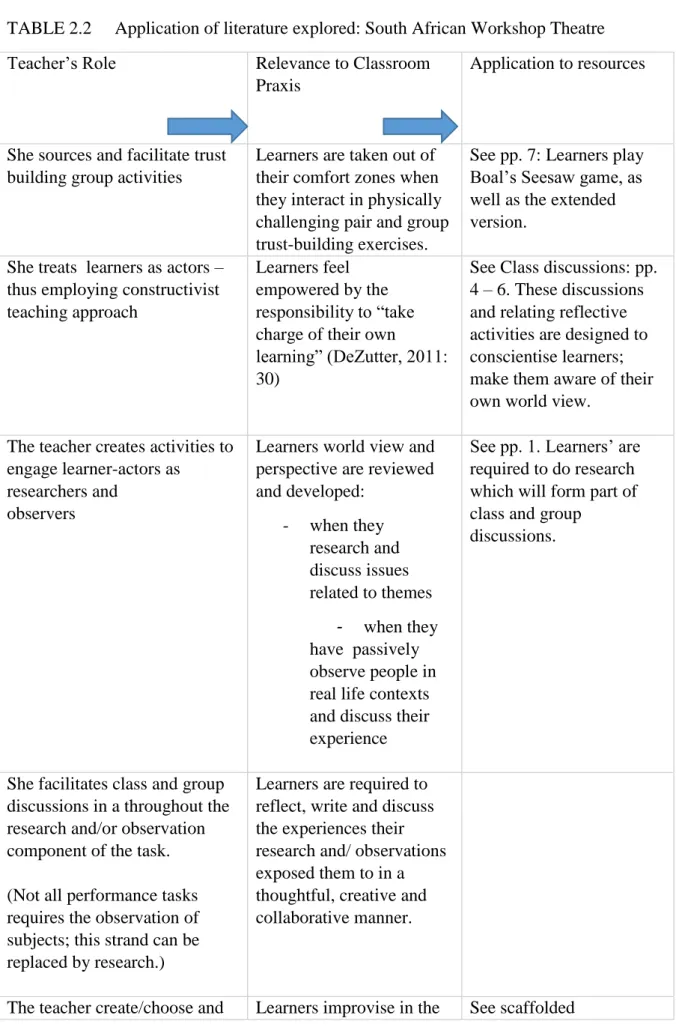
TABLE 2.2 Application of literature explored: South African Workshop Theatre 43
TABLE 3.1 Application of literature explored: Devised Theatre 61
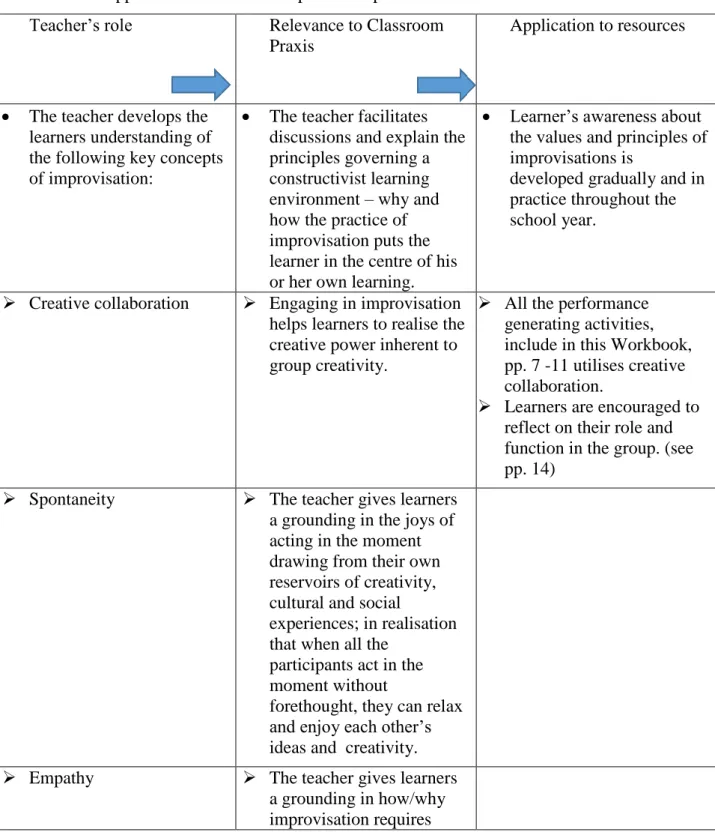
TABLE 4.1 Application of literature explored: Improvisation in the classroom 86
TABLE 5.1 Classroom discussion points on the implication of a constructivist teaching approach: the role of the teacher and learners 105
TABLE 6.1 Overarching aims of the National Curriculum Statement Grades R-12 reflected in Workbook (See Appendix A) 129
TABLE 7.1 Comments and advice on future action related to the Facilitator’s Copy (See Appendix B) 134
Chapter 1: Introduction
There are two key performance generating strategies that the Curriculum and Assessment Policy Statements (CAPS) for Dramatic Arts (Grade 10 – 12) and Creative Arts (Grade 7 – 9) respectively requires of the drama teacher to implement in the drama classroom. The first strategy is that of workshop, only evident in the CAPS for Dramatic Arts (Grade 10 – 12) and only stipulated in the context of South African Workshop plays. The second strategy is that of improvisation which is prescribed in both CAPS.
The concern that serves as incentive for this study is my own seeming lack of knowledge, experience and skill to effectively implement and facilitate these performance strategies in the secondary school drama classroom. I will begin this chapter by defining my concern in more detail and explain how my discovery of Devised Theatre not only enriched my understanding of the creative potential and pedagogical significance inherent to workshop and improvisation as play-building strategies, but also informed my teaching praxis.
After stating the aims for this study, I will motivate why I modelled a substantial part of this study on a literary research design and methodology and how and why I employed the principles of an action research enquiry as an underpinning agency and guiding paradigm. I will then explain why I chose grounded theory as a research paradigm to support the subjective suppositions drawn from the literature reviewed and analysed and the practical application of the newly acquired knowledge. A chapter layout will highlight the intentions and focal points of this study and a literature review, which will conclude this chapter, will substantiate the choice of research material and literature explored for the purposes of this study.
1.1 Background and rationale
South African theatre owes a great debt to the workshop methodology utilised by prominent theatre practitioners such as Barney Simon and Athol Fugard and their collaborators in the 1970s and 1980s. The plays created by these practitioners were ground-breaking due to its innately experimental character, which encapsulated a political agenda voicing the socio-political injustice practitioners experienced under the Apartheid regime in South Africa during that time. The three plays in this genre
most significant for the South African drama teacher are Woza Albert! (workshopped by Mbongeni
(created by John Kani, Winston Ntshona in collaboration with Athol Fugard). These plays are consistently on the prescribed plays list for Grade 10 – 11 Dramatic Arts. The latter two plays garnered much attention and accolades for the actors and Athol Fugard in America and the United
Kingdom.“But perhaps the most important figure here”, Temple Hauptfleisch (2007: 17) contends,
“was Barney Simon at the Market, who really introduced the improvisational workshop format into
South African theatre. His first seminal work of this kind, i.e. Cincinnati, Scenes from the city life
(credited to him and his cast, 1979), led to the sensation of Woza Albert (1981), which he did with
author/performers Mbongeni Ngema and Percy Mtwa, and such other works as Born in the RSA and
Black Dog/Nyemjama”.
This style of theatre making was significant in that it gave South African performers, according to Fleischman (1991: 58), the opportunity to shrug off the control “of a single authority, the director/writer/manager, who determined what they would say and do on the stage, how they would do it, where and for whom”. Actors of all races had the opportunity to tell their stories unbridled by Western performance contexts and political sanction (and interference). In the subject, Dramatic Arts learners in Grade 10 and 11 read, analyse and write exams on these texts from an established genre defined by the CAPS as “South African Workshop Theatre” in the Grade 10 curriculum and as “Protest/Resistance theatre” in the Grade 11 curriculum. The curriculum also requires that learners immerse themselves in the performance style and methodology the practitioners who created these plays utilised as play-building strategies (RSA Department of Education, 2011: 21; 28).
Drama learners in Grade 10, for instance, are required to: “Workshop a short play as a group” (RSA Department of Education. 2011: 22). The instructions, as seen in TABLE 1.1, serve as guidelines for the drama teacher with regard to both the practical and supporting theoretical components of the intended classroom praxis. Text study and analysis go hand in glove, therefore the drama teacher will typically have learners workshop scenes or short plays based on themes from a prescribed text (three of which I mentioned above) and have learners explore performance strategies employed by the creators.
TABLE 1.1 Instructions for Grade 10 Practical Performance Task: Understand the workshop
(play-building) process in the South African context.
Content/concepts/skills:
Understand the workshop (play-building) process in the South African context Workshop a short play as a group
Theory
• Communal creation • Process of workshopping
- Idea - Research/observation (oral/written)/reflection - Improvisation - Selection - Polished improvisation - Performance - Recording
• Episodic nature of workshopping
• Dramatic and theatrical linking devices such as narrator figure, music, placards, posters, film
Practical
• Explore process of workshopping in order to create a performance • Establish personal and social discipline
• Use improvisation to develop characters, structure and scenes • Script, rehearse and polish the performance
• Develop vocal and physical communication tools for performance
• Demonstrate both group and individual performance skills in improvisation and acting • Conduct ongoing self and peer assessment
(RSA Department of Education. 2011: 22)
Loren Kruger (1999) gives insight into the complexity of not only the performance strategies theatre practitioners such as Simon and Fugard employed, but also the personal and emotional significance that the collaborative creation of the mentioned plays, which she calls the “theatre of testimony”,
required from their actors. In The Drama of South Africa: Plays, Pageants, and Publics since 1910,
Kruger (1999: 147) writes:
This theatre […] is distinguished by the dramatic interpretation of individual and collective narratives, and of politically provocative topics […] Its presentation combines physical and verbal comedy, impersonation of multiple roles with minimal props, and direct address to the audience by performers representing themselves and their own convictions as well as those of fictional characters. Its practitioners have drawn on different models from township musicals and variety to European experiments, such as Grotowski’s ‘poor theatre’ and Brecht’s ‘social gest’.
In making this style of theatre a required topic the CAPS certainly speaks to "the core concept of drama in education” where learners are afforded the opportunities to make “personal meaning and sense of universal, abstract, social, moral, and ethical concepts through the concrete experience of the drama" (Norman in Bolton, 1985: 155). I however find the lack of specific guidelines to support theory and teacher material disconcerting. No mention is made of which specific “workshop processes” the drama teacher should implement other than “improvisation” or “polished improvisation” in order to “develop characters, structure and scenes” (see TABLE 1.1). Furthermore,
Brechtian techniques are introduced very rudimentarily in that the guidelines asks of learners to include a “narrator figure, music, placards”, which again puts the onus on the teacher to gage to which depth she wants to explore Brecht’s estrangement devises with her learners.
The theme of workshop in the South African context is carried through in Grade 11 where the curriculum requires learners to create “a short, original scene/play, highlighting environmental, educational or social issues” by utilising the performance techniques of South African workshopped plays that predated 1994 (RSA Department of Education, 2011: 28). Again, no attempt has been made to guide teacher praxis with regard to which specific improvisation techniques the drama teacher could utilise that would best serve her learners when unpacking and exploring the extreme complexities and the social relevance of the messages the prescribed plays contain. The content and themes of which certainly have the potential to expose personal truths and experiences in leaners who might have had similar experiences of racism and disempowerment, for instance. I believe this curriculum topic warrants a more thoughtful reading list to guide teacher praxis. The recommended texts/resource guidelines stipulated by the CAPS are similar for both Grade 10 and 11 – and equally vague (see TABLE 1.2).
TABLE 1.2 Recommended text/resource guidelines
Recommended texts/resources
• Dramatic Arts Grade 10 textbook/s
• Any published credible theatre history reference book • Notes provided by teacher
• DVDs or live performances of appropriate material (RSA Department of Education. 2011: 21; 28)
It seems clear that the onus lies on the drama teacher to flesh out the curriculum guidelines by employing prior knowledge, notes and research. I was lucky enough to have researched the life, work and workshop methodology of Barney Simon in my honours year. I therefore, initially, sincerely believed that my theoretical knowledge of his working style and philosophy would enable me to implement his techniques and strategies in my teaching practice. When I started out as a drama teacher, it became quite evident, however, that my practical application of the workshop processes of improvisation in the context of South African Workshop Theatre, lacked pedagogical depth.
I would like to give an abbreviated description of the performance generating processes and outcomes of an Integrated Practical Task1 I designed for Grade 10 learners as an example of my brewing
dissatisfaction with my own practice. The task required of the Grade 10 learners to create a short
Protest play based on the themes generated by the prescribed text (The Island by John Kani, Winston
Ntshona in collaboration with Athol Fugard) that we had read and analysed in class. In order to help learners create characters and narratives the task required of them to conduct interviews with a parent or a grandparent (or someone close to them) about their experiences during the apartheid years. The learners brought these ‘stories’ to class and then shared it with their groups. I also took my learners into the town centre during their drama lesson and the adjacent break time (my school was close enough so that we could walk) to do research on the streets. Learners had to observe people at a safe and respectful distance for about half an hour, watching how they walked, moved and just went about their business; these ‘people’ would then became characters on the rehearsal floor. Learners would create an imagined backstory; mimic the physicality of the individuals they had observed the previous day, etc. I based the investigative workshop processes on the strategies Barney Simon employed with his actors2. Over the next week or two of lessons learners worked in groups incorporating the characters they had created into narratives and scenes.
After about another week of rehearsals, learners performed their plays. Two of the five groups created very interesting and creative short plays. The rest of the learners struggled to varying degrees. Certain individuals struggled to collaborate effectively, which hampered their groups’ creative processes. Some of the groups struggled to create plots for their plays that could give all the characters enough scope and all of them found writing the dialogue extremely frustrating. Learners who created interesting and well-drawn characters on the rehearsal floor, could simply not write dialogue driven by narrative. Even though I believed that I had ticked all the ‘workshop’ boxes, I simply did not have the necessary skills, literacy and experience to help learners engage with the collaborative creative and learning processes typical of workshop theatre, effectively. In hindsight, I believe that my own and my learners’ frustrations were due to the fact that I had absolutely no idea of the complexity of the pedagogically significant and perspective changing dramatic processes my learners were going through right under my nose. My skills as a facilitator of improvisation as a play-building strategy were especially ineffectual.
In general classroom praxis improvisation is more often than not utilised to exemplify and support dramatic and performance theory relating to a specific theatrical genre. Further Education and Training (FET) Dramatic Arts learners (Grades 10 – 12) are required to employ improvisation to
2 I gleaned these techniques from interviews with actors who worked with Barney Simon as documented in The World in an Orange: Creating Theatre with Barney Simon (Stephanou, et al., 2005).
create scenarios, characters, structure and narratives related to specific themes or theatre styles such as Greek Theatre, Medieval Theatre or Commedia dell’ Arte and South African Workshop Theatre (RSA Department of Education, 2011: 10; 20; 22; 29).
In the General Education and Training (GET) senior phase (Grades 7 – 9) learners are required to utilise improvisation as a play-building strategy in the “development of classroom performances” based on topics ranging from folk tales to environmental and social issues employing specialised performance styles such as comedy, tragedy, musical and puppet shows (RSA Department of Education, 2011: 9; 15; 16; 35; 39; 41; 43). In not a single one of the mentioned improvisation driven performance contexts do the CAPS for Creative Arts (senior phase) or Dramatic Arts give guidelines to the drama teacher as to which specific improvisation techniques or strategies she could (or should) utilise.
When I started teaching Dramatic Arts in 2011, it was obvious that I did not know enough about improvisation to teach improvisation; especially in the context of utilising improvisation as a devising strategy to create/workshop scenes and short plays. In fact, this study was partly prompted by my fascination with the devised works of South African playmakers such as Lara Foot, Andrew Buckland, Jenine Collocott and Sylvaine Strike. I was introduced to their work at the Standard Bank National Schools' Festival in Grahamstown and where I took my learners annually. I craved the skill set and knowhow to teach my learners the strategies that would equip them (and me) to devise such infinitely imaginative theatre that seemingly defied genre. I intuitively knew that I was stuck in a rut: all my ‘workshop’ or play building strategies were based on notes and research that I had accumulated on South African Workshop Theatre. Since the CAPS for the FET phase does not refer to the play-building methodology of the workshop process outside of the context of South African theatre, I never did either.
After a question and answer session at Grahamstown in 2013, in which Jenine Collocott shared the
devising strategies she employed when creating The Snow Goose and A Day in the Desert, with the
learners who had attended that year’s Schools’ Festival, I saw the light. I subsequently started to educate myself in the strategies of Devised Theatre and I realised that there was a world of strategies that I could utilise to enhance my learners’ experience of play building. Why it took me so long to make the distinction between South African Workshop Theatre as a genre, and workshop as a play-building strategy, I do not know. Workshop is, simply put, a means to an end since it is only one of the play-building strategies of the devising practice. For the purpose of this study Workshop Theatre will also be defined as a creative method or process employed by performers on the rehearsal floor
(Heddon & Milling, 2006: 9).
My exploration of what Devised Theatre entails and the creative collaborative strategies it encapsulates, gave me the pedagogical insights that I so desperately needed. I find it quite unfortunate that the term Devised Theatre is never mentioned in the CAPS for the GET: either senior phase or the FET phase.
I want to list the concerns that plagued me when I started my career as a drama teacher very simply and systematically. I hope that these concerns will give credence and support to my research question and subsequent aims of this study.
● I profess the value of being an accountable educator in my field, drama and education, yet I
did not know enough about improvisation in order to facilitate it effectively. I professed the values that speak to my professional ability to create a learning environment that exemplifies egalitarian standards, yet I expected learners with different skillsets and performance capabilities to create polished improvisations in groups for formal assessments, guiding their endeavours by rudimentary knowledge and intuition.
● The CAPS documents for drama subjects in both the GET (senior phase) and FET phases require of me to utilise improvisation and ‘workshop’ as play-building strategies without giving me any guidelines/ tools to assist me in differentiating between which improvisation methods and techniques would best suit the prescribed topics. I simply do not know enough about the learning and performance processes embedded in these strategies to be an effective teacher.
● I see that my instructions regarding improvisation often confuse and disconcert my learners.
I see that learners fight amongst each other because there are always one or two learners who do all the work in group-work contexts. I experience the extraordinary work that learners can do when the creative collaborative processes run smoothly; I also experience the exact opposite.
Five years ago, it seemed to me that I was doing everything wrong. I was teaching at a small IEB3
school, in a small, insulated town, and I was the only drama teacher in the area. I could see how my learners were thriving due to the complexity of the drama processes they engage with on a daily basis:
3 The IEB – Independent Examinations Board – is an independent assessment body, accredited by Umalusi for school and adult assessments: the QCTO for the Foundational Learning Competence and the ETDP SETA for accredited training courses. The IEB offers external assessments in accordance with legislation and Umalusi directives for Schools registered with at Grade 12 for the National Senior Certificate (Prycision, 2015).
personally, academically and creatively – I just did not have the experience, knowledge or literacy to prove WHY.
I would like to bring to mind the complexity of the role of the drama teacher in the South African, IEB context. This is indeed a positive factor, since the more challenging and complex the role of the teacher, the more rewarding and professionally satisfying the praxis.
The drama teacher is responsible for sourcing and designing the learning and teaching material that support classroom praxis. When designing the learning and teaching material she must consider quite a number of strategies and procedures in order to reach the required curriculum goals.
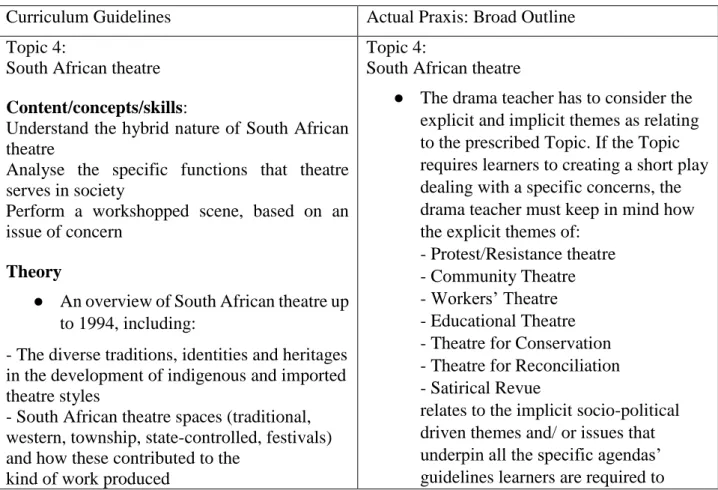
In order to illustrate the tension that exists between the extremely rudimentary curriculum guidelines and actual teacher praxis I present below – see TABLE 1.3 – the actual curriculum guidelines of a prescribed topic, South African theatre in which the CAPS for FET phase requires of learners to create a workshopped performance (RSA Department of Education, 2011: 28). Next to the actual guidelines, I present a possible example, or broad outline, of considerations pertaining to the planning phase for a performance task based on this topic.
TABLE 1.3 Curriculum Guidelines vs. Actual teacher praxis
Curriculum Guidelines Actual Praxis: Broad Outline
Topic 4:
South African theatre
Content/concepts/skills:
Understand the hybrid nature of South African theatre
Analyse the specific functions that theatre serves in society
Perform a workshopped scene, based on an issue of concern
Theory
● An overview of South African theatre up
to 1994, including:
- The diverse traditions, identities and heritages in the development of indigenous and imported theatre styles
- South African theatre spaces (traditional, western, township, state-controlled, festivals) and how these contributed to the
kind of work produced
Topic 4:
South African theatre
● The drama teacher has to consider the
explicit and implicit themes as relating to the prescribed Topic. If the Topic requires learners to creating a short play dealing with a specific concerns, the drama teacher must keep in mind how the explicit themes of:
- Protest/Resistance theatre - Community Theatre - Workers’ Theatre - Educational Theatre - Theatre for Conservation - Theatre for Reconciliation - Satirical Revue
relates to the implicit socio-political driven themes and/ or issues that underpin all the specific agendas’ guidelines learners are required to
- Workshopping as a process of theatre making that suited specific South African conditions (revise from Grade 10)
● South African theatre with a specific
agenda:
- Protest/Resistance theatre - Community theatre - Workers’ theatre - Educational theatre - Theatre for Conservation - Theatre for Reconciliation - Satirical Revue
Practical
● Research a form of South African
theatre with a specific agenda and present research in the form of a poster,
essay, radio programme or TV
documentary
● Develop group dynamics for
workshopped theatre
● Prepare a short, original scene/play, highlighting environmental, educational or social issues, using workshopped techniques
● Consider and follow the production
process (inclusive of all stages,
including marketing to an audience) to bring this original scene/play to performance
assimilate.
● These agendas were and still are first
and foremost driven by the lived experiences of real people, everyday South Africans. I for one certainly believe that it is the stories, the lived experience and the circumstances that should drive the workshop, and not the form or style of theatre.
● During the research and design phase of
the Integrated Practical Task the teacher must carefully consider which devising strategies and how she wants to employ it so that the learners’ age, potential skills sets and experience are served; consider the allocated time for the research and performance components of the task, the writing and rehearsal phases; decide where the performance should take place, taking technical and practical issues that may result into consideration
● During this phase the teacher must
decide what format the Integrated Practical Task or Workbook should take in order support the dramatic processes of workshop and reflection.
● The Integrated Performance Task or
Workbook must contain assessment tools and guidelines which will help the learners to set group, individual and performance goals.
● During the rehearsal and
implementation phase the drama teacher will facilitate the range of devising strategies included in the Integrated Performance Task/ Workbook.
● The teacher must make sure to include
scaffolded questions that will enable her learners to reflect on their creative, collaborative and embodied learning processes throughout the creative journey.
● During the workshop phase, where learners work together in their groups, the drama teacher takes on the role of a collaborator or co-deviser; then slowly but surely she becomes an objective observer.
● Learners need to ‘direct’ themselves for
ultimately they are the ones to be assessed on their process as well as their performance; the teacher may only make suggestions – along the way.
My concerns as elaborated above can be distilled into one question, which I offer as my main research question.
1.2 Main research question
How does a drama teacher, especially a novice teacher, negotiate the glaring discrepancy between WHAT she should do according to the CAPS for Drama, especially when she utilises workshop and improvisation as play-building strategies, and HOW she should do it, in order to adhere to the aims of The National Curriculum Statement Grades R – 12 (see TABLE 1.6)?
1.3 Aims of the study
The overarching aim of this study is that I want to equip myself with knowledge that will enable me to become an effective facilitator of the creative collaborative processes underpinning the devising strategies of improvisation and workshop. The core research, which will serve the overarching aim of this study, will entail the comprehensive exploration of the creative strategies and methods utilised and advocated by scholars and eminent theatre practitioners in the field of South African Workshop Theatre, Devised Theatre and Theatrical Improvisation. The study will specifically relate to the acquired knowledge through the lens of the educational values and skills these performance modes may engender as specified by the Aims of the National Curriculum Statement Grades R-12 (see TABLE 1.6) as well as the Aims of drama in Creative Arts (GET: senior phase) (see TABLE 1.7). The reading and analysis of existing literature will firstly give me a much more comprehensive and reassuring understanding of WHAT the CAPS actually requires me to do. Secondly I believe that the newly acquired knowledge and pedagogical insight, gained from the research, should help me to bridge that gap that exists between WHAT I am doing and HOW I should be doing it.
For the purpose of this study, the acquired theory will therefore be distilled and then applied in creating learner and teacher Devised Theatre resource documents. The most important aim of the inclusion of these resource documents in the study is to give evidence of the potential practical application of the newly acquired theory. The secondary aim of the teacher and learner resource documents is to offer possible templates for the future design and scaffolding of similar resources in order to ensure that the Devised Theatre resource document serve the process as well as the final product in adherence to the curriculum requirements. Thus, the study will comment on the motivations and feasibility of the choice of improvisation activities, learner reflection as well as script writing activities comprised in the resource documents.
1.4 Research design and methodology
The study will employ the research designs and methodologies relating to literature and action research. These designs and methodologies will be underpinned by the tenets of grounded theory.
1.4.1 Literature study
The first phase of this study will be a literature study. This will encompass the exploration and deductive analysis of existing literature on South African Workshop Theatre, Devised Theatre and Theatrical Improvisation. There are three key stimuli that motivated the choice of literature study as the framework on which this study rests. Firstly, as a drama teacher I am required by the curricula to be a skilled teacher and facilitator of theatrical modes pertaining to South African Workshop Theatre and Theatrical Improvisation, to equip my learners for formal assessment procedures. The second motivational factor is directly related to my inadequate knowledge of the theory and methodology that govern these performance modes. The third motivational factor is based on my personal assumption that these modes of practice hold significant perspective changing pedagogical potential for all participants involved, including the teacher. My investigation into Devised Theatre practice serves specifically as an extension to the existing literature on the performance modes of workshop and improvisation outside of the South African Theatre context.
A literature based research enquiry requires of the researcher to review the works of pertinent scholars and “representative research” in his/her chosen field of enquiry and by way of summarising, logical deduction and creative analysis to sort and define the literature relevant to the aims of the proposed study (Lin, 2009). The literature review I offer in section 1.8 of this chapter will inform and validate the authority of the literature explored for the purpose of this study.
1.4.2 Action research
In the second phase of this study I will endeavour to marry my newly acquired knowledge with the curriculum requirements and outcomes in the three performance modes on which this study will focus. I will endeavour to find a solution to a personal “educational problem” which Creswell (2012: 576) suggests to be the starting point of an action enquiry. The second phase of the study will therefore be modelled on an action research design and methodology. Whilst sifting through, sorting and analysing the existing literature on the three modes of performance practice, i.e. South African Workshop Theatre, Devised Theatre and Theatrical Improvisation, over the past two years, I could simultaneously test my findings and ideas. Experimentation by means of group improvisation and workshops resulted in experimentation with learner resource packs that would guide learners and classroom practice in this regard. Thus, the first phase of this study is in fact inextricably linked with the questions that all action researchers should ask themselves according to McNiff and Whitehead (2006: 11), which are:
● What am I doing?
● How do I describe and explain my actions to you?
● How do I hold myself accountable to myself and to you?
In order to improve teacher practice, action research scholars suggest that the teacher considers her own values and that these values should form the starting point of her action research enquiry (McNiff & Whitehead, 2006: 101). My values on which I base my professional growth and practice as a teacher are set out in TABLE 1.4 below.
TABLE 1.4 My professional values as teacher
1. To be a progressive teacher who engenders a positive attitude towards dramatic processes.
2. To advocate egalitarian standards and values.
3. To create an interesting and challenging learning environment, rife with creative
opportunities.
4. To surprise learners with their own creativity.
5. To be a specialist in my field; which in turn would engender the trust and enthusiasm of my
learners.
6. To be accountable, adaptable and supportive.
Kemmis et al. (2014: 6) elaborate on the character of the teacher as action researcher when they note that research should be active, proactive and self-reflective – in fact they go so far as to postulate that action researchers are “profoundly interested in their practices, in whether they understand their
practices and the consequences of their practices, and in whether the conditions under which they practice are appropriate”. These guiding principles of action research speaks to my own deep interest in the pedagogical values embedded in the dramatic processes of the subject Drama and to my professional values as teacher as stipulated in TABLE 1.4.
In section 1.1 of this chapter I have systematically reflected on the concerns that plagued me when I started my career as a drama teacher. It is my reading of McNiff and Whitehead that enabled me to put my concerns on paper for the first time. These scholars encourage potential action researchers to consider their concerns when reflecting on the feasibility of their proposed enquiry in a very simplistic manner, and then to make a plan to rectify the problem. The suggested questions, which made me realise that I want to model my research design on an action inquiry, are:
● What is my concern?
● Why am I concerned?
● What experiences can I describe to show why I am concerned?
● What can I do about it? What will I do about it? (McNiff & Whitehead, 2006: 3; 79)
These questions coupled with the vagueness of the Recommended text/resource guidelines of the CAPS for the FET phase (see TABLE 1.2) incentivised me to come up with my own teacher and learner resources, seeped in existing theory, that would help me assuage my concerns. The teacher and learner resources (see Appendix A & B) are part of a ‘road map’ that this study has manifested into and which I offer as a possible action plan to bridge the gap between WHAT I am doing, WHAT I should be doing and HOW I should be doing it, in the context of improvisation and workshop as play-building strategies.
A simple dictionary definition for the noun ‘road map’ (Definition of Road Map, 2016) reads as follows:
● a map that shows the roads in a particular area
● a plan or road map for achieving a goal.
I would like to emphasise two of the many factors that give credence to action research in an educational context that relates to this study specifically, namely that action research “encourages educators to reflect on their practices” and that it “promotes a process of testing new ideas” (Mills in Creswell, 2012). In many respects it was the curriculum that compelled me to come up with “new ideas” to support my teacher praxis, and in doing so, a wealth of new knowledge presented itself to
me.
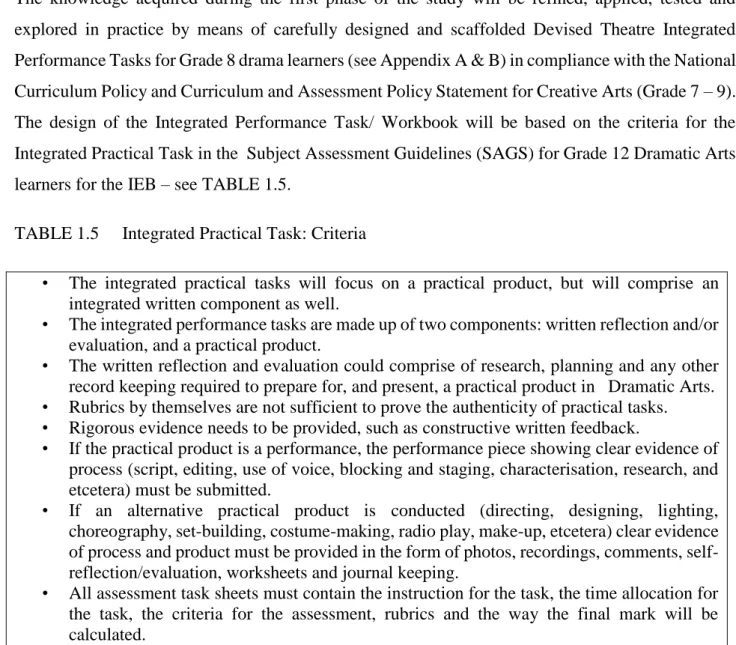
The knowledge acquired during the first phase of the study will be refined, applied, tested and explored in practice by means of carefully designed and scaffolded Devised Theatre Integrated Performance Tasks for Grade 8 drama learners (see Appendix A & B) in compliance with the National Curriculum Policy and Curriculum and Assessment Policy Statement for Creative Arts (Grade 7 – 9). The design of the Integrated Performance Task/ Workbook will be based on the criteria for the Integrated Practical Task in the Subject Assessment Guidelines (SAGS) for Grade 12 Dramatic Arts learners for the IEB – see TABLE 1.5.
TABLE 1.5 Integrated Practical Task: Criteria
• The integrated practical tasks will focus on a practical product, but will comprise an integrated written component as well.
• The integrated performance tasks are made up of two components: written reflection and/or
evaluation, and a practical product.
• The written reflection and evaluation could comprise of research, planning and any other
record keeping required to prepare for, and present, a practical product in Dramatic Arts.
• Rubrics by themselves are not sufficient to prove the authenticity of practical tasks.
• Rigorous evidence needs to be provided, such as constructive written feedback.
• If the practical product is a performance, the performance piece showing clear evidence of
process (script, editing, use of voice, blocking and staging, characterisation, research, and etcetera) must be submitted.
• If an alternative practical product is conducted (directing, designing, lighting,
choreography, set-building, costume-making, radio play, make-up, etcetera) clear evidence of process and product must be provided in the form of photos, recordings, comments, self-reflection/evaluation, worksheets and journal keeping.
• All assessment task sheets must contain the instruction for the task, the time allocation for
the task, the criteria for the assessment, rubrics and the way the final mark will be calculated.
(National Senior Certificate Handbook Implementation: Grade 12, 2104: 4)
The Integrated Performance Task in question will require of learners to devise a short play exploring environmental issues. The Integrated Performance Task was published as a Workbook (see Appendix A). This Workbook was generated to run for one school term culminating in a performance at the end of Term 3, 2016. The concept of the Workbook was inspired by and based on the scaffolded design and criteria for the Externally Set Integrated Task (ESIT) for Grade 12 learners of 2013 and 2014 (see Appendix C).
In the final chapter of this study, the efficacy of a Workbook as a teaching resource will be explored in relation to the following action:
● The proposed study will examine the motivation for the inclusion of specific dramatic processes and improvisation techniques.
● The proposed study will also unpack the practicality of the learning material included in the
Workbook.
I will also relate my choices of learning material and the implementation thereof to the overarching Aims of the National Curriculum Statement Grades R – 12 (see TABLE 1.6), as well as the Aims of drama in Creative Arts (GET: senior phase) (see TABLE 1.7) in order to prove my accountability. Quite a number of considerations influenced the decision making process with regards to the delineation of the age group and the choice of themes for the Integrated Performance Tasks generated for the purpose of this study.
The drama teacher has to make provision for extremely complex learning outcomes when creating learning and teaching materials that sets very high personal, creative, social and academic targets for the learners. Furthermore, these learning outcomes have to be compliant to and measured against the General Aims of the National Curriculum Statement Grades R – 12 (see TABLE 1.6) and the Specific Aims of Drama in the Senior Phase of the GET (or General Education and Training) Phase (see TABLE 1.7)
TABLE 1.6 Overarching aims of the National Curriculum Statement Grades R – 12
The National Curriculum Statement Grades R – 12 aims to produce learners that are able to: • identify and solve problems and make decisions using critical and creative thinking; • work effectively as individuals and with others as members of a team;
• organise and manage themselves and their activities responsibly and effectively; • collect, analyse, organise and critically evaluate information;
• communicate effectively using visual, symbolic and/or language skills in various modes;
• use science and technology effectively and critically showing responsibility towards the environment and the health of others; and demonstrate an understanding of the world as a set of related systems by recognising that problem solving contexts do not exist in isolation.
(RSA Department of Education, 2011: 5)
TABLE 1.7 Aims of drama in Creative Arts GET (senior phase)
Drama
• The study of drama in Creative Arts gives learners tools to represent human experiences in
dramatic form, through processes of participation, collaboration, exploration and presentation.
• Drama encourages the creative exploration of themes and issues, creates a safe context for this exploration, and provides opportunities to reflect on the insights gained in the process. • Learners appreciate and interpret a wide range of dramatic works both published and
created in the class.
• An important aspect of drama is the development of classroom performances (through
improvisation/playmaking processes) based on a specific stimulus.
• In drama, the learner explores the motivation and the relationships between people in a real,
imagined or historical context, to help him or her understand the world.
• The learner is encouraged to make decisions and to take responsibility for those decisions
within the safe context of the drama.
Source adapted from: (RSA Department of Education, 2011: 8 - 9)
The challenge that the effective implementation of the CAPS requirements for Grade 8 Drama present with regards to time management was another deciding factor. The contact time allocated by the CAPS allows for only ±2 hours of instructional time per week, per learner (RSA Department of Education, 2011: 7). This presents immense challenges for the drama teacher who wants to create teaching and learning material with the pedagogical depth and scope required by the General Aims of the National Curriculum, as well as the Specific Aims for Drama in the GET: senior phase. Therefore, the proposed study will certainly aim to provide reasonable reflection on why and how classroom praxis may benefit from the effective and thoughtful sourcing, designing and scaffolding of learning and teaching material to optimise the quality of the limited teacher learner contact opportunities allocated for Drama by the CAPS for Creative Arts Grades 7 – 9.
The third guiding factor is that of the acquisition and transference of skills from one education and training phase to the next. The CAPS states that the skills acquired in the drama class in the GET: senior phase should be transferable and relatable to the skills required of and honed in the Dramatic Arts learner in the Further Education and Training (FET) Phase (RSA Department of Education, 2011: 8).
It is therefore no coincidence that the Workbook generated for the purpose of this study is based on the design and principles of the ESIT for Grade 12 learners (see Appendix C & D) as stated above. The choice to use this task as template not only speaks to the educational values and skills the National Curriculum for Drama requires of drama teachers to implement; it also speaks to my personal values and beliefs as a drama teacher.
The choice of the specific curriculum topic to base the example resource on is linked to the performance modes of South African Workshop Theatre, Devised Theatre and Theatrical Improvisation which requires of learners to create a written sketch or polished improvisation to reflect
a social or environmental issue (see TABLE 1.8). This topic introduces learners to the skill of creating plays with a specific agenda, which they hone and extend in Grade 11 drama, since the CAPS for the FET phase requires of learners to workshop plays based on a specific agenda in the context of South African Theatre (see TABLE 1.3).
TABLE 1.8 Create a written sketch of polished improvisation to reflect a social or environmental
issue Topic 2
Written sketch or polished improvisations:
• Theme(s) related to a social or environmental issue for the drama • Isolating and developing a topic from the research
• Structure of the performance
• Shape and focus of the performance
• Specialised style, e.g. melodrama, comedy, tragedy, farce, musical and puppet show. • Technical resources to enhance the performance
(RSA Department of Education, 2011:15)
I strongly believe that the sounder you lay the skills foundation for learners relating to dramatic processes in Grade 8, the sounder the academic, creative and personal growth drama learners will experience throughout their school career. I am of the belief that if Grade 12 Dramatic Arts learners in the IEB are expected to create devised plays as part of a nationally set performance exam (see Appendix C as an example), Grade 8 drama learners should be provided with the learning experiences in the GET: senior phase that will guide and aid them to excel in the FET phase.
A key characteristic of the processes of an action research design and methodology is an enquiry conducted in participation with other participants in order to share understanding, commitment and to increase “the motivation for collective and collaborative action” (Dick, 2003: 2). In the case of my proposed study, I will be relying on my fellow drama teacher and Department Head, Jhanie van Aswegen, who will be participating in every aspect of the planning, implementation and reflection phases of the Grade 8 Workbook designed for this study. My hope is that the quality of the included activities in the resource coupled by my increased abilities as facilitator (underpinned by my investigation into the learning processes inherent to the performance modes of workshop and
improvisation) will enhance and enrich classroom praxis.“Giving meaning to a learning situation”,
Lombofsky writes, “motivates the students and encourages an emotional investment in driving the activity and the behaviour” (2014: 182).
The learners’ experience of every aspect of the dramatic processes they engage with during the devising activities included in the resource certainly will instruct and inform the immediate facilitation as well as the reimagining of future teacher and learner resources.
It is therefore accepted that the instructional material and facilitation devices will change and grow through the observance of the cyclical process known as “action-reflection” (McNiff & Whitehead, 2006: 3) which the proposed study needs to employ in order to attain and sustain credibility. The action enquiry is known for a cyclical character, since the research, application and reflection phases are processes that feed off each other, and is therefore an ongoing process. As McNiff and Whitehead (2006: 9) point out, as soon as the process reach a “provisional point” […] the point itself raises new questions”.
The drama teacher as facilitator is in the unique position to employ action research in the moment; when she observes, analyses, synthesizes and readjusts (when necessary) the theory and practice employed in the drama classroom, she is applying “self-study” which places her in the centre of their her own enquiry (McNiff & Whitehead, 2006: 11). However, I believe that without the acquired knowledge that the first phase of this study affords me, my attempts at self-study would be empty and lacking a sound theoretical foundation.
1.4.3 Grounded theory
The study proposes to utilise the tenets of grounded theory as means to support, focus and guide the processes of the action research phase. Especially as Dick (2003) notes, “that there are relatively few descriptions in the Action research literature which reveal exactly how a theory is developed” (2003:6).
The principles of grounded theory speaks to the “emergent methodology” of the action design; in fact, the principles of both shows “some important similarities”, therefore a symbiosis of these two designs can only enhance the research procedures (Dick, 2003: 1; 6). Creswell, in his deliberation on grounded theory design and methodology, focuses on the fact that it is a “process theory that explains an educational process of events, activities, actions, and interactions that occur over time” (Creswell, 2012: 423).
Grounded theory presupposes not only a systematic approach to data analysis, which gives “direction” to the researcher, it is also “self-correcting”, allowing the researcher to stay close to the data “at all times in the analysis” (Creswell, 2012: 423). This aspect of grounded theory supports the
self-correcting nature of the devising practice and the facilitation of the dramatic processes. It entails: the drama teacher has to constantly rethink and re-imagine ways and means – often on the spot – to enhance the devising strategies and facilitation processes in order for learners to get the most out of each stage of the devising process.
Most importantly, in consideration to the proposed study, grounded theory allows for the constructivist approach to research procedures; it allows the researcher to focus on “sociological concepts” (Charmaz in Creswell), when gathering and considering data, that encompasses her personal views, values, beliefs, feelings, assumptions, experiences and ideologies of all the role players connected to the study (Creswell, 2012: 429 - 430). The process driven literature study, analysis and application of the performance theory and modes of workshop in the context of South African theatre, Devised Theatre and Theatrical Improvisations have been carried out through the lens of the pedagogical implications related to the specific and general curriculum aims. The study and analysis of the literature is therefore ultimately subjective.
I find the personal and reflective mode of expression with regards to grounded theory research procedures specifically attractive. Since this style of enquiry allows me to write about my own values, feelings and assumptions – it thus validates the importance of personal and professional values in the context of educational research. An important distinction between the action enquiry and grounded theory methods is that in the latter context, the researcher tends to be an observer of a process in order to establish a theory to explain the process. The action researcher try to establish a theory based on her own experience of the process that they are immersed in that will influence future action (Creswell, 2012: 422; Kemmis, 1994: 46). I believe the objective approach to generating theory, pertaining to grounded theory, will serve to ‘ground’ my subjective responses to the literature explored, analysed and applied.
This study therefore aims to rely on the grounded theory model (see TABLE 1.9) to guide the literature study component of this thesis and the interrelated action research component that “addresses the process” of classroom praxis pertaining to improvisation and workshop in the secondary school context.
TABLE 1.9 A Process and Categories within the Flow of Research in Grounded Theory
The research problem leads to ↓
↓
That addresses a process ↓
Which contains
• a sequence of activities • including actions by people • including interactions by people ↓
Which a grounded theorist begins to understand by • developing categories
• relating categories
• developing a theory that explains (Creswell, 2012: 432)
The study aims to incorporate qualitative data collecting strategies utilised by grounded theorists that will include “observations, conversations, interviews, public records […] and the researcher’s own personal reflections” (Charmaz in Creswell, 2012: 432). Four activities, specific to grounded theory research methodology, i.e. data-collection, note taking, coding and memoing will be carried out simultaneously as Dick (2003:5) notes.
Observation will certainly be a key data collecting and analysing device. The teacher in the role of researcher has to be willing to adapt and challenge her own preconceptions, moving from ‘outsider’, and then “participating in the setting and observing as an ‘insider’” and back depending on the needs of the learners in the creative process (Creswell, 2012: 213).
Creswell’s observation ties in with the idea of critical reflection, which is a prolific component of the devising practice. Alison Oddey (1996: 26) points out that the devising practice leaves no room for contrived actions and modes of thinking, learning and doing: “The devising process needs to be searching, the work constantly sifted, re-examined, and criticised. Group analysis is required, which ultimately leads back to self-examination and self-criticism”.
Given the above characteristics of grounded theory and the fact that “grounded theory exhibits the rigor quantitative researchers like to see in an educational study” it should support and exhibit the authenticity of my actions as teacher-researcher in the devising context (Creswell, 2012: 422).
1.5 Theoretical framework
This study aims to utilise the theory, philosophy and participatory theatrical techniques advocated by
Keith Johnstone and Augusto Boal’s Theatre of the Oppressed. The techniques and philosophy of
these practitioners will form the basis of the practical exploration and experimentation with regards to performance strategies and methods that informs the creation of script and character by way of experimental improvisation.
I decided on the work of Augusto Boal for quite a number of reasons. Firstly, his philosophy and theories on theatre and performance speak to the democratic and egalitarian nature of the creative processes of “collective decision-making and skills-sharing” inherent to Devised Theatre (Oddey, 1994: 8; Govan et al. 2007: 47). His methods are non-didactic, but pedagogic, since he advocates that the theatre could be utilised as a form of collective learning (Boal, 1995: 7). Secondly, Boal’s techniques and exercises for actors and non-actors, are extremely user-friendly, and uniquely suitable for adaption to a secondary school context. In my reading of his work I could draw many parallels to the socially conscious philosophy and intentions of South African theatre practitioners of the 1970s and 1980s, like Fugard, in order to give “voice to the voiceless” (Walder, 1993: 356).
I found the underpinning philosophy of Keith Johnstone’s work to be specifically important and inspiring. His teachings advocate fun, experimentation, personal accountability and adaptability. His dictum, and I paraphrase, that it is okay to make mistakes, certainly assists the drama teacher in creating a carefree and cheerful classroom environment where nothing is impossible (Johnstone, 1999: 62).
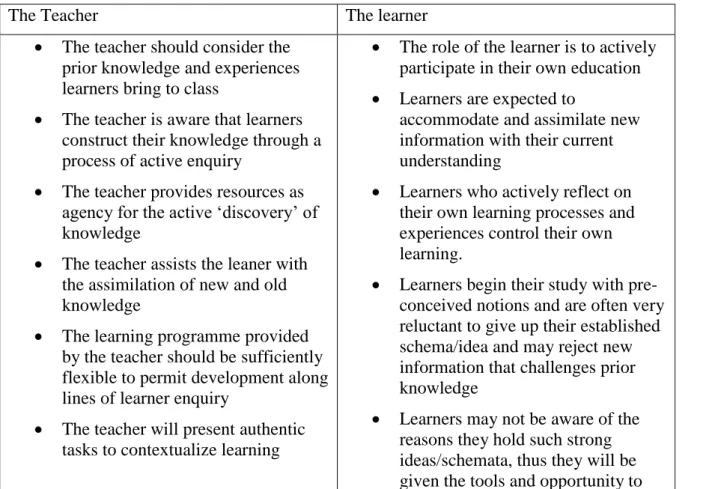
The underpinning tenets of the philosophy of constructivism when applied in an educational context speaks to the learner-centred, creative collaborative practice inherent to Devised Theatre. This philosophy underpins the aims of the overarching National Curriculum for Grade R – 12 (see TABLE 1.6), as well as the aims of Drama in Creative Arts GET (senior phase) (see TABLE 1.7) and will serve as the lens through which this study aims to explore the research, creative methods and pedagogical processes teachers and learners are exposed to in the context of workshopping and improvisation for devising.
Bonk and Cunningham (1998: 27) distinguish between the foci of Cognitive and Social Constructivist theory in their book, Searching for Learner Centred, Constructivist and Sociocultural Learning Tools. The governing principles that influence the teacher’s approach to classroom practice are bulleted for the sake of clarity:
Cognitive constructivists focus on:
● making learning more relevant, building on student prior knowledge;
● posing contradictions; and
● addressing misconceptions.
Social constructivists emphasize:
● human dialogue;
● interaction;
● negotiation; and
● collaboration.
The devising practice certainly relates to the dynamic, learner-centred acquisition of knowledge characteristic of constructivism in education. It also speaks to the social and collaborative perspective on the acquisition of knowledge associated with Vygotsky, “considered to be the father of social constructivism,” as well as the perspective on the cognitive construction of knowledge by Piaget who “is often classified as a father of personal (or cognitive) constructivism” (Sjøberg, 2010: 8). It is a widely accepted assumption that “Piaget acknowledged to have been inspired by Vygotsky's ideas” (Pass in Sjøberg, 2010: 8). The design of the Workbook will be underpinned by both these scholars’ theories.
This study cannot but focus on the ways and means the dramatic processes of devising require of and incite learners to construct their own knowledge; from a social and collaborative position, as well as a personal (and cognitive) position. The learners’ own life experiences, knowledge and ideas are central to the creative processes of Devised Theatre since it offers, as Oddey (1996: 1) points out, a platform for learners to “make sense of themselves within their own cultural and social context”. In fact, she argues that learners are encouraged to investigate, integrate and transform “their personal experiences” when they devise (Oddey, 1996: 1). The very nature of dramatic processes, Roa (2008) writes, such as role-play, improvisation and group performances, not only asks learners to discuss and contemplate, but also “actively explore” their “critical and compassionate imagination” via role-play, improvisation and group performances”. The active exploration of themes, social issues and personal understanding within the creative collaborative practice of devising, more often than not, do not require the input of a teacher. The learners grow in understanding, as a group and as individuals throughout the devising process; they are ultimately in control of the final, creative product.