Review Article
Mindfulness-Based Interventions for Chronic Pain:
A Systematic Review of the Evidence
Alberto Chiesa, MD, and Alessandro Serretti, MD, PhD
Abstract
Objectives:Chronic pain is a common disabling illness that does not completely respond to current medical treatments. As a consequence, in recent years many alternative interventions have been suggested. Among them, mindfulness-based interventions (MBIs) are receiving growing attention. The aim of the present article is to review controlled studies investigating the efficacy of MBIs for the reduction of pain and the improvement of depressive symptoms in patients suffering from chronic pain.
Methods:A literature search was undertaken using MEDLINE,ISI web of knowledge, the Cochrane database, and references of retrieved articles. The search included articles written in English published up to July 2009. The data were independently extracted by two reviewers from the original reports. Quality of included trials was also assessed.
Results: Ten (10) studies were considered eligible for the present review. Current studies showed that MBIs could have nonspecific effects for the reduction of pain symptoms and the improvement of depressive symptoms in patients with chronic pain, while there is only limited evidence suggesting specific effects of such interven-tions. Further findings evidenced some improvements in psychologic measures related to chronic pain such as copying with pain following MBIs as well.
Discussion:There is not yet sufficient evidence to determine the magnitude of the effects of MBIs for patients with chronic pain. Main limitations of reviewed studies include small sample size, absence of randomization, the use of a waiting list control group that does not allow distinguishing of specific from nonspecific effects of MBI as well as differences among interventions.
Conclusions: However, because of these preliminary results, further research in larger properly powered and better designed studies is warranted.
Introduction
C
hronic pain is a common disabling illness thataf-fects about 20%–30% of the adult population in Western countries1and is often related to high rates of comorbid de-pressive symptoms.2 Although current therapeutic ap-proaches, including analgesic and opioid drugs, can provide significant improvements, the most potent drugs only re-duce pain by 30%–40% in fewer than 50% of patients.3In addition, surgical techniques such as implantation of artifi-cial discs in the spine and implantable drug delivery systems provide limited pain reduction in only a subset of patients as well.4,5As a consequence, several psychologic treatments for chronic pain have been suggested.6Among them, mindfulness-based stress reduction (MBSR) and closely derived interventions (mindfulness-based interventions or MBIs) are some of the most studied.
MBSR is a standardized group-based meditation program conceived in the late 1970s from the effort to integrate Buddhist mindfulness meditation with contemporary Western clinical and psychologic practice.7,8 In the last 2 decades, MBSR has been proposed as a treatment for many diseases, showing a good efficacy for many mental and physical dis-orders9–11as well as for healthy people,12although results are not always convincing.9,13Note, however, that such a medi-tation program was originally developed and is still consis-tently used for patients suffering from chronic pain.14,15
The main feature of MBSR is the cultivation of ‘‘mindful-ness’’ (i.e., the development of a particular kind of attention characterized by a nonjudgmental awareness, openness, cu-riosity, and acceptance of internal and external present ex-periences, which allows the practitioners to act more reflectively rather than impulsively).16–18 MBSR comprises three different techniques including (1) ‘‘body scan,’’ which
Institute of Psychiatry, University of Bologna, Bologna, Italy.
THE JOURNAL OF ALTERNATIVE AND COMPLEMENTARY MEDICINE Volume 17, Number 1, 2011, pp. 83–93
ªMary Ann Liebert, Inc. DOI: 10.1089/acm.2009.0546
involves a gradual sweeping of attention through the en-tire body from feet to head, focusing noncritically on any sensation or feeling in body regions and using periodic suggestions of breath awareness and relaxation; (2) ‘‘sitting meditation,’’ which involves both mindful attention on the breath or on the rising and falling abdomen as well as on other perceptions, and a state of nonjudgmental awareness of cognitions and of the stream of thoughts and distractions that continuously flow through the mind; and (3) ‘‘Hatha yoga’’ practice, which includes breathing exercises, simple stretches, and posture designed to strengthen and relax the musculoskeletal system.7The standard program consists of 8-week sessions with a duration of 2 hours each and home-work for 45 minutes a day, 6 days a week,7,8even though several modifications in sessions, homeworks, and total du-ration can be observed among different courses for different populations of patients. Additionally, interventions inspired by the original program but including specific modifications such as the adjunct of particular exercises or of psychologic techniques are consistently used as well.19
Preliminary results on the efficacy of MBIs for patients suffering from chronic pain have been established in several independent uncontrolled studies on patients with different types of pain such as low back, upper back, shoulder and cervical pain, headache,14,20,21 and fibromyalgia.22 Interest-ingly, there is some evidence to suggest that results gained in the short term could be maintained in the long term23and that MBIs could be useful for older people as well.21,24 However, it is worth mentioning that very often initial em-phasis deriving from early uncontrolled studies is not yet supported when controlled studies are undertaken.
As a consequence, the aim of the present article is to re-view controlled studies investigating the efficacy of MBIs for the reduction of pain and/or the improvement of depressive symptoms in patients with chronic pain.
Methods
Literature research
A literature search was undertaken using MEDLINE,ISI web of knowledge, the Cochrane database, and references of retrieved articles. The search included original articles, letters to the editor, and congress abstracts indexed by web-based electronic databases mentioned above or mentioned in re-trieved articles published up to July 2009. The search strategy considered only studies published in English. The main search terms were MBSR, mindfulness-based intervention, mindfulness meditation, stress reduction, and chronic pain, in various combinations as needed.
Selection of trials
Included studies had to investigate the efficacy of a MBI, be performed in patients suffering from chronic pain (e.g., low back pain, fibromyalgia, rheumatoid arthritis) with at least 6 months of illness history, provide at least one measure of pain and/or depression, provide quantitative data, have a control group procedure that was either inactive (for in-stance, a waiting list) and/or active, and oriented to control for nonspecific effects of the MBI group (such as an educa-tional control group). Of note, we considered an intervention as nonspecific (placebo-like) if it could induce the expectancy
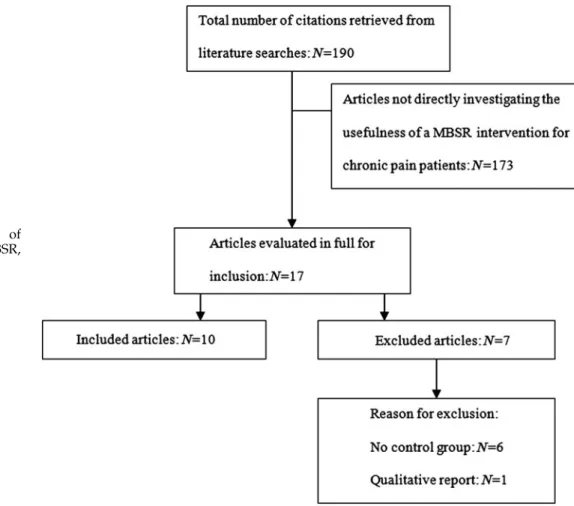
of a benefit but it had no additional specific effects.25 Ex-clusion criteria were as follows: absence of a control group, qualitative reports, speculative reports, and review articles. A summary of included articles investigating the efficacy of MBIs for the management of chronic pain is shown in Table 1. Main features of included interventions are reported in Table 2. Quality of included trials, assessed by the authors using a validated quality scale,26is shown in Table 3. A flow chart of the review process is shown in Figure 1.
Outcome measures
Our primary outcomes were (1) the reduction of pain and (2) the reduction of depressive symptoms in MBI groups compared to inactive and/or active control groups. Our secondary outcome measures were the improvement of (1) coping with pain, (2) physical function, (3) stress reduction and quality of life, and (4) miscellaneous psychologic chan-ges related to MBIs.
Data extraction and quality assessment
The data were independently extracted by the authors from the original reports. Quality of included trials was in-dependently assessed by the authors using a validated quality scale26 (Table 3). All disagreements were resolved through discussion. A score3 was considered to be indic-ative of a moderate- to high-quality study.26
Results
Characteristics of included studies
The original search retrieved 190 articles. One hundred and seventy-three (173) articles were excluded because their primary focus was not the investigation of a MBI for patients with chronic pain. After the first screening, 17 articles re-mained. Seven (7) studies were excluded because of the ab-sence of a control group and/or of quantitative analysis (Table 4) and 10 studies could be included in the present review (Table 1). Included studies comprised 6 randomized controlled studies27–32and 4 controlled studies.33–36Five (5) studies compared MBIs to a waiting list,28,30,31,33,35 1 study compared a MBIþqigongto a nonspecific intervention (social support group),27 1 study compared a MBI to a specific treatment,342 studies compared MBIs to both a waiting list and a specific treatment,29,36and 1 study compared a MBI to both a nonspecific and a specific treatment.32Four (4) studies focused on fibromyalgia,27,28,33,344 studies on various types of chronic musculoskeletal pain such as low back pain,29,30,35,36 and 2 studies on rheumatoid arthritis.31,32Six (6) studies in-cluded a follow-up at different time points.28–32,34
Primary outcome measures
Efficacy for pain symptoms. Seven (7) of the included
studies reported some measures of pain.27,29,30,32–34,36Five (5) of these studies reported an improvement in pain perception in MBI groups that was significantly higher than that ob-served in the comparison groups.30,32–34,36 Among them, three studies suggested that MBIs were better in comparison to a waiting list30,33,36; 1 study suggested that a MBI was better than an educational control group designed to control for nonspecific effects of the intervention, such as the
Table 1. Summary of Included Studies Study Meditation/ comparison Number ofsubjects (ITT) Study design Disease condition Mean duration of symptoms a Measures of pain Measures of depression Further measures Main findings Goldenberg et al., 1994 33
MBI Waiting list
or no treatment 87 42 CT Fibromyalgia 7.3 9.9 7.9 7.8 VAS pain – FIQ, GSI Mean VAS scores, FIQ and GSI scores significantly improved in the meditation compared to the control group. Astin et al., 2003 27 MBSR þ qigong Support group 64 63 RCT- ANSC Fibromyalgia 5.22 7.31 4.89 4.15 Pain subscale of SF-36 BDI TPC, FIQ, 6-minute- walk time test Significant and equivalent improvements from baseline were observed for both groups at the 8th week for pain subscale of SF-36, FIQ, Total Myalgic and BDI scores. No improvement in the 6-minute-walk time test. Benefits were still maintained at the 6-month follow-up in both groups. Sagula & Rice, 2004 35 MBSR Waiting list 49 22 CT Various types of chronic pain Not reported – BDI STAI, RTL MBSR group showed significant reductions in depression and state anxiety and advanced significantly more quickly through the initial stages of grieving than the comparison group Plews-Ogan et al., 2005 29
MBSR Massage Waiting list
10 10 10 RCT-AC Musculoskeletal pain Not reported VAS –
Mental Health scale of
SF-12 Massage groups showed significantly higher benefits for pain and MBSR group showed significantly higher improvements for Mental Health scores compared to waiting list. Results of active treatments were still maintained at 4-week follow-up. Septhon et al., 2007 28 MBSR Waiting list 51 40 RCT Fibromyalgia 4.5 3.6 4.9 5.2 – BDI FIQ, SSQ Marked reductions in BDI scores were observed in the meditation group but not in the control group. Benefits were still maintained at the 2-month follow-up. Grossman et al., 2007 34 MBSR PMR & gentle stretching 31 16 CT-AC Fibromyalgia 13.8 6.1 9.9 6.9 VAS, PPS HADS depression IPR, QOF MBSR compared to PMR group displayed significant improvements for VAS, QOL subscales, coping with pain, anxiety, depression, and somatic complaints. Benefits were still maintained at the 3-year follow-up. Pradhan et al., 2007 31 MBSR Waiting list 31 32 RCT Rheumatoid arthritis 6 7 11 12 – BDI
MAAS, DAS28, PWBS, GSI
At 2 months, there were no significant differences between groups in any outcomes. At 6 months there were significant improvements for MBSR compared to control group for GSI, PWBS, BDI, and MAAS score. No impact on disease status was observed. ( continued ) 85
Table
1.
(Continued)
Study
Meditation/ comparison Number ofsubjects (ITT) Study design Disease condition Mean duration of symptoms a Measures of pain Measures of depre ssion Further measures Main findings Morone et al., 2008 30 MBSR Waiting list 19 18 RCT Chronic low back pain in people > 65 years Not reported Pain subscale of SF-36, MPQ-SF – CPAQ, RMQ, SPPB, SF-36 Significant reductions in the MBSR compared to the control group were observed for the Pain subscale of SF-36 as well as for CPAQ. No significant difference for other measures. Positive results were maintained at the 3-month follow-up. Gardner-Nix et al., 2008 36
In-site MBI Tele
MBI Waiting list 99 57 57 CT Various types of chronic pain Not reported NRSP – PCS Tele and in-site MBI groups achieved similar results for mental health and pain catastrophizing levels. However, only in-site group obtained significantly higher scores on the physical dimension of QOL and lower scores of usual pain compared to waiting list. Zautra et al., 2008 32
MBI CBT Support group
52 (17) 47 (6) 44 (14) b RCT-AC- ANSC Rheumatoid arthritis 10.86 10.27 15.02 13.78 11.81 13,92 VAS 6 items of PANAS DAS28, IL-6, CE, PANAS CBT group showed the greatest pre to post improvement in self-reported pain control and reductions in the IL-6; both MBI and CBT groups showed more improvement in coping efficacy than support group. Patients with history of depression benefited most from MBI across several measures. aYear s. bSub group of patients w ith depress ion history. Sca les: FIQ, Fibro myalg ia Impac t Questionnaire 37 ; SF-36, Short Form-36 38 ; TPC, Tend er Point Cou nt; BDI , Beck De pression Invent ory 39 ; H A DS, Hos pital Anxi ety and Depres sion Scale 40 ; PPS, Pain Perc eption Scale 41;DAS28, Dise ase Act ivity Scor e in 28 joints 42;NRSP, N u meric al Rating Sca le for Pain 43;M P Q-SF, Mc Gill Pai n Q u estionnai re Short Form (MPQ -SF) 44;S T AI, State–T rait Anxiety (a); RTL, Short Form of the Respon se to Lo ss Sca le (b); SF-12, Short Form Heal th Survey (c); SSQ , Stan ford Sleep Qu estionnaire (d ); QOL, Qu ality of Life (e); IPR , Inve ntory of Pai n Regulati on (f ); MAAS, Mindf ulness Att ention Aw areness Scale (g); PWBS , P sychological Wel l-Bei ng Scales (h) ; IL-6, interleukin-6 bl ood levels; PANAS, Positive and Neg ative Aff ect Sche dule (i); CE, Copyi ng Effica cy for Pain (j); CPAQ , C h ronic Pain Acc eptance Questionnaire (k); RMQ , Rolan d and Mor ris Qu estionnaire (l) ; SPPB , Short P h ysical Performan ce Batt ery (m); NR S, Nu merical Ra ting Scale for Pain; PC S, Pai n Catas trophi zing Scale (n). So urces for Sca les: (a) Speilberger CD. State–Trai t Anxiety Inve ntory. Palo Alto, CA: Mind Ga rden, 1983 ; (b) Sch neider J, Deutsch D. Unders tandin g the tran sformative p otential of grief: Con struct valid ation of the Respon se to Loss Invent ory. Travers e City , MI: Se asons Pres s; 1997 ; (c) War e JE, Kosins ki M, Keller SD. A 12-item sh ort-form health su rvey: Con struction of sc ales and prel iminar y tests of reliab ility and valid ity. Med Car e 1996 ;34:220– 233; (d) Doug lass AB, Borns tein R, Nino-Murcia G, et al. The Slee p Disord ers Qu estionnai re: I. Cre ation and m ultivariate structure of the SDQ. Sleep 1994 ;17:160– 167; (e) Sieg rist J, Bro er M, Junge A . Profil der Lebe nsqualita ¨t chronisch Kran ker. Handan weisung. Go ¨ttinge n: Beltz Test, 1996; (f ) Scherm elleh-Engel K. Que stionnaire for Pai n Reg ulation (FSR) [in Germa n]. Fra nkfurt, Swe ts: Handan weis ung, 1995 ; (g) Brown KW, Ryan RM. The ben efits of bei ng pres ent: Mindf ulness and its role in psychol ogi cal well-b eing. J Pers Soc Ps ychol 2003 ;84:822– 848; (h) Ryff CD. Hap piness is everything, or is it? Explorations on the meani ng of psychol ogica l well-b eing. J Pers Soc Ps ychol 1989 ;57:1069 –108 1; (i) Watson D , Clark LA, Tellege n A . D evelopm ent and valid ation of brie f measu res of pos itive and negativ e aff ect: The PAN AS scales . J Pers Soc Ps ychol 1988;54: 1063 –1070; (j) Rei ch J, Zautra AJ. Expe rim en tal and measure ment app roaches to in ternal con trol in at-risk older adul ts. J Soc Issues 1991;47: 143– 158; (k) McCr acken LM, Carson JW, Eccleston C, et al. Acceptance and ch ange in the context of ch ronic pain. Pain 2004;109 :4–7 ; (l) Rolan d M , Morris R. A study of the natura l history o f bac k pain. Part I: developm ent of a reliab le and sensitive m easure o f dis ability in low-ba ck pain. Spine 1983 ;8:14 1–14 4; (m) Gural nik JM, Ferrucc i L , Pieper CF , et al. Lo wer ext remity fun ction and su bsequent disabil ity: Con sistency across studies , pred ictive mo dels, and valu e o f gait speed alone compare d wit h the short physic al pe rforma nce battery . J Gero ntol A Biol Sci Med Sci 2000;55: M2 21–M23 1; (n) Sulli van MJ , Bishop SR, Pivik J. The Pain Catas trophizing Sca le: Deve lopme nt and valid ation. Psyc hol Assess 1995;7: 524–5 32. Defin itions of terms in notes (a) –(n). MBSR , mind fulness-based stress reduct ion; MBI, mind fulness-based m editation; CBT , cognitiv e behavioral in tervention; ITT, intent to treat ; R C T , rando mized control led trial; CT, controlled tri al; RCT AC, ran domized con trolled trial wit h an act ive con trol; CT AC, control led tri al with an active control ; R C T ANSC, random ized controlled trial with an active nonsp ecific con trol con dition (such as socia l su pport); PMR, progressive m uscle relaxat ion; VAS, Vis ual Analog ue Scale; GS I (of the SCL-90-r ), Glob al Severity Ind ex (of the Hopkins Symptom Check list 90 Revi sed). 86
pectancy effect and group support, but less efficacious than a standard cognitive behavioral intervention (CBT)32; and 1 study suggested that a MBI was better than progressive muscle relaxation.34 On the other hand, 2 studies did not observe any significant difference between a MBIþqigong and an educational support group designed to control for nonspecific effects of the intervention27and between a MBI and massages or a waiting list,31respectively.
More in detail, Goldenberg and colleagues33observed that 67% of subjects suffering from fibromyalgia assigned to a MBI showed a significant improvement in perceived pain from baseline as measured by a visual analog scale (VAS) for pain compared to only 40% of subjects of the control group (p¼0.006). In addition, subjects assigned to the MBI showed a final 16% decrease of pain compared to controls. In a fol-lowing study, Gardner-Nix and colleagues compared an in-site MBI for patients suffering from musculoskeletal pain to a waiting list and to a distant-site mindfulness program via videoconferencing at local hospital site.36 A significant im-provement from baseline in usual pain as measured by a Numerical Rating Scale for Pain37was observed only in the in-site group (p<0.05). Also, a significant improvement in a MBI group compared to a waiting list was observed in a
sample of older adults suffering from musculoskeletal pain.30 Mean pain scores changed in the expected direction for the meditation group as compared to the control group at the 8-week follow-up for the McGill Pain Questionnaire Short Form38 and the Pain Scale of the Short Form-36,39 though only the latter difference was significant. On the other hand, in a pilot randomized trial performed in a sample of subjects suffering from musculoskeletal pain randomly assigned to a MBI, massages, or to a waiting list, Plews-Ogan and col-leagues29 did not observe any significant difference in pain outcomes for the meditation group at any time. Note, how-ever, that this result could be linked to the very small sample size of this study. Although these studies overall suggest the potential clinical usefulness of MBIs, such findings have to be interpreted with caution because of their several limitations including absence of randomization,33,36 small sample size,29,30and the impossibility of distinguishing specific from nonspecific effects of MBIs because of the use of a waiting list as a control group.29,30,33,36
Two (2) further studies showed mixed results in samples of patients with fibromyalgia. In the first nonrandomized study comparing a MBI to a program of progressive muscle relaxation and gentle stretching,34 patients assigned to the
Table3. Assessment of Studies’ Quality
Study Randomization Appropriate randomization Dropouts and withdrawals Blinding Appropriate blinding Jadad score
Goldenberg et al., 199433 No – Yes No – 1
Astin et al., 200327 Yes Yes Yes Yes No 3
Sagula & Rice, 200435 No – Yes No No 1
Plews-Ogan et al., 200529 Yes Yes Yes No No 3
Sephton et al., 200728 Yes N.S. Yes Yes No 2
Grossman et al., 200734 No – Yes No – 1
Pradhan et al., 200731 Yes Yes Yes Yes No 3
Zautra et al., 200832 Yes Yes Yes Yes No 3
Morone et al., 200830 Yes Yes Yes No No 3
Gardner-Nix et al., 200836 No – Yes No – 1
N.S., not specified.
Table2. Characteristics and Follow-up of MBI Interventions
Study Study duration (weeks) Session duration (minutes) Daily homework duration (minutes) Day-long retreat Retreat duration (hours) Main modification to the standard programa Follow-up (weeks from baseline) Goldenberg et al., 199433 10 120 N.S. No – N.S. No
Astin et al., 200327 8 150 N.S. No – Adjunct of 1 hourqigong
No Sagula & Rice, 200435 8 90 At least 20 No – None No
Plews-Ogan et al., 200529 8 150 N.S. No – N.S 12
Sephton et al., 200728 8 150 30–45 Yes N.S. None 16
Grossman et al., 200734 8 150 N.S. Yes 7 None 3 years for MBSR group only
Pradhan et al., 200731 8 150 45 Yes N.S. None 26
Zautra et al., 200832 8 N.S. N.S. No – No yoga, teaching of cognitive exercises
26
Morone et al., 200830 8 90 45 No – No yoga 22
Gardner-Nix et al., 200836 10 120 N.S. No – N.S. No
a
As reported in the background.
MBI, mindfulness-based meditation; N.S., not specified; –, not applicable; MBSR, mindfulness-based stress reduction.
MBI achieved a significant reduction from baseline in per-ceived pain as measured by a VAS for pain (p<0.0001), whereas the control group did not achieve any significant improvement. Also, the sensory and the affective component of perceived pain as measured by the Pain Perception Scale40 showed significant reductions in the MBI group (p<0.01 and p<0.0001, respectively) but not in the control group. Interestingly, benefits gained at the end of the trial in MBI subjects were still maintained at the 3-year follow-up. Note, however, that this study was limited by a small sample size
and by the absence of randomization, and opposite results were observed, in fact, in a larger higher quality randomized controlled trial performed in a population of patients with fibromyalgia comparing a MBIþqigongto a social support group designed to be structurally equivalent to the medita-tion program in terms of expectancy effect and group sup-port but excluding the ‘‘active ingredient’’ of formal meditation.27 Although significant improvements from baseline were observed in pain measures in the meditation group, similar results were achieved in the social support group and were maintained in both groups at the 6-month follow-up. However, some concerns could be raised about the integrity of treatment of the this study,27given that such treatment was not completely manualized and a high attri-tion rate was observed. Finally, in a randomized controlled study comparing a MBI to CBT and to an educational sup-port group that served to control for the nonspecific effects of the interventions, the authors observed that both active treatments were more efficacious than the educational group in reducing pain levels and enhancing pain control, although the highest improvement was observed in the CBT group.
Considering higher quality randomized controlled trials separately, there is only limited evidence suggesting that a MBI could have a specific effect for patients with rheumatoid arthritis,32that MBIþqigongcould have a nonspecific effect for patients with fibromyalgia,27 and contrasting evidence suggesting nonspecific effects of MBIs for patients suffering from musculoskeletal pain.29,30However, higher quality tri-als are limited by important methodological shortcomings as
FIG. 1. Flow diagram of the review process. MBSR, mindfulness-based stress reduction.
Table4. Excluded Studies and Reasons
for Exclusion
Study Reasons for exclusion
Kabat-Zinn, 198214 No control group Kabat-Zinn et al., 1985a No control group Kabat-Zinn et al., 198723 No control group Kaplan et al., 199322 No control group McBee et al., 200421 No control group Morone et al., 200824 Qualitative study Lush et al., 2009b No control group
aKabat-Zinn J, Lipworth L, Burney R. The clinical use of
mind-fulness meditation for the self-regulation of chronic pain. J Behav Med 1985;8:163–190.
bLush E, Salmon P, Floyd A, et al. Mindfulness meditation for
symptom reduction in fibromyalgia: Psychophysiological correlates. J Clin Psychol Med Settings 2009;16:200–207.
well, including the application of nonmanualized treat-ments27,32or lack of adequate power to detect small differ-ences among different treatment groups.29,30
In conclusion, available studies mainly suggest that MBIs could have nonspecific effects related to the expectation of a benefit or of group support27,33,36for pain reduction in pa-tients with chronic pain, while there is only limited evidence suggesting specific effects of such interventions.32,34 How-ever, because of several methodological shortcomings of available trials and differences in terms of MBI programs and diseases under investigation, current evidence must be con-sidered with caution and replications in larger, well-designed studies are needed.
Efficacy for depressive symptoms. Six (6) of the included
studies reported some measures of depression.27,28,31,32,34,35 Four (4) of these studies reported a significant advantage for MBI groups in comparison to control groups.28,31,34,35 Among them, 3 studies suggested that MBIs were better in comparison to a waiting list,30,33,36 and 1 study suggested that a MBI was better than progressive muscle relaxation.34 On the other hand, 2 studies did not observe any significant difference between a MBIþqigongand an educational sup-port group designed to control for nonspecific effects of the intervention27and between a MBI, CBT, and an educational group,31respectively.
Furthermore, despite MBIs showing some efficacy for reducing depressive symptoms in patients with fi-bromyalgia in many independent studies,27,28,34 current evidence is controversial and it mainly suggests that MBIs could have a nonspecific effect on the reduction of depres-sive symptoms. A significant advantage for a MBI was observed in comparison to a waiting list control group28but not in comparison to a social support group designed to control for nonspecific benefits.27On the other hand, a fol-lowing study34showed that a MBI was significantly better than an active treatment (i.e., progressive muscle relaxa-tion) in reducing depressive symptoms in patients with fi-bromyalgia, as shown by a significant reduction in the depressive subscale scores of the Hospital Anxiety and Depression Scale41in the meditation group compared to the control group (p<0.03) that was still maintained at the 3-year follow-up. Note, however, that such studies are limited by methodological shortcomings including small sample size,28,34use of a nonmanualized treatment,27and absence of randomization.34
In the only study assessing depressive symptoms in pa-tients suffering from musculoskeletal pain35by means of the Beck Depression Inventory (BDI),42a significant difference in post-test BDI scores emerged between the treatment group when contrasted with the comparison group. However, the use of a waiting list did not allow distinguishing a specific from a nonspecific effect of the MBI in such patients. Finally, pertaining to rheumatoid arthritis, in an early study Pradhan et al.31 observed a marginal improvement in depressive symptoms as measured by the BDI in the MBI group com-pared to the waiting list control group at the 6-month follow-up (p¼0.08). In a following study, Zautra and colleagues32 observed a significant improvement in depressive symptoms in their sample, even though no significant difference was observed between the MBI, CBT, and educational support group.
Considering higher quality randomized controlled trials separately,27,31,32 current evidence suggests that MBIs could have nonspecific effects but not specific effects on depressive symptoms, although the use of nonmanualized protocols in 2 studies27,32as well as the small sample size of the third study,31 possibly related to a false-negative finding, suggest that these findings be considered with caution.
To summarize, studies that investigated the usefulness of MBIs for the reduction of depressive symptoms in patients with chronic pain, including higher quality studies, sug-gested that they had nonspecific but not specific effects on this outcome. However, because of the heterogeneity of the diseases under investigation and the use of different MBI protocols, further research in larger samples using more standardized MBIs is needed.
Secondary outcome measures
Coping with pain. Some studies suggested that MBIs
could have a nonspecific effect in helping patients with fi-bromyalgia to cope with physical burden related to their illness. The mean Fibromyalgia Impact Questionnaire43 score, in fact, decreased by 11% in participants of the MBI compared to the waiting list control group (p¼0.05) in the study performed by Goldenberg et al.,33 and a similar re-duction was reported by Astin and colleagues,27 though similar findings were observed in the social support control group as well. On the other hand, limited evidence for a specific effect of MBIs was supported by Grossman et al.,34 although their findings were limited by a small sample size and by the absence of randomization. Notably, similar findings along with an increase in pain acceptance (p¼0.008) were also observed in samples of patients suf-fering from musculoskeletal pain (p<0.01).36Additionally, Zautra et al.32 observed that patients with recurrent de-pression assigned to the MBI group showed a greater shift from pre- to postintervention in their efficacy expectations for coping successfully with pain compared to the CBT and the educational control groups.
Physical function. A single study showed that a MBI
could have a significant positive impact on patients with rheumatoid arthritis as shown by an improvement in the Disease Activity Score in 28 joints,44although only the CBT group showed significant reductions in the inflammatory interleukin-6 levels.32 Also, significant improvements were observed in physical function both in the in-site and in the distant-site MBI groups in comparison to the waiting list control group.36
In contrast to the previous findings, however, no im-provement in objective measures of physical function such as the number of feet traversed in the 6-minute walk—an objective test often used for patients with fibromyalgia where subjects are asked to walk as far and as quickly as possible within 6 minutes—was observed either in the MBI or in the social support control group in the study per-formed by Astin et al.27 Additionally, no significant im-provement in physical function was observed in older adults suffering from chronic low-back pain30 and in pa-tients suffering from rheumatoid arthritis31in other studies. Note, however, that such negative findings could be related
to the small sample size of these studies,27and replications in larger studies are needed.
Stress reduction and quality of life. Significant
improve-ments from baseline were observed in MBI groups for measures of stress reduction,33anxiety levels, and different domains of the quality of life such as functional status and positive affect in comparison to a progressive muscle relax-ation group (all p-values<0.0001)34 in patients suffering from fibromyalgia. Similarly, some findings suggested that a MBI could be better than a waiting list in reducing psycho-logic distress and enhancing well-being as well as in pro-viding marginal enhancements in mindfulness levels.31
Further findings. Further observations suggested a
pos-sible nonspecific effect of MBIs on anxiety levels,35on mental health status,29and on the grieving process often associated with chronic pain, finding significant support for an im-provement in the early phase of grieving (cope/awareness; p<0.05) but not for the second phase (growth).35
When higher quality randomized controlled studies were considered separately, possible nonspecific effects were observed for the ability to cope with pain27 and for the improvement in mental status,29 and a specific effect was observed with respect to physical function in patients suf-fering from rheumatoid arthritis.32 On the other hand, no significant benefit for physical function in patients with fibromyalgia was observed.27It is worth noting, however, that these findings must be considered with caution because of a number of methodological shortcomings already con-sidered for the primary outcome measures and because results reported in this section often lack replication. Nonetheless, because of these preliminary findings, further research in larger studies using more adequate methodol-ogies is warranted.
Discussion
The aim of the present article was to review controlled studies investigating the efficacy of MBIs for the reduction of pain and/or the improvement of depressive symptoms in patients with chronic pain. We observed three main findings. First, available studies suggested that MBIs could have nonspecific effects related, for instance, to the expectation of a benefit for pain reduction in patients suffering from fi-bromyalgia or rheumatoid arthritis, while there is only lim-ited evidence suggesting specific effects of such interventions in these populations of patients. Although MBI groups showed benefits in comparison to waiting list control groups, in fact, when they were compared to active control groups designed to be structurally equivalent to the meditation program in terms of expectancy effect and group support but excluding the active ingredient of mindfulness meditation, they usually showed no significant advantage for the re-duction of perceived pain. Of course, it cannot be ruled out that the nonspecific control groups used to control for non-specific effects of MBIs could provide some non-specific benefits for pain as well, but such a hypothesis should be more thoroughly investigated in the context of adequate experi-mental studies.
On the other hand, no significant improvement from baseline and in comparison with other treatment options was
usually found for patients suffering from musculoskeletal pain such as low-back pain or cervical pain. Note, however, that such findings were observed in trials limited by a sample size and performed in very heterogeneous samples of patients, including populations with different sites or types of pain as well as of different ages. As a consequence, further larger properly powered studies are warranted to determine the magnitude of the effects related to MBIs and to more thoroughly investigate whether such effects are larger than those related to nonspecific support groups. Importantly, when we considered higher quality studies separately, re-sults did not significantly change, though such studies were often limited by important methodological shortcomings as well, including the application of nonmanualized treatments or the lack of adequate power to detect small differences among different treatment groups.
A second important finding was that MBIs could be useful for reducing depressive symptoms associated with chronic pain. However, the magnitude of such benefits appeared comparable to that of other nonspecific inter-ventions and did not suggest a possible advantage for MBIs in comparison to such interventions as educational support groups. Notably, in the study performed by Zautra and colleagues, similar results were observed in patients with rheumatoid arthritis who were assigned to a MBI, a CBT, and an educational support group.32 Although it could be suggested that both active treatments showed only a non-specific effect on the reduction of depressive symptoms, it is noteworthy that, in a previous report, reductions in anxiety as well as enhanced self-efficacy were observed for partic-ipants involved in a self-management course for arthritis in comparison to those provided with only an education manual,45hence suggesting that further investigations are needed in order to better explore the nature and the mag-nitude of the improvements related to the so-called non-specific treatments and to better differentiate them from the natural history of illness.25
Third, MBIs could be useful to improve specific psycho-logic features associated with chronic pain even without modifying pain itself. Interestingly, reviewed findings showed that patients assigned to MBIs showed an increased pain acceptance and tolerance as well as significant im-provements in their stress levels and quality of life, though the frequent use of a waiting list as a comparator does not allow definitive conclusions to be drawn.
Also, it should be noted that very often results gained in the short term were still maintained in the long term. A significant example is represented by the study performed by Grossman et al.,34who observed that benefits in the group of patients with fibromyalgia who underwent a MBI were still maintained at the 3-year follow-up. Although no comparison was used in the follow-up, most longitudinal studies of fe-male patients with fibromyalgia indicate an absence of spontaneous improvement of symptoms or remission in the natural course of the syndrome.46–48 Thus, it could be hy-pothesized that, although MBIs do not consistently modify pain perception, they provide beneficial modifications to the relationship of patients with their symptoms, enhancing ac-ceptance and reducing concomitant depressive symptoms. Such an explanation is consistent with the main aim of being mindful, which is not directed at symptom reduction but more fundamentally toward altering how perceptible mental
processes and contents are experienced, toward greater awareness, acceptance, and tolerance of the unavoidable vagaries of life.7,14 In addition, acceptance of symptoms could facilitate enhanced psychologic well-being, even in the face of continued symptoms.49,50
Interestingly, there is some evidence suggesting that higher levels of mindfulness could be linked to decreased pain perception and to an overall better functioning.51Even though a single study only partially supported an increase of mindfulness levels at postintervention in patients suffering from rheumatoid arthritis,31 a challenge for future studies could be linking enhancements of psychologic and physical outcomes to increases in mindfulness levels in patients with chronic pain, a relationship already supported in other populations of patients.52,53
Several limitations have to be taken into account in the interpretation of reviewed findings. A first limitation is re-presented by the heterogeneity of diseases under investiga-tion, including fibromyalgia, musculoskeletal pain, and rheumatoid arthritis. Even though they all share chronic pain as an important feature of illness, such heterogeneity in pa-tient populations could partially explain the heterogeneity observed in reviewed findings. A second limitation is re-presented by the differences across the studies in term of comparative control groups. Control groups included wait-ing lists, nonspecific interventions, as well physical and psychologic interventions of established efficacy. Such dif-ferences in comparators along with the heterogeneity of diseases under investigation prevented us from the use of a meta-analytic procedure.
A further limitation is represented by the administration of self-rated scales, which could be influenced by social de-siderability such as, for instance, the desire to please the in-vestigators. Although such an issue cannot be completely ruled out, it is worth mentioning that the maintenance of clinical benefits at the follow-up suggests that reported im-provements did not represent only a momentary emphasis of subjects toward meditation but rather that they could be long-lasting. To overcome such limitations, however, future studies could use specific psychometric scales designed to assess social desiderability such as the Marlowe-Crowe So-cial Desiderability Scale,54a strategy already used in previ-ous works about MBSR.55An alternative strategy could be the use, when possible, of external assessments, at least for the measures of depression.
A fourth limitation was that subjects in included stud-ies were often females, white, and belonging to Western countries, thus limiting the generalizability to males, non-Caucasians, and Eastern populations. The last issue is of particular importance, considering that mindfulness could be differently interpreted in Western and Eastern counties.56In addition, current studies were often limited by methodo-logical shortcomings including absence of randomization, small sample size, and the impossibility to perform a medi-tation trial using a double-blind condition. To overcome such limitations, we considered better-designed studies separately when possible. Also, we assessed the quality of included studies through the use of a standardized scale26 that was not specifically designed to assess the quality of studies about meditative practices. As Orme-Johnson recently poin-ted out,57the development of a new quality scale designed to assess the quality of studies on meditation is needed. As he
suggested, high-quality meditation research should have high compliance levels, ensure proficient practice, use state-of-the-art measurement methodology, and make sure that control subjects are not inadvertently practicing the same or another form of meditation.
Finally, as already pointed out by other authors (e.g., Toneatto and Nguyen13), an important limitation could be represented by differences in the duration and characteristics of included studies. MBI techniques, programs, and lessons/ homework duration, in fact, were significantly different across the studies (for this reason, we believed it was more appropriate to call them MBIs rather than MBSR). Even though recent findings suggest that the total length of the program does not seem to significantly influence the out-come,19 specific modifications to the standard program in-cluding, for instance, the exclusion of Hatha yoga practice or the augmentation ofqigongtherapy in some studies, do not allow a precise estimate to be provided of the efficacy of a unique standardized MBI.
Conclusions
In conclusion, there is not yet sufficient evidence to de-termine whether MBIs could be more efficacious than non-specific interventions such as support and educational control groups for the reduction of pain and depressive symptoms in patients with chronic pain. Further larger and properly powered studies are needed in order to extend current findings, to allow greater comparability across the interventions by using more standardized MBIs and to ex-haustively investigate MBIs in more homogeneous samples of patients.
Disclosure Statement
No competing financial interests exist. References
1. Verhaak PF, Kerssens JJ, Dekker J, et al. Prevalence of chronic benign pain disorder among adults: A review of the literature. Pain 1998;77:231–239.
2. Bair MJ, Robinson RL, Katon W, et al. Depression and pain comorbidity: A literature review. Arch Intern Med 2003;163:2433–2445.
3. Turk DC. Clinical effectiveness and cost-effectiveness of treatments for patients with chronic pain. Clin J Pain 2002; 18:355–365.
4. Deyo RA, Nachemson A, Mirza SK. Spinal-fusion surgery: The case for restraint. NEJM 2004;350:722–726.
5. Taylor RS, Van Buyten JP, Buchser E. Spinal cord stimula-tion for chronic back and leg pain and failed back surgery syndrome: A systematic review and analysis of prognostic factors. Spine 2005;30:152–160.
6. Turk DC, Swanson KS, Tunks ER. Psychological approaches in the treatment of chronic pain patients: When pills, scal-pels, and needles are not enough. Can J Psychiatry 2008;53: 213–223.
7. Kabat-Zinn J. Full Catastrophe Living: Using the Wisdom of Your Body and Mind to Face Stress, Pain and Illness. New York: Dell Publishing, 1990.
8. Kabat-Zinn J. Mindfulness based stress reduction (MBSR). Constructiv Hum Sci 2003;8:73–107.
9. Bishop SR. What do we really know about mindfulness-based stress reduction? Psychosom Med 2002;64:71–83.
10. Proulx K. Integrating mindfulness-based stress reduction. Holist Nurs Pract 2003;17:201–208.
11. Praissman S. Mindfulness-based stress reduction: A litera-ture review and clinician’s guide. J Am Acad Nurse Pract 2008;20:212–216.
12. Chiesa A, Serretti A. Mindfulness-based stress reduction for stress management in healthy people: A review and meta-analysis. J Altern Complement Med 2009;15:593–600. 13. Toneatto T, Nguyen L. Does mindfulness meditation
im-prove anxiety and mood symptoms? A review of the con-trolled research. Can J Psychiatry 2007;52:260–266.
14. Kabat-Zinn J. An outpatients program in behavioural med-icine for chronic pain patients based on the practice of mindfulness meditation: Preliminary considerations and preliminary results. Gen Hosp Psychiatry 1982;4:33–47. 15. Kabat-Zinn J. Mindfulness-based interventions in context:
Past, present and future. Clin Psychol Sci Pract 2003;10:144– 156.
16. Bishop SR, Lau M, Shapiro S. Mindfulness: A proposed operational definition. Clin Psychol 2004;11:230–241. 17. Kabat-Zinn J. Wherever You Go, There You Are:
Mind-fulness Meditation in Everyday Life. New York: Hyperion, 1994.
18. Marlatt GA, Kristeller JL. Integrating spirituality into treat-ment: Resources for practitioners. In: Miller WR, ed. Mind-fulness and Meditation. Washington, DC: American Psychological Association, 1999.
19. Carmody J, Baer RA. How long does a mindfulness-based stress reduction program need to be? A review of class contact hours and effect sizes for psychological distress. J Clin Psychol 2009;65:627–638.
20. Kabat-Zinn J. An outpatient program in behavioral medicine for chronic pain patients based on the practice of mindful-ness meditation: Theoretical considerations and preliminary results. Gen Hosp Psychiatry 1985;4:33–47.
21. McBee L, Westreich L, Likourezos A. A psychoeducational relaxation group for pain and stress management in the nursing home. J Soc Work Long-Term Care 2004;3:15–28. 22. Kaplan KH, Goldenberg DL, Galvin-Nadeau M.
Effective-ness of a meditation based stress reduction program on fi-bromyalgia. Gen Hosp Psychiatry 1993;15:284–289. 23. Kabat-Zinn J, Lipworth L, Burney R, et al. Four-year
follow-up of a meditation-based program for the self-regulation of chronic pain: Treatment outcome and compliance. Clin J Pain 1987;2:159–173.
24. Morone NE, Lynch CS, Greco CM, et al. "I felt like a new person." The effects of mindfulness meditation on older adults with chronic pain: Qualitative narrative analysis of diary entries. J Pain 2008;9:841–848.
25. Price DD, Finniss DG, Benedetti F. A comprehensive review of the placebo effect: Recent advances and current thought. Annual Rev Psychol 2008;59:565–590.
26. Jadad AR, Moore RA, Carroll D. Assessing the quality of reports of randomized clinical trials: Is blinding necessary? Controlled Clin Trials 1996;17:1–12.
27. Astin JA, Berman BM, Bausell B, et al. The efficacy of mindfulness meditation plusQigong movement therapy in the treatment of fibromyalgia: A randomized controlled trial. J Rheumatol 2003;30:2257–2262.
28. Sephton SE, Salmon P, Weissbecker I, et al. Mindfulness meditation alleviates depressive symptoms in women with fibromyalgia: Results of a randomized clinical trial. Arthritis Rheum 2007;57:77–85.
29. Plews-Ogan M, Owens JE, Goodman M, et al. A pilot study evaluating mindfulness based stress reduction and massage for the management of chronic pain. J Gen Intern Med 2005;20:1136–1138.
30. Morone NE, Greco CM, Weiner DK. Mindfulness medita-tion for the treatment of chronic low back pain in older adults: A randomized controlled pilot study. Pain 2008;134: 310–319.
31. Pradhan EK, Baumgarten M, Langenberg P, et al. Effect of mindfulness-based stress reduction in rheumatoid arthritis patients. Arthritis Rheum 2007;57:1134–1142.
32. Zautra AJ, Davis MC, Reich JW, et al. Comparison of cog-nitive behavioral and mindfulness meditation interventions on adaptation to rheumatoid arthritis for patients with and without history of recurrent depression. J Consult Clin Psychol 2008;76:408–421.
33. Goldenberg DL, Kaplan KH, Nadeau MG, et al. A con-trolled study of a stress-reduction, cognitive-behavioral treatment program in fibromyalgia. J Musculoskel Pain 1994;2:53–66.
34. Grossman P, Tiefenthaler-Gilmer U, Raysz A, Kesper U. Mindfulness training as an intervention for fibromyalgia: Evidence of postintervention and 3-year follow-up benefits in well-being. Psychother Psychosom 2007;76:226–233. 35. Sagula D, Rice KG. The effectiveness of mindfulness training
on the grieving process and emotional well-being of chronic pain patients. J Clin Psychol Med Settings 2004;11:333–342. 36. Gardner-Nix J, Backman S, Barbati J, Grummitt J. Evaluating
distance education of a mindfulness-based meditation pro-gramme for chronic pain management. Telemed Chronic Pain Manage 2008;14:88–92.
37. Burckhardt CS, Clark SR, Bennett RM. The fibromyalgia impact questionnaire: Development and validation. J Rheu-matol 1991;18:728–733.
38. Ware JE Jr, Sherbourne CD. The MOS 36-item short-form health survey (SF-36): I. Conceptual framework and item selection. Med Care 1992;30:473–483.
39. Beck AT, Ward CH, Mendelson M, et al. An inventory for measuring depression. Arch Gen Psychiatry 1961;4:561–571. 40. Herrmann C, Buss U, Snaith RP. Hospital Anxiety and Depression Scale German Version: A Questionnaire for De-tecting Anxiety and Depression in Somatic Medicine. Test Documentation and Instruction Manual [in German]. Bern, Huber: Handanweisung, 1995.
41. Geissner E. Die The Pain Scale (SES): Instruction Manual [in German]. Handanweisung. Go¨ttingen: Handanweisung, 1996.
42. Prevoo ML, van ’t Hof MA, Kuper HH, et al. Modified disease activity scores that include twenty-eight–joint counts: Development and validation in a prospective lon-gitudinal study of patients with rheumatoid arthritis. Ar-thritis Rheum 1995;38:44–48.
43. Farrar JT, Young JP Jr, LaMoreaux L, et al. Clinical impor-tance of changes in chronic pain intensity measured on an 11-point numerical pain rating scale. Pain 2001;94:149–158. 44. Melzack R. The short-form McGill Pain Questionnaire. Pain
1987;30:191–197.
45. Buszewicz M, Rait G, Griffin M, et al. Self management of arthritis in primary care: Randomised controlled trial. BMJ 2006;333:879.
46. Wolfe F, Anderson J, Harkness D, et al. Health status and disease severity in fibromyalgia: Results of a six-center lon-gitudinal study. Arthritis Rheum 1997;40:1571–1579.
47. Baumgartner E, Finckh A, Cedraschi C, et al. A six year prospective study of a cohort of patients with fibromyalgia. Ann Rheum Dis 2002;61:644–645.
48. Neumann L, Zeldets V, Bolotin A, et al. Outcome of post-traumatic fibromyalgia: A 3-year follow-up of 78 cases of cervical spine injuries. Semin Arthritis Rheum 2003;32:320– 325.
49. Viane I, Crombez G, Eccleston C, et al. Acceptance of pain is an independent predictor of mental well-being in patients with chronic pain: Empirical evidence and reappraisal. Pain 2003;106:65–72.
50. McCracken LM, Vowles KE, Eccleston C. Acceptance of chronic pain: Component analysis and a revised assessment method. Pain 2004;107:159–166.
51. McCracken LM, Gauntlett-Gilbert J, Vowles KE. The role of mindfulness in a contextual cognitive-behavioral analysis of chronic pain-related suffering and disability. Pain 2007;131: 63–69.
52. Carmody J, Reed G, Kristeller J, et al. Mindfulness, spiritu-ality, and health-related symptoms. J Psychosom Res 2008; 64:393–403.
53. Baer RA, Smith GT, Hopkins J, et al. Using self-report assessment methods to explore facets of mindfulness. As-sessment 2006;13:27–45.
54. Reynolds W. Development of reliable and valid short forms of the Marlowe-Crowne Social Desiderability Scale. J Clin Psychol 1982;38:119–125.
55. Jain S, Shapiro SL, Swanick S, et al. A randomized controlled trial of mindfulness meditation versus relaxation training: Effects on distress, positive states of mind, rumination, and distraction. Ann Behav Med 2007;33:11–21.
56. Christopher MS, Charoensuk S, Gilbert BD, et al. Mind-fulness in Thailand and the United States: A case of apples versus oranges? J Clin Psychol 2009;65:590–612.
57. Orme-Johnson DW. Commentary on the AHRQ report on research on meditation practices in health. J Altern Com-plement Med 2008;14:1215–1221.
Address correspondence to: Alberto Chiesa, MD Institute of Psychiatry University of Bologna Viale Carlo Pepoli 5 Bologna 40123 Italy
E-mail:[email protected]