RANLP 2015
Second Workshop on
Natural Language Processing and Linked Open Data
(NLP&LOD2)
Proceedings of the Workshop
September 11, 2015
Hissar, Bulgaria
Second Workshop on Natural Language Processing and Linked Open Data Associated with the International Conference
Recent Advances in Natural Language Processing’2015
PROCEEDINGS Hissar, Bulgaria 11 September 2015 ISBN 978-954-452-035-9 Designed and Printed by INCOMA Ltd.
Shoumen, BULGARIA
Introduction
NLP started to use extensively LOD in various scenarios, such as: exploring knowledge datasets (DBPedia, FreeBase, GeoNames, etc.) for annotation and information extraction; publishing language resources as LOD (WordNet, FrameNet, etc.); aggregating of the available data for various tasks (BabelNet, Global WordNet Grid); creation of standards for LOD (LEMON); building ontologies for different domains.
At the same time, the NLP processing pipelines have been developed towards the recognition and extraction of entities and events from raw stream data. Handling of events, however, requires also the inclusion of high quality modules like NER, NED, Semantic Role Labeling (SRL), sense and valency annotation. These modules rely not only on canonical resources, but also on the LOD datasets for extracting information about people, facts, and organizations. Additionally NLP techniques are used for creation of LOD datasets on the basis of new textual information.
Since there is some experience gained now in the interaction between NLP and LOD as well as between LOD and NLP, some problems have been identified, too. These are: general failure of NLP technology to meet completely the requirements of LOD; incompleteness of LOD datasets; sparseness of LOD datasets through various languages and domains; lack of robust reasoning mechanisms in NLP and LOD; still inefficient handling of natural language non-literal phenomena, such as metonymy, polysemy, figurative expressions; usability and re-usability of NLP and LOD applications.
Thus, a number of issues are related to the interaction between NLP and LOD. These are: reasons for low precision and inconsistencies; enhancing NLP applications with LOD; information extraction from LOD using NLP techniques; manipulating LOD (cleaning, adding information, deleting information, reconstructing facts) with NLP techniques; LOD as a corpus; mapping LOD to common sense ontologies and language data; storing LOD in RDF bases; methodological and theoretical approaches to LOD; handling polysemy and metonymy of entities in LOD; incompleteness of LOD data; LOD as unbalanced data through countries, cultures and topics of interest; insufficient reasoning in NLP and LOD; dynamics of LOD and NLP: versioning, replication, provenance, etc.
There are 6 papers accepted at the workshop. They cover the following topics: resources for Linked Open Data; representation of language phenomena in Linked Open Data; unified access to Linked Open Data and an ontology-based POS tagger using unifications of different tagsets.
We wish you a pleasant reading! The Organizers
Organizers:
Piek Vossen, VU University Amsterdam
German Rigau, University of the Basque Country Petya Osenova, Sofia University, Bulgaria
Kiril Simov, Bulgarian Academy of Sciences, Bulgaria Program Committee:
Eneko Agirre, University of the Basque Country, Spain Kalina Boncheva, Sheffield University, UK
António Branco, University of Lisbon, Portugal Aljoscha Burchardt, DFKI, Germany
Nicoletta Calzolari, Istituto di Linguistica Computazionale, Italy Philipp Cimiano, University of Bielefeld, Germany
Christian Chiarcos, Goethe-University Frankfurt am Main, Germany Thierry Declerck, DFKI, Germany
Markus Egg, Humboldt-University Berlin, Germany Jan Hajiˇc, Charles University in Prague, Czech Republic John McCrae, University of Bielefeld, Germany
Petya Osenova, Sofia University and IICT-BAS, Bulgaria Maciej Piasecki, Wroclaw University of Technology, Poland German Rigau, University of the Basque Country, Spain Felix Sasaki, DFKI, Germany
Kiril Simov, IICT-BAS, Bulgaria
Gertjan van Noord, University of Groningen, The Netherlands Piek Vossen, Vrije Universiteit Amsterdam, The Netherlands Invited Speaker:
German Rigau, University of the Basque Country
Table of Contents
Cross-lingual Event Detection in DiscourseGerman Rigau . . . .1 Generating Lexicalization Patterns for Linked Open Data
Rivindu Perera and Parma Nand . . . .2 Small in Size, Big in Precision: A Case for Using Language-Specific Lexical Resources for Word Sense Disambiguation
Steven Neale, João Silva and António Branco . . . .6 Towards the Representation of Hashtags in Linguistic Linked Open Data Format
Thierry Declerck and Piroska Lendvai . . . .16 An Ontology-based Approach To Automatic Part-of-Speech Tagging Using Heterogeneously Annotated Corpora
Maria Sukhareva and Christian Chiarcos . . . .23 Accessing Linked Open Data via A Common Ontology
Kiril Simov and Atanas Kiryakov . . . .33 The GuanXi network: a new multilingual LLOD for Language Learning applications
Ismail El Maarouf, Hatem Mousselly Sergieh, Eugene Alferov, Haofen Wang, Zhijia Fang and Doug Cooper . . . .42
Conference Program
09:00–09:30 Welcome Invited lecture
09:30–10:30 Cross-lingual Event Detection in Discourse German Rigau
Session 1:
10:30–11:00 Generating Lexicalization Patterns for Linked Open Data Rivindu Perera and Parma Nand
11:00–11:30 Coffee break Session 2:
11:30–12:00 Small in Size, Big in Precision: A Case for Using Language-Specific Lexical Re-sources for Word Sense Disambiguation
Steven Neale, João Silva and António Branco
12:00–12:30 Towards the Representation of Hashtags in Linguistic Linked Open Data Format Thierry Declerck and Piroska Lendvai
12:30–14:00 Lunch break
Session 3:
14:00–14:30 An Ontology-based Approach To Automatic Part-of-Speech Tagging Using Hetero-geneously Annotated Corpora
Maria Sukhareva and Christian Chiarcos
14:30–15:00 Accessing Linked Open Data via A Common Ontology Kiril Simov and Atanas Kiryakov
15:00–15:30 The GuanXi network: a new multilingual LLOD for Language Learning applica-tions
Ismail El Maarouf, Hatem Mousselly Sergieh, Eugene Alferov, Haofen Wang, Zhi-jia Fang and Doug Cooper
15:30–16:00 Discussion and Closing
Cross-lingual Event Detection in Discourse
German RigauComputer Science Faculty, EHU [email protected]
Abstract
We describe a system for event extraction across documents and languages. We de-veloped a framework for the interopera-ble semantic interpretation of mentions of events, participants, locations and time, as well as the relations between them. Furthermore, we use a common RDF model to represent instances of events and normalised entities and dates. We con-vert multiple mentions of the same event in English and Spanish to a single represen-tation. We thus resolve cross-document event and entity coreference within a lan-guage but also across lanlan-guages. We tested our system on a Wikinews corpus of 120 English articles that have been manually translated to Spanish.
We report on the lingual cross-document event and entity extraction com-paring the Spanish output with respect to English.
1 Speaker’s Bio
German Rigau Ph.D. and B.A. in Computer Sci-ence by the Universitat Politecnica de Catalunya (UPC). Formerly member of the Computer Sci-ence department at the UPC and member of the TALP research group of the UPC, currently, he is teaching at the Computer Science Faculty of the EHU as an Associate Professor. He has published more than hundred-refereed articles and confer-ence papers in the area of Natural Language Pro-cessing, and in particular Acquisition of Lexical Knowledge, Word Sense Disambiguation, Seman-tic Processing and Inferencing.
He has been involved in several European re-search projects (ESPRIT BRA ACQUILEX, AC-QUILEX II, LE EUROWORDNET, LE NAMIC,
MEANING, KYOTO, PATHS, OpeNER and NewsReader). He coordinated the 5th Framework MEANING project (IST-2001-34460) and the lo-cal groups for NAMIC, KYOTO and OpeNER. Currently, he is coordinating the local group for NewsReader (FP7-ICT-2011-8-316404).
He has been also involved in several Span-ish National research projects (ITEM, HERMES, SENSEM, KNOW, KNOW2 and SKaTer). Cur-rently, he is coordinating the local group of the SKaTer project. He served as PC member and reviewer of the main international confer-ences and workshops in NLP and AI including ACL, EACL, NAACL, COLING, AAAI, ECAI, IJCAI, EMNLP, IJCNLP, CoNLL, TSD, SENSE-VAL/SEMEVAL and IWC.
He also served as reviewer of International Jour-nals including: Computers and the Humanities, Journal of Natural Language Engineering, Jour-nal of Artificial Intelligence Research and Artifi-cial Intelligence. He has also participated in all editions of the international competition of SEN-SEVAL.
Currently, he is member of the Association for Computational Linguistics (ACL) and the Span-ish Society for Natural Language Processing (SE-PLN).
Proceedings of the Second Workshop on Natural Language Processing and Linked Open Data, pages 2–5, Hissar, Bulgaria, 11 September 2015.
Generating Lexicalization Patterns for Linked Open Data
Rivindu Perera and Parma NandAuckland University of Technology Auckland, New Zealand
{rperera, pnand}@aut.ac.nz
Abstract
The concept of Linked Data has attracted increased interest in recent times due to its free and open availability and the sheer of volume. We present a framework to gener-ate patterns which can be used to lexical-ize Linked Data. We use DBpedia as the Linked Data resource which is one of the most comprehensive and fastest growing Linked Data resource available for free. The framework incorporates a text prepa-ration module which collects and prepares the text after which Open Information Ex-traction is employed to extract relations which are then aligned with triples to iden-tify patterns. The framework also uses lexical semantic resources to mine pat-terns utilizing VerbNet and WordNet. The framework achieved 70.36% accuracy and a Mean reciprocal Rank value of 0.72 for five DBpedia ontology classes generating 101 lexicalizations.
1 Introduction
Semantic web continues to grow rapidly in var-ious forms. Two key areas that recent semantic web researches have focused on are enrichment of Linked Data resources and using these resources in different applications.
DBpedia, Freebase, and YAGO1 are frontiers in Linked Data area. The Linked Data is repre-sented as triples (a data structure in the form of hsubject, predicate, objecti) using Resource De-scription Framework (RDF). As Linked Data con-cept moves forward, there is also a need to uti-lize this data in applications. A major area that re-quires Linked Data is Natural Language Process-ing (NLP) and applications such as Question An-swering (QA) (Perera, 2012a; Perera, 2012b). A
1dbpedia.org, freebase.com, mpi-inf.mpg.de/yago/
drawback of Linked Data is that it lacks the lin-guistic information which can be used to turn them back to a natural textual format.
Generating linguistic structures and choosing words to communicate a particular abstract repre-sentation (e.g., triple) is referred to as lexicaliza-tion which is a subtask in Natural Language Gen-eration. The work described in this paper is a part of our NLG project2currently under way (Perera and Nand, 2014a; Perera and Nand, 2014b; Per-era and Nand, 2014c). The framework presented in this paper uses DBpedia as the Linked Data re-source and lexicalization is presented as the min-ing best available pattern to generate a natural lan-guage representation for the triple being consid-ered.
The remainder of the paper is structured as fol-lows. Section 2 presents related work in the area of lexicalization. In Section 3 we describe the pro-posed framework in detail. Section 4 presents the experiments used to validate the framework. Sec-tion 5 concludes the paper with an outlook on fu-ture work.
2 Related work
Duma and Klein (2013) present an approach to ex-tract templates to verbalize triples using a heuris-tic. The main drawbacks noticed in this model are the ignorance of additional textual resources and less consideration on the cohesive pattern genera-tion
Lemon model (Walter et al., 2013) extracts lex-icalizations for DBpedia using dependency pat-terns extracted from Wikipedia sentences. How-ever, the initial experiments we performed have shown that this approach fails completely when provided with sentences with grammatical con-junctions.
Ell and Harth (2014) introduce the language in-2http://rivinduperera.com/information/realtextlex
dependent approach to generate RDF verbaliza-tion templates. This model utilizes the maxi-mal sub-graph pattern extraction model. However, in our approach the Open Information Extraction (OpenIE) is utilized to get more coherent lexical-ization patterns (Perera and Nand, 2015a; Perera and Nand, 2015b).
3 RealTextlexframework
Fig. 1 depicts the high-level overview of the pro-cess of generating lexicalization patterns in the proposed framework. The process starts with a given DBpedia ontology class (e.g., person, orga-nization, etc.). The following sections explains the process in detail.
3.1 Candidate sentence extraction
The objective of candidate sentence extractor is to identify potential sentences that can lexicalize a given triple. The input is taken as a collection of co-reference resolved sentences and a set of triples. This unit firstly verbalizes the triples us-ing a set of rules. Then each sentence is analysed to check either complete subject (s), the object (o) or the predicate (p) are mentioned in the sentence (S). This sentence analysis assigns a score to each sentence based on presence of a triple. The score is the ratio of subject, predicate and object present in the sentence.
3.2 Open Information Extraction
Once the candidate sentences are selected for each triple, we then extract relations from these can-didate sentences employing Open IE. The Open IE (Etzioni et al., 2008) essentially focuses on do-main independent relation extraction and predom-inantly targets the web as a corpus for deriving the relations. The framework proposed in this paper uses textual content extracted from the web which works with a diverse set of domains. Specifically, the framework uses Ollie Open IE system3for lation extraction. This module associates each re-lation with the triple and outputs a triple-rere-lations collection. A relation is composed of first argu-ment (arg1), relation (rel), and second arguargu-ment (arg2).
3.3 Pattern processing and combination This module generates patterns from aligned rela-tions in Section 3.2. In addition to these patterns,
3knowitall.github.io/ollie/
verb frame based patterns are also determined and added to the pattern list.
3.3.1 Relation based patterns
Based on the aligned relations and triples, a string based pattern is generated. These string based pat-terns can get two forms as shown in Fig. 2 for two sample scenarios. The subject and object are de-noted by symbolss?ando?respectively.
3.3.2 Verb frame based patterns
The framework utilizes two lexical semantic re-sources, VerbNet and WordNet to mine patterns. Currently, the framework generates only one type of pattern (s? Verb o?), if the predicate is a verb and if that verb has the frame{Noun phrase, Verb, Noun phrase}in either VerbNet or WordNet. 3.3.3 Property based patterns
The predicates which cannot be associated with a pattern in the above processes described in Sec-tion 3.3.1 and SecSec-tion 3.3.2 are properties belong-ing to the DBpedia resources selected. The left over predicates are assigned a generic pattern (s? has hpredicatei of o?) based on the spe-cific predicate.
3.4 Pattern enrichment
Pattern enrichment adds two types of additional information; grammatical gender related to the pattern and multiplicity level associated with the determined pattern. When searching a pattern in the lexicalization pattern database, these addi-tional information is also mined in the lexicaliza-tion patterns for a given predicate of an ontology class.
3.4.1 Grammatical gender determination The lexicalization patterns can be accurately reused later only if the grammatical gender is recorded with the pattern. For example, consider triple, hWalt Disney, spouse, Lillian Disneyi and lexicalization pattern, “s? is the husband of o?”. This pattern cannot be reused to lexicalize the triple hLillian Disney, spouse, Walt Disneyi, be-cause the grammatical gender of the subject is now different, even though the property (spouse) is same in both scenarios. The framework uses three types of grammatical gender types (male, female, neutral) based on the triple subject and it is determined by DBpedia grammatical gender dataset (Mendes et al., 2012).
Figure 1: Schematic representation of the complete framework • hWalt Disney, birth date, 1901-12-05i
– arg1: Walt Disney, rel: was born on,arg2:December 5, 1901
pattern:s? was born on o? • hWalt Disney, designer, Mickey Mousei
– arg1: Mickey Mouse, rel: is designed by,arg2:Walt Disney
pattern:o? is designed by s? Figure 2: Basic patterns generated for two sample triples. s? and o? represent subject and object respectively.
3.4.2 Multiplicity determination
In DBpedia page for Nile River has three countries listed under the predicate “country” because it does not belong to one country, but flows through these countries. However, East River belongs only to United States. The lexicalization patterns gen-erated for these two scenarios will also be differ-ent and cannot be shared. For example, lexical-ization pattern for Nile river will in the form of “s? flows through o?” and for East River it will be like “s? is in o?”. To address this variation, our framework checks whether there are multiple object values for the same subject and predicate, then it adds the appropriate property value (multiple/single) to the pattern.
4 Experimental framework 4.1 Experimental settings and results
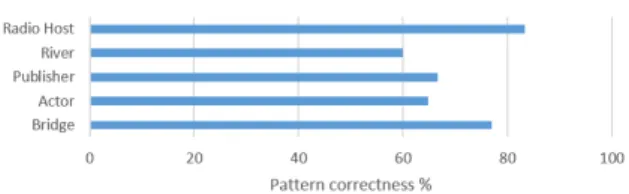
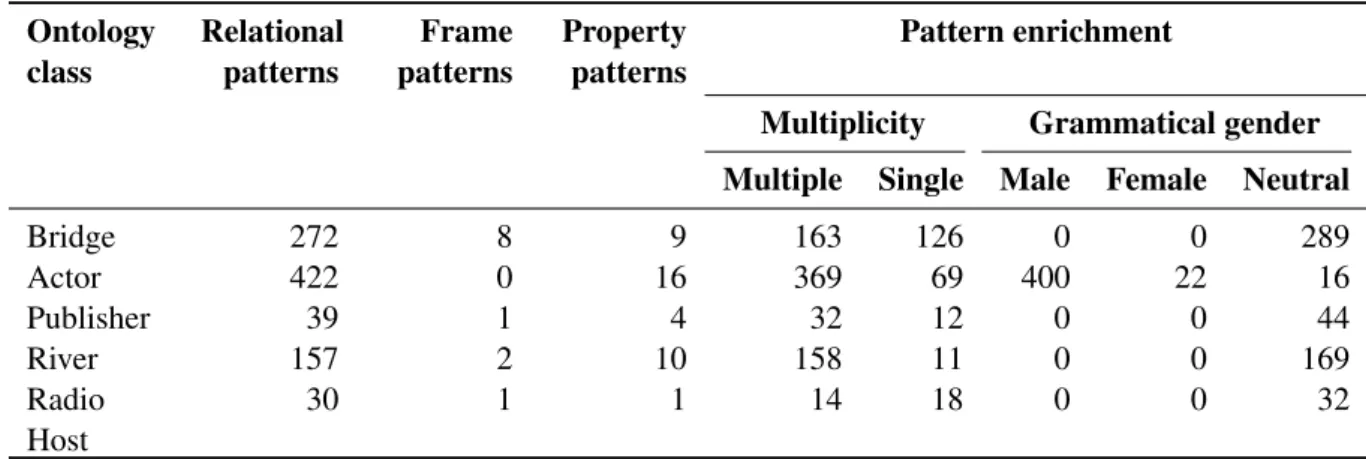
Table 1 shows the summary of the breakdown of the results for pattern extraction. The last 5 columns of the table also shows the results for the pattern enrichment modules. To get a clear idea on the accuracy of the framework, we checked how many syntactically correct lexicalization pat-terns appear as the highest ranked pattern for the given predicate. In this context syntactic
correct-Figure 3: Analysis of syntactic correctness of the extracted patterns
ness was considered as being both grammatically accurate and coherent. The results of this evalu-ation is shown in Fig. 3 for each of the ontology classes.
Since, the framework ranks lexicalization pat-terns using a scoring system, we considered it as a method that provides a set of possible outputs. We decided to get a statistical measurement incor-porating Mean Reciprocal Rank (MRR) as shown below to compute the rank of the first correct pat-tern of each predicate in each ontology class.
MRR= |P1| |P| X i=1 1 ranki (1)
where P and ranki represent predicates and the
rank of the correct lexicalization for theith
predi-cate respectively. Table 2 depicts the MRR results for the 5 ontology classes being considered.
Table 3 shows a statistical summary of proposed approach.
4.2 Observations and discussions
The following observations can be made based on the results of the experiment. Fig. 3 shows that our framework has achieved 70.36% average curacy for 5 ontology classes where the lowest ac-curacy was reported as 60%. This evaluation does not take into account the rank of the correct lex-icalization patterns and measures the number of correct patterns present in the extracted set of pat-terns. On the other hand, MRR based evaluation 4
Table 1: Results of the pattern extraction module Ontology
class Relationalpatterns patternsFrame Propertypatterns Pattern enrichment
Multiplicity Grammatical gender Multiple Single Male Female Neutral
Bridge 272 8 9 163 126 0 0 289 Actor 422 0 16 369 69 400 22 16 Publisher 39 1 4 32 12 0 0 44 River 157 2 10 158 11 0 0 169 Radio Host 30 1 1 14 18 0 0 32
Table 2: Mean Reciprocal Rank analysis for ranked lexicalization patterns
Bridge Actor Publish River Radio Host
MRR 0.77 0.69 0.72 0.61 0.83
Table 3: Statistics of evaluation of proposed ap-proach
Candidate
templates Lexicalizations Accuracy
393 101 70.36%
provides an detailed look at ranking of the first cor-rect lexicalization. Average MRR value of 0.724 achieved for 5 ontology classes. Finally, based on the comparison in Table 3, it is clear that proposed approach in this paper has advanced the way of deriving lexicalizations by generating reasonable number of valid patterns and with a higher accu-racy.
5 Conclusion and future work
This paper presented a framework to generate lex-icalization patterns for DBpedia triples using a pipeline of processes. The pipeline starts with ontology classes which is then used to mine pat-terns aligning triples with relations extracted from sentence collections from the web. The frame-work generated patterns were human-evaluated and showed an accuracy of 70.36% and a MRR of 0.72 on test dataset. In future, we aim to target on expanding the test collection to build a reasonable sized lexicalization pattern database for DBpedia.
References
Daniel Duma and Ewan Klein. 2013. Generating nat-ural language from linked data: Unsupervised tem-plate extraction. InIWCS-2013.
Basil Ell and Andreas Harth. 2014. A language-independent method for the extraction of rdf verbal-ization templates. InINLG-2014.
Oren Etzioni, Michele Banko, Stephen Soderland, and Daniel S. Weld. 2008. Open information extraction from the web.Communications of the ACM, 51. Pablo N. Mendes, Max Jakob, and Christian Bizer.
2012. DBpedia for NLP: A Multilingual Cross-domain Knowledge Base. InLREC-2012.
Rivindu Perera and Parma Nand. 2014a. Interaction history based answer formulation for question an-swering. InKESW-2014, pages 128–139.
Rivindu Perera and Parma Nand. 2014b. Real textcs -corpus based domain independent content selection model. InICTAI-2014, pages 599–606.
Rivindu Perera and Parma Nand. 2014c. The role of linked data in content selection. InPRICAI-2014, pages 573–586.
Rivindu Perera and Parma Nand. 2015a. A multi-strategy approach for lexicalizing linked open data. InCICLing-2015, pages 348–363.
Rivindu Perera and Parma Nand. 2015b. Realtext-lex: A lexicalization framework for linked open data. In
ISWC-2015 Demonstration.
Rivindu Perera. 2012a. Ipedagogy: Question answer-ing system based on web information clusteranswer-ing. In
T4E-2012.
Rivindu Perera. 2012b.Scholar: Cognitive Computing Approach for Question Answering. Honours thesis, University of Westminster.
Sebastian Walter, Christina Unger, and Philipp Cimi-ano. 2013. A corpus-based approach for the induc-tion of ontology lexica. InNLDB-2013, Salford.
Proceedings of the Second Workshop on Natural Language Processing and Linked Open Data, pages 6–15, Hissar, Bulgaria, 11 September 2015.
Small in Size, Big in Precision: A Case for Using Language-Specific
Lexical Resources for Word Sense Disambiguation
Steven Neale, Jo˜ao Silva and Ant´onio Branco Department of Informatics
Faculty of Sciences University of Lisbon, Portugal
{steven.neale, jsilva, antonio.branco}@di.fc.ul.pt Abstract
Linked open data (LOD) presents an ideal platform for connecting the multilingual lexical resources used in natural language processing (NLP) tasks, but the use of ma-chine translation to fill in gaps in lexi-cal coverage for resource-poor languages means that large amounts of data are potentially unverified. For graph-based word sense disambiguation (WSD), one approach has been to first translate terms into English in order to disambiguate us-ing richer, fuller lexical knowledge bases (LKBs) such as WordNet.
In this paper, we show that this approach actually creates more ambiguity and is far less accurate than using language-specific resources, which, regardless of their smaller size, can provide results com-parable in accuracy to the state-of-the-art reported for graph-based WSDin En-glish. For LOD, this demonstrates the im-portance of continuing to grow and ex-tend language-specific resources in order to continually verify and reintegrate them as accurate resources.
1 Introduction
In the context of natural language processing (NLP), word sense disambiguation (WSD) refers to the computational problem of determining the ‘sense’ or meaning of a word when used in a par-ticular context (Agirre and Edmonds, 2006). To use a classic example, the word ‘bank’ could be interpreted in the sense of the financial institution or as the slope of land at the side of a river, de-pending on the context in which it is used. Tar-get words are disambiguated based on their con-text (determined based on the words surrounding
them), and the potential senses that they could re-late to (N´obrega and Pardo, 2014).
Linked Open Data (LOD) – the implementation of best practices ensuring that not just documents but the data within them are structured and inter-connected on the web – is particularly useful in tying together the resources used for knowledge-based WSD, which leverages existing collections and indexes of potential senses to choose the most appropriate for a given target word (Agirre and Edmonds, 2006). WSD research has tended to derive knowledge bases from stand-alone dictio-naries and ontologies such as WordNet, where nouns, verbs, adjectives and adverbs are stored as ‘synsets’ and linked by their semantic rela-tions (Fellbaum, 1998). Recent projects such as BabelNet (Navigli and Ponzetto, 2012) are now focusing on integrating these resources with en-cyclopedic information and making the connected data available as LOD.
Our work focuses on Portuguese, for which specific work on WSD – particularly involving Portuguese knowledge resources – is still lim-ited, and usually either focused on particular do-main areas and applications or achieved by trans-lating terms to English in order to disambiguate using English knowledge sources (N´obrega and Pardo, 2014). While there are similarities be-tween Portuguese and other languages for which more substantial lexical resources and WSD re-search are already available – French and Span-ish, for example – there are still enough dif-ferences to motivate specific research in Por-tuguese. The sheer number of ’false friends’ – similar words with very different meanings – be-tween Portuguese and Spanish (Director General of Translation, 2006) demonstrates the necessity of having Portuguese-specific resources available for lexically-motivated tasks such as WSD.
This paper describes a comparison between two approaches to performing graph-based WSD 6
in Portuguese; 1) using the smaller, language-specific Portuguese MultiWordNet (MultiWord-Net, nd) as the underlying lexical knowledge base (LKB) for the WSD, and 2) translating open-class words in the input text from Portuguese to English in order to run WSD using the much larger En-glish WordNet as the underlying LKB. The contri-butions from our results are twofold:
• Performing graph-based WSD using a smaller, language-specific LKB (Portuguese MultiWordNet) provides better results than translating terms to English in order to run WSD using the much larger English WordNet.
• The results obtained when performing graph-based WSD using a small, language-specific LKB (such as the Portuguese MultiWordNet) are comparably accurate with state-of-the-art results previously reported for graph-based WSD in English using WordNet.
These contributions suggest that for LOD, re-lying on machine translation to fill in the lexical gaps between resource-rich and research-poor lan-guages (as with BabelNet) must only be a stopgap measure, and that work to grow and extend local, language-specific lexical resources such as Word-Nets should continue so that verified, accurate data can be properly linked and reintegrated with exist-ing LOD later for use in NLP tasks such as WSD. We first explore some related work (Section 2), before describing an implementation of graph-based WSD for Portuguese (Section 3). Next, we present our evaluation of the two approaches to WSD in Portuguese, using a gold-standard, human-annotated corpus for comparison (Section 4). Finally, we discuss the possible ramifications of our findings in the context of LOD (Section 5), before presenting our conclusions (Section 6). 2 Related Work
2.1 Knowledge and graph-based WSD While WSD has traditionally delivered its best re-sults using supervised and unsupervised machine learning methods, domain-specific knowledge-based WSD can now perform as well or better than a more generic, supervised machine learning-based WSD approach (Agirre et al., 2009). For example, in the medical domain good results have been obtained in WSD tasks by creating an
LKB from the Unified Medical Language Sys-tem (UMLS) Metathesarurus, a collection of more than one million biomedical concepts and five mil-lion concept names (Stevenson et al., 2011; Preiss and Stevenson, 2013).
Progress in knowledge-based WSD has largely been driven by the development of graph-based disambiguation methods, as pioneered by a num-ber of researchers (Navigli and Velardi, 2005; Mi-halcea, 2005; Sinha and MiMi-halcea, 2007; Nav-igli and Lapata, 2007; Agirre and Soroa, 2008). Graph-based methods allow LKBs such as Word-Nets to be represented as weighted graphs, where word senses correspond to nodes and the rela-tionships or dependencies between pairs of senses correspond to the edges between nodes. The strength of the edge between two nodes, corre-sponding to the relationship or dependency be-tween two synsets, can then be calculated using semantic similarity measures such as the Lesk al-gorithm (Lesk, 1986).
For WSD tasks, graph-based representations of LKBs can then be used to choose the most likely sense of a word in a given context, based on the dependencies between nodes in the graph (Agirre and Soroa, 2009). Algorithms such as PageR-ank (Brin and Page, 1998) allow for the weights and probabilities of directed links between target words and words in their local context to be spread over the entirety of the graph (Agirre and Soroa, 2009). Nodes (senses) ‘recommend’ each other based on their own importance – with the impor-tance of any given node being higher or lower de-pending on the importance of other nodes which recommend it – and then follow a ‘random walk’ over the rest of the graph based on the importance of the nodes to whose edges they are attached (Mi-halcea, 2005; Agirre and Soroa, 2009).
At the end of this random walk, the probability of a random walk from the target word’s node end-ing on any other node in the graph has been calcu-lated, thus allowing the most appropriate sense of the target word to be detemined. By utilizing the full extent of the graph-based representation of the LKB in this way, the performance of WSD in gen-eral (non-specific) domains has been shown to im-prove, becoming almost as efficient as supervised learning-based methods in some tasks (Agirre et al., 2014).
2.2 Linked Open Data and aligned LKBs In parallel to the growing use and adaptation of different types of LKBs in knowledge and graph-based WSD, the lexical resources on which these LKBs and WSD methods depend are becoming increasingly linked, interconnected and accessi-ble. Projects like MultiWordNet (MultiWord-Net, nd) and EuroWordNet (Vossen, 2004) are built around the idea of aligning and mapping the identifier codes of WordNet-style synsets to each other, and in many languages. For knowledge-based WSD, this connectivity makes multilingual and language-specific WSD tasks and workflows much simpler to construct.
Recent LOD projects such as DBpe-dia (Lehmann et al., 2012) and BabelNet (Navigli and Ponzetto, 2012) are now collecting data from encyclopedic sources such as Wikipedia to create large-scale, structured multilingual knowledge bases. BabelNet, in particular, inte-grates both lexical and encyclopedic resources – chiefly WordNet and Wikipedia – to create a ‘wide-coverage, multilingual semantic network’ of not only information and concepts but also the semantic relationships between them (Navigli and Ponzetto, 2012). Like DBpedia – which connects the extracted knowledge from 111 different language editions of Wikipedia (Lehmann et al., 2012) – BabelNet is also multilingual, using machine translation techniques to fill in the lexical gaps in resource-poor languages (Navigli and Ponzetto, 2012).
2.3 Current state of WSD in Portuguese Portuguese-specific WSD has also followed the knowledge-based trend. Early work focused on the automatic generation of disambiguation rules based on representations of meaning in pre-annotated corpora (Specia et al., 2005), before ex-ploring hybrid approaches that leverage the re-lationships between different knowledge sources to support such rules (Specia, 2006; Specia et al., 2007). More recent work has focused on graph-based methods, leveraging WordNets as LKBs (N´obrega and Pardo, 2014). However, this work assumes that translating Portuguese terms into English and then querying the English Word-Net is sufficient for representing most of the senses found in Portuguese texts.
Spanish, which shares a degree of similarity with Portuguese, has been more widely explored
in the context of WSD. Agirre and Soroa (2009) evaluated their graph-based WSD algorithm us-ing the Spanish WordNet of approximately 67,000 senses (Atserias et al., 2004) as their LKB. They obtained promising results that approach those re-ported using the supervised ‘most frequent sense’ (MFS) baseline system for the SemEval-2007 Task 09 dataset (M`arquez et al., 2007). More re-cently, graph-based WSD performed over Span-ish Babelnet senses as the LKB was shown to im-prove over the MFS baseline in the Multilingual Word Sense Disambiguation task at SemEval-2013 (Navigli et al., SemEval-2013).
These results are encouraging for the case of Portuguese, demonstrating that knowledge-based WSD produces good results using LKBs specific to similar languages. For Portuguese, it would thus seem more appropriate to grow Portuguese-specific lexical resources and to link them with ex-isting resources in other languages as LOD, than to rely either on translating the input words to be disambiguated, as in (N´obrega and Pardo, 2014), or on filling the gaps in one language by trans-lating from the fuller lexical resources of other languages, as in BabelNet (Navigli and Ponzetto, 2012).
3 Implementing Graph-Based WSD for Portuguese
For the evaluations described in this paper, we use UKB, a collection of tools and algorithms (Agirre and Soroa, 2009; Agirre et al., 2014) for perform-ing graph-based WSD over a pre-existperform-ing knowl-edge base. We use UKB for two reasons:
• UKB includes tools for automatically creat-ing graph-based representations of LKBs in WordNet-style formats.
• The algorithm used by UKB for performing WSD over the graph itself has been consis-tently shown to produce results in line with or above the state-of-the-art (Agirre and Soroa, 2009; Agirre et al., 2014).
For the purpose of our work, we are thus able to perform highly-efficient disambiguation over an accurate graph-based representation of our chosen LKBs, meaning that any differences in results can be confidently attributed to the quality of either the input texts that are being disambiguated or to the LKBs themselves.
UKB first accepts input texts in a ‘context’ for-mat, where each sentence in a text is treated as an individual context containing the target word and all other open-class words (nouns, verbs, adjec-tives and adverbs) from the original sentence. This context file can be easily extracted and arranged from input texts pre-tagged with lemmas and part-of-speech (PoS) tags, which we produce using the LX-Suite (Branco and Silva, 2006), a collection of shallow processing tools for Portuguese.
UKB then performs WSD for each sentence in the context file, using a PageRank-based (Brin and Page, 1998) random walk to return the probability of each node (synset) in a given graph being se-mantically related to a target word, and returning the appropriate synset identifier for the most likely node. It is this use of the words surrounding a tar-get word in the context file – which are also in-cluded as nodes in the graph and whose relevance thus affects the final decision on which sense to assign – that separates UKB from similar algo-rithms and consistently delivers state-of-the-art re-sults (Agirre and Soroa, 2009; Agirre et al., 2014). The graphs used for the evaluation in this paper were created, using the tools supplied with UKB, from two different source LKBs – the Portuguese MultiWordNet (MultiWordNet, nd) and version 3.0 of the Princeton English WordNet (Fellbaum, 1998). These LKBs are described in more detail in the following section.
4 Evaluation
This section describes our comparison of the as-signment of word senses by a human annotator with the output of two options for performing graph-based WSD in Portuguese:
• UKB-based WSD over the Portuguese Multi-WordNet.
• UKB-based WSD over the English WordNet (using terms automatically translated from Portuguese to English)
For UKB-based WSD over the Portuguese MultiWordNet, we create the required dictionary files and corresponding graph from approximately 19,700 verified synsets. Because the synset identi-fiers are mapped to the corresponding synsets in the English WordNet, we are able to make use of the semantic relations in the English WordNet
when building the graph – although the dictio-nary used is small at 19,700, the fuller representa-tion of semantic relarepresenta-tions for English ensures that the computed similarity between Portuguese dic-tionary items is more reliable. Semantic relations between glosses in the English WordNet are also used when building the graph, which our own ex-perimentation and previous reporting of results us-ing UKB (Agirre and Soroa, 2009; Agirre et al., 2014) have both shown to result in more accurate WSD.
For UKB-based WSD over the English Word-Net, we follow the model used by N´obrega and Pardo (2014) of translating ambiguous terms into English and then disambiguating them using the English WordNet. In practice, this involves trans-lating the context file from Portuguese to English after the input text is preprocessed and tagged us-ing the shallow processus-ing tools, so as to have translated not just the target words but also the surrounding open class words in each sentence. The translated context file is then disambiguated by UKB using a dictionary file and corresponding graph created from the English WordNet, compris-ing approximately 117,000 synsets.
We have not been able to use the WordRefer-ence API (WordReferWordRefer-ence.com, nd) that N´obrega and Pardo (2014) used for translating from Por-tuguese to English, for which user access is no longer being granted. Instead, we have created our own tool for translating terms from the con-text file word-by-word using BabelNet. Each in-dividual Portuguese word to be translated is given together with its part of speech to BabelNet, which returns the most appropriate ‘BabelSynset’ for that word.
BabelSynsets are constructed from linked information from a variety of sources in different languages (including Wikipedia (Wikipedia,
nd), WordNet (Fellbaum, 1998),
Wik-tionary (WikWik-tionary, nd), Wikidata (Wikidata, nd), OmegaWiki (OmegaWiki, nd) and various others) with gaps in resource-poor languages filled using machine translation. Every BabelSynset contains a list of translations of its main sense in different languages, and each of the possible translations for the word in each language has a weighting or probability attached to it. From this, we choose the best weighted translation from the English options and use this as the translation for the original Portuguese word in the context file. 9
CINTIL UKB + PT UKB + EN Translations
Manually disambiguated 45,502 45,502
Automatically disambiguated 59,190 112,678
Manuallyandautomatically disamb. 45,386 41,441
Same sense assigned 29,540 12,563
Precision 65.09 30.32
Recall 64.92 27.61
F1 65.00 28.90
Table 1: Comparison of the performance of UKB-based WSD over the Portuguese MultiWordNet and by translating terms to English to be run over the English WordNet.
4.1 Gold-Standard Test Corpus
The CINTIL International Corpus of Por-tuguese (Barreto et al., 2006) was chosen as the gold-standard for our evaluation. It comprises approximately 1 million tokens manually anno-tated with lemmas, part-of-speech, inflection, and named entities, which are compatible with the input and output formats of the tools in the LX-Suite. The corpus contains data from both written sources and transcriptions of spoken Portuguese – we have used the data from the written part, sourced mainly from newspaper articles and short novels and comprising approximately 700,000 tokens, of which 193,443 are open class words.
Word senses were manually chosen and as-signed to open-class words by a team of human an-notators using the LX-SenseAnnotator tool (Neale et al., 2015), a graphical user interface for assign-ing senses from WordNet-style lexicons to pre-tagged input texts. The lexicon from which an-notators were able to choose senses was the same Portuguese MultiWordNet (approximately 19,700 verified synsets) used in the evaluation. Because annotators were only able to select from the words and synets present in the Portuguese MultiWord-Net, not all of the open-class words in the corpus were able to be annotated.
4.2 Performance for Portuguese
Running the UKB algorithm over the manually disambiuated CINTIL corpus, we can see how well the two approaches – disambiguation using the smaller Portuguese MultiWordNet or translat-ing words to English and then disambiguattranslat-ing us-ing the much larger English WordNet – perform when compared with disambiguation by a human annotator. As described earlier in section 4, the mapping of synset identifiers between the
Por-tuguese and English WordNets allows the same graph to be used in both approaches (built based on the semantic relations between English synsets coupled with the semantic relations between En-glish glosses) - it is the sizes of the dictionary files that link words to synsets in the graph that greatly differ.
Table 1 shows that 45,502 of the 193,443 open class words have been manually disambiguated. When running UKB over the dictionary files and graph built from the Portuguese MultiWordNet, 45,386 of the manually disambiguated words are also automatically disambiguated, from a total of 59,190 tagged by the algorithm. Note that al-though annotators may have chosennotto disam-biguate certain words if they felt that the senses presented to them by the Portuguese MultiWord-Net did not convey the required meaning, the UKB algorithm will always assign something from the options available to it, choosing the most probable sense from those provided.
This explains the greater number of senses au-tomatically disambiguated than manually disam-biguated, but without manual disambiguation we have no measure of whether the additional auto-matic disambiguation was correct or not. Thus, we here define recall as the number of words with the same sense assigned by UKBandthe human annotator, divided by the number of words man-ually disambiguated (45,502). The UKB-based WSD was able to assign the same sense to the word as was chosen by the annotator for 29,540 of the 45,386 words for which the same sense was assigned manually and automatically, giving a pre-cision of 65.09% and recall of 64.92%.
When running UKB by automatically translat-ing ambiguous Portuguese terms into English and then running them over the dictionary files and 10
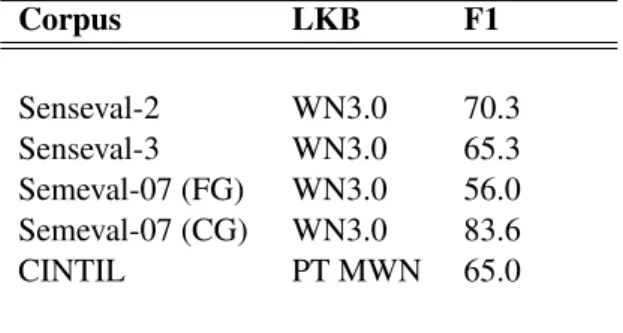
graph built from the English WordNet, perfor-mance is greatly affected. Despite vastly more words being tagged with an assigned sense by the algorithm – 112,678 – a lower number of the words that were manually disambiguated end up being tagged as well – 41,441. The UKB-based WSD was able to assign the same sense to the word as was chosen by the annotator for just 12,563 of these words, giving a precision of 30.32% and recall of 27.61% Corpus LKB F1 Senseval-2 WN3.0 70.3 Senseval-3 WN3.0 65.3 Semeval-07 (FG) WN3.0 56.0 Semeval-07 (CG) WN3.0 83.6 CINTIL PT MWN 65.0
Table 2: Comparison of UKB-based WSD over the Portuguese MultiWordNet with previously re-ported state-of-the-art results (for nouns).
Table 2 compares the performance of UKB over the Portuguese MultiWordNet with the results ob-tained by Agirre et al. (2014), who most recently reported on the performance of UKB as F1 over four different datasets – the Senseval-2 (Palmer et al., 2001), Senseval-3 (Snyder and Palmer, 2004), Semeval-2007 fine-grained (Palmer et al., 2001; Snyder and Palmer, 2004; Pradhan et al., 2007) and Semeval-2007 coarse-graned (Navigli et al., 2007) English all-words tasks. Although the re-sults they present cover various disambiguation options within UKB, we focus here on the results they obtained using theppr w2wUKB method (as we have). We also assume that they continue us-ing version 3.0 of the English WordNet (complete with information on the semantic relationships be-tween glosses) as their underlying LKB, as they have reported in previous evaluations (Agirre and Soroa, 2009). This combination of UKB option and underlying LKB is comparable with our own evaluation of UKB over the Portuguese Multi-WordNet.
The 19,700 verified synsets from the Portuguese MultiWordNet version used in our evaluation are constructed from 16,728 words, of which only 45 are not nouns. While Agirre et al. separate their results by nouns, verbs, adjectives and adverbs and also offer an overall score (2014), to compare our
results with their overall score would cast our own in a very favourable (and very unfair) light. There-fore, Table 2 only compares our results against those previously reported for nouns by Agirre et al. (2014).
5 Discussion
The results presented in the previous section high-light two important points:
• That performing WSD over a smaller, lan-guage specific LKB (such as the Portuguese MultiWordNet) is more accurate (tagged with the sames senses as were manually as-signed by a human annotator) than translat-ing ambiguous terms into English to perform WSD over larger LKBs (such as WordNet). • That performing WSD over a smaller,
lan-guage specific LKB (such as the Portuguese MultiWordNet) produces results with compa-rable accuracy to state-of-the-art results re-ported for (UKB-based) WSD over the much larger English WordNet.
Table 1 shows that the results obtained by run-ning UKB over the dictionary and graph files cre-ated from the Portuguese MultiWordNet are far higher than those obtained by first translating the target and surrounding words in the context file into English, and then running UKB over the En-glish WordNet. This is despite the fact that the Portuguese MultiWordNet is considerably smaller, at around 19,700 verified synsets, than the English WordNet, at a reported 117,000 synsets.
N´obrega and Pardo themselves (2014), whose approach of translating ambiguous words to glish in order to perform WSD using the En-glish WordNet we have compared with our own language-specific results, describe some of the problems that translating terms to and from En-glish can introduce. They observe that some very specific terms or concepts in Portuguese may not have a direct translation in English at all, while conversely there may be generic terms or con-cepts in Portuguese that have much more specific categories in English (N´obrega and Pardo, 2014). While their coverage may be less due to their smaller size, language-specific LKBs limit such problems, with the terminology thatisaccounted for being specific to the language in question.
A glance at the original and translated context files used in our comparison shows that in many 11
cases incorrect translations before the WSD has even been performed have led to the difference in results using the two approaches. For example, a line from a news article in the CINTIL corpus reads:
“O secret´ario de Imprensa da Casa Branca, Mike McCurry, disse que qual-quer agress˜ao iraquiana seria ‘uma quest˜ao de grave preocupac¸˜ao”’
An accurate translation of which would be: “The White House press secretary, Mike McCurry, said that any Iraqi offensive would be ‘a question of serious con-cern”’
From this sentence, extracting the open-class words in Portuguese produces the follow-ing line for the context file (formatted as lemma#pos#wordid): secret´ario#n#w1 imprensa#n#w2 dizer#v#w3 agress˜ao#n#w4 iraquiano#a#w5 ser#v#w6 quest˜ao#n#w7 grave#a#w8 preocupac¸˜ao#n#w9
Upon translating each of these words to English, we are left with the following line in our translated context file, to be passed to UKB and each term disambiguated using the dictionary and graph files from the English WordNet.
secretary#n#w1 printing press#n#w2 tell#v#w3 aggression#n#w4 iraqi#a#w5
being#v#w6 question#n#w7
grave#a#w8 concern#n#w9
As well as a number of words which could have been translated slightly better – ‘say’ would have been better than ‘tell’ for word three, ‘offensive’ better than ‘aggression’ for word four and ‘seri-ous’ better than ‘grave’ for word eight – there is a more obvious problem with the translation of word two. The Portuguese word ‘imprensa’ has been (in this context) incorrectly translated as ‘printing press’, the actual mechanical device used to create printed materials. With it being highly unlikely that the White House employs a ‘printing press’ secretary, we can see how incorrect translations from Portuguese to English would lead to UKB being provided with problematic and potentially
confusing contexts from which to disambiguate target words.
Of course, we must take into account that our translations from Portuguese to English are not likely to be as accurate as those obtained by N´obrega and Pardo (2014). They describe using the WordReference API to extract dictionary def-initions of Portuguese terms in English, but be-cause that is no longer available we instead trans-late terms using the linked datasets in BabelNet, as described in section 4. Because lexical gaps in BabelNet are filled using machine translation for resource-poor languages, the resources on which our translations depend are unlikely to be as accu-rate from the outset as those from a verified dic-tionary API, and it would be interesting to ex-plore whether alternative methods of producing our translations might give different results in our future work. However, we feel that the point demonstrated by the previous example still holds true – in trying to translate ambiguous terms from Portuguese to English in order to perform WSD over a larger underlying LKB in English, we are actually introducing more noise to the problem.
Table 2 shows that the accuracy of running UKB over the dictionary and graph files created from the Portuguese MultiWordNet is comparable with previously-reported state-of-the-art results – namely running UKB over the much larger En-glish Wordnet to disambiguate words already in English. As well as the results shown in Table 1 and discussed in the preceding paragraphs, show-ing that translatshow-ing Portuguese terms into English to make use of a much larger English LKB for disambiguation decreases accuracy, the results in Table 2 show that the smaller size of the Por-tuguese MultiWordNet does not have any consid-erable detrimental effect on the accuracy of the WSD process itself.
Besides the limited lexical coverage, there is no reason that using a smaller, language-specific LKB would produce any less accurate results for WSD. In fact, while language-specific dictionaries might be much smaller in certain languages, be-cause the semantic relationships between concepts generally hold true across different languages, graphs representing these relationships as nodes and edges can actually be created from much fuller LKBs (as we have done using semantic relations from the English WordNet). This ensures that although not all words are covered locally, our 12
capacity to determine the relationships between them is still strong, providing consistently accu-rate results. Problems arise not necessarily from difficulty in determining the semantic relation-ships between concepts, but because the kinds of ambiguities and translation errors described above will occur when gaps in the lexical coverage of linked data are filled using machine translation.
For LOD, the implications are that while miss-ing data for resource-poor languages can be filled in using machine translation (Navigli and Ponzetto, 2012), verified language-specific lexi-cal resources still provide highly accurate results for tasks like WSD regardless of their compara-tive size – there is nothing to be gained by trans-lating terms into other languages (such as En-glish) to make use of fuller, larger LKBs. The increased connectivity and integration of lexical (and encyclopedic) resources in projects like DB-pedia and BabelNet open up a world of possibili-ties for multilingual NLP, but filling the gaps us-ing machine translation should only be a stopgap measure. Rather than abandon them in favour of the linked data already available, local efforts to grow, extend and expand language-specific lexi-cal resources must continue, such that they can be continually re-integrated as LOD later as fuller, accurate and verified resources – thus increasing the overall quality of linked lexical data.
6 Conclusions
We have evaluated two approaches to performing graph-based WSD in Portuguese; 1) by using the smaller, language-specific Portuguese MultiWord-Net as the underlying LKB, and 2) by first trans-lating open-class words from Portuguese to En-glish in order to use the much larger EnEn-glish Word-Net as the underlying LKB. Comparing the re-sults of both approaches with the human-assigned senses in a gold-standard annotated corpus, we have demonstrated that performing graph-based WSD using a smaller, language-specific LKB pro-vides more accurate results than the approach of using the larger LKB by way of translating terms first. Furthermore, the accuracy of the language-specific approach is comparable with state-of-the-art results reported for graph-based WSD in En-glish using WordNet.
For LOD, the implications of our results are that as well as in the short term making use of linked data where the gaps between resource-rich and
resource-poor languages have been filled by ma-chine translation, local efforts to grow and extend language-specific lexical resources such as Word-Nets should continue, so that these can be linked back to existing data as LOD later. This way, LOD will eventually consist not only of the connected semantic relationships across languages, but also fuller and verified lexical coverage, making rich multilingual NLP applications possible based on accurate linked data.
We plan to build on our work by making further comparisons to other graph-based WSD approaches, such as the disambiguation options available in BabelNet itself performed over its own linked data as an LKB, and by experimenting with alternative techniques and APIs for translating the open-class words from the context file into En-glish in the first instance. It would also be in-teresting to combine approaches, augmenting sults from accurate local lexical resources with sults sourced via translated terms fed to larger re-sources. We also plan to explore whether LOD can play an effective role in the growth and ex-tension of local lexical resources themselves, in-vestigating whether there is an effective way that the expansion of local WordNets can be in some part automated based on manually checked and verified translations sourced from existing multi-lingual LOD.
Acknowledgments
This work has been undertaken and funded as part of the EU project QTLeap (EC/FP7/610516) and the Portuguese project DP4LT (PTDC/EEI-SII/1940/2012).
References
Eneko Agirre and Philip Edmonds. 2006. Word Sense Disambiguation: Algorithms and Applica-tions. Springer.
Eneko Agirre and Aitor Soroa. 2008. Using the Multilingual Central Repository for Graph-Based Word Sense Disambiguation. In Proceed-ings of the Sixth International Conference on Lan-guage Resources and Evaluation (LREC’08), Mar-rakech, Morocco, may. European Language Re-sources Association (ELRA). http://www.lrec-conf.org/proceedings/lrec2008/.
Eneko Agirre and Aitor Soroa. 2009. Personalizing PageRank for Word Sense Disambiguation. In Pro-ceedings of the 12th Conference of the European
Chapter of the Association for Computational Lin-guistics, EACL ’09, pages 33–41, Athens, Greece. Association for Computational Linguistics.
Eneko Agirre, Oier Lopez De Lacalle, and Aitor Soroa. 2009. Knowledge-based WSD on Specific Do-mains: Performing Better Than Generic Supervised WSD. In Proceedings of the 21st International Jont Conference on Artifical Intelligence, IJCAI’09, pages 1501–1506, San Francisco, CA, USA. Mor-gan Kaufmann Publishers Inc.
Eneko Agirre, Oier L´opez de Lacalle, and Aitor Soroa. 2014. Random Walks for Knowledge-based Word Sense Disambiguation. Comput. Linguist., 40(1):57–84, March.
Jordi Atserias, Lu´ıs Villarejo, and German Rigau. 2004. Spanish WordNet 1.6: Porting the Spanish WordNet across Princeton Versions. InProceedings of the 4th International Conference on Language Resources and Evaluation, LREC ’04.
Florbela Barreto, Ant´onio Branco, Eduardo Ferreira, Am´alia Mendes, Maria Fernanda Bacelar Nasci-mento, Filipe Nunes, and Jo˜ao Silva. 2006. Open Resources and Tools for the Shallow Processing of Portuguese: The TagShare Project. InProceedings of the 5th International Conference on Language Resources and Evaluation, LREC’06, pages 1438– 1443.
Ant´onio Branco and Jo˜ao Silva. 2006. A Suite of Shal-low Processing Tools for Portuguese: LX-suite. In
Proceedings of the 11th Conference of the European Chapter of the Association for Computational Lin-guistics: Posters and Demonstrations, EACL ’06, pages 179–182, Trento, Italy. Association for Com-putational Linguistics.
Sergey Brin and Lawrence Page. 1998. The Anatomy of a Large-Scale Hypertextual Web Search Engine. In Seventh International World-Wide Web Confer-ence (WWW 1998).
Director General of Translation. 2006. Nova Vers˜ao da Lista de Falsos Amigos Portuguˆes-Espanhol / Espa˜nol-Portugu´es. A Folha: Boletim da L´ıngua Portuguesa nas Instituic¸˜oes Europeias (Comiss˜ao Europeia), 23:19–27.
Christine Fellbaum. 1998. WordNet: An Electronic Lexical Database. MIT Press.
Jens Lehmann, Robert Isele, Max Jakob, Anja Jentzsch, Dimitris Kontokostas, Pablo Mendes, Se-bastian Hellmann, Mohamed Morsey, Patrick van Kleef, S¨oren Auer, and Christian Bizer. 2012. DB-pedia - A Large-scale, Multilingual Knowledge Base Extracted from Wikipedia. Semantic Web Journal, 6(2):167–195.
Michael Lesk. 1986. Automatic Sense Disambigua-tion Using Machine Readable DicDisambigua-tionaries: How to Tell a Pine Cone from an Ice Cream Cone. In
Proceedings of the 5th Annual International Con-ference on Systems Documentation, SIGDOC ’86, pages 24–26, New York, NY, USA. ACM.
Llu´ıs M`arquez, Luis Villarejo, M. A. Mart´ı, and Mar-iona Taul´e. 2007. SemEval-2007 Task 09: Multi-level Semantic Annotation of Catalan and Spanish. In Proceedings of the 4th International Workshop on Semantic Evaluations, SemEval ’07, pages 42– 47, Stroudsburg, PA, USA. Association for Compu-tational Linguistics.
Rada Mihalcea. 2005. Unsupervised Large-vocabulary Word Sense Disambiguation with Graph-based Algorithms for Sequence Data Label-ing. In Proceedings of the Conference on Human Language Technology and Empirical Methods in Natural Language Processing, HLT ’05, pages 411–418, Stroudsburg, PA, USA. Association for Computational Linguistics.
MultiWordNet. n.d. The MultiWordNet project. http://multiwordnet.fbk.eu/ english/home.php. Accessed: 2015-01-13. Roberto Navigli and Mirella Lapata. 2007. Graph
Connectivity Measures for Unsupervised Word Sense Disambiguation. InProceedings of the 20th International Joint Conference on Artifical Intelli-gence, IJCAI’07, pages 1683–1688, San Francisco, CA, USA. Morgan Kaufmann Publishers Inc. Roberto Navigli and Simone Paolo Ponzetto. 2012.
BabelNet: The Automatic Construction, Evaluation and Application of a Wide-Coverage Multilingual Semantic Network. Artificial Intelligence, 193:217– 250.
Roberto Navigli and Paola Velardi. 2005. Structural Semantic Interconnections: A Knowledge-Based Approach to Word Sense Disambiguation. IEEE Transactions on Pattern Analysis and Machine In-telligence, 27(7):1075–1086, July.
Roberto Navigli, Kenneth C. Litkowski, and Orin Har-graves. 2007. SemEval-2007 Task 07: Coarse-grained English All-words Task. InProceedings of the 4th International Workshop on Semantic Eval-uations, SemEval-2007, pages 30–35, Stroudsburg, PA, USA. Association for Computational Linguis-tics.
Roberto Navigli, David Jurgens, and Daniele Vannella. 2013. SemEval-2013 Task 12: Multilingual Word Sense Disambiguation. In International Workshop on Semantic Evaluation, SemEval-2013.
Steven Neale, Jo˜ao Silva, and Ant´onio Branco. 2015. A Flexible Interface Tool for Manual Word Sense Annotation. InProceedings of the 11th Joint ACL-ISO Workshop on Interoperable Semantic Annota-tion, ISA-11, pages 67–71, London, UK. Associa-tion for ComputaAssocia-tional Linguistics.
Fernando Antˆonio Asvedo N´obrega and Thiago Alexandre Salgueiro Pardo. 2014. General Purpose Word Sense Disambiguation Methods for Nouns in Portuguese. Computational Processing of the Por-tuguese Language, 8775:94–101.
OmegaWiki. n.d. OmegaWiki. http://en. omegawiki.org. Accessed: 2015-07-10. Martha Palmer, Christiane Fellbaum, Scott Cotton,
Lauren Delfs, and Hoa Trang Dang. 2001. En-glish Tasks: All-Words and Verb Lexical Sample. In
Proceedings of SENSEVAL-2 Second International Workshop on Evaluating Word Sense Disambigua-tion Systems, SensEval-2, pages 21–24, Toulouse, France, July. Association for Computational Lin-guistics.
Sameer S. Pradhan, Edward Loper, Dmitriy Dligach, and Martha Palmer. 2007. SemEval-2007 Task 17: English Lexical Sample, SRL and All Words. In
Proceedings of the 4th International Workshop on Semantic Evaluations, SemEval ’07, pages 87–92, Stroudsburg, PA, USA. Association for Computa-tional Linguistics.
Judita Preiss and Mark Stevenson. 2013. Dale: A word sense disambiguation system for biomedical docu-ments trained using automatically labeled examples. InProceedings of the 2013 NAACL HLT Demonstra-tion Session, pages 1–4. Association for Computa-tional Linguistics.
Ravi Sinha and Rada Mihalcea. 2007. Unsuper-vised Graph-basedWord Sense Disambiguation Us-ing Measures of Word Semantic Similarity. In Pro-ceedings of the International Conference on Seman-tic Computing, ICSC ’07, pages 363–369, Washing-ton, DC, USA. IEEE Computer Society.
Benjamin Snyder and Martha Palmer. 2004. The En-glish All-Words Task. In Rada Mihalcea and Phil Edmonds, editors, Senseval-3: Third International Workshop on the Evaluation of Systems for the Se-mantic Analysis of Text, SensEval-3, pages 41–43, Barcelona, Spain, July. Association for Computa-tional Linguistics.
Lucia Specia, Maria das Grac¸as V. Nunes, and Mark Stevenson. 2005. Exploiting Rules for Word Sense Disambiguation in Machine Translation. Proce-samiento del Lenguaje Natural, 35:171–178. Lucia Specia, Mark Stevenson, and Maria Grac¸as V.
Nunes. 2007. Learning expressive models for words sense disambiguation. In In Proceedings of the 45th Annual Meeting of the Association for Com-putational Linguistics (ACL), pages 41–48.
Lucia Specia. 2006. A Hybrid Relational Approach for WSD: First Results. InProceedings of the 21st In-ternational Conference on Computational Linguis-tics and 44th Annual Meeting of the Association for Computational Linguistics: Student Research Work-shop, COLING ACL ’06, pages 55–60, Stroudsburg, PA, USA. Association for Computational Linguis-tics.
Mark Stevenson, Eneko Agirre, and Aitor Soroa. 2011. Exploiting Domain Information for Word Sense Disambiguation of Medical Documents. Journal of the American Medical Informatics Association, 19(2):235–40.
Piek Vossen. 2004. Eurowordnet: A multilin-gual database of autonomous and language-specific wordnets connected via an inter-lingualindex. Inter-national Journal of Lexicography, 17(2):161–173. Wikidata. n.d. Wikidata. http://en.wikidata.
org. Accessed: 2015-07-10.
Wikipedia. n.d. Wikipedia, the free encyclope-dia. https://en.wikipedia.org. Ac-cessed: 2015-07-10.
Wiktionary. n.d. Wiktionary, the free dictio-nary. http://en.wiktionary.org. Ac-cessed: 2015-07-10.
WordReference.com. n.d. WordReference API Doc-umentation. http://www.wordreference. com/docs/api.aspx. Accessed: 2015-06-04.
Proceedings of the Second Workshop on Natural Language Processing and Linked Open Data, pages 16–22, Hissar, Bulgaria, 11 September 2015.
Towards the Representation of Hashtags
in Linguistic Linked Open Data Format
Thierry Declerck
Dept. of Computational Linguistics,
Saarland University, Saarbrücken,
Germany
[email protected]
Piroska Lendvai
Dept. of Computational Linguistics,
Saarland University, Saarbrücken,
Germany
[email protected]
Abstract
A pilot study is reported on developing the basic Linguistic Linked Open Data (LLOD) infrastructure for hashtags from social media posts. Our goal is the encoding of linguistical-ly and semanticallinguistical-ly enriched hashtags in a formally compact way using the
machine-readable OntoLex model. Initial hashtag
pro-cessing consists of data-driven decomposition of multi-element hashtags, the linking of spelling variants, and part-of-speech analysis
of the elements. Then we explain how the
On-toLex model is used both to encode and to en-rich the hashtags and their elements by linking them to existing semantic and lexical LOD
re-sources: DBpedia and Wiktionary.
1
Introduction
Applying term clustering methods to hashtags in social media posts is an emerging research thread in language and semantic web technologies. Hashtags often denote named entities and events, as exemplified by an entry from our reference corpus that includes Twitter1 posts ('tweets') about the Ferguson unrest2: "#foxnews #Fergu-sonShooting is in a long line of questionable acts by the police. Because some acted out does not excuse the police."
In recent work (Declerck and Lendvai, 2015) we have applied string and pattern matching to address lexical variation in hashtags with the goal of normalizing, and subsequently contextu-alizing hashtagged strings. Types of contexts for a hashtag can be derived from e.g. hashtag co-occurrence and semantic relations between hahstags; representing such contexts necessitates
1
twitter.com
2
https://en.wikipedia.org/wiki/Ferguson_unrest
the understanding of the linguistic and extra-linguistic environment of the social media post-ing that features the hashtag.
In the light of recent developments in the Linked Open Data (LOD) framework, it seems relevant to investigate the representation of lan-guage data in social media so that it can be pub-lished in the LOD cloud. Already the classical Linked Data framework included a growing set of linguistic resources: language data i.e. hu-man-readable information connected to data ob-jects by e.g. RDFs annotation properties such as 'label' and 'comment' , have been suggested to be encoded in machine-readable representation3. This triggered the development of the lemon
model (McCrae et al., 2012) that allowed to op-timally relate, in a machine-readable way, the content of these annotation properties with the objects they describe.
While LOD enables connecting and querying databases from different sources4, the recently emerging Linguistic Linked Open Data (LLOD) facilitates connecting and querying also in terms of linguistic constructs. Based on the activities of the Working Group on Open Data in Linguistics5 and of projects such as the European FP7 Sup-port Action “LIDER”6
, the linked data cloud of linguistic resources is expanding.
Our goal in the current study is to develop and promote the modeling of linguistic and semantic phenomena related to hashtags, adopting the
3
(Declerck and Lendvai, 2010) discussed already the possi-ble benefits of the linguistic annotation of this type of lan-guage data.
4
A more technical definition of Linked Data is given at http://www.w3.org/standards/semanticweb/data 5 http://linguistics.okfn.org/ 6 http://www.lider-project.eu/. 16
toLex model7. This model, a result of the W3C Ontology-Lexicon community group8, lies at the core of the publication of language data and lin-guistic information in the LLOD cloud9. In the next sections we briefly present the current state of OntoLex, then summarize our approach to hashtag processing, after which our LOD and LLOD linking efforts are explained in detail, fi-nally leading us to future plans.
2
The OntoLex model
The OntoLex model has been designed using the Semantic Web formal representation languages OWL, RDFS and RDF10. It also makes use of the SKOS and SKOS-XL vocabularies11. OntoLex is based on the ISO Lexical Markup Framework (LMF)12and is an extension of the lemon model. OntoLex describes a modular approach to lexi-con specification.
Figure 1: The core model of OntoLex. Figure created by John P. McCrae for the W3C Ontolex Community Group.
With OntoLex, all elements of a lexicon can be described independently, while they are con-nected by typed relation markers. The compo-nents of each lexicon entry are linked by RDF encoded relations and properties. Figure 1 de-picts the overall design of the core OntoLex model.
7
http://www.w3.org/community/ontolex/wiki/Main_Page, and more specifically:
http://www.w3.org/community/ontolex/wiki/Final_Model_ Specification 8 https://www.w3.org/community/ontolex/ and https://github.com/cimiano/ontolex 9 http://linguistic-lod.org/llod-cloud 10 http://www.w3.org/TR/owl-semantics/ http://www.w3.org/TR/rdf-schema/ http://www.w3.org/RDF/ 11 http://www.w3.org/2004/02/skos/ 12
Francopoulo et al. (2006) and
http://www.lexicalmarkupframework.org/
An important relation for us will be ‘refer-ence’ that represents a property that supports the linking of senses of lexicon entries to knowledge objects available in the LOD cloud so that the meaning of a lexicon entry can be referred to appropriate resources on the Semantic Web.
Additionally to the core model of OntoLex, we make use of its decomposition module13, which is important for the representation of seg-mented hashtags
.
The relation of this module to a lexical entry in OntoLex is displayed in Figure 2.Figure 2: The relation between the decomposition module and the lexical entry of the core module. Fig-ure created by John P. McCrae for the W3C Ontolex Community Group.
3
Hashtag analysis and decomposition
The hashtag set we work with originates from tweets collected about both the Ferguson and the Ottawa shootings14, as part of a journalistic use case defined in the PHEME project15. Below we give examples of the hashtags that we encoded in a lexicon using the OntoLex guidelines:#FergusonShooting, #fergusonshooting, #FER-GUSON, #FERGUSONSHOOTING, #Fergu-sonShootings, #OttawaShooting, #ottawashooting, #Ottawashooting, #Ottawashootings, #ottawashoot-ings, #OttawaShoot#ottawashoot-ings, #Ottawa #SHOOTING, #ottwashooting, #OttwaShooting, #Ottwashooting
In Declerck and Lendvai (2015) we reported on the relation between a hashtag processing ap-proach that we apply in our present study as well, and previous work from the literature. Our goal was to examine if hashtags can be segmented and normalized in a data-driven way. In that study, we processed a different, much larger corpus of
13
For details see
http://www.w3.org/community/ontolex/wiki/Final_Model_ Specification#Decomposition_.28decomp.29
14
See https://en.wikipedia.org/wiki/Ferguson_unrest and https://en.wikipedia.org/wiki/2014_shootings_at_Parliament _Hill,_Ottawa
15
http://www.pheme.eu/