Composable M&S Web Services
for Net-Centric Applications
Andreas Tolk
Charles D. Turnitsa
Saikou Y. Diallo
Virginia Modeling, Analysis & Simulation Center
Old Dominion University
Norfolk, VA 23529
[atolk,cturnits,sdiallo]@odu.edu
Leslie S. Winters
J6I Net-centric Information Integration/U.S. Joint Forces Command
Norfolk, VA 23551
[email protected]
Service-oriented architectures promise easier integration of functionality in the form of web services into operational systems than is the case with interface-driven system-oriented approaches. Although the Extensible Markup Language (XML) enables a new level of interoperability among heterogeneous systems, XML alone does not solve all interoperability problems users contend with when integrating services into operational systems. To manage the basic challenges of service interoperation, we developed the Levels of Conceptual Interoperability Model (LCIM) to enable a layered approach and gradual solution improvements. Furthermore, we developed methods of model-based data
engineering (MBDE) for semantically consistent service integration as a first step. These methods have been applied in
the U.S. in collaboration with industry resulting in proofs of concepts. The results are directly applicable in a net-centric and net-enabled environment.
Keywords: Data engineering, data mediation services, global information grid, net centricity, net-centric data strategy, service-oriented architecture, web services
1. Introduction
The reuse of legacy solutions and the composition of solutions to create a new system are the objectives of many commercial and government driven initiatives. These initiatives include both national inter-agency solutions and multilateral collaborations among nations. This is especially true for modeling and simulation (M&S) applications and their use within operational systems for training, testing, and decision support. These ideas are supported by the request to use web-based services to support net-centric and net-enabled operations. While the advent of the Extensible Markup Language (XML) and Web Services (WSs) promised an easier integration of components
into service-oriented architectures (SOAs), a theory of composability shows that more than technical interoperability is needed to ensure the meaningful
collaboration of systems and services. Petty and Weisel specifically deal with this topic [1]. One of the
immediate challenges is the mapping of information format and content to enable consistent information exchange between systems and services. The theory of
data engineering, as discussed by Spaccapietra et al. [2] and adapted for the military domain, specifically for
M&S integration within NATO’s Code of Best Practice
for Command and Control Assessment [3], deals with
this challenge. A Common Reference Model (CRM) is
proposed for efficient information exchange between
systems and services belonging to one community of interest (COI). In the military domain, the Command
(C2IEDM) has potential to become such a CRM [4].
The results show that the current DoD data strategy
[5] is not sufficient to support composable M&S WSs
for net-centric applications.
This paper introduces a description of the challenges modelers will face when managing composable services in general and M&S services in particular
(section 2, Composable Services). Next, a description of the data engineering methods (section 3, Data
Engineering) used to solve some of the emerging problems as an initial step will be presented. Third, we provide a description of the prototypes used as proofs
of concept and feasibility (section 4, Prototypical Implementations) including the use of C2IEDM as a domain-specific CRM for data mediation. The paper
concludes with proposals on how the work described in this research will support command and control in
the future (section 5, Net-Centric Applications) and
prescribes necessary changes for the future.
2. Composable Services
This section describes in general the current state, constraints, and objectives of the research conducted on implementation of prototypical proofs of concept and feasibility. As such, it summarizes the underlying general domain, such as web services and research on web services composition, and research on integration, interoperability, and composability. These topics motivate the data engineering methods, which are the central topic of this paper.
2.1 Web Services
WSs are discrete web-based applications that interact dynamically with other web applications. The fundamental idea behind WSs is the integration of
software applications as services using a defined set of
industry-supported, open standard technologies that work together to facilitate interoperability between heterogeneous systems, either within an organization or across the Internet. In other words, WSs can web-enable applications to communicate with other applications according to WSs standards. At its core, WSs are another approach to distributed computing with application resources provided over networks using standard technologies. Because WSs are based on standard interfaces, they can communicate even if
they are running on different operating systems and are written in different languages. They are widely
supported by industry and already successfully
applied in a wide range of different domains.
WSs are a set of operations, modular and independent applications, that can be published, discovered, and invoked by using a family of standard protocols built
on and around XML—Simple Object Access Protocol (SOAP), Web Service Description Language (WSDL), and Universal Description, Discovery, and Integration (UDDI). WSs are used as a distributed computing model that represents the interaction between program and program; it is not the interaction between program and user. Several sub-functions are necessary to make this happen, namely:
Self-description of the service functionality,
Publishing of the service descriptions using a standardized format,
Locating the service with the required functionality,
Establishing communications with the service, Requesting the required data to initiate the service, and
Exchanging data with other WSs, including delivering the results.
The underlying assumption is that services will work together seamlessly because they are developed to the same standards for self-description, publication, location, communication, invocation, and data exchange capabilities. Because all the standards concerned are open, the technologies chosen are inherently neutral to compatibility issues that exist between programming languages, middleware solutions, and operating platforms. As a result, applications using WSs can dynamically locate and use necessary functionality—whether available locally or from across the Internet.
At the technical level, the composition of services
is easily accomplished as shown in Figure 1: the
service provider describes the service using WSDL
and posts the description to the registry (1); the service is discovered using this UDDI entry (2); the
input parameters are converted into XML, the service
is invoked using SOAP (3a), and the result (3b) is
transformed from XML into the native format.1
To achieve a system that delivers meaningful results, the applied services must be composable regarding their underlying ideas. This is particularly true for simulation systems, as they are implementations of models that are meaningful abstractions of reality. In other words, every model has a set of assumptions and constraints that must be aligned when two models are merged into a new model. This is true not only when models are combined into a single system, but also when multiple simulation systems are federated as well.
1. A technically more detailed description of standards and use cases can be found in [6].
• • • • • •
2.2 The Levels of Conceptual Interoperability Model
From the early ideas of Harkrider and Lunceford [7],
simulation composability has been studied in more
detail. Petty and Weisel formulated the current working definition [1]:
“Composability is the capability to select and assemble simulation components in various combinations into simulation systems to satisfy specific user
requirements. The defining characteristic of
composability is the ability to combine and recombine
components into different simulation systems for different purposes.”
A recent RAND study provided a coherent overview of the state of composability for military simulation systems within the U.S. Department of Defense; many
of its findings have much broader applicability [8].
The resulting challenges have produced layered
views. Petty and Weisel [1] distinguish between the
idea of interoperability, coping with the technical challenges, and composability, dealing with modeling issues. Research at the Virginia Modeling Analysis
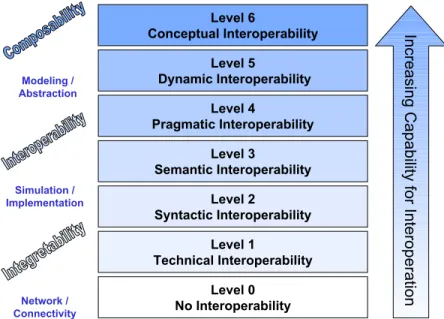
& Simulation Center (VMASC) refined these layers to define the Levels of Conceptual Interoperability Model (LCIM). This definition has undergone gradual improvement since the first discussion in [9]. The current version of LCIM, as depicted in Figure 2, is documented in [10].
The different levels are characterized as follows: Level 0: Stand-alone systems have no inter- operability.
Level 1: On the level of technical interoperability, a communication protocol exists for exchanging data between participating systems.2 On
2. Petty distinguished additionally between hardware level and communication level when analyzing the domains of technical interoperability in [11].
• •
this level, a communication infrastructure is established allowing systems to exchange bits and bytes, and the underlying networks and
protocols are unambiguously defined.
Level 2: The syntactic interoperability level introduces a common structure to exchange information; i.e., a common data format is applied. On this level, a common protocol to structure the data is used; the format of the information exchange is unambiguously
defined.
Level 3: If a common information exchange
reference model is used, the level of semantic interoperability is reached. On this level, the meaning of the data is shared; the content of the information exchange requests are
unambiguously defined.
Level 4: Pragmatic interoperability is reached when the interoperating systems are aware of the methods and procedures that each system is employing. In other words, the use of the data— or the context of its application—is understood by the participating systems; the context in which the information is exchanged is unambiguously
defined.
Level 5: As a system operates on data over
time, the state of that system will change, and this includes the assumptions and constraints
that affect its data interchange. If systems have attained dynamic interoperability, they are able to comprehend the state changes that occur in the assumptions and constraints that each is making over time, and they are able to take advantage of those changes.3 When interested
specifically in the effects of operations, this
becomes increasingly important; the effect of the
information exchange within the participating
systems is unambiguously defined.
Level 6: Finally, if the conceptual model—i.e., the
assumptions and constraints of the meaningful abstraction of reality—are aligned, the highest level of interoperability is reached: conceptual interoperability. This requires that conceptual models are documented based on engineering methods enabling their interpretation and evaluation by other engineers. In essence, this
requires a “fully specified, but implementation independent model” as requested by Davis and 3. Methods that enable such interoperability can be (documented)
open source, reference implementations, or adequate documentation, such as complete UML [12] or DEVS [13] models. Tolk and Muguira proposed an initial framework based on the LCIM merging several engineering approaches, including UML and DEVS, to insure consistent interoperation of services in [14]. • • • • • Figure 1. General web-service architecture
Service Registry (Naming service)
Service Consumer
(Client) Service Provider(Server)
Invoke Service (SOAP) Discover Service (UDDI) 2 Describe Service (WSDL) 1 3a Results (SOAP)3b
Anderson [8]; this is not simply text describing
the conceptual idea.
The LCIM shows that a layered approach to support composable services is necessary. The WS standards described earlier are not able to manage all
levels, in particular not with the M&S specific upper
layers. It is worth mentioning, however, that the LCIM focuses on technical support by information systems, such as command and control information systems in the military context. As Alberts and Hayes point
out in [15], the organizational and social aspects are often even more important. Tolk proposes such a
layered framework for measures of merits dealing with questions like tactical or strategic alignment of objectives or even political will of coalition partners in
[16]. Within this paper, however, the focus will be on
the information system aspects. 2.3 Related Work
Related work of various M&S experts supports
these findings. During a recent panel discussion on
priorities for M&S standards, Zeigler explicitly stated in his presentation that standardization must be aimed at the modeling level to ensure interoperability between systems, i.e., the standardized level must be higher than the programming level standards currently applied.4
4. Simulation Interoperability Standards Organization (SISO)/ Society for Modeling and Simulation International (SCS) Panel Discussion on “Priorities for M&S Standards;” conducted during the IEEE Spring Simulation Interoperability Workshop in Orlando, Florida, March 2003.
For “meaningful interoperability,” the sharing of
standardized data via standardized protocols, such
as the distributed interactive simulation (IEEE1278) protocol [17] or the high level architecture (IEEE1516) standard [18], is necessary, but not sufficient. The
coordination of the underlying conceptual models and the harmonization of the operational ideas simulated are the real crux in creating interoperable solutions. Solely standardizing the information exchange requirements is not adequate; the underlying modeled
cause-effect chains must also be coordinated.
Sarjoughian et al. propose a framework for a general modeling formalism comprising the system
formalism describing first the model, the abstract simulator, a platform-independent description of implementation ideas interpreting the formalism, the simulation algorithm computing the formalism and correctly implementing the abstract simulator, and the computational platform [19]. Next, the general
model formalism copes with the conceptual issues of interoperability. This is followed by an abstract simulator and simulation algorithms that make the interplay of dynamic, pragmatic, and semantic interoperability transparent to the developer. Finally, the computational platform copes with syntactic and technical interoperability levels.
Page et al. propose a framework based on the three concepts of integratability, interoperability,
and composability [20]. Integratability manages
the physical/technical realms and challenges of
connections between systems, which include
hardware and firmware, and protocols.
Figure 2. Levels of conceptual interoperability
Level 5 Dynamic Interoperability Level 4 Pragmatic Interoperability Level 3 Semantic Interoperability Level 2 Syntactic Interoperability Level 0 No Interoperability Level 1 Technical Interoperability Level 6
Conceptual Interoperability Inc
re as ing C ap ab ility fo r In ter op era tio n Modeling / Abstraction Simulation / Implementation Network / Connectivity
Interoperability deals with the software and
implementation details of interoperation, including exchange of data elements based on a common data interpretation, which can be mapped to the levels of syntactic and semantic interoperability. Composability addresses the alignment of issues on the modeling level. The underlying models are meaningful abstractions of reality used for the conceptualization being implemented by the resulting simulation systems. These are the topics covered by pragmatic, dynamic, and conceptual interoperability.
At first glance, some of the challenges in
resolving how to enable composable services appear unrelated. These challenges include aggregation and disaggregation, alignment and orchestration
of execution, and different time schemas. Even so, the interdisciplinary academic field of ontologies
has the potential to become the unifying theory for interoperability and composability; see [21] for some first results. The findings are supported by Oberle et al. [22] and refer to groundbreaking papers like those collected by Welty and Smith [23]. In order to
support the interoperation of services, the underlying
assumption is that the result of these ontology efforts will map different views to a common core, showing how entities of different resolution overlap, how they are used within the different systems, what
processes are used, and so on. Frameworks such as those summarized in this section will help make the interpretation and the application of such ontologies meaningful for the M&S domain as well as support the idea of composable services.
These M&S- and application domain–specific efforts described above are accompanied by a great
amount of general research initiatives on web-service composition. A complete survey of this topic goes beyond the scope of this paper; however, the interested reader should be aware of the core ideas for WS composition, orchestration, and choreography,
as they support the M&S-specific research results. In
their overview on current solutions for web-service
composability [24], Srivastava and Koehler concluded
that the functionality of a WS needs to be described with additional pieces of information, either by a
semantic annotation of what it does and/or by a
functional annotation of how it behaves, which de
facto points to the LCIM level 5. They also show that
current solutions based on the Resource Description Framework (RDF) are often not sufficient. Tosic et al. come to similar conclusions in [25]. Lopes and Hammoudi show in [26] how the use of frameworks,
as provided by the OMG’s Model Driven Architecture
(MDA) [27], can support the composition of WSs on
higher levels. Alternatively, concepts like the Web Service Conversation Language (WSCL) can enable
services to negotiate their composition, as discussed
in Banerji et al. in [28], but again a semantically rich
environment for orchestration is needed. Agarval et
al. summarize this in [29] and go on to recommend a
framework to represent the underlying concepts in the form of a common ontology. The latest applications of ideas of the Semantic Web Service Initiative (SWSI)
are given on their website [30]; foundations and basic ideas are summarized by Alesso and Smith [31]. These results are confirmed with our evaluations, partly summarized in Table 2 at the end of section 7, focusing
on military net-centric applications.
In order to reach the objective of composability of services, support is necessary on all levels—and works on improving current standards concur with
this conclusion; see [20, 32, 33, 34]. In fact, many state-of-the-art works are focusing on raising the efforts
from the syntactic level of interoperability, such as supported by standards like the HLA, to higher levels, particularly the semantic level.
The LCIM has been used in various international
standardization efforts and in various domains, reaching from validation and verification [34] to international crisis management [35].
3. Data Engineering
This section deals with the aspects of data engineering
as the necessary, yet insufficient, initial step toward
composable M&S services. Traditional data engineering makes use of established integratability (technical interoperability) and enables syntactic and semantic interoperability. Model-based data engineering facilitates these processes by using a CRM. With
the combination of business objects defined in the
supported domain and model-based data engineering, even pragmatic interoperability can be supported. As such, this section focuses on a special solution used as the core concept in the prototypical implementations described later.
3.1 Traditional Data Engineering – Enabling Semantic Interoperability
The theory of data engineering has matured over the recent decades from its original inception, which was based on the theory of heterogeneous databases and applied to various domains of information
technology (IT), including SOAs; see [2], among
others. Applying the theory’s methods, syntactic and
semantic interoperability can assure a first step toward
composable services. The methods are applicable in support of current M&S standards to improve the overall support of interoperable solutions. The importance of data as the driving resource for applied
models and the necessity of obtaining data not only for studies but also for operational support of operations has been stressed recently in the NATO Code of Best
Practice for Command and Control Assessment [3].
The RTO assigns one full chapter to the challenge of data including discussions on necessary metadata. Regarding composability, SOAs potentially enable both the composition of services and orchestration of their execution. This allows new functionality
compositions that fulfill the current often-changing user requests “on the fly.” To this end, information
must be meaningfully exchangeable between all composed services; in other words, each service has to know what data is located where, and the meaning of data and its context, and into what format it has to be transformed so that it can be used in respective services composed into a distributed application within the overall system. In terms of the LCIM, semantic interoperability must be assured between all participating services. Data engineering deals with these questions by applying data administration, management, alignment, and transformation:
Data administration is the process of managing the information exchange needs that exist between the services, including the documentation of the
source, format, context of validity, and fidelity
and credibility of the data. Data administration therefore is part of the overall information management process for the service architecture. (“Where are the data? In what format? How can
the data be accessed?”)
Data management is planning, organizing, and
managing of data by defining and using rules,
methods, tools, and respective resources to
identify, clarify, define, and standardize the
meaning of data. Data are described by propertied concepts describing the universe of discourse as well as their relations. (“What do the data
mean?”)
Data alignment ensures that the data to be exchanged exist in the participating systems as an information entity or that the necessary information can be derived from the data available, e.g., using the means of aggregation or disaggregation. (“Can all needed data be
obtained?”)
Data transformation is the technical process
of aggregation and/or disaggregation of the
information entities of the embedding systems to match the information exchange requirements including the adjustment of data formats as
needed (“How to transform/mediate the data”).
Data engineering is not a radical new concept but the consistent application of aligned engineering
•
•
•
•
principles to obtain and prepare data as a valuable resource for M&S applications.
In the domain of WSs, the use of XML to describe data solves the technical aspects of data interchange, such as agreeing on a common format. Using the idea of service registration via UDDI helps to generalize the concept of locating data. Furthermore, several
commercial tools supporting the mapping of different
XML dialects to each other are available, meaning that data transformation is technically solved as well. Without using a CRM, data management and data alignment remain unresolved challenges.
3.2 Model-based Data Engineering – Facilitating Semantic Interoperability
Model-based data engineering introduces the idea of using a CRM for data management, capturing the
meaning of data and their relations [36]. If such a CRM
is used, data alignment becomes a simple comparison of the mapping results; i.e., we have to compare the mapping of the source model to the CRM with the mapping of the target model to the CRM. If every piece of information needed by the target model (which means a data element of the CRM is in the mapping results of the target model) is delivered by the source model (which means a data element of the CRM is in the mapping results of the source model), the source and target model are aligned. This leaves data management, which is the process to unambiguously
define the meaning of data by mapping it to a set of standardized data elements defined by the CRM, as the
dominant challenge within the topics of model-based data engineering.5
The proposed method for data management uses property values, properties, propertied concepts, and associated concepts describing the data: atomic information is stored in property values; a property is
defined by its domain and range, which are reflected by its possible values; sets of properties define propertied
concepts; and propertied concepts can be related to each other in associated concepts (in which other associated concepts can be comprised as well). In summary, the
following elements are defined:
Properties specify minimal characteristics of
concepts (such as attributes in the relational
model specify entities).
Property values are the allowed values for a specifying characteristic, such as enumerations or alphanumeric values (such as red, white, and blue 5. Misaligned data is a remaining challenge as well. However, data
engineering cannot solve the problem of misaligned data, it can only expose this misalignment. Overcoming this misalignment is the task of the system and services developers, as they have to adapt their systems respectively.
• •
being possible property values for the property color).
Propertied concepts are a collection of specifying characteristics for an entity in the domain of knowledge (such as tables in the relational model).
Associated concepts are semantic entities in which data is given in a broader context (such
as views in the relational model; these are often
business objects of higher complexity within the application domain).
The data management approach is in alignment
with the international standard, ISO/IEC 11179
on Information Technology—Metadata Registries
(MDR) [37], which distinguishes between contextual information (meaning/semantics of data) and symbolic information (structure/syntax of data) as well as the
conceptual and representational level of data elements.
ISO/IEC 11179 introduces the following terms to
describe a registry:
Conceptual domains define sets of categories, which are not necessarily finite, where the categories
represent the meaning of the permissible values in the associated value domains. They comprise symbolic information on the conceptual level, the meaning of the data.
Data element concepts describe the contextual semantics, i.e., the kinds of objects for which data are collected and the particular characteristics of those objects being measured. They comprise the contextual information on the conceptual level, what pieces of data are needed to capture a concept.
Data elements are the basic containers for data as used in data models. Data may exist purely as an abstraction or exist in some application system. Data elements comprise contextual information on the representation level.
Value domains comprise the allowed values for the respective data element. Value domains comprise symbolic information on the representation level.
The distinction between contextual and symbolic information becomes essential in the process of data mediation. If two data elements are derived from the same data element concept, the mapping can usually be done by a symbolic transformation of their value domains. The main contribution, however,
is the identification of the underlying concepts.
It is important that concepts in the CRM are not composed; they should model individual elements of the universe of discourse. However, in the context
• • • • • •
of an application it often makes sense to aggregate concepts into application-specific views reflecting the
purposeful abstraction used to develop the application, but for information exchange it is best practice to avoid
such application-specific compositions and aggregates in the CRM. To overcome this apparent conflict, it
is best practice to introduce a relation between the two concepts in the CRM enabling the composition of these two concepts based on this relation for the application.
In case of model-based data engineering, these concepts and their relations must be the foundation of the CRM. The three processes of data management, data alignment, and data transformation can be summarized as identifying the underlying data element concepts of the data elements to be exchanged, mapping of these data element concepts to the CRM, and transforming the value domains.
One can see that the model-based data engineering
processes go beyond simply mapping attributes and
tables to each other or creating an interface with some translation technology applied to it. Starting with a core model of the CRM, the continuous application of data management perpetually enhances and increases
format and content represented. See [36, 38] for a
discussion of the methods in more detail. There are
two central ideas: first, every time a model of higher
resolution is made interoperable (i.e., via a mapping) with the core model, the core model’s resolution necessarily increases. Typical examples are adding enumerations within the applicable property values or more details—mostly modeled in the form of additional tables within a view—to describe a higher resolution concept. Second, every time a new concept not in the core model is mapped, this new concept is integrated. In particular, when merging models from complementary domains—such as Army, Air Force, and Navy models in the military area—this
happens quite often. Following this process, data engineering gradually refines, enhances, and extends
the CRM starting from an initially agreed-upon core model. The resulting extended and enhanced CRM has the potential to gradually increase with every new model mapped to it and continuously grow in its applicability to the applications summarized in the supported domain. How the CRM should be enhanced and extended in detail goes beyond the scope of this paper, but some examples are given in
[38]. Finally, it is noteworthy that the data engineering
processes capture information of processes that must be conducted anyhow in a standardizable way.
Current research is evaluating to what degree even the aspect of tag mapping can be automated, such as
military domain the authors are managing, however, are too complex to be covered by current algorithms and more research is needed.
3.3 Combining Business Objects and Model-Based Data Management – Enabling Pragmatic Interoperability
A look at the most recent research shows the necessity to extend semantic interoperability beyond the
definition of standardized data elements and their
relations. In order to ensure not only the theoretic availability of information done by data alignment but also the accessibility of information at the time it is needed by the demanding system, business objects
must be defined and managed. In [40], Arpinar et al. use such compositions to define the elements supported by their ontology, which reflects the application
domain. Chen et al. use knowledge elements for their knowledge management in corporate services
[41]. Military users are familiar with forms capturing
the necessary information for a report or an order. Simulation developers are comfortable with interface
specifications defining the necessary input parameters
to invoke a service as well as the output parameters, which are used to deliver the results. In the domain
of WSs, WSDL defines these parameters using XML. Srivastava and Koehler identify the need for orchestration using the information flow underlying the supported business process as well [24].
In the context of this paper, the application of
Lopes and Hammoudi [26] is of interest. They show
that the general business model can be captured in implementation- and platform-independent models. Tolk and Muguira demonstrated the application of
these ideas for M&S applications in [14]. Alternatives are identified by Srivastava and Koehler [24] and
comprise Business Process Execution Language for
Web Services (BPEL4WS) described by Andrews et al. [42] or approaches like the Web Services Flow Language (WSFL) proposed by Leymann [43]. All approaches uniformly identify the “business objects” used to
invoke web services and those being produced by the
services. By using the identified standardized data
elements produced by the processes of model-based
data engineering, we now can unambiguously define
which data is produced when, by whom, and based
on what web service call. This information sufficiently fulfills the requirements of pragmatic interoperability
and suggests dynamic interoperability.
3.4 Applying Data Engineering Methods for Composable Web Services
In order to support pragmatic interoperability for composable WSs, another idea must be introduced,
namely data mediation. As described in section 2 of
this paper, the input data must be transformed into the format and the content (symbolic and contextual representation) of the receiving WS. The model-based data engineering principles described so far enable
data mediation services based on XML definitions of
input and output data.
Earlier in this section, we defined conceptual
domain as the foundation for the data element concepts representing the elements of the domain supported. The CRM comprises these concepts as well as their relations. Furthermore, it comprises rules for the use of business objects, consistency constraints, mandatory elements, etc. An ontological view of this
is given in [44]. As defined above, each concept models
a piece of information that on its own is already of value for participating applications. Furthermore, we
requested that the information be “atomic” for the
participating systems, which means no participating application splits the information into two or more implementing data elements.6 The necessary views
of the participating applications can be generated from these atomic pieces by composing them. It is possible that some constraints of the underlying CRM must be taken into account, or that some information must be aggregated to satisfy the requirements of the application. This additional knowledge must be captured in rules and processes. The data mediation services use the associated three types of information services described below.
For each concept, there is a WS allowing inserting, updating, and selecting information. These are atomic services directly accessing the concepts captured in the CRM. The WSs are transparent to the user so that individual concept access is supported.
For higher objects, which are defined as a
collection of information of interest distributed over more than one concept, views of the CRM
are defined based on concepts and relations.
These views are presented as one service, but they make use of the underlying atomic services. They are called composite services. The application must ensure that underlying rules and processes required by the CRM are followed. Composite 6. It is worth mentioning that a new application may require
splitting a piece of “atomic” information into two or more pieces when it supports a higher resolution. In the context of this section, this means that properties will be split into properties of higher resolution as described in section 3.2 or in more detail in [38].
•
services support the rapid integration of new models; however, the user is responsible for the integrity of the underlying data as composite services only retrieve and store information based on atomic services.
For business objects, in particular for those that are accepted within the supported community
of interest/business domain, access routines are defined that not only access the necessary
information, but also ensure that underlying rules and processes required by the CRM are followed and aggregation of information is conducted. These are aggregate services, which support data integrity as well as obtainability of data. They use concepts, relations, and rules.
Figure 3 shows the interplay of the services enabling
the unambiguous information exchange. Participating
services configure the data mediation services to fulfill
their information exchange requirements. If new concepts are required, data management will establish them by extending and enhancing the CRM. Every concept implies a new atomic service responsible to access it; every new relation enables new composite
services. The data mediation services are configured
by the results of the data engineering processes. They
aggregate CRM data elements into application specific
data elements (if it is not a one-to-one mapping), and they transform the symbolic transformation from the CRM into the symbolic transformation of the application.
In summary, data mediation services accessing the CRM using the aggregated, composite, and atomic services support pragmatic interoperability
•
and—when they are combined with workflow or
business process models—can even support dynamic
interoperability. However, the firm foundations of
data engineering in general and model-based data engineering in particular are a necessary requirement for their success. The next section will show a prototypical implementation based on these ideas to prove concept and feasibility for composable M&S WSs.
4. Proof of Concept and Feasibility by Prototypical Implementations
This section describes several prototypes that have been implemented to prove concept and feasibility of data engineering contributing to higher levels of interoperation. The authors implemented all prototypes with various partners in support of various
efforts on Battle Management Language (BML).
BML, as described in general by Sudnikovich et al.
in [45], is a rich method for communicating between
live troops using command and control systems, simulated troops with simulation systems, and robotic
forces. BML is defined as the “unambiguous language
used to command and control forces and equipment conducting military operations and provide for situational awareness and a shared, common
operational picture.”
The projects conducted in support of this activity include Extensible BML (XBML), Air Operations BML (AO BML), and Coalition BML (C-BML). Currently, the Simulation Interoperability Standards Organization (SISO) supports a product development
Figure 3. Atomic, composite, aggregate, and data mediation services
CRM Concepts Relations Rules
Figure 4. Conceptual view of the WS-oriented architecture C2 or Simulation System C2 or Simulation System Data Mediation
Service Data MediationService
Data Storage Service RDBS Network Connectivity Conceptual Connectivity Conceptual Connectivity Conceptual Connectivity
group working on an international simulation standard for C-BML. The NATO Modeling and Simulation Group (MSG), which is part of NATO’s Research and Technology Organization (RTO), established the
technical activity MSG-048 on usability of C-BML
within the alliance. NATO’s MSG’s exploratory team
(ET-016) conducted first tests described by Pullen et al. [46].
All prototypes supported by the authors use a
WS-oriented architecture as shown in Figure 4. These are
implementations of combining business objects and model-based data engineering as described in the last
section, using C2IEDM as the CRM and web services
as the technical implementation. The main goal is to build a WS architecture enabling information exchange between participating systems based on predetermined rules. This necessitates the creation
of two distinct families of services. The first family is
composed of a series of data mediators between each participating system and the CRM (data mediation services). The second consists of a series of data miners storing and retrieving information within the CRM (data storage services).
4.1 C2IEDM as the Common Reference Model As stated before, data engineering efficiency is increased when a CRM is used to define standard data elements fulfilling the operational information
exchange requirements. This should not be confused with mandating an enterprise-wide data model, which
has been proven to be difficult if not impossible; a CRM defines the structure (syntax) and meaning (semantics)
of data when interchanged between systems and services. Whenever two systems are interfaced, this
work must be done. The proposal first published by Tolk in [38] is to use standardized methods to
document the results, thereby perpetually increasing the granularity, resolution, and applicability of the CRM. As this is done case by case, it is a gradual
solution that grows bottom-up based on top-down
mandated rules for extending and enhancing the model.
In the military domain, the Command and Control
Information Exchange Data Model (C2IEDM) is a
promising candidate for the CRM. It is currently applied by the NATO Data Administration Group to ensure semantic interoperability for operational NATO systems among themselves as well as with
contributing national systems. The C2IEDM has a long
history built around the idea of agreed-upon central data that is of interest to all involved international partners and their data systems. Details concerning the history and current state of the model, which has just been announced to have a new release under the
name of the Joint Consultation Command and Control
Information Exchange Data Model (JC3IEDM), can be found at the MIP website [4].
A technical view of the data model goes far beyond
the scope of this paper, as C2IEDM comprises data
elements describing a common vocabulary captured
in 194 tables with 972 attributes.7 These data elements
were designed to manage information exchange needs captured in the form of messages, reports, and other military data, which can be seen as military “business
objects.” The data modelers designed the generic hub
of the data model in way that current requirements can be captured and future requirements can be met without having to change the kernel. To administer
these needs, C2IEDM is divided into a generic hub comprising the core of the data identified for
exchange across multiple functional areas, and also the provision for extensions to that generic hub. It lays down a common approach to describe the information to be exchanged and it is not limited
to a specific level of command, force category, etc. In general, C2IEDM describes all objects of interest on the battlefield, e.g., organizations, persons,
equipment, facilities, geographic features, weather phenomena, and military control measures such as boundaries. Additionally, special functional areas are
defined extending the generic hub under national
responsibility to cope with information exchange needs
of national concern. Loaiza gives a tutorial on C2IEDM [47]. The complete data model documentation and
additional information—including the documentation
of the JC3IEDM—are available on the MIP website [4]. In summary, the C2IEDM is usable as an initial CRM
for information exchange in the application domains
in the scope of this journal supported by a significant
fraction of the international military community. The contributions of data modeling experts as well as operational experts and users from more than twenty
countries for over fifteen years ensure technical maturity and operational applicability based on mutual agreement and multilateral consensus. This makes the C2IEDM
unique in both the technical and the operational
domain. The U.S. Army endorses the use of C2IEDM for all Battle Command Systems [48], in particular for
information exchange between M&S applications and operational systems. Furthermore, the NATO Modeling
and Simulation Group recognizes the value of C2IEDM
for Consultation, Command and Control Information
and M&S systems as well [49]. Military “business objects” in the form of various message formats, tasks,
and reports have been incorporated and build a strong basis for enhancements. This is true for its successor,
the JC3IEDM, as well.
4.2 Implementing the Families of Web Services All prototypes developed at VMASC were implemented using web services and the theoretic ideas described before. Conformant to the World
Wide Web Consortium (W3C) standards, the authors
used the Simple Object Access Protocol (SOAP) as means of communication. All WSs are described using Web Services Description Language (WSDL) and are discoverable through Universal Description, Discovery and Integration (UDDI) directories. The
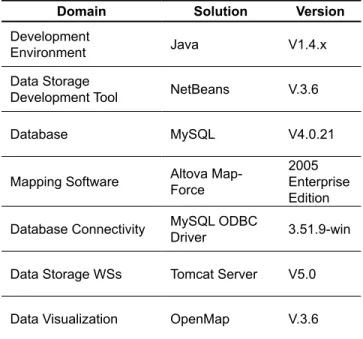
specifications are given in Table 1. The choice of open
source applications was deliberate because in addition to being free, they are non-proprietary, platform independent and widely supported.
Table 1. VMASC implementation details for the prototype
Domain Solution Version
Development
Environment Java V1.4.x
Data Storage
Development Tool NetBeans V.3.6
Database MySQL V4.0.21
Mapping Software Altova Map-Force 2005 Enterprise Edition Database Connectivity MySQL ODBC Driver 3.51.9-win
Data Storage WSs Tomcat Server V5.0
Data Visualization OpenMap V.3.6
As described in [45], BML uses the military structure for tasks and reports. It utilizes the so-called 5Ws,
which are internationally used mainly by ground troops to support the structure of their information exchange needs: Who is doing what, where, when, and why!8 Exploiting C2IEDM’s logical framework allows
the fast identification of a subset of higher concepts in which the 5Ws are defined. These higher concept areas used for the 5Ws include the following.
8. Some researchers recommend including information on which
resources to use and how to conduct the task. While this is worthwhile for simulation systems without internal decision logic or robotic forces without support of internal decision, such instructions will contradict current doctrine for live troops. A local commander can decide on which and how based on his own knowledge and the commander’s intent, which is given in the why section. Therefore, the authors support the 5Ws as the backbone for BML structures, and not the more simulation centric 6WH view.
Organization: This part specifies who is doing the work; with regard to supported domains, these are military units conducting the tasks.
Action: This part specifies both the what and when of BML, as timing constraints are connected with the Action concept. In addition,
Action-Effect is often used to describe the why part.9
Location: This part specifies the where in the form of associations between organizations and actions.
Each higher concept area is composed of multiple tables that are linked into views and provide
explicit specification of information in the form
of the necessary basic concepts. They are the core
of the supported “BML business objects.” Within C2IEDM, each table represents a concept; hence, atomic services as defined before access individual
tables. Higher concepts that are needed to describe a military task in BML in more detail can be composed
using the relations defined by C2IEDM. As a result,
we use composite services to access tables and create views using their relations. Finally, if such higher concepts are agreed to, they can be implemented as aggregate services supporting concepts, relations, and consistency rules. As the overall architecture uses web services to access the repository, XML interfaces based on the coalition XML namespace tag
set for C2IEDM were applied for all three classes and WSDL definitions were generated. In summary:
Individual tables are accessed via the selected Java Database Connectivity driver as atomic services realizing the basic SQL statements for data manipulation: select, insert, update, and delete. These atomic services are implemented as a family of services whose role is to allow the user to directly interact with the reference model. The resulting WSDL is an abstracted view of the model showing only the table
name and attribute and hiding the underlying
SQL statements: atomic services. The current prototype, implemented by industry partners
and the authors, supports 84 atomic services,
which means that the information exchange
currently captured is stored in 42 tables that are
selected and updated using WSs.
The composite level allows the user to navigate the model consistently while searching for information. This is implemented by providing not only access to individual tables but also access to all other semantically related tables through foreign keys and relation tables. The WSDL presents a layer of abstraction that reduces 9. Possibilities and some limitations of this approach for
effect-based operations (EBO) are dealt with by Snyder and Tolk [50]. •
•
•
•
the amount of web service calls and therefore
the amount of traffic on the network: composite services. The various prototypes support composite services to exchange information with the U.S. Army BML prototype, the French BML prototype, the C-BML prototype—all prototypes are summarized by Blais et al.
[51], and more detail is given by Pullen et al. [46]—and even the Military Scenario Definition Language [52].
The aggregate level implemented supports the information structure views of BML: for each view (who, what, where, when, and why) all
pertinent tables are offered as a single unit to the user. The result is five services representing the BML view of the C2IEDM: aggregate services. The current prototype supports the five BML
views.
In addition, the prototypes offer a series of support
services combining aggregate services into meaningful operational views useable for participating systems,
such as “Who is doing what?,” “Who is where?,” or “Who has what?” If this information is used on
a regular basis by participating systems, they are
likely to become new “BML business objects” and
may become standardized.
The family of atomic, composite, and aggregate services builds the core for data mediation services. Calling appropriate web services comprising the
necessary information fulfills the information
exchange requirements of a participating system.
Model-based data engineering using C2IEDM as the
CRM ensures that information can be composed. The atomic services allow access to information in each table, including new tables generated by data engineering processes, and higher concepts are
supported by composite and/or aggregate services. Each service is defined as a get service (request information) as well as a push service (submit information). While current prototypes utilize a
physical implementation of C2IEDM to store pushed
information and to extract selected information, data mediation does not require the physical storage of information. As captured in the conceptual view
in Figure 4, the information request (get) from an information customer can be fulfilled by calling
the related information deliveries (push) on the information provider side: data mediation services can communicate directly with each other, without having to use the data storage service. Furthermore, a family of specialized data mining services allows the user to search the database based on certain
parameters (identifiers, names, types, etc.). Tolk et
•
al. described the prototype, the implementation, and
application results [53].10
While the initial prototype proved sufficient for
systems dealing with ground operations, it needed to be extended in order to support air operations. Although
AO BML leverages the same C2IEDM data model as
XBML, the set of business objects and business rules
is different. This results in the necessity to extend and
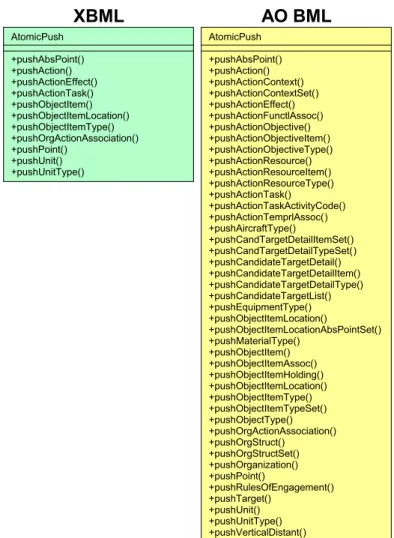
enhance available data mediation services in support of the additional information exchange requirements. To prove the idea of extensibility, the second prototype
had to extend the available services. Figure 5 shows
the atomic push services recommended initially for XBML and the implemented extensions for the prototype used within AO BML. The extensions are
10. After this presentation, several international organizations started to conduct collaborative efforts to increase the applicability, including applications in Australia, Germany, Spain, and the United Kingdom with further discussions on possible collaboration in Israel, Russia, and Sweden. Figure 5. Comparison of XBML and AO BML services (atomic push only)
AtomicPush +pushAbsPoint() +pushAction() +pushActionContext() +pushActionContextSet() +pushActionEffect() +pushActionFunctlAssoc() +pushActionObjective() +pushActionObjectiveItem() +pushActionObjectiveType() +pushActionResource() +pushActionResourceItem() +pushActionResourceType() +pushActionTask() +pushActionTaskActivityCode() +pushActionTemprlAssoc() +pushAircraftType() +pushCandTargetDetailItemSet() +pushCandTargetDetailTypeSet() +pushCandidateTargetDetail() +pushCandidateTargetDetailItem() +pushCandidateTargetDetailType() +pushCandidateTargetList() +pushEquipmentType() +pushObjectItemLocation() +pushObjectItemLocationAbsPointSet() +pushMaterialType() +pushObjectItem() +pushObjectItemAssoc() +pushObjectItemHolding() +pushObjectItemLocation() +pushObjectItemType() +pushObjectItemTypeSet() +pushObjectType() +pushOrgActionAssociation() +pushOrgStruct() +pushOrgStructSet() +pushOrganization() +pushPoint() +pushRulesOfEngagement() +pushTarget() +pushUnit() +pushUnitType() +pushVerticalDistant() AtomicPush +pushAbsPoint() +pushAction() +pushActionEffect() +pushActionTask() +pushObjectItem() +pushObjectItemLocation() +pushObjectItemType() +pushOrgActionAssociation() +pushPoint() +pushUnit() +pushUnitType()
XB
M
L
AO BM
L
AtomicPush +pushAbsPoint() +pushAction() +pushActionContext() +pushActionContextSet() +pushActionEffect() +pushActionFunctlAssoc() +pushActionObjective() +pushActionObjectiveItem() +pushActionObjectiveType() +pushActionResource() +pushActionResourceItem() +pushActionResourceType() +pushActionTask() +pushActionTaskActivityCode() +pushActionTemprlAssoc() +pushAircraftType() +pushCandTargetDetailItemSet() +pushCandTargetDetailTypeSet() +pushCandidateTargetDetail() +pushCandidateTargetDetailItem() +pushCandidateTargetDetailType() +pushCandidateTargetList() +pushEquipmentType() +pushObjectItemLocation() +pushObjectItemLocationAbsPointSet() +pushMaterialType() +pushObjectItem() +pushObjectItemAssoc() +pushObjectItemHolding() +pushObjectItemLocation() +pushObjectItemType() +pushObjectItemTypeSet() +pushObjectType() +pushOrgActionAssociation() +pushOrgStruct() +pushOrgStructSet() +pushOrganization() +pushPoint() +pushRulesOfEngagement() +pushTarget() +pushUnit() +pushUnitType() +pushVerticalDistant() AtomicPush +pushAbsPoint() +pushAction() +pushActionEffect() +pushActionTask() +pushObjectItem() +pushObjectItemLocation() +pushObjectItemType() +pushOrgActionAssociation() +pushPoint() +pushUnit() +pushUnitType()XB
M
L
AO BM
L
XBML
AO BML
based on model-based data engineering results and were implemented by industry partners.
The prototypes show that the idea of model-based
data engineering in combination with the definition of business objects significantly contributes to higher
levels of interoperation. The prototype is currently used in the Joint Advanced Training Technology Laboratory (JATTL) of the U.S. Joint Forces Command,
which is responsible for configuration control. Within
this project, our industry partner, Gestalt LLC, increased the number of available services to over
400. Each project reusing the prototype contributes additional WSs and identified information exchange
requirements, which then can be reused by the next project using this idea. Most recent activity is the use of this approach for the Joint Event Data Initialization Services (JEDIS) supported by JATTL.
In summary, the aggregate services offered within
the prototypes ensure that the correct data is at the correct location, and most of all that relationships are maintained. As the number of agreed BML business objects increases, the number of atomic services increases as well. Individual information exchange
requests of participating systems can be satisfied
using composite services. All services can be described
using the XML tag sets defined for C2IEDM and the
WSDL describing the individual services. When the registration of these services on a common UDDI is included, this idea is immediately applicable to net-centric applications. The WSDL becomes in
effect the common language for all participating
systems. New systems need not know the underlying
structure of the C2IEDM; however, they do need to map their attributes to those provided within the
WSDL. It becomes even possible to replace the CRM with another without changing the access routines. The authors do, however, strongly recommend establishing a strong liaison between the CRM used by the COI and the information structure used within model-based data engineering.
5. Relevance for Net-Centric Applications
The U.S. Department of Defense is currently launching into the Global Information Grid (GIG) environment, which is based on the idea of service-oriented architectures. While Alberts and Hayes describe the operational background and high-level views of why
the GIG is necessary [15], several DoD directives specify the technical constraints; see, in particular, [5, 54, 55, 56]. Other nations are likely to follow a similar
path to set up an infrastructure for centric and net-enabled operations. NATO is already preparing the path to web-enable its infrastructure accordingly.
One reason to introduce the LCIM in [9] was to
show that the current integration strategy for services
in the GIG, as specified in the Net-Centric Data Strategy papers [5, 56], are not sufficient for M&S
applications. The current structure supports only the levels up to semantic interoperability. In order to support composable M&S services additional outside support is necessary. The constraints and assumptions underlying the applicability of M&S applications must be captured in respective metadata to enable and ensure meaningful compositions. The work
summarized by Phillips-Wren and Jain [57] shows how intelligent software agents can support this process,
but this work is in its preliminary stages.
Papers [38, 58] show the applicability of ideas
presented in this paper to support Joint Command
and Control (JC2) as defined by the DoD [55].11 As
documented in the JC2 Capability Development Document, JC2 will require M&S capabilities to support
a multitude of functions including course of action analysis, planning, mission rehearsal, and training. As described in the specifying documents, the GIG will implement a military SOA delivering enterprise services
to its users. There are fundamentally two different
types of GIG Enterprise Services: Core Enterprise
Services (CES) and COI services/capabilities. CES are
basic, common computing services that are available
across the enterprise to users and/or applications
residing on the GIG. The Defense Information Systems Agency (DISA) Net-Centric Enterprise Services (NCES) program is charged with developing the GIG CES.
COI services are more complex software applications that are of general interest within a specific functional
community, as opposed to the entire enterprise. While in the current concept CES must support interoperability levels up to semantic interoperability, the COI services must cover all levels.
To support composability of services on the GIG, which includes CES and COI services, the Net-Centric
Data Strategy [5] requires documentation in the form
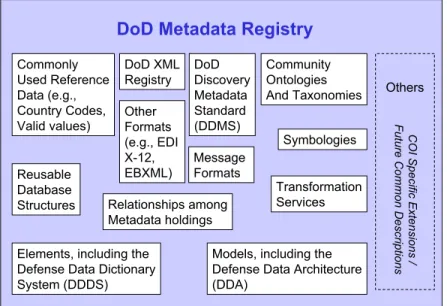
of metadata. Such metadata support the discovery of applicable services and allow evaluation if the service can be composed with other services currently used, and ensure that the composition still produces
meaningful results. Figure 6 shows the current vision
of the DoD Metadata Registry.
As discussed in this paper, the meaningful integration of M&S services will require that metadata are available to describe assumptions and constraints on all levels of the LCIM. This is currently not the
case. The DoD Directive for Data Sharing [56] merely
requests description of the data source, but not the 11. In a memorandum from the Secretaries of the Military
Departments [59], the term Joint Command and Control was replaced with the term Net-Enabled Command Capability (NECC).
data structure as defined in ISO/IEC 11179 [37]. This paper shows that this is a significant shortcoming. The DoD Discovery Metadata Specification [60] and
the Intelligence Community Metadata Working Group
[61] follow these guidelines and define metadata to discover data assets. While this is sufficient to support
data administration, the essential next steps of data engineering are not supported. This paper shows that without data management, data alignment, and data transformation a common foundation for data unambiguity does not exist. The use of a CRM as recommended by the authors is not necessary, although the process of data management and
alignment for COIs will be more difficult, and the definition of generally understandable business object
or higher management languages, such as C-BML, will be nearly impossible without a CRM. The underlying problems are not of a technical nature, as shown by the prototypes described in this paper.
Despite the shortcoming of not reaching out to all levels of interoperability in a standardized manner, the methods described in this paper are state of the art. By applying these methods, accepted and matured tools can be integrated as services into the GIG and similar service-oriented architectures. The technical steps necessary to do this are:
Describe the necessary input data in XML; Describe the produced output data in XML; Describe the functionality of the service in XML (including constraints and assumptions in the form of metadata, whose structure must be
defined by the COI);
• • •
Apply model-based data engineering to ensure that other users understand the tags used and the business objects that are used to exchange the information;
Merge the description with additional technical information (ports, protocols, addresses, etc.) into WSDL;
Post the WSDL description to a UDDI server enabling the discovery of the services by other service consumers.
The application of this method in several prototypes has shown the feasibility of this
approach; see [6, 62] for detailed descriptions. Papers [36, 38] describe the general approach. More
research needs to be conducted, including semantic web applications, to describe the functionality of
services and the applicability of intelligent software
agents, etc.12 Papers [14, 63] give a first tentative
overview of various applicable methods, standards, and technologies to support the various levels of interoperability, but additional research is necessary.
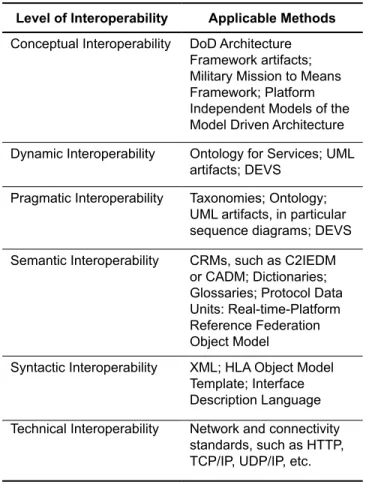
Table 2 summarizes these results in the framework
of the LCIM.
The table is neither complete nor exclusive. The authors are well aware of the fact that further discussions that substantiate the utility of these
technologies are necessary to instill confidence in the use of the proposed solutions. A complete reflection
goes beyond the scope of this paper; however, the 12. Chapter one and chapter eight in [57] give a good overview on
the state of the art and possible research fields in the military domain; however, these ideas are neither complete nor exclusive and additional input to the current research is necessary. •
• • Figure 6. DoD Metadata Registry [5]
COI Specific Extensions
/
Future Common Descriptions
Commonly Used Reference Data (e.g., Country Codes, Valid values) Reusable Database Structures
Elements, including the Defense Data Dictionary System (DDDS)
Models, including the Defense Data Architecture (DDA) DoD XML Registry Other Formats (e.g., EDI X-12, EBXML) Relationships among Metadata holdings DoD Discovery Metadata Standard (DDMS) Message Formats Community Ontologies And Taxonomies Symbologies Transformation Services Others