PRODUCT INFORMATION
MANAGEMENT IN E-‐COMMERCE
SYSTEMS
CHALLENGES AND BEST PRACTICES
Justyna Kubisztal
Bachelor’s Thesis
May 2013
Degree Programme in Software Engineering
Technology, Communication and Transport
Author(s) Kubisztal Justyna
Type of publication Bachelor´s Thesis Date 15.05.2013 Pages 42 Language English
Permission for web publication ( X ) Title
Product information management in E-‐Commerce systems Degree Programme Software Engineering Tutor(s) Salmikangas Esa Assigned by Descom Oy Abstract
E-‐commerce became a widely spread platform used both by enterprises as well as private customers. Since product information became more and more complex, new tools were needed and systems such as Products Information Management were created.
Despite the fact that PIM system solves several common problems with data for e-‐commerce, it still has its own challenges. This study shows examples of different solutions for same kind of products and common problems with its attributes that are considered to be master data of e-‐commerce. Different web stores examples were examined and compared with focus on product information, without a deeper analysis of e-‐commerce platform itself.
As a result, common rules for some product categories were shown as well as examples of good practices regarding product information management. Part of study also showed examples of web stores that exceeded the recommended number of information stored in the system – both as too less and too much of information.
This study is to be used as example of good and bad practices, which is useful and important during designing a new solution of PIM system for e-‐commerce. There are always some challenges and this study aims to give answers to at least some of them, those most common.
Keywords
Product Information Management, Master Data, E-‐commerce
CONTENTS
CONTENTS 1
1 INTRODUCTION 3
1.1 E-‐commerce 4
1.2 Master data 5
1.3 Master data management 6
1.4 Product Information Management 6
2 METHODS 8
2.1 Introduction 8
2.2 Attributes research 9
3 CASE STUDIES 12
3.1 Clothes case study 12
3.2 Sport shoes case study 19
3.3 Notebooks case study 20
3.4 Case studies with too little and too much product information 25
3.5 Case study of different ways of searching 30
3.6 Results 33
4 DISCUSSION 38
REFERENCES 40
LIST OF FIGURES FIGURE 1. BLOOMINGDALE’S 12 FIGURE 2. MACY’S 13 FIGURE 3. WALMART 14 FIGURE 4. SEARS 15 FIGURE 5. SHOPYOURWAY 16 FIGURE 6. L.L. BEAN 17
FIGURE 7. DELL.COM – GENERAL PAGE WITH NOTEBOOKS 21 FIGURE 8. DELL.COM – PAGE WITH SPECIFIC PRODUCT 22 FIGURE 9. CDW.COM – PAGE WITH DETAILS ABOUT PRODUCT 23 FIGURE 10. APPLE STORE – PAGE WITH AVAILABLE NOTEBOOKS 23 FIGURE 11. APPLE STORE – DETAILS AND SPECIFICATION ABOUT PRODUCTS 24 FIGURE 12. BESTBUY.COM – TOP OF PAGE WITH PRODUCT DESCRIPTION 25 FIGURE 13. BESTBUY.COM – PAGE WITH PRODUCT OVERVIEW 25
FIGURE 14. AOL SHOPPING 26
FIGURE 15. AOL SHOPPING – ITEM DESCRIPTION PAGE 27 FIGURE 16. ABT.COM – PAGE WITH INFORMATION ABOUT PRODUCT 28
FIGURE 17. BESTBUY.COM 29
FIGURE 18. BESTBUY.COM 30
LIST OF TABLES
TABLE 1. RANKING OF TOP INTERNET RETAILERS 8 TABLE 2. CLOTHES ATTRIBUTES COMPARISON ON EXAMPLE OF T-‐SHIRT 18
TABLE 3. SPORT SHOES COMPARISON 20
1
INTRODUCTION
Product information is a very important part of e-‐commerce. It is supposed to provide full information about a product to let customers base their decision on it. In traditional shop it is possible to get a great deal of information on one’s own by looking at a product from different angles, try it on and get more advice from a more experienced person in this field – salesman. (Product Information Management (PIM) – Heiler Software, heiler.com)
Research consists of different parts, since it is supposed to give information about solving different challenges and problems.
It seems like providing customer with as much information as possible will be always better. But storing and handling product information costs a great deal. The goal of this research is to provide guidelines about which information is important for customers and which may be considered as a technical detail and does not need to be displayed on the website.
Customers can find products in different ways. A part of this research is to give insight on possible search tools, which make it possible to find the right product according to more sophisticated rules. Another option of searching is using existing categories within system groups and structures. Products in each web store are divided into different categories, which can improve customer comfort.
Some customers like to get more knowledge about the desired products before buying. They want to compare a lot of alternatives before the final decision of purchase. Some webstores provide tools for comparing products, however, also have recommendations of possible alternatives. There are many tools and tricks that try to guide customers to buy a specific one.
Most e-‐commerce companies are aware of the power of cross-‐selling and offer some special additions for each item like accessories, possible extensions, or an additional product for special care. There are many suggestions and
recommendations that differ between different webstores and categories. Research will give general insight on rules related to that.
Since marketing has a great impact on sells, it is also important in e-‐commerce. For most of the products there seems to be relation between attributes and marketing text that is displayed in commercials. There are always some key attributes that customers are searching for and it is common practice to emphasize them in product name or marketing text.
All those challenges and problems are important for e-‐commerce, because they can bring huge savings or simply increase sells. Well-‐maintained product information can help providing customers with consistent, up-‐to-‐date information and improve customer satisfaction from their shopping.
1.1 E-‐commerce
E-‐commerce (full name “Electronic commerce”) refers to different activities related to buying and selling products and services through on-‐line channels of communication. It does not have to be based on World Wide Web services only; however, in most cases at least one part of the process is conducted using it. Among others channels like mail, social media and mobile technologies can be used.
As Internet became a popular and widely accessible tool for both private customers and industry, it succeeded with a lot of shifts in traditional way of making business. Many companies need to adjust their business to new requirements of the market in order to stay on the top. Otherwise they will be replaced with new solutions based on modern technology providing a wide range of new tools. They enable customers to do their business cheaper and in a more convenient way without any services in between. (Barnes 2007)
Some example of industries that already experienced those shifts can be: travel agencies, stock exchange, jewelry and precious gems industry. In order to stay on market they need to provide additional services.
It is possible for customers to buy cheaper flight tickets on the Internet. But travel agencies try to provide support that is not possible for pure on-‐line retailers to acquire, for example providing information about delays, possible
rebooking of tickets in case of cancelling a plane and special offers for companies that need constant service.
More and more customers become more educated and can make their own decisions even about those parts of industry that they are not specialists in; this is all thanks to modern technologies that provide them more knowledge and easy tools to compare different products.
1.2 Master data
As mentioned before, companies need to adjust to new requirements of the market constantly. In order to achieve this they need to implement new
information systems to provide their customers with more flexibility and higher quality of service.
The point of designing and implementing a new system is to store and manage data to exclude the necessity of performing every operation manually and therefore save time and money. Key data for that specific business is called Master Data. (Dreibelbis, Hechler, Milman, Oberhofer, Run, Wolfson 2008)
Because master data is strongly related to different sector it differs within different ones. For example master data for e-‐commerce is considered product, but for banking and accounting it is considered customer.
When a new information system is implemented it is designed for the current needs of a customer. With time the data stored within it grows. It is possible that a different branch of the company uses different systems to store its information, especially after merger of different companies. Another case is that definition of key data is often not precise and strict through the whole system and processes that transform them.
All of those reasons make it hard or even impossible to make any changes to the current system. Improving the system can be too costly and risky, because one small change in one part of the system can be a significant change for a different
one, therefore the implementation of a new approach like for example SOA can be blocked.
1.3 Master data management
Master data is a base of the system and it is the most valuable data of an enterprise. Well-‐managed data can solve major problems of a company, make new possibilities visible and increase revenue as a result. (Dreibelbis et al. 2008)
The main goal of implementing an information system is to automate business tasks. As its result, a great deal of data is created, most of the time very complex one. Across one enterprise there could be a few different systems implemented for different purposes. Redundancy of data is very common. Key data is either not defined or not shared between different projects. If there are no processes of managing and checking data, it will lack integrity and consistency.
Redundancy and lack of consistency of data are most common problems that Master Data Management tries to solve.
Master Data Management is not supposed to just store data. It applies business logic to a specific branch of industry to that data and handles it according to the rules of this branch regarding its further use within it.
1.4 Product Information Management
Those Master Data Management systems that focus only on product descriptions are called Product Information Management systems.
PIM systems concern only finished goods or service and are not interested in the whole process of designing, developing and production of product. Product Lifetime Management (PLM) systems provide such information. The flow of data between them is natural and logical even if their purpose is different, because PLM provides data for engineering purposes and PIM focuses mainly on marketing and sales approach. (Dreibelbis et al. 2008)
PIM systems collect information about a product from different sources, create one consistent definition of product and then provide that information for further use. The main purpose of storing this information is to present it later on Web sites, marketing systems, merchandizing systems, printing channels and all other kind of services. Thanks to PIM this data can be consistent, adequate and precise despite of different channels of communication and different ways of presenting it.
With evolution of PIM systems it has become obvious that despite the focus on products and their descriptions, they also need more references to other
information for example about suppliers of products. With time this possibility to store cross-‐domain information has become useful and significant.
PIM system can also help with Regulatory Compliance. When a company sells products across the globe problems with adjusting to local law, different formatting of dates and currency, language specific information problems are bound to occur. PIM system can also cut costs of translating over again the same information in each repeating case. It can also take care of translations between different units and formats.
It is possible to make one general translation of geography-‐specific information and dynamically adjust it according to those rules for each case that require crossing borders of country that company is based.
2
METHODS
2.1 IntroductionResearch work consists of several parts. All of them concern web-‐shops; however, they answer to different questions and challenges.
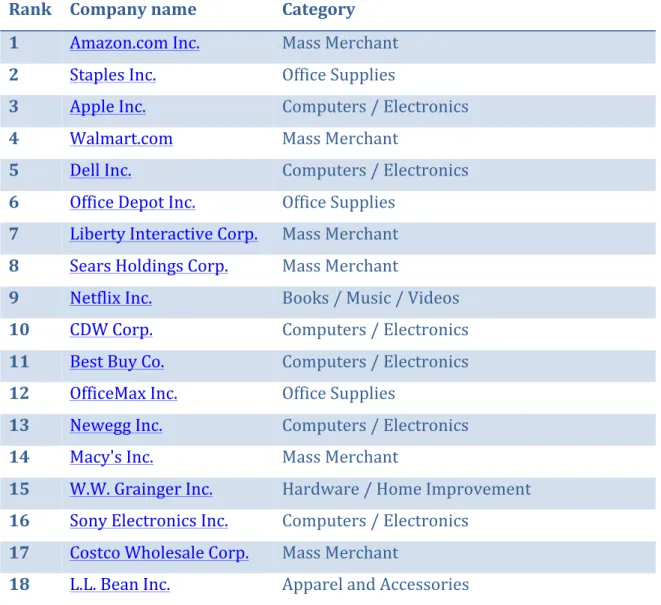
To provide best examples, ranking based on actual market feedback was used. The ranking (Table 1.) is based on the revenue of each company from last year, thus it shows exactly which companies are successful on the market.
TABLE 1. Ranking of top Internet Retailers (Internet Retailer, “TOP 500 Guide”, 2012)
Rank Company name Category
1 Amazon.com Inc. Mass Merchant
2 Staples Inc. Office Supplies
3 Apple Inc. Computers / Electronics
4 Walmart.com Mass Merchant
5 Dell Inc. Computers / Electronics
6 Office Depot Inc. Office Supplies
7 Liberty Interactive Corp. Mass Merchant
8 Sears Holdings Corp. Mass Merchant
9 Netflix Inc. Books / Music / Videos
10 CDW Corp. Computers / Electronics
11 Best Buy Co. Computers / Electronics
12 OfficeMax Inc. Office Supplies
13 Newegg Inc. Computers / Electronics
14 Macy's Inc. Mass Merchant
15 W.W. Grainger Inc. Hardware / Home Improvement
16 Sony Electronics Inc. Computers / Electronics
17 Costco Wholesale Corp. Mass Merchant
2.2 Attributes research
Product information is stored in different ways in different webstores. Providing correct and consistent ones is crucial for the success in e-‐commerce, however, storing too much information about products costs a lot of money and is hard to maintain for a longer time.
The goal of this research was to provide some general rules of which information is important and which can be considered as only technical details, which are not necessary to be presented on the web-‐shop.
Since it is hard to perform such a research for all possible kind of products, two popular categories were chosen – electronics and clothes.
2.2.1 Case studies -‐ Clothes
For this research two products were chosen and a comparison of their presentation in six different shops was performed.
• Bloomingdale’s
One of the web shops from Macy’s Inc. company (rank #14). Specialty in apparel and accessories and it has plenty of designer’s clothes.
• Macy’s
Another Macy’s Inc. web shop, specialty in apparel and accessories, with also assortment for home.
• Walmart
Popular mass merchant providing all kind of assortment including clothes (Rank #4)
• Shopyourway.com
Part of Sears Holding Corp. (Rank #8), which include several different web-‐shops, mass merchant with strong personalization and social media focus.
• Sears.com
Another shop from Sears Holding Corp. with different assortment • L.L. Bean Inc.
Retailer with the highest rank from strictly apparel and accessories category (general rank #18)
2.2.2 Case study 1. T-‐shirt
The first example in the research was a T-‐shirt. The goal of comparison was to see how the same kind of data is presented in different systems. All attributes were noted out and its popularity was measured based on how many times they appear in different stores.
The T-‐shirt choice was made randomly within the shop.
2.2.3 Case study 2. Sport shoes
The second example also from the same category was sport shoes. The products are slightly different, however, with the same purpose. The attributes were compared, noted out and it was calculated how many times they were encountered in different web stores.
The examples were chosen randomly from shop.
2.2.4 Case study 3. Notebooks
For this research four different web shops were chosen.
•
Best Buy Co.Web shop, which sells all kind of electronics and accessories from a different brand, according to ranking its revenue makes it 18th biggest e-‐
commerce platform
•
Apple Inc.Their web shop sells electronics and gadgets only from Apple brand, despite of that it is on 3rd position in ranking
•
CDW Inc.Specialize in electronics and accessories, sells products from different brands, 10th position in rank
Specialize in selling electronics and accessories, all products from Dell brand. 5th position in ranking
3
CASE STUDIES
3.1 Clothes case studyThe examples from different shops were used. The screenshots are presented below.
Bloomingdale’s webshop has basic information about price, available colors and sizes. It also has a description, which says more about appearance and
parameters such as country of its origin and fabric from what it is made of.
There are also two images with good quality and possibility of zooming. Despite of that it is the only webshop that does not provide marketing text.
Another webshop is Macy’s. The product page contains information about the price and current special offers. It informs about available colors and sizes. The product description starts with marketing text, which also mentions what product it will suit with.
Moreover, it provides information about the fabric, being imported and there are also enlisted features of appearance like neckline, type of caps and hem, style and few others.
Walmart’s product page (FIGURE 3) is slightly different than the previous examples. The product information is divided into sections with
recommendation sections in between.
There is only one image, however, it has possibility of zooming: despite the fact that the product description is informative and provides all kind of information on both about appearance as well as about fabric, being imported and washing care.
There is one very misleading attribute in Specification called “Battery type”. It is hard to believe that T-‐shirt can contain battery. It looks like attributes are not well maintained and are not predefined.
FIGURE 4. Sears
The next image (FIGURE 4) presents Sears.com webshop product page. It contains information about price, colors and size. There are also parameters of
Information is separated into two different sections. There is a description next to the image and there are three tabs below that say more about “Specifications”; however, in fact these sections do not contain any new useful information. Some parameters are repeated and phrased in different words, but do not provide anything new.
It looks like the product information is stored in an inconsistent way and there is redundancy.
ShopYourWay.com (FIGURE 5) provides basic information like price, color and size and also presents product data separated in “Description” and
“Specifications” tabs. Again, it repeats few attributes in a slightly different
convention despite of being only a shop that has separate attributes for style and occasion.
FIGURE 5. shopYourWay
L.L.Bean web shop provides most of information as product description. To get a specific detail, a customer needs to search through the whole text. There is a listing of features; however, they are not strictly related to facts but can be considered rather as marketing text.
FIGURE 6. L.L. Bean
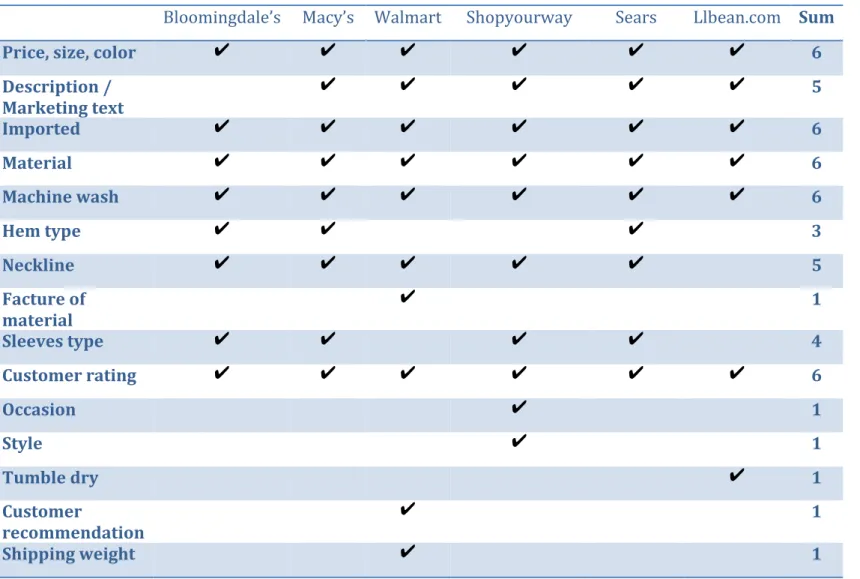
The comparison of T-‐shirt attributes from all the webshops is summed up in TABLE 2. All webshops have some attributes in common – price, size and color, information about possible machine wash, if a product is imported and its material. The customer rate was also present in every one of them, even if it was presented with different name.
Most web stores had also attributes of appearance like neckline, hem type. One has even occasion and style attributes. Of course, most of those attributes could be just observed on the image, but the major advantage and main function of having them stored in more structured and organized way is a possibility of searching according to attributes.
Moreover, customers base their decision relatively often on attributes. In case of clothes it might not be that important, but for any kind of electronics it is crucial. All tools for comparing products are based on attributes, but they need to have input information in order to produce good comparison.
Attributes and their presentation were different from page to page. Some
webstores provided less information, however, in every such case they provided either more pictures either images of better quality.
TABLE 2. Clothes attributes comparison on example of T-‐shirt
Web stores that sell designer’s clothes, which are way more expensive than regular ones had better pictures and the general presentation was better. They also provide more information about other products that suit the chosen one.
Another important thing is that all pages provided at least one customers’ rate. Some had even more of them, but from a different point of view.
Bloomingdale’s Macy’s Walmart Shopyourway Sears Llbean.com Sum
Price, size, color ✔ ✔ ✔ ✔ ✔ ✔ 6
Description / Marketing text ✔ ✔ ✔ ✔ ✔ 5 Imported ✔ ✔ ✔ ✔ ✔ ✔ 6 Material ✔ ✔ ✔ ✔ ✔ ✔ 6 Machine wash ✔ ✔ ✔ ✔ ✔ ✔ 6 Hem type ✔ ✔ ✔ 3 Neckline ✔ ✔ ✔ ✔ ✔ 5 Facture of material ✔ 1 Sleeves type ✔ ✔ ✔ ✔ 4 Customer rating ✔ ✔ ✔ ✔ ✔ ✔ 6 Occasion ✔ 1 Style ✔ 1 Tumble dry ✔ 1 Customer recommendation ✔ 1 Shipping weight ✔ 1
3.2 Sport shoes case study
In this case study the same six web stores mentioned in previous case study were compared with their presentation of sport shoes. Since web stores are the same, pictures will not be attached, neither will longer description, but general sum up will be presented.
Every webshop contains information about price, material and of course available colors and sizes. Some of them inform also if product was imported.
Bloomingdale’s and Macy’s have more pictures and layout of web is better. Therefore products make better impression.
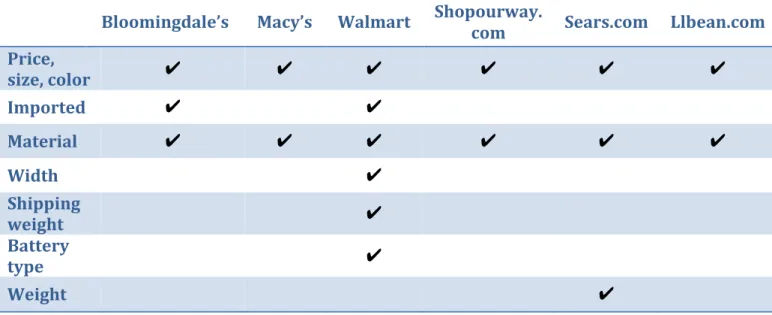
On the other side, Walmart contain more information then previous two, like width, shipping weight and battery type. Battery type is again very misleading and completely useless.
ShopYourWay mixes information of product with marketing text that makes it harder to extract specific data that might be needed.
Sears.com contains extra picture of sole from the bottom, but it appeals more to aesthetic impressions then is informative in any way.
L. L. Bean informs also about extra features of product like “extra breathability” and “quick drying”. It has also useful feature of marking product as “too large” or “too small” comparing to table of sizes and adding this information to customer rate.
Pictures are in the same convention with very small variations. Web shops with more expensive clothes provide better pictures and in most cases bigger quantity of them.
In all cases there is feedback from customers like rating, comments or recommendations.
TABLE 3. Sport shoes comparison
Bloomingdale’s Macy’s Walmart Shopourway.com Sears.com Llbean.com Sum Price, size, color ✔ ✔ ✔ ✔ ✔ ✔ 6 Imported ✔ ✔ 2 Material ✔ ✔ ✔ ✔ ✔ ✔ 6 Width ✔ 1 Shipping weight ✔ 1 Battery type ✔ 1 Weight ✔ 1
3.3 Notebooks case study
In this case study four different web shops were compared. Example product was a notebook.
Dell.com sells products only from its own brand, so there is not great variety of choice. When choosing notebooks from menu, page with offer of different models is displayed (FIGURE 7). In fact, there are two different main models with
variations on diameter.
Most common features are mentioned here, like: screen size, weight, number of USB ports and others. Apart from that there is a lot of marketing text and
information that is slightly related to details of products. Page contains also some videos presenting computer in use.
FIGURE 7. Dell.com – general page with notebooks
To see detailed information about product, customer needs to choose one of the computers and then information appears on separate page. Figure 8 shows fragment of this page. There are again a lot of pictures, many marketing texts about features. In separate tab there is whole list of technical details.
FIGURE 8. Dell.com – page with specific product
Cdw.com sells different products and brands, because of what it presents products in slightly different way then previous example. Name contains some attributes in shortened form, what makes it faster for experienced users to see quickly most important of them.
Highlighted attributes are RAM, HDD, DVD-‐Writer, graphics and type of screen. There is also a lot of information about new features and possibilities of
Windows 8 and about Windows Store, but that does not bring any more information about computer itself.
FIGURE 9. cdw.com – page with details about product
FIGURE 10. Apple Store – page with available notebooks
Apple Store sells only products made by Apple. Apple’s design for most products is rather minimalistic and simple. The same thing can be found on their web
store (FIGURE 10). After choosing category of product, page with table with similar product are displayed. Whole information is provided in the table that compares different models in each column. Whole parameter list is made in the same convention (FIGURE 11), but Overview, Technical Details and others are separated in different tabs.
FIGURE 11. Apple Store – Details and specification about products
On the final page for choosing product there is possibility of choosing part according to own wish. Most of parts can be boost up by buying ones with better parameters.
Last example of web shop is BestBuy.com, which sells different electronics from different brands (Figure 12). It shows in fact the same product as previous
example. Name contains some basic attributes in same way as web shop cdw.com did (see Figure 9.). Information is separated in 4 tabs.
FIGURE 12. BestBuy.com – top of page with product description
Product overview provides list of product features. Most information is precise, just short marketing text and standard gallery. There is no more colorful design or videos of product.
FIGURE 13. BestBuy.com – page with product overview
3.4 Case studies with too little and too much product information
Since product information is important to make a decision about buying product, it seems that providing as much information as possible will be the best solution. Too much information is hard to maintain and costs a great deal to keep it up to
date. Moreover, it can be hard for a customer to find the right and important one through a long list of every possible parameter.
In order to provide the best solution it is advisable to find the right balance between too little and too much information.
The example below shows the same product in two different webshops. Its presentation and even information are different.
Firstly we can see page from webshop with very few information about product (FIGURE 14). It contains two images, both of them are small, icon-‐like and it is impossible to see any details. Even the tool for zooming the image does not help with that problem, because the image is low quality and low resolution itself.
FIGURE 14. Aol Shopping
What is more, the table with specification is very short and provides only basic information. It has also a misleading position like “Smart TV” where the
Punctuation is also incorrect, since there should not be any mark between caption and parameter.
Second figure (FIGURE 15) shows a table with Item Description. It also misses some white mark. The list on the bottom contains additional “#” mark, which makes it less readable. The description text is formatted in the wrong way and it is hard to read.
FIGURE 15. Aol Shopping – Item Description page
The page provides very little information and the way in which it is presented is not convenient. It is probable that customers will search for more information in a different web shop and finally might be more convinced to buy there.
Another example (FIGURE 16.) shows webshop with the same product presented in a different way. It contains description of product, some images with a
FIGURE 16. Abt.com – page with information about product
Despite of this basic information, customers will also look for more detailed information. The page provides a longer list of parameters with description of every feature. Is it possible that customer will get on this website enough information to make final decision about buying. Data are presented in convenient and precise way.
Another example shows bestbuy.com webpage with camera (FIGURE 17). It presents basic information about camera like price, color, megapixels and others. Further information is separated in different tabs: Overview, Specifications, Ratings & Review, and Accessories.
FIGURE 17. bestbuy.com
Specifications tab provide long list of attributes. On FIGURE 18 there is presented fragment of it and original one is 5 times longer. It provides description of every feature and every possible attribute.
List of attributes of this long is hard to store and handle for longer time. It cost a lot to create it for every product. Customer will rarely base their decision on most of these attributes. Neither will they be interested in searching for products according to them.
FIGURE 18. bestbuy.com
3.5 Case study of different ways of searching
3.5.1 How to find alternatives
Each web shop contains several products with the same or very similar features. In some cases customer might be not convinced about one product and search for some alternatives to get better comparison and to be sure his choice best suits his needs. There are many ways to suggest customer changing his mind – either in a way of buying different product or buying some extra product.
Apple Store has only few products in each category in their assortment. Every category is displayed in compact table with details, what makes it easy to
compare products. Every product has also suggestion of replacing part with more expensive ones with better parameters.
BestBuy.com has explicit tool for comparing products. Customer has to tick at least two products and then press “Compare” button. Then page with comparison of all available attributes is displayed, so it is fairly easy to compare parameters of each product.
Dell web shop presents page for whole family of products. It is easy to compare most important attributes and features of it. It also suggests a lot of possible accessories that match with that product.
Cdw.com provides recommendations based on what other users interested in this particular product viewed. There is also comparison tool. Another
interesting option is search for products with same attributes – customer can choose which are most important for him and search only from those ones.
Clothing shops have a bit different conventions of recommendations, but there is also some emphasis on that.
Macy’s shop has suggestions about what other customers also bought. Bloomingdale’s suggest products that “customers also loved”. ShopYourWay shows how many people “liked” it and what other people viewed. Sears.com got section with “similar items to consider” and apart from that -‐ “other users viewed”. Llbean.com have section “you may also consider” and “frequently purchased together” with suggestions of other suitable products. Walmart have two different recommendations: one contains products that other people who searched through this category finally bought and second one presents what are most searched products within category.
3.5.2 Ways of searching and grouping
When customer enters web shop he or she either search for specific product or just has general idea on their mind without precise thought. In either case, there needs to be starting point.
Tools that group products in appropriate categories or enable searching according to some rules make it a lot easier. But each web shop has different ways of providing such service. Most of them provide searching based on attributes.
Cdw.com web shop has standard tool for searching, so customers can search by category, catalog, brand or choose range of price. Later on there is possibility to
Apple Store has separate section for each category of products. They provide also general search tool with keywords. Their assortment is too small and most of cases there is possibility to choose parts according to personal preference, so search according to attributes is not so necessary.
Dell.com provides grouping into categories like notebooks, desktops and so on. Because in each of those categories there are a lot of products, further grouping is also available. For example products are divided according to purpose or special features. Among others there are categories like: everyday use, gaming, premium design and performance.
Search tool at Dell.com can be based on attributes like: OS, diameter, processor, memory, HDD, optical drive, screen resolution, price, weight, usage, thinness and few more. So it gives a lot of possibility to narrow results according to personal preferences.
BestBuy.com web shop makes it possible to search by keyword or item number. Structure of groups are straight – just products, without any more complexity. But results can be narrowed according to parameters. Unfortunately there is no possibility to show results of search of two attributes like for example results of search for two different brands.
Of course different branches of market have different needs, contain different data and need to present it in slightly different way. For examples clothes do not need to store so long list of attributes as electronics where attributes are way more significant.
Web store of Macy’s keeps products in standard categories according to target group – like for men, woman and kids. There is possibility to narrow results by attribute types of clothes (for example skirts) and then by color. No general search based on keywords is provided.
At Bloomingdale’s webshop searching is possible by designer or products categories. There are also whole “looks” which are proposition of whole outfit based on products from this shop that fit together.
ShopYourWay.com has products categorized by departments, brands, catalogs (which are private users’ catalogs or collections of saved items) and so on. Big part of this shop is just social platform. There is not only possibility of marking products as “likes” or “has it”, but also writing about them and adding them to own catalogs, what can be nice experience for customers who are really keen on shopping.
Sears.com provide standard search according to attributes and based on keywords. Products are grouped in standard groups according to its use. There are also some special sections related to event like Mother’s day, Christmas depending on time of the year.
Llbean.com groups products according to standard categories like products for home, clothes and so on. It is also possible to search according to keywords and narrowing results according to attributes. One of nice and unique features is possibility of narrowing results according to customer’s rating.
Walmart has quite typical categories related to different types of products or branches and in addition several categories related to special occasions like for example Mother’s Day.
3.6 Results
The main goal of the case studies was to show different presentations of the same kind of product and show the best practices related strictly to the product information management. Even with such simple products like T-‐shirts there were differences in presentations and quantity of data presented on each web store.
Of course providing more then less information seems to be a perfect solution. But providing every single detail of product cost a lot of money. Amount of work with each product should be considered – both preparing pictures and then preparing repository for storing huge amount of data.
In first case study different T-‐shirts were compared. All of the web shops provide information about price, available colors, sizes, material and if product was imported. Those are most important attributes almost every customer is
interested to learn about. Most of web shops have also description or marketing text. There was only one shop that did not have any, but instead of that more pictures were presented.
Pictures on each website were in the same convention, but number of them, quality and ways of zooming differ between each of them. Based on those examples, it can be assumed that those web shops that sell more expensive clothes care much more about visual presentation of their products. Pictures are better quality, zooming tools work very well and most of them are made with models not only with product itself.
Attributes that were presented in most or at least half of cases, are those related to appearance – type of neckline, type of sleeves and hem type. Even if all of those attributes can be seen on pictures, having them stored in a more organized way have advantages. It is possible that customer will want to find products according to those attributes, so in order to make such kind of search possible those
attributes need to be accessible by search tool. Depending on each web store, decision about maintaining this additional kind of data should be made and according to that product information of all products should be maintained in the same way.
Rest of attributes was more unique and displayed only at few web shops. For example shipping weight can be useful, but in case of clothes it does not seem necessary. Information about style and occasion is a bit vague and it is hard to treat is as fact as it also depends on personal taste.
At one web shop there was attribute called “battery type”. It does not provide any useful information, since presented T-‐shirt does not possess any electronic parts.
Shoes’ case study showed slightly similar results despite of fact that quantity of attributes was smaller. All of web shops presented information about prices, material, available colors and sizes, what seems to be reasonably essential for all
products. In some of them, information was hard to extract, because attributes were mentioned in description or marketing text instead of listing or table.
Some provided more information about width, shipping weight that can be useful for customers. One web shop had very long description were all extra features were described. Since product was considered to be quick drying and providing more breathability, those attributes were described and emphasized couple of times. Since this attitude is more marketing case then strictly technical it will not be discussed in details.
Third case study’s objects were notebooks. Electronics has much more
parameters and technical details and presentation of this types of products is very different.
First of all web shops that were studied can be categorized to two different categories: those that sells own products and those who sells wide range of brands and products. Presentation of products differed between those two.
Web stores that have only own products have typically smaller assortment and emphasize more differences between models and some parameters or special features. They also have strong recommendations for other products that suit chosen one.
Products are presented as families or groups with emphasize on differences, since they have a lot attributes in common with each other.
Those web stores that sell all kind of products and brands from electronics have different approach. In most cases their assortment is big enough to find couple similar products with more or less same parameters. Therefore they present suggestions of alternatives and have tools of comparing them.
In all cases attributes like screen size, memory, operation system, parameters of processor are emphasized. Apart from that, in most cases attributes related to design, performance, features or strictly technical like number of USB ports are
mentioned and showed as more important. Those are attributes important for customers and are easy to understand for them.
Rest of attributes is technical details that could be important for more experienced customers, but for average one they are not understandable or important.
Part of research was to answer questions when there is too much or too little information. As it was mentioned before it is possible that there is too much product information. Firstly it hinders customer from finding exact information they are looking for in long list of different attributes. Moreover what is most important for business, huge amount of product information is hard to maintain.
Problems may start at the beginning of project when product information should be provided to system. Since PIM system manages very complex data it cannot accept wrong format or vague one. All information that should be later used in the system needs to be well prepared according to rules of used software. In most cases data provided by ERP or other systems are not enough, because its focus is different and in some cases definition of data may differ between those.
In mentioned situations, the bigger is product information, the more time is needed to import data from raw version produced by other systems to consistent data stored by PIM systems.
Example in case study shows camera with very long list of parameters. Part of list consists of attributes describing features that most customers never heard of. Most of customers will not look at each attribute, because it takes a lot of time and does not provide them with knowledge they want. Some of those attributes will never be taken into consideration and they will not be used as search attributes. Therefore storing them provides only costs without any additional profits.
Of course if product information provides only few basic parameters, web store will not be considered as reliable. Pictures of attributes are very important, because they replace experience known from traditional shop. They create first
impression on customer. If customer will not be convinced about quantity of information provided by web shop, they will probably look for different place to buy product they are interested in.
4
DISCUSSION
Introducing e-‐commerce brought a huge change in the way people make their shopping and shopping decisions. It has enabled customers to get deeper knowledge about products, easier way of comparing them and searching for appropriate ones. Despite the fact that traditional shops still have undeniable advantages, on-‐line shopping platforms provided completely new tools and possibilities.
Of course new systems have needed to provide customers with convenient platforms for shopping. What is supposed to be simple for customers does not have to be simple in implementing and maintaining. Since new technologies for selling needed to operate on more and more complex product data, new ways of delivering them were needed.
Product information is master data of e-‐commerce, what means that it is key data for this branch of industry and profits of whole business are strongly related on them. Product Information Management is supposed to provide answers and help for all kind of problems related to maintaining product information, such as data inconsistency, lack of precise definition of those data, storing up-‐to-‐date information in all communication channels and others.
Main purpose of the research was to find best practices about product
information and provide good and bad examples of those. This knowledge can help making better choices while implementing new system about types of attributes, number of them, number and quality of pictures and presentation of all those data. PIM is not interested in methods of presentation as it concerns only data for e-‐commerce platform stored outside of it, nevertheless presentation issues can help with choices about which data and how should be stored.
Product information is key data of e-‐commerce and it should provide customers with all data they need to make decision about final transaction. Both too much and too little information can affect process of buying. Too less information can discourage customers from buying, because it will not convince them if they will not find answers to their question. On the other hand too much information
about products can hinder decision process, because of overload of it. Moreover it cost a lot of effort and money to provide consistent and up-‐to-‐date huge list of information when it does not provide any useful one.
Case studies were supposed to show examples of different presentations of same kind of products in different web shops. Since their focus was different,
presentation also varied between them. Despite of that all of them had some attributes in common that can be considered as main attributes of that product type.
Product information is not only about attributes. Sometimes information about structure or grouping of products is also very important. Well-‐designed groups can help a lot with finding right products or their alternatives and show how products are related to each other. It can also simplify searching for specific products from one category or brand.
All in all, product information management systems are supposed to help e-‐ commerce platforms with storing data more efficiently and provide better tools of maintaining them. Thanks to PIM, product information in all marketing channels is the same and consistent. Despite of those advantages, there are always some choices that need to be considered before implementing PIM system for current solution.
REFERENCES
Barnes, S. 2007. E-‐Commerce and V-‐Business. Digital Enterprise in the Twenty-‐ First Century
Dreibelbis A., Hechler E., Milman I., Oberhofer M., Run P., Wolfson D. 2008. Enterprise Master Data Management: An SOA Approach to Managing Core Information
Heiler Enterprise Product Information Management (PIM), 2013,
http://www.heiler.com/en/solutions/product-‐information-‐management.php
Internet Retailer, “TOP 500 Guide”, 2012, http://www.internetretailer.com/top500/