Comprehensive Review of the Development
of the Harmony Search Algorithm and
Its Applications
ALA’A A. AL-OMOUSH , ABDULRAHMAN A. ALSEWARI , (Senior Member, IEEE), HAMMOUDEH S. ALAMRI, AND KAMAL Z. ZAMLI , (Member, IEEE)
Faculty of Computer Systems and Software Engineering, Universiti Malaysia Pahang, Kuantan 26300, Malaysia
Corresponding author: Abdulrahman A. Alsewari ([email protected])
This research is partially funded by FRGS/1/2018/ICT05/UMP/02/1, RDU190102: A Novel Hybrid Kidney-inspired algorithm for Global Optimization, and UMP PGRS160396: Hybridize Jaya Algorithm for Harmony Search Algorithm’s Parameters Selection.
ABSTRACT This paper presents a comprehensive overview of the development of the harmony search (HS) algorithm and its applications. HS is a well-known human-based meta-heuristic algorithm that mimics the process of creating a new harmony in music. This algorithm can be applied to different fields of research, owing to its ability to balance between exploitation (i.e., searching around the known best) and exploration (i.e., roaming the entire search space). Thus, numerous studies have been conducted to utilize HS in real-world optimization problems, and many variants and hybrid algorithms of HS have been developed to cope with different problems. In this paper, HS and its variants are reviewed from various aspects. First, we describe the HS algorithm and present how its parameters affect algorithm performance. Second, we describe HS classifications based on the well-known HS variants and hybrid algorithms, along with their applications. Finally, a discussion conducted on the strengths and weaknesses of the HS algorithm and the possibilities for its improvement. Focusing on related work from diverse fields (such as optimization, engineering, computer science, biology, and medicine), this paper can foster interests on the application of HS for multidisciplinary audiences.
INDEX TERMS Harmony search, evolutionary algorithms, meta-heuristics, Optimization, computational intelligence.
I. INTRODUCTION
Optimization algorithms aim to find the fittest element from groups of choices subjected to specific constraints [1], [2]. The use of the optimization algorithm to solve real-world problems started in the early 1940s. The optimization algo-rithms have two main categories. The first category includes exact algorithms, which prove their ability to find optimal solution values in direct and typical models. However, real world optimization problems are complicated, and thus, are impossible to solve using exact algorithms [3]. The second category includes heuristic algorithms, which are developed to solve problems faster than classic methods by scarifying optimally or completeness to find a near optimal value.
Heuristic optimization technique contains a general design that does not require specific conditions or mathematical attributes of objective functions, such as gradient information and differentiable attributes; thus, researchers rely more on heuristic algorithms to find the most optimal solutions within
a limited time [4]. The disadvantage of this method is the need to create a specific solution for a specified problem. Hence, one algorithm cannot be used for all types of problems.
Meta-heuristic algorithms are higher-level heuristic algo-rithms that can cover a wider range of problems [5]. The main functionality of meta-heuristic algorithms is obtained by merging rules and randomness to simulate natural phe-nomena, such as physical annealing in a simulated anneal-ing (SA) algorithm [6], human intelligence in the harmony search (HS) algorithm [7], the biological evolutionary process in differential evolutionary algorithm (DE) [8], and animal behavior in Tabu search [9].
The effectiveness of meta-heuristic algorithms relies on the utilization of explorative (diversification) and exploitative (intensification) ranges through a search [10]. The exploita-tive process is achieved by utilizing the information gained to guide the search toward its goal. The explorative process is defined as the ability of an algorithm to investigate uncovered
areas rapidly within large search sizes. Implementation per-formance will improve if the balance between these two features is achieved [11].
Some researchers categorize meta-heuristic algorithms based on their method of searching, such as trajectory-based or population-based algorithms [12]. The method used in searching has a special effect on optimization algo-rithms. For example, SA works through functional search nodes or agents that shape the Brownian motion path through its movement across certain targets. Meanwhile, population-based algorithms are implemented through the parallel use of various operators. Although both techniques have achieved successful results in different works, some studies suggest that population-based algorithm is more suit-able for multi-objective optimization problems [13]. How-ever, combining these two techniques can produce good results [4].
Geemet al. [7] proposed a well-known population-based meta-heuristic algorithm, known as harmony search algo-rithm(HS). This algorithm mimics the process of creating a new harmony in music to solve an optimization prob-lem. HS has been proven to produce exceptional results over a vast scope of optimization problems because of its ability to handle different optimization problems in various fields, such as university timetable [2], [14], [15], structural design [3], [10], [16]–[18], water distribution [19]–[21], and other fields of research. The main advantage of the HS algorithm is that it is easy to code and apply to diverse problems [22].
The ability of the HS algorithm to achieve a balance between exploitative and explorative ranges is the reason for its strength and success. In the HS process, the exploitative range is mainly dominated by pitch adjustment rate(PAR)and bandwidth(BW), whereas the explorative range is essentially controlled by the HS memory-accepting rate(HMCR)[2].
This review aims to present an overall summary of related studies on the HS algorithm, including its characteristics, variants, hybridizations, applications to different optimiza-tion fields, and future challenges and potentials. In this work, we classified HS algorithm research topics into four cate-gories: HS general structure, classifications, hybridizations, and applications.
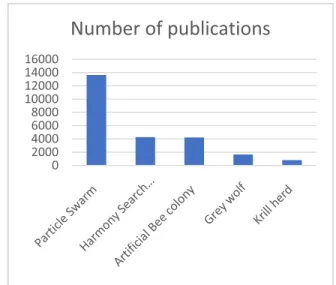
In this article, we determined the number of HS publi-cations from various publishers: ACM, Hindawi, Taylor & Francis, Elsevier, IEEE, SpringerLink, and others. Fig 1 shows the number of published papers based on each database when the HS algorithm is applied to various optimization fields. Meanwhile, Fig 2 shows the growing interest in the utilization of the HS algorithm and its applicability to differ-ent fields of research compared to other recdiffer-ent metaheuristics based on the Google Scholar database for the period from 1999 until 2018.
The rest of this paper is organized as follows. Section 2 presents the general structure of HS. Section 3 discusses the effects of HS parameters and identifies well-known HS clas-sifications and several HS-based variants. Section 4 describes
FIGURE 1. The number of HS publications per database for several journals: ACM, Elsevier, Hindawi, IEE, Springer, Taylor & Francis, and other journals as one group.
FIGURE 2. The number of publications between (1999 – 2018).
hybrid HS and provides examples. Section 5 presents HS applications. Finally, Section 6 includes discussions and con-cludes the paper.
II. THE GENERAL STRUCTURE OF THE HS ALGORITHM HS is a well-known (EA). EA basically begins by creating random values that are possible solutions to a specific prob-lem. The fitness of each value is evaluated based on the evaluation function. A nomination process must be used in every rotation within EA to create a better population. The main objective of the nomination process is to deviate the search toward fitter values, capture these values, and include them in the next population [23].
The HS algorithm is applied in different areas due to the following special advantages: HS requires lower mathemati-cal operations than traditional heuristic algorithms, does not use premier amount or gradient search for decision variables,
and does not consider the derived values because stochastic inspections are used [3].
The main similarities between the HS algorithm and music harmony improvisation processes are as follows. First, a musician searches for the most beautiful music harmony (ideal condition) as specified by the standard for tunes, while the HS algorithm searches for the global solution (ideal con-dition) as specified by an objective function. Second, every pitch of a musical instrument contributes to the level of music harmony and beauty, which is similar to the objective function value specified by the combination of values assigned to each decision variable [3], [10].
HS involves processes that are analogous to those of other meta-heuristic algorithms. For example, it saves the history of visited vectors in harmony memory(HM), which is com-parable with the memory of the Tabu search algorithm. HS is capable of mutating the(HMCR)through the entire calcula-tion process, similar to SA. HS considers all vectors, which is similar to a genetic algorithm (GA). The main difference between HS and GA is that the latter creates a new vector based on two previous vectors (called parents). By contrast, HS considers all previous vectors before creating a new har-mony vector [10].
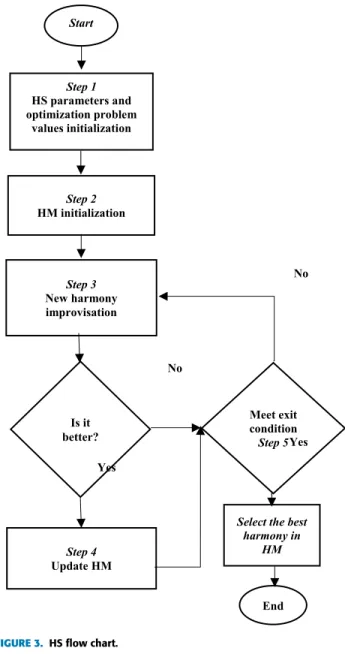
The HS algorithm process contains five main steps, as illustrated in Fig 3.
Step 1: Initialize values of the HS parameters, such as
HMCR, BW, PAR, number of iterations(NI), and HM size (HMS).
The optimization problem goal will be determined in this step, either by using maximum or minimum objective func-tionf(xi), wherexiwill be the possible solution fromN (N ∈all the decision variables of xi).
Step 2:HMvalues will be initialized, asxiwithin the upper and lower boundary ranges, using the following equation:
xi=lowerbound+R1×(upperbound−lowerbound) .{R1is random number(0−1)} (1)
Step 3:Improvisation of the new harmony is performed using a combination of three major parameters:HMCR, PAR, and BW. The improvisation has two main steps, as shown in Algorithm 1. First, two random values (a&b) will be created between (0∼1), and if (a>HMCR), then a new valuexjwill be created using Eq. (1), as a new generated vector (xj0).
Second If the value of (a<HMCR), then a random value fromHM (xi) will be selected, and if the value of (b<PAR), thenxiwill be modified using Eq. (2).
xj0 =xnew,j±bw∗rand (2)
Step 4:Memory is updated if the new generated vector of the last step (xj0) is better than the worst vector inHM, based on the objective function.
Step 5:After each improvisation, the algorithm will check the stopping criteria, such as the maximum number of impro-visations, to end the search process. The next pseudocode describes the improvisation process of HS algorithm:
FIGURE 3. HS flow chart.
III. HS CLASSIFICATIONS
The following parameters affect the performance of HS:
HMS, HMCR, BW, and PAR.Many researchers have tried to enhance the performance of HS algorithm by selecting the ideal combination of these variables [24]. In this section, we will show the descriptions of these parameters from previ-ous studies, some suggested values, and how they affect HS.
HMCRenables selecting one of the existing values inHM (xi,j) or creating a new valuexjnewthrough the improvisation process; that is, the larger the value of HMCR, the larger
the convergence rate of HS. Hence, a small HMCR value
will increase the diversity of the algorithm. PAR enables modifying the selected value xi,j. Large PAR values will improve the intensification ability of HS, whereas smallPAR
values will improve the diversity or exploration ofHM. Large
PAR andHMCR values are better for unimodal problems,
Algorithm 1Harmony Search Algorithm Improvisation 1. while(t<Max number of iterations)
2. for(j=1toD)= {D:number of dimensions} 3. If (R2)≤HMCR{Memory consideration} 4. xi0 =xi,j{i is a random integer (1, . . . HMS)} 5. if (R3≤PAR){Pitch adjustment}
6. xj0 =xj0±R4×bw 7. end if 8. else 9. xj0 =LB+R5×(UB−LB)) 10. end if 11. end for 12. Update HM: 13. if
xj0 better than worst xjxj∈HM
14. xj=x 0 j 15. t=t+1 16. End while
17. return best harmony
Selecting fixed HMCR andPARvalues is difficult because characteristics differ for each optimization problem [25].
Different variants of the HS algorithm have been developed to cope with various types of parameters, such as binary, dis-crete, and continuous. Selecting the appropriate values for HS parameters is one of the difficulties in using the HS algorithm and other meta-heuristic algorithms; numerous variants have been created to address this problem by replacing these values with new dynamic values or by adding another component to solve this issue [26]. In the next sections, the classifications of some variants and their enhancement of the original HS algorithm are described.
A. CONTINUOUS-BASED HS ALGORITHMS
Different variants of HS have been created to deal with con-tinuous variable problems. We present some well-known HS continuous variants and how they differ from the original HS algorithm.
1) AN IMPROVED HARMONY SEARCH ALGORITHM FOR SOLVING OPTIMIZATION PROBLEMS (IHS; 2007)
Mahdavi et al. [1] developed a dynamic method to gener-ate PARandBWvalues. Eq. (3) describes dynamicPARas follows:
PAR(t)=PARmin+(
PARmax−PARmin)
NI ×t. (3) PAR(t) is the value of PAR for each iteration (t), and its value is increased in every iteration based onPARmin and
PARmax, which are the minimum and maximum values of
PAR, respectively.NIdenotes the number of iterations. Meanwhile,BWalso has a dynamic value for each iteration based on the minimum and maximum values of bandwidth
(BWmin,BWmax), as shown in Eqs. (4) and (5):
C = ln BWmin BWmax ÷NI (4) BW(t)=BWmax×e(c×t). (5) Mahdavi applied the new algorithm on benchmark functions and other engineering optimization problems (e.g., minimiza-tion of the weight of a spring and pressure vessel design) to compare the results with the original HS and other optimiza-tion algorithms. The new variant provided better results. This variant of HS inspired many researchers to develop modified versions of the original HS and improve its performance. The problem with IHS is that it requires selecting the upper and lower values of the variable BW within a large range (0∼ ∞).
2) GLOBAL-BEST HARMONY SEARCH (GHS; 2008)
Omranet al.[23] proposed a new variant of HS, called GHS. GHS can handle discrete and continuous cases. It utilizes the concept of swarm intelligence in particle swarm optimization (PSO) [27] to replace theBWvalue. Replacement is accom-plished by using the best HM value for pitch adjustment instead ofBW. The effects ofHMSandHMCRwere tested on the GHS algorithm. A higher value ofHMCRwas suggested to obtain a better result for high-dimensionality problems, whereas a lower result is better for low-dimensionality prob-lems. The results show that GHS outperforms HS and IHS except at low dimensions. GHS has the same steps as IHS except for the pitch-adjusting step. Eq. (6) describes how GHS uses the best result inHMto replaceBWvalues.
if (rand ≤PAR)xj=xbest,n, n∈ {1,2,3, . . .ND} (6) Although GHS eliminates the use of the BW value, lower and upper PAR values should still be specified.
3) A SELF-ADAPTIVE GLOBAL BEST HARMONY SEARCH ALGORITHM (SGHS; 2010)
Panet al. [25] created a new variant of HS based on GHS [23] for continuous optimization problems. The new variant has a
new improvisation technique and dynamicHMCRandPAR
based on a learning procedure. The BW value is reduced dynamically with an increasing number of iterations based on Eq. (7 & 8).
BW(t)=BWmax−BWmax−BWmin×2t
NI if t< NI 2 (7) BW(t)=BWminift ≥ NI 2 (8) (8)
To update HMCR and PAR values, the initial values of
HMCRm (e.g., 0.98) and PARm (e.g., 0.9) are provided, and
HMCRm and PARm values are generated using a normal distribution (Gaussian) in every iteration. After a specific number of iterations, such as 100 iterations in this work, the mean values ofHMCRand PARare calculated to obtain a successful result, and then used in the next iteration. This step is repeated until the stopping criteria are achieved.
ForHMS, the author suggested that the use of small fixed values (5∼10) is best based on their experiments.
4) NOVEL GLOBAL HARMONY SEARCH ALGORITHM FOR UNCONSTRAINED PROBLEMS (NGHS; 2010)
Zou et al. [28]. developed another variant that excludes
HMCR andPARvariables and replaces them with position updating and genetic mutation, respectively. The concept of position updating was borrowed from PSO to prevent the NGHS algorithm from getting trapped in the local optimum. The next pseudocode shows the manner of improvisation of NGHS:
Algorithm 2NGHS Improvisation (Zou 2010) 1. for (j=1to D){D:number of dimensions}
2. XR=2×XjBest−Xjworst 3. if(XR>xU) 4. XR=xU 5. else if(XR<xL) 6. XR=xL 7. end if
8. x´i=xjworst±rand(0∼1)×XR−XjWorst 9. if(rand(0∼1)≤Pm)
10. x´i=xL+rand(0∼1)×(xU −xL) 11. end if
12. Update The Memory
13. end for
where XjBest andXjworst are the best and worst Xi in HM, respectively, based on the objective functionf(x);xU andxL are the upper and lower bounds of the objective function, respectively; and rand(0∼1) is a random value between 0 and 1. Another modification on the original HS is when the worst value is updated with the newXjeven if the new value is not better than the worst one.
5) AN IMPROVED GLOBAL-BEST HARMONY SEARCH ALGORITHM (IGHS; 2013)
El-Abd [29] developed an improved variant of GHS by focus-ing on the explorative range at the beginnfocus-ing, and then on the exploitative range at the end of a search. To accomplish this, the author used Gaussian distribution to select the random pitch adjustment, as described in Equation (9):
Xj0 =HMrd+Gauss(0,1)×BW (9) where HMrd is a randomly selected value from HM, and Gauss is a random number with a mean of 0 and a standard deviation of 1. For pitch adjustment, Equation (10) is used as follows:
Xj0 =HMbestd + ∅ ×BW (10)
whereHMbestd is the best value in HM based on the objective function evaluationf(x). The value∅is a random number that is uniformly distributed within the range {−1, 1}.
PAR value is decreased within the iterations to achieve great exploitation, as described by Wang and Huang [30]. For
BW, the author borrowed its formula from the IHS [1] variant. The algorithm was compared with seven previous HS variants using the benchmark function from CEC05.
6) A DIFFERENTIAL-BASED HARMONY SEARCH ALGORITHM FOR THE OPTIMIZATION of CONTINUOUS PROBLEMS (DH/BEST; 2016)
Abedinpourshotorbanet al. [31] introduced a new HS variant by modifying two aspects of the original HS. The first mod-ification is applied to the initialization of HS by using a new method to initiate feasible solutions with less randomness. The second modification involves replacing pitch adjustment with the updated version inspired by the differential evolution (DE) mutation strategy and excluding theBWparameter.
The following algorithm describes the new initialization processes, which is implemented by replacing the random value with a new calculation based on HMS:
Algorithm 3DH/Best Initialization(Hosein2016) 1. for(j=1toD){D=dimensions
2. for(i=1toHMS)
3. tempi=LB+((i− 0.5
HMS))×(UB-LB) 4. end for
5. Shuffle the temporary array
6. for(i=1toHMS)
7. HM =tempi
8. end for
9. end for
whereUBandLBare the upper and lower bounds of the deci-sion variables. The new variant eliminates the requirement of settingBW, and pitches are adjusted based on the distances between the pitches in HM by using DE/best/1 mutation, as described in the following pseudocode:
Algorithm 4DH/Best Improvisation(Hosein2016)
1. for(i=1to D)
2. if (r(0∼1)≤HMCR)
3. Xi0 =Xij(i is random integer from1..HMS)
4. if(r(0∼1)≤PAR) 5. Xi0 =Xbest+r(0∼1)×(Xr1,J−Xr2,J) 6. if(Xj0 <LBorXj0 >UB) 7. Xj0 =r(0∼1)×(UB-LB)+LB 8. end if 9. end if 10. else 11. Xj0 =r(0∼1)×(UB-LB)+LB 12. end if 13. end for
whereUB and LB are the upper and lower bounds of the
Xbestis the bestXiinHMbased on the objective function, and
Xr1,J andXr2,J are two random values in thejthdimension. B. DISCRETE-BASED HS ALGORITHMS
Leeet al. [18], Geem [32], and Wanget al. [33] developed several versions of HS to address the discrete variable prob-lem. In these previous works, HS was used to solve engineer-ing design problems, which are discrete by nature. In another research, Al-Betar used HS to solve another discrete problem, which is a university course timetabling optimization prob-lem [14]. Moreover, Gaoet al. [34] utilized the HS algorithm in the no-wait flow shop scheduling problem with total flow time criterion.
The improvisation process of discrete HS for Xi
is described in equation (11), and for continuous in equation (12):
xi0 ←xi(i+c) For discrete design variables (11)
xi0 ←xi+a Forcontinuousdesign variables (12) We select the neighbor value by adding c∈(−1∼1) for the discrete problem anda=BW×ufor the continuous problem, whereBWis the bandwidth value and u is a random value between (−1∼1).
For the mixed problem between discrete and continuous problems, such as the work of Lee et al. [35], HS is used in a truss design problem that requires solving both types of optimization problems (discrete and continuous) in parallel. HS shows that it can effectively cope with all these types of problems.
C. BINARY-BASED HS ALGORITHMS
Many researchers have been using HS in discrete and contin-uous optimizations in different fields of science and engineer-ing. Some researchers have utilized HS in binary problems. Although HS with binary coding can be used to address binary-coded problems, the pitch adjustment operator is infe-rior in binary space, which degrades the performance of the algorithm because PAR is typically eliminated. For exam-ple, Geem [36] utilized HS with binary coding to address water pump switching problems and thePARparameter was eliminated in this work. Another utilization of binary HS was performed by Geem and Williams [37] to cope with an ecological optimization problem that achieved competitive results. The next variant demonstrates how HS binary variants handle binary problems.
AN IMPROVED BINARY hARMONY SEARCH ALGORITHM (ABHS; 2013)
Wang et al. [38] developed a new HS variant to cope with the binary optimization problem. In the beginning, HM is initialized by generating random binary numbers for each value withinHM. Then, a new pitch adjustment is created to handle the binary problems and improve HS capabilities by replacing the adjacent value in the original HS with a global
optimal adjacent value as follows:
Xij=
(
hbj r<PAR Xi else
(13)
where hbj corresponds to the best value within HM (i.e., global optimal harmony).
Two updating techniques: memory consideration strategies (serial and parallel update mechanisms) and (individual and bit selection mechanisms) were studied.
Individual selection strategy:
Xij = ( hpj if r1<HMCR R else (14) R= ( 0 if r1<0.5 1 else (15)
whereXijis thejthbit ofXj, the new improvised vectorpis the random value ofHMS, andr1 andr2 are two random values between the range of 0 and 1.
The algorithm achieves good results after being tested by benchmark functions and the knapsack problem.
D. CHAOTIC-BASED HS ALGORITHMS
Chaotic maps are similar to randomness in their function-ality. However, these algorithms are less sensitive to the initial condition and parameters due to their deterministic nature. Chaotic-based HS algorithms are applied to many meta-heuristic algorithms to improve their performance. Some HS algorithm variants have been used in chaotic maps [22], [39]–[41]. The following variant describes how chaotic maps are applied to HS.
CHAOTIC HARMONY SEARCH ALGORITHMS (CHS; 2010)
Alatas developed a new HS variant by using chaotic maps for parameter adoption. the main objective was to avoid falling into the local optimum and to improve the convergence of HS. Seven chaotic maps were used to generate random values instead of the original random generator in HS.
Maps were used in this work for different parameters of HS, such as inHM, PAR, and BWgeneration. Some of the maps enhanced solution quality and helped HS escape from the local optimum. In this work, Alatas used only two bench-mark functions to demonstrate the capabilities of the new variant.
E. OPPOSITION-BASED HS ALGORITHMS
Gaoet al. [42] and other researchers used the opposition-based intelligent computation approach to enhance HS performance, by creating opposite values from the new improvisation results and replacing the improvisation values if the new results are found to be better. Successful variants that use opposition-based methods are presented in the suc-ceeding subsections.
1) AN IMPROVED GLOBAL BEST HARMONY SEARCH ALGORITHM FOR FASTER OPTIMIZATION (IGHS; 2014)
Xianget al[43] recently developed a new HS variant based on the GHS [23] algorithm. The new variant exhibits four modifications from the original GHS. First, it uses the opposi-tion technique (OBL) [44] during initializaopposi-tion to obtain more diverse initial values and avoid falling into the local optimum. Second, the DE concept is adopted to implement new impro-visations. Third, HS exploration is improved and falling into the local minimum is avoided by using two concepts based on the artificial bee colony algorithm [45] and the OBL scheme. Fourth, theHMCRandPARparameters are updated based on the sign and periodic functions.
Two experimental studies were conducted to compare IGHS with the original HS and GHS (2008) and other meta-heuristic algorithms. Competitive results were achieved by IGHS.
2) GLOBAL HARMONY SEARCH WITH GENERALIZED OPPOSITION-BASED LEARNING (GOGHS; 2015)
Gouet al. [46] created a new HS variant because of the poor exploitation of the original HS. The new variant adopts the concept of generalized opposition [47], which is a modified version of the original opposition [44], in addition to utilizing NGHS [28].
GOGHS first initializes itsHMin the same manner as the original HS. After initialization, a new candidate (Xi) is cre-ated using the NGHS algorithm [28]. A modified version of (Xi) is created in the new candidate harmony (O_Xi) by using the generalized opposition-based solution. Finally, the worst result inHMwill be replaced with the best value between the new candidate and its opposition (XiandO_Xi).
3) IMPROVED HARMONY SEARCH ALGORITHM: LHS (LHS; 2017)
Ouyang et al. [48] recently developed an HS variant by implementing three modifications to the original HS to improve its effectiveness. First, they used the opposition concept [44], within the harmony consideration process to obtain better diversity in the result. Second, they used self-adaptation in pitch adjustment to improve the inten-sification of the HS algorithm by mimicking the swarm intelligence concept of PSO. Third, they found the worst vector in HM and updated it with the best value between the improvisation and opposition results. Finally, they com-pared the new variant with 10 previous HS variants using 48 mathematical benchmark functions. The new variant exhibited higher competitive performance than the previous variants.
F. MULTI-OBJECTIVE HS ALGORITHM
After the success of applying HS to single-objective opti-mization problems, many researchers have applied HS to multi-objective optimization problems [49]–[52].
IV. HYBRIDIZATION OF THE HS ALGORITHM
The development of new meta-heuristic algorithms can be accomplished in several ways, and the creation of new hybrid algorithms based on existing heuristic algorithms is considered one of the most successful techniques [53]. The best way to create a new successful meta-heuristic algorithm is by using an appropriate assembly of existing meta-heuristic algorithms, such as combining a multi-agent algorithm with a trajectory algorithm, to create algorithms with enhanced capabilities [54]. The need to create a multi-objective meta-heuristic algorithm to handle NP-hard opti-mization problems remains a productive research area [4].
The hybrid algorithms of HS have proven their effective-ness in improving the performance of HS to cope with differ-ent cases [55]. The concept of hybridizing the HS algorithm with other meta-heuristic algorithms has recently become prevalent, and many hybrid algorithms have been developed and used [38]. We present well-known hybrid HS categories and provide examples for each.
A. HYBRIDIZATION WITH A LOCAL SEARCH-BASED ALGORITHM
Global search algorithms, such as HS, are well-known for their good exploration, whereas local search algorithms are appropriate for exploitation. Combining the two types will probably produce a strong algorithm for exploration and exploitation. The following hybrid algorithms are examples of HS algorithms with a local search algorithm.
1) HYBRIDIZING HARMONY SEARCH ALGORITHM WITH SEQUENTIAL QUADRATIC PROGRAMMING FOR
ENGINEERING OPTIMIZATION PROBLEMS (HHSA; 2008)
Fesangharyet al. [56] developed an example of a hybrid HS algorithm with a local-based search algorithm. This hybrid algorithm is incorporated with sequential quadratic program-ming (SQP) to improve the local search speed and accuracy of the HS algorithm. The hybrid algorithm achieves better result compared with the original HS and other heuristic algorithms. The effects of HS parameters, such as HMCR, HMS, and PAR, were also tested in this work. A small HMCR value will reduce the algorithm’s efficiency, whereas a large value will result in better exploration. However, this condition may cause the algorithm to fall into the local optimum. For HMS, the larger the size, the better the results obtained with numer-ous iterations. However, this process can be time-consuming. By contrast, a small HMS value can cause premature con-vergence. The authors suggest using an HMS value between 4 and 10. For PAR, a large value with a small BW will increase HS efficiency.
2) HHS, HGHS, HMGHS (2010)
Wang et al. [33] made another hybrid local/global search algorithm in 2010, and developed three hybrid HS algo-rithms to reduce the total time of flow shop scheduling
in a blocking optimization problem. The first algorithm is based on the original HS by Geemet al. [7], the second is based on GHS [23], and the third is based on a modified GHS. The authors hybridized the HS variants with a local search algorithm based on the insert neighborhood to bal-ance the exploration and exploitation of the new algorithm. They implemented HM initialization using another heuristic algorithm (NEH) [57]. Furthermore, they transformed the continuous vectors of harmonies to discrete job adjustments based on the largest position value. To test the efficiency and effectiveness of their hybrid algorithms, the authors used the blocking flow shop scheduling problem, which is consid-ered an NP-hard problem when more than two machines are involved.
B. HYBRIDIZATION WITH POPULATION-BASED ALGORITHM
Another way to improve population search algorithms is by creating a hybrid algorithm with another population search algorithm (or some of its components) to combine the advan-tages of both algorithms. The next hybrid algorithm is an example of a hybrid population-based algorithm.
AN EFFECTIVE HYBRID HARMONY SEARCH-BASED ALGORITHM FOR SOLVING MULTIDIMENSIONAL KNAPSACK PROBLEMS (2015)
Zhang et al. [58] developed a new hybrid algorithm of HS with fruit fly optimization (FFO) [59]. The main objective of this algorithm is to overcome the weak exploitation process of HS. This hybrid algorithm is used to solve MKPs.
Binary string values are used in this work to apply the new hybrid algorithm to MKPs, with few modifications to the original HS algorithm. The hybrid algorithm starts by using the original HS initialization process. Then, the global HS scheme is used to improvise the values in HM that are similar to GHS [23]. The smell-based FFO search is used to create modified values of HM and update each value of HM to see if each value is better than the original. A repair operator is used to ensure that the new improvised values satisfy the weight constraints.
C. HYBRIDIZATION HS WITH OTHER COMPONENTS
The use of HS or its component to assist another meta-heuristic algorithm through hybridization has been realized in different studies [60]–[63]. The subsequent hybrid algorithm is an example of using HS as a component in the search process.
PSO, ANT COLONY OPTIMIZATION (ACO), AND HS SCHEME HYBRIDIZED TO OPTIMIZE TRUSS STRUCTURES
Kavehet al. [64] proposed a new hybrid HS algorithm with PSO [27] and ACO [65]. HHS, HGHS, and HMGHS used the hybrid principle to solve the continuous and truss design optimization problems. In this work, the role of HS was to control the variable constraints through the design of the truss structure optimization problem.
V. APPLICATIONS OF HS ALGORITHM
Multiple mathematical techniques, such as dynamic, lin-ear, and nonlinear programming, have been used to solve optimization problems before the existence of heuristic algo-rithms. All traditional techniques can find the global opti-mal solution, but special specifications or characteristics should be specified for each problem, and thus, covering NP-hard problems is impossible. Another disadvantage of these methods is that they consume considerable space and time in solving a problem, thereby increasing the complex-ity of the problem and making these methods impracti-cal for real-world problems. Consequently, meta-heuristic algorithms have been developed by mimicking nature or human intelligence to solve these issues. These algorithms have proven their efficiency in handling real NP-hard problems [66].
HS was initially used to find the best design for water distribution networks by its original author Geem There-after, many researchers have utilized HS in different fields, such as engineering and information technology. Several categories of these works are described in the subsequent sections.
A. REAL-WORLD APPLICATIONS /INDUSTRIAL APPLICATIONS
Many researchers have used HS to solve real-world issues. Music composition, an example of a real-world applica-tion, has been conducted to support composers, such as Navarroet al. [67].
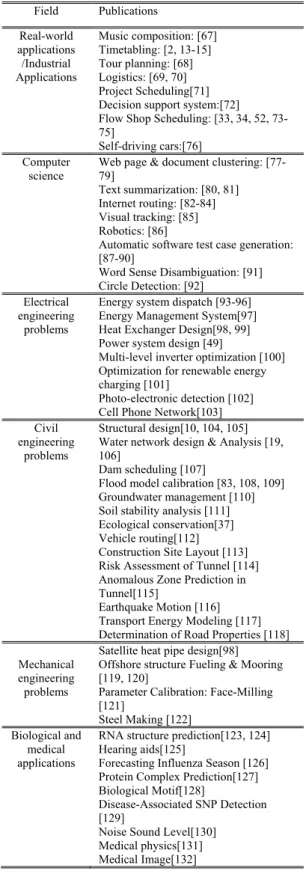
Al-Betaret al. [2], [15] and Chiarandiniet al. [13] used HS and its hybrids to create a university course timetable, which is considered a real-world optimization problem. Many researchers have applied HS to solve real-world problems, such as tour planning, logistics, and project and flow shop scheduling, as shown in Table 1.
B. COMPUTER SCIENCE PROBLEMS
Different applications in computer science have been solved using the HS algorithm, such as web page and document clustering. Clustering refers to the automatic classification of a webpage or document content to reduce the amount of data and gain useful information. Forsati et al. [77], [78] used a hybrid HS with K-means to cluster web pages. Cobos et al. [79] used GHS [23] with K-means, frequent term sets, and the Bayesian information criterion to cluster webpage data. Text summarization is another computer appli-cation of text extraction that aims to summarize the text of web content, such that the end user can easily find what he/she is looking for in summarized form. Different studies have been conducted using HS and its variant GHS to accomplish text summarization [47], [80], [81].
Other computer applications of HS are used in the liter-ature in other areas, such as Internet routing, visual track-ing, robotics, and automatic software test case generation, as shown in Table 1.
TABLE 1. Applications of HS.
C. ELECTRICAL ENGINEERING PROBLEMS
Research on power dispatch and energy flow manage-ment systems has been utilizing HS in different works. Vasebiet al.[93] used HS to find the minimum cost of energy
production while meeting power requirements. A new con-cept, namely, combined heat and power (CHP), was formed to achieve maximum efficiency because the primitive pro-duction of electricity with the use of fossil fuels can only achieve up to 60% efficiency, thereby causing wasted heat. However, balancing heat and power produced by the same units is required. Vasebi applied HS to solve the CHP eco-nomic dispatch problem by using two cases and compared the results with those of other meta-heuristic algorithms. Since then, other researchers have used HS to solve CHP problems [94], [95].
Table 1 shows that considerable research has utilized HS to optimize power streaming systems by achieving the minimum cost to transfer electricity in a power system. HS optimizes voltage nodes as a variable for a set of non-linear equations as an objective function. Sivasubramani and Swarup [49] developed multi-objective HS to minimize fuel consumption, which will reduce the cost and power transfer emission, which will then reduce energy loss. The results obtained were compared with those of GA. The HS results outperform those of GA.
HS is utilized in different fields of electric engineering research, such as optimization for renewable energy charg-ing [101], wind power generation [133], and multilevel inverter optimization [100].
D. CIVIL ENGINEERING PROBLEMS
Considerable research has been conducted on structural design optimization because it is considered a sensitive and difficult activity, particularly when time and cost are consid-ered. Lee and Geem [10] used HS to cope with this optimiza-tion problem, and the result outperformed those of tradioptimiza-tional techniques, such as linear and nonlinear equations, because unlike traditional techniques, HS does not require a high volume of gradient calculation. References [104] and [134] also used HS to cope with this problem.
E. MECHANICAL ENGINEERING PROBLEMS
Several works have utilized HS to cope with mechanical engi-neering problems. Zareiet al.[121] used the HS algorithm to find the ideal cutting parameters of a multi-pass face-milling machine, thereby improving production quality and minimizing the cost and time consumption. Different param-eters have been optimized using HS to improve machine tool capabilities, such as the number of passes, the depth of cut for each pass, speed, and feed. The result showed better performance of HS compared with that of GA.
Another mechanical problem solved by HS is the schedul-ing of diesel generators in oil rig platforms, as reported by Yadavet al.[119]. The author attempted to reduce the fuel consumption of a diesel generator that supports the oil rig, while meeting load demand and operational constraints to achieve the optimum performance of the rig. The improved variant of HS obtained competitive results and convergence with the original HS and other meta-heuristic algorithms.
F. BIOLOGICAL AND MEDICAL APPLICATIONS
Forecasting infectious diseases is an interesting idea, and we can formulate strategies to minimize them by predicting their effects. A study was conducted by Hickmannet al.[126] on infectious disease forecasting using HS. Data were obtained from the Centers for Disease Control and Prevention and Wikipedia article access logs, and then analyzed using epi-demiological models to predict the effect of infectious dis-eases in the United States. The HS algorithm was used in the prediction process to solve a nonlinear equation.
The HS algorithm was also used to optimize radioisotope placement and intensities by Panchal [131]. Radiation is used to diagnose and treat cancer as part of medical physics. GA and SA were applied to optimize the radioisotope, but the results were obtained faster by using HS compared with GA, thereby improving the patient treatment process.
Table 1 shows the full categories of HS applications with related research works.
VI. DISCUSSION AND CONCLUSION
This article describes the HS optimization algorithm, some of its variants, applications, and hybrid versions. The algorithm has maintained considerable interest since its inception until now because of its ability to balance between exploration and exploitation, and its ability to be used in different research areas because of its simplicity. The author of HS exerted con-siderable effort to utilize the algorithm in different research areas, and a webpage that contains the full information of HS is available for the benefit of other researchers.
We noticed considerable utilization of HS and improve-ment on HS. However, the utilization and improveimprove-ment of HS continues, particularly in terms of its hybridization with other meta-heuristic algorithms. A standard framework or criterion to compare meta-heuristic algorithms or its variants in the meta-heuristic field is necessary.
Finally, the following are the advantages of HS over previ-ous optimization algorithms:
• HS has proven its ability to be applied to different fields
of real applications [66].
• HS can cover discrete or continuous optimization
prob-lems, and decimal and binary alphabets [66].
• HS can distinguish the high-performance zone in the solution range within a short time.
• HS requires less mathematical operations.
• HS does not exhibit divergence.
• Constructive information of the optimization problem is not important in HS because it uses random search.
• HS produces a new solution in accordance with all
pre-vious solutions and simultaneously covers all vectors.
• HS is easy to program, and its simplicity makes it easy
to combine with other meta-heuristic algorithms. The weaknesses of the HS algorithm are as follows:
• HS is highly sensitive to its parameter values, such as
HMCR, PAR, andBW[30].
• HS gets stuck in a local search when applied to
numeri-cal applications. REFERENCES
[1] M. Mahdavi, M. Fesanghary, and E. Damangir, ‘‘An improved harmony search algorithm for solving optimization problems,’’Appl. Math. Com-put., vol. 188, no. 2, pp. 1567–1579, May 2007.
[2] M. A. Al-Betar and A. T. Khader, ‘‘A harmony search algorithm for University course timetabling,’’Ann. Oper. Res., vol. 194, no. 3, pp. 3–31, 2012.
[3] K. S. Lee and Z. W. Geem, ‘‘A new meta-heuristic algorithm for con-tinuous engineering optimization: Harmony search theory and practice,’’
Comput. Methods Appl. Mech. Eng., vol. 194, no. 3, pp. 3902–3933, 2005. [4] X.-S. Yang, ‘‘Harmony search as a metaheuristic algorithm,’’ in
Music-Inspired Harmony Search Algorithm. Springer, 2009, pp. 1–14. [5] K. Sörensen, ‘‘Metaheuristics—The metaphor exposed,’’Int. Trans. Oper.
Res., vol. 22, no. 3, pp. 3–18, 2015.
[6] S. Kirkpatrick, C. D. Gelatt, and M. P. Vecchi, ‘‘Optimization by simu-lated annealing,’’Science, vol. 220, no. 4598, pp. 671–680, 1983. [7] Z. W. Geem, J. H. Kim, and G. V. Loganathan, ‘‘A new heuristic
opti-mization algorithm: Harmony search,’’J. Simul., vol. 76, no. 2, pp. 60–68, Feb. 2001.
[8] R. Storn and K. Price, ‘‘Differential evolution-a simple and efficient heuristic for global optimization over continuous spaces,’’J. Global Optim., vol. 11, no. 4, pp. 341–359, 1997.
[9] F. Glover, ‘‘Heuristics for integer programming using surrogate con-straints,’’Decis. Sci., vol. 8, no. 1, pp. 156–166, 1977.
[10] K. S. Lee and Z. W. Geem, ‘‘A new structural optimization method based on the harmony search algorithm,’’Comput. Struct., vol. 82, nos. 9–10, pp. 781–798, 2004.
[11] A. E. Eiben and C. A. Schippers, ‘‘On evolutionary exploration and exploitation,’’Fundam. Inform., vol. 35, nos. 1–4, pp. 35–50, 1998. [12] K. Deb, A. Pratap, S. Agarwal, and T. Meyarivan, ‘‘A fast and elitist
multiobjective genetic algorithm: NSGA-II,’’IEEE Trans. Evol. Comput., vol. 6, no. 2, pp. 182–197, Apr. 2002.
[13] M. Chiarandini, M. Birattari, K. Socha, and O. Rossi-Doria, ‘‘An effective hybrid algorithm for university course timetabling,’’J. Scheduling, vol. 9, no. 5, pp. 403–432, 2006.
[14] M. A. Al-Betar, A. T. Khader, and I. Y. Liao, ‘‘A harmony search with multi-pitch adjusting rate for the University course timetabling,’’ inRecent Advances in Harmony Search Algorithm. Springer, 2010, pp. 147–161.
[15] M. A. Al-Betar and A. T. M. Khader Zaman, ‘‘University course timetabling using a hybrid harmony search metaheuristic algorithm,’’
IEEE Trans. Syst., Man, Cybern. C, Appl. Rev., vol. 42, no. 5, pp. 664–681, Sep. 2012.
[16] S. O. Degertekin, ‘‘Optimum design of steel frames using harmony search algorithm,’’Struct. Multidiscipl. Optim., vol. 36, no. 3, pp. 393–401, 2008.
[17] Z. W. Geem,Harmony Search Algorithms for Structural Design Opti-mization, vol. 239. Berlin, Germany: Springer, 2009.
[18] K. S. Lee, Z. W. Geem, S.-H. Lee, and K.-W. Bae, ‘‘The harmony search heuristic algorithm for discrete structural optimization,’’Eng. Optim., vol. 37, no. 7, pp. 663–684, 2005.
[19] Z. W. Geem, ‘‘Optimal cost design of water distribution networks using harmony search,’’Eng. Optim., vol. 38, no. 3, pp. 259–277, 2006. [20] Z. W. Geem, ‘‘Particle-swarm harmony search for water network design,’’
Eng. Optim., vol. 41, no. 3, pp. 297–311, 2009.
[21] Z. W. Geem, J. H. Kim, and G. Loganathan, ‘‘Harmony search optimiza-tion: Application to pipe network design,’’Int. J. Model. Simul., vol. 22, no. 3, pp. 125–133, 2002.
[22] B. Alatas, ‘‘Chaotic harmony search algorithms,’’Appl. Math. Comput., vol. 216, no. 3, pp. 2687–2699, 2010.
[23] M. G. H. Omran and M. Mahdavi, ‘‘Global-best harmony search,’’Appl. Math. Comput., vol. 198, no. 2, pp. 643–656, 2008.
[24] M. A. Al-Betar, I. A. Doush, A. T. Khader, and M. A. Awadallah, ‘‘Novel selection schemes for harmony search,’’Appl. Math. Comput., vol. 218, no. 10, pp. 6095–6117, 2012.
[25] Q.-K. Pan, P. N. Suganthan, M. F. Tasgetiren, and J. J. Liang, ‘‘A self-adaptive global best harmony search algorithm for continuous optimiza-tion problems,’’Appl. Math. Comput., vol. 216, no. 3, pp. 830–848, 2010.
[26] O. Moh’d Alia and R. Mandava, ‘‘The variants of the harmony search algorithm: An overview,’’Artif. Intell. Rev., vol. 36, no. 1, pp. 49–68, 2011.
[27] R. Eberhart and J. Kennedy, ‘‘A new optimizer using particle swarm theory,’’ inProc. 6th Int. Symp. Micro Mach. Hum. Sci. (MHS), Oct. 1995, pp. 39–43.
[28] D. Zou, L. Gao, J. Wu, and S. Li, ‘‘Novel global harmony search algorithm for unconstrained problems,’’Neurocomputing, vol. 73, no. 3, pp. 3308–3318, 2010.
[29] M. El-Abd, ‘‘An improved global-best harmony search algorithm,’’Appl. Math. Comput., vol. 222, pp. 94–106, Oct. 2013.
[30] C.-M. Wang and Y.-F. Huang, ‘‘Self-adaptive harmony search algorithm for optimization,’’Expert Syst. Appl., vol. 37, no. 3, pp. 2826–2837, 2010. [31] H. Abedinpourshotorban, S. Hasan, S. M. Shamsuddin, and N. F. As’Sahra, ‘‘A differential-based harmony search algorithm for the optimization of continuous problems,’’Expert Syst. Appl., vol. 62, pp. 317–332, Nov. 2016.
[32] Z. W. Geem, ‘‘Novel derivative of harmony search algorithm for discrete design variables,’’Appl. Math. Comput., vol. 199, no. 1, pp. 223–230, 2008.
[33] L. Wang, Q.-K. Pan, and M. F. Tasgetiren, ‘‘Minimizing the total flow time in a flow shop with blocking by using hybrid harmony search algorithms,’’Expert Syst. Appl., vol. 37, no. 12, pp. 7929–7936, 2010. [34] K.-Z. Gao, Q.-K. Pan, and J.-Q. Li, ‘‘Discrete harmony search algorithm
for the no-wait flow shop scheduling problem with total flow time crite-rion,’’Int. J. Adv. Manuf. Technol., vol. 56, nos. 5–8, pp. 683–692, 2011. [35] K. S. Lee, S. W. Han, and Z. W. Geem, ‘‘Discrete size and discrete-continuous configuration optimization methods for truss structures using the harmony search algorithm,’’ Int. J. Optim. Civil Eng., vol. 1, pp. 107–126, Jan. 2011.
[36] Z. W. Geem, ‘‘Harmony search in water pump switching problem,’’ in
Proc. Int. Conf. Natural Comput., 2005, pp. 751–760.
[37] Z. W. Geem and J. C. Williams, ‘‘Ecological optimization using har-mony search,’’ inProc. Amer. Conf. Appl. Math., World Sci. Eng. Acad. Soc. (WSEAS), 2008, pp. 148–152.
[38] L. Wang, R. Yang, Y. Xu, Q. Niu, P. M. Pardalos, and M. Fei, ‘‘An improved adaptive binary harmony search algorithm,’’ Inf. Sci., vol. 232, pp. 58–87, May 2013.
[39] O. Abdel-Raouf, I. El-Henawy, and M. Abdel-Baset, ‘‘A novel hybrid flower pollination algorithm with chaotic harmony search for solving sudoku puzzles,’’Int. J. Mod. Educ. Comput. Sci., vol. 6, no. 3, p. 38, 2014.
[40] M. F. El-Santawy, A. N. Ahmed, Z. El-Dean, and A. Ramadan, ‘‘Chaotic Harmony Search Optimizer for Solving Numerical Integration,’’Comput. Inf. Syst., vol. 16, no. 2, pp. 21–24, 2012.
[41] O. Abdel-Raouf, I. El-henawy, and M. Abdel-Baset, ‘‘Chaotic harmony search algorithm with different chaotic maps for solving assignment problems,’’Int. J. Comput. Appl., vol. 86, no. 10, pp. 1–6, 2014. [42] X. Z. Gao, X. Wang, S. J. Ovaska, and K. Zenger, ‘‘A hybrid optimization
method of harmony search and opposition-based learning,’’Eng. Optim., vol. 44, no. 8, pp. 895–914, 2012.
[43] W.-L. Xiang, M.-Q. An, Y.-Z. Li, R.-C. He, and J.-F. Zhang, ‘‘An improved global-best harmony search algorithm for faster optimiza-tion,’’Expert Syst. Appl., vol. 41, no. 13, pp. 5788–5803, Oct. 2014. [44] H. R. Tizhoosh, ‘‘Opposition-based learning: A new scheme for machine
intelligence,’’ in Proc. Int. Conf. Comput. Intell. Model., Control Automat., Int. Conf. Intell. Agents, Web Technol. Internet Commerce, Nov. 2005, pp. 695–701.
[45] D. Karaboga and B. Basturk, ‘‘Artificial bee colony (ABC) optimization algorithm for solving constrained optimization problems,’’ inProc. Int. Fuzzy Syst. Assoc. World Congr., 2007, pp. 789–798.
[46] Z. Guo, S. Wang, X. Yue, and H. Yang, ‘‘Global harmony search with generalized opposition-based learning,’’ Soft Comput., vol. 21, no. 3, pp. 2129–2137, 2017.
[47] H. Wang, Z. Wu, Y. Liu, J. Wang, D. Jiang, and L. Chen, ‘‘Space transformation search: A new evolutionary technique,’’ in Proc. 1st ACM/SIGEVO Summit Genet. Evol. Comput., 2009, pp. 537–544. [48] H. Ouyang, L. Gao, S. Li, X. Kong, Q. Wang, and D. X. Zou,
‘‘Improved harmony search algorithm: LHS,’’Appl. Soft Comput., vol. 53, pp. 133–167, Apr. 2017.
[49] S. Sivasubramani and K. Swarup, ‘‘Multi-objective harmony search algo-rithm for optimal power flow problem,’’Int. J. Elect. Power Energy Syst., vol. 33, no. 3, pp. 745–752, 2011.
[50] S. Sivasubramani and K. Swarup, ‘‘Environmental/economic dispatch using multi-objective harmony search algorithm,’’Electr. Power Syst. Res., vol. 81, no. 9, pp. 1778–1785, 2011.
[51] K. Nekooei, M. M. Farsangi, H. Nezamabadi-Pour, and K. Y. Lee, ‘‘An improved multi-objective harmony search for optimal placement of DGs in distribution systems,’’IEEE Trans. Smart Grid, vol. 4, no. 1, pp. 557–567, Mar. 2013.
[52] K.-Z. Gao, P. N. Suganthan, Q.-K. Pan, T. J. Chua, T. X. Cai, and C.-S. Chong, ‘‘Pareto-based grouping discrete harmony search algorithm for multi-objective flexible job shop scheduling,’’Inf. Sci., vol. 289, pp. 76–90, Dec. 2014.
[53] E. Corchado and A. A. A. de Carvalho, ‘‘Hybrid intelligent algorithms and applications,’’Inf. Sci., Int. J., vol. 180, no. 14, pp. 2633–2634, 2010. [54] A. Alaa, A. R. A. M. Al-Sewari, B. Ameen, S. Hammoudeh, and Z. Kamal, ‘‘Hyperdize jaya algorithm for harmony search algo-rithm’s parameters selection,’’ Univ. Malaysia Pahang, Pekan, Malaysia, Tech. Rep., 2016, pp. 788–791.
[55] A. Alomoush, A. A. Alsewari, H. S. Alamri, and K. Z. Zamli, ‘‘Solving 0/1 knapsack problem using hybrid HS and Jaya algorithms,’’Adv. Sci. Lett., vol. 24, no. 3, pp. 7486–7489, 2018.
[56] M. Fesanghary, M. Mahdavi, M. Minary-Jolandan, and Y. Alizadeh, ‘‘Hybridizing harmony search algorithm with sequential quadratic pro-gramming for engineering optimization problems,’’Comput. Methods Appl. Mech. Eng., vol. 197, no. 3, pp. 3080–3091, 2008.
[57] M. Nawaz, E. E. Enscore, Jr., and I. Ham, ‘‘A heuristic algorithm for the m-machine, n-job flow-shop sequencing problem,’’Omega, vol. 11, no. 3, pp. 91–95, 1983.
[58] B. Zhang, Q.-K. Pan, X.-L. Zhang, and P.-Y. Duan, ‘‘An effective hybrid harmony search-based algorithm for solving multidimensional knapsack problems,’’Appl. Soft Comput., vol. 29, pp. 288–297, Apr. 2015. [59] W. T. Pan, ‘‘A new evolutionary computation approach: Fruit fly
opti-mization algorithm,’’ inProc. Conf. Digit. Technol. Innov. Manage., 2011, pp. 382–391.
[60] H. Moeinzadeh, E. Asgarian, M. Zanjani, A. Rezaee, and M. Seidi, ‘‘Combination of harmony search and linear discriminate analysis to improve classification,’’ in Proc. 3rd Asia Int. Conf. Modelling Simulation (AMS), 2009, pp. 131–135.
[61] F. Nadi, A. T. Khader, and M. A. Al-Betar, ‘‘Adaptive genetic algorithm using harmony search,’’ inProc. 12th Annu. Conf. Genet. Evol. Comput., 2010, pp. 819–820.
[62] M. J. Li, M. K. Ng, Y.-M. Cheung, and J. Z. Huang, ‘‘Agglomerative fuzzy K-means clustering algorithm with selection of number of clusters,’’IEEE Trans. Knowl. Data Eng., vol. 20, no. 11, pp. 1519–1534, Nov. 2008. [63] Q. Li, N. Mitianoudis, and T. Stathaki, ‘‘Spatial kernel K-harmonic means
clustering for multi-spectral image segmentation,’’IET Image Process., vol. 1, no. 3, pp. 156–167, 2007.
[64] A. Kaveh and S. Talatahari, ‘‘Particle swarm optimizer, ant colony strat-egy and harmony search scheme hybridized for optimization of truss structures,’’Comput. Struct., vol. 87, no. 3, pp. 267–283, 2009. [65] M. Dorigo, M. Birattari, and T. Stutzle, ‘‘Ant colony optimization,’’IEEE
Comput. Intell. Mag., vol. 1, no. 4, pp. 28–39, Nov. 2006.
[66] D. Manjarreset al., ‘‘A survey on applications of the harmony search algorithm,’’ Eng. Appl. Artif. Intell., vol. 26, no. 8, pp. 1818–1831, 2013.
[67] M. Navarro, J. M. Corchado, and Y. Demazeau, ‘‘MUSIC-MAS: Mod-eling a harmonic composition system with virtual organizations to assist novice composers,’’ Expert Syst. Appl., vol. 57, pp. 345–355, Sep. 2016.
[68] Z. W. Geem, C.-L. Tseng, and Y. Park, ‘‘Harmony search for generalized orienteering problem: Best touring in China,’’ inProc. Int. Conf. Natural Comput., 2005, pp. 741–750.
[69] G. Bo, M. Huang, W. H. Ip, and X. Wang, ‘‘The harmony search for the routing optimization in fourth party logistics with time windows,’’ inProc. IEEE Congr. Evol. Comput. (CEC), May 2009, pp. 962–967. [70] M. Huang, G. Bo, X. Wang, and W. H. Ip, ‘‘The optimization of routing in
fourth-party logistics with soft time windows using harmony search,’’ in
Proc. 6th Int. Conf. Natural Comput. (ICNC), Aug. 2010, pp. 4344–4348. [71] Z. W. Geem, ‘‘Multiobjective optimization of time-cost trade-off using harmony search,’’J. Construct. Eng. Manage., vol. 136, no. 3, pp. 711–716, 2009.
[72] F. De Paola, M. Giugni, F. Pugliese, and P. Romano, ‘‘Optimal design of LIDs in urban stormwater systems using a harmony-search decision support system,’’Water Resour. Manage., vol. 32, no. 3, pp. 4933–4951, 2018.
[73] Y. Yuan, H. Xu, and J. Yang, ‘‘A hybrid harmony search algorithm for the flexible job shop scheduling problem,’’Appl. Soft Comput., vol. 13, no. 3, pp. 3259–3272, 2013.
[74] K.-Z. Gao, P. N. Suganthan, Q. K. Pan, T. J. Chua, T. X. Cai, and C. S. Chong, ‘‘Discrete harmony search algorithm for flexible job shop scheduling problem with multiple objectives,’’J. Intell. Manuf., vol. 27, no. 2, pp. 363–374, 2016.
[75] Y. Yuan and H. Xu, ‘‘An integrated search heuristic for large-scale flexible job shop scheduling problems,’’Comput. Oper. Res., vol. 40, no. 12, pp. 2864–2877, 2013.
[76] Y. Y. Moon, Z. W. Geem, and G.-T. Han, ‘‘Vanishing point detection for self-driving car using harmony search algorithm,’’Swarm Evol. Comput., vol. 41, pp. 111–119, Aug. 2018.
[77] R. Forsati, M. Mahdavi, M. Kangavari, and B. Safarkhani, ‘‘Web page clustering using harmony search optimization,’’ inProc. Can. Conf. Elect. Comput. Eng. (CCECE), May 2008, pp. 1601–1604.
[78] R. Forsati, M. Meybodi, M. Mahdavi, and A. Neiat, ‘‘Hybridization of K-means and harmony search methods for Web page clustering,’’ in
Proc. IEEE/WIC/ACM Int. Conf. Web Intell. Intell. Agent Technol., vol. 1, Dec. 2008, pp. 329–335.
[79] C. Cobos, J. Andrade, W. Constain, M. Mendoza, and E. León, ‘‘Web document clustering based on global-best harmony search, K-means, frequent term sets and Bayesian information criterion,’’ inProc. IEEE Congr. Evol. Comput. (CEC), Jul. 2010, pp. 1–8.
[80] E. Shareghi and L. S. Hassanabadi, ‘‘Text summarization with harmony search algorithm-based sentence extraction,’’ inProc. 5th Int. Conf. Soft Comput. Transdiscipl. Sci. Technol., 2008, pp. 226–231.
[81] M. Mendoza, C. Cobos, and E. León, ‘‘Extractive single-document sum-marization based on global-best harmony search and a greedy local optimizer,’’ inProc. Mex. Int. Conf. Artif. Intell., 2015, pp. 52–66. [82] R. Forsati, A. Haghighat, and M. Mahdavi, ‘‘Harmony search based
algo-rithms for bandwidth-delay-constrained least-cost multicast routing,’’
Comput. Commun., vol. 31, no. 10, pp. 2505–2519, 2008.
[83] H. Karahan, G. Gurarslan, and Z. W. Geem, ‘‘Parameter estimation of the nonlinear Muskingum flood-routing model using a hybrid harmony search algorithm,’’J. Hydrol. Eng., vol. 18, no. 3, pp. 352–360, 2012. [84] B. Zeng and Y. Dong, ‘‘An improved harmony search based
energy-efficient routing algorithm for wireless sensor networks,’’ Appl. Soft Comput., vol. 41, pp. 135–147, Apr. 2016.
[85] J. Fourie, S. Mills, and R. Green, ‘‘Harmony filter: A robust visual tracking system using the improved harmony search algorithm,’’Image Vis. Comput., vol. 28, no. 3, pp. 1702–1716, 2010.
[86] E. Yazdi and A. T. Haghighat. (2010). ‘‘Evolution of biped walking using neural oscillators controller and harmony search algorithm optimizer.’’ [Online]. Available: https://arxiv.org/abs/1006.4553
[87] A. R. A. Alsewari and K. Z. Zamli, ‘‘A harmony search based pairwise sampling strategy for combinatorial testing,’’Int. J. Phys. Sci., vol. 7, no. 7, pp. 1062–1072, 2012.
[88] A. R. A. Alsewari and K. Z. Zamli, ‘‘Design and implementation of a harmony-search-based variable-strength t-way testing strategy with constraints support,’’Inf. Softw. Technol., vol. 54, no. 6, pp. 553–568, 2012.
[89] A. A. Alsewari and K. Z. Zamli, ‘‘Interaction test data generation using harmony search algorithm,’’ inProc. IEEE Symp. Ind. Electron. Appl. (ISIEA), Sep. 2011, pp. 559–564.
[90] C. Mao, ‘‘Harmony search-based test data generation for branch coverage in software structural testing,’’ Neural Comput. Appl., vol. 25, no. 1, pp. 199–216, 2014.
[91] S. A. Abed, S. Tiun, and N. Omar, ‘‘Harmony search algorithm for word sense disambiguation,’’PLoS ONE, vol. 10, no. 9, p. e0136614, 2015. [92] E. Cuevas, N. Ortega-Sánchez, D. Zaldivar, and M. Pérez-Cisneros,
‘‘Cir-cle detection by harmony search optimization,’’J. Intell. Robot. Syst., vol. 66, no. 3, pp. 359–376, 2012.
[93] A. Vasebi, M. Fesanghary, and S. M. T. Bathaee, ‘‘Combined heat and power economic dispatch by harmony search algorithm,’’Int. J. Elect. Power Energy Syst., vol. 29, no. 3, pp. 713–719, 2007.
[94] E. Khorram and M. Jaberipour, ‘‘Harmony search algorithm for solving combined heat and power economic dispatch problems,’’Energy Convers. Manage., vol. 52, no. 2, pp. 1550–1554, 2011.
[95] A. H. Khazali and M. Kalantar, ‘‘Optimal reactive power dispatch based on harmony search algorithm,’’Int. J. Elect. Power Energy Syst., vol. 33, no. 3, pp. 684–692, 2011.
[96] E. E. Elattar, ‘‘Modified harmony search algorithm for combined eco-nomic emission dispatch of microgrid incorporating renewable sources,’’
Energy, vol. 159, pp. 496–507, Sep. 2018.
[97] A. U. Rehmanet al., ‘‘Efficient energy management system using firefly and harmony search algorithm,’’ inProc. Int. Conf. Broadband Wireless Comput., Commun. Appl., 2017, pp. 37–49.
[98] Z. W. Geem and H. Hwangbo, ‘‘Application of harmony search to multi-objective optimization for satellite heat pipe design,’’ inProc. UKC, 2006, pp. 1–3.
[99] M. Fesanghary, E. Damangir, and I. Soleimani, ‘‘Design optimization of shell and tube heat exchangers using global sensitivity analysis and harmony search algorithm,’’Appl. Therm. Eng., vol. 29, nos. 5–6, pp. 1026–1031, 2009.
[100] B. Majidi, H. R. Baghaee, G. B. Gharehpetian, J. Milimonfared, and M. Mirsalim, ‘‘Harmonic optimization in multi-level inverters using har-mony search algorithm,’’ inProc. IEEE 2nd Int. Power Energy Conf. (PECon), Dec. 2008, pp. 646–650.
[101] Z. W. Geem and Y. Yoon, ‘‘Harmony search optimization of renewable energy charging with energy storage system,’’Int. J. Elect. Power Energy Syst., vol. 86, pp. 120–126, Mar. 2017.
[102] H. Dong, Y. Bo, M. Gao, and T. Zhu, ‘‘Improved harmony search for detection with photon density wave,’’ inProc. Int. Symp. Photoelectron. Detection Imag., Technol. Appl., 2007, p. 662523.
[103] R. Zhang and L. Hanzo, ‘‘Iterative multiuser detection and channel decod-ing for DS-CDMA usdecod-ing harmony search,’’IEEE Signal Process. Lett., vol. 16, no. 10, pp. 917–920, Oct. 2009.
[104] M. P. Saka, ‘‘Optimum design of steel sway frames to BS5950 using harmony search algorithm,’’J. Construct. Steel Res., vol. 65, no. 3, pp. 36–43, 2009.
[105] T. García-Segura, V. Yepes, and J. A. González, ‘‘Computer-support tool to optimize bridges automatically,’’Int. J. Comput. Methods Exp. Meas., vol. 5, no. 3, pp. 171–178, 2017.
[106] Z. W. Geem, ‘‘Hydraulic analysis of water distribution network using harmony search,’’ inProc. World Environ. Water Resour. Congr., 2009, pp. 1–9.
[107] Z. W. Geem, ‘‘Optimal scheduling of multiple dam system using harmony search algorithm,’’ inProc. Int. Work-Conf. Artif. Neural Netw., 2007, pp. 316–323.
[108] Z. W. Geem, ‘‘Parameter estimation of the nonlinear Muskingum model using parameter-setting-free harmony search,’’J. Hydrol. Eng., vol. 16, no. 3, pp. 684–688, 2010.
[109] J. H. Kim, Z. W. Geem, and E. S. Kim, ‘‘Parameter estimation of the nonlinear Muskingum model using harmony search,’’JAWRA J. Amer. Water Resour. Assoc., vol. 37, no. 3, pp. 1131–1138, 2001.
[110] M. T. Ayvaz, ‘‘Application of harmony search algorithm to the solution of groundwater management models,’’Adv. Water Resour., vol. 32, no. 3, pp. 916–924, 2009.
[111] Y. M. Cheng, L. Li, T. Lansivaara, S. C. Chi, and Y. J. Sun, ‘‘An improved harmony search minimization algorithm using different slip surface gen-eration methods for slope stability analysis,’’Eng. Optim., vol. 40, no. 2, pp. 95–115, 2008.
[112] E. T. Yassen, M. Ayob, M. Z. A. Nazri, and N. R. Sabar, ‘‘Meta-harmony search algorithm for the vehicle routing problem with time windows,’’
Inf. Sci., vol. 325, pp. 140–158, Dec. 2015.
[113] R. Gholizadeh, G. G. Amiri, and B. Mohebi, ‘‘An alternative approach to a harmony search algorithm for a construction site layout problem,’’Can. J. Civil Eng., vol. 37, no. 12, pp. 1560–1571, 2010.
[114] R. Mikaeil, S. S. Haghshenas, Y. Shirvand, M. V. Hasanluy, and V. Roshanaei, ‘‘Risk assessment of geological hazards in a tunnel-ing project ustunnel-ing harmony search algorithm (case study: Ardabil-Mianeh railway tunnel),’’Civil Eng. J., vol. 2, no. 10, pp. 546–554, 2016.
[115] J. Park, K.-H. Lee, J. Park, H. Choi, and I.-M. Lee, ‘‘Predicting anomalous zone ahead of tunnel face utilizing electrical resistivity: I. Algorithm and measuring system development,’’Tunnelling Underground Space Technol., vol. 60, pp. 141–150, Nov. 2016.
[116] A. H. Kayhan, K. A. Korkmaz, and A. Irfanoglu, ‘‘Selecting and scaling real ground motion records using harmony search algorithm,’’Soil Dyn. Earthquake Eng., vol. 31, no. 7, pp. 941–953, 2011.
[117] H. Ceylan, H. Ceylan, S. Haldenbilen, and O. Baskan, ‘‘Transport energy modeling with meta-heuristic harmony search algorithm, an application to Turkey,’’Energy Policy, vol. 36, no. 7, pp. 2527–2535, 2008.