QuESo: a Quality Model for Open Source Software Ecosystems
Oscar Franco-Bedoya
1,2, David Ameller
1, Dolors Costal
1and Xavier Franch
11Group of Software and Service Engineering, Universitat Polit`ecnica de Catalunya, Campus Nord, Omega building, Jordi Girona Salgado 1-3, Barcelona, Spain
2Universidad de Caldas, Manizales, Colombia
{ohernan, dameller, dolors, franch}@essi.upc.edu
http://www.essi.upc.edu/˜gessi/
Keywords: Quality Model, Software Ecosystem, Quality Measures, Open Source Software
Abstract: Open source software has witnessed an exponential growth in the last two decades and it is playing an increas-ingly important role in many companies and organizations leading to the formation of open source software ecosystems. In this paper we present a quality model that will allow the evaluation of those ecosystems in terms of their relevant quality characteristics such as health or activeness. To design this quality model we started by analysing the quality measures found during the execution of a systematic literature review on open source software ecosystems and, then, we classified and reorganized the set of measures in order to build a solid quality model.
1
INTRODUCTION
Software ecosystems are emerging in the last years as a new way to understand the relationships between software projects, products, and organizations. There are two widespread definitions:
• A software ecosystem is “a set of actors func-tioning as a unit and interacting with a shared
market for software and services. A software
ecosystem consists of actors such as independent software vendors (ISV), outsourcers, and cus-tomers. A software ecosystem typically is inter-connected with institutions such as standardiza-tion organizastandardiza-tions, open source software commu-nities, research commucommu-nities, and related
ecosys-tems”(Jansen and Cusumano, 2013).
• A software ecosystem is“a collection of software projects which are developed and evolve together
in the same environment”(Lungu et al., 2009).
In the first definition software ecosystems are un-derstood from a holistic business oriented perspective as a network of actors, organizations and companies, while the second definition focuses on technical and social aspects of a set of software projects and their communities. In this paper we try to reconcile both visions and consider the business oriented tive together with the technical and social perspec-tives in order to assess software ecosystem quality in its broader sense.
We focus on a particular kind of software ecosys-tems, i.e., those that are built around an Open Source Software (OSS) initiative (e.g., Android, Gnome, and Eclipse ecosystems), namely OSS ecosystems. We have identified three dimensions of quality in OSS ecosystems: the first dimension is the quality of the software platform in which the projects of the ecosys-tem are built upon (e.g., the Android ecosysecosys-tem pro-vides the Android platform used by all the Android mobile apps); the second dimension, as mentioned in Jansen and Cusumano (2013), is the quality of the OSS communities that grow inside the ecosystem and ecosystem’s projects (e.g., the Gnome community it-self, i.e., the community of the platform, but also the communities of the projects that belong to the ecosys-tem such as Anjuta, Banshee, and Abi Word commu-nities); the third dimension of quality is inherent to the ecosystems themselves, i.e., the quality derived from the understanding of the OSS ecosystem as a network of interrelated elements (e.g., the number of Eclipse plug-ins and their dependencies between them can be used to assess the ecosystem’s interrelatedness).
Assessing the quality of OSS ecosystems is of vi-tal importance because quality assurance is a way to prevent bad decisions, avoid problems, and it allows to verify the compliance with the requirements and the business goals. It can also be used for quality systematic monitoring to provide feedback and exe-cute preventive actions. For example, before deciding
to integrate a project into an established OSS ecosys-tem it is crucial to perform a good quality assessment to avoid problems such as inactive user communi-ties, low level of community cohesion, or even syn-ergetic evolution problems, i.e., lack of collaboration between the key developers.
One way to ensure that the quality assessment has covered the most important characteristics of the ecosystem is to use a quality model,“the set of char-acteristics and the relationships between them which provide the basis for specifying quality requirements
and evaluating quality”(ISO/IEC 9126, 2001).
Un-fortunately, currently there is not any quality model for OSS ecosystems available in the literature, except from some measures distributed among many papers. To fill this gap, in this paper we present QuESo, a quality model for the quality assessment of OSS ecosystems. To obtain this quality model, first, we searched in the literature for all available measures related to OSS ecosystems, and second, we designed the quality model using both a bottom-up strategy by classifying the measures found, and a top-down strat-egy by analysing the relationships in the quality char-acteristics that can be assessed by the measures (e.g., to assess the community activeness we can count the number of changes in the source repository or the number of messages in the mailing lists in a recent period of time).
The rest of the paper is structured as follows: in Section 2 we review the related work; in Section 3 we explain the methods used to construct and design the quality model; in Section 4 we explain the QuESo quality model; in Section 5 we provide examples of real measures and their meaning; in Section 6 we dis-cuss the validity and the observations made in this work; and finally, in Section 7 we provide the con-clusions and the future work.
2
RELATED WORK
When talking about quality models in the software domain it is inevitable to mention the ISO quality model (ISO/IEC 25000, 2014). This quality model targets the quality of a software product, from three perspectives: internal, external, and quality of use. The specific quality characteristics of the ISO quality model do not cover the important dimensions of OSS ecosystems such as the ones related to the community or the ones related to thehealthof the ecosystem.
The QualOSS quality model (Soto and Ciolkowski, 2009) gives a good representation for one of the three dimensions covered by QuESo, the OSS community. However we had to extend
it with new characteristics that are relevant in the context of OSS ecosystems (see Section 4.2 for details).
As we will explain in Section 3, we have found many papers that, although do not provide a quality model, they propose a good set of measures to eval-uate some aspects of OSS ecosystems. We would like to mention some of these works, in particular, the ones that provided the most interesting measures.
• Hartigh et al. (2013) developed a concrete measure tool for evaluating business ecosystems based on the classification made by Iansity and Lieven (2004). They conceptualized the business ecosystem health as financial health and network health based on a set of eight measures.
• Mens and Goeminne (2011) provided a set of measures (e.g., number of commits, total bugs mailing list), by exploring social software engi-neering, studying the developer community, in-cluding the way developers work, cooperate, com-municate and share information.
• Neu et al. (2011) presented a web application for ecosystem analysis by means of interactive visual-izations. The authors used the application to anal-ysis the GNOME ecosystem study case.
• Kilamo et al. (2012) studied the problem of building open source communities for industrial software that was originally developed as closed source.
Finally we remark the existence of two other sec-ondary studies about software ecosystems (Manikas and Hansen, 2013; Barbosa and Alves, 2011), but in both cases the studies did not have a research question about quality metrics or quality assessment for soft-ware ecosystems. Also, it is worth mentioning that as a way to complete our SLR we included the results of these two studies to our SLR (see Section 3.1).
3
METHOD
In this section we explain the two methodologies fol-lowed in this paper. The first one is related to the way we gathered the measures from the available lit-erature using a Systematic Litlit-erature Review (SLR) while the second one is related to the way we designed the QuESo quality model.
3.1
Systematic literature review
An SLR is a method to identify, evaluate, and interpret the available research relevant to a particular topic,
re-search question, or phenomenon of interest (Kitchen-ham and Charters, 2007).
The protocol described here for the literature re-view is part of a wider SLR that we are conducting with the goal of identifying the primary studies re-lated to OSS ecosystems. A more detailed explana-tion of the protocol can be found in Franco-Bedoya et al. (2014).
The research question that addresses the measures and indicators related to the ecosystem quality is:
What measures or attributes are defined to assess or evaluate open source software ecosystems?
We defined a search string based on keywords de-rived from all the SLR research questions:“(OSS OR FOSS OR FLOSS OR Open Source OR Free Software
OR Libre Software) AND ecosystem”.
The search strategy used was a combination of sources: searches in digital libraries, manual searches, the inclusion of specific papers from the two secondary studies mentioned in Section 2 and the chapters in a recently published book about software ecosystems (Jansen and van Capelleveen, 2013).
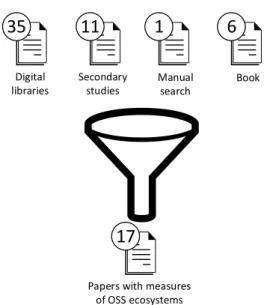
As a result of the SLR, 53 primary studies were selected, from them we identified 17 related to the identification of measures to evaluate the quality of OSS ecosystems. Figure 1 illustrates the SLR selec-tion process.
Once we had collected the measures from the se-lected papers, we used the following criteria from Hartigh et al. (2013) and Neu et al. (2011) to include them in QuESo:
1. User-friendly and operationalizable: measures
should be logical, easy to use and operationaliz-able into a measuroperationaliz-able entity.
2. Non-redundant: when we identified similar
mea-sures we selected only one of them, but we kept all the sources for traceability.
After excluding non-operationalizable and merg-ing the similar measures with the previous criteria, we finally selected 68 different measures for the QuESo quality model (note that some of the measures are used to assess more than one characteristic of the quality model).
3.2
Quality model construction
There exist several proposals for quality model con-struction that focus on software quality. Most of them follow top-down strategies (Franch and Car-vallo, 2003; Behkamal et al., 2009). In short, they take as a basis a reference quality model such as the ISO quality model (ISO/IEC 25000, 2014), take their quality characteristics as departing point and
re-Book Manual search Secondary studies Digital libraries
35
11
1
6
Papers with measures of OSS ecosystems
17
Figure 1: Selection of primary studies.
fine them till they end up with a hierarchy with spe-cific measures at its lower level. Remarkably, the proposal in Radulovic and Garcia-Castro (2011) is mainly bottom-up oriented, i.e., it takes a set of mea-sures as departing point to build the model. For our purposes, a bottom-up approach is the most ad-equate because: (1) a well-established reference qual-ity model (or even, in its defect, a complete and sys-tematic body of knowledge) for software ecosystems is still missing (Jansen et al., 2013), and (2) there al-ready exist a myriad of specific measures that can be applied to OSS ecosystems and that have been identi-fied in our SLR. Furthermore, although it focuses on the construction of software quality models, we can easily use it to the construction of a quality model for OSS ecosystems.
Radulovic and Garcia-Castro (2011) proposal consists of a clearly defined sequence of steps:
1. To identify basic measures. 2. To identify derived measures.
3. To identify quality measures (by aggregation of basic and derived measures).
4. To identify relationships between measures. 5. To specify relationships between measures. 6. To define domain-specific quality
sub-characteristics.
7. To align quality sub-characteristics with a quality model.
Note that the alignment in the seventh step partly implies top-down reasoning. Quality sub-characteristics that have been previously defined
QuESo Maintenance capacity Sustainability Process maturity Community quality Size Cohesion Activeness Heterogeneity Regeneration ability Effort balance Expertise balance Visibility Ecosystem network quality Resource health Network health Information consistency Financial Vitality Clustering Trustworthiness Interrelatedness Synergetic evolution Platform quality Dimension Characteristic Sub-characteristic From QualOSS
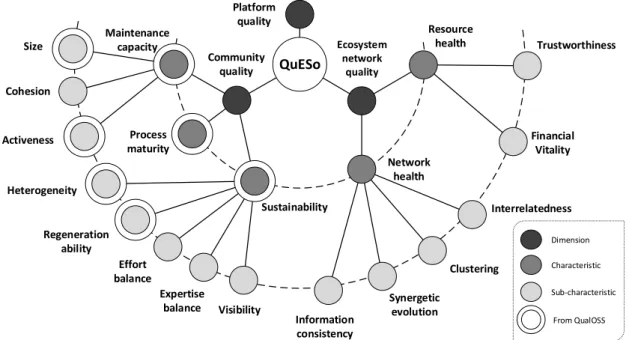
Figure 2: QuESo quality model.
are related to others already specified in the ex-isting model. If needed, some new quality sub-characteristics can be specified, or existing ones can be modified or excluded.
We have followed all the steps of the proposal. In particular, for steps 1 and 2, devoted to identify measures, we have based our work on the SLR de-scribed in Section 3.1. The application of step 7 re-quires the use of a reference quality model. Since, to our knowledge, a quality model for the whole scope of OSS ecosystems is still missing, we have decided to use QualOSS (Soto and Ciolkowski, 2009) which measures the performance of open source communi-ties. Clearly, new quality sub-characteristics emerg-ing from measures related to the ecosystem consid-ered as a whole will have to be specified, since they are not addressed by QualOSS.
4
QuESo QUALITY MODEL
In this section we describe the QuESo quality model obtained as a result of the application of the proce-dure described in Section 3.2. The model is com-posed of two types of interrelated elements: quality characteristics and measures. Quality characteristics correspond to the attributes of an open source soft-ware ecosystem that are considered relevant for eval-uation. The quality characteristics are organized in a hierarchy of levels that is described in the rest of this section. For the lack of space, in the tables presented
in this paper we have omitted the descriptions. The whole set of measures with their definitions is avail-able in the Appendix. Also, note that we opted to keep the measure names that appear in the primary studies, even that in some cases the name given is not the most appropriate, we discuss about this topic in Section 6.
The quality characteristics in QuESo have been organized in three dimensions: (1) those that relate to
theplatformaround which the ecosystem is built, (2)
those that relate to thecommunity(or set of communi-ties) of the ecosystem and (3) those that are related to
the ecosystem as a networkof interrelated elements,
such as projects or companies (see Figure 2).
4.1
Platform-related quality
characteristics
Platform-related quality characteristics consist of the set of attributes that are relevant for the evaluation of the software platform.
As a result of our SLR, we have observed that the selected papers do not provide measures for evaluat-ing open source platform-related quality characteris-tics. This fact may indicate that there are not signifi-cant differential issues for open source software qual-ity with respect to generic software qualqual-ity that moti-vates the need of specific measures.
Then, similarly as done in the QualOSS model, since a mature proposal such as ISO 25000-SQuaRE (ISO/IEC 25000, 2014) focuses on generic software quality, QuESo adopts directly the
character-Table 1: List of measures formaintenance capacity. Sub-char. Measure
Size Number contributors Size Number of members Size Number authors Size Number bug fixer Size Number of committers Size Number of core developers Size Number of nodes and edges Cohesion Betweenness centrality Cohesion Cluster of collaborating
developers
Cohesion Ecosystem connectedness Cohesion Out degree of keystone actors Activeness Bug tracking activity
Activeness Buildup of assets Activeness Community effort Activeness Date of last commit Activeness Files changed Activeness Files per version Activeness Lines added Activeness Lines changed Activeness Lines removed Activeness Mailing list
Activeness Number of commits Activeness Contributor commit rate Activeness Developer activity diagrams Activeness Temporal community effort Activeness Number of event people
istics and sub-characteristics proposed by ISO 25000-SQuaRE and this part of the quality model is omitted in the paper.
4.2
Community-related quality
characteristics
Following the procedure described in Section 3.2, the QuESo proposal for community-related quality characteristics is based both on the set of measures identified in our SLR and on the QualOSS quality model (Soto and Ciolkowski, 2009) (see Figure 2).
QualOSS specifies three community characteris-tics, namely,maintenance capacity,sustainabilityand
process maturity.
4.2.1 Maintenance capacity
Soto et al. definemaintenance capacityas the ability of a community to provide the resources necessary for maintaining its products and mention that aspects rel-evant to it are the number of contributors to a project
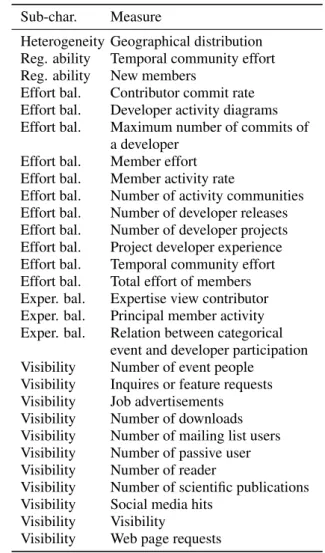
Table 2: List of measures forsustainability. Sub-char. Measure
Heterogeneity Geographical distribution Reg. ability Temporal community effort Reg. ability New members
Effort bal. Contributor commit rate Effort bal. Developer activity diagrams Effort bal. Maximum number of commits of
a developer Effort bal. Member effort Effort bal. Member activity rate
Effort bal. Number of activity communities Effort bal. Number of developer releases Effort bal. Number of developer projects Effort bal. Project developer experience Effort bal. Temporal community effort Effort bal. Total effort of members Exper. bal. Expertise view contributor Exper. bal. Principal member activity Exper. bal. Relation between categorical
event and developer participation Visibility Number of event people
Visibility Inquires or feature requests Visibility Job advertisements Visibility Number of downloads Visibility Number of mailing list users Visibility Number of passive user Visibility Number of reader
Visibility Number of scientific publications Visibility Social media hits
Visibility Visibility
Visibility Web page requests
and the amount of time they contribute to the devel-opment effort. In order to align maintenance capacity with our identified measures it is refined in three sub-characteristics: size, cohesion andactiveness. The
sizeof the community influences its maintenance ca-pacity and can be evaluated by measures such as
num-ber of core developersandnumber of committers. The
ability of the community to collaborate defined by its
cohesionis also relevant. A measure that can be used
to evaluate cohesion is the ecosystem connectedness
in the community social network. Finally, the active-nessof the community can be evaluated by measures such asbug tracking activityandnumber of commits. We have identified 26 measures that can be used to measure the maintenance capacity (see Table 1).
4.2.2 Sustainability
Sustainability is the likelihood that a community
an extended period of time. According to Soto et al. it is affected byheterogeneityandregeneration abil-ityand, as a result of our measure analysis, we have specified additional sub-characteristics besides them:
effort balance, expertise balanceandvisibility.
Theheterogeneityof a community contributes to
its sustainability. For instance, if a community is mainly composed of employees of a particular com-pany, there is the risk of the company cutting its fi-nancial support. Heterogeneitycan be evaluated by measures such asgeographical distributionof com-munity members.
Regeneration abilityalso enhances sustainability
since a community that has been able to grow in the past increases its chances of not declining in the fu-ture. A measure that we have identified for it is for instance,new memberswhich counts the number of new members of the community at any point of time.
The effort balance is relevant for sustainability
i.e., if most of the contribution effort comes from one or a small number of members of the community and it is not uniformly distributed, then its continuity is highly dependent on that small set of members. On the other hand, a balanced effort distribution among all members facilitates its continuity over time. Some measures for effort balance are:number of developer projectsandnumber of developer releases.
In a similar way, the expertise balance among most members of a community is again a way to guar-antee its sustainability. A community highly depen-dent on the expertise of one or a few members suffers from a risky situation. A measure for this is, for in-stance,expertise view contributor which calculates a contributor expertise based on the number and type of files he changed within a month.
Thevisibilityof a community gives it the
capac-ity of attracting people to contribute and support it if needed. Examples of measures identified for visibil-ity are: number of downloads, social media hitsand
web page requests.
We have identified 28 measures that can be used to measure the sustainability quality (see Table 2).
4.2.3 Process maturity
Process maturity is the ability of a developer
com-munity to consistently achieve development-related goals by following established processes. It can be assessed for specific software development tasks with the answers of questions such as: is there a
docu-mented process for the task?(Soto and Ciolkowski,
2009). Apparently, this characteristic requires qual-itative assessment more than quantqual-itative measures. This is consistent with the results of our SLR since we have not identified measures devoted to evaluate
Table 3: List of measures forresource health. Sub-char. Measure
Trustworthiness Zeta model Trustworthiness Z-score Financial vitality Liquidity Financial vitality Solvency
Financial vitality Network resources
process maturity aspects. The absence of measures for process maturity hampers the application of the bottom-up process to further refine this characteristic.
4.3
Ecosystem network quality
characteristics
Since QualOSS does not address the network-related quality, this part of QuESo is exclusively based on the analysis of measures identified in our SLR.
QuESo proposes two ecosystem network-related characteristics: resource health andnetwork health. In this paper we take as definition for healthapplied to software ecosystems: longevity and a propensity for growth(Jansen, 2014; Lucassen et al., 2013) .
4.3.1 Resource health
Resource healthfacilitates the combination of value
activities from multiple actors to obtain value-creating end products (Anderson et al., 2009). It is related to the financial health concept defined by Hartigh et al. (2013): “The financial health is a long-term financially based reflection of a partner’s strength of management and of its competences to exploit opportunities that arise within the ecosystem and is directly related to the capability of an
ecosys-tem to face and survive disruptions”. In the OSS
ecosystem case this means that there is a set of part-ners or actors functioning as a unit and interacting among them. Their relationships are frequently op-erated through the exchange of information and re-sources. Two sub-characteristics, particularly relevant to resource health, are the financial vitalityand the
trustworthinessof the ecosystem.
Thefinancial vitalityis the viability and the ability to expand (i.e., robustness, ability to increase size and strength) of the ecosystem (Li et al., 2013). Two ex-amples of measures that evaluate it areliquidityand
solvency financial measures. They can be obtained
directly, e.g., using balance sheet data of partners, but also indirectly, through the network relations.
Trustworthinessis the ability to establish a trusted partnership of shared responsibility in building an
Table 4: List of measures fornetwork health. Sub-char. Measure
Interrelatedness Contributor activity graph Interrelatedness Project activity diagrams Interrelatedness Networks node connection Interrelatedness Ecosystem connectedness Interrelatedness Ecosystem cohesion Interrelatedness Centrality
Interrelatedness Variety of partners Clustering Variety in products
Clustering Number community projects Clustering Number active projects Clustering Number of files
Synergetic evo. Distribution over the species Synergetic evo. Ecosystem entropy
Synergetic evo. Ecosystem reciprocity Information
consistency
Code vocabulary map
overall open source ecosystem (Agerfalk and Fitzger-ald, 2008). Operational financial measures obtained from bankruptcy models (e.g., Z-score and Zeta
model) are adequate to measure it because they take
short-term and long-term survival into account (Har-tigh et al., 2013).
We have identified 5 measures that can be used to measure the resource health quality (see Table 3).
4.3.2 Network health
Hartigh et al. (2013) definenetwork healthas a rep-resentation of how well partners are connected in the ecosystem and the impact that each partner has in its local network. Healthy ecosystems show many rela-tions and subsystems of different types of elements that are intensely related (Gamalielsson et al., 2010). Furthermore, in a healthy OSS ecosystem network, these relations are mutualistic (Lundell and Forssten, 2009). Van der Linden et al. (2009) proposed to evaluate the network health of an OSS ecosystem before its adoption. To align network health with the identified measures we have refined it into four sub-characteristics: interrelatedness,clustering, syn-ergetic evolutionandinformation consistency.
Interrelatedness is the ability of the nodes of
an OSS ecosystem to establish connections between them. It can be evaluated by measures such as cen-tralityi.e., the number of network relations of a node, andproject activity diagramsthat allows to obtain the kind of project evolution.
Clusteringis the capacity of the species (or nodes) in the entire ecosystem to be classified around its projects. It also enables small OSS projects to come
together as a large social network with a critical mass (Scacchi, 2007). Basic measures as number
community projects, number of files and variety in
productscan be used to identify clusters using social network analysis techniques (Lungu et al., 2010).
Synergetic evolutionis the ability of the subsys-tems that constitute the whole ecosystem to form a dy-namic and stable space-time structure (Haken, 1980; Li et al., 2013). Measures such asecosystem entropy
andecosystem reciprocitycan be used to evaluate syn-ergetic evolution. Theecosystem entropymeasure is based on the definition of software system entropy from Jacobson (2004) who states that it is a mea-sure for the disorder that always increases when a system is modified. Ecosystem reciprocitymeasures direct and active collaboration between the company and its customers in creating value propositions (e.g., through collaboration with key developers in an OSS community and other companies within the ecosys-tem) (Glott et al., 2013).
Information consistencyis the consistency of the
core information elements across the breadth of an ecosystem. Thecode vocabulary mapmeasure evalu-ates this sub-characteristic. It consists of a summary of terms used in the source code of the project that can be used to obtain a general overview of the do-main language of the project’s network.
We have identified 15 measures that can be used to measure the network health quality (see Table 4).
5
EXAMPLES OF MEASURES
In this section we provide several examples extracted from the papers selected in the SLR. In particular we have selected the examples that belong to theGnome
software ecosystem. Our intention is to clarify the type of measures that are mentioned in this paper with examples and also to provide some evidence of the feasibility to obtain these measures. As mentioned in Jansen (2014), one of the most habitual problems is theabsence of datato calculate the measures.
It is worth mentioning that to perform a complete quality assessment of a software ecosystem we first would need to define the assessment process which is out of the scope of this paper. Thequality
assess-ment process will have to deal with, e.g., How are
the values of each measure interpreted (i.e., defining what are the good and the bad values)?; How can the measures be merged to provide the assessment for a particular sub-characteristic of the quality model?; or What are the principles to perform the assessment with missing, incorrect, and/or inconsistent measure data? We are will provide the answer to these and
other questions as part of our future work in this topic. In the following we present the selectedGnome
examples of measure values organized by the charac-teristics of the QuESo quality model. We omit
pro-cess maturity because we have not found
quantita-tive measures to evaluate it (see explanation in Sec-tion 4.2.3). We also omitresource healthmeasures because examples for them are not reported in the SLR papers for theGnomeecosystem.
• Themaintenance capacitycan be evaluated from
the number authors measure which gives the
amount of people that change files in a project. According to Goeminne and Mens (2013) data, for theGnomeecosystem there have been 3.500 different people having contributed at least once to at least one of the Gnome projects between 1997 and 2012. Thenumber of commitsmeasure is also relevant. Each commit corresponds to the action of making a set of changes permanent. Ac-cording to Jergensen and Sarma (2011) approx-imately 480.000 commits were made in Gnome
from 1997 to 2007.
• A measure for sustainability is the member
ac-tivity rate which gives a value between 0 and 1
that helps to analyse the effort balance, i.e., a zero value indicates a uniform distribution of the work, which means that each person has the same activ-ity rate while a value of 1 means that a single per-son carries out all the work. Themember activity ratefor theGnome Evinceproject has had a value between 0,7 and 0,8 from 1999 to 2009 according to Mens and Goeminne (2011).
• Thenetwork healthof an ecosystem can be
eval-uated by measures such as number community
projects and number active projects. For the
Gnome ecosystem, there were more than 1.300
projects between 1997 and 2012 and more than 25% of them had been active for more than six and a half years. At the lower side of the spectrum, more than 25% of all projects had been active less than one year (Goeminne and Mens, 2013). An-other measure for network health is the contribu-tor activity graph. According to Neu et al. (2011) one of the contributors of theGnomeecosystem has been working in 499 projects and has more than 15.000 changes between 1998 and 2011.
6
DISCUSSION
Some observations were made during the design of this quality model. In the following, the most inter-esting ones are discussed:
• Completeness: since we followed a mainly
bottom-up strategy, the completeness of the qual-ity model depends on how complete the set of measures found in the literature is. In this sense, we would like to remark that our quality model may be not complete by one or more of the follow-ing reasons: there may be some papers with rel-evant measures not included in the SLR because they were not present in digital libraries or be-cause our search string did not find them; another reason could be that some important measures are not yet reported in the literature. In this work, our intention was not to invent new measures but to organize the existing ones into a quality model.
• Quantitative vs. qualitative: the measures found
in the literature are mostly quantitative, but a qual-ity assessment may also include qualitative eval-uations. For example, we commented in Sec-tion 4.2.3 the lack of measures for process ma-turity because in this case the assessment needs to be done with qualitative evaluations of the com-munity. Since we have focused on quantitative measures, there may be other characteristics of the quality model that require or that may be comple-mented with qualitative evaluations.
• Unbalanced distribution of measures: just by
looking into the measure tables, it is easy to ob-serve that the amount of measures for some char-acteristics is high (e.g., activeness with 17 mea-sures,visibilitywith 11 measures) while for other is very low (e.g.,heterogeneitywith 1 measure,
in-formation consistencywith 1 measure). This
un-balanced situation could be an indicator that more research is needed for the characteristics with a low amount of measures.
• Measure names:we have named the measures
in-cluded in the QuESo quality model with the same names they are referred to in the SLR papers from where they were extracted. The reason for this is to improve traceability. However, some of those measure names might be ambiguous or mislead-ing because it is not evident from them how the measure is evaluated (e.g., project activity
dia-grams). To improve measure understandability
we have listed their definitions in the Appendix.
7
CONCLUSIONS
In this paper we have presented QuESo, a quality model for assessing the quality of OSS ecosystems. This quality model has been constructed following a bottom-up strategy that consisted in searching the
available measures for OSS ecosystems in the litera-ture and then organize them into several quality char-acteristics. The presented quality model covers three aspects of OSS ecosystems: the platform, the commu-nity, and the ecosystem network; which altogether are a good representation of the most important aspects of an OSS ecosystem.
This quality model can be used as a starting point for the quality assessment of an OSS ecosystem, and it is in our plans for the future work to define a com-plete quality assessment process (as described in Sec-tion 5) and to apply it in a real quality assessment. As consequence new measures may be needed for the assessment, but this is the best way to improve, and complete the quality model, and a way to prove its capabilities in quality assessment.
ACKNOWLEDGMENTS
This work is a result of the RISCOSS project, funded by the EC 7th Framework Programme FP7/2007-2013 under the agreement number 318249. We would also like to thank Carme Quer for her assistance.
REFERENCES
Agerfalk, P. J. and Fitzgerald, B. (2008). Outsourcing to an Unknown Workforce: Exploring Opensourcing as a Global Sourcing Strategy.Mis Quartely, 32(2):385– 409.
Anderson, J. C., Narus, J. A., and Narayandas, D. (2009).
Business Market Management: Understanding, Cre-ating, and Delivering Value (3rd Edition). Prentice Hall.
Barbosa, O. and Alves, C. (2011). A Systematic Mapping Study on Software Ecosystems. InProceedings of the 3rdIWSECO, pages 15–26.
Behkamal, B., Kahani, M., and Akbari, M. K. (2009). Cus-tomizing ISO 9126 quality model for evaluation of B2B applications.Information and Software Technol-ogy, 51(3):599–609.
Franch, X. and Carvallo, J. P. (2003). Using quality models in software package selection.IEEE Software, 20:34– 41.
Franco-Bedoya, O., Ameller, D., Costal, D., and Franch, X. (2014). Protocol for a systematic literature re-view on open source-software ecosystems. Techni-cal report, Universitat Politcnica de Catalunya. Avail-able online: www.essi.upc.edu/˜gessi/papers/
queso-slrprotocol.pdf.
Gamalielsson, J., Lundell, B., and Lings, B. (2010). The Nagios community: An extended quantitative anal-ysis. In Proceedings of the 6th OSS, pages 85–96. Springer.
Glott, R., Haaland, K., and Bannier, S. (2013). D3.1 Draft Business Model Risk Requirements Report. Deliver-able of the RISCOSS FP7 project (grant 318249). Goeminne, M. and Mens, T. (2013). Software Ecosystems:
Analyzing and Managing Business Networks in the Software Industry, chapter Analyzing ecosystems for open source software developer communities, pages 247–275. Volume 1 of (Jansen et al., 2013).
Haken, H. (1980). Synergetics. Naturwissenschaften, 67:121–128.
Hartigh, E., Visscher, W., Tol, M., and Salas, A. J. (2013).
Software Ecosystems: Analyzing and Managing Busi-ness Networks in the Software Industry, chapter Mea-suring the health of a business ecosystem, pages 221– 245. Volume 1 of (Jansen et al., 2013).
Iansiti, M. and Levien, R. (2004). Keystones and domina-tors: framing operating and technology strategy in a business ecosystem. Technical report, Harvard Busi-ness School.
ISO/IEC 25000 (2014). Systems and software engineer-ing – Systems and software Quality Requirements and Evaluation (SQuaRE) – Guide to SQuaRE.
ISO/IEC 9126 (2001). Product quality – Part 1: Quality model.
Jacobson, I. (2004). Object-Oriented Software Engineer-ing: A Use Case Driven Approach. Addison Wesley. Jansen, S. (2014). Measuring the health of open source
soft-ware ecosystems: Beyond the scope of project health.
Information and Software Technology, (Available on-line).
Jansen, S., Brinkkemper, S., and Michael Cusumano (2013). Software Ecosystems: Analyzing and Manag-ing Business Networks in the Software Industry, vol-ume 1. Edward Elgar Publishing.
Jansen, S. and Cusumano, M. (2013).Software Ecosystems: Analyzing and Managing Business Networks in the Software Industry, chapter Defining software ecosys-tems: a survey of software platforms and business net-work governance, pages 13–28. Volume 1 of (Jansen et al., 2013).
Jansen, S. and van Capelleveen, G. (2013). Software Ecosystems: Analyzing and Managing Business Net-works in the Software Industry, chapter Quality re-view and approval methods for extensions in software ecosystems, pages 187–217. Volume 1 of (Jansen et al., 2013).
Jergensen, C. and Sarma, A. (2011). The onion patch: mi-gration in open source ecosystems. InProceedings of the 19thSIGSOFT and 13thESEC/FSE, pages 70–80. ACM.
Kilamo, T., Hammouda, I., Mikkonen, T., and Aaltonen, T. (2012). From proprietary to open source - Growing an open source ecosystem. Journal of Systems and Software, 85(7):1467–1478.
Kitchenham, B. and Charters, S. (2007). Guidelines for performing Systematic Literature reviews in Software Engineering Version 2.3. Technical report, Keele Uni-versity EBSE.
Li, X., Jie, X., Li, Q., and Zhang, Q. (2013). Research on the Evaluation of Business Ecosystem Health. In
Proceedings of the 6th ICMSEM, pages 1009–1020. Springer.
Lucassen, G., Rooij, K., and Jansen, S. (2013). Ecosystem Health of Cloud PaaS Providers. InProceedings of the 4thICSOB, pages 183–194.
Lundell, B. and Forssten, B. (2009). Exploring health within OSS ecosystems. InProceedings of the 1st OS-COMM, pages 1–5.
Lungu, M., Lanza, M., Gˆırba, T., and Robbes, R. (2010). The Small Project Observatory: Visualizing soft-ware ecosystems.Science of Computer Programming, 75(4):264–275.
Lungu, M., Malnati, J., and Lanza, M. (2009). Visualizing gnome with the small project observatory. In Proceed-ings of the 6thMSR, pages 103–106. IEEE.
Manikas, K. and Hansen, K. M. (2013). Software ecosys-tems A systematic literature review. Journal of Sys-tems and Software, 86(5):1294–1306.
Mens, T. and Goeminne, M. (2011). Analysing the Evo-lution of Social Aspects of Open Source Software Ecosystems. In Proceedings of the 3rd IWSECO, pages 1–14.
Neu, S., Lanza, M., Hattori, L., and D’Ambros, M. (2011). Telling stories about GNOME with Complicity. In
Proceedings of the 6thVISSOFT, pages 1–8. Radulovic, F. and Garcia-Castro, R. (2011). Extending
Software Quality Models - A Sample In The Domain of Semantic Technologies. InProceedings of the 23rd SEKE, pages 25–30.
Scacchi, W. (2007). Free/Open Source Software Develop-ment: Recent Research Results and Emerging Oppor-tunities. InProceedings of the 6thESEC-FSE, pages 459–468.
Soto, M. and Ciolkowski, M. (2009). The QualOSS open source assessment model measuring the performance of open source communities. InProceedings of the 3rdESEM, pages 498–501.
van der Linden, F., Lundell, B., and Marttiin, P. (2009). Commodification of Industrial Software: A Case for Open Source.IEEE Software, 26(4):77–83.
SLR REFERENCES
[R1] Gamalielsson, J., Lundell, B., and Lings, B. (2010). The Nagios community: An extended quantitative analysis. InProceedings of the 6thOSS, pages 85–96. Springer.
[R2] Goeminne, M. and Mens, T. (2010). A framework for analysing and visualising open source software ecosystems. InProceedings of IWPSE-EVOL, pages 42–47. ACM.
[R3] Goeminne, M. and Mens, T. (2013).Software Ecosys-tems: Analyzing and Managing Business Networks in the Software Industry, chapter Analyzing ecosys-tems for open source software developer communi-ties, pages 247–275. In (Jansen et al., 2013).
[R4] Hartigh, E., Visscher, W., Tol, M., and Salas, A. J. (2013). Software Ecosystems: Analyzing and Man-aging Business Networks in the Software Industry, chapter Measuring the health of a business ecosystem, pages 221–245. In (Jansen et al., 2013).
[R5] Jansen, S., Souer, J., Luinenburg, L., and Brinkkem-per, S. (2012). Shades of gray: Opening up a soft-ware producing organization with the open softsoft-ware enterprise model. Journal of Systems and Software, 85(7):1495–1510.
[R6] Jergensen, C. and Sarma, A. (2011). The onion patch: migration in open source ecosystems. InProceedings of the 19thSIGSOFT and 13thESEC/FSE, pages 70– 80. ACM.
[R7] Kabbedijk, J. and Jansen, S. (2011). Steering insight: An exploration of the ruby software ecosystem. In
Proceedings of the 2ndICSOB, pages 44–55. Springer. [R8] Kilamo, T., Hammouda, I., Mikkonen, T., and Aaltonen, T. (2012). From proprietary to open source -Growing an open source ecosystem. Journal of Sys-tems and Software, 85(7):1467–1478.
[R9] Lungu, M., Lanza, M., Gˆırba, T., and Robbes, R. (2010). The Small Project Observatory: Visualizing software ecosystems. Science of Computer Program-ming, 75(4):264–275.
[R10] Lungu, M., Malnati, J., and Lanza, M. (2009). Visu-alizing gnome with the small project observatory. In
Proceedings of the 6thMSR, pages 103–106. IEEE. [R11] Mens, T. and Goeminne, M. (2011). Analysing the
Evolution of Social Aspects of Open Source Soft-ware Ecosystems. InProceedings of the 3rdIWSECO, pages 1–14.
[R12] Neu, S., Lanza, M., Hattori, L., and D’Ambros, M. (2011). Telling stories about GNOME with Complic-ity. InProceedings of the 6thVISSOFT, pages 1–8. [R13] Scacchi, W. and Alspaugh, T. A. (2012).
Understand-ing the role of licenses and evolution in open archi-tecture software ecosystems. Journal of Systems and Software, 85(7):1479–1494.
[R14] Shao, J., Kuk, G., Anand, S., Morley, J. G., Jackson, M. J., and Mitchell, T. (2012). Mapping Collaboration in Open Source Geospatial Ecosystem. Transactions in GIS, 16(4):581–597.
[R15] Ververs, E., van Bommel, R., and Jansen, S. (2011). Influences on developer participation in the Debian software ecosystem. InProceedings of the MEDES, pages 89–93. ACM.
[R16] Weiss, M. (2011). Economics of collectives. In Pro-ceedings of the 15thSPLC, pages 39:1–39:8. ACM. [R17] Yu, L., Cawley, J., and Ramaswamy, S. (2012).
Entropy-Based Study of Components in Open-Source Software Ecosystems. INFOCOMP Journal of Com-puter Science, 11(1):22–31.
APPENDIX: MEASURE DEFINITIONS
Measure Definition Sources
Amount of inquires or feature requests
Number of inquire or feedbacks received for the OSS community. Con-tributions could be corrective, adaptive, perfective or preventive.
R8 Betweenness centrality Reflects the number of shortest paths that pass through a specific node. R1 Bug tracking activity Number of comments created in project bug tracker and total number
of actions in the bug tracker. These discussions are often technical in nature and focus on a specific defect or feature.
R6, R8, R15
Buildup of assets Total factor productivity over time. Can be measured using individual company data.
R4 Centrality Number of relations clique memberships. Number of individual
net-work relations of a partner. The more central partner is the most per-sistent. When the partners are in clique or cluster, its persistence is considered high. Because is regarded as a secure environment.
R1, R4, R7
Cluster of collaborating developers
The nodes are developers and the edges between them represent projects on which they collaborated. They both make modifications to the project for at least a certain number of times.
R9, R10
Code vocabulary map Summary of terms used in the source code of the project. The vocab-ulary map is a tool for the developer who wants to obtain a general overview of the domain language of a project.
R9
Community effort The combined effort of all members belonging to community. R3 Contributor activity graph The contributor distribution at ecosystem level. R12 Contributor commit rate Average between first and last commit. R12 Date of last commit Date of last commit of a project/community. R11 Developer activity diagrams Give an overview of the contributors daily activity within an ecosystem. R12 Distribution over the species Variety measure for niche creation factor. The equality of the division
of partners over the species. E.g., the distribution between numbers of resellers, number of system integrators, numbers of OEM’s.
R4
Ecosystem cohesion Number of relations present in a subgroup/maximum possible of rela-tion among all the nodes in the sub-group.
R4 Ecosystem connectedness Number of relations as a proportion of the theoretically maximum
num-ber of relations in all ecosystem. Is a metric of connectedness. Is a property that keeps communities structure safe from risks, guaranteeing their well-being and health.
R4
Ecosystem Entropy The second law of thermodynamics, in principle, states that a closed system’s disorder cannot be reduced, it can only remain unchanged or increase. A measure of this disorder is entropy. This law also seems plausible for software systems; as a system is modified, its disorder, or entropy, always increases. This is known as software entropy. Can be viewed as being similar to the measurement of the existence of or-der or disoror-der among the participating software components, software products, or software organizations.
R17
Expertise view contributor Visualization about a contributor expertise based on file extensions (number and type of files changed within a month).
R12
Files changed Number of files that has been changed. R12
Files per version Number of files per version. R11
Geographical distribution Geographical distribution of community members. R9 Job advertisements Number of job advertisements on the project/community. R8
Lines added Lines added. R12, R7
Lines changed Lines changed. R12
Lines removed Lines removed. R12
Liquidity Is a metric for the robustness factor: survival rates. Provide an indica-tion whether a partner is able to meet its short-term obligaindica-tions. Can be measured with: financial status of a partner; counting the number of new members in a business ecosystem.
R4
Mailing list Number of messages posted to project mailing lists and the number of responses obtained from those messages.
R1, R11, R15, R6, R2 Maximum number of commits
of a developer
The size and density of a contributor in a project. R12 Member activity rate Activity rate 1 means that a single person carries out all the work. R11
Member effort The effort of membermin communityc. R3 Network resources Measure for delivery innovations factor of productivity. They can be
measured directly, e.g., using balance of partners, but also indirectly, through the network relations.
R4
Networks node connection Connections between central and non-central species or partners. R4 New members Counting the number of new members at any point in time. R4
Number active projects Number active projects. R3
Number authors Number of authors for projects. Author can change files in a project. R11, R3
Number bug fixer Number bug fixers in the community. R8
Number committers Number of committers per project. R11, R3, R9
Number of activity communities
The number of activity communities in which membermis involved. R3, R7 Number of commits Total number of commits containing source code, documentation, and
translation. Average number of commits per week (project/community).
R15, R9, R11, R12, R3, R14 Number of community project Number of projects built on top of the platform of a community. R8, R3 Number of contributors Total of contributors per project. R8, R12 Number of core developers Core developer contribute most of the code and oversee the design and
evolution of the project.
R1 Number of developer releases Number of releases that a developer has been active on a project. R6 Number of developer projects Number of projects of a developer. R12 Number of downloads Number of downloads from the official community portal or mirrors. R8, R7 Number of event people The number of people participating in project events and meetings gives
direct information on the activity in the community.
R8
Number of files Files during projects life. R14, R11
Number of mailing list users Number of users subscribed to the project mailing list. R8
Number of members The number of activity members involved in communityc. R3, R5, R16
Number of nodes and edges Number of nodes and edges. R1
Number of passive user Passive users in the community. R8
Number of reader Number of readers in the community. R8
Number of scientific publications
Number of scientific publications mentioning the community. R8 Out degree of keystone actors Is defined for this specific case as someone who has a lot of developers
he works with and also plays a large role in the software ecosystem.
R7 Principal member activity The principal activity of a membermfor a given timet. Communityc
for whichmcarried out the most effort.
R3 Project activity diagrams Allow identify the project evolution comparing six metrics; calculating
the contributors involvement distribution.
R12 Project developer experience Total number of releases in which the developer was active. R6
Reciprocity of the ecosystem (definition not provided). R7
Relation between categorical event and developer participation
Relation between categorical event and developer participation. R15
Social media hits Number of hits the project gets in the social media and blogs. R8, R7 Solvency Value creation measure for niche creation. Can be measured by
stan-dard metrics such as revenue share or profit share of newly introduced products or technologies. An alternative is to look at the build-up of partner equity.
R4
Temporal community effort The combined effort of all members belonging to communitycduring time periodt.
R3 Total effort of members Total effort done by a particular community membermin a set of
com-munitiesC.
R3 Variety in products Measure for the variety factor of niche creation. The variety in products
offered by the partner depends on alliances with other partners. Eu-clidean distances towards the overall mean of the business ecosystem can be used to measured most of these variety of scores.
R4, R13
Variety of partners Covariance with market indicates the variety of different partners a part-ner has.
R4 Visibility Tell us something about the centrality of a partner in the market.
Popu-larity of the partner.
R4 Web page requests Total request to OSS community web page. R8
Zeta model Bankruptcy classification score model. R4