Semantics-Aware Malware Detection
Mihai Christodorescu
∗Somesh Jha
∗University of Wisconsin, Madison
{mihai, jha}@cs.wisc.edu
Sanjit A. Seshia
†Dawn Song
Randal E. Bryant
†Carnegie Mellon University
{sanjit@cs., dawnsong@, bryant@cs.}cmu.edu
Abstract
A malware detector is a system that attempts to de-termine whether a program has malicious intent. In or-der to evade detection, malware writers (hackers) fre-quently use obfuscation to morph malware. Malware detectors that use a pattern-matching approach (such as commercial virus scanners) are susceptible to obfus-cations used by hackers. The fundamental deficiency in the pattern-matching approach to malware detection is that it is purely syntactic and ignores the semantics of instructions. In this paper, we present a malware-detection algorithm that addresses this deficiency by in-corporating instruction semantics to detect malicious program traits. Experimental evaluation demonstrates that our malware-detection algorithm can detect vari-ants of malware with a relatively low run-time over-head. Moreover, our semantics-aware malware detec-tion algorithm is resilient to common obfuscadetec-tions used by hackers.
1. Introduction
Amalware instanceis a program that has malicious intent. Examples of such programs include viruses, trojans, and worms. A classification of malware with respect to its propagation method and goal is given in [29]. Amalware detectoris a system that attempts to identify malware. A virus scanner uses signatures and other heuristics to identify malware, and thus is an example of a malware detector. Given the havoc that can be caused by malware [18], malware detection is an important goal.
∗This work was supported in part by the Office of Naval Research under contracts N00014-01-1-0796 and N00014-01-1-0708. The U.S. Government is authorized to reproduce and distribute reprints for Governmental purposes, notwithstanding any copyright notices af-fixed thereon.
The views and conclusions contained herein are those of the authors and should not be interpreted as necessarily representing the official policies or endorsements, either expressed or implied, of the above government agencies or the U.S. Government.
†This work was supported in part by Army Research Office grant DAAD19-01-1-0485.
The goal of a malware writer (hacker) is to modify or morph their malware to evade detection by a mal-ware detector. A common technique used by malmal-ware writers to evade detection is program obfuscation [30]. Polymorphism and metamorphism are two common ob-fuscation techniques used by malware writers. For ex-ample, in order to evade detection, a virus can morph itself by encrypting its malicious payload and decrypt-ing it durdecrypt-ing execution. A polymorphic virus obfus-cates its decryption loop using several transformations, such asnop-insertion, code transposition (changing the order of instructions and placing jump instructions to maintain the original semantics), and register reassign-ment (permuting the register allocation). Metamor-phic viruses attempt to evade detection by obfuscat-ing the entire virus. When they replicate, these viruses change their code in a variety of ways, such as code transposition, substitution of equivalent instruction se-quences, change of conditional jumps, and register re-assignment [28, 35, 36].
Addition of new behaviors to existing malware is an-other favorite technique used by malware writers. For example, the Sobig.A through Sobig.F worm variants (widespread during the summer of 2003) were devel-oped iteratively, with each successive iteration adding or changing small features [25–27]. Each new vari-ant managed to evade detection either through the use of obfuscations or by adding more behavior. The re-cent recurrence of the Netsky and B[e]agle worms (both active in the first half of 2004) is also an example of how adding new code or changing existing code creates new undetectable and more malicious variants [9, 17]. For example, the B[e]agle worm shows a series of “up-grades” from version A to version C that include the addition of a backdoor, code to disable local security mechanisms, and functionality to better hide the worm within existing processes. A quote from [17] summa-rizes the challenges worm families pose to detectors:
Arguably the most striking aspect of Beagle is the dedication of the author or authors to refining the code. New pieces are tested, per-fected, and then deployed with great fore-thought as to how to evade antivirus scanners and how to defeat network edge protection
devices.
Commercial malware detectors (such as virus scan-ners) use a simple pattern matching approach to mal-ware detection, i.e., a program is declared as malmal-ware if it contains a sequence of instructions that is matched by a regular expression. A recent study demonstrated that such malware detectors can be easily defeated us-ing simple program obfuscations [8], that are already being used by hackers. The basic deficiency in the pat-tern matching approach to malware detection is thatthey ignore the semantics of instructions. Since the pattern-matching algorithm is not resilient to slight variations, these malware detectors must use different patterns for detecting two malware instances that are slight varia-tions of each other. This is the reason that the signature database of a commercial virus scanner has to be fre-quently updated. The goal of this paper is to design a malware-detection algorithm that uses semantics of in-structions. Such an algorithm will be resilient to minor obfuscations and variations.
Suppose a programP is transformed by a compiler phase (such as register allocation) to produce a program
P′. The translation-validationproblem is the prob-lem of determining whetherP′ “simulates”P[31, 32]. Translation validation can be used to prove that vari-ous compiler phases preserve the semantics of a spe-cific programP. By viewing hacker obfuscations as compiler phases, the malware-detection problem at the surface seems similar to the translation-validation prob-lem. However, there are fundamental differences be-tween the two problems. Translation-validation tech-niques determine whether the two programs are seman-tically equivalent. However, variants of malware are notequivalent because malware writers add additional functionality between variants. Moreover, translation-validation researchers make certain assumptions about the transformed program. For example, Necula [31] as-sumes that all branches in the target program must cor-respond to branches in the source program. In the con-text of malicious-code detection, such an assumption is not valid: an adversary is free to transform the mali-cious code as they wish. Although we use some ideas from the translation-validation literature in the context of malware detection (such as modeling semantics of instructions and using decision procedures), our algo-rithm is differs from those in the translation-validation literature.
We use the observation that certain malicious behav-iors (such as a decryption loop in a polymorphic virus or a loop to search for email addresses in a user’s mail folder) appear in all variants of a certain malware. The problem is that the specified malicious behavior (such as a decryption loop) appears in different guises in the different variants. We formalize this problem and de-scribe an algorithm for discovering specified malicious behaviors in a given program. Since our algorithm is
semantic rather than purely syntactic, it is resistant to common obfuscations used by hackers. Specifically, this paper makes the following contributions:
• Formal semantics: We formally define the problem of determining whether a program exhibits a speci-fied malicious behavior. In general, this problem is undecidable. Our semantics is described in detail in Section 2. We believe that the semantics presented in Section 2 can be used as a “reference semantics” for other researchers working on malware detection.
• A semantics-aware malware detection algorithm: Since the problem of determining whether a program exhibits a specified malicious behavior is undecid-able, we cannot hope to have a algorithm for the abovementioned problem. In Section 3 we present an algorithm for handling a limited set of transfor-mations used by hackers. However, our evaluation (in Section 4) shows that our algorithm is very effec-tive in discovering malicious behavior, as it detects multiple Netsky and B[e]agle variants with a single template, and its resilience to obfuscation is better than that of commercial virus scanners.
2. Semantics of malware detection
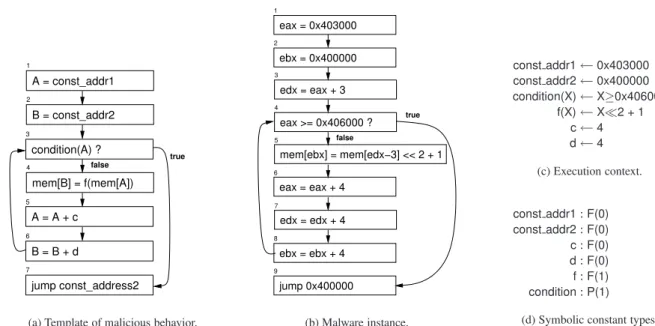
Before we present our formal semantics for malware detection, we will provide an intuitive explanation of the underlying ideas. We will use the example shown in Figure 1 as a running example. Figure 1(a) shows the control-flow graph (CFG) of a specification of ma-licious behavior and Figure 1(b) shows the CFG of an instruction sequence (which is a fragment of larger pro-gram). Instructions in Figure 1 are in the intermediate form (IR) used by our tool. The instructions in our IR are intuitive, and we give a formal description of the IR in Appendix B. We describe various components of our semantics.
Specifying the malicious behavior. In our frame-work, malicious behavior is described usingtemplates, which are instruction sequences where variables and symbolic constants are used. Figure 1(a) describes a malicious behavior that is a simplified version of a decryption loop found in polymorphic worms. The malware specification described in Figure 1(a) de-crypts memory starting from address const addr1and writes the decrypted data to memory starting at address const addr2. The decryption function and the termina-tion conditermina-tion are denoted by the functermina-tionf(·)and pred-icatecondition(·)respectively. By abstracting away the names of specific registers and symbolic constants in the specification of the malicious behavior, our seman-tics and algorithm are insensitive to simple obfusca-tions, such as register renaming and changing the start-ing address of a memory block.
4 mem[B] = f(mem[A]) 3 condition(A) ? 5 A = A + c 6 B = B + d 7 jump const_address2 2 B = const_addr2 1 A = const_addr1 true false
(a) Template of malicious behavior.
2 ebx = 0x400000 1 eax = 0x403000 3 edx = eax + 3 4 eax >= 0x406000 ? 6 eax = eax + 4 7 edx = edx + 4 8 ebx = ebx + 4 5 mem[ebx] = mem[edx−3] << 2 + 1 false 9 jump 0x400000 true (b) Malware instance. const addr1←0x403000 const addr2←0x400000 condition(X)←X≥0x406000 f(X)←X≪2 + 1 c←4 d←4 (c) Execution context. const addr1:F(0) const addr2:F(0) c:F(0) d:F(0) f:F(1) condition:P(1) (d) Symbolic constant types.
Figure 1. Malware instance (b) satisfies the template (a) according to our semantics.
When does an instruction sequence contain the malicious behavior? Consider the instruction se-quence shown in Figure 1(b). Assume the symbolic constants in the template are assigned values shown in Figure 1(c). If the template and the instruction se-quence shown in Figure 1(a) and 1(b) are executed from a state where the contents of the memory are the same, then after both the executions the state of the memory is the same. In other words, the template and the in-struction sequence have the same effect on the mem-ory. This is because whenever memory accesses are performed the addresses in the two executions are the same. Moreover, stores to memory locations are also the same. Thus, there is an execution of instruction se-quence shown in Figure 1(b) that exhibits the behavior specified by the template given in Figure 1(a). In other words,the malicious behavior specified by the template is demonstrated by the instruction sequence. Note that this intuitive notion of an instruction sequence demon-strating a specified malicious behavior is not affected by program transformations, such as register renaming, inserting irrelevant instruction sequences, and changing starting addresses of memory blocks.
2.1. Formal semantics
AtemplateT = (IT, VT, CT)is a 3-tuple, where
IT is a sequence of instructions and VT and CT are the set of variables and symbolic constants that appear inIT. There are two types of symbolic constants: an
n-ary function (denoted asF(n)) and ann-ary predi-cate (denoted asP(n)). Notice that a simple symbolic
constant is 0-ary function or has type F(0). A con-stant c of typeτ is written asc : τ. In the template shown in Figure 1(a) the variablesVT are{A, B}and the symbolic constants CT are shown in Figure 1(d). Let I be an instruction sequence or a program frag-ment. An example instruction sequence is shown in Fig-ure 1(b). Memory contents are represented as a function
M :Addr →V aluesfrom the set of addressesAddr
to the set of values V alues, where M[a] denotes the value stored at addressa.
An execution context for a template T, with T = (IT, VT, CT), is an assignment of values of appropriate types to the symbolic constants in the setCT. Formally, an execution contextECT for a templateTis a function with domainCT, such that for allc∈CT the type ofc andECT(c)are the same. An execution context for the template shown in Figure 1(a) is shown in Figure 1(c). Given an execution contextECT for a templateT, let
ECT(T)be the template obtained by replacing every constantc∈CT byECT(c).
Astate sT
for the templateT is a3-tuple denoted
(valT, pcT, memT), wherevalT : VT → V aluesis an assignment of values to the variables inVT,pc
T is a value for the program counter, andmemT
: Addr → V aluesgives the memory content. We follow the con-vention that a state and its component referring to the template are superscripted byT. Given a template state
sT
,val(sT
), pc(sT
)andmem(sT
)refer to the three components of the state. Similarly, a state for the in-struction sequenceIis a3-tuple(val, pc, mem), where
val : Reg → V aluesis an assignment of values to the set of registersReg,pcis a value for the program
counter, andmem : Addr →V aluesgives the mem-ory contents. LetST
andS be the state space for the template and the instruction sequence respectively.
Assume that we are given an execution contextECT for a templateT, and the template is in statesT
. If we execute an instructionifrom the templateECT(T)in statesT
, we transition to a new statesT
1 and generate a
system evente(in our context, events are usually sys-tem calls or kernel traps). We denote a state change from sT to sT 1 generating an evente as s T e −→ sT 1.
For uniformity, if an instructionidoes not generate a system event, we say that it generates the null event, ore(i) = null. For every initial template statesT
0,
executing the templateT in an execution contextECT generates a sequence as follows:
σ(T, ECT, s T 0) = s T 0 eT 1 −→sT 1 eT 1 −→ · · · , where fori ≥ 1,sT
i is the state after executing thei -th instruction from -the templateECT(T)ande
T i is the event generated by the(i−1)-th instruction. Notice that if the template does not terminate,σ(T, ECT, s
T
0)
can be infinite. Similarly,σ(I, s0)denotes the sequence
when the instruction sequenceI is executed from the initial states0.
Definition 1 We say that an instruction sequence I
contains a behavior specified by the template T = (IT, VT, CT)if there exists a program states0, an
ex-ecution context ECT, and a template state sT0 such thatmem(sT
0) = mem(s0) (the memory in the two
states are the same), and the two sequencesσ(I, s0)and
σ(T, ECT, s T
0)are finite, and the following conditions
hold on the two sequences:
• (Condition 1): Let the two execution sequences be given as follows: σ(T, ECT, s T 0) = s T 0 eT 1 −→sT1 eT 2 −→ · · · e T k −→sTk σ(I, s0) = s0 e 1 −→s1 e 2 −→ · · · er −→sr Letaffected(σ(T, ECT, sT0))be the set of addresses
a such that mem(sT
0)[a] 6= mem(s
T
k)[a], i.e., affected(σ(T, ECT, s
T
0)) is the set of memory
ad-dresses whose value changes after executing the tem-plate T from the initial state. We require that
mem(sT
k)[a] = mem(sr)[a] holds for all a ∈ affected(σ(T, ECT, s
T
0)), i.e. values at addresses
that belong to the set affected(σ(T, ECT, s T
0))are
the same after executing the templateT and the in-struction sequenceI.
• (Condition 2): Ignoringnull events, the event se-quenceheT
0,· · ·, e
T
kiis a subsequence of the event sequencehe0,· · ·, eri. In order for the two system eventse1ande2to match, their arguments and return
values should be identical.
• (Condition 3):If pc(sTk)∈affected(σ(T, ECT, s T 0)), then pc(sr) ∈ affected(σ(T, ECT, s T 0)). In other
words, if the program counter at the end of executing the template T points to the affected memory area, then the program counter after executing I should also point into the affected memory area.
Consider the example shown in Figure 1. Assume that we use the execution context shown in Figure 1(c) for the template shown in Figure 1(a). Suppose we ex-ecute the template and instruction sequence shown in Figure 1 from states with the same memory contents. The state of the memory is same in both executions, so condition 1 is true. Condition 2 is trivially satisfied. Since the jumps have the same target, condition 3 is triv-ially true.
Definition 2 A programP satisfies a templateT (de-noted asP |=T) iffPcontains an instruction sequence
Isuch thatIcontains a behavior specified byT. Given a programP and a templateT, we call the problem of determining whetherP |=T as thetemplate matching problemorTMP.
Defining a variant family.Definition 2 can be used to define a variant family. The intuition is that most vari-ants of a malware contain a common set of malicious behavior, such as a decryption loop and a loop to search for email addresses. LetTbe a set of templates (this set
contains specification of malicious behavior common to a certain malware family). The setTdefines avariant
familyas follows:
{P |for allT ∈T , P |=T}
In other words, the variant family defined byTcontains
all programs that satisfy all templates in the setT.
Theorem 1 TMP is undecidable.
Proof:We will reduce the halting problem to TMP. Let
M be a Turing machine, andPM be a program that uses instructions in our IR that simulates M (since our IR is Turing complete, this can be accomplished). With-out loss of generality, assume thatPM does not touch a special addresssp addrwhile simulating the Turing machineM. Before starting to simulateM,PM sets
mem[sp addr]to0. After simulatingM, ifPM halts, it sets mem[sp addr] to1. Consider the template T
shown below:
mem[sp addr] = 0 mem[sp addr] = 1
It is easy to see thatPM |=T iffM halts.
2.2. A weaker semantics
In some scenarios the semantics described in defini-tion 1 is too strict. For example, if a template uses
cer-tain memory locations to store temporaries, then these memory locations should not be checked for equality in comparing executions of an instruction sequence and a template. Let σ(T, ECT, s
T
0) be the sequence
gen-erated when a templateT is executed from a statesT
0
using the execution contextECT. Define a set ofcore
memory locationscore(σ(T, ECT, sT0))which is a sub-set ofaffected(σ(T, ECT, s
T
0)). Condition 1 in
defini-tion 1 can be changed as follows to give a weaker se-mantics:
• (Modified condition 1): We require that for all
a∈core(σ(T, ECT, s0T)), we havemem(sTk)[a] =
mem(sr)[a], i.e., values in the addresses that belong to the setcore(σ(T, ECT, sT0))are the same after ex-ecuting the templateT and the instruction sequence
I. In other words, only the memory locations in the setcore(σ(T, ECT, sT0))are checked for equality in the two executions.
There are several ways to define core memory lo-cations. We describe one possible definition of core memory locations. Assume that each instruction in the templateT is labeled as temporpersistent. Intu-itively if an instruction is labeled withtemp, it performs temporary computation. Letσ(T, ECT, s
T
0)be the
se-quence generated when a templateT executed from a statesT
0 using the execution contextECT. Recall that affected(σ(T, ECT, s
T
0))is the set of addressesasuch
thatmem(sT 0)[a] 6= mem(s T k)[a], wheres T k is the last state in the sequenceσ(T, ECT, s
T
0). Then the core
memory locationscore(σ(T, ECT, s T
0))can be defined
as any address inaffected(σ(T, ECT, s T
0))that is a
tar-get of a load or store instruction with labelpersistent.
3. Semantics-aware matching algorithm
We present an algorithm for checking whether a pro-gramP satisfies a templateT; this algorithm is sound, but not complete, with respect to the semantics pre-sented in Section 2.1, yet it can handle several classes of obfuscations (see Section 3.4). We have also im-plemented our algorithm as a malware-detection tool. The tool takes as input a template and a binary program for the Microsoft Windows on Intel IA-32 (x86) plat-form, and determines whether a fragment of the sus-picious program contains a behavior specified by the template. The tool’s output describes the matched frag-ment of the program together with information relating template variables to program registers and memory lo-cations, and a list of “irrelevant” instruction sequences that are part of the matched program fragment.
3.1. Architecture
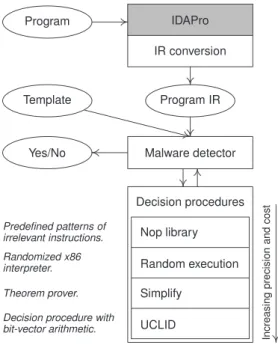
The tool is built on top of the IDA Pro disassem-bler [13]. Figure 2 illustrates the flow through the tool,
Program IDAPro
IR conversion
Template Program IR
Yes/No Malware detector
Decision procedures Nop library Random execution Simplify UCLID Predefined patterns of irrelevant instructions. Randomized x86 interpreter. Theorem prover. Decision procedure with bit-vector arithmetic. In c re a s in g p re c is io n a n d c o s t
Figure 2. The architecture of the
mali-cious code detector. Gray boxes repre-sent existing infrastructure.
starting with the input binary program on the left and ending with an output indicating whether the program satisfies the template.
We first disassemble the binary program, construct control flow graphs, one per program function (as iden-tified by IDA Pro), and produce an intermediate rep-resentation (IR). The IR is generated using a library of x86 instruction transformers, in such a way that the IR is architecture-independent. The IR can still con-tain library and system calls that are, by definition, platform-specific – we remove this last dependency by using summary functions expressed in IR form (see Ap-pendix B for a description of the IR).
The rest of the toolkit takes advantage of the plat-form- and architecture-independent IR. We have ini-tially focused our research on the Microsoft Windows on Intel IA-32 platform, with no loss of generality. By providing appropriate front-ends that translate the pro-gram into the IR format, one can use our malware-detector tool to process programs for different plat-forms.
3.2. Algorithm description
Our malware detection algorithm AMD works by
finding, for each template node, a matching node in the program. Individual nodes from the template and the program match if there exists an assignment to vari-ables from the template node expression that unifies it with the program node expression. Once two matching
nodes are found, we check whether the def-use relation-ships true between template nodes also hold true in the corresponding program (two nodes are related by a def-use relationship if one node’s definition of a variable reaches the other node’s use of the same variable). If all the nodes in the template have matching counterparts under these conditions, the algorithm has found a pro-gram fragment that satisfies the template and produces a proof of this relationship.
Formally, given a malicious code templateT and a programP, we define the malware detection algorithm
AMDas a predicate on pairs of programs and templates, AMD : Programs×Templates → {yes,⊥}, such that AMD(P, T) returns “yes” when program P satisfies templateTunder the conditions below. We denote by⊥
(i.e. “don’t know”) the return value from the algorithm when it cannot determine that the program satisfies the template.
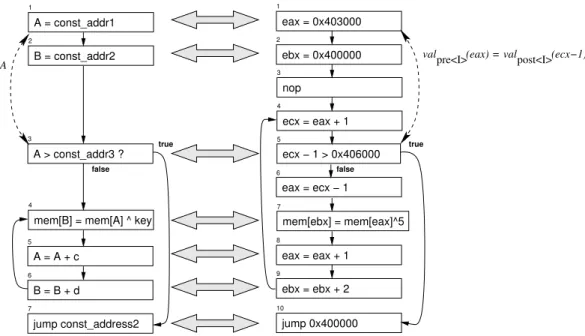
Consider the example in Figure 3, where a simpler version of the templateT from Figure 1(a) uses expres-sion X≥const addr3instead of the symbolic constant condition(X)andXˆ5(where symbol ‘ˆ’ represents the bit-vector xor operator) instead of f(X). Similarly, the programP in Figure 3 is a simpler version of the mal-ware instance from Figure 1(b). ForP to satisfyT in algorithmAMD, i.e.,AMD(P, T) =yes, the following
two conditions have to hold:
• Matching of template nodes to program nodes. First, each nodenin the template has to unify with a nodeminP. In other words, there is an onto partial functionf from the nodes ofP to nodes inT, such thatf(m)inTandminPare unifiable. We will de-note byB(X, n, m), wheren = f(m), the binding of variableX referred to in the template instruction at nodento an expression referred to in the program instruction at nodem. In Figure 3, the gray arrows connect unified template nodes and program nodes: for instance, program node7 unifies with template node4.
• Preservation of def-use paths. For each nodenin
T, definedef(n) as the set of variables defined in
n. Similarly,use(n)is the set of variables used in noden. In Figure 3, template node3uses variableA, use(3) = {A}, while template node6 both defines and uses variableB,def(6) =use(6) = {B}. De-fine synthetic nodesnpre as predecessor to the
tem-plate entry node andnpostas successor to all template
exit nodes, such thatdef(npre) =use(npost) =VT. A def-use pathis a sequence of nodeshn1, ..., nki such that the following conditions are true:
– For1 ≤i < k, there is an edge fromnitoni+1
inT, i.e.,hn1,· · ·, nkiis a valid path through the templateT.
– The instructionI(n1)(at noden1) defines a
vari-able thatI(nk)uses, that is,def(n1)∩use(nk)6=
∅.
– None of the instructions at the intermediate nodes redefine the value of the variables indef(n1), i.e.,
def(n1)∩def(ni) =∅for1< i < k.
Two nodesn1andn2aredef-use related(denoted by
duse(n1, n2)) iff there exists a path from n1 ton2
that is a def-use path. In Figure 3, template nodes
1 and3are def-use related, with the corresponding def-use pathh1,2,3i.
Consider two nodes nandn′ inT that are def-use related. Let nodes n and n′ in T be matched to nodes m and m′ in program P, i.e. f(m) = n
andf(m′) = n′. Suppose X is a variable that is defined in n and used in n′, andB(X, n, m) = r
andB(X, n′, m′) = r′, i.e., X is bound to expres-sion rprogram in nodem andr′ in program node
m′. In this case, we need to make sure that the value of expressionrafter executing the instruction
I(m) is same as the value of expressionr′ before executing the instruction I(m′), for every program path corresponding (under the matching functionf) to a template path from nton′. In Figure 3, pro-gram nodes 1 and 5 match template nodes 1 and
3, with respective bindingsB(A,1,1) = eax and
B(A,3,5) = (ecx −1). The condition we need to enforce is that the value ofeaxafter program instruc-tionI(1)is same as the value of(ecx−1)before pro-gram instructionI(5). In our algorithm, these value invariants are checked using a decision procedure. AlgorithmAMDimplements a conservative
approxima-tion of the formal semantics of malware detecapproxima-tion from Section 2.1, as the following result demonstrates. Theorem 2 AMD is sound with respect to theTMP se-mantics, i.e.AMD(P, T) =yes implies thatP |=T.
The proof is given in Appendix A. Our algorithm is thus sound with respect to theTMPsemantics, but it is not complete. We can show there exists a programP, and a templateT, such thatP |=T, butAMD(P, T)returns
⊥. Consider the following example (in C-like syntax) where the template captures the behavior of initializing an array of 10 elements to 0. TemplateT ProgramP f o r( i = 0 ; i<10; i ++) a [ i ] = 0 ; f o r( i = 0 ; i<10; i +=2) a [ i ] = 0 ; f o r( i = 1 ; i<10; i +=2) a [ i ] = 0 ;
Both the program and the template initialize one array of 10 elements: the sets of affected memory locations are the same in the final states of the template and the program, thusP |= T. Our algorithmAMD will not
2 ebx = 0x400000 1 eax = 0x403000 3 nop 4 ecx = eax + 1 6 eax = ecx − 1 8 eax = eax + 1 9 ebx = ebx + 2 5 ecx − 1 > 0x406000 10 jump 0x400000 7 mem[ebx] = mem[eax]^5 true false 2 B = const_addr2 1 A = const_addr1 5 A = A + c 6 B = B + d 7 jump const_address2 3 A > const_addr3 ? 4
mem[B] = mem[A] ^ key false
true
valpre<I>(eax) = valpost<I>(ecx−1) A
Figure 3. Example of program (on the right) satisfying a template (on the left) according to
our algorithmAMD. Gray arrows connect program nodes to their template counterparts. The
dashed arrow on the left marks one of the def-use relations thatdoes hold truein the template,
while the corresponding dashed arrow on the right marks the def-use relation thatmust hold true
in the program.
match the program with the template as the ordering of memory updates in the template loop is different from that in the program loops.
Local unification. The unification step addresses the first condition of algorithmAMD, by producing an
assignment to variables in an instruction at a template node such that it matches a program node instruction (if such an assignment exists). Since a program node ex-pression contains only ground terms, the algorithm uses one-way matching that instantiates template variables with program expressions. In Figure 3, template node
3matches program node5, with the binding{A←ecx
- 1, const addr3←0x406000 }. In the prototype we implemented, a template can contain expressions with variables, symbolic constants, predefined functions (see the operators in Appendix B), and external function calls. The matching algorithm takes these restrictions into account:
• A variable in the template can be unified with any program expression, except for assignment expres-sions.
• A symbolic constant in the template can only be uni-fied with a program constant.
• The predefined functionmemory:F(1)(traditionally written in array notation memory[. . .]) can only be unified with the program functionmemory:F(1).
• A predefined operator in the template can only be unified with the same operator in the program.
• An external function call in the template can only be unified with the same external function call in the program.
Standard unification rules apply in all other cases: for example, an operator expression in the template unifies with an expression in the program if the program oper-ator is the same as the template operoper-ator and the cor-responding operator arguments unify. Template node1
(A = const addr1) can unify with program nodes1
(eax = 0x403000) or2(ebx = 0x400000) but not with program nodes8 or9, since template node1 ex-pression has a symbolic constant as the right-hand side. The result of the local unification step is a binding relating template variables to program expressions. The binding for the example in Figure 3 is shown in Table 1. Note that the bindings are different at various program points (at program node1, template variableAis bound toeax, while at program node5, template variableAis bound to (ecx - 1)). Requiring bindings to be consis-tent (monomorphic) seems like an intuitive approach, but leads to an overly restrictive semantics – any obfus-cation attack that reassigns registers in a program frag-ment would evade detection. We want to check pro-gram expressions bound to the same template variable (e.g. eaxand(ecx - 1)are both bound toA) and verify
they change value in the same way the template vari-able changes values. We employ a mechanism based on def-use chains and value preservation to answer this problem.
Unified nodes Bindings
T1 P1 A←eax const addr1←0x403000 T2 P2 B←ebx const addr2←0x400000 T3 P5 A←ecx - 1 const addr3←0x406000 T4 P7 AB←←eaxebx T5 P8 A←eax increment1←1 T6 P9 B←ebx increment2←2 T7 P10 const addr2←0x400000
Table 1. Bindings generated from the uni-fication of template and program nodes in
Figure 3. Notation Tnrefers to nodenof
the template, and Pmrefers to nodemof
the program.
Value preservation on def-use chains. The sec-ond csec-ondition of algorithmAMDrequires template
vari-ables and the corresponding program expressions to have similar update patterns (although not necessarily the same values). For each def-use chain in the tem-plate, the algorithm checks whether the value of the pro-gram expression corresponding to the template-variable use is the same as the value of the program expression corresponding to the template-variable definition. Con-sider Figure 3, where template nodes1 and3are def-use related. Program nodes1 and5 map to template nodes1and3, respectively. Denote byRthe program fragment between nodes1and5, such thatRcontains only program paths from program node1to node5that correspond to template paths between template nodes1
and3(i.e., any path inRhas nodes that either map to template paths between1and3, or have no correspond-ing template node). A def-use chain for template vari-ableAconnects template node1with template node3: in the program, the expressions corresponding to tem-plate variableAafter program node1and before pro-gram node5must be equal in value, across all paths in
R. This condition can be expressed in terms of value predicates: for each pathIin program fragmentR(e.g.
I=hP2,P3,P4i),valprehIi(eax) =valposthIi(ecx−1), wherevalprehIi represents the variable-valuation func-tion for the program state before pathI andvalposthIi is the variable-valuation function for the program state after pathI. We can formulate this query about pre-serving def-use chains as a value preservation
prob-lem: given the program fragmentR, we want to check whether it maintains the value predicate φ ≡ ∀I ∈ R . valprehIi(eax) =valposthIi(ecx−1)
.
The algorithm uses decision procedures to determine whether a value predicate holds. We discuss these de-cision procedures in Section 3.3; for now, we treat the decision procedures as oracles that can answer queries of the form “Does a program fragmentR maintain an invariantφ?” For each match considered between a pro-gram node and a template node, the algorithm checks whether the def-use chain is preserved for each program expression corresponding to a template variable used at the matched node (see Appendix C for a listing of all the def-use chains checked for the example shown in Figure 3). This approach eliminates a large number of matches that cannot lead to a correct template assign-ment.
3.3. Using decision procedures to check
value-preservation
A value-preservation oracle is a decision procedure that determines whether a given program fragment is a semantic nop with respect to certain program vari-ables. Formally, given a program fragmentP and pro-gram expressionse1,e2, a decision procedureD
deter-mines whether the value predicateφ(P, e1, e2)≡ ∀I∈
P .valprehIi(e1) =valposthIi(e2)holds.
D(P, e1, e2) =
true ifPis a semantic nop, i.e.φ(P, e1, e2)holds
⊥ otherwise
Similarly, we can define decision procedures that de-termine whether ¬φ(P, e1, e2)holds (in this case, the
result ofD(P, e1, e2) is “false” or⊥). We denote by D+
a decision procedure forφ(P, e1, e2), and byD−a
decision procedure for¬φ(P, e1, e2).
As the value preservation queries are frequent in our algorithm (possibly at every step during node match-ing), the prototype use a collections of decision proce-dures ordered by their precision and cost. Intuitively, the most na¨ıve decision procedures are the least precise, but the fastest to execute. If aD+
-style decision proce-dure reports “true” on some input, all D+
-style deci-sion procedures following it in the ordered collection will also report “true” on the same input. Similarly, if a
D−-style decision procedure reports “false on some in-put, allD−-style decision procedures following it in the
ordered collection will also report “false” on the same input. As bothD+
- andD−-style decision procedures
are sound, we define the order betweenD+
andD−
de-cision procedures based only on performance.
This collection of decision procedures provides us with an efficient algorithm for testing whether a pro-gram fragment P preserves expression values: iterate
through the ordered collection of decision procedures, querying eachDi, and stop when one of them returns “true”, respectively “false” forD−-style decision pro-cedures. This algorithm provides for incrementally ex-pensive and powerful checking of the program frag-ment, in step with its complexity: program fragments that are simple semantic nops will be detected early by decision procedures in the ordered collection. Complex value preserving fragments will require passes through multiple decision procedures. We present, in order, four decision procedures that are part of our prototype.
Nop LibraryD+
NOP. This decision procedure iden-tifies sequences of actualnopinstructions, which are processor-specific instructions similar to theskip state-ment in some high-level programming languages, as well as predefined instruction sequences known to be semantic nops. Based on simple pattern matching, the decision procedure annotates basic blocks as nop se-quences where applicable. If the whole program frag-ment under analysis is annotated, then it is a semantic nop. The nop library can also act as a cache for queries already resolved by other decision procedures.
Randomized Symbolic ExecutionD−
RE. This ora-cle is based on aD−-style decision procedure using ran-domized execution. The program fragment is executed using a random initial state (i.e. the values in registers and memory are chosen to be random). At completion time, we check whether it is true that¬φ(P, e1, e2): if
true, at least one path in the program fragment is not a semantic nop, and thus the whole program fragment is not a semantic nop.
Theorem Proving D+
ThSimplify. The value
preser-vation problem can be formulated as a theorem to be proved, given that the program fragment has no loops. We use the Simplify theorem prover [14] to implement this oracle: the program fragment is represented as a state transformer δ, using each program register and memory expression converted to SSA form. We then use Simplify to prove the formulaδ⇒φ(P, e1, e2), in
order to show that all paths through the program frag-ment are semantic nops underφ(P, e1, e2). If Simplify
confirms that the formula is valid, the program fragment is a semantic nop. One limitation of the Simplify the-orem prover is the lack of bit-vector arithmetic, which binary programs are based on. Thus, we can query Sim-plify only on programs that do not use bit-vector opera-tions.
Theorem Proving D+ThUCLID. A second theorem proving oracle is based on the UCLID infinite-state bounded model checker [22]. For our purposes, the logic supported by UCLID is a superset of that sup-ported by Simplify. In particular, UCLID precisely models integer and bit-vector arithmetic. We model the program fragment instructions as state transformers for each register and for memory (represented as an unin-terpreted function). UCLID then simulates the program
Obfuscation transformation Handled byAMD?
Instruction reordering ✓
Register renaming ✓
Garbage insertion ✓
Instruction replacement limited
Equivalent functionality ✗
Reordered memory accesses ✗
Table 3. Obfuscation transformations ad-dressed by our malware detection algo-rithm and some limitations.
fragment for a given number of steps and determines whetherφ(P, e1, e2)holds at the end of the simulation.
For illustration, consider Figure 3: the value preser-vation problem consists of the program fragmentR, cre-ated from program nodes2,3, and4, and the value pred-icateφ≡ ∀I∈R .valprehIi(eax) =valposthIi(ecx−1). To use the Simplify theorem proving oracle, the formula shown in Table 2 is generated from program fragment
R.
3.4. Strengths and limitations
For the algorithm to be effective against real-life at-tacks, it has to “undo” various obfuscations and other program transformations that a malware writer might use. We list the strengths and weaknesses of our algo-rithm in Table 3. We discuss below in detail four classes of obfuscations algorithm AMD can handle: code
re-ordering, equivalent instruction replacement, register renaming, and garbage insertion.
Code reorderingis one of the simplest obfuscations hackers use to evade signature matching. The obfus-cation changes the order of instructions on disk, in the binary image, while maintaining the execution order us-ing jump instructions. This obfuscation is handled by the use of control flow graphs. Register renamingis a simple obfuscation that reassigns registers in selected program fragments. As a result, a signature matching tool will fail to detect any obfuscated variant as long as it searches for a signature with a specific register. Our template matching algorithm avoids this pitfall by us-ing templates. The uninterpreted variables are assigned corresponding program registers and memory locations only during unification and, thus, the matching algo-rithm can identify any program with the same behavior as the template, irrespective of the register allocation.
Garbage insertionobfuscates a program by inserting instruction sequences that do not change the behavior of the program. AlgorithmAMD tackles this class of
obfuscations through the use of decision procedures to reason about value predicates on def-use chains. Equiv-alent instruction replacementuses the rich instruction set available on some architectures, notably on the Intel
Instruction sequence: 2:ebx = 0x400000 3:nop 4:ecx = eax + 1 Value predicate: ∀I∈R .valpreh
Ii(eax) =valposthIi(ecx−1)
Simplify formula:
(IMPLIES (AND (EQ ebx 1 4194304) (EQ ecx 4 ( + e a x p r e 1 ) ) (EQ e c x p o s t ecx 4 ) )
(EQ e a x p r e (− e c x p o s t 1 ) ) )
Table 2. Example of Simplify query corresponding to program fragmentRand value predicate
φ.
IA-32 (x86), to replace groups of consecutive instruc-tions with other short instruction sequences that have the same semantics. For example, to add 1 to register
Xin the x86 architecture, one can use theinc X (in-crement) instruction, or theadd X, 1instruction, or thesub X, -1instruction. We handle a limited kind of instruction replacement by normalizing the code into an intermediate representation (IR) with semantically-disjoint operations.
Limitations. Our tool has few limitations. First, the current implementation requires all of the IR in-structions in the template to appear in the same form in the program. For example, if an IR node in the tem-plate contains “x = x * 2”, the same operation (an assignment with a multiplication on the right hand side) has to appear in the program for that node to match. This means that we will not match the equivalent pro-gram instruction “eax = eax << 1” (arithmetic left shift). Attacks against this requirement are still possi-ble, but are fairly hard, as the bar has been raised: the attacker has to devise multiple equivalent, yet distinct, implementations of the same computation, to evade de-tection. This is not an inherent limitation of the seman-tics, and can be handled using an IR normalization step. The second limitation comes from the use of def-use chains for value preservation checking. The def-use re-lations in the malicious template effectively encode a specific ordering of memory updates – thus, our algo-rithmAMD will detect only those program that exhibit
the same ordering of memory updates. We note that au-tomatically generating functionally-equivalent variants is a hard problem. Handling obfuscations that reorder instructions to achieve a different ordering of memory updates is one goal of our ongoing research.
4. Experimental results
We evaluated our implementation of algorithmAMD
against real-world malware variants. The three major goals of our experiments were to develop malicious be-havior templates that can match malware variants, to measure the false positive rates the algorithm generates with these templates, and to measure the detection
al-gorithm’s resilience to obfuscation. We used malware instances in the wild both for developing behavior tem-plates and as starting point for obfuscation transforma-tions in the obfuscation resilience testing. Highlights of the evaluation are:
• The template-based algorithm detects worms from the same family, as well as unrelated worms, using a single template.
• No false positiveswere generated when running our malware detector on benign programs, illustrating the soundness of our algorithm in its current implemen-tation.
• The algorithm exhibitsimproved resilience to obfus-cationwhen compared to commercial anti-virus tool McAfee VirusScan.
4.1. Variant detection evaluation
We developed two templates and tested malware samples and benign programs against them. One tem-plate captures the decryption-loop functionality com-mon in many malicious programs, while the other tem-plate captures the mass-mailing functionality common to email worms. While throughout this section we use only the decryption-loop template as example, the re-sults from using the mass email template were similar. For malware samples we used seven variants of Netsky (B, C, D, O, P, T, and W), seven variants of B[e]agle (I, J, N, O, P, R, and Y), and seven variants of Sober (A, C, D, E, F, G, and I). All of them are email worms, each with many variants in the wild, ranging in size from 12 kB to 75 kB.
Malware Template detection Running time family Decryp-tion loop
Mass-mailer Avg. Std. dev.
Netsky 100% 100% 99.57 s 41.01 s
B[e]agle 100% 100% 56.41 s 40.72 s
Sober 100% 0% 100.12 s 45.00 s
Table 4. Malware detection using
The decryption-loop template describes the behav-ior of programs that unpack or decrypt themselves to memory: the template consists of (1) a loop that pro-cesses data from a source memory area and writes data to a destination memory area, and (2) a jump that targets the destination area. Many binary worms use this tech-nique to make static analysis harder: the actual code of the worm is not available for inspection until runtime. To construct the template, we analyzed the Netsky.B email worm and manually extracted the code that per-forms the decryption and the jump. The template was then generalized from this code by replacing actual reg-isters and memory addresses with variables. The mass-mailing template was developed in a similar manner: it describes the custom SMTP functionality present in the worm, including email composition and transmission.
We applied our algorithm on each malware instance and each decryption-loop template. We achieved100%
detection of the Netsky and B[e]agle worm instances using only the two templates (the mass-mailing tem-plate required minor tweaks to detect B[e]agle). The Sober worm instances did not match the mass-mailing template, requiring a separate template. Due to limita-tions in the current prototype implementation, match-ing calls into the Microsoft Visual Basic runtime li-brary (used by Sober worm instances) is not supported. Nonetheless, we have shown that algorithmAMD can
detect multiple worm instances from the same family using one template, in contrast with commercial virus scanners that require many signatures (McAfee VirusS-can uses 13 signatures to detect the worms in our test set). Our detection results come with one caveat: 3 of the Netsky variants could not be processed by IDA Pro. Since we build our tool on the assumption that disas-sembly can be performed successfully, we do not con-sider those 3 variants as false negatives. Running times for the tool (listed in Table 4) are satisfactory for a pro-totype and suggest that real-time performance can be achieved with an optimized implementation.
4.2. False positive evaluation
We evaluated the algorithm and the templates against a set of benign programs, in order to measure the false positive rate and to evaluate the templates we devel-oped. We used a set of 2,000 programs with sizes between<1 kB and 150 kB, from standard Microsoft Windows system programs, to compiler tools, to Mi-crosoft Office programs. We have also tried to test larger benign binaries, with sizes up to 5 MB, but they did not disassemble successfully. For successfully dis-assembled programs, the false positive rate was 0%, meaning that our implementationAMD correctly
clas-sified all programs as benign (none of the test programs matched the templates).
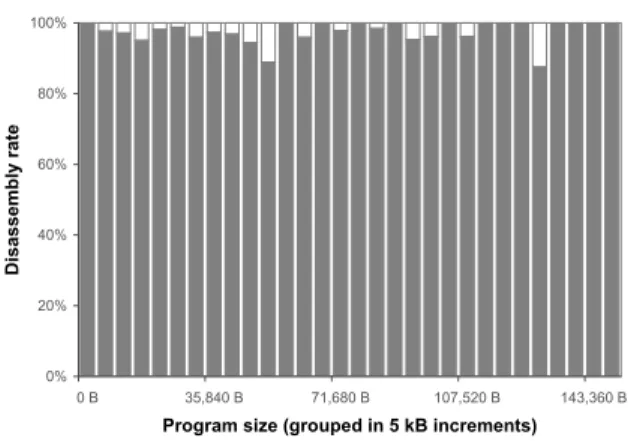
In Figure 4, we present the results of this
evalua-tion: programs are grouped by size, in 5 kB increments, and the disassembly and detection rates are plotted for each group. For example, the bar to the right of the 71,680 B point represents programs between 71,680 B and 76,799 B in size, and indicates that 97.78% of the programs in this group were disassembled successfully and were detected as benign, while 2.22% failed to dis-assemble (either because the disdis-assembler crashed, or because it failed to group program code into functions). The running time per test case ranged from 9.12 s to 413.78 s, with an average of 165.5 s.
False Positive Evaluation of 2,000 Binaries
0% 20% 40% 60% 80% 100% 0 B 35,840 B 71,680 B 107,520 B 143,360 B
Program size (grouped in 5 kB increments)
D is a s s e m b ly r a te
Figure 4. Evaluation of algorithmAMD on
a set of 2,000 benign Windows programs yielded no false positives. Gray bars indi-cate the percentage of programs that dis-assembled correctly and were detected as benign; white bars indicate the percent-age of programs that failed to disassem-ble.
4.3. Obfuscation resilience evaluation
To test resilience to obfuscation, we applied garbage insertion transformations of varying degrees of com-plexity to worm variant B[e]agle.Y, and compared the detection rate of our malware detection tool against McAfee VirusScan. The garbage insertion transforma-tion adds code fragments to a program, such that each code fragment is irrelevant in its insertion context. We considered three types of garbage insertion: (1)nop in-sertion adds simple sequences ofnopinstructions; (2) stack-op insertion adds sequences of stack operations; and (3)math-op insertionadds sequences of arithmetic operations. We generated 20 variants for each type of obfuscation. To test the limits of our implementation, one of the math-op insertiontransformations actually replaced single instructions of the form x = x + const with equivalent sequences. The results are tabulated in Table 5: our tool catches all obfuscations with the
ex-ception of the math-op replacement transformation; in such a case, since the algorithm seeks to exactly match a template instruction of the form x = x + const, any equivalent instruction sequences are not detected.
Obfuscation type AlgorithmAMD McAfee VirusScan Average time Detection rate Nop 74.81 s 100% 75.0% Stack op 159.10 s 100% 25.0% Math op 186.50 s 95% 5.0%
Table 5. Evaluation of algorithm AMD on
a set of obfuscated variants of B[e]agle.Y. For comparison, we include the detection rate of McAfee VirusScan.
5. Related work
We compare our work to existing research in the areas of malware detection, translation validation, and software verification.
5.1. Malware detection
In previous work [8], we demonstrated that cur-rent commercial virus scanners can be easily evaded by using simple obfuscations used by hackers. Many malware-detection techniques are based on static-analysis of executables. In this area, we previously de-scribed a malware-detection algorithm called SAFE [7]. SAFE can only handle very simple obfuscations (only nops can appear between matching instructions), e.g., the example shown in Figure 1 cannot be handled by SAFE. Moreover, the formal semantics of malware de-tection was not explored by the earlier work. Static analysis of binaries is used by Kruegel et al. [21] to detect kernel-level rootkits, which are attack tools that are used by hackers to hide their presence from system administrators. They look for suspicious instruction se-quences using symbolic execution. The detection algo-rithm presented in this paper is more powerful because we use multiple decision procedures (symbolic execu-tion being just one of them). Our specificaexecu-tion of ma-licious behavior is richer than the one used by Kruegel et al. Therefore, using our algorithm can result in a more powerful tool for detecting kernel-level rootkits. We will explore this interesting application of our algo-rithm in the future. Singh and Lakhotia [33] provide an annotated bibliography of papers on malware analysis and detection.
An essential step in statically analyzing executables is disassembly, which translates machine code to as-sembly code. Linn and Debray [23] demonstrate that
simple obfuscations can thwart the disassembly pro-cess. The abovementioned research demonstrates the importance of handling obfuscations in malware detec-tion. Kruegelet al. [20] present techniques for dissembling obfuscated executables. In this paper, we as-sume that the malware being analyzed can be disassem-bled.
The theoretical limits of malicious code detection (specifically of virus detection) have been the focus of many researchers. A virus is a malware that replicates itself by copying its code to other program files. Co-hen [10] and Chess-White [6] showed that in general the problem of virus detection is undecidable. Spinel-lis [34] proved that problem of reliably identifying a bounded-length virus is NP-complete. These results are similar to the result presented in this paper (see Theo-rem 1). However, our formal model of malware detec-tion is different than the one used by these researchers: we present a semantics and an algorithm for detecting specific malicious behaviors, avoiding the problem of undecidability (as proven by Cohen) and the problem of undetectable malware classes (as introduced by Chess and White).
Dynamic monitoring can also be used for malware detection. Cohen [10] and Chess-White [6] propose a virus detection model that executes code in a sand-box. Another approach rewrites the binary to introduce checks driven by an enforceable security policy [15] (known as theinline reference monitoror theIRM ap-proach). We believe static analysis can be used to im-prove the efficiency of dynamic analysis techniques, e.g., static analysis can remove redundant checks in the IRM framework. In the future we will explore hybrid static-dynamic approaches to malware detection.
5.2. Translation validation
A translation-validation [12, 16, 31, 32] system at-tempts to verify that the semantics of a program is not changed by an optimizing transformation. Differences between malware detection and translation validation were discussed in the introduction.
5.3. Software verification
Our work is closely related to previous results on static analysis techniques for verifying security proper-ties of software [1, 3–5, 19, 24]. In a larger context, our work is similar to existing research on software verifica-tion [2,11]. However, there are several important differ-ences. First, since these systems analyze benign code, they do not have to handle obfuscations. Second, to our knowledge, all existing work on static analysis tech-niques for verifying security properties analyzes source code. On the other hand, our analysis technique works on executables.
6. Conclusion
We observe that certain malicious behaviors (such as decryption loops) appear in all variants of a certain malware. Based on this intuition, we gave a formal semantics for malware detection. We also presented a malware-detection algorithm that is sound with respect to our semantics. Experimental evaluation demon-strated that our algorithm can detect all variants of cer-tain malware, has no false positives, and is resilient to obfuscation transformations generally used by hackers. There are several opportunities for further work. In the future we will address the limitations discussed in Section 3 (see Table 3). We also plan to optimize our tool to reduce the execution times.
Acknowledgments. We are thankful to our anony-mous reviewers for their invaluable comments. We would also like to express our gratitude to Giovanni Vi-gna, our shepherd throughout the revision process, for his feedback.
References
[1] K. Ashcraft and D. Engler. Using programmer-written compiler extensions to catch security holes. In Proceed-ings of the 2002 IEEE Symposium on Security and Pri-vacy (Oakland’02), pages 143–159, May 2002. [2] T. Ball and S. Rajamani. Automatically validating
tem-poral safety properties of interfaces. InProceedings of the 8th International SPIN Workshop on Model Check-ing of Software (SPIN’01), volume 2057 of Lecture Notes in Computer Science, pages 103–122, Toronto, Ontario, Canada, 2001. Springer-Verlag Heidelberg. [3] M. Bishop and M. Dilger. Checking for race conditions
in file accesses.Computing Systems, 9(2), 1996. [4] H. Chen and D. Wagner. MOPS: an infrastructure for
examining security properties of software. In9th ACM Conference on Computer and Communications Security (CCS’02). ACM Press, November 2002.
[5] B. Chess. Improving computer security using extending static checking. InProceedings of the 2002 IEEE Sym-posium on Security and Privacy (Oakland’02), pages 160–173, May 2002.
[6] D. Chess and S. White. An undetectable computer virus. InProceedings of the 2000 Virus Bulletin Conference (VB2000), 2000.
[7] M. Christodorescu and S. Jha. Static analysis of exe-cutables to detect malicious patterns. InProceedings of the 12th USENIX Security Symposium (Security’03), pages 169–186. USENIX Association, USENIX Asso-ciation, Aug. 2003.
[8] M. Christodorescu and S. Jha. Testing malware de-tectors. In Proceedings of the ACM SIGSOFT Inter-national Symposium on Software Testing and Analysis 2004 (ISSTA’04), pages 34–44, Boston, MA, USA, July 2004. ACM Press.
[9] M. Ciubotariu. Netsky: a conflict starter? Virus Bul-letin, pages 4–8, May 2004.
[10] F. Cohen. Computer viruses: Theory and experiments.
Computers and Security, 6:22–35, 1987.
[11] J. Corbett, M. Dwyer, J. Hatcliff, C. Pasareanu, Robby, S. Laubach, and H. Zheng. Bandera: Extracting finite-state models from Java source code. InProceedings of the 22nd International Conference on Software Engi-neering (ICSE’00), pages 439–448. ACM Press, 2000. [12] D. W. Currie, A. J. Hu, and S. Rajan. Automatic formal
verification of DSP software. InProceedings of the 37th Annual ACM IEEE Conference on Design Automation (DAC’00), pages 130–135. ACM Press, 2000.
[13] DataRescue sa/nv. IDA Pro – interactive disassembler. Published online at http://www.datarescue. com/idabase/. Last accessed on 3 Feb. 2003. [14] D. Detlefs, G. Nelson, and J. Saxe. The Simplify
theo-rem prover. Published online athttp://research. compaq.com/SRC/esc/Simplify.html. Last accessed on 10 Nov. 2004.
[15] U. Erlingsson and F. B. Schneider. IRM enforce-ment of Java stack inspection. InProceedings of the 2000 IEEE Symposium on Security and Privacy (Oak-land’00), pages 246–255, May 2000.
[16] X. Feng and A. J. Hu. Automatic formal verification for scheduled VLIW code. InProceedings of the Joint Conference on Languages, Compilers and Tools for Em-bedded Systems & Software and Compilers for Embed-ded Systems (LCTES/SCOPES’02), pages 85–92. ACM Press, 2002.
[17] J. Gordon. Lessons from virus developers: The Beagle worm history through April 24, 2004. InSecurityFocus Guest Feature Forum. SecurityFocus, May 2004. Pub-lished online at http://www.securityfocus. com/guest/24228. Last accessed: 9 Sep. 2004. [18] L. A. Gordon, M. P. Loeb, W. Lucyshyn, and
R. Richardson. 2004 CSI/FBI computer crime and se-curity survey. Technical report, Computer Sese-curity In-stitute, 2004.
[19] T. Jensen, D. M´etayer, and T. Thorn. Verification of control flow based security properties. InProceedings of the 1999 IEEE Symposium on Security and Privacy (Oakland’99), May 1999.
[20] C. Kruegel, W. Robertson, F. Valeur, and G. Vigna. Static disassembly of obfuscated binaries. In Proceed-ings of the 13th USENIX Security Symposium (Secu-rity’04), San Diego, CA, Aug. 2004.
[21] C. Kruegel, W. Robertson, and G. Vigna. Detecting kernel-level rootkits through binary analysis. In Pro-ceedings of the 20th Annual Computer Security Ap-plications Conference (ACSAC’04), Tucson, AZ, Dec. 2004.
[22] S. K. Lahiri and S. A. Seshia. The UCLID decision pro-cedure. In R. Alur and D. A. Peled, editors, Proceed-ings of the 16th International Conference on Computer Aided Verification (CAV’04), volume 3114 ofLecture Notes in Computer Science, pages 475–478, Boston, MA, USA, July 2004. Springer-Verlag Heidelberg. [23] C. Linn and S. Debray. Obfuscation of executable code
to improve resistance to static disassembly. In Pro-ceedings of the 10th ACM Conference on Computer and Communications Security (CCS’03), Oct. 2003. [24] R. Lo, K. Levitt, and R. Olsson. MCF: A malicious code
[25] LURHQ Threat Intelligence Group. Sobig.a and the spam you received today. Technical report, LURHQ, 2003. Published online at http://www.lurhq. com/sobig.html. Last accessed on 16 Jan. 2004. [26] LURHQ Threat Intelligence Group. Sobig.e -
Evo-lution of the worm. Technical report, LURHQ, 2003. Published online at http://www.lurhq. com/sobig-e.html. Last accessed on 16 Jan. 2004. [27] LURHQ Threat Intelligence Group. Sobig.f examined. Technical report, LURHQ, 2003. Published online at http://www.lurhq.com/sobig-f.html. Last accessed on 16 Jan. 2004.
[28] A. Marinescu. Russian doll.Virus Bulletin, pages 7–9, Aug. 2003.
[29] G. McGraw and G. Morrisett. Attacking malicious code: report to the Infosec research council.IEEE Soft-ware, 17(5):33 – 41, Sept./Oct. 2000.
[30] C. Nachenberg. Computer virus-antivirus coevolution.
Communications of the ACM, 40(1):46–51, Jan. 1997. [31] G. C. Necula. Translation validation for an
optimiz-ing compiler. In Proceedings of the ACM SIGPLAN 2000 Conference on Programming Language Design and Implementation (PLDI’00), pages 83–94. ACM Press, June 2000.
[32] A. Pnueli, M. Siegel, and E. Singerman. Translation validation. In Proceedings of the 4th International Conference on Tools and Algorithms for Construction and Analysis of Systems (TACAS’98), volume 1384 of
Lecture Notes in Computer Science, pages 151–166. Springer-Verlag Heidelberg, Mar. 1998.
[33] P. Singh and A. Lakhotia. Analysis and detection of computer viruses and worms: An annotated bibliogra-phy. ACM SIGPLAN Notices, 37(2):29–35, Feb. 2002. [34] D. Spinellis. Reliable identification of bounded-length
viruses is NP-complete. IEEE Transactions on Infor-mation Theory, 49(1):280–284, Jan. 2003.
[35] P. Sz¨or and P. Ferrie. Hunting for metamorphic. In
Proceedings of the 2001 Virus Bulletin Conference (VB2001), pages 123 – 144, Sept. 2001.
[36] z0mbie. z0mbie’s homepage. Published online at http://z0mbie.host.sk. Last accessed: 16 Jan. 2004.
A. Proof of Theorem 2
Let P be a program and T a template such that
AM D(P, T)returnsyes. Letf be a function from the set of nodes of P to nodes in T that satisfy the two conditions given in section 3 (such a function exists be-cause theAM D(P, T)returnedyes). We will prove that
P |=T.
There are two set of states - one for the program (which we simply refer to as state) and other for the template (which we refer to as template state). Re-call that a state sof program is a3-tuple comprising of an assignment val(s) of values to registers, value
pc(s) for the program counter, and the memory con-tentsmem(s). Consider a nodenin the templateTand a nodeminP such thatf(m) = n. Letsbe a state
such thatpc(s) = m(in this proof we equate the pro-gram counter with the CFG node it corresponds to), and
B(·, n, m)be the binding. We define a template state corresponding tos(denoted byT(s)) as follows:
• LetB(val(s))be the assignment implied by the bind-ingB, i.e.,B(val(s))(X)is equal to the value of the expressionB(X, n, m)in the states.
• Define pc(T(s)) to be the program counter corre-sponding to noden.
• Definemem(T(s))asmem(s).
Let n0 be the initial node of the template and m0
be a node in the program such that f(m0) = n0.
Let s0 be a state such thatpc(s0) = m0, and define
sT
0 asT(s0). Recall thatI(n)denotes the instruction
corresponding to noden. Given a states,I(n)(s) de-notes the state obtained by executing instruction I(n)
from state s, ande(I(n), s) denotes the event gener-ated by executing instructionI(n)from states. Lets′
1
be equal toI(m0)(s0)ande1be equal toe(I(m0), s0).
LetsT 1 = I(n0)(s T 0)ande T 1 =e(I(n0), s T 0). Sincen0
andm0are unifiable, it is easy to see thate
T
1 =e1. Let
n1be the template node corresponding topc(s
T
1).
As-sume that in programP, from states′
1there is a feasible
pathpath(s′
1, m1)frompc(s′1)to a nodem1, such that
f(m1) = n1, i.e., executing path(s′1, m1)from state
s′
1 yields a states1, such thatpc(s1) = m1. We
de-note this fact by s0
e
1 s
1, i.e., there is an execution
sequenceαthat starts ats0and ends ats1and the first
event generated byαise1. Thus we obtain the
follow-ing execution sequences inP andT:
σ = s0 e 1 s1 σT = s T 0 eT 1 →sT 1
Recall thatuse(n1)is the set of variables used by
in-struction I(n1). For every variable X ∈ use(n1),
value of expression B(X, n1, m1) is unchanged by
path(s′
1, m1). Therefore, executing instruction I(n1)
in the template from the states T(s1) and s
T
1 =
I(n0)(s0)results in same memory accesses, generate
the same event, and transitions to the same noden2in
the template. We continue augmenting the execution sequencesσandσT until we obtain a template states
T k such that pc(sT
k)corresponds to the final node of the template. At the end, we have two execution sequences
σ = s0 e 1 s 1 e 2 s 2· · · ek sk σT = s T 0 eT 1 →sT1 eT 2 →sT2 · · · eT k →sk
whereσandσT are execution sequences in the program and the template. Moreover, for1≤i≤k,ei = eTi and template statessT
i andT(si)satisfy the following property:
• Executing instruction I(pc(si)) in the program P from the state si and instruction I(pc(s
T
i)) in the template from the stateT(si)results in same mem-ory accesses and generate the same event.
• In the template T, executing instructionI(pc(sTi)) from the statesT
i and from the stateT(si)results in same memory accesses and generate the same event. The proof of abovementioned property uses the condi-tion that def-use paths are preserved by the program. From the above two observations it is easy to see that
P |=T.
B. Intermediate representation language
The intermediate representation (IR) of a program is structured as a collection of control flow graphs (CFGs), each node in the graph corresponding to one IR instruc-tion. Edges in a CFG are unlabeled, with the exception of the outgoing edges of a conditional control flow in-struction. In such a case, the IR instruction is labeled
jump, and the outgoing edges are labeled with the cor-responding condition that holds true along that branch.
IR instructions are elements in a language with sim-ple rules, illustrated in Table 6. Each IR instruction (or IR term) is either an assignment that updates state vari-ables or a call to other functions in the same program, or to external functions (library or system routines). An IR expression uses arithmetic, bit-vector, and relational operators, as well as the special memory addressing op-erator.
term :: expr1ASSIGNexpr2
| CALLexpr expr :: expr1op expr2
| ident(expr,. . . )
| memory [expr]
| ident|number|string
op :: OR|AND|XOR|NOT|BITAND
| BITOR|BITXOR|BITNOT
| EQUAL|LESSTHAN
| GREATERTHAN|LEQ|GEQ
| BITSHIFTLEFT|BITSHIFTRIGHT
| PLUS|MINUS|STAR|DIV|MOD
Table 6. Term algebra for intermediate rep-resentation (IR) expressions.
C. Def-use paths and value predicates
We list here the complete set of value predicates and corresponding program fragments that have to be
proven as semantic nops for the program in Figure 3 to satisfy the template in the same figure. In Table 7, we list the 10 def-use chains in the template, the de-rived value predicates that relate program expressions, and the corresponding program fragments. The nota-tionn→x n′describes the variable corresponding to the def-use path, such thatdef(n)∩use(n′) ={x}.
Def-use chain and
value predicate Program fragment
T1→A T3 valposth Ii(ecx−1) =val prehIi(eax) 2:ebx = 0x400000 3:nop 4:ecx = eax + 1 T5→A T3 valposth Ii(ecx−1) =valpreh Ii(eax) 9:ebx = ebx + 1 4:ecx = eax + 1 T1→A T4 val posthIi(eax) =valpreh Ii(eax) 2:ebx = 0x400000 3:nop 4:ecx = eax + 1 6:eax = ecx - 1 T5→A T4 valposth Ii(eax) =valpreh Ii(eax) 9:ebx = ebx + 1 4:ecx = eax + 1 6:eax = ecx - 1 T2→B T4 val posthIi(ebx) =valpreh Ii(ebx) 3:nop 4:ecx = eax + 1 6:eax = ecx - 1 T6→B T4 valposth Ii(ebx) =val prehIi(ebx) 4:ecx = eax + 1 6:eax = ecx - 1 T1→A T5 valposth Ii(eax) =val prehIi(eax) 2:ebx = 0x400000 3:nop 4:ecx = eax + 1 6:eax = ecx - 1 7:mem[ebx] = mem[eax] ˆ 5 T5→A T5 valposth Ii(eax) =valpreh Ii(eax) 9:ebx = ebx + 1 4:ecx = eax + 1 6:eax = ecx - 1 7:mem[ebx] = mem[eax] ˆ 5 T2→B T6 valposth Ii(ebx) =valpreh Ii(ebx) 3:nop 4:ecx = eax + 1 6:eax = ecx - 1 7:mem[ebx] = mem[eax] ˆ 5 8:eax = eax + 1 T6→B T6 valposth Ii(ebx) =valpreh Ii(ebx) 4:ecx = eax + 1 6:eax = ecx - 1 7:mem[ebx] = mem[eax] ˆ 5 8:eax = eax + 1
Table 7. Def-use paths, value predicates, and program paths for the example in Fig-ure 3.

![Table 5. Evaluation of algorithm A MD on a set of obfuscated variants of B[e]agle.Y.](https://thumb-us.123doks.com/thumbv2/123dok_us/1061522.2641044/12.892.117.430.263.388/table-evaluation-algorithm-md-set-obfuscated-variants-agle.webp)