Centre for Educational Assessment Helsinki University, in collaboration with the National Board of Education in Finland Helsinki, Finland 2002
Assessing
Learning-to-Learn
A FRAMEWORK
Jarkko Hautamäki Pekka Arinen Sanna Eronen Airi Hautamäki Sirkku Kupiainen Bettina Lindblom Markku Niemivirta Laura Pakaslahti Pekka Rantanen Patrik Scheinin© National Board of Education ISBN 952-13-1423-0 ISBN 952-13-1424-9 (pdf) ISSN 1238-4453
Helsinki 2002
Preface
The concept of learning-to-learn has been adopted in response to the new challenges and demands presented for educational assessment by changes due to the educational reforms made in the 1990’s. According to the new legislation in Finland since 1.1.1999, the evaluation and assessment of educational outcomes form an important tool in directing education. At the preparatory stage of the educational legislation, a framework for evaluating educational outcomes was prepared and accepted by the National Board of Education. Education is understood to be effective when it succeeds in promoting the personal growth and development of individuals, and the capacity building and development of society, cul-ture and working life.
For concrete assessments, provided by the National Board of Educa-tion under the Ministry of EducaEduca-tion, the concept of effectiveness is di-vided into five aspects:
• How do the available education services, in terms of their objec-tives, correspond with the educational needs in society?
• How do the learning achievements correspond with the objectives set for these studies?
• What kind of learning-to-learn skills does the education pro-duce?
• What kind of communication skills does the education produce? • How has the education affected the students’ motivation for
Learning-to-learn is understood to be a readiness formed through good educational practices and accompanying all achievement. Learning-to-learn as an indicator in assessment is meant to provide essential infor-mation for teachers, administration, and decision makers responsible for the developing of education.
Developing tools for the assessment of learning-to-learn was under-stood to be a very demanding process. In 1995, the National Board of Education, responsible for developing methods used in assessment and evaluation, started co-operation with the University of Helsinki. Since that, a research group lead by professor Jarkko Hautamäki has been car-rying out a project “Oppimaan oppimisen arviointi” (Assessing learning to learn) under the support of the National Board of Education.
Learning-to-learn has been understood to be a key competence for lifelong learning. It has been a great pleasure to start and support the process of developing and testing tools for the assessment of learning-to-learn. I hope that the results of this effort can be used and developed further in international co-operation with teachers, researchers and other partners responsible for developing quality of education.
Summary
The concept of learning-to-learn has been adopted in response to the new challenges and demands presented for educational assessment by changes at the macro-level of work and society, and at the micro-level of work processes. It refers to the diverse cognitive and affective factors that are central to the application of existing skills to novel tasks and to new learn-ing. Learning-to-learn is formed through good educational practices and accompanies all achievement. Its inclusion as a distinct indicator in assess-ment would provide a means to analyse the relative role of the different factors affecting student achievement, and help direct schools towards practices and contents that would truly foster lifelong learning.
Learning-to-learn is defined as the competence and the willingness to adapt to novel tasks. A task is seen to activate a complex system of inter-related competencies and beliefs, leading to learning action. The adaptive and voluntary mastery of this learning action through affective and cog-nitive self-regulation forms the core of learning-to-learn.
Competence, in the definition, refers to the application of general procedures and the already known to new situations and tasks, i.e., to the exercise of thinking and reasoning, and to the knowing of relevant facts. The indicators for the cognitive competencies encompass such areas as knowledge acquisition, quantitative-relational comprehension, logical reasoning, text comprehension, and cultural knowledge. The cognitive learning-to-learn competencies are by necessity related to intelligence, but the criterion-referencing of the scales to the Piagetian formal operational schemata, that have been shown to be malleable, ties the assessment to factors that can be affected by good teaching.
Willingness refers to the perspective of hope. It comprises several motivational and attitudinal subsystems; both self-related and context-related. Central among the self-related beliefs are learning motivation, action-control beliefs, task acceptance, socio-moral commitment, school-subject-related beliefs, and various forms of self-evaluation. Among the context-related beliefs, at least the experienced support of significant oth-ers (parents, teachoth-ers and peoth-ers) in school- and other learning-related activities should be covered. The indicators also allow for the assessment of motivation for lifelong learning.
Learning-to-learn provides an easy to execute and cost-effective meas-ure for the assessment of factors that have been found relevant for lifelong learning, in the transfer of learning, in reflective theoretical learning, and in the practical constitution of new knowledge. Learning-to-learn pro-vides also a new indicator for educational evaluation, to be of use at dif-ferent administrative levels. It offers a means to monitor the comparability of school reports, and could give added value to national certificate ex-aminations. The indicator could also serve international comparisons and prospective shared achievement standards.
Combined with data on pupils’ socio-economic background, gender, etc., the different learning-to-learn indicators could provide information on more specific educational problems. Critical among these is the degree to which schools succeed in counterbalancing the role of family back-ground in educational achievement, or in overcoming gender differences in different areas of education.
The indicators for learning-to-learn have been tried in Finland in several studies, including national representative studies of 6th-graders, 9th -graders, and upper secondary school students, in 1996, 1997 and 2000, respectively. The indicators were also used in a study of Swedish upper secondary school students in 2001, offering the first comparative data to affirm the functioning of the instrument in international comparison. The multiple-choice tasks and self-report questionnaires are available in paper-and-pencil form and in e-form, requiring 180 and 90 minutes of classroom time, respectively, and both allowing for computerised processing.
Table of Contents
Introduction... 9
Assessment of education and the notion of learning-to-learn ... 9
The Finnish initiative in learning-to-learn assessment ... 11
Chapter 1 Assessing Education... 15
Education for all, with a high standard of achievement ... 15
Prospects for the production of new competencies and motivation at school ... 17
A general framework for educational assessment ... 18
Chapter 2 Learning-to-Learn: Formation and Assessment... 21
Developing a model of learning ... 21
Building a model of learning-to-learn assessment ... 22
Learning-to-learn and specific and general cognitive strategies ... 25
Learning-to-learn and reflective abstraction ... 28
The role of beliefs in learning-to-learn ... 30
Chapter 3 A framework for learning-to-learn assessment... 39
Defining learning-to-learn ... 39
Components of learning-to-learn ... 41
A. Learning competencies ... 42
B. Self-related beliefs ... 44
C. Context-related beliefs ... 46
D. A set of scales for the assessment of learning-to-learn ... 47
Chapter 4 The assessment procedure and technical details... 49
The assessment procedure ... 49
B. Beliefs ... 52
C. Context variables ... 52
D. Samples ... 53
E. Data collection ... 53
F. Drawing conclusions and preparing reports ... 54
References... 55
APPENDIX 1 Competence scales proposed for international learning-to-learn assessment ... 60
APPENDIX 2 Belief scales proposed for international learning-to-learn assessment ... 61
APPENDIX 3 The Finnish studies ... 62
Introduction
The assessment of education and the notion of learning-to-learnDuring the past decade, the gradual relaxation of the centralised admin-istration and control of education, and the accompanying increase in the autonomy of individual schools in matters of curricula, have given assess-ment a pivotal role in educational policy and regulation in many Euro-pean countries. Educational assessment has traditionally meant the assess-ment of educational achieveassess-ment; how well pupils master the knowledge, skills, and contents taught according to the curriculum and required as end results of, or entry requirements for, diverse levels of education. Educa-tion is, however, challenged today by rapidly-changing and forever new requirements that the transformations taking place in the sphere of work and in the world at large set for the education of the new generation. The accelerating development of technology and the seemingly limitless growth of information has established the requirement for lifelong learn-ing, and made the continuous education of the workforce – and of the citizenry as a whole – a necessity.
This development has precipitated the need for new foci and meth-ods for the assessment of education – assessment that would go beyond the boundaries of existing curricula. As a consequence, international or-ganisations in the fields of economics and education, as well as national administrative offices and educational research organisations, have opted for collaboration with scholars from the educational departments of uni-versities in the development of new strategies for educational assessment, and in deliberating upon the varied functions, conditions, advantages –
and possible disadvantages – of assessment and evaluation. The objective behind this new generation of assessment, meant not to replace but to supplement traditional methods, is to allow for the more comprehensive examination of the diverse factors behind the performance of individual pupils at different levels of the educational system. The intention is also to allow for new and relevant information about the functioning of edu-cation both at the level of individual schools, and at the communal and national levels of educational planning and regulation.
This approach to the assessment of education and educational achievement has put the newer concept of learning-to-learn on a level with the basic concept of learning. The term is used to emphasise the new focus on the analysis of learning and the subsequent expansion of the field analysed. The focus in learning-to-learn has shifted from the subject-spe-cific knowledge aspect of today’s assessed learning to the diverse cognitive and affective factors that guide pupils’ learning and life at school. These factors not only direct the learning process and performance in different subjects at school, but they are also reflected in the way in which pupils are capable of applying their learning to novel tasks presented to them. The cognitive and affective factors in question could be seen as a prod-uct of, or at least as strongly affected by, the educational process. At their base lies the diverse cognitive requirements crossing and permeating the different school subjects, and the common attitudinal requirements the undertaking of daily school tasks poses for the pupil.
Learning-to-learn competencies, both cognitive and affective, are taught and instilled as a non-separable part of education, embedded in the different subjects taught at school. They play a decisive role – though not always in unison – in pupils’ learning, in their school performance, and in their achievement in different types and levels of subject-confined assessment. However, even if the different learning-to-learn competencies play a decisive role in the forming of pupils’ subject-related knowledge, curriculum-tied assessment does not suffice to reveal the actual role the different factors play in their performance. Over- and under-achievement, for example, indicate that ordinary assessment does not succeed in expos-ing uniformly all knowledge or competencies acquired by pupils. It could be assumed that the different factors that affect their success – or failure – at school affect the performance of different pupils, or groups of pupils,
in different ways due to their favourable – or not so favourable – inter-play. This interplay could be expected to have different implications for their success not only at school, but also in later learning situations, and in life after school. The new perspective the notion of learning-to-learn offers on educational assessment is proposed as a response to the analy-sis of the working mechanisms and possible consequences of these varied cognitive and affective factors and their interplay.
The goal of the assessment of learning-to-learn competencies is thus twofold. The first objective is to establish the factors that lie behind school success and the variation between pupils revealed by subject-confined assessment. The second objective is to find out what is the relative role of the different factors in the success of individual pupils.
The identifiable factors that lie behind the performance of pupils in different areas of school attainment fall into two theoretically independ-ent but functionally closely-interacting areas – cognitive competencies or skills on the one hand, and conative and affective attitudes or beliefs on the other. The successful managing of any school subject, or supposedly of any cognitively challenging task, could be claimed to be an interactive process in which both the cognitive and the affective domains or factors have a role to play. However, only longitudinal studies will reveal the per-manence of the different modes of action of any individual, and show whether the effect of the different factors revealed will be the same for the success of the pupil at different levels of education – and in later life.
The Finnish initiative in learning-to-learn assessment
The somewhat fuzzy notion of cross-curriculum competencies has be-come one of the foci of international interest in recent attempts to widen educational evaluation within both the OECD and the EU. There are at least three major lines of approach to be discerned, with existing initia-tives for: 1) the definition and selection of competencies (DeSeCo), 2) metacognition and learning-to-learn, and 3) problem solving. Despite the differences in foci and in the level of connection to actual educational practice, these initiatives are all related and can be seen to work within the same conceptual domain. It is also to be expected that their possible
empirical indicators will resemble each other, or at least be correlated to each other in one way or another. The broader and even fuzzier notion of life-long learning and motivation will probably also come relatively close to this conceptual scope.
The National Board of Education, the University of Helsinki Depart-ment of Education and the City of Helsinki Education DepartDepart-ment set up a joint research project in 1996 to investigate the possibility of devel-oping an essentially new type of national educational assessment in Fin-land. The objective was to create a set of indicators and subsequent tests to allow for the assessment of pupils’ potential, or readiness, for learning besides the traditionally assessed level of the already attained, in order to provide pupil- and school-level information for the further evaluation and development of education at the national level. In order to do this, the Centre for Educational Assessment created a model, and a subsequent series of tests, for the measurement of the two-dimensional composition – cognitive skills and affective attitudes – of learning-to-learn.
The tests comprised the measurement of diverse non-subject-ori-ented performance activated in learning and other task situations, and of the relevant guiding systems. The performance tasks were all in the form of pencil-and-paper tasks, and the guiding systems were examined using self-report questionnaires. The subsequent large-scale studies of 6th1 and 9th2 graders and of the 17+-year-olds at upper secondary school (high schools and vocational schools) 3, executed in 1996, 1999 and 2000 re-spectively, have shown that focusing on pupils’ guiding systems, or beliefs and attitudes, alongside their performance in different types of cognitive tasks, yields valuable information about the role the affective and emo-tional factors have in, and of the mechanisms by which they affect, their performance in those tasks.
1 Hautamäki, J., Arinen, P., Bergholm, B., Hautamäki, A., Kupiainen, S., Kuusela, J., Lehto, J., Niemivirta, M., and
Scheinin. P., 1999.
2 Hautamäki, J., Arinen, P., Hautamäki, A., Ikonen-Varila, M., Kupiainen, S., Lindblom, B., Niemivirta, M., Rantanen, P.,
Ruuth, M., and Scheinin, P., 2000
3 Hautamäki, J., Arinen, P., Hautamäki, A., Kupiainen, S., Lindblom, B., Mehtäläinen, J., Niemivirta, M., Rantanen, P. &
The National Board of Education in Finland, in collaboration with the Helsinki University Centre for Educational Assessment, organised two experts’ meetings in Helsinki in 1999 funded by the EU (Socrates programme). The Finnish research was introduced to the representatives of the participating EU member countries for discussion, and to help es-tablish mutual understanding in the eses-tablishment of common European indicators for learning-to-learn competencies. The developed instrument for their measurement and the results of the first studies were presented as one solution for the assessment of these competencies and for the evaluation of a nation’s educational system in providing and fostering them. The Finnish research has since been presented in other interna-tional forums as well, both policy-oriented and scientific4. The Finnish model and the results of the large-scale studies have aroused keen inter-est at the different forums, although some reservations, both technical and more principled, have also been voiced.
The National Board of Education and the Centre for Educational As-sessment are now presenting this revised framework for the Finnish assess-ment model, and an outline for the necessary measuring instruassess-ments with some technical specifications.
4 For example, at the meeting in Paris, in December 1999, of EU educational experts, and in Bremen, in October
2000 at the OECD/CERI/INES Project Meeting. The scientific forums that can be mentioned include the EARLI conference in Athens, 1998; the IAAP conference in San Francisco, 1999; the Activity Theory Conference in Aarhus, 1999; the European Council for High Ability Conference in Oxford, 1999; the International Union of Psy-chological Science Conference in Stockholm, 1999; and the EARLI conference in Gothenburg, 2000.
Chapter 1
Assessing Education
Education for all, with a high standard of achievement
Education is part of human socialisation (Cole 1996; Gardner 1991; Moll 1990). It has a shared socio-historical base, but the concrete form it takes varies according to historical and political conditions, revealing diverse national variations. Formal education is, however, simultaneously part of the process that helps create the tools with which the constraints pre-sented by social and economic life are overcome. Luria (1976) remarks that the processes of education, and its psychological or cognitive core – abstraction and generalisation – are not invariant at the different stages of socio-economic and cultural development, but are themselves products of the processes of cultural development. The notion of learning-to-learn, as a construct based on the core notions of learning and development, can be seen as one such phenomenon or process that gained in stature with the changing premises of schooling at the end of the twentieth century. A new type of problem has been created for formal education in the comprehensive school, where instruction is offered to the whole age co-hort in shared settings with no differentiation based on prior abilities. If curriculum standards are simultaneously set on a high level or, in Piagetian terms, close to the formal operational level (Adey, Shayer, 1994), the successful attainment of the curricular goals is a difficult task due to the heterogeneity of the student population, e.g., the existing variety and individual differences in an age cohort. The arising problem and the related attempts to solve it could be called the problem of educability (Häyrynen, Hautamäki, 1977). The analysis and assessment of the many constituent factors of learning-to-learn could be seen as one approach to the evaluation
of socially constructed models of education and of their role in creating and maintaining the educability of the nation’s future generation. The socio-historically conditioned notion of educability thus functions to direct our attention to the problem of securing both the adeptness and the psycho-logical well-being of the future generation in the present and in the future society.
One way of defining schooling in relation to the tasks of assessment and evaluation is to use the two axes, the coverage of education and the content of education (Hautamäki, 1993). Coverage indicates the portion of an age cohort who enjoy formal education. In most modern societies, the theoretical coverage is one hundred percent, but there is, in practice, a lower or higher drop-out rate at different levels of education. The con-tent can be deemed to display a low or high standard. A low standard means knowledge coverage that is not very comprehensive, and a high standard means, for example, the level needed for successful studies at university. In any educational system learners comprising the lowest quar-tile, or possibly just the lowest ten percent of the cohort, pose an educa-tional problem. In a system aiming at a high standard, however, they not only do that, but face an especially high risk of drop-out. One important goal for the assessment of learning-to-learn or, as it could be expressed, the epistemic identity and mentality of the pupils, is to be able to diag-nose more closely the factors involved in this process.
It is also possible to approach education and the school using the fol-lowing four frames as a metaphor: the Adaptive School, the Open School, the Humanistic School and the Thinking School (Hautamäki, Kärkkäinen, Räty-Sarko, 1998). The two first-mentioned types or aspects of school refer to its organisation and management. The Adaptive School stresses internal adaptation to individual pupils or groups of pupils, to teacher collaboration, and to other measures aimed at increasing the internal coherence and functioning of the school. The Open School refers to bor-ders between the school as an institution and other institutions, such as the family, the social services, police and work life.
More relevant for learning-to-learn are the two content-related types or aspects of school, the Humanistic School and the Thinking School. The main task of formal education is to guarantee the formation of think-ing and intellectual processes. This is the meanthink-ing behind the Thinkthink-ing
school. The Humanistic school relates to the moral and value-forming or value-supporting aspects of schooling. Martha Nussbaum (1997) refers to these two aspects of education, stating that reason and moral capacity are the two fundamental ingredients of humanity to be taken into ac-count in any form of modern schooling. These, then are the two concep-tual frames which have been applied and further explored in the two major components of the learning-to-learn construct – reason and moral capacity, or commitment-to-thinking and the perspective-of-hope.
Prospects for the production of new competencies and motivation at school
Education could be understood as a tool to overcome certain constraints. The solutions it offers – like many of the constraints it aims to overcome – are socio-historically determined and they change in relation to changes in the socio-political circumstances. In addition to the partially socio-his-torical constraints of educability there are, on the level of the individual learner, two more types of constraints: universal constraints of plasticity, and objective constraints of teachability. The human nervous system is bound by universal biological laws. Work tasks and other objects of learning, such as the different subjects taught at school, require some key objective skills and prior pieces of knowledge. Using the concept of the teachability of various contents and areas of knowledge marks this fact. The socio-historical nature of educability has already been mentioned, and we will return to this when discussing the contexts of learning and support.
The process of education is continuous. It depends upon, and is af-fected by, society at all levels, and receives different types and forms of feedback at the different levels. It is part of the long-term civilising proc-ess, of family socialisation, and of educational technologies with their respec-tive influences in the educational system in general and in schooling spe-cifically. The most germane feedback is given by the nation as a whole, as both the provider of comprehensive education and the recipient of the new generation of educated youth or young adults with their skills, abili-ties, beliefs and forms of motivation. In addition to this general national level, labour and political markets instigate their own efforts at
curricu-lar reforms. Educational technologies, on the other hand, refer to aspects of schooling in which pupils are tested, graded, marked and grouped in a continuous flow during and for lessons and grade levels, and at differ-ent crossroads of their educational careers. One of the vital issues concern-ing learnconcern-ing-to-learn assessment is how to define the level of assessment correctly, so as to be able to draw conclusions relevant and helpful for both the individual pupil, the school, and the educational system as a whole. How can we measure the quality of schooling and see whether we have been able to form the fundamental ingredients of reason and moral capacity?
A general framework for educational assessment
Educational assessment optimally produces information of four kinds, or on four levels. It is planned to provide indexes of a special type; it provides information concerning the relevant contexts to be used in the interpre-tation of and in presenting the results; repeated assessments provide in-formation on trends; and all these provide a growing pool of data for policy studies and academic research (OECD, 1999).
In the assessment of learning-to-learn competencies, the indexes will reflect the factors behind the general two-dimensional (cognition / belief) notion of learning-to-learn, and are discussed in detail in Chapters 2 and 3. The context variables chosen are based on considerations of added-value factors or fairness variables (Webster & Mendro, 1997; Millman, 1997), which, in the Finnish studies, have been gender, parental educa-tional background, and domicile or location of the school (province and form of community). Repeated studies would overcome sampling vari-ations and varivari-ations between cohorts to reveal possible trends at differ-ent levels of education, or in the educational career of one age-group through the different levels of schooling. However, no large-scale, re-peated studies have yet been conducted as part of the Finnish research project. Hence, the assessment results, for now, cannot be used to draw binding conclusions on the level of national standards even if they pro-vide adequate information for school- and local-level decisions. Trends, as well as common data pools, will be important long-term outcomes that
we hope will provide material for international collaboration in addition to their national policy use.
The traditional forms of assessment, the assessment of school achieve-ment or literacy, are assessachieve-ments of past outcomes. The assessachieve-ment of learning-to-learn competencies – and even more that of life-long learn-ing motivation – is ideally a prophecy of the future use of acquired skills, abilities, and beliefs. This apparent paradox of assessing what does not yet exist, has to be solved. In the ideal case criterion validity would be the obvious way to measure the validity of the indicators. However given the lack of trends and data pools to allow for that, there is still one way to partially overcome this problem: the use of school marks (GPA) as a cri-terion. This seems to form a paradox, too, as the aim of learning-to-learn and related measures is exactly to extend and surpass the predictive value of school marks and school-achievement assessments. However, there is evidence that school marks do have predictive value in relation to later studies, and even to job success. Given the lack of longitudinal studies to lean on for criteria, learning-to-learn test results combined with GPA seem to form the most promising type of criteria for the assessment of the learning-to-learn competencies of even over- and underachieving pupils. Alongside their use for criterion validity, longitudinal studies will also help in disclosing the degree of permanence of the different modes of action, and in showing whether the effect of the different factors will be the same for the success of pupils in later life.
Learning-to-Learn:
Formation and Assessment
Developing a model of learningLearning-to-learn has been analysed in literature since the late 1970’s and 1980’s5. Several approaches have been used, but they seem to converge predominantly into two main lines. Either the approach is in essence psychological, or it is more oriented toward society and its new and changing demands.
The psychological approaches can be further subdivided into models in which the aim is to apply working-memory concepts (for example Nuthall, 1999) in combination with some model of concept-forming stages (e.g., selecting, sorting, integrating, elaborating, evaluating), and to models which apply results and theories from research on thinking and intelligence. The latter use concepts such as higher-order thinking, think-ing skills, skills and strategies, and teachthink-ing for understandthink-ing6. Weinert (1999) presents a good summary of that approach in his article “Concepts of Competence”. The socio-culturally oriented approaches analyse and use concepts such as ‘learning society’ and ‘risk society’ (Claxton, 1998), or directly address the issue of how people and firms learn.
Whatever the approach chosen, the definition of a fuzzy notion such as learning-to-learn requires some reference to psychological theories and
Chapter 2
5 See, for example, Pask (1976), Pintrich, McKeachie & Lin (1987), and Klauer (1988). 6 See, for example, Kirkwood, 2000; Resnick, 1987; Markman & Gentner, 2001; VanLehn 1996.
to attempts to generalise the results of psycho-educational studies on learning, thinking, and problem solving. One major component is the problem of how to define and analyse competencies in relation to (rela-tively) new situations and tasks. The rationale behind the learning-to-learn concept is the need and aspiration to assess how new tasks can be-ing solved usbe-ing the skills, abilities, beliefs and motivations people have acquired at school, e.g., in terms of their capacity to transfer skills and abilities to fit or adapt to new situations, and how they cope with new tasks where failure is a real possibility.
The Finnish framework for the assessment of learning-to-learn com-petencies takes into account the socio-historical approach, with its em-phasis on forming “a nation of good learners”, and the need for an indi-vidual to have the power of reflection and self-awareness in order to manage his or her learning career (Claxton, 1998), but applies some of the best measurement models of the psychological aspects of schooling and of educational psychology as well.
On a very general level, the search for learning-to-learn might be clas-sified under Hirsch’s theme “Tool Conception of Education” (Hirsch, 1996). Hirsch includes notions such as accessing skills, critical-thinking skills, higher-order skills, life-long learning, metacognitive skills, and problem-solving skills. The Finnish framework embraces the idea of gen-eral tools formed through good teaching, but simultaneously acknowl-edges the fact of slow changes and of structural constraints on learning and development.
Building a model of learning-to-learn assessment
In the Finnish model the assessment of the central factors of learning-to-learn is based on a slightly modified version of Snow’s earlier models of educational assessment (1990, 1994). The components assessed in the 1990-model (Snow, 1990) The components assessed are Conceptual Struc-tures, Procedural Skills, Learning Strategies, Self-Regulatory Functions and Motivational Orientations. Each component may be examined from three different perspectives or on three levels. The first is the perspective of Aptitude Constructsand Initial States, the second Learning-Development
Transitions, and the third Achievement Constructs and Desired End States. A certain aptitude is assumed to provide the starting point for a new learning activity, and to (re)appear as a new achievement. There is, ac-cordingly, a relation between an aptitude and the respective achievement, which is reflected in some form of aptitude – treatment – interaction me-diation. If learning-to-learn assessment is made using tasks that require ad-aptation in the sense of learning - development transition by the pupil, the tasks can be described from the perspective of both aptitude and achieve-ment assessachieve-ment.
The concept of learning function is used to make a distinction between knowledge (to know), skill (to be able), exploration (to study) and hope (to hope) (Häyrynen & Hautamäki, 1977). Knowledge refers to the know-ing of facts, to declarative knowknow-ing, or conceptual structures (Snow, 1990). Skill refers to knowing how, to the ability to apply knowledge, or to procedural knowledge (Snow, 1990). However, the mere knowing of facts or of how to proceed does not, in itself, lead to the willingness to tackle a problem. What is needed is the act of exploration – the readiness to assess the situation, to set a goal, and to act on it with perseverance (Hautamäki, A. & Hautamäki, J., 2001). In the Snow model (1990), The functions covered here by the term exploration are in the Snow model (1990) embedded in the concepts of learning strategies and self-regulation. What is still needed, in addition to knowledge, skill and exploration, is the component of hope as an integral but conceptually distinct part of explo-ration. Hope refers to the willingness and readiness needed to actually di-rect oneself towards a task, to form goals, to become motivated, to have the courage to face the challenge – and possible defeat. Only in conjunction with hope the acceptance of the task will lead to effort and exploration.
The link between the concepts of learning-to-learn and the will could theoretically be made through the construct of the relatively autonomous fields of personal control in the areas of the up-keep of the self and of reflective thinking, of learning and personal development, and of the socio-moral self. These are all domains of voluntary action in which the autonomous setting of goals is central to the quality of the action. Seen from this perspective, the concept of learning-to-learn is closely attached to that of voluntary learning. Another way to approach the issue is to talk of autonomously generated goal-directed action.
Pupils’ goals at school are linked to learning tasks that the teacher gives, and which the pupils are expected to accept as their own. In this process, the outer social context is to be replaced by the inner context of the self. The solution – be it positive or negative – is then evaluated on two levels. Social comparison and achievement assessment tie it to the social system – to teachers, classmates and parents, whereas the pupil’s inner evaluation links it back to the goals set, so that the inner norm es-tablished by the pupil is either reinforced or is given the incentive to change. It is thus natural to take the normal setting of school assignments as the basis for the assessment of education. The pupils are given tasks that they are invited to accept as their own, with all the motivational, goal-related and ability conditions (or beliefs thereof ) attached to them, and the processes of learning-to-learn are set in motion in this acceptance. Regardless of the knowledge or skill level of the pupil, the acceptance of the task (or the refusing of it) activates processes that either enhance or hinder flexible, intellectual work.
Snow (1994) relates the notion of ability tests to the notion of aca-demic tasks, that reflect the way pupils’ cognitive skills and abilities, or their competencies, are generally assessed by means of various ability tests. The aim of learning-to-learn assessment, however, is not only to try to assess or model pupils’ skills and abilities, but also to try to assess or model how they perceive academic tasks, and how they use their skills and abili-ties to solve them. The academic task, in a form not directly tied to the curriculum, is seen to serve well as a tool for assessment, as it requires the acceptance of the task and the use of knowledge and skills learnt at school. Snow shows in his later model (1994) that, before being accepted as a task, the task activates the orientation to task type, subject-matter charac-teristics (relevance and novelty to the learner, dominant symbol system), treatment dimensions (ambiguity, risk and form of evaluation, stress and importance of outcome, novelty, meaningfulness, complexity of informa-tion processing required, structuredness and completeness, adaptiveness to the learner), and instructional-social contexts.
When a new task is presented, the pupils’ abilities, aptitudes, and task-analysis skills meet up with their affective and cognitive constraints and potentialities. They have to adapt their aptitudes and attitudes to the new task in order to solve it, and to maintain their epistemic mentality, e.g.,
their identity as a person who is able and willing to commit him- or her-self to learning, knowing, and solving required tasks by adapting present competence to a novel situation. The environment, which in the case of a pupil means the school, could be seen as presenting tasks which are then accepted, and in this sense it is the task that “wakes up” the skills and abilities in the pupil. This shift in the formation of the description of the process changes the individual interpretation of skills and abilities (see Gazzaniga,1992).
Among the various models of human cognitive abilities, the most comprehensive one was put forward by Carroll (1993). Spearritt (1996) analysed Carroll’s model for its educational implications, and found his proposal for the identification of first-order factors plausible, especially with reference to the analysis put forward by Gustafsson (1984). These factors include visualisation, spatial orientation, flexibility of closure, speed of closure, cognition of figural relations, induction, memory span, vocabulary and school achievement. The second-order factors include visualisation, and fluid and crystallised intellect. Carroll did identify a learning domain, but only in a weak sense, e.g., for him, learning is made up of memory processes, which are important, but in relation to learn-ing-to-learn assessment not of cardinal relevance. Spearritt (1996) con-cludes that there is insufficient cohesion within Carroll’s learning-ability factors to justify their consideration for direct educational implications. We have taken this to imply that the notion of learning-to-learn refers pri-marily to reasoning on the first-order level and to fluid abilities on the second-order level.
Learning-to-learn and specific and general cognitive strategies One issue critical for the concept of learning-to-learn is the question of transfer. Klauer (2000) differentiates between trivial and nontrivial trans-fer, and between identical and non-identical tasks in assessing the amount and direction of transfer. For example, assessment tasks have to be differ-ent from the tasks used in teaching, otherwise what is assessed is a trivial case of learning effect. Klauer also remarks how it is not always easy to define whether the tasks used for the assessment of transfer are really
dif-ferent enough from those used in teaching. This issue is important in the general framework of assessment, and needs consideration. In most achievement assessment, as in assessment not directly tied to the school such as international assessment of literacy or science, the tasks should have sufficient connection to the national curricula, and to the tasks used in teaching and in school-level assessment of the skills and contents in question. Continuous collaboration is thus needed to safeguard the in-terests of different national educational systems in the compilation of sets of items that adequately reflect the various curricular contents.
In terms of assessing learning-to-learn, the situation is different. What is needed, is a set of tasks which are sufficiently close to, but also suffi-ciently removed from, standard curricular tasks, be it in science, language or mathematics teaching or assessment, and which do not directly or too narrowly draw on specific skills, abilities, or contents taught in the dif-ferent school subjects.
Klauer (2000) uses the concept of strategy as a plan for an activity se-quence for the achievement of the goal of the activity7. He also makes the important point that strategies – even as plans – may be unconscious and unintended as well as conscious and deliberate. Likewise, in the context of learning-to-learn, it is necessary to make the point that the skills and abilities in question are not, by definition or necessity, conscious or in-ternally-mastered activities, but may vary in this sense and also be rather undeveloped and specific. However, these skills and abilities, when form-ing part of learnform-ing-to-learn competencies, may be voluntarily activated and directed in a goal-oriented way to the solving of different tasks which resemble, even if they are not identical to, the tasks through, or in con-nection with, which the skills and abilities have been learned at school.
Klauer also makes a distinction between general and specific strate-gies. General strategies are those related to the execution of the core as-pects of tasks in a discipline or field. He points out the asymmetrical re-lationship between specific and general strategies. The learning of a task-or field-specific strategy leads, in the learning situation, to transfer effects,
7 As in any activity theory (e.g., Galperin, Leontjiev, Lompscher, Davydov ; or Skinner, Chapman, Baltes), the notion
which build on, and are dependent of, general strategies. The reverse, however, is not true. The learning of a general strategy does not lead to transfer effects in learning situations, which are always dependent upon specific strategies. As Klauer sums it up: a general strategy is used, a specific strategy is learned. He calls these higher-order skills, or general strategies, analytical thinking, and the related specific strategies inductive thinking, and sees the forming of inductive thinking as a means to promote learn-ing and the formation of higher-level general strategies.
In the light of Klauer’s theory, learning-to-learn skills and abilities, or competencies, could be seen to form a general-ability complex. This is brought about through the learning and application of specific strategies that can be specified in a curriculum-relevant manner, and which are connected to their respective curricular areas. These specific areas are re-lated to, or are part of the forming of, a more general core area which is developmentally higher and provides for the use of general, higher-order strategies.
The next step in the search for the core area of the cognitive side of the learning-to-learn complex is to have a look at some recent generali-sations concerning thinking. Klauer (2000) discussed general and specific strategies, and in a related manner, Markman & Gentner (2001) speak of domain-general and domain-specific reasoning. Generally, reference is made to the distinction between content-related and thinking/learning-related issues in which a relationship between content and form, or be-tween specific and general is seen to prevail. However, in the general con-text of learning-to-learn, it is essential to take account of Markman & Gentner’s claim that new instances of domain-specific cognition result from domain-general processes operating on domain-specific representa-tions – a view very similar to Klauer’s. Furthermore, they suggest that learning typically occurs as a by-product of reasoning, rather than as an end in itself (Markman & Gentner 2001, 236). The main point thus seems to be the relationship between general processes and specific knowl-edge structures, reflected in the division between the assessment of learn-ing-to-learn competencies and the more traditional achievement assess-ment. The research conclusion has been that people seem to align specific causal systems between premises and conclusions to guide their induc-tion.
Learning-to-learn and reflective abstraction
One of the central features of the theoretical framework for learning-to-learn is the differentiation of the object of learning-to-learning from the mental tools available to the learner. Knowledge is defined as a function of the relation-ship between the knowing subject and the object to be known, and new knowledge is formed in a process in which a person applies his or her prior knowledge and conceptual machinery to the task at hand. The potential for new knowledge that a novel task carries in itself is realised in the process of being at the same time mentally analysed and experi-mentally tried (what kind of properties it has, how it is similar to or dif-ferent from other more familiar things), while the mental tools are fur-ther developed in that very same process (see Piaget, 1985; Piaget & Garcia, 1989). The focus of the assessment of cognitive learning-to-learn competencies thus lies beyond mere school achievement, on the abilities of the pupil to analyse novel problems and to form new concepts with the help of what has already been learnt.
In Piagetian terms, a distinction is made between general means of thinking and learning on the one hand, and the mastering of subject matter on the other. The latter is the focus of traditional school assess-ment, the former the subject matter of learning-to-learn competencies. The focus is on the form, on the ‘how to’, not on the content. This is why the content and form of the assessment tasks are not directly tied to sub-jects taught at school at the grade levels assessed. Instead, they are cho-sen so as to require the use of the ‘mental tools’ available to the pupil in ways that do not allow for the mere mechanical application of formulas learned. The differentiation of form and content in the cognitive realm is purely conceptual, however. Even if the tasks used for the measuring of analytical thinking, for example, do not necessarily resemble the problems encountered in the mathematics curriculum, the skills actually needed to analyse and solve the tasks are the same ones. The Piagetian perspective allows for making the general remark that the (latent) levels of learning-to-learn are characterised by the sorts of problems the subject is capable of solving (Piaget & Garcia, 1989). The Piagetian model (1985) also al-lows for the specification of the reactions of subjects when they face a new
challenge, assignment, or task - the alfa, beta and gamma types of cogni-tive and emotional reactions.
A developmental and epistemological approach is used to define the core of the learn complex. In terms of cognition learning-to-learn means the readiness to adapt oneself to, and to acquire new knowl-edge in, solving tasks provided and defined by the (task) environment. In other words, learning-to-learn means the process in which a task activates the subject’s internal structure of equilibration, which in turn provides the capacity to learn and to structure the learning-acquisition-appropriation process. This could also be conceived of in Piagetian terms as dynamic equilibration between assimilation and accommodation in the service of reflective abstraction (Piaget, 2001; Tryphon & Vonèche, 2001) in order to provide both a new internal structure for the subject and a need, as well as an impetus, for him or her to re-structure the environment.
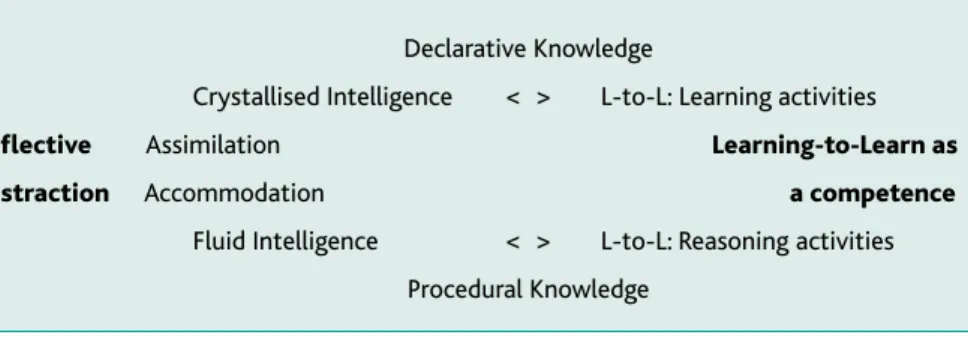
With the core notion of reflective abstraction as a starting point, it is possible to formulate a model combining most of the concepts referred to above, and to converge the basic parts of mental actions. Only then can the attitudes or beliefs be related to the model. Reflective abstraction comprises the processes of assimilation and accommodation which, in turn, are related respectively to crystallised and fluid intelligence (Carroll, 1993), and these, in turn, to declarative and procedural knowledge (Snow, 1990). This three-level complex can then be related to learning-to-learn as a competence by separating two conceptual sub-areas of learn-ing-to-learn competencies – Learning Activities and Reasoning Activities.
Declarative Knowledge
Crystallised Intelligence < > L-to-L: Learning activities
Reflective Assimilation Learning-to-Learn as abstraction Accommodation a competence
Fluid Intelligence < > L-to-L: Reasoning activities Procedural Knowledge
The model supports the claim that assimilation is both conceptually and in practice more related to crystallised intelligence, and through that to declarative knowledge, whereas the activation of accommodation is a process more related to fluid intelligence and through that to procedural knowledge. The different factors are, nevertheless, in constant interaction, and the extent and nature of this interaction is one deciding dimension of the assessment of learning-to-learn as opposed to more traditional achievement assessment.
The role of beliefs in learning-to-learn assessment
Pupils’ beliefs are approached in the assessment of learning-to-learn from two perspectives. The developmental approach focuses on the formation of, and on changes in, self- and context-related beliefs in a dynamic re-lation to learning, and to the requirements set by the school and by edu-cation in general. The other approach, with its basis in motivation theory, focuses more closely on self-regulation in learning and school perform-ance.
The development of self-regulation refers both to the actual process and to the individual’s reflections on this process. These reflections be-come crystallised as personal beliefs. The contents of beliefs, as well as their psychological functions, vary from person to person, in time, and as a function of the particulars of the situation at hand. Beliefs covered in learning-to-learn assessment must hence address both the demands of content diversity relevant to the processes of learning and education, and the variety of functions beliefs serve in directing learning activity and related actions towards – or away from – tasks posited for the pupil.
Developmental theory, as well as developmentally oriented self-con-cept research (Harter, 1999), attest that changes, or progress, in the dif-ferentiation of the domains of a person’s beliefs are paralleled by a hier-archical (re)ordering of the structure of his or her respective context-re-lated self-concepts. The developmental outcome is considered to be a multi-dimensional and hierarchically ordered self-concept (Marsh, 1990; Shavelson et al., 1976; Shavelson & Marsh, 1986) or set of beliefs. This presumed developmental pattern, initially linked mainly to the domain
of the academic self-concept, was demonstrated by Byrne & Shavelson (1996) to apply equally to the social self-concept. This developmental in-terpretation could be taken as a general approach to the personal beliefs pupils have in relation to school and learning.
Byrne & Shavelson (1996, 611) stress that children do not simply always just add new facets to their conceptualisations of themselves when facing new domains, “but rather that they evaluate themselves in differ-ent terms relative to the ontogenetic developmdiffer-ent of their social cognitions”. There is thus a gradual progressive shift during the primary grades, from describing the self in physical terms, and in terms of outer activities, to a description of the self in psychological terms during ado-lescence (Harter, 1999).
Transition to the role of the pupil represents a new developmental task for children (Erikson, 1951/1977; Havighurst, 1948/1972). When the child starts primary school, he or she embarks on a new institutional career (Mayer, 1986), surrounded by a complex set of new interrelated expectations (Hautamäki, A., 1982, 1986; Hautamäki, A. & Hautamäki, J., 1997a; Nurmi, 1993). Children will be confronted with new develop-mental standards (Caspi, 1987; Nurmi, 1993) and subsequent norms for age-appropriate behaviour, and they will be evaluated according to them, usually in comparison to their classmates. In particular, the focus will be on the child’s capacity to learn and to work industriously towards the ac-quisition of what Erikson has termed “the technological ethos of a cul-ture”. It is posited that children, as pupils, react to this challenge by de-veloping their skills and, ideally, by gradually generalising their beliefs of themselves as achievers in relation to the requirements of the school, e.g., forming a belief structure in which education does matter, and accord-ing to which to achieve well in school is important and worth strivaccord-ing for. It is also presumed that coping with this task is reflected in the develop-ment of more generalised domain-specific self-concepts.
If a developmental perspective is endorsed, beliefs are seen both as multi-layered and multi-voiced, and as reflecting a complexly orchestrated self. Both self-related and context-related conceptions, or beliefs, are then defined as cognitive schemas. Campbell et al. (1996,141) maintain that this organised knowledge structure “contains traits, values, semantic and episodic memories about the self and controls the processing of
self-rel-evant information”. Situational determinants of behaviour, e.g., demands implicit in social scripts and subsequently imposed on pupils, are thus emphasised.
Observations of how an individual’s behaviour depends on the cur-rent situation have challenged earlier static views of individual person-ality, and directed the focus from trait-based conceptualisations of in-dividual differences to more dynamic approaches to person-situation transactions (Higgins, 1990; Mischel & Shoda, 1995). It has turned out that situation-dependent variation is not random, but reflects fairly stable characteristics of the individual (e.g., Shoda, Mischel, Wright, 1993). The apparent complexity of the person-situation transaction thus necessitates both a more process-oriented conception of personal-ity, and the need to address the issue of stable variability across situa-tions.
The cognitive-affective process system model of personality (Mischel and Shoda, 1995), incorporating the role of situations, events and con-texts into the conception of personality, is one attempt to respond to this challenge. According to the model, individuals differ in “how they selec-tively focus on different features of situations, how they categorise and encode them cognitively and emotionally, and how those encodings ac-tivate and interact with other cognitions and affects in the personality system” (Mischel & Shoda, 1995, 252). According to the model, people do not just passively react to situations, but are active and goal-directed agents who make plans and generate changes, and by their role partake in creating the situations themselves.
Analogously, in the context of school, pupils could be seen as active agents whose subjective interpretations of the different classroom situa-tions largely determine the goals they choose. These situational interpre-tations are, however, dependent on their motivational beliefs and on their perceptions of themselves. Furthermore, even if the situational construals may instigate the goals they choose to strive for, the actual engagement is also dependent on their volitional control, i.e., on their ability to sup-port and maintain the chosen paths of engagement, and on the supsup-port and the constraints of the instructional and social environment.
According to achievement-goal (or goal-orientation) theory, personal and environmental factors are both seen as necessary components of
motivation (Pintrich & Schunk, 1996). Goal orientations, i.e., individu-als’ preferences for certain types of desired end-states (Niemivirta, 1998a, 2002a), provide an organising framework through which a variety of cog-nitive and affective responses to achievement situations can be interpreted (cf. Ames, 1992). These reflect a pupil’s general orientation towards class-room situations and tasks, and are closely associated with other related beliefs about purpose, competence, success, ability, effort, errors and standards (Pintrich, 2000). The integrated and organised nature of these different beliefs provides the theoretical utility and predictive power of the achievement-goal construct.
Goal orientations may be viewed as knowledge structures that become activated depending on the contextual setting and environmental cues (Niemivirta, 1998a; Pintrich, 2000). Various achievement-related ele-ments, such as purposes, definition of success, the role given to effort and errors, and standards, are nodes in a network that display different pat-terns of activation as a function of contextual and internal personal fac-tors. This type of representational model suggests that goals are dynamic states, which fluctuate in response to contextual information as well as to internal feedback between the different nodes or units in the network. Consequently, this view implies that goal orientations influence the very way individuals perceive their present social and contextual arenas.
The psychological significance of an event could be seen as a critical determinant of how a person responds to it, and the psychological signifi-cance as a product of both the person and the situation (Higgins, 1990; Järvelä & Niemivirta, 2001). This is elaborated by Boekaerts and Niemivirta (2000), who suggest the way pupils give meaning to situations proceeds through the processes of identification, interpretation and ap-praisal. Pupils’ situational construals are thus not based just on their per-ceptions of the situation as such (data-driven processing), but much of the significance of events, situations and other social objects is determined by how they categorise them (theory-driven processing). Subjective mean-ing is thus a joint construction of previous experiences and current infor-mational input from the situation at hand (Higgins, 1990; Higgins & Bargh, 1987).
The first stage of a pupil’s situational construal is identification, the rec-ognition of the situational input and the resulting activation of related
knowledge. For example, when facing an examination, pupils recognise the stimulus to be an instance of a previously-established class of events, a spe-cific type of classroom episode with spespe-cific implications. The second phase could be conceptually partitioned into two tightly-interwoven processes, in-terpretation, or inference of the implications of the stimulus, and appraisal, an estimation of the personal significance of those implications. These two are often, if not always, related to some kind of standard or reference point (Higgins, Strauman & Klein, 1986). The last phase of the meaning-giving process, the pupil’s appraisal of the personal significance of the situation at hand, is of specific interest here, because it is – by definition – a motivation-ally charged one.8 Pupils’ situational construals are considered to set the scene for further engagement. In order to transform an appraisal of a situ-ation into desired action, however, the pupil must first set, or activate, ap-propriate goals, and create a corresponding action plan (see Bargh & Chartrand, 1999, and Boekaerts & Niemivirta, 2000). Here, a qualitative distinction can be made between the notions of goal setting and goal striv-ing (Lewin et al., 1944; cf. Niemivirta, 1999). For example, Kuhl (1984) refers to the former as a motivational phase concerning the decision on what goals to adopt, whereas the latter refers to the determined pursuit of goal completion. The factors and processes leading to a goal choice are largely based on subjective interpretations and appraisals of prevailing situ-ations. Then, once the choice has been made, the initiation and execution of the corresponding actions themselves must take place.
The action-phase model suggested by Heckhausen and Gollwitzer (1987; Gollwitzer, 1990), going beyond the conceptual distinction of goal setting and goal striving, provides a coherent framework for bridging dif-ferent aspects of motivation and volition. The model incorporates the is-sues of initiating and maintaining action into a process-like continuum. The temporal phases of goal-directed engagement are partitioned into
8 It must be noted that, although the theoretical descriptions provided above rely on a cognitively and individually
saturated psychological framework, the “previously established classes of events” affecting the pupil’s situational construals become such only as parts and products of the socio-culturally shaped common practices embedded in the context. What is identified as a classroom episode, and what characteristics become attached to it, depend on the socially-shared meanings developed in the classroom, in school, or even in a larger cultural setting (cf. Niemivirta, Rijavec & Yamauchi, 2001).
four phases, which in turn are separated by particular transition points (decision, action initiation, and action outcomes, respectively) that give rise to subsequent engagement. According to this framework, both ap-praisals and the process of forming a goal intention can be described as characteristic of a pre-decisional phase – a phase in which people trans-late their wishes into intentions. In other words, during the pre-decisional phase, individuals weigh the desirability and feasibility – or outcome-ex-pectancy and subjective value – of different alternative goals and their po-tential outcomes or consequences on the basis of various subjective cri-teria. This “relative preference expressed in a context of conflicts, alterna-tives and trade-offs” (Mischel, Cantor & Feldman, 1996, p. 333) mani-fests itself in a commitment to the chosen goal. The formation of a goal intention thus represents a leap from a state of uncertainty to a goal state in which the desired outcome becomes an end state that the individual feels committed to attain (Gollwitzer, 1990).
The subjective criteria that define the desirability and feasibility of goal choices are, in part, determined by individuals’ situation-specific judgements. Unlike goal orientations, which are considered as general or relatively context-free sets of motivational beliefs, some types of motiva-tional beliefs can be viewed as more situamotiva-tional by nature. Three impor-tant classes of personal judgements that are likely to influence individu-als’ goal choice and their subsequent action are self-efficacy beliefs, task value, and anticipated interest.
Self-efficacy refers to individuals’ judgements about their ability to carry out specific actions in specific situations (Bandura, 1997). Such beliefs have been found to be highly influential in predicting actual be-haviour and task performance (cf. Pajares, 1996). Task value refers to the degree or amount of value and worthiness that individuals attach to the future task and/or to its outcomes, whereas anticipated interest reflects their expectations about the extent to which the upcoming activity will be experienced as interesting. Recent studies examining the relationships between general motivational beliefs, situational appraisals and perform-ance have supported the assumption of the importperform-ance of situation-spe-cific self-appraisals in mediating the influence of general beliefs and prior achievements on later performance (Boekaerts, 1999; Niemivirta, 2000; see also Pajares, 1997).
9 These could be seen to include issues such as the value of formal education vs. the constitution of knowledge at
work, the value of epistemic reflection and intellectual enterprise, the value of cultural inheritance, and the value of moral rules and of the capacity - and willingness - for the moral evaluation of the workings of society.
The outcomes of students’ situational construals define the course of further engagement, but they are not sufficient determinants of actual en-gagement (Boekaerts & Niemivirta, 2000; Kuhl, 2000). Sometimes learn-ers fail to realise their intentions or to attain desired goals, and sometimes they carry out even the most boring or unpleasant tasks with great effort and commitment. One explanation for how they could become active in tasks that may initially seem frustrating is through effective volitional control. This comprises the strategies and plans invoked after decisions to pursue certain goals have been made. According to Kuhl (1984; see also Corno, 1993), volition could be characterised as a dynamic system of psychological control processes that protect concentration and directed effort in the face of personal and environmental distractions.
The affective content areas essential to the assessment of learning-to-learn, which complement the cognitive components discussed earlier, seem to fall onto two separate but internally related and interacting lev-els – self-related and context-related beliefs.
Self-related beliefs are assumed to disclose pupils’ conceptions of them-selves as persons in general, and as learners in particular, along with their personal interpretations of the meaningfulness and demands of different learning situations. Self-related beliefs thus encompass the general self-esteem of the pupil, his or her self-concept in relation to various academic disciplines, goal orientations and action-control beliefs, the degree of task-acceptance, the continuous updating of self-evaluation, and personal future orientation.
Context-related beliefs are assumed to disclose the pupils’ personal in-terpretations of issues related to the wider educational context of society with the conflicting interests in its (sub)cultures and classes. The generational issue is approached through the role the pupils consider their parents and teachers to have in their education. Context-related beliefs also comprise pupils’ interpretations of the prevalent beliefs concerning the societal frames of education9, as their interpretations of the larger societal frames and future of education, work and society have an effect
on their personal educational beliefs and choices. This wider social per-spective has not yet been addressed in the context of the proposed set of scales, although the issue could be of special interest in international com-parisons.
Perceived support for education– mediators and social relations. There exists a rich body of empirical and theoretical evidence on the role of parenting and of the parent-child relationship in the development of af-fective self-regulation and intellectual competencies, and in the socio-moral domain (Baumrind, 1993). Teacher relations and peer relations also have effects on school achievement (Wenzel, 1996). Pupils’ social goals not only have their own influence, but also interact with their academic goals, having a conjoint effect on school performance, learning and de-velopment. It has been found, for example, that pupils’ perceptions of teacher support are positively associated with – and make possible – in-structional techniques that stress mastery and learning goals (Covington, 2000, p. 180).
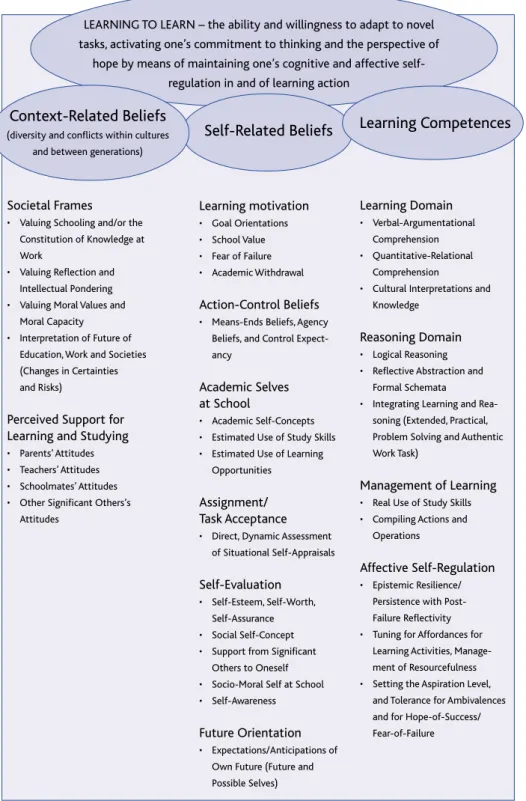
Figure 2. The conceptual framework for assessing learning-to-learn. Chapter 3. LEARNING TO LEARN – the ability and willingness to adapt to novel tasks, activating one’s commitment to thinking and the perspective of
hope by means of maintaining one’s cognitive and affective self-regulation in and of learning action
Context-Related Beliefs (diversity and conflicts within cultures
and between generations)
Self-Related Beliefs
Societal Frames
• Valuing Schooling and/or the Constitution of Knowledge at Work
• Valuing Reflection and Intellectual Pondering • Valuing Moral Values and
Moral Capacity • Interpretation of Future of
Education, Work and Societies (Changes in Certainties and Risks)
Perceived Support for Learning and Studying
• Parents’ Attitudes • Teachers’ Attitudes • Schoolmates’ Attitudes • Other Significant Others’s
Attitudes Learning motivation • Goal Orientations • School Value • Fear of Failure • Academic Withdrawal Action-Control Beliefs
• Means-Ends Beliefs, Agency Beliefs, and Control Expect-ancy
Academic Selves at School
• Academic Self-Concepts • Estimated Use of Study Skills • Estimated Use of Learning
Opportunities
Assignment/ Task Acceptance
• Direct, Dynamic Assessment of Situational Self-Appraisals
Self-Evaluation
• Self-Esteem, Self-Worth, Self-Assurance • Social Self-Concept • Support from Significant
Others to Oneself • Socio-Moral Self at School • Self-Awareness
Future Orientation
• Expectations/Anticipations of Own Future (Future and Possible Selves) Learning Domain • Verbal-Argumentational Comprehension • Quantitative-Relational Comprehension
• Cultural Interpretations and Knowledge
Reasoning Domain
• Logical Reasoning • Reflective Abstraction and
Formal Schemata
• Integrating Learning and Rea-soning (Extended, Practical, Problem Solving and Authentic Work Task)
Management of Learning
• Real Use of Study Skills • Compiling Actions and
Operations
Affective Self-Regulation
• Epistemic Resilience/ Persistence with Post-Failure Reflectivity • Tuning for Affordances for
Learning Activities, Manage-ment of Resourcefulness • Setting the Aspiration Level,
and Tolerance for Ambivalences and for Hope-of-Success/ Fear-of-Failure