Twisted-pair Ethernet:
pper Cabling for High Performance Networking
Products. Technology. Delivered Globally.
Twisted-pair Ethernet:
P r o d u c t s . T e c h n o l o g y . S e r v i c e s . D e l i v e r e d G n
Introduction . . . .03
n
Twisted-pair Ethernet: Copper Cabling for High Performance Networking
. . . .03
n
The Need for Speed . . . .03
n
Cabling Standards . . . .04
n
Installation Issues . . . .04
n
Environmental Issues Affecting Today’s Cabling Standards for UTP Cabling . . .05
n
Twisted-Pair Ethernet and Data Transmission Basics . . . .05
n
MHz vs. Mbps . . . .06
n
Signal to Noise (SNR) and Line Coding . . . .06
SNR for 10GBase-T . . . .07
n
Real-Time Applications . . . .07
n
Conclusion . . . .07
Contents
Anixter is the world’s leading supplier of communications products used to connect voice, video, data and security systems. Anixter is also the leading provider of electrical and electronic wire and cable, fasteners, and other small components to build, repair and maintain a variety of systems and equipment. We bundle our products with our innovative Supply Chain Services to cut costs out of our customers’ business processes, and ensure they get the right product, the first time.
Solarflare is delivering the next level of high-performance 10Gigabit Ethernet. As the leading supplier of standards-based 10GbE silicon and reference designs, Solarflare’s robust and power-efficient solutions are easy to deploy and cost effective for switches and NICs. The combination of Solarflare’s Solarstorm™ 10GbE Controller and 10Xpress®10GBase-T PHY enables NIC and server OEMs to
provide 10G adapters at about the same cost as quad 1Gb. As the first company to demo, sample and ship standards-based 10 Gigabit Ethernet that works to 100 meters over copper cabling, Solarflare is engaged with key industry partners and customers to ensure interoperability and build a complete 10GBase-T ecosystem.
T w i s t e d -p a i r E t h e r n e t : C o p p e r C a b l i n g f o r H i g h P e r f o r m a n c e N e t w o r k i n g 3
Introduction
The escalating Internet data traffic has stimulated an unprecedented transformation in the telecommunication infrastructure. As a result, network designers are struggling with critical path design choices to address a fundamental reengineering of the telecommunication infrastructure. With multiple media and technologies to choose from, the network upgrade paths for the managers of enterprise networks and data centers are many and varied. Ethernet over twisted-pair copper continues as the preferred protocol and media for in-building horizontal network cabling applications operating at distances less than 100 meters (328 ft.). It provides the advantages of plug-and-play simplicity and cost-performance benefits over alternative networks and media types. There are strong reasons for the broad acceptance and rapid growth of unshielded twisted pair (UTP) as the horizontal media of choice: low initial cost, the ability to deliver higher data rate LAN services, and the flexibility to use one medium for all services. As speeds increase, copper-based LANs will require more complex and expensive electronics. It is important to note, however, that fiber has a significant bandwidth distance advantage over UTP in centralized architectures as well as between buildings and in the backbone.
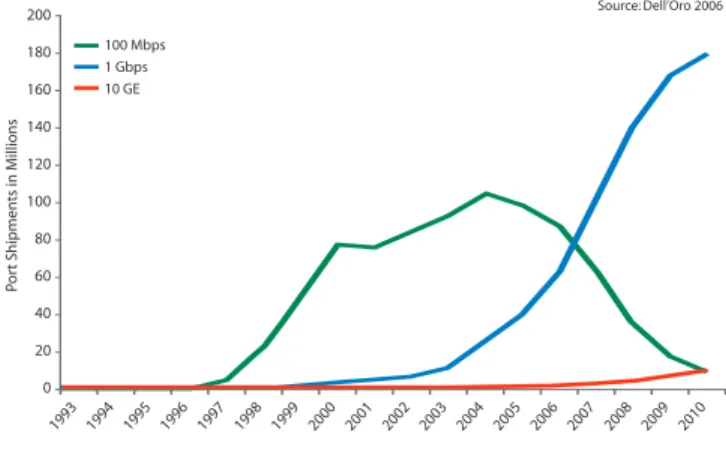
Ethernet has become the default network communications protocol and has evolved from first generation 10 Megabits per second (Mbps) speeds that were predominant in the early 1990s to the 10 Gigabits per second (10 Gbps) of today’s networks. As illustrated in the chart below, according to Dell’Oro, by the end of 2007, it is expected that one Gbps port shipments will exceed 100 Mbps port shipments.
Figure 1: Dell’Oro 2006 – Ethernet Port Shipments
Twisted-pair Ethernet: Copper Cabling
for High Performance Networking
This white paper will discuss UTP copper cabling performance specifications as related to signal transmission aspects with special emphasis on twisted-pair Ethernet applications. It will also discuss some installation and environmental considerations that affect the performance of cabling. Additionally, the paper will illustrate the performance differences when running several applications
over different twisted performance levels of twisted-pair copper cabling. End-users should carefully consider the available cabling technology options to ensure that the selected cabling system will meet both their current and future application requirements.
The Need for Speed
In today’s modern enterprise, organizations have shifted away from the centralized mainframe computing environments of the early 1990s to more distributed client-server architectures. Servers, now clustered in data centers, require both resilient and high-speed network connectivity. Vertical markets, especially the financial industry, have seen tremendous growth in network traffic over the last decade. As an example, the New York Stock Exchange processes roughly $5 trillion in transactions per day. This is more than the entire annual GDP of nearly all industrialized nations in the world. The Internet continues to evolve. With the advent of more video content providers and video hosting Web sites such as YouTube, the expectations of consumers are also changing. Consumers will no longer tolerate slow server response, slow download speeds, or low-resolution video. A series of performance tests conducted by the Anixter Infrastructure Solutions Lab demonstrates the download speed and response time of a Category 5e and Category 6 cabling system when sending a 450 MB file between two workstations.
Table 1: 450 MB TCP Windows File Send (Short Connections)
* These frame error rates represent the file transfer of data packets over a 100Base-T Link using a marginal Ethernet adapter and switch port.
Source: Anixter Infrastructure Solutions Lab
Additionally, the enterprise network has started to expand into the area of the physical building infrastructure controls. More of these controls are becoming IP enabled and added to the network; a universal concept for a single building cabling approach will be required. This IP Connected EnterpriseSMwill need a
robust, utility grade cabling plant to be able to act as a single transport for both IP and analog signaling at the device level. As Web-enabled gateways become more pervasive, from the integration of building automation systems (BAS) to the now ubiquitous corporate network, a single cabling plant of four-pair copper and fiber optic design will interface directly to these BAS devices. The transition to running analog signals on twisted pair is a tried and true conversion and it works smoothly when the cabling has superior copper conductors. As most BAS signals are serial in nature, the strength lost is proportional to the length of the copper cabling.
200 180 160 140 120 100 80 60 40 20 0 1993 1994 1995 1996 1997 1998 1999 2000 2001 2002 2003 2004 2005 2006 2007 2008 2009 2010 P o rt S h ip m e n ts in M il li o n s Source: Dell’Oro 2006 100 Mbps 1 Gbps 10 GE
Cabling System Average Throughput * Response Time
Category 6 86.83 Mbps 41.46 seconds
P r o d u c t s . T e c h n o l o g y . S e r v i c e s . D e l i v e r e d G
Cabling Standards
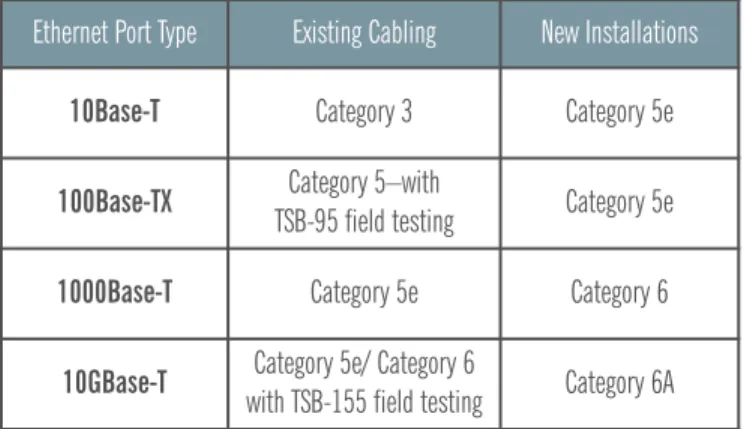
End-users use the ANSI /TIA /EIA-568 and ISO /IEC 11801 series of standards that define Category 5e, Category 6 and Category 6A performance levels to establish the minimum transmission medium requirements necessary to support a wide array of data, voice, and video communications systems within their enterprise. Performance and test parameters within these standards ensure that the cabling systems that meet the specified requirements demonstrate sufficient “headroom” or margin to ensure operation of the communications equipment.
Table 2: Twisted-Pair Ethernet and TIA Cabling Performance Specifications
There is also an “ANSI /TIA /EIA-854 Full Duplex Ethernet Specification for 1000 Mbps (1000Base-TX) Operating over Category 6 Balanced Twisted-Pair Cabling” standard. The main difference is that it requires Category 6 cabling instead of Category 5e cabling. Because of the improved performance of Category 6 cabling, the ANSI /TIA /EIA-854 standard does not implement NEXT cancellation or echo cancellation.
Table 3: Electrical Properties
Installation Issues
Installation and environmental issues can also affect the cabling that supports Ethernet networks. Just as a new car’s value drops the moment it is driven out of a showroom, so does the signal to noise ratio of a cabling system as soon as you install it. The following issues can affect the performance of a cabling system:
•Excessive untwisting to terminate
•High temperature environments such as plenum ceilings •Excessive bending
•Pulling tension
When you have a cabling system that just barely meets the required standards for your applications, installation can put it below the necessary performance requirements and cause problems on your network.
Performance Comparisons (dB @ 100 MHz) UTP Category Cables
Permanent Links (100 meter plus [3] connections)
Parameter Cat 5e Cat 6 Cat 6A
Max Operating Frequency - MHz 100 250 500
Insertion Loss 21.0 18.6 17.9
CrossTalk - NEXT 32.3 41.8 41.8
PowerSum Crosstalk - PSNEXT 29.3 39.3 39.3
Return Loss 12.0 14.0 14.0
PowerSum Alien - NEXT Not Tested 62.0 60.0 Approximate AWG
(American Wire Gauge) 24 23 22
Typical Copper Diameter
(inches) .0204 .0226 .0248
Ethernet Port Type Existing Cabling New Installations
10Base-T Category 3 Category 5e
100Base-TX Category 5–with
TSB-95 field testing Category 5e
1000Base-T Category 5e Category 6
10GBase-T Category 5e/ Category 6
T w i s t e d -p a i r E t h e r n e t : C o p p e r C a b l i n g f o r H i g h P e r f o r m a n c e N e t w o r k i n g 5
Environmental Issues Affecting Today’s
Cabling Standards for UTP Cabling
With any standard, there is the assumption that total interoperability and all possible environmental and installation issues are included. To some degree, this is true; nevertheless, in the real world there are always installation, environmental, and hardware issues that are present, which could never be demonstrated in the developmental process. Take the environment for an example. In both the TIA and ISO performance rating classifications, attached to the requirement is a statement for insertion loss (attenuation of signal strength through the copper conductor) related to the testing being performed at 20° C; however, the cabling is allowed to be installed into a environment of up to 60° C. 1This reflects an actual loss of signal strength in a Category 5e cable
of 16 percent. This means that at 60° C, the actual loss would increase by 16 percent. Instead of expecting a 21 dB loss in the link test, you would get 24.4 dB loss, which is like adding another 53 feet of cable to the link, which would reduce the delivered power by almost 50 percent! It cannot be expected that all cabling will be installed in a 72° F environment from end to end, and this is just one of many factors that can affect the actual performance of cabling (not the least all being transmitters and receivers that are less than perfect).
In just that single parameter of insertion loss for Category cables, it can be seen how dramatically the building automation system performance can be degraded by temperature variations and installed cable lengths. From the accompanying performance chart (Table 3), it is apparent that as cable design changes according to bandwidth requirements, it also requires copper connectors with larger diameters. The minimum cabling system for use in any enterprise should be Category 6, with the potential for Gigabit Ethernet speeds and the possible inclusion of integration into building automation systems.
Twisted-Pair Ethernet and
Data Transmission Basics
The 10Base-T and 100Base-TX signaling transmission characteristics are classified as unidirectional; the signals are transmitted in one direction on a single wire pair. In contrast, 1000Base-T and 10GBase-T signaling transmission characteristics are bidirectional; the signals are transmitted simultaneously in both directions on the same wire pair (i.e., the transmit and receive pair occupy the same wire pair). (See Figure 2).
For 10Base-T and 100Base-TX unidirectional signaling, the far-end crosstalk is coupled into a transmitter and not into a receiver at the far-end and therefore does not impact the receiver performance (Figure 3). 1000Base-T and 10GBase-T use bidirectional signaling on each of the four pairs to support full duplex
operation. Due to the higher degree of complexity of the bidirectional signaling techniques associated with 1000Base-T and 10GBase-T transmission versus those associated with 10Base-T and 100Base-T transmission, the selection of the correct cabling media type becomes more critical.
Figure 2: Twisted-pair Ethernet Signal Transmission
The 1000Base-T and 10GBase-T bidirectional signal transmission on a single pair is enabled by a device called a hybrid. The hybrid stops the local transmitted signals from being mixed with the local received signals. Bidirectional transmission on the same wire can result in echo. Echo is the combined effect of the cabling return loss and the hybrid function appearing as noise at the receiver. Return loss (RL) is a measurement of the reflected energy caused by impedance mismatches in the cabling system. In a balanced twisted-pair cabling system, the impedance should normally be 100 ohms. Far-end crosstalk (FEXT) is another noise source, which is induced by a transmitter at the near-end into a far-near-end receiver due to unwanted signal coupling (Figure 3). FEXT needs to be considered in multi-pair, bidirectional signaling such as 1000Base-T and 10GBase-1000Base-T. Pair-to-pair equal level far-end crosstalk (ELFEX1000Base-T), also known as attenuation crosstalk ratio far-end (ACRF), is expressed in decibels as the difference between the measured FEXT loss and the insertion loss of the disturbed pair. In addition, because the signal transmission is on all four pairs, powersum crosstalk loss needs to be considered. The powersum crosstalk specifications takes into account the combined crosstalk on a receive pair from all near-end and far-end sources.
1As per TIA 568-B: Insertion loss shall be measured for all cable pairs in accordance with ASTM D4566 and 4.3.4.14 at 20° ± 3°C or corrected to a temperature
of 20°C using a 0.4% / °C correction factor for Category 5e cables for the measured insertion loss.
T R R T T T R R T R R T T T R R H Y B R I D H Y B R I D Unidirectional – Transmit and receive on different wire pairs (10Base-T and 100Base-T)
Bidirectional – Transmit and receive on the same wire pair (1000Base-T and 10GBase-T)
P r o d u c t s . T e c h n o l o g y . S e r v i c e s . D e l i v e r e d G
Figure 3: 1000Base-T and 10GBase-T – Bidirectional Transmission
Table 4: Signal Transmission Over Twisted-pair Cabling
The additional cabling performance parameters of return loss and ELFEXT and the need to specify a powersum for the crosstalk disturbers for 1000Base-T and 10GBase-T, which were not specified for 10Base-T and 100Base-TX, are related to the differences in the signal transmission implementations. Figure 4 illustrates the bidirectional signal transmission on one of the four wire pairs used for 1000Base-T and 10GBase-T. The transmitted signal is impaired by the cable insertion loss. The FEXT and NEXT from the other three pairs and the echo combine with the received signal. The ratio of the impaired signal to the noise (e.g., FEXT, NEXT and echo/return loss) is the signal-to-noise ratio (SNR). The SNR at the receiver is the most important figure of merit for a communication channel.
Figure 4: Signal Impairments at the Receiver
MHz vs. Mbps
Insertion loss and near-end crosstalk loss for cabling are derived from swept frequency measurements. Specifications range from 0.1 MHz to 500 MHz. The insertion loss and near-end crosstalk loss specification values represent the loss of a sinusoidal voltage at the specified frequency and should not be confused with bandwidth limitations, bit rate, or baud (e.g., 622 Mbps does not necessarily require cabling specified to 622 MHz). Modulation, the additional variations of amplitude, frequency or phase, and signal conditioning are used to transform the desired bit rate into an acceptable signaling rate (baud) based on the design objectives.
Figure 5 illustrates the signal reference for bit rate and baud. Bit is an abbreviation for binary digit. Bit rate is the number of bits transferred per unit of time expressed in bits per second or in millions of bits per second (Mbps). Baud is the unit of signaling speed on the physical media, equal to the number of discrete conditions or signal events per second.
Figure 5: Signaling Reference
Signal to Noise (SNR) and Line Coding
The bit error ratio (BER), the ratio of the number of bits incorrectly received to the total number of bits received, is mathematically related to the SNR and the line code utilized. Line coding is the process of converting the discrete bits into signals suitable for transmission over the communication channel. The conversion of bits into codes (encoding) and the transformation of the encoded data into symbols increases the bandwidth efficiency of the data transmission. The symbols are representations of the encoded bits as voltages on the pairs. For binary transmission, where two symbols are used (e.g., 1 and 0), the number of symbols per second (the signaling rate in baud) is equivalent to the data rate in bits per second. For multilevel signaling, the relationship between the signaling rate in baud and the data rate is dependent on the number of voltage levels of the symbols. As an example, if four voltage levels are used as symbols, each voltage level can represent two binary digits (bits of data); therefore, the data rate in bits per second is twice the signaling rate in baud (two bits of data for every baud). In this example, the signaling rate in baud is one-half of the data rate resulting in a reduction in the signal bandwidth.
T R R T T R H Y B R I D H Y B R I D T R R T T T R R H Y B R I D H Y B R I D Noise – far-en d crosstalk N o is e – n e a r-e nd cro ssta lk Near-end Far-end echo
Ethernet Port Type Data Rate Signal Transmission
10Base-T 10 Mbps Unidirectional 2 pairs 100Base-TX 100 Mbps Unidirectional 2 pairs 1000Base-T 1000 Mbps or 1Gigabit /sec (Gbps) Bidirectional 4 pairs 10GBase-T 10,000 Mbps or 10 Gbps Bidirectional 4 pairs T R R T H Y B R I D H Y B R I D signal at receiver
within cable noise: • near-end crosstalk • far-end crosstalk • echo (return loss)
between cable noise: • alien crosstalk
signal + noise
echo
Specified in bits / second
10 1
10 1 Encode
Decode Cable Plant
TIA / TIA-568-B or ISO / IEC Cables and Connectin
g Hardware
Bit Rate
Transmitter
ISO Data Link
ISO Physical Layer
Receiver Baud
T w i s t e d -p a i r E t h e r n e t : C o p p e r C a b l i n g f o r H i g h P e r f o r m a n c e N e t w o r k i n g 7
SNR for 10GBase-T
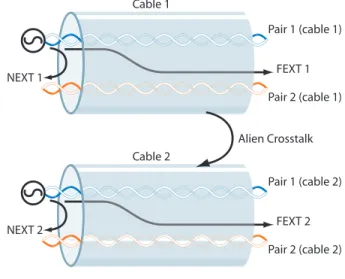
10GBase-T will incorporate advanced digital signal processing (DSP) techniques to perform crosstalk cancellation between the pairs in the cable as well as echo cancellation on each pair. The noise coupled between cables referred to as “alien crosstalk” is not easily canceled. (See Figure 6). For 10GBase-T, alien crosstalk is the dominant noise source and, therefore, the SNR at the receiver is the ratio of the signal (insertion loss) to alien crosstalk noise appearing at the receiver.
Figure 6: Alien Crosstalk
Real-Time Applications
Today, many of our applications are time sensitive. Voice over IP and Video over IP require that the data packets be sent across an IP network at a particular time and in a particular order. Unlike normal data transfers (e.g., file transfers), if a packet cannot be decoded, these applications
cannot ask the transmitter to resend the missing data. Refer to Table 5 for the recommended network design criteria for real-time applications. If the problem is bad enough, it can completely interrupt the communications. Therefore, it is recommended to build margin into the network by using minimum Category 6 rated cabling for real-time applications. Figure 7 demonstrates a comparison of streaming video running over a minimally compliant Category 5e cabling versus a Category 6 cabling.
Figure 7: Streaming Video Running Over Category 5e vs. Category 6 Cables
Conclusion
While it is technically correct that one Gigabit Ethernet can run over a Category 5e cable from a standards perspective, the results will not always be positive in real-world scenarios. The bottom line: starting with the best cabling system ensures that all needed applications will run productively in tomorrow’s IP Connected EnterpriseSMenvironment, even as that technically
driven environment continuously evolves. Today, the recommended cabling system for high-speed Ethernet systems would be a minimum of a Category 6, while the minimum for 10GBase-T would be Category 6A.
Pair 1 (cable 1) Cable 1 Pair 2 (cable 1) FEXT 1 Alien Crosstalk NEXT 1 Pair 1 (cable 2) Cable 2 Pair 2 (cable 2) FEXT 2 NEXT 2
Using category 5e cabling
Using category 6 cabling
Zero downtime for mission-critical applications
Table 5: – Application Requirements (Source: Cisco Systems)
Data file transfer Data Interactive Application Real-Time Voice Real-Time Video
Response Time Reasonable Within a second
100 ms of delay with low
jitter
Minimum delay and jitter Throughout /
Packet Loss High / Medium Low / Low Low / Low
High / Minimum Reliability
We bundle our products with our innovative Supply Chain Services to help control the cost of our customers’ business processes, reduce their investment in inventory, and ensure they get the right product when they need it. A publicly held company, Anixter, with its subsidiaries, serves companies in more than 46 countries around the world. Anixter’s total revenue exceeds $4.9 billion.
Anixter Inc. does not manufacture the items described in this publication. All applicable warranties are provided by the manufacturers. Purchasers are requested to determine directly from the manufacturers the applicable product warranties and limitations. Data and suggestions made in the publication are not to be construed as recommendations or authorizations to use any products in violation of any government law or regulation relating to any material or its use.
7F 00 02 X0 © 2 00