Abstract—In view of dynamic and complex business environment, customer management face changing requirements and increasing demand from business users for quick enhancements to the underlying software systems managing corresponding business processes. In light of the above, starting from late 2000’s, IT industry has witnessed huge traction towards adoption of agile methodologies in project executions which operate well in more fluid and dynamic environments. Customers are therefore demanding their IT vendors to move over from conventional SDLC methodologies to agile methodologies in anticipation of deriving key benefits such as quick time to market, shorter feedback cycles, early return on investments etc... In this paper, we try to highlight few challenges that both IT vendors and customers are likely to face w.r.to scaling up teams on both the sides on agile methodologies towards brining awareness, understanding and managing few demands raised by agile adoption, executing project with multiple vendors, contract management etc..
Keywords— SDLC, Agile, IT Vendors, SCRUM, ALM I. INTRODUCTION
UE to stringent peer competition, today’s business climate is both dynamic and complex. Customer’s management is facing the challenges of frequent change in requirements, tight budget limits and increasing demand for quick time to market. As a result, IT service providing companies are directly affected with their current service models. Also, to sustain profit margins, service providers are forced to reduce resources, including less money and in many cases reduced workforce. Inevitably, this forces the service providers to optimize every aspect of the business, specifically project management. It is quite clear that performance and outcome are taking precedence both in customer and IT service provider’s community.
Given the context, agile methodologies have gained phenomenal traction in IT industry, both in customer’s and service provider’s community. But what exactly is agile and how different is it w.r.to conventional waterfall methodologies? Agile methodologies emphasize the increment delivery of working product in the form of prototype that delivers significant value to customer in terms of providing incremental business functionalities. However, in spirit, both
Sreekumar. Vobugari is a Research Scholar with the Department of Computer Science & Engineering, National Institute of Technology, Warangal, Telangana, India; (e-mail: [email protected]
Somayajulu. DVLN is Dean Academics at National Institute of Technology, Warangal, Telangana, India; He is also a professor at Department of Computer Science & Engineering (e-mail:[email protected]).
traditional (waterfall) and agile methodologies embody similar principles and practices that aim to deliver measurable results.
II.WATERFALL VS AGILE METHODOLOGIES
The conventional waterfall methodology adoption is good for building software systems when customer is able to provide the requirement up-front i.e. during system’s engineering and/or Requirements engineering phase. However, this may not be the case in every scenario where customer can provide major functional requirements in detail. Predominantly, the reasons for such limitations can be due to the following but not limited to:
i. Business process undergoing periodic changes due to the change in regulatory compliance and hence requirements are continuously evolving and changing ii. Customer business influenced by market & trends thus
forcing customer to continuously re-look into his products and services
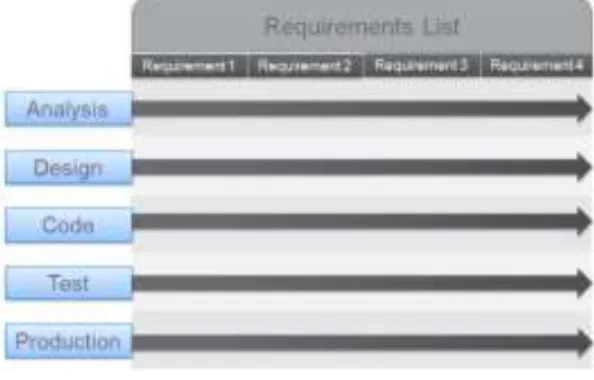
Given the context, use of water fall model is not a viable option due to the fact that water fall model adopts horizontal slicing strategy as shown in Fig.1, where all the requirements are analyzed completely before going to design followed by a big-bang design for all the requirements followed by code and testing for all the requirements.
Fig. 1 Waterfall way of software development
Adopting this strategy when requirements are frequently changing due to any of the reasons stated above can result in higher rework effort and worst, the software under development might need to undergo a complete re-haul of design. Given the context where Change is the only constant, there is a need for paradigm shift to handle such scenarios. That’s exactly where agile methodology comes handy. Agile methodologies have been widely used in software development and testing in IT industry for over a decade now. The conception of agile based flavors emerged from the best practices of two other conventional SDLC models namely
From Horizontal Slicing to Vertical Slicing –
SCRUM Paybacks and Challenges
Sreekumar. Vobugari, and Somayajulu. DVLN
iterative incremental model and spiral model as shown in Fig. 2
Fig. 2 Agile Methodologies Origin
Some of the distinct features of agile methodologies are: a) Respond to change by keeping design flexible to
accommodate evolving and/or new requirements b) Collaborating with customer and making customer
equally responsible for success and failure of the project c) Emphasize more on delivering a working prototype and
less on documentation
d) Reducing total cycle times of software delivery from months/quarters in waterfall to weeks in agile
Above features address many of the shortcomings of waterfall model. Some of the predominant agile flavors that are prevailing in the market are:
i. Extreme Programming (XP) ii. LEAN
iii. SCRUM iv. Crystal
v. KANBAN
Fig.3 depicts some of the above flavors.
Fig. 3 Agile flavors
Our discussion in the rest of the paper will be on SCRUM flavor of agile methodologies which is predominantly used in large scale software application development projects.
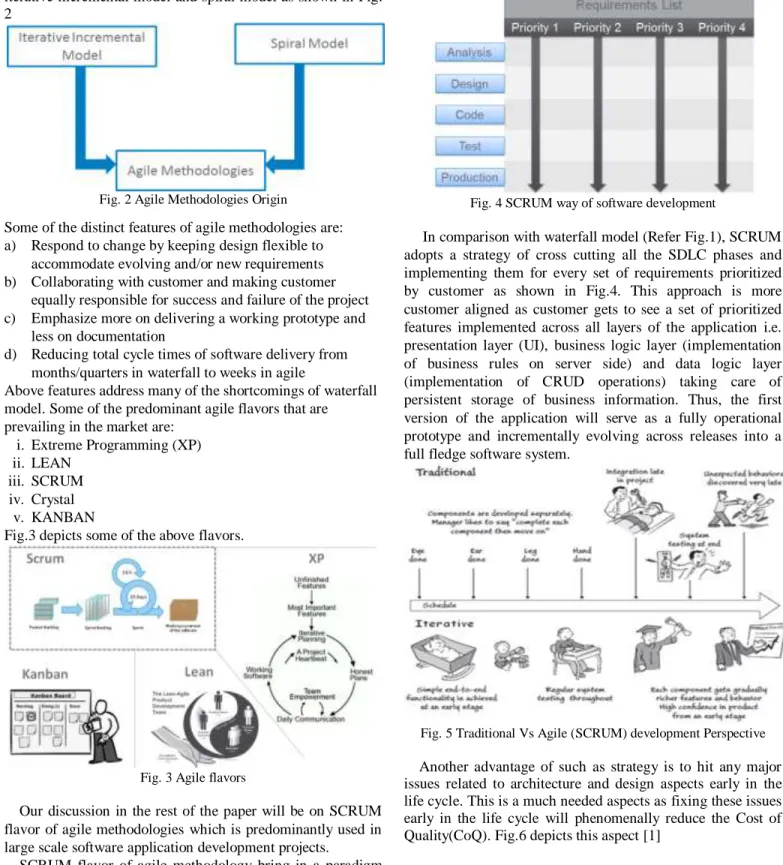
SCRUM flavor of agile methodology bring in a paradigm shift in the way we deliver value to customer. Unlike in waterfall model, in SCRUM, we emphasize in building the software incrementally rather than adopting the big-bang approach of development. In order to achieve this, we ask customer to list down the list of requirements (written in the form of User Stories) and ask him to prioritize the requirements by business value. Fig.4 depicts the SCRUM way of building software systems.
Fig. 4 SCRUM way of software development
In comparison with waterfall model (Refer Fig.1), SCRUM adopts a strategy of cross cutting all the SDLC phases and implementing them for every set of requirements prioritized by customer as shown in Fig.4. This approach is more customer aligned as customer gets to see a set of prioritized features implemented across all layers of the application i.e. presentation layer (UI), business logic layer (implementation of business rules on server side) and data logic layer (implementation of CRUD operations) taking care of persistent storage of business information. Thus, the first version of the application will serve as a fully operational prototype and incrementally evolving across releases into a full fledge software system.
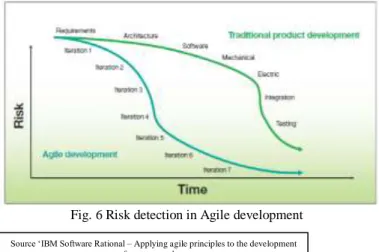
Fig. 5 Traditional Vs Agile (SCRUM) development Perspective Another advantage of such as strategy is to hit any major issues related to architecture and design aspects early in the life cycle. This is a much needed aspects as fixing these issues early in the life cycle will phenomenally reduce the Cost of Quality(CoQ). Fig.6 depicts this aspect [1]
Fig. 6 Risk detection in Agile development
Fig.5 brings out the general perspective of differentiating in building a product using traditional (waterfall model) approach and Iterative (Agile model) approach.
Table-1 summarizes the key differences between waterfall (traditional method) and agile (Iterative method).
TABLE I
DIFFERENCES BETWEEN TRADITIONAL VS WATERFALL
III. SCRUM PAYBACKS IN COMPARISON TO WATERFALL MODEL
We compare SCRUM with waterfall model from the following perspectives:
i. Cost of change
ii. Value to customer in terms of Return On Investment (ROI)
iii. Visibility and Adaptability
Fig.7 depicts the comparison between Conventional methodologies and Agile methodologies w.r.to cost of change in development life cycle time. Due to incremental nature of SCRUM flavor, the vendor development team take up a particular set of requirements prioritized under a specific business value and implement, validate and deliver it to customer.
Fig. 7 Comparison on Cost of Change
Thus, customer gets to see the application (increment) much early in lifecycle and enabling them to assess the product usability and review to provide observations/defects to the vendor team. This ensures that any deviation or missing requirements are identified much early in the life cycle and enabling the vendor development team to fix the defects/changes just-on-time basis. This can reduce the overall rework significantly thus improving ROI. Fig.8 depicts this comparison.
Fig. 8 SCRUM Value to Customer
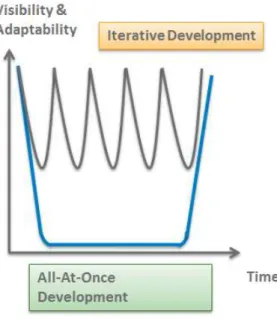
Another advantage that SCRUM based development brings to both vendor and customer is providing an opportunity for collaboration. Unlike in water fall model where the interactions between customer team and vendor team will be high(peak) only during initial requirements analysis phase and final user acceptance testing phase (blue line indicating a bath tub curve in Fig.8), in SCRUM since the features are built incrementally (refer Fig.4), across each release/sprint( in SCRUM, a release is termed as SPRINT), there will be detailed discussions between customer team and vendor team at multiple points in the sprint life cycle to validate and analyze the requirements as below:
i. Sprint planning
ii. Product backlog grooming iii. Sprint review
iv. Sprint retrospection
Due to multiple touch points between customer and vendor team, customer has a high visibility on the progress of the system development and also due to incremental development in nature, SCRUM process is adaptable for changing Source ‘IBM Software Rational – Applying agile principles to the development
requirements. Fig.9 compares waterfall and SCRUM w.r.to visibility and adaptability aspects.
Fig. 9 Customer and Vendor Touch Points IV. SCRUM CHALLENGES
While agile approaches, in specific SCRUM, facilitates the development team to respond for any changes by interacting with client team closely during analysis & development phase, it has been observed that agile suits well in scenario’s where the complete development team is co-located. However, in reality, many vendors need to deploy their development/support teams across geographies for some of the following factors but not limited to:
i. For machine critical systems, in order to provide 24/7 support, to avoid night shifts at vendor location, the teams are spread across geography in order to take advantage of varying time zones.
ii. From cost reduction perspective, in order to manage the rising operational costs, the teams are deployed at locations where the operational costs are relatively lower than that at customer’s region/geography. It is not uncommon to see that some of the major IT vendors deploy their development/support team in Spanish speaking Latin American countries for Spanish clients located out of Spain, Portugal etc...
Due to distributed teams, sometimes decisions need to be made when Product Owner (Customer representative) and Technical architectures (Vendor team) are located at different regions. To handle such situations, SCRUM expects that the team should be cross-functional in terms of capabilities. Yet another challenge posed by the need to have distributed team is how to ease communication and collaboration between teams so that team are in synch w.r.to the parallel activities, decisions related to change/new requirements, plan for builds, deployments and testing’s. In order to address these challenges, there is a need for organizations (both service providers/vendors and customers) to do significant investment on Application Life Cycle(ALM) tools that can manage the critical project artifacts at all phases of SDLC and present a
unified up-to-date artifacts to distributed teams.
In order to address these challenges and reap the benefits of agile processes, there is a need to change in the mind set from all the stakeholders of the IT system i.e. service providers and service consumers.
V. AGILE STATE OF MIND
Implementing the agile principles for software development/support in a distributed environment may initially appear to be a challenging task. However, if the stakeholders are consciously following the agile practices through collaboration and communication. To make this happen, there is a need for change in the mindset from all stakeholders of the IT systems. Fig.10 depicts the aspects related to mindset change requirements.
Critical success factors for implementing agile (SCRUM) flavors are:
Fig. 10 Mindset change At Organization level:
i. Have a strategy for adoption and promotion of SCRUM across organization in phases starting from portfolio to program and project level
ii. Guidelines to clearly define the roles and responsibilities for SCRUM
iii. Identify Key Performance Indicators (KPI’s) and goals starting at portfolio to program and project level
iv. Identify strategies for adaptive planning i.e. the ability to plan and execute simultaneously as against sequential planning and execution as in conventional methodologies (waterfall)
v. Significant investment in procuring/building tools[2] that enable automation of various SDLC activities to enable faster and smoother execution
vi. For Center of Excellence (COE) team consisting agile coaches who can provide consulting services to customers in helping them to transform from conventional to agile methodologies by performing maturity assessment and providing clear road-map for transformation to agile
vii. Define metrics based on the data points collected from previous agile projects executed on agile models by domain and technology
on previous project experiences executed on agile methodologies.
ix. To focus on continuous training and coaching for agile adoption. Also include aspects such as:
a. Soft skills training with emphasis on communication and collaboration
b. Requirements management training with emphasis on converting large requirements into smaller requirements (referred to as User Stories in SCRUM)
c. Agile specific tools and technologies At Project level:
i. Come out of ‘Not mine syndrome’. In precise, every artifact is owned by every member in the SCRUM team irrespective of who authored or developed it ii. Involving customer representative(Product Owner)
during iteration (Sprint) retrospection for getting feedback from service consumer point of view iii. Constant revisit on requirements (Product Backlog)
size based on the clarity obtained by SCRUM team across iterations.
iv. Plan for short releases in order to enable revisiting of SCRUM team’s velocity with an anticipation of increase in teams velocity as they get experienced to customer’s domain and technology being used in previous sprints.
v. Adoption of XP practices [5] such as Test Driven Development (TDD), Continuous Integration (CI), Simple design etc...
At Person level:
i. Conversant with SCRUM process, roles & responsibilities
ii. Be open to perform cross-functional activities within the project
iii. Open-up to speak conveying views without hesitation, during Sprint planning, Product Backlog Grooming and Sprint retrospective meetings (these are SCRUM ceremonies) with an assumption that no idea/question is silly
VI. AGILE EFFECTIVENESS
How does a project assess the impact of agile adoption for its on-going application development? Following are some of the symptoms that can give indications that the agile adoption is effective and the team is moving in the right direction. i. The first few iterations/sprints have witnessed lot of
instabilities w.r.to requirements analysis and finalization ii. The project is witnessing lot of code defects much early
in the life cycle as against traditional models. With Agile, such issues should surface sooner [4]
iii. Iteration(Sprint) after Iteration, the project management team is observing a gradual decrease in the number of functional, code and design defects resulting in lower Cost of Quality (COQ). With agile, this is one of the expectation
iv. Clients are appearing to be more satisfied with project outcomes due to frequent releases and continuous improvement in product quality.
VII. CONCLUSION
Change is the only constant in this world. In order to adapt to changes in business process, there is a need for IT systems to continuously evolve. In this paper we made an attempt to highlight the benefits of SCRUM, a flavor in agile methodologies and the challenges it poses. We have compared the SCRUM process with that of waterfall model from various dimensions to highlight tangible benefits that customers can realize when the business needs are changing. We have highlighted few challenges that SCRUM process during initial adoption and also suggested few guidelines to be practiced at enterprise level, project level and individual level to overcome the challenges.
REFERENCES
[1] IBM Software Rational – Applying agile principles to the development of smarter products
[2] Anupama Rathi, Chand Warrier, Prasad Prabhakaran, Ketan Navinchandra Shah, “A Holistic Approach to Enterprise IT Agility”, Infosys Viewpoint, 2013
[3] Mike Cohn, “Agile estimation and planning”, Chapter-6’ Addison-Wesley [4] HP business white paper, ‘Finding agility in the age of applications, May 2012
[5] Ian Somerville, “Software Engineering”, Chapter 17, 7th Edition
Sreekumar Vobugari is currently pursuing PhD program in department of
computer science and engineering at the National Institute of Technology, Warangal, A.P, India. He holds a Master of Engineering Degree in computer science from Jadavpur University, Kolkata, 1998 and a Bachelor of Engineering in computer science and engineering from Gulbarga University, 1992.
His has published a Conference papers titled ‘An approach for Database Size Estimation’ in IEEE-International Advance Computing Conference, 2009 Patiala India , ‘Index Tuning through Query Evaluation Mechanism Based on Indirect Domain Knowledge’ in UKSim 14th International Conference on Computer Modeling and Simulation,2012, Cambridge, UK, ‘A Roadmap on Improved Performance-centric Cloud Storage Estimation Approach for Database System Deployment in Cloud Environment’ in MDM 14th International Conference on Mobile Data Management, 2013, Milan, Italy. He has also published two journals titled ‘Dynamic Replication Algorithm For Data Replication To Improve System Availability : A Performance Engineering Approach’, in IETE Journal of Research, ‘A model for building Dynamic Indexes & Storage and Reuse of Optimal Query Plans generated thru Progressive Optimization (POP)’ in International Journal of Machine Learning and Computing, Vol.2, No.4, August 2012.He has filed a Defensive Publication on ‘System and Method for defect tracking in software projects’. His research interest is around Performance Engineering, Software Architectures and Large scale distributed data processing.
D. V. L. N. Somayajulu is Dean-Academics and Professor in Department
of Computer Science and Engineering at the National Institute of Technology (NIT), Warangal, AP, India. He holds a PhD in Computer Science and Engineering from the Indian Institute of Technology, Delhi, India. His area of interest is around Database Performance, Data mining and eLearning. He has carried out various Software projects sponsored by Government of India and has organized various Conferences and workshops.
Currently he is guiding and mentoring 6 PhD students in various fields of Databases. Some of his publications are ‘Ontology Matching schema integration using node ranking’ at International Conference on Semantic Web and Web Services, June, 2006, ‘Sentiment Classification of text reviews using novel feature selection with reduced over-fitting’ at International al conference on Internet Technologies and Secured Transactions, November, 2010.