Challenging the NPM Ideas About
Performance Management:
Selectivity and Differentiation in
Outcome-Oriented Performance
Budgeting
HENKJ. TERBOGT, G. JANVANHELDEN ANDBERENDVANDERKOLK∗
Abstract: This paper shows how the performance budget of a local government
organization, in this case a province in the Netherlands, can be attuned to the specific task characteristics of the programmes in these budgets. Three ways of alignment are suggested: differentiating between standardized and complex programmes; focussing on the politically most relevant programmes in order to avoid information overload; and distinguishing between the types of performance information in terms of the role of the province in the programme (facilitator versus executor) and the stage in the policy making cycle (policy development, policy elaboration or policy execution). These suggestions challenge the generally straightforward NPM rationale of performance budgeting, in which standardized outputs are directly related to resources. Our empirical research shows on the one hand that the redesigned programme budget based on the above principles received substantial approval of its users, i.e., the provincial councillors. On the other hand, as regards the use of this programme budget the picture is rather diffuse, i.e., the majority of the councillors indicate that they use the information rather intensively, but its formal use in official Council and Council committee meetings remains limited.
Keywords:NPM, performance budgeting, performance management, programme
differentiation, the Netherlands
∗The first and the third authors are from the Department of Accounting, Faculty of Economics
and Business, University of Groningen, the Netherlands. The second author is Professor Emeritus at the Department of Accounting, Faculty of Economics and Business, University of Groningen. They are indebted to Bob Scapens and the anonymous reviewers for their helpful comments on previous versions of this paper.
Address for correspondence:Henk ter Bogt, University of Groningen, Faculty of Economics and Business, P.O. Box 800, 9700 AV Groningen, the Netherlands.
INTRODUCTION
One of the aims of the recent public sector reforms in the Netherlands has been to improve the budgetary information available to elected politicians and enable them to execute their budget allocation, budgetary control, and accountability tasks more effectively. Performance budgets, a type of budgetary document in which the budgeted performances in terms of outputs or outcomes are linked to the planned expenses, are often advocated as part of these reforms.
The introduction of performance budgeting implicitly assumed that the potential users, particularly the members of Parliament or the local government councillors, would make use of this budgetary information in a rational manner. Rationalism is an important element in the New Public Management approach (NPM), which has been underlying the more recent initiatives to increase the focus on performance in the public sector’s management and budgeting activities (Gruening, 2001). However, the assumption of a rational use of performance information is contestable, as shown by the research on politicians’ use of performance information in general and that of performance budgeting in particular (ter Bogt, 2004; Sterck, 2007; Taylor, 2009; see also van Helden et al., 2008). This research primarily emphasizes the reasons why the politicians are hesitant in making use of performance information in the budgetary cycle. They seem to prefer informal to formal information, i.e., performance information in official reports (ter Bogt, 2004) and, if available, they use the latter primarily for accountability rather than for steering and controlling purposes (Taylor, 2009). In addition, sometimes an internal use of performance information is hindered by technical complications (Taylor, 2009). Finally, there are indications that politicians often lack the expertise to make a proper use of more advanced accounting information, such as accrual-based data (Ezzamel et al., 2005; and Hyndman, 2008).
Other than examining the reasons for the limited use of performance budgeting information by politicians, our research particularly discusses the initiatives aimed at enhancing the extent to which politicians value and use the performance information in the budgets (and the related annual accounts). The idea underlying these initiatives – which fit the NPM concept of rational management – is that the more politicians come to value the performance information included in the budgets, the more they might be inclined to use this information in their decision-making and control activities.1
The term ‘performance’ can have many different connotations (Wholey, 1999, pp. 289–90; and Jackson, 2011, p. 15). In the Dutch government sector, for example, it is primarily used for activities, outputs and outcomes. Although in practice information about activities and outputs can be relevant, in this paper the performance concept particularly relates to outcomes, the primary focus of the so-called programme budgets of the Dutch provinces. Our research setting was a province in the Netherlands predominantly engaged in non-standardized
outputs, i.e., programmes containing a range of interrelated activities aimed at achieving certain outcomes. This context is far more complex than that associated with the ‘traditional’ NPM view on performance budgeting (and its conceptualization of the transformation process). This view (see, e.g., Schrijvers, 1993, pp. 598–99; Van der Knaap, 2000, pp. 337–42; Young, 2003, pp. 20–21; and Freeman and Shoulders, 2003, p. 94), which seems to be quite influential in practice, implies that an organization’s resources are directly linked to its more or less standardized outputs (and outcomes). In that way the various complexities associated with measuring outputs or outcomes are avoided or ignored, despite the fact that various academics (see, e.g., Carter, 1991; and Diefenbach, 2009) have criticized simple conceptualizations of performance measurement. Our paper specifically focusses on the initiatives taken by organizations to capture these complexities in their performance budgets, thereby challenging the traditional NPM view on performance budgeting.
The criticism towards NPM links our paper to work by van Helden and Northcott (2010), who argue that academic articles on public sector management accounting predominantly focus on understanding or criticizing the use of man-agement accounting techniques, whereas more practically oriented research, such as developing new techniques or assessing the effectiveness of existing instruments, is practically absent (see also Baldvinsdottir et al., 2010). Our study’s aim has been twofold in that it both critically analyses the traditional NPM ideas and seeks to support organizations that want to develop a more differentiated view on performance management and performance budgeting, which might help them in practice. Furthermore, this paper tries to assess the effectiveness of such an approach; i.e., do politicians actually appreciate and use the performance information available? This question concerns the assumption of rational decision-making in NPM.
The paper proceeds as follows. The next section briefly describes the important changes in the accounting systems of the Dutch local governments, which have formed the context of the budget revisions within the province of Groningen. After that, we explain how concerns about the previous performance budget of the province of Groningen have informed its redesign, which is characterized by selectivity, differentiation and outcome-orientation. The fourth section introduces the research process and the methods of data collection used for assessing the valuation and use of the redesigned budget by its main users, the councillors of the province of Groningen. Next, the findings of our empirical research are presented. The final section discusses our findings in the light of the NPM ideas about performance management and performance budgeting.
NPM-LIKE ACCOUNTING CHANGES IN DUTCH LOCAL GOVERNMENTS In the last three decades, several changes have been introduced in the Dutch municipalities and provinces, i.e,. the local governments. Mostly, these changes
are in line with the the New Public (Financial) Management (NPM) view. The changes implied that NPM instruments such as, for example, decentralization, the use of private sector management tools, and performance measurement started to play a more important role (Hood, 1995; and Humphrey et al., 2005). In the 1980s and 1990s the innovations implemented by the Dutch local government included output-oriented planning and control as well as private sector management approaches. Furthermore, in the context of the so-called Public Management Initiative (PMI; in Dutch: BBI), output-oriented budgets, interim reports and annual accounts were introduced, which can be regarded as elements of NPM-like projects (van Helden, 1998; and cf. Hood, 1995).
In 2002, the so-called dual system for local governments (municipalities and provinces) was introduced. In the dual system the responsibilities and powers of the Provincial Council – which is formally the highest authority in the provincial organization – are clearly separated from those of the Executive. In contrast, the former monistic system emphasized a joint responsibility of the Council and the Executive for policy making and policy execution.2
The introduction of the dual system resulted in various changes in the approach to planning and control. The Provincial Council is now expected to outline its policies in an outcome-oriented programme budget in a more explicit manner than in the past, while the Provincial Executive Committee is responsible for the execution of these policies. The Council determines the budget, which is a broad overview of the programmes in the various policy fields, and defines the activities planned, the resources involved and the outcomes to be achieved. In practice, however, the content of the outcome-oriented programme budget is mostly prepared by the Executive and its civil servants. Outcome-oriented programme budgets and other related documents, such as interim reports and the annual accounts (which now also have to be based on the new approach), are meant to give a clear and general description of the Provincial Council’s policy framework and programmes, enabling the Council to exercise overall control. The Executive exerts control by means of more detailed output budgets that list the resources and the products to be delivered (see also Bac, 2003, pp. 661–65). The managers, i.e., civil servants, are also users of these output budgets (which are generally further detailed within the various departments for internal purposes). The new roles of the Council and Executive and the planning and control documents are sketched in the central government documents on which the dual system and the programme budget are based. In these documents explicit attention is paid to the role of the Council as well as to planning and control issues in the management and control of local government organizations. In order to enable the councillors to set their policy priorities in an optimum manner and exert maximum control, other focal points are transparency and the availability of high quality information (Tweede Kamer, 2000–2001, 27751, No. 3, pp. 25–31, 38–46 and 2001–2002, 28384,
No. 3; VNG/Ministry BZK, 2002; and Staatsblad, 2003, pp. 21–25, 54–55). In that sense the government documents clearly breathe the NPM principle of rational management.
ADAPTING THE PERFORMANCE BUDGET TO THE PROVINCIAL TASK CHARACTERISTICS
For the year 2003 the province of Groningen as well as many other provinces in the Netherlands first introduced the outcome-oriented performance budget. Since then various changes had been implemented, but in 2007 the members of the Provincial Council (who are elected politicians) complained that they were not satisfied with the budget’s contents. In order to obtain a better understanding of the councillors’ criticism towards the budget used at that time, which resulted in a revision of the budget format, we will first give a brief outline of the role and tasks of Dutch provinces.
As indicated in the previous section, provinces are the administrative organizations between central government as the highest layer and local government (municipalities) as the lowest layer of the governmental system in the Netherlands. Currently there are 12 provinces and about 400 municipalities. Municipalities are generally engaged in rather concrete (i.e., specific, clear, factual and/or observable) tasks and services for the benefit of their citizens. These tasks range from maintenance of the infrastructure and garbage collection to sports and cultural initiatives and from social services to activities such as the planning of housing and industrial sites. Provinces on the other hand, mainly focus on scheduling, coordination and oversight tasks, such as the regional planning and organization of welfare services and the financial oversight of the municipalities. In fact, only a minority of the provincial tasks concern concrete services (especially related to infrastructure, i.e., main roads and canals). Given this task profile, it is quite difficult to specify performance indicators for budgeting purposes in terms of output and costs. Provincial tasks often evolve around more or less complex programmes, which – in addition to the related resources – can only be typified by their underlying activities and outcomes. However, there are different types of budget programmes, as can be illustrated with some examples pertaining to the province of Groningen.3
First, there are provincial programmes which include a number of interrelated repetitive activities, for instance the law-based supervision of the financial health of municipalities within the province (see Box 1, example 1). Here the focus is on performance information about activities, because the desired effect – financially healthy municipalities – is only accomplishable beyond the province’s yearly planning and control cycle, and because this objective is only partially controllable by the province. Second, some programmes involve a number of interrelated activities as a response to actual problems, such as the educational support plan for counteracting youth problems (see Box 1, example 2). Unlike the first example, this programme relates to policy making aimed at solving an
urgent and actual problem, which implies that this type of initiative may only be included in the budget for one or just a few years. Once such a programme is fully developed and ready to be executed, it will contain performance information on activities and outcomes (and perhaps some outputs, but they are not the focus of an outcome budget). However, if the policy making is in an early stage of development – which is the case in our example 2 in Box 1 – the main emphasis will lie on activities. Third, there are programmes with the features of a complex project, such as the renovation of a railway connection (see example 3 in Box 1). Here the province is mainly responsible for a number of important facilitating activities to realize the rail connection, while the railway’s exploitation is beyond the province’s scope because this task will become the responsibility of a private company. So also this type of programme mainly involves performance information on activities (as opposed to outcomes). Finally, as indicated above, the province also performs more or less standardized activities, such as the maintenance of its roads, which can also be relatively easily characterized by a number of policy outcomes (see example 4 in Box 1).
After this sketch of provincial tasks, let us now return to the performance budget which should include information on these issues.
In 2007, the councillors expressed the following reasons for criticizing the then used programme budget: its formulation of outcomes was mostly rather vague, and there was often no clear relationship between the programmes and the performance results expected to be realized in that year. It was therefore concluded that a redesign of the budget was desirable. Furthermore, another point which came up during our discussions with the councillors was the need for more focus in the information included in the budget, which means that some programmes required in-depth information while for others brief information would do. Figure 1 summarizes the redesign of the budget, its antecedents and the assessment of the new version.
Box 1
Examples of Programmes as Part of the Performance Budget (Resources Remain Unmentioned)
Example 1:Oversight of municipal finances
1. Activities:
-Inspection of the yearly budget and annual accounts of municipalities.
-Additional oversight activities for the benefit of municipalities with problematic financial conditions.
2. Outcomes:
-Financially healthy municipalities without long-term deficits. (The provincial task is based on the law, with mandatory types of activities)
Example 2:Educational support aimed at counteracting youth problems 1. Activities:
-Launching youth and educational monitoring services.
-Coordinating support projects that strengthen the school-labour market relation. -Initiating plans to reduce the number of early school leavers (reduction rate 10%). -Promoting a strong connection between youth and family centres and educational institutions.
-Translating the monitoring of education into concrete projects. Example 3:The renovation of an old railway connection
1. Activities:
-Improving the rail connection between A and B. -Realizing a platform in B.
-Taking possible noise-decreasing measures.
-Adjusting the required safety level to the new situation. -Providing information to travellers and neighbours. 2. Outcomes:
-The railway connection is exploited by a private company, whereby acceptable travelling times and safety conditions are realized and the road traffic from A→B and B→A will be reduced by 20% after four years.
Example 4:Road maintenance 1. Activities:
-Preparing and contracting out the upkeep of a certain percentage of the provincial roads according to a multi-year maintenance programme. 2. Outcomes:
-Keeping the roads on a predefined maintenance level in line with the goals of traffic safety and smooth traffic flow.
The upper box of Figure 1 includes the three reasons for the dissatisfaction mentioned earlier, which incited the redesign of the budget. Together with the other three boxes on the provincial context, they formed the antecedents for the redesign of the budget. The more concretely elaborated principles and points of attention as regards the redesign process were derived from these antecedents and are therefore placed in the middle of Figure 1. These items also formed the basis for the assessment criteria used in our empirical research. The assessment and its relation to the principles and points of attention are clearly depicted in the bottom box of Figure 1. In the remainder of this section, we will deal with the three contextual themes included in the top box of Figure 1. In addition to the councillors’ critiques towards the existing budget, these themes indicate the three arguments underlying the budget redesign project.
First, the introduction of thedual systemfor the provinces required that the programme budget of the Provincial council becameoutcome-oriented. Therefore,
Figure 1
Considerations and Expected Impacts of the Performance Budget’s Redesign
Antecedents on which the performance budgets’s (PB) redesign was based
Context: introduc on of thedual system
Context:heterogeneityof the programmes anddiverging roles
for the province
Context: councillors’
bounded ra onality, crea ng a risk of informa on overload
Dissa sfac onof the councillors about the performance budget (PB) because: 1. The formula on of the outcomes was mostlyvague;
2. The lack of a clear rela onshipbetween theprogrammesand theperformance resultsexpected to be realized as indicated in the budget;
3. A desire for morefocusin the informa on provided.
Redesign of the PB Need for measurable
outcomes:
performance informa on as
concreteas possible
Need fordifferen a on: 1. Performance informa on of standardized versus complex project-type of programmes (if complex: mainly informa on on ac vi es or ac vi es/effects); 2. Performance informa on differen ated based on stage of policy making cycle and role of province
Need forselec vity:
1. Some poli cally important programmes require more extensive performance informa on 2. Other, less important programmes are only briefly indicated
Assessment criteria of the new PB
a. Types of performances: outcomes and ac vi es or just ac vi es b. Concreteness of performance informa on
c. Rela onship between concreteness of performance informa on and stage in policy making cycle
d. Rela onship between types of performance (outcomes and ac vi es or just ac vi es) and the role of the province
e. Council members’ valua on of the selec vity in the programme budget
Valua onanduseof PB by councillors
Direct rela on
Reciprocal rela on Indirect rela on
the programmes had to be typified by the societal effects they were supposed to achieve. In addition, the budget had to include a specification of the underlying activities and resources (see criterion a in Figure 1, the first criterion used for assessing the redesigned performance budget). Furthermore, council members would only be able to exert control over the Executive properly if the performance information (on the activities and effects) was specified as concretely as possible(see criterion b in Figure 1). Particularly concreteness was regarded as important in increasing the councillors’ valuation and use of the performance information. If the information was too vague, extensive use and positive valuations could hardly be expected (cf. Van Dooren, 2005).
Second, the provincial programmes showvarying characteristics, as explained and illustrated by the examples in Box 1, ranging from yearly trajectories containing repeated sets of activities to undertakings initiated as a response to ad hoc problems and from complex project-types of programmes to those based on standardized activities. Each specific programme and situation required specific information, i.e., information which has the ‘right qualities’ (Van Dooren, 2005). This condition gave rise to several implications which all revealed theneed for differentiated performance information. That is, programmes containing standardized activities might be characterized by a brief and relatively simple indication of the performance desired (as in example 4 in Box 1), whereas complex trajectories would require more extensive and specified performance information about activities and/or effects (see examples 2 and 3 in Box 1). Furthermore, the performance information provided might be contingent upon two variables: 1) thestagein the policy cycle: at its beginning – when a certain policy still had to be developed (see criterion c in Figure 1) – the information could be more indicative, whereas at the end – when the final execution of the policy would be at stake – it could be more concrete, and 2) theroleof the province; a facilitating role might need performance information about activities and an executive role about activities and effects (see criterion d in Figure 1). The suggested relationship between the stages in the policy cycle and the differentiation of performance information can be explained as follows. The policy cycle generally begins with some quite general ideas about certain types of problems and how they could be solved (policy identification or policy development). Subsequently, a more precise definition of these problems and possible solutions will be needed, including the potential effectiveness of these measures, which may require certain research efforts (policy elaboration). Finally, political choices will be made regarding the most desirable option for solving the problem and how to implement it in practice (policy execution). A full policy cycle takes time, ranging from some months to several years. So the earlier the stage in this policy cycle, the more difficult it is to be specific about what has to be achieved, or to put it differently, the less concrete the performance information will be. With respect to the role of the province it could be argued that if it is further removed from the actual realization of certain outputs and outcomes, or only one of the participating
parties involved, it could be more difficult to clearly indicate the outcomes of the provincial activities in the budget.
Third, and partly related to the above argument, councillors were assumed to be boundedly rational (Simons, 1976; see also Van Dooren, 2005), which means that they might intend to act ‘rational’ but that their information processing capabilities were in fact limited. Extensive performance information on all programmes would therefore lead to information overload. Selectivity of the performance information, which was introduced in consultation with the councillors, appeared to provide opportunities for coping with this risk.Selectivity
implies here that the choice of the programmes to be included in the budget is based on their political importance and ‘sensitivity’. In the budget for 2010, developed on the basis of the above redesign considerations, in total 66 programmes were described using performance information on activities and/or effects. For the remaining tasks only elementary financial information was provided. These other programmes – less sensitive and/or important – were therefore only mentioned briefly in the budget (see criterion e in Figure 1).
The three ways of redesigning the performance budget were expected to lead to a more positive valuation and thereby a more intensive use by the councillors of the budgetary performance information (see the bottom part in Figure 1). In order to find out to what extent the redesigned budget was a successful reflection of these arguments, it was evaluated. The criteria introduced above (a, b, c, d and e) as well as the extent to which the valuation and use of the budgetary performance information were positive, formed the basis for our assessment, which will be presented after the next section. First, however, we will discuss our research methodology.
RESEARCH PROCESS AND METHODS OF DATA COLLECTION
As university researchers we first acted as advisors during the process of redesigning the budget of the province of Groningen. Our work during the change process can be considered as interventionist research (J¨onsson and Lukka, 2007; and Kasanen et al., 1993, pp. 246, 255). That process and our role in it have been discussed in a previous paper (ter Bogt and van Helden, 2011). This paper focusses on the final part of this process, its evaluation. We conducted a case study aimed at investigating the extent to which the new budgetary format lived up to the ambitions as set out in the previous section. Additionally, we wanted to obtain an impression of the use that was made of the performance information in the planning and control documents according to the new budget format. For these reasons, our research – as conducted in the period 2009–2011– was based on three methods, as will be clarified below.
First, as researchers we performed a content analysis of the budget document for 2010. The aim of this analysis was to assess to what extent the objective of concretely identifying the activities and effects of the budgetary programmes was realized. Therefore, we developed an assessment form based on two criteria:
the type of performance (mainly activities or activities and effects) and the concreteness of the performance information (see assessment criteria a and b in Figure 1). The three researchers conducted a pilot study in which they independently used the assessment form to give scores to a selection of ten programmes based on the two criteria. On the basis of this pilot study the assessment form was revised; e.g., by re-categorizing certain assessment criteria. Hereafter, the resulting form was used to rate all 66 programmes in the budget. Each one was independently checked by two of the three researchers, after which any diverging outcomes were additionally discussed by the three researchers, resulting in the definitive scores. Since assessing different types of performance and their levels of concreteness required a certain expertise in interpreting complex budgetary documents, a merely computer-aided analysis would have been inadequate.
In addition, as underpinned in the previous section, we related the concrete-ness of the performance information in the programmes to two contingencies: 1) the stage in the policy making cycle, in the sense that earlier stages in the policy-making cycle would match with relatively less concrete performance information (assessment criterion c in Figure 1), and 2) thedifferences in the roles of the provinces, for example, by implying that a role as oversight body is expected to lead to performance information in terms of only activities, whereas a role as policy executor would enable a specification of performance as activities and outcomes (assessment criterion d in Figure 1).
Second, we conducted a survey amongst all 43 Council members in the period from November 2010 to February 2011. After a written invitation and a reminder by email, 21 Council members responded to our survey, which was a response rate of 49%. Via this survey we wanted to obtain an insight into the degree to which the participants valued the revisions made in the budget format (typified by the labels selectivity, differentiation and concreteness of information; see assessment criterion d in Figure 1). As indicated before, in this context ‘value’ meant the extent to which the primary users of the budget perceived this information as relevant. Additionally, this survey was meant to provide us with a more detailed overview of the councillors’ individualuse of the budget (see bottom line of Figure 1).
Finally, in 2008, 2009 and 2010 we observed discussions about the programme budget in three Council meetings and three meetings of two relevant Council committees. In addition, we visited two Council meetings and two Council committee meetings in 2010 and 2011 where the annual account was discussed (in its newly developed budget format). We also read and examined the extensive minutes of these and some other meetings. This part of our empirical research focussed on the assessment of the use of the budgetary information in official meetings of the Council (see bottom line of Figure 1).
Our research is thus based on three different methods of data collection: 1) a content analysis of the revised programme budget, 2) a survey amongst the Council members to evaluate their individual valuation and use of this budget,
and 3) attendance (and reading minutes) of Council and Council Committee meetings to assess the ‘visible’ use of the new budget during the discussions and to see whether it is used for decision-making and control purposes. This process of so-called method triangulation enabled us as researchers to describe and explain the complex phenomena in our study from multiple perspectives, which could help to increase the validity of our findings (see e.g., Modell, 2009; and Vaivio and Sir´en, 2010). Concentrating only on one of these methods might easily have led to inadequate, biased results, as the next sections will explain.
CONTENT, VALUATION AND USE OF THE REVISED BUDGET
Introduction
This section discusses the results of our method triangulation approach. First, we describe the content analysis of the 2010 budget; then we discuss the survey held amongst the Council members about the valuation and use of this new version. In the following subsection we present evidence from the observations during the meetings of the Council and Council committees. Throughout this section we will refer to the criteria formulated for assessing the revised budget, as developed in the second section (see also Figure 1).
Content Analysis of the 2010 Budget
As explained above, in line with the ambitions formulated by central government and the desires of the councillors, one of the challenges of the revision of the budget format was to encourage civil servants and members of the Executive to be concrete in identifying performance indicators of the activities and their effects in the budgetary programmes. The 2010 budget of the province of Groningen contained 66 programmes in total, divided into ten chapters (i.e., policy fields). Each chapter included between one and twelve programmes. The results of the content analysis are presented as follows.
Table 1 shows the results of the content analysis in terms of the frequency of the two classifications ‘performance types’ and ‘the degree of concreteness of the performances’ (assessment criteria a and b in Figure 1). The performance information in the programmes was categorized into: 1) exclusively related to activities, 2) including both activities and effects/outcomes and 3) exclusively effects. The concreteness of the performance information in the programmes was categorized as low, mixed (i.e., some concrete and some not concrete information) and high. Performance information can be regarded as concrete if the topics are described in specific, factual and/or plain terms, so that a clear picture is given of the ‘real’ performance.
Table 1 indicates that 64% of the programmes contained performance information on activities and 36% on both activities and effects, while the category ‘exclusively effects’ did not exist. In addition, this table shows that
Table 1
Classification of Performance Information According to Performance Type and Concreteness of the Performance (as Percentages of Total,
N=66)
Performance Type Both
Exclusively Activities Exclusively Activities and Effects Effects Total
Concreteness of Low 18 3 0 21
Performance Information Mixed (some low and some high)
40 30 0 70
High 6 3 0 9
Total 64 36 0 100
the degree of concreteness of the performance information is mostly mixed (70% of the programmes), i.e., some performances are described concretely and some vaguely.
As set out in a previous section, the degree of concreteness of the performance information in a programme may depend on its position in the stage of the policy-making cycle. In an early stage, when the policy is still being developed, it is sometimes difficult to be very specific about performances to be achieved in the coming budget year. However, at a later stage in the policy-making cycle, when the focus is on the policy’s execution, the activities and their effects can often be specified more concretely (see assessment criterion c in Figure 1). Table 2 relates the stages in the policy making cycle of the programmes to the degree of concreteness of the performance information. We distinguished three stages: 1) development, 2) elaboration and 3) execution, and categorized each programme into one of them. Although the findings in Table 2 are statistically insignificant (probably also due to the small number of observations), they seem to give the tentative indication that the concreteness of the performance information is to a certain extent related to the stage of the policy making cycle.4 This finding suggests that it might make sense to differentiate the type of performance information on the basis of the policy cycle stage, or, at least, to investigate this issue further.
In addition, we argued that the specification of the performance information into ‘activities’ or ‘activities/effects’ is dependent upon the role of the province: the stronger the involvement of the province in executing the policy (i.e., as the planner or executer of certain tasks), the stronger the likelihood that performances can be specified as activities/effects, whereas if the province has a more detached role with respect to the policy execution (i.e., as the facilitator or oversight body), the category ‘activities’ is more obvious. The findings in
Table 2
Relationship Between the Stage of the Policy-Making Cycle and the Degree of Concreteness of the Performance Information of
Programmes (N=66)*
Stage in Policy Making Cycle
Policy Policy Policy
Development Elaboration Execution Total
Concreteness of Low 2 (29) 5 (26) 7 (18) 14 (21)
Performance Information Mixed (some low and some high)
5 (71) 14 (74) 27 (68) 46 (70)
High 0 (0) 0 (0) 6 (15) 6 (9)
Total 7 (100) 19 (100) 40 (100) 66 (100)
Note:
*Cells contain absolute frequencies and relative frequencies of column totals in parenthesis (Chi-square=4.6; not-significant at 4 degrees of freedom, and three cells containing less than 5 observations).
Table 3
Relationship Between the Roles of the Province and the Categorization of the Performance Information as Activities or Activities/Effects
of Programmes (N=66)*
Role of Province Facilitator Planner or Oversight or
Body Executor Total
Type of Performance Activities 22 (76) 19 (51) 41 (62)
Information Activities and
Effects
7 (24) 18 (49) 25 (38)
Total 29 (100) 37 (100) 66 (100)
Note:
*Cells contain absolute frequencies and relative frequencies of column totals in parenthesis (Chi-square=6.3; significant at 2 degrees of freedom, all cells containing 5 or more observations).
Table 3 give some support for the existence of such a relationship (which is also statistically significant). The railway connection example, as introduced in Box 1, can be used as an illustration: in this specific case it seems to make sense to concentrate on activities, because effects (in terms of, for example, travelling time) are beyond the scope of the province’s responsibilities.
Survey Findings on the Valuation and Use of the Revised Budget
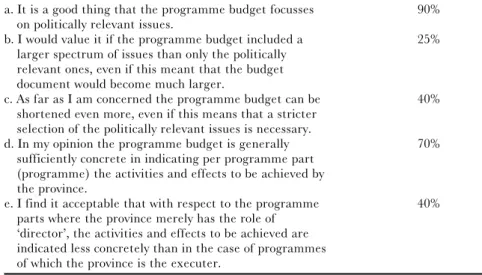
Table 4 summarizes how the respondents valued several elements of the revised budget format (see assessment criterion d in Figure 1).5 The responses to the first three statements in Table 4 show the Council members’ appraisal of selectivity, in the sense that only politically relevant issues (programmes) should be included. The table indicates that selectivity in the current budget, i.e., a focus on politically relevant issues, is supported by a large majority (90% of the respondents, see statement a). The inclusion of more issues in the budget, i.e., less selectivity, is advocated by only 25%, while 40% of the respondents would prefer even more selectivity.
Considering the reactions to statements d and e, Table 4 also shows support for the second type of revision of the budget format, i.e., a concrete specification of activities and effects. The answers to statement d show that according to 70% of the respondents the programme budget indicated the activities and effects in a sufficiently concrete manner. However, the response to statement e suggests that performance differentiation with respect to the role of the province is not supported by a majority of the councillors.6
Table 4
Valuation by Council Members of Revisions to the Budget Format (N=21)
Statement Agree or Strongly Agree*
a. It is a good thing that the programme budget focusses on politically relevant issues.
90% b. I would value it if the programme budget included a
larger spectrum of issues than only the politically relevant ones, even if this meant that the budget document would become much larger.
25%
c. As far as I am concerned the programme budget can be shortened even more, even if this means that a stricter selection of the politically relevant issues is necessary.
40%
d. In my opinion the programme budget is generally sufficiently concrete in indicating per programme part (programme) the activities and effects to be achieved by the province.
70%
e. I find it acceptable that with respect to the programme parts where the province merely has the role of ‘director’, the activities and effects to be achieved are indicated less concretely than in the case of programmes of which the province is the executer.
40%
Note:
*With all statements the respondents could choose among: strongly disagree, disagree, neutral, agree, and strongly agree, while also a non-opinion response was allowed.
The survey also served to obtain an overview of the opinions of the councillors on their use of the budget (see Figure 1, bottom line). Their responses can be summarized as follows: around two thirds of the respondents claimed that they read and used both the general part of the budget and the parts which were, depending upon the councillors’ portfolios (membership of a particular Council committee), the most relevant. One third of the respondents read and used practically the entire budget. A little bit less than half (48%) indicated that the Provincial Council only discussed a number of key issues in the programme budget (including financial affairs in general), whereas the Council committees addressed the contents of the programmes concerned in more detail. According to about 14% the Council and the committees discussed the documents in an intensive and in-depth manner.
Summarizing, the responses of the councillors in the survey indicate that over 60% (i.e., 48%+14%) of them were of the opinion that during the discussions of the programme budget attention was paid to (at least) the main lines of the financial policy and the contents of the programmes.
Value Attached to the Revised Budget in Terms of the Information Use Observed
In addition to the survey on the use of the revised budget as discussed in the previous section, we also attended some Council and Council committee meetings in which the budgetary documents were discussed. Furthermore, we read the minutes of some (other) meetings. This section discusses our observations during these meetings and the results of the analysis of the minutes of meetings of both the Council and the Council committees.
During the budget revision process, which took place prior to the evaluative research presented here, the councillors were intensively involved in the activities of developing a new format. Generally speaking, they approved of the ideas underlying the budget revision. The first discussions about our proposals for a new format, characterized by selectivity, differentiation and concreteness, yielded support from the Council committees. During these discussions various councillors indicated that they would prefer even higher standards of concreteness. After adapting the new format, it was used in two pilot chapters in 2009. A year later the Council committee in charge of budgetary and accounting affairs decided that all programmes had to be designed according to this format. We were thereupon asked to help with the implementation, resulting in a programme budget for 2010, which was completely based on the new format. Both the Council committee in charge of budgetary and accounting affairs and the plenary Provincial Council were positive about the information in the 2010 budget on the activities to be executed and the goals to be realized. All in all, during the meetings of the Council and Council committees the councillors ex-pressed much support for the new budget format and the concrete performance information on the budget’s outcomes. In view of these findings, we subsequently
focussed our evaluative research on the issue of how this positive valuation might become visible in the councillors’ actual use of the budget information.
However, in spite of the satisfaction with the new budget format and the available budget information as expressed during the various meetings and in the minutes we read, we observed that the ‘actual’ use of the information in the budget and annual account meetings we analysed was very limited. This finding applied to both the two pilot chapters in 2009 and the full-fletched new budget for the year 2010, as well as to the accounts over 2009, in which a variance analysis of the plans and their realization was performed for the two pilot chapters. Furthermore, the information in the accounts which covered 2010 was also used to a very limited extent during the meetings. We will illustrate this result with a few examples.
In the Council and Committee meetings during which the budgets were discussed, the available performance information was by no means used in an extensive or critical manner. For instance, in some programmes the ambitions were again formulated vaguely, while the accounts of some of the goals in the annual accounts also remained unclear. None of the councillors, however, critically examined, evaluated or discussed the quality and content of this information. We also observed that the councillors were hardly critical of why some programmes had not been realized as planned. In some cases they merely acknowledged the fact more or less casually and swiftly continued by inquiring how the situation was now and what the expectations were for the future. Neither did we observe any initiatives on the part of the councillors to include new programmes because of their political importance and topicality. In fact, the content of the programme budget still largely remained to be carried out by the civil servants and the Executive without any adaptations by the councillors.
To sum up, despite the positive attitude expressed by the councillors towards the new budget format and the available performance information, and the relative satisfaction with the redesigned budget as expressed in the survey, we could only see a very limited use of this information in practice. During the various Committee and Council meetings the core element of the NPM-approach and the Dutch central government’s ambitions as regards the dual system did not become visible, namely a critical and rational use of outcome-related performance information for decision-making and control purposes. Therefore, we see that the different research methods as used in this study have yielded diverging insights.
DISCUSSION AND CONCLUSION
NPM and the Use of Performance Information
NPM has certainly not been the first attempt to introduce elements of performance measurement and performance budgeting in the governmental
domain (Poister and Streib, 1999, pp. 325–26; and Jackson, 2011, pp. 13–14). Previous discussions on forms of programme budgeting, like those by Wildavsky (1978) and Olson (1990), have underlined the basic notion of rationality in accounting tasks and in programme budgeting. Similar to former approaches, NPM considers performance measurement and performance information as important instruments for making rational choices in governmental policy making (Hood, 1995, pp. 94–97; and Gruening, 2001). The idea behind the availability of high quality performance information to politicians is that it can help them in their decision-making process, e.g., in terms of setting political priorities and linking resources to the performances targeted. Moreover, NPM advocates suggest that an improved quality of the performance information fosters ‘economically rational’ decision making (e.g., Moynihan, 2005a; Pollitt, 2006, pp. 38–39; and Askim, 2007, pp. 453–56).
However, for various reasons NPM, and especially the introduction of performance budgets (with their output- or outcome-oriented performance indicators), often does not seem to fulfil its promises (for the Netherlands, see e.g., van Helden, 2000; and ter Bogt, 2004 and 2008; for some other countries, see e.g., Guthrie and Parker, 1998, pp. 58–61; Mellemvik and Pettersen, 1998, pp. 202–3; Pollitt and Bouckaert, 2004; Johnsen, 2005; and Jackson, 2011). In several cases empirical research has shown that neither citizens nor politicians have a great affinity for the performance information available in budgets and other planning and control documents and that in general it is not widely used (see e.g., Franklin, 2000, pp. 18–21; ter Bogt, 2001, pp. 631–32 and 2004; Melkers and Willoughby, 2005, pp. 183–86; and Pollitt, 2006, pp. 46–47). In a similar vein, Moynihan (2005b, pp. 226–28) observes that as far as the elected officials are concerned the symbolic benefits of ‘managing for results’ are often more important than the more instrumental advantages. Ter Bogt (2004) indicates that these politicians – at least as far as they are members of the Executive – only marginally value the performance information available to them because they generally seem to have a much larger preference for ‘rich’ informal and verbal information than for written formal reports (see also Daft and Macintosh, 1978; and Daft and Lengel, 1986).
However, ter Bogt (2001, pp. 631–32) also found that according to several councillors the planning and control documents would be more useful if their quality was improved. Furthermore, Askim (2007, pp.458–68) observed a more extensive use of the performance information in budgetary documents by councillors in Norwegian municipalities. According to him, this situation can be explained by the well-developed, standardized and mandatory information system used in these municipalities (Askim, 2007, pp. 467–68). In addition, Askim (2009, p. 40) posits that the different ways in which councillors use performance information may also be related to the individual differences among them, for example, by their level of education.
Despite the critical conclusions in several other studies about the use of performance information in the political domain, the findings of ter Bogt (2001)
and Askim (2007 and 2009) do suggest that councillors may come to value and use this information if its quality is improved. In this context quality then implies well-developed quantitative and/or qualitative information particularly adjusted to the specific context of the decision-making or control tasks (i.e., adjusted to a specific policy aspect). Enhancing the quality of performance information might therefore increase its value to the politicians and in turn stimulate its use. As politicians generally appear to prefer verbal information, Pollitt (2006, p. 50) argues that the written reports should be very concise. Furthermore, Askim (2009) proposes that the use of the performance information available could be enhanced by training.
The belief that improved performance information will make politicians more positive about its value, which in turn will stimulate its use, seems to fit the principles of rational management on which NPM is based. Nevertheless, various authors have remained critical towards the role of rationality and formal performance information in decision making and the management of organizations (see e.g., Ansari and Euske, 1987; Brunsson, 1990; ter Bogt, 2004; and Van Dooren, 2005). However, following Simon’s (1976) concept of bounded rationality, Van Dooren (2005, p. 364) argues that, since decision-makers’ rationality ‘is limited by several factors, performance information has to have the right quality for a specific purpose if it is to play a significant role’. This claim suggests that decision-makers, such as councillors, may be interested after all in information of ‘good quality’, which fits their specific needs, and that they will actually start to use this information (see also Chenhall, 2003, p. 132).
Integrating the Complexities of a ‘Real’ Organization into the Performance Budget
In 2007, the councillors of the province of Groningen were critical towards the existing programme budget, while expressing a desire for ‘good’ performance information which would fit their needs. Their criticism and wishes expressed during the interviews conducted to prepare the redesign of the budget, suggested that the councillors were genuinely interested in using the performance information if it was more concrete. Moreover, this new budget was meant to take the heterogeneity of the provincial tasks and roles into account, as well as the desire to avoid an information overload (see also Figure 1).
Hood (1995, p. 95) indicates that NPM gives a prominent role to explicit performance measures related to clearly defined targets, which replace the qualitative and implicit performance standards as used in the traditional public administration. Guthrie et al. (1999, p. 223) also conclude that, despite the differences among countries, a general characteristic of NPM is an increased concern with reporting performance. In practice this focus on performance often manifests itself by the use of relatively simple forms of output and/or outcome measurement. NPM ideas also prevail in types of performance budgeting which link resources to units of outputs under the implicit assumption that organizations’ outputs are homogeneous (Freeman and Shoulders, 2003,
p. 94; and Mikesell, 2011, pp. 242–45). Based on such a point of departure, a performance budget could be defined as the cost per unit of output multiplied by the number of units of this output and, in case outcomes are referred to, as the ‘quantity’ of outcomes which follows from this number of outputs.
This definition does not imply that several authors have not already discussed the technical and behavioral complexities of performance measurement in the past (see e.g., Ridgway, 1956; Carter, 1991; Johnsen, 2005; and Hood, 2007). An author like Diefenbach (2009, pp. 899–902) has pointed to the tension between the logic of using quantitative performance indicators in planning and control decisions and the resulting overemphasis on number crunching in the steering and monitoring of public sector organizations in practice. However, despite this criticism and the fact that different forms of performance measurement can be distinguished (see e.g., OECD, 2007), in practice many public sector organizations in the Netherlands have interpreted NPM as a rather technical and simple form of performance budgeting in which the budgeted resources (in a ‘cost per unit’ system) were straightforwardly linked to performance (this was the case, for example, in the so-called PMI project initiated for local governments; van Helden, 1998). We have indicated that the complexities of the provincial tasks and roles often do not match with the rather simple conceptualizations of the transformation process, which frequently seem to be adopted in practice (see, e.g., Schrijvers, 1993; Van der Knaap, 2000; Young, 2003; and OECD, 2007, p. 23). In the provincial context it is often not easy to determine efficiency (which in a business context relates inputs to homogeneous outputs to determine whether the latter are produced at ‘acceptable’ costs) or effectiveness (which links homogeneous outputs to outcomes to establish whether the outputs have led to the desired effects).
The majority of the tasks of the Dutch province as studied could not be measured properly by using the traditional conceptualization of the transformation process reflected by a straightforward approach to performance measurement and budgeting. Therefore, we argued that in conceptualizing the transformation process and the performance management, the complexities of the provincial domain have to be taken into account explicitly. In Box 1 we already indicated some of the complexities of the programmes and projects of a provincial organization.
The examples in Box 1 clarify a number of issues, firstly that several activities of provinces are undertaken in collaboration with other actors, such as municipalities, as well as profit and not-for-profit organizations (in Box 1: a private railway company).7This cooperation can, for example, involve processes of co-production in which it is difficult to specify the exact contribution of each of the participants. In the redesign of the performance budget, it therefore had to be acknowledged that a one-sided focus on the contributions of the province as one of the actors involved would only provide a partial picture of the whole of activities in and outcomes of the project. Moreover, it would be difficult, of course, to determine the contribution of each separate participant
to the outcomes. Secondly, in the programme budget as required by the dual system, outcomes rather than outputs are relevant. However, as can also be inferred from some of the examples in Box 1, several of the outcomes (effects) will only be observable beyond the annual budget cycle. Therefore, in order for the redesigned budget to provide concrete performance information which specifically pertained to a particular budget year,8 the issues discussed had in several cases to be restricted to phenomena observable within the annual budget cycle, such as activities. Thirdly, as observed before, many provincial tasks can be characterized as relatively unique, which means that their aim is often to realize a particular project or programme rather than to organize a production process which generates a homogeneous output. This aspect, however, seems to be in conflict with the assumptions that underlie the NPM perspective on performance measurement and performance budgeting. In a project-context there are usually no specific output indicators or they are meaningless. ‘The number of projects finalized’, for example, is not very informative with respect to the activities that actually took place.
A project or programme is generally a complex set of interrelated tasks whose characterization requires extensive information on the nature of the underlying activities and their effects. In order to develop a performance budget which might meet the councillors’ prerequisites, therefore, the new version had to include such extensive information (see also ter Bogt, 2001). However, it was also essential to avoid information overload as a result of too detailed descriptions of all the activities and programmes. So the new performance budget had to be specifically concentrated on a restricted number of politically relevant or sensitive programmes, accompanied by only brief (financial) accounts of the politically non-sensitive and/or routine programmes and their activities.
These three observations, made during the period we did our advisory work, could help in handling the complexities of the provincial domain. Since the performance budget of the province of Groningen included several tasks and programmes to which one or two, or all three of these circumstances applied, we concluded that NPM’s ‘traditional’ ideas about the transformation process and performance budgeting would not suit this particular context. We therefore developed a conceptualization of the transformation process in which the complexities as described above are explicitly taken into account; see Figure 2.9 Figure 2 shows the situation in practice where a more differentiated type of performance measurement and budgeting may be needed instead of the straightforward uniform approach, as often propagated by the traditional NPM advocates. The figure depicts the need to take the complexities of the tasks and programmes of organizations in the provincial domain into consideration. These complexities, as well as the principles of the dual system and the criticisms and desires as expressed by the councillors in 2007, formed the basis of our framework, in which differentiation is a key facet. This means that, in order to make the information useful to councillors, the type of performance information provided has to depend on the kinds of activities in the programme. In addition,
Figure 2
The Extended Conceptualization of the Transformation Process of Provincial Organizations Inputs Multiple throughputs Outputs EFFICIENCY EFFECTIVENESS Jointly realized multiple outcomes
Jointly realized multiple outcomes beyond budget year
Transformation process of the organizations which co-produce the outcomes in collaboration with the focus organization
given that politicians (members of the Provincial Council) are the primary users of the programme budget, the main focus had to be on outcomes/effectiveness rather than on results/efficiency (as stipulated by the legislator when the dual system and programme budget were introduced).10
The above discussion challenges (at least partially) some of the performance measurement and performance budgeting ideas core to the NPM philosophy of steering and controlling public sector organizations. In this way, it also challenges the ambitions of the Dutch central government when it introduced the programme budgets.
In principle, the redesigned budget might better meet the performance information desires of the councillors. As indicated before, and in line with Askim (2007and 2009), the more the councillors value the information available to them, the more they may actually use it in their decision-making and control tasks. This assumption seems to fit the NPM ideas about rationality, or at least Simon’s (1976) and Van Dooren’s (2005) more narrow conceptualization of the ‘bounded rationality’ of policy makers, which requires performance information of ‘good’ quality if it is supposed to play a role in the decision-making process. However, also this (bounded) rational use of performance information has been contested by various authors (see above). We therefore tried to obtain additional knowledge of how the members of the Provincial Council – the primary users – actually valued and used the information developed on the basis of our extended performance model.
Do Politicians Use ‘Good’ Performance Information?
In the evaluative empirical research as presented before, we investigated whether a more differentiated form of performance budgeting which captures the complexities of the provincial government domain, would be useful to the users within this context, as summarized in Figure 2. This redesigned budget was meant to enable organizations to produce performance budgets in line with the demands of both the dual system and the councillors. The bottom box of Figure 1 includes the criteria used to assess the 2010 performance budget of the province of Groningen.
The empirical findings presented in the previous section indicate that the idea to differentiate the performance information included in the perfor-mance budget on the basis of the role/task of the province is supported by the evidence from the evaluation of the 2010 programme budget (see Table 3). To some extent this support also applies to the differentiation on the basis of the stage in the policy making cycle, although the results are more ambiguous here. Furthermore, the councillors indicated that they generally valued the selectivity in the redesigned performance budget positively, while they were also rather satisfied with the concreteness of the performance information. So it seems that the ‘conditions’ for a bounded rational use of the information in the performance budget were at least met to a considerable extent. Similarly, over 60% of the responding councillors indicated in the survey that attention was now paid to (the main lines of) the financial policy and the contents of the programmes during the discussions in the Council and in the Council committee meetings about the performance budget and the related annual report. All in all, confronting the above results of our empirical findings with the five criteria indicated in Figure 1 – criteria which challenge the traditional NPM ideas – is likely to lead to a mainly ‘positive’ evaluation of the redesigned budget (and the underlying extended conceptualization of the transformation process, as depicted in Figure 2).
However, during our field research we also found that the actual, visible use of the performance information in the budget during the Council and Council committee meetings turned out to be very limited. In fact, we did not really observe a critical and rational use of this information for decision-making and control purposes, as core to the NPM-approach and the dual system, as promoted by the Dutch central government.
At the moment we can only speculate about the reasons why the councillors did not make much use of the budgetary information, although they seemed to be rather positive about it. One reason could be that in spite of the improved clarity of the information, which is essential in strengthening the processes of democratic governance (Guthrie et al., 1999, pp. 224–25), and the fact that the councillors had been involved in the redesign of the budget, its content was still too complex for many of them. This assumption may particularly apply, as noted by Hyndman (2008, pp. 64–66), to councillors who are ‘outsiders’ with respect
to (expertise in) accounting and accountability issues and to the committees in which these matters were discussed. Perhaps training, as suggested by Askim (2009), can help reduce such problems.
The fact that the councillors were involved in the redesign process of the budget could also have played a role in the positive valuation of the new format (despite the still limited use of the budget information). During their participation in the process we, as consultant-researchers, consulted them about their ideas and discussed with them the results of the two pilot projects and the accountability issues. Therefore, they may have considered the new format as the result of a process to which they had contributed. Moreover, their involvement in the process may have had a learning effect (giving them a better understanding of the difficulties associated with performance measurement). These elements may have led to a rather positive assessment as indicated by the review of the new budget format, while the actual use of the information remained limited.
However, the fact that many politicians do not use performance information could also be regarded from an efficiency perspective, i.e., as economically and politically rational behaviour. Johnsen (2008, pp. 147–48), for example, observes that (Norwegian) politicians rely on a ‘division of labour’ and only specialize in certain policy fields. Johnsen further notes that these politicians mainly focus on information which they perceive as potentially politically relevant to them. Although further research may bring more clarity with respect to this matter, this finding could also apply to the province of Groningen, given that most councillors have to do their political work within a limited time scale. Perhaps they simply do not consider it worthwhile or efficient to spend much time on making critical evaluations of the programmes in the budget whenever they do not see politically relevant problems (which may even imply, that as far as they are concerned, the information available to them is satisfying).11
The above reflections reveal some ambiguity in our research findings. They support the desirability of differentiation, but also seem to question NPM’s implicit assumption of (economic) rationality in decision making. The latter could be regarded as casting doubt on the statement that a redesign of the budget based on differentiated and ‘proper’ performance information (i.e., valued by those involved) automatically leads to a more intensive use of this information in the process of decision-making and control. It seems that the results of our study do not really support such a claim. But it is not clear whether our findings are the result of, for example, ‘efficient’ behaviour on the part of the politicians, i.e., another form of rationality than the economic rationality NPM assumes (see also ter Bogt, 2003, pp. 155, 175–76), or due to the psychological mechanism of giving ‘desirable’ answers in a survey, which is a more cynical explanation. Of course, the difference between the results of the survey and those of the other two methods could be an indication that survey research is subject to diverse forms of bias (e.g., selection bias and intervention bias) and that in this kind of context method triangulation is crucially important, as suggested by e.g., Modell (2009) and Vaivio and Sir´en (2010). But this is an issue for further research.
Our paper challenges the NPM ideas about the transformation process and the conceptualization of the performance budgeting in government organizations. Furthermore, our findings seem to raise (additional) doubts about NPM’s implicit assumption of the ‘rational’ use of information by politicians. However, with respect to the latter, we also have to conclude that the different research methods as used in our study have led to diverging results. These heterogeneous findings make it difficult to draw unambiguous conclusions with respect to the usefulness of the more extended conceptualization of the transformation process and the performance measurement/budgeting as proposed on the basis of Figure 2. Differentiation of performance information seems to make sense, but it remains unclear whether as a result of this adaptation its use has really increased. In this respect, the results from our research do not clearly support a claim that ‘better’ information leads to a more intensive use. These findings also further emphasize the relevance of data triangulation in academic (case study) research, since a focus on only one research method has appeared to involve the risk of conclusion bias.
NOTES
1 Words like ‘value’ can have different meanings. In the context of our research the term indicates a positive appraisal of the performance information available because it is regarded as useful.
2 In a similar way a separation of the responsibilities and powers of the Council and the Executive was introduced in municipalities. The Provincial Council of Groningen includes 43 members who are elected every four years and who generally come together once every month in a Council meeting. The members additionally attend monthly Council committee meetings where particular portfolios are dealt with. Here the Council meetings are prepared and the opportunity is given to discuss particular issues at a more detailed policy level. Councillors are elected by the citizens, whereas the members of the Executive are elected by the councillors. The function of a councillor is mostly a part-time activity, i.e., often about fifteen hours a week. Members of the Executive are full-time politicians. The various daily activities of the provincial organization are executed by managers (who are not politicians) and the other civil servants.
3 It may be appropriate to explain what is meant by the terms throughputs (i.e., activities), outputs (i.e., products) and outcomes (i.e., effects) as used throughout this paper. A public sector organization is traditionally conceptualized as a transformation process in which inputs are required for the execution of activities (throughputs), whereby products (outputs) are produced that ultimately generate effects (outcomes). This conceptualization enables an assessment of the organization’s efficiency and effectiveness (see, for example, Johnsen, 2005, p. 11; and Jackson, 2011, p. 16). Efficiency relates the inputs to the outputs and establishes whether the outputs are produced at acceptable costs. Effectiveness links the outcomes to the outputs, enabling the organization to find out whether the outputs have led to the desired effects. So based on this conceptualization, activities (throughputs) are stages in the process that an organization needs to follow in order to deliver certain products (outputs) to external parties, such as citizens or other organizations. With the production of these outputs certain effects (outcomes) have to be achieved. Although it could be argued that it is often difficult to realize an effect (outcome) within a one-year budget period, Dutch central government supports a focus of the outcome-oriented programme budgets on visible outcomes in that same budget year.
4 Although the statistical analysis is not core to our (in general more qualitative) research, we included this ‘mixed methods’ element (Modell, 2009) in our analysis because it provides additional information. In Tables 2 and 3 two assumptions are tested. Both have been