Foundations for the Study of Software Architecture
Dewayne E. Perry
AT&T Bell Laboratories
600 Mountain Avenue
Murray Hill, New Jersey 07974
[email protected]
Alexander L. Wolf
Department of Computer Science
University of Colorado
Boulder, Colorado 80309
[email protected]
c
1989,1991,1992 Dewayne E. Perry and Alexander L. Wolf
ABSTRACT
The purpose of this paper is to build the foundation for software architecture. We rst develop an intuition for software architecture by appealing to several well-established architectural disciplines. On the basis of this intuition, we present a model of software architec-ture that consists of three components: elements, form, and rationale. Elements are either processing, data, or connecting elements. Form is dened in terms of the properties of, and the relationships among, the elements | that is, the constraints on the elements. The ratio-nale provides the underlying basis for the architecture in terms of the system constraints, which most often derive from the system requirements. We discuss the compo-nents of the model in the context of both architectures and architectural styles and present an extended exam-ple to illustrate some important architecture and style considerations. We conclude by presenting some of the benets of our approach to software architecture, sum-marizing our contributions, and relating our approach to other current work.
1 Introduction
Software design received a great deal of attention by researchers in the 1970s. This research arose in response to the unique problems of developing large-scale soft-ware systems rst recognized in the 1960s [5]. The premise of the research was that design is an activity separate from implementation, requiring special nota-tions, techniques, and tools [3, 9, 17]. The results of this software design research has now begun to make in-roads into the marketplace as computer-aided software engineering (CASE) tools [7].
In the 1980s, the focus of software engineering re-search moved away from software design specically and
more toward integrating designs and the design process into the broader context of the software process and its management. One result of this integration was that many of the notations and techniques developed for soft-ware design have been absorbed by implementation lan-guages. Consider, for example, the concept of support-ing \programmmsupport-ing-in-the-large". This integration has tended to blur, if not confuse, the distinction between design and implementation.
The 1980s also saw great advances in our ability to describe and analyze software systems. We refer here to such things as formal descriptive techniques and sophis-ticated notions of typing that enable us to reason more eectively about software systems. For example, we are able to reason about \consistency" and \inconsistency" more eectively and we are able to talk about \type conformance"1rather than just \type equivalence".
The 1990s, we believe, will be the decade ofsoftware architecture. We use the term \architecture", in con-trast to \design", to evoke notions of codication, of abstraction, of standards, of formal training (of soft-ware architects), and of style. While there has been some work in dening particular software architectures (e.g., [19, 22]), and even some work in developing gen-eral support for the process of developing architectures (notablySara[8]), it is time to reexamine the role of
ar-chitecture in the broader context of the software process and software process management, as well as to marshal the various new techniques that have been developed.
Some of the benets we expect to gain from the emer-gence of software architecture as a major discipline are: 1) architecture as the framework for satisfying require-ments; 2) architecture as the technical basis for design
1Conformance is used to describe the relationship between
and as the managerial basis for cost estimation and pro-cess managment; 3) architecture as an eective basis for reuse; and 4) architecture as the basis for dependency and consistency analysis.
Thus, the primary object of our research is support for the development and use of software architecture specications. This paper is intended to build the foun-dation for future research in software architecture. We begin in Section 2 by developing an intuition about software architecture against the background of well-established disciplines such as hardware, network, and building architecture, establish the context of software architecture, and provide the motivation for our ap-proach. In Section 3, we propose a model for, and a characterization of, software architecture and software architectural styles. Next, in Section 4, we discuss an easily understood example to elicit some important as-pects of software architecture and to delineate require-ments for a software-architecture notation. In Section 5, we elaborate on two of the major benets of our ap-proach to software architecture. We conclude, in Sec-tion 6, by summarizing the major points made in this paper and considering related work.
2 Intuition, Context, and Motivation
Before presenting our model of software architecture, we lay the philosophical foundations for it by: 1) devel-oping an intuition about software architecture through analogies to existing disciplines; 2) proposing a con-text for software architecture in a multi-level product paradigm; and 3) providing some motivation for soft-ware architecture as a separate discipline.
2.1 Developing an Intuition about
Soft-ware Architecture
It is interesting to note that we do not have named
software architectures. We have some intuition that there are dierent kinds of software architectures, but we have not formalized, or institutionalized, them. It is our claim that it is because there are so many software architectures, not because there are so few, that the present state of aairs exists. In this section we look at several architectural disciplines in order to develop our intuition about software architecture. We look at hard-ware and network architecture because they have tra-ditionally been considered sources of ideas for software architecture; we look at building architecture because it is the \classical" architectural discipline.
2.1.1 Computing Hardware Architecture
There are several dierent approaches to hardware architecture that are distinguished by the aspect of the hardware that is emphasized. RISC machines are ex-amples of a hardware architecture that emphasizes the instruction set as the important feature. Pipelined ma-chines and multi-processor machines are examples of hardware architectures that emphasize the congura-tion of architectural pieces of the hardware.
There are two interesting features of the second ap-proach to hardware architecture that are important in our consideration of software architecture:
there are a relatively small number of design
ele-ments; and
scale is achieved by replication of these design
ele-ments.
This contrasts with software architecture, where there is an exceedingly large number of possible design elements. Further, scale is achieved not by replicating design el-ements, but by adding more distinct design elements. However, there are some similarities: we often organize and congure software architectures in ways analogous to the hardware architectures mentioned above. For ex-ample, we create multi-process software systems and use pipelined processing.
Thus, the important insight from this discussion is that there are fundamental and important dierences between the two kinds of architecture. Because of these dierences, it is somewhat ironic that we often present software architecture in hardware-like terms.
2.1.2 Network Architecture
Network architectures are achieved by abstracting the design elements of a network into nodes and connec-tions, and by naming the kinds of relationships that these two elements have to each other. Thus we get
star networks,ringnetworks, andmanhattan street net-works as examples of named network architectures.
The two interesting architectural points about net-work architecture are:
there are two components | nodes and
connec-tions; and
there are only a few topologies that are considered.
It is certainly the case that we can abstract to a similar level in software architecture | for example, processes and inteprocess communication. However, rather than a few topologies to consider, there are an exceedingly
large number of possible topologies and those topolo-gies generally go without names. Moreover, we empha-size aspects dierent from the topology of the nodes and connections. We consider instead such matters as the placement of processes (e.g., distributed architectures) or the kinds of interprocess communication (e.g., mes-sage passing architectures).
Thus, we do not benet much from using networks as an analogy for software architecture, even though we can look at architectural elements from a similar level of abstraction.
2.1.3 Building Architecture
The classical eld of architecture provides some of the more interesting insights for software architecture. While the subject matter for the two is quite dierent, there are a number of interesting architectural points in building architecture that are suggestive for software architecture:
multiple views; architectural styles; style and engineering; and style and materials.
A building architect works with the customer by means of a number of dierent views in which some particular aspect of the building is emphasized. For example, there are elevations and oor plans that give the exterior views and \top-down" views, respectively. The elevation views may be supplemented by contextual drawings or even scale models to provide the customer with the look of the building in its context. For the builder, the architect provides the same oor plans plus additional structural views that provide an immense amount of detail about various explicit design consider-ations such as electrical wiring, plumbing, heating, and air-conditioning.
Analogously, the software architect needs a number of dierent views of the software architecture for the var-ious uses and users. At present we make do with only one view: the implementation. In a real sense, the im-plementation is like a builders detailed view | that is, like a building with no skin in which all the details are visible. It is very dicult to abstract the design and ar-chitecture of the system from all the details. (Consider the Pompidou Center in Paris as an example.)
The notion of architectural style is particularly use-ful from both descriptive and prescriptive points of
view. Descriptively, architectural style denes a partic-ular codication of design elements and formal arrange-ments. Prescriptively, style limits the kinds of design elements and their formal arrangements. That is, an architectural style constrains both the design elements and the formalrelationships among the design elements. Analogously, we shall nd this a most useful concept in software architecture.
Of extreme importance is the relationship between engineering principles and architectural style (and, of course, architecture itself). For example, one does not get the light, airy feel of the perpendicular style as ex-emplied in the chapel at King's College, Cambridge, from romanesque engineering. Dierent engineering principles are needed to move from the massiveness of the romanesque to lightness of the perpendicular. It is not just a matter of aesthetics. This relationship be-tween engineering principles and software architecture is also of fundamental importance.
Finally, the relationship between architectural style and materials is of critical importance. The materi-als have certain properties that are exploited in pro-viding a particular style. One may combine structural with aesthetic uses of materials, such as that found in the post and beam construction of tudor-style houses. However, one does not build a skyscraper with wooden posts and beams. The material aspects of the design elements provide both aesthetic and engineering bases for an architecture. Again, this relationship is of critical importance in software architecture.
Thus, we nd in building architecture some funda-mental insights about software architecture: multiple views are needed to emphasize and to understand dif-ferent aspects of the architecture; styles are a cogent and important form of codication that can be used both descriptively and prescriptively; and, engineering principles and material properties are of fundamental importance in the development and support of a partic-ular architecture and architectural style.
2.2 The Context of Architecture
Before discussing our motivation for software archi-tecture specications, we posit a characterization of ar-chitecture in the context of the entire software product. Note that we do not mean to imply anything about the particular process by which this product is created | though of course there may be implications about the process that are inherent in our view. Our purpose is primarily to provide a context for architecture in what would be considered a fairly standard software product. We characterize the dierent parts of the software
product by the kinds of things that are important for that part | the kinds of entities, their properties and relationships that are important at that level, and the kinds of decision and evaluation criteria that are rele-vant at that level:
requirementsare concerned with the determination
of the information, processing, and the character-istics of that information and processing needed by the user of the system;2
architectureis concerned with the selection of
archi-tectural elements, their interactions, and the con-straints on those elements and their interactions necessary to provide a framework in which to sat-isfy the requirements and serve as a basis for the design;
design is concerned with the modularization and
detailed interfaces of the design elements, their algorithms and procedures, and the data types needed to support the architecture and to satisfy the requirements; and
implementation is concerned with the
representa-tions of the algorithms and data types that satisfy the design, architecture, and requirements. The dierent parts of a particular product are by no means as simple as this characterization. There is a continuum of possible choices of models, abstractions, transformations, and representations. We simplify this continuum into four discrete parts primarily to provide an intuition about how architecture is related to the requirements and design of a software system.
It should be noted that there are some development paradigms to which our characterization will not apply | for example, the exploratory programming paradigm often found in AI research. However, our characteriza-tion represents a wide variety of development and evo-lutionary paradigms used in the creation of production software, and delineates an important, and hitherto un-derconsidered, part of a unied software product [15].
2.3 Motivation for Architectural
Speci-cations
There are a number of factors that contribute to the high cost of software. Two factors that are important
2Note that the notion of requirementspresented here is an
ide-alistic one. In practice, requirementsare not so \pure"; they often contain constraintson the architectureof a system, constraintson the system design, and even constraints on the implementation.
to software architecture are evolution and customiza-tion. Systems evolve and are adapted to new uses, just as buildings change over time and are adapted to new uses. One frequently accompanying property of evolu-tion is an increasing brittleness of the system | that is, an increasing resistance to change, or at least to chang-ing gracefully [5]. This is due in part to two architec-tural problems: architectural erosion and architectural drift. Architectural erosion is due to violations of the ar-chitecture. These violations often lead to an increase in problems in the system and contribute to the increasing brittleness of a system | for example, removing load-bearing walls often leads to disastrous results. Architec-tural drift is due to insensitivity about the architecture. This insensitivity leads more to inadaptability than to disasters and results in a lack of coherence and clarity of form, which in turn makes it much easier to violate the architecture that has now become more obscured.
Customization is an important factor in software ar-chitecture, not because of problems that it causes, but because of the lack of architectural maturity that it in-dicates. In building software systems, we are still at the stage of recreating every design element for each new architecture. We have not yet arrived at the stage where we have a standard set of architectural styles with their accompanying design elements and formal arrangements. Each system is, in essence, a new ar-chitecture, a new architectural style. The presense of ubiquitous customization indicates that there is a gen-eral need for codication | that is, there is a need for architectural templates for various architectural styles. For the standard parts of a system in a particular style, the architect can select from a set of well-known and understood elements and use them in ways appropriate to the desired architecture. This use of standard tem-plates for architectural elements then frees the architect to concentrate on those elements where customization is crucial.
Given our characterization of architecture and moti-vating problems, there are a number of things that we want to be able to do with an architectural specication:
Prescribe the architectural constraints to the desired level | that is, indicate the desired restrictiveness or permissiveness, determine the desired level of generality or particularity, dene what is necessity and what is luxury, and pin-point the degree of rel-ativeness and absoluteness. We want a means of supporting a \principle of least constraint" to be able to to express only those constraints in the ar-chitecture that are necessary at the architectural level of the system description. This is an
impor-tant departure from current practice that, instead of specifying the constraints, supplies specic solu-tions that embody those desired constraints.
Separate aesthetics from engineering | that is,
in-dicate what is \load-bearing" from what is \dec-oration". This separation enables us to avoid the kinds of changes that result in architectural erosion.
Express dierent aspects of the architecture in an appropriate manner | that is, describe dierent parts of the architecture in an appropriate view.
Perform dependency and consistency analysis |
that is, determine the interdependencies between architecture, requirements and design; determine interdependencies between various parts of the ar-chitecture; and determine the consistency, or lack of it, between architectural styles, between styles and architecture, and between architectural ele-ments.
3 Model of Software Architecture
In Section 2 we use the eld of building architecture to provide a number of insights into what software ar-chitecture might be. The concept of building architec-ture that we appeal to is that of the standard denition:
\The art or science of building: especially designing and building habital structures" [11]. Perhaps more relevant to our needs here is a secondary denition: \A unifying or coherent form or structure" [11]. It is this sense of architecture | providing a unifying or coherent form or structure | that infuses our model of software archi-tecture.
We rst present our model of software architecture, introduce the notion of software architectural style, and discuss the interdependence of processing, data, and connector views.
3.1 The Model
By analogy to building architecture, we propose the following model of software architecture:
Software Architecture =
fElements, Form, Rationaleg
That is, a software architecture is a set of architectural (or, if you will, design) elements that have a particular form.
We distinguish three dierent classes of architectural
elements:
processing elements; data elements; and connecting elements.
The processing elements are those components that sup-ply the transformation on the data elements; the data elements are those that contain the information that is used and transformed; the connecting elements (which at times may be either processing or data elements, or both) are the glue that holds the dierent pieces of the architecture together. For example, procedure calls, shared data, and messages are dierent examples of connecting elements that serve to \glue" architectural elements together.
Consider the example of water polo as a metaphor for the dierent classes of elements: the swimmers are the processing elements, the ball is the data element, and water is the primary connecting element (the \glue"). Consider further the similaritiesof water polo, polo, and soccer. They all have a similar \architecture" but dif-fer in the \glue" | that is, they have similar elements, shapes and forms, but dier mainly in the context in which they are played and in the way that the elements are connected together. We shall see below that these connecting elements play a fundamental part in distin-guishing one architecture from another and may have an important eect on the characteristics of a particu-lar architecture or architectural style.
The architectural form consists of weighted proper-ties and relationships. The weighting indicates one of two things: either the importance of the property or the relationship, or the necessity of selecting among alterna-tives, some of which may be preferred over others. The use of weighting to indicate importance enables the ar-chitect to distinguish between \load-bearing" and \dec-orative" formal aspects; the use of weighting to indicate alternatives enables the architect to constrain the choice while giving a degree of latitude to the designers who must satisfy and implement the architecture.
Properties are used to constrain the choice of archi-tectural elements | that is, the properties are used to dene constraints on the elements to the degree desired by the architect. Properties dene the minimum de-sired constraints unless otherwise stated | that is, the default on constraints dened by properties is: \what is not constrained by the architect may take any form desired by the designer or implementer".
Relationships are used to constrain the \placement" of architectural elements | that is, they constrain how the dierent elements may interact and how they are organized with respect to each other in the architecture.
As with properties, relationships dene the minimum desired constraints unless otherwise stated.
An underlying, but integral, part of an architecture is therationalefor the various choices made in dening an architecture. The rationale captures the motivation for the choice of architectural style, the choice of elements, and the form. In building architecture, the rationale explicates the underlying philosophical aesthetics that motivate the architect. In software architecture, the rationale instead explicates the satisfaction of the sys-tem constraints. These constraints are determined by considerations ranging from basic functional aspects to various non-functional aspects such as economics [4], performance [2] and reliability [13].
3.2 Architectural Style
If architecture is a formal arrangement of architec-tural elements, then architecarchitec-tural style is that which abstracts elements and formal aspects from various spe-cic architectures. An architectural style is less con-strained and less complete than a specic architecture. For example, we might talk about adistributed style or amulti-process style. In these cases, we concentrate on only certain aspects of a specic architecture: relation-ships between processing elements and hardware pro-cessors, and constraints on the elements, respectively.
Given this denition of architecture and architectural style, there is no hard dividing line between where ar-chitectural style leaves o and architecture begins. We have a continuum in which one person's architecture may be another's architectural style. Whether it is an architecture or a style depends in some sense on the use. For example, we propose in Section 2.3 that archi-tectural styles be used as constraints on an architecture. Given that we want the architectural specication to be constrained only to the level desired by the architect, it could easily happen that one person's architecture might well be less constrained than another's architec-tural style.
The important thing about an architectural style is that it encapsulates important decisions about the architectural elements and emphasizes important con-straints on the elements and their relationships. The useful thing about style is that we can use it both to constrain the architecture and to coordinate cooperat-ing architects. Moreover, style embodies those decisions that suer erosion and drift. An emphasis on style as a constraint on the architecture provides a visibility to certain aspects of the architecture so that violations of those aspects and insensitivity to them will be more obvious.
3.3 Process/Data/Connector
Interdependence
As mentioned above, an important insight from build-ing architecture is that of multiple views. Three im-portant views in software architecture are those of pro-cessing, data, and connections. We observe that if a process view3of an architecture is provided, the
result-ing emphasis is on the data ow though the processresult-ing elements and on some aspects of the connections be-tween the processing elements with respect to the data elements. Conversely, if a data view of an architecture is provided, the resulting emphasis is on the process-ing ow, but with less an emphasis on the connectprocess-ing elements than we have in the process view. While the current common wisdom seems to put the emphasis on object-oriented (that is, data-oriented) approaches, we believe that all three views are necessary and useful at the architectural level.
We argue informally, in the following way, that there is a process and data interdependence:
there are some properties that distinguish one state
of the data from another; and
those properties are the result of some
transforma-tion produced by some processing element. These two views are thus intertwined | each dependent on the other for at least some of the important charac-teristics of both data and processing. (For a more gen-eral discussion of process and data interdependence, see [10].)
The interdependence of processing and data upon the connections is more obvious: the connecting elements are the mechanisms for moving data around from pro-cessor to propro-cessor. Because of this activity upon the data, the connecting elements will necessarily have some of the properties required by the data elements in pre-cisely the same way that processing elements have some of the properties required by the data elements.
At the architectural level, we need all three views and the ability to move freely and easily among them. Our example in the next section provides illustrations of this interdependence and how we might provide three dierent, but overlapping, views.
3We use the dichotomyof
processanddatainstead offunction
andobject because these terms seem to be more neutral. The
latter terms seem to suggest something more specic in terms of programming than the former.
4 Examples
One of the few software architectural styles that has achieved widespread acceptance is that of the multi-phase compiler. It is practically the only style in which every software engineer is expected to have been trained. We rely on this familiarity to illustrate some of the insights that we have gained into software archi-tectures and their descriptions.
In this section we look at two compiler architectures of the multi-phase style:
a compiler that is organized sequentially; and a compiler that is organized as a set of parallel
pro-cesses connected by means of a shared internal rep-resentation.
Because of space limitations and for presentation pur-poses, our examples are somewhat simplied and ideal-ized, with many details ignored. Moreover, we use exist-ing notations because they are convenient for illustrative purposes; proposals for specic architectural notations are beyond the scope of this paper. In each case we focus on the architectural considerations that seem to be the most interesting to derive from that particular example. (Of course, other examples of multi-phase compiler ar-chitectures exist and we make no claims of exhaustive coverage of this architectural landscape.) Before explor-ing these examples, we provide a brief review of their common architectural style.
4.1 The Multi-phase Architectural
Style
Our simplied model of a compiler distinguishes ve phases: lexical analysis, syntactic analysis, semantic analysis, optimization, and code generation. Lexical analysis acts oncharacters in a source text to produce
tokens for syntactic analysis. Syntactic analysis pro-duces phrases that are either denition phrases or use phrases. Semantic analysis correlates use phrases with denition phrases | i.e., each use of a program element such as an identier is associated with the denition for that element, resulting incorrelated phrases. Optimiza-tion produces annotations on correlated phrases that are hints used during generation of object code. The optimization phase is considered a preferred, but not necessary, aspect of this style. Thus, the multi-phase style recognizes the following architectural elements:
processing elements: lexer, parser, semantor, op-timizer, and code generator; and
data elements: characters, tokens, phrases, correlated phrases, annotated phrases, and object code. Notice that we have not specied connecting elements. It is simply the case that this style does not dictate what connecting elements are to be used. Of course, the choice of connecting elements has a profound impact on the resulting architecture, as shown below.
The form of the architectural style is expressed by weighted properties and relationships among the archi-tectural elements. For example, the optimizer and an-notated phrases must be found together, but they are both only preferred elements, not necessary. As an-other example, there are linear relationships between the characters constituting the text of the program, the tokens produced by the lexer, and the phrases produced by the parser. In particular, tokens consist of a sequence of characters, and phrases consist of a sequence of to-kens. However, there exists a non-linear relationship between phrases and correlated phrases. These relation-ships are depicted in Figure 1. As a nal example, each of the processing elements has a set of properties that denes the constraints on those elements. The lexer, for instance, takes as input the characters that represent the program text and produces as output a sequence of tokens. Moreover, there is an ordering correspondence between the tokens and the characters that must be preserved by the lexer. A good architectural descrip-tion would capture these and other such properties and relationships.
Let us illustrate this by formally describing the rela-tionship between characters and tokens and describing the order-preserving property of the lexer. We begin the description with a data view stated in terms of se-quences and disjoint subsese-quences.
Let C = fc
1;c2;...;cm
g be a sequence of
char-acters representing a source text, Cij i j be a
subsequence of C whose elements are all the el-ements in C between ci and cj inclusive, T =
ft
1;t2;...;tn
g be a sequence of tokens, and \
=" indicate the correspondence between a token inT
and a subsequence ofC. T is said topreserve C
if there exists an i, j, k, q, r, and s such that 1i < jm, 1< k < n, 1< q r < m, and
for allt2T there exists aCxysuch that: t= 8 > > > > > < > > > > > : C1 i ift=t1 Cjm ift=tn Cqr ift=tk, where9u,v 1uq,1 r+ 1vm tk,1 =Cuq,1 tk+1 =Cr+1 v
Correlated Phrases Phrases
Tokens Characters
Figure 1: Data Element Relationships.
The lexer is now constrained from a processing perspec-tive to accept a sequence of characters C, produce a
sequence of tokensT, and to preserve the ordering
cor-respondence between characters and tokens: lexer: C!T, where T preserves C
Finally, it is interesting to note that the connec-tor view reveals additional constraints that should be placed on the architectural style. These constraints are illustrated by the connection between the lexer and the parser. In particular, connecting elements must ensure that the tokens produced by the lexer are preserved for the parser, such that the order remains intact and that there are no losses, duplicates, or spurious additions.
4.2 Sequential Architecture
If there is a \classical" multi-phase compiler archi-tecture, then it is the sequential one, in which each phase performs its function to completion before the next phase begins and in which data elements are passed directly from one processing element to the other. Thus, we add the following architectural elements to those characterizing the overall style:
connecting elements: procedure call and parame-ters.
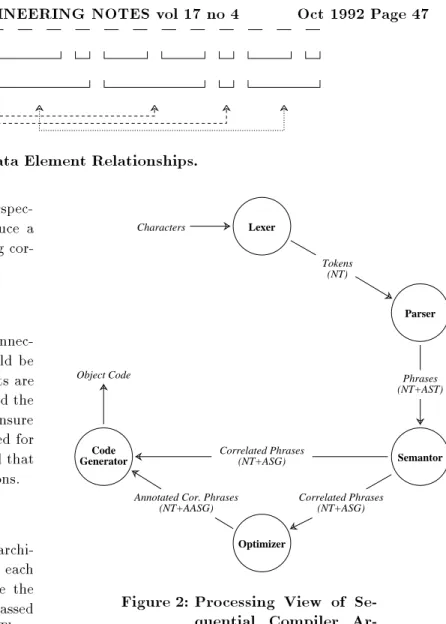
Furthermore, we rene tokens to include the structur-ing of the identier tokens into aname table(NT), and rene phrases to be organized into an abstract syntax tree(AST). Correlation of phrases results in anabstract syntax graph (ASG) and optimization in anannotated abstract syntax graph(AASG). Figure 2 gives a process-ing view of the sequential architecture, showprocess-ing the ow of data through the system. Notice that there are two paths from the semantor to the code generator, only one of which passes through the optimizer. This reects the fact that a separate optimization phase is not necessary in this architecture. That is, a design satisfying this architecture need not provide an optimizer.
To illustrate the interdependence of processing and data views, let us consider the data as a whole being
(NT+ASG) Correlated Phrases Lexer Parser Semantor Characters Tokens (NT) Phrases (NT+AST) Correlated Phrases (NT+ASG) Optimizer Code Generator
Annotated Cor. Phrases (NT+AASG) Object Code
Figure 2: Processing View of
Se-quential Compiler
Ar-chitecture.
created and transformed as they ow through the sys-tem. We have found that the data view is best captured by a notion that we callapplication-oriented properties. Application-oriented properties describe the states of a data structure that are of signicance to the process-ing elements manipulatprocess-ing that structure. They can be used for such things as controlling the order of process-ing, helping to dene the eects of a processing element on a data structure, and even helping to dene the op-erations needed by the processing elements to achieve those eects.
For this example, the (simplied) application-oriented properties are as follows:
has-all-tokens: a state produced as a result of lex-ically analyzing the program text, necessary for the parser to begin processing;
has-all-phrases: a state produced by the parser, necessary for the semantor to be-gin processing;
has-all-correlated-phrases: a state produced by the semantor, necessary for the opti-mizer and code generator to begin processing; and
has-all-optimization-annotations: a state produced by the optimizer, preferred for the code generator to begin process-ing.
Notice again that the last property is only preferred. While in this example the application-oriented proper-ties may appear obvious and almost trivial, in the next example they are crucial to the description of the archi-tecture and in guaranteeing the compliance of designs and implementations with that architecture.
An interesting question to consider is why we evi-dently chose to use a property-based scheme for de-scribing architectural elements rather than a type-based scheme. The reason is that type models, as they cur-rently exist, are essentially only able to characterize el-ements and element types in terms of the relationship of one element type to another (e.g., subtyping and in-heritance [12]), in terms of the relationships that par-ticular elements have with other elements (e.g., as in
Oros [18]), and in terms of the operations that can
be performed on the elements. They are not suited to descriptions of characteristics of elements such as the application-oriented properties mentioned above. For example, simply knowing that there is an operation as-sociated with abstract syntax graphs to connect one phrase to another does not lead to an understanding that the abstract syntax graph must have all phrases correlated before the code generator can access the graph.
Property-based schemes, on the other hand, can be used to capture easily all these characteristics; one prop-erty of an element could be the set of operations with which it is associated. It seems reasonable to consider enhancing type models in this regard and we see this as a potentially interesting area of future work. We note, however, that type-based schemes are already ap-propriately used at the design level, as mentioned in Section 2. Further, we note that application-oriented properties provide a good vehicle with which to drive the design, or justify the suitability, of a set of opera-tions for an element type.
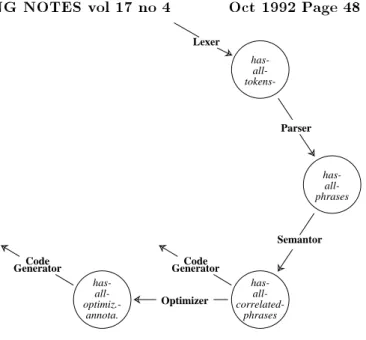
Returning to the interdependence between the pro-cessing and data views, we can see that the data
annota. optimiz.- all- has-phrases correlated- all- has-phrases all- has- tokens- all- has-Code
Generator GeneratorCode
Optimizer
Semantor Parser Lexer
Figure 3: Data View of Sequential
Compiler Architecture.
view concentrates on the particular application-oriented properties that are of importance in describing each data structure, while the processing view concentrates on the functional properties of each processing element. These views are actually complementary. In fact, if we depict the data view, as is done in Figure 3, and com-pare it to the processing view, shown in Figure 2, then the correspondence becomes fairly obvious.
The important architectural considerations that de-rive from this example can be summarized as follows:
the form descriptions must include the
relation-ships and constraints among the elements, includ-ing relative weightinclud-ings and preferences;
current type-based schemes for characterizing
ele-ments are insucient; and
there is a natural interdependence between the
pro-cessing and data views that can provide comple-mentary descriptions of an architecture.
4.3 Parallel Process, Shared Data
Structure Architecture
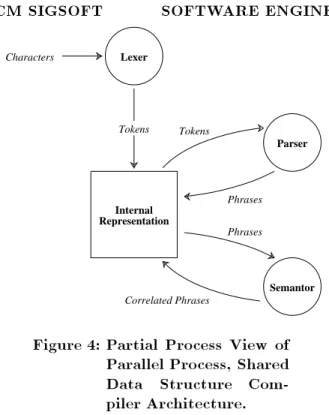
Suppose that performance is of paramount impor-tance, such that one wants to optimize the speed of the compiler as much as possible. One possible solution is to adopt an architecture that treats the processing elements as independent processes driven by a shared internal representation | that is, the connecting ele-ment is the shared representation and each processing element performs eager evaluation. Figure 4 depicts a
Representation Internal Lexer Parser Semantor Tokens Tokens Correlated Phrases Phrases Phrases Characters
Figure 4: Partial Process View of
Parallel Process, Shared
Data Structure
Com-piler Architecture.
simplied and partial process view of this architecture, showing the relationships between the internal repre-sentation and the lexer, the parser, and the semantor. (We only consider these three processing elements in the remainder of this example.)
The application-oriented properties of the shared in-ternal representation in this architecture are much more complicated, and interesting, than those given in the previous example. In particular, a number of process-ing elements are aectprocess-ing the state of the internal repre-sentation, and doing so concurrently. This implies that the application-oriented properties must provide for co-ordination and synchronization among the processing elements. We begin by giving the basic properties that the internal representation may exhibit:
no-tokens has-token will-be-no-more-tokens no-phrases has-phrase will-be-no-more-phrases no-correlated-phrases have-correlated-phrases all-phrases-correlated
Notice that these properties imply that tokens and phrases are consumed, but that correlated phrases are accumulated (consider \has-phrase" versus \have-correlated-phrases").
Because of the parallel behavior of the processing el-ements, the interrelationships among the various
ba-sic properties must be explicitly described. A num-ber of notations exist that are suitable for making such descriptions, including parallel path expressions
[6], constrained expressions [1], and petri nets [16]. In this example we use parallel path expressions, where a comma indicates sequence, a plus sign indicates one or more repetitions, an asterisk indicates zero or more repetitions, and subexpressions are enclosed in paren-theses. Synchronization points occur where names of application-oriented properties are the same in dier-ent parallel path expressions. First, the path expres-sions for each of the data elements | tokens, phrases, and correlated phrases | are given:
(1) (no-tokens, has-token+)*,
will-be-no-more-tokens, has-token*, no-tokens (2) (no-phrases, has-phrase+)*,
will-be-no-more-phrases, has-phrase*, no-phrases (3) no-correlated-phrases, (have-correlated-phrases)*,
all-phrases-correlated
Next, the path expressions relating the application-oriented properties are given:
(4) will-be-no-more-tokens, will-be-no-more-phrases, all-phrases-correlated
(5) has-token+, has-phrase
(6) has-phrase+, has-correlated-phrase
Thus, tokens are consumed to produce phrases, and phrases are correlated until they are all processed.
What we have given so far is essentially a connector view (and, in this case, eectively a data view as well). Concentrating instead on the processing view allows us to describe how each processing element transforms the internal representation as well as how those processing elements are synchronized:
lexer: (no-tokens, has-token+)*, will-be-no-more-tokens
parser: no-phrases, (has-token+, has-phrase)*, will-be-no-more-tokens, (has-token+, has-phrase)*, no-tokens,
will-be-no-more-phrases
semantor: no-correlated-phrases, (has-phrase+, has-correlated-phrase)*,
will-be-no-more-phrases, (has-phrase+, has-correlated-phrase)*, no-phrases, all-phrases-correlated
An interesting question to ask is how this architec-ture relates to the previous one. In fact, the ability to
relate similar architectures is an important aspect of the software process; an example is the evaluation of \com-peting" architectures. Certainly, the architectures both being of a common style captures some portion of the relationship. More can be said, however, given the use of application-oriented properties. In particular, we can draw correlations among the properties of the dierent architectures. The table below shows some of these cor-relations.
Sequential Architecture Parallel Architecture
has-all-tokens will-be-no-more-tokens has-all-phrases will-be-no-more-pharses has-all-correlated-phrases all-phrases-correlated
In this case, the correlations indicate common points of processing, leading, for instance, to a better under-standing of the possible reusability of the processing elements.
The important points of this example can be summa-rized as follows:
the processing elements are much the same as in
the previous architecture, but with dierent \locus of control" properties;
the form of this architecture is more complex
than that of the previous one | there are more application-oriented properties and those proper-ties require a richer notation to express them and their interrelationships;
we still benet from the processing/data/connector
view interdependence, albeit with more complexity; and
application-oriented properties are useful in
relat-ing similar architectures.
5 Some Benets Derived from Software
Architecture
We have previously mentioned the use of software ar-chitecture in the context of requirements and design. Software architecture provides the framework within which to satisfy the system requirements and provides both the technical and managerial basis for the design and implementation of the system. There are two fur-ther benets that we wish to discuss in detail: the kinds of analysis that software architecture specications will enable us to perform and the kinds of reuse that we gain from our approach to software architecture.
5.1 Software Architecture and Analysis
Aside from providing clear and precise documenta-tion, the primary purpose of specications is to provide automated analysis of the documents and to expose var-ious kinds of problems that would otherwise go unde-tected. There are two primary categories of analysis that we wish to perform: consistency and dependency analysis. Consistency occurs in several dimensions: con-sistency within the architecture and architectural styles, consistency of the architecture with the requirements, and consistency of the design with the architecture. In the same way that Inscape [14] formally and automat-ically manages the interdependencies between interface specications and implementations, we also want to be able to manage the interdependencies between require-ments, architecture, and design.
Therefore, we want to provide and support at least the following kinds of analysis:
consistency of architectural style constraints; satisfaction of architectural styles by an
architec-ture;
consistency of architectural constraints; satisfaction of the architecture by the design; establishment of dependencies between
architec-ture and design, and architecarchitec-ture and require-ments; and
determination of the implications of changes in
ar-chitecture or architectural style on design and re-quirements, and vice versa.
5.2 Architecture and the Problems of
Use and Reuse
An important aspect in improving the productivity of the designers and the programmers is that of being able to build on the eorts of others | that is, using and reusing components whether they come as part of another system or as parts from standard components catalogs.
There has been much attention given to the problem of nding components to reuse. Finding components may be important in reducing the duplication of eort and code within a system, but it is not the primary issue in attaining eective use of standardized compo-nents. For example, nding the components in a math library is not an issue. The primary issue is under-standing the concepts embodied in the library. If they
are understood, then there is usually no problem nd-ing the appropriate component in the library to use. If they are not understood, then browsing will help only in conjunction with the acquisition of the appropriate concepts.
The primary focus in architecture is the identication of important properties and relationships | constraints on the kinds of components that are necessary for the architecture, design, and implementation of a system. Given this as the basis for use and reuse, the architect, designer, or implementer may be able to select the ap-propriate architectural element, design element, or im-plemented code to satisfy the specied constraints at the appropriate level.
Moreover, the various parts of previously imple-mented software may be teased apart to select that which is useful from that which is not. For example, the design of a component from another system may have just the right architectural constraints to satisfy a particular architectural element, but the implementa-tion is constrained such that it conicts with other sys-tem constraints. The solution is to use the design but not the implementation. This becomes possible only by indentifying the architectural, design, and implemen-tation constraints and use them to satisfy the desired goals of the architecture, design, and implementation.
The important lesson in reusing components is that the possibilities for reuse are the greatest where speci-cations for the components are constrained the least | at the architectural level. Component reuse at the im-plementation level is usually too late because the imple-mentation elements often embody too many constraints. Moreover, consideration of reuse at the architectural level may lead development down a dierent, equally valid solution path, but one that results in greater reuse.
6 Conclusions
Our eorts over the past few years have been directed toward improving the software process associated with large, complex software systems. We have come to be-lieve that software architecture can play a vital role in this process, but that it has been both underutilized and underdeveloped. We have begun to address this sit-uation by establishing an intuition about and context for software architecture and architectural style. We have formulated a model of software architecture that emphasizes the architectural elements of data, process-ing, and connection, highlights their relationships and properties, and captures constraints on their realization or satisfaction. Moreover, we have begun to delineate
the necessary features of architectural description tech-niques and their supporting infrastructure. In so doing, we have set a direction for future research that should establish the primacy of software architecture.
Others have begun to look at software architecture. Three that are most relevant are Schwanke, et al., Zach-man, and Shaw.
Schwanke, et al., [20] dene architecture as the per-mitted or allowed set of connections among components. We agree that that aspect of architecture is important, but feel that there is much more to architecture than simply components and connections, as we demonstrate in this paper.
Zachman [23] uses the metaphor of building architec-ture to advantage in constructing an architecarchitec-ture for information systems. He exploits the notion of dier-ent architectural documdier-ents to provide a vision of what the various documents ought to be in the building of an information system. The architect is the mediator between the user and the builders of the system. The various documents provide the various views of dierent parts of the product | the users view, the contractors views, etc. His work diers from ours in that he is proposing a specic architecture for a specic applica-tion domain while we are attempting to dene the philo-sophical underpinnings of the discipline, to determine a notation for expressing the specication of the various architectural documents, and determine how these doc-uments can be used in automated ways.
Shaw [21] comes the closest in approach to ours. She takes the view of a programming language designer and abstracts classes of components, methods of composi-tion, and schemas from a wide variety of systems. These correspond somewhat to our notions of processing and data elements, connecting elements, and architectural style, respectively. One major dierence between our work and Shaw's is that she is taking a traditional type-based approach to describing architecture, while we are taking a more expressive property-based approach. Our approach appears better able to more directly cap-ture notions of weighted properties and relationships. Shaw's approach of abstracting the various properties and relationships of existing architectures and embody-ing them in a small set of component and composition types appears rather restrictive. Indeed, she is seeking to provide a xed set of useful architectural elements that one can mix and match to create an architecture. Shaw's approach is clearly an important and useful one and does much to promote the understanding of basic and important architectural concepts. Our approach, on the other hand, emphasizes the importance of the
underlying properties and relationships as a more gen-eral mechanism that can be used to describe the partic-ular types of elements and compositions in such a way that provides a latitude of choice.
In conclusion, we oer the following conjecture: per-haps the reason for such slow progress in the develop-ment and evolution of software systems is thatwe have trained carpenters and contractors, but no architects.
REFERENCES
[1] G.S. Avrunin, L.K. Dillon., J.C. Wileden, and W.E. Riddle, Constrained Expressions: Adding Anal-ysis Capabilities to Design Methods for Concurrent Systems, IEEE Trans. on Software Engineering, Vol. SE-12, No. 2, Feb. 1986, pp. 278{292.
[2] J.L. Bentley,Writing Ecient Programs, Addison-Wesley, Reading, MA, 1982.
[3] G.D. Bergland, A Guided Tour of Program Design Methodologies, IEEE Computer, Vol. 14, No. 10, Oct. 1981, pp. 13{37.
[4] B.W. Boehm, Software Engineering Economics, Prentice-Hall, Englewood Clis, NJ, 1981.
[5] F.P. Brooks, Jr., The Mythical Man-Month, Addison-Wesley, Reading, MA, 1972.
[6] R.H. Campbell and A.N. Habermann, The Specica-tion of Process SynchronizaSpecica-tion by Path Expressions,
Lecture Notes in Computer Science, No. 16,
Apr. 1974, pp. 89{102.
[7] E.J. Chikofsky (ed.), Software Development |
Computer-aided Software Engineering,
Technol-ogy Series, IEEE Computer Society Press, 1988. [8] G. Estrin, R.S. Fenchel, R.R. Razouk, and M.K.
Ver-non, SARA (System ARchitects Apprentice), IEEE Trans. on Software Engineering,Vol. SE-12, No. 2, Feb. 1986, pp. 293{277.
[9] P. Freeman and A.I. Wasserman, Tutorial on
Soft-ware Design Techniques, IEEE Computer Society
Press, 1976.
[10] D. Jackson, Composing Data and Process Descriptions in the Design of Software Systems, LCS Tech. Re-port 419,Massachusetts Institute of Technology, Cam-bridge, MA, May 1988.
[11] F.C. Mish,Webster's Ninth New Collegiate Dic-tionary,Merriam Webster, Springeld, MA, 1983. [12] J.E.B. Moss and A.L. Wolf, Toward Principles of
In-heritance and Subtyping for Programming Languages,
COINS Tech. Report 88{95,COINS Dept., Univ.
of Mass., Amherst, MA, Nov. 1988.
[13] J.D. Musa, Software Reliability: Measurement, Prediction, Application, McGraw-Hill, New York, NY, 1990.
[14] D.E. Perry, The Inscape Environment,Proc. Eleventh Inter. Conf. on
Soft-ware Engineering,Pittsburgh, PA, IEEE Computer Society Press, May 1989, pp. 2{12.
[15] D.E. Perry, Industrial Strength Software Development Environments,Proc. IFIP Congress '89, The 11th
World Computer Congress, San Francisco, CA,
Aug. 1989.
[16] J.L. Peterson, Petri Nets, ACM Computing
Sur-veys,Vol. 9, No. 3, Sept. 1977, pp. 223-252.
[17] W.E. Riddle and J.C. Wileden,Tutorial on Software
System Design: Description and Analysis,
Com-puter Society Press, 1980.
[18] W.R. Rosenblatt, J.C. Wileden, and A.L. Wolf, OROS: Towards a Type Model for Software Development Environments, Proc. OOPSLA '89, New Orleans, Louisiana, October 1989.
[19] E. Sandewall, C. Stromberg, and H. Sorensen, Software Architecture Based on Communicating Residential En-vironments, Proc. Fifth Inter. Conf. on Software
Engineering,San Diego, CA, IEEE Computer Society Press, Mar. 1981, pp. 144{152.
[20] R.W. Schwanke, R.Z. Altucher, and M.A. Plato, Dis-covering, Visualizing and Controlling Software Struc-ture, Proc. Fifth Inter. Workshop on
Soft-ware Specication and Design, Pittsburgh, PA,
May 1989, appearing in ACM SIGSOFT Notes, Vol. 14, No. 3, May 1989, pp. 147{150.
[21] M. Shaw, Larger Scale Systems Require
Higher-Level Abstractions,Proc. Fifth Inter. Workshop on Software Specication and Design, Pittsburgh, PA, May 1989, appearing in ACM SIGSOFT Notes, Vol. 14, No. 3, May 1989, pp. 143{146.
[22] A.Z. Spector, Modular Architectures for Distributed and Database Systems, Proc. Eighth ACM SIGACT-SIGMOD-SIGART Symp. on Princi-ples of Database Systems, Philadelphia, PA, ACM Press, Mar. 1989, pp. 217{224.
[23] J.A. Zachman, A Framework for Information Sys-tems Architecture, IBM Systems Journal, Vol. 26, No. 3, 1987.