AIS Electronic Library (AISeL)
PACIS 2018 Proceedings
Pacific Asia Conference on Information Systems
(PACIS)
6-26-2018
Exploring the Role of 'Price Value' for
Understanding Consumer Adoption of
Technology: A Review and Meta-analysis of
UTAUT2 based Empirical Studies
Kuttimani Tamilmani
Swansea University, [email protected]
Nripendra Rana
Swansea University, [email protected]
Yogesh Dwivedi
Swansea University, [email protected]
G.P. Sahu
Matilal Nehru National Institute of Technology Allahabad, [email protected]
Sian Roderick
Swansea University, [email protected]
Follow this and additional works at:
https://aisel.aisnet.org/pacis2018
This material is brought to you by the Pacific Asia Conference on Information Systems (PACIS) at AIS Electronic Library (AISeL). It has been accepted for inclusion in PACIS 2018 Proceedings by an authorized administrator of AIS Electronic Library (AISeL). For more information, please [email protected].
Recommended Citation
Tamilmani, Kuttimani; Rana, Nripendra; Dwivedi, Yogesh; Sahu, G.P.; and Roderick, Sian, "Exploring the Role of 'Price Value' for Understanding Consumer Adoption of Technology: A Review and Meta-analysis of UTAUT2 based Empirical Studies" (2018).
PACIS 2018 Proceedings. 64.
Exploring the Role of ‘Price Value’ for
Understanding Consumer Adoption of Technology:
A Review and Meta-analysis of UTAUT2 based
Empirical Studies
Completed Research Paper
Kuttimani Tamilmani
School of Management, Swansea
University Bay Campus, SA1 8EN,UK
Nripendra P Rana
School of Management, Swansea
University Bay Campus, SA1 8EN, UK
Yogesh K. Dwivedi
School of Management, Swansea, Swansea
University Bay Campus, SA1 8EN, UK
Ganesh P. Sahu
Motilal Nehru National Institute of
Technology, Allahabad, India
Sian Roderick
School of Management, Swansea University Bay Campus,
SA1 8EN, UK
Abstract
Price value is important theoretical addition to the extended unified theory of
acceptance and use of technology (UTAUT2) as individuals bear monetary cost
in using technology in consumer setting. A preliminary review of 650 UTAUT2
citations revealed majority of the studies utilized UTAUT2 in combination with
external theories omitting some of original UTAUT2 constructs and rarely
included moderators. Only 147 studies utilized at least one UTAUT2 construct
in their research model. Thus, the aim of this study is to identify usage of price
value construct in UTAUT2 based studies and their reason for inclusion or
omission. The findings from 79 UTAUT2 empirical studies revealed only 32
studies (41%) utilized price value while the remaining 47 studies (59%)
excluded the construct from their research model. The major reason for
exclusion was studies examined technologies such as mobile applications and
social networking sites that are available to individuals at free of cost.
Keywords: Meta-analysis, Habit, Intrinsic motivation, UTAUT2, Price saving
Introduction
The extended Unified theory of acceptance and use of technology (UTAUT) popularly referred, as UTAUT2 is the most comprehensive model as on date in explaining individual technology acceptance and use. The UTAUT2 saw addition of three new constructs such as hedonic motivation, price value
and habit in the consumer context emphasizing on hedonic value (intrinsic motivation) to its predecessor UTAUT developed in the organisational context emphasizing on the utilitarian value (extrinsic motivation) (Venkatesh et al. 2003). However, in UTAUT2 voluntariness of use was dropped as moderator since consumers have no organizational mandate and in many situations, consumer behaviour is voluntary (see Venkatesh et al. 2012). Despite its recent introduction in the year 2012, UTAUT2 model has already gathered more than 2500 citations in Google Scholar alone spanning from IS field and beyond emphasizing on its predictive ability. However, huge citation for UTAUT2 did not translate into actual use of the theory as systematic review of 650 UTAUT2 citations revealed 77% of the studies cited UTAUT2 for generic purpose without employing its constructs. Whereas the remaining 23% of studies, even if they utilized UTATU2, did so in combination with external theories omitting some of its original construct with rare inclusion of moderators(see Tamilmani et al. 2017 for review). Price value construct was an important theoretical construct addition into UTAUT2 model alongside habit and hedonic motivation. Major difference in terms of price value among technology users in organisational setting (UTAUT) and consumer setting (UTAUT2) is that access to technology is free for employees in organisation whereas individuals bear the monetary cost for using technology in consumer setting. Price value is positive predicator of consumer behavioural intention to use a technology in UTAUT2 such that perceived benefits of using a technology is greater than the perceived monetary cost incurred to use the technology (Venkatesh et al. 2012). In addition, some studies that adapted UTAUT2 model as their underpinning theory redefined the price value construct based on then context. For instance apart from the monetary cost the study of Dwivedi et al. (2016) included opportunity cost of citizens to avail health services from traditional channels in absence of m-health service system as an element of price value construct. However, previous studies on additional constructs of UTAUT2 such as habit have revealed major inconsistency on its usage with just 35% studies including the construct in their research model(see Tamilmani et al. 2018).
The preceding discussion underscores the significance of price value construct as a key predicator in determining individual behavioral intention to use technology. The extant literature also revealed numerous inconsistency in using UTAUT2 model on its entirety with rare inclusion of moderators and frequent exclusion of additional constructs. However, none of the existing studies has conducted thorough analysis to evaluate appropriate usage of price value construct among UTAUT2 studies, this study intend to fulfill this research gap employing meta-analysis technique. In order to achieve objectives of this study it was deemed appropriate to undertake following steps:
• To locate studies using UTAUT2 model as their underpinning theory and their reason for omission or inclusion of price value construct.
• To locate various antecedents/dependent variables of price value and their significance.
• To conduct meta-analysis on empirical studies that utilized price value from UTAUT2 model to establish convergence and divergence among various path relationships.
The next section of this paper i.e. section 2 describes the research method employed in this study; Section 3 will present the results of meta-analysis and narrative review research on inclusion/omission of price value construct among UTAUT2 studies. Whereas section 4 elaborates discussion from the results section followed by conclusion in section 5.
Research Method
In order to synthesize findings from studies that operationalized price value construct in the UTAUT2 model this study deemed appropriate to employ combination of “narrative review”, “citation reference search” and “meta-analysis” approach (Dwivedi et al. 2017; King and He 2006; Venkatesh et al. 2016). This study preferred meta-analysis over traditional narrative review since its indispensable statistical tool to correct sampling and measurement errors (Schmidt and Hunter 2014) enabling rigours, unbiased, trustworthy interventions through synthesis of existing research findings including studies with non-significant and contradictory results (Sabherwal et al. 2006). Cited reference search for Venkatesh et al. (2012)article in Scopus and Web of Science database resulted in 1,320 papers (823 from Scopus; 497 from Web of Science). However, on further scrutiny 452 citations were found common in both databases resulting in 868 unique citations. Out of 868 only 650 articles were fully
downloadable with merely 147 of them utilizing at least one UTAUT2 construct, the remaining 503 articles just citied UTAUT2 for generic reason (see Tamilmani et al. 2017 for review). In order to ensure consistency among studies included for meta-analysis coding scheme was developed and deployed; Studies were included for meta-analysis only if they were empirical in nature, utilized at least one UTAUT2 construct and reported data for the path coefficients standardized (β) (Dwivedi et al., 2011; King and He 2006; Rana et al., 2012, 2015). Only 79 studies fulfilled this criterion and were eligible for meta-analysis the remaining 68 studies were discarded from scope of this study since they were neither empirical in nature nor did they report relevant data for meta-analysis. Final screening involved these 79 UTAUT2 based empirical studies to evaluate operationalization of price value construct and its appropriate usage spread across 53 unique journals and conferences. Computers in Human Behaviour emerged as the leading journal with (seven citations) for Venkatesh et al. (2012) article; Whereas with four citations each: 1) Industrial Management and Data Systems journal, 2) European Conference on Information Systems, (ECIS) and 3) The Americas Conference on Information Systems, (AMCIS) jointly occupied the second position. The joint third place went to Hawaii International Conference on System Science (HICSS) and International Journal of Information Management with three citations each. Whereas there were seven conferences and journals with two citations each and the remaining 40 with just one citation. The number of citations for Venkatesh et al. (2012) article increased steadily every year with one citation in 2012 to seven citations in 2013, reaching double digits from 2014 with 17 citations, up into twenties with 21 citations in 2015 reaching maximum of 26 citations for the year 2016. For 2017, UTAUT2 already garnered seven citation up until mid of March when the data collection completed.
Research Results
This section presents findings of the 79 UTAUT2 based empirical studies through narrative review and meta-analysis based on their usage of price value construct. The findings resulted in classification of 79 studies broadly into two categories: 1) Studies not using price value – 47 studies; and 2) studies using price value – 32 studies.
Literature synthesis of studies not using Price value construct
The findings revealed majority of the 79 UTAUT2 based empirical studies as much as 47studies (59%) did not operationalize price value construct in their research model. Behavioural intention (BI) was the most used outcome variable among the studies that did not operationalize price value construct with 28 studies (60%) hypothesizing BI. Whereas with 15 studies (32%) use behaviour (UB) emerged as the second most operated outcome variable with all of them utilizing behavioural intention (BI) as their immediate antecedent. Apart from BI and UB four studies employed new outcome variables such as: 1) Consumerization(CN) of Information Technology (Dernbecher et al. 2013), 2) Location disclosure on location based social networking applications (Koohikamali et al. 2015), 3) Disclosure of information about others in social networking sites (Koohikamali et al. 2017) and 4) Job seeker unemployment duration (Huang and Chuang 2016).
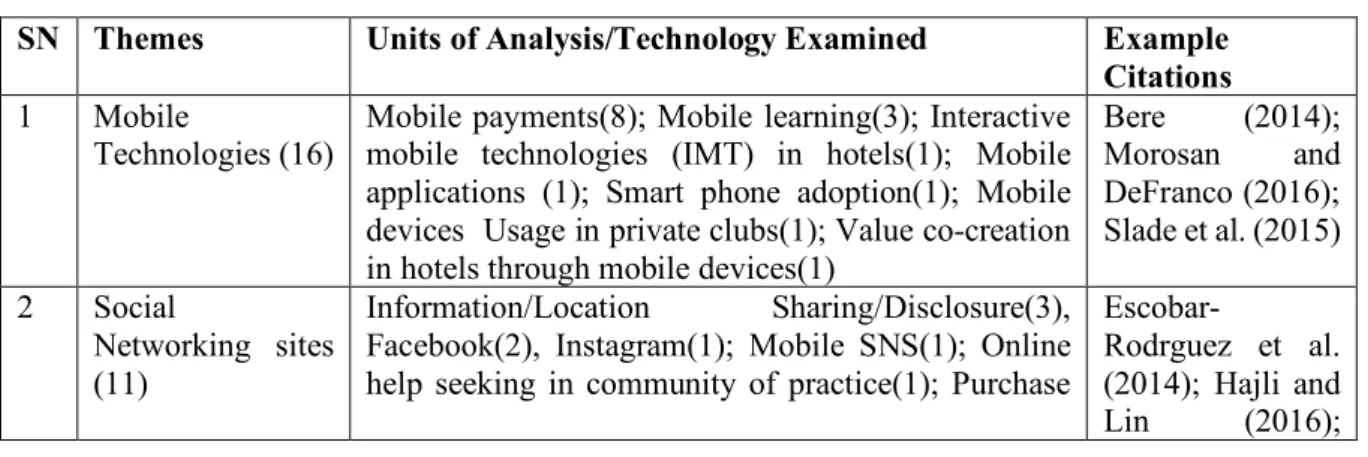
Table 1: Classification of Studies Not Using Price Value Construct SN Themes Units of Analysis/Technology Examined Example
Citations 1 Mobile
Technologies (16)
Mobile payments(8); Mobile learning(3); Interactive mobile technologies (IMT) in hotels(1); Mobile applications (1); Smart phone adoption(1); Mobile devices Usage in private clubs(1); Value co-creation in hotels through mobile devices(1)
Bere (2014); Morosan and DeFranco (2016); Slade et al. (2015) 2 Social Networking sites (11) Information/Location Sharing/Disclosure(3), Facebook(2), Instagram(1); Mobile SNS(1); Online help seeking in community of practice(1); Purchase
Escobar-Rodrguez et al. (2014); Hajli and Lin (2016);
intention in Social networking sites(1); UGC sharing in Social networking sites (1); Use of SNS(1)
Järvinen et al. (2016)
3 Education (4) Learning Management system(2); Informal learning context(1); Podcasting in higher education(1)
Lai et al. (2016); Lin et al. (2013); Raman and Don (2013)
4 Internet Banking (2)
Consumer adoption of Internet Banking(2) Alalwan et al. (2015); Chaouali et al. (2016) 5 Others (14) Biometric e-gates in airports(1); Broadband
Technology Use(1); Consumerization of IT(1); Consumers usage of financial products on internet(1);Crime prevention using IS (1); E-books(1); E-government(1); Household Technology acceptance(1); Job search websites (JSWs)(1); Omni channel shopping (1); Online shopping intention for agricultural products(1); Software reuse adoption individual perspective(1); Virtual communities of practice(VCoP)(1); Wearable self-tracking device(1)
Juaneda-Ayensa et al. (2016); Nistor et al. (2014); Pfeiffer et al. (2016)
The narrative review resulted in classification of forty-seven studies that did not employ price value broadly into five major themes as shown in Table 1 alongside their units of analysis/technology examined with frequency. Mobile technologies with 16 studies was the most researched theme without price value construct, studies under this theme examined multitude of technologies ranging from mobile learning (Bere 2014), Value co-creation in hotels through mobile devices (Morosan and DeFranco 2016) and Mobile payments(Slade et al. 2015) to name a few. Social networking sites (SNS) emerged as the second most popular theme with 11 studies examining technologies including but not limited to student use of Facebook for learning (Escobar-Rodrguez et al. 2014), consumer acceptance and use of Instagram (Järvinen et al. 2016) and students information sharing in SNS (Hajli and Lin 2016). Whereas, education was the third most popular theme with four studies, two of them focusing on Learning Management system (Ain et al. 2016; Raman and Don 2013), third one exploring learning in informal contexts (Lai et al. 2016) and the fourth final study focusing on teachers and students differing perspectives of podcasting acceptance in campus (Lin et al. 2013). The fourth theme internet banking had two studies that explored consumer adoption to internet banking one in Jordan (Alalwan et al. 2015) and the other one in Tunisia (Chaouali et al. 2016). The fifth and final theme others had fourteen studies that could not be readily classified into the above four themes all exploring unique technologies on their own. For instance Juaneda-Ayensa et al. (2016) explored consumer purchase intention in Omni channel shopping , Pfeiffer et al. (2016) examined consumer acceptance of Wearable self-tracking device, Nistor et al. (2014) examined teachers Virtual communities of practice(VCoP) and so on refer to table 1 for exhaustive list on various technologies examined.
Reason for studies not using price value construct
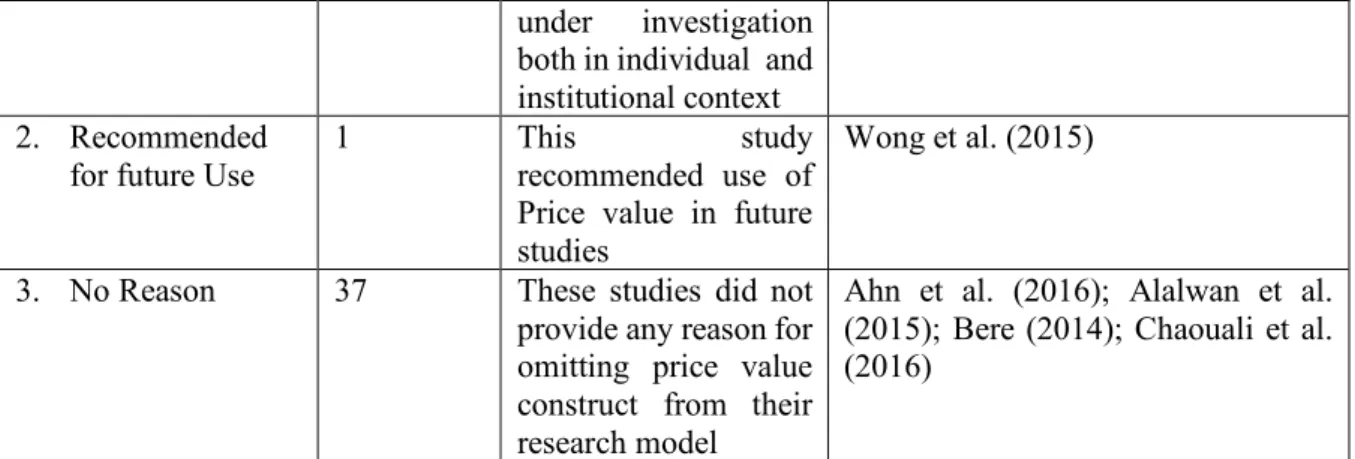
This section presents the findings and explains the reason behind 47 studies that adapted UTAUT2 as their underpinning theory and omitted price value construct from their final research model. Three categories emerged as reason for studies that excluded price value construct from their research model as seen from Table 2.
Freetechnology
Free technology is the topmost category among the studies that provided reason for not utilizing price value construct with nine studies. Studies in this category excluded ‘price value construct’ from their research model, as the technologies examined were available to users free of cost without incurring any financial cost to them both in the individual and institutional settings. Such instances include but not
limited to the research of Ain et al. (2016) on students learning management system(LMS) that replaced price value with learning value stating following reason in the institutional context:
“….students are not liable to pay any cost to gain benefits from LMS technology. However, students devote time and effort to gain benefit from LMS. The students’ positive perceptions about learning from LMS influence their intention to devote more time and effort to explore and obtain the required knowledge from LMS. The current study refers to this as the Learning –Time & Effort relationship and terms it Learning Value, which impacts on students’ intention to use LMS.”(Ain et al. 2016, p. 6) Whereas in the individual context such instance include the study of Koenig-Lewis et al. (2015) on consumer mobile payment:
“….Perceived price/value and habit were excluded as these are less applicable in the m-payments context which usually causes no or very little additional financial cost to users….” (Koenig-Lewis et al. 2015, p. 541)
The study of Sharifi fard et al. (2016) on students purchase intention in social networking sites: “…..The construct PV also has not been adapted to the research model as marketers can get to their intended consumers at a cheaper price, occasionally even with zero cost through SNSs, and online purchasing through SNSs does not represent a monetary cost for the consumer”(Sharifi fard et al. 2016, p. 3)
and the study of An et al. (2016) on the students online shopping intention for agricultural products to name a few.
“….In the e-commerce environment, consumers think that no any additional costs should be paid for online shopping, so the construct price value is dropped, too…...” (An et al. 2016, p. 303).
Recommended for future Use
The lonely study of Wong et al. (2015) in this category examined the changing landscape of advertising industry on consumers with introduction of new technologies such as mobile advertising and recommend perceived cost similar construct to price value to be used in the future studies for following reason:
“…Future research should consider adopting additional factors such as perceived cost, perceived value, perceived trust and perceived mobility so as to provide a more comprehensive understanding of users’ BI on m-advertising acceptance” (Wong et al. 2015, p. 733)
No Reason
Most of the studies that utilized UTAUT2 as their underpinning theory without price value construct fell under this category of no reason. Thirty-seven such studies omitted price value construct from their research model without providing any reason at all. Such instances include but not limited to understanding consumers sustainable Household Technology acceptance in USA (Ahn et al. 2016) and consumers adoption of internet banking in Jordan (Alalwan et al. 2015).
Table 2: Reason for Studies Not Using Price Value Construct Category Type Frequency Description Example Citations 1. Free Technology 9 The users under this
category did not incur any monetary cost for utilizing technologies
An et al. (2016) ; Ain et al. (2016); Koenig-Lewis et al. (2015); Sharifi fard et al. (2016)
Literature synthesis of studies using Price value construct
The thirty-two empirical studies that utilized price value construct operated BI and UB almost equally as their outcome variable , UB (e.g. Dwivedi et al. 2016; Mahfuz et al. 2016) was operated as outcome variable in 16 studies whereas, BI (e.g. Degirmenci and Breitner 2017; Lallmahomed et al. 2017) was operated as outcome variable on one instance less with 15 studies. There was lone study of Buettner (2016) that employed job offer success as outcome variable apart from BI and UB to measure working professional job search success in career oriented social networking sites. Two studies (Escobar-Rodríguez and Carvajal-Trujillo 2013; Escobar-(Escobar-Rodríguez and Carvajal-Trujillo 2014) utilized price saving orientation to understand consumer behaviour in purchasing online air tickets instead of price value since websites can save money to consumer by offering best product for a given price even though usage of websites are entirely free of cost (Ryan and Rao 2008). Although UB was the most operated outcome variable among studies using price value construct with 16 studies only two studies using price saving orientation(Escobar-Rodríguez and Carvajal-Trujillo 2013; Escobar-Rodríguez and Carvajal-Trujillo 2014) used PV as direct determinant of UB whereas the remaining 14 studies used PV as direct determinant of only BI. Table 3 summaries the usage of price value construct across the 32 UTAUT2 based empirical studies combined with its path relationship among various dependent, independent and moderator’s variables besides their significance. Moreover, its observed price value apart from being an antecedent on most instances also got few antecedents on its own on few occasions.
Table 3: Summary of habit path relationships
SN I.V. D.V.(Mod) Total Sig Example Citations (Sig) Non-Sig Example Citations (Non-Sig)
1
PV BI 33 17
Chong and Ngai (2013); Dwivedi et al. (2016); Lallmahomed et al. (2017)
16
Baptista and Oliveira (2015); Buettner (2016); Hew et al. (2015) 2 PV BI(GEN) 4 1 Baptista et al. (2017) 3 Ramantoko et al. (2015); Ramírez-Correa et al. (2014); Wong et al. (2014) 3 PV BI(AGE) 3 1 Ramantoko et al. (2015) 2 Baptista et al. (2017); Ramírez-Correa et al. (2014) 4 PV ATT 1 1
Degirmenci and Breitner
(2017) 0 None
5 PV RTC 1 0
None 1 Lallmahomed et al.
(2017)
6 PV CP 1 1 Wagner et al. (2014) 0 None
7 PV BIP 1 1 Wagner and Hess (2013) 0 None
8 PO BI 2 2
Escobar-Rodríguez and
Carvajal-Trujillo (2013); 0 None under investigation
both in individual and institutional context 2. Recommended
for future Use
1 This study
recommended use of Price value in future studies
Wong et al. (2015)
3. No Reason 37 These studies did not provide any reason for omitting price value construct from their research model
Ahn et al. (2016); Alalwan et al. (2015); Bere (2014); Chaouali et al. (2016)
Escobar-Rodríguez and Carvajal-Trujillo (2014) 9 PO UB 2 0 None 2 Escobar-Rodríguez and Carvajal-Trujillo (2013); Escobar-Rodríguez and Carvajal-Trujillo (2014) 10 CAW PV 1 1
Segura and Thiesse
(2015) 0 None
11 PE PV 1 1 Alalwan et al. (2016) 0 None
12 HM PV 1 1 Alalwan et al. (2016) 0 None
[Legend: ATT: Attitude; BI: Behavioural Intention; BIP: Behavioural intention premium; CAW: Context awareness; CP: Cognitive premium; D.V.: Dependent Variable; Gen: Gender; HM: Hedonic motivation; I.V.: Independent Variable; In. Sig: Number of insignificant path values; Mod: Moderator; PE: Performance Expectancy; PO: Price saving orientation; PV: Price value; RTC: Resistance to change; Sig: Number of significant path values; SN: Serial Number; UB: Use Behaviour]
Price value as an antecedent
Price value (PV) and Price saving orientation (PO) were used as an antecedent in 32 UTAUT2 based empirical studies in understating individual adoption to range of technologies. Price value served as an antecedent of five dependent variables across the span of 30 studies. Behavioural Intention (BI) served as the dependent variable of price value on most instances with 33 examinations. The number of PVàBI path examinations is higher than number of studies as in case of multiple datasets obtained from different samples in a study; each dataset was included for analysis and treated as an independent study. There were only 17 significant examinations of PVàBI path out of 33 total examinations while the remaining 16 reporting non-significant value. Few significant instances of PVàBI path relationships include: 1) Understanding travelers’ adoption of location based social media service (Chong and Ngai 2013), 2) Cross country comparison of citizens mobile health (Dwivedi et al. 2016) and 3) Citizens e-government adoption in Mauritius (Lallmahomed et al. 2017) all these technologies were more focused on the utilitarian aspect of the individual users. However, on the other hand insignificant instances of PVàBI path relationships include: 1) Consumers’ mobile banking adoption (Baptista and Oliveira 2015), 2) Job search through Social Networking Sites (Buettner 2016) and 3) Older adults use of smartphones in china where the price of technologies under examination were considered relatively low or provided free of cost to the consumers.
Four other dependent variables employed Price value as their antecedent apart from BI, such as: 1) Attitude (ATT) in understanding consumer Purchase intention of electric vehicles (Degirmenci and Breitner 2017), 2) Resistance to change (RTC) in evaluating citizens adoption of e-government services (Lallmahomed et al. 2017), 3) The role of Cognitive premium (CP) to evaluate consumers use of Music as a service (Wagner et al., 2014) and 4) Behavioral intention premium (BIP) in examining consumers’ willingness to pay for music services. Except for the path, PVàRTC that reported insignificant value all the remaining three paths reported significant path values and need further examination. Apart from direct relationships age and gender moderated the PVàBI path relationship on various combinations and found to be significant only on two instances PVàBI (Gen) (Baptista et al. 2017) and PVàBI (Age) (Ramantoko et al. 2015) as seen from Table3. Moreover, there were couple of studies (Escobar-Rodríguez and Carvajal-Trujillo 2013; Escobar-(Escobar-Rodríguez and Carvajal-Trujillo 2014) where Price saving orientation (PO) was employed as an antecedent of both BI and UB. Although both studies reported significant results for PO àBI, they found POàUB insignificant on both instances.
Antecedents of Price value
Price value apart from serving as an antecedent also got three antecedents of its own such as: 1) Context awareness (CAW) in understanding user acceptance of Pervasive Information Systems(Google glass) (Segura and Thiesse 2015), 2) Performance expectancy (PE) and 3) Hedonic motivation (HM) in exploring consumer’s adoption of telebanking in Jordan (Alalwan et al. 2016). The results of these two studies revealed all three antecedents Context awareness (CAW), Performance expectancy (PE) and Hedonic motivation (HM) had significant relationship with price value.
Meta-analysis of studies using price value construct
Meta-analysis was conducted for various dependent, independent and moderator variables of price value construct explored two or more times across 32 studies in similar vein to studies (e.g., King and He 2006; Rana et al. 2015; Wu and Du 2012). Table 4 presents meta-analysis summary of five path coefficients (β) that fulfilled this criterion. Meta-analysis allows both significant and non-significant effects to be analyzed through accumulation of various results taking the relative sample and effect size into consideration. Thus, the overall result on the performance of the model is considered more accurate and credible due to the overarching span of the analysis (King and He, 2006). In doing so, meta-analysis permits discovery of new knowledge that is undetectable otherwise in the isolated parcels of data scattered amongst individual “primary” studies (Schmidt 1992). The meta-analysis results of price value construct in UTAUT2 based empirical studies revealed only two paths PVàBI and POàBI to be significant at p<0.001 level. Whereas the remaining three relationships PVàBI (Gen), PVàBI (Age) and POàUB were insignificant with very high p values. POàBI emerged as the strongest price value path with meta-analysis (β) of 0.256 followed by PVàBI with meta-analysis (β) of 0.115. The 95% confidence interval for PVàBI was the narrowest Low (β) – 0.056 and High (β) – 0.174 than POàBI revealing the range is narrow enough such that it can explain at least one confidence within the extent of variance. Whereas 95% confidence interval for POàBI was bit wider with Low (β) – 0.155 and High (β) – 0.358.
Table 4: Price Value (β) Meta-analysis: Method Adapted from King and He (2006) SN I.V D.V(Mod) # TSS p(ES) Meta (β) 95 % L(β) 95 % H(β)
1 PV BI 33 9927 0.000 0.115 0.056 0.174
2 PV BI(Gen) 4 1520 0.690 -0.013 -0.074 0.049 3 PV BI(Age) 3 1327 0.280 0.030 -0.024 0.084
4 PO BI 2 2456 0.000 0.259 0.155 0.358
5 PO UB 2 2456 0.956 0.001 -0.038 0.041
[Legend: BI: Behavioural Intention; D.V: Dependent variable; Gen: Gender; H(β): Highest (beta); I.V: Independent Variable; L (β): Lowest (beta); Meta (β): Meta-analysis path coefficient; Mod: Moderator; p (ES): Estimated value of p (p-value); PO: Price saving orientation; PV: Price value; T.S.S.: Total sample size; #: Number of studies; UB: Use Behaviour]
Discussion
The objective of this study was to have deeper understanding on appropriateness of ‘price value construct’ usage among 79 empirical studies that used UTAUT2 as underpinning theory in their research. The findings of this study divulged majority of the studies that utilized UTAUT2 failed to include “price value” construct in their research model there were 47 such studies constituting 59% and 37 out of 47 studies (79%) did not provide any reason for exclusion making “No reason” top category among non-price value studies. Whereas nine out of ten remaining studies excluded ‘price value construct’ since the technology investigated did not incur financial cost to the users and classified them into “free technology” category. This should serve as guideline for future researchers in operationalizing their research model involving users of technology that include but not limited to social networking sites (Sharifi fard et al. 2016), students learning management systems (Ain et al. 2016) and mobile payments (Koenig-Lewis et al. 2015) where the technology is provided free of cost. The final
non-price value category examined mobile advertising to recommend usage of non-price related construct in future studies as mobile advertising is at very nascent stages.
In terms of studies that used ‘price value’ construct, it mostly served as antecedent of BI (33 studies). The number of significant relationships with 17 studies for the path PVàBI was marginally higher than the 16 insignificant studies. Studies reported significant value for PVàBI when individuals felt the perceived benefits of using such technologies is higher at much lower cost than their alternatives emphasising on utilitarian value both in individual and organisational context. For instance, travelers felt the benefits of using location based social media services is much higher than internet access cost (Chong and Ngai 2013). Whereas citizens from three different countries such as USA, Canada and Bangladesh felt m-health as preferred channel of accessing health services which is much lower in comparison to the traditional health service system saving citizens opportunity cost in terms of time, money and effort (Dwivedi et al. 2016). Similarly the study of Lallmahomed et al. (2017) found significant results for PVàBI path where citizens found electronic government (e-gov) services offers better benefits to them than traditional government offices requiring frequent visits saving them significant amount of time and money. On the other hand, for the 16 studies that reported insignificant value for PVàBI path majority of the technologies under examination did not incur any monetary cost to their users justifying the result. Moreover, four other dependent variables employed Price value as an antecedent on one instance such as 1) Attitude (ATT), 2) Cognitive premium (CP), 3) Resistance to change (RTC) and 4) Behavioural intention premium (BIP) and found the path to be significant on three instances except for the path, PVàRTC.
Finally among the five ‘price value’ based path relationships that were eligible for meta-analysis only two of them PVàBI and POàBI were found significant at p<0.000 as seen from the results in Table 4. This underscores the dominance of price value as important determinant of BI in predicating consumer technology acceptance and use. Whereas, meta-analysis results revealed the effect of moderator’s age and gender are insignificant on PVàBI path. This is a significant departure from the original UTAUT2 model of Venkatesh et al. (2012) that had significant results for moderators’ (i.e. age, gender) and found effect of price value more to be more important to older women. To that extent, the study of Venkatesh et al. (2016) merged the complex moderators into individual user attributes and prescribed them to be used based on context in their multi-level framework for measuring individual technology acceptance and use. One of the intriguing finding of meta-analysis is even though Price saving orientation (PO) had significant relationship with BI the path POàUB yielded insignificant results. This phenomenon is found in consumer purchase of website airline tickets (Escobar-Rodríguez and Carvajal-Trujillo 2013) where price saving was found good indicator of purchase intention and not of the actual online purchase. The plausible explanation for this could be facilitating condition of such flights with fewer/no stopover or free food during the travel decides the actual ticket purchase than mere intention and need more research (Escobar-Rodríguez and Carvajal-Trujillo, 2013).
Conclusion
This study-fulfilled the objective of understanding appropriateness of the “Price value construct’ usage among UTAUT2 based empirical studies through narrative literature review and meta-analysis of path coefficients (β). The findings of descriptive literature review divulged as much as 47 out of 79 UTAUT2 empirical studies did not operationalize ‘price value’ in their study with majority of them focusing on technologies that does not incur monetary cost to the users. Hence, ‘price value’ is not an appropriate construct to be included in research model of studies examining individual technology adoption and diffusion related issues that are available freely to users such as mobile and social networking sites. In addition, meta-analysis revealed all the moderator relationship of price value constructs to be insignificant, which is substantial departure from the UTAUT2 model. Hence, future studies should exercise caution in employing ‘price value construct’ and its moderators in the above-mentioned scenarios. On the other hand price value can be appropriate construct in examining individual technologies that emphasize more on the their utilitarian value such as m-health (Dwivedi et al. 2016) and e-government Lallmahomed et al. (2017) saving their opportunity cost in terms of time, effort and money. Moreover all three antecedents of ‘price value’ in this study such as Context awareness (CAW),
Performance expectancy (PE) and Hedonic motivation (HM) were found significant. Hence, future research should focus more on these antecedents impact on price value to be a key predicator in determining individual technology adoption. Finally, BI acted as dependent variable of price value in all studies except for two that used UB as dependent variable of PO and found insignificant results. Thus, researchers should employ PVàUB path apart from PVàBI in future in order to understand the differences, as intention of using product is not equal to usage.
References
Ahn, M., Kang, J., and Hustvedt, G. 2016. "A Model of Sustainable Household Technology Acceptance," International Journal of Consumer Studies (40:1), pp. 83-91.
Ain, N., Kaur, K., and Waheed, M. 2016. "The Influence of Learning Value on Learning Management System Use: An Extension of Utaut2," Information Development (32:5), pp. 1306-1321. Alalwan, A. A., Dwivedi, Y. K., Rana, N. P., Lal, B., and Williams, M. D. 2015. "Consumer Adoption
of Internet Banking in Jordan: Examining the Role of Hedonic Motivation, Habit, Self-Efficacy and Trust," Journal of Financial Services Marketing (20:2), pp. 145-157.
Alalwan, A. A., Dwivedi, Y. K., and Williams, M. D. 2016. "Customers’ Intention and Adoption of Telebanking in Jordan," Information Systems Management (33:2), pp. 154-178.
An, L., Han, Y., and Tong, L. 2016. "Study on the Factors of Online Shopping Intention for Fresh Agricultural Products Based on Utaut2," 2nd Information Technology and Mechatronics Engineering Conference (ITOEC 2016).
Baptista, G., Baptista, G., Oliveira, T., and Oliveira, T. 2017. "Why So Serious? Gamification Impact in the Acceptance of Mobile Banking Services," Internet Research (27:1), pp. 118-139. Baptista, G., and Oliveira, T. 2015. "Understanding Mobile Banking: The Unified Theory of
Acceptance and Use of Technology Combined with Cultural Moderators," Computers in Human Behavior (50), pp. 418-430. http://dx.doi.org/10.1016/j.chb.2015.04.024
Bere, A. 2014. "Exploring Determinants for Mobile Learning User Acceptance and Use: An Application of UTAUT," Information Technology: New Generations (ITNG), 2014 11th International Conference on: IEEE, pp. 84-90.
Buettner, R. 2016. "Getting a Job Via Career-Oriented Social Networking Sites: The Weakness of Ties," System Sciences (HICSS), 2016 49th Hawaii International Conference on: IEEE, pp. 2156-2165.
Chaouali, W., Yahia, I. B., and Souiden, N. 2016. "The Interplay of Counter-Conformity Motivation, Social Influence, and Trust in Customers' Intention to Adopt Internet Banking Services: The Case of an Emerging Country," Journal of Retailing and Consumer Services (28), pp. 209-218. http://dx.doi.org/10.1016/j.jretconser.2015.10.007
Chong, A. Y.-L., and Ngai, E. W. 2013. "What Influences Travellers' Adoption of a Location-Based Social Media Service for Their Travel Planning?," PACIS. http://aisel.aisnet.org/pacis2013/210 Degirmenci, K., and Breitner, M. H. 2017. "Consumer Purchase Intentions for Electric Vehicles: Is Green More Important Than Price and Range?," Transportation Research Part D: Transport and Environment (51), pp. 250-260. http://dx.doi.org/10.1016/j.trd.2017.01.001
Dernbecher, S., Beck, R., and Weber, S. 2013. "Switch to Your Own to Work with the Known: An Empirical Study on Consumerization of IT," Proceedings of the Nineteenth American Conference on Information Systems, Chicago.
Dwivedi, Y.K., Rana, N.P., Chen, H., and Williams, M.D. 2011. "A Meta-Analysis of the Unified Theory of Acceptance and Use of Technology", In M. Nuttgens et al. (Eds.): Governance and Sustainability in IS, IFIP AICT 366, 2011, 155-170.
Dwivedi, Y. K., Rana, N. P., Jeyaraj, A., Clement, M., and Williams, M. D. 2017. "Re-Examining the Unified Theory of Acceptance and Use of Technology (UTAUT): Towards a Revised Theoretical Model," Information Systems Frontiers, pp. 1-16. DOI 10.1007/s10796-017-9774-y.
Dwivedi, Y. K., Shareef, M. A., Simintiras, A. C., Lal, B., and Weerakkody, V. 2016. "A Generalised Adoption Model for Services: A Cross-Country Comparison of Mobile Health (M-Health)," Government Information Quarterly (33:1), pp. 174-187.
Escobar-Rodrguez, T., Carvajal-Trujillo, E., and Monge-Lozano, P. 2014. "Factors That Influence the Perceived Advantages and Relevance of Facebook as a Learning Tool: An Extension of the Utaut," Australasian Journal of Educational Technology (30:2), pp. 136-151.
Escobar-Rodríguez, T., and Carvajal-Trujillo, E. 2013. "Online Drivers of Consumer Purchase of Website Airline Tickets," Journal of Air Transport Management (32), pp. 58-64.
https://doi.org/10.1016/j.jairtraman.2013.06.018
Escobar-Rodríguez, T., and Carvajal-Trujillo, E. 2014. "Online Purchasing Tickets for Low Cost Carriers: An Application of the Unified Theory of Acceptance and Use of Technology (Utaut) Model," Tourism Management (43), pp. 70-88. http://dx.doi.org/10.1016/j.jairtraman.2013.06.018
Hajli, N., and Lin, X. 2016. "Exploring the Security of Information Sharing on Social Networking Sites: The Role of Perceived Control of Information," Journal of Business Ethics (133:1), pp. 111-123.
Hew, J.-J., Lee, V.-H., Ooi, K.-B., and Wei, J. 2015. "What Catalyses Mobile Apps Usage Intention: An Empirical Analysis," Industrial Management & Data Systems (115:7), pp. 1269-1291. Huang, K.-Y., and Chuang, Y.-R. 2016. "A Task–Technology Fit View of Job Search Website Impact
on Performance Effects: An Empirical Analysis from Taiwan," Cogent Business & Management (3:1), p. 1253943.
Järvinen, J., Ohtonen, R., and Karjaluoto, H. 2016. "Consumer Acceptance and Use of Instagram," System Sciences (HICSS), 2016. 49th Hawaii International Conference on: IEEE, pp. 2227-2236.
Juaneda-Ayensa, E., Mosquera, A., and Murillo, Y. S. 2016. "Omnichannel Customer Behavior: Key Drivers of Technology Acceptance and Use and Their Effects on Purchase Intention," Frontiers in Psychology (7). doi: 10.3389/fpsyg.2016.01117.
King, W. R., and He, J. 2006. "A Meta-Analysis of the Technology Acceptance Model," Information & Management (43:6), pp. 740-755.
Koenig-Lewis, N., Marquet, M., Palmer, A., and Zhao, A. L. 2015. "Enjoyment and Social Influence: Predicting Mobile Payment Adoption," The Service Industries Journal (35:10), pp. 537-554. Koohikamali, M., Gerhart, N., and Mousavizadeh, M. 2015. "Location Disclosure on Lb-Snas: The
Role of Incentives on Sharing Behavior," Decision Support Systems (71), pp. 78-87. http://dx.doi.org/10.1016/j.dss.2015.01.008.
Koohikamali, M., Peak, D. A., and Prybutok, V. R. 2017. "Beyond Self-Disclosure: Disclosure of Information About Others in Social Network Sites," Computers in Human Behavior (69), pp. 29-42. http://dx.doi.org/10.1016/j.chb.2016.12.012.
Lai, C., Wang, Q., Li, X., and Hu, X. 2016. "The Influence of Individual Espoused Cultural Values on Self-Directed Use of Technology for Language Learning Beyond the Classroom," Computers in Human Behavior (62), pp. 676-688. http://dx.doi.org/10.1016/j.chb.2016.04.039.
Lallmahomed, M. Z., Lallmahomed, N., and Lallmahomed, G. M. 2017. "Factors Influencing the Adoption of E-Government Services in Mauritius," Telematics and Informatics (34:4), pp. 57-72.
Lin, S., Zimmer, J. C., and Lee, V. 2013. "Podcasting Acceptance on Campus: The Differing Perspectives of Teachers and Students," Computers & Education (68), pp. 416-428. http://dx.doi.org/10.1016/j.compedu.2013.06.003
Mahfuz, M. A., Hu, W., and Khanam, L. 2016. "The Influence of Cultural Dimensions and Website Quality on M-Banking Services Adoption in Bangladesh: Applying the UTAUT2 Model Using Pls," WHICEB. pp. 428-440.
Morosan, C., and DeFranco, A. 2016. "Co-Creating Value in Hotels Using Mobile Devices: A Conceptual Model with Empirical Validation," International Journal of Hospitality Management (52), pp. 131-142. http://dx.doi.org/10.1016/j.ijhm.2015.10.004
Nistor, N., Baltes, B., Dascălu, M., Mihăilă, D., Smeaton, G., and Trăuşan-Matu, Ş. 2014. "Participation in Virtual Academic Communities of Practice under the Influence of Technology Acceptance and Community Factors. A Learning Analytics Application," Computers in Human Behavior (34), pp. 339-344. http://dx.doi.org/10.1016/j.chb.2013.10.051
Pfeiffer, J., von Entress-Fuersteneck, M., Urbach, N., and Buchwald, A. 2016. "Quantify-Me: Consumer Acceptance of Wearable Self-Tracking Devices," ECIS, Research Paper 99. http://aisel.aisnet.org/ecis2016_rp/99
Raman, A., and Don, Y. 2013. "Preservice Teachers’ Acceptance of Learning Management Software: An Application of the Utaut2 Model," International Education Studies (6:7), pp. 157-164. Ramantoko, G., Putra, G., Ariyanti, M., and Sianturi, N. V. 2015. "Early Adoption Characteristic of
Consumers’: A Behavioral Intention to Use Home Digital Services in Indonesia, International Seminar and Conference on Learning Organization(ISCLO).
Ramírez-Correa, P. E., Rondán-Cataluña, F. J., and Arenas-Gaitán, J. 2014. "An Empirical Analysis of Mobile Internet Acceptance in Chile," Information Research (19:3), pp. 19-13.
Rana, N. P., Dwivedi, Y. K., and Williams, M. D. 2015. "A Meta-Analysis of Existing Research on Citizen Adoption of E-Government," Information Systems Frontiers (17:3), pp. 547-563. Rana, N.P., Williams, M.D., and Dwivedi, Y.K. 2012. "E-Government Adoption Research: A
Meta-Analysis of Findings", European Conference of Information Systems, 11-13 June 2012, Barcelona, Spain.
Ryan, C., and Rao, U. 2008. "Holiday Users of the Internet—Ease of Use, Functionality and Novelty," International Journal of Tourism Research (10:4), pp. 329-339.
Schmidt, F. L. 1992. "What Do Data Really Mean? Research Findings, Meta-Analysis, and Cumulative Knowledge in Psychology," American Psychologist (47:10), pp. 1173-1181.
Segura, A. S., and Thiesse, F. 2015. "Extending Utaut2 to Explore Pervasive Information Systems," ECIS. http://aisel.aisnet.org/ecis2015_cr/154
Sharifi fard, S., Tamam, E., Hj Hassan, M. S., Waheed, M., and Zaremohzzabieh, Z. 2016. "Factors Affecting Malaysian University Students’ Purchase Intention in Social Networking Sites," Cogent Business & Management (3:1), pp. 1-12.
Slade, E. L., Dwivedi, Y. K., Piercy, N. C., and Williams, M. D. 2015. "Modeling Consumers’ Adoption Intentions of Remote Mobile Payments in the United Kingdom: Extending Utaut with Innovativeness, Risk, and Trust," Psychology & Marketing (32:8), pp. 860-873.
Tamilmani, K., Rana, N. P., and Dwivedi, Y. K. 2017. "A Systematic Review of Citations of UTAUT2 Article and Its Usage Trends," Conference on e-Business, e-Services and e-Society: Springer, pp. 38-49.
Tamilmani, K., Rana, N. P., and Dwivedi, Y. K. 2018. " Use of ‘Habit’ is Not a Habit in Understanding Individual Technology Adoption: A Review of UTAUT2 based Empirical Studies," Forthcoming ,In proceedings of IFIP WG 8.6 Working conference - Smart working, living and organising 25th june, Portsmouth, UK.
Venkatesh, V., Morris, M. G., Davis, G. B., and Davis, F. D. 2003. "User Acceptance of Information Technology: Toward a Unified View," MIS Quarterly, pp. 425-478.
Venkatesh, V., Thong, J. Y., and Xu, X. 2012. "Consumer Acceptance and Use of Information Technology: Extending the Unified Theory of Acceptance and Use of Technology," MIS Quarterly (36:1), pp. 157-178.
Venkatesh, V., Thong, J. Y., and Xu, X. 2016. "Unified Theory of Acceptance and Use of Technology: A Synthesis and the Road Ahead," Journal of the Association for Information Systems (17:5), pp. 328-376.
Wagner, T. M., Benlian, A., and Hess, T. 2014. "Converting Freemium Customers from Free to Premium—the Role of the Perceived Premium Fit in the Case of Music as a Service," Electronic Markets (24:4), pp. 259-268.
Wagner, T. M., and Hess, T. 2013. "What Drives Users to Pay for Freemium Services? Examining People’s Willingness to Pay for Music Services," in: Nineteenth Americas Conference on Information Systems. Chicago, Illinois, pp. 1-8.
Wong, C.-H., Tan, G. W.-H., Tan, B.-I., and Ooi, K.-B. 2015. "Mobile Advertising: The Changing Landscape of the Advertising Industry," Telematics and Informatics (32:4), pp. 720-734. Wong, C.-H., Wei-Han Tan, G., Loke, S.-P., and Ooi, K.-B. 2014. "Mobile Tv: A New Form of