“Roles” in the Bachelor’s and Master’s programmes
in Engineering Technology
Definitions and corresponding learning outcomes
E. Hofland1
Project Assistant
Katholieke Universiteit Leuven
Leuven Engineering and Science Education Center (LESEC) Leuven, Belgium
M. Pinxten
Research Associate, Project Coordinator ReadySTEMgo Katholieke Universiteit Leuven
Leuven Engineering and Science Education Center (LESEC) Leuven, Belgium
D. Wauters
Professor of Innovation Management Katholieke Universiteit Leuven
Leuven, Belgium [email protected]
G. Langie
Vice Dean of the Faculty of Engineering Technology Leuven Engineering and Science Education Center (LESEC)
Katholieke Universiteit Leuven Leuven, Belgium
Keywords: Engineering education, Professional field, Engineering competences
INTRODUCTION
Research has shown that students’ ideas and beliefs about the nature of engineering affects their learning of the study content. Being well informed at the beginning of the study can improve students’ attitudes and motivation towards their studies [1]. It is also shown that making the content of courses relevant to students’ career goals
1 Corresponding Author E.A.M.F. Hofland
increases study motivation [2] and that students reporting career goals are more likely to persist in their studies [3]. Therefore, it is in our intention to stimulate and challenge students to think about their future professional life from the start of their studies.
There is a wide variation in the possible career paths for engineers. Besides the disciplinary wealth (electromechanics, chemistry, etc.), engineers can fulfil different kinds of ‘roles’, which require a different set of professional skills (for example in R&D, management, maintenance, etc.). Not only technical skills, but also certain non-technical skills (for example creativity or innovative thinking) are important and can make a graduate more or less suited for a specific ‘role’ [4]. Companies attach importance to these roles when recruiting engineers.
The Faculty of Engineering Technology (KU Leuven) strives to increase awareness for these roles in the curriculum of the Bachelor’s and Master’s programmes in Engineering Technology, alongside the traditional disciplinary content. For this reason the ‘rolling’ project was launched. The ‘rolling’ project aims to closely integrate the needs of the professional field into the curriculum programmes and simultaneously address the disciplinary future selves of the students from day one of their studies. This project has the following three main tasks: 1) defining the professional roles for engineers and their corresponding learning outcomes; 2) measuring the future self-images of the students, with an eye on the different professional roles; 3) drafting a strategy on programme reform based on the results of the two points above, in cooperation with the teaching staff.
In this paper we report on the first step we have taken in context of the rolling project. This first step consists of answering the following two questions: 1) which roles for engineers are identified by and used in the professional field?; 2) which learning outcomes are associated with each of these roles? Qualitative and quantitative research methods were administered to answer these questions.
1 POSSIBLE ROLE MODELS FOR ENGINEERS 1.1 Selection of the role models
The role models selected in this study were identified and supported in previous discussions with the professionals of the Faculty of Engineering Technology. These discussions led to two different approaches to the roles of engineers in the professional field. One approach being more conceptual and applicable independent of specific sectors (the core value disciplines model by Treacy and Wiersema [5]) and the other one more concrete and more bound to specific profiles/functions in professional field of engineers (the engineering profile role model by Lauwers [6]).
1.2 Core value disciplines by Treacy and Wiersema
Treacy and Wiersema pointed out the presence of three main strategic value disciplines in the professional environment, namely: operational excellence, product leadership, and customer intimacy. Each of these value disciplines has its own main focus. Operational excellence strives to obtain a maximum level of efficiency. This means that there is a continuous search for ways to improve processes in order to deliver reliable products at the lowest possible cost. For product leadership the emphasis lays on innovation and the main aim is to be the first on the market with a leading-edge product or technology. To gain advantage in this area, rapid development and renewing is essential. At last, customer intimacy is all about customer satisfaction, which is achieved by offering optimal services and paying attention to client acquisition and development. According to Treacy and Wiersema,
a company can greatly increase its competitiveness on the market, if it commits to distinguish itself in one of these three disciplines.
Prior to the rolling project, a vacancy study was performed by the Faculty of Engineering Technology as part of a quantitative analysis of the interconnection between the Faculty and the professional field. In context of the ‘rolling’ project this vacancy research has explored the translatability of these value disciplines to the different roles that engineers fulfil in their professional lives and validated the demand from the professional field for these roles.
This vacancy study was based on a small-scale consultation of the professional field (interviews with HR managers) and a large-scale analysis of engineering job vacancies. A total number of 7,672 vacancies was analysed between December 2013 and November 2014. It turned out to be possible to make a categorization of the vacancies’ function descriptions into the three roles (operational excellence, product leadership and customer intimacy). The results also showed that each of the three roles appeared to be substantially represented in the professional field of engineering, with operational excellence the most prevalent, followed by customer intimacy and product leadership.
Based on the vacancy type descriptions of SERV (the Flemish social-economic council) a translation of the value disciplines of Treacy and Wiersema into the following roles for engineers could be made:
1) Operational excellence: an engineer that organises and optimises processes with a focus on efficiency
2) Product leadership: an engineer that develops new leading-edge products/technologies with a focus on industrial innovation
3) Customer intimacy: an engineer that provides solutions according to the needs of the customer with a focus on customer satisfaction.
1.3 Engineering profile role model
Lauwers [6] analysed 300 job vacancies and distinguished between eight different professional profiles for engineers: product engineering; process and automation engineering; maintenance engineering; quality-, prevention-, environment- and safety engineering; project engineering; R&D engineering; planning and work preparation engineering; method engineering and the commercial field. Aside from identifying the profiles, the most important competencies were defined for each profile. This classification and the related was acknowledged by recruitment agencies.
2 LEARNING OUTCOMES
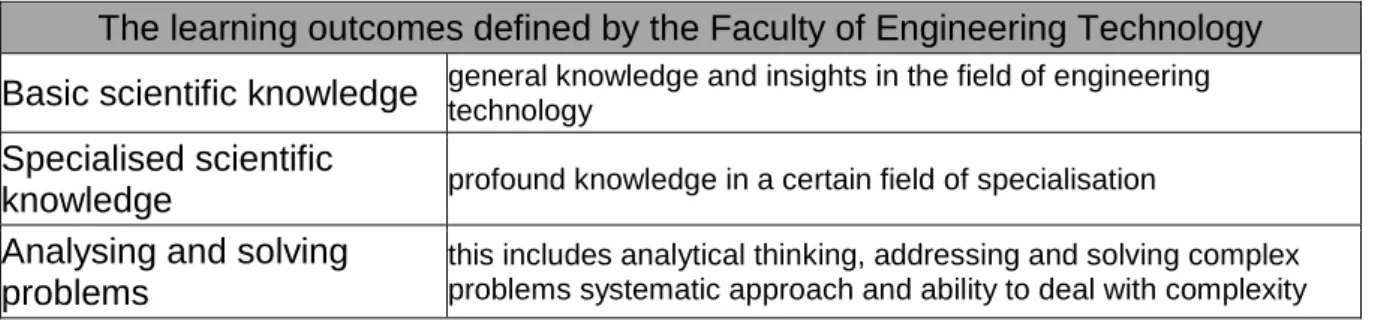
The learning outcomes used in this study are the official learning outcomes as they are defined and reported by the Faculty of Engineering Technology (KU Leuven). Table 1 presents an overview of these learning outcomes and their definitions.
Table 1. The learning outcomes and their definitions
The learning outcomes defined by the Faculty of Engineering Technology Basic scientific knowledge general knowledge and insights in the field of engineering technology Specialised scientific
knowledge profound knowledge in a certain field of specialisation Analysing and solving
problems
this includes analytical thinking, addressing and solving complex problems systematic approach and ability to deal with complexity
Design and development planning and carrying out a creative design- and/or development project Application-oriented
research
formulating a research question, planning and conducting a research project and selecting the research methods
Ethical responsibility acting with a sense for corporate social and environmental responsibilities Entrepreneurship taking initiative and having attention for economic and business-related aspects Operationalization conducting practical, discipline-specific basic operations
Collecting and processing information
searching information, evaluating its reliability and correctly referring to it
Communication being able to communicate with peers and non-peers
Teamwork being able to function in a team in different roles
Professionalism operating precisely, showing curiosity, drive, perseverance and punctuality, being able to make and respect a planning Critical reflection being critical towards the own performance, results and conflicting information
3 METHODOLOGY
3.1 Semi-structured interviews
We started the exploration of the possible role models with a qualitative research method. The main goal was to explore the recognisability of the proposed role models by the professional field, and to discover their preferred model. To stay open for input and adjustments of the model, we choose a qualitative research method in which discussion is possible. Semi-structured interviews (n=5) were carried out with HR managers of companies from different sectors (energy, recruitment, building,…). During the interviews the participants were introduced to the two role models outlined above (Treacy and Wiersema’s model and Lauwers’ engineering profiles model). We asked them which of the two role models best suited their business practice. Also, the interviewees were introduced to a list containing the main learning outcomes of the study programs of the Faculty of Engineering Technology. They were asked to indicate which learning outcomes were most important for each of the roles of their chosen role model.
All the interviews were recorded, transcribed and coded. Codes that covered a similar topic were grouped together. The code groups were used to create an overview of the main ideas and answers that were put forward during the interviews.
3.2 Job fair surveys and online surveys with companies
Based on the outcomes of the interviews, a quantitative survey was set up. We chose a quantitative research model to collect data on a larger scale, which would enable us to statistically analyse the results. With the quantitative survey we aimed to further verify the validity of the chosen model and the substantial presence of each of the roles in the professional life. Also, we aimed to clarify the core competences/learning outcomes for each of these roles and see if significantly corresponding learning outcomes could be found. A standardised questionnaire was used to survey company representatives of companies working with engineers. At a first stage, representatives who were present on job fairs were asked to fill in a hard copy questionnaire (n=63). In total, three job fairs were visited: two in Leuven (18th of
February; 3rd of March, 2015) and one in Sint Katelijne-Waver (24th of February,
business contacts of the Faculty of Engineering Technology through email. The total number of company contact persons invited to fill in the online questionnaire was 277. This resulted in a valid response of 58, which brings the response rate of the web survey to 20,9% percent. Together with the surveys obtained from the job fairs, the total number of filled in surveys is 121.
In order to measure the importance of the learning outcomes per role a scale question was included in the questionnaire (scale 1 to 3). Per role, each learning outcome could be rated 1: ‘somewhat important’, 2: ‘important’ or 3: ‘essential (core competence)’. The mean scores of importance of each learning outcome (per role) were calculated. This way the mean scores of the learning outcomes could be calculated and ranked. An ANOVA was used to detect significant differences between the different roles for each of the learning outcomes.
4 RESULTS
4.1 Identifying the roles
To decide which of the two role models should be focused on in the continuation of the research project and the composition of the subsequent survey we introduced the interviewees with both role models. Could they recognize the three abstract roles in their company or they saw more value in the concrete roles? In the interviews, almost all participants indicated that the role model based on Treacy and Wiersema’s work was recognisable for them when recruiting engineers. Three out of the five interviewees could easily apply the three roles on the engineers within their own company and even used the terminology spontaneously during the interview. Two of the interviewees could identify the model in some way, but did not stick to the introduced terms. Moreover, the interviewees seemed to have specific functions in mind when discussing the three roles for engineers. For example, when discussing the role of operational excellence, respondents mentioned ‘maintenance’ and ‘logistics and supply chain’. Product leadership often leaded to discussing ‘R&D’ and ‘design’. And customer intimacy was regularly linked to ‘sales and communication’ and ‘customer support’. An aspect that was indicated as missing in this model was ‘entrepreneurship’.
The profile role model of Lauwers was recognisable in most cases, but not fully applicable to all sectors. Also, it was mentioned that the model of Lauwers is rather an overview of functions, whereas the division of Treacy and Wiersema could be seen as a set of ‘overarching roles’. Therefore, in the continuation of the research the role model of Treacy and Wiersema was used.
In order to ensure the validity of the chosen model, we also asked the company representatives in the questionnaire whether or not they recognised the three roles for engineers within their company. In total, 91% of respondents was able to recognise the roles. Out of all respondents, 85% answered ‘yes’ to the question if they could recognise the model and 6% answered that the roles were ‘recognisable, but incomplete/need some adjustment’. For example, some indicated that ‘management’ was missing in this model or that a job often contains a combination of the three roles.
In order to verify the substantial presence of each of the roles in the professional life, we asked the professionals what share of the total number of engineers in their company was employed in each of these roles. In line with the previous vacancy research, we found that most engineers were employed in operational excellence (40%). For both product leadership and customer intimacy this percentage lays around 30%.
4.2 Corresponding learning outcomes
Besides identifying the professional roles for engineers, another main goal of the study was to determine which learning outcomes relate to which role, and whether the corresponding learning outcomes differ significantly between roles.
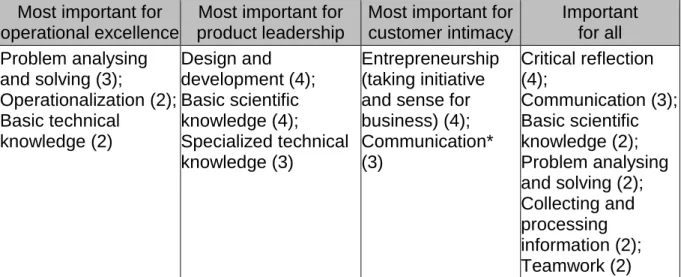
The interviewees were asked to determine for each learning outcome whether it was ‘most important for operational excellence’, ‘most important for product leadership’ or ‘most important for customer intimacy’. It was also possible to stress equal importance to all three of the roles. In table 2 an overview is presented. The number in bracketsreflects the number of interviewees who explicitly mentioned that learning outcome as most important for a certain role (or equally important for all).
Table 2. Learning outcomes per role (interviews)
Most important for operational excellence
Most important for product leadership
Most important for customer intimacy Important for all Problem analysing and solving (3); Operationalization (2); Basic technical knowledge (2) Design and development (4); Basic scientific knowledge (4); Specialized technical knowledge (3) Entrepreneurship (taking initiative and sense for business) (4); Communication* (3) Critical reflection (4); Communication (3); Basic scientific knowledge (2); Problem analysing and solving (2); Collecting and processing information (2); Teamwork (2)
*Although often emphasized for customer intimacy, communication skills were seen as indispensable for all the roles
In the questionnaire the respondents were asked to rate the importance of each learning outcome for each role. In table 3, the rankings of the learning outcomes’ general mean scores and the mean scores per role are shown. An initial ANOVA gave an indication of which learning outcomes have a significant difference in mean scores between the roles. Tukey HSD enabled us to test statistical differences based on post hoc pairwise comparisons.
Table 3. Learning outcomes’ general mean scores and mean scores per role (survey)
Learning outcomes General Mean Scores Operational Excellence Product Leadership Customer Intimacy Professionalism 2,61 2,57a,b 2,49a 2,78ᵇ
Collecting & processing information 2,55 2,42a 2,52a 2,59a Problem analysing & solving 2,54 2,74ᵃ 2,43b 2,44b
Teamwork 2,54 2,55a 2,47a 2,6a
Communication 2,49 2,42 a,b 2,37 a 2,64ᵇ
Critical reflection 2,47 2,42a 2,43a 2,54a Entrepreneurship 2,28 2,19 a,b 2,14a 2,44ᵇ Application-oriented research 2,23 2,17a 2,43a 2,16a Ethical responsibility 2,22 2,18 a,b 2,16a 2,44ᵇ Basic scientific knowledge 2,17 2,30a 2,30a 1,92b
Design and development 2,16 2,10a 2,46b 2,05a Operationalization 2,16 2,33a 1,97b 2,10a,b Specialization 2,05 2,09a,b 2,23a 1,90b
* Mean values with different subscripts were significantly different at the 0,05 level (post hoc Tukey HSD)
** Learning outcomes displayed in bold indicate learning outcomes with significant ANOVA scores at the 0,05 level
First of all, we see that the mean scores for ‘collecting and processing information’, ‘teamwork’ and ‘critical reflection’ are generally high, but do not remarkably differ from each other and they do not correspond significantly with any specific role. These results suggest that these competences are essential for all engineers. This is in line with the results of the interviews.
An exceptional non-significant learning outcome is ‘application-oriented research’. Although the ANOVA score was significant, the Tukey HSD scores did not show significant differences between the roles.
Engineers working in an operational excellence role are supposed to be strong in analysing and solving problems, since it scored significantly higher than for the two other roles. This is confirmed by the interviews with the HR-managers (table 2). The ability to design and develop was ranked significantly higher for the role of product leadership, than for the two other roles. This is confirmed as well by the interviewees (table 2).
For the customer intimacy role, clear characterizing learning outcomes were not observed. However, one learning outcome stood out significantly in a negative way. Basic scientific knowledge was found to be of lower importance for a customer intimacy engineer, than for the engineers in other roles. A similar trend was found for ‘specialization’, but this finding was only significant in comparison with the product leadership role.
Furthermore, several learning outcomes were found to have a significant higher score for the customer intimacy role compared to the product leadership role. These learning outcomes are ‘professionalism’, ‘communication’, ‘entrepreneurship’ and ‘ethical responsibility’. It should be noted that the mean scores for professionalism and communication are high for all the roles and that also in the interviews, these learning outcomes (especially communication) were stressed to be essential for engineer, regardless of the role. However, professionalism and communication are both indicated to hold most importance for engineers working in customer intimacy and least importance for engineers in product leadership. Also this was in accordance with the interviews (table 2).
5 SUMMARY
This study aimed to identify the different professional roles for engineers and the corresponding learning outcomes. Interviews with HR-managers of companies working with engineers resulted in the identification of three main roles, namely: operational excellence (an engineer that organises and optimises processes), product leadership (an engineer that develops new products/technologies) and customer intimacy (an engineer that provides solutions according to the needs of the customer). A survey with company representatives showed that for an operational excellence engineer, problem analysing and solving skills are considered the most essential skills. For an engineer in product leadership, the design and development skills are found significantly more important. At last, for customer intimacy it was less clear. However, professionalism, communication, entrepreneurship and ethic
responsibility were found to be more important for a customer intimacy engineer than for a product leadership engineer. Basic scientific knowledge was found to be of lower importance for a customer intimacy engineer.
It is important keep in mind that this story is not as black and white as may be concluded from this study. Often, engineers do not function in one specific ‘role’ during their professional life: they combine roles within one function or they change roles in the course of their career.
This research was a first step in the exploration of roles for engineers and the implementation of these roles in the study programme. To increase our further understanding of the results, our next step is to research the disciplinary future self-images of the students in context of the different professional roles.
In the near future we will study how we can include these results in the engineering programmes. It is our goal to face all students, even so the freshmen, with this reality. It is important that we make them aware of their gifts and how these gifts can be developed to become an engineer fitting perfectly with their ideal future self. A well-informed view of the future professional roles could help students in directing their individual development of competences.
6 ACKNOWLEDGMENTS
The input of the professional field was essential for this exploration, therefore we would like to express our gratefulness to everyone that participated in this research. We also highly value the suggestions that were given by André Lauwers and Kathleen Dupont.
REFERENCES
[1] Karataş, F. Ö., Bodner, G. M., & Unal, S. (2015), First-year engineering students' views of the nature of engineering: implications for engineering programmes, European Journal of Engineering Education, (ahead-of-print), pp. 1-22.
[2] Frymier, A. B., & Shulman, G. M. (1995), “What's in it for me?”: Increasing content relevance to enhance students' motivation, Communication Education, 44(1), 40-50.
[3] Hull-Blanks, E., Kurpius, S. E. R., Befort, C., Sollenberger, S., Nicpon, M. F., & Huser, L. (2005), Career goals and retention-related factors among college freshmen, Journal of Career Development, 32(1), 16-30.
[4] Robinson, M. A., Sparrow, P. R., Clegg, C., & Birdi, K. (2005), Design engineering competencies: future requirements and predicted changes in the forthcoming decade, Design Studies, 26(2), 123-153.
[5] Lauwers, A., Bonte, H., Vanmaercke, R. (2013), Personal Competencies Overview: Helping the graduating students to choose a job, 41st SEFI Conference, Leuven, Belgium.
[6] Treacy, M., & Wiersema, F. (1993), Customer intimacy and other value disciplines, Harvard business review, 71(1), 84-93.