Riki Mukhaiyar
CANCELLABLE BIOMETRIC
USING MATRIX APPROACHES
DOCTOR OF PHILOSOPHY
SCHOOL OF ELECTRICAL AND ELECTRONIC ENGINEERING
NEWCASTLE UNIVERSITY
UNITED KINGDOM
A THESIS SUBMITTED TO
THE FACULTY OF SCIENCE, AGRICULTURE, AND ENGINEERING IN PARTIAL FULFILMENT OF THE REQUIREMENTS FOR
THE DEGREE OF
NEWCASTLE UNIVERSITY
SCHOOL OF ELECTRICAL AND ELECTRONIC
ENGINEERING
I, Riki Mukhaiyar, confirm that this thesis and work presented in it are
my own achievement.
I have read and understand the penalties associated with plagiarism.
Signed:
i
Abstract
Cancellable biometrics endeavour to hide the appearance of a biometric image into a transformed template which prevents the outsider from recognising whom the biometric belongs to. Current research into cancellable biometric methodologies concentrates on the details of biometric traits. This approach has a drawback which cannot possibly be implemented with other biometric technology.
To address this problem, this thesis contributes to development of a novel concept for the feature transformation of biometric technology, especially for fingerprints, by utilizing several matrix operations to provide an alternative algorithm in order to produce multi-implementation of the cancellable system. The matrix operations generate the feature element of the input fingerprint image in an irrevocable form of output fingerprint template by ignoring the type of biometric traits unique to fingerprints; thus, the cancellable algorithm can be implemented in different biometrics technologies. The implementation offers a new concept in generating a cancellable template by considering a sequential procedure for the fingerprint processing, in order to allow the authentication process to succeed in authenticating an enquired input. For example, a region of interest (RoI) step is required to provide a square form input to support the system working in a matrix domain. Meanwhile, the input fingerprints are mostly in rectangular form.
This thesis contributes a new approach to selecting a certain area of a fingerprint by utilizing the density of ridge frequency and orientation. The implementation of these two enhancement steps reduces the excision process of this significant region of the fingerprint by avoiding the involvement of a non-feature area. Meanwhile, to avoid obtaining an un classified fingerprint, this thesis offers a new approach to the fingerprint image classification process entailing three requirements in classifying the fingerprint: the core point and its number, ridge frequency, and ridge direction; whilst the tented arch (TA) is only an additional requirement. The proposed idea increases both the percentage accuracy in classifying fingerprints and time consuming of the system. For Example, the accuracy of the fingerprint classification improves from less than 41 per cent of the fingerprint to 86.48 per cent in average for all of databases.
ii
Acknowledgement
Alhamdulillah rabbil ‘alamin. Thanks to Allah Azza Wa Jalla for allowing me to finish this
thesis. I am with humility thankful to my supervisors, Prof. Satnam S. Dlay and Dr. Wai Lok
Woo, for their support, understanding, encouragement, and helping me to identify, desing,
conduct, and complete the research.
Furthermore, I want to give my appreciation to the Directorate General of Higher Education
of the Ministry of Education and Culture of the Republic of Indonesia for the scholarship to
finance my Ph.D study at Newcastle University, United Kingdom. Finally, the most
important thanks I dedicate to my parents: papa Professor Mukhaiyar and mama Hirnawati,
my wife: Sylvia Utari, my son: Muhammad Azzam Riki Mukhaiyar, my daughter: Mahdiya
Aisyah Riki Mukhaiyar, my sister: Utriweni Mukhaiyar, and my brother: Hadi Mukhaiyar for
iii
Contents
ABSTRACT i
ACKNOWLEDGEMENT ii
CONTENTS iii
LIST OF FIGURES vii
LIST OF TABLES xi
ABBREVIATIONS xiv
LIST OF PUBLICATIONS xvi
1. INTRODUCTION
1.1. Biometric 1
1.2. Cancellable Biometrics 3
1.3. Thesis Aims and Objectives 6
1.4. Contributions 7
1.5. Thesis Outline 8
2. CANCELLABLE BIOMETRICS
2.1. Introduction 10
2.2. The Non-Invertible Issue 13
2.3. Re-Issuing 15
2.4. Accuracy Performance 16
2.5. Matrix Operations 17
iv
2.5.2. Kronecker Product Operation 19
2.6. Summary 20 3. BIOMETRICS FINGERPRINT 3.1. Introduction 22 3.2. Fingerprint Enhancement 25 3.3. Core-Point Identification 27 3.4. Region of Interest 28 3.5. Fingerprint Classification 31 3.6. Minutiae Extraction 33 3.7. Summary 34
4. MATRICES OPERATIONS AND CANCELLABLE FINGERPRINT
4.1. Introduction 36
4.2. Basic Idea of Generating Cancellable Features 37
4.3. Matrix Implementation 39
4.4. Algorithm Outline 43
4.5. Experimental Results and Discussions 44
4.6. Summary 52
5. DEPENDABLE CANCELLABLE FINGERPRINT
5.1. Introduction 55 5.2. Fingerprint Enhancement 56 5.3. Core-Point Identification 57 5.4. RoI 58 5.5. Fingerprint Classification 60 5.6. Minutiae Extraction 61 5.7. Experimental Results 63
v 5.7.1. Database FVC 2002 64 5.7.2. Database FVC 2004 66 5.7.3. Database BRC 67 5.8. Discussions 68 5.9. Summary 81 6. PERFORMANCE ANALYSIS 6.1. Introduction 84
6.2. Error Rates Evaluation 84
6.3. Evaluation of Time Taken 98
6.4. Evaluation of Matrices Operations Requirements 101
6.4.1. The Size of the Arbitrary Matrix of the KP Operation 101
6.4.2. The Zero Rows and Columns of the ERO Operation 103
6.5. Discussions 107
6.6. Summary 110
7. CONCLUSION AND FUTURE WORK
7.1. Conclusion 112
7.2. Recommendations for Future Work 117
REFERENCE 119
APPENDIX 131
A.1. Elementary Row Operation 131
A.2. Kronecker Product 137
A.2.1. Definition and Examples 137
A.2.2. Properties of the Kronecker Product 139
A.3. Inverse Matrix Operations 144
vi
vii
List of Figures
Figure 2.1. Cancellable Templates from Different Transforms 17
Figure 2.2. Re-Issuing in Cancellable Biometrics 19
Figure 3.1. Core-Point Detection using Ridge Frequency, and 28
Orientation Steps of Fingerprint
Figure 3.2. Fingerprint and Its Core-point and Delta 29
Figure 3.3. Region of Interest Step 30
Figure 3.4. Examples of the Five Commonly Used of the Fingerprints Classes 31
Under the Galton-Henry Classification Scheme
Figure 3.5. Examples of the Minutiae Extraction of Two Different Fingerprints 34
Database Sources (FVC2002 and BRC)
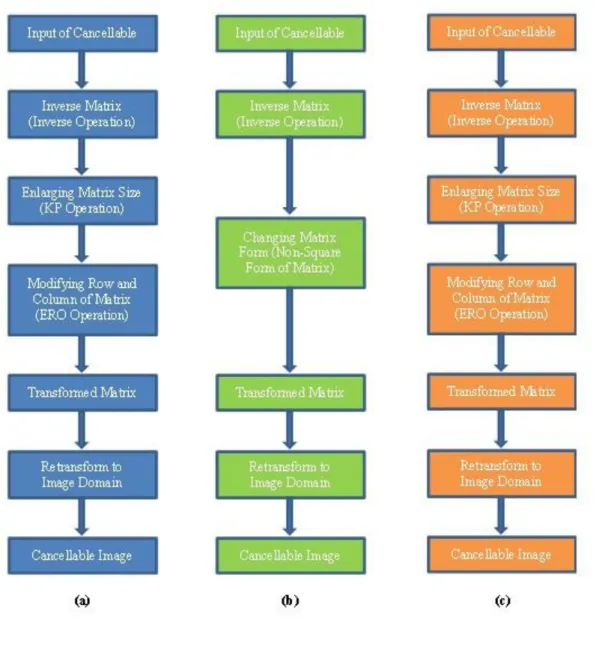
Figure 4.1. Three Approaches in Generating a Cancellable Image using 44
Several Matrix Operations
Figure 4.2. Implementation Result of the First Procedure of the Research Outline 45
Figure 4.3. Image as a Result of Elementary Row Operation (the Cancellable 47
Fingerprint Image)
Figure 4.4. Another Approach of the Procedure of the Proposed Research Outline 48
(720 x 720 pixel) by Exchanging the Placing Combination of
the Kronecker Operation
Figure 4.5. The Kronecker Product of the Second Alternative Procedure of 49
the Research Outline (480 x 720 pixels)
Figure 4.6. Images of the Cancellable Algorithm 50
Figure 4.7. The Third Procesure of the Research Outline 51
viii
Figure 4.9. Illustration Flow of the Second Procedure of the Research Outline 53
Figure 4.10. Illustration Flow of the Third Procedure of the Research Outline 53
Figure 4.11. Illustration of the Importance of Pre-Processing Step for Fingerprint 54
Figure 5.1. RoI Procedures for Fingerprint Image Un-Centred Core-Point 58
Figure 5.2. Another RoI Result 59
Figure 5.3. Examples of a Ridge Ending and Bifurcation 62
Figure 5.4. Eight Neighbourhood Pixels Scanned in an Anti-Clockwise Direction 62
of the Crossing Number (CN)
Figure 5.5. The Candidate of Ridge Ending and Ridge Bifurcation 63
(Illustration using the Properties of CN)
Figure 5.6. Enhancement Process’ Result for FVC2004DB1 and FVC2002DB1 69
Figure 5.7. The Enhancement Process Omits the Noise of 70
the Original Fingerprint
Figure 5.8. Comparison Results for an Original Fingerprint 71
Figure 5.9. Core-point Identification Result 72
Figure 5.10. Step Process of RoI 73
Figure 5.11. Ridge Orientation of Fingeprint 101_1.tif (FVC2002 DB1_B);
Indicated as Right Loop Class Fingerprint 78
Figure 5.12. Indicated as a New Type of Fingprint (Besides Henry-Galton Scheme) 80
Figure 5.13. Frequency Display for Cancellable Result of Fingeprint 81
Figure 6.1. Original RoI Fingerprint of FVC2002DB1 used as the Established 87
Database
Figure 6.2. Original RoI Fingerprint of FVC2002DB2 used as the Established 88
Database
ix
Database
Figure 6.4. Original RoI Fingerprint of FVC2002DB4 used as the Established 90
Database
Figure 6.5. Original RoI Fingerprint of FVC2004DB1 used as the Established 91
Database
Figure 6.6. Original RoI Fingerprint of FVC2004DB2 used as the Established 92
Database
Figure 6.7. Original RoI Fingerprint of FVC2004DB3 used as the Established 94
Database
Figure 6.8. Original RoI Fingerprint of FVC2004DB4 used as the Established 95
Database
Figure 6.9. Original RoI Fingerprint of BRCDB1Test used as the Established 96
Database
Figure 6.10. Original RoI Fingerprint of BRCDB1Training used as the Established 97
Database
Figure 6.11. Original RoI Fingerprint of BRCDB2 used as the Established 98
Database
Figure 6.12. Illustrating the Correlation between the Size of the Arbitrary Matrix and 102
Time Taken of the Process
Figure 6.13. Illustrating of the Original Feature of the Fingerprint 104
Figure 6.14 One Row of the Original Feature of the Fingerprint Replaced by 104
Zero Row
Figure 6.15 Two Rows of the Original Feature of the Fingerprint Replaced by 104
Zero Row
x
Zero Row
Figure 6.17 One Column of the Original Feature of the Fingerprint Replaced by 105
Zero Column
Figure 6.18 Two Columns of the Original Feature of the Fingerprint Replaced by 105
Zero Columns
Figure 6.19 Three Columns of the Original Feature of the Fingerprint Replaced by 106
Zero Columns
Figure 6.20. Illustration the Combination of the Zero Row and Column of the Image 106
Figure 6.21. The Unchanged Look of the Fingerprint Features after the Augmenting 107
Process of the Zero Row and Column into the Image
Figure A.1. Illustration of ERO 137
xi
List of Tables
Table 5.1. Properties of Crossing Number (CN) 63
Table 5.2. FVC 2002 Scanners/Technologies for each Database 64
Table 5.3. Results for Fingerprint Images of FVC2002 Database 65
Table 5.4. FVC 2003 Scanners/Technologies for each Database 66
Table 5.5. Results for Fingerprint Images of FVC2004 Database 66
Table 5.6. BRC Database Detail Information 67
Table 5.7. Results for Fingerprint Images of BRC Database 68
Table 5.8. Fingerprint Classification for Database FVC2002 under Galton-Henry 74
Classification Scheme
Table 5.9. Fingerprint Classification for Database FVC2002 based on 74
the Existence of the Fingerprint
Table 5.10. Fingerprint Classification for Database FVC2004 under Galton-Henry 75
classification Scheme
Table 5.11. Fingerprint Classification for Database FVC2004 based on 75
the Existence of the Fingerprint
Table 5.12. Fingerprint Classification for Database BRC DBI-Test under 76
xii
Table 5.13. Fingerprint Classification for Database BRC DBI-Test based on 76
the Existence of the Fingerprint
Table 5.14. The Comparison Result of Three Different Databases in term of 79
classified, Unclassified, Indicated as Left/Right Loop, and False
classification Decision
Table 6.1. EER values FVC 2002 DB1 86
Table 6.2. EER values FVC 2002 DB2 87
Table 6.3. EER values FVC 2002 DB3 88
Table 6.4. EER values FVC 2002 DB4 89
Table 6.5. EER values FVC 2004 DB1 91
Table 6.6. EER values FVC 2004 DB2 92
Table 6.7. EER values FVC 2004 DB3 93
Table 6.8. EER values FVC 2004 DB4 94
Table 6.9. EER values BRC DB1 Test 95
Table 6.10. EER values BRC DB1 Training 96
Table 6.11. EER values BRC DB2 97
Table 6.12. Time Needed for Database FVC 2002 99
Table 6.13. Time Needed for Database FVC 2004 99
xiii
Table 6.15. Correlation Between the Size Differences of the Input Fingerprint 101
xiv
Abbreviations
DNA Deoxyribonucleic Acid
DC Direct Current
ID Identity
PIN Personal Identification Number
ERO Elementary Row Operation
KP Kronecker Product Operation
RoI Region of Interest
TA Tented Arch
FAR False Accept Rates
FRR False Reject Rates
EER Equal Error Rate
MRF Markov Random Field
DC Direction of Curvature
GR Geometry of Region
AFIS Automatic Fingerprint Identification System
FVC Fingerprint Verification Competition
DB Database
BRC Biometrics Research Centre
INV Inverse Matrix Operation
CN Crossing Number
GAR Genuine Accepted Rate
CPU Central Processing Unit
xv
RAM Random Access Memory
MATLAB Matrix Laboratory
xvi
List of Publications
1. R. Mukhaiyar, S. S. Dlay, and W. L. Woo, “Alternative Approach in Generating
Cancellable Biometric by using Matrices Operations”, In the Proceedings of the 56th
International Symposium ELMAR-2014, pp. 163-166, Zadar, Croatia, Sept. 10-12,
2014.
2. R. Mukhaiyar, S. S. Dlay, and W. L. Woo, “Generating Cancellable Fingerprint using
Matrices Operations and Its Fingerprint Processing Requirements”, Journal
1
Chapter 1
1.
Introduction
1.1.
Biometrics
Biometrics is a method of identifying human uniqueness based on one or several
features of either physical or behavioural characteristics. The physical characteristics relate to
the human body, such as fingerprints, the face, shape of the hand or palm, iris, retina, DNA,
or even human smell. Conversely, behavioural characteristics relate to human features, for
instance sound, typing rhythm, or the way a person walks. These characteristics are used to
identify humans based on the basic concepts of uniqueness, permanence, and collectivity.
Thus, the basic idea of biometric science is to use part of the human body as the key
or sign to obtain detailed information. This is either from the person whose part body part is
being used, or from someone who has a certain relationship with them. In computing science,
biometrics is specifically used as a requirement in managing private access and also in
controlling access given to an individual. In addition, it can also be used to identify a person
in a group which is under supervision.
One of the main biometric technologies that has been studied in detail is fingerprints.
Fingerprints can be defined as ‘a trace or an imprint of friction of contraction in most or all of the surface of the human fingers’. The friction of contraction can be found on the palm of
one’s hand, fingers and toes, and on the skin of one’s foot. It consists of one, or more of
contraction unit that is connected to the imprint of the skin. This contraction is also known as ‘dermal contraction’.
2
Nowadays, the acquisition process of a fingerprint from its source is conducted
through direct fingerprint reading, also known as live fingerprint reader. This technology
relies on the principles of thermal and optical as well as silicon and ultrasonic sensing [1],
[2], [3] and is mostly used to read the fingerprint. It is based on the concept of changes to the
reflection in the area where a person’s finger touches the surface of the reader. All readers
that use optical technology consist of a source and a light sensor, and moreover a source of
specific reflection that can change a reflection if pressure occurs. Several of the type of
readers are equipped with processing equipment and a chip memory. The sensor used in this
technology is based on DC capacitance from fingers, and contain a layout of a capacitor with a square shape that is implanted on the silicon chip. One side of the capacitor’s plate is on the
finger, while the other side, which contains a small area made from metal, is on the surface of the chip, so that the finger is opposite the chip’s surface.
Another type of fingerprint reader technology is based on ultrasound, however, this is
less frequently used [4]. The initial concept of this technology is to use the ultrasound to
observe the surface of the pictures. The ultrasonic sensor will start moving and reading the
entire fingers for one or two seconds, as soon as the user place the fingers on a piece of glass
that is on the reader. The results will be saved in a particular unit in a database. This database
will be used when the application system for fingers requires confirmation by matching the
database with the fingers. If the fingers are recognized as one of the collection in the
database, the application system will accept them as the owner of the fingerprint. Otherwise
the application will state that it is an impostor. This process is known as the authentication
process of the fingerprint, and furthermore is also called the process of matching fingerprints.
Fingerprint matching techniques can be classified into two categories: minutiae-based
and correlation-based [5]. In the minutiae-based technique, the initial concept of matching the
3
ascertaining the connection between the minutiae and the fingers. Conversely, the correlation
based technique requires the exact location during the registration process. In addition, it is
also affected by the rotation and movement of the image [3], [6], [7], [8].
In this research, matrix operations are the main rule utilized in generating the
cancellable fingerprint template. The matrix operations are used to produce a transformed
template of fingerprint which is irrevocable to the original image of fingerprint. This
irrevocability factor is needed to protect the information of fingerprint to be compromised by
impostor. Initially, if a fingerprint is being processed in the matrix domain, then each pixel of
the image describes what the image is. This means that no noise is allowed as a part of the
image because the existence of noise may add specific information to the fingerprint feature.
In relation to the cancellable fingerprint, at the end of this process is the authentication step,
where even a small amount of noise will significantly affect the quality of the cancellable
feature and result in low precision in subsequent verification.
Thus, an early process to be accomplished in establishing a fingerprint is the
enhancement process. The result of this process will provide a fingerprint feature with the
precise value of all of its information, so that when it is mathematically processed with
matrices operations, there will be no unnecessary values contained within it. The result of
these operations will be the input of the cancellable system that is going to be created.
1.2.
Cancellable Biometrics
The advances in information technology and increases in security concerns have
encouraged the rapid development of automatic personal identification systems in biometrics.
4
physical and behavioural distinctions is considered to be crucial, given the need for
something reliable and capable of distinguishing whether the biometric owner is real or bogus
[9]. This technology is more preeminent than the token-based method or even other
knowledge-based methods which are based on traditional concepts, given that biometric
technology offers a particularly comfortable and secure process for its users.
Proving a person’s uniqueness using biometric technology is reliable, as human
physical characteristics are very difficult to imitate or falsify, compared with other methods
that use security codes and passwords, but requires a significant amount of important
memory. Biometric authentication can be located in various applications, such as in network
access and the workplace, log-on applications, data protection, the long distance access of
resources, website network security, e-government and e-commerce. Furthermore, biometric
technology will be needed to provide electronic banking services, as well as other financial
and investment transactions. In addition, retail sales, law enforcement, health and social
services also require this technology. It is expected to play an important role in clarifying a person’s validity in larger scale trading networks that require authentication and protection
for its applications.
The implementation of biometric technology, whether on its own or combined with
other technologies such as smart cards, digital signatures and encrypted biometric keys, has
already been implemented in many areas. Thus, personal authentication through biometric
technology presents a new challenge in protecting personal data, which cannot be established
using traditional authentication methods. Moreover, users’ biometric data relating to health
and personal information will not be able to be changed, to be processed, or even illegally
distributed without the approval of eligible users [10], because during the cross-matching
process the system will also detect the invalidity of subjects that are registered by the eligible
5
security system will be able to verify the identity of the impostor. This is possible since the
biometric data is permanent and interconnected with the data owner. Nevertheless, it is
undeniable that someone will lose his/her privacy as a consequence of using biometric data.
Due to a number of issues related to users’ privacy and security, many recent studies
have attempted to find a method to protect biometric systems from the possibility of misuse
by improving certain points that are considered to be deficient [11]. The security in this
method will have to be able to improve its security system, while efficiently running the
matching process and ensuring that it continues to identify appropriate biometric data. The
fact that biometric data is permanent and unique, as it is not owned by two or more persons,
means that offences against one’s personal data is less likely to happen, as in a traditional system where a person’s identification, such as ID and PIN (personal identification number)
can be cancelled and remade.
Another approach proposed to protect biometric data is the biometric cryptosystem
[12]. This technology embeds key information onto the feature of biometrics as an additional
information about it. This information could not be revealed without a successful
authentication procedure. However, this technology has drawbacks related to unstable
recognition performance caused by the unreliable production of the key information [13].
With regards to sharing personal biometric data in public, for instance with
commercial companies, enforcement agencies, and government agencies, security and
privacy systems in biometric technology have been vastly improved by implementing
cancellable biometric technology [13], [14]. This is based on the fact that biometric data do
not vary much over time (permanence) and are very rarely shared by two people (uniqueness)
where privacy violations could occur if biometrics are misused or stolen. Traditional methods
6
cancelled and reissued if the above privacy issues are compromised; however, this is not
possible with biometric data. Furthermore, there are privacy concerns about sharing biometric
data with commercial companies and law enforcement or government agencies.
Cancellable biometric technology uses biometric data that is intentionally transformed
instead of using the original biometric data in order to identify a person. The initial concept
of cancellable biometrics is that the system or the eligible user can automatically nullify the
registered data if his/her biometric data is being misused. The data in the cancellable
biometrics has to be different from the initial data and cannot be easily reconverted into its
original version, although the method of prior data transformation is known, and, moreover,
that the transformed version of the original data has been submitted. The original data can be
transformed into various types of data; however, the quality of the data does not decrease
compared to its fundamental version.
These advantages have motivated researchers in the biometric security field to find a
new and enhanced approach to generating a cancellable biometric template. A consideration
of the various possibilities to produce an algorithm for the cancellable biometric is a principle
reason for us to discuss the cancellable technology in this thesis.
1.3.
Thesis Aims and Objectives
The main aim of this work is to produce a novel approach to the generation of
cancellable biometric features, particularly in fingerprint technology, by providing an
alternative method to produce a cancellable template that is able to be implemented not only
7
understanding the basic requirements of a cancellable fingerprint. The objectives of these
requirements are:
- Produce a novel approach in generating cancellable biometric features,
particularly in fingerprint technology.
- Provide an alternative method to produce a cancellable template that is able to be
implemented not only for fingerprint technology but for another biometric
technologies as well.
- Provide all supporting fingerprint process algorithms, for instance fingerprint
enhancement and core-point identification to produce a dependable cancellable
fingerprint template.
1.4.
Contributions
With current cancellable biometric methodologies, research is focusing onto the
details of biometric traits. Hence, the resulting algorithms cannot possibly be implemented in
other biometric technologies. For example, a cancellable fingerprint using the rotation and
orientation of the minutiae approach is not appropriate for generating cancellable face, iris, or
retina.
- Based on this disadvantage, a novel concept of utilizing matrix operations is
introduced in this thesis, to give an alternative algorithm which can produce a
multi-implementation cancellable biometric. The methodology developed in this thesis is
not limited to the proposed fingerprint only, as it is also able to be used for other
8
- This research proposes a new concept with the aim of producing a cancellable
template. The concept requires a sequential procedure to guarantee that an established
and a queried biometric feature are compatible with an accepted one and incompatible
with a rejected one. This framework makes any applicant of this proposed approach to
be able to analyse less performance of the system.
- In generating the cancellable template, several requirements should be provided as an
input. One of the requirements is an input image form that is improved in a square
form shape and furthermore, a region of interest (RoI) algorithm is needed to select a
particular area of the fingerprint. In this thesis, a new method is applied by utilizing
the density of ridge-frequency and –orientation. The implementation of these two
enhancement steps reduces the excision of the important region of the fingerprint and
avoids involving the featureless area.
- To avoid obtaining an un-classified fingerprint, there are three principal requirements
of the proposed fingerprint classification image process: the core point and its
number, ridge frequency, and ridge direction; whilst the tented arch (TA) is only an
additional requirement. The proposed idea enhances the percentage accuracy in
classifying the fingerprint.
1.5.
Thesis Outline
The thesis is organised into seven chapters. The first chapter presents an introduction
to this thesis and describes what biometrics and cancellable biometrics. This is followed by
the aims and objectives, thesis methodology and its contributions. In addition, the outline of
9
Chapter 2 focuses on producing cancellable biometrics along with the requirements
needed to achieve a reliable cancellable template, such as being non-invertible and re-issuing
and the authentication of performance. The existing cancellable biometric approaches are
considered so as to illustrate the uniqueness of the algorithm proposed in this thesis.
Nevertheless, the matrix operations used in this research are discussed as well.
Chapter 3 discusses fingerprints as a biometric technology requiring several methods
in order to produce a reliable cancellable template; such as, fingerprint enhancement,
core-point identification, region of interest, fingerprint classification, minutiae extraction and
fingerprint authentication.
Chapter 4 presents an innovative approach to generating a cancellable fingerprint
template using several matrix operations. A description of each operation is explained
algebraically to illustrate how the operation works. Moreover, the methodology for this
exclusive approach will be introduced along with results that indicate that the method is
reliable enough to generate a cancellable template.
Chapter 5 analyses the requirements regarding pre-processing, core point
identification, and region of interest, fingerprint classification, and minutiae extraction, in
order to support this distinctive approach, which produces a dependable cancellable biometric
methodology.
Chapter 6 focuses on a performance evaluation of the approaches discussed in
chapters 4 and 5, such as the evaluation of error rates, time taken and the requirements for
matrix operations.
Chapter 7 presents the overall conclusions of the thesis and moreover provides some
10
Chapter 2
2.
Cancellable Biometrics
2.1.
Introduction
The use of representations of identity such as passwords and ID cards is no longer
sufficient, as these can easily be shared or compromised. The security requirements in an
authentication system based on biometric technologies have to be the benchmark of the
system, as its characteristics will be permanently associated with the eligible user and cannot
be cancelled or withdrawn when used inappropriately. Someone’s biometric characteristics
cannot easily be replaced. So if an impostor misuses it, the data will be lost forever. As a
result, there is a possibility that the user will lose all access to the application using that
particular biometric data. In order to overcome this problem, the susceptibility of the
biometric system needs to be systematically identified and recognized [15], [16]. Thus,
protecting biometric information has become one of the main concerns, as well as a major
challenge to researchers, in this field.
Cancellable biometric is a concept where its biometric template is protected by
combining both the security system and replacement features in the biometric system. The
main idea of this system is the transformation of the cancellable biometric and the changing
of all images and features before proceeding to the matching process, whilst still maintaining
the natural characteristics of the cancellable scheme. An appropriate cancellable biometric
system has to have the following standards: to be distinctive and reusable, and with
11
The transformation process implemented in various biometric technologies has
several functions such as: face identification [18], [19], [20], [21], signature identification
[22], [23], iris identification [24], [25], [26], [27], and voice identification [28], [29]. Many
recent papers consider that fingerprints are one of the technologies that are being widely
discussed for use in biometric systems [30], [31], [32], [33] & [34].
Three types of transformation have been recommended for implementation [30] with
fingerprint images: Cartesian transformation, polar transformation and image folding
transformation. However, the former two types have a disadvantage in relation to the
boundary issue. If the original minutiae point is away from its boundary and then divides the
area of the feature, as a result of minor distortion to the image alignment or if the original
fingerprint image is damaged, then the transformed version of the minutiae points will be
placed far from where it is supposed to be. Meanwhile, the third method relates to the
functional use of smoothing a local value to flip a fingerprint feature over the space.
Local smoothing function has been used to create a cancellable fingerprint template
by maintaining the original geometric connection (rotation and movement) between the
registered template and the questionable template after the transformation process is
conducted [33]. Therefore, the result from the template transformation can be used to identify
a person without requesting the alignment of the image fingerprint that is being used as an
input. However, this security method is in sufficient as protection for biometric data. For
example, an impostor might narrow down the candidates of the original minutiae design
based on limitations in the orientation continuity of the minutiae feature and the local
smoothing process of the transformation function.
Several investigations have been conducted regarding this issue. For instance, the
12
representations of binary numbers are transformed into an anonymous representation using a
unique personal key. According to the author, not only is the transformation non-invertible,
but also when it is misused by someone else, the template will disappear and can be renewed
by entering a different key. One of the advantages of this representation is that existing
methods, for instance bio-hashing could be implemented.
Alternatively, a secure method has been introduced to produce a template of a
cancellable fingerprint [35]. This method extracts a local image of the fingerprint filled with
minutiae in small pieces and subsequently transforms them into projection matrices without
changing the space between each minutia in those small pieces. However, the disadvantage
of this method is the poor accuracy of the transformation results. It can be noted that [36]
presents an idea in constructing a cancellable biometric system and secure sketches, in order
to protect the privacy of the biometric template while supervising the matching process
between the protected and referenced data. The standard process in cancellable biometrics is
to perform a transformation to create an unchangeable image and to produce a matching
process for those transformed images. In this technique a correction system is used on the
sketches which can be secured from the cancellable biometric system, resulting in a
procedure that supervises the appropriate matching process.
The geometric transformation system of the minutiae position has also been proposed
to create a template of cancellable fingerprints [37], which is useful in an alignment process.
In order to create a template of the cancellable fingerprint, a supervising parameter over the
encryption of minutiae features is conducted on the surrounding area of minutiae.
Subsequently, all the encrypted minutiae will be superimposed to form a protected template.
The parameters used to control minutiae encryption are created from the arranged minutiae
13
use the information from the minutiae that have to be encrypted, this minutiae encryption can
guarantee the solidity of the non-invertibility concept.
2.2.
The Non-Invertible Issue
In non-invertible transformation systems, a function, for example B, is designed to
transform the original biometric image into a new image within the scope of the domain
feature or signal. The B will serve as a key factor in protecting the cancellable template, as
well as determining if the template is non-invertible, reusable and variable. In view of the fact
that function B is not directly related to the original biometric image, then function B does
not have to be kept confidential.
his non-invertible transformation has been used where the fingerprint data is
transformed by the order of the three functions of non-invertible transformation [30]. As
shown in Figure 2.1, the three transformation functions are based on the Cartesian polar
concept and the surface folding transformation of the existing minutiae.
In general, the three transformation functions in Figure 2.1 enable more than one
minutia to be mapped onto the same points within the same transformation domain. This is
also known as many-to-one mapping. For example, two or more cells can be mapped into a
single cell in the Cartesian transformation, so that when the impostor discovers the key and
the transformation between the cells, the owner of the original cell will not be discovered, as
each minutia can refer to one of the cells at large. Therefore, this method provides certainty
14 Cartesian Transformation Polar Transformation Surface Folding Transformation Original Fingerprint
Figure 2.1. Cancellable Templates from Different Transforms (adopted from [30])
However, it has been argued [38] that the transformation and the choice of parameters
in this approach might decrease or even abolish the characteristic of many-to-one mapping on
which the non-invertible functions will depend, which will result in the reversion of the
original biometric feature. It has been shown [39] that the surface folding transformation can
be reversed to its original form if two transformed original templates are compromised.
A further study [40], the author presents a method of hashing minutiae information for
fingerprints and conducted the matching process in a new domain. Computationally, it is
quite complicated to reconstruct the original features because of the hashing value, as the
results from this method have a one way characteristic of transformation. Meanwhile, a
geometric transformation has been proposed [41] to create a key-dependent non-invertible
cancellable template for minutiae fingerprints. In this method the first factor to determine is
15
minutiae that are above the line reflect symmetrically below, this means that the template of
the transformation contains some information from its original template.
Cancellable biometrics offers a solution to protect the user’s privacy, as the client will
never be identified in the authentication process. This will guarantee that the protection of
template can be obtained at a feature level by using support from data in a non-invertible
transformation [42].
2.3.
Re-Issuing
Biometrics automatically identifies and verifies someone based on his/her physical,
biological, and/or behavioural characteristics. Compared with traditional identification and
verification methods, biometrics is not only considered to be comfortable for its users, but
also minimizes the number of impostors and is more secure. Biometrics is also associated
into: the security system, through intelligent, and a security forces.
Nevertheless, there are several concerns related to the application of biometrics in
everyday life, such as security and privacy issues, along with the question of ensuring that it
is standardized. The principal concern is the issues that relate to biometric data security.
Unlike traditional identification methods, it is difficult to re-issue a person’s biometric data.
Therefore, cancellable biometrics allows the system to re-issue the user’s biometric data by
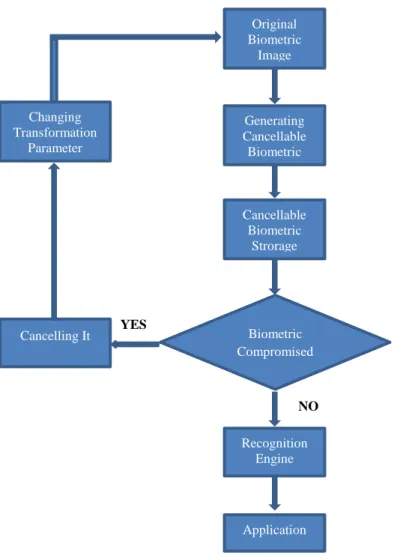
mixing up the biometric features before continuing to the matching process. The mixing
parameters can easily be changed to prevent the data being misused. Figure 2.2 demonstrates
16
Figure 2.2. Re-Issuing in Cancellable Biometrics
2.4.
Accuracy Performance
A problem will occur in the biometric authentication system when the data associated
with the biometric features is misused. Unlike with biometrics system, physical
authentication systems using a form of token such as a key or an ID can easily be cancelled or
replaced with a new token, whenever the token is lost or misused. Conversely, it is not
possible to change or to replace the data in a biometric system. Original Biometric Image Generating Cancellable Biometric Cancellable Biometric Strorage Biometric Compromised Recognition Engine Application Cancelling It Changing Transformation Parameter NO YES
17
The performance evaluation of systems based on the biometric authentication is a
vital issue. Authentication systems will run the process by comparing the live biometric data
from the owner, which can belong to the owner or to others, with the original reference
template made by the system during the registration procedure. Matching the biometric
information entails calculating the degree of similarity between the live data in question and
the registered reference template. The results from this comparison process will be scored.
The false acceptance rate (FAR) and false rejection rate (FRR) are the important basic
performance measures of the matching process. The values of the rates for a threshold of
tolerance, however, combine levels of FAR and FRR in considering the security and
convenience of a biometric-based authentication system. In practice, the most challenging
aspect is to obtain a zero score for FAR and FRR. If the FAR score is higher, the system will
be more likely to recognize impostor data as genuine. If the FRR result is high the live data of
the owner will be recognized as an impostor, and vice versa. The impact of rejection in a
biometric system therefore becomes the main focus of discussion, and another index of
performance has been introduced where the point of FAR and FRR will be equal [43]. This
point is known as the equal error rate (EER), and a system will be considered as perfect if the
EER score is zero.
2.5.
Matrix Operations
The objectives of this research are to produce a cancellable template for fingerprints
based on the similarity between the non-invertible need for the fingerprint template in the
cancellable system to be non-invertible and a non-invertible matrix in the matrices
18
to the original image. This also applies to the matrices. The matrices cannot be inverted when
satisfying three conditions. Firstly, there is at least one zero row. Subsequently, there is a row
that is a multiple of another row; and finally, the matrix form is not a square.
The first requirement can be achieved by using an elementary row operation (ERO),
where a selected row is multiplied by zero. Meanwhile, for the next requirement, it is rare to
find a row in the image system which is a multiple of another row; hence, it can be created
using ERO.
Furthermore, to ensure that the obtained cancellable matrix is completely masked and
to be able to meet the final requirement of the non-invertible matrix, each element of the
transformed matrix is multiplied by an arbitrary matrix/element in this research. This process
is called the Kronecker product or tensor product operation. By using this process, the
outcome comprises those matrices, and contains more numerous elements and an adjustable
matrix form (whether a rectangle or square matrix).
2.5.1.
Elementary Row Operations (ERO)
Generally, Elementary Row Operations (ERO) can be defined as a multiplication and
addition force that is imposed on the matrix rows. The three operations corresponding to the
operations in rows of EROs are multiplied in the following way: a row by a non-zero
constant; interchanging two rows; and then adding a multiple of one row to another row [44].
The purpose of these operations is to acquire a solution in algebra or to obtain a new
form of matrix. For example, an arbitrary system of m linear equations in n unknowns can be
19
𝑎11𝑥1+ 𝑎12𝑥2+ ⋯ + 𝑎1𝑛𝑥𝑛 = 𝑏1
𝑎21𝑥1+ 𝑎22𝑥2+ ⋯ + 𝑎2𝑛𝑥𝑛 = 𝑏2
⋮
𝑎𝑚1𝑥1+ 𝑎𝑚2𝑥2+ ⋯ + 𝑎𝑚𝑛𝑥𝑛 = 𝑏𝑚 (2.1)
wherex1, x2, x3, …,xn are the unknowns and the subscripted a’s and b’s denote constants.
The above equation can be simplified by writing down only the constant values in the form of
a rectangular matrix as follows:
[ 𝑎11 𝑎12 ⋯ 𝑎1𝑛 𝑎21 𝑎22 … 𝑎2𝑛 ⋮ ⋮ ⋱ ⋮ 𝑎𝑚1 𝑎𝑚2 ⋯ 𝑎𝑚𝑛 ] [ 𝑥1 𝑥2 ⋮ 𝑥𝑛 ] = [ 𝑏1 𝑏2 ⋮ 𝑏𝑚 ] (2.2)
By using the three operations above, the unknown variables can be derived.
2.5.2.
Kronecker Product (KP) Operation
The definition of the Kronecker product or tensor product can be noted as follows
[45]. Suppose 𝐴 ∈ ℝ𝑚×𝑛, 𝐵 ∈ ℝ𝑝×𝑞. Then the Kronecker product of A and B is defined as the matrix: 𝐴 ⊗ 𝐵 = [ 𝑎11𝐵 ⋯ 𝑎1𝑛𝐵 ⋮ ⋱ ⋮ 𝑎𝑚1𝐵 ⋯ 𝑎𝑚𝑛𝐵] ∈ ℝ 𝑚𝑝×𝑛𝑞
20
There are two advantages that can be obtained using this operation. First of all, it is
able to change the value of each element of the original matrix. Secondly, if B has any kind of
matrix form, this means that a new larger matrix can be generated with different dimensions.
2.6.
Summary
In this chapter, the discussion has centred on the reasons why security is more
important for biometric-based authentication systems than for non-biometrics systems. The
main reason is that a biometric is permanently associated with a user and cannot be revoked
or cancelled if compromised. In this case, if a biometric identifier is stolen and misused, it is
lost indefinitely and possibly for every application where that biometric is used. In order to
avoid any potential security crisis, vulnerabilities in the biometric system must be identified
and addressed systematically. Cancellable biometrics has been a challenging but essential
approach to protecting the privacy of biometric data. Therefore, protecting biometric
information is a major concern.
According to [30], there were eight places in the generic biometric system that is
vulnerable to be compromised. For example, some attacks can be perpetrated at the sensor
level and at the feature extractor level by presenting a fake biometric at the acquisition
process or resubmitting a sensor stored digitized biometrics signals. Meanwhile, in overriding
the feature extraction process, the feature extractor is attacked using a Trojan horse, so that is
produces feature sets pre-selected by the intruder.
Other attacks are related to the biometric templates generated by the feature extractor
module, which are stored in the database or matched against previously stored templates. The
21
interconnecting channel level. Finally, the matcher and the output to the device application
can be attacked to override the system decision.
Cancellable biometrics is a concept where the biometric template is secured by
incorporating protection and replacement features into the biometrics. Fundamentally,
cancellable biometrics alter the biometric images or features before being matched. The
variability in distortion parameters offers the scheme its cancellable nature. A superior
cancellable biometrics formulation must fulfil four requirements: to be distinctive and
reusable, with unidirectional transformation and performance.
Based on these requirements, cancellable biometrics allows the system to re-issue the
biometrics for a user. The key idea of cancellable biometrics is to distort the biometric
image/signal/features before matching. The distortion parameters can easily be changed,
which provides the cancellable nature of the scheme.
The performance evaluation of biometric-based authentication systems is an
important issue. The authentication session compares a live biometric sample provided by the user with the user’s reference template generated by the system during the enrolment
procedure. This biometric matching determines the degree of similarity between the live
22
Chapter 3
3.
Biometric Fingerprint
3.1.
Introduction
In this research, fingerprint technology is utilized as an input for the cancellable
algorithm. This is influenced by the fact that a biometric fingerprint has centain unique
features, such as minutiae, pore, core-point, ridge and valley, and the fingerprint itself. These
features and traits provide particular information related to the owner so that no single other
person has identical information. This uniqueness encouraged us to select fingerprint
technology to provide the input for the cancellable algorithm.
In the previous chapter, it was stated that a cancellable template could be established
by utilizing several matrix operations that are inverse operations; for instance, the Kronecker
product operation and the elementary row operation. These operations yield a disguised
transformed template so as to recognize an impostor. Using these matrix operations requires a
quality-enhanced image as an input to ensure that there is no missing feature information
whilst the cancellable template is being generated.
For fingerprint technology, a qualifying image can be obtained by implementing a
pre-processing step to provide an enhanced fingerprint input for the cancellable fingerprint
algorithm. This stage can minimize the possibility of obtaining false-feature information
caused by noise, scars, unclear ridges/valleys, and so on. Another fingerprint processing step
needed is core-point identification as a reference point to select a certain region for the
23
classification step. The classification of a fingerprint is also utilized to reduce the time taken
during the authentication step, especially for the identification process. By classifying the
type of fingerprint, for instance, whorl, arch, tented arch, right loop, or left loop, this provides
a simple way to reduce the number of fingerprints which need to be compared.
Furthermore, the core-point is needed for several other purposes as follows. Firstly, it
means that a correct decision can be made with regards to which class a fingerprint is related
to. Actually, in class determination, the core-point is at the centre of the fingerprint ridge plot
pattern. Secondly, the core-point can be used as the core of the region of interest (RoI) of a
registered fingerprint. Normally for fingertips, the core is positioned in the centre. Therefore,
if the selection of the RoI uses the core-point as a zero coordinate, this is very useful in
recognising all of the fingerprint features. Furthermore, by using the core-point as a point
reference for a fingerprint, it helps to locate the minutiae details precisely in their own data
positions during the authentication step.
Minutiae extraction is used as one of the inputs for the cancellable system. After
minutia extraction, data on minutiae position will be dispersed in a row/column projection to
specify the certain location of the minutia. The method used in spreading the minutia
information is by collecting all minutiae caught in the extraction process afterwards and
placing it all in a data table. Subsequently, for authentication purposes, it will be difficult to
achieve a faster and efficient process, as a step-by-step initialization process is needed to
check an enquiry minutia again a registered one. Otherwise, if the core point is used as a
reference point, then the time taken can be reduced because the position of the minutia can be
directly confirmed with the original one without firstly identifying the position of each
24
In this research, the possibility of establishing a cancellable fingerprint by using an
enhanced fingerprint image such as with minutiae extraction is determined as well. The
reason for this is that the minutiae observed by the naked eye do not show up as a fingerprint
any more, and only appear as scattered figured points. However, implementing an improved
minutiae extraction approach is required to omit false-recorded information for fingerprint
recognition.
As previously mentioned, the RoI is required to ensure that all feature extraction such
as minutiae are entirely covered. Furthermore, the RoI is also required to make certain that
the input from the fingerprint will be in square form. Naturally, the fingerprint obtained from
an acquisition process is a non-square fingerprint image. Meanwhile, a mathematical
operation in matrices operations mostly requires a square form of matrix. Therefore, the
cropping and selection of the region is necessary, even though a non-square output is
produced later to obtain a dependable cancellable template.
Similarly to all issues of authentication of biometric output, a cancellable proposed
algorithm will be worthless if it cannot recognize which enquiry fingerprint is valid and
which one is an impostor. This means that it cannot be claimed that the cancellable
fingerprint reliable without knowing how good it is in successfully passing the authentication
process. Recently in the field of fingerprint research, minutia extraction has been
acknowledged to be one of the most appropriate methods for authenticating an enquiry
fingerprint. If more minutiae being accepted, as confirmed minutia, in the authentication
process, This means that the authentication failure rate will be lower [19]. This justification is
based on the fact that minutiae are an extraction of the unique links and furrows of the
fingerprint, known as termination and bifurcation, means that each distinct fingerprint has its
25
3.2.
Fingerprint Enhancement
Given that the quality of fingerprint input is important, researchers have been
encouraged to propose various approaches to fingerprint enhancement. For example, a
Laplacian-like image pyramid has been used to spoil the form of the original fingerprint and
to turn it into interconnected pieces with different special scales [46]. On an image level,
where the filtering direction comes from symmetrical linear features, a contextual smoothing
process the has to be conducted.
One of the enhancement fingerprint algorithms that has been accepted as a key
reference is based on the principle of image convolution using Gabor filters to apply local
ridge orientation and ridge frequency [47]. The main steps of this algorithm cover the
normalization of the ridge orientation calculation, ridge frequency calculation and filtering.
In order to facilitate various fingerprint applications, such as matching fingerprint
[48], [49], and fingerprint classification [50], the fingerprint enhancement approach based on
the Gabor filter can be taken into consideration. The Gabor filter is a type of band-pass filter
that has two characteristics: being frequency-selective and orientation-selective [51]. The
average values of those filters can effectively impose specific frequency and orientation
values. The fingerprint is known to have characteristics of local ridge orientation and ridge
frequency, and the enhancement algorithm benefits from the regulation of its spatial structure
by applying Gabor filters to match local ridge orientation and frequency. Therefore, in this
research, the Gabor filter is used so that ridge frequency and ridge orientation are utilized in
26
An alternative method to improve the quality of fingerprint features has been
proposed which is known as the Fourier directional filtering technique [52]. In this research,
the image enhancement process starts by computerizing the orientation image. This is
different to previous techniques, which work in the spatial domain and involve spatial
convolution toward an image through filters, as well as estimating ridge orientation using
continuous estimation from its direction. However, this new proposed method operates in the
frequency domain and allows the system to use only 16 groups of directions in calculating the
orientation [52].
The approach to local estimation is called gradient-based, and has been studied by
various researchers [53], [54], [55], and [56]. The dominant orientation is computerized using
the gradient in the surrounding neighbourhood environment since gradient operators such as
Premitt and Sobel [57] are sensitive to noise and pores (a fingerprint feature within the ridge).
Many techniques have been introduced from the field of orientation, in order to
overcome the noise issue in the fingerprint. One that is commonly used is the smoothing
process, based on the low-pass filter method [54]. Although this method is simple and
effective, the size of the filtering window is the most critical parameter. A larger window will
eliminate the noise better, while a smaller window will protect the correct orientation in the
high curvature area. Several publications recommend using the multi-resolution of orientation
areas in order to overcome this issue [58], [59], [60], and [61]. Unfortunately, the smoothing
process cannot fix the correct orientation area if the noise is worse or hidden.
Various studies have implemented the smoothing process of the orientation area by
using a Markov Random Field (MRF) or an energy minimization approach [62], [63], [64].
The limitation with this algorithm is that the orientation variable is connected to a small area
27
model with a small neighbourhood or small connection can only utilize the structure of a
fingerprint that contains the main information [65], [66]. In addition, poor quality fingerprints
cannot be used in this method.
Furthermore, several mathematical models have been proposed by a number of
researchers with the purpose of describing all of the orientation area of the fingerprint. In
addition, several models are commonly used, such as the polynomial [67], and Fourier series
[68]. The models that are explicit consider single points and rely on their extraction.
Nevertheless, the extraction of hidden single points contributes to the problems that might
occur during the process. Due to this, the orientation field estimation approach [69], [70],
[71], [72] is used as an input to specify the single points that are manually marked.
3.3.
Core-Point Identification
The core-point application has obviously been used in the process of fingerprint
classification and matching, no matter how precise or inaccurate its placement is. The
core-point is also needed to calculate the number of ridge lines between the core and other
reference points, such as the delta point. The direction of curvature (DC) technique is used to
detect the raw core-point, while the geometry of region (GR) technique has been used to find
the correct core-point by introducing the region of interest, in order to increase the accuracy
of the core fingerprint [73]. Based on the similarity of ideas related to fingerprint
classification, it has been argued that this approach should be based on how enhanced and reliable the image is of the orientation of the fingerprint [74].
28
Another approach proposed for finding the core-point detects the curvature in the
fingerprint through the filtering complex method [75]. Here, the complex filter will be
applied to the field ridge orientation from the result image of the original fingerprint.
(a) (b) (c)
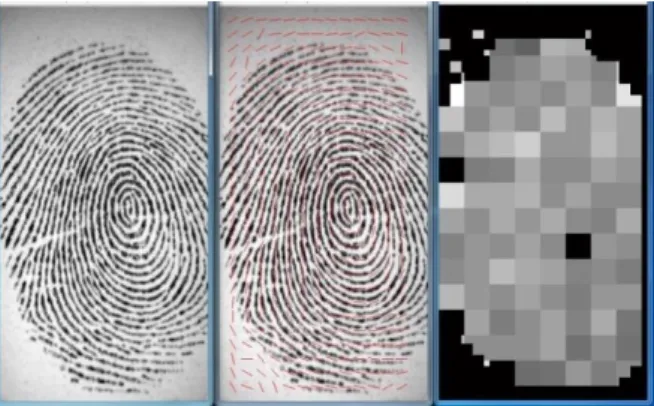
Figure 3.1. Core point detection using ridge frequency and ridge orientation steps of a fingerprint (a)Original fingerprint; (b)Ridge frequency step; (c)Ridge orientation step
In this thesis, ridge frequency and ridge orientation processes are utilized to identify
the core of the fingerprint. The pattern created from these two steps helps the developed
algorithm to recognize and analyse the central of the fingerprint by optimizing the
intersection of each patterns. The intersections trace a spotted area that is identified as an
estimation of the core point. Decision to choose a point as a core is based on peak-sharp
pattern form on the spotted area.
3.4.
Region of Interest
In order to determine the desired working area and to more focus on the process of the
29
also known as the region of interest (RoI), is also required. This stage of image processing
can combine, extract, remove and transform the area resulting from the selection process into
an image window. In biometrics, this selection process is needed to select numerous
biometric characteristics that are accurate and contain less noise objects. For example, a
fingerprint is normally obtained as a result of scaning process. This means that the fingerprint
not only contains the information but is also surrounded by noise that becomes the
background of the fingerprint.
Therefore, this selection procedure requires a determination that is used as a reference
in choosing the desired proper area. As an example, in several cases of fingerprint, full
fingerprint recognition is not needed as it only requires information about the delta and
core-point sighting of that fingerprint. This is shown in Figure 3.2.
Figure 3.2. Fingerprint and its Core-point (circle) and Delta (triangle)
The RoI is obviously required as well when the field work domain is in matrix form.
As is generally known, working in the matrices field usually requires a square-form image.
Meanwhile, a fingerprint recognition input is mostly available in non-square form. Thus,
30
One author has proposed a new image-based fingerprint matching method for various
rotations and translations of fingerprint input [76]. This approach combines the directions of
ridges as a prominent feature component and describes the fingerprint in terms of the
directional energies. The area of a particular radius that is detected around the reference point
is used as the RoI for feature extraction.
Another proposed application of the RoI is as an accurate object detector [77]. In this
paper, the author discussed the approach used to determine the location of an object through
selecting and classifying areas from the main object. The determination of the targeted area
based on its similarity and also its spatial neighbourhood citations is also discussed.
31
3.5.
Fingerprint Classification
The first scientific study to thoroughly discuss finger classification was conducted by
Sir Francis Galton in 1880 [78]. The classification process was introduced as the average of
fingerprint indexing to speed up the process of locating a fingerprint in the database. In the last 10 years, Edward Henry has renewed Galton’s work by introducing the concept of the
core-point and delta of the fingerprint to meet the needs of fingerprint classification [79].
(a) Arch (b) Tented Arch (c) Left Loop
(d) Right Loop (e) Whorl (f) Twin Loop Whorl
Figure 3.4. Examples of the five commonly used fingerprint classes under the Galton-Henry classification scheme
Even though the Galton-Henry scheme offers several benefits, such as being
32
number of classes can be automatically applied to the system. As an example, most of the
automatic systems [80], [50], [81], [82], [83] can only classify fingerprints into six classes as
shown in Figure 3.4.
Conversely, there are many fingerprints that cannot be easily distributed into classes
and which cannot even be classified properly by an expert because of the ambiguity of the
fingerprint features. Therefore, the Galton-Henry scheme that separates a fingerprint database
into interpretable classes for humans will not be free from error. Moreover, this scheme does
not offer fingerprint selectivity for a larger database. In fact, it is unnecessary for the
automatic system to sort the database into fingerprint classes that can be interpreted by
humans.
In the Automatic Fingerprint Identification System (AFIS), the purpose of the
classification process is to reduce the area that needs to be searched. This purpose can be
achieved by sorting the database into fingerprint machine-g
![Figure 2.1. Cancellable Templates from Different Transforms (adopted from [30])](https://thumb-us.123doks.com/thumbv2/123dok_us/1109254.2647601/33.892.185.708.102.468/figure-cancellable-templates-different-transforms-adopted.webp)