Telecom Network Planning for evolving
Network Architectures
Reference Manual
Draft version 4.1
February 2007
ITU, Geneva, 2007
Document NPM/4.1 28 February 2007 TELECOMMUNICATION DEVELOPMENTBUREAUITU-D
Telecom Network Planning for evolving
Network Architectures
Reference Manual
Draft version 4.1
Disclaim:
These Guidelines have been prepared with the contribution of many volunteers from different Administrations and Companies coordinated by Riccardo Passerini, ITU- BDT.
The mention of specific Companies or products doesn’t imply any endorsement or recommendation by ITU. Opinions expressed in this document are those of the contributors and do not engage ITU
PREFACE
These Guidelines have been prepared with the contribution of many volunteers from different Administrations and companies.
The mention of specific companies or products does not imply any endorsement or recommendation by ITU.
All rights reserved. No part of this publication may be reproduced or used in any form or by an means, electronic or mechanical, including photocopying without written permission of the ITU
Revision Status :
Chapter Title Revision Status
1 Introduction 15 – January 2007
2 Overview of network planning 15 – January 2007 3 Service definition and forecasting 15 – January 2007 4 Traffic characterization 15 – January 2007 5 Economical modelling and business plans 15 – January 2007 6 Network architectures and technologies 15 – January 2007 7 Network design, dimensioning and
optimization
15 – January 2007
8 Data gathering 15 – January 2007
Annex 1 Network planning tools 15 – January 2007
Annex 2 Case Studies 15 – January 2007
Reference Manual on the Telecom Network Planning for
evolving Network Architectures
Table of Contents
PREFACE ... 3
CHAPTER 1 – INTRODUCTION... 12
CHAPTER 2 – OVERVIEW OF NETWORK PLANNING ... 16
2.1. Evolution of the Telecom context... 16
2.2. Requirements to the planners ... 17
2.3. Typical network planning tasks ... 18
2.4. Network planning processes ... 18
2.4.1 Definition ... 20
2.4.2 Long-term planning... 21
2.4.3 Medium-term planning... 23
2.4.4 The breakdown approach for LTP and MTP solving... 25
2.4.4.1 Breakdown approach in LTP...25
2.4.4.2 Breakdown approach in MTP...25
2.5. Overall plans per network layer and technology ... 29
2.6. Solution mapping per scenario... 31
2.7. Relation among technical, business and operational plans ... 31
2.8 Planning issues and trends when reaching NGN... 33
2.8.1. End to end multiservice traffic demand: Processes for services and traffic flows aggregation. ... 33
2.8.2. Functionality and location for SSWs. ... 34
2.8.3. Design for security at network and information levels ... 34
2.8.4. Trends towards convergence at different network dimensions ... 35
2.8.5. Planning inter-working and interoperability among domains... 35
2.8.6. Quality of Service considerations ... 38
2.8.6.1 QoS parameter types ...39
2.8.6.2 Survey of standardized QoS parameters...39
2.8.6.3 QoS classes and performance objectives...41
2.8.6.4 Service Level Agreement (SLA) ...43
CHAPTER 3 – SERVICE DEFINITION AND FORECASTING... 45
3.1.1. Per socio-economical category: LE, SME, SOHO, Business, High-end
residential, Low-end residential, etc. ... 45
3.1.2. Per consumption level: stratified per consumption unit (time, events, information volume) ... 45
3.1.3. Per type of end user class (innovators, followers, lazars, addicts, etc.) ... 45
3.2. Services definition and characterization. Categories... 45
3.2.1. Service definition as voice, data, video, etc. ... 45
3.2.2. Service characterization by traffic, bandwidth, etc. ... 47
3.3. Services mapping to customer segment... 47
3.4. Service forecasting per segment... 48
3.4.1. Forecasting methods... 50
3.4.2 Demand forecasting per site and per area ... 52
3.5. Service bundling ... 53
3.6. Service security ... 53
CHAPTER 4 – TRAFFIC CHARACTERIZATION ... 54
4.1. Traffic units for service characterization... 54
4.1.1. Traffic in Erlang ... 54
4.1.2. Bit rate – Mean rate, Pick rate... 54
4.1.3. Total traffic, present of service ... 55
4.1.4. Service and degree of usage ... 55
4.2. Reference periods for dimensioning ... 56
4.3. Traffic aggregation process ... 56
4.4. Traffic profiles ... 56
4.5. Origin/destination of the traffic flows in Local, Metropolitan, Regional, National, Continental and Intercontinental networks... 58
4.6. Interest factors, i.e. attraction coefficients between areas or cities ... 58
4.7. Traffic evolution ... 59
4.8. Traffic models ... 60
4.8.1. Introduction – traffic engineering ... 60
4.8.2. Traffic concepts... 60
4.8.3. Traffic variations ... 61
4.8.4 Loss systems... 62
4.8.4.1 Grade of Service parameters ...62
4.8.4.2 Erlang's loss systems ...63
4.8.4.3 Engset's loss system ...64
4.8.4.4 Peakedness ...65
4.8.4.6 Principles of dimensioning ...66
4.8.5 Delay systems... 67
4.8.5.1 Grade of Service parameters ...67
4.8.5.2 Erlang's delay systems...68
4.8.5.3 Palm's delay systems ...68
4.8.5.4 Processor sharing strategies ...69
4.8.6 Multi-rate (multi-service) loss systems ... 70
4.8.6.1 Convolution algorithm...70
4.8.6.2 State space based algorithms...71
4.8.7 Multi-rate traffic and reversible scheduling ... 72
4.8.7.1 Performance measures ...73
4.8.7.1 Properties of the algorithm...76
CHAPTER 5 – ECONOMICAL MODELLING AND BUSINESS PLANS ... 78
5.1. Business planning ... 78
5.2. Economic modelling for planning... 79
5.3. Economic concepts and terms ... 79
5.4. Economic modelling for services... 89
5.5. Cycle life amortization versus modernization ... 91
CHAPTER 6 – NETWORK ARCHITECTURES AND TECHNOLOGIES ... 94
6.1. Network architectures... 94
6.1.1 Metropolitan Area Network – MAN technology ... 94
6.1.2 Access Network Technology ... 98
6.1.2.1 Fixed Access Network Technologies...98
6.1.2.2 Mobile Access Network Technologies ...99
6.1.2.3 Dynamic handover between wireless networks ...100
6.1.2.4 Wireless LAN Market Trends ...101
6.1.2.5 Fixed-Wireless Access Technologies...102
6.1.3 The evolution of home networks... 103
6.1.3.1 Fixed home networks ...104
6.1.3.2 Wireless home networks ...104
6.1.3.3 Ad-hoc Networks ...107
6.2. New network technologies ... 109
6.2.1. On information carrying procedure and associated routing: IP, MPLS, MGW, etc. 109 6.2.1.1 Generation IP (IPv6) and Transition Strategies from IPv4 to IPv6 ...109
6.2.1.2 MPLS (Multiprotocol Label Switching)...111
6.2.2. On the mobile technology: Edge, 3G, etc. ... 120
6.2.3. On the access segment: xDSL, FTTC, FTTP, FTTH, etc. ... 120
6.2.4. On the transmission technology: FO, WDM, SDH, Ethernet ... 120
6.2.4.1. Ethernet Technologies ...120
6.2.4.2. Next Generation SDH...127
6.2.5. On the Radio technologies: TDMA, CDMA, WI-FI, etc... 133
6.3. NGN solutions and migration steps ... 134
6.3.1. NGN concepts definition and NEs ... 134
6.3.2. NGN solutions and migration steps ... 134
6.4. Converged Networks... 134
6.4.1 IMS architecture for convergence ... 134
6.4.2 Fixed Mobile convergence ... 134
6.4.3 Broadcasting convergence... 134
6.4.4. IMS development in NGN and benefits ... 134
6.4.4.1 Functionalities ...134
- Call Session Control Function (CSCF) ... 134
- Media Gateway Control Function (MGCF) ... 134
- Multimedia Resource Function Controller (MRFC)... 134
- Breakout Gateway Control Function (BGCF) ... 134
6.4.4.2 Convergence to IMS and phasing...134
6.4.4.3 IMS Benefits...134
CHAPTER 7 – NETWORK DESIGN, DIMENSIONING AND OPTIMIZATION ... 161
7.1. Core Network... 161
7.1.1. Single layer design ... 161
7.1.1.1. Classical problems ...161
Dimensioning Problems ... 161
7.1.1.2. Shortest-Path Routing Allocation Problems...171
7.1.2. Multi-state restoration/protection design ... 173
7.1.2.1. Failure situations...173
7.1.2.2. Restoration (protection) mechanisms ...173
7.1.2.3. Path diversity...174
7.1.2.4. Hot-standby ...175
7.1.2.5. Link protection...176
7.1.2.6. Path protection ...176
7.1.3. Design of Multi-Layer Networks ... 179
7.1.3.1. Nominal design of multi-layer networks ...179
7.1.3.2. Restoration design for three-layer networks...182
7.2. Access Network... 184
7.2.1 Key factors and constraints in access networks deployment ... 184
7.2.2 Access networks - technology specific issues... 185
7.2.2.1 Impact of the physical layer on the access network design ...185
7.2.2.2 Impact of networking technology on the access network design ...187
7.2.2.3 The impact on density of population on network design...190
7.2.2.4 Possible access networks evolution strategy ...191
7.2.2.5 The time to deploy target access network ...191
7.2.2.6 Access Networks availability ...191
7.2.2.7 Greenfield access network installation versus network upgrade...191
7.2.2.8 Access network deployment cost...192
7.2.2.9 Access networks OA&M costs ...193
7.2.2.10 Market oriented issues...193
7.2.4 Mathematical foundations of access network planning ... 195
7.2.5 A pragmatic approach to access network design ... 196
7.2.6 Access network planning tools... 196
7.2.7 Example of the access network design algorithm ... 199
7.2.6.1 An example of planning of a wireline access network ...200
7.2.6.2 Access Planning Example for Wireless Access Networks...201
7.3. Basic optimisation methods ... 204
7.3.1. Linear Programming ... 204
7.3.2. Branch-and-Bound method for Mixed-Integer problems... 204
7.3.3. Stochastic Meta-heuristics... 206
7.3.4. Other Optimization Methods... 208
7.3.5. Shortest Path Algorithms ... 208
7.4 Specific Issues of Radio Network Planning... 209
7.4.1. Introduction to radio network planning... 209
7.4.1.1 Introduction to IMT2000 ...209
7.4.1.2 A brief look at cellular history...211
7.4.1.3 Evolution of radio network planning—From 1G to 3G...212
7.4.2 General Process of 3G radio network planning ... 215
7.4.2.1. Introduction ...215
7.4.2.2 Cell dimensioning ...216
7.4.2. WCDMA capacity... 217
7.4.2.1 Radio Link Budget ...217
7.4.2.2 Uplink Load factor and Uplink Capacity ...219
7.4.2.3 Soft capacity for both WCDMA and GSM ...222
7.4.2.4 Detailed cell planning and Optimization...223
7.4.2.5 Radio Network Subsystem (RNS) planning...226
7.4.3. 2/2.5G Radio network planning for GSM /GPRS... 230
7.4.3.1 Introduction to general planning process...230
7.4.3.2 Cell planning for GSM/GPRS...232
7.4.3.3 GPRS planning over GSM ...235
7.4.4. 2/2.5G radio network planning... 238
7.4.4.1 Introduction to automatic cell planning ...238
7.4.4.2. Activities on adaptive propagation model selection ...240
7.4.4.3 Review different algorithms used in cell planning...242
7.5. Additional design and dimensional problems... 244
7.6. Special issues for rural networks ... 249
7.6.1. Rural networks – specific features ... 251
7.6.2. Customers distribution in the rural areas... 251
7.6.3. Services and traffic intensity in rural areas ... 253
7.6.4. Telecommunication technologies for rural networks... 253
7.6.5. Structure of rural networks... 254
7.6.6. Optimization models for fixed rural networks ... 255
7.6.6.1. Ring networks ...255
7.6.6.2. Tree/star networks ...257
7.6.6.3. Mesh networks ...257
7.6.6.4. Resilience issues ...258
7.6.7. Optimization methods for fixed rural networks ... 259
7.6.7.1. Ring network optimization...259
7.6.7.3. Mesh network optimization...260
CHAPTER 8 – DATA GATHERING ... 262
8.1. Geographical information for the studied area ... 262
8.1.1. Vector and Raster data ... 262
8.1.1.1. Vector data ...262
8.1.1.2. Raster data...263
8.1.1.3. Comparison ...264
8.1.2. Background Maps for Display and Visualization ... 264
8.1.2.1. Overview maps ...264
8.1.2.2. Medium scale maps ...265
8.1.2.3. Detailed maps ...265
8.1.3. Elevation data ... 266
8.1.4. Clutter / Land-use data ... 268
8.1.5. Demographic data ... 270
8.1.6. Locations of populated places / buildings, Service areas, Clutter data ... 271
8.1.7. Digitizing of maps ... 271
8.2. Demand of services in relative penetration per customer category... 271
8.2.1. Offered services... 271
8.2.2. Customer categories ... 272
8.2.2. Demand per site and per area ... 272
8.2.4. Demand per time point ... 272
8.3. Demand of traffic, usually expressed as traffic matrices... 272
8.3.1. Traffic per service per customer class... 272
8.3.2. Traffic matrices per service... 272
8.3.3. Traffic per time point ... 272
8.4. Information for the existing network and infrastructure... 272
8.4.1. Exchanges, routers, concentrators, etc. ... 272
8.4.2. Transmission equipment, cables, etc... 272
8.4.3. Buildings, duct system, etc... 272
8.5. Telecommunication equipment characteristics and capabilities ... 272
8.5.1. Max capacities for utilization ... 272
8.5.2. Technical characteristics, e.g. cable attenuation/km ... 272
8.6. QOS requirements... 272
8.6.1. For the system - e.g. congestion criteria... 273
8.6.2. For the technology – e.g. permitted attenuation... 273
8.7. Telecommunication equipment fixed and variable costs... 273
8.7.1. Equipment structuring and modeling ... 273
8.7.2. Cost models - linear, step functions, etc... 273
8.8. Economical and Operational data ... 273
8.8.1. Purchasing, installation costs ... 273
ANNEX 1 – NETWORK PLANNING TOOLS... 274
A1.1. Application of EXCEL... 275
A1.2. PLANITU - ITU ... 278
A1.3. STEM... 281
Issues addressed by the tool ... 281
Applications concerned in business planning ... 281
Modeling Features... 282
Capabilities of the New version 7.0 ... 283
A1.4. VPIsystems ... 281
Planning and Engineering Solutions from VPIsystems ... 281
Overview of Integrated Network Planning using VPI products ... 281
New Planning Environment ... 282
Current Network Planning Process ... 283
The Solution to Network Planning... 284
Integrated Design Flows Supported in VPIlifecycleManagerTM... 294
Demonstration of Integrated Network Planning ... 295
VPIserviceMaker™Distribution ... 296
VPIserviceMaker™Switch... 299
VPIserviceMaker™IP ... 301
VPIserviceMaker™ATM... 302
VPItransportMaker™ ... 304
Summary of Integrated Planning Procedure ... 308
Next Generation Products from VPIsystems ... 308
VPIsystems Network Lifecycle Management Solution ... 309
Introduction ...309
Key Requirements of NLM...310
VPIsystems Pre-sales Process Automation Solution ... 311
A1.5. LStelcom... 313 MULTIlink ... 313 Introduction ...313 Database ...314 Planning ...315 Modules ...316 xG-Planner ... 319 Introduction ...319
Basic xG-Planner Module ...319
Coverage Prediction Module...322
Microcell Module ...322
Frequency Planning Module ...323
QoS Prediction Module ...324
BSS Parameter Module ...324
Measurement Evaluation Module...325
GPRS Module ...325
UMTS Module ...326
CATCHit - Terrain Database Management Tool ... 328
Digital Terrain Data Generation...328
Terrain Data Conversion...330
SPECTRAemc... 335
Features and Highlights ...335
Implemented ITU-Recommendations...336
Terrain Map Database ...336
Coverage Prediction...336
Interference analysis ...337
3D-View ...338
ANNEX 2 – CASE STUDIES... 339
A2.1. Forecasting of services ... 340
A2.2. Consolidation of national transit network ... 344
A2.3. Business planning ... 347
A2.3.1. Problem of network evolution and study case scope ... 347
A2.3.2. Modeling scenarios for business analysis ... 347
A2.3.3. Business evaluation with STEM tool ... 350
A2.3.4. Evaluation Results ... 351
A2.3.5. Results assessment ... 355
A2.3.6. Case study summary... 356
A2.4. Broadband access planning for major cities... 358
A2.5. Voice over IP over WDM... 362
A2.6. Mobile network coverage... 378
A2.7. Case study from developing country ... 395
TELECOMMUNICATIONS INDUSTRY IN PNG... 395
SOCIO-ECONOMIC ASPECTS ... 396
TELECOMMUNICATIONS SERVICES & COMMUNICATIONS ... 396
DEVELOPMENT OF TELECOMMUNICATIONS SERVICES ... 398
PNG NETWORK PLANNING CASE STUDIES... 399
CONCLUSIONS ... 407
ANNEX 3 – REFERENCES... 409
A3.1. Direct references within the text ... 409
A3.2. Additional references for extension ... 414
Chapter 1 – Introduction
ITU Vision on Network PlanningBackground
Telecommunication networks architectures are changing to meet new requirements for a number of services/applications (Broadband, IP, Multimedia, mobile, etc.).
New generation equipment (soft switches, databases, service controllers, new protocols and interfaces, etc.) and new call/mix traffic cases are going to be introduced in the networks. Different solutions/network architectures can be taken into account for a smooth transition from existing network infrastructures (PSTN/PLMN) towards New Generation Network (NGN) as a result of the convergence process leading to different applications/services sharing network infrastructures.
The planning tool PLANITU, capable of dealing with some new traffic cases, can be considered a tool to introduce people to the Network Planning. However, any real Network Planning case should be dealt with using other powerful and modern tools available on the market.
Planning Strategy
Considering the different solutions/network architectures that exist, each Network Planning case has to be analysed and dealt with by using more than just one planning tool.
It means that maintaining and updating a unique tool is not the correct strategy to be applied for Network Planning.
The major concerned telecommunication Companies normally use different tools (or different packages integrated on a unique platform) for network Planning. They usually rely on the services of software companies who are in a position to provide quick updates as soon as required.
Therefore, countries’ requests for assistance on Network Planning should be dealt with as follows:
a) First, to analyse the Network Planning case, taking into account the different technical aspects of the issue.
b) Second, after reaching the best solution in terms of cost and technical validity, to look for the appropriate partnership with whom to define a Project for the specific Network Planning case.
c) Implementation of the Project under the coordination and/or supervision of ITU-BDT. This strategy has been endorsed by the World Telecommunication Development Conference - WTDC-02 (Istanbul, March 2002) in Program 2, point 1.3 (herewith attached) and reaffirmed during the last WTDC-06 (Doha March 2006).
WTDC-06 PROGRAMME 2: INFORMATION AND COMMUNICATION INFRASTRUCTURE AND TECHNOLOGY DEVELOPMENT
1.3 Network planning
The selection of new technology hinges on projected needs and consequent network development planning. In developing countries, the needs may be substantially different in urban and rural areas, and infrastructure and technology requirements will differ. In choosing technologies for a new or existing telecommunication network, a very wide range of factors needs to be considered.
The most difficult component of the network to build, and the least cost-effective to maintain, has proved to be the local access network. One of the main problems facing the developing countries is precisely the lack of access to broadband services, and low teledensity.
Adaptation of power-line communications and cable-television networks to provide telephony and internet services has converted them into broadband networks. The technology shall be of low cost, easy to maintain and adapted to the local environment.
The rural population will need to be connected to the information society. Choosing efficient and cost-effective and fast-deployment technologies such as wired and wireless networks will improve accessibility.
The architecture of the information and communication infrastructure is changing to accommodate the requirements of a growing number of ICT-enabled services/applications (broadband, IP, mobile, multimedia, streaming, multicasting, etc.) and evolving to next generation networks (NGN).
New-generation technology is being introduced in the networks, speeding up the convergence process, and obliging planners to apply different specialized up-to-date planning tools.
Network planning is a critical issue for network operators and network service providers in a time of globalization and intense competition. The current telecommunication market requires flexible and adaptive network planning methodologies for evolving network architectures to NGN. Practical guidelines, readily and easily applicable, should continue to be provided to be of use to operators and decision-makers. Moreover, there will be a need for powerful software tools to assist operators in developing their networks. ITU should continue entering into formal partnership agreements with outside partners, positioned to provide the Union with appropriate planning tools suitable for specific network planning requests. Taking into
account the above considerations, and in order to contribute to bridging the digital divide, this programme should apply the following measures:
a) providing advice on the design, deployment and maximization of digital networks at an increased pace, including the roll-out of wireline broadband technologies such as, but not limited to, optical-fibre, xDSL, CATV, power-line and wireless broadband technologies, and the establishment of satellite earth stations;
b) facilitating the introduction of digital technology;
c) facilitating the design, production and availability of digital terminal equipment; d) enhancing technical skills and management know-how;
e) promoting digitization of analogue networks and applying affordable wireline and wireless technologies to facilitate people's access to ICT, thereby also improving quality of service; f) encouraging research on the information society, extensive networking, interoperability of ICT infrastructure, tools and services/applications to facilitate accessibility of ICTs for all; g) optimizing connectivity among major information networks via regional ICT backbones in order to reduce interconnection costs and optimize the routing of traffic.
Who should use this Manual
To meet countries’ requests for assistance in the field of Network Planning ITU has prepared this Reference Manual on the Telecom Network Planning for evolving Network Architectures.
The Reference Manual is intended for use by network planning experts from telecom operators, policy makers and regulators to facilitate the development of their respective strategies for evolution of the present network architectures and transition to the next generation networks - NGN.
The Reference Manual on the Telecom Network Planning for evolving Network Architectures intends to present an objective and technology neutral view of the issues to be addressed in the planning of the transition to NGN.
Content of the Manual
This reference Manual comprises 8 chapters and 3 annexes, each of which could be updated periodically, due to the rapid changes in the telecom networks.
Typical reason for revisions in the manual could be:
• introduction of innovative network technologies and corresponding planning methods
• appearance of new or improved planning tools on the market
• the need for better explanations in the presented material
Special emphasis in the Manual is given to the role of network planning today and the strong relation to the telecom business.
Chapter 1 provides the objectives and context of the manual as well as the content of the different chapters and relation to other ITU activities and documents.
Chapter 2 will review the aspects that a planner is confronted with when taking decisions on what to do in the network evolution, when to perform the changes, how to perform the corresponding actions and which processes to follow.
Chapter 3 addresses the needed modelling and characterization of services that is required for the planning activities.
Chapter 4 will give generic traffic characterization. Due to the overall modelling of the network for planning purposes, the needed traffic characterization is less detailed than the one needed for detailed system design.
Chapter 5 gives an overview on the economic modelling for planning and different evaluation procedures.
Chapter 6 describes different network architectures - existing telephony network architectures, data network architectures, data invasion of the telecommunication network, the future telecommunication network architectures. Special attention is drown on the next
generation network (NGN) and the migration scenarios from the current TDM networks to this goal.
Chapter 7 presents an overview on the diverse models and methods used in the telecommunication network planning.
Chapter 8 lists the main input data needed for network planning. Network planning, especially performed with NP tools, requires collection of numerous data.
Annex 1 presents a portfolio selection of planning tools to support different planning activities. The selection criteria are: capability to model modern technologies, commercial availability and being well proven in the field.
Annex 2 provides selection of most frequent case studies (ie: Network extension, transmission, signalling, migration to NGN, mobile, etc.) in order to illustrate the application process.
Annex 3 contains list with references and glossary of the most frequently used terms and abbriviations.
Chapter 2 – Overview of network planning
Network planning activities evolve with the proper evolution of the network, the services, the technologies, the market and the regulatory environment. These evolutions imply a wider set of options to implement a network than in the past and as a consequence, the importance of careful planning and analysis for alternatives have larger impact on the network capabilities today in order to assure the needed capacities, the associated quality of service and the required investments.
For general feasibility -- to economically justify the move towards the evolving architectures -- one should pay attention to planning of investments and services in a manner which makes sure there is no costly over-investment nor bad utilisation of already earlier made investments, and at the same time ensures fluent migration of the services for the large amount of existing subscribers.
This chapter will review the aspects that a planner is confronted with when taking decisions on what to do in the network evolution, when to perform the changes, how to perform the corresponding actions and which processes to follow.
2.1. Evolution of the Telecom context
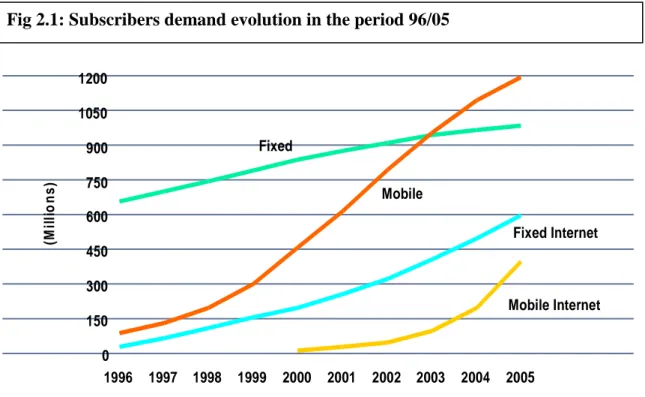
o Services demand, associated traffic and revenues are evolving as indicated in the charts below:
Fixed Mobile Fixed Internet Mobile Internet 0 150 300 450 600 750 900 1050 1200 1996 1997 1998 1999 2000 2001 2002 2003 2004 2005 (M il li o n s )
o New network capabilities are due to the technologies (NGN, 2G to 3G. xDSL, FTTx, WDM, etc., new regulation and competition (market share, service promotion,, etc.) new services in the market (VoIP, VOD, UMS, MMS, etc.), service/platforms convergence through different technologies and pending communication coverage (Geo areas not covered, population not served, network expansion, etc.)
2.2. Requirements to the planners
Under the previous evolutionary context, the planner is confronted to a number of requirements in order to provide answers to the following needs:
o Business Oriented Needs
What are the best customer segments to address in multimedia? Which new services have to be introduced through time?
What is the best service bundling per customer type? How to increase market share?
How to maximize revenues?
How to reduce capital expenditure? How to reduce operational expenditure?
o Network Oriented Needs
How to forecast multimedia services and related traffic demands? How many nodes to install, especially for NGN?
What is best location for new systems and related communication media?
What is the best network architecture and routing in NGN? Best balance between built and lease for infrastructure?
How to plan capacity evolution and solutions migration towards NGN and towards 3G
How to converge service applications and platforms through different access technologies?
How to ensure SLA and protection level?
o Operation Support Needs
How to evaluate alternatives for direct operation and outsourcing? How to organize and engineer the new operation processes?
Which IT applications ensure an efficient support to operation? How to train labor force on the new operational activities?
2.3. Typical network planning tasks
The most typical tasks that the planner has to perform to solve the complexity associated to the previous requirements are summarized as follows:
o Initial situation analysis for economy, customers, services and network
o Problem partitioning
o Data gathering
o Definition of alternatives per scenario
o Mapping solutions per scenario
o Design, dimensioning, location and costing
o Optimization
o Sensitivity analysis to uncertain variables
o Plan selection and consolidation
o Reporting
2.4. Network planning processes
o Due to the high speed of changes both on the environment and the
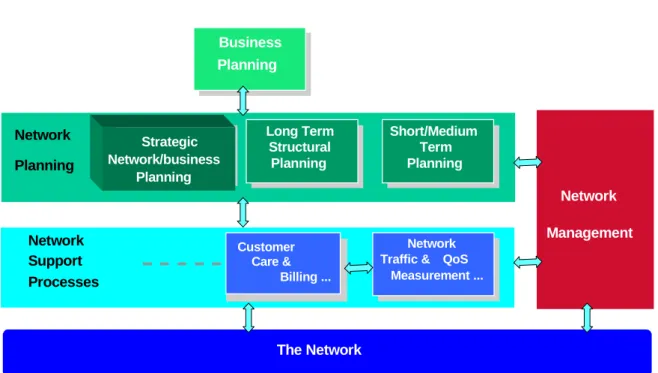
technologies, the traditional planning activities that were performed in an separated way, today have to be strongly interrelated among themselves and to the other network related tasks. For that environment, the Strategic network planning, Business planning, Long term structural planning, Short/medium term planning have to be applied in iterative way with what-if analysis and also communicate with the related Network
Management and Operation Support Processes like traffic measurement, performance measurement, etc. as illustrated in the figure:
- Data on topologies, architectures, location, routing, etc from long term planning are transferred to the medium term and iteratively to short term activities
- Planning results are transferred to NM applications and vice versa, NM measurements and status are provided as inputs to the planning activities - Operating System Processes also provide data to the short/medium term planning activities on the traffic demand, performance and Origin/destination flows
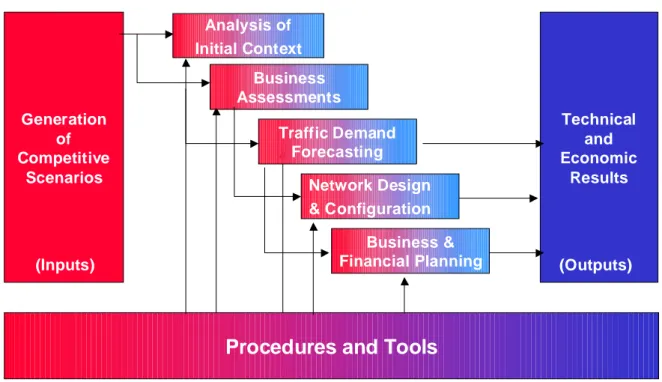
Due to the high number of scenarios possible in the competition, a special analysis of those scenarios is needed in order to derive which ones are feasible both from a technical and economical point of view. The following structured procedure is recommended to perform those analyses in an iterative manner:
Business Planning Strategic Network/business Planning Long Term Structural Planning Short/Medium Term Planning Network Planning The Network Network Management Network Support Processes Customer Care & Billing ... Network Traffic & QoS
Measurement ...
-Telecom network scenarios are generated with the premises derived from realistic market share and competitive situation
-Final objective is to have a quantified design fulfilling the strategy for the operator the requirements of the society and being feasible from the business point of view
-Defined processes and tasks are needed for all solutions and technologies. Internal data and algorithms vary for each technology case
-Feedback among activities is needed to incorporate results of the optimization on the inputs and assumptions
-Business assessment is made at the start of the process to select feasible solutions and discard the ones not being realistic. A more detailed business plan is obtained at the end of the analysis for the selected solutions and providing the business and investment plans
2.4.1 Definition
Network planning addresses all the activities related to the definition of the network evolution in order to allow the transport of an expected amount of traffic demands, taking into account a set of requirements and constraints [2.1]. Depending on the timescale of the network
evolution problem under study, three different planning activities can be performed: Business & Financial Planning Network Design & Configuration Traffic Demand Forecasting Business Assessments Generation of Competitive Scenarios (Inputs)
Procedures and Tools
Technical and Economic Results (Outputs) Analysis of Initial Context
• Long-term planning (LTP), whose objectives are to define and dimension the network
parts which are characterised by a long lifetime and large investments for their deployment.
• Medium-term planning (MTP), whose framework should emphasise the behaviour and
the relationships among the sets of entities (nodes, links, subnetworks) and the list of planning actions and procedures which are involved when planning a network to guarantee the convergence towards the established long term plans. Therefore, MTP should have as an objective the capacity upgrading of the network nodes and links; always, following the long-term (LT) deployment strategies of the optical network1.
• Short Term Planning (STP), that determines the routes and the telecommunications
systems that support a demand. That is, the network has to satisfy the current
telecommunications demands with the already installed capacities without additional capital investments.
2.4.2Long-term planning
The objective of the long-term planning (LTP) is to define and dimension the network aspects which are characterised by a long life time and large investments for their deployment; therefore mainly the topological and technological decisions and fibre cables capacity issues are addressed. LTP, then, elaborates a target network objective for the medium-term planning process; drawing to normally single-period processes.
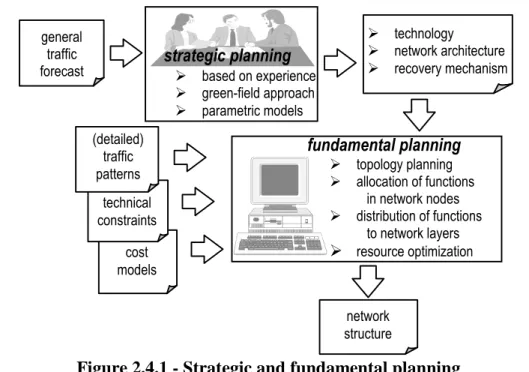
Two different phases/approaches in LTP are generally considered (cf. Figure 2.4.1):
• the strategic planning, which aims at defining the technology and architecture to be used in the network through the comparison of different options. It is generally based on a green-field approach and uses parametric models and typical values for the relevant network parameters.
• fundamental planning, which uses as input the technology and network architecture
selected by the strategic planning and defines the structure of the network2. The problems to be faced in the fundamental planning usually are the allocation of functions in the network nodes, the topology planning, the apportionment of functions between the optical and the client layer, the definition of an optimal network structure.
Dealing with LTP the focus of the project has been on the fundamental planning. Unless explicitly stated, LTP and fundamental planning are considered as synonymous in the following chapters.
Being more concrete, LTP defines the following aspects:
• Location and technological evolution of the network nodes.
• Partitioning into subnetworks (domain definition). In this aspect, the hub nodes for interconnecting the different domains should be identified. Additionally, the hierarchy between the different domains, if any, should be established.
1 These strategies should be the outputs of the long-term planning process. 2 Generally a green-field approach is used for the fundamental planning as well.
• Logical network structure for the considered network layer. Eventually a mapping of the telecommunications systems on the physical telecommunications infrastructures can be given.
general traffic
forecast based on experience
green-field approach parametric models strategic planning technology network architecture recovery mechanism topology planning allocation of functions in network nodes distribution of functions to network layers resource optimization fundamental planning cost models technical constraints (detailed) traffic patterns network structure
Figure 2.4.1 - Strategic and fundamental planning
The output of LTP is the dimensioned network structure. LTP uses as inputs the following data:
• Single-period long-term demand forecasts.
• Set of possible node locations. Even in the case of a new operator beginning the service in a greenfield zone, it is very usual that an initial set of possible locations is previously identified (own or allied-companies premises are frequently used as the initial set). Of course, this set may be as large as needed and even infinite (meaning that there is no constraint in the node location).
• Set of possible physical paths for the telecommunications infrastructures.
• Architecture to be used in each domain: ring, mesh. This aspect includes the protection/restoration schemes and the general routing/grooming criteria to be used.
• Component and telecommunications infrastructure costs. Normally, non-discounted costs of the target objective are used as minimisation function3.
The cost elements used in the different cost calculations should have the same precision as the long-term demand forecasts. As these forecasts are normally not too much reliable, it is not worthy at all to use a very complex cost model and to perform very detailed cost calculations. The timescale of the LTP is normally few years (from 3 to 5). In any case, the LTP exercises are performed to update the results, especially when the demand forecasts have significantly changed or when the NO has to implement the telecommunications installation plan
(typically, each year). LTP is also performed whenever a rupture in technology is foreseen.
2.4.3 Medium-term planning
The objective of Medium-Term Planning (MTP) is the capacity upgrading of the network nodes and links following the long-term deployment strategies of the optical network. Then, the goal of the MTP is to determine the routing map and node capacities.
MTP is normally performed in a multi-period basis; setting of the different steps for moving from the installed plan (if any) to the long-term network objective (calculated by the LTP). Being more concrete, MTP should generate the following results for each planning period:
• Detailed routing and grooming for each demand (traffic relation). It should not have conflicts with the defined LTP criteria.
• Telecommunications systems to be installed or uninstalled in all the periods. It should be done according to the MT forecasts and inside the set of nodes and telecommunications infrastructure supplied by LTP.
• Equipment to be installed, upgraded or uninstalled in all the periods. It should be done according to the MT forecasts and inside the set of nodes defined by the LTP.
• Scaling and possible delays in deploying/installing new network elements according to the budget constraints.
For producing these results, MTP should receive the following inputs:
• Network nodes (from LTP).
• Present and potential fibre routes (from LTP).
• Telecommunications systems in use.
• Installed equipment in each node.
• Forecasted demands for each planning period.
• Component costs. It should take into account, installation, upgrading and uninstallation costs of the different systems.
The discounted costs in each period are used4. MTP may take into account, as an additional constraint, budget restrictions; that is a limitation of the available budget for the installation/upgrading/uninstallation of equipment in each period of time. This constraint may lead to possible delays in deploying/installing new network elements.
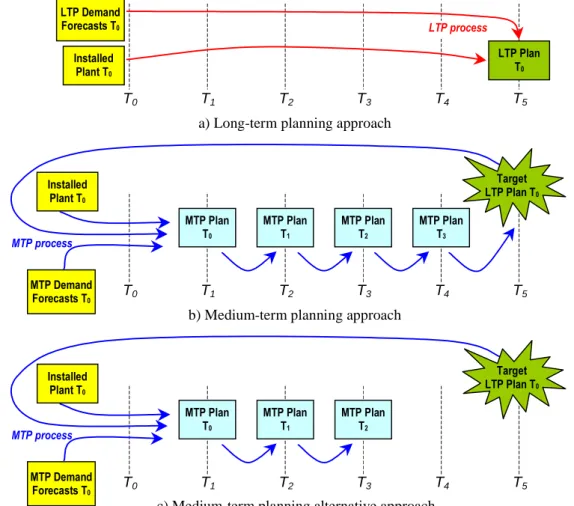
The MTP time scale should be equal to the one for LTP and is subdivided into several shorter periods (typically around one year each), as shown in Figure 2.4.2. In a first step, the LTP process is performed for getting the LTP target network (Figure 2.4.2a). This first step uses the demand forecasts and the installed plant. In a second step, the MTP process calculates the different steps for reaching the LTP target network (Figure 2.4.2b). This second process uses as inputs the MTP multi-period demand forecasts, the installed plant and the LTP plan (generated in the first step). Both steps should be repeated each time the demand forecasts change dramatically; in any case, it is very normal to repeat them in each planning period (T0, T1, …), typically each year. In case of strong variations of the demand forecasts, the LTP
4 So the MTP cost for each network resource is a function of time and takes into account the depreciation due to
target may change in each planning period. In this situation, the MTP plan (steps) calculated each year goes towards different targets; something like performing steps towards a “moving” target.
Under conditions of high uncertainty a NO could adopt a different MTP approach (cf. Figure 2c), having its medium-term plans (MTPs) partially disjoint from its long-term plans (LTPs). In this case the results of the LTPs are considered like a set of valuable constraints, rather than an absolute target to be reached. The most important reasons driving this option seem to be:
LTP Demand Forecasts T0 Installed Plant T0 LTP Plan T0 T0 T1 T2 T3 T4 T5 LTP process
b) Medium-term planning approach a) Long-term planning approach
c) Medium-term planning alternative approach
MTP Demand Forecasts T0 Installed Plant T0 T0 T1 T2 T3 T4 T5 MTP Plan T3 MTP Plan T0 MTP Plan T1 MTP Plan T2 MTP process Target LTP Plan T0 MTP Demand Forecasts T0 Installed Plant T0 T0 T1 T2 T3 T4 T5 MTP Plan T0 MTP Plan T1 MTP Plan T2 MTP process Target LTP Plan T0
Figure 2.4.2 - LTP and MTP processes
• the Operator considers as useless to plan periods far away in the time since there is the highest probability to have unreliable forecasting leading to unreliable results;
• the optimised results attainable in a static LTP are due to the huge advantage to be able to use network resources in a long period of time selecting the best fitting with the
incremental traffic. Unfortunately traffic demands are subject to time constraints (you are not allowed to delay the provisioning of a circuit in order to optimise the network filling) and the network resources’ deployment is subject to budget constraints. Consequently through the months and the periods the network grows un-optimised compared to the LTP perspective and it will be impossible to stick to the LTP programs even if your MTP planning algorithm is the best possible one.
2.4.4 The breakdown approach for LTP and MTP solving
Dividing a problem into simpler sub-problems is recognised as an effective solution for very complex problems like the telecommunications network planning. The resulting planning approach, called breakdown approach in this document, is described in this section.
2.4.4.1Breakdown approach in LTP
The LTP for telecommunications networks is a very complex problem due to the size and complexity of the realistic network planning tasks. There are several limiting factors that makes the solution of the planning problems difficult, such as the available computing resources and the limited practical applicability of general and unified formalisation of the optimisation problems.
The division of the overall planning problem in smaller sub-problems (called breakdown
approach in the following) decreases the complexity of the planning activity and it has many
positive consequences like simpler solution algorithms, shorter development periods, software re-usability, etc.
The main drawback of the breakdown approach is that it becomes more and more difficult taking under control the global optimisation of the planning problem when the number of sub-problems grows. That is because in this case the optimisation does not only depend on the efficiency of the algorithms that are used to solve the sub-problems, but also on the harmonisation of the sub-problems in a global process. In fact, as outputs of a sub-problem become inputs for another one, an order in the solution of the sub-problems should be identified.
However, realistic network planning problems are so complex that the breakdown approach is unavoidable (in spite of its disadvantages). That is why this approach is widely adopted for the telecommunications network planning problems.
The identification of sub-problems in the planning process is a cumbersome matter. Generally NOs adopt ad-hoc solution for each planning problem, with the aim of taking all the possible advantages in terms of simplification.
2.4.4.2Breakdown approach in MTP
MTP for telecommunications networks is even more complicated than LTP. First of all that
is due to the additional outputs required to MTP (cf. section 2.4.3). But other aspects add complexity to MTP. A single MTP formulation is: how to maximise flow minimising total cost; solving this problem, the MTP adopts a temporised perspective, in which the time-scale is divided into time-slots, demand matrices has to be carried in each time slot, and the network costs are time related. As in the LTP there are technical constraints to the problem, but additional constraints can appear as a maximum budget (and the question about how to maximise its utility), and the duty of using previously installed resources but not paid off equipment. On the other hand, MTP decisions (annual periods) will often condition the future network profitability. As a result, planner should also consider LTP in his medium-term
planning decisions. If technological breakthroughs are considered, additional difficulties
arise, as the unlimited options of upgrading a SDH network. Because there is a temporary cost evolution and opportunity capital cost, different alternatives appear: when to change to the newest technology (which period), total change instead of partial ones, etc.
The additional difficulties of MTP can be taken under control through a breakdown approach again. So a general methodology to solve a planning problem in the MTP perspective consists in dividing MTP into two separated and related parts: single-period and multi-period.
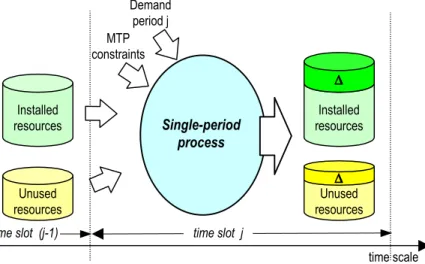
Single-period planning process objective is to determine quantity and cost of network
resources to meet a single-period incremental demand forecast. It is schematically shown in Figure 2.4.3. The process can be further divided into sub-problems, like in the LTP case. However the problem is generally more complex than the single-period planning applied in LTP, both because more constraints, existing resources and their usage and available unused resources should be taken into account and because more detailed output are necessary.
Multi-period planning process and its relationships with single-period planning process can
be viewed in Figure 2.4.4. In order to minimise the total network cost in all the considered periods, a relationship between single-period and multi-period planning is established, while an overall optimisation objective is in target. Results provided by single-period network planning process are the required network resources in the period. There is a relationship between one period and the next one. Multi-period planning process requires information about the total amount of resources of technology p and type i, purchased in period t and disposed in period j (new acquisitions cannot be available since purchase time), because these resources are inputs in the following period.
Demand period j MTP constraints Installed resources Unused resources Single-period process time scale time slot (j-1) time slot j
Installed resources Unused resources ∆∆∆∆ ∆∆∆∆
Figure 2.4.3 - Single-period process in MTP
Appropriate network models should be formulated in each period. Furthermore, it is necessary to take into account the different costs involved in the adopted solution: usage of installed and unused equipment (de-installation and new installation costs), usage of uninstalled equipment but purchased for taking advantage of scale economies (installation costs) and usage of purchased equipment (acquisition costs including installation). It is necessary to remark that the equipment cost in each period includes its temporary evolution, and total investments in each period are correctly discounted.
This kind of approach can be viewed as a time-scaled decision process. Each step requires taking a decision among the available alternatives, each taken decision affects the future decision and the overall solution. As the tree of the solutions grows very fast in number of possible branches, different ways of reducing the decision tree (composed of the whole of solutions) are looked for. Typical levers to prune the decision tree are application of network
development strategies, consideration of techno-economical constraints and reduction of the number of time-slots (i.e. MTP periods) taken into account.
As a result of this process, optimal network solutions are obtained. Three overall
optimisation goals are possible, leading to different network results:
1. optimise at the same time the network cost in each period;
2. optimise the discounted sum of the investments from the beginning to the considered period;
3. optimise the next MTP period, only considering the structural part (network architecture, network structure) of the LTP results as a weak constraint.
These three goals answer to three different MTP interpretations, being the first well suited to the MTP process described in Figure 2.4.2b and the third to the MTP process described in Figure 2.4.2c. The second option can be adapted to both the interpretations of MTP. In each case, the costs taken into account in each period are:
• the cost of the acquired resources up to the considered period,
• the maintenance cost of the resources up to the considered period,
• network operation costs in the considered period,
• net saving costs from disposal of unused resources up to the considered period,
• net saving costs from disposal of used resources before the considered period.
Installed resources Unused resources time scale time slot (j-1) Demand matrices MTP constraints Single-period process time slot j Installed resources Unused resources ∆∆∆∆ ∆∆∆∆ Demand matrices MTP constraints Single-period process time slot ( j+1) Installed resources Unused resources ∆∆∆∆ ∆∆∆∆
Figure 2.4.4 - Multi-period process in MTP
It is then possible to identify difficulties that arise in single and multi-period planning phases of MTP, when an optimal solution is looked for. Particularly, in single-period planning
• previously installed and not paid off equipment has to be used;
• limited budget difficult to use. Criteria for establishing network element priorities are needed;
• criteria for sub-network definition;
• optimisation intrinsic problems; while in multi-period planning
• temporary cost evolution of network elements has to be defined;
• demand uncertainty exists. Moreover, demand variance increases as temporary horizon does. Planner should consider it when a network solution is selected;
• technological breakthroughs have to be considered. Particularly, upgrading existing networks to NGN ones is needed (minimising cost and risk);
• single-period planning problem has to be resolved in each step;
• different alternatives have to be compared. As required investments are not simultaneous, a financial assessment rule is needed. NPV (Net Present Value) criterion may be used. Summarising MTP is generally solved applying twice the breakdown approach:
• first a time breakdown allows to divide the single multi-period problem into several single-period problems;
then a LTP-like breakdown is applied to divide each single-period problem into simpler, solvable sub-problems.
2.5. Overall plans per network layer and technology
o The inherent layering structure of the network and related technologies together with the complexity of the overall network implies that the network planning has to be performed also by layers, subnetworks and technologies:
- By Layers in a vertical dimension following the client-server relation (one layer is supported in the layer below and provides resources for the layer up) as indicated: Physical, Transmission, Routing/Switching, and
Applications/Services/Control.
- By Segments or splitting of the end to end communication into sub areas as customer premises, access, core national, core international
- By Technologies or underlying technique as FO, WDM, PDH, SDH, PSTN, ATM, IP, NGN, GSM, 3G, etc...
Fig 2.4: Network Layer Modeling for Planning and Design
Transport/SDH/WDM
Infrastructure and Cable level
SMS-C Voice Mail
SMP
IP
SCP
IN
Service and Control level
VoIPl VOD Int’l BSC EIR POP/LEX TEX Fixed NB/BB/NGN network SSP SSP MSC WLL/Mobile BTS TSC LL HLR/AuC DATA/IP SSW GW Functional level
- The planning process starts with a first phase for the services and traffic demand projection both at user interfaces and origin to destination interest -A second phase considers the design for the functional level for the involved functions and technologies like: switching, routing, mobile, data, etc.
- Intermediate results are given as inputs for Transmission and control layers
- In a third phase, the transmission design and planning is performed and the results are provided as inputs to the Physical layer
- Fourth phase contains the planning for the physical elements as ducts, buildings, cables, FO, etc.
- Iteration is made among layers for consolidation, being the functional layer the one that may require more what-if analysis for the central role played among all the other layers and the services/customers.
Functional level Service and Control level Transport/SDH Infrastructure and Cable level
Network Layers Traffic Demand Circuit location/design Routing optimization Planning Phases BW grooming Route design/optim. Path protection Data flows NE dimensioning Delay evaluation Physical Layout Cable routing/grouping Node/duct sharing Phase 1 Phase 2 Phase 4 Phase 3
2.6. Solution mapping per scenario
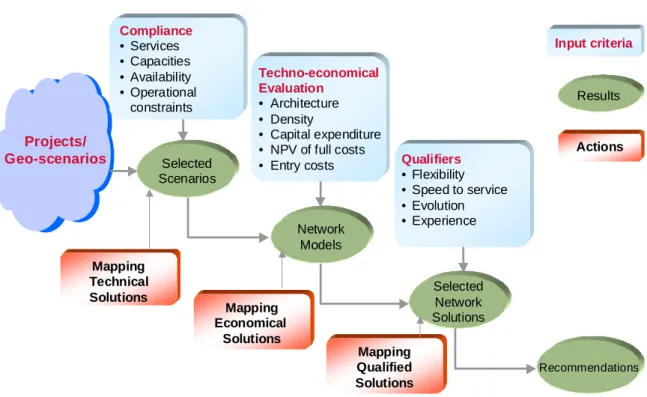
o Due to the large variety of geo-scenarios defined by the combination of customers, services, geo-models, density, consumption, available solutions, etc. the planner has to analyze and decide which solution is going to be planned in more detail per scenario type. The recommended methodology is structured in the diagram with a first selection by technical compliance followed by an economical evaluation of the Cost Of Ownership that is self-explanatory.
2.7. Relation among technical, business and operational plans
Compliance • Services • Capacities • Availability • Operational constraints Selected Scenarios Network Models Selected Network Solutions Recommendations Mapping Technical Solutions Projects/ Geo-scenarios Techno-economical Evaluation • Architecture • Density • Capital expenditure • NPV of full costs
• Entry costs Qualifiers • Flexibility • Speed to service • Evolution • Experience Results Input criteria Actions Mapping Economical Solutions Mapping Qualified Solutions
o The number of scenarios and high interrelation among decisions at each level of the organization: Financial, Technical and Operation requires implementing carefully an integrated processing for the information at each stage which is summarized in the following diagrams. The large ranges of variation in many cases and the need to optimize synergies in competition obliges to interchange results between the processes and have an
information System across the organization based on Operational Support Systems (OSS) to facilitate consistency and speed of application
Technical Plan
Network Structure
Technologies used
Capacities
Services provided
Traffic forecasted
Performances
Iteration to consolidate all plans
Operations Plan
Labor-force
Training
Maintenance
OSS
Traffic measured
SLA fulfillment
Business Plan
Market demands
Pricing
Costing
Revenues
Financial indicators
Investments
2.8 Planning issues and trends when reaching NGN
Once the migration to NGN enters in the final evolution steps after network topology
consolidadtion and access capacity increase to broadband, the specific NGN arquitecture and systems at transit and local segments have to be designed and optimized. Some of the key planning issues to be solved and related activities are summarized:
2.8.1. End to end multiservice traffic demand: Processes for services and traffic flows aggregation.
In a full NGN network, all the service flows need to be modelled with the IP traffic parameters at the five levels of: 1) Calls, 2) Sessions, 3) Bursts, 4) Packets and 5) Bits for each service class at the user origin. Due to the heterogeneous service types, they have to be aggregated by affinity of demand types first (like voice, audio streaming, video streaming, file transfer, etc.) in order to know the demand per user at the network origin points. In a second step, the service types have to be aggregated by Quality of Service category like a) constant speed, b) variable streaming and c) elastic category in order to be able to dimension network resources according to each grade of service and Service Level Agreement per category. A well defined Sustained Bit Rate (SBR) common unit and measurement period of reference (i.e.: 5 minutes) has to be used in order to maintain consistency in the statistical aggregation. This process is illustrated in the following diagram:
Traffic aggregation per O/D and flow category
Traffic matrices
Services per customer type Traffic per service/customer type
Services projection
Mapping services per customer
Traffic units per service (multi-service IP) Traffic aggregation per customer type
Traffic aggregation per IP flow category Traffic flow aggregation per O/D
Matrix per IP flow category (original BW flow) Dimensioning matrix (capacity BW)
Once that all the matrices for that categories are well defined, the dimensioning of network resources is to be performed, according to the used routing procedures with the corresponding algorithm for each category. Most frequent algorithms are proposed and discussed within the contributions at the International Teletraffic Congress series.
2.8.2. Functionality and location for SSWs.
Up to now most published information describes the NGN network nodes like Softswitches (SSW), Gateways (GW), etc. at a functional level. As soon as a design has to be made and optimized for a mature and large network, a number of new issues appear as:
- Decision on SSW multifunctional versus specific per type of control and application (Fixed network calls, mobile network calls, HLR, NM functions, OSS functions, etc.)
- Number of SSW by functionality, capacity and security level
- SSW locations as a function of all previous constraints and survivability required
- Number and location of GWs as a function of capacities and optimum design either at transit level, local level or hybrid assignment.
These and other more detailed issues are being analyzed today on a per case basis and methodologies are in phase of consolidation for a secure and optimum network evolution in a near time frame.
2.8.3. Design for security at network and information levels
Number of processing nodes at a mature NGN is much lower than in a traditional PSTN and is one of the causes for savings in CAPEX and OPEX. Nevertheless, in order to maintain a proper level of survivability to the network and services, the design criteria cannot just be extrapolated from the current networks and very robust methods have to be applied at the following domains:
- High physical security at topological level with higher connectivity ratios and diversity paths for high capacity and wide influence network nodes.
- High protection level for the energy supply in all key nodes with duplicated or triplicated sources of energy and diverse physical energy paths
- Design of large capacity routes and logical paths with high security criteria
- Design of high security and protected buildings for all involved elements and servers associated to key services
- High level of protection for intrusion, hacking and security for accessibility to SSWs and key NGN resources considering that within IP all network interfaces are potential gates candidates for access to the control.
In most of previous issues, basic mathematical procedures are available for a design, but application criteria need to be much more stringent and combination with new capacities will derive in innovative network designs and configurations. Special attention has to be given to the last one on accessibility that is new for a large, all IP, high quality network and really imply novel concepts and solutions.
2.8.4. Trends towards convergence at different network dimensions
Once that an NGN is implemented at transit, local and access network segments, the convergence possibilities are extended to more domains that the conventional fixed and mobile services. The expected trends in convergence have the following dimensions: - Convergence at Network Technology level in wich synergies will be applied for all the network levels, hierarchies and geographical locations.
- Convergence at User Terminals or devices like mobiles, PDAs, GPS, etc. for all functionalities on communication, frequencies, protocols, control positioning, agenda, entertainement, etc.
- Convergence at User Services domains with the same functionalities across diffrent network types like fixed, mobile, xLAN, satellite, etc.
- Covergence at OSS for all functions on SLA management, Measurements, Service
activation, Service management, Quality/performance mgt, Invoicing, Billing, Customer care, Provisioning, Inventory, Application monitoring, etc.
- Convergence at IT platforms, Databases and enablers for SSWs, NM and OSS,
Economies of scale for higher customer density, purchasing volume, traffic grouping, system sizes and technology scalation are the main business drivers for the implementation of
convergence at the previous identified dimensions.
2.8.5. Planning inter-working and interoperability among domains
When multiple networks reach the NGN maturity stage, a number of inter-working principles have to be planed and designed to ensure the correct end to end operation. The operation of different networks either belonging to the same operator or to different operators is organized in management domains or set of network resources controlled by one management entity. Inter-working and interoperability apply to a given country, a region, an operator or a sub network with a given technological solution.
In order to ensure interoperability between NGN areas and administrative domains, a set of network capabilities have to be planned. Such network capabilities include:
• Static and dynamic routing configuration, policies and algorithms
• Conversion of name, number or address
• Signalling inter-working
• Exchanging charging and billing information
• Exchanging user and terminal profiles
• Security policy and authentication
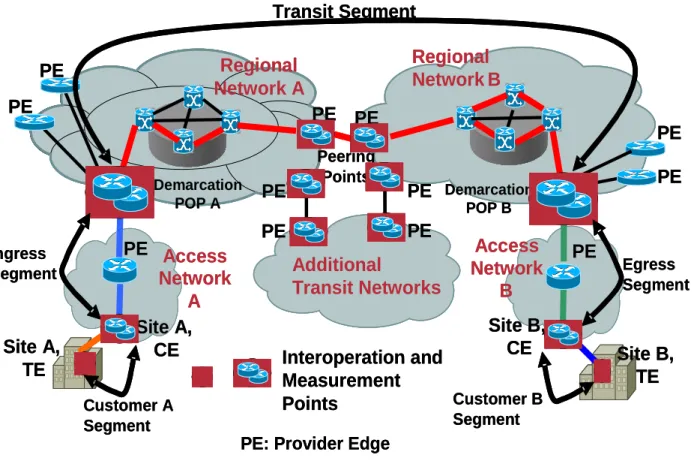
The planner has a new set of tasks to specify, locate, design, dimension, cost and optimize the following network interfaces, points and functionalities:
- Network inter-working points, points of presence, peering points, provider edges that have to be deployed at the networks edges with the corresponding functionality, location and dimensioning
- Admission control procedures for the traffic flow acceptance on the base of flow priority, demanded sustained bit rate, Quality of Service, available capacities, network routing algorithms and coordination between the origin based and destination based acceptance criteria.
- Management and filtering functionality across networks for the sensitive control and
management information like security level, authentication, authorization, user profiling, non-repudiation, data confidentiality, communication security, data Integrity, availability, privacy, etc.
- Protocol inter-working or adaptation for the different types of traffic flows and the information required to be interchanged for services across domains. Support multiple transport stratum address inter-working scenarios, i.e. inter-working scenarios among
different address domains, such as IPv4 and IPv6 address domains, public and private address domains.
- Charging information required for the multimedia services, either based on calls, number of events, information volume or sustained bit rate with a given quality.
- PSTN emulation and simulation functionality to complete calls with origin or destination in existing PSTN networks while maintaining the corresponding characteristics of end to end flows service capabilities and interfaces as well as to ensure service continuity respecting the end-user experience unchanged irrespective of the changing of the core network or the crossing among different network types.