Rev: 5/2015 USM Psy.D. Program Handbook
College of Management and Human Service
School of Education and Human Development
School Psychology Program
Doctor of Psychology in School Psychology
(Psy.D.)
Ψ
Program Handbook
8 Bailey Hall
37 College Ave.
Gorham, ME 04038
207-780-5300
[email protected]
TABLE OF CONTENTS
CHAPTER TITLE PAGE
I. Introduction 3
II. Faculty 5
III. Philosophy and Aims of the School Psychology Program 7 IV. Program of Study 9 V. Practica in School Psychology 23 VI. Psy.D. Comprehensive Examination 27
VII. Internship 32
VIII. Dissertation 39 IX. Student Resources 44
Appendices (found online inside the TK20 system):
A. Acknowledgment and Agreement to Abide by USM Psy.D. Program Handbook Policies
C. Course Equivalency Review Request D. Dissertation Forms
E. Exam Forms I. Internship Forms
M. Matriculated Student Annual Report Forms P. Practicum Forms
Rev: 5/2015 USM Psy.D. Program Handbook I. INTRODUCTION
This handbook has been prepared to assist students in the Psy.D. in School Psychology Program as they work toward degree completion. The handbook includes information regarding program mission, goals, objectives, philosophy, required courses, practica, internship, and student evaluation activities. It has been designed to give the student and the faculty advisor a better understanding of each other's roles. Students are advised that this handbook does not include all Department, School, and University policies. Students should consult the University of Southern Maine Graduate Catalog for other information.
Students are reminded that consultation with their advisors is an essential component to individual program of study planning. All Psy.D. students are expected to read this Handbook in its entirety and sign Form A which verifies they have read, understood, and agree to comply with all USM School Psychology Program policies and program requirements. Students will be expected to meet the requirements in effect as of the Fall semester of their first year of matriculation in the Psy.D. program. Students must also create and use an account in the TK20 student data system where the forms referenced in this Handbook are housed.
Comments about this handbook are encouraged so that these experiences can be more valuable to students, faculty and supporting agencies. Please send your comments directly to the Director of Training of the School Psychology Program.
Mark W. Steege, Ph.D., NCSP, BCBA-D Director of Clinical Training
Professor of Educational and School Psychology School of Education and Human Development 8 Bailey Hall
University of Southern Maine Gorham, ME 04038
(207) 228-8322
E-mail: [email protected]
Note: Program faculty reserve the right to change any of the terms of the handbook in any section at any time.
Program History
The Psy.D. in School Psychology Program began in 2005 as an extension of a specialist level school psychology program. In 1989, the University of Southern Maine (USM) began a M.S. in School Psychology Program and this program has prepared most of the school psychologists in Maine. In the late 1990s superintendents, directors of special education and others interested in school-based psychological services urged USM to develop a doctoral training program to offer advanced training in school psychology. USM faculty developed the current doctoral program based on the needs of Maine and New England schools. It is a practice doctorate (Psy.D.) rather than a Ph.D. because it is designed to prepare practitioners who will work in schools and agencies within Maine and northern New England.
Program Governance
The Psy.D. Program is housed in the School of Education and Human Development which is part of the
College of Management and Human Service. School Governance includes an Associate Dean and Department Chair. Each Program has a Program Coordinator and the Coordinators meet regularly to discuss Program, School, and College issues. All matters related to day to day operations of the School Psychology Program are handled by the Program faculty, also known as the School Psychology
Committee (SPC).The SPC is the operating committee for the program, overseeing program policy, procedure, and curriculum. Its membership includes the faculty of the School Psychology Program as well as two student representatives. The student representatives may bring issues to the SPC and attend meetings where such issues are discussed. Any individual student can bring an issue to the SPC for discussion or consideration through the student representatives.
Accreditation
The Psy.D. Program is accredited by the Maine Department of Education.
Graduate Credentials
Graduates of the USM School Psychology Program will have completed the academic requirements for several credentials. The Program prepares graduates who can apply to become a certified School Psychologist-Doctoral awarded by the Maine Department of Education. In addition, graduates are eligible to apply to become a Nationally Certified School Psychologist and a licensed psychologist. Maine
requires 1,500 hours of post-doctoral supervised work experience before licensure may occur. Students in the USM School Psychology Program also complete the coursework necessary to become a Board Certified Behavior Analyst (BCBA). Graduates who seek certification and/or licensure are responsible for completing all application requirements independent of any USM requirements.
Rev: 5/2015 USM Psy.D. Program Handbook 5 II. FACULTY
Rachel Brown, Ph.D., NCSP
Rachel received her Ph.D. in School Psychology from the University of Massachusetts, Amherst in 2000. Prior to that, she worked for 10 years as a general and special education teacher in Massachusetts. Rachel’s research focuses on intervention-linked assessments using curriculum-based measurement (CBM), problem-solving, and response-to-intervention (RTI) models. She has conducted several studies of silent reading fluency using CBM and is the author and/or editor of several books about effective school-based interventions. She is both certified and licensed as a psychologist.
Mark W. Steege, Ph.D., NCSP, BCBA-D
Mark earned his Educational Specialist (Ed.S.) degree in School Psychology from the University of Iowa in 1982. Mark worked as a school psychologist with the Grant Wood Area Education Agency in Cedar Rapids, Iowa for four years prior to earning his doctorate in school psychology from the University of Iowa in 1986. Mark completed his post-doctoral training as a pediatric psychologist within the Department of Pediatrics within the College of Medicine at the University of Iowa. He has written extensively on functional behavioral assessment, single-subject research methods, and use of empirically-based interventions for students with developmental and behavioral difficulties. He is certified and licensed as a psychologist and is a Board Certified Behavior Analyst-Doctoral.
III. PHILOSOPHY AND AIMS OF THE SCHOOL PSYCHOLOGY PROGRAM
The University of Southern Maine (USM) doctoral program in school psychology follows a practitioner-scientist model in seeking to accomplish its stated mission of “preparing psychologists for applied professional practice in schools and other child and family-oriented settings.” The philosophy, goals and objectives, and experiences serving this mission are discussed below.
Science and Practice
School psychologists are applied professional psychologists whose practice is tied to both content and process. That is, school psychologists access the theory and knowledge base of psychology and education in carrying out their professional functioning, while at the same time conducting their
professional activities in the manner of a scientist. They recognize the bidirectional nature of science and practice, and the importance of tailoring the application of knowledge to important personal, systemic, and ecological-contextual features. They need to be creative in using their knowledge and compensating for gaps and weaknesses in theory and research in order to solve immediate and long range problems of children, families, and schools. In this sense, school psychologists are “psychoeducational designers,” performing a function within the dynamic relationship of psychological theory and practice similar to that performed by an architect-engineer in the relationship between physics and the behavior of matter in natural environments. School psychologists are psychoeducational designers who bridge the gap between psychological science and professional practice in the synergistic context of schools, children, families, communities, and cultures.
Program Philosophy
The USM School Psychology Program is based on three fundamental principles:
1. Data-based decision-making. This is the organizing theme that permeates the training of USM's graduates and defines a best practices approach to service delivery. Within this model, school psychology graduates utilize assessment methods and interventions that are empirically-based. This means that the assessments and interventions they use have been demonstrated to be reliable, valid, and accurate. Moreover, school psychology graduates use and endorse only those interventions that have been subjected to scientific analysis and have yielded socially meaningful outcomes.
2. Problem solving. School psychology graduates utilize a collaborative problem solving approach in offering a continuum of services that include assessment, interventions (e.g., consultation, social skills training, positive behavioral supports), and program evaluation. While norm-referenced diagnostic assessment may be a part of this process, an emphasis is placed on the use of criterion-referenced, curriculum-based, and functional behavior assessments to address academic, social-emotional, and behavioral issues of referred students.
Rev: 5/2015 USM Psy.D. Program Handbook 7
3. Stimulus-Organism-Response-Consequence (S-O-R-C)model of human behavior. SORC is a dynamic interaction model of human behavior. As noted by Nelson & Hayes (1985), Shapiro & Kratochwill (2000), and Steege & Watson (2009), human behavior is a complex interaction of external and internal variables. The primary purpose of assessment is to identify and accurately measure those variables that occasion, elicit, motivate, and reinforce behaviors that interfere with and/or contribute to a child's acquisition of academic, social, and behavioral skills. The results of
assessments are used as the basis for designing individually tailored interventions that promote the development of socially meaningful behaviors.
Mission of the Program
Using the philosophical underpinnings stated above, USM's School Psychology Program seeks to prepare psychologists for applied professional practice in schools and other child and family-oriented settings. Graduates are problem-solving psychologists who embody practitioner-scientist methods to assist children in schools and other environments. Drawing on the knowledge base of psychology and education, we expect our graduates to apply that knowledge in a manner that takes into account the cultural, economic, socio-political, and multiple-systems contexts in which the problems of children and families occur. Recognizing the broad range of possible avenues to promote child-enhancing change, as well as the varied obstacles that exist, we seek to prepare graduates with an array of knowledge,
personal characteristics, and professional skills to participate in traditional, alternative, or innovative practice environments. Specifically, graduates are expected to learn (a) the scope and content of school psychology practices, (b) data-based, problem-solving, and Stimulus-Organism-Response-Consequence (SORC) oriented procedures, and (c) practical strategies for implementing best practices in school psychology by using empirically validated assessment, intervention, and consultation methods. In this sense, we seek balance throughout the program so that graduates learn how to understand and use basic science and practical skills, research and practice, traditional and alternative approaches,
assessment and intervention, direct and indirect intervention, and contrasting theoretical points of view. Broad competence coupled with interpersonal skills facilitates the functioning of our graduates as agents of positive change in the variety of systems and contexts in which they may eventually practice.
Goals and Objectives
Goal A: To produce professional psychologists with the personal qualities, interpersonal skills and awareness, and the ethical sensitivity predictive of success in a broad array of social, economic, and educational contexts.
Objective A1: Students will develop an understanding of service delivery programs within a context respectful and appreciative of individual and cultural diversity.
affect the quality, social validity, and acceptability of the services they provide.
Objective A3: Students will learn and use clinical skills appropriate for the client populations they serve. To this end, students will be assigned to work with a diverse range of clients who
represent various racial, linguistic, cultural, religious, sexual orientations, and other backgrounds. USM Psy.D. students should have no reasonable expectation of being exempted from having any particular category of potential clients/patients assigned to them for the duration of training.
Goal B: To produce psychologists competent to access a broad range of theoretical, empirical, and practical approaches with sufficient depth to be effective, flexible practitioners.
Objective B1: Students will develop proficiency in traditional and emerging approaches to the assessment and evaluation of children's academic, behavioral, and emotional problems.
Objective B2: Students will develop proficiency in the design and development of programs to intervene both directly and indirectly with children's academic, behavioral, and emotional problems.
Goal C: To produce professional psychologists competent in the conduct, comprehension, and application of research to professional practice.
Objective C1: Students will acquire a foundation in the scientific knowledge base of psychology and education.
Objective C2: Students will develop proficiency in the conduct, dissemination, and application of research related to professional practice.
Rev: 5/2015 USM Psy.D. Program Handbook 9 IV. PROGRAM OF STUDY
The doctoral program in school psychology at USM is sequential, cumulative, and graded in complexity. It culminates in a 1,500 clock hour internship. The degree program requires completion of 111 graduate credits. In addition, graduates must demonstrate proficiency with interpersonal skills and professional work habits. Students in the USM Psy.D. program are expected to earn grades of “B” or better in all classes. Any class in which a Psy.D. student earns less than a “B” must be taken again. Classes may not be taken more than twice. Procedures to support students in earning satisfactory grades and making progress in the Program are detailed at the end of this chapter in the section on student evaluation. USM school psychology students are expected to integrate and relate factual and theoretical information to professional practices in the following core content areas:
1. Biological aspects of behavior
2. Cognitive and affective aspects of behavior 3. Social aspects of behavior
4. History and systems of psychology 5. Psychological measurement 6. Research methodology 7. Techniques of data analysis 8. Individual differences in behavior 9. Human development
10. Dysfunctional behavior/psychopathology 11. Professional standards and ethics
12. Theories and methods of assessment and diagnosis 13. Effective interventions
14. Consultation and supervision
15. Evaluation of the efficacy of interventions
USM school psychology students integrate learning from required courses with field experiences that are incorporated in their programs of study. Psy.D. students complete practica courses throughout the program of study; these experiences are described in Chapter V of this Handbook. The culminating experience of the Psy.D. program is completion of the 1,500 hour internship. During all phases of the School Psychology Program, Psy.D. students are expected to be aware of and adhere to the legal, ethical, and professional standards specified by the professional organizations and governing bodies associated with the practice of school psychology (e.g., American Psychological Association; National Association of School Psychologists). USM is committed to preparing psychologists who are able to work with children, adolescents, and families from many diverse backgrounds. Psy.D. students will be
provided opportunities to work with as many different racial, linguistic, cultural, religious, sexual orientation, and other diversities as possible. USM Psy.D. students have no reasonable expectation of being exempted from having any particular category of potential clients/patients assigned to them for the duration of training.
Advising
encouraged to maintain regular contact with their faculty advisor throughout their program of study, and students are expected to contact their advisors at least once per semester of enrollment in the Psy.D. program. In addition, students must submit annual reports of their progress by 1 May of each academic year. Students may request a change of advisor at any time. Such changes typically ensure that the student and advisor's research interests are aligned. Advisor changes require the approval of program faculty; all requests will be carefully reviewed and every effort will be made to accommodate student advisor requests. To request an advisor change, contact the Director of Clinical Training, who will forward the request to the faculty for consideration.
Required Courses
The required courses are shown in the Table 4.1. The course of study requirements are designed to meet APA guidelines for comprehensive training in school psychology. In cases where Program requirements have changed, Psy.D. students must follow the guidelines of the Program Handbook in effect for the first semester of their matriculation in the Psy.D program, or the new requirements, but must abide by one or the other in entirety. The majority of the classes are taught by full-time and part-time School Psychology Program faculty, however some classes are taught by faculty from other programs, including faculty in Counseling, Adult Education, Special Education, and Educational Administration.
Program Sequence
The Psy.D. program generally takes full-time students five years to complete. Students should note that many Psy.D. classes are offered every other year and that it is important to plan out schedules according to the semesters when certain courses are offered. The University reserves the right to change course schedules as needed to meet Program, School, College, and University circumstances. Each student’s course schedule will vary, and it is essential that students consult with their advisors on a regular basis to develop and complete the program of study in a timely manner. Because the program of study is
sequential, cumulative, and graded in complexity, it is essential that students take courses and complete field experiences in a specific order. Table 4.2 depicts the order in which students take classes. The courses are organized by curriculum area and level. There are a total of 15 curriculum areas; however, these have been grouped together in Table 4.2 to make it easier for students to select courses. The sequential nature of courses is identified by course levels. Each course fits into a specific level according to what other experiences a student must have before taking each class. The courses within each curriculum area must be taken in order by level. This means that all level 1 classes IN A CURRICULUM AREA must be taken before ANY level 2, courses in that same CURRICULUM AREA. However, students can take higher level courses in other curriculum areas while they finish taking remaining lower level courses in other areas. For example, students can take level 2 assessment classes as soon as they have completed HCE 605 even if they have not yet completed all the Foundations area courses. There are two exceptions to the level advancement. Students must have taken or concurrently be taking all prerequisite
Rev: 5/2015 USM Psy.D. Program Handbook 11 Table 4. 1
Psy.D. Program of Study
Skill Area Course Course Title Credits
Biological aspects of behavior SPY 671 Physical Bases of Behavior 3 Cognitive and affective aspects of
behavior SPY 670
Cognitive and Affective Bases of
Behavior 3
Social aspects of behavior SPY 673 Social Foundations of Behavior 3 History and systems of psychology SPY 709 History and Systems of Psychology 3 Psychological measurement HCE 605 Psychological Measurement and Evaluation 3
Research methodology
EDU 600 Education Research Methods and Tech. 3 SPY 751 Advanced Research Seminar 3 SPY 759 Psy.D. Dissertation 3 Techniques of data analysis SPY 697 Statistics I 3 SPY 698 Statistics II 3
Individual differences in behavior
SPY 620 Intro to Multi-Tier Systems of Student Support for General & Special Ed 3 SPY 679 Diversity in the Science and Practice of
Psychology 3
Human development HCE 668 Human Development 3 Dysfunctional behavior/
psychopathology SPY 674 Psychopathology 3 Professional standards and ethics SED 540
Nature and Needs of the Exceptional
Learner 3
SPY 609 Professional Ethics in Psychology 3
Theories and methods of assessment and diagnosis
SPY 672 Assessment of Academic Achievement 3 SPY 675 Indirect Behavioral Assessment 3 SPY 677 Cognitive Assessment 3 SPY 604 Functional Behavioral Assessment 3
Effective interventions
HCE 620 Fundamentals of Counseling Theories 3 SPY 606 Behavior Therapy 3 SPY 601 Behavioral Principles of Learning 3 SPY 605 Advanced Applied Behavior Analysis 3 SPY 727 Advanced Academic Interventions 3 SPY 729
Advanced Interventions for Individuals with Behavioral and/or Developmental Disabilities
3 SPY 730 Advanced Behavior Therapy 3 Consultation and supervision HCE 681 Clinical Supervision 3 SPY 607 Consultation in School Psychology 3 Evaluation of the efficacy of
interventions SPY 602 Clinical Research Methods 3 Practica SPY 693 School Psychology Practicum I 3 SPY 694 School Psychology Practicum II 3 Internship SPY 788 Pre-doctoral Internship 9 Electives Chosen from SEHD catalog 6
TOTAL PROGRAM CREDITS 111
courses in order to take the comprehensive exam. Students must have completed all prerequisite courses and have passed the comprehensive exam in order to enroll and complete the dissertation and/or
Table 4.2
Required Course Sequence
Level Foundations Assessment
Effective Interventions Research Consultation & Supervision Field Experiences Other 1 HCE 668 SED 540 SPY 601 SPY 609 SPY 670 SPY 671 SPY 673 SPY 674 SPY 679 SPY 709 HCE 605 HCE 620 SPY 605 SPY 620 EDU 600 SPY 602 SPY 693 2 SPY 604 SPY 672 SPY 675 SPY 677
SPY 606 SPY 697 SPY 698 HCE 681 SPY 607 SPY 694 Electives 3 SPY 727 SPY 729
SPY 730
SPY 751 SPY 694 4 759 788
Due to the small size of the USM Psy.D. Program most courses are offered only once per year and some classes are offered every other year. Students need to plan out their course of study in advance and be prepared to take classes when they are offered. The following courses are generally offered every other year. Even and odd are based on the actual year so an odd year fall class would be offered in the fall of 2013, 2015, etc.
Course When offered
SPY 609 Even years, Fall SPY 670 Odd years, Fall SPY 674 Odd years, Spring SPY 675 Even years, Fall SPY 677 Even years, Spring SPY 679 Odd years, Spring SPY 697 Even years, Fall SPY 698 Odd years, Spring SPY 709 Odd years, Fall SPY 727 Even years, Spring SPY 729 Even years, Fall SPY 730 Odd years, Spring
To help students plan their course of study, Tables 4.3-4.6 show the recommended order of classes by semester. Table 4.3 shows the order of classes for students starting in an odd-number fall; Table 4.4 shows the order of classes for students starting in an even-number fall. All of the courses that are offered every other year are noted with an asterisk (*). Some Psy.D. students may have completed the USM Master of Science in Educational Psychology with a Concentration in Applied Behavior Analysis (MS-ABA). These students will have taken 33-36 credits of the Psy.D. Program already. For these students, Tables 4.5 and 4.6 show the sequence of remaining courses based on odd and even starting years.
Rev: 5/2015 USM Psy.D. Program Handbook 13 Table 4.3
Starting in an odd-numbered fall
Year Fall Credits Spring Credits Summer Credits Total Credits
1 HCE 668 SPY 670 SPY 601 3 3 3 EDU 600 SPY 605 SPY 674* SPY 693 3 3 3 1 HCE 605 SPY 620 3 3 25 2 SPY 602 SPY 609* SPY 673 SPY 693 3 3 3 1 SPY 604 SPY 675* SPY 679* SPY 693 3 3 3 1 Elective SED 540 3 3 51 3 HCE 620+ SPY 672 SPY 709* SPY 694 3 3 3 1 SPY 671 SPY 677* SPY 727* SPY 694 3 3 3 1 HCE 681* SPY 606 3 3 77 4 SPY 697* SPY 729* Elective SPY 694 3 3 3 1 SPY 698* SPY 730* SPY 751 Elective 3 3 3 3 SPY 607** 3 99 Comprehensive Exam
5 SPY 759 SPY 788 3 3 SPY 788 3 SPY 788 3 111
*Course offered in alternating years
**Psy.D. students who start in an odd-numbered fall, and are seeking the M.S. along the way, may want take SPY 607 in the third summer to be able to earn the M.S. prior to applying for internship.
+This course might not be offered every fall. Students should exchange an elective for HCE 620 if taught in another semester. Table 4.4
Starting in an even-numbered fall
Year Fall Credits Spring Credits Summer Credits Total Credits
1 HCE 668 SPY 609* SPY 601 3 3 3 EDU 600 SPY 605 SPY 679* SPY 693 3 3 3 1 HCE 605 SPY 620 3 3 25 2 SPY 602 SPY 670* SPY 673 SPY 693 3 3 3 1 SPY 671 SPY 604 SPY 674* SPY 693 3 3 3 1 Elective SED 540 3 3 51 3 SPY 672 SPY 697* SPY 729* SPY 694 3 3 3 1 SPY 675* SPY 698* SPY 730* SPY 694 3 3 3 1 SPY 606 SPY607 3 3 77 4 SPY 709* HCE 620+ Elective SPY 694 3 3 3 1 SPY 677* SPY 727* SPY 751 Elective 3 3 3 3 HCE 681* 3 99 Comprehensive Exam
5 SPY 759 SPY 788 3 3 SPY 788 3 SPY 788 3 111
*Course offered in alternating years
+This course might not be offered every fall. Students should exchange an elective for HCE 620 if taught in another semester.
It is important to note that the above course schedule does not guarantee when courses will be offered. USM retains the right to change course schedules at any time for any reason.
Table 4.5
Starting in an odd-numbered fall after completing USM MS-ABA
Year Fall Credits Spring Credits Summer Credits Total Credits
1 HCE 668 SPY 670* SPY 672 SPY 693 3 3 3 1 HCE 620 HCE 620+ SPY 677* SPY 693 3 3 3 1 HCE 605 SPY 693 3 1 24 2 SPY 609* SPY 697* SPY 729* SPY 694 3 3 3 1 SPY 675* SPY 679* SPY 698* SPY 730* 3 3 3 1 Elective 3 45 3 SPY 674* SPY 709* SPY 694 Elective 3 3 3 1 SPY 674* SPY 727* SPY 751 SPY 694 3 3 3 1 HCE 681* 3 69 Comprehensive Exam
4 SPY 759 SPY 788 3 3 SPY 788 3 SPY 788 3 81
*Course offered in alternating years
+This course might not be offered every spring. Students should exchange an elective for HCE 620 if taught in another semester. Table 4.6
Starting in an even-numbered fall after completing USM MS-ABA
Year Fall Credits Spring Credits Summer Credits Total Credits
1 HCE 668 SPY 609* SPY 672 SPY 693 3 3 3 1 HCE 620+ SPY 679* SPY 675* SPY 693 3 3 3 1 HCE 605 SPY 620 3 3 26 2 SPY 670* SPY 674* SPY 709* SPY 693 3 3 3 1 SPY 677* SPY 727* Elective SPY 693 3 3 3 1 HCE 681* 3 49 3 SPY 697* SPY 729* Elective SPY 694 3 3 3 1 SPY 698* SPY 730* SPY 751 SPY 694 3 3 3 1 69 Comprehensive Exam 4 SPY 759 SPY 788 3 3 SPY 788 3 SPY 788 3 81
*Course offered in alternating years
+This course might not be offered every fall. Students should exchange an elective for HCE 620 if taught in another semester.
It is important to note that the above course schedule does not guarantee when courses will be offered. USM retains the right to change course schedules at any time for any reason.
Learning Outcomes
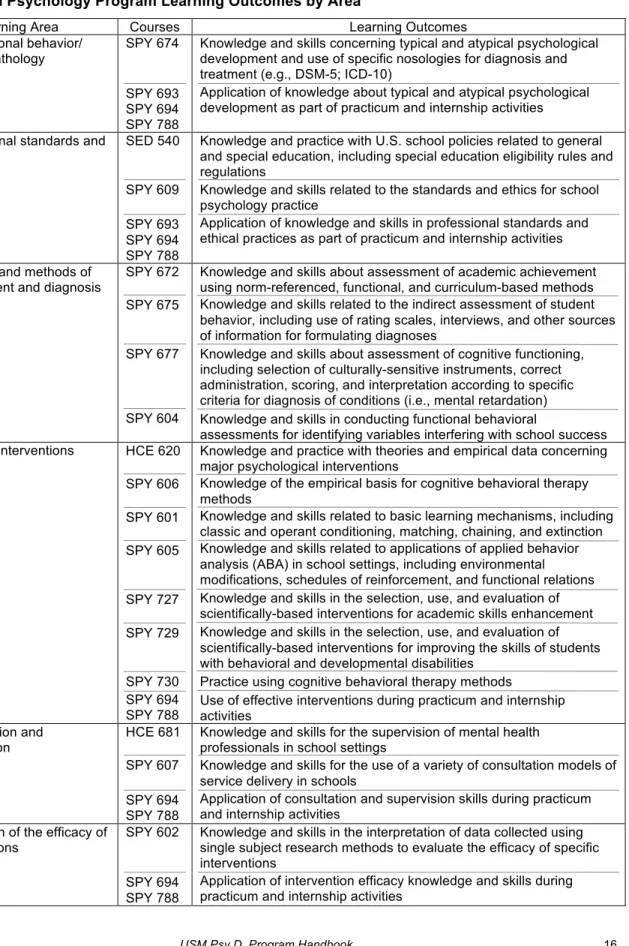
School Psychology Program students must learn a great deal of knowledge and skills in order to be prepared for eventual practice. In order to summarize how the courses and field experiences work together to prepare graduates, Table 4.7 shows each learning area alongside the specific courses and learning outcomes from those courses.
Rev: 5/2015 USM Psy.D. Program Handbook 15 Table 4.7
USM School Psychology Program Learning Outcomes by Area
Learning Area Courses Learning Outcomes 1. Biological aspects of behavior SPY 671 SPY 693 SPY 694 SPY 788
Knowledge of basic anatomy and physiology as well as neurophysiology
Use of knowledge about anatomy and physiology in the completion of practicum and internship activities
2. Cognitive and affective aspects of behavior
SPY 670 SPY 693 SPY 694 SPY 788
Knowledge and skills about the cognitive and affective elements in human behavior and learning
Use of knowledge about the cognitive and affective elements in human behavior and learning in the completion of practicum and internship activities, including the design and implementation of specific interventions for students
3. Social aspects of behavior SPY 673 SPY 693 SPY 694 SPY 788
Knowledge and skills related to basic social psychology and
application of findings from research for the improvement of students’ social skills
Use of knowledge about social psychology and social skills
interventions in the completion of practicum and internship activities 4. History and systems of
psychology
SPY 709 SPY 693 SPY 694 SPY 788
Knowledge and research activities pertaining to the history of
psychology in general and the relationship between other branches of psychology and school psychology
Identification and application of information from the history, systems, and ethics of general and school psychology in the practicum and internship
5. Psychological measurement HCE 605 SPY 694 SPY 788
Knowledge of the basic tenets of psychological and educational measurement, including test construction, reliability, validity, and culturally-sensitive assessment practices
Use of diverse psychological measurement tools during practicum and internship
6. Research methodology EDU 600 SPY 751 SPY 759
Introduction to basic research methods commonly used in education settings
Knowledge and skills for designing and evaluating psychological and educational research
Design, implementation, analysis, and interpretation of an independent dissertation
7. Techniques of data analysis SPY 697 SPY 698 SPY 751 SPY 759
Knowledge and skills pertaining to basic inferential statistics methods, including measures of central tendency, comparing means,
distribution analysis, and analysis of variance
Knowledge and skills pertaining to advanced inferential statistics, including multiple analysis of variance, regression, and path analysis Knowledge and skills related to the relationship between research designs and interpretation
Interpretation of data collected as part of an independent dissertation 8. Individual differences in behavior SPY 620 SPY 679 SPY 693 SPY 694 SPY 788
Knowledge of multi-tier student support systems that incorporate effective instructional methods for students with and without disabilities
Knowledge and skills for working with students from diverse racial, linguistic, cultural, ethnical, religious, and ability backgrounds Application of knowledge concerning effective instructional methods that work with learners from diverse backgrounds as part of practicum and internship activities
9. Human development HRD 668 Knowledge about the stages, features, and typical sequence of human development across the lifespan
Table 4.7, cont'd.
USM School Psychology Program Learning Outcomes by Area
Learning Area Courses Learning Outcomes 10. Dysfunctional behavior/ Psychopathology SPY 674 SPY 693 SPY 694 SPY 788
Knowledge and skills concerning typical and atypical psychological development and use of specific nosologies for diagnosis and treatment (e.g., DSM-5; ICD-10)
Application of knowledge about typical and atypical psychological development as part of practicum and internship activities 11. Professional standards and
ethics SED 540 SPY 609 SPY 693 SPY 694 SPY 788
Knowledge and practice with U.S. school policies related to general and special education, including special education eligibility rules and regulations
Knowledge and skills related to the standards and ethics for school psychology practice
Application of knowledge and skills in professional standards and ethical practices as part of practicum and internship activities 12. Theories and methods of
assessment and diagnosis SPY 672 SPY 675 SPY 677 SPY 604
Knowledge and skills about assessment of academic achievement using norm-referenced, functional, and curriculum-based methods Knowledge and skills related to the indirect assessment of student behavior, including use of rating scales, interviews, and other sources of information for formulating diagnoses
Knowledge and skills about assessment of cognitive functioning, including selection of culturally-sensitive instruments, correct administration, scoring, and interpretation according to specific criteria for diagnosis of conditions (i.e., mental retardation) Knowledge and skills in conducting functional behavioral
assessments for identifying variables interfering with school success 13. Effective interventions HCE 620
SPY 606 SPY 601 SPY 605 SPY 727 SPY 729 SPY 730 SPY 694 SPY 788
Knowledge and practice with theories and empirical data concerning major psychological interventions
Knowledge of the empirical basis for cognitive behavioral therapy methods
Knowledge and skills related to basic learning mechanisms, including classic and operant conditioning, matching, chaining, and extinction Knowledge and skills related to applications of applied behavior analysis (ABA) in school settings, including environmental modifications, schedules of reinforcement, and functional relations Knowledge and skills in the selection, use, and evaluation of scientifically-based interventions for academic skills enhancement Knowledge and skills in the selection, use, and evaluation of scientifically-based interventions for improving the skills of students with behavioral and developmental disabilities
Practice using cognitive behavioral therapy methods
Use of effective interventions during practicum and internship activities 14. Consultation and supervision HCE 681 SPY 607 SPY 694 SPY 788
Knowledge and skills for the supervision of mental health professionals in school settings
Knowledge and skills for the use of a variety of consultation models of service delivery in schools
Application of consultation and supervision skills during practicum and internship activities
15. Evaluation of the efficacy of interventions
SPY 602 SPY 694 SPY 788
Knowledge and skills in the interpretation of data collected using single subject research methods to evaluate the efficacy of specific interventions
Application of intervention efficacy knowledge and skills during practicum and internship activities
Rev: 5/2015 USM Psy.D. Program Handbook 17 Transfer Credits
The foundational curriculum plan requires completion of a minimum of 111 credit hours for a student entering the Program without graduate credit. USM guidelines stipulate that students who enter the Program with appropriate graduate credit from another institution may apply to transfer up to 45 semester credit hours into the Psy.D. Program. In cases in which 45 credit hours are approved for transfer, this would enable these students to complete the Program in 66 hours. Any students who wish to have coursework evaluated for transfer credit must complete the procedure outlined below for each course requested. Because not all graduate courses are equivalent or appropriate, and because even those that may have been equivalent or appropriate at one time may not be later, the USM School Psychology program has a process to evaluate courses for equivalency. This process is intended to help ensure that students have been (or will be) exposed to appropriate educational and training processes and activities, and that they possess (or will acquire) appropriate competencies. This process is known as the Course Equivalency Review (CER). For each graduate course the student wishes to have considered for transfer credit the student must:
1. have obtained a grade higher than a B-;
2. have completed the course in question no more than 6 years prior to beginning doctoral study in school psychology at USM. When students have developed initial competence in a professional practice area through coursework completed more than six years prior to entry into the program, and when students have continued to update their competency through professional experience (which may include, but not be limited to, relevant professional employment, supervision and continuing education) the Program may, at its discretion, consider coursework for waiver that was completed more than six years prior to entry into the Program.
3. Submit a Course Equivalency Review (CER) Request (Form C1) to the Director of Training. This request must include the following:
a. a brief (2-3 sentence) rationale for why the course should be considered equivalent,
b. a transcript (copy is acceptable) documenting the student’s grade for the course in question and the semester it was taken,
c. the prior graduate course number and name and the USM course number and the name of the USM course that the student wishes to be considered as equivalent, and
d. the syllabus for the graduate course and relevant supporting documentation (list of required and suggested readings, reports, papers, tests, etc.).
4. The request will be reviewed by the Program Director and referred to the faculty designee who has expertise in the area of instruction. The Director or faculty designee may ask for additional information from the student, including an official transcript, or consult with the previous instructor or other
sources.
5. The designee will then make a recommendation to the school psychology faculty and the faculty will vote to determine whether the course is considered equivalent.
6. The student will be informed about the faculty’s decision by the Director. 7. The result of the request will be documented in the student’s local program file.
8. For students seeking accompanying certification as BCBA, the applicable transfer course(s) must be transferred from a program that is approved by the Behavior Analyst Certification Board.
Transferred credits will be noted on the student’s USM transcript and counted toward the student’s degree. Once approved, the program will notify the USM Registrar to enter the official transfer onto the student’s record. Graduate students in APA-accredited doctoral-level school psychology programs at other universities may transfer into the program if they take their final 45 credits hours, or two years full time, plus the internship and dissertation requirement, in USM’s School Psychology Program.
M.S. in Educational Psychology with Concentration in Applied Behavior Analysis
Psy.D. Program students are eligible to earn a Master of Science (M.S.) degree along the way to completing the Psy.D. This M.S. degree includes the following 12 courses:
EDU 600 Research Methods and Techniques
SED 540 Nature and Needs of Learners who are Exceptional SED 682 Special Education Law*
SPY 601 Behavioral Principles of Learning SPY 602 Clinical Research Methods SPY 604 Functional Behavioral Assessment SPY 605 Applied Behavior Analysis
SPY 606 Behavior Therapy
SPY 607 Consultation in School Psychology SPY 608 Professional Ethics for Behavior Analysis* SPY 671 Physical Bases of Behavior
SPY 673 Social Foundations of Behavior
All but two of the M.S. courses are required of the Psy.D. Those Psy.D. students who want to earn the M.S. will need to take the two additional courses, SED 682 and SPY 608 as their electives or as additional courses. Psy.D. students do not have to apply to obtain the M.S. Those students who would like to earn the M.S. "along the way" must complete an online application for graduation (see Chapter IX) and submit it to the registrar's office. This application can be submitted during the final semester of taking the M.S. course requirements. Obtaining the M.S. "along the way" to the Psy.D. can bring certain benefits including eligibility for certain internships that require attainment of a master's degree.
Rev: 5/2015 USM Psy.D. Program Handbook 19 M.S. in Educational Psychology with Concentration in School Psychology
If a Psy.D. student is unable to complete all program requirements for the Psy.D., the student may be eligible for the M.S. in Educational Psychology with Concentration in School Psychology degree. Psy.D. students seeking to earn the M.S. instead of the Psy.D. in school psychology may apply to transfer into the M.S. program by completing the following steps:
1. complete an application for the M.S. program that includes the same GRE scores, transcript(s), and letters of recommendation submitted for the Psy.D.;
2. submit a letter with the M.S. application requesting admission to the M.S. that summarizes the reasons why the student wishes to obtain the M.S. instead of the Psy.D. as the terminal degree; 3. pay a $25.00 re-application fee with the M.S. application; and
4. provide the above information to the Office of Graduate Admissions no later than December 1 of the year preceding the requested transfer.
Students are advised that transferring into the M.S. in Educational Psychology with Concentration in School Psychology degree is a permanent decision and they cannot later transfer back into the Psy.D. Program. Decisions about transfer will be made on a case-by-case basis.
Evaluation of Student and Candidate Progress
The USM Psy.D. in School Psychology Program measures the progress of its students in many ways throughout the course of program completion. Table 4.8 summarizes the assessment system used to measure student progress.Degree students go through six distinct stages in the program: 1) Application, 2) Coursework and Practica, 3) Comprehensive Exam, 4) Internship, 5) Dissertation, and 6) Graduation. Stage designations are approximations of identifiable levels of the program that can be used to
differentiate students, but these do not correspond to academic years. At each stage, there are specific assessment activities that demonstrate whether a student is making satisfactory progress. In order to keep track of student progress toward the degree, USM uses the TK20 student data system. Use of this data system is required of all Psy.D. students and requires payment of a one-time fee prior to the start of the program courses. Information about how to use the TK20 system is available online at the TK20
website and from the USM Office of Educator Preparation.
Applicants. Psy.D. Program applicants are evaluated on a number of criteria indicative of their capacity to engage in graduate level training in psychology. These indicators include prior grades, exam scores, writing samples, references, and an on-campus interview. Applicants are compared with each other as well as with prior applicants. There are minimum criteria for prior grades and exam scores. Applicants must have an undergraduate GPA of at least 2.75 (or prior graduate GPA of 3.25) and a combined Verbal and Quantitative GRE score of 300 to be considered for admission. In addition, they must submit three letters of reference and two essays related to the philosophy and goals of the Psy.D. Program. Successful applicants are those who meet the academic and professional requirements.
Table 4.8
Psy.D. in School Psychology Assessment System
STAGE * PROGRESS INDICATOR(S) DECISION(S) MADE 1. Applicant 1. Application for admission including:
• GRE scores of at least 300 • GPA(s) for past degree(s)
• Three references
• Essays about school psychology • Pre-Admission interview
2. Admission into the program
1. Strength of individual applicants compared with skills levels of past students who have been successful in the program and whether the applicant has the interpersonal qualities and skills needed in the field of school psychology 2. Applicant possesses the knowledge,
skills, and dispositions needed for training in school psychology 2. Coursework and
Practica
1. Satisfactory completion of all
coursework (must receive B or better in all classes)
2. Satisfactory completion of 300 hours of Practicum 1 under the supervision of a credentialed school psychology
practitioner, as indicated by monthly and summative practicum evaluations and grade of Pass in SPY 693
3. Satisfactory completion of 300 hour Practicum 2 under the supervision of a credentialed school psychology
practitioner as indicated by monthly and summative practicum evaluations and grade of Pass in SPY 694
4. Annual student report of progress in which the student summarizes all progress made during that year of the program of study
5. Completion of all pre-internship courses
1. Whether student has the knowledge and skills necessary to complete more advanced coursework in school psychology
2. The level of student integration of the knowledge, skills, and concepts covered in each year of study
3. Whether student has the disposition and aptitude for school-based interactions with students, teachers, and others 4. Determination that student has
accumulated additional knowledge, skills, and dispositions in the field of school psychology and is ready to complete more advanced work in school psychology
5. Eligibility for enrollment in internship course and completion of 1,500 hour internship in school psychology 3. Comprehensive
Exam 1. Satisfactory completion of comprehensive exam covering all 15 domains of knowledge and practice
1. The level of student integration of the knowledge, skills, and concepts covered in the completed coursework and whether the student is ready to be an intern; Student becomes candidate for degree
4. Internship 1. Satisfactory ratings on monthly and summative evaluation of intern progress by site and university-based supervisors 2. Satisfactory (Pass) grade in SPY 788
(Pre-doctoral Internship in School Psychology)
1. Eligibility for continuation in internship activities
2. Eligibility for Psy.D. in School Psychology (pending dissertation completion) 5. Psy.D. Dissertation 1. Satisfactory completion of Psy.D.
dissertation following IRB-based protection of human subjects and using problem-solving methods for school psychology practice
1. Eligibility for Psy.D. in School Psychology 6. Graduate 1. Online exit survey which includes items
measuring graduate’s satisfaction with the overall program of study
1. Extent to which program of study is meeting the needs of immediate
consumers by preparing them for careers in school psychology
Rev: 5/2015 USM Psy.D. Program Handbook 21 Coursework and Practica. Students must demonstrate ongoing progress and mastery of
learning goals in all courses and practica. Specifically, students must have grades of B or better in all Program classes. In addition, they must have satisfactory Practica ratings. Practicum expectations are detailed in Chapter V and practicum performance is evaluated with Forms P1-P5 on TK20.
Comprehensive Exam. All Psy.D. students must take and pass a comprehensive examination covering all the learning areas. A detailed description of this exam is given in Chapter VI. Once a student has passed the exam, s/he is promoted to degree candidacy.
Internship. Psy.D. students must complete a 1,500 hour internship under the supervision of one or more licensed psychologists. A detailed description of the internship is found in Chapter VII.
Dissertation. Like all doctoral students, Psy.D. students must complete a dissertation. A detailed description of the steps required for the dissertation is found in Chapter VIII.
Graduate. Once a candidate has completed the Program and earned the Psy.D. degree, s/he is asked to complete an online exit evaluation. This evaluation includes items indicating the extent to which the graduate was satisfied with the Psy.D. Program. These data are used to make Program changes and improvements.
Annual Reports
A key feature of the Program Assessment System is the Matriculated Student Annual Report (Form M1). This report is due by 1 May each year of enrollment until graduation. Students complete their M1 forms through the TK20online system. Form M1 includes a self-assessment of learning for the year. In addition to Form M1, students must submit an unofficial transcript of all courses taken and complete a form evaluating their work during the year covered by the report. Program faculty review the annual reports to verify that students are making satisfactory progress; students will receive a letter from their advisors indicating whether the student remains in good standing or whether an improvement action plan is needed.
The annual reports are reviewed in relation to a number of indicators of student progress. The faculty review each student’s academic, professional, and social-emotional progress. If one or more areas are of concern, the faculty develop a written action plan for the student. If a student demonstrates significant difficulties with program requirements and expectations during the academic year, program faculty will meet with the student to explore solutions. School psychology practitioners need to be mature,
disciplined and emotionally healthy individuals. If a student’s physical or mental health problems interfere significantly with that student’s program success, an action plan will be written. If a student’s difficulties cannot be resolved via an action plan, the student might be counseled or required to withdraw from the program.
asked to meet with program faculty to construct a personalized action plan for improvement. Students who do not submit annual reports, or who do not meet the goals set out in their personalized plans, may be placed on probations or withdrawn from the program and not allowed to complete the program of study and degree. In such cases, the policies and procedures for academic probation outlined in the USM Graduate Catalog are followed. Additional information about these policies can be found in Chapter IX: Student Resources.
Rev: 5/2015 USM Psy.D. Program Handbook 23 V. PRACTICA IN SCHOOL PSYCHOLOGY
USM Psy.D. students complete two levels of pre-internship practical training as part of their programs of study. Students sign up for individual practica credits during six semesters of coursework. First, students take School Psychology Practicum 1 (SPY 693). After successfully completing 3 credits of Practicum 1, students take three separate credits of School Psychology Practicum 2. In addition, there are practical activities embedded into specific courses such as SPY 604, SPY 607, SPY 672, SPY 675, and SPY 677.
Practicum Applications
In order to keep track of how many students are seeking practica each semester, there are applications for each level of practicum. All Practicum forms are found at the USM TK20 student data system. Form P1 is the Application for Practicum 1 and P2 is the Application for Practicum 2. Each form requires the student to confirm meeting all practica prerequisites, including having passed a criminal background check and having student liability insurance.
CHRC
Prior to participation in any practicum placement, all School Psychology students must obtain Criminal History Record Clearance (CHRC) from the Maine Department of Education (MDOE). Instructions for obtaining CHRC are found on the MDOE website at:
http://www.maine.gov/doe/cert/fingerprinting/
Students are responsible for obtaining the fingerprints and getting the CHRC certificate before they begin any school-based work. Students must submit a copy of the CHRC certificate to the School Psychology Field Placement Coordinator prior to starting any practicum work.
Liability Insurance
USM Psy.D. in School Psychology students are required to obtain and maintain student liability insurance during their practica experiences. Both the National Association of School Psychologists and American Psychological Association have student liability policies available for purchase.
Tracking Practicum Progress
In order to keep track of students' practica activities, there are several other forms that students complete using the TK20 student data system. Before a student can register for a practicum credit, the student must submit Forms P3 and P4. These forms document that the school district or other site has approved the practicum and identify who will supervise it. In cases where more than one student is working at a given school site, only one copy of Form P3 is needed for the academic year. Students should note that Form P3 must be signed by the school district superintendent or agency Coordinator. Form P4 must be signed by the school psychologist who will provide the supervision. Forms submitted with the wrong signature(s) will be returned to students.
In addition, students must keep track of their practicum hours. During all semesters of practica students are required to record their activities in the TK20 student data system. Directions for how to use the time log feature of TK20 will be provided to students during their first semester of practicum. It is the student’s responsibility to keep all hours up to date in the TK20 student data system.
At the end of each semester, practica students must complete and submit the Practicum Hours
Verification Form (Form P5) in TK20. Field supervisors must conduct regular evaluations of the practicum student (Form P6) at the end of each semester of practicum. When the evaluation is completed each semester, the supervisor reviews it with the student, both sign it, and it is submitted to the USM Field Placement Coordinator via TK20. If needed, the USM Field Placement Coordinator will arrange to visit a practicum site. When such visits occur, a site visit form is completed in TK20 to document the discussion and plans resulting from the site visit (Form P7). As needed, the USM Field Placement Coordinator will stay in touch with practicum students and their supervisors through telephone and e-mail. It is the student’s responsibility to ensure that all forms are completed on time and maintained with accuracy.
Practicum Sites
Practica occur at various locations depending on availability. All practica must be approved by the Psy.D. Program Faculty. One Psy.D. faculty member serves as the Field Placement Coordinator and arranges all practica. The Field Placement Coordinator assists students with placements in sites where
appropriate school psychology learning experiences can be obtained. Students will complete practica in a variety of different settings so that they can learn about the many applications of school psychology. Generally, students cannot complete practica in their current employment locations. If a student works for a school or agency where s/he can be reassigned to a different program, building or level, it might be possible to complete a practicum in that different setting. In order to enroll in a credit of practicum the student must submit an application via TK20 (Forms P1 and P2) and work with the Field Placement Coordinator to identify a suitable site.
Practicum Course Credits
All credits of practicum are graded pass/fail and the Field Placement Coordinator awards the grade on the basis of whether the student has met the expectations set by the course syllabus, the practicum site, and agreed to by the student in accordance with the activities described in this section. In order to receive a passing grade for each credit of practicum, students must complete the required number of hours and the assignments set forth in the syllabus. Students must also receive a satisfactory evaluation from the site supervisor and from the Field Placement Coordinator. Students who do not meet the criteria for a passing grade will receive an F and will not earn credit for the practicum. In addition, the student’s advisor will be notified and will work with the Field Placement Coordinator to determine an appropriate course of action.
Rev: 5/2015 USM Psy.D. Program Handbook 25 School Psychology Practicum 1. Practicum 1 (SPY 693) is taken in 1-credit increments during the first two years of study. With the approval of the Field Placement Coordinator, the student registers for 1 credit of Practicum 1 (SPY 693) per semester. During the first two years of study, each student must complete three Practicum 1 credits for a total of 300 Practicum 1 hours. Practicum 1 includes activities that provide the student with an introductory experience to school psychology practice and the daily operations of schools in general. In Practicum 1 students are required to complete 100 contact hours for each credit of practicum. The Practicum 1 activities include shadowing the school psychologist, observing classroom practices, and becoming oriented to school routines.
School Psychology Practicum 2. Practicum 2 (SPY 694) is a more advanced supervised experience within a school or human service agency setting. The process for registering for Practicum 2 is identical to that of Practicum 1. The student must take three separate Practicum 2 credits. Practicum 2 provides the student with direct experiences in psychological assessment, intervention, and consultation practice. Because Practicum 2 is more advanced, it has a number of prerequisites. The prerequisites for registering for Practicum 2 are satisfactory completion of, or concurrent registration in, all pre-Practicum 2 coursework, and maintaining Criminal History Record Clearance (CHRC) from the Maine Department of Education and professional liability insurance. Table 5.1 lists all courses that the student must either have completed, or be registered in, while taking Practicum 2.
Table 5.1
Courses which must be completed prior to or at the same time as Practicum 2
Course Number Course Name EDU 600 Research Methods
HCE 605 Psychological Tests and Measurement HCE 668 Human Development
SED 540 Nature and Needs of Learners who are Exceptional SPY 609 Professional Ethics in Psychology
SPY 671 Physical Bases of Behavior
SPY 672 Assessment of Academic Achievement SPY 673 Social Foundations of Behavior
SPY 674 Psychopathology
SPY 601 Behavioral Principles of Learning SPY 677 Cognitive Assessment
SPY 604 Functional Behavioral Assessment SPY 605 Advanced Applied Behavior Analysis SPY 693 School Psychology Practicum 1
accumulated since Practicum 1. Practicum 2 builds on the learning in Practicum 1 by having students literally “practice” the skills they will need to use as school psychologists. Upon completion of Practicum 2, it is expected that students will be able to:
1. identify the operational procedures of the school system;
2. identify regional student support services that are utilized by the school system; 3. identify the assessment resources available to the school psychological services team; 4. identify the special education and school psychological services procedures for maintaining
confidentiality and storage of student records;
5. provide primary school psychological services under direct supervision by a licensed psychologist;
6. self evaluate personal competencies in school psychological assessment and consultation; and 7. develop internship goals and objectives based on practicum experiences.
During the 300 clock hours in Practicum 2, the practicum student will participate in a series of field experiences that include observing and shadowing the site supervisor, and demonstrating basic competencies in assessment, consultation, and school psychology practice. As with Practicum 1, Practicum 2 is graded pass/fail. Although the specific activities included in any given semester of Practicum 2 will vary, all students are expected to complete multiple comprehensive psychological evaluations for each credit of Practicum 2.
Throughout each semester of Practicum, the student and supervisor will discuss strengths, weaknesses, and ways to improve performance. At the end of the semester, the supervisor will complete the Practicum Performance Evaluation Form corresponding to the Practicum level; Practicum 1 uses Form P6 and Practicum 2 uses Form P7; these are submitted using TK20. The purpose of this evaluation is to identify the student’s strengths and weaknesses in school psychology service delivery.
Rev: 5/2015 USM Psy.D. Program Handbook 27 VI. PSY.D. COMPREHENSIVE EXAMINATION
In order to evaluate the general proficiency of Psy.D. students prior to placement for internship and initiation of the Psy.D. dissertation, all students must take a comprehensive examination. In order to move on to the pre-doctoral internship and dissertation, students must pass the comprehensive examination. In keeping with the general training in all aspects of psychology incorporated into the Program, the exam covers all 15 major area of school psychology practice. The areas covered on the exam are shown in Table 6.1.
Table 6.1
Areas covered on the Psy.D. comprehensive exam
1. Biological aspects of behavior
2. Cognitive and affective aspects of behavior 3. Social aspects of behavior
4. History and systems of psychology 5. Psychological measurement 6. Research methodology 7. Techniques of data analysis 8. Individual differences in behavior 9. Human development
10. Dysfunctional behavior/psychopathology 11. Professional standards and ethics
12. Theories and methods of assessment and diagnosis 13. Effective interventions
14. Consultation and supervision
15. Evaluation of the efficacy of interventions
The comprehensive exam is taken during the last year of Psy.D. course work prior to beginning either the pre-doctoral internship and/or the Psy.D. dissertation. Students cannot begin the internship or dissertation until they have satisfactorily passed the comprehensive exam. A summary of the process for scheduling, taking, and, if needed, re-taking the comprehensive exam is found in Table 6.2.
Table 6.2
Comprehensive exam process
Step Activity Time-Frame
1. Scheduling comprehensive exam At start of last semester of course work 2. Preparing for comprehensive exam 2-4 weeks of intensive study
3. Taking comprehensive exam 2 days of 5 hours each 4. Scoring comprehensive exam 1 week
5. Reporting comprehensive exam results Within 1 week of exam 6. Promotion to Psy.D. degree candidate Upon passing exam 7. Re-scheduling comprehensive exam 45 days after first attempt
Applying to Take the Comprehensive Exam
In order to take the school psychology Psy.D. comprehensive exam, students must complete and submit the application Form E1 using the TK20 student data system. In addition, students must submit the $100.00 exam application fee each time they apply to take the exam. The completed application must be submitted to the Director of Clinical Training no later than the Friday of the third week of the semester during which the exam will be taken (e.g., the weeks ending nearest to October 1 or February 1). The student should submit the payment to SEHD Office of Student Affairs in 218A Bailey Hall. Applications will be reviewed by the Director and incomplete applications will be returned to the student.
In order to be considered complete, all application questions must be answered and the application must be accompanied by an verification that the student has completed all prerequisites by providing an unofficial copy of the student’s USM transcript AND current semester enrollment form to show that all required courses have been taken or are being taken in the current semester. The application must be accompanied by a check or money order (no cash) for $100.00 made payable to USM. Once the Director has verified that the student is eligible to take the exam, s/he will schedule the exam. If the Director determines that the student is not yet eligible to take the exam, the application form and fee will be returned to the student.
Scheduling the Comprehensive Exam
Psy.D. comprehensive exams are scheduled twice each year, once in the fall semester, and once in the spring semester. The dates for comprehensive exams are set by faculty before each academic year begins and published on the SPY Network and Psy.D. student listserv. Typically, the exam is given in October and March of each year. Snow dates are set aside in case the University is closed on a specific exam date. All students who want to take the exam during a given semester will all take the exam on the same day.
The comprehensive exam is taken during the student’s last year of formal course work preceding the pre-doctoral internship or starting work on the Psy.D. dissertation. If a student will complete course work during the summer months, the comprehensive exam should be scheduled for the following Fall semester. The exam requires a total of 10 hours over two days for answering fifteen (15) essay
questions. On the first day, the student will be given 8 of the 15 total exam questions and on the second day, the student will be given the remaining 7 questions. The order of questions is the same as listed in Table 6.1. Questions 1-8 will be given on day 1 and questions 9-15 will be given on day 2. The exam typically goes from 10 am to 3 pm each day. Students may take brief breaks during the exam to use the restroom and have a meal, but that time will be part of the total five hours for the day. Both days should be set aside exclusively for taking the exam.
Rev: 5/2015 USM Psy.D. Program Handbook 29 Exam Format
The Director of Clinical Training will arrange to have the questions available on the approved computer at the start of each exam day. The computer will include a standard keyboard and mouse as well as a full-size screen. The exam will include a total of 15 essay questions that match the 15 areas of competency listed in Table 6.1. The questions will be developed by the faculty member whose area of expertise the question represents. Each faculty member will develop several questions and all questions will be
reviewed and approved by the remaining School Psychology faculty. The student will be expected to write a thorough answer to each question that demonstrates knowledge of best practices in school psychology.
Exam Location
The exam will be completed using a University-owned computer in a USM computer lab or classroom. The room will be set aside for the exclusive use of the student(s) during the exam. The student will not be allowed to use a cell phone or her/his own computer during the exam. Emergency contact can be made through the Faculty proctoring the exam.
Preparing for the Comprehensive Exam
Students should plan to engage in a substantial amount of review prior to taking the comprehensive exam. It is recommended that students plan to engage in 2-4 weeks of structured and systematic review of knowledge and skills learned in the program of study. For those Psy.D. students who transferred coursework from another University, it is expected that they will review the knowledge and skills learned as part of the prior courses. The exam will include questions representing all courses in the full Psy.D. program of study.
Taking the Comprehensive Exam
The exam requires up to 10 hours of time over two consecutive days. A faculty member will be available either in person or via phone each day for the duration of the exam to answer any questions. The student should plan to arrive at the exam location early. On both exam days, the student will have 5 hours to answer the questions for that day in any order desired. It is up to the student to pace her/his time during the exam. No additional time will be given. If the student completes the exam early, s/he may submit the answers ahead of the end time but, once submitted, the answers and exam questions will not be returned. The exam questions must be returned with the answers.
If a student needs accommodations and/or specific assistive technology in order to complete the comprehensive exam, these needs must be made specific in the Application for Comprehensive Exam Form (Form E1) on TK20. Those students who require such assistance must check off the appropriate box on the form and provide a signature. Checking this box gives permission for the faculty to contact the