
The Relationships Among Working Memory,
Math Anxiety, and Performance
Mark H. Ashcraft and Elizabeth P. Kirk
Cleveland State UniversityIndividuals with high math anxiety demonstrated smaller working memory spans, especially when assessed with a computation-based span task. This reduced working memory capacity led to a pro-nounced increase in reaction time and errors when mental addition was performed concurrently with a memory load task. The effects of the reduction also generalized to a working memory-intensive transformation task. Overall, the results demonstrated that an individual difference variable, math anxiety, affects on-line performance in math-related tasks and that this effect is a transitory disruption of working memory. The authors consider a possible mechanism underlying this effect—disruption of central executive processes—and suggest that individual difference variables like math anxiety deserve greater empirical attention, especially on assessments of working memory capacity and functioning.
Affect is the least investigated aspect of human problem solving, yet it is probably the aspect most often mentioned as deserving further investigation. (Mandler, 1989, p. 3)
In this article, we continue a program of research that examines the possible cognitive consequences and correlates of mathematics anxiety. As discussed elsewhere (Ashcraft & Faust, 1994; Ash-craft, Kirk, & Hopko, 1998), this work attempts to integrate two rather independent lines of research that have coexisted since the early 1970s. The first concerns studies of math anxiety per se, beginning with the important article by Richardson and Suinn (1972) and largely conducted within the psychometric tradition. The second is the study of mathematical cognition itself, focusing on the underlying mental representations and processes used in arithmetic and mathematics performance, work stemming princi-pally from Groen and Parkman's (1972) classic article.
It is surprising yet apparently true that up until this integrative research was begun, no one had considered whether math anxiety had any on-line effect on an individual's math performance, that is, an effect on underlying cognitive processes as the individual performs a math task. To be sure, the literature contains many reports of the general negative effects that math anxiety has on math performance and achievement (see the thorough meta-analysis by Hembree, 1990). For example, individuals with high math anxiety take fewer math courses, earn lower grades in the classes they do take, and demonstrate lower math achievement and
Mark H. Ashcraft and Elizabeth P. Kirk, Department of Psychology, Cleveland State University.
Elizabeth P. Kirk is now at the Department of Psychology, Florida State University.
Portions of these data were presented at the Midwestern Psychological Association, Chicago, May 1996. We wish to thank John Whalen and David Geary for helpful comments on earlier versions of this article.
Correspondence concerning this article should be addressed to Mark H. Ashcraft, Department of Psychology, Cleveland State University, Cleve-land, Ohio 44115. Electronic mail may be sent to m.ashcraft@popmail. csuohio.edu.
aptitude than their counterparts with low math anxiety. However useful this information is, it does not address the underlying cognitive processes involved in doing math, for example, mental processes that access the memory representations of mathematical knowledge. The same is largely true of the work reported in McLeod and Adams (1989). Its focus on relatively slow problem-solving tasks, especially when evaluated in classroom settings, precludes a fine-grained examination of mental representations and processes. Thus, the general focus of our research is to examine performance in standard cognitive frameworks and on-line tasks. We hope to examine the influence that math anxiety exerts on mathematical cognition and to identify the processing components that are so influenced.
Math Anxiety and Performance
Across several initial studies, we have found substantial evi-dence for performance differences as a function of math anxiety. These differences typically are not observed on the basic whole-number facts of simple addition or multiplication (e.g., 7 + 9, 6 X 8) but are prominent when somewhat more difficult arithmetic problems are tested. In particular, Ashcraft and Faust (1994; also Faust, Ashcraft, & Fleck, 1996) have shown that high-math-anxiety participants have particular difficulty on two-column ad-dition problems (e.g., 27 + 18), owing largely to the carry oper-ation. When such problems were answered correctly, the time estimate for the embedded carry operation was nearly three times as long for high-anxiety participants as it was for low-anxiety participants (Faust et al., 1996). Thus, high-math-anxiety partici-pants showed slower, more effortful processing on a procedural aspect of performance, performing the carry operation (for sug-gestive evidence on math affect and procedural performance in a numerical estimation task, see LeFevre, Greenham, & Waheed, 1993). Furthermore, their higher error rates on these problems, often showing classic speed-accuracy tradeoffs when confronted with relatively difficult arithmetic, indicated a willingness to sac-rifice accuracy on especially difficult trials, either to avoid having to deal with the stimulus problem or merely to speed the experi-mental session along.
Math Competence
A rival interpretation, of course, is that high-anxiety participants are simply less competent in math, unable to perform the necessary calculations at the same level of accuracy as low-anxiety individ-uals. The literature documents that there is indeed a significant relationship between math anxiety and math competence or achievement, a correlation of -.31 in Hembree's (1990) meta-analysis. If the correlation holds across all levels of problem difficulty, then competence and math anxiety are completely con-founded, and performance differences cannot be uniquely attrib-uted to either factor.
Results reported elsewhere, however, suggest that there is not a complete confounding of math anxiety and math competence. Faust et al. (1996), for instance, showed equivalent performance across math-anxiety groups to simple one- and two-column addi-tion and multiplicaaddi-tion problems when those problems were tested in an untimed, pencil-and-paper format. It is important to note that the larger of these problems had shown math-anxiety effects in laboratory tasks, suggesting strongly that the on-line anxiety reac-tion had compromised participants' ability to demonstrate their basic competence. Ashcraft and Kirk (1998) examined math com-petence and math anxiety more thoroughly in a study that admin-istered a standardized math achievement test. Simple whole-number arithmetic problems showed no math anxiety effects at all, whereas accuracy for the higher math-anxiety groups did decline more on the later test lines at which more difficult arithmetic (e.g., mixed fractions) and mathematics problems (e.g., factoring) were tested.
Finally, Hembree (1990) noted an interesting outcome in his meta-analysis on math anxiety. Reports on the most effective treatment interventions for math anxiety, behavioral and cogni-tive-behavioral approaches, also presented evidence of posttreat-ment increases in math achieveposttreat-ment or competence scores to levels "approaching the level of students with low mathematics anxiety" (p. 43). Because the treatments did not involve instruction or practice in mathematics, it is quite improbable that treatment itself improved individuals' math competence. Instead, it seems very likely that the low pretreatment achievement scores of high-math-anxiety individuals were depressed by math anxiety during the assessment itself and that relief from math anxiety then per-mitted a more accurate assessment of math achievement and competence.
On the basis of such evidence, it would appear that lower math competence cannot be offered as a simple, wholesale explanation for all the performance decrements associated with high math anxiety (see Ashcraft & Kirk, 1998, for a full discussion of this argument). Instead, these performance decrements seem to call for an explanation involving on-line cognitive processing.
Math Anxiety and Working Memory
For several reasons, we suspected that an assessment of the capacity and functioning of working memory (Baddeley, 1986; Baddeley & Hitch, 1974) might provide a useful explanation of results such as Faust et al.'s (1996) carry effect. A growing body of evidence now attests to the centrality of working memory to processes such as reading and reading comprehension (Just & Carpenter, 1992), reasoning (Baddeley & Hitch, 1974; Jonides,
1995), and retrieval from long-term memory (Conway & Engle, 1994; Rosen & Engle, 1997; for a collection of articles, see Richardson et al., 1996, and the contributions to this special issue). The various components of these mental processes are often at-tributed to one or another of the three major subcomponents—the
central executive, the auditory rehearsal loop, or the visuo-spatial sketchpad—in Baddeley's (1986, 1992) well-known model.
There is a supportive although not extensive literature on the role of working memory in mathematical cognition as well. Since Hitch's (1978) early article on multistep arithmetic problem solv-ing, there have been several reports on the critical role of working memory in math performance. As an example, Geary and Wida-man (1992) demonstrated that working memory capacity was closely related to skill in arithmetic problem solving and, in particular, to the speed of both fact retrieval and execution of the carry operation. In both cases, the higher the capacity of working memory, the faster were the component processes (see also Ash-craft, 1992, 1995; Lemaire, Abdi, & Fayol, 1996; Widaman, Geary, Cormier, & Little, 1989). So, for example, executing the carry operation is thought to be controlled by working memory, thus placing significant demands on the capacity of the working memory system (Ashcraft, Copeland, Vavro, & Falk, 1999; Hitch, 1978; Logie, Gilhooly, & Wynn, 1994).
Accordingly, we hypothesized that a major contributor to the performance deficits found for high-math-anxiety participants in-volves working memory. In particular, such deficits are predicted to stem from that portion of working memory, presumably the central executive, that applies the various procedures of arithmetic during problem solving (Ashcraft et al., 1999; but cf. Butterworth, Cipolotti, & Warrington, 1996; see Darke, 1988, and Sorg & Whitney, 1992, for additional evidence concerning anxiety and working-memory processes).
More generally, Eysenck and Calvo (1992) have proposed an overall model of the anxiety-to-performance relationship in cog-nitive tasks, which is called the processing efficiency theory. Their most relevant prediction for the present topic is that performance deficits due to generalized anxiety will be prominent in exactly those tasks that tap the limited capacity of working memory.1 In
their theory, the intrusive thoughts and worry characteristic of high anxiety are thought to compete with the ongoing cognitive task for the limited processing resources of working memory. The result of such competition is either a slowing of performance or a decline in accuracy—in other words, lower cognitive efficiency. Because high-anxiety individuals must expend greater cognitive effort to attain the same level of performance achieved by low-anxiety indi-viduals, processing efficiency is lower for high-anxiety individuals. Most of Eysenck's work (see Eysenck, 1992, for an integrative summary) is based on results with either generalized anxiety disorder individuals or individuals who exhibit high trait anxiety. For the present studies, we extended Eysenck's predictions to math anxiety. If this extension is valid, then an assessment of working memory capacity and functioning should reveal differences as a
1
Eysenck (1992) discusses a whole range of anxiety-related phenomena, for instance, increased physiological arousal, selective attention, and dis-tractibility. For the tasks under consideration here, however, the conse-quences of anxiety that affect working memory processes are the most relevant.
function of math anxiety, especially on tasks that require intensive processing within working memory. We do not test the specifics of Eysenck and Calvo's (1992) prediction here, which states that it is intrusive thoughts and worry (in this case, about math) that detract from available working memory capacity. Instead, we assess the more general prediction that math anxiety disrupts working mem-ory processing when the cognitive task involves arithmetic or math-related processes. In this sense, our prediction is not appre-ciably different from simpler models of attentional or working memory disruption, for instance, Kahneman's (1973) prediction that stress will disrupt processing that depends on attentional (working memory) factors.
Experiment 1
Experiment 1 evaluated the hypothesized relationship between math anxiety and working memory capacity. This assessment was embedded in a broad-based assessment of possible relationships among these and other factors, especially math computational skill and math attitudes. For a full report on the attitude and computa-tional skill assessments, see Ashcraft and Kirk (1998).
Method Participants
A total of 66 participants, recruited from lower level undergraduate psychology classes, received course credit for participating. After complet-ing informed consent procedures, they were administered the math-anxiety and working memory tests described below (along with the computational skill and attitudes assessments) and then were debriefed and excused. Sessions lasted approximately 90 min.
Instruments
Participants responded to a short (10-item) information sheet, which asked various demographic and math background questions. They also received a test of working memory capacity and a math-anxiety question-naire, described below.
Demographic information. The one-page information sheet asked for
age, gender, year in school, and ethnic group, as well as self-reported number of math courses and grades for both high school and college. We also asked for subjective ratings, on a 1-5 scale (1 = not at all), regarding how much participants enjoyed math and how math-anxious they were.
Math anxiety. The sMARS (short Mathematics Anxiety Rating Scale;
Alexander & Martray, 1989) is a 25-item version of the most widely used measure of this construct, the 98-item MARS (Richardson & Suinn, 1972). The sMARS assesses an individual's level of apprehension and anxiety about math on a 1-5 Likert scale, asking for participants' responses about how anxious they would be made by various settings and experiences (e.g., "Taking the math section of a standardized test"). Fleck, Sloan, Ashcraft, Slane, and Strakowski (1998) tested several shortened forms of the MARS and found the 25-item sMARS to yield a very high correlation with participants' overall MARS scores (r = .96) and acceptable test-retest reliability (r = .746 at a 2-week retest interval).
Working memory capacity. Salthouse and Babcock's (1990) listening
span (L-span) and computation span (C-span) tasks assessed participants' working memory capacity by requiring them to store increasing numbers of words or digits in working memory while processing simple verbal or arithmetic tasks. In the L-span task, participants hear a number of simple sentences, one by one, and must answer a simple question about the current sentence before hearing the next (e.g., "Last fall the farmers had a good harvest. When?"; "The children in the car wanted to stop for ice cream.
Where were the children?"). At the end of the set, the participant must then recall the final word in each of the presented sentences (e.g., harvest, ice cream), in serial order. Three trials are presented at each span length, with testing continuing until the participant fails to respond correctly to at least two of these trials (note that each sentence or problem in the block must also be answered correctly). For the C-span test, simple arithmetic prob-lems replace the sentences (e.g., 5 + 2 = ?, 9 — 6 = ?). Participants give the answer to each problem (7, 3), one by one, and then must recall the last number (2, 6) in each of the several problems within that trial, in order. Thus the span tasks require both on-line processing for sentence compre-hension or problem solution simultaneous with storage and maintenance of information in working memory for serial recall.
Procedure
Groups ranging in size from 7 to 24 participants were tested in a group setting. After the informed consent procedure, participants completed the demographic sheet and then were given the four categories of tests (in-cluding the two categories reported in Ashcraft & Kirk, 1998), sequenced randomly for each session. To ensure comparability of sessions, the span task stimuli and instructions were presented on a tape recording.
Results Demographic Data
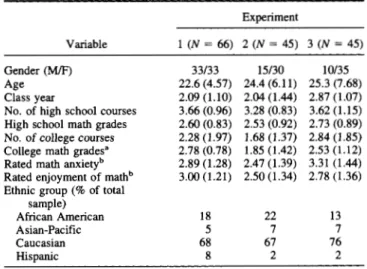
Table 1 presents summary statistics on the eight demographic characteristics of the sample. For clarity, the high school and college grades variables are reported on the standard 4-point scale (i.e., A = 4.0, etc.), as is class year (i.e., freshman, sophomore, etc.). Note that the n is reduced on college grades because 15 of the participants had either not yet enrolled in or not yet completed a college math course. The means and standard deviations for the self-reported enjoyment and math-anxiety questions are also in-cluded in Table 1. The values in this table suggest that the sample
Table 1
Summary Values, Sample Means, and Standard Deviations for Demographic Variables for Experiments 1-3
Experiment
Variable 1 (N = 66) 2 (N = 45) 3 (N = 45)
Gender (M/F) Age Class year
No. of high school courses High school math grades No. of college courses College math grades' Rated math anxietyb Rated enjoyment of mathb Ethnic group (% of total
sample) African American Asian-Pacific Caucasian Hispanic 33/33 22.6 (4.57) 2.09(1.10) 3.66 (0.96) 2.60 (0.83) 2.28(1.97) 2.78 (0.78) 2.89(1.28) 3.00(1.21) 18 5 68 8 15/30 24.4(6.11) 2.04(1.44) 3.28 (0.83) 2.53 (0.92) 1.68(1.37) 1.85(1.42) 2.47(1.39) 2.50(1.34) 22 7 67 2 10/35 25.3 (7.68) 2.87 (1.07) 3.62(1.15) 2.73 (0.89) 2.84(1.85) 2.53(1.12) 3.31 (1.44) 2.78(1.36) 13 7 76 2 Note. Standard deviations in parentheses. M = male; F = female. " n = 51 in Experiment 1; n = 40 in Experiment 2; n = 45 in Experiment 3.
of 66 participants was a relatively conventional undergraduate sample for an urban university.2
Mathematics Anxiety
Columns 1 and 2 of Table 2 present the overall sample means on the sMARS, the demographic variables that showed significant correlations with math anxiety, and the two working memory assessments. The mean sMARS score of 36.3 (SD = 16.3) was slightly higher than the normative values in Richardson and Suinn (1972) but very close to the values reported by Fleck et al. (1998), a mean of about 35.0, with a standard deviation of approxi-mately 16.0. The very small difference in sMARS scores between men (35.6) and women (37.1) was nonsignificant (F < 1.0).
Column 3 of Table 2 presents the correlations between sMARS and the remaining variables, and Columns 4-8 present group means and analysis of variance (ANOVA) results on these vari-ables, using math-anxiety group (low, medium, high) as a between-subjects variable.3 Cutoff scores for categorizing partic-ipants into the three anxiety groups were determined empirically by the overall sample mean and standard deviation, such that low-math-anxiety scores were at least 1 standard deviation below the overall sample mean on the sMARS, and high-math-anxiety scores were at least 1 standard deviation above the mean. Scores for the medium-math-anxiety group fell in the 1 standard deviation range centered on the sample mean, from 0.5 standard deviation below to 0.5 standard deviation above the mean. Twelve, 23, and 15 participants had scores that placed them in the low-, medium-, and high-math-anxiety groups, respectively—50 of the original 66 participants.
Grouping participants by their level of math anxiety yielded one significant group difference on the demographic variables, con-cerning number of high school math courses taken, and two differences that approached significance, on high school grades and self-rated math anxiety (1-5 scale). Note that the full corre-lations between sMARS and these three demographic variables were all significant.
Math Anxiety and Working Memory Span
As shown at the bottom of Table 2, individuals at higher levels of math anxiety showed significantly lower working memory capacity scores than those at lower anxiety levels. To see if the decline in capacity differed as a function of type of span task, we conducted a two-way ANOVA on the span scores. The analysis revealed significant main effects for anxiety group, F(2, 47) = 11.22, MSB = 1.23, and for type of span task, F(\, 47) = 10.17,
MSB = 0.77, both ps < .01. The F value for the interaction,
however, was nonsignificant, F(2, 47) = 1.71, computed p = .193.4 The result, taken at face value, indicates that individuals at higher levels of math anxiety have a reduced working memory capacity when tested with either a computation-based or language-based span task. This runs counter to the prediction that a decline in span scores due to math anxiety should be math specific and should not be apparent in nonmath testing situations. Because of the overlap between the two span tasks (e.g., the full sample correlation between the two span tasks was .38), we conducted several multiple regression analyses to partial out the contributions
of one span task to examine the math-anxiety effect on the other span task.
In brief, anxiety group was more predictive of an individual's C-span score than the individual's own L-span score was. The original correlation between C-span and math anxiety (-.44) remained significant and essentially unchanged (-.40), even after the common variance with L-span was statistically partialed out. In contrast, the original correlation between L-span and math anxiety (—.36) became nonsignificant (-.22) when the common variance with C-span was statistically removed. These results suggest that the decline in computation-based working memory span was clearly related to math anxiety, above and beyond the similarities in performance between computation- and verbal-based span tasks. Variations in verbal-based span, however, were less clearly related to math anxiety (see also Dark & Benbow, 1990, 1991), although the two original correlations did not differ significantly from each other (z = —.64). We postpone further discussion of this issue until Experiment 3, in which these relationships are tested again.
Discussion
The correlational results of this study were straightforward and replicated several of the global effects of math anxiety reported by Hembree (1990); high-math-anxiety individuals enroll in fewer math courses and earn lower grades in the math classes they do take. The most important new finding was that working memory capacity was negatively associated with math anxiety. Given the importance of working memory functioning to a variety of cogni-tive and intellectual tasks (e.g., Just & Carpenter, 1992; Logie et al., 1994), it becomes genuinely important to explore the relation-ship between working memory and math anxiety more fully.
This is especially the case given the positive relationship re-ported elsewhere between working memory and math performance (Ashcraft & Kirk, 1998; Geary & Widaman, 1992; Hitch, 1978). In particular, the possibility exists that the lower working-memory capacity that seems characteristic of high-math-anxiety individuals may be at least partially responsible for the performance decre-ments commonly found with math anxiety. It may be, further, that this reduced working-memory capacity is an on-line effect, one that disrupts information processing in arithmetic and math tasks. The argument here is that those aspects of math performance that rely especially on working memory will be the aspects most affected by math anxiety. If this disruption can be demonstrated on a rather straightforward arithmetic task, one on which competence differences can be ruled out, then this would be evidence of an on-line math-anxiety reaction. More generally, we would expect to find such evidence whenever the math task places heavy demands on the capacity of working memory. The following two experi-ments were designed to follow up on this prediction.
2
Unless otherwise noted, all findings reported as significant here achieved at least the .05 significance level.
3 The full correlation matrix for Experiment 1 is available upon request.
"We note in passing that the superiority of our participants on the C-span task (M = 3.4 vs. 2.8 for L-span) is reversed from the data in Salthouse and Babcock (1990; in that report, M = 2.87 for the C-span task and 3.37 for the L-span task), possibly owing to our group presentation method or the lengthy test sessions.
Table 2
Means (and Standard Deviations), Correlation Coefficients, and Math-Anxiety Group Means for Experiment 1
Anxiety group Variable
sMARS Demographics
No. of high school courses High school math grades Rated math anxiety Working-memory capacity L-span C-span M 36.3 (16.3) 3.66 (0.96) 2.60 (0.83) 2.89 (1.28) 2.80(1.01) 3.44(1.16) r with sMARS 1.0 -.28 -.29 .42 -.36 -.44 Low 12.3 4.08 3.0 2.25 3.7 4.3 Med. 37.1 3.56 2.50 3.17 2.4 3.4 High 57.4 3.53 2.40 3.20 2.6 2.8 F(2, 47) 255.20 3.72 2.13 2.60 7.83 7.33 P< .001 .05 .13 .08 .01 .01
Note. rcril(66) = .254 at/> = .05; rcrit(66) = .330 atp = .01. sMARS = short Mathematics Anxiety Rating
Scale; Med. = medium; L-span = listening-span task; C-span = computation-span task; crit = critical.
Experiment 2
We explored the hypothesis that math anxiety disrupts working memory by using an on-line mental addition task, in which par-ticipants see the problem and are timed as they produce its answer verbally. Problem difficulty ranged from basic addition facts (e.g., 4 + 3) up through two-column additions with carrying (e.g., 47 + 18). Importantly, this range of problems corresponds to difficulty levels that showed no math anxiety effects in math achievement testing (Ashcraft & Kirk, 1998). Performance differences here should therefore be attributable to the on-line disruption of math processing rather than to preexisting group differences in compe-tence and skill.
Mental addition was embedded here within a dual task. The reasoning behind the dual-task procedure (e.g., Baddeley, 1986) is that a demanding secondary task will compete with the primary task for working memory capacity, to the extent that each task requires the working memory system for successful performance. As the tasks increase in difficulty, their combination begins to overload the working memory system, with the interference visible as an increase in either reaction times (RTs) or errors. The relevant manipulations in the primary task were difficulty of the addition problem and whether the problem involved carrying from the units to the tens column; few, if any, other independent variables are more reliably associated with increasing difficulty in arithmetic processing than these (e.g., Ashcraft, 1992; Widaman et al., 1989). The secondary task here was a memory load task, holding either two or six random letters in working memory for later recall. The intent was to determine the point at which available working memory capacity becomes insufficient to maintain normal speed and accuracy on the two tasks.
Results with this combination of tasks (Ashcraft et al., 1999) have indicated a strong interaction between task (control vs. dual task) and the problem difficulty factors. In those results, the more difficult problems, especially those with carrying, showed in-creased solution latencies and dramatically higher error rates under high-memory-load conditions. This effect was interpreted to mean that more difficult addition problems rely significantly on working memory because performance to them was compromised when the system was also taxed with the memory load task.
We go one step further here in predicting that this interference
pattern should be exaggerated at the higher levels of math anxiety.
Participants at higher levels of math anxiety show lower working-memory capacity when processing numbers, as demonstrated in Experiment 1. Thus, the interference experienced under our dual-task procedure should be even more pronounced at higher levels of math anxiety. Indeed, the on-line math-anxiety effect may be conceptualized as functionally similar to a secondary task in that it drains working-memory capacity that otherwise would be avail-able for task-relevant processing, as suggested earlier. In a real sense, high-math-anxiety participants may face a triple-task situ-ation, with arithmetic and memory load performance further com-promised by the on-line anxiety effect.
Method
Participants
Undergraduates in lower level psychology courses volunteered their participation in return for extra credit. We continued testing until the three math-anxiety groups had 15 participants each; the sMARS cutoffs for group membership were the same as in Experiment 1. The additional participants who were tested had sMARS scores that fell outside of the critical ranges or, toward the end of testing, had a score that placed them in an already-filled group. During testing, 2 participants were dropped (and replaced) because they were unable to trigger the voice relay reliably, as were 8 who were unable to achieve an overall accuracy rate of 75% on letter recall. Table 1 presents summary values for this sample.
Apparatus
The demographic sheet and the sMARS were in pencil-and-paper for-mat. The experimental task was instrumented on ordinary laboratory per-sonal computers, using the Micro Experimental Laboratory software pack-age (MEL Professional 2.01, 1995; Schneider, 1988). The software presented all task instructions on the screen and recorded RTs automati-cally. At the end of each trial, the experimenter entered the participant's response to the arithmetic problem, and the software scored responses for accuracy. Spoken letter recall was recorded for later scoring.
Tasks
In the full dual-task condition, there were three main events per trial, each event separated from the next by a blank screen. The three events were (a) presenting the set of letters to be held in working memory, with the interval terminated by the participant's key press (Event 1), (b)
pre-seating the addition problem to be solved, with the interval terminated by the participant's spoken response (Event 2), and (c) prompting for recall of the letters, with the interval terminated by the experimenter after recall was recorded (Event 3). Participants were encouraged (although not required) to read the letter set aloud (Event 1) before moving on to the arithmetic problem. The RT interval began when the addition problem appeared on the screen (Event 2) and was terminated when the participant stated the answer to the problem. This was followed by the prompted recall of the letter set (Event 3). Thus, on each trial, participants (usually) read the letter set aloud, spoke the answer to the addition problem, then recalled the letter set orally. After the experimenter recorded letter recall and keyed in the addition answer, a "Ready" signal appeared, followed by the beginning of the next trial.
The appropriate controls for this dual task involve testing both the primary (math only) and secondary (letter recall only) tasks alone. To guard against the possibility that vocalizing per se in the dual task might cause some interference, both control conditions held overall vocalizations constant. That is, in the math-only task, participants still named the letter set aloud when it was presented (Event 1), and after solving the math problem, they named the letters when the prompt appeared (Event 3). To eliminate the load on working memory, the letters were shown on the screen during the prompt, and participants merely read them aloud. Like-wise, during the letter-recall-only task, the answer to the addition problem was shown along with the problem on the screen (Event 2), and the participants merely read the answer aloud prior to recalling the letter set at the recall prompt.
Stimuli
Sixty addition problems were evenly divided among the six stimulus conditions, the result of the 3 X 2 manipulation of problem size and carry. The three levels of problem size were basic fact, medium, and large, with these labels denoting, respectively, problems with single-digit operands (e.g., 4 + 3), with a double- and a single-digit operand (e.g., 15 + 2), and with two double-digit operands (e.g., 23 + 11). Half of the problems in each set were no carry problems (the examples just given), and half involved a carry (e.g., 7 + 9,16 + 8,25 + 17). The set of 60 problems was then permuted twice, yielding three comparable sets of problems to be used in the three task conditions. In one permutation, one of the two problem operands was randomly selected and changed by ±1 or 2; in the other permutation, the other operand was changed in the same way. Thus, the three different sets of addition problems were comparable in difficulty, yet involved no stimulus repetition across tasks. All problems had either 1- or 2-digit sums; the largest problem was 45 + 31.
Letter sets for the secondary task were composed of either two or six randomly selected consonants, selected with approximately equal frequen-cies across the entire experiment. Letter sets were modified as needed to avoid meaningful combinations, combinations that repeated a letter, and combinations that contained any pair of letters in alphabetical sequence. The letter combinations were also permuted, by changing one letter in each combination (subject to the same restrictions), to yield the sets necessary for the three tasks. As was the case with the three sets of addition problems, the letter combinations were comparable across tasks while not involving any exact repetition.
Procedure
Participants were tested individually in sessions that averaged 75 min. They were told the general purpose of the experiment, gave their informed consent, and then were given a short practice set that presented and tested each of the three tasks. They then proceeded to the experiment itself, with order of the three tasks counterbalanced across participants. The detailed purpose of the study was explained at the end of the session. Previous testing with this task (Ashcraft et al., 1999) indicated that the full set of 60
trials on the letter-recall-only task needlessly prolonged the session and was unnecessary for a reliable estimate of memory load performance. Thus, the letter-only task was reduced from 60 to 36 trials, with 3 trials in each experimental condition, versus the 5 per condition in math-only task and the dual task.
Results
All ANOVAs reported here used the same mixed design: math anxiety (low, medium, high) as a between-subjects variable and the remaining variables as within-subjects factors. As stated, the factors of problem size (basic fact, medium, and large) and carry status (no carry, carry) manipulated the difficulty of the addition problems, and the memory load condition (two- versus six-letter loads) manipulated difficulty in the secondary task. Thus, the within-subjects factors formed a 3 X 2 X 2 design, with a total of 12 stimulus conditions and five trials per condition.
Letter Recall Only
The number of correctly recalled letters was analyzed in the letter-recall-only task as a function of the three within-subjects independent variables (though, of course, no genuine arithmetic processing was necessary in this task). The only effect that achieved conventional significance was the main effect of memory load, F(l, 42) = 76.68, MSE = 0.12, p < .001, in which recall of the 2-letter sets averaged 100% correct, versus 96% correct recall of the 6-letter sets. The results indicated no relationship between math anxiety and letter recall in this control task; mean correct recall across the anxiety groups was 5.89, 5.87, and 5.81 letters (out of 6 possible; note that for all analyses, recall on 2-letter trials was converted to the same 6-point scale). The three-way interac-tion of anxiety, problem size, and memory load approached sig-nificance (computed p = .059) but only because of a strong ceiling effect in the 2-letter conditions (from 99% to 100% correct on 2-letter trials).
The letter-only results indicate that even the heavier memory loads were well within participants' basic working memory capac-ities. Furthermore, with the nonnumerical stimuli in this task, there were no apparent differences in working-memory capacity across the three anxiety groups. As such, anxiety-related effects in the math-only and dual-task conditions cannot plausibly be attributed to a general deficiency in working memory capacity for the higher anxiety groups. Note, finally, that the virtually perfect performance on the lighter memory loads suggests minimal involvement of working memory for storing and recalling two letters.
Math Only
Both RTs and errors to the addition problems were analyzed with the mixed ANOVA design described above. Of the origi-nal 2,700 possible RTs (60 for each of 45 participants), 0.6% were identified as outliers, 2% were spoiled owing to difficulties with the voice relay (e.g., triggering by an extraneous noise), and 4% of trials were answered incorrectly; RTs from these trials were ex-cluded from the analyses.
Latency Results
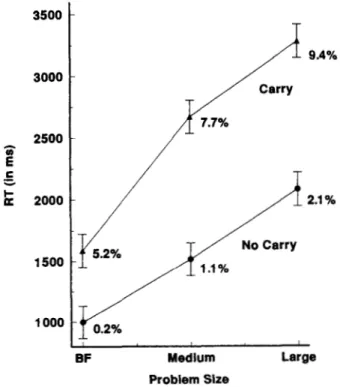
Problem size and the carry status of the problem, as well as the interaction of these two variables, had strong effects on RTs; for
the interaction, F(2, 84) = 25.77, MSB = 201,473, p < .001. The
diverging pattern of this interaction, shown with accompanying
error rates in Figure 1, replicates very closely the pattern reported
in Ashcraft et al. (1999). There was a nonsignificant (computed
p = .10) tendency for the low-anxiety group (M = 1,957 ms) to be
marginally slower than the medium group (M = 1,825 ms) and for
the high-anxiety group to be slower than both of these (M = 2,288
ms). The low-medium group reversal seemed due to a slight
speed-accuracy tradeoff, with 3% errors for low-math-anxiety
versus 5% for the medium group (the high-anxiety group's overall
error rate was 6%). The RT data also showed a 186-ms speedup of
performance on six-letter trials on the part of high-math-anxiety
participants, versus a nonsignificant 30 ms difference for low and
medium groups, despite the fact that letters did not have to be
stored in and retrieved from memory in this task: Anxiety X
Memory Load interaction, F(2, 42) = 6.76, MSB = 84,401,
p<
.01.
Accuracy Results
The analysis of error rates revealed straightforward evidence of
a math anxiety effect on addition performance in the form of an
Anxiety X Carry interaction, F(2,42) = 6.04, MSB = 128.17, p <
.01. No-carry problems showed essentially no variation in error
rates across anxiety group (2%, 1%, and 0.4%, respectively),
contrasted with the marked increase on carry problems (4%, 8%,
and 11%, respectively). This pattern replicates earlier reports (e.g.,
Faust et al., 1996) of the particular difficulties experienced by
3500 3000
2500
at c ff 2000 1500 1000 9.4% 2.1% No Carry 1.1% BF Medium Problem Size LargeFigure 1. Mean reaction time (RT) and percentage error rates to basic fact (BF; n + m), medium (nn + m), and large (nn + mm) addition problems, separately for no carry and carry problems: Experiment 2. Error bars display 95% confidence interval based on MSw.
high-math-anxiety participants on problems involving the carry
operation.
The analysis also revealed processing difficulties due to
prob-lem variables. Beyond the significant main effects of probprob-lem size,
F(2, 84) = 4.13, MSB = 101.9, and carry status of the problems,
F(l, 42) = 42.00, MSB = 128.2, p < .001, there was a significant
interaction of problem size, memory load, and carry, F(2, 84) =
8.19, MSB = 88.40, p < .001. Error rates climbed to 14% for large
carry problems on six-letter trials, suggesting that articulating
the six-letter sets generated some within-trial interference with
difficult arithmetic processing, even without the memory load
requirement.
Dual-Task Analyses
Latencies and error rates were analyzed as a function of control
versus dual task, to determine how much performance deteriorated
when the two demanding tasks were performed concurrently. We
begin with an explanation of the analysis decisions dictated by the
dual-task procedure, then present the results of the analyses.
In the dual-task condition, it seemed clear that errors in either
task could be taken as evidence of interference in working
mem-ory. That is, particularly difficult addition might disrupt working
memory sufficiently to depress letter recall, or the working
mem-ory load for letter recall might disrupt concurrent addition
perfor-mance. As such, error rates in the dual task were the percentages
of trials in the 12 stimulus conditions that contained an error of
either type. Likewise, for the control observations, we summed
error percentages across letter-recall-only and math-only tasks,
separately for the 12 stimulus conditions. For all scoring, accurate
recall was defined as recalling both letters in the two-letter sets and
at least five of the six in the six-letter sets. Our rationale here was
that accurate recall of five letters still required a substantial
in-volvement of working memory, whereas insistence on perfect
six-letter recall depleted the number of usable RT trials in the dual
task to a greater degree than was acceptable. The RT analyses
considered only accurate trials, which in the dual task meant only
those trials scored as correct for both the math and the letter recall.
Latency Results
The analysis of RTs revealed several processing effects due to
problem difficulty and memory loads. For example, problem size
and the carry factor were significant as main and interaction
effects, as found in the math-only analysis (Figure 1). Furthermore,
this interaction depended on the control versus dual-task factor; for
the three-way interaction, F(2, 84) = 5.49, MSB = 110,756, p <
.01. The diverging pattern shown in Figure 1 was even more
pronounced in the dual-task condition; for example, the slowest
RT in Figure 1—3,280 ms for large carry problems—increased
to 3,554 ms in the dual task, whereas RTs to the smaller problems
and those without a carry remained essentially unchanged. The
same (nonsignificant) pattern of means across anxiety groups was
obtained again, and there was once again a significant speedup to
six-letter trials for only the high-anxiety participants, F(2, 42) =
5.95, MSB = 97,316, p < .01.
Accuracy Results
Far more informative were the results from the error analysis.
Here, all main effects (math anxiety at a computed p of .052),
several double interactions, and three triple interactions were sig-nificant. We first focus on the three-way interaction pertaining to the task environment and then the two triple interactions that included math anxiety.
The interaction of task, carry, and memory load, F(l, 42) = 6.28, MSE = 195.20, was quite straightforward. The pattern in the control condition was of two main effects, showing a modest (6%) increase in error rates for carry problems and a modest (4%) increase with the heavy memory load. The source of the interaction was the diverging pattern found in the dual task. Here, the increase in errors for carry problems was 8% in the two-letter condition but 14% for carry problems done concurrently with the six-letter memory load. In other words, it was the combination of carrying performed under the heavy memory load that surpassed the capa-bilities of working memory. This is precisely the pattern reported for a sample of participants not selected on the basis of math anxiety (Ashcraft et al., 1999). Having to maintain a heavy load in working memory seems to selectively interfere with performance to difficult additions involving the carry operation.
This diverging Carry X Memory Load pattern also varied across the three math-anxiety groups, as shown in the Anxiety X Carry X Memory Load interaction, F(2, 42) = 3.94, MSE = 116.92. The four-way interaction of this effect with control versus dual task narrowly missed conventional significance, F(2, 42) = 2.99,
MSE = 195.20, computed p = .061. We nonetheless present the
four-way interaction in Figure 2 because it both shows the pattern of three-way effect as well as the exaggeration of this effect in the dual task. In the control task, the increases in errors due to carrying were moderate, increased slightly under the heavy memory load, and showed modest increases at higher levels of anxiety. A similar pattern was obtained in the dual task when only two letters had to be held in working memory. The heavy memory load, however, disrupted dual-task performance much more markedly. This dis-ruption was particularly strong in the high-math-anxiety group, which showed a 39% error rate.
Another way of conceptualizing these effects is to define the
cost of carrying as the difference in error rates between carry and
no carry problems. In these terms, although all four sections of the figure show costs in accuracy due to carrying, these costs range from minimal to moderate in the control condition (from 0.8% for low anxiety, two-letter to 9% for high anxiety, six-letter). Costs remained in the 8% range in the dual-task condition but only with the light memory load. With the heavy memory load, however, the cost of carrying increased sharply with math anxiety; for low-, medium-, and high-math anxiety, the costs of carrying here were 10%, 17%, and 27%, respectively. No-carry problems therefore appear to rely only moderately on working memory, showing only moderate increases when memory load increases. When carrying was required, however, the costs due to the memory load were greater and increased substantially with the math-anxiety group. Carrying thus seems especially reliant on working memory pro-cesses and is especially prone to disruption among high-math-anxiety individuals.
Finally, the Math Anxiety X Problem Size X Task interaction was also significant, F(4, 84) = 3.33, MSE = 546.23, p < .01. In the control observations, errors rose somewhat across problem size for the medium- and high-anxiety groups, although not for the low-anxiety group (confirmed by a breakdown analysis limited to the control condition). Under the dual-task condition, the increases
40 30 20 10 40 30 I 20 £
a
10 ControlTwo-Letter Load Six-Letter Load
Dual-Task
Two-Letter Load Six-Letter Load
No Carry Carry No Carry Carry Status
Carry
Figure 2. Mean percentage error rate for the control and dual-task con-ditions, separately by two- versus six-letter memory loads, no carry versus carry problems, and math anxiety (low anxiety [circles], medium anxiety [triangles], high anxiety [squares]): Experiment 2.
in error rates were clear for all three groups but were most pronounced for the high-anxiety group. The four-way interaction of this effect with memory load would have confirmed that this high error rate was particularly due to the heavy memory load; this interaction only approached significance, however (computed p = .085).
These results correspond well with the patterns predicted earlier, when we considered the lower working-memory capacity of high-math-anxiety participants and the reliance on working memory during difficult addition processing. All anxiety groups showed increases in error rates under the increasing pressures of problem size and dual-task requirements, indicating reliance on the working memory system for difficult arithmetic processing. However, the striking increase in errors for the high-math-anxiety group is consistent with the interpretation that the high-anxiety group had the least capacity to devote to concurrent processing, which itself taxed working-memory capacity. In passing, we note that despite their overall skill and achievement, low-math-anxiety participants still demonstrated reliance on working memory for carry problems, that is, problems involving procedural processes.
Discussion
Experiment 2 confirmed earlier indications that high-math-anxiety individuals have particular difficulties with addition
prob-lems involving a carry operation (Faust et al., 1996). Earlier interpretation had suggested that this was due to the load on working memory engendered by the carry operation. The results of Experiment 2 demonstrated this quite clearly. When carrying was performed concurrently with a task that placed heavy demands on working memory, performance deteriorated sharply for the nigh-math-anxiety group. This deterioration was not as pronounced at lesser degrees of problem difficulty or on problems not requiring the carry operation, and it was considerably weaker for participants at the low-math-anxiety level. Importantly, there was no evidence of anxiety-related deterioration in the letter-only task, in which processing within working memory involved nonnumerical stim-uli. In short, these results conform exactly to the predicted conse-quences of lower working memory span for high-math anxiety individuals: degradation of their working memory performance in an on-line arithmetic task.
Experiment 3
We wish to extend this relationship between compromised working memory span and math anxiety by examining perfor-mance in a task that is working-memory intensive while not explicitly involving learned math. This demonstration is motivated generally by Eysenck and Calvo's (1992) prediction that anxiety will have its primary debilitating effects in tasks that place heavy processing loads on working memory. If the math anxiety reaction compromises participants' available working memory capacity when doing math, as was the case in Experiment 2, then it is of interest to explore the limits of this effect. In brief, must arithmetic and math stimuli be used to trigger the math anxiety reaction, or will tasks that merely rely on number-related processes also dem-onstrate the effect?
To obtain evidence on this question we tested a transformation task used by Eysenck (1985; originally reported in Hamilton, Hockey, & Rejman, 1977); letter transformation here was basically an "alphabet arithmetic" task (e.g., A + 3 = D; Logan & Klapp, 1991) with a recall requirement. We also repeated our assessment of working memory span from Experiment 1 in hopes of obtaining more definitive results on the relationship between math anxiety and language-based span.
Method
Participants
Participants were recruited from several lower level undergraduate psy-chology classes and given extra credit for their participation. After com-pleting informed consent procedures, they completed the standard demo-graphic sheet and the sMARS. Participants whose scores categorized them as having low, medium, or high math anxiety were then recruited for individual testing in the two working-memory tasks. A total of 51 partic-ipants were tested in the individual sessions, 15 each from the three math-anxiety levels described earlier. Four participants were dropped from the sample because they were unable to complete the tasks with adequate accuracy, and 2 more were replaced as described below. After the 90-min testing session was completed, participants were debriefed about the pur-pose of the experiment and then excused.
Working Memory Tasks
Participants were given the L-span and C-span working memory tasks described in Experiment 1. Additionally, they were given a letter
transforma-tion task (Eysenck, 1985) to test working memory capacity and processing. In this task, participants were given series of letter transformation trials and series of number transformation trials. In both cases, the stimulus set had to be transformed mentally, then reported to the experimenter for final recall.
Letter transformation. Participants saw either two or four letters of the alphabet, one at a time. They were required to transform each letter mentally by moving or counting forward either two or four steps through the alphabet, then holding that outcome in working memory while transforming the next letter in the set. In the simplest type of trial (two letters, transformation size two), a participant would see 2, indicating that the letters had to be trans-formed two steps down the alphabet. The participant then pressed a key on the keyboard and saw the first letter, for example, E. The participant would mentally transform E by moving two letters through the alphabet (F, G), press the key again to see the next letter, for example, 5, then transform S to U while simultaneously holding the earlier transformation outcome (G) in working memory. After pressing the key to indicate the second trans-formation was completed, the word Recall would appear on the screen, and the outcome of the transformations (G, U) had to be reported in order.
After 10 practice trials, a total of 40 letter transformation trials were presented, in randomized order. There were 10 trials in each of the cells of a 2 X 2 design, with factors of transformation size (two or four), and number of letters (two or four). Letters were selected randomly from the set B through V and were ordered randomly within trials subject to two restrictions. First, we eliminated any letter sequences that formed words or meaningful acronyms. Second, we excluded letters that would duplicate part of the transformation sequence required for another letter in that trial (e.g., the transformation sequence for B—which is C, D, E, F—precluded using the letters C through F for that trial).
Number transformation. We substituted randomly selected single or double digit numbers in the range 5-25 for the letters and had participants transform those numbers by adding either the value 7 or 13. Thus, for a "transform 7" sequence, the numbers "15 3 25 19" might be presented, again one at a time, and at the end of transformation, the participant would report "22 10 32 26" at the Recall prompt. As in the letter task, participants saw either two or four numbers to be transformed, to which they applied either a "plus 7" or a "plus 13" transformation. Again, we presented 10 practice and 40 experimental trials, the latter in randomized order.
Dependent Measures
Accuracy and latency data were collected for both transformation tasks. Participants' recall scores were the percentage of letters and numbers correctly recalled on each trial. The computer recorded the latencies between key presses on the keyboard, yielding a position-by-position record of the time required to encode, transform, and rehearse the letters or numbers to be recalled on each trial. Accuracy and span length on the L-and C-span tasks were scored as described in Experiment 1.
Apparatus
The transformation experiment was conducted using the same apparatus as in Experiment 2. The software presented all instructions and stimuli to the participants and recorded latencies in milliseconds. The span tasks were conducted as in Experiment 1.
Procedure
Participants were selected on the basis of math-anxiety scores obtained in the preliminary screening session. They were given either the two span tasks and then the two transformation tasks, or they were given these tasks in reverse order. A few participants were retested on the sMARS at the end of the experimental session when their performance seemed inordinately out of line with their sMARS score. Two participants were dropped from the sample and replaced because the retest scores would have reclassified
Table 3
Means (and Standard Deviations), Correlation Coefficients, and Math-Anxiety Group Means for Experiment 3
Anxiety group Variable
sMARS Demographics
No. of high school courses High school math grades College math grades Rated math anxiety Rated enjoyment of math Performance measures L-span C-span Letters transformation Numbers transformation M 37.6 (23.4) 3.62(1.15) 2.73 (0.89) 2.53 (1.12) 3.31 (1.44) 2.78(1.36) 2.80(1.12) 3.04(1.31) 80.8 (12.0) 81.5(11.3) r with sMARS 1.0 -.45 -.67 -.35 .81 -.74 -.20 -.40 -.44 -.44 Low 10.6 4.20 3.4 3.1 1.87 4.2 3.13 3.60 85.0 85.6 Med. 36.7 3.67 2.80 2.6 3.40 2.4 2.73 3.27 84.0 85.8 High 66.0 3.00 2.00 1.9 4.67 1.7 2.53 2.27 73.5 73.0 F(2, 47) 345.11 4.77 15.54 4.50 37.91 31.15 1.12 4.94 4.25 6.26 P< .001 .05 .01 .05 .01 .01 ns .05 .05 .05
Note. rcrit(43) = .29 atp = .05; rcrit(43) = .39 atp = .01. Letters transformation category reports percentage
correct on difficult letter transformations; numbers transformation category reports percentage correct on difficult number transformations. sMARS = short Mathematics Anxiety Rating Scale; Med. = medium; L-span = listening-span task; C-span = computation span task; crit = critical.
them into a different math-anxiety group. The remaining retest scores were not seriously discrepant so these participants were retained in the sample.
Results
Demographic Data
The far right column of Table 1 summarizes the sample of participants in Experiment 3 in terms of demographic variables. The sample here was somewhat older than in the previous exper-iments, had taken more college math courses, and included a higher percentage of female participants but was otherwise fairly similar to those in the earlier experiments.
Mathematics Anxiety
Table 3 presents means and standard deviations of variables that correlated significantly with sMARS, the correlation coefficients, and group means as a function of math-anxiety group when those means were significantly different in simple ANOVAs.
The patterns of correlations and significant group differences were very similar to those obtained in Experiment 1. High math anxiety was associated with fewer high school math courses, lower high school and college math grades, higher self-rated math anx-iety, and lower enjoyment of math than low math anxiety.
Working Memory: C- and L-Span Results
Table 3 also displays the significant correlation of the C-span measure and sMARS, the group means on the C-span measure as a function of anxiety group, and the nonsignificant correlation and group means on the L-span measure; as in Experiment 1, these two span-to-sMARS correlations did not differ significantly (z = —1.34). Although the means were somewhat lower than those in Experi-ment 1 and there was no significant difference between C-span and L-span tasks, the overall effect of anxiety was the same, a signif-icant decline in span length from low to medium to high math
anxiety, F(2, 42) = 3.67, MSE = 1.94. A breakdown ANOVA confirmed that the C-span scores declined significantly with increas-ing math anxiety but that the L-span scores did not. We conclude that there is a clear decline in working-memory span that is specifi-cally related to an individual's level of math anxiety when the span task uses numerical information. The anxiety effect on working mem-ory span is rather moderate when language stimuli are used, however.
Transformation Task
Latency results. We first examined participants' latencies in
the transformation tasks, that is, the time spent in encoding, trans-forming, and then maintaining the transformation result for recall.5 Participants occasionally spent an extraordinarily long or short time on one or another item, usually because they "lost" the earlier transformation results as they worked on a subsequent item (ac-cording to volunteered reports). To avoid skewing the latency results owing to such on-line lapses, we screened outliers from the
5
Eysenck (1985) asked his participants to perform the transformation aloud. He then separated the total latency per position into three subpro-cesses; long-term-memory access to retrieve the correct starting point in the alphabet, transformation of the letter, and rehearsal and storage of the transformation result. These were defined, respectively, as time from stimulus presentation to onset of vocalization, the duration of the vocal-izations while transforming the letter, and the time from the end of vocalization until the keypress to reveal the next letter. According to this analysis, increasing latency across list position was entirely due to the rehearsal and storage component, which increased more sharply for high-anxiety participants. We did not intend to conduct this kind of breakdown analysis because it seems doubtful that the three subprocesses are com-pletely independent and nonoverlapping. Given the serial recall require-ment, however, we do not dispute the idea that increasing latencies are probably due to rehearsal and storage. It is unclear, however, whether this subprocess is more heavily dependent on the central executive, as Eysenck concluded, or the articulatory loop, as might be expected for serial re-hearsal.
data, removing any latency larger or smaller than 2 standard deviations away from the Participant X Condition X Position mean.
The latency analysis revealed that letter transformation was slower than number transformation, large transformations took more time than small ones, and transformation latency increased across positions. These three main effects, and their double inter-actions, were significant in both the two- and four-item analyses. There was also a three-way interaction in the four-item analysis, with factors of letter versus number, transformation size, and position, F(3, 126) = 7.66, MSB = 919,153, p < .001. Part of the explanation of the interaction involved the larger separation in latencies for the +4 transformations of letters than the parallel +13 transformation for numbers. Beyond that, in all but the large number transformation condition, there was a tendency for laten-cies to drop off at Position 4, essentially the result reported in Eysenck (1985). Participants seem to have relied on a classic short-term memory strategy in such self-timed study, knowing that the fourth position was the last item, so spending relatively little time rehearsing at that position.
Figure 3 reveals how the transformation latency patterns de-pended on level of math anxiety. Math anxiety was a significant main effect in the two-item latency analysis, as was the interaction of math anxiety and position, F(2, 42) = 7.08, MSB = 1,579,721,
p < .01. The main effects of anxiety, F(2, 42) = 6.44, MSB = 54,311,073, p < .01, and position, F(3, 126) = 47.27, MSB = 5,612,390, p < .001, were significant on the four-item
trials, although their interaction was not (computed p = .18).
Accuracy results. High-math-anxiety participants spent
signif-icantly more time transforming the letters and numbers in the tasks than did the low- and medium-anxiety groups, just as Eysenck (1985) reported for high trait anxious individuals. One might suspect that this greater effort on the part of high-anxiety partici-pants would lead to equivalent accuracy when the letters or num-bers had to be recalled. This was not the case, however. In all conditions, the high-math-anxiety participants had poorer recall scores in the transformation tasks, as depicted in Figure 4. Math anxiety was significant as a main effect in the accuracy analysis,
9000 8000 7000 6000 — 5000 JT | 4000 3000 2000 1000 0 Two-Item Four-Item 1 2 Position In List 100 90 80 70 60 Sm Lg Sm Transformation Size
Figure 3. Mean transformation latencies across positions in list,
sepa-rately for math-anxiety groups (low anxiety [circles], medium anxiety
[triangles], high anxiety [squares]): Experiment 3.
Figure 4. Mean percentage correct recall in the transformation task, as a
function of math anxiety (low anxiety [circles], medium anxiety [triangles], high anxiety [squares]), two- versus four-item lists, and small (Sm) versus large (Lg) transformations: Experiment 3.
F(2, 42) = 10.17, MSB = 232.39, p < .001, and interacted with transformation value (small vs. large), F(2, 42) = 4.05, MSE = 54.14. The three-way interaction among anxiety, transformation value, and number of items being transformed (two vs. four), depicted in the figure, was significant, F(2, 42) = 3.73,
MSE = 36.09, but seemed to depend on the somewhat unusual
pattern obtained for the medium-anxiety group; F < 1.0 for the interaction when the medium-anxiety group was excluded. None-theless, the accuracy scores for high-anxiety individuals were uniformly lower than the comparable scores for the other two groups. Despite their longer transformation latencies, high-math-anxiety participants recalled fewer transformed items correctly, whether for small transformations on short lists or large transfor-mations on long lists.
Thus, there is clear evidence of a math-anxiety-related differ-ence in the processing of information through working memory. The task itself is working memory intensive, in that previous transformation results have to be held and rehearsed while simul-taneously performing further transformations. High-math-anxiety participants were significantly slower at this, suggesting more laborious processing. Even with this additional effort, however, they were still less able to recall the transformations accurately. The results directly confirm and extend Eysenck and Calvo's (1992) prediction about processing efficiency and anxiety, that is, that under conditions in which anxiety is aroused, highly anxious individuals must expend additional working memory resources to achieve comparable levels of performance. It remains to be seen whether even greater effort during transformations would have achieved comparable accuracy in recall for the high-math-anxiety group.
We note two further effects in passing. First, transforming letters versus numbers made a consistent difference in the latency analyses but virtually no difference on the accuracy analysis. The closest this factor came to significance in accuracy scores was as a main effect, F(l, 42) = 3.00, p < .10; the means, however, were very close (M = 88% for letters, 90% for numbers). Second, there was no differential effect of anxiety on recall accuracy as a function of letter versus number transformation (computed
SPECIAL SECTION: WORKING MEMORY AND MATH F = 0.00 to two decimals). All three anxiety groups were
consis-tently 2% poorer in letter recall than number recall. Thus, the drop in accuracy depicted in Figure 4 was characteristic of high-math-anxiety participants regardless of whether letters or numbers were being transformed (f for the overall interaction = 0.13).
Attitudes and Math Anxiety
-Competence Learning, Mastery, Skill at Math -Performance e.g., WRAT DiscussionIt is not necessary to use conventional arithmetic and math problems to trigger the math-anxiety reaction. Instead, it is appar-ently enough that the task requires a counting-like process, as in Logan and Klapp's (1991) alphabet arithmetic task. With such a task, we found clear evidence of increased effort on the part of high-math-anxiety participants during input, effort which never-theless did not equate them with the low-math-anxiety group on output accuracy. Because the task—counting-based transforma-tions with an added recall requirement—is especially demanding of working memory, it highlights the performance decrements predicted for the high-math-anxiety group. Individuals already devoting some of their working memory's capacity to the on-line anxiety reaction show especially compromised performance when the experimental task is itself demanding of working memory.
General Discussion
The math-anxiety literature across the past 20 years attests to pervasive, long-term, damaging consequences of math anxiety (Hembree, 1990). What the literature has lacked until recently, however, is evidence that math anxiety is related to the actual doing of math, to the mental processes involved in working with numbers. The present work (also Ashcraft & Faust, 1994; Faust et al., 1996) has demonstrated that there are indeed such on-line effects, detected when procedures like carrying in multicolumn addition are required.
There are at least two possible reasons for finding such effects. One possibility is that because of their long-term avoidance of math, and their lesser mastery of the math that couldn't be avoided, high-math-anxiety individuals are simply less competent at doing math. This lesser degree of competence could presumably apply even to elementary carrying, introduced almost universally in the U.S. in the second grade math curriculum. It would surely apply at higher levels of math difficulty. This competence explanation is in fact the gist of Fennema's (1989) autonomous learning behavior model: Affect, including both attitudes and math anxiety, influ-ences the behaviors one engages in as learning takes place. These behaviors, in turn, affect performance. We have diagrammed the gist of Fennema's model, as applied to our research, in the top half of Figure 5, in which attitudes and math anxiety influence com-petence, which then determines performance as measured by standardized tests such as the Wide Range Achievement Test (WRAT).
The present results along with related data argue that this simple competence explanation is insufficient to account for math-anxiety effects. First, we find speed and accuracy effects of math anxiety on multicolumn addition problems when standard on-line labora-tory tasks are used (Ashcraft & Faust, 1994; Faust et al., 1996; the present Experiment 2). When the same stimuli were tested in a paper-and-pencil format designed to minimize the anxiety effect, there was no difference in performance across levels of math
LTM Knowledge, Competence, Skill, etc. -Working Memory — + Performance e.g., WRAT, RTs, errors
\
Math Anxiety /On-Line /Reaction
Figure 5. Top: A representation inspired by Fennema's (1989) autono-mous learning behavior model of math anxiety. Bottom: A representation of the on-line math anxiety proposal. WRAT = Wide Range Achievement Test; LTM = long-term memory. RT = reaction time.
anxiety (Ashcraft & Kirk, 1998). Further, in that same report, we also found no relationship between competence and math anxiety on the simpler, whole number math problems of a standardized math achievement test.
To be sure, a significant competence differential appears when more complex arithmetic and math are tested (mixed fractions, algebraic equations, etc.; see, e.g., the complex subtraction results in Ashcraft & Kirk, 1998). Thus, as noted elsewhere (Ashcraft, 1995), it may be very difficult to separate math anxiety and competence effects when more advanced math is tested. However, for the simpler math tested here, the lack of a basic competence difference among the anxiety groups, along with the prominence of anxiety effects on timed laboratory tasks, begs for a more accept-able interpretation than is provided by a simple competence model. We propose a second reason for math-anxiety effects, the on-line math anxiety influence shown in the bottom half of Figure 5. We propose that there is an on-line reduction in the available working-memory capacity of high-math-anxiety individuals when their anxiety is aroused. This reduction should depress levels of performance in any math or math-related task that relies substan-tially on working memory, including not only addition with car-rying but presumably any counting-based task (e.g., alphabet arith-metic; Logan & Klapp, 1991). It specifically includes math in which procedural knowledge is essential, for example, situations requiring carrying, borrowing, or sequencing and keeping track in a multistep problem. Our evidence here is consistent with this working-memory-based explanation; the obtained patterns are ex-actly what would be expected if the available capacity of working memory were reduced by an anxiety reaction.
As a first approximation to the specific working memory mech-anism affected by math anxiety, we suggest adapting Eysenck and Calvo's (1992) explanation of the effect of generalized anxiety on cognition. According to this position, the anxiety reaction is one of attention to or even preoccupation with intrusive thoughts and worry. Because such thoughts and worry are attended, they there-fore consume a portion of the limited resources of working mem-ory. This reduces the available pool of resources to be deployed for task-relevant processing. If this model holds here, then math
![Figure 2. Mean percentage error rate for the control and dual-task con- con-ditions, separately by two- versus six-letter memory loads, no carry versus carry problems, and math anxiety (low anxiety [circles], medium anxiety [triangles], high anxiety [squar](https://thumb-us.123doks.com/thumbv2/123dok_us/1696354.2734993/8.897.451.815.101.595/figure-percentage-control-ditions-separately-problems-anxiety-triangles.webp)
![Figure 3. Mean transformation latencies across positions in list, sepa- sepa-rately for math-anxiety groups (low anxiety [circles], medium anxiety [triangles], high anxiety [squares]): Experiment 3.](https://thumb-us.123doks.com/thumbv2/123dok_us/1696354.2734993/11.897.77.436.780.1025/figure-transformation-latencies-positions-anxiety-anxiety-triangles-experiment.webp)

