econ
stor
www.econstor.eu
Der Open-Access-Publikationsserver der ZBW – Leibniz-Informationszentrum Wirtschaft
The Open Access Publication Server of the ZBW – Leibniz Information Centre for Economics
Nutzungsbedingungen:
Die ZBW räumt Ihnen als Nutzerin/Nutzer das unentgeltliche, räumlich unbeschränkte und zeitlich auf die Dauer des Schutzrechts beschränkte einfache Recht ein, das ausgewählte Werk im Rahmen der unter
→ http://www.econstor.eu/dspace/Nutzungsbedingungen nachzulesenden vollständigen Nutzungsbedingungen zu vervielfältigen, mit denen die Nutzerin/der Nutzer sich durch die erste Nutzung einverstanden erklärt.
Terms of use:
The ZBW grants you, the user, the non-exclusive right to use the selected work free of charge, territorially unrestricted and within the time limit of the term of the property rights according to the terms specified at
→ http://www.econstor.eu/dspace/Nutzungsbedingungen By the first use of the selected work the user agrees and declares to comply with these terms of use.
Baltaci, Nuri; Akbulut, Gizem; Civelek, Gürsan
Article
The Relationship between Foreign Banking and
Credit Access: Panel Analysis Method
Journal of Economics and Political Economy
Suggested Citation: Baltaci, Nuri; Akbulut, Gizem; Civelek, Gürsan (2014) : The Relationship between Foreign Banking and Credit Access: Panel Analysis Method, Journal of Economics and Political Economy, Vol. 1, Iss. 1, pp. 39-48
This Version is available at: http://hdl.handle.net/10419/103465
Journal of
Economics and Political Economy
www.ijepe.com
Volume1 September 2014 Issue 1
The Relationship between Foreign Banking and
Credit Access: Panel Analysis Method
By
Nuri BALTACI
*,
Gizem AKBULUT
**and Gürsan CİVELEK
***1Abstract . After 1990, the crises in planned economies has resulted with accept of the free market system and disintegration of this country blocks. The transition economies are defined as process of approaching work to the free market system of markets. Privatization efforts especially in finance markets of transition economies have increased interest to these markets of foreign banks. From the studies concern with enter of foreign banks to the market show that there are both advantages and disadvantages. In this study, the relationship between the allocation of credit and the presence of foreign banks in transition economies examined for the period of 1995-2010. In the study panel data method is used. The aim of the study is examine aspects and effects between the presence of the foreign banks and the loans to the private sector. Also the effect of foreign bank on accessing to credit in transition economies examined in macroeconomic level. Findings obtained from the study empirical applications and theoretical supports from literature supports that when the existence share of foreign banks numerically and in the banking sector is examined, it is observed that foreign banks make the credit accessibility of the firms more difficult.
Keywords: Transition economies, Access to credit, Foreign banking
JEL Class.: P20, E51, G21
1.
Introduction
he changes experienced after 1990, transition of planned economies to free market systems and dismemberment of Union of Soviet Socialist Republics generated new markets. Transition Economy idiom is a definition which compromises the process in the transition practices from Planned Economy to Free Market. In this sense, these countries have to put many alterations such as privatization of public properties, development of private sector, supporting private properties and competition to life while passing on to free market from the planned economy.
In these countries, development of private sector necessitated the improvement of finance sector together with the direct foreign capital movements and opening branches of global companies. Foreign banks enter to these countries on score of many reasons. Although the main goal of the banks is to derive profit, the information, technology and experience they take into the markets they enter results in positive developments in these markets. On the other hand, their usage of
1*Corresponding author, Gümüşhane University, Department of Economics, Bağlarbaşı Mah. 29000,
Gümüşhane, Turkey. Tel. +904562337501 [email protected] **and*** Gümüşhane University, Department of Economics, Bağlarbaşı Mah. 29000, Gümüşhane, Turkey. Tel. +904562337501 Gümüşhane-Turkey [email protected] - [email protected]
global standards and risk quantifications in evaluation of credit applications makes it difficult for nontransparent companies to take credit.
In this study, banking sector and macro data of 29 transition economy countries between years 1989-2010 are analyzed with panel data method. The GDP ratio of the credits used by private sector is taken as the dependent variable in this study. Sector share and number of banks are used as the foreign bank variable. A negative relationship between number of foreign banks and assets of foreign banks and access to credit is determined. This result indicates that the entry of foreign banks aggravates credit access.
2. Foreign Bank Entrances and Effects on Financial
Markets
There are various reasons lying behind the request of the banks to enter a new market. It is possible to list economic reasons such as the expansion of international trading volume, dis-inflation, economic integration efforts of European Union, fulfillment of financial needs of entrepreneurs who started to take place in international markets together with the increase of the trading volume across borders (Yayla and others, 2005:1). Regulations which allows foreign banks to open branches and establish banks in various countries together with the liberalization policies which are performed in many countries, banking crises which are risen in developing countries, international capital flows, novelties in information and communication technologies increased the share of the foreign banks in finance sector considerably (Union of Banks of Turkey, Banking and Research Group, 2005: 3).
In accordance with a generally accepted opinion about whether entrance of foreign banking contributes to the stability of banking system, a more stable source of credit will be generated after the foreign banks enter the national market. By means of this source of credit the resistance of the host country’s banking system against the shocks. Because the foreign banks will contribute with additional fund and capital with the branches they open to the host country in case there is a need (Çakar, 2003: 35).
In addition to the stability effect, the entrance of foreign banks causes direct and indirect increase in efficiency. Foreign banks bring along novelties in fields of technology and management to the countries they enter and procure direct increase in efficiency by allowing the host country to provide advanced technologic, new and more qualified services to their customers with reduced costs. Together with this, foreign banks that penetrate to domestic markets usually set example to local banks which operate within smaller scale and with older methods. Therefore, they procure indirect increase in efficiency by forcing host banks to variation of services together with modernization, rationalization and automation (Afşar, 2004: 97). There are standpoints which argue against that entrance of foreign banks procures increase in efficiency and stability. Foreign banks which especially request to work with large companies force local banks to act in a riskier manner and therefore it is objected that foreign banks will increase efficiency. Moreover, in countries where the share of foreign banks is high in the sector they operate in, in case they move away from the country in periods of crisis it is argued that this will generate a destabilizing effect in the financial markets of the country (Turan, 2010: 102).
It is almost like a rule for the big international banks to operate with brand names they have in foreign markets. Credits and services offered to big companies or private sector customers constitute the majority of the operations of the foreign banks after they enter to the market. Moreover, these banks provide lower risk debt
Journal of Economics and Political Economy
jepe, 1(1), N. Baltacı et al. p.39-48.
41
ratio advantage as well as higher profitability. At the beginning they operate in a specific field in the market they enter. However, in time they may expand their banking operations to various fields (Etokova, 2006: 69-70).
In accordance with the study prepared by Detragiache and others (2006), customers who constitute the source of the system and whose management cost is low reside together with the small and medium scale companies in the credit pools of local banks. Together with this, as the number of foreign banks within the system increases, two different credit portfolios are generated. While there is upper class customers with lower risk and which may be managed with lower cost compared to local banks in portfolios of foreign banks, there are small and medium scale companies whose management is harder and more expensive in portfolios of local banks. Therefore, as the foreign banks start to work with upper class customers, management costs of local authorities and credit costs of small and medium scale companies increase. As a result, some companies become unable to use credit because of the existence of foreign banks and as the entrance of foreign banks increase, the credit volume start to be shallow and credit growth start to slow down (Aktaş and Kargın, 2007: 34).
In recent years, some of the studies support the view that foreign banks enter the market in order to benefit from the profitability opportunities of the host countries. Regarding the efficiency of the host country’s banking market; there are more foreign banks in regions where there are local banks with the higher average costs, lower net interest margin and higher cash flow. These results are interpreted consistent with the hypothesis which predicts that foreign investors should use their expertise and human capital in order to reconstruct the inefficient banks. Moreover, the reason why there are more foreign banks in regions where average bank size is small is that there are more opportunities to increase market share and that it is easier to take over small banks in accordance with the speculations after reconstruction (Clark, et al., 2002: 6-7).
When compared to local banks, foreign banks have much superiority in terms of giving cheaper credits, allocating risks that are supported by the big global capital and using the professional knowledge they have gained globally. Moreover, in case the foreign banks offer a higher level of service when they enter the domestic market, local banks develop strategies under such circumstances. The most widely known of these new strategies is to bring the banks to a state where they may offer services for a better price by merger of the banks. Thus local banks will have the opportunity to offer high quality services for a better price by reducing their costs (Pomerleano and Vojta, 2001).
In accordance with these studies, foreign banks are affected less from crisis since they have a more conservative attitude about their credit policies. In studies conducted to examine the period between years 1994-1999 in Mexico and Argentina, it is revealed that foreign banks have a stronger credit portfolio since they have less number of variables. Moreover, the branches of foreign banks apply similar credit policies, too. Since foreign banks benefit from the support of the mother company during crisis, these aforementioned banks are less affected from the crisis than the local banks. Besides, it is possible for the foreign banks to be affected from the negative economic conditions of the country of origin. On such an occasion, the capital adequacy of the mother company affects the crediting power of the branches; however the condition of the associates in the host country stays unaffected (Ataman Erdönmez, 2004: 23).
3. Literature
Clarke et al. (2006) examined the effect of the high foreign bank participation on the access of firms to credit in 35 developing countries and countries in transition economies. When inflation is used as independent variable in the study, no meaningful relationship is determined between inflation variable and long term credit access obstacle. When the same model is rerun in accordance with the size of the firms, a negative significant relationship at level of 5% between long term credit access obstacle and inflation is determined. As a result; business managers of the countries where foreign bank existence is higher stated that the high interest rates are a constraint on business activities and growth. However, it is determined that these business managers of countries where inflation rate is high do not perceive that the long term credit access is affected by high inflation rates.
The study of Maurer and Brown (2006) is for examination of the effect of foreign bank entrances on the credit access of firms in transition economies. In the study where inflation variable is used as the independent variable, they have determined a statistically negative significant relationship at the level of 1% between inflation variable and credit accessibility of the firms.
Detragiache et al. (2008), researched how foreign bank entrances affect the development of financial sector in poor countries. Theoretical model demonstrates that when local banks are better in controlling soft information customers than foreign banks, this entrance may harm the customers and may worsen the welfare level. Moreover, it demonstrates that the credits given to the private sector are lower in the countries where entrance of foreign banks is higher and that foreign banks have a lower-risk credit portfolio.
The aim of the study of Lin (2011) is to examine the effect of foreign bank entrances to the credit access of local banks in China. Profitable firms start to use long-term bank credits more after foreign banks enter the market. However, this is beside the point for firms that have higher potential collateral. Moreover, it is concluded that the firms that are not state-owned prefer to use long-term bank credits instead of commercial credits. Together with this, firms that are less transparent and that are not state-owned benefit more from the entrance of the foreign banks. Another indication which is obtained from the study is that when the rights of the creditors are not well-protected in the host country, collateral does not play a significant role in decrease of asymmetry of information problem.
In study of Manlagñit (2011), the economic effects of the deregulation of foreign bank entrances in Philippines on the profitability and general expenses of Philippine banks during the period between years 1990-2006. Although the increase of foreign banks in domestic market creates two balancing effects as increasing competition and generating externality, in accordance with the empirical findings of the study, strong proofs were obtained about the dominance of competition effect which causes increase in costs and decrease in profitability of local commercial banks.
The goal of the studies of Haber and Musacchio (2012) is for examining the effect of entrance of foreign banks to developing countries on credit usability and pricing. When Mexican banking system is examined, it is observed that Mexican government has taken radical decisions which regulate foreign ownership of banks in 1997. As a result, the foreign market share in Mexico has grown fivefold between years 1997-2007. Starting from this point of view, a panel analysis has been conducted in this study by using Mexican banking financial data that
Journal of Economics and Political Economy
jepe, 1(1), N. Baltacı et al. p.39-48.
43
comprises this period. At the end of the study, any proof supporting the view that entrance of foreign banks increases the credit usability could not be found.
In accordance with the study of Huat (2012) it is observed that the number of foreign banks in Latin America has increased dramatically during the period of years 1995-2001. The possible results of this situation on the host countries are discussed in the study. In the related study, the effect of foreign banks on real credit fluctuation and level of 8 Latin America countries by using quarterly data of the period of years 1995-2001 with ARCH techniques. As a result of the study it is observed that the foreign bank entrances develop buffer shock function on banking sector together with financial development and also decrease the real credit fluctuation.
The goal of the study of Havrylchyk (2012) is for examining the effect of foreign bank existence in 9 Middle and Eastern Europe Countries (Bulgaria, Czech Republic, Estonia, Hungary, Latvia, Romania, Slovak Republic and Slovenia) during the period of years 2000-2005 on the entrance and exit rate of firms to the market, size of their entrances and probability of their survival during this period. In the study 52 sectors are analyzed and panel data method is used. As a result of the study, it is first determined that the existence of the foreign banks is more strongly related with the lower entrance sizes and lower entrance ratios of the firms to the market in sectors that have high asymmetrical information in comparison with more transparent sectors. Secondly, it is observed that the foreign bank entrances have a positive effect on exit ratios of the firms in transparent sectors.
The aim of the study of Hassan et al. (2013) is examining the effect of the financial deregulation and entrance of Islamic banks on the performances of the local Islamic banks and the credit usability state of these banks in the private sector. In the study, the indicators of foreign bank entrances to 24 Islamic countries during sample period of years 1996-2010 are analyzed by using the econometric model developed by Lee (2005) and the performances of foreign banks are examined comparatively. As a result, it is determined that foreign Islamic banks, on average, follow the finance of host countries aggressively and have higher profit margins than the host country. Banking sector returns play a crucial role in existence and entrance to market decisions of the foreign banks. Moreover, private sector usability is at a loss because of the high tax and reserve ratios.
In the study conducted by Acheampong (2013) the effect of foreign bank entrance to Ghana in the period of years between 1975-2008 on financial performance of Ghana Merchant Bank (GMB) and Ghana Commercial Bank (GCB) is examined. In accordance with the consistent result that is obtained from the pooled regression, the foreign bank entrances during the period of years 1992-2008 when there are high rate of foreign bank entrance to Ghana, increases the return-on-assets of national banks. Moreover, there is no negative effect of foreign banks existence in Ghana on financial performance of domestic capital banks.
4. Methodology and Data
In the study, panel data method is applied in order to determine whether there is a significant relationship between foreign bank entrance to the market and variables of credit access and in order to reveal the direction and the degree of this relationship. The basic demonstration of the main panel data regression model used for the analysis of the relationship between the dependent and independent variables by gathering horizontal section and time series data is stated below (Greene,2002:285):
In function number (1) i sub-symbol represents horizontal section extent such as household, firm, country whereas t sub-symbol represents time series extent. In the
function, yit represents dependent variables of the model, X1it represents
independent variables, αi represents fixed transaction coefficient and εit represents
error term. (Baltagi, 2005: 11-12).
One of the important subjects to be determined in panel data analysis methods is whether to use fixed effect models or to use random effect models (Baltagi, 2005: 19-20). Under this circumstances it is necessary to examine whether the difference between fixed effect model parameter predictors and random effect model parameter predictors. Therefore, it can be revealed whether random effect model or fixed effect model should be used with Hausman test. Hausman test measures whether there is correlation between unit effect, meaning error term and explanatory variables, in other words reveals whether random effect model is suitable or not. It is examined whether the difference between parameter predictors of fixed effect model and parameter predictors of random effect model is statistically significant or not with Hausman Test (1978). The hypotheses of Hausman test statistics are as stated below:
Acceptance of zero hypotheses on this test demonstrates that random effect model should be preferred to fixed effect model. The fact that the null hypothesis which demonstrates the coefficient obtained from random effect model and coefficients obtained from the fixed effect model is declined and the fixed effect model can not be declined demonstrates that the random effect model gives more effective results.
TABLE 1. Definition of Variables and Sources
Variable Definition Source Expectation
Signs Dcps Domestic credit to private sector (in per cent
of GDP)
EBDR
Foba Asset share of foreign-owned banks (in per cent)
EBDR +/-
Soba Asset share of state-owned banks (in per cent)
EBDR +
Fbn Number of foreign banks EBDR +/-
Pss Private sector share in GDP (in per cent) EBDR +
Mc Market capitalization of listed companies (% of GDP)
WDI +
Ftli EBRD index of forex and trade liberalization
EBDR +
Rir Real interest rate (%) WDI -
Inf Inflation, GDP deflator (annual %) WDI +/-
Gdp GDP growth (annual %) WDI +/-
In this study, the effect of foreign bank existence on credit alignment in 29 transition economies for the period of years 1989-2010 is examined with unbalanced panel data analysis method. The economic analysis is conducted with 2 models in the study. In both models Domestic credit to private sector (in percent of GDP) (dcps) is taken as dependent variable. In the first model independent variables are number of foreign banks (FBN)I Private sector share in GDP (in percent) (pss), Market capitalization of listed companies (% of GDP) (mc), EBRD index of forex and trade liberalization 8ftli), Real interest rate (%) (rir), GDP growth (annual %) (gdp). In the second model, number of foreign banks (fbn) and
Journal of Economics and Political Economy
jepe, 1(1), N. Baltacı et al. p.39-48.
45
GDP growth (annual %) (gdp) are removed from the independent variables and are substituted with Asset share of foreign-owned banks (in percent) (foba), Asset share of state-owned banks (in percent) (soba), Inflation, GDP deflator (annual %) (inf) variables. The models that are used by Cottrelli, ao (2005) and Detragiache, ao. (2008) are developed and used in this study. The panel data analysis, random effect (rem) model is conducted as stated below:
(3)
5. Empirical Analysis
TABLE 2. Descriptive Statistics
Variables Obs Mean Std. Dev. Min Max
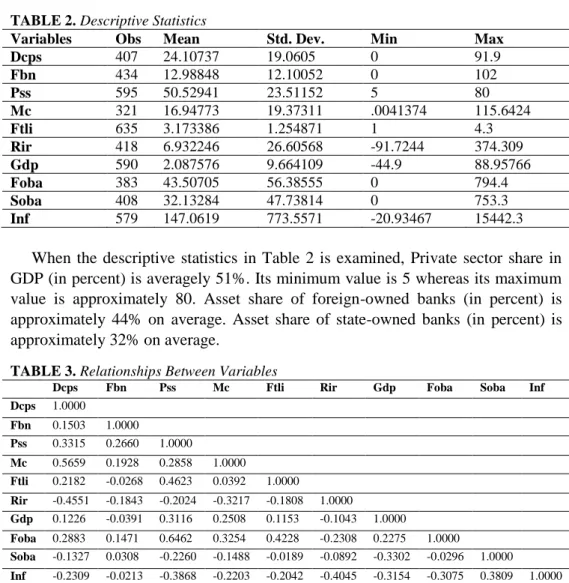
Dcps 407 24.10737 19.0605 0 91.9 Fbn 434 12.98848 12.10052 0 102 Pss 595 50.52941 23.51152 5 80 Mc 321 16.94773 19.37311 .0041374 115.6424 Ftli 635 3.173386 1.254871 1 4.3 Rir 418 6.932246 26.60568 -91.7244 374.309 Gdp 590 2.087576 9.664109 -44.9 88.95766 Foba 383 43.50705 56.38555 0 794.4 Soba 408 32.13284 47.73814 0 753.3 Inf 579 147.0619 773.5571 -20.93467 15442.3
When the descriptive statistics in Table 2 is examined, Private sector share in GDP (in percent) is averagely 51%. Its minimum value is 5 whereas its maximum value is approximately 80. Asset share of foreign-owned banks (in percent) is approximately 44% on average. Asset share of state-owned banks (in percent) is approximately 32% on average.
TABLE 3. Relationships Between Variables
Dcps Fbn Pss Mc Ftli Rir Gdp Foba Soba Inf
Dcps 1.0000 Fbn 0.1503 1.0000 Pss 0.3315 0.2660 1.0000 Mc 0.5659 0.1928 0.2858 1.0000 Ftli 0.2182 -0.0268 0.4623 0.0392 1.0000 Rir -0.4551 -0.1843 -0.2024 -0.3217 -0.1808 1.0000 Gdp 0.1226 -0.0391 0.3116 0.2508 0.1153 -0.1043 1.0000 Foba 0.2883 0.1471 0.6462 0.3254 0.4228 -0.2308 0.2275 1.0000 Soba -0.1327 0.0308 -0.2260 -0.1488 -0.0189 -0.0892 -0.3302 -0.0296 1.0000 Inf -0.2309 -0.0213 -0.3868 -0.2203 -0.2042 -0.4045 -0.3154 -0.3075 0.3809 1.0000
There is a correlation matrix about the variables of Table 3. There is a positive relationship at the level of 0.2883 between Asset share of foreign-owned banks (in percent) variable and Domestic credit to private sector (in percent of GDP) variable. There is a negative relationship at the level of 0.1327 between Asset share of state-owned banks (in percent) variable and Domestic credit to private sector (in percent of GDP) variable. There is a positive relationship at the level of 0.1503
between number of foreign banks variable and Domestic credit to private sector (in percent of GDP) variable.
TABLE 4. All Sample Countries in Transition Economies Regression Results
Depent Variable: Dcps Model I Model II
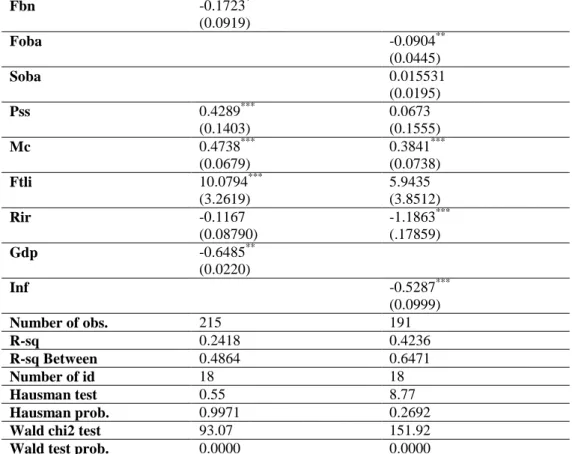
Fbn -0.1723* (0.0919) Foba -0.0904** (0.0445) Soba 0.015531 (0.0195) Pss 0.4289*** (0.1403) 0.0673 (0.1555) Mc 0.4738*** (0.0679) 0.3841*** (0.0738) Ftli 10.0794*** (3.2619) 5.9435 (3.8512) Rir -0.1167 (0.08790) -1.1863*** (.17859) Gdp -0.6485** (0.0220) Inf -0.5287*** (0.0999) Number of obs. 215 191 R-sq 0.2418 0.4236 R-sq Between 0.4864 0.6471 Number of id 18 18 Hausman test 0.55 8.77 Hausman prob. 0.9971 0.2692
Wald chi2 test 93.07 151.92
Wald test prob. 0.0000 0.0000
Notes: The values between parentheses indicate the standard errors.
*: Meaningful at level of %10, **: Meaningful at the level of %5, ***: Meaningful at the
level of %1
Table 4 demonstrates the results of panel data studies applied to all transition economy samples. Domestic credit to private sector (in percent of GDP) (dcps) is used for dependent variable in the study. 2 regression models are tested in total.
Since Hausman statistic is p 0.05 in all the models, random effect model is
preferred and analyzed. In the first model a strong negative relationship between number of foreign banks and private sector credit access statistically at the level of 10% is determined. Gormley (2010) has determined a negative and statistically significant relationship between number of foreign banks and credit access and the findings of our study reinforce this study.
In the first model, a positive relationship at the level of 1% is found between Private sector share in GDP (in percent) and Domestic credit to private sector (in percent of GDP) is found.
In both models, a positive and statistically significant relationship at the level of 1% is determined between Market capitalization of listed companies (% of GDP) and Domestic credit to private sector (in percent of GDP). The study conducted by Cottarelli, ao, (2005) is such as to support this finding of our study.
In the first model, it is determined that there is a statistically positive relationship at the level of 1% between EBRD index of forex and liberalization variable and Domestic credit to private sector (in percent of GDP) variable.
Journal of Economics and Political Economy
jepe, 1(1), N. Baltacı et al. p.39-48.
47
Real interest rate (%) variable is found negative and statistically significant at
the level of 1% in the 2nd model. A negative and statistically significant
relationship at the level of 5% is found between GDP growth (annual %) variable and Domestic credit to private sector (in percent of GDP) variable. Moreover, Haas and Lelyeveld have obtained results which are on the same direction.
Moreover, Haas and Lelyeveld (2006) have obtained results in the same direction in their study with our findings. Inflation, GDP deflator (annual %) variables are
found negative and statistically significantat the level of 1% in the 2nd model.
In the second model Asset share of foreign-owned banks (in percent) is found negative and however statistically significant at the level of 5%. A positive and statistically significant relationship is determined between foreign bank existence share and credit accessibility is determined in study of Maurer (2008) and the findings of our study are such as to support this.
6. Conclusion
Transition economies have completed the most of the partial transition process with the performance they have displayed in the last fifteen years and operated the institutions of the free market economy successfully. It is expected that foreign banks that enter these counties will ease the credit accessibility in the country by bringing foreign capital to these countries. However, firms being transparent or opaque make it difficult for these firms to get credit from the foreign banks which have entered the market recently. Model findings of our study are such as that the existence of foreign banks in transition economies affects the credit accessibility negatively. This result offers us proofs which displays that the firms in these countries are not transparent. Foreign banks prefer the firms to be transparent while giving credit to these firms. With regard to risk management, foreign banks show tendency to work with firms which are especially transparent and which are their own customers.
As a result, transition economy countries attracted attention of the foreign banks and will continue to attract their attention. When the existence share of foreign banks numerically and in the banking sector is examined, it is observed that foreign banks make the credit accessibility of the firms more difficult.
References
Acheampong, N. K. (2013). The effects of foreign bank entry on financial performance of domestic-owned banks in Ghana. International Journal of Business & Finance Research, 7(3), 93-104.
Afşar, M. (2004). Doğrudan yabancı yatırımlar ve bankacılık sektörü, Ege Academic Review, 4(1), 85-101.
Aktaş, H., & Kargın, M. (2007). Türk bankacılık sektöründeki yabancı ve ulusal bankaların finansal oranlar açısından karşılaştırılması, Yönetim ve Ekonomi, 14(2), 31-45.
Ataman Erdönmez, P. (2004). Finansal krizler sonrası gelişmekte olan ülkelerde yabancı bankalar, T.B.B, Bankacılık ve Araştırma Grubu, Bankacılar Dergisi, 51, 21-36. Clarke, G. R., Cull, R., Martinez Peria, M., & Sanchez, S. M. (2002). Foreign bank entry:
Experience, implications for developing countries, and agenda for further research.
World Bank Policy Research Paper, No: 2698.
Clarke, G. R., Cull, R., & Martínez Pería, M. S. (2006). Foreign bank participation and access to credit across firms in developing countries. Journal of Comparative Economics, 34(4), 774-795. (doi:10.1016/j.jce.2006.08.001).
Çakar, V. (2003). Yabancı sermayeli banka girişleri ve ulusal bankacılık sektörleri üzerindeki etkileri, TCMB Bankacılık ve Finansal Kuruluşlar Genel Müdürlüğü Uzmanlık Tezi, Ankara.
Detragiache, E., Tressel, T., & Gupta, P. (2008). Foreign banks in poor countries: Theory and evidence, The Journal of Finance, 63(5), 2123-2160. (10.1111/j.1540-6261.2008.01392.x).
Etokova, O. (2006). Case study foreign capital entry to banking systems of economies in transition: Prospects for Ukraine. International Research Journal of Finance and Economics, 6, 66-72.
Haber, S., & Musacchio, A. (2012). Foreign entry and the Mexican banking system. 1997-2007, Economía, 13(1), 13-37.
Huat, M., Moccero, D. N., & Sosa Navarro, R. (2012). Foreign banks and credit volatility: The case of Latin American Countries. Review of International Economics, 20(5), 1017-1033. (10.1111/roie.12010).
Hassan, M. K., Sanchez, B., & Safa, M. F. (2013). Impact of financial liberalization and foreign bank entry on Islamic banking performance. International Journal of Islamic and Middle Eastern Finance and Management, 6(1), 7-42.
Havrylchyk, O. (2012). The effect of foreign bank presence on firm entry and exit in transition economies. Journal of Banking & Finance, 36(6), 1710-1721. (10.1016/j.jbankfin.2012.01.015).
Manlagñit, M. C. V. (2011). The Economic Effects of Foreign Bank Presence: Evidence From the Philippines, Journal of International Money and Finance, 30(6), 1180-1194. (doi:10.1016/j.jimonfin.2011.06.015).
Lin, H. (2011). Foreign bank entry and firms’ access to bank credit: Evidence from China.
Journal of Banking & Finance, 35(4), 1000-1010. (doi:10.1016/j.jbankfin.2010.09.015). Pomerleano, M. & Vojta, G. (2001). What do foreign banks do in emerging markets?:
An institutional study. The World Bank, International Monetary Fund and Brookings Institution, 3rd Annual Financial Marktes and Development Conference, New York, USA.
Turan, Z. (2010). Gelişmekte olan ülkelerde yabancı banka girişlerinin etkileri ve Türk bankacılık sektöründe yabancı payları. Cag University Journal of Social Sciences, 7(2), 87-104.
Türkiye Bankalar Birliği, Bankacılık ve Araştırma Grubu. (2005). Türkiye’de yabancı bankalar, TBB Bankacılar Dergisi, 52, 3–9. http://www.tbb.org.tr/tr/Banka_ve_ Sektor_Bilgileri/bbts.aspx
Yayla, M., Kaya, Y. T., & Ekmen, İ. (2005). Bankacılık sektörüne yabancı girişi: Küresel gelişmeler ve Türkiye. Bankacılık Düzenleme ve Denetleme Kurumu, ARD Çalışma Raporları, 2005/6.
Copyrights
Copyright for this article is retained by the author(s), with first publication rights granted to the journal. This is an open-access article distributed under the terms and conditions of the Creative Commons Attribution license (http://creativecommons.org/licenses/by-nc/4.0).