Nursing process documentation systems in clinical
routine — prerequisites and experiences
Elske Ammenwerth
a,1*, Ulrike Kutscha
b, Ansgar Kutscha
c,
Cornelia Mahler
b, Ronald Eichsta¨dter
d, Reinhold Haux
aaDepartment of Medical Informatics,Institute for Medical Biometry and Informatics,Uni6ersity Medical Center, Im Neuenheimer Feld400,69120Heidelberg,Germany
bDepartment of Dermatology,Uni6ersity Medical Center,69120Heidelberg,Germany cDepartment of Pediatrics,Uni6ersity Medical Center,69120Heidelberg,Germany dDepartment of Psychiatry,Uni6ersity Medical Center,69120Heidelberg,Germany
Abstract
Documentation of the nursing process is an important, but often neglected part of clinical documentation. Paper-based systems have been introduced to support nursing process documentation. Frequently, however, prob-lems, such as low quality and high writing efforts, are reported. However, it is still unclear if computer-based documentation systems can reduce these problems. At the Heidelberg University Medical Center, computer-based nursing process documentation projects began in 1998. A computer-based nursing documentation system has now been successfully introduced on four wards of three different departments, supporting all six phases of the nursing process. The introduction of the new documentation system was accompanied by systematic evaluations of prerequisites and consequences. In this paper, we present preliminary results of this evaluation, focusing on prerequisites of computer-based nursing process documentation. We will discuss in detail the creation and use of predefined nursing care plans as one important prerequisite for computer-based nursing documentation. We will also focus on acceptance issues and on organizational and technical issues. © 2001 Elsevier Science Ireland Ltd. All rights reserved.
Keywords:Nursing documentation; Nursing process; Evaluation study; Acceptance; Nursing care plan; ICNP
www.elsevier.com/locate/ijmedinf
1. Introduction
Nursing documentation is one important part of clinical documentation. A thorough nursing documentation is a precondition for good patient care and for efficient communi-cation and cooperation within the healthcare professional team [1,2].
* Corresponding author. Present address: University for Health Informatics and Technology Tyrol Innrain 98, 6020 Innsbruck, Austria. Tel.: +43-512-58-67-34809; fax: + 43-512-58-67-34850.
E-mail address: [email protected] (E. Ammen-werth).
1www.mit-hit.at
1386-5056/01/$ - see front matter © 2001 Elsevier Science Ireland Ltd. All rights reserved. PII: S 1 3 8 6 - 5 0 5 6 ( 0 1 ) 0 0 2 1 6 - 7
Nursing care is usually oriented toward the so-called nursing process. The nursing pro-cess provides a systematic methodology for nursing practice [3]. It consists of six phases: (1) assessment of relevant information; (2) definition of patient problems and resources; (3) derivation of nursing aims; (4) planning of nursing tasks; (5) execution and documenta-tion of these tasks; (6) evaluadocumenta-tion of nursing care and possibly redefinition of the care plan [4].
Paper-based systems have been introduced to support nursing process documentation. Frequently, however, high documentation ef-forts, low quality and limited acceptance of the nursing process [2,5 – 7] are reported.
There have been many attempts to support the nursing process using computer-based documentation systems. The aim is to reduce documentation efforts, to increase documen-tation quality and to allow reuse of data for nursing management and nursing research. But despite high investments, problems asso-ciated with computer-based documentation systems are reported, for example, an insuffi-cient reflection of the complexity of the nurs-ing process, a lack of a standardized nursnurs-ing terminology, computer-anxious users, fear of less individual care and too much control, high implementation and operation costs, and unclear benefits [8 – 14].
Yet, the actual effects of computer-based nursing documentation systems have hardly been systematically evaluated. Studies evalu-ating some effects of computer-based nursing information systems exist [13,15 – 22], how-ever only few concentrated on some phases of computer-based nursing process documenta-tion (mostly on care planning) [2,5,23 – 25].
Overall, it seems unclear which prerequi-sites and consequences these systems have. Consequently, the project ‘computer-based nursing process documentation’ was initiated at the Heidelberg University Medical Center
in 1998. A computer-based nursing process documentation system (‘PIK’) was selected and successfully introduced on four pilot wards in three departments (Department of Psychiatry: two wards; Department of Der-matology and Department of Pediatrics: one ward each). The introduction was followed by a long-term, systematic evaluation study of prerequisites and consequences of the com-puter-based documentation system.
Some results of our randomized evaluation study on the first pilot ward have already been published [26,27]. The evaluation of the other three wards is still under way.
The aim of this paper is to present first results concerning prerequisites of computer-based nursing process documentation sys-tems. Several general prerequisites, such as general motivation and involvement of the users, computer knowledge and attitudes, and general organizational issues, are well known [28 – 31] and are not specific to the area of the nursing process. In this paper, we will instead focus on specific prerequisites for nursing process documentation. We will dis-cuss the creation and use of predefined nurs-ing care plans as one important prerequisite for computer-based nursing documentation. We will also focus on acceptance issues and on organizational and technical issues.
2. Functionality of computer-based nursing process documentation systems
In this chapter, we present the typical func-tionality of a computer-based nursing process documentation system, based on the example of the documentation system PIK (‘Pflegein-formations-und Kommunikationssystem’ — ‘Nursing information and communication system’) used in Heidelberg. The aim of these documentation systems is to support all six phases of the nursing process. A detailed
description of the nursing documentation sys-tem PIK can be found in [32].
Nursing anamnesis is usually supported by the ability to define and use individual forms (for example, for social anamnesis), contain-ing structured and unstructured information. Based on the information gathered in the anamnesis, a nursing care plan for an individ-ual patient can then be created. To support this, typical nursing problems, aims and tasks can be predefined and selected during cre-ation of the care plan. Typical combincre-ations of problems, aims and tasks can even be combined in predefined nursing care plans.
Later, during care planning, these pre-defined items and standards can be selected and adapted to the patients individual needs by adding or removing certain items. This makes care planning much easier and more efficient than conventionally possible.
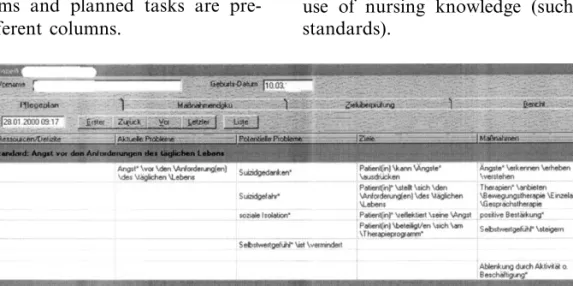
Fig. 1 presents a typical computer-based care plan for a patient: (recent and potential) problems, aims and planned tasks are pre-sented in different columns.
Based on this care plan, nursing tasks are executed and documented, usually using a time axis within the documentation form. The system allows the documentation of planned tasks or other tasks along with infor-mation of special observations or occurrences.
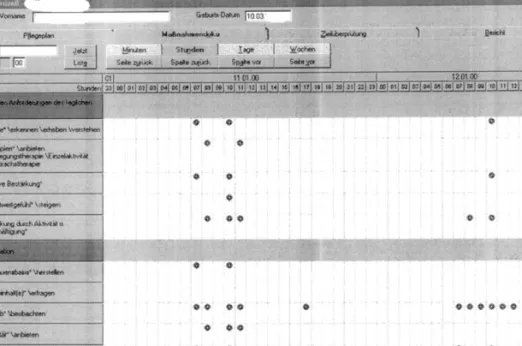
In Fig. 2, an example for the documenta-tion of planned tasks is presented.
In addition, nursing aims can be planned, checked and documented. The procedure is nearly identical to that of task documenta-tion. Finally, nursing reports can be written, usually containing free text. Individual nurs-ing reports may be highlighted for other health care professionals.
The functionality described above covers the six phases of the nursing care process. Usually, in addition, computer-based docu-mentation systems offer functions for ward management (for example, patient ment and use of general forms), for manage-ment of the predefined care plans, and for the use of nursing knowledge (such as nursing standards).
Fig. 1. A typical computer-based care plan for a patient. Two predefined care plans have been used. The columns 1 – 5 contain resources, recent problems, potential problems, aims and planned tasks. All screenshots are taken from the documentation system PIK.
Fig. 2. Typical documentation of planned or other tasks in a computer-based documentation system. The first column presents the list of planned tasks. The time axis is scalable (minutes, hours, days or weeks).
3. Prerequisite: standardization issues
An essential precondition for the introduc-tion of computer-based nursing process docu-mentation is the predefinition of items (nursing problems, aims and tasks) and of predefined nursing care plans (as a combina-tion of problems, aims and tasks). All docu-mentation can then be done based on those catalogues.
The use of predefined care plans is seen to have several advantages [5,8,33]: First of all, using predefined care plans, makes care plan-ning easier and more efficient, by extremely reducing documentation efforts and termino-logical difficulties during care planning. Sec-ondly, those predefined care plans can make nursing more transparent, reproducible and comparable. They can thus be seen as one step towards quality management in nursing. Thirdly, predefined care plans support learn-ing and exchange of knowledge within the
nursing team. Fourthly, as documentation becomes more complete, fewer items are for-gotten, and the question ‘what do nurses do’ is easier to answer. Last of all, using pre-defined care plans supports the understand-ing and implementation of the nursunderstand-ing care process and is therefore of extreme help to nursing education. It should be mentioned that most of these advantages are not specific to computer-based documentation, but also result from conventional documentation based on predefined care plans.
In the next paragraphs, we will discuss structure, content, creation and usage of pre-defined care plans during computer-based documentation.
3.1. Structure
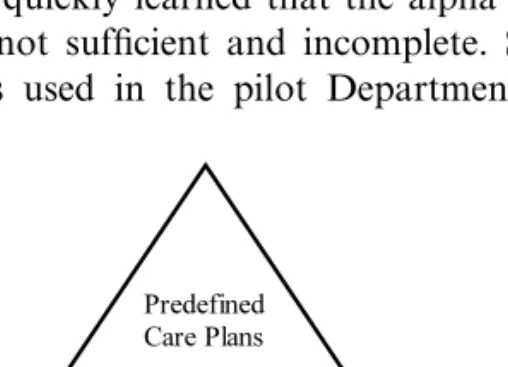
Predefined nursing care plans are usually based on items (such as problems, aims and tasks), which themselves are based on a nurs-ing terminology (Fig. 3).
Predefined care plans are mostly specific to a nursing field (for example, surgery or psy-chiatry). Nursing items may be field-depen-dent, but may also be used in more than one field (for example, ‘decubitus’ as a nursing problem). Nursing terminology should be universally valid to enable exchange, analysis and comparisons of items and care plans.
A universal nursing terminology which is just being developed is the ICNP (Interna-tional Classification of Nursing Practice). The aim of the ICNP is to establish a common language for describing nursing practice, to describe nursing care, and to enable compari-son of nursing data across clinical popula-tions, settings, geographic areas and time [34 – 37].
When creating nursing care plans, the ICNP can be used in two areas: First, it can be seen as the nursing terminology used to build nursing items and predefined care plans. Second, it can be used for indexing nursing items and care plans as a basis for nursing data analysis (both for nursing re-search and management).
In 1998, we started using the alpha version of ICNP as a basis for nursing items and care plans but quickly learned that the alpha ver-sion was not sufficient and incomplete. Sev-eral terms used in the pilot Department of
Dermatology could not be matched to ICNP terms. Nevertheless, the relevance of a com-mon nursing terminology is well known. Therefore, we are just starting a similar pro-ject, now using the recent beta-version of the ICNP.
3.2. Content
The content of predefined nursing care plans can be oriented towards different aims: they may represent typical medical diagnosis (for example, HIV), or nursing diagnosis (for example, itching), but also, they may repre-sent typical sequences of tasks (for example, tasks during patient admission, pneumonia prophylaxis, or the monitoring of suicide patient).
By reviewing the content, we could observe a typical development on our somatic wards. We observed that the first nursing care plans were either based on medical diagnosis or were task oriented. However, after some time, the wards learned that certain nursing problems reappeared in various care plans (such as itching in dermatological care plans). This motivated them to reformulate the pre-defined care plans which now are more based on nursing diagnosis.
In contrast, the care plans used by the psychiatric wards have been oriented toward nursing diagnosis all along. The reason may be that nursing process documentation has been established fore some years, in contrast to the somatic departments.
We learned that the wards tended to start with rather long predefined care plans. After some experience, they began splitting them into smaller parts (for example, containing no more than 20 items).
Another observation we made was that each department began with self-formulated nursing care plans. After several months of working with these plans, the pilot wards are
Fig. 3. Creation of predefined nursing care plans based on nursing items and nursing terminology.
Table 1
Number of predefined nursing items and predefined nursing care plans in the three departments before (first date) and after (second date) introduction of a computer-based nursing documentation system
Department Department of Dermatology Department of Pediatrics Department of Psychiatry December 00 October 00 December 00
Date October 00 September 98 December 00
13 6 – Predefine 0 – 18 resources 110 174 223 Predefined 242 – 436 problems 69 72 136 Predefined 111 – 201 aims 124 183 271 Predefined 260 – 293 tasks Predefined 12 20 23 30 36 55 care plans
The number of items for September 98 is not available.
now considering to establish ‘general’ hospi-tal-wide care plans which are to be valid for every department. Examples are pneumonia prophylaxis or patient mobilization, nursing activities which are relevant in each of the pilot departments. Obviously, there are some overlaps in care plans which can and should be standardized to ease the maintenance of the predefined care plans.
3.3. Creation
Before the introduction of a computer-based nursing documentation system, a cer-tain amount of nursing items (problems, aims, tasks) and predefined nursing care plans must be prepared.
Table 1 presents the number of items and care plans on our four wards during the beginning of the projects and again in De-cember 2000. The numbers indicate that the items and catalogues must be maintained reg-ularly, adapted and extended as the ward becomes more and more accustomed to com-puter-based documentation.
Our experiences show that the preparation of the items and care plans take several months for a department, depending on the amount of information which can be reused from other wards. This effort will certainly be partly reduced in the next years, when a common nursing terminology (for example, ICNP) is available to cover a certain part of the catalogues. In addition, as more and more departments begin developing pre-defined care plans and nursing items, this information can be reused, most probably reducing the required preparation time.
3.4. Usage
A documentation system must be well inte-grated into the clinical workflow in order to be of use. Predefined care plans are an impor-tant issue in this context. In this paragraph, we will shortly describe how the documenta-tion system and the predefined care plans can typically be used.
The patient admission is based on a task-oriented admission standard, using a pre-defined form for nursing anamnesis. Based
on this information, the responsible nurse creates the first care plan for the patient. After selecting adequate care plans, they are adapted to the individual needs. Mostly, items are removed (for example, problems which do not apply). Sometimes, items are added (such as individual patient resources). Obviously, it is much easier to find a list of possible problems than to find a list of possi-ble individual resources. There are too many possible patient resources to list them all. Thus, a nurse using a predefined care plan must be motivated to add individual patient resources, and to eliminate the problems (and aims and tasks) which do not apply.
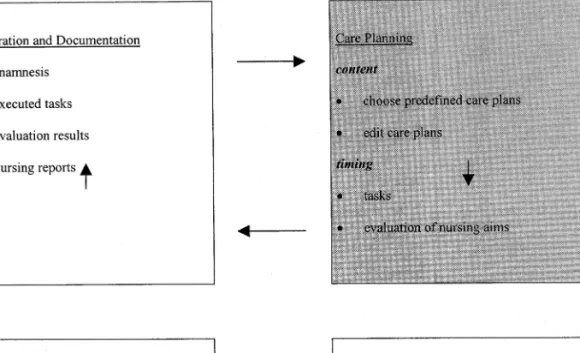
The description shows that the use of pre-defined care plans integrate the steps 2 – 4 of the nursing process (definition of problems and patient resources; derivation of nursing aims; planning of nursing tasks) into one care planning step, i.e. choosing and editing a
patient-related care plan. This procedure seems to simplify care planning and improves the nursing attitude towards the nursing process.
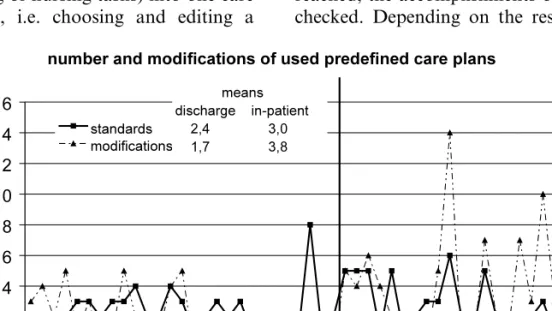
On our four pilot wards, we observed that the amount of changes to the predefined care plans grew the more familiar the nurses be-came with the computer-based documenta-tion system. Fig. 4 shows some statistics for one ward.
After care planning, the execution of planned tasks can be scheduled, if necessary. After executing the tasks, they can be docu-mented and information and observations may be added. This documentation is carried out a multiple number of times during each shift.
The evaluation of planned aims is also scheduled. When the planned dates are reached, the accomplishments of the aims are checked. Depending on the results, the care
Fig. 4. Number of predefined care plans and amount of modifications of the care plans of 58 patients, treated between December 08, 1999 and January 17, 2000 on one pilot ward. Date of analysis was January 17, 2000. Patients are divided into two groups: ‘discharge group’ with 27 patients already discharged, and ‘in-patient group’ with patients still in treatment at the time of analysis. Individual numbers and mean numbers for each group are presented. The figures indicate that, after becoming more familiar with the documentation system, the nurses use more predefined care plans and modify them more often.
Fig. 5. Use of predefined care plans as a part of the integrated step ‘care planning’ (in gray) within the nursing process.
plan must be modified by removing or adding items.
A nursing reports is written as least at the end of each shift, usually in the form of free text.
When the patient is dismissed, the whole nursing documentation is added either to the electronic patients records’ archive, or printed out and added to the paper-based record.
Fig. 5 presents a summary of the typical use of predefined care plans.
4. Prerequisite: acceptance issues
An important prerequisite for the introduc-tion of any new computer-based system is user motivation and also, some general as-pects such as computer anxiety and attitudes toward computers. Much research has been conducted dealing with this issues [38 – 42].
In this chapter, we will concentrate on the aspects specific to the introduction of nursing process documentation systems. We will in-clude the topics of acceptance of the nursing process as a guideline for nursing care, as well as the acceptance of the use of comput-ers in nursing which is an issue as computcomput-ers are said to endanger the individuality of nurs-ing care.
4.1. Acceptance of the nursing process
It has been questioned how the acceptance of the nursing process influences the success of computer-based nursing process documen-tation support. However, the relationship be-tween the acceptance of the nursing process and successful introduction of computer-based nursing process documentation system seems to be double-sided. On the one side, nurses, who do not accept the nursing pro-cess as the basis for systematic nursing care,
will not be motivated to use computers since, to them, they seem to increase the documen-tation effort. On the other side, the realiza-tion of the nursing process is difficult when its documentation is done manually, as docu-mentation efforts and formulation problems will be high.
We analyzed the acceptance of the nursing process before, during and after the introduc-tion of the computer-based nursing process documentation system in order to answer the following two questions:
How does the acceptance of the nursing process change when computer-support is introduced?
Is the acceptance of the nursing process a success factor for the introduction of computer-based nursing documentation? It is important to be aware of the fact that on wards A and B the nursing care process had been established for several years. In contrast, on ward C and D only planning and documentation of tasks have been documented; care planning or regular achievement reviews of nursing aims were not conducted prior to the intro-duction of computer-support. To answer our questions, we use a standardized, vali-dated questionnaire [43] before, during and after the introduction of computer-sup-port.
Based on the 18 items of the question-naire, a mean acceptance score for each nurse was calculated (1=minimum, 4= maximum acceptance). The following are the results prior to the introduction of com-puter support (mean and standard deviation are presented):
Ward A: 2.790.4 (n=11) Ward B: 3.490.3 (n=9) Ward C: 2.890.4 (n=10) Ward D: 3.090.4 (n=11).
The figures show that the acceptance of the nursing process is quite high despite the
different implementation of the nursing pro-cess on the four wards. When data from both during and after introduction is avail-able, we will test if there is a significant change in the acceptance scores. Preliminary results from wards A and B indicate a sig-nificant increase. The data from wards C and D will be used to complete this analy-sis.
In seems useful to precede the introduc-tion of computer-based nursing process doc-umentation by such an evaluation of users’ acceptance. If low acceptance scores are found, training courses for the nursing pro-cess should be offered. Without a general acceptance of the nursing process (as found on our four pilot wards), the introduction of computer-support may not be successful, as their functionality will not be used or will be found useless and burdensome.
When looking at the responses in detail, we can see that most nurses are in favor of the idea of the nursing process and want to use it, but that the majority thinks it takes too much time and causes too much writing effort. With these details in mind, it is clear that the acceptance scores tend to rise when a computer-based system is introduced, as the writing efforts and formulation prob-lems will be reduced.
To analyze the importance of this accep-tance score as a success factor, we corre-lated the acceptance of the nursing process with the overall acceptance of the com-puter-based documentation system after 1 year of use. Preliminary results from wards A and B indicate that the acceptance of the nursing process prior to the study is posi-tively correlated to the acceptance of the computer-based system following 1 year of use. This indicates that the acceptance of the nursing process may be a one factor relevant for a successful introduction.
4.2. Acceptance of computers in nursing Some discussion has arisen over the fear that computers endanger individual patient care, reduce the time nurses have for patients, and reduce the professional autonomy of the nurses. We analyzed the acceptance of com-puters in nursing before, during and after the introduction of the computer-based nursing process documentation system in order to answer the following questions:
How does the acceptance of computers in nursing change when a computer-support is introduced?
Is the acceptance of computers in nursing a success factor for the introduction of computer-based nursing documentation? To answer our questions, we use a stan-dardized and validated questionnaire [44] be-fore, during, and after the introduction of computer-support. Based on the 18 items of the questionnaire, a mean acceptance score for each nurse was calculated (1=minimum, 4=maximum acceptance). The following are the results before computer-support was in-troduced (mean and standard deviation are presented):
Ward A: 2.690.6 (n=11) Ward B: 3.090.5 (n=9) Ward C: 2.590.6 (n=10) Ward D: 3.090.4 (n=11).
The figures show that the acceptance is quite high. Preliminary results from wards A and B indicate that these acceptance scores did not change during or after introduction. The data from ward C and D will be used to complete this analysis.
To analyze the importance of the accep-tance scores as a possible success factor, we correlated it with the overall acceptance of the computer-based documentation system after 1 year of use. Preliminary results from wards A and B indicate, that the acceptance of computers in nursing before the study is
not correlated to the acceptance of the com-puter-based system after some time of use.
5. Prerequisite: organizational issues
As much research is being conducted in the field of organizational issues [28,30], we will concentrate on organizational issues specific to the introduction of computer-based nurs-ing process documentation in this chapter.
It seems to be helpful to select those wards as pilot wards in which the nursing process is at least partly accepted. The aims of the introduction of computer-support should be made clear. Typical aims are, for example: increase the number of documented tasks as a basis for nursing management, increase the quality of documentation as a basis for qual-ity management, reduce documentation ef-forts for the nurses themselves, increase reusability of documented data for nursing research, or improve communication within the healthcare professional team. These aims may require different project organization, as well as different functionality and specific preparation of nursing terminology and pre-defined care plans. To avoid aim conflicts, the aims should be discussed and clearly defined beforehand.
After the aims are clear and wards have been selected, it should not be forgotten to inform and include the non-nursing profes-sionals such as physicians or psychologists. These professionals at least temporarily use nursing documentation as a source of infor-mation. It should therefore be decided whether they receive online access to com-puter-based nursing documentation or whether parts of the documentation will be communicated in other forms.
The usual documentation processes should also be examined and analyzed with regard to computer support. When and where is what
documented by whom? Is computer support feasible? Must working processes be changed when computer support is introduced? Can, for example, working lists be generated and applied? Is nursing documentation needed during physician rounds? In addition, it must be defined what happens with the data after the patient has been discharged. In hospitals still using a conventional patient record, all relevant information should be printed out and placed into this record. In other hospitals, nursing documentation should be transferred to the electronic record archive.
The introduction of computer-based nurs-ing process documentation can be organized in different steps. The following presents a possible order of steps that can be defined (steps may be left out as required by a ward’s preconditions): First, care plans are created and printed with the help of the computer system. During the second step, care plans are maintained within the documentation sys-tem, and no printing is required in this step. The third step involves the documentation of tasks and report writing by the computer system. Within the fourth step, nursing anamnesis is carried out using computer sup-port. Finally, during the fifth step, the evalu-ation of nursing aims is conducted using computer support.
These steps may be refined, for example, to effecting an increasing number of patients. This solution allows a slow adoption of the nursing process. It is obvious that the differ-ent steps must be defined and planned before-hand and the realization be monitored carefully to ensure success.
It is helpful to have a qualified project member to accompany the introduction of each step of the nursing process. This enables to quickly realise whether the staff needs further training regarding steps of the nursing
process and will finally help improve the quality of nursing documentation.
6. Prerequisite: technical issues
The technical equipment necessary to in-troduce computer-based nursing process doc-umentation on a ward must be carefully defined beforehand. The required equipment depends on the number of patients and nurses, but also on the documentation and working processes. For example, a ward us-ing nursus-ing process documentation only in the ward room may be sufficiently equipped with two or three computer systems. In con-trast, if nursing documentation is used during doctors’ rounds or even by the nurses inside the patients rooms, either bedside terminals or mobile computers should be considered to avoid double documentation, data losses and user frustration. In addition to those comput-ers, other health care professionals must also be able to access this new computer-based documentation, thus the function ‘nursing documentation’ must also be integrated in the Health Care Professional Workstation [45] of the non-nursing professionals.
The nursing documentation system must also be carefully integrated into the hospital information system [46]. To achieve data in-tegration and to enable exchange of adminis-trative patient data, the software should be interfaced with the patient management sys-tem. After patient discharge, the nursing doc-umentation should be transferred to the electronic or conventional patient record.
Finally, it is useful if special nursing knowledge (for example, about the prepara-tion and execuprepara-tion of nursing tasks or about some nursing diagnosis) can be connected to the information inside the computer-based documentation system, using for example web-based knowledge resources.
7. Discussion
In this paper, we presented some specific prerequisites for the introduction of com-puter-based nursing process documentation systems. We presented standardization as-pects of nursing terminology, users accep-tance of the nursing process and of computers in nursing, and also some organi-zational and technical issues. We concen-trated on aspects and experiences specific to nursing process documentation.
In our opinion, a high acceptance of the nursing process, a careful preparation of pre-defined care plans (at least partly based on standardized vocabulary), together with ele-mentary measures such as organizational preparation, good project management, in-clusion of future users in the preparation process, and sufficient technical equipment with integration into the hospital information system are important preconditions for the success of computer-based nursing process documentation. This confirms the results of other studies [47]. In addition, the nursing terminology and the nursing care plans must be regularly maintained and updated, taking into account the development of skills and experiences of the users.
On our pilot wards, a nursing documenta-tion system has been successfully introduced, despite the different preconditions (for exam-ple, with regard to the previous implementa-tion of the nursing process). The user acceptance is high. The results indicate that awareness and understanding of the nursing process increased on the pilot wards after the introduction of computer assistance. Com-puter-support of the nursing process can therefore be regarded as one element of a strategy to integrate the nursing process into the daily nursing routine.
The analysis of the success factors can be refined when 1 year of experience is available
for all four wards. We will then also be able to present detailed results concerning the ef-fects of computer-support on quantity and quality of documentation, on working pro-cesses, and on user acceptance.
It can be discussed if our results are trans-ferable to other wards and other depart-ments. We deliberately chose two psychiatric and two (very different) somatic departments in order to obtain a broad view of the topic. Despite many differences among the wards, the results and the experiences are very simi-lar. Nevertheless, this assumption should still be verified in other surroundings.
Acknowledgements
Such a long-term project is not possible without the help of many people. We wish to thank Friedrich Fellhauer, Torsten Happek, Bettina Hoppe, Marianne Kandert, Gisela Luther, Angelika Tautz and Andreas Wagner for their cooperation.
References
[1] B. Davis, J. Billings, R. Ryland, Evaluation of nursing process documentation, J. Adv. Nurs. 19 (5) (1994) 960 – 968.
[2] S. Sahlstedt, H. Adolfsson, M. Ehnfors, B. Ka¨ll-stro¨m, Nursing process documentation — effects on workload and quality when using a computer program and a key word model for nursing docu-mentation, in: U. Gerdin, M. Tallberg, P. Wain-wright (Eds.), Nursing Informatics — The Impact of Nursing Knowledge on Health Care Informat-ics, IOS Press, Amsterdam, 1997, pp. 330 – 336. [3] E. Lindsey, G. Hartrick, Health-promoting
nurs-ing practice: the demise of the nursnurs-ing process?, J. Adv. Nurs. 23 (1) (1996) 106 – 112.
[4] V. Fiechter, M. Meier, Pflegeplanung-Eine An-leitung fu¨r die Praxis (Nursing care planning — a practical introduction), Recom, Basel, 1993. [5] P. Hanisch, S. Honan, R. Torkelson, Quality
implementing practical computerized standards, J. Healthc. Qual. 15 (5) (1993) 6 – 12.
[6] M. Peterson, Time and the nursing process, Holist. Nurs. Pract. 1 (3) (1987) 72 – 80.
[7] C. Varcoe, Disparagement of the nursing process: the new dogma?, J. Adv. Nurs. 23 (1) (1996) 120 – 125.
[8] J. Allan, J. Englebright, Patient-centered docu-mentation — an effective and efficient use of clini-cal information systems, JONA 30 (2) (2000) 90 – 95.
[9] A. Bu¨ssing, B. Herbig, Recent developments of care information systems in Germany, Comput. Nurs. 16 (6) (1998) 307 – 310.
[10] W. Goossen, P. Epping, T. Dassen, A. Hasman, W. van den Heuvel, Can we solve current prob-lems with nursing information systems?, Comput. Methods Programs Biomed. 54 (1 – 2) (1997) 85 – 91.
[11] W. Goossen, P. Epping, T. Dassen, Criteria for nursing information systems as a component of the electronic patient record: an International Del-phi study, Comput. Nurs. 15 (6) (1997) 307 – 315. [12] B. Harris, Becoming de-professionalized: one as-pect of the staff nurse’s persas-pective on computer mediated nursing care plans, Adv. Nurs. Sci. 13 (2) (1990) 63 – 74.
[13] D. Hinson, S. Huether, J. Blaufuss, M. Neiswanger, A. Tinker, K. Meyer, R. Jensen, Measuring the impact of a clinical nursing infor-mation system on one nursing unit, in: Proceed-ings of the AMIA Annual Fall Symposium, Mc Graw-Hill, New York, 1994, pp. 203 – 210. http://www.nih.gov/ninr/vol4/Preface.html[14]NCNR.
Report of Priority Expert Panel E: Nursing Infor-matics, NCNR (National Center for Nursing Re-search), , Last access: July 2000.
[15] T. Bu¨rkle, R. Kuch, H. Prokosch, J. Dudeck, Stepwise evaluation of information systems in an university hospital, Meth. Inform. Med. 38 (1) (1999) 9 – 15.
[16] F. Eurlings, A. van Asten, H. Cozijn, K. Klaassen, R. Stokman, R. van Valkenburg, E. van Gennip, Effects of a nursing information system in 5 dutch hospitals, in: U. Gerdin, M. Tallberg, P. Wainwright (Eds.), Nursing Informatics — The Impact of Nursing Knowledge on Health Care Informatics, IOS Press, Amsterdam, 1997, pp. 50 – 55.
[17] A. Lyness, M. Hravnak, D. Martich, Nurses’ per-ceptions of the impact of a computerized informa-tion system on a critical care unit, in: U. Gerding,
M. Tallberg, P. Wainwright (Eds.), Nursing Infor-matics — The Impact of Nursing Knowledge on Health Care Informatics, IOS Press, Amsterdam, 1997, pp. 463 – 468.
[18] C. Marasovic, C. Kenney, D. Elliott, D. Sind-husake, A comparison of nursing activities associ-ated with manual and automassoci-ated documentation in an Australian intensive care unit, Comput. Nurs. 15 (4) (1997) 205 – 211.
[19] D. Milholland, Information systems in critical care: a measure of their effectiveness, in: R. Greenes, H. Peterson, D. Protti (Eds.), Medinfo 95 — Proceedings of the Eight World Congress on Medical Informatics, North Holland, Amsterdam, 1995, pp. 395 – 399.
[20] R. Nahm, I. Poston, Measurement of the effects of an integrated, point-of-care computer system on quality of nursing documentation and patient satisfaction, Comput. Nurs. 18 (5) (2000) 220 – 229.
[21] C. Prophet, M. Krall, G. Budreau, T. Gibbs, K. Walker, J. Eyman, M. Hafner, Evaluation of on-line documentation, in: C. Chute (Ed.), Proceed-ings AMIA Annual Fall Symposium, Hanley & Belfus, Philadelphia, 1998, pp. 255 – 259.
[22] E. van Gennip, H. Kramer, C. Enning, C. Klaassen-Leil, R. Stokman, R. van Valkenburg, VISTA: study of effects of an integrated nursing information system in three dutch hospitals — setup and intermediate results, in: P. Barahona, M. Veloso, J. Bryant (Eds.), Medical Informatics Europe ’94, EFMI, Lissabon, 1994, pp. 333 – 338. [23] L. Keller, S. McDermott, A. Alt-White, Effects of computerized nurse care planning on selected health care effectiveness measures, in: Proceedings of the Annual Symposium on Computer Applica-tions and Medical Care, McGraw-Hill, New York, 1992, pp. 38 – 41.
[24] S. Minda, D. Brundage, Time differences in hand-written and computer documentation of nursing assessment, Comput. Nurs. 12 (6) (1994) 277 – 279. [25] C. Ruland, Decision support for patient prefer-ences-based care planning: effects on nursing care and patient outcome, J. Am. Med. Inform. Assoc. 6 (4) (1999) 304 – 312.
[26] E. Ammenwerth, R. Eichsta¨dter, R. Haux, U. Pohl, S. Rebel, S. Ziegler, A randomized evalua-tion of a computer-based nursing documentaevalua-tion systems, Meth. Inform. Med. 40 (2) (2001) 61 – 68. [27] E. Ammenwerth, R. Eichsta¨dter, L. Kochen-burger, U. Pohl, S. Rebel, R. Haux, Systematic evaluation of computer-based nursing
documenta-tion system, in: N. Victor, M. Blettner, L. Edler, et al. (Eds.), Medical Informatics, Biostatistics and Epidemiology for Efficient Health Care and Medi-cal Research — Contributions from the 44th An-nual Conference of the GMDS, Heidelberg, Urban und Vogel, Mu¨nchen, 1999, pp. 286 – 290. [28] J. Brender, Methodology for constructive
assess-ment of IT-based systems in an organisational context, Inf. J. Med. Inf. 56 (1999) 67 – 86. [29] N. Dewan, N. Lorenzi, Behavioral health
infor-mation systems: evaluating readiness and user ac-ceptance, MD Comput. 17 (4) (2000) 50 – 52. [30] N.M. Lorenzi, R.T. Riley, Managing change: an
overview, J. Am. Med. Inform. Assoc. 7 (1999) 116 – 124.
[31] M. van der Meijden, H. Tange, J. Biten, J. Troost, A. Hasman, The user in the design process of an EPR, in: A. Hasman, B. Blobel, J. Dudeck, et al. (Eds.), Medical Infobahn for Europe — Proceed-ings of MIE and GMDS 2000, IOS Press, Amster-dam, 2000, pp. 224 – 228.
[32] A. Bu¨ssing, B. Herbig, The challenges of a care information systems reflecting holistic nursing care, Comput. Nurs. 16 (6) (1998) 311 – 317. [33] C. Newton, A Decision Support Database for
Nurse Care Planning As Part of a Hospital Infor-mation System, in: R. Greenes, H. Peterson, D. Protti (Eds.), Medinfo 95 — Proceedings of the Eight World Congress on Medical Informatics, North Holland, Amsterdam, 1995, pp. 1394 – 1398. [34] ICN. Description of the ICNP, International Council of Nurses, http://www.icn.ch/ icnpup-date.htm, Last access: December 2000.
[35] D.J. Clark, The international classification for nursing practice: a progress report, in: U. Gerdin, M. Tallberg, P. Wainwright (Eds.), Nursing Infor-matics, IOS Press, Amsterdam, 1997, pp. 62 – 68. [36] G.H. Nielsen, R.A. Mortensen, The architecture
of ICNP: time for outcomes — part 1, Int. Nurs. Rev. 44 (6) (1997) 176, 182 – 188.
[37] G.H. Nielsen, R.A. Mortensen, The architecture of ICNP: time for outcomes — part 2, Int. Nurs. Rev. 45 (1) (1998) 27 – 31.
[38] S. Brown, R. Coney, Changes in physicians’ com-puter anxiety and attitudes related to clinical
in-formation system use, J. Am. Med. Inform. Assoc. 1 (5) (1994) 381 – 394.
[39] R. Jayasuriya, P. Caputi, Computer attitude and computer anxiety in nursing. Validation of an instrument using an Australian sample, Comput. Nurs. 14 (6) (1996) 340 – 345.
[40] M. Martin-Baranera, I. Planas, J. Palau, M. Mi-ralles, J.J. Sancho, F. Sanz, Assessing physician’s expectations and attitudes toward hospital infor-mation systems — the IMASIS experience, MD Comput. 16 (1) (1999) 73 – 76.
[41] J. Negron, The impact of computer anxiety and computer resistance on the use of computer tech-nology in nursing, J. Nurs. Staff Dev. 11 (3) (1995) 172 – 175.
[42] A. Sultana, Nurses attitudes towards computeriza-tion in a clinical practice, J. Adv. Nurs. 15 (1990) 696 – 702.
[43] G. Bowman, D. Thompson, T. Sutton, Nurses’ attitudes towards the nursing process, J. Adv. Nurs. 8 (2) (1983) 125 – 129.
[44] C. Lowry, Nurses’ attitudes toward computerised care plans in intensive care. Part 2, Nurs. Crit. Care 10 (1994) 2 – 11.
[45] M.J. Ball, J.S. Silva, J.V. Douglas, P. Degoulet, S. Kaihara, editors. International Journal of Biomedical Computing, Special Issue: The Health Care Professional Workstation — Proc. of a work-ing conference sponsored by the IMIA, Washwork-ing- Washing-ton, USA, 1994.
[46] E. Ammenwerth, R. Haux, P. Knaup, U. Pohl, Computer-based documentation systems and their integration into hospital information systems, in: M. Torres, J. Molero, Y. Kurihara, et al. (Eds.), Proceedings der World Multiconference on Sys-temics, Cybernetics and Informatics (SCI 2000), July 23 – 26, 2000, Orlando, Florida, USA, IIIS (International Institute of Informatics and Sys-temics), 2000, pp. 419 – 424.
[47] E. Opitz, T. Bu¨rkle, U. Schrader, Nursing infor-mation system in Germany and Europe, in: H.U. Prokosch, J. Dudeck (Eds.), Hospital Information Systems: Design and Development Characteristics, Elsevier, Amsterdam, 1995, pp. 153 – 172.