A Procedure for Formulation of Multi-Objective
Optimisation Problems in Complex Water Resources
Systems
W.R. Godoy a, A.F. Barton a, b and B.J.C. Perera a
a
School of Engineering and Science, Victoria University, Footscray, Victoria, Australia
b
Grampians Wimmera Mallee Water, Horsham, Victoria, Australia Email: [email protected]
The recently completed Wimmera Mallee Pipeline Project (WMPP) provides reticulated water to 36 towns and about 6000 farms across an area of approximately 2 million hectares in Western Victoria (Australia). This new pipeline has replaced an open channel distribution system and has vastly improved efficiencies in the supply of water, with water savings being returned to the environment, existing consumptive use and new development. One of the challenges for managers of these water recovery projects is to determine the most effective or optimal operational strategy to meet the needs of all water users. The study area supplies a subset of the Wimmera Mallee Pipeline and includes two separate river systems, namely the Glenelg River and the MacKenzie River which flow South-ward and North-ward from the Great Dividing Range respectively. Both river systems have their own unique environmental and socio-economic attributes which are indicative of those relating to the broader Wimmera-Mallee Water Supply System.
In Victoria, these often conflicting interests to water have traditionally been addressed through a consultative process supported by surface water simulation modelling. Simulation models attempt to represent all the major characteristics of a system and are therefore tailored to examine “what if?” scenarios. Whilst such models are highly effective in demonstrating the effect of changes in system operation, the modelling process is limited to finding one solution at a time for a given set of conditions. Moreover, such traditional approaches have been challenged by the need to develop sustainable water management plans which attempt to meet the need of all users by searching for the optimal operating rules. Optimisation models have also proven to be effective tools but unlike simulation models are characterised by a numeric search technique and are better suited to address “what should be?” questions. However, the lack of popularity in optimisation models has been due to the complexity in their development, computational effort, and subsequently the simplification in problem specification. In recent times there has been growing interest in linking optimisation techniques with simulation models in order to build on the strengths of both modelling approaches in the search for optimal solutions. The general structure of this combined modelling technique provides for an iterative process; simulation outputs are used to quantify the effect of candidate solutions which are in turn passed to the search engine to find optimal solutions.
The aim of this study is to develop a generalised procedure for the formulation of multi-objective optimisation problems relating to multi-reservoir systems with complex operating rules. Importantly the procedure has been developed for problems that are intended to be solved using a combined optimisation-simulation modelling technique. For the present study, the procedure will be used to formulate a sample multi-objective problem for the optimisation of operation of the study area. The procedure is applied in case study form, detailing the various components of the problem, both in mathematical terms and also the necessary qualitative information derived from stakeholder participation. The outcomes of this paper demonstrate:
• the importance of on-going stakeholder participation in providing higher level qualitative information as part of (a) the problem formulation process in order to explicitly account for all interests to water, and (b) the optimisation process in order to enable decision makers to make the necessary trade-offs between choosing one optimal solution over another; and
• the need to systematically identify the relevant system operating rules that control the movement of water within the simulation model.
1. INTRODUCTION
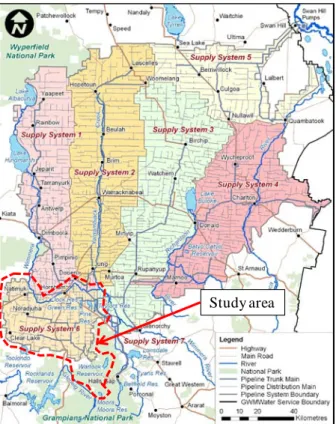
The Australian State of Victoria’s strategic planning processes for water resource management are heavily reliant on the results generated by surface water simulation modelling using the REALM (REsource and ALlocation Model) software package (Department of Sustainability and Environment, 2010). REALM is a generalised computer software package that simulates the harvesting and bulk distribution of water resources, usually at monthly times steps, within a water supply system (Perera et al., 2005). The Wimmera-Glenelg REALM model represents all the key attributes of the Wimmera-Mallee Water Supply System including the eleven headworks water storages and five diversion weirs located in and around the Grampians National Park which divert water from the Wimmera and Glenelg river systems for distribution via the Wimmera Mallee Pipeline. The study area (see Figure 1) supplies
a subset of the Wimmera Mallee Pipeline known as Supply System 6 (or SS6) and includes two separate river systems, namely the Glenelg River and the MacKenzie River which flow South-ward and North-ward from the Great Dividing Range respectively. Both river systems have their own unique environmental and socio-economic attributes which are indicative of the multi-objective problems relating to the broader system.
Optimisation models have also proven to be effective tools but unlike simulation models are characterised by a numeric search technique and are better suited to address “what should be?” questions. The lack of popularity in this method in the past has been due to complexity in development, computational requirements, and as a consequence problems under consideration are simplified. A general multi-objective optimisation problem consists of a number of objectives subject to a number of inequality and equality constraints. Mathematically, the problem may be written as follows (Srinivas and Deb, 1995):
Minimise/Maximise fi(x) i = 1,2,…, N
Subject to gj(x) ≤ 0 j = 1,2,…, J
hk(x) = 0 k = 1,2,…, K (1)
The parameter x is a p dimensional vector having p design or decision variables. The aim is to find a vector x that satisfies J inequality constraints, K equality constraints and minimises/maximises the N objective functions. Solutions to the above multi-objective problem are mathematically expressed in terms of superior or non-dominated points. This highlights the difficulty with multi-objective problems in that there is usually no single optimal solution with respect to all objectives, as improving performance for one objective means that the quality of another objective will decrease. Instead there is a set of optimal trade-offs between the conflicting objectives known as the Pareto-optimal solutions or the Pareto front (Deb, 2001).
Classical multi-objective optimisation methods combine multiple objectives into one overall single objective function, 𝑍. Perhaps the simplest of these is the method of objective weighting, which may be written as follows (Srinivas and Deb, 1995):
Minimise/Maximise, 𝑍 = � 𝑤𝑖 𝑁 𝑖=1
𝑓𝑖(𝑥) , where 0 ≤ 𝑤𝑖≤ 1 Note the sum of all weights wi equals 1 (2)
In this method the optimal solution is controlled by the weight vector 𝑤. As higher level qualitative information is required in order to set a preference for one objective over another, classical methods tend to be highly subjective to the particular user (Deb, 2001). Notwithstanding this potential deficiency, Godoy and Barton (2011) demonstrated that such an approach could be used to find trade-off solutions for the environment’s regulated and unregulated entitlement considering a range of climatic sequences.
Non-Figure 1. Wimmera-Mallee Water Supply System Study area
classical techniques can consider all objectives concurrently in a single run and are not affected by the dimensionality aspect of multi-objective problems. These methods are particularly useful for water resource management problems because they tend to find the entire set of Pareto-optimal solutions which may be used to inform a diverse and often conflicting group of stakeholders whose decisions depend on a number of different factors. In recent times there has been growing interest in using combined optimisation–simulation models given that multi-objective optimisation methods can be directly linked with simulation models without requiring simplifications in problem specification (Labadie, 2004, Mortazavi et al., 2009, and Dandy and Engelhardt, 2006).
The aim of this study is to develop a generalised procedure for the formulation of multi-objective optimisation problems relating to multi-reservoir systems with complex operating rules. This procedure provides a means for identifying each component of the problem using a systematic and objective approach. Importantly, the procedure has been developed for problems that are intended to be solved using the aforementioned combinatorial models. For the present study, the procedure will be used to formulate a sample multi-objective problem for the optimisation of operation of the study area. Whilst this study does not undertake the optimisation process, it is mindful of the broader objective to identify a wide range of alternative operating rules that in some way meet stakeholders’ objectives over a long-term planning horizon. For this study, it is assumed that the Wimmera-Glenelg REALM model will be used to simulate system behaviour and quantify the effect of the changes to the operating rules during the optimisation process. These operating rules are specified in the model as storage targets, storage releases, passing flows, and harvesting rules for every regulating structure within the study area. Hence each simulation run will feature a different combination of operating rules which will have a direct effect on the system’s performance over the long-term. This effect will be measured by way of the fitness values associated with each candidate solution to assess how well each set of operating rules combination satisfies the stated objective functions.
2. THE STUDY AREA
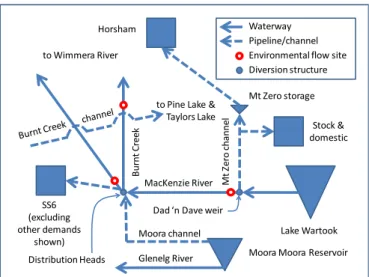
The study area features two major river systems, namely the Glenelg River and the MacKenzie River and their respective storages Moora Moora Reservoir and Lake Wartook (Figure 2). These storages control the harvest and release of water from these rivers and are operated conjunctively to meet the needs of SS6 of the Wimmera Mallee Pipeline. Moora Moora Reservoir is located at the headwaters of the Glenelg River and is used to divert water North-ward across the Great Dividing Range. It is operated as the primary source of supply to SS6 via the Distribution Heads regulating structure situated at the confluence of the MacKenzie River and its tributary Burnt Creek.
Lake Wartook was built in 1890 at the headwaters of the MacKenzie River and is the oldest and the highest storage in the system (Barlow, 1987). Although it has a spillway, uncontrolled flows downstream are inconvenient and are managed by maintaining a flood reserve volume. The storage was built to provide a reliable supply to the township of Horsham and rural domestic and stock via the Dad ‘n Dave weir and Mt Zero channel. The system operator, Grampians Wimmera Mallee Water (GWMWater), plans to use Lake Wartook as the primary source of supply to Horsham and as a secondary source to SS6. Lake Wartook is also renowned as a popular tourist destination given its location in the Grampians National Park. Whilst data published by Tourism Victoria for 2007-08 shows that the Grampians is one of the least tourism reliant regions in Victoria, the importance of the $115 million local tourism industry can be considerable to the local economy (Tourism Victoria, 2011).
Environmental flow requirements are specified in the MacKenzie River at Dad ‘n Dave weir and Distribution Heads, and in Burnt Creek at the Burnt Creek channel. The three reaches each have their own water requirements and their relative priorities vary both spatially and temporally. These environmental demands are satisfied with run-of-river flows that naturally occur overland, followed by regulated releases from Lake Wartook. The composition of these water requirements is based on daily flow recommendations undertaken
Figure 2. Schematic representation of study area.
Horsham
Distribution Heads Moora Moora Reservoir
Mt Zero storage
Lake Wartook Waterway Pipeline/channel Environmental flow site
M t Z er o c ha nne l MacKenzie River Bu rn t C re ek
Dad ‘n Dave weir to Wimmera River
SS6 (excluding other demands
shown)
to Pine Lake & Taylors Lake Moora channel Glenelg River Diversion structure Stock & domestic
as part of scientific studies which aim to restore the waterway ecology to near-natural conditions. The most recent state-wide assessments of Victorian streams (Department of Sustainability and Environment, 2005) rates the environmental condition of streams within the study area on a scale from very poor to excellent over the period 1999 to 2004. This assessment shows that the environmental condition of MacKenzie River upstream of Dad ‘n Dave weir is moderate whilst immediately downstream of this point the condition is very poor up to Distribution Heads. With the increased overland flow in the lower reach, the environmental condition of the river slightly improves to a status of poor downstream of Distribution Heads. Burnt Creek is rated as poor for the entire reach from Distribution Heads to the confluence with the Wimmera River. The reason for such low ratings is attributed to the diversions for stock and domestic use which has significantly altered streamflows particularly over the summer period.
The reservoirs, demands centres and diversion weirs within the study area are represented in the Wimmera-Glenelg REALM model using nodes which are connected to rivers and pipes using carriers. Similar to other water resource simulation models, REALM uses mass-balance accounting at these nodes, while carriers provide for the movement of water subject to user-defined operating rules (Perera et al., 2005). Historic streamflows, rainfall and evaporation extending from 1891 to 2011 are configured at various sites in order to represent storage inflows and catchment flows into streams, and net evaporation at storages.
3. FORMULATION OF MULTI-OBJECTIVE OPTIMISATION PROBLEMS
The following sections of this paper describe the approach used to formulate a multi-objective problem for the study area. This procedure may be summarised in four sequential steps as follows:
1. A clear statement of stakeholders’ interest to water that form the basis of a multi-objective problem; 2. Identification of decision variables in the simulation model that control the operation of the system; 3. An agreed set of objective functions that are used to guide the search and quantify the performance of
each combination of decision variables. It is recommended that the functions be based on step (1) above to ensure all stakeholders’ interests are explicitly taken into account; and
4. The inclusion of real-world limits or constraints such as the capacity of storages, channels and pipes etc. 3.1. Stakeholders’ interests to water and objective functions
It is clear from the brief overview of the operation of the study area in Section 2 that numerous, often conflicting, decisions need to be made in order to satisfy the interests of all stakeholders considering a range of climatic conditions. It is therefore useful to explicitly account for all interests to water in the formulation of the problem in order to develop a common understanding of the problem, of the decisions that have to be made, and of the criteria by which such decisions are measured or evaluated against (Belton and Stewart, 2002). Whilst these will be quite specific for any given water supply system, in general they can be classified into any one or combination of social, economic, and environmental interests, which is often referred to in business parlance as the triple-bottom line. In more recent times such an approach is considered the key driver behind sustainable development in Australia and internationally (Department of the Environment and Heritage, 2003). For the present study, stakeholders’ interests were sourced from community feedback collected as part of GWMWater’s Future Use of Reservoirs Project (Godoy et al., 2009) and the Victorian Government’s Western Region Sustainable Water Strategy (Department of Sustainability and Environment, 2010). This information was used to ascertain three broad conflicting interests relating to the operation of Lake Wartook viz. (a) to keep the storage above a minimum storage level in order to preserve aesthetic values over the peak recreation period; (b) to release stored water to meet the needs of consumptive users; and (c) to release stored water for environmental purposes. Note that there is also a requirement to determine the best release pattern that satisfies the needs of consumptive users (via Dad ‘n Dave weir and at Distribution Heads) and the in-stream needs of the environment along MacKenzie River. These interests are detailed below in terms of the triple-bottom line categories. Whilst the objective functions are generally formulated after having identified the decision variables, these have been included here together with the relevant stakeholder interest to demonstrate the important link between the two components:
a) A social interest may be expressed in terms of preserving aesthetic values at Lake Wartook by maximising the probability (𝑝2) of exceeding the minimum storage volume for recreation at the beginning of the peak tourist season in November:
b) An economic interest may be expressed in terms of the shortfall in supply to consumptive users by minimising the deviations of supply volumes (𝑄) from the respective stock and domestic demands via Mt Zero channel (𝐷1), Horsham urban (𝐷2), and stock and domestic via Distribution heads (𝐷3):
Minimise, 𝑓2 =��𝐷1,𝑡− 𝑄1,𝑡� + ��𝐷2,𝑡− 𝑄2,𝑡� + 12 𝑡=1 ��𝐷3,𝑡− 𝑄3,𝑡� 12 𝑡=1 12 𝑡=1 , units: ML (4) c) An environmental interest may be expressed in terms of the shortfall in supply to the environment by minimising the deviations of supply volumes (𝑄) from the respective environmental demands specified in the MacKenzie River at Dad ‘n Dave weir (𝐷4) and Distribution Heads (𝐷5), and Burnt Creek at Burnt Creek channel (𝐷6): Minimise, 𝑓3 =��𝐷4,𝑡− 𝑄4,𝑡� + ��𝐷5,𝑡− 𝑄5,𝑡� + 12 𝑡=1 ��𝐷6,𝑡− 𝑄6,𝑡� 12 𝑡=1 12 𝑡=1 , units: ML (5) Interestingly, in a review of multi-objective optimisation by Van Veldhuizen and Lamont (2000) the authors note that most real-world problems have been solved using two or three objective functions, most probably for ease and understanding, particularly when communicating complex model results to non-technical decision makers. The authors suggest that the analyst should probably begin with two or three primary objectives in an effort to gain an understanding of the problem domain. This may enable more functions to be added in order to capture other relevant problem characteristics.
3.2. Decision variables
Once stakeholders’ interests have been identified, the next step is to identify the variables that measure the amounts of resource or product of interest. As the focus of this study is the optimisation of operation of water supply systems, the water resource is controlled by a set of complex operating rules which regulate its movement within the system network. Each REALM simulation will feature a unique set of operating rules which describe different areas of reservoir operation viz. storage targets, storage releases, passing flows and harvesting rules. Thus, each facet of reservoir operation is specified in terms of an input or decision variable which is used by the optimisation search engine to find optimal operating rules. For convenience the decision variables for the study area are grouped in terms of the relevant reservoir operation. It is important to highlight that the current operating rules in the REALM model are based on historic system behaviour and have been developed through an iterative trial-and-error approach using simulation modelling only.
Storage targets
In REALM, storage targets are used to describe the broad operation of the system in terms of the sharing of the available resource amongst the various storages at any given month of the year. In addition to their individual target curves, the relative drawdown priority of each storage is also specified so that under a situation of limited resource, water is sourced from the preferred storage. Currently in the REALM model, Moora Moora Reservoir is the first to be drawn down under situations when a choice exists between it and Lake Wartook for supply to SS6, and Lake Wartook is first to be drawn down relative to Mt Zero storage for supply to Horsham. The decision variables that may be used to describe this reservoir operation are given by storage target (𝑆𝑡) and drawdown priority (𝑆𝑝) as follows:
a) The relative rate of filling or drawing down for Moora Moora Reservoir (𝑆𝑡1), Lake Wartook (𝑆𝑡2), and Mt Zero storage (𝑆𝑡3) may be expressed in terms of a proportion (𝑃) of their respective storage capacities (𝑆), assuming (𝑛) points are used to describe a target curve:
𝑆𝑡𝑖,𝑛+1= 𝑆𝑡𝑖,𝑛+ 𝑃�𝑆𝑖 −𝑆𝑡𝑖,𝑛� for 𝑖 = 1, 2, 3 , units: ML (6) b) The drawdown priorities for Moora Moora Reservoir (𝑆𝑝1), Lake Wartook (𝑆𝑝2), and Mt Zero storage (𝑆𝑝3) may be expressed in terms of their relative drawdown priorities, where 1 is the highest priority and 3 is the lowest.
Storage releases
Unlike storage targets, the carriers in the REALM model are more flexible in that they can be used to specify virtually any mathematical expression (i.e. not limited to storage related variables) and can be used to override the effect of storage targets as well as any demand shortfall. Such a carrier is used for Lake Wartook in order to provide some degree of flood attenuation whilst at the same time ensuring a very good chance of filling over the winter/spring period. Over the long term, a flood reserve volume that is too large may affect
the reliability of supply to users downstream, and a reserve volume that is too small may cause the storage to overflow more often and result in more water being lost (in an operational sense) from the system. The flood reserve at Lake Wartook is provided for by a carrier which forces the release of any water held in storage above 21000 ML, 22300 ML, 25000 ML, and 27500 ML in June, July, August, and September respectively. The decision variable that may be used to describe this reservoir operation is given by the flood reserve volume (𝑆𝑟2).
Passing flows and harvesting rules
Environmental water requirements are configured in the REALM simulation model as either explicit environmental demands or passing flows which are firstly satisfied by unregulated river flows and where shortfalls occur, regulated releases from upstream storages (GHD 2011). For the study area, the environmental water requirements are configured as explicit demands and are already specified in the setup of the REALM simulation model. As Lake Wartook is an on-stream storage and has the ability to capture all inflows up to the capacity of the storage, a harvesting rule is not required to control the flow rate of water into the storage. Instead, storage targets and a release rule are used in the REALM model to regulate water and to provide a flood reserve volume. Whilst Moora Moora Reservoir is an off-stream storage, it too is operated from the storage outlet (Barlow, 1987) and is controlled within the REALM model through storage targets.
3.3. Constraints
Lastly, the constraints need to be specified in order for the optimisation model to find optimal operating rules which reflect real-world limits such as the physical capacities of the network infrastructure that comprise a large and complex water supply system. As many of these constraints are conveniently configured within the REALM simulation model (GHD, 2011), only those which will be used by the optimisation search engine are specified below (all units in ML unless specified otherwise):
a) Storage target volumes for Moora Moora Reservoir (𝑆𝑡1), Lake Wartook (𝑆𝑡2), and Mt Zero storage (𝑆𝑡3):
0 ≤ 𝑆𝑡1,𝑡≤ 6,300 for all 𝑡 = 1, 2, …., 12 (7)
0 ≤ 𝑆𝑡2,𝑡≤ 29,300 for all 𝑡 = 1, 2, …., 12 (8)
0 ≤ 𝑆𝑡3,𝑡≤ 180 for all 𝑡 = 1, 2, …., 12 (9)
b) Storage drawdown priority for Moora Moora Reservoir (𝑆𝑝1), Lake Wartook (𝑆𝑝2), and Mt Zero storage (𝑆𝑝3):
𝑆𝑝𝑖=1, 2, 3 for 𝑖 = 1, 2, 3 , units: priority level (10) c) Flood reserve volume for Lake Wartook (𝑆𝑟2):
0 ≤ 𝑆𝑟2,𝑡≤ 29,300 for 𝑡 = 6, 7, 8, 9 , otherwise 𝑆𝑟2,𝑡= 0 (11)
4. DISCUSSION AND CONCLUSIONS
Unlike single-objective optimisation problems that have a unique optimal solution, multi-objective problems have a suite of optimal solutions which form a Pareto front. This highlights the importance of on-going stakeholder participation in providing higher level qualitative information as part of both; the problem formulation process (as demonstrated by this study) and also the optimisation process to enable decision makers to make the necessary trade-offs between choosing one optimal solution over another (Deb, 2001). In a recent review of state-of-the-art methodologies for the optimisation of multi-reservoir systems, Labadie (2004) notes that many of the hindrances to optimisation in reservoir system management are being overcome with the aid of decision support systems (DSS) or decision frameworks. The author believes that this is due to the greater focus that is placed on the decision makers, rather than the computer modellers. There are many examples of DSS but perhaps the most relevant to water resources management is that developed by Pearson et al. (2010) for urban water decision-making. The authors discuss the challenges that face sustainable urban water decision-making, and highlight the two main areas of further work as the incorporation of adaptive management, and integrated urban water management. The decision framework proposed by the authors incorporates a process known as social learning through effective stakeholder engagement. They argue that such processes provide learning through inclusion, interaction and engagement with stakeholders which assists practitioners in developing more sustainable management practices.
Importantly, the procedure for formulation of multi-objective problems will be validated as part of a separate study, by way of application to the remaining Supply Systems of the Wimmera Mallee Pipeline. This testing may lead to further refinements of the procedure in light of particular aspects that are not present within the study area. Once the formulation of the multi-objective problem is complete, the intention is to develop optimal operating plans for the entire Wimmera-Mallee Water Supply System using a non-classical optimisation technique which is linked to the Wimmera-Glenelg REALM model.
The outcomes of this study demonstrate:
• the importance of on-going stakeholder participation in providing higher level qualitative information as part of the problem formulation process and the optimisation process; and
• highlight a need to systematically identify the relevant system operating rules that control the movement of water within the simulation model.
ACKNOWLEDGMENTS
The work presented in this paper is funded by the Australian Research Council (project no LP100100554). REFERENCES
Barlow, K.R. (1987). Wimmera/Mallee Headworks System Reference Manual. Rural Water Commission of Victoria: Wimmera Region, Australia.
Belton, V. and Stewart, T.J. (2002). Multiple Criteria Decision Analysis. Kluwer Academic Publishers, United Kingdom.
Dandy, G.C. and Engelhardt M.O. (2006). Multi-Objective Trade-Offs between Cost and Reliability in the Replacement of Water Mains. Journal of Water Resources Planning and Management, 132(2), 79-88. Deb, K. (2001). Multi-Objective Optimization using Evolutionary Algorithms. John Wiley & Sons, United
Kingdom.
Department of the Environment and Heritage (2003). Triple Bottom Line Reporting in Australia: A Guide to Reporting Against Environmental Indicators, Federal Government, Canberra, Australia.
Department of Sustainability and Environment (2005) Index of Stream Condition: The Second Benchmark of Victorian River Condition. Victorian Government, Melbourne, Australia.
Department of Sustainability and Environment (2010) Draft Western Region Sustainable Water Strategy for Community Comment. Victorian Government, Melbourne, Australia.
GHD (2011). Report for Wimmera-Glenelg REALM Model Update: Volume 1 - Model Setup Report. Prepared for the Department of Sustainability and Environment, Melbourne, Australia.
Godoy, W., Barton, A.F. and Martin, J. (2009). Modelling the Future Use of Reservoirs: A Case Study Exploring the Impact of Operating Rules and Climate Change. Australian Journal of Water Resources, 13(2), 113-120.
Godoy, W. and Barton, A.F. (2011). Modelling the environmental water reserve: A case study exploring the effects of the environment’s water entitlement in a complex water supply system. Australian Journal of Water Resources, 14(2), 157-167.
Labadie, J.W. (2004). Optimal Operation of Multireservoir Systems: State-of-the-Art Review. Journal of Water Resources Planning and Management, 130(2), 93-111.
Mortazavi, S., Cui, L., and Kuczera, G. (2009). Application of Multiobjective Optimisation Methods for Urban Water Management: A Case Study for Canberra Water Supply System. in 32nd Hydrology and Water Resources Symposium, Newcastle, Australia, CD.
Pearson, L.J., Coggan, A., Proctor, W., and Smith, T.F. (2010). A Sustainable Decision Support Framework for Urban Water Management. Water Resources Management, 24(2), 363-376.
Perera, B.J.C., James, B., and Kularathna M.D.U.P. (2005). Computer Software Tool REALM for Sustainable Water Allocation and Management. Journal of Environmental Management, 77, 291-300. Srinivas, N. and Deb, K. (1994). Multiobjective optimization using nondominated sorting in genetic
algorithms. Evolutionary Computation, 2(3), 221-248.
Tourism Victoria (2011). Economic Importance of Tourism in Victoria’s Regions 2007-2008: Fact sheet
http://www.tourism.vic.gov.au/images/stories/Economic%20Importance%20Factsheet%202007-08.pdf
Van Veldhuizen, D.A. and Lamont, G.B. (2000). Multiobjective Evolutionary Algorithms: Analyzing the State-of-the-Art. Evolutionary Computation, 8(2), 125-147.