Some pages of this thesis may have been removed for copyright restrictions.
If you have discovered material in Aston Research Explorer which is unlawful e.g. breaches copyright, (either yours or that of a third party) or any other law, including but not limited to those relating to patent, trademark, confidentiality, data protection, obscenity, defamation, libel, then please read our Takedown policy and contact the service immediatelyHierarchical Reinforcement Learning
for Trading Agents
Rodrigue TALLA KUATE
Doctor of Philosophy
ASTON UNIVERSITY
April 2015
©Rodrigue TALLA KUATE, 2015
Rodrigue Talla Kuate asserts his moral right to be identified as the
author of this thesis
This copy of the thesis has been supplied on condition that anyone who
consults it is understood to recognise that its copyright rests with its
author and that no quotation from the thesis and no information derived
from it may be published without appropriate permission or
acknowledgement.
ASTON UNIVERSITY
Hierarchical Reinforcement Learning for
Trading Agents
Rodrigue TALLA KUATE
Doctor of Philosophy, 2015
Thesis Summary
Autonomous software agents, the use of which has increased due to the recent growth in computer power, have considerably improved electronic commerce processes by facilitating automated trading actions between the market participants (sellers, brokers and buyers). The rapidly changing market environments pose challenges to the per-formance of such agents, which are generally developed for specific market settings. To this end, this thesis is concerned with designing agents that can gradually adapt to variable, dynamic and uncertain markets and that are able to reuse the acquired trading skills in new markets.
This thesis proposes the use of reinforcement learning techniques to develop adapt-ive trading agents and puts forward a novel software architecture based on the semi-Markov decision process and on an innovative knowledge transfer framework. To eval-uate my approach, the developed trading agents are tested in internationally well-known market simulations and their behaviours when buying or/and selling in the retail and wholesale markets are analysed. The proposed approach has been shown to improve the adaptation of the trading agent in a specific market as well as to enable the portab-ility of the its knowledge in new markets.
Keywords: SMDP, Agent Learning and Adaptation, Knowledge Transfer, Trading
Acknowledgements
Without the direct or indirect contributions and advice of many people, the comple-tion of the work presented in this PhD thesis would not be possible. First and foremost, I am deeply grateful to my supervisors Dr. Minghua He and Dr. Maria Chli as well as to my associate supervisor Dr. Hai Wang for their heartfelt encouragement, their con-structive comments and the enlightening discussions throughout this research. I would also like to extend my gratitude to Professor Ian Nabney, who gave me valuable guid-ance on the use of machine learning techniques at the beginning of my research. More generally, I am indebted to the School of Engineering and Applied Science of Aston University that provides me the ideal environment for innovative and ground breaking research. I would also like to acknowledge the unknown reviewers who gave me in-sightful feedback on the papers submitted. Finally, I would specially like to thank all the members of my family and friends for their unconditional support, encouragement and patience over the years.
Contents
Contents 5 List of Tables 10 List of Figures 11 Nomenclature 13 1 Introduction 14 1.1 Research Contributions . . . 161.1.1 SMDP-based Trading Agent Architecture . . . 16
1.1.2 HRL-based Electricity Retailers . . . 17
1.1.3 Building of Portable Reasoning Structure . . . 18
1.2 Thesis Structure . . . 19
1.3 Publications from this Thesis . . . 20
2 Background and Related Work 21 2.1 Trading Agents . . . 21
2.1.1 Software Agents Architecture . . . 21
2.1.1.1 Reactive Agent Architecture . . . 22
2.1.1.2 Deliberative Agent Architecture . . . 23
2.1.1.3 Hybrid Agent Architecture . . . 23
2.1.1.4 Learning Agent Architecture . . . 24
2.1.2 Trading Agent Architecture . . . 24
2.1.2.1 Trading Agent Sensors . . . 26
2.1.2.2 Trading Agent Reasoning Engine . . . 28
2.1.2.3 Trading Agent Actuators . . . 29
2.1.3 Trading Environments . . . 30
2.1.3.2 TAC Supply Chain Management . . . 34
2.2 Hierarchical Reinforcement Learning . . . 36
2.2.1 Introduction to Markov Decision Process . . . 36
2.2.2 A Primer on Reinforcement Learning . . . 39
2.2.2.1 TD(0) . . . 41
2.2.2.2 TD(1) . . . 41
2.2.2.3 TD(0<λ <1) . . . 42
2.2.3 Hierarchical Reinforcement Learning Algorithms . . . 43
2.2.3.1 MAXQ Value Function Decomposition . . . 44
2.2.3.2 Option Framework . . . 45
2.2.3.3 HAM . . . 47
2.3 SMDP Modelling for Trading Agents . . . 47
2.3.1 SMDP with Discrete Action and State Spaces . . . 48
2.3.2 Fully Observable SMDP . . . 51
2.3.3 Policy Search . . . 51
2.3.4 Multi-Objective Reinforcement Learning (MORL) . . . 52
2.3.5 Markov Property . . . 54
2.3.6 Learning to Execute MDP Actions Concurrently . . . 54
2.3.7 Transfer Learning . . . 56
2.4 Summary of the Chapter . . . 57
3 Optimising the Wholesale Bidding Strategy for Short-Term Procurement 58 3.1 Introduction . . . 58
3.2 Wholesale Market in Power TAC . . . 60
3.3 Related Work . . . 61
3.4 Proposed Wholesale Architecture . . . 63
3.4.1 AstonTAC_V1 MDP Model . . . 65
3.4.1.1 State Space (S) . . . 66
3.4.1.2 Action Space (A) . . . 68
3.4.1.3 Reward Function (R) . . . 69
3.4.1.4 Transition Probability (P) . . . 69
3.4.1.5 Optimal Value and Policy . . . 70
3.4.2 State Estimator . . . 73
3.5 Implementation of the Wholesale MDP . . . 73
3.5.1 MDP Design . . . 73
3.5.1.1 MDP States . . . 73
3.5.1.3 MDP Rewards . . . 74
3.6 Evaluation in 2012 Power TAC . . . 74
3.6.1 Competition Results . . . 75
3.6.2 Competition Game Analysis . . . 78
3.7 Summary of the Chapter . . . 80
4 Optimising Bids and Asks in Electricity Pool Markets 81 4.1 Introduction . . . 81
4.2 Proposed Procurement SMDP . . . 83
4.2.1 State Space . . . 85
4.2.2 Composite Actions and Primitive Actions . . . 85
4.2.3 Reward Functions . . . 86
4.2.3.1 Optimising the Bids . . . 86
4.2.3.2 Optimising the Asks . . . 86
4.2.3.3 Minimising the Imbalance Cost . . . 86
4.2.4 Hierarchical Reinforcement Learning . . . 87
4.2.4.1 HAM Model . . . 89
4.2.4.2 HRL Algorithm . . . 90
4.3 Evaluation of AstonTAC_V2 . . . 92
4.3.1 Implementation of HAM . . . 94
4.3.2 Environment Settings . . . 94
4.3.2.1 Scenario 1: Stable Market . . . 95
4.3.2.2 Scenario 2: Volatile Electricity Demand . . . 95
4.3.2.3 Scenario 3: Volatile Clearing Prices . . . 98
4.3.2.4 Scenario 4: Volatile Market . . . 98
4.3.3 Results . . . 99
4.3.3.1 Imbalance Level . . . 99
4.3.3.2 Profit Level . . . 100
4.4 Summary of the Chapter . . . 102
5 Optimising Retail Market Share and Profit Margin 103 5.1 Introduction . . . 103
5.2 Retail Market Simulation . . . 104
5.3 Related Work . . . 105
5.4 SMDP Pricing Framework . . . 106
5.4.1 Higher Level Decision Making . . . 107
5.4.3 Solving the SMDP . . . 110
5.4.4 Implementation of an SMDP-based Retailer Agent . . . 112
5.4.4.1 State Estimator . . . 113
5.4.4.2 Action Interpreter . . . 114
5.4.5 Implementation of the HRL algorithm . . . 115
5.5 Evaluation . . . 115
5.5.1 PowerTAC 2013 Final . . . 115
5.5.2 Competition Game Analysis . . . 116
5.5.2.1 Game 136 . . . 119
5.5.2.2 Game 110 . . . 119
5.6 Summary of the Chapter . . . 121
6 Novel SMDP Formalisation of a Trader’s Decision Problem 122 6.1 Introduction . . . 122 6.2 Related Work . . . 124 6.3 SMDP Formalisation . . . 125 6.4 Implementation of AstonTAC_V4 . . . 127 6.4.1 AstonTAC_V4’s Architecture . . . 127 6.4.1.1 SMDP Component . . . 127 6.4.1.2 Mapping Components . . . 130 6.4.1.3 Environment-Specific Components . . . 130
6.4.2 Hierarchical Reinforcement Learning . . . 130
6.4.2.1 Termination Conditionβ-Check . . . 131
6.4.2.2 Learning the Overall Strategy with OverallMDP_RL . 132 6.4.2.3 Learning of the Market MDPs with StandardMDPs_RL132 6.5 Evaluation . . . 132
6.5.1 Experiment Setup . . . 133
6.5.2 Results . . . 133
6.6 Summary of the Chapter . . . 137
7 Transfer of Trading Skills 138 7.1 Introduction . . . 138
7.2 Related Work . . . 139
7.3 Knowledge Transfer Framework . . . 140
7.3.1 Transfer Phase . . . 141
7.3.2 Learning Phase . . . 141
7.4.1 Simulation Environments . . . 143
7.4.2 Experiment Setup . . . 143
7.4.3 Experiment Results . . . 144
7.5 Summary of the Chapter . . . 147
8 Conclusion and Future Perspectives 148 8.1 Summary of the Research Contributions . . . 149
8.2 Future Work . . . 151
List of References 153 A AstonTAC Sensors 175 A.1 Sensing the Markets . . . 175
A.2 Forecasting with Non-Homogeneous Hidden Markov Model . . . 176
A.2.1 HMMs for Electricity Market Prediction . . . 176
A.2.2 Implementation with Matlab . . . 178
A.2.3 Evaluation during the Power TAC 2012 . . . 178
List of Tables
3.1 Results of the Power TAC Tournament . . . 75
3.2 Results of Two-Player Games with (a) SotonPower and (b) MinerTA . . 76
3.3 Brokers’ Performance in Wholesale Market . . . 77
4.1 Retailers’ Imbalance . . . 99
4.2 Retailers’ Profit . . . 101
5.1 Power TAC Final Results, Retail Market . . . 117
6.1 Performance of the HRL Approach; Part 1 . . . 135
6.2 Performance of the HRL Approach; Part 2 . . . 136
7.1 Overall Performance of the Knowledge Transfer Framework . . . 145
List of Figures
2.1 Power TAC Overview . . . 30
2.2 Activities of the Retailer Agent . . . 33
2.3 The scenario of the TAC Supply Chain Management . . . 35
2.4 Overview of the AstonTAC Architecture . . . 49
3.1 Trading Process for the Hours-Ahead in Power TAC . . . 60
3.2 Wholesale Architecture of AstonTAC_V1 using the wholesale MDP . . 64
3.3 Wholesale Market Performance in Game 418 . . . 79
4.1 MDP Hierarchy of the SMDP . . . 82
4.2 AstonTAC_V2’s Architecture using the procurement SMDP . . . 84
4.3 HAM Model . . . 88
4.4 Stable Market Clearing Price and Retail Demand . . . 96
4.5 Volatile Market Clearing Price and Retail Demand . . . 97
4.6 Autocorrelation Function for Market Clearing Price. . . 98
5.1 SMDP Pricing Framework . . . 108
5.2 Retail View of AstonTAC_V3’s Architecture . . . 113
5.3 Game with Four Retailers (Game 136) . . . 118
5.4 Game with Seven Retailers (Game 110) . . . 120
6.1 Actual SMDP Hierarchy of a Proposed Broker . . . 125
6.2 AstonTAC_V4’s Architecture using the Generalised SMDP . . . 128
7.1 Learning Curves for AstonTAC_V5 . . . 146
A.1 Graphical Structure of the HMM Model . . . 177
A.2 Prediction of the Energy Consumption in Game 562 for the Customer-ID 513 . . . 179
A.3 Prediction of the Energy Production in Game 562 for the Customer-ID 525 . . . 179
Nomenclature
ARHMM Autoregressive HMM BDI Belief-Desire-Intention CDA Continuous Double Auctions HAM Hierarchy of Abstract Machines HMM Hidden Markov ModelHRL Hierarchical Reinforcement Learning IOHMM Input-Output HMM
MC-HRL Monte Carlo HRL
MDP Markov Decision Process MOMDP Multi-Objective MDP
MORL Multi-Objective Reinforcement Learning NHHMM Non Homogeneous HMM
POMDP Partially Observable MDP RFQs Request For Quotes
SARSA State-Action-Reward-State-Action SMDP Semi-Markov Decision Process TAC Trading Agent Competition TAC SCM TAC Supply Chain Management TD Temporal Difference
Chapter 1
Introduction
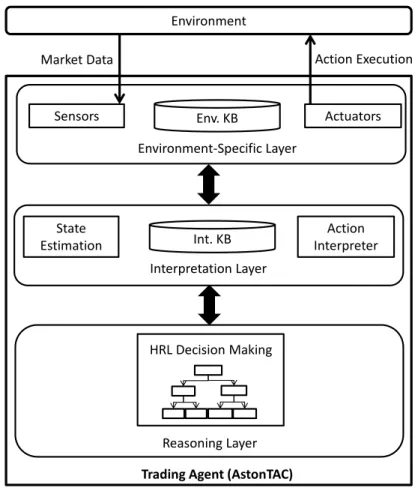
Software agents are computer programs that autonomously use environment states as inputs and output actions in order to meet their delegated goals (Russell and Norvig, 2009; Wooldridge, 2009). Their use in improving business processes has been increas-ing, owing to the progress of information technologies (Dignum and Dignum, 2010; Müller and Fischer, 2014) and to their attractive properties such as autonomy, reactivity, proactivity and social ability that are instrumental in simplifying the implementation of distributed and automated systems. A wide range of techniques and programming lan-guages have been devised to support the development of robust software agents (Ferber, 1999; Girardi and Leite, 2013). Architectures of such agents are generally composed of three types of components:
• sensors to identify the states of their environment. An environment that may be observable or hidden, static or variable, deterministic or non-deterministic, accessible or inaccessible and discrete or continuous (Russell and Norvig, 2009), • areasoning engineto aid the agent in deciding which actions to take in order to
achieve its goal and
• actuatorsto execute the agent’s selected actions in the environment.
This architectural setting is also widely adopted for building of software agents termed trading agents that interact autonomously in diverse market systems - real or simulated. In these systems, the agents are responsible of any relevant trading tasks or sub-tasks such as buying, selling or searching for the most advantageous service providers (Sec-tion 2.1 provides more details for trading agents).
Despite the fact that the adaptation of trading agent’s sensors, reasoning component and actuators is essential for its performance in variable and non-deterministic market environments, only the adaptation of sensors using machine learning techniques has attracted many researchers (LeBaron, 2006; He et al., 2006; Pardoe, 2011; Wellman, 2011). Nevertheless, researchers have shown an increased interest in developing adapt-ive reasoning engines for trading agents acting in simplified market settings using flat reinforcement learning. This kind of adaptation enables the agent to hone its strategies to be as optimal as possible with respect to one decision problem, but it does not allow the agent to generalise its learning through hierarchically related decision processes (Raju et al., 2006; Nevmyvaka et al., 2006; Reddy and Veloso, 2011a; Mahvi and Ar-dehali, 2011; Peters et al., 2013).
Furthermore, most current techniques that are used for the development of trading agents’ reasoning are tailored to a specific market setting; this is the case for the fol-lowing approaches: the Belief-Desire-Intention (BDI) framework (Fasli, 2001, 2003), fuzzy logic (He et al., 2003, 2006), environment-specific and flat Markov decision process (MDP) models (Reddy and Veloso, 2011b; Peters et al., 2013) or rule-based routines (LeBaron, 2006; Benisch et al., 2009). Since an adaptive trading agent is de-signed to solve an environment-specific task, it is not able to reuse the acquired trading ability in new markets in order to minimise the time required by the learning. In ad-dition to this, actuators are mainly used as the interface for action execution, with no relevant studies being reported in the software agent community to support their adapt-ation.
Against this background, this thesis is concerned with the development of a trading agent that can continually adapt its reasoning engine as well as its sensors and actuators to the market changes in order to maximize its overall profit and to reduce the training effort required in new markets. Specifically, this thesis focuses on the development of a reasoning engine that will enable the trading agent to acquire most of its behavioural knowledge through continuous interactions with its environments as well as to reuse the acquired trading skills in new markets without having to learn how to behave from scratch. To achieve this I consider hierarchical reinforcement learning (HRL) and semi-Markov decision processes (SMDP), which have been used in simplified settings to build adaptive robots (Barto and Mahadevan, 2003a; Kober et al., 2013) and, recently, portable agents that can reuse their reasoning engines in new settings (Taylor and Stone, 2009; Lazaric, 2012). This thesis proposes for the first time the use of hierarchical reinforcement learning techniques to build a trading agent which is characterised by
two core properties:
1. Continuous Adaptability: Using advanced learning techniques, such as hierarch-ical reinforcement learning (Barto and Mahadevan, 2003a), the agent’s reasoning can learn and adapt continually to changes occurring in its environments. The SMDPs presented in this thesis have been used by the developed broker, As-tonTAC to optimise diverse decision problems and to continually adapt to differ-ent market settings (see Chapters 3-6).
2. Portability: Just like a human trader, AstonTAC is able to reuse its trading experi-ence in different and new market domains using the proposed transfer framework inspired by existing robotic approaches (Taylor and Stone, 2009; Lazaric, 2012) that deal with knowledge transfer in reinforcement learning. The portability of AstonTAC is presented and evaluated in Chapter 7.
The remaining of this chapter is organised as follows. Section 1.1 discusses the major contributions of this thesis. In Section 1.2, the content of the thesis is outlined. A list of publications arising from this thesis is presented in Section 1.3.
1.1
Research Contributions
This thesis has three main contributions: the design of an SMDP-based trading agent architecture, the implementation and evaluation of an SMDP-based electricity trader as well as a novel knowledge transfer framework to enable the portability of its trading skills.
1.1.1
SMDP-based Trading Agent Architecture
As part of this contribution, a trading agent architecture associates HRL algorithms with a common agent architecture to create a trading agent that can learn and adapt to markets online, while at the same time being able to reuse its trading skills in markets it has not previously encountered - the proposed architecture is introduced in Section 2.3. The market simulations used for evaluation and benchmarking purposes are envir-onments that are assumed to be partly hidden, variable, non-deterministic, inaccessible and continuous. This design approach has been used to implement AstonTAC, which has been tested in a set of diverse trading environments. Different versions of AstonTAC architecture are described Chapters 3-6.
1.1.2
HRL-based Electricity Retailers
To illustrate the design approach put forward, novel SMDP-based architectures enable the AstonTAC versions, acting as electricity retailers, to trade simultaneously in whole-sale and retail markets. When purchasing electricity from the wholewhole-sale markets, the AstonTAC aims to buy the electricity needed at low prices while keeping the imbalance between the energy required and the energy bought low. The challenge of the simula-tion environment considered, is that the clearing prices, demand and supply volume of the electricity can be very volatile at short term, as renewable energy sources used are mostly weather-dependent.
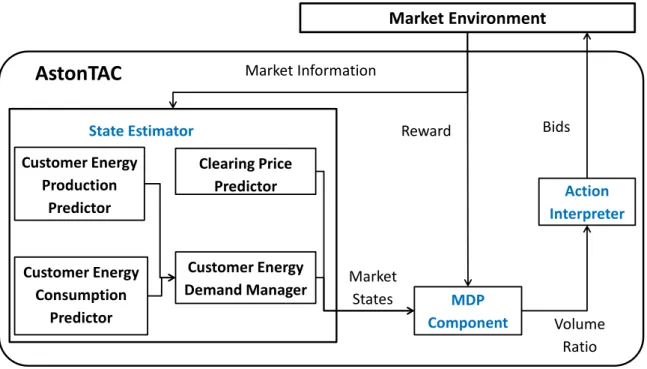
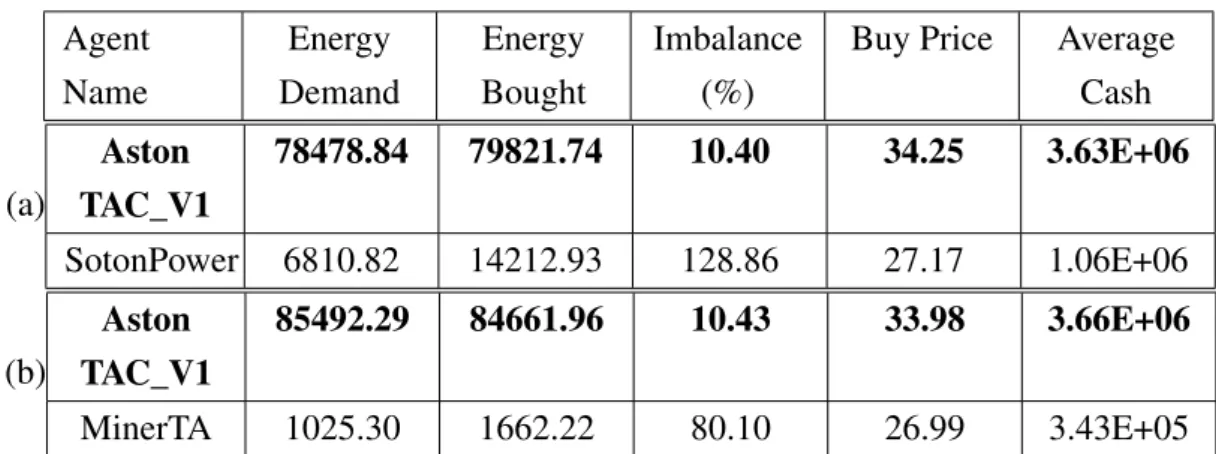
In view of this, a standard MDP is used for the first time to solve the short-term electricity procurement problem from the retailer’s viewpoint. The design of the pro-curement MDP has focused on relevant market features that remain invariant for a wide range of wholesale market settings. This procurement MDP was evaluated in Power Trading Agent Competitions (Power TAC), a multi-agent simulation environment that supports the development and testing of electricity retailer agents (Ketter et al., 2015) and offers a configurable retail and wholesale markets with real-life features and com-plexity. During the Power TAC competition in 2012, AstonTAC_V1 was the only broker that could minimise its procurement cost and energy imbalance. Chapter 3 de-scribes the procurement MDP.
Since consumers are able to produce electricity in a smart grid market using solar panels, for instance, the volume of electricity needed by the retailer can vary rapidly at short-term so that the retailer will need to have the ability to buy and sell electrical energy in the wholesale markets. To enable AstonTAC_V1 to buy its energy shortage and sell its energy excess in the wholesale market, the procurement MDP is extended into a procurement SMDP while maintaining the knowledge acquired by the procure-ment MDP. In order to solve the SMDP, a hierarchical reinforceprocure-ment learning (HRL) approach called hierarchy of abstract machines (HAM) is applied, as it enables the use of domain knowledge that reduces the learning time needed to solve the SMDP. This work is encompassed within AstonTAC_V2. An evaluation of AstonTAC_V2 in Power TAC shows that when trading for short-term procurement the new SMDP approach outperforms the continuous double auctions (CDA) and the MDP trading techniques. Chapter 4 provides details on the design, implementation and use of the procurement SMDP.
Symmetrically to the procurement SMDP, considering the decision problem faced by a retailer agent in a retail market, a semi-Markov decision process is proposed in
Chapter 5 to optimise simultaneously the agent’s market share and profit rate. In order to maximise its profit, the trading agent has two extreme alternatives: one alternative consists of using a maximal profit margin with a minimal number of customers and the other alternative is the use of a minimal profit margin with a maximal number of customers. These extreme alternatives have motivated the creation of two behavioural options for the agent in retail market: “customer-enticing” or “profit-oriented”. This agent was named AstonTAC_V3. To evaluate the performance of the proposed ap-proach, AstonTAC_V3 uses the SMDP reasoning engine to compete in Power TAC. During the Power TAC competition in 2013, AstonTAC_V3 was able to keep its profit and market share higher than the other retailers.
Finally, a novel SMDP framework is proposed in Chapter 6 to formalise all the de-cision problems of the retailer in the retail and wholesale markets. The novel SMDP framework optimises the retail and wholesale strategies, while also optimising the over-all retailer’s strategy. This SMDP framework makes use of the MDP coarticulation ap-proach of Rohanimanesh (2006) to enable the execution of concurrent actions. This novel SMDP formalisation reuses the knowledge contained in the retail and procure-ment SMDPs to speed up the learning. The resulting reasoning SMDP is solved with different reinforcement learning techniques depending on the decision problem con-sidered. Using the same SMDP to manage all its trading decisions in the wholesale and retail markets, this version of our agent, AstonTAC_V4, has a better coordination of its retail wholesale actions, which enables it to perform better than the top TAC retailers when the level of interdependence between retail and wholesale market is high. This means that the level of demand in retail market influences the wholesale prices and reciprocally the supply level in the wholesale market influences the retail price.
1.1.3
Building of Portable Reasoning Structure
After designing, implementing and evaluating the SMDP-based agent architecture, a novel knowledge transfer framework is put forward in order to enable an electricity re-tailer to reuse its SMDP reasoning engine in new, different markets. This novel frame-work extends existing knowledge transfer approaches by combining two knowledge transfer approaches: agent-centric framework of Konidaris et al. (2012) and inter-task mappings of Taylor et al. (2007); Taylor and Stone (2007). The proposed knowledge transfer is considered to be agent-centric, as it uses the same core reasoning system of a trading agent engine to act in different markets. At the same time, it also applies
inter-task mapping techniques to enable the retailer to act in the newly-encountered markets. The knowledge transfer framework is evaluated in the TAC environments and is shown to truly enable trading skills transfer of AstonTAC_V5 to new markets (see Chapter 7 for further details).
1.2
Thesis Structure
The remainder of this thesis is composed of eight chapters and an appendix.
Chapter 2 introduces the concepts that are relevant for the understanding of this work: agent architectures, semi-Markov decision processes with HRL and knowledge transfer for reinforcement learning. It also contains a critical review of previous work on development of trading agents.
Chapter 3 describes the formalisation of the short-term procurement problem as an MDP which is solved using a Monte Carlo approach. A critical literature review is presented at the beginning of the chapter. Subsequently, the MDP model and the actual architecture of the retailer agent are described, followed by the evaluation of the AstonTAC_V1’s performance in 2012 Power TAC.
Chapter 4 gives details on the extension of the procurement MDP framework presen-ted in Chapter 3 to a procurement SMDP that enables AstonTAC_V2 to alternatively buy and sell in wholesale markets for short-term electricity procurement. AstonTAC_V2 is evaluated in a series of controlled experiments.
Chapter 5 describes the SMDP framework that is proposed to optimise the retail market strategy of an electricity retailer agent. First, existing studies that discuss the development of retail strategies are reviewed. Then, the SMDP framework and the implementation of AstonTAC_V3 are described. AstonTAC_V3 is evaluated in the Power TAC 2013.
Chapter 6 describes the formalisation of the broker’s decision problem as a semi-Markov decision problem. This generalised SMDP framework is built using the trading skills acquired by retail and procurement SMDPs. An evaluation compares the per-formance of AstonTAC_V4 with top TAC brokers.
Chapter 7 presents the proposed knowledge transfer framework and describes the learning algorithm and some insights on how to technically build portable agents. The developed agent, AstonTAC_V5, is tested in the TAC environments Power TAC and TAC SCM.
the possible extensions of the thesis.
An appendix complements the thesis with additional information on the implement-ation of AstonTAC sensors.
1.3
Publications from this Thesis
The work contained in this thesis has been very positively received by both the Agents and Multiagent Systems and the Energy and Smart Grid communities. Parts of the work presented in this thesis have been or will be published in the following papers:
1. Chapter 3 was originally published in Kuate et al. (2013):
Rodrigue T Kuate, Minghua He, Maria Chli, and Hai Wang. An intelligent broker agent for energy trading: an MDP approach. In Proceedings of the Twenty-Third International Joint Conference on Artificial Intelligence, pages 234–240, 2013 2. Chapter 5 has, in part, been published in Kuate et al. (2014):
Rodrigue T. Kuate, Maria Chli, and Hai Wang. Optimising market share and profit margin: SMDP-based tariff pricing under the smart grid paradigm. In In-novative Smart Grid Technologies Europe, 2014 5th IEEE/PES. IEEE, 2014. 3. Chapters 6 and 7, in part, appear in Kuate et al. (2015):
Rodrigue T. Kuate, Maria Chli, and Hai Wang. An efficient knowledge transfer solution to a novel SMDP formalization of a broker decision problem. In Inter-national Conference on Autonomous Agents and Multiagent Systems, 2015.
Chapter 2
Background and Related Work
As this thesis is concerned with the application of HRL to design trading agents, this chapter introduces and reviews the two areas relevant to this work: trading agents in Section 2.1 and HRL in Section 2.2. Section 2.3 discusses the modelling of SMDPs for the trading agents.
2.1
Trading Agents
Section 2.1.1 presents background knowledge on agent architecture, whereas studies on trading agent architectures and learning are reviewed in Section 2.1.2. Section 2.1.3 in-troduces the simulation environments considered in this thesis for evaluation purposes.
2.1.1
Software Agents Architecture
Several definitions of software agents can be found in the literature. A generally accep-ted definition that will be used throughout this thesis is provided by Wooldridge (2009, page 21):
“An agent is a computer system that is situated in some environment, and that is capable of autonomous action in this environment in order to meet its delegated objectives".
To achieve its objectives, the agent proceeds in three steps:
1. It uses its sensors to estimate the state of the environment which is defined by a combination of relevant environment features.
2. Knowing the state of the environment, the agent selects the appropriate action to take using its reasoning system.
3. Finally, using its actuators or effectors, the agent executes the selected action according to the environment rules or mechanisms.
These three components are essential parts of the agent architecture. Depending on the impact of its three core components (sensors, actuators and reasoning engine), the agent can exhibit these four key properties: autonomy, reactivity, pro-activeness and social ability (Wooldridge and Jennings, 1995; Wooldridge, 2009).
• Autonomy: an autonomous agent is able to act on its environment without human intervention by autonomously sensing the environment, deciding what to do, how to do it and executing the action in order to achieve the delegated objectives. • Reactivity: a reactive agent responds to the changes occurring in its environment
by taking the corresponding actions.
• Pro-activeness: a proactive agent creates new goals and takes initiatives in order to meet the delegated objectives.
• Social ability: a social agent is able to communicate with other agents in order to achieve its individual or the collective objectives.
These four properties are important characteristics of trading agents, as they are expec-ted to trade autonomously without human intervention. To improve their performance, trading agents need to be able to react to environment changes that are foreseen or unforeseen at design time, while at the same time being able to pro-actively plan the actions to take in order to realise their long-term goals. Furthermore, a trading agents is expected to communicate with other traders in order to buy or sell their goods or services.
In order to enable these four properties, four groups of agent architectures have been explored (Russell and Norvig, 2009; Wooldridge and Jennings, 1995; Ferber, 1999; Wooldridge, 2009; Girardi and Leite, 2013): reactive agent architecture, deliberative agent architecture, hybrid agent architecture and learning agent architecture.
2.1.1.1 Reactive Agent Architecture
A reactive agent architecture enables the agent to react to its environment changes by using provided rules that associate an action with each state of the environment.
Many examples of reactive architectures have been presented in the literature: the sub-sumption architecture of Brooks (1995), the Pengi architecture of Agre and Chapman (1987), the situated automata approach of Kaelbling and Rosenschein (1990) as well as the agent network architecture of Maes (1989). The main motivation for the adop-tion of a reactive architecture is the fast reacadop-tion to environment changes which is a very important feature when building trading agents that may need to react in real time. However, this approach is not appropriate for building a proactive agent that does not only use the current environment state, but also an additional source of knowledge in order to plan their actions for achieving its long-term goals.
2.1.1.2 Deliberative Agent Architecture
Adeliberative agent architectureis applied for agents that use logical reasoning to de-cide their goals and achieve them. Contrary to reactive agents which essentially react to their environment, the deliberative agents are proactive by using a knowledge database to plan and execute their actions in attempting to achieve their goals. A deliberative agent is assumed to have a complete knowledge of its world, which remains unchanged during the execution of a plan, and to know the effect of its action that are always suc-cessful. The building of deliberative agents that are able to manipulate logical formulae to achieve their goals turns out to be very difficult, as the designer needs to always identify the relevant symbolic representation that will support the agent reasoning. Rel-evant symbolic representation can be difficult to define, even for common sense reason-ing problem. Moreover, the use of this logical representation to act is time-consumreason-ing and does not enable the agent to be efficient when acting under a time constraint. Very few studies have been reported on the use of pure deliberative architectures for building trading agents (Fasli, 2001, 2003).
2.1.1.3 Hybrid Agent Architecture
A hybrid agent architecture is applied for agents that are both reactive and deliber-ative. To enable deductive, practical reasoning architecture to support real-time re-action, many hybrid architectures have been studied to create reasoning systems that are reactive and proactive. These architectures present two types of layered structures: horizontal layering and vertical layering. In a horizontally layered architecture each reasoning layer can fully carry out a reasoning process by using information from the agent’s sensors and outputting one or more actions for the agent’s actuators, whereas
in a vertically layered architecture no single layer fully carries out the reasoning, they collaborate in handling the sensory input and suggesting an output action. A hybrid architecture provides a more appropriate approach for designing trading agents that act for short- and long-term goals. However, most trading agents use pre-programmed rules to identify which actions to take and generally, no logical representation of the environ-ment is provided to infer the logical actions to take. Therefore, most trading agents with a hybrid architecture are more reactive than proactive, as described in Section 2.1.2.2.
2.1.1.4 Learning Agent Architecture
A learning agent architecture which characterises any architecture that is augmented with a learning component to improve the adaptation of the agent. Augmenting the agent architecture with learning capability enables the agent to adapt its behaviour to unforeseen environment changes (Ferguson, 1992; Russell and Norvig, 2009). The agent can be equipped with two types of learning capability (1) logic-based learning which enables the agent to create new rules using a set of rules provided at design time (Juba, 2013; Muggleton and Lin, 2013) or (2) machine learning techniques, which gen-erally include regression models, classification models, decision trees models and rein-forcement learning algorithms (Kazakov and Kudenko, 2001; Tan et al., 2011; Singh, 2011; Sniezynski, 2014).
The reactive, the deliberative as well as the hybrid agent architectures as presen-ted above are based on predefined, preprogrammed logic and rules, which need to be specified at design-time and do not enable the agent to learn and adapt to unforeseen environment changes. As the trading agent’s environment can be variable and dynamic, it is essential for its performance to be able to learn and adapt to its environment. As reviewed in the next subsection, many trading agents have been equipped with learning capability in order to adapt and to perform well in their environments.
2.1.2
Trading Agent Architecture
In electronic markets, trading agents are generally used as buyers or sellers that act in electronic markets on behalf of their owners (Chen et al., 2012; Geanakoplos et al., 2012). Seller agents enable their owners to optimise their sale strategy either through improvement of their online advertisement strategy or through computing of competit-ive prices for their services and goods. Analogously, buyer agents optimise their own-ers’ purchase strategy given their preferences which can be defined by the prices or/and
the quality of the offered products or services. This thesis uses electricity trading agents (Rogers et al., 2012; Bach et al., 2012; Reddy, 2013; Amato et al., 2015) to illustrate the proposed learning approach as outlined in Section 1.1.
In order to understand or predict behaviour of the complex markets such as the fin-ancial market, new research disciplines have been created: agent-based computational economics (Tesfatsion, 2002; Tesauro and Kephart, 2002; MacKie-Mason and Well-man, 2006; Richiardi, 2012) and agent-based computational finance (Hommes, 2006; Samanidou et al., 2007). In both scenarios, a trading agent makes use of its three core components (sensors, reasoning engine and actuators) in order to act autonomously.
This thesis aims to design and evaluate a reasoning engine that enables trading agents to perform well by taking appropriate real-time trading decisions in dynamic and uncertain markets. In view of this, we use test environments that simulate dynamic and uncertain markets and that impose to the agent the need to act quickly. AstonTAC is developed and tested in well-known simulation environments of the Trading Agent Competition (TAC) community, which is an international forum whose aim is to support the development of intelligent agents through agent competitions. Since 2000, it has at-tracted many research groups that evaluated the performance of their agents in compet-itive environments such as TAC SCM, TAC Ad Auctions or Power TAC. AstonTAC was placed in two different environments: TAC SCM and Power TAC. While Power TAC simulates a smart grid electricity market which encompasses both a competitive electri-city wholesale and a retail market under the smart grid paradigm (Ketter et al., 2015), TAC SCM simulates a PC market (Arunachalam and Sadeh, 2005; MacKie-Mason and Wellman, 2006). These two environments are characterised by common features that have impacted the development of AstonTAC.
1. Two markets: Retail and wholesale. A trading agent acting in the two envir-onments trades simultaneously in the retail and in wholesale markets, which are interdependent markets, as the level of the retail demand influences the wholesale prices and the level of wholesale supply influences the retail prices. Despite this interdependence, the two markets present two different optimisation problems to the trading agents, which aim to attract as many clients as possible and make as much profit as possible in the retail market, while in the wholesale market, they aim to buy the products needed on time for their customers and at lowest possible price.
under-stand the customer expectations and offer competitive prices in order to attract customers and make profit. However, the retail market offers limited inform-ation, therefore the agent cannot easily predict the customer expectations and demand or the behaviour of competitor agents. Agent designers generally use di-verse techniques for forecasting the retail behaviour based on the limited amount of information. The trading agent uses the price as an essential tool to attract customers and aims to maintain a good reputation among customers.
3. The structure of the wholesale markets: In the wholesale market, the trader agent mainly acts as a buyer who needs to buy the required products in order to meet the predicted retail demand. The agents compete with others traders to buy the products offered by the suppliers at the lowest prices possible. In a manner ana-logous to the retail market, the agent has limited access to the market information needed to predict the market supply and the behaviour of other trading agents and supplier agents.
4. Market dynamics: The agents face an environment with limited access to relevant information. The market dynamic is created by the behaviour of the different agents in the environment. The customer behaviours influence the demand level in the retail market and sometimes their preferences to the offered products or services, whereas wholesale trader behaviour influences the supply level. The behaviours of other agents have an impact on the state of the markets as each agent tries to control the environment using the offered prices.
Section 2.1.3.1 provides an overview of each evaluation environment: Power TAC and TAC SCM.
2.1.2.1 Trading Agent Sensors
Designers of trading agents apply diverse machine learning techniques to improve the performance of the agents’ sensors in determining the state of environment which is commonly specified by the variables: projected market prices, demand and supply. As the focus of this thesis is on the reasoning engine, this section mainly outlines techniques that have been used for the implementation of the trading agents’ sensors without providing cross-domain comparisons as the sensors are environment-specific components.
In the Santa Fe Artificial Stock Market (SFASM) simulation that has been created to investigate the dynamics of stock markets and to test trading strategies (Palmer et al.,
1994; LeBaron, 2002), the trading agent applies time series models to estimate the state of the market (LeBaron, 2001, 2006).
Considering the trading agent competition (TAC) environment, several simulation environments have been developed to promote research on trading agents. In the TAC Supply Chain Management (SCM) environment, which simulates the trading of per-sonal computers, the trading agents use diverse approaches to estimate the state of the environment (Wellman et al., 2005; MacKie-Mason and Wellman, 2006). Most of the brokers employ the forecast of retail prices and retail demand as inputs for their de-cision making; these forecasting techniques vary from simple average of previous ob-servations to multi-linear regression approaches. A price average is used by He et al. (2006) as input to fuzzy-based reasoning. The retail mean price is used by Ketter et al. (2006) to determine the market state. The k-nearest neighbours algorithm is applied by Kiekintveld et al. (2009) to forecast the retail prices, whereas in the wholesale market, a linear regression is performed to predict suppliers’ future prices. A further technique, the distribution tree is used by Benisch et al. (2009) to predict the retail prices. Par-doe (2011) uses transfer learning to improve the performances of the linear regression models used to predict the relevant environment variables such as prices, demand and supply level in new TAC markets.
Similar to TAC SCM, trading agents in Power TAC (Ketter et al., 2015), which is a simulation environment for electricity trading, make decisions based on their estim-ation of the future prices, demand and supply quantities. Urieli and Stone (2014) use linear regressions to predict future customers’ energy demand and energy procurement cost which are used as inputs for deciding the agent’s tariff prices in the retail market. In Reddy and Veloso (2011a,b), the retail price status and the structure of the agent portfolio are used as inputs of the reasoning structure. Peters et al. (2013) propose to use of feature selection and regularisation techniques (Petrik et al., 2010) to identify the environment variables that are relevant for the trading agent’s decision making.
These studies on the sensory techniques perform well in the market setting con-sidered by the authors. The sensors are generally designed in an environment-specific manner, because there are interface components that are responsible for gathering the market data into information that is usable by the agent’s reasoning. As this thesis fo-cuses of the enhancement of the reasoning engine and not on the sensory component, the full description of the AstonTAC’s sensors is provided in Appendix A.
2.1.2.2 Trading Agent Reasoning Engine
A wide range of techniques have been proposed to design the reasoning engine: both static and adaptive approaches. While static approaches design rule-based and non-adaptive reasoning engine, non-adaptive approaches propose reasoning engine which can adapt their behaviour to environments changes.
Static approaches Rule-based subroutines are used to map environment states to
possible market actions. In the SFASM environment, LeBaron (2001, 2006) designed agents that use a rule-based reasoning engine to trade by mapping specified trading rules to market states. Using game theoretical approaches (Binmore, 1990; Fudenberg and Tirole, 1991; Binmore, 2007), the behaviour of the trading agent is codified by game-theoretical rules that are predefined offline (Kiekintveld et al., 2004; Kiekintveld, 2008; Liefers et al., 2014).
When the agent designer does not know or has a limited knowledge of the rules required for it to perform well, the building of a rule-based reasoning engine is difficult. Moreover, in a dynamic environment as the financial market, rule-based agents, which use trading strategies that are predefined and preprogrammed at design time, cannot adapt to unforeseen market changes, whereas agents with adaptive reasoning can.
Adaptive Approaches In the TAC environment, trading agents use utility
func-tions to identity their trading prices as a function of historical market prices and the levels of demand and supply (He et al., 2006; Pardoe, 2011; Urieli and Stone, 2014). The drawback of this approach is that the utility functions are tailored to the agent’s en-vironment and generally do not give any information on real trading strategy, as more powerful mathematical models can be used to design utility functions for real-life trad-ing (Heij et al., 2004; Waters and Waters, 2008; Wooldridge, 2010).
Many trading agents use evolutionary algorithms to identify the suitable trading rules given a set of market simulations with predefined settings (LeBaron, 2001, 2006). Evolutionary algorithms are also used as tools in trading markets to identify the op-timal trading rules (Lohpetch and Corne, 2009; Wilson and Banzhaf, 2010; Hassan, 2010; Lohpetch et al., 2011; Esfahanipour and Mousavi, 2011). The main drawback of evolutionary algorithms is the time required to find the suitable rules, which makes these approaches inappropriate for trading agents that act with time constraints.
Reinforcement Learning as an Adaptive Approach Reinforcement learning offers a much more structured technique for enabling efficient agent adaptation (Sutton and Barto, 1998). In simplified market settings, trading agents that use flat MDPs and the reinforcement learning for decision making have been presented (Raju et al., 2006; Reddy and Veloso, 2011b,a; Peters et al., 2013). Flat MDPs are not appropriate for the type of markets considered, as the resulting reasoning MDPs can be very complex and difficult to solve. This thesis remedies this limitation by applying SMDP and HRL to model and solve complex decision making problems as faced by trading agents that act in the environments considered. Furthermore, SMDP and HRL not only enable the trading agents to adapt to variable and uncertain markets, but they also enable the agent to reuse the knowledge acquired without having to learn from scratch. The background knowledge on SMDP and HRL is provided in Section 2.2. Critical reviews of the reasoning engine of trading agents are presented for each decision problem considered in the thesis. First, Section 3.3 reviews work on decision making in wholesale market. Then, in Section 5.3, the techniques used by trading agents to optimise the decision making in retail markets are presented. Finally, Section 6.2 contrasts studies on decision making for trading agents.
2.1.2.3 Trading Agent Actuators
Similar to the the sensors, actuators are generally designed for a specific environment, however, far too little attention has been paid to the implementation of trading agents’ actuators, whereas the implementation of robots’ actuators has a large volume of pub-lished studies (Khatib and Burdick, 1986; Hunter et al., 1991; Zinn et al., 2004). When designing trading agents that need to continually adapt to environment changes, there is a need to develop intelligent actuators that can optimise the execution of the selected actions. Moreover, intelligent actuators can handle and adapt to environment-specific changes that may affect the execution of the trader’s action, while the invariant trading knowledge is managed by the reasoning component.
Figure 2.1: Power TAC Overview from Ketter et al. (2015). This is an overview of the Power TAC simulation environment that simulates an electricity wholesale market with large electricity suppliers and a smart grid retail market with retail consumers and producers. The electricity retailers that act as brokers compete in wholesale and retail markets for buying and selling electrical energy. A distribution utility is responsible of electricity balancing between supply and demand.
2.1.3
Trading Environments
2.1.3.1 Power TAC Environment
Power Trading Agent Competition platform Ketter et al. (2015) (Power TAC1) offers an open and competitive environment that is as close as possible to the complexity of real-life markets, encompassing both a competitive electricity wholesale and a retail market under the smart grid paradigm (see Figure 2.1). While the wholesale market mimics day-ahead energy markets such as Nord Pool in Scandinavia or FERC in North America, the retail market simulates several types of real-life energy consumers and tariffs. The broker agents offer diverse tariff contracts to the customers and provide them the required energy each hour by buying the needed volume from the wholesale market.
Wholesale Market The wholesale market, which is composed of generator
compan-ies (GenCos), energy brokers and transmission operators, called Independent Systems
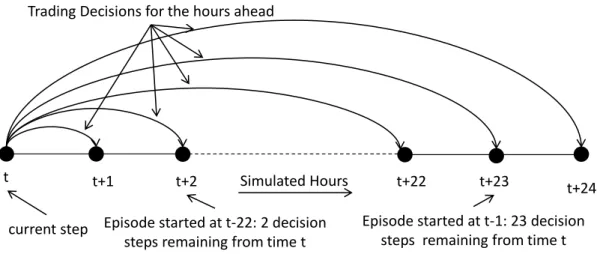
Operator (ISO), simulates a periodic double auction and day-ahead market where the market is cleared each simulated hour. The market is cleared when there is an equi-librium price between the bids and the asks placed to the market. Successful bids are buy orders that have a limit price higher than the clearing price and successful asks are sell orders that have limit price lower than the clearing price. The broker agent can buy energy for future delivery between 1 and 24 hours ahead in the wholesale market. This gives the broker a time horizon of 1 to 24 hours ahead to satisfy the hourly demand for the contracted power consumers.
Retail Market The retail market provides several types of customers that can be
grouped in two classes: (1) small and elemental customers, such as households, small and medium businesses, small energy producers and electric vehicles; and (2) large customers, such as greenhouse complexes and manufacturing facilities. A Distribution Utility owns the distribution network and ensures real time energy balancing between supply and demand. Moreover, it charges the broker with a penalty, if it cannot balance its electricity demand and supply. In the retail market, the agent can offer different types of consumption and production tariffs with real world tariff features: periodic payments, time-of-use tariffs, tiered rates, sign-up bonuses and early withdrawal fees, as well as dynamic pricing. Power TAC customers select the energy tariffs that are the most advantageous considering their energy requirements.
Retailer Agent Activities In the Power TAC environment, the retailer agent is
ex-posed to series of activities that can be executed during the game (this is illustrated in Figure 2.2). The agent’s activities encompass the recording of environment data con-tained in the public and private server messages and the sending of messages to the game server. The server messages are the agent financial states (market position, cash position and transactions), weather report and forecast, the balancing state between retailer’s energy supply and demand as well as all tariff information (customer sub-scription, cancellation and tariffs’ transaction). The agent needs to use this information to adapt to the environment changes by optimising the tariff pricing in retail market.
At any time in the game, the agent can take actions in the two markets. In the wholesale market, it can buy or/and sell electricity by submitting bids and asks to the market. As feedback, it is informed by the game server about the clearing prices, the order book and its successful orders. In the retail market, the trading agent deals with managing a portfolio of electricity tariffs for the consumers by creating new or updating
existing tariff contracts given the retail strategy that it follows: the broker can offer tariff contracts for consumption, production, storage and balancing. The retail customers select and sign to diverse tariffs according to their preferences and the reputation of the trading agents. These activities have influenced the development of AstonTAC versions, as AstonTAC_V1 presented in Chapter 3 and AstonTAC_V2 in Chapter 4 deal with the optimisation of the wholesale activities, whereas AstonTAC_V3 described in Chapter 5 optimises the retail strategy. The wholesale and retail markets strategies are optimised simultaneously by AstonTAC_V4, which is presented in Chapter 6.
Tournament Settings and AstonTAC Approach Each Power TAC game is
initial-ised with a setup game that lasts for 15 days (384 simulated hours or timeslots) and procures initial simulation data, which is composed of customer energy consumption, customer energy production, clearing prices and weather reports. A Game generally runs for about 60 virtual days or 1440 simulated hours or timeslots - each simulated hour lasts 5 seconds in the real world. At the end of the simulation, the broker with the highest balance in the bank wins the game. Starting the game with an empty bank account, the broker agent gets a bank credit by buying energy in the wholesale mar-ket. It earns money by getting payment for the sold energy and spends it by paying for the required energy or market fees (energy distribution fee, energy imbalance fee, tariff publication fee, tariff revocation fee and the bank interest for the debt). During the game, the bank always loans the broker money to purchase energy and charges interest. The dynamism and uncertainty of the Power TAC environment is a result of the definition of the implementation of the game server:
1. Thenumber of agents and the typeof agents competing in each game are variable. As result, the behaviours of wholesale and retail markets depend on the agents playing in a specific games. A basic way to develop a trading strategy is to create a profile of the competing agents and use game-theoretical approach to select a trading strategy as suggested by Vidal and Durfee (2003); Gmytrasiewicz and Durfee (2000). However, there are two main limitations to this approach. First, the game server does not offer enough information to confidently profile the agents competing in a competition. This makes the creation of agent profiles difficult to realise. Moreover, as adaptive agents adjust their behaviour during and between the tournament games, game-theoretical approaches are difficult to apply successfully. Additionally, as using a game-theoretical approaches to determine each decision making is time consuming, it is not an efficient approach for Power
Figure 2.2: Activities of the Retailer Agent from Ketter et al. (2015). This figure shows the interactions between the retailer agent and the Power TAC simulation environment. The simulation game sends at every time step diverse information to the retailer agent about the weather state, the transaction in the wholesale and retail markets, as well as its financial situation.
TAC where real-time decision making is required (for instance the agent may be required to make a wholesale market decision within 5 seconds).
2. The wholesale market tradingas well asretail consumption andproductionare influenced by the weather parameters which are variable and drawn from real weather history of real location on the planet. This makes the energy production and consumption behaviour of each game to be specific and influenced by the real-world weather data of a specific location in the world. Therefore, the weather makes the dynamic of the game to be different from game to game making the prediction of the game dynamic difficult. The Appendix A explains the approach used by AstonTAC to dynamically predict the consumption and production online in each game.
3. Theinitialisation of customers type and number, which differ from game to game, is also a source of uncertainty in the environment, particularly in the retail market. Similar to real-world case, large customers prefer variable tariffs as they pay only for what they consume, while elemental customers prefer fixed tariffs as they cater for fixed and regular payments without risk of extremely high electricity bill to pay. As elemental and large customers behaviours are different both in the amount of energy they consume and their tariff preference, the trading agent needs to adapt its tariff contracts and procurement strategy according to mix of customers in each game.
These environment specifications have largely influenced the implementation of As-tonTAC and strengthened the need for building the proposed SMDP architecture.
The Power TAC tournament is held every year and enables researchers around the world to build and test their retailer agents in a competitive environment. During the Power TAC tournament, the agent attends several competitions where it plays several games with different number of agents (two, four or eight). At the end of each Power TAC simulation, the retailer agent with the highest standard score (z-scores) of the accumulated profits wins the game. Thez-scores use the standard normal distribution to show how well a player performs compared to all other players (Marx and Larsen, 2006).
2.1.3.2 TAC Supply Chain Management
While the Power TAC has been used to test the SMDP-based architecture of the trading agent, TAC Supply Chain Management has been used to demonstrate the knowledge
Figure 2.3: The scenario of the TAC Supply Chain Management from Collins et al. (2006) . The retail agent has four main activities: (1) buying computer parts from the suppliers, (2) assembling the computers, (3) selling the computers to the customers as well as (4) scheduling their delivery.
transfer of the developed MDP modules.
TAC Supply Chain Management simulates a supply chain scenario in which six broker agents compete in selling 16 types of personal computers (PC) in a retail mar-ket, as well as in buying the computer components from suppliers and schedules PCs production and delivery Arunachalam and Sadeh (2005); Collins et al. (2006). Sim-ilar to the Power TAC, this game has a retail and a wholesale market as illustrated in Figure 2.3. In the retail market, the trading agent competes in selling different types of PCs by bidding on customers’ request for quotes (RFQs) . The PCs differ by their components (CPUs, Motherboards, memory and disk drives), which are available in different brands. To manufacture the PCs, the trading agent buy the components from the wholesale market using RFQs.
Wholesale Procurement Using the RFQs, the trading agent sends at most five
re-quests to each supplier individually and specifies in the RFQ the product needed, the quantity, the delivery date and the limit price. In turn, each supplier considers its fu-ture delivery commitment and capacity in order to send an offer with the quantity of the product that can be provided and its price. The trading agent can then accept or reject the suppliers’ offers. The quantity of products needed by the trading agent in the future is defined by its estimation of the future retail demand and current retail commit-ments. Because of the late delivery penalty in the retail market, the retail agent strives to buy the components on time from the wholesale market in order to avoid the penalty.
Moreover, the agent does not only face the time constraint, it also has to buy when the prices are low.
Retail Market In the retail market, the trading agents compete by bidding on the
customer RFQs while having to satisfy the customer orders on time given their produc-tion capacity and scheduled deliveries. The customers’ RFQs are composed of the type of the PC needed, the quantity and the due date. After receiving the brokers’ offers, the customers select the most suitable offers and send orders back to the corresponding broker.
Trading Agent Activities The trading agent needs to excel in retail market, wholesale procurement and production scheduling in order to be successful in TAC SCM. The game server provides to the broker market information such as minimum and maximum prices of PCs and of the needed components. The bank account information and the negotiation orders and offers are sent privately to each broker.
Game Settings The game lasts for 220 simulated days with each day representing
roughly 15 seconds in real time. At the end of the game the brokers with the highest cash in the bank account wins the game.
2.2
Hierarchical Reinforcement Learning
This section introduces the (S)MDP formalisms that have been used to model behavi-oural modules as well as the techniques used for learning trading strategies in Sections 2.2.1 - 2.2.3.
2.2.1
Introduction to Markov Decision Process
When modelling decision problems in dynamic and uncertain environments, MDPs are the most effective and widely accepted approaches (see Bellman (1957); Witten (1977); Whittle (1982); Ross (1983); Littman (1996)). The standard discrete-time MDP with finite state and action spaces can be formally defined with the tuple⟨S,A,P,R⟩as follows:
• Sis the set of environment states. The state of the environment at timet is noted stϵS. In the standard MDP, the states of the environment are assumed to be fully
observable. This means that the decision maker knows the exact state st of the environment.
• A is the set of actions that can be taken by the agent. The action at time t is notedatϵA. The agent uses the actionat to control the environment and achieve its goals. At each run or episode, the agent takes a sequence of actions that optimises the control of the environment. The sequence of actions for each run is defined by the policy function:
π : S→A.
The deterministic policyπ associates to each statestthe actionat, so that:
at=π(st).
• P is the state transition distribution. It defines the probability P(st+1|st,at) of transition from statest to state st+1 after the agent has taken the actionat. The transition to state st+1 depends only on the current state st and the taken action at. P(st+1|st,at)does not depend on the previous actions and previous states. • R is the reward function. The decision maker receives a positive or a negative
reward for being in a certain state of the environment. At each state st of the environment, the agent receives the reward rt from the system after the action at−1is taken from statest−1. The reward function of the MDP is used to control the aims of the agent training. While a positive reward encourages the decision maker to take in the future the same decision in the same situation, a negative reward discourages him or her to take the same decision in the same situation. Consequently, the agent gradually takes more successful decisions in order to get the maximum reward. The aim of the decision maker is to find the policyπ that maximises the return (cumulated rewards)Rin the long run. At each time stept, the cumulative discounted returnReturnt is defined by:
Returnt =rt+γ1rt+1+γ2rt+2+· · ·+γTrT, (2.1) Returnt= ∞
∑
k=0 γkrt+k, (2.2)• whereγ is the discount factor, 0≤γ ≤1 andT the final time step of an episode. The end of an episode is the end of the decision process. In an infinite-horizon decision process,T →∞and 0≤γ <1. γ specifies the relationship between the future rewards and the current state-action pair (st−1,at−1): ifγ=0, thenRt=rt, the action selection are driven by the immediate rewardrt and the future rewards are irrelevant for agent’s decisions. Ifγ =1 for finite-horizon decision problem, then all future rewards (delayed rewards) influence the selection of actionat−1at statest−1.
Following π, at each state st, the agent selects the action π(st) =at. The expected cumulative value of the future rewardsVπ(s
t)is the state-value function corresponding to a deterministic policyπ defined as follows:
Vπ(st) =E[Returnt|st]. (2.3) Vπ(st) =E " ∞
∑
k=0 γkrt+k|st # . (2.4)The associated Bellman equation is defined as:
Vπ(s
t) =
∑
st+1P(st+1|st,π(st)) [R(st+1|st,π(st)) +γVπ(st+1)], (2.5)
whereR(st+1|st,π(st))is the expected reward withR(st+1|st,π(st)) =E[rt+1|st,π(st)]. The optimal policyπ∗(st)is any policy that maximises the valueVπ(st)at statest. The maximal value ofVπ(s
t)is denotedV∗(st):
V∗(st) =max π
Vπ(s
t). (2.6)
If all the parameters of the MDP ⟨S,A,P,R⟩ are known, π∗(st) andV∗(st) can be computed using dynamic programming techniques (Bellman, 1957; Watkins, 1989b; Bertsekas et al., 1995; Bertsekas and Tsitsiklis, 1995). However, for the simulation en-vironments considered in this thesis, the parametersPandRare not known and are to be learned by agent through direct interactions with the environment using reinforcement learning techniques. Considering the complexity of the evaluation test environment, as presented in Section 2.1.3.1, it is difficult to obtain enough relevant data to calculate the parametersPandR.
Analogue to the state-value functionVπ(s
t), an action-value functionQπ(st,at)can be considered to model Markov problems where the Returnt does not only depend on the on the statest, but also on the taken actionat. Similarly, following equations can be written: Qπ(s t,at) =E[Returnt|st,at], (2.7) Qπ(s t,at) =E " ∞
∑
k=0 γkrt+k|st,at # , (2.8) Qπ(st,at) =∑
st+1 P(st+1|st,at) [R(st+1|st,at) +γQπ(st+1,at+1)], (2.9)where R(st+1|st,at) is the expected reward with R(st+1|st,at) = E[rt+1|st,at]. The action-value functionQπ(s
t,at)is more suitable for solving MDP through interactions with the environment. The optimal action-value functionQ∗(st,at)is defined as:
Q∗(st,at) =max
π
Qπ(st,at). (2.10) The definition ofQπ(s
t,at)is more meaningful for the application of diverse rein-forcement learning techniques than for the formal definition of the MDP. The following section will introduce reinforcement learning.
2.2.2
A Primer on Reinforcement Learning
Reinforcement learning is a computational framework for learning MDP through direct interaction with the concerned environment. A reinforcement learning algorithm tries to approximateπ∗by learning suitable mappings between environment statesstϵSand the actionsatϵAgiven the observed rewardsrt. Sutton and Barto (1998, page 3) defines reinforcement learning as follows:
“Reinforcement learning is learning what to do – how to map situations to actions– so as to maximize a numerical reward signal. The learner is not told which actions to take, as in most forms of machine learning, but instead must discover which actions yield the most reward by trying them. In the most interesting and challenging cases, ac-tions may affect not only the immediate reward, but also the next situation and, through that, all subsequent rewards. These two characteristics – trial-and-error search and delayed reward – are the two most important distinguishing features of reinforcement
learning.”
Reinforcement learning algorithms are characterised by the two fundamental prop-erties: the trial-and-error search and the temporal assignment of the observed rewards to the visited states and actions taken. Under the trial-and-error search approach, sev-eral techniques have been proposed to enable the agent to adjust the trade-off between exploring the possible (if not all) action mappings and exploiting suitable state-action mappings. While the exploration enables the agent to find better policy, the ex-ploitation supports the maximisation of expected rewards. The most common exploration-exploitation approach is the ε-greedy action selection (Watkins, 1989b). At each state s, an agent takes the actionawith the highest expected return with respect toε-greedy. With a probability ofε, a random action is chosen and with the probability of 1−ε, the action with the maximum expected value is selected. Generally, the value of ε varies according to the number of training games. At the beginning of the training it has a high value to encourage exploratory action selection and toward the end of the training, it is decreased to enables more exploitation of successful policy. The ε-greedy approach is generalised using the softmax action selection (Bridle, 1990) which uses a Gibbs, or Boltzmann, distribution to select the next action with a probability:
P(a|st) =
exp(Q(st,a)/τ)
∑ki=1exp(Q(st,ai)/τ)
, (2.11)
wherekis the number of actions available in statest,Q(st,a)is the expected cumulative value of the future rewards when the actionais taken at states,τ is called the temper-ature andτ>0. With a high value ofτ, actions are selected more randomly, whereas, with low value ofτ the actions are selected greedily according toQ(st,a).
The method of assigning observed rewards to experienced state-action pairs is the core of reinforcement learning techniques, which specifies when to update the estimate Vπ(s
t) of the state values. The update ofVπ(st) can be done after any action taken by the agent, at the end of the of the episode or after a certain number of actions. Most reinforcement learning techniques used to solve flat MDPs can be formalised as a temporal difference (TD) learning method or with eligibility trace called TD(λ) methods. λ is the trace-decay parameter (0≤λ ≤1). Withλ =0, the values ofVπ(st) are updated after each actionatfollows by a rewardrt+1, whereasλ =1, the update of
the estimationVπ(s
t)of all visited state-action pairs happen at the end of the episode. The following subsections will provide more details on the TD(0), TD(1) and TD(λ)
2.2.2.1 TD(0)
The reinforcement learning algorithms TD(λ =0), one-step Q-learning and one-step State-Action-Reward-State-Action (SARSA) update the estimates ofVπ at each step of the decision decision process. One-step Q-learning (Watkins, 1989b; Watkins and Dayan, 1992) is an off-policy TD control algorithm, which updates its state-value func-tionsQ(st,at)as follows: Q(st,at)←Q(st,at) +α rt+1+γmax at+1 Q(st+1,at+1)−Q(st,at) , (2.12)
where α is the learning rate, which defines how much the new observation rt+1 will
influence the existing estimate ofQ(st,at).
Q-learning is an offline policy, because the algorithm is initialised with maximal value of Q(st,at), which is provided offline. This assumes that the algorithm designer has a good estimation of the state-rewardsrtthat are used to compute max
at+1
Q(st+1,at+1).
The SARSA algorithm (Rummery and Niranjan, 1994; Sutton, 1996), which was ini-tially proposed as a modified Q-learning, is an online TD method, where theQ(st,at)
are to be learned online as follows:
Q(st,at)←Q(st,at) +α[rt+1+γQ(st+1,at+1)−Q(st,at)]. (2.13) Algorithm 1 presents the learning protocol of one-step SARSA as described in Sut-ton and Barto (1998). At the beginning of the learning protocol the initial state and action are defined given the exploration-exploitation approach (e.g.,ε-greedy). At each state st