Mutation of Java Objects
Roger T. Alexander, James M. Bieman, Sudipto Ghosh, Bixia Ji
Department of Computer Science
Colorado State University
Fort Collins, Colorado 80523
Abstract
Fault insertion based techniques have been used for mea-suring test adequacy and testability of programs. Mutation analysis inserts faults into a program with the goal of creat-ing mutation-adequate test sets that distcreat-inguish the mutant from the original program. Software testability is measured by calculating the probability that a program will fail on the next test input coming from a predefined input distribution, given that the software includes a fault. Inserted faults must represent plausible errors.
It is relatively easy to apply standard transformations to mutate scalar values such as integers, floats, and character data, because their semantics are well understood. Mutat-ing objects that are instances of user defined types is more difficult. There is no obvious way to modify such objects in a manner consistent with realistic faults, without writing cus-tom mutation methods for each object class. We propose a new object mutation approach along with a set of mutation operators and support tools for inserting faults into objects that instantiate items from common Java libraries heavily used in commercial software as well as user defined classes. Preliminary evaluation of our technique shows that it should be effective for evaluating real-world software testing suites. Keywords: Faults, Java, mutation analysis, object-oriented programming, software testing, test adequacy, testability
1. Introduction
Program testing is an integral part of software develop-ment processes. Testing a program involves the creation of test cases, the execution of the program against these test cases, and the observation of program behavior to determine correctness. A test case is a sequence of input values sup-plied to a program to test it, along with the expected output. A test set is a set of one or more test cases. A test case is successful if the observed behavior conforms to functional
requirements; otherwise, the test fails. Success may be de-termined with the help of an oracle that compares the ob-served output with the expected (correct) output.
Test adequacy assessment is the evaluation of how thor-ough the testing was, and is an indicator of the goodness of the test sets. An adequacy criterion is defined as a predi-cate that defines what properties of a program must be ex-ercised to constitute a thorough test [11]. The term
cover-age domain denotes a set of program related entities that are
checked and counted for measuring coverage. Within a pro-gram these entities include functions, statements, decisions, and definition-use pairs. Test coverage is measured with re-spect to a particular coverage domain and reflects how much of that domain has been executed and tested.
Testability is defined by the IEEE Standard Glossary of Software Engineering Terminology (1990) as:
“(1) the degree to which a system or component facilitates the establishment of test criteria and the performance of tests to determine whether those criteria have been met, and (2) the degree to which a requirement is stated in terms that permit es-tablishment of test criteria and performance of tests to determine whether those criteria have been met.”
Voas [21] defines testability as the likelihood of a pro-gram failing on the next test input from a predefined input distribution, given that there is a fault in the program.
Fault insertion based approaches have been used for mea-suring test adequacy [7, 5, 17] and testability [20]. Mutation analysis inserts faults into a program with the goal of creat-ing mutation-adequate test sets that distcreat-inguish the mutant from the original program. Software testability is measured by seeding faults into a program. In both cases, inserted faults must represent plausible errors. It is relatively easy to apply standard transformations to mutate scalar values such as integers, floats and character data, because their seman-tics are well understood. Inserting faults into objects that are instances of user-defined types is more difficult. There is no obvious way to modify such objects in a manner consistent
To appear in Proc. IEEE Int. Symp. Software Reliability Engineering
(ISSRE) 2002.
with realistic faults, without writing custom mutation meth-ods for each class. For example, one may define a mutation operator that nullifies an object reference. However, the op-erator is actually being used to change an object reference (which is scalar) and not necessarily the state of the object itself. The semantics of an object reference may be under-stood without knowing the semantics of the object itself. To mutate an object, one needs to know its semantics. Why is the ability to mutate user defined-types important? Because of the proliferation of user-defined types in software written using object-oriented (OO) languages.
Traditional mutation techniques use operators that are ap-plied to constructs (variables, constants, operators and state-ments) in program code. These techniques cannot be easily extended to object-oriented programs where the variables usually represent objects (actually object references). Some OO mutation approaches use mutation operators that oper-ate at code level to mutoper-ate aspects of attribute and method visibility, and inheritance. However, they do not address the important issue about object semantics.
In a prior paper, we introduced a new approach to object mutation that involves the definition of mutators (short for mutation operators) for classes of objects that need to be mu-tated [2]. We found that it is not necessary to define muta-tors for every class. We can mutate Java library items that are heavily used in commercial software. We can select ap-plicable mutators based on (1) the inheritance hierarchy of classes and (2) the hierarchy of available mutators.
This paper further refines our approach to object muta-tion and describes our mutator operamuta-tions and support tools. We have implemented an Object Mutation Engine that se-lects appropriate mutators and applies them to mutate ob-jects. Our mutators are applied to objects at run-time, unlike other approaches where mutants are created from program code, compiled and then executed. Preliminary evaluation of our technique indicates that reusable libraries of mutation components can effectively insert faults into objects that in-stantiate items from the common Java libraries.
The remainder of this paper is organized as follows. We summarize background material on mutation analysis in Section 2. We describe our object mutation approach in Sec-tion 3 and explain the Object MutaSec-tion Engine in SecSec-tion 4. We demonstrate our approach in Section 5. In Section 6 we present our conclusions and outline directions for future work.
2. Background on Mutation Analysis
Mutation analysis involves the modification of programs to see if existing tests can distinguish the original program from the modified program (also called mutant). The mu-tants must compile. Traditionally, syntactic modifications have been used and they are determined by a set of mutation
operators. This set is determined by the language of the
pro-gram being tested and the mutation system used. Mutation operators are created with one of two goals: (1) to induce simple syntax changes based on errors that programmer typ-ically make (e.g. use a wrong variable name), and (2) to force common testing goals (e.g. execute each branch).
Mutation testing relies on the Competent Programmer
Hypothesis and the Coupling Effect. The Competent Pro-grammer Hypothesis states that proPro-grammers are generally
competent and produce a program close to a correct pro-gram. A correct program can be constructed from an incor-rect program by making changes that are composed of mi-nor alterations. The Coupling Effect states that test cases that distinguish programs with minor differences from each other are so sensitive that they can distinguish programs with more complex differences. The competent program-mer hypothesis and the coupling effect imply that small changes in programs are adequate to help reveal complex er-rors.
An example of a programmer error in a C program is
typ-ing
instead of the intended
. Thus, one may define a mutation operator that takes an expression
contain-ing
and replaces it with
. The goal for the tester is to create a test case that can detect a difference in the out-puts of the program containing
and the mutant contain-ing
. Other examples of mutation operators include (1) re-place a binary operator by another, (2) rere-place a variable by another variable used in the program, and (3) replace a con-stant by another concon-stant. Mutation operators were defined for procedural programming languages such as Fortran [6] and C [1, 3, 4].
Let be the program under test and be one correct
version of . If is correct, and are the same. is
the set of tests used to test . Let the input domain of be denoted by . Mutation testing relies on a set of faults .
Each fault in is introduced in one by one.
Introduc-tion of a fault into results in a program that is slightly
different from . The program is called a mutant of .
The application of all the faults in one by one into
pro-duces a set of mutants . Elements of are known as mu-tation operators. When a mutant is executed against a
test case in and the behavior of is different from that
of , the mutant is said to be killed by. A tester is
ex-pected to kill each mutant in with at least one test case.
In case a mutant cannot be killed, the tester needs to show
that or update by adding a test case
that
kills . A mutant that is not killed during testing is said to
be live. The adequacy of is determined by the ratio of the
number of mutants killed to the number of non-equivalent mutants in . This ratio is also called the mutation score. is considered adequate if the mutation score is 1.
2.1. Mutation Operators for Object-Oriented
Pro-grams
Mutation operators defined for procedural languages such as Fortran and C are also applicable to Java. However, Java has several additional features that arise out of the OO programming paradigm. Offutt et al. [18] applied mutation analysis to Ada programs and addressed some of the object-oriented features, but the analysis was limited to properties within a class and did not address inheritance.
Kim et al. [12, 13] used Hazard and Operability Studies Analysis (HAZOP) to define mutation operators for Java. HAZOP was applied to the Java syntax definition to identify deviations of Java language constructs. The analysis pro-vided a list of Java mutation operators and helped create a database of flaws for Java programs. The operators apply to types and variables, modifiers, class and interface dec-larations, blocks and expressions. Specifically, class muta-tion targets faults related to the OO-specific features of Java: (1) class declarations and references, (2) single inheritance, (3) information hiding and (4) polymorphism. The proposed Java mutation operators represent “generic” faults that do not take object semantics into account. Several operators listed by Kim et al. will result in mutants that do not com-pile. The issue of integration testing is not addressed. While there are some operators that mutate parameters of methods to model the faults related to erroneous use of overloaded methods, there could be other sources of integration errors. An object possesses state and makes transitions from one state to another. Mutation operators that are applied to pro-gram code are not effective in ensuring that objects will go through different states. The necessity for testing of ob-jects in different states has been shown in several testing techniques: Doong and Frankl [8], Kirani and Tsai [14] and Kung et al. [15].
2.2. Mutation Analysis for Integration Testing
Delamaro et al. [4] first described the technique of
in-terface mutation for the integration testing of C programs.
The underlying idea is to create mutants by inducing simple changes only in the entities belonging to the interface be-tween modules or sub-systems. The technique is designed to be scalable with the size of the software under test. The size is measured as the number of sub-systems being inte-grated. To address the mutant explosion problem normally associated with traditional mutation techniques, the inter-face mutation approach (1) restricts the mutation operators to model only integration errors, (2) tests only the connec-tions between two modules, a pair at a time, and (3) applies the integration mutation operators only to module interfaces such as function calls, parameters or global variables.
Ghosh and Mathur [10] applied interface mutation
anal-ysis to distributed object systems. They defined interface mutation operators based on interface descriptions that de-scribed methods and exceptions. Operators would be ap-plied to method parameters and return values. Testers would mutate the client program’s method call or the definition of the method implementation in the server. A server mutation affects all the callers of the mutated method.
The mutation operators for interface mutation as de-scribed above can be easily defined and applied when the pa-rameters are scalars. However, mutating papa-rameters that are objects is more difficult. State mutation operators cannot be applied statically to a program, because the state of the ob-ject depends on program execution. In addition, the inter-face mutation operators cannot represent state errors caused by specific sequences of method execution. Such errors de-pend on the order of operations and not necessarily on the values of the arguments.
3. Approach
A goal of our work is to identify plausible faults that can be injected into objects to put them in faulty states for instan-tiations of arbitrary user-defined types. Identifying mutation operators is difficult. We begin by analyzing the Java Appli-cation Programming Interface (API) and identify mutation operators that apply to instantiations of classes defined in the API.
Instead of defining operators for each class, we define op-erators that can apply to a whole group of classes that imple-ment a certain interface. For example, we look at mutation operators (mutators) that apply to the following interfaces:
1. Container types defined in the interfaces, Collection and List in the packagejava.util.
2. Iterators defined in the interface Iterator in the package
java.util.
3. InputStream defined in the abstract class InputStream in the packagejava.io.
1. class C {
2. ...
3. public void m (Foo f) {
4. ...
5. ...
6. }
7. ...
8. }
Figure 1. Code of Class C
The code in Figure 1 shows a classCcontaining a method m()which takes a parameterfthat references an object of typeFoo. The code insidemis not shown. The code uses the
parameterffor computation. We wish to mutate the object bound tofbefore it is used. This will involve inserting just after line 3, the statement shown below.
f = (Foo) ObjectMutationEngine.mutate(f);
We can also mutate an object returned by a method as shown in Figure 2. To do this, we place themutatecall just prior to thereturnstatement. The ObjectMutationEngine implements themutatemethods. Inserting calls to the Ob-jectMutationEngine is relatively easy using a code instru-menter that builds a parse tree and instruments certain nodes in the tree with themutatemethod.
1. class C {
2. ...
3. public Bar m (Foo f) {
4. ... 5. Bar b; 6. ... 7. return b; 8. } 9. ... 10. }
Figure 2. Mutation of Return Statement The details of the ObjectMutationEngine are described in Section 4.
3.1. Default mutators
For an instance of an arbitrary user-defined type we look at the fields of the object. The Java reflection API enables us to identify the types of objects. This applies topublic, privateandprotectedfields. If the field is a scalar, we apply the traditional scalar mutators as follows:
1. Increment the value by 1 2. Decrement the value by 1 3. Set the value to a constant
For fields that are objects we use our new mutators. If we know the semantics of the objects, it is easier to
se-lect the mutators. In case we do not know the
seman-tics, certain default mutators can be applied. A default mu-tator could be one that makes an object reference null. This mutation may not be useful as it will probably raise a
NullPointerException. Moreover this is an
opera-tion that is applied to the reference, not the object. This mu-tation treats a variable that refers to an object as having an underlying type of “reference to object” and takes advantage of knowledge of the semantics of variables of this sort. All that it can do with a variable that is an object reference is take its value, assign it a value, test for equality between two such
variables (i.e. do they refer to the same object), and derefer-ence its value (i.e. using the member access operator).
Another mutator for arbitrary object types is one that re-cursively applies mutators to the nested fields until the scalar fields are reached. The following mutators can also be ap-plied:
1. Cloning the object referred to by the variable and as-signing the reference to the clone to the variable. For a testing perspective, this would test the sensitivity of a program to the identity of an object as opposed to the state of the object.
2. Creating a new object whose type is compatible with the declared type of the object reference. In other words, we can instantiate a new object whose type is a descendant of . Options here would be to have the
state variables common to both and be the same.
That is, the two objects would be the same with respect to their common ancestors. They could be the same from either an equality perspective (i.e. shallow copy), or from the perspective of equivalency (i.e. deep copy).
3.2. Mutators for containers
Java provides several container interfaces, such as
CollectionsandIterators. Classes that implement
these interfaces are also provided as part of the API. We identify mutators for these interfaces and classes using their semantics.
3.2.1 Mutators for the Collection interface
The following mutators are implemented for the
Collectioninterface.
1. Make the Collection empty:
In Java everyCollectionneeds to implement the
methodclear(). The mutate method for making the
Collectionempty would just invoke theclear()
method on this object. This mutator models errors re-lated to inserting elements in an unintended collection, or accidental removal of elements from a collection. 2. Remove an element from the Collection:
The element to be removed from the Collection
could be the first, last or some random element.
Ev-eryCollectionprovides aremove()method that
takes an object as a parameter. We can select the first, last or random object by using thetoArray()
method on theCollectionand getting an array of
Objects. We can index this array and select any object to be removed. This mutator models errors that occur because the programmer forgot to put an element inside the collection (may be an off-by-one error).
3. Add an element to the Collection:
We can add some arbitrary element to the
Collectionusing theadd()method provided in
any Collection. This element could be a clone
of some existing element. Alternatively, the element constructor that takes no parameters or the default constructor of the element, if available, can be used to create a new element. This mutator models redundant additions of elements into a collection.
4. Mutate the elements:
For every element inside theCollection, the mu-tate method for the element’s type can be invoked. This mutator is used to recursively apply mutation to ob-jects.
5. Reorder of the elements in the Collection:
A collection may be implemented using a class that makes use of ordering. This mutator models errors that may be made in the ordering. Since there is no no-tion of order embodied in aCollection, and there is no method provided in the API that can manipulate the order, we cannot apply the r
¯eorder mutator to the Collectioninterface directly. We can still use the methodtoArray()to obtain an array of the objects, reorder the array and create a newCollectionfrom the objects in the array.
3.2.2 Mutators for the Iterator interface
TheIteratorinterface provided in the Java API allows one to obtain the next element in the iteration using the methodnext(). We define a skip mutator that makes the iterator skip elements. The skip mutator is implemented by
amutatemethod that calls the next()method one or
more times.
This mutator does not affect all instances of the mutated type but just the instance held by some client. Since we are only mutating one iterator and not the original container, any other client using the container or a different iterator over the container will not see a difference. This mutator is similar to the Remove element mutator except that it must be de-tected by testing code that deals with the iterator and not the collection itself.
3.2.3 Mutators for List and Vector
The mutators defined for the Collection and
Iterator interfaces apply to the List interface as
well. The faults they model are similar as well. In
ad-dition, the Collections class provides a number of
static methods, such as shuffle(List list) and
shuffle(List list, Random rnd) that can be
used to reorder the elements in theList.
The specific semantics of implementations can be used to mutate container objects. For example, a binary tree has a notion of ordering. This notion can be used to implement a
reorder mutator. The following mutators are implemented
forListandVector:
1. Randomly reorder the elements in theList. 2. Delete the first/last/any element from theList. 3. Delete the first/last/any element from theVector.
3.3. Mutators for map
The following mutators are implemented forMap. 1. Delete the first mapping.
2. Delete the last mapping. 3. Empty the map.
3.4. Mutators for inputstreams
TheInputStreamabstract class in the Java API
pro-vides a method calledskip(long n)which skips over
and discardsnbytes of data from this input stream. We de-fine a mutator for inputstreams that results in the skipping of bytes of data. This mutate method will call theskip() method with an appropriate length parameter.
3.5. Mutators for user-defined classes
We implemented mutators for two user-defined classes RegionandGraphEdgethat were written for two appli-cations, (1) Paint and (2) GraphPath respectively.
The mutators forPaintare:
1. Increment by one the height of a parent. 2. Increment by one the width of a region.
3. Increment by one the width and height of a region.
The mutator forGraphPathis:
1. Increment by one the number of graph edges.
4. Architecture of Mutation Engine
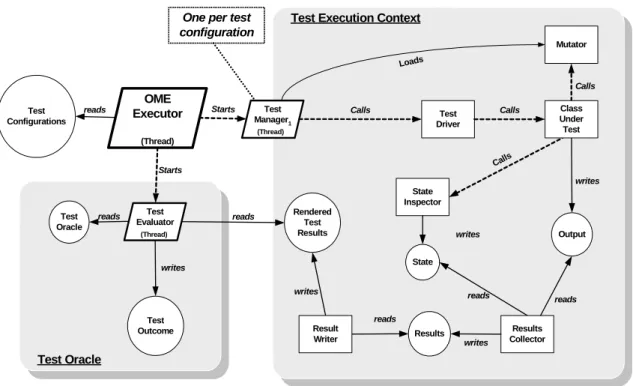
The abstract components of the Object Mutation Engine (OME) architecture are depicted in Figure 3. The parallel-ograms represent separate threads of control, the rectangles represent sequential processes that are executed by a thread, and the circles represent data. The dashed directed line seg-ments between the threads or sequential processes represent control flow. The solid line segments superimposed with a circle represent both control flow and specific types of data flow. This architecture is realized by a Java implementation that provides abstractions and concrete types for each archi-tectural component.
Test Oracle
Test Execution Context
Test Manager1 Test Driver State Inspector Calls Mutator Starts Test Outcome Test Evaluator Calls Test Oracle Calls State Rendered Test Results Test Configurations Results Collector Output Results Class Under Test (Thread) (Thread) (Thread) OME Executor (Thread) Loads Result Writer Starts Calls
One per test configuration reads reads reads reads reads reads writes writes writes writes writes
Figure 3. Architecture of the Object Mutation Engine
As the threads depicted by Figure 3 suggest, the OME is a concurrent system following a master-slave model of com-putation. It is envisaged that the OME will ultimately be-come a distributed system whereby individual tests will be parceled out to different nodes of a network. The objective is to reduce the amount of time required to conduct muta-tion testing, thereby overcoming one of its perceived weak-nesses.
4.1
Execution of the OME
The execution of a single test within the OME begins when the OME Executor reads a test configuration. A test configuration contains parameters that describe the charac-teristics of the Class Under Test (CUT). This includes the fully qualified name of the CUT, the fully qualified name of the test driver to use, the number of locations within the CUT where a mutation operation will be applied, and the set of mutation operators that will be applied.
Upon reading a test configuration, the OME Executor creates a new Test Manager that will configure and run the test. The Test Manager runs on its own thread of execution. When created, it first establishes the environmental condi-tions necessary to execute the test. This includes loading the mutation operators that will be used during the test, and loading the State Inspector that will be used to capture state of the CUT and other objects. The Test Manager then loads
the Test Driver that is specific to the CUT and that will exe-cute the actual test.
When executed, the Test Driver performs initializations that are specific to the test and to the CUT. For example, this might include initializing database connections, staging test data, and so on. After completing initialization, the Test
Driver creates the instance of the CUT that will be tested,
and then executes the test. This is accomplished by making calls into the CUT instance that are necessary to carry out the test. Upon conclusion of the test, the Test Driver performs any cleanup actions necessary and then terminates, returning control to the Test Manager. The Test Manager then signals completion of the test back to the OME Executor and then terminates.
4.2
Variation within the testing process
One of the key objectives of the OME is to provide a gen-eral purpose framework that can support mutation testing of object-oriented programs. To accomplish this, the OME takes into consideration the variation that must necessarily occur due to syntactic and semantic differences in classes. There are five areas in which this variation may occur:
1. Variation in the class C that is the subject of the test: C is referred to generically as the Class Under Test (CUT). The syntactic interface of C and C’s behavior
ome.resultWriters.ResultWriter ome.mutators.Mutator Thread OMEExecutor Thread TestEvaluator ResultsCollector ome.testDrivers.TestDriver ome.inspectors.Inspector ClassUnderTest Thread TestManager
Records the state of a particular type of object.
Writes results in a specified format.
Compares results of mutated subjects with results of original subject.
Manages the entire mutation engine.
Temporarily Stores results (state, console output, etc.) that accumulate during the execution of a test..
Placeholder for the actual class that is the subject of testing.
Manages execution of a single test configuration.
Mutates the state of a object of a particular type T or T's descendants.
Figure 4. UML Class Diagram of OME
are unpredictable. Consequently, it is not possible to write a generic framework that can make any assump-tions about the actual classes that will be tested. 2. Variation in the driver that executes C under the
con-ditions of a test: Because of difficulties in (1), it is not
possible to write a generic test driver that can establish the conditions necessary to execute a test of C. 3. Variation in the operators that are used to mutate the
state of objects that occur during the course of a test:
This too is a consequence of (1). Because the seman-tics of C can specify any behavior, the operations used to mutate instances of C cannot be predicted. Thus, it is not possible to automatically generate mutations without prior knowledge of the required operations and their semantics.
4. Variation in the mechanism that is used to capture the
state of C and related objects: C is a user-defined type
and has a concrete representation that is the foundation of its implementation. Part of this representation will likely include instances of other types, some of which will be scalars (e.g. integers and floating point num-bers). and others will also be user-defined types. Be-cause of the wide variation of types available for use, it is not possible to know in the general case the form in which to capture the internal state of C. For scalar types, a string representation is straightforward, but not
for user-defined types. For example, what should the form be that is used to capture the value (state) of an instance of a carburetor?
5. Variation in the mechanism that collects the output
pro-duced by C during the execution of a test: Ultimately,
programs are written for the output that results from their computation. This output has the potential to take an infinite number of representations. In the simplest case, the output can simply be text written to a console. In more complicated cases, the output could be some-thing in the file system, such as the creation of a new file or modification to an existing file. More complicated cases include modifications to relational databases, or output to a graphical user interface.
The OME accounts for the variation described using mechanisms that isolate and abstract away the physical de-tails of any particular C. The following subsections describe each of these mechanisms and the other components of the OME in detail.
4.3
Components of the OME
As noted at the beginning of section 4, the OME is im-plemented using the Java programming language. Figure 4 depicts a UML class diagram that illustrates a portion of the static structure of the OME’s implementation. In particu-lar, the diagram shows the key abstractions that comprise the
implementation, and their relationships. The following sub-sections describe each of these abstractions in detail.
4.3.1 OME Executor
As depicted in Figure 3, the OME Executor plays the role of a master process that controls the execution of tests. Within the implementation of the OME, it is represented by the class
OMEExecutor, as shown in Figure 4. The primary
respon-sibility of this class is the loading of test configurations and creating corresponding test jobs that will manage the testing activities. To accomplish this, the OMEExecutor creates an instance of TestManager (section 4.3.2) and delegates to it the responsibility for overseeing the execution of a particu-lar test job.
The OMEExecutor also is responsible for initiating one or more processes that will provide a testing oracle func-tion. This is done by creating instances of TestEvaluator, each running on separate threads of control. Upon comple-tion of a test job, the OMEExecutor assigns the responsibil-ity for evaluating the results of the testing activities to an in-stance of TestEvaluator.
4.3.2 Test Manager
As described in section 4.3.1, instances of TestManager oversee the activities associated with a particular test job. A test harness establishes any necessary environmental condi-tions required to support a test, loading the proper instance
T of TestDriver associated with the CUT, providing a
mech-anism for collecting test results (ResultCollector), and mak-ing the mechanisms for state inspection (Inspector) and the rendering of results (ResultsWriter) available to T.
Instances of TestManager must also know which muta-tion operators will be applied during a particular test along with the number of times each mutation operator must be ap-plied (i.e. the number of locations within the CUT). This in-formation is passed from OMEExecutor as part of the test configuration.
4.3.3 State Inspectors and Results Collection
One of the general problems with testing is that of cap-turing the results that must be used to determine the out-come. This problem is worse for OO software due to the decreased observability that results from encapsulation in-formation hiding [19]. A complicating aspect of this prob-lem is that output can occur in many forms, such as di-rect console output, changes to a local file system (e.g. creating/updating/deleting files and directories), updates to databases. In general, there is a plethora of different mech-anisms that can produce output. Thus, it is not possible to write a general purpose mechanism that can capture all forms of output.
To overcome part of these problems (at least for software written in Java), the OME has a family of mechanisms that examine the state of arbitrary types of objects. This family is defined by the class Inspector shown in Figure 4. Each class in this family is capable of inspecting the state of a specific type of object. For example, the OME includes the class
De-faultInspector that provides the capability of inspecting the
state of instances of the most general type java.lang.Object. When a field f is inspected, the type of the object bound to f is used to determine the specific kind of inspector to use. Thus, each type of inspector is written to inspect the state of a specific type of object (referred to as the inspector’s
characteristic type). The inspector that is selected is the one
whose characteristic type is the closest in an inheritance hi-erarchy to the type of the instance bound to the field. Thus, a given inspector may be applicable to a number of differ-ent types of objects (specifically those that are instances of descendants of the inspector’s characteristic type).
If the type of a particular field f in an object being in-spected does not match an existing inspector, an instance of
DefaultInspector is used to capture f ’s value. If f is of a type
unknown to DefaultInspector, its value is rendered using the
toString provided by the class java.lang.Object (this class is
the parent of all other user-defined types in Java). The OME also includes a predefined class StringInspector that is used to capture the state of instances of this type.
Instances of Inspector populate an instance of
ResultCol-lector with the values of the state variables of an arbitrary
object o. The Java Reflection API is used to gain access to o to query its individual fields for their values. These val-ues are rendered as strings and stored as key/value pairs in an instance of ResultCollector. Ambiguities are avoided by having the keys structured as stylized names that include the fully qualified names of the state variables contained in the definition of the actual type of the object bound to o. The keys also embed the type of the field, as illustrated by:
java.lang.System.out[java.io.PrintStream]
Inspectors are used during the testing process by calls embedded in the CUT at locations where the recording of intermediate and final state is required. Typically, the latter will be performed just prior to where control returns from a method that is executed as part of the test.
For capturing other forms of output, specialized types of
ResultCollector can be written that know how to capture the
various forms of output that a given CUT produces. The details of this vary widely from one CUT to the next. The default ResultCollector within the OME has the capability of capturing I/O written to the standard output and standard error devices. This information is buffered in the local file system until the final results of the test are rendered (section 4.3.4).
4.3.4 Results Rendering
Results may be rendered from a given test in a number of dif-ferent ways. The mechanism (ResultsWriter) employed by the OME allows the definition of custom mechanisms that can render test results in any arbitrary form. By default, re-sults are rendered as simple textual representations of the key/value pairs contained in an instance of ResultCollector. The OME also includes a specialized ResultCollector that renders test results and capture output as an XML document. This is then used by the TestEvaluator to determine the test outcome.
4.3.5 Test Drivers
Each CUT C represents a type defined by a distinct syntac-tic unit that has a unique semansyntac-tics. A consequence of this is that writing a general purpose test driver that can be ap-plied to any C is impractical. Such a test driver D would be required to have the capability to establish the environmen-tal conditions for any C, and be able to create instances of C for testing. Given that the set of all C is potentially infinite, writing D would not be possible.
Recognizing that all test drivers can be considered the same from a very abstract perspective, it is possible to define a common interface and associated behaviors that each D would possess. For example, each driver must initialize en-vironmental conditions, load test data, execute one or more tests, and record results. While the specifics of these activi-ties are likely to be different for any two test drivers, all test drivers can be assumed to have these activities and execute them in the same order. This assumption underlies our
Test-Driver abstraction contained within the OME which utilizes
a Template Method design pattern [9] to define the algorithm for executing a test that all test drivers use. Essentially, this algorithm consists of steps that first perform whatever ac-tions are necessary to setup for a test, runs the test, cleans up, and finally records results. Each step is delegated to an ab-stract method that each concrete test driver must implement. Thus, generality in the test driver is achieved by taking ad-vantage of inheritance.
Each concrete test driver has several responsibilities within the OME that must be satisfied. The driver must know how to create the environmental conditions necessary to execute its associated test. This could include creating files, database connections, and so on. The driver must also know where to get its test data from. This could, for exam-ple, be defined within the driver itself, or could exist in a file or external database. Perhaps the most important responsi-bility the driver has is in creating the instance of the CUT that will be used as the test subject.
4.3.6 Mutation Operators
The source code of the CUT is instrumented with calls to mutation operators (and to the instance of Inspector). Calls to mutation operators are inserted within the methods of the CUT at locations that involve objects that are of interest from a testing perspective. Typically, these will be immedi-ately before or after locations that have calls to methods or statements that reference the state of a particular object in some manner. The particular mutation operator used is de-termined by the declared type of the object reference used at a particular location of interest. The basic idea is to create a special mutator class for each type or family of types that need to be mutated. These mutator classes implement a mu-tate method to support fault models relevant to a particular type — interface or class — and make use of the underlying semantics of the type.
Each mutation operator is implemented as a class that is a descendant of the Mutator class, shown in Figure 4. This class specifies the methodmutatethat takes a reference to an instance of java.lang.Object. The characteristic type of a mutator is that of the actual type of the mutation candidate (i.e. the reference that is bound to an object that will be mu-tated). Similar to the use in inspectors (section 4.3.3), the characteristic type is used to identify the types of object that the mutation operator is compatible with. Thus, generality for mutation is achieved by allowing the definition of cus-tom operations that are specific to particular types.
4.3.7 Test Evaluation
Once a test is complete, as described in section 4.3.1, the
OMEExecutor calls on an instance of TestEvaluator to
deter-mine the outcome of a particular test. TestEvaluator, shown in Figure 4, is an abstract class that defines a set of com-mon behaviors and interfaces. This allows for the definition of custom test evaluation mechanisms. This is necessary to achieve generality since the differences in test results and output will have a high degree of variation.
5. Demonstration of OME
We used the OME to mutate a selection of Java programs. The applied mutations include a set of mutators designed to mutate both standard Java library objects and custom mu-tators that can inject faults into user defined class objects. Only a small set of mutators were implemented for this ini-tial demonstration of the OME. The standard library muta-tors include the following:
in ome.mutators.java.util:
– CollectionMutator: seven mutate methods delete
or add an object from or to a Collection, or change the order of the objects in a Collection.
Table 1. Applying the OME to five example programs.
Number of Num Actual Number of Number of
Potential Mutated Mutators Number of Number of Mutants
Program Locations Locations Per Location Tests Mutants Killed
Ant 21,065 16 1–7 2 53 28
Junit 1,478 4 6 1 24 16
GraphPath 142 6 1–7 8 21 10
Paint 323 4 3 13 12 8
MazeGame 1,624 6 3 6 18 12
– ListMutator: two mutators — one deletes the last
element in a List, the other changes the order of List elements.
– VectorMutator: deletes the last object in a Vector. – MapMutator: three mutators — one deletes the
first element, one deletes the last element, and one makes a Map empty.
– IteratorMutator: skips the next object.
in ome.mutators.java.io:
– InputStreamMutator: skips a random number of
bytes in an input stream.
We applied the library mutations and some custom mu-tations to classes in a selection of Java programs including open source programs and programs used for classroom ex-amples and assignments:
Ant: a build tool from Apache. We mutated class org.apache.tools.ant.Project in version 1.4.1 of jakarta-ant. Three library mutators were applied: Collection-Mutator, MapCollection-Mutator, and InputStreamMutator.
Junit: a unit testing framework written by E.
Gamma and K. Beck. We mutated class
ju-nit.framework.TestSuite in Junit 3.7. Collection-Mutator was applied.
GraphPath: finds the shortest path and distance be-tween specified nodes in a directed graph using Dijk-stra’s shortest path algorithm. CollectionMutator, It-eratorMutator, and InputStreamMutator were applied. In addition, a custom mutator modified the length of a graph edge by one.
Paint: calculates the amount of paint needed to paint a house. This program is adapted from a text by Lambert and Osborne [16]. A custom mutator modifies a paint-ing region by addpaint-ing one to the height and/or width.
MazeGame: a game that involves finding and rescuing a hostage in a maze. This was a development assign-ment in a software engineering course. MapMutator was applied.
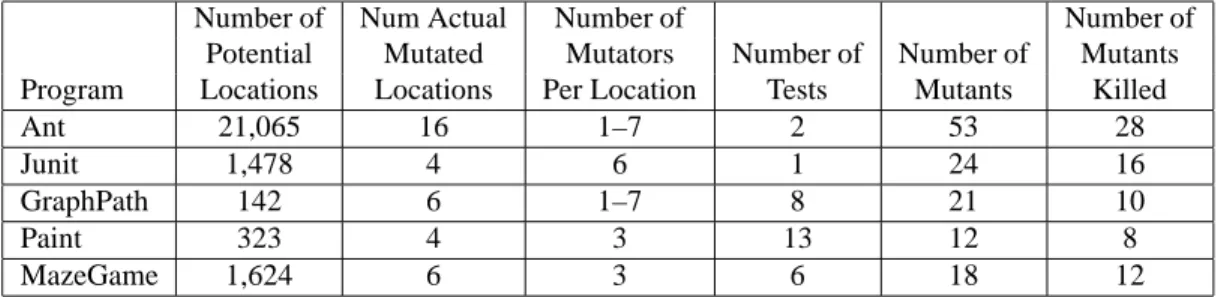
Table 1 shows the number of locations that were mutated and the number of mutators that were generated for each program. Only half of the 128 mutant programs were killed by our test data. We do not claim that our test data was com-prehensive — we did not generate a large number of test cases. However, only a few test cases were needed to kill half of the mutants. It is also clear that the mutations rep-resent plausible errors — the mutants had some chance of surviving the testing process, since half of the mutants re-mained alive.
This demonstration represents only a small fraction of all possible mutations for the selected programs. We mutated only a few locations in one class for each program. This is especially obvious in Ant where we mutated only 16 out of 21,065 possible locations, where each possible location is where a method is called. We leave the problem of how to optimally select locations to mutate as future work. Our ob-jective here is to demonstrate that our methods for mutating objects can be applied to real programs.
6. Conclusions and Future Work
We described a technique for performing mutation anal-ysis on object-oriented programs by injecting faults into ob-jects. Our techniques make mutation work for OO software. We showed that reusable libraries of mutation compo-nents can effectively inject plausible faults into objects that instantiate items from common Java libraries as well as user defined classes. Since Java library items are heavily used in commercial software, our technique should be effective for evaluating the real-world software testing suites. We can also develop custom mutators for user-defined types.
We designed an object mutation engine that implements our technique. We are now assessing the effectiveness of
this technique. The design of the Object Mutation
into running programs, and can be extended to support new fault models. With our techniques and tools, mutation of component-based systems is also possible.
Our next task is to experimentally evaluate the object mu-tation technique. We are investigating the cost of using the mutation framework and the gains of using our mutation technique. From these experiments we will have a better un-derstanding of several issues — scalability, relative fault de-tection capabilities of test suites created using different sets of mutators, and the adaptability of the mutation framework to different application types. We will also be able to de-velop a set of guidelines that will aid the tester in using the object mutation technique on a particular application.
References
[1] H. Agrawal, R. DeMillo, R. Hathaway, W. M. Hsu, W. Hsu, E. Krauser, R. J. Martin, A. Mathur, and E. Spafford. De-sign of Mutant Operators for the C Programming Language. Technical Report SERC-TR-41-P, Software Engineering Re-search Center, Purdue University, West Lafayette, Indiana, March 1989.
[2] J. Bieman, S. Ghosh, R. Alexander. A technique for mutation of Java objects. Proc. Automated Software Engineering (ASE
2001). 2001.
[3] M. E. Delamaro, J. C. Maldonado, M. Jino, and M. L. Chaim. PROTEUM: Uma ferramenta de teste baseada na analise de mutantes (proteum: A test tool based on mutation analysis). In Software Tools Proceedings of the VII Brazilian
Sympo-sium on Software Engineering, October 1993.
[4] M. E. Delamaro, J. C. Maldonado, and A. P. Mathur. Inte-gration Testing Using Interface Mutation. In Proceedings of
International Symposium on Software Reliability Engineer-ing (ISSRE ’96), pages 112–121, April 1996.
[5] R. A. DeMillo, D. S. Guindi, K. N. King, and W. M. Mc-Cracken. An Overview of the Mothra Software Testing En-vironment. Technical Report SERC-TR-3-P, Software Engi-neering Research Center, Purdue University, West Lafayette, Indiana, August 1987.
[6] R. A. DeMillo et al. An Extended Overview of the
MOTHRA Testing Environment. In Workshop of Software
Testing, Verification and Analysis, July 1988.
[7] R. A. DeMillo and A. J. Offutt. Constraint-based Automatic Test Data Generation. IEEE Transactions on Software
Engi-neering, 17(9):900–910, September 1991.
[8] R.-K. Doong and P. G. Frankl. The ASTOOT Approach
to Testing Object-Oriented Programs. ACM Transactions
on Software Engineering and Methodology, 3(2):101–130,
April 1994.
[9] E. Gamma, R. Helm, J. R., and J. Vlissides. Design Patterns:
Elements of Reusable Object-Oriented Software.
Addison-Wesley, Reading MA, 1995.
[10] S. Ghosh and A. P. Mathur. “Interface Mutation”. Journal
of Software Testing, Verification and Reliability, 11(4):227–
247, December 2001.
[11] J. B. Goodenough and S. L. Gerhart. Toward a theory of test data selection. IEEE Transactions on Software Engineering, 1(2):156–173, 1975.
[12] S. Kim, J. A. Clark, and J. A. McDermid. “The Rigorous Generation of Java Mutation Operators Using HAZOP”. In
Proceedings of the 12th International Conference on Soft-ware and Systems Engineering and their Applications (IC-SSEA’99), Paris, France, December 1999.
[13] S. Kim, J. A. Clark, and J. A. McDermid. “Class Mutation: Mutation Testing for Object Oriented Programs”. In
Pro-ceedings of the FMES 2000, 2000.
[14] S. Kirani and W. T. Tsai. “Method Sequence Specification
and Verification of Classes”. Journal of Object-Oriented
Programming, pages 28–38, October 1994.
[15] D. Kung, J. Gao, P. Hsia, F. Wen, Y. Toyoshima, and C. Chen. “Change Impact Identification in Object Oriented Software Maintenance”. In Proceedings of IEEE International
Con-ference on Software Maintenance, pages 202–211, 1994.
[16] K. Lambert and M. Osborne. Java: Complete Course in
Pro-gramming and Problem Solving. ITP Press. 1998.
[17] A. P. Mathur and W. E. Wong. A Theoretical Comparison Between Mutation and Data Flow Based Criteria. In
Pro-ceedings 22nd Annual ACM Computer Science Conference on scaling up: meeting the challenge of complexity in real-world computing applications, pages 38–45, Phoenix,
Ari-zona, USA, March 8-10 1994.
[18] A. J. Offutt, J. Voas, and J. Payne. Mutation Operators for
Ada. Technical Report ISSE-TR-96-09, Information and
Software Systems Engineering, George Mason University, Fairfax, Virginia, March 1996.
[19] J.E. Payne, R.T. Alexander, and C.D. Hutchinson. Design-for-Testability for Object-Oriented Software. Object
Maga-zine. pp. 34-43, 1997.
[20] J. M. Voas and G. McGraw. Software Fault Injection:
In-noculating Programs Against Errors. John Wiley and Sons,
January 1998.
[21] J. M. Voas and K. W. Miller. “Software Testability: The New Verification”. IEEE Software, pages 17–28, May 1995.