CEC Theses and Dissertations College of Engineering and Computing
2015
Incremental Sparse-PCA Feature Extraction For
Data Streams
Jean-Pierre Nziga
Nova Southeastern University,[email protected]
This document is a product of extensive research conducted at the Nova Southeastern UniversityCollege of Engineering and Computing. For more information on research and degree programs at the NSU College of Engineering and Computing, please clickhere.
Follow this and additional works at:http://nsuworks.nova.edu/gscis_etd
Part of theDatabases and Information Systems Commons, and theInformation Security Commons
Share Feedback About This Item
This Dissertation is brought to you by the College of Engineering and Computing at NSUWorks. It has been accepted for inclusion in CEC Theses and Dissertations by an authorized administrator of NSUWorks. For more information, please [email protected].
NSUWorks Citation
Jean-Pierre Nziga. 2015.Incremental Sparse-PCA Feature Extraction For Data Streams.Doctoral dissertation. Nova Southeastern University. Retrieved from NSUWorks, College of Engineering and Computing. (365)
Incremental Sparse-PCA Feature Extraction For Data Streams
By
Jean-Pierre Nziga
A dissertation submitted in partial fulfillment of the requirements for the degree of Doctor of Philosophy
in
Computer Information Systems
College of Engineering and Computing Nova Southeastern University
We hereby certify that this dissertation, submitted by Jean-Pierre Nziga, conforms to acceptable standards and is fully adequate in scope and quality to fulfill the dissertation requirements for the degree of Doctor of Philosophy.
_____________________________________________ ________________
James Cannady, Ph.D. Date
Chairperson of Dissertation Committee
_____________________________________________ ________________
Paul Cerkez, Ph.D. Date
Dissertation Committee Member
_____________________________________________ ________________
Rita M. Barrios, Ph.D. Date
Dissertation Committee Member
Approved:
_____________________________________________ ________________ Amon B. Seagull, Ph.D. Date
Interim Dean, College of Engineering and Computing
College of Engineering and Computing
Nova Southeastern University
An Abstract of a Dissertation Submitted to Nova Southeastern University in Partial Fulfillment of the Requirements for the Degree of Doctor of Philosophy
Incremental Sparse-PCA Feature Extraction For Data Streams
ByJean-Pierre Nziga October 2015
Intruders attempt to penetrate commercial systems daily and cause considerable financial losses for individuals and organizations. Intrusion detection systems monitor network events to detect computer security threats. An extensive amount of network data is devoted to detecting malicious activities.
Storing, processing, and analyzing the massive volume of data is costly and indicate the need to find efficient methods to perform network data reduction that does not require the data to be first captured and stored. A better approach allows the extraction of useful variables from data streams in real time and in a single pass. The removal of irrelevant attributes reduces the data to be fed to the intrusion detection system (IDS) and shortens the analysis time while improving the classification accuracy. This dissertation introduces an online, real time, data processing method for knowledge extraction.
This incremental feature extraction is based on two approaches. First, Chunk Incremental Principal Component Analysis (CIPCA) detects intrusion in data streams. Then, two novel incremental feature extraction methods, Incremental Structured Sparse PCA (ISSPCA) and Incremental Generalized Power Method Sparse PCA (IGSPCA), find malicious elements. Metrics helped compare the performance of all methods.
The IGSPCA was found to perform as well as or better than CIPCA overall in term of dimensionality reduction, classification accuracy, and learning time. ISSPCA yielded better results for higher chunk values and greater accumulation ratio thresholds. CIPCA and IGSPCA reduced the IDS dataset to 10 principal components as opposed to 14 eigenvectors for ISSPCA. ISSPCA is more expensive in terms of learning time in comparison to the other techniques.
This dissertation presents new methods that perform feature extraction from continuous data streams to find the small number of features necessary to express the most data variance. Data subsets derived from a few important variables render their interpretation easier.
Another goal of this dissertation was to propose incremental sparse PCA algorithms capable to process data with concept drift and concept shift. Experiments using
WaveForm and WaveFormNoise datasets confirmed this ability. Similar to CIPCA, the ISSPCA and IGSPCA updated eigen-axes as a function of the accumulation ratio value, forming informative eigenspace with few eigenvectors.
Acknowledgments
This work would not have been possible without the support and help of many people. The author would like to express his gratitude to all those who contributed to the completion of this degree.
I am particularly thankful to my committee chair, Professor James Cannady for his
guidance, assistance and patience throughout the dissertation process. I am also extending my appreciation to my committee members, Dr. Paul Cerkez for his advice and multiple revisions of this dissertation, Dr. Rita Barrios for her critique and valuable suggestions. I am grateful to my entire family and friends for their encouragement and support over the years through the completion of this dissertation work.
I am very grateful to my wife, Dr. Yolande Nziga for her encouragement and assistance during this Ph.D. program.
vi
Table of Contents
Abstract iii
Acknowledgement v Table of Contents vi List of Tables viii List of Figures x Chapters
1. Introduction 1
Problem Statement and Goal 2 Relevance and Significance 3 Barriers and Issues 5
Definitions of Terms 6 List of Acronyms 7
Summary 8
2. Review of the Literature 9
Feature Selection 10 Feature Extraction 13
Linear Dimensionality Reduction Techniques 13
Global Nonlinear Dimensionality Reduction Techniques 15 Local Nonlinear Dimensionality Reduction Techniques 19 Incremental Dimensionality Reduction Approaches 21
3. Methodology 32
Overview of Research Methodology 33
Phase 1. Chunk Incremental Principal Component: Application to Network Data Streams 34
Phase 2. Sparse Principal Component Analysis 39
Phase 3. Incremental Structured Sparse Principal Component Analysis
(ISSPCA) 41
Phase 4. Incremental Generalized Power Method Sparse Principal Component Analysis (IGSPCA) 45
Phase 5. Incremental Sparse Principal Component Analysis: Impact of Concept Drift and Concept Shift 50
Data Sets 51
Experimental Setup 52
Measures 53
vii
4. Results, Data Analysis, and Summary 55
Introduction 55
Intrusion Detection Dataset 56 PokerHand Dataset 80
WaveForm Dataset 86
WaveFormNoise Dataset 92
Incremental Sparse Principal Component Analysis: Impact of Concept Drift and Concept Shift 98
5. Conclusions and Summary 104
Summary 106
References 108
viii List of Tables Tables
1. Datasets Used to Evaluate Algorithms 56
2. Intrusion Detection Dataset: mpact of Chunk Size on Dimensionality, θ = 0.9 58
3. Intrusion Detection Dataset: Impact of Chunk Size on Classification Accuracy, θ = 0.9 60
4. Intrusion Detection Dataset: Impact of Chunk Size on Learning Time, θ = 0.9 61
5. Intrusion Detection Dataset: Impact of Accumulation Ratio on Dimensionality, L =
500 63
6. Intrusion Detection Dataset: Impact of Accumulation Ratio on Classification Accuracy, L = 500 65
7. Intrusion Detection Dataset: Impact of Accumulation Ratio on Learning Time, L = 500 66
8. Intrusion Detection Dataset: Impact of Chunk Size on Dimensionality, θ = 0.7 68
9. Intrusion Detection Dataset: Impact of Chunk Size on Classification Accuracy, θ =
0.7 70
10. Intrusion Detection Dataset: Impact of Chunk Size on Learning Time, θ = 0.7 72
11. Intrusion Detection Dataset: Impact of Initial Data on Dimensionality, θ = 0.7 and L = 500 74
12. Intrusion Detection Dataset: Impact of Initial Data on Classification Accuracy, θ = 0.7 and L = 500 75
13. Intrusion Detection Dataset: Impact of Initial Data on Learning Time, θ = 0.7 and L =
500 77
14. Intrusion Detection Dataset: Input Variables Contributing in Data Reduction 78 15. PokerHand Dataset: Impact of Chunk Size on Dimensionality, θ = 0.3 82 16. PokerHand Dataset: Impact of Chunk Size on Classification Accuracy, θ = 0.3
83
ix
18. WaveForm Dataset: Impact of Chunk Size on Dimensionality, θ = 0.8 87 19. WaveForm Dataset: Impact of Chunk Size on Classification Accuracy, θ = 0.8
89
20. WaveForm Dataset: Impact of Chunk Size on Learning Time, θ = 0.8 90 21. WaveFormNoise Dataset: Impact of Chunk Size on Dimensionality, θ = 0.4 93 22. WaveFormNoise Dataset: Impact of Chunk Size on Classification
Accuracy, θ = 0.4 94
23. WaveFormNoise Dataset: Impact of Chunk Size on Learning Time, θ = 0.4 95
24. WaveFormNoise Dataset: Input Variables Contributing in Data Reduction 96
25. WaveFormNoise_ConceptShift Dataset: Impact of Chunk Size on Classification Accuracy, θ = 0.4 100
26. WaveFormNoise_ConceptShift Dataset: Impact of Chunk Size on Learning Time, θ = 0.4 101
27. WaveFormNoise_ConceptShift Dataset: Input Variables Contributing in Data Reduction 102
28. WaveFormNoise_ConceptShift: Performance Comparison 103
x List of Figures Figures
1. A Network System with an IDS 32
2. Chunk Incremental PCA Approach 34
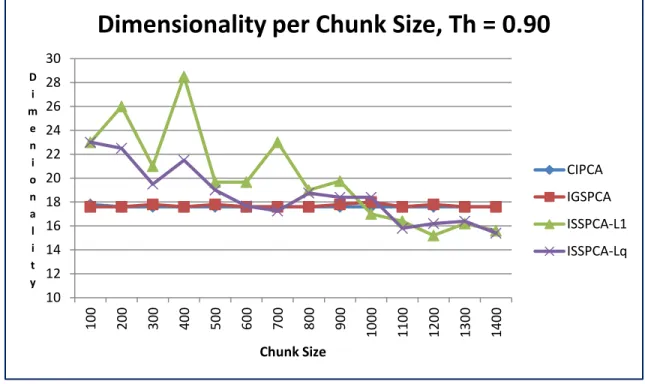
3. Intrusion Detection Dataset: Impact of Chunk Size on Dimensionality, θ = 0.9 59
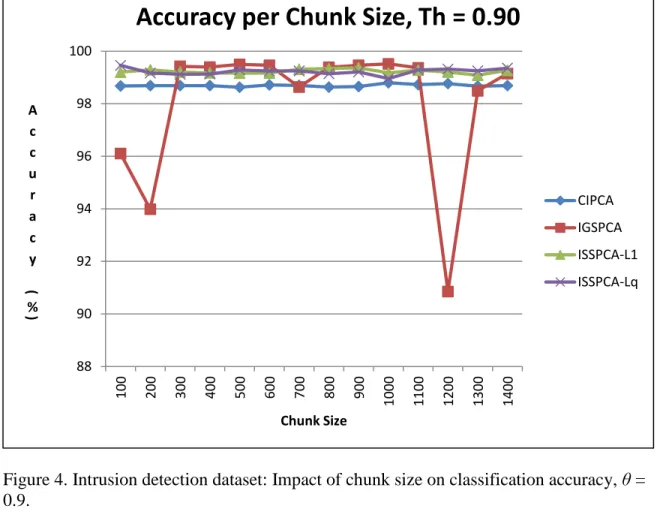
4. Intrusion Detection Dataset: Impact of Chunk Size on Classification Accuracy, θ =
0.9 61
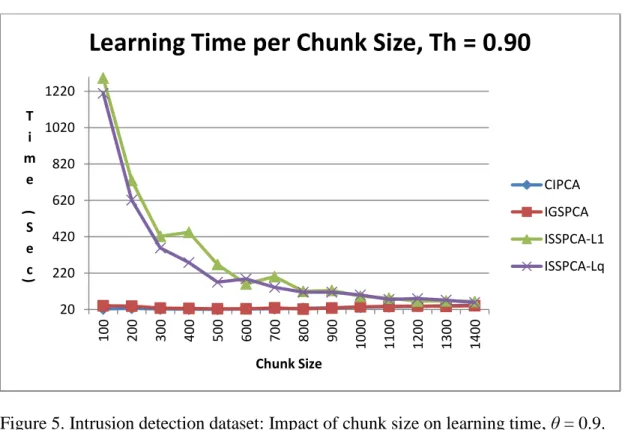
5. Intrusion Detection Dataset: Impact of Chunk Size on Learning Time, θ = 0.9 62
6. Intrusion Detection Dataset: Impact of Accumulation Ration on Dimensionality, L =
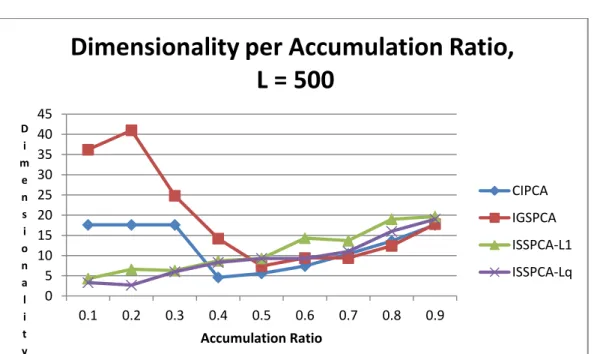
500 64
7. Intrusion Detection Dataset: Impact of Accumulation Ratio on Classification Accuracy, L = 500 66
8. Intrusion Detection Dataset: Impact of Accumulation Ratio on Learning Time, L = 500 67
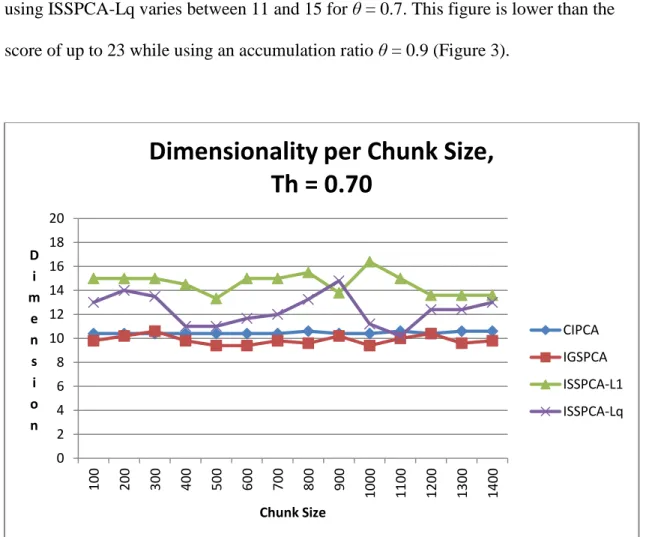
9. Intrusion Detection Dataset: Impact of Chunk Size on Dimensionality - θ = 0.7 69
10. Intrusion Detection Dataset – Impact of Chunk Size on Classification Accuracy, θ =
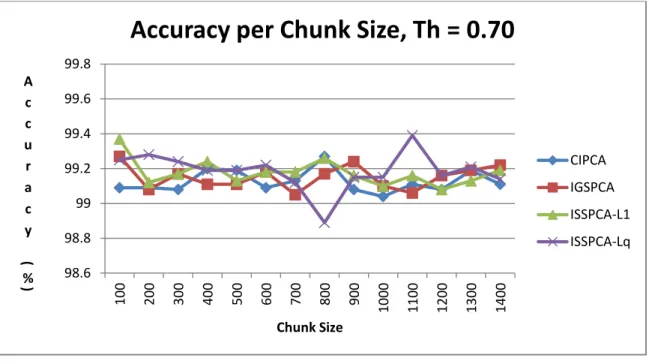
0.7 71
11. Intrusion Detection Dataset: Impact of Chunk Size on Learning Time, θ = 0.7 73
12. Intrusion Detection Dataset: Impact of Initial Data on Dimensionality, θ = 0.7 and L = 500 74
13. Intrusion Detection Dataset: Impact of Initial Data on Classification Accuracy, θ = 0.7 and L = 500 76
14. Intrusion Detection Dataset: Impact of Initial Data on Learning Time, θ = 0.7 and L = 500 77
15. Intrusion Detection Dataset: Input Variables Contributing in Data Reduction 79
16. PokerHand Dataset: Impact of Chunk Size on Dimensionality, θ = 0.3 82 17. PokerHand Dataset: Impact of Chunk Size on Classification Accuracy, θ = 0.3
xi
18. PokerHand Dataset: Impact of Chunk Size on Learning Time, θ = 0.3 85
19. WaveForm Dataset: Impact of Chunk Size on Dimensionality, θ = 0.8 88 20. WaveForm Dataset: Impact of Chunk Size on Classification Accuracy, θ = 0.8
89
21. WaveForm Dataset: Impact of Chunk Size on Learning Time, θ = 0.8 91 22. WaveFormNoise Dataset: Impact of Chunk Size on Dimensionality, θ = 0.4 93 23. WaveFormNoise Dataset: Impact of Chunk Size on Classification Accuracy, θ = 0.4
94
24. WaveFormNoise Dataset: Impact of Chunk Size on Learning Time, θ = 0.4 95
25. WaveFormNoise Dataset: Input Variables Contributing in Data Reduction 97 26. WaveFormNoise_ConceptShift Dataset: Impact of Chunk Size on Dimensionality,
θ = 0.4 100
27. WaveFormNoise_ConceptShift Dataset: Impact of Chunk Size on Classification Accuracy, θ = 0.4 101
28. WaveFormNoise_ConceptShift Dataset: Impact of Chunk Size on Learning Time, θ = 0.4 103
Chapter 1
Introduction
Operational information systems such as web traffic, face recognition programs, sensor measurements, and surveillance continuously generate large amounts of data to be mined for pattern discovery. Applications such as network intrusion detection systems (IDS) generate continuous streams of data to be analyzed in real time (Akhtar, 2011). Extracting useful knowledge from data streams is a difficult task. Existing approaches store the whole data off-line before analysis in a batch mode (Hebrail, 2008).
Batch processing of static datasets impacts the processing speed and requires large memory capacity, resulting in the necessity to develop methods to extract meaningful features from continuous data streams in real time (Chandrika & Kumar, 2011). An efficient algorithm should extract the optimal fraction of data elements sufficient to improve the analysis performance and obtain insights from systems under consideration. Existing data patterns need to be updated as new streams arrive.
Incremental principal component analysis (PCA) approaches have been proposed with the expectation to achieve the dimensionality reduction of data streams. PCA reduces dimensionality by projecting the dataset onto principal subsets to find
components that display the maximum data variance (Nziga, 2011; Nziga & Cannady, 2012). Leading principal components are linear combinations of all the original variables, rendering their interpretation difficult. A successful dimensionality reduction technique that finds principal components with maximum variance of the dataset while combining
few variables improves the interpretability and analysis of the data. In intrusion detection, it would be greatly beneficial to retrieve and analyze just the subset of variables to detect network unauthorized accesses. This result can be obtained with a method based on sparse PCA.
Sparse PCA produces modified principal components with sparse loadings (Zou, Hastie, & Tibshirani, 2006); each component is modeled as a linear combination of the subset’s original attributes. However, the sparse PCA algorithms proposed so far process only static datasets. In order to reduce the dimensionality of continuous data streams, this dissertation describes incremental sparse PCA techniques. This dissertation presents the experimental results of using the sparse PCA methods on several datasets and comparing them to the output of the chunk incremental PCA algorithm.
Problem Statement and Goal
Mining of non-stopping data streams is computationally challenging. Existing feature selection and attributes extraction approaches perform poorly in locating relevant features from data streams that grow without a limit at a rate of several million or billion records per day (Domingos & Hulten, 2000). Traditional feature selection algorithms are designed and tuned for applications, requiring that the data be stored prior to processing off-line. Increasing numbers of applications, such as network intrusion detection systems, telecommunications, real-time surveillance, sensor networks, stock market tracking systems, road traffic analysis, and weather forecasting systems generate continuous streams of data to be processed online and in real time for knowledge extraction. The
goal of this research was to implement improved methods that perform feature extraction from these continuous data streams.
Relevance and Significance
The tremendous increase in the amount of data produced in operational information systems such as web traffic, face recognition programs, sensor measurements, surveillance, and so on renders their mining for finding useful and unknown patterns difficult using the old paradigm of storing data before analysis
(Hebrail, 2008). Furthermore, a plethora of feature extraction approaches proposed in the literature are inefficient solutions for continuous streams of data because of their reliance on static datasets or pre-available sets of data in a batch mode (Aboalsamh, Mathkour, Assassa, & Mursi, 2009; Dagher, 2010; Ohta & Ozawa, 2009; Ozawa, Pang, & Kasabov, 2008; Ozawa, Takeuchi, & Abe, 2010). Therefore, data streams cannot be mined for knowledge using algorithms developed for static datasets. Continuous data streams are captured in real time and fed to systems for online analysis. It is important to develop methods capable of extracting relevant features from continuous data streams in real time. Achieving this goal will address the limitations of existing feature selection approaches (offline processing of static dataset in a batch mode, poor processing speed, high memory requirement, and poor performance with large amount of data).
Contrary to previous studies of dimensionality reduction, which process static datasets in a batch and offline mode, this research focused on processing large and continuous numbers of data streams generated by applications such as network intrusion detection systems and consisting of millions or billions of records per day to extract the
embedded knowledge and take appropriate action in a timely manner (Chandrika & Kumar, 2011). Dimensionality reduction is the process of reducing the number of random variables under consideration (Roweis & Saul, 2000). The process can be divided into feature selection and feature extraction. Feature selection techniques find a subset of the original variables or attributes. Feature extraction approaches, on the other hand,
transform high-dimensional space data to a space of fewer dimensions. Challenges of mining data streams include minimizing resources requirements while providing
acceptable results. The purpose of this research was to introduce a method that finds the minimum amount of relevant data from continuous data streams, resulting in a successful knowledge extraction and behavioral interpretations of applications under consideration. This algorithm will dynamically extract the optimal fraction of data elements sufficient to improve the analysis performance and obtain insights from the systems under analysis.
This research began by leveraging some incremental feature extraction
approaches previously proposed for facial recognition applications (Aboalsamh et al., 2009; Ding, Tian, & Xu, 2009; Ozawa et al., 2008; Tokumoto & Ozawa, 2011; Yan & Liu, 2012). Facial recognition systems aim to automatically identify a person using facial features from large database of images. The approach in this research is capable of extracting features from continuous computer network data streams. Performance metrics of this approach, such as accuracy, speed, and memory use, were compared to those of well-known features extraction algorithms, using a real-world application such as network data for intrusion detection.
This study’s feature extraction methods should be efficient and capable of
streams (Chandrika & Kumar, 2011; Kholghi & Keyvanpour, 2011).Sliding window and forgetting factor approaches are considered to account for changes in data streams if necessary. Sliding window technique limits the amount of data streams being fed to the learner. It is a deterministic approach that prevents stale data from influencing the data analysis. Sliding window is popularly considered when handling evolving data (Bifet & Gavaldà, 2006, 2007; Datar, Gionis, Indyk, & Motwani, 2002; Guha & Koudas, 2002; Ikonomovska, Gorgevik, & Loskovska, 2007); forgetting factor moderates the balance between old and new observations (Levy & Lindenbaum, 2000). This is achieved by multiplying the previous singular values at each update by a scalar factor f∊ [0, 1].
Barriers and Issues
The majority of dimensionality reduction approaches proposed in the literature are designed to statically process a previously collected dataset (Chandrika & Kumar, 2011; Kholghi & Keyvanpour, 2011). However, an increasing number of applications such as network intrusion detection systems, stock market, sensor networks, telecommunication systems, and web applications generate continuous streams of data to be processed and analyzed in real time in order to react accordingly. Researchers, increasingly interested in online data extraction techniques and algorithms, have recently proposed incremental dimensionality reduction to improve facial recognition systems by analyzing the data stream instead of static datasets (Aboalsamh et al., 2009; Ding et al., 2009; Ozawa et al., 2008; Tokumoto & Ozawa, 2011; Yan & Liu, 2012). A facial recognition system is a computer application that aims to identify a person from a digital image automatically. Recognition is achieved by comparing facial features extracted from an image using
algorithms to a facial database. The majority of facial recognition systems use one of the following algorithms for features extraction: PCA, LDA, hidden Markov model, or the multi-linear subspace learning. Similarly, intrusion detection systems extract relevant features from computer network data stream as a pre-processing step to pattern matching phase to keep intruders out.
Feature extraction algorithms designed for data streams that have yielded great results in other fields of research, such as chunk incremental principal component analysis, were implemented for the purpose of this research. Another issue considered in this research was the fact that one-pass incremental learning presents two important problems, as noted by Ozawa et al. (2008). First, the data stream is continuous; hence, it is impossible to keep part of training data to be utilized for learning. Moreover, the distribution of data is unknown, making it difficult to extract essential features only from initial training samples.
Definitions of Terms
Term Definition
Dimensionality reduction Process of reducing the number of random variables under consideration
Facial recognition system Computer application that identifies a person from digital image, comparing facial features extracted from an image using algorithms to a facial database
Feature extraction Transform high-dimensional space data to a space of fewer dimensions
Feature selection Find a subset of the original variables or attributes Forgetting factor Moderate the balance between old and new observations Sliding window technique Limit the amount of data streams being fed to the learner
List of Acronyms Acronym Definition
ACO-SA Ant Colony Optimization and Simulated Annealing ACOMI Ant-Colony Optimization and Mutual Information BCD Block Coordinate Descent
CCIPCA Candid Covariance-free IPCA
CIPCA Chunk Incremental Principal Component
DM Diffusion Maps
DSPCA Semi-definite programming Sparse Principal Component Analysis FastMVU Fast Maximum Variance Unfolding
GDA Generalized Discriminant Analysis
GPSPCA Generalized Power Method Sparse Principal Component Analysis HLLE Hessian Local Linear Embedding
IDS Intrusion Detection Systems
IGSPCA Incremental Generalized Power Method Sparse Principal Component Analysis
IKPCA Incremental Kernel Principal Component Analysis ILDA Incremental Linear Discriminant Analysis
IPCA Incremental Principal Component Analysis
IRFLD Incremental Recursive Fisher Linear Discriminant ISPCA Incremental Sparse Principal Component Analysis
ISSPCA Incremental Structured Sparse Principal Component Analysis KPC Kernel Principal Components
KPCA Kernel Principal Component Analysis LDA Linear Discriminant Analysis
LE Laplacian Eigenmaps
LLE Local Linear Embedding LTSA Local Tangent Space Analysis MCA Minor Components Analysis MDS Multi-Dimensional Scaling
MI Mutual Information
mRMR minimum-Redundancy Maximum-Relevancy PCA Principal Component Analysis
PSO-MI Particle Swarm Optimization method and Mutual Information RFLD Recursive Fisher Linear Discriminant
SEA Streaming Ensemble Algorithm SFA Slow Feature Analysis
SNE Stochastic Neighbor Embedding SPCA Sparse Principal Component Analysis SPE Stochastic Proximity Embedding
SSPCA Structured Sparse Principal Component Analysis SVD Singular Value Decomposition
SVM-RFE Support Vector Recursive Feature Elimination
T-IKPCA Takeuchi Incremental Kernel Principal Component Analysis
Summary
Operational information systems generate continuous large amount of data to mine for knowledge discovery. Irrelevant and redundant attributes slow down the learning process and consume more computing resources. Dimensionality reduction contributes to reduce the number of random variables under consideration (Roweis & Saul, 2000).
PCA analyzes the interdependency between attributes to map the data to a lower dimensional space (because the size of attributes are lower than in the original dataset), such that the variance of the data in the low-dimensional representation is maximized. Unfortunately, PCA lacks sparseness of the principal vectors. Sparse principal component analysis (SPCA) addresses these limitations by modifying principal components with sparse loadings. SPCA methods adjust the PCA approaches by injecting sparseness into the loading vectors, similar to regularization methods, which inject sparseness to the parameter estimates in the regression setting.
This dissertation presents an incremental SPCA approach to extract features from data streams in real time. The goal was to find the minimum fraction of the original data that provides the maximum insight about the application under consideration. Metrics used in this dissertation have been representative and useful as benchmarks for comparison in well-known research studies.
Chapter 2
Review of the Literature
The high volume of data generated by today’s applications makes training and testing using classification methods difficult. Irrelevant and redundant attributes slow down the learning process, confuse learning algorithms, and consume more resources while increasing the classifier’s risk of over-fitting (Yu & Lui, 2003). Kohavi and John (1997) demonstrated that redundant and irrelevant features negatively impact the prediction accuracy of machine learning algorithms. The research community continues to develop data mining and machine learning algorithms for data pre-processing,
classification, clustering, association rules, and virtualization. Feature selection techniques are extensively used for pattern recognition in data preprocessing, data mining, and machine learning to remove redundant and irrelevant features from high dimensional datasets in order to select a subset of relevant features to build robust
learning models (Fukunaga, 1990). Feature extraction is another dimensionality reduction approach that transforms high-dimensional space data to a space of fewer dimensions. The purpose of the dimensionality reduction goal is to reduce the number of random variables under consideration (Roweis & Saul, 2000).
Feature Selection
According to Lui and Yu (2005), the large majority of feature selection
Wrapper-based feature selection methods validate the goodness of a subset of features using a learning algorithm, as opposed to the filter-based feature selection algorithms that use metrics to assess the usefulness of any single feature (Guyon & Elisseeff, 2003). The process ends when an optimal set of algorithms is generated. Wrapper selection methods search for possible features through the dataset using search algorithms with the subset being constantly evaluated. By using a learning algorithm for features selection, wrapper methods are more accurate than filter methods. The main drawbacks of wrapper-based algorithms are their requirement for vast computational resources, in addition to their operation risk of over fitting the learning algorithm (Kohavi & John, 1997; Kohavi & Sommerfield, 1995).
Filter-based feature selection algorithms use metrics to classify each feature. Low ranking features are eliminated (Ahmad, Norwawi, Deris, & Othman, 2008). The intrinsic characteristic of the data is considered in evaluating the fitness of the feature subset. Filter-based feature selection techniques do not use a learning algorithm and require fewer computer resources. However, the resulting subset of features may not be good matches for classification algorithms (Zhu, Ong, & Dash, 2007).
Hybrid-feature selection methods assess the validity of subsets from the original dataset using an independent measure in conjunction with a learning algorithm (Das, 2001; Lui & Yu, 2005). There are many examples of this method in the literature. C.-K. Zhang and Hu (2005) proposed a hybrid-feature selection based on ant-colony optimization and mutual information (ACOMI) for forecasters at the Australian Bureau of Meteorology. Ant-colony optimization is used to find colonies between data points. The results were
better than either of the individual ant-colony optimization or mutual information approaches.
Khushaba, Al-Ani, and Al-Jumaily (2007) proposed a feature-selection algorithm based on a mixture of particle swarm optimization method and mutual information (PSO-MI). PSO-MI showed an improved accuracy on a dataset of transient myoelectric signal, compared to particle swarm optimization or mutual information used separately. Y. Zhang, Ding, and Li (2007) presented a two-stage selection algorithm by combining ReliefF and minimum-Redundancy Maximum-Relevancy (mRMR) for gene expression data. The authors performed experiments comparing the mRMR-ReliefF selection algorithm with ReliefF, mRMR, and other feature selection methods using two
classifiers: Support Vector Machine (SVM) and Naive Bayes. The authors used seven different datasets. According to the authors, experiments showed improved results using mRMR-ReliefF algorithm for gene selection compared to that of mRMR or ReliefF used separately.
Firouzi, Niknam, and Nayeripour (2008) proposed a hybrid evolutionary
algorithm based on the combination of ant colony optimization and simulated annealing (ACO-SA). The researchers chose cluster center with the help of ACO and SA in order to achieve global optima. Ant colony optimization is used to find colonies between data points. Simulated annealing is a good local search algorithm for finding the best global position using the cumulative probability. Michelakos, Papageorgiou, and
Vasilakopoulos (2010a) proposed a hybrid algorithm combining the cAnt-Miner2 and the mRMR feature selection algorithms. cAnt-Miner2 algorithm (Michelakos, Papageorgiou, & Vasilakopoulos, 2010b) is an extended approach of coping with continuous attributes
introduced by the cAnt-Miner algorithm. cAnt-Miner algorithm (Otero, Freitas, & Jonhson, 2008) is an extension of Ant-Miner (Parpinelli, Lopes, & Freitas, 2002). Ant-Miner copes with continuous attributes and therefore incorporates an entropy-based discretization method during the rule construction process. cAnt-Miner creates discrete intervals for continuous attributes on the fly and does not require a discretization method for preprocessing. Experimental results of the combination of cAnt-Miner2 and mRMR using public medical data sets yielded improved results
compared to that of cAnt-Miner2 only. The proposed combination was better in terms of accuracy, simplicity, and computational cost compared to the original cAnt-Miner2 algorithm.
Mundra and Rajapakse (2010) proposed the support vector recursive feature elimination (SVM-RFE) for gene selection incorporating an mRMR filter. According to the authors, the approach improved the identification of cancer tissue from benign tissues on several benchmark datasets because it accounted for the redundancy among the genes compared to mRMR or SVM-RFE separately. Hossain, Pickering, and Jia (2011)
proposed an approach for hyper-spectral data dimensionality reduction based on a
measure of mutual information (MI) and principal components analysis (PCA) called MI-PCA, using a mutual information measure to find principal components, which are spatially most similar to all the target classes. The authors conducted experiments using hyper-spectral data with 191 bands covering the Washington, DC, area; results showed that two features selected from 191 using MI-PCA provided 98% and 93% classification accuracy for training and test data respectively, with a support vector machines classifier. Feature Extraction
Other researchers considered feature extraction over feature selection for dimensionality reduction purposes (Agrafiotis, 2003; Donoho & Grimes, 2005;
Duraiswami & Raykar, 2005; Hoffmann, 2007; Huber, Ramoser, Mayer, Penz, & Rubik, 2005; K. I. Kim, Jung, & Kim, 2002; Shawe-Taylor & Christianini, 2004; Zou et al., 2006). Feature extraction converts the data in the high-dimensional space to a lower dimensional space. Van der Maaten, Postma, and van den Herik (2009) compared several of these dimensionality reduction techniques in a technical report as described below.
Linear Dimensionality Reduction Techniques Principal Component Analysis
Principal component analysis (PCA) is a linear method that reduces data dimensionality by performing a covariance analysis between factors as described by Hotelling (1933) and Pearson (1901) in their seminal works. PCA analyzes the
interdependency between pairs of attributes to identify significant ones and performs a linear mapping of the data to a lower dimensional space (size of attributes lower than in the original dataset) such that the variance of the data in the low-dimensional
representation is maximized. PCA constructs the data correlation matrix and computes eigenvectors matrixes. Eigenvectors that correspond to largest principal components are used to reconstruct a large fraction of the variance of the original data.
The goal of PCA is to find the matrix/vector Y such that:
Y = w X
(1)Where: Y = m-dimensional projected vector X = the original d-dimensional data vector
w
= an m-by-m matrix where columns are the eigenvectors ofX
TX
The m projection vectors maximizing the variance of Y are derived from the eigenvectors e1, e2, e3… em of the data set’s covariance matrix Eassociated with the largest m eigenvalues.
The data covariance matrix is the following:
E =
(2)
The eigenvectors and eigenvalues are obtained by solving the following equations:
(E - λ
iI)e
i= 0, I = 1, …,d
(3)
PCA has shown great performance in various applications such as face recognition (Turk & Pentland, 1991), coin classification (Huber et al., 2005), and seismic series analysis (Posadas et al., 1993). PCA shows some limitations if the data has a very high dimension. For example, the computation of the eigenvectors might not be possible because the size of the covariance is proportional to the dimensionality of the data point. Therefore, performing PCA can be costly. An N dimensional matrix requires N3 matrix inversion operations. Also, N2 operations are required to store covariance matrix (Hotelling, 1933; Pearson, 1901).
PCA has shown great performance in various applications, including network intrusion detection (Nziga, 2011; Nziga & Cannady, 2012). However, the algorithms developed in these publications require that the data be stored and processed in a batch mode.
Linear Discriminant Analysis
Linear discriminant analysis (LDA) is a supervised technique that maximizes the linear reliability between data of different classes (Fisher, 1936). LDA finds linear mapping, maximizing the linear class separability in the reduced dimensionality of the data. Similar to PCA, LDA looks for linear combinations of variables that best represent the data. LDA models the difference between the classes of data. PCA does not take into account any difference in class. LDA’s performance is optimal when dealing with continuous variables (variables with numeric values). LDA projections of continuous variables preserve complex structure in data for classification. LDA has shown improved classification results of large datasets in various applications such as speech recognition (Haeb-Umbach & Ney, 1992), document classification (Torkkola, 2001), and
mammography (Chan et al., 1995).
Global Nonlinear Dimensionality Reduction Techniques
Global nonlinear dimensionality reduction techniques construct nonlinear transformation between a high dimensional dataset and its low dimensional representation while preserving global properties of the data.
Multidimensional Scaling
Multidimensional scaling (MDS) is a set of nonlinear techniques mapping the high dimensional dataset to a low dimensional representation and keeping the pairwise distances between data points whenever possible (Cox & Cox, 1994; Kruskal, 1964). MDS includes many different specific types that can be classified based on whether the similarities data are qualitative (called nonmetric MDS) or quantitative (metric MDS).
MDS is very popular for visualization of data (Tagaris et al., 1998) and in molecular modeling (Venkatarajan & Braun, 2004).
Stochastic Proximity Embedding
Stochastic proximity embedding (SPE) is a repetitive algorithm that employs an efficient rule, in comparison to MDS, to update the current estimate of the low
dimensionality of the data (Agrafiotis, 2003). SPE minimizes the MDS raw stress function and is able to retain only distances in a neighborhood graph. SPE attempts to generate Euclidean coordinates for a set of data points to comply with a prescribed set of geometric constraints. The method begins with an initial configuration and iteratively refines it by repeatedly selecting pairs of objects at random and adjusting their
coordinates so that their distances on the map match more closely their respective proximities. The adjustments are controlled by a learning rate parameter.
Isomap
Isomap attempts to resolve MDS limitations by incorporating the geodesic distances on a weighted graph. The generalization of the notion of a straight line to curved spaces is called geodesic. A geodesic is a locally length-minimizing curve. Isomap attempts to estimate the intrinsic geometry of a data manifold (dataset composed of many features and diverse elements) based on a rough estimate of each data point’s neighbors (Tenenbaum, 1998). Isomap defines the geodesic distance to be the sum of edge weights along the shortest path between two nodes. The connectivity of each data point in the neighborhood graph is defined as its nearest k Euclidean neighbor in the high-dimensional space.
Fast Maximum Variance Unfolding
Fast maximum variance unfolding (FastMVU) defines a neighborhood graph on the data and retains pairwise distances in the resulting graph by minimizing the Euclidian distances between the data points. FastMVU begins with the construction of a
neighborhood graph, connecting each data point to its given number of nearest neighbors. FastMVU attempts to maximize the sum of the squared Euclidian distances between datapoints (Weinberger, Sha, Zhu, & Saul, 2007).
Kernel PCA
Kernel PCA (KPCA) is an extension of PCA using kernel functions (Schoelkopf, Smola, & Mueller, 1998). KPCA computes the principal eigenvectors of the kernel matrix while the linear PCA computes those of the covariance matrix. KPCA constructs nonlinear mappings using the application of PCA in kernel space. The eigenvectors of the covariance matrix are scaled versions of the eigenvectors of the kernel matrix, and
mappings performed by KPCA are closely related to the choice of the kernel function (Shawe-Taylor & Christianini, 2004). KPCA has shown encouraging results on face recognition (K. I. Kim et al., 2002), speech recognition (Lima et al., 2004), and novelty detection (Hoffmann, 2007).
Generalized Discriminant Analysis
Generalized discriminant analysis (GDA) or kernel LDA is the implementation of the LDA using kernel function (Baudat & Anouar, 2000). GDA maximizes the Fisher criterion using the kernel function in the high dimensional space. GDA deals with nonlinear discriminant analysis using kernel function operator to provide a mapping of the input vectors into high-dimensional feature space. Linear properties make it easy to
extend and generalize the classical linear discriminant analysis (LDA) to nonlinear discriminant analysis. The formulation is expressed as an eigenvalue problem resolution. Diffusion Maps
The diffusion maps (DM) framework originated from the field of dynamic
systems (Lafon & Lee, 2006; Nadler, Lafon, Coifman, & Kevrekidis, 2006). DM is based on the definition of a Markov random walk on the graph of the data. The nonlinear method DM focuses on discovering the underlying manifold of the data, leveraging the relationship between heat diffusion and random walk Markov chain. DM gives a global description of the data set by integrating local similarities at different scales.
Stochastic Neighbor Embedding
Stochastic neighbor embedding (SNE) is a repetitive technique that aims to retain the pairwise distances between the data points in the low-dimensional representation of the data (Hinton & Roweis, 2002). In SNE, similarities of nearby points account more for the cost function, leading to a low-dimensional data representation that keeps mainly local properties of the manifold. According to the authors, SNE allows ambiguous
objects, such as document count vector for the “word” bank, to have versions close to the images of both “river” and “finance” without forcing the images of outdoor concepts to be located close to those of corporate concepts.
Sparse Principal Component Analysis
PCA decomposition is a linear combination of the input coordinates where principal vectors form a low-dimensional subspace that corresponds to the direction of maximal variance in the data. PCA minimizes information loss and provides the closest linear subspace to the data (Zou et al., 2006). However, PCA lacks sparseness of the
principal vectors, and linear combination may mix positive and negative weights, which might partly cancel each other. Sparse principal component analysis (SPCA) addresses these issues by modifying principal components with sparse loadings. SPCA methods adjust the PCA approaches by injecting sparseness to the loading vectors; this process is similar to regularization methods, which inject sparseness to the parameter estimates in the regression setting. Several approaches and algorithms performing SPCA have recently been proposed for batch processing of static dataset. Grbovic, Dance, and
Vucetic (2012) proposed a methodology for adding two general types of feature grouping constraints into the original SPCA optimization procedure. D’Aspremont, El Ghaoui, Jordan, and Lanckriet (2007) proposed a direct formulation for SPCA using semidefinite programming (DSPCA). Jenatton, Obozinski, and Bach (2010) proposed a SPCA
wherein the sparse patterns of all dictionary elements were structured and constrained to belong to a pre-specified set of shapes. Hein and Buhler (2010) proposed a nonlinear inverse power method for SPCA. Journee, Nesterov, Richtarik, and Sepulchre (2010) proposed a generalized power method for sparse principal component analysis.
Local Nonlinear Dimensionality Reduction Techniques
Local nonlinear dimensionality reduction techniques preserve properties of small neighborhoods around data points, therefore retaining the global layout of the data manifold for classification.
Local Linear Embedding
Local linear embedding (LLE) constructs a graph representation (Roweis & Saul, 2000). LLE attempts to preserve only local properties of the data by reducing sensitivity
to short-circuiting in comparison with isomap and allowing for successful embedding of nonconvex manifolds. LLE writes the data points as a linear combination of their nearest neighbors and attempts to retain the reconstruction weights in the linear combinations. LLE has been applied with satisfaction in super-resolution, the problem of generating a high-resolution image from one or more low-resolution images (Chang, Yeung, & Xiong, 2004) and sound source localization (Duraiswami & Raykar, 2005).
Laplacian Eigenmaps
Laplacian eigenmaps (LE) use spectral techniques to perform dimensionality reduction, relying on the assumption that the data lies in a low dimensional manifold of a high dimensional space. Laplacian eigenmaps preserve local properties of the manifold in finding a reduced dimensionality of data representation (Belkin & Niyogi, 2002). Local properties are functions of the pairwise distances between near neighbors. Laplacian eigenmaps build a graph from the data set’s neighborhood information, with each data point serving as a node on the graph. The connectivity between nodes is governed by the proximity of neighboring points. Laplacian eigenmaps generate reduced dimensionality of a dataset by minimizing the distances between a data point and its k nearest neighbors in a weighted manner. The minimization of a cost function is based on the graph,
ensuring that points close to each other on the manifold are mapped close to each other in the low dimensional space, thus preserving local distances. Applications of Laplacian eigenmaps on solid theoretical ground have shown some success, with graph Laplacian matrix converging to the Laplace–Beltrami operator as the number of points goes to infinity.
Hessian Local Linear Embedding
Hessian local linear embedding (HLLE) is a flavor of LLE, which minimizes the curviness of the large dataset into a low-dimensional space with the reduced dataset locally isometric (Donoho & Grimes, 2005). Based on sparse matrix techniques, HLLE yields results of a much higher quality than LLE. However, HLLE has a very costly computational complexity and therefore is not well suited for heavily-sampled manifolds. Local Tangent Space Analysis
Local tangent space analysis (LTSA) describes local properties of the high-dimensional data using the local tangent space of each data point (Z. Zhang & Zha, 2002). LTSA assumes that there exists a linear mapping from a high-dimensional data point to its local tangent space if local linearity of the manifold is assumed. According to the authors, LTSA also assumes there exists a linear mapping from the corresponding low-dimensional data point to the same local tangent space. LTSA aligns linear mappings such that they construct the local tangent space of the manifold from the low-dimensional representation, simultaneously searching for the coordinates of the low-dimensional data representations and the linear mappings of the low-dimensional data points to the local tangent space of the high-dimensional data.
Incremental Dimensionality Reduction Approaches
The aforementioned dimensionality reduction techniques have displayed acceptable performance in extracting knowledge in various applications including data summarization and web data searching. These dimensionality reduction techniques were designed to perform on a stationary dataset and in off-line mode. Batch computation
algorithms display limitations when dealing with large sets of data. These data mining algorithms were not designed for real-time data reductions. Increasing real world applications requires that the training set be dynamic, have an evolving nature, and be able to process continuous learning of new training data as they are added to the original set. A considerable number of applications generate a massive amount of continuous data streams, which must to be processed in real-time or stored online for interpretation, and then appropriate actions must be taken. Several incremental methods for the computation of reduced datasets have been proposed to address limitations of batch feature extraction approaches (Aboalsamh et al., 2009; Ding et al., 2009; Ozawa et al., 2008; Tokumoto & Ozawa, 2011; Yan & Liu, 2012). Incremental learning, also known as online learning, processes incoming streams sequentially while allowing the trained classifier to generate accuracy similar to that obtained with batch processing of the whole dataset. Incremental learning reads blocks of data at a time. Batch processing requires analyzing the complete dataset at once.
Incremental Principal Component Analysis
This method of analysis assumes that N training samples
a
(i)are provided to a
system initially:
a
(i)∊
R
n(
i
= 1, …,
N
).
Applying PCA to the training samples produces the following eigenspace model:
Ω = (
ā
,
U
k,
Ʌ
k,
N
) (4)
Where:
ā
is a mean vector of
a
(i)(
i
=1, …,
N
),
Uk is an n x k matrix with column vector corresponding to eigenvectors,
Ʌ
k= diag{λ
1, λ
2, …., λ
k} is a
k x k matrix with non-zero eigenvalues asas accumulation ratio, represents the number of eigen-axes spanning the
eigenspace. The system computes Ω, keeps the information and throws away the entire training sample (Ozawa, Pang, & Kasabov, 2010).
Incremental Principal Component Analysis (IPCA) now assumes that the (
N +
1
)
th training sample is provided as follows:a
(N + 1)=
y
∊
R
n (5)This addition of the new sample creates changes in the mean vector and the covariance matrix, requiring the eigenspace model Ω to be updated. The new eigenspace
model Ωˊ can be defined as follows:
Ωˊ = (
ā
ˊ,
U
ˊ
kˊ,
Ʌ
ˊ
kˊ,N+1
) (6)
The eigenspace dimensions kˊ is k or k+1 depending on whether or not y includes certain energy in the complementary eigenspace. The eigen-axes are rotated to adapt to the variation in the data distribution in three steps: mean vector update, eigenspace augmentation, and rotation of eigen-axes.
Mean vector update. This step is explained by the following equation:
ā
ˊ =
(
ā +
y)
∊
R
n
(7)
Eigenspace augmentation. Two criteria help decide whether the dimensional augmentation is needed or not. One of them is the norm of a residue vector defined below:
h
= (
y
–
ā) -
g
(8)
Where: g =(y – ā)
This criterion was adopted by the original IPCA proposed by Hall, Marshall, and Martin (1998). The other criterion is the accumulation ratio whose definition and incremental calculation are defined below,
A
(
U
k) =
=
– – – –(9)
where λi is the ith largest eigenvalues, n represents the dimensionality of the input space and k the dimensionality of the current eigenspace. This criterion was used in the modified IPCA proposed by Ozawa, Pang, and Kasabov (2004).
The conditions on the eigenspace augmentation are represented respectively by:
[Residue Vector Norm]
ĥ
=
(10)
[Accumulation Ratio]
ĥ
=
(11)
Eigenspace rotation.If either Residue Vector Norm or Accumulation Ratio above is satisfied, the dimension of the eigenspace increases from k to k+1. A new eigen-axis ĥ is added to the eigenvector matrix Uk. If neither of those conditions is met, the
dimensionality does not change. The eigen-axes are then rotated to adapt to the new data distribution. If the rotation is given by a rotation matrix R, the eigenspace update is represented by the following:
If there is a new eigen-axis to be added,
U
ˊ
k+1= [
U
ˊ
k,
ĥ
]
R.
Weng, Zhang, and Hwang (2003) proposed an incremental principal component analysis (IPCA) algorithm called candid covariance-free IPCA (CCIPCA) which computes the principal components of a sequence of samples incrementally without estimating the covariance matrix (or covariance-free). The method keeps the scale of observations and computes the mean of observations incrementally. However, the highest possible efficiency is not guaranteed in case of unknown sample distribution. While the method is designed for real-time applications, it does not allow iterations.
Zhao, Yuen, and Kwok (2006) pointed to the lack of guarantee on the
approximation error as a major limitation of existing IPCA methods. They then proposed a new IPCA method based on the idea of singular value decomposition (SVD) updating algorithm called SVDU-IPCA for face-recognition. SVDU-IPCA approximation error is bounded. SVDU-IPCA algorithm can be easily extended to a kernel version. The authors claimed that experimental results show that the difference of the average recognition accuracy between the proposed incremental method and the batch-mode method is less than 1%.
Ross, Lim, Lin, and Yang (2008) attempted to address the limitations of existing algorithms that tracked objects well in controlled environments but failed in the presence of significant variation of the object's appearance or surrounding illumination. The
authors proposed a tracking method that incrementally learns a low-dimensional subspace representation and adapts online to changes in the appearance of the target. The model is based on incremental algorithms for principal component analysis and includes two features: a method for correctly updating the sample mean and a forgetting factor to ensure less modeling power is expended on fitting older observations. These two features
improved the overall tracking performance. According to the authors, experiments demonstrated the effectiveness of the tracking algorithm in indoor and outdoor environments where the target objects underwent large changes in pose, scale, and illumination.
Ozawa et al. (2008) presented a pattern classification system in which feature extraction and classifier learning were simultaneously carried both online and in one pass where training samples were presented only once. The authors extended incremental principal component analysis in combination with classifier models. Training samples must be learned one by one due to the limitation of IPCA. To overcome this problem, chunk IPCA was proposed, in which a chunk of training samples is processed at a time. The authors conducted experiments using several large-scale data sets to demonstrate the scalability of chunk IPCA under one-pass incremental learning environments. Results suggested that chunk IPCA can reduce the training time more effectively than IPCA, unless the number of input attributes is too large.
Aboalsamh et al. (2009) proposed various incremental PCA training and relearning strategies applicable to the candid covariance-free incremental principal component algorithm. The authors studied the effect of the number of increments and sizes of the eigen-vectors on the correct rate of face recognition. The results suggested that batch PCA is inferior to methods IPCA1 through 4 (Aboalsamh et al., 2009) and that all IPCAs are practically equivalent with IPCA3, yielding slightly better results than the other IPCAs.
Ding et al. (2009) proposed an adaptive approach for online extraction of the kernel principal components (KPC). First, a kernel covariance matrix is correctly updated
to adapt to the changing characteristics of data. Second, KPC are recursively formulated to overcome the batch nature of standard KPCA, deriving the formulation from the recursive eigen-decomposition of kernel covariance matrix and indicating the KPC variation caused by the new data. The method alleviates the sub-optimality of the KPCA method for non-stationary data, in addition to maintaining a constant update speed and memory usage as the data size increases. According to the authors, experiments showed improvements in both computational speed and approximation accuracy.
Dagher (2010) introduced a recursive algorithm of calculating the discriminant features of the PCA-LDA procedure. The algorithm computed the principal components of a sequence of vectors incrementally without estimating the covariance matrix
(meaning covariance-free) while computing the linear discriminant directions along which the classes are well separated. The procedure merges two algorithms based on principal component analysis (PCA) and linear discriminant analysis (LDA) running sequentially. Experiments were applied to face recognition problems, and results showed a high average success rate of the proposed algorithm compared to PCA, LDA, and PCA-LDA algorithms in batch mode.
Tokumoto and Ozawa (2011) proposed an incremental learning algorithm of kernel principal component analysis (IKPCA) for online feature extraction in pattern recognition problems by extending the incremental KPCA or T-IKPCA proposed by Takeuchi, Ozawa, and Abe (2007). T-IKPCA is able to learn new data incrementally without keeping past training data. T-IKPCA learns data chunk individually in order to update the eigen-feature space. T-IKPCA performs the eigenvalue decomposition for every data in the chunk. The authors extended T-IKPCA such that an eigen-feature space
learning is conducted by performing the eigenvalue decomposition only once for a chunk of given data. For each new chunk of training data, IKPCA first selects linearly
independent data based on the cumulative proportion. Then, the eigenspace augmentation is conducted by calculating the coefficients for the selected linearly independent data, and the eigen-feature space is rotated based on the rotation matrix that can be obtained by solving a kernel eigenvalue problem. Experiments showed that IKPCA can learn an eigen-feature space very fast without sacrificing the recognition accuracy.
Kompella, Luciw, and Schmidhuber (2011) proposed an incremental version of slow feature analysis (SFA) called IncSFA by combining incremental principal
components analysis and minor components analysis (MCA). According to the authors, IncSFA, along with non-stationary environments, is amenable to episodic training, is not corrupted by outliers, and is covariance-free, unlike standard batch-based SFA. These properties make IncSFA a useful unsupervised preprocessor for autonomous learning agents and robots. In IncSFA, the CCIPCA and MCA updates take the form of Hebbian and anti-Hebbian updating, extending the biological plausibility of SFA. In both single node and deep network versions, IncSFA learns to encode its input streams (such as high-dimensional video) by informative slow features representing meaningful abstract
environmental properties. It can handle cases where batch SFA fails. Hierarchical
IncSFA derives the driving forces from a complex and continuous input video stream in a completely online and unsupervised manner.
Yan and Liu (2012) proposed an approach to retrieve an image in a data stream using principle component analysis by subdividing image into several blocks and
extracting image principle features. According to the authors, the proposed approach efficiently retrieved an image and met the needs of wide bandwidth network traffic. Incremental Linear Discriminant Analysis
According to Fukunaga (1990), there exist equivalent variants of Fisher’s criterion to generate the projection matrix U and maximize class separability of the dataset:
arg = arg = arg (12)
where
S
B=
(13)
is the between-class scatter matrix,
S
W=
(14)
is the within-class scatter matrix, and
S
T=
=
S
B+
S
W(15)
is the total scatter matrix, C is the total number of classes, ni the sample number of class i, mi the mean of class i, and the global mean. The ST matrix is used to better keep
discriminatory data during the update (T.-K. Kim, Stenger, Kittler, & Cipolla, 2011). Pang, Ozawa, and Kasabov (2005) presented a method for deriving an updated discriminant eigenspace for classification when a burst of data containing new classes is being added to an initial discriminant eigenspace in the form of random chunks. The authors proposed an incremental linear discriminant analysis (ILDA) in two forms: a sequential ILDA and a chunk ILDA. Experiments compared the proposed ILDA against the traditional batch LDA in terms of discriminability, execution time, and memory use
with additional consideration of increasing volume of data. According to the authors, the results showed that the proposed ILDA can effectively evolve a discriminant eigenspace over a fast and large data stream and extract features with superior discriminability in classification when compared with other methods.
Ghassabeh and Moghaddam (2007) introduced new adaptive learning algorithms to extract linear discriminant analysis features from multidimensional data in order to reduce the data dimension space. New adaptive algorithms for the computation of the square root of the inverse covariance matrix Σ− 1/2 were introduced. These algorithms preceded an adaptive principal component analysis algorithm in order to construct an adaptive multivariate multi-class LDA algorithm. The adaptive nature of the new optimal feature extraction method makes it appropriate for online pattern recognition
applications. According to the authors, experimental results using synthetic, real multi-class, and multi-dimensional sequence of data demonstrated the effectiveness of the new adaptive feature extraction algorithm.
Ohta and Ozawa (2009) proposed an online feature extraction method called incremental recursive Fisher linear discriminant (IRFLD) based on recursive Fisher linear discriminant (RFLD), a batch learning algorithm proposed by Xiang, Fan, and Lee
(2006). The number of discriminant vectors is limited to the number of classes minus one, due to the rank of the between-class scatter matrix in the conventional linear
discriminant analysis (LDA). RFLD and the proposed IRFLD eliminate this limitation. In the proposed IRFLD, effective discriminant vectors are recursively searched for the complementary space of a conventional ILDA subspace. The authors also proposed a convergence criterion for the recursive computations defined by using the class
separability of discriminant features projected on the complementary subspace.
According to the authors, experiments results showed that the recognition accuracies of IRFLD outperform ILDA in terms of recognition accuracy. However, the advantage of IRFLD against ILDA depends on datasets.
T. K. Kim et al. (2011) proposed an incremental learning solution for LDA and its applications to object recognition problems, applying the sufficient spanning set
approximation in three steps: updates for the total scatter matrix, the between-class scatter matrix, and the projected data matrix. The proposed online solution closely agreed with the batch solution in term of accuracy while significantly reducing the
computational complexity, even when the number of classes as well as the set size is large. Moreover, the incremental LDA method is useful for semi-supervised online learning. Label propagation is done by integrating the incremental LDA into an expectation maximization framework.
Ozawa et al. (2010) stated that PCA and LDA transform inputs into linear features that are not always effective for classification purposes. The authors suggested for future research the extension of the incremental learning approach based on kernel PCA
(Takeuchi et al., 2007) and kernel LDA (Cai, He, & Han, 2007). Another PCA limitation is the fact that it finds a small number of important factors while involving all original variables (Jenatton et al., 2010).
Chapter 3
Methodology
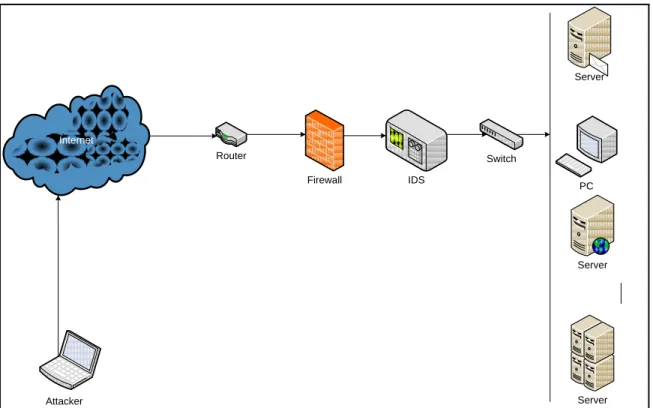
As Figure 1 shows,intrusion detection systems monitor network events for analysis to find computer security threats such as malware, spyware, and access violations. Internet Router Firewall Attacker IDS Switch PC Server Server Server
Overview of Research Methodology
Increasing numbers of applications generate large streams of data to be processed online and in real time for knowledge extraction. Processing such a large volume of data produced by a plurality of operational information systems renders their monitoring difficult using the old paradigm of storing data before analysis (Hebrail, 2008). Mining of continuous data streams of information to gather relevant attributes is computationally challenging (Domingos & Hulten, 2000). Noise and irrelevant attributes worsen the prediction accuracy.
This research aimed to find a method that dynamically extracts an optimal subset of data elements sufficient to obtain insights from massive data streams and take
appropriate actions. This study proposed approaches, which when applied to the continuous network data streams efficiently, reduce the data dimensionality without negatively impacting its classification accuracy.
Principal component analysis is a popular dimensionality reduction technique used in a large variety of research domains. Nziga (2011) implemented PCA to considerably reduce the network dataset for intrusion detection. Nziga and Cannady (2012) combined PCA and mutual information to extract important features from the network dataset. This dissertation extends the original research presented by Nziga and Cannady, introducing a variation in the method of processing the data. Instead of storing the data off-line to be processed in a batch mode, this research aimed to process the data online and in real time for knowledge extraction.
This research was subdivided into five phases. First, a previously proposed incremental features extraction algorithm for facial recognition applications was implemented to
process intrusion detection data streams. Using dimensionality reduction techniques on intrusion detection systems improves their performance. Then, two sparse principal component analysis techniques were presented. The next two phases introduced new incremental features extraction algorithms. Finally, we evaluated the concept drift impact using the newly proposed techniques.
Phase 1. Chunk Incremental Principal Component: Application to Network Data Streams
Incremental PCA-based methods have recently been proposed that allow adding new data and updating of PCA representation for face recognition (Pang et al., 2008; Yan & Liu, 2012).
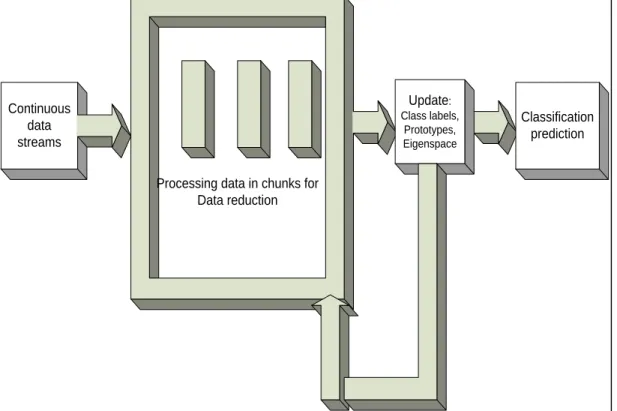
Continuous data streams
Processing data in chunks for Data reduction Classification prediction Update: Class labels, Prototypes, Eigenspace
Figure 2 shows Chunk IPCA that was implemented to evaluate network data streams. Chunk IPCA can overcome the problem with IPCA, processing a chunk of training samples at a time.
A set of initial training samples D0 is provided prior to the start of the
incremental learning.
An initial eigenspace model is obtained by applying PCA to D0.
The smallest dimensionality k of the eigenspace is determined, with an
accumulation ratio larger than θ.
The eigenspace model and L training samples become input to begin Chunk
IPCA.
o Eigen-axis selection to obtain augmented eigen-axes o Eigenspace rotation to obtain to obtain eigen-problem o Obtain the updated eigenvector matrix
o Update the mean vector o Update the eigenspace model
The following metrics were gathered for evaluation:
The impact of the initial data size on the classification accuracy, starting with
5% of the training dataset. Then increasing by 5% until no behavioral change was noticeable.
The impact of the chunk size on the classification accuracy, staring with 100
samples of the training set. The chunk size increased by 100 at a time, until no output change was noticeable.
The impact of the accumulation ratio factor θ, a positive value between [0, 1]
on the classification accuracy,
The CPU usage
The processing time
The full chunk IPCA algorithm as proposed by Ozawa et al. (2008) follows. Input:
Chunk IPCA algorithm
Initial training set D0 = {(x(i), z(i)) | i = 1, … N}.
The number P of prototypes,
The number M of search points for threshold and search range [θ1,θM] Initialization:
1) Call Training of initial Eigenspace to obtain the threshold θ and the initial eigenspace model Ω = (ā, Uk, Ʌk, N) of D0.
2) P’ min (P, N)
3) Select P’ training sample randomly from D0 as reference vectors and put them into a set γ
loop // Prediction and Learning
Input: A new chunk of training samples D = {(y(i), z(i))|i = 1, … L}.
if P’ < P then
Select min (P - P’, L) training samples randomly from D put them into γ
end if
Call Update of Classifier to update the prototype γ’
Call Classification to predict the class labels z(y(i)) of queries y(i) (i = 1, … ,L) in D Apply chunk IPCA to Y = {y(1) , …, y(L) }
1) Call Selection of Eigenaxes to obtain a matrix Hl of the l augmented eigenaxes 2) Solve an intermediate eigenproblem