Programming Models Through MPI-3 Techniques
Antonio J. Pe˜
na
Vicen¸c Beltran
(antonio.pena,vbeltran)@bsc.es Barcelona Supercomputing Center (BSC)Carsten Clauss
Thomas Moschny
(clauss,moschny)@par-tec.com ParTec Cluster Competence Center GmbHABSTRACT
In this paper we describe the design of fault tolerance ca-pabilities for general-purpose offload semantics, based on the OmpSs programming model. Using ParaStation MPI, a production MPI-3.1 implementation, we explore the features that, being standard compliant, an MPI stack must support to provide the necessary fault tolerance guarantees, based on MPI’s dynamic process management. Our results, including synthetic benchmarks and applications, reveal low runtime overhead and efficient recovery, demonstrating that the exist-ing MPI standard provided us with sufficient mechanisms to implement an effective and efficient fault-tolerant solution. ACM Reference format:
Antonio J. Pe˜na, Vicen¸c Beltran, Carsten Clauss, and Thomas Moschny. 2017. Supporting Automatic Recovery in Offloaded Distributed Programming Models Through MPI-3 Techniques. In Proceedings of ICS ’17, Chicago, IL, USA, June 14-16, 2017, 10 pages.
DOI: http://dx.doi.org/10.1145/3079079.3079093
1
INTRODUCTION
OmpSs is a popular programming model (PM) for high-performance computing (HPC) based on compiler directives and task decomposition. It incorporates functionality to ease the programmer’s management of resources efficiently, hence greatly fostering programming productivity and maintenance. Recently,collective offload extensions have been proposed
for their incorporation in this PM. Apart from mapping greatly to some algorithms, these ease the efficient use of heterogeneous compute nodes by enabling the offload of tasks to compute nodes featuring the most suitable architecture.
The nature of the distributed offload semantics makes them especially vulnerable to a variety of local failures that may well propagate to the entire application causing its ab-normal termination. Our proposal is focused in protecting from fail-stop failures ultimately causing a process to lose communication with its peers, such as process abortions or hardware failures. Traditional approaches based on check-point/restart (C/R) may be used to mitigate this situation
Publication rights licensed to ACM. ACM acknowledges that this contribution was authored or co-authored by an employee, contractor or affiliate of a national government. As such, the Government retains a nonexclusive, royalty-free right to publish or reproduce this article, or to allow others to do so, for Government purposes only.
ICS ’17, Chicago, IL, USA
© 2017 Copyright held by the owner/author(s). Publication rights licensed to ACM. 978-1-4503-5020-4/17/06. . . $15.00
DOI: http://dx.doi.org/10.1145/3079079.3079093
and prevent having to restart the execution entirely. The specific semantics of this PM, however, lead us to investi-gate on more efficient fault tolerance capabilities. By basing our (partial) restarting techniques in PM semantics instead of user-specified or periodic checkpoints, we provide lower runtime overhead and efficient recovery. Although we use OmpSs offload to showcase our idea, our approach should be applicable to other similar offload PMs such as [8].
The Message Passing Interface (MPI) is ade facto
stan-dard in HPC communication. Offering a common application programming interface (API), the different hardware ven-dors provide highly-optimized MPI implementations for their platforms, making MPI a good choice to leverage efficient portable communication. The OmpSs collective offload fea-ture has been designed to interoperate with MPI applications; internally, it relies on the MPI process spawning capabilities. In spite of the efforts of the community, the MPI Forum has not yet incorporated specific fault-tolerance capabilities into the MPI Standard. The few references to error detection and reporting in the latest release (version 3.1) are often ambigu-ous, but also optional to adopt by the MPI implementors. Hence, users requiring fault-tolerance capabilities in MPI applications are often forced to either implement application-dependent resilience mechanisms or to use non-standard MPI features offered by some implementations.
Instead, in order to obtain the base MPI resilience capa-bilities that our solution demands, and following the original MPI philosophy which leaves fault tolerance as “a property of an MPI program coupled with an MPI implementation” [23], we have opted for incorporating error detection, reporting, and handling features into the ParaStation MPI implementa-tion that fully comply with the MPI standard. At the OmpSs runtime level, we leverage these features to implement the detection of a failure in a remotely offloaded task and re-execute the appropriate dependent tasks on a new set of sane compute nodes in cooperation with the global resource manager. This is handled completely transparently to the user, thereby preventing application developers from having to implement complex failure handling code.
In this work, (1) we introduce MPI-3 standard compliant techniques to be adopted by MPI implementations to enable runtimes leverage resilient distributed offload semantics; (2) built on top of these, we present the design and implementa-tion details of efficient and transparent resilience support for the OmpSs offload semantics in the Nanos++ runtime; and (3) we provide an in-depth performance evaluation of the runtime overhead and recovery efficiency of our proposal. To
the best of our knowledge, this is the first time the suggestion of [23, Section 5.2] to use MPI dynamic process management for fault-tolerance purposes is explored (1) showing an ap-plication domain on which this approach is practical and manageable and (2) devising the required support from the MPI implementation. Our evaluations, involving both bench-marks and applications, reveal that this proposal introduces low runtime overhead and provides efficient error recovery. In times in which the existing MPI fault-tolerance support is highly debated, we provide a use case in which the current specifications already incorporate sufficient mechanisms to implement an efficient and effective fault tolerant solution.
2
BACKGROUND
OmpSs is a directive-based PM that enables parallelism in a data-flow way. The developer is in charge of decomposing the code intotasksand identifying their data dependencies.
This information is used by the source–to–source Mercurium compiler to generate the corresponding calls to the Nanos++ runtime API. Nanos++ is responsible for scheduling and executing the annotated tasks, preserving the implied task dependency constraints. Further general information can be found at http://pm.bsc.es.
The dynamic offload functionality recently incorporated into OmpSs [10] enables the execution of tasks in remote compute nodes. Apart from providing enhanced support for node heterogeneity (tasks may be offloaded to those compute nodes featuring the most suitable architecture), the offload semantics map greatly to some algorithms, yielding programmability benefits. Unlike other offload-based PMs, OmpSs is designed to offload full general-purpose tasks. This model introduces in OmpSs the concept ofmasterandbooster
nodes/processes, where the former execute the main dataflow and the latter the offloaded tasks. Abooster process may
only execute a task instance at a time, but users may allocate an arbitrary number ofboostersper host. The OmpSs offload
extensions allow recursivity, enablingbooster nodes act as mastersof their offloaded tasks. Data transfers are handled
implicitly from the task data dependency information. The offload extensions consist ofbooster allocator and
re-leaser functions plus a new clause for task offloading. The allo-cator (deep booster alloc) internally callsMPI Comm
spawn-multiple, returning the created intercommunicator that
masterprocesses may use to interact with theirbooster
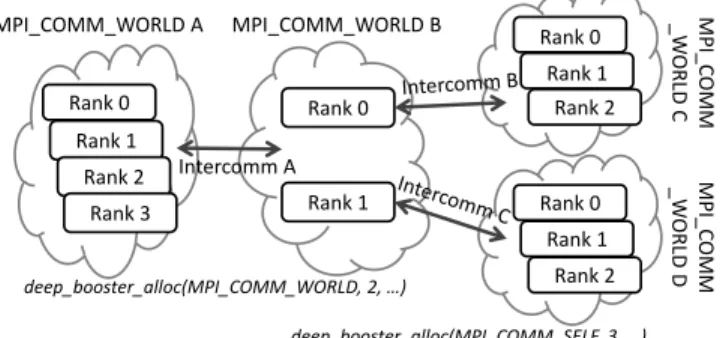
pro-cesses. It also gets an intracommunicator to specify the set of spawning processes. Figure 1 depicts an example of 4 MPI
masterprocesses allocating 2boosterson theMPI COMM WORLD
communicator which in turn allocate 3boosterprocesses each
(i.e., using theMPI COMM SELFcommunicator). The newonto
clause is used in combination with thetaskclause to offload
a particular task to a givenboosterprocess identified by its
intercommunicator and MPI rank number.
3
RELATED WORK
This section reviews prior work on the topics related with the specific contributions of this paper. A discussion about how
Rank 0 Rank 1 Rank 2 Rank 3 Rank 0 Rank 1 Rank 0 Rank 1 Rank 2 Rank 0 Rank 1 Rank 2 Intercomm A MPI_COMM_WORLD A MPI_COMM_WORLD B MP I_ C OM M _W OR LD C MP I_C OM M _W OR LD D deep_booster_alloc(MPI_COMM_WORLD, 2, …) deep_booster_alloc(MPI_COMM_SELF, 3, …)
Figure 1: OmpSs offload sample process structure.
the OmpSs offload mode is related with other PMs featur-ing offload semantics (such as Intel Offload [8], CUDA [25], OpenCL [24], OpenACC [26], or OpenMP 4.0 [27]) or tar-geting cluster-level heterogeneity (VCL [1], rCUDA [4, 28], MPI spawn) can be found in [10].
3.1
Checkpointing
The traditional mechanism to protect application data has been C/R: data is saved regularly so that it can be restored upon failure. For instance, FTI [16] and SCR [5] are popular checkpointing libraries. In contrast, our proposal ensures that remotely offloaded tasks finalize properly in spite of eventual connection lost events, preventing from the need to restart the entire application from a past state. Both solutions are fully compatible and complementary to each other and their combination should decrease checkpoint frequency.
3.2
MPI Resilience
Up to the current version of the MPI Standard (3.1), there is no specific support for fault tolerance capabilities. Al-though it contemplates the possibility that MPI functions do not cause a program abortion upon a failure by setting arbitrary error handlers, continuing a program in which an MPI call failed is not guaranteed to be possible. MPI imple-mentations, however, are not forbidden to support program continuation after properly handled errors at their will. For instance, the Hydra process manager of MPICH features a command-line option (--disable-auto-cleanup) to prevent
killing all the processes upon any abortion [3]; however, this leaves live processes with broken communicators. We develop novel standard-compliant fault tolerance capabilities into the ParaStation MPI implementation [30] to control process cleanup and provide the required error reporting.
The MPI community has been working on providing spe-cific support for enabling communication among live pro-cesses after one or several propro-cesses of a communicator failed. User-Level Failure Mitigation (ULFM) [22] is the proposal currently being discussed and iteratively refined at the MPI Forum. Although we can find implementations supporting it experimentally, it cannot be considered MPI compliant, and its contents are likely to change before its possible final incorporation into a future version of the Standard. Several
other works have proposed extensions to the MPI API for incorporating a variety of fault tolerance capabilities, but no one has been accepted into the MPI standard so far. Au-tomatic and semiauAu-tomatic fault tolerance within the MPI implementation (i.e, without user intervention) have been studied, but proven to pose high overhead at scale [11, 17].
3.3
Resilience in Task-Based PMs
Prior to the incorporation of the OmpSs offload functional-ity, “smart” C/R was introduced in the Nanos++ runtime to provide efficient fault-tolerance capabilities by benefiting from the PM semantics (leveraging the task data dependen-cies) [19]. This protected from memory faults reported by the OS. Our proposal is complementary to this solution, targeting specifically the recently-introduced offload semantics.
The NABBIT task graph scheduling framework was added fault tolerance capabilities in [18]. This and other previ-ous works leveraged local task reexecution as a response to transient errors. Recovering from soft errors supporting distributed task graphs was considered within the PaRSEC task-based runtime framework [7], not including offloaded semantics—posing high storage overheads and possibly a long list of predecessors to be reexecuted to recover damaged data—norconnection lostevents. Our work, however, focuses
specifically on adding automatic fault tolerance capabilities todistributed offloading semantics, covering from the
MPI-level error detection and recovery to the upper-MPI-level runtime implementation and associated PM semantics.
The CIEL execution engine for cloud environments pro-vided fault-tolerance to a conceptually similar task-based PM involving masters and workers [9]. CIEL does not use MPI underneath nor considers collaborative offloaded tasks and hence limits its approach to heartbeat monitoring and sane worker reexecution. In fact, that paper mentions application C/R as the only possibility to attain resiliency in similar HPC environments leveraging MPI. Our work demonstrates that a more efficient approach is possible.
3.4
Resilience for Offload-Based PMs
The most popular offload-based PMs are those targeting ac-celerators. Resilience has been provided leveraging redundant computations [14]. Hauberk [15] is able to restart a GPU application from a checkpoint upon a failure detected by automatically-inserted silent data corruption detectors.
CheCUDA [12] and CheCL [13] are C/R solutions for CUDA and OpenCL applications, respectively. Snapify pro-vides C/R, migration, and swapping services for Intel® Xeon Phi™ coprocessors [6]. These do not target specifically co-processor failures nor integrate fault detection mechanisms.
VOCL-FT [29] benefits from OpenCL’s offload semantics to provide a transparent and more efficient microcheckpoint-ing and partial restart mechanism inside the OpenCL imple-mentation. Although the proposed optimization techniques are not OpenCL specific, these are meant to be efficient for offload-based PMs with fine-grained, iterative kernel offloads (with their corresponding data movements between host and
accelerator memories). Since the OmpSs offloading mode targets remote general-purpose processing platforms, it is expected to leveragecoarse-grained tasks, hence minimizing
the data transfer overhead across a network. Therefore, our work does not propose using a checkpoint-based recovery of the offloaded processor’s memory space, hence reducing runtime overhead.
4
SUPPORT FROM THE MPI STACK
We have developed additional capabilities compliant with the MPI 3.1 standard into ParaStation MPI for providing the features needed by the upper-level distributed runtimes. ParaStation MPI is an open-source MPI library developed and supported by ParTec GmbH together with the J¨ulich Supercomputing Centre (JSC). ParaStation MPI, which is in turn based on MPICH, is fully MPI 3.1 compatible and offers support for a multitude of HPC-related networks.
4.1
Process Manager
The process management framework of ParaStation MPI (calledpsmgmt) is implemented in the form of an efficient
and robust network of control daemons. One instance of such a daemon (calledpsid) is running on each node of the system
and all the distributed daemons are then linked together by means of a highly-scalable communication subsystem. This subsystem is based on a Reliable Datagram Protocol (RDP) that is used for inter-daemon signaling as well as for I/O and signal forwarding with respect to the actual MPI processes [2].
Each node-local daemon instance is also responsible for creating the local processes belonging to a distributed MPI session. After forking, thepsidskeep control over the MPI
processes and constantly monitor their existence as well as the responsiveness of the otherpsids in the network. If an
MPI process should fail, then the localpsiddetects this event
and notifies all the other daemons for cleaning the whole MPI session belonging to the failed process. In addition, if a whole node along with its localpsidshould fail, the daemon network
detects the absence of corresponding heartbeat messages of the deceasedpsid and can react accordingly. That way, a
proper cleaning and release of all resources still allocated by the failed session is guaranteed.
For the handling of larger systems,psmgmtmay be
com-bined with an outer and more generic resource manager featuring a batch queuing system together with a job sched-uler like TORQUE/MAUI or SLURM. In doing so,psmgmt
follows a strictsingle-daemonconcept where the native
mon-itoring daemons of the resource managers are replaced by special plugins for thepsids. That way, thepsidscan directly
interact with the outer resource manager and report a failed MPI session, e.g., for aborting the whole related job.
However, for providing fault tolerance, less radical but more sophisticated measures have to be taken in order to keep healthy process groups alive for eventually recovering the faulty session parts. Specifically, the process manager had to be extended with the ability to differentiate between the processes sharing the sameMPI COMM WORLDcommunicator
and those not belonging to the same process group but to the same session. That way, thepsidsare now able to clean, e.g.,
a group of failedbooster processes while keeping themaster
processes alive, which may then strive for a respawn in a sane set of nodes for recovering the failed offloaded tasks.
The logic for this process group awareness is naturally rooted in theMPI Comm spawn( multiple) call. When a
pro-gram enters this function, a dialog between the respective MPI process and the localpsidis conducted via the Process
Management Interface (PMI) [20]. During this dialog, the needed information for creating and interconnecting to the newly spawned process group is exchanged.
By utilizing theMPI Infoobject, as it is to be passed as an
argument of the spawn function, themasterprocesses can tell
thepsids if they explicitly want to be treated independently
from the child processes forming theboostergroup. For doing
so, the root process of themaster group calling the spawn
function has to add a (key="parricide",value="disable")
pair to theinfoobject. As a result, a process fault in the
child group triggers a cleaning of thebooster processes only,
whereas the mastersare kept alive and running. However,
this behavior is consciously implemented asymmetrically: a process fault in the parent group still results in a cleaning of
allprocesses belonging to the affected session.
4.2
Communication Layer
The lower-level communication layer of ParaStation MPI (calledpscom) is specially designed for its employment in
HPC systems. As such, a variety of interconnects and in-terfaces commonly used in this specific application field is supported by pscom. For doing so, the library exhibits a
flexible architecture featuring plugins for all the different
interfaces and protocols. Such plugins are loaded and se-lected at library runtime by means of a priority/fallback scheme, which means that plugins promising faster communi-cation than others are preferred while slower but more robust counterparts may still be used in case of an unsuccessful initialization of the former.
As the lowest common denominator, socket-based com-munication via the TCP/IP protocol serves as a sort of
pseudo-plugin, which provides a scalable on-demand
connec-tion establishment by delaying the actual connecconnec-tion setup to the first send request posted for the respective peer. That means that all needed connections are initially made via TCP/IP and that other plugins may then use these socket channels for exchanging further information like keys, queue pair numbers, and other identifiers as needed, for instance, for establishing InfiniBand-based communication.
Usually, these initial socket connections are directly closed after the initialization of a higher prioritized plugin. However, for providing fault tolerance, these may also be kept inten-tionally open in order to enable an OS-assisted detection of broken links. In doing so, the still open socket connections are handed over to dedicatedconnection guardthreads waiting
inselectcalls for detecting TCP events, whereas the regular
MPI communication among the processes is then normally
conducted via the connections of a higher prioritized plugin like one of those for InfiniBand or Extoll.
Such TCP events could either be the arrival of anend of filemessage, indicating the proper shutdown of a connection,
or the occurrence of an error, for example, triggered by the absence of aTCP keep alive message (i.e., a TCP timeout).
By queuing and forwarding such events from the connection guard threads to the main threads of the MPI processes, the latter can eventually analyze and transform the events into appropriate error codes for the application layer. Since the connection guard threads commonly block most of the time within theselectfunction, their impact onto the regular MPI
communication performance should practically be negligible.
4.3
Discussion on Standardization
As mentioned in Section 1, we follow the original MPI fault-tolerance philosophy. In case we would like such a solution to operate onanyMPI implementation, the MPI Standard
should (1) incorporate a new reserved MPI Info key as de-scribed in Section 4.1; (2) require implementations honor reserved keys; and (3) enforce reporting broken connections as returned error codes in MPI calls (see Section 4.2).
On the other hand, the MPI Forum is currently dis-cussing several minor modifications to the Standard affecting fault behavior, like limiting the effect of failures to process groups leveraging involved communicators or distinguishing catastrophic error codes (see issues #1, #3, and #28 on http://github.com/mpi-forum/mpi-issues/issues). Our solu-tion would benefit from these proposals being standardized, preventing the use of a custominfokey.
5
OMPSS RESILIENT OFFLOAD
In this section we first discuss the high-level design of our approach in terms of functionality and semantic constraints. Next, we provide insight on implementation details.
5.1
Functionality
Our main goal is to provide automatic resilient OmpSs offload functionality, so that the failure handling burden is removed from the application level. For example, the snippet of code shown in Figure 2 would allocateppnbooster processes in
each ofnhosts, offload a task to eachbooster, and wait for
their execution finalization, relying on the Nanos++ runtime for the proper execution of the offloaded tasks in case of an eventual failure ultimately leading to the interruption of interprocess communication. If rootmaster node failures
were a concern, these could well be addressed additionally leveraging C/R. Since the resiliency feature involves semantic side effects as explained in Section 5.2 and it may pose some performance impact, we require users to specify the new
recoverclause to leverage this functionality.
The OmpSs offload primitives are designed to interoperate with MPI applications and internally use the MPI infrastruc-ture tospawn booster processes. By default, MPI process
managers terminate all processes upon the abortion of any of them, as depicted in Figure 3a. Since this action is performed
// Allocates 'ppn ' processes in each of 'n ' hosts d e e p _ b o o s t e r _ a l l o c ( M P I _ C O M M _ W O R L D , n , ppn , & w o r k e r ); f o r (i n t i =0; i < n * ppn ; i ++) { # p r a g m a omp t a s k o n t o ( worker , i ) r e c o v e r o f f l o a d e d _ t a s k (); } #pragma omp t a s k w a i t d e e p _ b o o s t e r _ f r e e ( w o r k e r );
Figure 2: Sample offloaded application pseudocode.
Rank 0 Rank 1 Rank 0 Rank 1 MASTERS BOOSTERS Rank 2 1 1 2 2 3 3
(a) Default process cleanup.
Rank 0 Rank 1 Rank 0 Rank 1 Rank 2 MASTERS Rank 0 Rank 1 Rank 2 BOOSTERS 1 1 2 2 3 (b) Smart cleanup+recovery.
Figure 3: Process cleanup upon failure with OmpSs offload. Failure originated atbooster rank 1. Numbers indicate pos-sible failure propagation order.
at process manager level, MPI error handlers are not involved and hence cannot prevent process termination. Our desired behavior, however, is that the MPI process manager would limit the process cleanup upon failure to those processes sharing the sameMPI COMM WORLDcommunicator of the failed
process. As shown in Figure 3b, our idea is to replace the failedbooster processes with a freshly spawned set of them.
With the support from the MPI environment discussed in Section 4, the Nanos++ runtime will be able to detect a failed group ofboosters, provide a replacement for these,
allocating a new set ofbooster processes in sane nodes (we
implement the integration with the resource manager to incorporate new resources described in [21]), and restart the required operations. Nothing prevents recoverable offloaded tasks from containing further subtasks; a failure in abooster
process would trigger the termination and replacement of all sibling and descendingbooster processes.
Heterogeneous hardware, either in form coprocessors (i.e., GPUs) or heterogeneous compute nodes, is fully supported. Data copies present in the failed booster node at the begin-ning of the task (including those in accelerator memories) are invalidated in themaster’s Nanos++ runtime upon failure.
Copies of the input data are already stored by design by the Nanos++ runtime of themaster processes and sent as part
of restarting the task.
5.2
Semantic Constraints
The original semantics of the OmpSs offload capabilities en-ablemaster processes to communicate directly with their boostersperforming MPI calls by employing the
intercommu-nicator provided by thedeep booster alloccall. An internal
#pragma omp task \\ onto(BOOSTER,X) recover
#pragma omp task \\ onto(BOOSTER,Y) recover
#pragma omp task
BOOSTER X BOOSTER Y
#pragma omp task
Figure 4: Subtasking to define arecoverdomain.
replacement of the original intercommunicator upon failure and recovery, however, would initially prevent this feature. The MPI profiling interface could be used to intercept MPI calls and perform the proper communicator mapping. Since we have not found any use case for this feature, however, we chose to disallow this practice for tasks with recovery capabil-ities, considering the value returned by theboosterallocation
call an opaque handler to identify the set ofboosters. In the
end, data transfers betweenmastersandboostersshould be
expressed leveraging the OmpSs semantics by means ofdata dependenciesand performed internally by the runtime.
Since tasks offloaded to the same set ofboosters may
com-municate using MPI operations assuming the corresponding peers to be present, we need to identify which tasks to restart upon the failure of one of them. For instance, some tasks presenting communication dependencies among themselves may have already finished properly when a failure is noticed in one of their peer tasks. On the other hand, a big task may be designed to communicate with several smaller sequential tasks executed on a different booster. In order to
guaran-tee that the appropriate tasks are restarted, we (1) prevent
boosters from executing new tasks until all other boosters
finished properly (in a “waiting for clearance” status1); and (2) upon failure, we restart all currently executing tasks and those waiting for clearance. If a task presenting a commu-nication dependence is not yet in execution when a failure
is found in another task featuring the same communication dependence, it will start on the new set of sane boosters,
meeting the communication dependence. If several sequential tasks are designed to meet a communication dependence with a single task running on a differentbooster, these must be
grouped as subtasks under a singlerecovertask, as depicted
in Figure 4. Hence, we leverage implicitrecover domainsby
preserving the occurrence order ofrecover tasks and their
natural synchronization mechanisms.
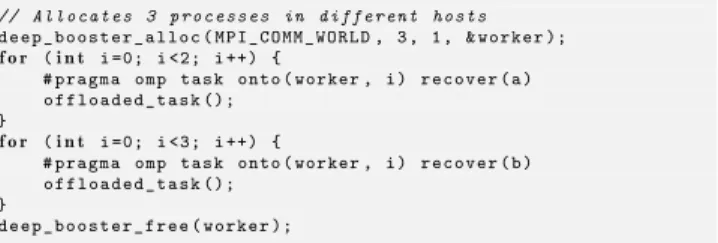
Defining explicit recover domains is also allowed to enable meeting the previous constraints where implicit synchroniza-tion mechanisms would not guarantee the proper automatic differentiation. Figure 5 shows an example of offloaded tasks, where those within the differentforloops belong to
differ-ent recover domains. The first two offloaded tasks will not release their corresponding executingbooster until ensuring
that their peer finished successfully. Specifying explicitly a 1Output transfers to
inoutbuffers are delayed, avoiding the need of
// Allocates 3 processes in different hosts d e e p _ b o o s t e r _ a l l o c ( M P I _ C O M M _ W O R L D , 3 , 1 , & w o r k e r ); f o r (i n t i =0; i <2; i ++) { # p r a g m a omp t a s k o n t o ( worker , i ) r e c o v e r ( a ) o f f l o a d e d _ t a s k (); } f o r (i n t i =0; i <3; i ++) { # p r a g m a omp t a s k o n t o ( worker , i ) r e c o v e r ( b ) o f f l o a d e d _ t a s k (); } d e e p _ b o o s t e r _ f r e e ( w o r k e r );
Figure 5: Code defining tworecover domains.
recover domain is required if the task executing onbooster 2
has communication dependencies with other tasks launched as part of the same loop. Otherwise, if explicit recover do-mains are not specifiedand the task starts execution before
those belonging to the first domain finished, these would wait for their third peer to finish properly while the latter may be waiting for communication with its peers from domainb,
causing a deadlock. Nevertheless, this situation is unlikely and usually the natural synchronization mechanisms will separate the different recover domains, so users are rarely required to manually specify recover domains. For example, the code shown in Figure 5 would likely require ataskwait
separating both loops to prevent communication interference, or issuing both set of tasks on a different allocation ofboosters,
removing the need to manually specify the recover domains. Last, the full or partial reexecution of arecovertask should
not pose undesired side effects.
5.3
Implementation Details
The OmpSs Nanos++ runtime leverages anidle loopduring
which the finalization of offloaded tasks is queried. Depending on the configuration of the runtime, this may be performed by a dedicated thread. The original task finalization query implementation consisted in calls toMPI Iprobe to detect
the arrival of finalization messages (identified by a specific MPI tag) fromboosters. We replaced these MPI calls by
calls to MPI Testany. The required array of MPI request
handlers is previously returned byMPI Irecvcalls matching
the appropriate finalization tag and origin in everybooster,
initially populated during thedeep booster alloccall, and
reissued after every request completion. This new approach lets us determine process finalization more efficiently by avoiding the use of the unexpected message queue of the MPI implementation, but also to assess whether aboosterprocess
failed: in case abooster process is no longer connected, the
improved MPI implementation will issue the corresponding request completion and error return.
This mechanism allows everymaster process notice the
ab-normal termination of anyboosterregardless of whether or not
it had offloaded any task to the failedbooster. However, when booster processes are allocated in collective communicators
(i.e., not MPI COMM SELF), amaster may notice the correct
finalization of an offloaded task before another task belonging to the same domain fails. Hence, we implement afailure con-sensusmechanism consisting ofMPI Allreducecalls, placing
properly finalized tasks on a “waiting for clearance” status until the MPI collective communication is finished and the execution is either globally cleared or determined to have failed. This failure consensus mechanism is also implemented as part of thedeep booster freecall to makemaster
pro-cesses not currently involved in task offload execution aware of possible failures and have them participate in the collective MPI spawning call to generate a sane set ofboosterprocesses.
Although this procedure poses tighter synchronization con-straints than the original nonresilient implementation, since offloaded tasks should be coarse grained, we do not expect high overheads. The failure consensus mechanism isnot ac-tivated for tasks offloaded to boosters allocated within the
MPI COMM SELFcommunicator. Output data is flushed back
to themaster at the end of every task to ensure the most
recent copy is available for a potential restore.
In the event of an error detection, the following response steps are performed to recover from the failure and resume the normal execution of the application: (1) clean data structures pointing to failed resources; (2) perform an MPI spawn and
setMPI ERRORS RETURNas the error handler on the new
inter-communicator; (3) map old to new communicators to properly interpret subsequentontoclauses /deep booster freecalls;
(4) reset the failed work descriptor (a Nanos++ internal
structure representing a task instance) and associated re-sources to their initial state; and (5) launch the failed work descriptor on the newbooster.
Note that we set theMPI ERRORS RETURNerror handler on
intercommunicators with thebooster processes in order to
preventmastersfrom being terminated by the MPI process
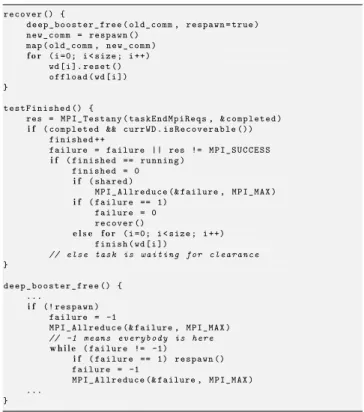
manager upon a failure involving that communicator. The overall failure detection and recovery implementation is summarized in pseudocode in Figure 6.
6
EVALUATION
In this section we provide an in-depth evaluation of our so-lution. We analyze our results based on benchmarks and applications. Unless otherwise stated, we present the average wallclock time of five repetitions of the experiment. Follow-ing the approach in [29], to provide a worst-case scenario, failures are injected hard-coding abort system calls right
before the end of the indicated task. Although this implies a FIN packet is sent immediately by the operating system (OS), favoring failure detection time, relatively-frequent TCP keep alive messages are advised to reduce response time in case of an OS/hardware failure, yielding similar runtime overhead and recovery performance. Also, following the ap-proach described in [10], all compute resources to be used by dynamically-created processes are available in a set of system-wide spare nodes. In the plots,Originalrefers to pragmas
not employing therecover clause, disabling the resilience
feature. The rest of the configurations do use therecover
clause. Error-Freerefers to executions not impacted by a
fault. Errorconfigurations state that an error was injected.
We perform our experiments in a 128-node homogeneous cluster (note that leveraging a heterogeneous platform would
r e c o v e r () { d e e p _ b o o s t e r _ f r e e ( o l d _ c o m m , r e s p a w n = t r u e ) n e w _ c o m m = r e s p a w n () map ( o l d _ c o m m , n e w _ c o m m ) f o r ( i =0; i < s i z e ; i ++) wd [ i ]. r e s e t () o f f l o a d ( wd [ i ]) } t e s t F i n i s h e d () { res = M P I _ T e s t a n y ( t a s k E n d M p i R e q s , & c o m p l e t e d ) i f ( c o m p l e t e d && c u r r W D . i s R e c o v e r a b l e ()) f i n i s h e d ++ f a i l u r e = f a i l u r e || res != M P I _ S U C C E S S i f ( f i n i s h e d == r u n n i n g ) f i n i s h e d = 0 i f ( s h a r e d ) M P I _ A l l r e d u c e (& failure , M P I _ M A X ) i f ( f a i l u r e == 1) f a i l u r e = 0 r e c o v e r () e l s e f o r ( i =0; i < s i z e ; i ++) f i n i s h ( wd [ i ])
// else task is waiting for clearance } d e e p _ b o o s t e r _ f r e e () { ... i f (! r e s p a w n ) f a i l u r e = -1 M P I _ A l l r e d u c e (& failure , M P I _ M A X ) // -1 means everybody is here
w h i l e ( f a i l u r e != -1) i f ( f a i l u r e == 1) r e s p a w n () f a i l u r e = -1 M P I _ A l l r e d u c e (& failure , M P I _ M A X ) ... }
Figure 6: Nanos++ failure detection/recovery.
Table 1: Connection Guard benchmarking. Max. STD: 0.04s.
Configuration Benchmark
Guard Error Handler(MPI ERRORS ) PingPong PingPing Disabled ARE FATAL 1.455 µs 1.425 µs Enabled ARE FATAL 1.444 µs 1.425 µs
Enabled RETURN 1.452 µs 1.426 µs
only impact the execution efficiency of the offloaded tasks). Each node is equipped with two 8-core Intel®Xeon®ES-2680 CPUs running at 2.7 GHz and 32 GB of RAM. The intercon-nection network is an InfiniBand QDR. We implemented our functionality on top of ParaStation MPI 5 and OmpSs v15. All the code is compiled using the GNU C 5.3 compiler.
6.1
MPI Connection Guard
To assess the impact of thepscom connection guard feature,
we used the PingPong and PingPing benchmarks from the Intel® MPI Benchmarks suite version 4.1 with their default setting for latency measurements: 1000 repetitions and zero-byte messages. Each of both benchmarks was run 10 times for each of the following scenarios: connection guard disabled, connection guard enabled, and connection guard enabled plus
MPI ERRORS RETURNas the error handler. The results, shown
in Table 1, confirm that the connection guard feature does not pose any noticeable performance impact.
d e e p _ b o o s t e r _ a l l o c ( M P I _ C O M M _ W O R L D , sz , 1 , & b o o s t e r s );
#pragma omp t a s k o n t o ( b o o s t e r s , r a n k ) r e c o v e r
p u t s ( " Hello , w o r l d ! " );
#pragma omp t a s k w a i t
Figure 7: Nanos++ offload resilience benchmark code.
Table 2: Nanos++ offload resilience benchmarking results.
# of Nodes Original Error-Free Error 2 0.001 s 0.035 s 0.036 s 4 0.001 s 0.013 s 1.397 s 8 0.001 s 0.055 s 1.431 s 16 0.001 s 0.061 s 2.370 s
6.2
OmpSs Offload Microbenchmarking
We performed microbenchmarking (see Figure 7) in order to provide an initial assessment of the performance impact of our fault-tolerant OmpSs offload implementation. In a set of 1–8mastersleveraging the same number ofboosters,
we measured the execution time of an offloaded task using
theOriginal,Error-Free, andErrorconfigurations. The
recoverclause in Figure 7 is not included inOriginal. Our
results, featuring a maximum relative standard deviation (RSD) of 27%, are shown in Table 2. These reveal up to 61 ms overhead for theError-Freecase—which should be
negligible for coarse-grained tasks—mainly led by the failure consensus mechanism. The Error case poses up to 2.4 s
overhead, mainly caused by the MPI spawning call (see [10]).
6.3
N-Body Benchmark
N-Body simulates the movement of a group of “bodies” (may be from particles to planets) given the forces driving their physical interaction. The dataset is usually distributed among compute nodes due to its size. At each time step, each process first calculates the interactions among its own bodies. Next, the bodies are exchanged in a ring fashion using a temporary buffer. Then, the interactions including the new bodies are computed again. This process is repeated until all bodies have visited all processes, what concludes a time step.
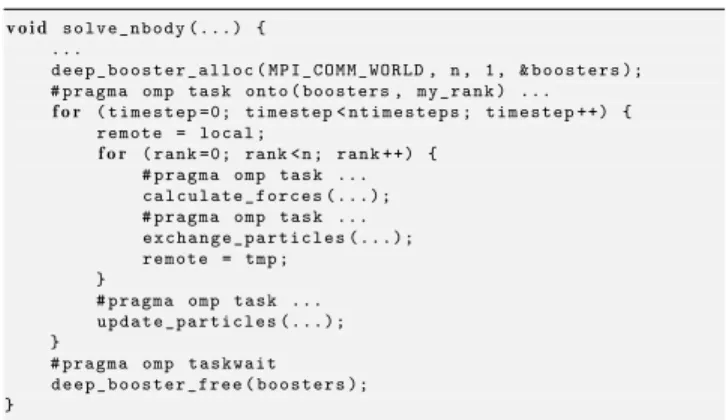
We note that the code developed for this benchmark is not intended to be an efficient N-Body implementation. Instead, the purpose of this benchmark is to showcase the behavior of the resilient offload capabilities both in favorable and un-favorable cases (a test case using a production application is analyzed in Section 6.4). Figure 8 shows an OmpSs imple-mentation in which all major tasks are offloaded to abooster
within a single globaltask. We refer to this implementation
asglobal. On the other hand, Figure 9 describes an
implemen-tation in which the different tasks are offloaded separately. We refer to this implementation as partial. While the
for-mer constitutes a good case for the resilient offload feature because of minimizing synchronization amongboosters, the
latter does the opposite, posing a bad-case scenario: booster
processes have to exchange more often failure information, delaying the finalization of more tasks, and multiplying the
v o i d s o l v e _ n b o d y ( . . . ) { ... d e e p _ b o o s t e r _ a l l o c ( M P I _ C O M M _ W O R L D , n , 1 , & b o o s t e r s ); # p r a g m a omp t a s k o n t o ( b o o s t e r s , m y _ r a n k ) ... f o r ( t i m e s t e p =0; t i m e s t e p < n t i m e s t e p s ; t i m e s t e p ++) { r e m o t e = l o c a l ; f o r ( r a n k =0; rank < n ; r a n k ++) { # p r a g m a omp t a s k ... c a l c u l a t e _ f o r c e s ( . . . ) ; # p r a g m a omp t a s k ... e x c h a n g e _ p a r t i c l e s ( . . . ) ; r e m o t e = tmp ; } # p r a g m a omp t a s k ... u p d a t e _ p a r t i c l e s ( . . . ) ; } # p r a g m a omp t a s k w a i t d e e p _ b o o s t e r _ f r e e ( b o o s t e r s ); }
Figure 8: Offloaded N-Body—global version.
v o i d s o l v e _ n b o d y ( . . . ) { ... d e e p _ b o o s t e r _ a l l o c ( M P I _ C O M M _ W O R L D , n , 1 , & b o o s t e r s ); f o r ( t i m e s t e p =0; t i m e s t e p < n t i m e s t e p s ; t i m e s t e p ++) { r e m o t e = l o c a l ; f o r ( r a n k =0; rank < n ; r a n k ++) { # p r a g m a omp t a s k o n t o ( b o o s t e r s , m y _ r a n k ) ... c a l c u l a t e _ f o r c e s ( . . . ) ; # p r a g m a omp t a s k o n t o ( b o o s t e r s , m y _ r a n k ) ... e x c h a n g e _ p a r t i c l e s ( . . . ) ; r e m o t e = tmp ; } # p r a g m a omp t a s k o n t o ( b o o s t e r s , m y _ r a n k ) ... u p d a t e _ p a r t i c l e s ( . . . ) ; } # p r a g m a omp t a s k w a i t d e e p _ b o o s t e r _ f r e e ( b o o s t e r s ); }
Figure 9: Offloaded N-Body—partial version.
output data flushes to theirmaster processes. As introduced
earlier, due to the inherent overhead of task offloading, the OmpSs offload feature is intended to be used along with coarse grain task decomposition. Hence, the N-Bodyglobal
offload implementation would be the preferred method to offload this computation toboosternodes, whereas thepartial
offload implementation is artificially developed with the pur-pose of presenting a bad-case scenario. In our experiments, we execute 10 time steps of the N-Body simulation.
Figure 10 shows the execution time of different configura-tions of the two N-Body implementaconfigura-tions (maximum RSD: 0.9%). The interaction among 4 M particles is simulated using asingle booster. The number after theErrorkey in the partial version states the task in which the error occurred,
according to the order in which they appear in Figure 9. We follow the same naming convention in subsequent figures.
Figure 10 reveals that while in theGlobalcase the
protec-tion mechanisms enabled by the use of therecoverclause
do not pose a noticeable performance impact, inPartialit
introduces a 3.9% overhead. TheError cases include the
overhead of MPI process respawning and data restoration, as well as that of the task reexecution. For example,Error #1
includes the reexecution of the most computationally inten-sive task plus the overhead of using therecoveryclause in
40 42 44 46 48 50 52 54 O ri gi n al Er ro r-Fre e Er ro r Or ig in al Er ro r-Fr ee Er ro r # 1 Er ro r #2 Er ro r #3 Global Partial Ti m e (s)
Figure 10: N-Body using onebooster (4 M particles).
1 10 100 1000
2 4 8 16 32 64 2 4 8 16 32 64
Weak Scaling Strong Scaling
Ti
m
e
(s)
Number of Nodes Original Error-Free Error
Figure 11: N-Bodyglobalscaling. Particles: weak–1 M/node; strong–4 M total.
this implementation (i.e., it is roughlyPartial Error-Free
plusGlobal ErrorminusGlobal Error-Free).
We next present a performance evaluation including both weak and strong scaling on up to 32master plus 32booster
nodes. Figure 11 shows our results for the global
imple-mentation (maximum RSD: 2.2%). As we can see in the figure, the resilient offload feature does not impact scalability on this test case. We find the highestError-Freeoverhead
(2.5%) at the largest number of nodes in the strong scaling case. The recovery time varies between 11% and 39%, being higher for the large node counts in strong scaling due to the relative impact of the recovery overhead with respect to the computational load.
Experiencing more than a single fault in the less than 10 minutes these executions last is unlikely. If these faults occur at different points within the same group of offloaded tasks, the recovery process is the same as if a single failure happened. If, on the other hand, these are encountered during successive task executions, the application execution time may be easily inferred from the recovery times of the single-failure cases. Due to space constraints, we limit to present a study involving multiple successive failures for the FWI application in Section 6.4.
The scaling results for the partial implementation are
depicted in Figure 12 (maximum RSD: 14.3%). As the fig-ure shows, the overhead introduced by the offload fault-tolerance feature in this artificial test case is considerable, because of the reasons explained earlier in this section. While
1 10 100 1000 10000 2 4 8 16 32 64 2 4 8 16 32 64
Weak Scaling Strong Scaling
Ti
m
e
(s)
Number of Nodes
Original Error-Free Error #1 Error #2 Error #3
Figure 12: N-Bodypartial scaling. Particles: weak–1 M/n-ode; strong–4 M total.
Master Slave 0 Slave n Worker 0 Worker 1 Worker n Worker 0 Worker 1 Worker n
Figure 13: FWI offloaded structure.
Error-Freeexecutions pose an overhead under 4% up to 8
nodes, this reaches almost 20% on 16 nodes, and over 400% for higher node counts. The recovery times are similar to those of theglobalcase. As we mentioned earlier, this is a
purposely-designed bad-case scenario and the OmpSs offload feature is not intended to execute fine-grained tasks.
6.4
Full Wave Inversion (FWI) Application
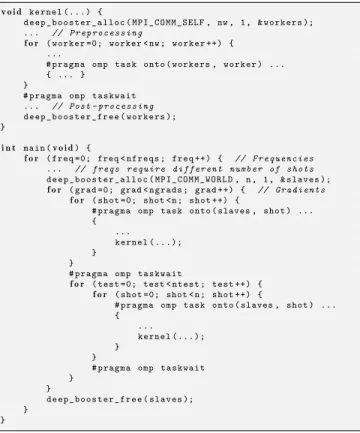
The Full Wave Inversion application analyzes the physical properties of the subsoil from seismic measurements. The area to be analyzed is divided in “shots”, which are usually processed in a distributed fashion due to their size. Its struc-ture using OmpSs offload semantics is depicted in Figure 13 and its implementation listed in pseudocode in Figure 14. An initialmasterprocess iterates over the different frequencies to
explore. For each gradient, a number of shots are processed by akernel function. Each of these is offloaded to a slave
process. Theslaves, after performing some preprocessing,
split the computation of the kernel into several offloaded tasks (workers) and perform the required post-processing
af-ter waiting for their finalization. Severaltestpost-processing kernel executions are required pershotafter this process.
We configure our experiments to use 4 workers per slave, processing up to 1 GB of data each. We vary the number of shots from 2 to 16, usingup to 80 boostersin different
hosts. A single frequency, two gradients, and two tests are executed, leading to 6kerneloffloads to eachslaveduring
the execution. Nanos++ leverages the intranode parallelism using the 16 CPU cores of the compute nodes.
v o i d k e r n e l ( . . . ) { d e e p _ b o o s t e r _ a l l o c ( M P I _ C O M M _ S E L F , nw , 1 , & w o r k e r s ); ... // Preprocessing f o r ( w o r k e r =0; worker < nw ; w o r k e r ++) { ... # p r a g m a omp t a s k o n t o ( workers , w o r k e r ) ... { ... } } # p r a g m a omp t a s k w a i t ... // Post - processing d e e p _ b o o s t e r _ f r e e ( w o r k e r s ); } i n t m a i n (v o i d) { f o r ( f r e q =0; freq < n f r e q s ; f r e q ++) { // Frequencies
... // freqs require different number of shots d e e p _ b o o s t e r _ a l l o c ( M P I _ C O M M _ W O R L D , n , 1 , & s l a v e s ); f o r ( g r a d =0; grad < n g r a d s ; g r a d ++) { // Gradients f o r ( s h o t =0; shot < n ; s h o t ++) { # p r a g m a omp t a s k o n t o ( slaves , s h o t ) ... { ... k e r n e l ( . . . ) ; } } # p r a g m a omp t a s k w a i t f o r ( t e s t =0; test < n t e s t ; t e s t ++) { f o r ( s h o t =0; shot < n ; s h o t ++) { # p r a g m a omp t a s k o n t o ( slaves , s h o t ) ... { ... k e r n e l ( . . . ) ; } } # p r a g m a omp t a s k w a i t } } d e e p _ b o o s t e r _ f r e e ( s l a v e s ); } }
Figure 14: FWI pseudocode.
Figure 15 shows the execution time of FWI in four different cases (the maximum RSD is 1.5%). In Error Worker, a
failure appears in aworkerprocess, whereas inError Slave,
it occurs in aslave. As we can see in the figure, the recovery
feature does not noticeably impact the run time, being the maximum overhead a mere 0.56% (negative overheads just reflect variability and are indicative of the low performance impact). When a failure is detected, the task is reexecuted. The added execution time corresponds to the respawning procedure plus the reexecution of the tasks involved in the failure, including the necessary data restoring movements. Figure 16 represents an extrapolation of the execution time for different number of errors in the 64-worker case. A failure in a worker increases the execution time 18.3%, whereas if the failing process is a slave, the execution time is increased 20.3%. In the unlikely case of experiencing 5 process disconnection failures in the roughly 2.2 hours of execution, the run time would be approximately doubled.
7
CONCLUSION
Our experiments show no impact on the scalability properties of our test cases, revealing low runtime overhead and efficient recovery for coarse-grained tasks. The runtime overhead in our approach involves the synchronization of all sibling masters at the end of their offloaded tasks only in case these are collaborating (e.g., if they were not created using the
-0 .6 5 % -0 .0 3 % 0.56% 0.0 4 % -0. 49 % 0 1000 2000 3000 4000 5000 6000 4 / 5 8 / 10 16 / 20 32 / 40 64 / 80 Tim e (s)
Number of Workers / Boosters Original Error-Free Error Worker Error Slave
Figure 15: FWI execution time in 4 configurations.
4000 4500 5000 5500 6000 6500 7000 7500 8000 8500 0 1 2 3 4 5 Ti m e (s) Number of Errors Error Worker Error Slave
Figure 16: FWI execution time extrapolation (64 workers).
MPI COMM SELFcommunicator). In that case, one would
any-way expect some sort of user-level synchronization as well among the workers during the execution of their task, usually at least before finalization. Hence, targeting coarse-grained tasks [10], the runtime overhead introduced by our method-ology should not be noticeable even in a larger number of nodes. In the event of a failure, the recovery time is basically dominated by the respawning latency, which should in any case improve upon restarting the entire application.
We hence have provided a use case demonstrating the viability of implementing effective and efficient fault toler-ance using MPI-3 compliant techniques. Although we use OmpSs offload to showcase our idea, this approach should be applicable to other similar offload PMs such as [8].
ACKNOWLEDGMENTS
This research received funding from the European Commu-nity’s 7th Framework Programme via the DEEP-ER project under Grant Agreement no. 610476. This work has also been supported by the Spanish Ministry of Science and Innovation (contract TIN2012-34557) and by Generalitat de Catalunya (contracts 2014-SGR-1051 and 2014-SGR-1272). Antonio J.
Pe˜na is cofinanced by the Spanish Ministry of Economy and Competitiveness under Juan de la Cierva fellowship number IJCI-2015-23266. The authors thank Jorge Bell´on, from BSC, for his technical support with the Nanos++ internals.
REFERENCES
[1] A. Barak and A. Shiloh. 2011. The MOSIX virtual OpenCL (VCL) cluster platform. InIntel European Research and Innovation.
[2] C. Clauss, T. Moschny, and N. Eicker. 2016. Dynamic process management with allocation-internal co-scheduling towards inter-active supercomputing. InCo-Scheduling of HPC Applications. [3] A. Amer et al. 2015.MPICH User’s Guide Version 3.2. Argonne
National Laboratory.
[4] A. J. Pe˜na et al. 2014. A complete and efficient CUDA-sharing solution for HPC clusters.Parallel Comput.40, 10 (2014). [5] A. Moody et al. 2010. Design, modeling, and evaluation of a
scalable multi-level checkpointing system. InInt. Conf. for High Perf. Computing, Networking, Storage and Analysis (SC). [6] A. Rezaei et al. 2014. Snapify: Capturing snapshots of offload
applications on Xeon Phi manycore processors. InInt. Symposium on High-Performance Parallel and Distributed Computing. [7] C. Cao et al. 2015. Design for a soft error resilient dynamic
task-based runtime. InInternational Parallel and Distributed Processing Symposium (IPDPS).
[8] C. J. Newburn et al. 2013. Offload compiler runtime for the Intel® Xeon Phi coprocessor. InInternational Parallel and Distributed Processing Symposium (IPDPS) Workshops.
[9] D. G. Murray et al. 2011. CIEL: A universal execution engine for distributed data-flow computing. InSymposium on Networked Systems Design and Implementation (NSDI). 113–126. [10] F. Sainz et al. 2015. Collective offload for heterogeneous clusters.
InInt. Conference on High Performance Computing (HiPC). [11] G. Bosilca et al. 2014. Unified model for assessing
checkpoint-ing protocols at extreme-scale.Concurrency and Computation: Practice and Experience26, 17 (2014), 2772–2791.
[12] H. Takizawa et al. 2009. CheCUDA: A checkpoint/restart tool for CUDA applications. InParallel and Distributed Computing, Applications and Technologies.
[13] H. Takizawa et al. 2011. CheCL: Transparent checkpointing and process migration of OpenCL applications. InInternational Parallel & Distributed Processing Symposium (IPDPS). [14] J. Wadden et al. 2014. Real-world design and evaluation of
compiler-managed GPU redundant multithreading. In Interna-tional Symposium on Computer Architecture (ISCA). [15] K. S. Yim et al. 2011. Hauberk: Lightweight silent data corruption
error detector for GPGPU. InInt. Conference on Parallel and Distributed Computing, Applications and Technologies. [16] L. Bautista-Gomez et al. 2011. FTI: High performance fault
tolerance interface for hybrid systems. InInt. Conference for High Perf. Computing, Networking, Storage and Analysis (SC). [17] M. Bougeret et al. 2014. Using group replication for resilience on
exascale systems. International Journal of High Performance Computing Applications28, 2 (2014), 210–224.
[18] M. C. Kurt et al. 2014. Fault-tolerant dynamic task graph sched-uling. InInternational Conference for High Performance Com-puting, Networking, Storage and Analysis (SC).
[19] O. Subasi et al. 2015. NanoCheckpoints: A task-based asynchro-nous dataflow framework for efficient and scalable checkpoint/ restart. InParallel, Distributed and Network-Based Processing. [20] P. Balaji et al. 2010. PMI: A scalable parallel process-management
interface for extreme-scale systems. InEuroMPI.
[21] S. Prabhakaran et al. 2015. A batch system with efficient adaptive scheduling for malleable and evolving applications. In Interna-tional Parallel and Distributed Processing Symposium (IPDPS). [22] W. Bland et al. 2013. Post-failure recovery of MPI communication
capability: Design and rationale.International Journal of High Performance Computing Applications27, 3 (2013), 244–254. [23] W. Gropp and E. Lusk. 2004. Fault tolerance in message passing
interface programs.International Journal on High Performance Computing Applications18, 3 (2004), 363–372.
[24] L. Howes (Ed.). 2015.The OpenCL Specification, Version 2.1. Khronos OpenCL Working Group.
[25] NVIDIA 2016. CUDA C Programming Guide 8.0. NVIDIA. [26] OpenACC-Standard.org. 2015.The OpenACC© Application
Pro-gramming Interface, Version 2.5.
[27] OpenMP Architecture Review Board. 2015.OpenMP Application Programming Interface(4.5 ed.).
[28] A. J. Pe˜na. 2013. Virtualization of Accelerators in High Perfor-mance Clusters. Ph.D. Dissertation. Universitat Jaume I. [29] A. J. Pe˜na, W. Bland, and P. Balaji. 2015. VOCL-FT: Introducing
techniques for efficient soft error coprocessor recovery. InThe International Conference for High Performance Computing, Networking, Storage and Analysis (SC). IEEE/ACM.
[30] T. Warschko, J. M. Blum, and W. F. Tichy. 1998. ParaStation: Efficient parallel computing by clustering workstations.Journal of Systems Architecture44, 3 (1998), 241–260.