The Determinants of the Effectiveness of Internal Audits with Management Support as the Moderating Variable 33
International Journal of Multicultural
and Multireligious Understanding
http://ijmmu.com [email protected] ISSN 2364-5369 Volume 6, Issue 1 February, 2019 Pages: 33-51
The Determinants of the Effectiveness of Internal Audits with Management
Support as the Moderating Variable
Hendra Poltak
*; Made Sudarma; Lilik Purwanti
Faculty of Economics and Business, Brawijaya University, Indonesia Email: [email protected]
http://dx.doi.org/10.18415/ijmmu.v6i1.483
Abstract
Weak financial accountability reflects the lack of effectiveness of internal audits. The purpose of this research was to test and provide the evidence of the determinants of the effectiveness of internal audits at the Ministry of Marine Affairs and Fisheries (KKP). The samples of this research were 31 internal auditors and 31 KKP employees. This research was explanatory research. To test the hypotheses, the data of the research questionnaire data were analysed using Partial Least Squares (PLS) analysis tool. The results show that the relationship between internal auditors and external auditors, organizational
independence, and auditee perceptions positively influences the effectiveness of internal audits.However,
audit professionalism does not have a positive effect towards the effectiveness of internal audits and the
management support cannot be a moderating variable. This finding can open the horizons of interested
parties, especially KKP leaders, to consider policies that can improve the effectiveness of internal audits to improve organizational goals and performance.
Keywords: Effectiveness; Internal Audit; Ministry of Marine and Fisheries
Introduction
The future of organizations both the public and the private sectors is inseparable from the reliability level of the effectiveness of internal audits. The established effectiveness of internal audits is a control function for management in achieving the goals and targets of the organization. The non-established effectiveness of internal audits will be an organizational barrier to achieving organizational goals economically, efficiently, and effectively.
This non-establishment can be seen from the number of corruption cases as evidenced by the results of the Transparency International (TI) release. In 2017, the Corruption Perception Index (CPI) put Indonesia as one of the most corrupt countries in the world, also worsened by the weak financial accountability. The Summary of First Semester Examination Results (IHPS) in 2017 shows that there are still ministries/institutions with a disclaimer predicate.
The phenomenon of weak financial accountability also occurs in the Ministry of Marine Affairs and Fisheries (KKP). The Supreme Audit Agency gave disclaimer opinion for 2016 even though
2012-The Determinants of the Effectiveness of Internal Audits with Management Support as the Moderating Variable 34
2015 obtained unqualified opinion. Internal auditors and KKP employees as auditees are the objects of the research considering their role in being able to increase the effectiveness of internal audits to support the achievement of organizational performance with accountable governance.
This research was the development of the research conducted by Cohen and Sayag (2010). The difference between this research and the previous is that the researcher added the auditee perception variable because the previous research (Hailemariam., 2014 and Santoso., 2016) did not yield positive results for the effectiveness of internal audits and the relationship between Internal Auditors and External Auditors due to the researchers' knowledge. Then, the research of Gwilliam (2010), Badara and Saidin (2014), Santoso (2016), Shohiha et al. (2018) began to use this variable to measure the effectiveness of internal audits. Management support was chosen as a moderating variable in accordance with the opinion of Endaya (2016) stating that the senior management (top management) which had an interest and encouragement to support activities will ensure the effectiveness of internal audits. The selection of this variable is relevant to use in the public sector in Indonesia. According to Endaya and Hanefah (2013), there is no consensus among researchers regarding the effectiveness of the audit or the best framework for the effectiveness of internal audits.
Theoretical Framework
In the context of this research, the researcher used the Contingency theory developed by Daft (2015: 28) stating that one thing depends on other things and that to be an effective organization, there must be a "goodness of fit" between design and contingent factors. Badara and Saidin (2014) argue that Contingency theory can explain the relationship between two or more variables. The application of this theory cannot be compared in every organization with different characteristics because it has different effects depending on the context of organizational settings. Therefore, the success of achieving organizational goals can be determined by internal and external factors and certain conditions.
Based on the Contingency theory, the effectiveness of internal audits is influenced by internal factors, namely the auditor independence and audit professionalism. On the other hand, the external factor that influences the effectiveness of internal audits is the relationship of internal auditors with external auditors, auditee's perceptions, and top management support. In addition, Contingency theory can also explain the moderating effects of management support.
A. The Effectivenessof Internal Audits
Badara and Saidin (2014) argue that the effectiveness of internal audits is the ability of internal auditors to achieve the objectives of the internal audit function in the local government. According to Sarens (2009), the effectiveness of internal audit is the ability of the internal audit function to positively influence the quality of corporate governance. The effectiveness of internal audits will be able to help the organization achieve the goals and targets set by influencing the quality of organizational governance and ensuring higher certainty of the recommendations generated by internal audits that can be trusted.
B. The Relationship between Internal Auditors, External Auditors and the Effectiveness of
Internal Audits
According to Alzeban and Gwilliam (2014), coordination and collaboration between internal and external auditors has long been seen as important for the benefits of audits for organizations and external stakeholders. This coordination and collaboration is carried out continuously to get optimal benefits for
The Determinants of the Effectiveness of Internal Audits with Management Support as the Moderating Variable 35
the common interests and goals. The ability to foster good relationships with external auditors conducted by internal auditors helps maintain the effectiveness of organizational governance (Gramling et al., 2004). Contingency theory supports the effectiveness of an audit determined by the response of internal factors to external factors. Internal auditors can improve the effectiveness of internal audits if they are able to build relationships with external auditors. The relationship between internal and external auditors which influences the effectiveness has been empirically proven (Alzeban and Gwilliam., 2014; Badara and Saidin., 2014; Shohiha., 2017). Based on the explanation of the research above, the hypothesis is formulated as follows:
H1: The relationship between internal auditors and external auditors has a positive effect towards the
effectiveness of internal audits.
C. The Effect of OrganizationalIndependence towards the Effectiveness of Internal Audits The success of internal audits in carrying out audit activities to provide audit recommendations objectively for organizational improvement is determined by independence. Independence can be interpreted as acting objectively and not influenced by any party in connection with the audit activities carried out. Independence can be done with the organizational status and policy to maintain the auditor's objectivity to the auditee (AAIPI Audit Standards., 2014).
Organizational independence in accordance with contingency theory can be realized with certain conditions and the presence of external factors. Independence provided by management and the absence of pressure from the auditee are the dominant characteristics of a successful audit program (Van Peursem., 2005). That the organizational independence influences the effectiveness has been empirically proven (Aaron and Sayag., 2010; George et al., 2015; Badar.a, 2015). The biggest obstacle to internal audit performance in developing countries lies in the independence (Alzeban and Gwilliam., 2014). Based on the explanation of the research above, the hypothesis is formulated as follows:
H2: Organizational independence has a positive effect towards the effectiveness of internal audits.
D. The Effect of the Audit Professionalism towards the Effectiveness of Internal Audits
According to Arens et al. (2011: 43), professionalism is a professional skill possessed by the auditor in conducting an audit of the client's financial statements. High professionalism ensures that the services provided are of high quality and can be accounted for because the ability of professional internal audits is not only to find weaknesses in internal control, but also to disclose the audit findings and anticipate them in the future and make improvements.
Audit Professionalism in accordance with contingency theory can be realized with certain conditions and the influence of the auditor and outside the auditor. The influence of the auditor, in the form of an auditor’s loss of his independence, will affect his professional ability to carry out audit activities. Likewise, the factors outside the auditor in the form of organizational audit commitment to improve the audit of professional abilities through education and training can increase the auditor’s use of his professional abilities in audit activities. Audit Professionalism has an effect towards the effectiveness of internal audits which have been proven by Tackie (2016) in the local government in Ghana. Based on the explanation of the research above, the hypothesis is formulated as follows:
The Determinants of the Effectiveness of Internal Audits with Management Support as the Moderating Variable 36
E. The Effect of the Euditee’sPerception towards the Effectiveness of Internal Audits
According to Asrori (2009: 21), perception is an individual process in interpreting, organizing, and giving meaning to stimulus that comes from the environment as the result of the learning process and experience. The meaning given by an individual can be different although the object given is the same, which can produce different perceptions. Related to the auditee’s perception, according to Hailemariam (2014), internal auditors and audit service users must have the same understanding that makes internal audit activities have added value.
Contingency theory can explain that the auditee's positive perception is influenced by certain conditions with the support from the management. This is in line with the opinion of Cohen and Sayag (2010) that when the employees at all levels get an understanding from internal management, they will work together and assist this process. Another condition that affects is that the internal auditor performs audit activities independently and objectively to provide useful recommendations to achieve the goal that will provide a positive perception for the auditee. Auditors and auditees as partners who jointly have harmonic perceptions will support audit activities. Putra’s Research (2017) found that the auditee’s perception influences internal audit activities at the Ministry of Finance. Based on the explanation of the research above, the hypothesis is formulated as follows:
H4: Auditee’s perception has a positive effect towards the effectiveness of internal audits.
F. The Effect of the Relationship between Internal Auditors and External Auditors,
Independence, Audit Professionalism, and Auditee's Perception towards the Effectiveness of Internal Audits Moderated by Management Support
Top management support has vital contribution in providing and creating the conditions needed for the success of the project (Staehr., 2010). The auditor as a management partner has a very important role to ensure that organizational goals can be achieved in accordance with the procedures set by the management.
Management support can be seen in several forms such as assisting the team in handling obstacles, showing commitment to work, and encouraging subordinates (Kandelousi et al., 2011). Management support is provided by employing skilful internal audit staff, developing career paths for internal audit staff, and providing organizational independence for internal audit works (Aaron and Sayag., 2010). In addition, Alzeban and Gwilliam (2014) states that management support can also be in the form of improving relationship between internal auditors and external auditors. Mihret (2007) states that management support is in the form of resources and commitment to implement audit recommendations.
Contingency theory explains that the variable of the relationship between internal auditors and external auditors, independence, audit professionalism, and the auditee's perception in achieving the effectiveness of internal audits will depend on certain conditions, namely management support. Management with all efforts will support the relationship between internal auditors and external auditors which in addition to being beneficial to both parties, it will also be beneficial for management in taking policies in the operation of the organization to achieve its goals and targets.
The research conducted by Endaya and Hanefa (2016) states that the characteristics of internal audits moderated by management support can improve the effectiveness of internal audits. The characteristic in the research refers to the attributes that must be owned by internal auditors, namely objectivity, effective communication, proficiency and professional care, and training and development
The Determinants of the Effectiveness of Internal Audits with Management Support as the Moderating Variable 37
(Endaya and Hanefah., 2013). Based on the explanation of the research above, the hypothesis is formulated as follows:
H5A : Top management support positively moderates the effect of the internal auditor relationship with
external auditors towards the effectiveness of internal audits.
H5B : Top management support positively moderates the effect of positive organizational independence
towards the effectiveness of internal audits.
H5C : Top management support positively moderates the effect of the audit professionalism towards
internal audit activities.
H5D : Top management support positively moderates the effect of the auditee’s perception towards the
effectiveness of internal audits.
Methodology
A. Type of Research
This research is quantitative research in the form of explanatory research. It explains the causal relationship between variables through hypothesis testing.
B. Populationand Sample
The population were the KKP employees divided into two categories, namely internal auditors
and auditees.The internal auditors are the functional auditors working at the Inspectorate General (IG) of
KKP. The Auditees are the employees of the echelon I unit audited by the IG in KKP. The research samples for the internal auditor category are all the functional population of auditors working at the KKP IG as many as 91 people. The number of auditees was determined based on the number of auditors in KKP. The research was conducted by distributing questionnaires to all auditor samples. The 33 questionnaires from the respondents were obtained, and those that could be processed were 31. Similarly, the researcher only used 31 auditee respondents so that the contents of the independent variable questionnaires filled out by the auditors and those of the dependent variable questionnaires filled by the auditee respondents were in pair.
C. DataCollection Method and Technique
The questionnaires were given to the internal auditors and auditees to obtain the primary data from the management support variable, the relationship between internal auditors and external auditors, independence, the auditee’s perception, and audit professionalism. The researcher collected the data from the respondents for 15 days starting from September 21 to October 10, 2018.
D. OperationalDefinitions and Their Measurement
The Relationship betweenInternal Auditors and External Auditors (X1)
The Relationship between Internal Auditor and External Auditors refers to joint efforts or cooperation between internal auditors and external auditors to realize success in achieving goals related to audit activities.
The Determinants of the Effectiveness of Internal Audits with Management Support as the Moderating Variable 38
The relationship is measured by a number of proxies: attitudes towards internal auditors, coordination that addresses mutual interests, the dependence of internal audits on internal audit works, frequency of meetings, sharing of work papers, and management promotions for relations between these two groups (Alzeban and Gwilliam., 2014)
The Independence of the internal audit organization (X2)
The Independence of the Internal Audit Organization is the independence of the organization for the freedom to express its views and thoughts without the influence or pressure from the management and other parties related to the organization. This variable was measured by the eight indicators used by Alzeban and Gwilliam (2014).
Audit Professionalism (X3)
Audit Professionalism is defined as the professional consideration of individuals in carrying out audit tasks (Askary., 2006). This variable was measured using five items by modifying the instrument developed by Cohen and Sayag (2010).
Auditee’s Perception (X4)
Auditee’s Perception (X4) is the process of observing, organizing, and interpreting the auditee as a result of stimuli received through the five senses and giving meaning based on the stimuli obtained from
internal audit activities can provide the added value to the organization. The auditee’s perception was
measured with five items used by Hailemariam (2014).
Management Support (M)
Management Support is an effort and concern for management to support internal audit activities with the aim of improving organizational performance. This variable was measured with the seven indicators used by Mihret and Yismau (2007).
The Effectiveness of Internal Audits (Y)
The Effectiveness of Internal Audits is defined as the achievement of audit goals carried out by internal auditors to improve organizational performance. This variable was measured with the seventeen items used by Cohen and Sayag (2010).
Scale likert 1-7 was used to measure the respondents in this research because the 7-point response has reliability, validity, strength of discrimination, and good stability (Budiadji., 2013).
E. Data AnalysisMethodology
The data in this research were analysed using Partial Least Square (PLS) to test several variables and the moderating effects. The model evaluation in Partial Least Square was performed by evaluating the measurement model (outer model) to assess the validity and reliability of the model and structural model
The Determinants of the Effectiveness of Internal Audits with Management Support as the Moderating Variable 39
(inner model) to measure changes in the exogenous variables towards endogenous variables and measure how well the observation value is generated by the model and estimation. H1 to H4 testing is a direct test without moderation while H5 (H5a, b, c, and d) testing is a test of the moderation effect. The hypothesis testing in general in this research was conducted by determining the level of significance or critical value (α) that is equal to 5% and seeing the significance of the p-value and direction of the coefficient. If the significance of p-value is ≤ 0.05 (5%) and the direction of the coefficient is in accordance with the direction specified in the hypothesis, the hypothesis is supported. If not, the hypothesis is not supported.
Results
A. TheDescription of the Respondent Characteristics
Based on the questionnaires received from the respondents, the demographic characteristics of the auditor respondents in this research consisted of age, gender, latest education, and educational background. The majority of the auditor respondents aged 31-40 years were 16 people (51.61%). This composition shows that the auditors in KKP are classified as mostly productive age. Viewed from the gender of the respondents, the auditors were dominated by men with a ratio of 3:1. The number of male auditors was 23 (74.19%). The educational level of the auditor respondents was quite high. The respondents were dominated by S1 (Bachelor Degree) graduates with 19 people (61.29%). The auditor's educational background was dominated by non-accounting as many as 25 people (85.42%) and accounting by 6 people (19.35%).
B. Model Evaluation
The data analysis stage in this research used the help of the warpPLS application. Outer model testing was carried out before hypothesis testing. The outer model evaluations were in the forms of validity test and reliability test. The convergent validation test with reflective indicators was assessed based on the factor loading in the research model of Rule of Thumb (> 0.7) and the parameter value of AVE greater than 0.5 and the value of communality greater than 0.5. If the factor loading is between 0.5-0.7, the researcher should not delete the indicator that has the loading value as long as the AVE and communality indicator is > 0.5 (Hartono., 2011). The followings are the results of the convergent validation test presented.
Table 1 Convergent validation test
Indicator Loading
Factor
P Value Conclusion AVE Conclusion
Relationship between Internal Auditors and External Auditors HA1 0.837 <0.001 Valid 0.643 Valid HA2 0.909 <0.001 Valid HA3 0.839 <0.001 Valid HA5 0.759 <0.001 Valid HA7 0.504 <0.001 Valid HA9 0.893 <0.001 Valid Organizational independence IO2 0.84 <0.001 Valid 0.682 Valid IO3 0.93 <0.001 Valid IO4 0.689 <0.001 Valid
The Determinants of the Effectiveness of Internal Audits with Management Support as the Moderating Variable 40
Indicator Loading
Factor
P Value Conclusion AVE Conclusion
Professionalism AP2 0.798 <0.001 Valid
AP3 0.89 <0.001 Valid
AP4 0.89 <0.001 Valid
AP5 0.693 <0.001 Valid
Auditee Perceptions PA1 0.917 <0.001 Valid
0.727 Valid PA2 0.858 <0.001 Valid PA3 0.903 <0.001 Valid PA4 0.718 <0.001 Valid Management Support M 1 <0.001 Valid 1 Valid Effectiveness of Internal Audits Y1 0.948 <0.001 Valid 0.804 Valid Y2 0.86 <0.001 Valid Y3 0.88 <0.001 Valid
Source: Processed primary data, 2018
Table 2 Discriminant validation test
HA IO AP PA DM EIA Information HA.1 0.837 -0.147 -0.194 -0.098 0.149 0.311 Valid HA.2 0.909 0.077 0.015 -0.157 -0.132 0.158 Valid HA.3 0.839 -0.075 0.136 -0.05 0.264 0.223 Valid HA.5 0.759 0.127 -0.19 0.204 -0.132 -0.428 Valid HA.7 0.504 -0.015 -0.161 0.204 -0.077 -0.423 Valid HA.9 0.893 0.03 0.29 0.011 -0.097 -0.059 Valid IO.2 0.044 0.84 0.344 0.179 -0.212 -0.464 Valid IO.3 0.084 0.93 -0.127 -0.051 -0.086 0.181 Valid IO.4 -0.167 0.689 -0.248 -0.149 0.375 0.322 Valid AP.1 -0.186 -0.111 0.903 -0.049 0.052 0 Valid AP.2 0.006 -0.17 0.798 0.057 0.018 0.484 Valid AP.3 -0.268 -0.226 0.89 0.014 0.125 0.062 Valid AP.4 0.087 0.249 0.89 -0.222 -0.096 0.144 Valid AP.5 0.468 0.311 0.693 0.265 -0.126 -0.821 Valid PA.1 -0.303 -0.16 -0.11 0.917 -0.061 0.524 Valid PA.2 0.018 -0.352 -0.15 0.858 0.092 -0.017 Valid PA.3 -0.128 -0.12 0.035 0.903 0.081 0.233 Valid PA.4 0.527 0.777 0.278 0.718 -0.133 -0.942 Valid M 0 0 0 0 1 0 Valid Y1 -0.249 -0.234 -0.17 0.1 0.078 0.948 Valid Y2 0.491 0.245 -0.084 0.057 -0.067 0.86 Valid Y3 -0.212 0.013 0.266 -0.164 -0.018 0.88 Valid
The Determinants of the Effectiveness of Internal Audits with Management Support as the Moderating Variable 41
The next process was discriminant validation test by looking at the loading and cross loading values for validating each indicator. The method for viewing discriminant validation tests for all indicators was by comparing the roots of the Average Variance Extracted (AVE) for each construct with a correlation between constructs in the model. The results of the discriminant validation test obtained are shown in Table 2
Based on Table 2, it can be seen that all indicators have passed the discriminant validation test. Each indicator of the loading value is greater than the cross loading value. In addition, based on table 3, the root of main diagonal pad AVE is greater than the correlation of the variable in question. Based on this, all questionnaires in the variable consisting of several indicators have passed the discriminant validation test.
Table 3 Comparison of AVE roots and correlation coefficients
SnnnnnSource: Processed primary data, 2018
The parameters used in the reliability test are Croncbach alpha and composite reliability. The criteria that can be used in measuring reliability are the values of Croncbach alpha and composite reliability above 0.7 (Solihin and Ratmono., 2013: 125). The followings are the results of the reliability test.
Table 4 Reliability Test
Variable HA IO AP PA DM EAI Information
Cronbach's alpha
coefficients 0.882 0.759 0.892 0.872 1.00 0.88 Reliable
Composite reliability
coefficients 0.913 0.864 0.922 0.914 1.00 0.925 Reliable
Source: Processed primary data, 2018
Based on Table 4, it is known that the composite value is greater than 0.7 and the Cronbach value is greater than 0.7. Thus, based on the Croncbach alpha and composite reliability values, it can be stated that all items of the questionnaire are reliable.
Structural Model Evaluation (Inner Model)
The structural model testing was done by looking at the coefficient of determination (R-Square)
which is the goodness fit model test.R2 and Q2 value can be seen in Table 5.
Variable HA IO AP PA DM EAI Information
HA 0.802 0.07 0.658 0.464 0.365 0.753 Valid IO 0.070 0.826 0.202 0.195 0.348 0.417 Valid AP 0.658 0.202 0.839 0.397 0.348 0.708 Valid PA 0.464 0.195 0.397 0.853 0.466 0.635 Valid DM 0.365 0.348 0.348 0.466 1 0.476 Valid EAI 0.753 0.417 0.708 0.635 0.476 0.897 Valid
The Determinants of the Effectiveness of Internal Audits with Management Support as the Moderating Variable 42 Table 5 Value R2 and Q2
Based on Table 5, it is known that the value of R2 constructs of the effectiveness of internal audits
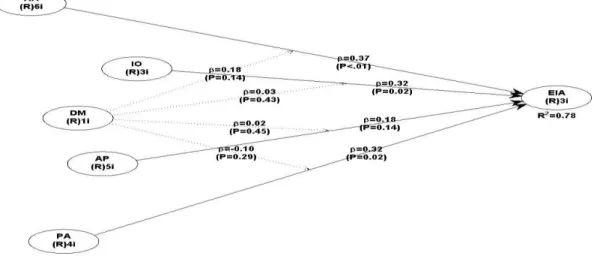
is 0.781. This means that the effectiveness of internal audits (EIA) can be explained by the relationship between internal auditors and external auditors, organizational independence, audit professionalism, auditee’s perceptions, and model management support constructed at 78.1% and the remaining 21.9% influenced by other variables outside the model.
Then, testing the inner model was conducted find out the feasibility of the research model made using Q squared. Q squared is used to assess predictive validity or relevance of a set of predictor latent variables on criterion variables. Models with validity must have a Q-Squared value of > 0. The model estimation results show good predictive validity, which is 0.895 because it is above zero. The last step in testing the inner model was to describe the testing model produced in Figure 1.
Fig. 1 Structural Model Testing Hypotheses
C. HypothesisTesting
The research hypothesis testing was carried out using the structural equation method through the PLS approach, namely looking at the path coefficient. The significance of the path coefficient in the model is used to test the hypothesis in finding the effect of the independent variables (exogenous) and moderating variables on the dependent variable (endogenous). Therefore, the conclusion whether the research hypothesis is accepted or rejected through the P-value is if the P-value on the tested path is <0.05 (α = 5%), then the research hypothesis is accepted. The results of the hypothesis testing are presented in Table 6.
Construct R2 Q2
Effectiveness of Internal Audits 0,78 0.895
The Determinants of the Effectiveness of Internal Audits with Management Support as the Moderating Variable 43 Table 6 Hypothesis testing results
Influence between latent
variables H
path
coefficient P-Value Conclusion
HA --> EAI H1 0.375 0.009 Accepted
IO --> EAI H2 0.321 0.023 Accepted
AP --> EAI H3 0.183 0.137 Rejected
PA --> EAI H4 0.316 0.025 Accepted
DM*HA --> EAI H5a 0.179 0.143 Rejected
DM*IO --> EAI H5b 0.031 0.43 Rejected
DM*AP --> EAI H5c 0.023 0.45 Rejected
DM*PA --> EAI H5d -0.095 0.291 Rejected
Source: Processed primary data, 2018
Based on Table 6, it can be concluded that:
The hypothesis 1 (H1) formulated is that the relationship between internal auditors and external
auditors has a positive effect towards the effectiveness of internal audits. The hypothesis test results show the relationship between internal auditors and external auditors to produce a path coefficient of 0.375 with p-value of 0.009. This shows that the relationship between internal auditors and external auditors has a
positive effect towards the effectiveness of internal audits. In accordance with this, hypothesis 1 is
accepted.
The hypothesis 2 (H2) formulated is that organizational independence has a positive effect
towards the effectiveness of internal audits. The hypothesis test results indicate that the organizational independence variable produces a path coefficient of 0.321 with p-value of 0.023. This shows that organizational independence has a positive effect towards the effectiveness of internal audits. In
accordance with this, hypothesis 2 is accepted.
The hypothesis 3 (H3) formulated is that audit professionalism has a positive effect towards the
effectiveness of internal audits. The hypothesis test results show that the audit professionalism variable produces a path coefficient of 0.183 with p-value of 0.137. This shows that audit professionalism does not
affect the effectiveness of internal audits. In accordance with this, hypothesis 3 is rejected.
The hypothesis 4 (H3) formulated is that the auditee’s perception has a positive effect towards
the effectiveness of internal audits. The hypothesis test results show that the auditee’s perception variable produces a path coefficient of 0.316 with p-value of 0.025. This shows that audit’s perception has a
positive affect the effectiveness of internal audits. In accordance with this, hypothesis 4 is accepted.
The hypothesis 5 (H5a) formulated is that top management support positively moderates the
effect of the relationship between internal auditors and external auditors towards the effectiveness of internal audits. The hypothesis test results show the interaction variable of management support with the relationship between internal auditors and external auditors towards the effectiveness of internal audits resulting in a path coefficient of 0.179 with p-value of 0.143. This shows that the interaction of management support with the relationship between internal auditors and external auditors has no
significant effect towards the effectiveness of internal audits. In accordance with this, hypothesis 5a is
The Determinants of the Effectiveness of Internal Audits with Management Support as the Moderating Variable 44 The hypothesis 5 (H5b) formulated is that top management support positively moderates the
effect of organizational independence towards the effectiveness of internal audits. The hypothesis test results show the interaction variable of management support with organizational independence towards the effectiveness of internal audits produces a path coefficient of 0.031 with p-value of 0.43. This shows that the interaction of management support with organizational independence has no significant effect
towards the effectiveness of internal audits. In accordance with this, the hypothesis 5b is rejected.
The hypothesis 5 (H5c) formulated is that top management support positively moderates the
effect of audit professionalism towards the effectiveness of internal audits. The hypothesis test results show that the interaction variable of support management with the audit professionalism towards the effectiveness of internal audits produces a path coefficient of 0.023 with p-value of 0.45. This shows that the interaction of management support with professional audits does not have a significant effect on the
effectiveness of internal audits. In accordance with this, hypothesis 5c is rejected.
The hypothesis 5 (H5d) formulated is that top management support positively moderates the
effect of auditee's perception on the effectiveness of internal audits. The hypothesis test results show that the interaction variable of management support with the auditee's perception towards the effectiveness of internal audits produces a path coefficient of -0.095 with p-value of 0.291. This shows that the interaction of management support with auditee's perception does not have a significant effect on the effectiveness of
internal audits. In accordance with this, it is stated that hypothesis 5d is rejected. The negative numbers
on the path coefficient explain the effect that occurs is a negative influence, namely the interaction of management support with the auditee’s perception which has a negative effect towards the effectiveness of internal audits.
Discussion
A. Effect of the Relationship between Internal Auditor and External Auditors towards the
Effectiveness of Internal Audits
The results showed that the first hypothesis formulated that the relationship of internal auditors with external auditors had a positive effect towards the effectiveness of internal audits was received. The results of this research are in line with those of Alzeban and Gwilliam (2014) which show that the relationship between internal and external auditors contributes to the effectiveness of internal audits. The same thing is also shown by the research of Badara and Saidin (2014) believes that there is a positive relationship between internal and external auditors towards the effectiveness of internal audits.
The results of this research also support the Contingency theory developed by Daft that things depend on other things, and for the organization to be effective, there must be "goodness of fit" between the design and various contingent factors. The relationship between internal and external auditors can improve the effectiveness of internal audits depending on certain conditions including the internal factor i.e. the internal auditor’s ability to build relationships with external auditors and the external factor i.e. the external auditor’s interest in internal auditors. Mutual relationships and dependence on each other will attract both parties to work together to minimize repeated errors and duplications of audit works.
B. The Effect of OrganizationalIndependence towards the Effectiveness of Internal Audits The results show that the second hypothesis formulated that organizational independence had a positive effect towards the effectiveness of internal audits is accepted. The results of this research are in line with the research of Cohen and Sayag (2010) which prove that organizational independence influences the effectiveness of internal audits. The same result is also shown by the research of
The Determinants of the Effectiveness of Internal Audits with Management Support as the Moderating Variable 45
Badaruddin et al. (2014), Alzeban and Gwilliam (2014), Badara (2015), Saleh (2015), Tackie et al. (2016), Arles et al. (2017) which found that independence had a positive effect towards the effectiveness of internal audits.
The results of this research also support the Contingency theory developed by Daft that things depend on other things, and for the organization to be effective, there must be "goodness of fit" between the design and various contingent factors. Organizational Independence can increase the effectiveness of internal audits depending on certain conditions including the internal factor, conflict of interest, and the external factor, the absence of intervention from the auditee.
C. The Effect of Audit Professionalismtowards the Effectiveness of Internal Audits
The results show that the third hypothesis formulated that audit professionalism has a positive effect towards the effectiveness of internal audits is rejected. The results of this research are not in line with Tackie's research (2016) which proves that audit professionalism has a significant effect towards the effectiveness of internal audits. The results of the third hypothesis testing are relevant to the research of Arena and Azone (2009), Cohen and Sayag (2010), Mahmudah and Riyanto (2016) which prove that audit professionalism does not affect the effectiveness of the audit. This hypothesis is not supported. It is assumed that audit professionalism is still limited to the audit function as management and organizational servants who prioritize compliance rather than enhancing organizational value and influencing audit effectiveness by providing quality audit services, value enhancers, and auditee evaluations.
The results of this research also do not support the Contingency theory developed by Daft that things depend on other things, and for the organization to be effective, there must be "goodness of fit" between the design and various contingent factors. The existence of interference from the audit organization in the form of education, training, and assignment is not able to bring the impact of increasing audit professionalism to carry out its duties and functions in increasing the effectiveness of internal audits.
If it is related to the demographics of the existing respondents, the majority of internal auditors are not from the accounting education background. Setyaningrum (2012) argues that accounting education background is a necessity for financial report examiners. The higher the level of education they have, the accounting knowledge will be more comprehensive. The results of Syamsidah’s research (2014) found that educational backgrounds had a positive effect towards audit quality. This research reinforces the research results of Fergurson et al. (2000) stating that the acquisition of knowledge through formal education with that from work experience is not completely interchangeable. The educational background possessed by internal auditors can improve their professional ability to carry out audit activities and provide useful recommendations to give added values to the organization.
D. The Effect of Auditee'sPerception towards the Effectiveness of Internal Audits
The results show that the fourth hypothesis formulated that the auditee's perception has a positive effect towards the effectiveness of the internal audit is accepted. The results of this research are in line with Putra's research (2017) which proves that auditee's perceptions influence the effectiveness of internal audits. The results of the relevant research of Flesher and Zanzig (2000) show that the auditee's good perception towards internal audit activities will improve the effectiveness of internal audits.
The results of this research also support the Contingency theory developed by Daft that things depend on other things, and for the organization to be effective, there must be "goodness of fit" between
The Determinants of the Effectiveness of Internal Audits with Management Support as the Moderating Variable 46
the design and various contingent factors. The positive perception of the auditee will improve audit effectiveness. This positive perception occurs when the internal auditor is considered to carry out audit activities to assist the organization in achieving its objectives, not fault-finding oriented. With the positive perception of the auditee, the auditor can carry out his audit duties optimally to carry out his duties responsibilities.
E. Management Support Moderates the Effects of the Relationship between Internal Auditors
and External Auditors, Organizational Independence, Audit Professionalism, and Auditee's Perception towards the Effectiveness of Internal Audits
The hypothesis 5a formulated that management support positively moderates the effect of the
relationship between internal auditors and external auditors towards the effectiveness of internal audits is rejected. This means that management support is not able to moderate the relationship between internal auditors and external auditors towards the effectiveness of internal audits. The results of this research do not support Fawzia's (2010) findings which prove that the collaboration of internal auditors with external auditors supported by the promotion from management and audit committees will increase the effectiveness of audits and supervision.
It is associated with contingency theory developed by Daft that things depend on other things, and for an organization to be effective, there must be "goodness of fit" between the design and various contingent factors. The theory explains that the effectiveness of internal audits will increase under a certain condition if there is management support. The existence of management support that can strengthen and weaken the relationship between internal and external audits towards the effectiveness of internal audits is not proven.
The hypothesis 5b formulated that management support positively moderates the effect of
organizational independence towards the effectiveness of internal audits is rejected. This means that management support is not able to moderate the organizational independence towards the effectiveness of internal audits. The results of this research do not support the opinion of Van Peursem (2005) who concludes that management support provided in the form of organizational independence is the dominant characteristic of the success of the audit program. The management support for organizational independence will improve audit effectiveness. This management support is very important to provide flexibility for internal audits to carry out their duties and responsibilities free of intervention and provide meaningful recommendations for the audited organization.
It is associated with contingency theory developed by Daft that things depend on other things, and for an organization to be effective, there must be "goodness of fit" between the design and various contingent factors. The management support that can strengthen or weaken the organizational independence towards the effectiveness of internal audits is not proven.
The hypothesis 5c formulated that management support positively moderates the effect of audit
professionalism towards the effectiveness of internal audit is rejected. This means that management support is not able to moderate audit professionalism towards the effectiveness of internal audits. The results of this research are not in line with the research of Endaya and Hanefa (2016) which concludes that the characteristic relationship between internal auditors and the effectiveness of internal audits is moderated by management support. The relationship between internal auditor's characteristics and the effectiveness of internal audits depends on management support. The Characteristics of Internal Auditors refer to the attributes that must be owned by each internal auditor i.e. objectivity, effective communication, proficiency and professional care, and training and development (Endaya and Hanefah., 2013).
The Determinants of the Effectiveness of Internal Audits with Management Support as the Moderating Variable 47
It is associated with contingency theory developed by Daft that things depend on other things, and for an organization to be effective, there must be "goodness of fit" between the design and various contingent factors. The management support that can strengthen or weaken audit professionalism of the effectiveness of internal audits is not proven
The hypothesis 5c formulated that management support positively moderates the effect of the
auditee’s perception towards the effectiveness of internal audits is rejected. This means that management support is not able to moderate the auditee's perception towards the effectiveness of internal audits. The results of this research are not in line with the research of Cohen and Sayag (2010) arguing that management support given to the employees at all levels related to the importance of the internal audit function will have an impact on increasing auditee collaboration and supporting the audit process. The existence of management support in this research does not provide a moderating effect on the relationship between the auditee's perception and the effectiveness of internal audits. It is the same as the research result of Mihret and Yismau (2007) which found that the absence of management support negatively affected the internal audit function by creating a bad attitude towards the function by the auditee.
It is associated with contingency theory developed by Daft that things depend on other things, and for an organization to be effective, there must be "goodness of fit" between the design and various contingent factors. The management support that can strengthen or weaken the auditee's perception towards the effectiveness of internal audits is not proven.
Ideally, management support can improve the effectiveness of internal audits that have been proven in the previous research. In this research, management support does not provide a moderating effect. It may be due to the neutral management support. According to Tugiman (2000: 173), management support for the supervisory function can be positive, negative, and neutral. Positive and negative support can be strong and weak. Management support is neutral. It can be interpreted that the support provided is general and the standard is limited to rules and has not reached the high management commitment.
When viewed from the auditor's side, according to Angel and Perry (1981), strong organizational commitment will encourage individuals to try harder to achieve organizational goals. Relevant to this opinion, it can be assumed that the auditor’s organizational commitment is still low so that any form of support provided by the management is not able to improve his performance in carrying out his activities. Associated with the respondents' data in table 1, it can be seen that the relationship between the number of auditors based on the background of accounting education and those with non-accounting educational background is thought to be the neutral attitude of the management in strengthening the internal audit function. Management does not have a high commitment in recruiting auditors with an accounting background.
Conclusion
The results of this research can be concluded that the effectiveness of internal audits is influenced by the relationship between internal auditors and external auditors, organizational independence, and the auditee’s perception. The relationship between internal auditors and external auditors, organizational independence, and auditee's perceptions to increase the effectiveness of internal audits depends on certain conditions, namely the interdependence of the interests of internal auditors with external auditors so as to improve good relations, no intervention from auditees or interested parties others, as well as positive perceptions from the auditee that can increase the confidence of the auditors in conducting audit activities and provide recommendations to give added values to the organization.
The Determinants of the Effectiveness of Internal Audits with Management Support as the Moderating Variable 48
Another finding is that audit professionalism cannot influence the effectiveness of internal audits. The interference from audit organizations to improve audit effectiveness by providing auditors with education and training and audit assignments does not have an impact on increasing the effectiveness of internal audits. Besides the existence of different auditors' educational backgrounds, it is possible for audit professionalism not to affect the effectiveness of internal audits.
Management support is not able to moderate the relationship between the independent variables and the effectiveness of internal audits. Management support in this research is neutral. It has not reached the high management commitment.
The results of this research contribute additionally to the contingency theory in increasing the effectiveness of internal audits. Contingency theory can be applied to the variable of the relationship between internal auditors and external auditors, organizational independence, and auditee’s perception, but cannot be applied to audit professionalism, and is unable to prove the management support as a moderating variable.
The researcher realizes that there are several limitations in this research. Some of the limitations include: 1) the questionnaire responses to auditor respondents is not as expected; 2) the object of the research is limited to KKP so that the results of this research cannot be generalized to other work units such as Ministries/Institutions and Regional Government. Based on the limitations of the researcher, the researcher’s suggestions for further research may consider the followings: 1) Increasing the number of samples so that the level of generalization can be higher; 2) Conducting research with similar objects in larger organizations and involving external auditors; 3) Considering interview techniques for management to explore the effectiveness of internal audit studies; 4) And developing research by adding organizational commitment variable.
The results of this research provide the practical implementation for all parties involved in improving the effectiveness of internal audits within KKP. Each with its duties and functions can contribute to increasing the effectiveness of internal audits to achieve the goals set by the organization. KKP leaders as the policy makers and parties interested in improving organizational goals and performance need to formulate and consider a new policy that can optimize the role of auditors and auditees and other parties, especially the role of auditors as consulting and catalysts who can identify risks and provide suggestions for the improvement of KKP leaders.
Acknowledgement
The researcher greatest appreciation to the Inspectorate General of the Ministry of Marine Affairs and Fisheries for helping carry out this research and gratefully thank to Marine and Fisheries Education Center which fully guarantees the funding of this research to the publication.
References
AAIPI. (2014). Standar Audit Intern Pemerintah Indonesia.
Alzeban, A., & Gwilliam, D. (2014). Factors Affecting the Internal Audit Effectiveness: A Survey of the Saudi Public Sector. Journal of International Accounting, Auditing and Taxation, 23(2): 74-86.
Angel, H. L. and Perry, J. L. (1981). Empirical Assessment of Organizational Commitment and Organizational Effectiveness. Administrative Science Quarterly, 15(4): 1-14.
The Determinants of the Effectiveness of Internal Audits with Management Support as the Moderating Variable 49
Arena, M., & Azzone, G. (2009). Identifying Organizational Drivers of Internal Audit Effectiveness. International Journal of Auditing, 13(1): 43-60.
Arens, A. A., Elder, R. J., Beasley, M. S. (2011). Auditing dan Pelayanan Verifikasi: Pendekatan Terpadu, alih bahasa oleh Tim Dejakarta, edisi kesembilan, Jakarta: Indeks.
Arles, L., & Anugrah, R. (2017). Analisis Faktor Faktor Yang Mempengaruhi Efektivitas Audit Internal: Peran Penting Dukungan Manajemen. Jurnal Akuntansi (Media Riset Akuntansi & Keuangan), 5(2): 125-133.
Askary, S. (2006). Accounting Professionalism–a Cultural Perspective of Developing
Countries. Managerial Auditing Journal, 21(1): 102-111.
Asrori, M. (2009). Psikologi Pembelajaran. Bandung: CV Wacana Prima.
Badan Pemeriksa Keuangan Republik Indonesia. (2018). Ikhtisar Hasil Pemeriksaan Semester I Tahun 2017. www.bpk.go.id/ihps/. accessed 05 March 2018.
Badara, M. A. S., and Saidin, S. Z. (2014). Empirical Evidence of Antecedents of Internal Audit Effectiveness from Nigerian Perspective. Middle-East Journal of Scientific Research, 19(4): 460-469. ---. (2015). Important Elements Connected with Internal Audit Effectiveness: Perception of
Internal Buditors in Bauchi State. Nigerian Journal of Management Technology & Development, 6(1): 79-86.
Budiaji, W. (2013). Skala Pengukuran dan Jumlah Respon skala Likert (the Measurement Scale and the Number of Responses in Likert Scale). Jurnal Ilmu Pertanian Dan Perikanan, 2(2): 127–133.
Cohen, A., & Sayag, G. (2010). The Effectiveness of Internal Auditing: an Empirical Examination of its Determinants in Israeli Organisations. Australian Accounting Review, 20(3): 296-307.
Daft, R. L. (2015). Organization Theory and Design. Boston: Cengage Learning.
Endaya, K. A., & Hanefah, M. M. (2013). Internal Audit Effectiveness: An Approach Proposition to Develop the Theoretical Framework. Research Journal of Finance and Accounting, 4(10): 92-102. ---. (2016). Internal Auditor Characteristics, Internal Audit Effectiveness, and Moderating
Effect of Senior Management. Journal of Economic and Administrative Sciences, 32(2): 160-176. Ferguson, C. B., Richardson, G. D., & Wines, G. (2000). Audit Education and Training: the Effect of
Formal Studies and Work Experience. Accounting Horizons, 14(2): 137-167.
Flesher, D. L., & Zanzig, J. S. (2000). Management Accountants Express a Desire for Change in the Functioning of Internal Auditing. Managerial Auditing Journal, 15(7): 331-337.
George, D., Theofanis, K., & Konstantinos, A. (2015). Factors Associated with Internal Audit Effectiveness: Evidence from Greece. Journal of Accounting and Taxation, 7(7): 113-122.
Gramling, A. A., Maletta, M. J., Schneider, A., & Church, B. K. (2004). The Role of the Internal Audit Function in Corporate Governance: A Synthesis of the Extant Internal Auditing Literature and Directions for Future Research. Journal of Accounting Literature, 23: 194.
The Determinants of the Effectiveness of Internal Audits with Management Support as the Moderating Variable 50
Hailemariam, S. (2014). Determinants of Internal Audit Effectiveness in the Public Sector, Case Study in Selected Ethiopian Public Sector Offices. Doctoral (Dissertation, Jimma University).
Hartono, Jogiyanto. (2011). Metodologi Penelitian Bisnis: Salah Kaprah dan Pengalaman-pengalaman. Yogyakarta: BPFE.
Kandelousi, N. S. (2011). Key Success Factors for Managing Projects. World Academy of Science, Engineering and Technology, International Journal of Social, Behavioral, Educational, Economic, Business and Industrial Engineering, 5(11): 1541-1545.
Karagiorgos, T., Drogalas, G., & Giovanis, N. (2011). Evaluation of the Effectiveness of Internal Audit in Greek Hotel Business. International Journal of Economic Sciences and Applied Research, 4(1): 19-34. Keuangan, B. P. (2007). Standar Pemeriksaan Keuangan Negara.
Mahmudah, H. dan Riyanto. (2016). Keefektifan Audit Internal Pemerintah Daerah. Universitas Tarumanagara Journal of Accounting, 20(1).
Mihret, D. G., and Wondim Yismaw, A. (2007). Internal Audit Effectiveness: An Ethiopian Public Sector Case Study. Managerial Auditing Journal, 22(5): 470-484.
Putra, A. Y. K. (2017). Faktor-Faktor Yang Mempengaruhi Efektivitas Audit Internal Pada Kementerian Keuangan. Tesis, Universitas Sebelas Maret, Surakarta.
Ratmono, D., & Solihin, M. (2013). Analisis SEM PLS dengan WrapPLS 3.0 untuk hubungan nonlinear dalam Penelitian Sosial dan Bisnis. Yogyakarta: Andi.
Santoso, B. W. (2016). Faktor-Faktor Yang Berpengaruh Terhadap Efektivitas Audit Internal (Studi Empiris Pada Inspektorat dan SKPD di Kota dan Kabupaten Magelang).
Sarens, G. (2009). Internal Auditing Research: Where Are We Going? Editorial. International Journal of Auditing, 13(1): 1-7.
Shohihah, I., Djamhuri, A., & Purwanti, L. (2018). Determinants of Internal Audit Effectiveness and Implication on Corruption Prevention in The Religious Ministry. WACANA, Jurnal Sosial dan Humaniora, 21(1).
Staehr, L. (2010). Understanding the Role of Managerial Agency in Achieving Business Benefits from Erp Systems. Information Systems Journal, 20(3): 213-238.
Tackie, G., Marfo-Yiadom, E., & Achina, S. O. (2016). Determinants of Internal Audit Effectiveness in Decentralized Local Government Administrative Systems. International Journal of Business and Management, 11(11): 184.
Tugiman. (2000). Pandangan Baru Internal Auditing, Edisi ke-4, Yogyakarta, Kanisius.
Van Peursem, K. A. (2005). Conversations with Internal Auditors: The Power of Ambiguity. Managerial Auditing Journal, 20(5): 489-512. https://www.transparency.org/news/feature/corruption_perceptions _index_2017. accessed 06 March 2018.
The Determinants of the Effectiveness of Internal Audits with Management Support as the Moderating Variable 51 Copyrights
Copyright for this article is retained by the author(s), with first publication rights granted to the journal. This is an open-access article distributed under the terms and conditions of the Creative Commons Attribution license (http://creativecommons.org/licenses/by/4.0/).