Bing Liu
Web Data Mining
Exploring Hyperlinks,
Contents, and Usage Data
With 177 Figures
In Chap. 9, we studied structured data extraction from Web pages. Such data are usually records retrieved from underlying databases and displayed in Web pages following some fixed templates. The Web also contains a huge amount of information in unstructured texts. Analyzing these texts is of great importance and perhaps even more important than extracting structured data because of the sheer volume of valuable information of al-most any imaginable types contained in them. In this chapter, we only fo-cus on mining of opinions on the Web. The task is not only technically challenging because of the need for natural language processing, but also very useful in practice. For example, businesses always want to find public or consumer opinions on their products and services. Potential customers also want to know the opinions of existing users before they use a service or purchase a product. Moreover, opinion mining can also provide valuable information for placing advertisements in Web pages. If in a page people express positive opinions or sentiments on a product, it may be a good idea to place an ad of the product. However, if people express negative opinions about the product, it is probably not wise to place an ad of the product. A better idea may be to place an ad of a competitor’s product.
The Web has dramatically changed the way that people express their opinions. They can now post reviews of products at merchant sites and ex-press their views on almost anything in Internet forums, discussion groups, blogs, etc., which are commonly called the user generated content or
user generated media. This online word-of-mouth behavior represents new and measurable sources of information with many practical applica-tions. Techniques are now being developed to exploit these sources to help businesses and individuals gain such information effectively and easily.
The first part of this chapter focuses on three mining tasks of evaluative texts (which are documents expressing opinions):
1.Sentiment classification: This task treats opinion mining as a text clas-sification problem. It classifies an evaluative text as being positive or negative. For example, given a product review, the system determines whether the review expresses a positive or a negative sentiment of the reviewer. The classification is usually at the document-level. No details are discovered about what people liked or didn’t like.
412 11 Opinion Mining
1.Featured-based opinion mining and summarization: This task goes to the sentence level to discover details, i.e., what aspects of an object that people liked or disliked. The object could be a product, a service, a topic, an individual, an organization, etc. For example, in a product re-view, this task identifies product features that have been commented on by reviewers and determines whether the comments are positive or negative. In the sentence, “the battery life of this camera is too short,” the comment is on the “battery life” and the opinion is negative. A struc-tured summary will also be produced from the mining results.
2.Comparative sentence and relation mining: Comparison is another type of evaluation, which directly compares one object against one or more other similar objects. For example, the following sentence com-pares two cameras: “the battery life of camera A is much shorter than that of camera B.” We want to identify such sentences and extract com-parative relations expressed in them.
The second part of the chapter discusses opinion search and opinion spam. Since our focus is on opinions on the Web, opinion search is natu-rally relevant, and so is opinion spam. An opinion search system enables users to search for opinions on any object. Opinion spam refers to dishon-est or malicious opinions aimed at promoting one’s own products and ser-vices, and/or at damaging the reputations of those of one’s competitors. Detecting opinion spam is a challenging problem because for opinions ex-pressed on the Web, the true identities of their authors are often unknown.
The research in opinion mining only began recently. Hence, this chapter should be treated as statements of problems and descriptions of current re-search rather than a report of mature techniques for solving the problems. We expect major progresses to be made in the coming years.
11.1 Sentiment Classification
Given a set of evaluative texts D, a sentiment classifier classifies each document dD into one of the two classes, positive and negative. Posi-tive means that d expresses a positive opinion. Negative means that d ex-presses a negative opinion. For example, given some reviews of a movie, the system classifies them into positive reviews and negative reviews.
The main application of sentiment classification is to give a quick de-termination of the prevailing opinion on an object. The task is similar but also different from classic topic-based text classification, which classifies documents into predefined topic classes, e.g., politics,science,sports, etc. In topic-based classification, topic related words are important. However,
in sentiment classification, topic-related words are unimportant. Instead, sentiment words that indicate positive or negative opinions are important, e.g., great, excellent, amazing, horrible, bad, worst, etc.
The existing research in this area is mainly at the document-level, i.e., to classify each whole document as positive or negative (in some cases, the
neutral class is used as well). One can also extend such classification to thesentence-level, i.e., to classify each sentence as expressing a positive, negative or neutral opinion. We discuss several approaches below.
11.1.1 Classification Based on Sentiment Phrases
This method performs classification based on positive and negative senti-ment words and phrases contained in each evaluative text. The algorithm described here is based on the work of Turney [521], which is designed to classify customer reviews.
This algorithm makes use of a natural language processing technique called part-of-speech (POS) tagging. The part-of-speech of a word is a linguistic category that is defined by its syntactic or morphological behav-ior. Common POS categories in English grammar are: noun, verb, adjec-tive, adverb, pronoun, preposition, conjunction and interjection. Then, there are many categories which arise from different forms of these catego-ries. For example, a verb can be a verb in its base form, in its past tense, etc. In this book, we use the standard Penn Treebank POS Tags as shown in Table 11.1. POS tagging is the task of labeling (or tagging) each word in a sentence with its appropriate part of speech. For details on part-of-speech tagging, please refer to the report by Santorini [472]. The Penn Treebank site is athttp://www.cis.upenn.edu/~treebank/home.html.
The algorithm given in [521] consists of three steps:
Step 1: It extracts phrases containing adjectives or adverbs. The reason for doing this is that research has shown that adjectives and adverbs are good indicators of subjectivity and opinions. However, although an iso-lated adjective may indicate subjectivity, there may be an insufficient context to determine its semantic (or opinion) orientation. For exam-ple, the adjective “unpredictable” may have a negative orientation in an automotive review, in such a phrase as “unpredictable steering”, but it could have a positive orientation in a movie review, in a phrase such as “unpredictable plot”. Therefore, the algorithm extracts two consecutive words, where one member of the pair is an adjective/adverb and the other is a context word.
Two consecutive words are extracted if their POS tags conform to any of the patterns in Table 11.2. For example, the pattern in line 2 means
414 11 Opinion Mining
that two consecutive words are extracted if the first word is an adverb and the second word is an adjective, but the third word (which is not ex-tracted) cannot be a noun. NNP and NNPS are avoided so that the names of the objects in the review cannot influence the classification.
Table 11.2. Patterns of tags for extracting two-word phrases from reviews
First word Second word Third word
(Not Extracted) 1. JJ NN or NNS anything 2. RB, RBR, or RBS JJ not NN nor NNS 3. JJ JJ not NN nor NNS 4. NN or NNS JJ not NN nor NNS 5. RB, RBR, or RBS VB, VBD, VBN, or VBG anything
Example 1: In the sentence “this camera produces beautiful pictures”, “beautiful pictures” will be extracted as it satisfies the first pattern. ɼ Step 2: It estimates the semantic orientation of the extracted phrases using
thepointwise mutual information measure given in Equation 1:
. Table 11.1. Penn Treebank part-of-speech tags (excluding punctuation)
Tag Description Tag Description
CC Coordinating conjunction PRP$ Possessive pronoun CD Cardinal number RB Adverb
DT Determiner RBR Adverb, comparative EX Existential there RBS Adverb, superlative FW Foreign word RP Particle
IN Preposition or subordi-nating conjunction
SYM Symbol JJ Adjective TO to
JJR Adjective, comparative UH Interjection JJS Adjective, superlative VB Verb, base form LS List item marker VBD Verb, past tense
MD Modal VBG Verb, gerund or present participle NN Noun, singular or mass VBN Verb, past participle
NNS Noun, plural VBP Verb, non-3rd person singular pre-sent
NNP Proper noun, singular VBZ Verb, 3rd person singular present NNPS Proper noun, plural WDT Wh-determiner
PDT Predeterminer WP Wh-pronoun
POS Possessive ending WP$ Possessive wh-pronoun PRP Personal pronoun WRB Wh-adverb
. ) Pr( ) Pr( ) Pr( log ) , ( 2 1 2 1 2 2 1 ¸¸ ¹ · ¨¨ © § term term term term term term PMI (1)
Here, Pr(term1 term2) is the co-occurrence probability of term1 and term2, and Pr(term1)Pr(term2) gives the probability that the two terms co-occur if they are statistically independent. The ratio between Pr(term1 term2) and Pr(term1)Pr(term2) is thus a measure of the degree of statisti-cal dependence between them. The log of this ratio is the amount of in-formation that we acquire about the presence of one of the words when we observe the other.
The semantic/opinion orientation (SO) of a phrase is computed based on its association with the positive reference word “excellent” and its as-sociation with the negative reference word “poor”:
SO(phrase) = PMI(phrase,“excellent”) PMI(phrase,“poor”). (2) The probabilities are calculated by issuing queries to a search engine and collecting the number of hits. For each search query, a search engine usually gives the number of relevant documents to the query, which is the number of hits. Thus, by searching the two terms together and sepa-rately, we can estimate the probabilities in Equation 1. Turney [521] used the AltaVista search engine because it has a NEAR operator, which constrains the search to documents that contain the words within ten words of one another, in either order. Let hits(query) be the number of hits returned. Equation 2 can be rewritten as:
. ) excellent" " ( ) " poor " phrase ( ) poor" " ( ) excellent" " phrase ( log ) ( 2 ¸¸ ¹ · ¨¨ © § hits NEAR hits hits NEAR hits phrase SO (3)
To avoid division by zero, 0.01 is added to the hits.
Step 3: Given a review, the algorithm computes the average SO of all phrases in the review, and classifies the review as recommended if the averageSO is positive, not recommended otherwise.
Final classification accuracies on reviews from various domains range from 84% for automobile reviews to 66% for movie reviews.
11.1.2 Classification Using Text Classification Methods
The simplest approach to sentiment classification is to treat the problem as a topic-based text classification problem. Then, any text classification al-gorithm can be employed, e.g., naïve Bayesian, SVM, kNN, etc.
416 11 Opinion Mining
The approach was experimented by Pang et al. [428] using movie re-views of two classes, positive and negative. It was shown that using a uni-gram (a bag of individual words) in classification performed well using ei-ther naïve Bayesian or SVM. Test results using 700 positive reviews and 700 negative reviews showed that these two classification algorithms achieved 81% and 82.9% accuracy respectively with 3-fold cross valida-tion. However, neutral reviews were not used in this work, which made the problem easier. No stemming or stopword removal was applied.
11.1.3 Classification Using a Score Function
A custom score function for review sentiment classification was given by Dave et al. [122]. The algorithm consists of two steps:
Step 1: It scores each term in the training set using the following equation, , ) ' | Pr( ) | Pr( ) ' | Pr( ) | Pr( ) ( C t C t C t C t t score i i i i i (4)
where ti is a term and C is a class and Cc is its complement, i.e., not C, and Pr(ti|C) is the conditional probability of term ti in class C. It is
com-puted by taking the number of times that a term ti occurs in class C
re-views and dividing it by the total number of terms in the rere-views of class C. A term’s score is thus a measure of bias towards either class ranging from 1 and 1.
Step 2: To classify a new document di = t1…tn, the algorithm sums up the
scores of all terms and uses the sign of the total to determine the class. That is, it uses the following equation for classification,
¯ ® ! otherwise, ' 0 ) ( ) ( C d eval C d class i i (5) where
¦
j j i scoret d eval( ) ( ). (6)Experiments were conducted based on a large number of reviews (more than 13000) of seven types of products. The results showed that the bi-grams (consecutive two words) and tribi-grams (consecutive three words) as terms gave (similar) best accuracies (84.6%88.3%), on two different re-view data sets. No stemming or stopword removal was applied.
In this paper, the authors experimented with many alternative classifica-tion techniques, e.g., naïve Bayesian, SVM, and several algorithms based
on other score functions. They also tried some word substitution strategies to improve generalization, e.g.,
x replace product names with a token (“_productname”); x replace rare words with a token (“_unique”);
x replace category-specific words with a token (“_producttypeword”); x replace numeric tokens with NUMBER.
Some linguistic modifications using WordNet, stemming, negation, and collocation were tested too. However, they were not helpful, and usually degraded the classification accuracy.
In summary, the main advantage of document level sentiment classifica-tion is that it provides a prevailing opinion on an object, topic or event. The main shortcomings of the document-level classification are:
x It does not give details on what people liked or disliked. In a typical evaluative text such as a review, the author usually writes specific as-pects of an object that he/she likes or dislikes. The ability to extract such details is useful in practice.
x It is not easily applicable to non-reviews, e.g., forum and blog postings, because although their main focus may not be evaluation or reviewing of a product, they may still contain a few opinion sentences. In such cases, we need to identify and extract opinion sentences.
There are several variations of the algorithms discussed in this section (see Bibliographic Notes). Apart from these learning based methods, there are also manual approaches for specific applications. For example, Tong [517] reported a system that generates sentiment timelines. The system tracks online discussions about movies and displays a plot of the number of positive sentiment and negative sentiment messages (Y-axis) over time (X-axis). Messages are classified by matching specific phrases that indicate sentiments of the author towards the movie (e.g., “great acting”, “ wonder-ful visuals”, “uneven editing”, “highly recommend it”, and “it sucks”). The phrases were manually compiled and tagged as indicating positive or nega-tive sentiments to form a lexicon. The lexicon is specific to the domain (e.g., movies) and must be built anew for each new domain.
11.2 Feature-Based Opinion Mining and Summarization
Although studying evaluative texts at the document level is useful in many cases, it leaves much to be desired. A positive evaluative text on a particu-lar object does not mean that the author has positive opinions on every as-pect of the object. Likewise, a negative evaluative text does not mean that
418 11 Opinion Mining
the author dislikes everything about the object. For example, in a product review, the reviewer usually writes both positive and negative aspects of the product, although the general sentiment on the product could be posi-tive or negaposi-tive. To obtain such detailed aspects, we need to go to the sen-tence level. Two tasks are apparent [245]:
1. Identifying and extracting features of the product that the reviewers have expressed their opinions on, called product features. For instance, in the sentence “the picture quality of this camera is amazing,” the prod-uct feature is “picture quality”.
2. Determining whether the opinions on the features are positive, negative or neutral. In the above sentence, the opinion on the feature “picture quality” is positive.
11.2.1 Problem Definition
In general, the opinions can be expressed on anything, e.g., a product, an individual, an organization, an event, a topic, etc. We use the general term “object” to denote the entity that has been commented on. The object has a set of components (or parts) and also a set of attributes (or properties). Thus the object can be hierarchically decomposed according to the part-of
relationship, i.e., each component may also have its sub-components and so on. For example, a product (e.g., a car, a digital camera) can have dif-ferent components, an event can have events, a topic can have sub-topics, etc. Formally, we have the following definition:
Definition (object): An objectO is an entity which can be a product, per-son, event, organization, or topic. It is associated with a pair, O: (T, A), where T is a hierarchy or taxonomy of components (or parts), sub-components, and so on, and A is a set of attributesofO. Each compo-nent has its own set of sub-compocompo-nents and attributes.
Example 2: A particular brand of digital camera is an object. It has a set of components, e.g., lens, battery, view-finder, etc., and also a set of attrib-utes, e.g., picture quality, size, weight, etc. The battery component also has its set of attributes, e.g., battery life, battery size, battery weight, etc. ɼ
Essentially, an object is represented as a tree. The root is the object it-self. Each non-root node is a component or sub-component of the object. Each link represents a part-of relationship. Each node is also associated with a set of attributes. An opinion can be expressed on any node and any attribute of the node.
Example 3: Following Example 2, one can express an opinion on the camera (the root node), e.g., “I do not like this camera”, or on one of its at-tributes, e.g., “the picture quality of this camera is poor”. Likewise, one can also express an opinion on one of the camera’s components, e.g., “the bat-tery of this camera is bad”, or an opinion on the attribute of the compo-nent, “the battery life of this camera is too short.” ɼ
To simplify our discussion, we use the word “features” to represent both components and attributes, which allows us to omit the hierarchy. Us-ing features for products is also quite common in practice. For an ordinary user, it is probably too complex to use a hierarchical representation of product features and opinions. We note that in this framework the object itself is also treated as a feature.
Let the evaluative text (e.g., a product review) be r. In the most general case,r consists of a sequence of sentences r=¢s1,s2, …, sm².
Definition(explicit and implicit feature): If a feature f appears in evalua-tive text r, it is called an explicit feature in r. If f does not appear in r but is implied, it is called an implicit feature in r.
Example 4: “battery life” in the following sentence is an explicit feature: “The battery life of this camera is too short”.
“Size” is an implicit feature in the following sentence as it does not appear in the sentence but it is implied:
“This camera is too large”.
Definition(opinion passage on a feature): The opinion passageon fea-turef of an object evaluated in r is a group of consecutive sentences in r that expresses a positive or negative opinion on f.
It is common that a sequence of sentences (at least one) in an evaluative text together expresses an opinion on an object or a feature of the object. Also, it is possible that a single sentence expresses opinions on more than one feature:
“The picture quality is good, but the battery life is short”.
Most current research focuses on sentences, i.e., each passage consisting of a single sentence. Thus, in our subsequent discussion, we use sentences
andpassagesinterchangeably.
Definition(explicit and implicit opinion): An explicit opinion on feature f is a subjective sentence that directly expresses a positive or negative opinion. An implicit opinion on feature f is an objective sentence that implies a positive or negative opinion.
420 11 Opinion Mining
Example 5: The following sentence expresses an explicit positive opinion: “The picture quality of this camera is amazing.”
The following sentence expresses an implicit negative opinion: “The earphone broke in two days.”
Although this sentence states an objective fact (assume it is true), it implic-itly expresses a negative opinion on the earphone. ɼ Definition (opinion holder): The holder of a particular opinion is a
per-son or an organization that holds the opinion.
In the case of product reviews, forum postings and blogs, opinion holders are usually the authors of the postings, although occasionally some authors cite or repeat the opinions of others. Opinion holders are more important in news articles because they often explicitly state the person or organization that holds a particular view. For example, the opinion holder in the sen-tence “John expressed his disagreement on the treaty” is “John”.
We now put things together to define a model of an object and a set of opinions on the object. An object is represented with a finite set of fea-tures,F = {f1,f2, …, fn}. Each feature fi in F can be expressed with a finite
set of words or phrases Wi, which are synonyms. That is, we have a set of
corresponding synonym sets W = {W1, W2, …, Wn} for the n features.
Since each feature fi in F has a name (denoted by fi), then fiWi. Each
au-thor or opinion holderj comments on a subset of the features SjF. For
each feature fk Sj that opinion holder j comments on, he/she chooses a
word or phrase from Wk to describe the feature, and then expresses a
posi-tive or negaposi-tive opinion on it.
This simple model covers most but not all cases. For example, it does not cover the situation described in the following sentence: “the view-finder and the lens of this camera are too close”, which expresses a nega-tive opinion on the distance of the two components. We will follow this simplified model in the rest of this chapter.
This model introduces three main practical problems. Given a collection of evaluative texts Das input, we have:
Problem 1: Both F and W are unknown. Then, in opinion mining, we need to perform three tasks:
Task 1: Identifying and extracting object features that have been com-mented on in each evaluative text dD.
Task 2: Determining whether the opinions on the features are positive, negative or neutral.
Task 3: Grouping synonyms of features, as different people may use dif-ferent words or phrases to express the same feature.
Problem 2:F is known but W is unknown. This is similar to Problem 1, but slightly easier. All the three tasks for Problem 1 still need to be per-formed, but Task 3 becomes the problem of matching discovered fea-tures with the set of given feafea-tures F.
Problem 3:W is known (then F is also known). We only need to perform Task 2 above, namely, determining whether the opinions on the known features are positive, negative or neutral after all the sentences that con-tain them are extracted (which is simple).
Clearly, the first problem is the most difficult to solve. Problem 2 is slightly easier. Problem 3 is the easiest, but still realistic.
Example 6: A cellular phone company wants to mine customer reviews on a few models of its phones. It is quite realistic to produce the feature set F that the company is interested in and also the set of synonyms of each fea-ture (although the set might not be complete). Then there is no need to per-form Tasks 1 and 3 (which are very challenging problems). ɼ Output: The final output for each evaluative text d is a set of pairs. Each pair is denoted by (f, SO), where f is a feature and SO is the semantic or opinion orientation (positive or negative) expressed in d on feature f. We ignore neutral opinions in the output as they are not usually useful.
Note that this model does not consider the strength of each opinion, i.e., whether the opinion is strongly negative (or positive) or weakly negative (or positive), but it can be added easily (see [548] for a related work).
There are many ways to use the results. A simple way is to produce a
feature-based summary of opinions on the object. We use an example to illustrate what that means.
Example 7: Assume we summarize the reviews of a particular digital camera, digital_camera_1. The summary looks like that in Fig. 11.1.
In Fig. 11.1, “picture quality” and (camera) “size” are the product fea-tures. There are 123 reviews that express positive opinions about the pic-ture quality, and only 6 that express negative opinions. The <individual re-view sentences> link points to the specific sentences and/or the whole reviews that give positive or negative comments about the feature.
With such a summary, the user can easily see how the existing custom-ers feel about the digital camera. If he/she is very interested in a particular feature, he/she can drill down by following the <individual review sen-tences> link to see why existing customers like it and/or what they are not
422 11 Opinion Mining
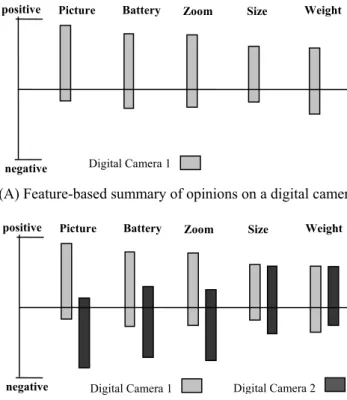
satisfied with. The summary can also be visualized using a bar chart. Fig-ure 11.2(A) shows the featFig-ure-based opinion summary of a digital camera.
In the figure, the bars above the X-axis in the middle show the percent-ages of positive opinions on various features (given at the top), and the bars below the X-axis show the percentages of negative opinions on the same features.
Fig. 11.2. Visualization of feature-based opinion summary and comparison
Digital_camera_1: Feature: picture quality
Positive: 123 <individual review sentences> Negative: 6 <individual review sentences> Feature: size
Positive: 82 <individual review sentences> Negative: 10 <individual review sentences> …
Fig. 11.1.An example of a feature-based summary of opinions
Picture Battery Zoom Size Weight positive
negative Digital Camera 1
Picture Battery Zoom Size Weight positive
negative Digital Camera 1 Digital Camera 2
(A) Feature-based summary of opinions on a digital camera
Comparing the opinion summaries of a few competing products is even more interesting. Figure 11.2(B) shows a visual comparison of consumer opinions on two competing digital cameras. We can clearly see how con-sumers view different features of each product. Digital camera 1 is clearly superior to digital camera 2. Specifically, most customers have negative opinions about the picture quality, battery and zoom of digital camera 2. However, on the same three features, customers are mostly positive about digital camera 1. Regarding size and weight, customers have similar opin-ions on both cameras. Thus, the visualization enables users to clearly see how the cameras compare with each other along each feature dimension.ɼ
Below, we discuss four other important issues.
Separation of Opinions on the Object itself and its Features: It is often useful to separate opinions on the object itself and opinions on the features of the object. The opinion on the object itself reflects the general sentiment of the author (or the opinion holder) on the object, which is what sentiment classification tries to discover at the document level.
Granularity of Analysis: Let us go back to the general representation of an object with a component tree and each component with a set of attrib-utes. We can study opinions at any level.
At level 1: We identify opinions on the object itself and its attributes. At level 2: We identify opinions on the major components of the object,
and also opinions on the attributes of the components.
At other levels, similar tasks can be performed. However, in practice, analysis at level 1 and level 2 are usually sufficient.
Example 8: Given the following review of a camera (the object), “I like this camera. Its picture quality is amazing. However, the bat-tery life is a little short”,
in the first sentence, the positive opinion is at level 1, i.e., a positive opin-ion on the camera itself. The positive opinopin-ion on the picture quality in the second sentence is also at level 1 as “picture quality” is an attribute of the camera. The third sentence expresses a negative opinion on an attribute of the battery (at level 2), which is a component of the camera. ɼ Opinion Holder Identification: In some applications, it is useful to iden-tify and extract opinion holders, i.e., persons or organizations that have ex-pressed certain opinions. As we mentioned earlier, opinion holders are more useful for news articles and other types of formal documents, in which the person or organization that expressed an opinion is usually stated in the text explicitly. However, such holders need to be identified by
424 11 Opinion Mining
the system. In the case of the user-generated content on the Web, the opin-ion holders are often the authors of discussopin-ion posts, bloggers, or review-ers, whose login ids are often known although their true identities in the real-world may be unknown. We will not discuss opinion holders in the chapter further due to our focus on the user-generated content on the Web. Interested readers, please refer to [276].
Opinioned Object Identification and Pronoun Resolution: In product reviews, the reviewed objects are usually known. However, this is not the case for opinions expressed in blogs and discussions. For example, in the following post “I have a Canon S50 camera purchased from Amazon. It takes great photos.”, two interesting questions can be asked: (1) what ob-ject does the post praise? and (2) what “it” means in the second sentence? Clearly, we know that the post praises “Canon S50 camera”, which is the problem of opinioned object identification, and we also know that “it” here means “Canon S50 camera” too, which is the problem of pronoun resolution. However, to automatically discover answers to the questions is a very challenging problem. So far, little work has been done.
11.2.2 Object Feature Extraction
Current research on feature extraction is mainly carried out from online
product reviews. We focus on such reviews in this subsection as well. It is a common practice for online merchants (e.g., amazon.com) to ask their customers to review the products that they have purchased. There are also dedicated review sites like epinions.com. There are three main review formats on the Web. Different review formats may need different tech-niques to perform the feature extraction task.
Format 1Pros, cons and the detailed review: The reviewer is asked to describe pros and cons separately and also write a detailed review. An example of such a review is given in Fig. 11.3.
Format 2 Pros and cons: The reviewer is asked to describe pros and cons separately, but there is not a separate detailed review as in format 1. That is, the details are in pros and cons. An example of such a review is given in Fig. 11.4.
Format 3Free format: The reviewer can write freely, i.e., no separation of pros and cons. An example of such a review is given in Fig. 11.5. For formats 1 and 2, opinion (or semantic) orientations (positive or nega-tive) of the features are known because pros and cons are separated. Only product features need to be identified. For format 3, we need to identify both product features and opinion orientations.
In both formats 2 and 3, reviewers typically use full sentences. How-ever, for format 1, pros and cons tend to be very brief. For example, in Fig. 11.3, under pros, we have “Great photos, easy to use, take videos”, which are elaborated in the detailed review.
Let us deal with pros and cons of format 1 first. The detailed reviews of format 1 are not used as they are elaborations of pros and cons. Analyzing short sentence segments in pros and cons produces more accurate results. Detailed reviews of format 1 are the same as reviews of format 3.
11.2.3 Feature Extraction from Pros and Cons of Format 1
We now describe a supervised pattern learning approach to extract product features from pros and cons in the reviews of format 1. These patterns are
My SLR is on the shelf
by camerafun4. Aug 09 ‘04
Pros: Great photos, easy to use, very small
Cons: Battery usage; included memory is stingy.
I had never used a digital camera prior to purchasing this Canon A70. I have always used a SLR … Read the full review
Fig. 11.3. An example of a review of format 1.
“It is a great digital still camera for this century”
September 1 2004.
Pros:
It’s small in size, and the rotatable lens is great. It’s very easy to use, and has fast response from the shutter. The LCD …
Cons:
It almost has no cons. It could be better if the LCD is bigger and it’s going to be best if the model is designed to a smaller size.
Fig. 11.4. An example of a review of format 2.
GREAT Camera., Jun 3, 2004 Reviewer: jprice174 from Atlanta, Ga.
I did a lot of research last year before I bought this camera... It kinda hurt to leave behind my beloved nikon 35mm SLR, but I was going to Italy, and I needed something smaller, and digital.
The pictures coming out of this camera are amazing. The 'auto' feature takes great pictures most of the time. And with digital, you're not wasting film if the picture doesn't come out. …
426 11 Opinion Mining
generated from label sequential rules (LSR) (see Sect. 2.9.2). This method is based on the algorithm in [247, 347].
A product feature can be expressed with a noun, adjective, verb or ad-verb. The labels and their POS tags used in mining LSRs are: {$feature, NN}, {$feature, JJ},{$feature, VB} and {$feature, RB}, where $feature de-notes a feature to be extracted, and NN stands for noun, VB for verb, JJ for adjective, and RB for adverb. They represent both explicit features and implicit feature indicators. We call a word that indicates an implicit feature an implicit feature indicator. For example, in the sentence “this camera is too heavy”, “heavy” is an adjective and is an implicit feature indicator for feature “weight”.
The feature extraction technique is based on the following observation: x Each sentence segment in pros and cons contains only one feature.
Sen-tence segments are separated by commas, periods, semi-colons, hy-phens, ‘&’’s, ‘and’’s, ‘but’’s, etc.
Example 9: Pros in Fig. 11.3 can be separated into three segments:
great photos ¢photo²
easy to use ¢use²
very small ¢small² ¢size².
Cons in Fig. 11.3 can be separated into two segments:
battery usage ¢battery²
included memory is stingy ¢memory² ɼ
We can see that each segment describes a product feature, which is listed within ¢ ². Notice that ¢small² is an implicit feature indicator and ¢size² is the implicit feature.
One point to note is that an explicit feature may not be a noun or noun phrase. Verbs can be explicit features as well, e.g., “use” in “easy to use”. In general, 6070% of the features are explicit noun features. A small pro-portion of explicit features are verbs. 2030% of the features are implicit features represented by their indicators. Let us now describe the method.
Given a set of reviews, this method consists of the following two steps: 1.Training data preparation for LSR mining: It consists of 4 sub-steps:
x Part-Of-Speech (POS) tagging and sequence generation: For each sentence segment, the algorithm first performs POS tagging, and then produces a sequence. For example, the sentence segment,
“Included memory is stingy”.
is turned into a sequence with POS tags:
x Replace the actual feature words with {$feature, <tag>}, where $fea-ture represents a feature. This replacement is necessary because dif-ferent products have difdif-ferent features, and the replacement ensures that we can find general language patterns to extract any product fea-ture. After replacement, the above example becomes:
¢{included, VB}{$feature, NN}{is, VB}{stingy, JJ}².
x Use an n-gram to produce shorter segments from long ones: For ex-ample, the above sequence will generate two trigram sequences:
¢{included, VB}{$feature, NN}{is, VB}² ¢{$feature, NN}{is, VB}{stingy, JJ}².
Trigrams are usually sufficient. The reason for using n-grams rather than full sentences is because most product features can be found based on local information and POS tags. Using long sentences tend to generate a large number of spurious rules.
x Perform word stemming: This reduces a word to its stem (see Sect. 6.5.2).
After the four-step pre-processing, the resulting sentence (trigram) seg-ments are saved in a sequence database for label sequential rule mining. In this file, each line contains one processed sequence.
2.Label sequential rule mining: A LSR mining system is applied to find all rules that involve a feature, i.e., $feature. An example rule is:
¢{easy, JJ }{to}{*, VB}² o ¢{easy, JJ}{to}{$feature, VB}².
Note that both POS tags and words may appear in a rule. A suitable minimum confidence and minimum support should be used, which can be chosen based on experiments. The right-hand-side of the rule is also called a language pattern.
3.Feature extraction: The resulting language patterns are used to match each sentence segment in a new review to extract product features. That is, the word in the sentence segment that matches $feature in a language pattern is extracted. Three situations are considered in extraction: x If a sentence segment satisfies multiple rules, we search for a
match-ing rule in the followmatch-ing order: {$feature, NN}, {$feature, JJ}, {$fea-ture, VB} and {$feature, RB}. The reason for this ordering is that noun features appear more frequently than other types. For rules of the same tag, the rule with the highest confidence is used since higher confidence indicates higher predictive accuracy.
428 11 Opinion Mining
x For sentence segments that no rules apply, nouns or noun phrases produced by a POS tagger are extracted as features if such nouns or noun phrases exist.
x For a sentence segment with only a single word (e.g., “heavy” and “big”), this pattern-based method does not apply. In such cases, the single words are treated as (implicit or explicit) features.
After extraction, we need to deal with several other important problems:
Mapping to Implicit Features: There are many types of implicit feature indicators. Adjectives are perhaps the most common type. Many adjectives modify or describe some specific attributes or properties of objects. For example, the adjective “heavy” usually describes the attribute “weight” of an object. “Beautiful” is normally used to describe (positively) the attribute “look” or “appearance” of an object. By no means, however, does this say that these adjectives only describe such attributes. Their exact meaning can be domain dependent. For example, “heavy” in the sentence “the traffic is heavy” does not describe the “weight” of the traffic.
One way to map indicator words to implicit features is to manually compile a list of such mappings during training data annotation, which can then be used in the same domain in the future. However, it is not clear whether this is an effective approach as little research has been done.
Grouping Synonyms: It is common that people use different words or phrases to describe the same feature. For example, “photo” and “picture” refer to the same feature in digital camera reviews. Identifying and group-ing synonyms is essential for practical applications. Although WordNet [175] and other thesaurus dictionaries help to some extent, they are far from sufficient due to the fact that many synonyms are domain dependent. For example, “picture” and “movie” are synonyms in movie reviews. However, they are not synonyms in digital camera reviews as “picture” is more related to “photo” while “movie” refers to “video”.
Liu et al. [347] made an attempt using synonyms in WordNet. Carenini et al. [80] proposes a more sophisticated method based on several similar-ity metrics that require the taxonomy of features to be given. The system merges each discovered feature to a feature node in the taxonomy. The similarity metrics are defined based on string similarity, synonyms and other distances measured using WordNet. Experimental results based on digital camera and DVD reviews show promising results. Clearly, many ideas and techniques described in Chap. 10 for information integration are applicable here.
Granularity of Features: In the sentence segment “great photos”, it is easy to decide that “photo” is the feature. However, in “battery usage”, we
can use either “battery usage” or “battery” as the feature. As we discussed in Sect. 11.2.1, each object has a component/part tree and each component node has a set of attributes. In a practical application, we need to determine the right level of analysis. If it is too general, it may not be useful. If it is too specific, it may result in a large number of features and also make the extraction very difficult and inaccurate.
11.2.4 Feature Extraction from Reviews of Formats 2 and 3
Pros and cons of format 1 mainly consist of short phrases and incomplete sentences. The reviews of formats 2 and 3 usually consist of complete sen-tences. To extract features from such reviews, the above algorithm can also be applied. However, some preliminary experiments show that it is not ef-fective because complete sentences are more complex and contain a large amount of irrelevant information. Below, we describe an unsupervised method for finding explicit features that are nouns and noun phrases. This method requires a large number of reviews, and consists of two steps: 1. Finding frequent nouns and noun phrases. Nouns and noun phrases (or
groups) are identified by using a POS tagger. We then count their fre-quency and only keep the frequent ones. A frefre-quency threshold can be decided experimentally. The reason for using this approach is that most product features are nouns, and those nouns that are frequently talked about are usually genuine and important features. Irrelevant contents (see Fig. 11.5) in reviews are often diverse, i.e., they are quite different in different reviews. When people comment on product features, the vo-cabulary that they use converges. Those nouns that are infrequent are likely to be non-features or less important features.
2. Finding infrequent features by making use of sentiment words. Senti-ment words (also called opinion words) are usually adjectives and ad-verbs that express positive or negative opinions, e.g., great, amazing,
bad, and expensive. The idea is as follows: The same opinion word can be used to describe different objects. Opinion words that modify fre-quent features can be used to find infrefre-quent features. For example, “picture” is found to be a frequent feature, and we have the sentence,
“The pictures are absolutely amazing.”
We also know that “amazing” is a positive opinion word (to be dis-cussed in Sect. 11.2.5). Then “software” may also be extracted as a fea-ture from the following sentence,
430 11 Opinion Mining
because the two sentences follow the same language pattern and “ soft-ware” in the sentence is also a noun.
This two-step approach is based on the work of Hu and Liu [245]. At the time this book was written, the shopping site Froogle of the search en-gine Google implemented a method similar to step 1 of the algorithm. However, it does not restrict frequent terms to be nouns or noun phrases.
The precision of step 1 of the above algorithm was improved by Pope-scu and Etzioni in [447]. Their algorithm tries to remove those noun phrases that may not be product features. It evaluates each noun phrase by computing a PMI score between the phrase and meronymy discrimina-torsassociated with the product class, e.g., a scanner class. The meronymy discriminators for the scanner class are, “of scanner”, “scanner has”, “scanner comes with”, etc., which are used to find components or parts of scanners by searching on the Web (see [166] also). The PMI measure is a simplified version of the measure given in Sect. 11.1.1:
, ) ( ) ( ) ( ) , ( d hits f hits d f hits d f PMI (7)
where f is a candidate feature identified in step 1 and d is a discriminator. Web search is used to find the number of hits. The idea of this approach is clear. If the PMI value of a candidate feature is too low, it may not be a component of the product because f and d do not co-occur frequently. The algorithm also distinguishes components/parts from attributes/properties using WordNet’s is-a hierarchy (which enumerates different kinds of properties) and morphological cues (e.g., “-iness”, “-ity” suffixes).
Finally, we note that many information extraction techniques are also applicable, e.g., conditional random fields (CRF) [298], hidden Markov models (HMM) [185], and many others. However, no comparative evalua-tion of these methods on this problem has been reported so far.
11.2.5 Opinion Orientation Classification
For reviews of format 3, we need to classify each sentence that contains a product feature as positive, negative or neutral. This classification may also be needed for reviews of format 2 because although pros and cons are separated in format 2, some sentences containing features are neutral.
We describe two main techniques below. The accuracy is usually rea-sonable (greater than 80%) if the sentences are either positive or negative, but if neutral sentences are included, the accuracy often drops signifi-cantly. Sentences containing negations also pose difficulties.
1. Using sentiment words and phrases: As explained above, sentiment words and phrases are words and phrases that express positive or nega-tive sentiments (or opinions). They are mostly adjecnega-tives and adverbs, but can be verbs and nouns too. Researchers have compiled sets of such words and phrases for adjectives, adverbs, verbs, and nouns respec-tively. Each set is usually obtained through a bootstrapping process: x Manually find a set of seed positive and negative words. Separate
seed sets are prepared for adjectives, adverbs, verbs and nouns. x Grow each of the seed set by iteratively searching for their synonyms
and antonyms in WordNet until convergence, i.e., until no new words can be added to the set. Antonyms of positive (or negative) words will be added to the negative (or positive) set.
x Manually inspect the results to remove those incorrect words. Al-though this step is time consuming, it is only an one-time effort. Apart from a set of opinion words, there are also idioms, which can be classified as positive, negative and neutral as well. Many language pat-terns also indicate positive or negative sentiments. They can be manu-ally compiled and/or discovered using pattern discovery methods.
Using the final lists of positive and negative words, phrases, idioms and patterns, each sentence that contains product features can be classi-fied as follows: Sentiment words and phrases in the sentence are identi-fied first. A positive word or phrase is assigned a score of +1 and a negative word or phrase is assigned a score of 1. All the scores are then summed up. If the final total is positive, then the sentence is positive, otherwise it is negative. If a negation word is near a sentiment word, the opinion is reversed. A sentence that contains a “but” clause (sub-sentence that starts with “but”, “however”, etc.) indicates a sentiment change for the feature in the clause.
This method is based on the techniques given by Hu and Liu [245], and Kim and Hovy [276]. In [447], Popescu and Etzioni proposed a more complex method, which makes use of syntactical dependencies produced by a parser. Yu and Hatzivassiloglou [584] presented a method similar to that in Sect. 11.1.1 but used a large number of seeds. Recall that Turney [521] used only two seeds (see Sect. 11.1.1), “ excel-lent” for positive and “poor” for negative. The sentence orientation is determined by a threshold of the average score of the words in the sen-tence. It is not clear which method performs better because there is little comparative evaluation.
Note that the opinion orientations of many words are domainand/or
sentence context dependent. Such situations are usually hard to deal with. It can be easy in some cases. For example, “small” can be positive
432 11 Opinion Mining
or negative. However, if there is a “too” before it, it normally indicates a negative sentiment, e.g., “this camera is too small for me”.
2. The methods described in Sect. 11.1 for sentiment classification are ap-plicable here. Using supervised learning, we need to prepare a set of manually labeled positive, negative and neutral sentences as the training data. If sentiment words and phrases, idioms and patterns are used also as attributes, the classification results can be further improved. Sen-tences containing negations and clauses starting with “but”, “however”, etc., need special handling since one part of the sentence may be posi-tive and another part may be negaposi-tive, e.g., “The pictures of this camera are great, but the camera itself is a bit too heavy.”
In summary, although many classification techniques have been proposed, little comparative study of these techniques has been reported. A promis-ing approach is to combine these techniques to produce a better classifier.
11.3 Comparative Sentence and Relation Mining
Directly expressing positive or negative opinions on an object is only one form of evaluation. Comparing the object with some other similar objects is another. Comparison is perhaps a more convincing way of evaluation. For example, when a person says that something is good or bad, one often asks “compared to what?” Thus, one of the most important ways of evalu-ating an object is to directly compare it with some other similar objects.
Comparisons are related to but also different from typical opinions. They have different semantic meanings and different syntactic forms. Comparisons may be subjective or objective. For example, a typical opin-ion sentence is “the picture quality of camera x is great.” A subjective comparison is “the picture quality of camera x is better than that of camera y.” An objective comparison is “camera x is 20 grams heavier than cam-era y”, which may be a statement of a fact and may not have an implied opinion on which camera is better.
In this section, we study the problem of identifying comparative sen-tences and comparative relations (defined shortly) in text documents, e.g., consumer reviews, forum discussions and news articles. This problem is also challenging because although we can see that the above example sen-tences all contain some indicators, i.e., “better” and “longer”, many sen-tences that contain such words are not comparisons, e.g., “in the context of speed, faster means better”. Similarly, many sentences that do not contain such indicators are comparative sentences, e.g., “cellphone X has blue-tooth, but cellphone Y does not,” and “Intel is way ahead of AMD.”
11.3.1 Problem Definition
Acomparative sentence is a sentence that expresses a relation based on similarities or differences of more than one object. The comparison in a comparative sentence is usually expressed using the comparative or the
superlative form of an adjective or adverb. The comparative is used to state that one thing has more (bigger, smaller) “value” than the other. The superlative is used to say that one thing has the most (the biggest, the smallest) “value”. The structure of a comparative consists normally of the stem of an adjective or adverb, plus the suffix -er, or the modifier “more” or “less” before the adjective or adverb. For example, in “John is taller than James”, “taller” is the comparative form of the adjective “tall”. The structure of a superlative consists normally of the stem of an adjective or adverb, plus the suffix -est, or the modifier “most” or “least” before the adjective or adverb. In “John is the tallest in the class”, “tallest” is the superlative form of the adjective “tall”.
A comparison can be between two or more objects, groups of objects, one object and the rest of the objects. It can also be between an object and its previous or future versions.
Types of Important Comparisons: We can classify comparisons into four main types. The first three types are gradable comparisons and the last one is the non-gradable comparison. The gradable types are defined based on the relationships of greater or less than, equal to, and greater or less than all others.
1.Non-equal gradable comparisons: Relations of the type greater or less than that express an ordering of some objects with regard to some of their features, e.g., “the Intel chip is faster than that of AMD”. This type also includes user preferences, e.g., “I prefer Intel to AMD”.
2.Equative comparisons: Relations of the type equal to that state two ob-jects are equal with respect to some of their features, e.g., “the picture quality of camera A is as good as that of camera B”
3.Superlative comparisons: Relations of the type greater or less than all others that rank one object over all others, e.g., “the Intel chip is the fastest”.
4.Non-gradable comparisons: Sentences that compare features of two or more objects, but do not grade them. There are three main types:
x ObjectA is similar to or different from object B with regard to some features, e.g., “Coke tastes differently from Pepsi”.
x Object A has feature f1, and object B has feature f2 (f1 and f2 are usu-ally substitutable), e.g., “desktop PCs use external speakers but lap-tops use internal speakers”.
434 11 Opinion Mining
x Object A has feature f, but object B does not have, e.g., “cell phone A has an earphone, but cell phone B does not have”.
Gradable comparisons can be classified further into two types: adjectival comparisons and adverbial comparisons. Adjectival comparisons involve comparisons of degrees associated with adjectives, e.g., in “John is taller than Mary,” and “John is the tallest in the class”). Adverbial comparisons are similar but usually occur after verb phrases, e.g., “John runs faster than James,” and “John runs the fastest in the class”.
Given an evaluative text d,comparison mining consists of two tasks: 1. Identify comparative passages or sentences from d, and classify the
identified comparative sentences into different types or classes.
2. Extract comparative relations from the identified sentences. This in-volves the extraction of entities and their features that are being com-pared, and the comparative keywords. Relations in gradable adjectival comparisons can be expressed with
(<relationWord>, <features>, <entityS1>, <entityS2>, <type>) where:
relationWord: The comparative keyword used to express a compara-tive relation in a sentence.
features: a set of features being compared.
entityS1 and entityS2: Sets of entities being compared. Entities in enti-tyS1 appear to the left of the relation word and entities in entityS2 appear to the right of the relation word.
type:non-equal gradable,equative or superlative.
Example 10: Consider the comparative sentence “Canon’s optics is bet-ter than those of Sony and Nikon.” The extracted relation is:
(better, {optics}, {Canon}, {Sony, Nikon},non-equal gradable). ɼ We can also design relation representations for adverbial comparisons and non-gradable comparisons. In this section, however, we only focus on adjectival gradable comparisons as there is little study on relation extrac-tion of the other types. For simplicity, we will use comparative sentences andgradable comparative sentences interchangeably from now on.
Finally, we note that there are other types of comparatives in linguistics that are used to express different types of relations. However, they are rela-tively rare in evaluative texts and/or less useful in practice. For example, a meta-linguistic comparative compares the extent to which a single object has one property to a greater or lesser extent than another property, e.g., “Ronaldo is angrier than upset” (see [150, 274, 313, 393]).
11.3.2 Identification of Gradable Comparative Sentences
This is a classification problem. A machine learning algorithm is applica-ble to solve this proapplica-blem. The main issue is what attributes to use.
An interesting phenomenon about comparative sentences is that such a sentence usually has a comparative keyword. It is shown in [256] that us-ing a set of 83 keywords, 98% of the comparative sentences (recall = 98%) can be identified with a precision of 32% using the authors’ data set. Let us see what the keywords are:
1.Comparative adjectives (with the POS tag of JJR) and comparative adverbs (with the POS tag of RBR), e.g., more,less,better,longer and words ending with -er.
2.Superlative adjectives (with the POS tag of JJS) and superlative ad-verbs (with the POS tag of RBS), e.g., most, least, best, tallest and words ending with -est.
3. Words like same, similar, differ and those used with equative as, e.g., same as,as well as, etc.
4. Others, such as favor, beat, win, exceed, outperform, prefer, ahead, than,superior,inferior,number one, up against, etc.
Note that those words with POS tags of JJR, RBR, JJS and RBS are not used as keywords themselves. Instead, their POS tags, JJR, RBR, JJS and RBS, are treated as four keywords only. There are four exceptions: more, less, most, and least are treated as individual keywords because their us-ages are diverse, and using them as individual keywords enables the sys-tem to catch their individual usage patterns for classification.
Since keywords alone are able to achieve a very high recall, the follow-ing learnfollow-ing approach is used in [255] to improve the precision:
x Use the set of keywords to filter out those sentences that are unlikely to be comparative sentences (do not contain any keywords). The remaining set of sentences R forms the candidate set of comparative sentences. x Work on R to improve the precision, i.e., to classify the sentences in R
intocomparativeandnon-comparative sentences, and then into different types of comparative sentences.
It is also observed in [255] that comparative sentences have strong patterns involving comparative keywords, which is not surprising. These patterns can be used as attributes in learning. To discover these patterns, class se-quential rule (CSR) mining (see Sect. 2.9.3) was used. Each training ex-ample used for mining CSRs is a pair (si,yi), where si is a sequence and yi
436 11 Opinion Mining
Training Data Preparation: The sequences in the training data are gener-ated from sentences. Since we want to find patterns surrounding specific keywords, we use keywords as pivots to produce sequences.
Let the set of pivots be P. We generate the training sequence database as follows:
1. For each sentence, only words within the radius of r of the keyword pivot pi P are used to form a sequence. In [256], r is set to 3. Each
pivot in a sentence forms a separate sequence.
2. Each word is then replaced with its POS tag. The actual words are not used because the contents of sentences may be very different, but their underlying language patterns can be the same. Using POS tags allow us to capture content independent patterns. There is an exception. For each keyword (except those represented by JJR, RBR, JJS and RBS), the ac-tual word and its POS tag are combined together to form a single item. The reason for this is that some keywords have multiple POS tags de-pending on their use. Their specific usages can be important in deter-mining whether a sentence is a comparative sentence or not. For exam-ple, the keyword “more” can be a comparative adjective (more/JJR) or a comparative adverb (more/RBR) in a sentence.
3. A class is attached to each sequence according to whether the sentence is a comparative or non-comparative sentence.
Example 11: Consider the comparative sentence “this/DT camera/NN has/VBZ significantly/RB more/JJR noise/NN at/IN iso/NN 100/CD than/IN the/DT nikon/NN 4500/CD.” It has the keywords “more” and “than”. The sequence involving “more” put in the training set is:
(¢{NN}{VBZ}{RB}{more/JJR}{NN}{IN}{NN}²,comparative)
CSR Generation: Using the training data, CSRs can be generated. Recall that a CSR is an implication of the form, Xoy, where X is a sequence and y is a class. Due to the fact that some keywords appear very frequently in the data and some appear rarely, multiple minimum supports are used in mining. The minimum item support for each keyword is computed with freq*W, where W is set to 0.1 (freq is the actual frequency of its occurrence). See Sect. 2.7.2 or Sect. 2.8.2 in Chap. 2 for details on mining with multiple minimum supports.
In addition to the automatically generated rules, some manually com-piled rules are also used in [255, 256], which are more complex and diffi-cult to generate by current rule mining techniques.
Classifier Building: There are many ways to build classifiers using the discovered CSRs, we describe two methods:
1. Treat all CSRs as a classifier. A CSR simply expresses the conditional probability that a sentence is a comparison if it contains the sequence pattern X. These rules can thus be used for classification. That is, for each test sentence, the algorithm finds all the rules satisfied by the sen-tence, and then chooses the rule with the highest confidence to classify the sentence. This is basically the “use the strongest rule” method dis-cussed in Sect. 3.5.1 in Chap. 3.
1. Use CSRs as attributes to create a data set and then learn a naïve Bayes-ian (NB) classifier (or any other types of classifiers) (see Sect. 3.5.2 in Chap. 3). The data set uses the following attribute set:
Attribute Set = {X | X is the sequential pattern in CSR Xoy} {Z| Z is the pattern in a manual rule Zoy}.
The class is not used but only the sequence pattern X (or Z) of each rule. The idea is that these patterns are predictive of the classes. A rule’s pre-dictability is indicated by its confidence. The minimum confidence of 60% is used in [255].
Each sentence forms an example in the training data. If the sentence has a particular pattern in the attribute set, the corresponding attribute value is 1, and is 0 otherwise. Using the resulting data, it is straightfor-ward to perform NB learning. Other learning methods can be used as well, but according to [255], NB seems to perform better.
Classify Comparative Sentences into Three Types: This step classifies comparative sentences obtained from the last step into one of the three types or classes, non-equal gradable, equative, and superlative. For this task, the keywords alone are already sufficient. That is, we use the set of keywords as the attribute set for machine learning. If the sentence has a particular keyword in the attribute set, the corresponding attribute value is 1, and otherwise it is 0. SVM gives the best results in this case.
11.3.3 Extraction of Comparative Relations
We now discuss how to extract relation entries/items. Label sequential rules are again used for this task. The algorithm presented below is based on the work in [256], which makes the following assumptions:
1. There is only one relation in a sentence. In practice, this is violated only in a very small number of cases.
2. Entities or features are nouns (includes nouns, plural nouns and proper nouns) and pronouns. These cover most cases. However, a feature can sometimes be a noun used in its verb form or some action described as a
438 11 Opinion Mining
verb (e.g., “Intel costs more”; “costs” is a verb and a feature). Such comparisons are adverbial comparisons and are not considered in [256].
Sequence Data Generation: A sequence database for mining is created as follows: Since we are interested in predicting and extracting items repre-senting entityS1 (denoted by $entityS1), entityS2 (denoted by $entityS2), and features (denoted by $feature), which are all called labels, we first manually mark/label such words in each sentence in the training data. For example, in the sentence “Intel/NNP is/VBZ better/JJR than/IN amd/NN”, the proper noun “Intel” is labeled with $entityS1, and the noun “amd” is labeled with $entityS2. The two labels are then used as pivots to generate sequence data. For every occurrence of a label in a sentence, a separate se-quence is created and put in the sese-quence database. A radius of 4 is used in [256]. The following position words are also added to keep track of the distance between two items in a generated pattern:
1. Distance words = {l1,l2,l3,l4,r1,r2, r3,r4}, where li means distance ofi to the left of the pivot, and ri means the distance of i to the right of pivot.
2. Special words #start and #end are used to mark the start and the end of a sentence.
Example 12: The comparative sentence “Canon/NNP has/VBZ better/JJR optics/NNS than/IN Nikon/NNP” has $entityS1 “Canon”,$feature “optics” and$entityS2“Nikon”. The three sequences corresponding to the two enti-ties and one feature put in the database are:
¢{#start}{l1}{$entityS1, NNP}{r1}{has, VBZ}{r2}{better, JJR} {r3}{$feature, NNS}{r4}{thanIN}²
¢{#start}{l4}{$entityS1, NNP}{l3}{has, VBZ}{l2}{better, JJR} {l1} {$feature, NNS}{r1}{thanIN}{r2}{entityS2, NNP}{r3} {#end}² ¢{has, VBZ}{l4}{better, JJR}{l3}{$feature, NNS}{l2}{thanIN}
{l1}{$entityS2, NNP}{r1}{#end}².
The keyword “than” is merged with its POS tag to form a single item.
LSR Generation: After the sequence database is built, a rule mining sys-tem is applied to generate label sequential rules. Note that only those rules that contain one or more labels (i.e., $entityS1, $entityS2, and $feature) will be generated. An example of a LSR rule is as follows
Rule 1: ¢{*, NN}{VBZ}{JJR}{thanIN}{*, NN}² o
¢{$entityS1, NN}{VBZ}{JJR}{thanIN}{$entityS2, NN}².
Relation Item Extraction: The generated LSRs are used to extract rela-tion items from each input (or test) sentence. One strategy is to use all the
rules to match the sentence and to extract the relation items using the rule with the highest confidence. For example, the above rule will label and ex-tract “coke” as entityS1, and “pepsi” as entityS2 from the following sen-tence:
¢{coke, NN}{is, VBZ}{definitely, RB}{better, JJR}{thanIN}{pepsi, NN}².
There is no feature in this sentence. The relationWord is simply the key-word that identifies the sentence as a comparative sentence. In this case, it is “better.” A similar but more complex method is used in [256].
Again, many other methods can also be applied to the extraction, e.g., conditional random fields, hidden Markov models, and others. Results in [256] show that the LSR-based method outperforms conditional random fields. Further research and more comprehensive evaluations are needed to assess the strengths and weaknesses of these methods.
11.4 Opinion
Search
Like the general Web search, one can also crawl the user-generated content on the Web and provide an opinion search service. The objective is to en-able users to search for opinions on any object. Let us look at some typical opinion search queries:
1. Search for opinions on a particular object or feature of an object, e.g., customer opinions on a digital camera or the picture quality of a digital camera, or public opinions on a political topic. Recall that the object can be a product, organization, topic, etc.
2. Search for opinions of a person or organization (i.e., opinion holder) on a particular object or feature of the object. For example, one may search for Bill Clinton’s opinion on abortion or a particular aspect of it. This type of search is particularly relevant to news documents, where indi-viduals or organizations who express opinions are explicitly stated. In the user-generated content on the Web, the opinions are mostly ex-pressed by authors of the postings.
For the first type of queries, the user may simply give the name of the ob-ject and/or some features of the obo