Verifying Pointer Safety for Programs with
Unknown Calls
Chenguang Luo, Florin Craciun, Shengchao Qin, Guanhua He
Durham University, Durham DH1 3LE, UKWei-Ngan Chin
National University of SingaporeAbstract
We study the automated verification of pointer safety for heap-manipulating imperative pro-grams with unknown procedure calls. Given a Hoare-style partial correctness specificationS= {Pre}C {Post}in separation logic, where the programC contains calls to some unknown pro-cedureU, we infer a specificationSU for the unknown procedureU from the calling contexts. We show that the problem of verifying the programCagainst the specificationS can be safely reduced to the problem of proving that the procedureU (once its code is available) meets the derived specification SU. The expected specification SU for the unknown procedure U is au-tomatically calculated using an abduction-based shape analysis. We have also implemented a prototype system to validate the viability of our approach. Preliminary results show that the specifications derived by our tool fully capture the behaviors of the unknown code in many cases. Key words: Inference, verification, abduction, separation logic
1. Introduction
While automated verification of memory safety remains a big challenge [14, 21], espe-cially for substantial system software such as the Linux distribution and device drivers, significant advances have been seen recently on the automated verification of pointer safety for such software [6, 22]. The abduction-based compositional shape analysis [6] is able to calculate the pre/post specifications for procedures in a bottom-up approach, based on the call-dependency graph. It can verify the pointer safety of a large portion Email addresses:{chenguang.luo, florin.craciun, shengchao.qin, guanhua.he}@durham.ac.uk
(Chenguang Luo, Florin Craciun, Shengchao Qin, Guanhua He),[email protected](Wei-Ngan Chin).
of the Linux kernel and many device drivers manipulating shared mutable data struc-tures. One issue that has not been dealt within their work is unknown procedure calls. In their SpaceInvader tool, unknown calls are currently ignored and replaced by the empty statementskip during the verification. This may lead to imprecise or unsound results in general. Our work here is to investigate this issue carefully and provide a better solution to the verification of pointer safety of programs with unknown calls.
Automated program verifiers usually require to have access to the entire given pro-gram, which in practice may not be completely available for various reasons. For instance, some programs (e.g. in C) may contain unknown calls that correspond to function point-ers, some programs (e.g. in OO) may contain calls to interface methods whose actual implementations may not be available statically, or some programs may have calls to library procedures whose code is not available during verification. Other possible scenar-ios can be found in remote procedure calls such as COM/DCOM [20], mobile code and software upgrading, where program fragments may be unavailable at verification time. To deal with the verification of programs with unknown procedure calls, current automated program verifiers either
• ignore the unknown procedure calls, e.g. replacing them by skip [6], which can be unsound in general; or
• assume that the program and the unknown procedure have disjoint memory footprints so that the unknown call can be safely ignored due to the hypothetical frame rule [18]; however, this assumption does not hold in many cases; or
• use specification mining [1] to discover possible specifications for the (unknown part of the) program, which is performed dynamically by observing the execution traces and is not likely to be exhaustive for all possible program behaviors; or
• take into account all possible implementations for the unknown procedure [10, 12]. In general, there can be too many such candidates, making the verification almost impossible at compile time; or
• simply stop at the first unknown procedure call and provide an incomplete verification, which is obviously undesirable.
Approach and contributions. We propose a different approach in this paper to the verification of programs with unknown procedure calls. Given a specification S = {Pre} C{Post}for the programCcontaining calls to an unknown procedure U, our so-lution is to proceed with the verification for the known fragments ofC, and at the same time infer a specification SU that is expected for the unknown procedure U based on
the calling context(s). The problem of verifying the programCagainst the specification
S can now be safely reduced to the problem of verifying the procedure U against the inferred specificationSU, provided that the verification of the known fragments does not
cause any problems. The inferred specification is subject to a later verification when an implementation or a specification for the unknown procedure becomes available (e.g. at loading time in Java).
The intuition of our method to infer the unknown procedure’s specification can be di-vided into two steps. The first step is to analyze the code before the unknown procedure call to discover its precondition. The second is to analyze the code after the unknown call in order to discover its postcondition. For the second step, one might suggest to use a deductive backwards analysis, starting from the postcondition of the program being verified, to derive an expected postcondition for the unknown procedure. We cannot fol-low this suggestion due to a technical challenge: backwards reasoning over the separation
domain is simply too costly to implement ([6]). Therefore, we exploit an abductive for-wards reasoning [6, 11] to derive the unknown procedure’s postcondition, and in this way the verification can be accomplished.
Our paper makes the following technical contributions:
• We propose a novel framework in separation logic for the verification of pointer safety for programs with unknown calls.
• The top-down feature of our approach can potentially benefit the general software development process. Given the specification for the caller procedure, it can be used to infer the specification for the callee procedures. This is a potentially beneficial complement for currentbottom-upapproaches ([13]).
• We have enhanced the abduction mechanism, resulting in an improved algorithm for the verification use. Compared with bi-abductive analysis [6] we have added additional reasoning rules (e.g. for the list tail matching) such that the use of inaccurate reasoning rules (like the “missing” rule) is avoided in many cases. We have also introduced a more practical partial order to judge the quality of different solutions for abduction. • We have successfully incorporated the call-by-reference mechanism into the forward
analyses in the separation domain.
• We have built a prototype system to test the viability and performance of our approach, and we have conducted some initial experimental studies to evaluate the precision of the results and the scalability of our system. Preliminary results show that our tool can derive expressive specifications which fully capture the behaviors of the unknown code in many cases.
Outline.Section 2 employs a motivating example to informally illustrate our main ap-proach. Section 3 presents the programming language and the abstract domain for our analysis. Section 4 introduces our abductive reasoning. Section 5 defines two abstract semantics used in our verification. Section 6 depicts our verification algorithms. Experi-mental results are shown in Section 7, followed by some concluding remarks.
2. A Motivating Example
In this section we illustrate informally, via an example, how our analysis infers the specification for an unknown procedure. Our analysis makes use of a separation domain similar to the one used in the SpaceInvader tool [6, 9]. To keep the presentation simple, we use a small imperative language with both call-by-value and call-by-reference parameters for procedures. Formal details about the abstract domain and the language will be given in Section 3.
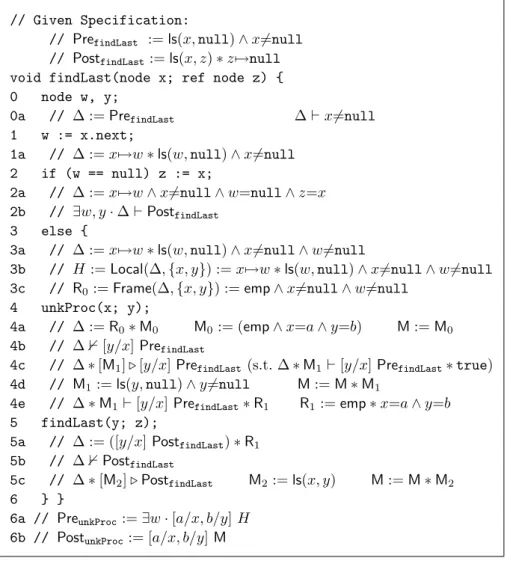
Example 1. Our goal is to verify the procedure findLastagainst the given pre/post specifications shown in Figure 1. The data structure node { int data; node next } defines a node in a linked list. The predicatels(x, y) used in the pre/post specifications as well as other places denotes a (possibly empty) list segment referred to byxand ended with the pointery (i.e.,y denotes the next field of the last node). Its formal definition is given in page 7.
According to the given specification, the procedure findLast takes in a non-empty linked list x and stores a reference to the last node of the list in the call-by-reference parameterz. Here we group call-by-value and call-by-reference parameters together and use semicolon ; to separate them. Note that findLast calls an unknown procedure
// Given Specification:
// PrefindLast :=ls(x,null)∧x6=null
// PostfindLast:=ls(x, z)∗z7→null
void findLast(node x; ref node z) { 0 node w, y;
0a // ∆ :=PrefindLast ∆`x6=null
1 w := x.next; 1a // ∆ :=x7→w∗ls(w,null)∧x6=null 2 if (w == null) z := x; 2a // ∆ :=x7→w∧x=6 null∧w=null∧z=x 2b // ∃w, y·∆`PostfindLast 3 else {
3a // ∆ :=x7→w∗ls(w,null)∧x6=null∧w6=null
3b // H :=Local(∆,{x, y}) :=x7→w∗ls(w,null)∧x6=null∧w6=null 3c // R0:=Frame(∆,{x, y}) :=emp∧x6=null∧w6=null
4 unkProc(x; y);
4a // ∆ :=R0∗M0 M0:= (emp∧x=a∧y=b) M:=M0
4b // ∆0[y/x]PrefindLast
4c // ∆∗[M1].[y/x]PrefindLast (s.t. ∆∗M1`[y/x]PrefindLast∗true)
4d // M1:=ls(y,null)∧y6=null M:=M∗M1
4e // ∆∗M1`[y/x]PrefindLast∗R1 R1:=emp∗x=a∧y=b
5 findLast(y; z);
5a // ∆ := ([y/x]PostfindLast)∗R1
5b // ∆0PostfindLast
5c // ∆∗[M2].PostfindLast M2:=ls(x, y) M:=M∗M2
6 } }
6a // PreunkProc:=∃w·[a/x, b/y]H
6b // PostunkProc:= [a/x, b/y] M
Fig. 1. Verification offindLastcalling an unknown procedureunkProc.
For this example, the unknown call to unkProcperforms essential modification to a local variable, so it can neither be regarded asskipnor dealt with using the hypothetical frame rule. The candidate implementations of unkProc are not available, preventing a verification against all possible candidates. However our approach is still applicable here as described below.
We conduct a symbolic execution ([4, 16]) on the procedure body starting with the preconditionPrefindLast(line0a). The results of our analysis (e.g. the abstract states) are
marked as comments in the code. The analysis carries on as a standard forward shape analysis until the unknown procedure call at line4.
At line3, the current symbolic heap ∆ is split into two disjoint parts: the local part
H (line3b) that is dependent on, and possibly mutated by, the unknown procedure; and the frame partR0 (line3c) that is not accessed by the unknown procedure. Intuitively, the local part of a symbolic heap w.r.t. a set of variables X is the part of the heap
reachable from variables inX (together with the aliasing information); while the frame part denotes the unreachable heap part (together with the aliasing information). For example, for a symbolic heap ls(x, w)∗ls(y, z)∗ls(z,null)∧w=z, its local part w.r.t. {x}isls(x, w)∗ls(z,null)∧w=z, and its frame part w.r.t.{x}isls(y, z)∧w=z. We will have their formal definitions in Section 6.
We take H (line 3b) as a crude precondition for the unknown procedure, since it denotes the symbolic heap that is accessible, and hence potentially usable, by the un-known call. The frame part R0 is not touched by the unknown call and will remain in the post-state, as shown in line4a.
At line 4a, the abstract state after the unknown call consists of two parts: one is the aforesaid frameR0not accessed by the call, and the other is due to the procedure’s postcondition which is unfortunately not available. Our next step is to discover the postcondition by examining (the requirements of) the code fragment after the unknown call by doing abductive reasoning (line4ato 5c).
Initially, we assume the unknown procedure having an empty heapM0as its postcondi-tion1, and gradually discover the missing parts of the postcondition during the symbolic execution of the code fragment after the unknown call. To do that, our analysis keeps track of a pair (∆,M) at each program point, where ∆ refers to the current heap state, andMdenotes the expected postcondition discovered so far for the unknown procedure. The notationsMi are used to represent parts of the discovered postcondition.
At line 5, the procedure findLastis called recursively. Since the current heap state does not satisfy the precondition of findLast (as shown in line 4b), the verification fails. However, this is not necessarily due to a program error; it may be due to the fact that the unknown call’s postcondition is still unknown. Therefore, our analysis performs an abductive reasoning (line 4c) to infer the missing part M1 for ∆ such that ∆∗M1 entails the precondition of findLast w.r.t. some substitution [y/x]. As shown in line
4d, M1 is inferred to be ls(y,null)∧y6=null, which is accumulated into M as part of the expected postcondition of the unknown procedure. (We will explain the details for abductive reasoning in Sec 4.) Now the heap state combined with the inferredM1meets the precondition of the procedure findLast, and also generates a residual frame heap R1(line4e).
The heap state ∆ immediately after the recursive call (line5a) is formed byfindLast’s postcondition and the frame R1, and it is expected to establish the postcondition of
findLastfor the overall verification to succeed. However, it does not (as shown in line
5b). Again this might be due to the fact that part of the unknown call’s postcondition is still missing. Therefore, we perform another abductive reasoning (line5c) to infer the missingM2 as follows:
ls(y, z)∗z7→null∧x=a∧y=b∗[M2].ls(x, z)∗z7→null
such that ∆∗M2entailsPostfindLast. In this case, our abductor returnsM2:=ls(x, y) as
the result which is then added intoMby separation conjunction, as shown in line5c. Finally, we generate the expected pre/post-specification for the unknown procedure (lines6aand6b). The precondition is obtained from the local pre-state of the unknown call,H, by replacing all variables that are aliases of a (or b) with the formal parame-ter a (or b). The postcondition is obtained from the accumulated abduction result, M,
1 Note that we introduce fresh logical variablesaandbto record the value ofxandy whenunkProc
after performing the same substitution. Our discovered specification for the unknown procedureunkProc(a;b)is:
PreunkProc :=∃w·a7→w∗ls(w,null)∧a6=null∧w6=null
PostunkProc :=ls(a, b)∗ls(b,null)∧b6=null
The entire program is correct ifunkProcmeets the derived specification.
3. Programming Language and Abstract Domain
In this section, we first depict the syntax of a language in which programs may invoke unknown procedures, and then present the abstract domain for our analysis.
To focus only on key issues, we use a simple imperative language:
E =df x|null
b =df E1=E2| E16=E2
A[E] =df [E] :=E1|dispose(E)|x:= [E]
A =df x:=E |x:=new(E)|skip C =df A[E]|A|f(x;y)|C1;C2|
if b then C1 elseC2 fi|while b doCod
U =df unkFn(x;y)| {unkFn(x0;y0);C1;
unkFn(x1;y1);C2;. . .;Cn−1;unkFn(xn;yn)} |
if b then V elseC fi|if b thenC elseV fi| if b then V1 elseV2 fi|while b doV od
V =df { C1;U(x1;y1);C2}(x0;y0)
P =df · | P;f(x;ref y){localz;C } | P;f(x;ref y){ localz;V }
Note that expressions (E) are program variables to record memory locations in the heap, and all program variables are assumed of the same type, reference. The language has both heap sensitive (A[E]) and heap insensitive (A) atomic commands. The former requires access to the heap location referred to byE, while the latter does not. The command
C contains calls to known procedures only, while the commands U and V comprise unknown procedure calls. Note also that our language allows both call-by-value and call-by-reference parameters for procedures, and for convenience, we group call-by-value parameters on the left and call-by-reference ones on the right, separated by a semicolon. The unknown commandsU andV specify the possible scenarios in which an unknown call (unkFn(x;y)) may occur. Note thatU andV may be annotated with two sets of vari-ables, e.g. (x0,y0) in the definition ofV, wherex0denotes variables that can be accessed, but cannot be modified byV, and wherey0 denotes variables that may be mutated by
V. The same annotation applies toU. These annotations can be obtained automatically via a pre-processing phase of the analysis, by recording all the variables appearing inV
as the right(left)-value of an assignment, and/or as a call-by-value(reference) parameter of a procedure invocation [17].
Example 2 (Unknown procedure and unknown block). The parse tree of findLast’s body (omitting local variable definition) in our motivating example is as in Figure 2.2
V({...}(x;w,y,z)) gggggggggg gggg X X X X X X X X X X X X X X X
C(w:=x.next) U(x,w;y,z) C(skip)
if(w==null)thenC(z:=x)else V({...}(x;y,z)) ccccccccccccccccccccccccccc
cccccccc gggggggggg
gggg
C(skip) U(x;y)(unkProc(x;y)) C(findLast(y,z)) Fig. 2. The parse tree offindLast’s body.
A program P is composed of several procedures (with one of them as the entry method). A procedure can be totally known to the verifier (so that its body is com-posed byC), or it may contain an unknown blockV.
We use amemory model similar to the standard one for separation logic [19]: Stack =df (Var∪LVar∪SVar)→Val
Val =df Loc∪ {null}
Heap =df Loc*Val
State =df Stack×Heap
The slight difference is that we have three (disjoint) set of variables: a finite set of program variables Var = {x, y, ..}, logical variables LVar = {x0, y0, ..}, and the special
(logical) variables SVar = {a, b, ..}, with the last set reserved for unknown procedures for specification purpose. As usual,Locis a countably infinite set of locations, subsumed by the set of valuesVal. The functionHeap denotes a partial mapping from locations to values and a program state is a pair of stack and heap.
An abstract (program) state in our analysis is a symbolic heap representing a set of concrete heaps. It is defined as follows:
E =df x|x0 |a Expressions
Π =df E1=E2|E16=E2|true|Π1∧Π2 Pure formulae
B(E1, E2) =df E17→E2 |ls(E1, E2) Basic separation predicates Σ =df B(E1, E2)|true |emp|Σ1∗Σ2Separation formulae
∆ =df Π∧Σ Quantifier-free symbolic heaps
H =df ∃x.∆ Symbolic heaps
The expressions (x, x0anda) correspond to the three kinds of variables (program, logical
and special ones). Pure formulae Π express the aliasing information among expressions. The basic separation predicate B(E1, E2) denotes either a singleton heap or a list seg-ment [6, 9, 16]. A (possibly empty) list segseg-ment is inductively defined as follows:
ls(E1, E2) =df (emp∧E1=E2)∨(∃E3·E17→E3∗ls(E3, E2))
Here the list segment predicate is regarded as a built-in predicate in our abstract domain, as our abstract semantics and abduction are fine tuned for it. According to SpaceIn-vader [6] we may extend it with other predicates. A symbolic heapH is composed of a
pure formula Π and a separation formula Σ, possibly with existential quantifications over them. The separation formula Σ is formed by the predicatesB(E1, E2),true(arbitrary heaps) andemp (an empty heap) via separation conjunction [19]. We useSHto denote the set of all symbolic heaps and we will use the two terms “symbolic heap” and “abstract state” interchangeably.
The semantics of a symbolic heapH [3, 4] is defined by the satisfaction relationship (s, h)|=H between a pair of stack and heap states (s, h) and H, where s∈Stack and
h∈Heap: |[x]|s=df s(x) |[null]|s=df null (s, h)|=E1=E2 =df |[E1]|s=|[E2]|s (s, h)|=E16=E2 =df |[E1]|s6=|[E2]|s (s, h)|= Π1∧Π2 =df (s, h)|= Π1 and (s, h)|= Π2 (s, h)|=true =df always (s, h)|=emp =df h=∅ (s, h)|=E17→E2 =df h={|[E1]|s7→|[E2]|s} (s, h)|= Σ1∗Σ2 =df h=h1∪h2 and (s, h1)|= Σ1 and (s, h2)|= Σ2 whereh1 andh2are domain-disjoint
and the semantics of ls(E1, E2) can be obtained from its inductive definition over the abstract domain. Based on such semantics, the entailment relationship between two sym-bolic heapsH1 andH2 is straightforward:
H1`H2=df ∀s, h·(s, h)|=H1implies (s, h)|=H2
which is used to check whether one symbolic heap is stronger than another in our analysis. 4. Abduction
As shown in Example 1 (Section 2), when analyzing the code after an unknown call, due to the lack of information about the unknown procedure, it is possible that the current state is too weak to meet the required precondition for the next instruction. As a consequence, the symbolic execution fails. A technique called abduction (or abductive reasoning) [6, 11] can be used to discover a symbolic heap M to make the entailment ∆∗M ` H ∗R succeed, when the entailment ∆ ` H ∗R fails. Here R denotes the (automatically computed) frame part. For instance, the entailments at line 4band line
5bfailed in Example 1, and in both cases, the abduction algorithm was called to find the missingM.
One problem in abduction is that there can be many solutions ofMfor the entailment ∆∗M`H∗Rto succeed. For instance,falsecan be a solution but should be avoided where possible. As another example, for the entailment ls(y, z)∗M ` ls(x, z)∗ R (a similar one was at line 5cin Example 1 in Sec 2), an abductive reasoning may return, for example, two different solutions:M = ls(x, y) with R = emp or M = ls(x, z) with
R=ls(y, z). A partial order ¹over symbolic heaps was given by Calcagno et al. [6] to make the selection from different solutions:
M¹M0 =
df (M0`M∗true∧M0M0∗true)∨
Intuitively speaking, consider two symbolic heaps M and M0, if M0 entails M (possibly
extended by some frame), thenMis less thanM0under¹. For example, we havels(x, y)¹
ls(x, y)∗ls(y, z), andemp∨ ∃x, y.ls(x, y)¹emp.
With such partial order¹, we can judge the quality of different solutions for abduction by always choosing the least one according to¹.
Two solutions can not be distinguished when they are not comparable under this partial order. However, we may still prefer one solution over another in this case, as will be discussed in Section 6. We would expect that the solution to incur as few free variables as possible in the frame part (R). For this reason, we define a new order as follows:
M¹∆
HM0 =df M¹M0∨(MM0∧M0M∧
∆∗M`H∗R∧∆∗M0`H∗R0 ∧
|fv(R)| ≤ |fv(R0)|)
Note that our partial order is defined over the set of solutions for one abduction. Intu-itively, given two solutions which are not comparable w.r.t.¹, our partial order may still be able to compare them, if one incurs fewer free variables in the frameRthan the other. To ensure that the abductor will choose the former, but not the latter, we enrich the abductor [6] with some new rules (right column below) so that it attempts to introduce less free variables in the frame, where possible:
∆∗[M].∆0 ∆∗B(E, E0)0false ∆∗[M∗B(E, E0)].∆0∗B(E, E0) missing (E0=E1∧∆)∗[M].∃y0.∆0 ∆∗E07→E∗[∃x0.E0=E1∧M]. ∃x0y0.∆0∗E 17→E t-match (E6=E0∧∆∗ls(x, E0))∗[M].∆0 ∆∗ls(E, E0)∗[E6=E0∧M]. ∃x.∆0∗E7→x h-left E6=E0∧∆∗ls(E0, x 0)∗[M].∃y0.∆0 ∆∗ls(E0, E)∗[E06=E∧M]. ∃x0y0.∆0∗x07→E t-left ∆∗[M].∆0∗ls(E 0, E1) ∆∗B(E, E0)∗[M].∆0∗ls(E, E1) h-right ∆∗[M].∃x0.∆0∗ls(E 0, E1) ∆∗B(E0, E)∗[M].∃x0.∆0∗B(E1, E) t-right where the rules from Calcagno et al. [6] are on the left and our new ones are on the right. Compared with their work, when the matching from the head of a list segment fails, our abductor also tries to match from the tail, instead of directly applying missing rule to introduce a new separation predicate, which could bring in more free variables in the frame. In our case, the rulet-matchintroduces aliasing information between two heads of pointing-to relationships in the premise and conclusion of the abduction, respectively. The last two rules try to match from the end of a basic separation predicate; if the matching succeeds then the matched part will be dropped from both sides to reduce the complexity of the predicates. For instance, in Example 1 in Section 2, for the last abduction
∃y .ls(y, z)∗z7→null∗[M].ls(x, z)∗z7→null
their abductor will returnls(x, z) asM, by trying to match the heads of the list segments on both sides of ., and adding the missing heap part to the left hand side once the matching fails. This solution is not optimal in the light that it introduces a free variable
z in the frame. Comparatively, our abduction tries to match also from the tail of a list segment, finding ls(x, y) as the result for the aforesaid abduction, which is a minimal solution under our partial order¹∆
We prefer to find solutions that are (potentially locally) minimal with respect to ¹∆
H and consistent. However, such solutions are generally not easy to compute and can
incur excess cost (with additional disjunction in the analysis). Therefore, our abductive inference is designed more from a practical perspective to discover anti-frames that should be suitable as specifications for unknown procedures, and the order¹∆
H is to state the
decision choices of our implementation of the abduction. This is proven in Sec 7 with the experiments we conduct.
5. Abstract Semantics
This section introduces two kinds of abstract semantics we use to analyze the program: an underlying semantics from the local shape analysis ([9]) and another semantics based on both the first one and abduction from the composite shape analysis ([6]).
We denote the specifications of a procedure f(x;y) as a subset ofSH×(SH∪ {>}) (where>stands for a fault abstract state). Note that for a call-by-reference parameterx, bothold(x) andxmay occur in a postcondition with the former referring to the value of
xin the pre-state (as in JML [15]).To illustrate, a postconditionls(old(x), x) means that there is a list segment beginning with the initial value ofx(present in the precondition) to the finalxwhen the procedure returns. The set of all specifications for all procedures is defined as
AllSpec=df P(Name× P(SH×(SH∪ {>})))
whereNamerefers to the set of all function names. Then our underlying abstract seman-tics’ type is defined as
|[C]| : AllSpec→ P>(SH)→ P>(SH)
where P>(SH) stands for P(SH∪ {>}). Given a programC, a specification tableT ∈
AllSpec, a set of abstract statesS, |[C]|TS returns another set of abstract states. Example 3(Underlying semantics). For thefindLastin our motivating example, sup-pose the specification tableT is
{(findLast(a,b), {(ls(a,null)∧a6=null,ls(a, b)∗b7→null)})}
Then we know the symbolic execution|[findLast(x,y)]|T{ls(x,null)∧x6=null}will give
{ls(x, y)∗y7→null}as result. 2
The basic transition functions below form the foundation of the first underlying se-mantics. With one symbolic heap as input, they return either another symbolic heap or a set of symbolic heaps:
rearr(E) =df SH→ P>(SH[E]) Rearrangement
exec(A[E]) =df SH[E]→SH∪ {>} Heap-sensitive execution
exec(A) =df SH→SH Heap-insensitive execution
abs =df SH→SH Abstraction
where SH[E] denotes a set of symbolic heaps in which each element has E exposed as the head in one of its pointing-to conjuncts (E7→F). Here rearr(E) attempts to unroll
the shape beginning with E to expose it as the head of a pointing-to predicate, say,
E points to another expression. (If such unrolling fails then it will return {>}.) This is a preparation for the second transition function exec(A[E]), as it tries to perform some dereference of E. The third function, like the semantics for stack-based variable assignment and heap allocation, does not require such exposure ofE, and thus is called heap-insensitive compared with the second one. The last transition function conducts a rolling over the shapes, to eliminate unimportant cutpoints to ensure termination for our verification.
The rules for the basic transition functions are adopted from Distefano et al. [9], where the logical variablex00is always fresh.
Below are the rules for rearrangement, where we try to find an explicit pointing-to beginning with the expressionE to be unrolled (or its alias). If such unrolling fails then {>}is returned. rearr(E) (∃x0.Π∧∆∗ls(G, F)) = df if Π`G=E then {∃x0.Π∧E=F∧∆,∃x0.Π∧∆∗E7→F, ∃x0, x00.Π∧∆∗E7→x00∗ls(x00, F)} else{>} | (∃x0.Π∧∆∗G7→F) = df if Π`G=E then {∃x0.Π∧∆∗E7→F}else{>} | (∃x0.Π∧∆) = df {>}
Below are rules for symbolic execution to reflect the effects, over heap or not, of atomic commands. exec (x:=E)(∃x0.Π∧∆) = df ∃x0.x=[x00/x]E∧[x00/x](Π∧∆) exec (x:= [E])(∃x0.Π∧∆∗E7→F) = df ∃x0.x=[x00/x]F∧[x00/x](Π∧∆∗E7→F) | (∃x0.Π∧∆) = df > exec ([E] :=G)(∃x0.Π∧∆∗E7→F) = df ∃x0.Π∧∆∗E7→G |(∃x0.Π∧∆) = df > exec (x:=new(E))(∃x0.Π∧∆) = df ∃x0.[x00/x](Π∧∆)∗x7→[x00/x]E exec (dispose(E))(∃x0.Π∧∆∗E7→F) = df ∃x0.Π∧∆ | (∃x0.Π∧∆) = df >
Below are definitions of rules for abstraction. Their rationale is to remove any heap garbage from the current state and eliminate logical cutpoints that are neither shared nor essential in denoting a cyclic list over the heap. In our semantics, when the abstraction is actually performed, the six rules are applied several rounds, with each round from the top one to the bottom, until the abstracted state does not change any more. Its termination
is discussed later in Section 6.2. ∃z0. E=x0∧Π∧ΣÃ∃z0.[E/x0]Π∧Σ Equality x0∈/LVar(Σ) ∃z0. E6=x0∧Π∧ΣÃ∃z0.Π∧Σ Disequality x0∈/LVar(Π,Σ) ∃z0.Π∧Σ ∗ B(x0, E)Ã∃z0.Π∧Σ ∗ true Junk1 x0, y0∈/LVar(Π,Σ) ∃z0.Π∧Σ ∗ B(x0, y0) ∗ B(y0, x0)Ã∃z0.Π∧Σ ∗ true Junk2 x0∈/LVar(Π,Σ, E, F) Π`F=null ∃z0.Π∧Σ∗B1(E, x0)∗B(x0, F)Ã∃z0.Π∧Σ∗ls(E,null) Abs1 x0∈/LVar(Π,Σ, E, F, E 1, F1) Π`F=E1 ∃z0.Π∧Σ∗B1(E, x0)∗B(x0, F)∗B(E 1, F1)Ã∃z0.Π∧Σ∗ls(E, F)∗B(E1, F1) Abs2
A lifting functionp† is defined over partial functions on symbolic heaps to lift their
domains and ranges to a powerset ofSH, plus>:
p†S=
df {> | > ∈S} ∪ {p H | H∈S\ {>}}
and this function is overloaded forrearronly to lift its domain toP>(SH):
rearr(E)†S=
df {>|>∈S} ∪( [ H∈S\{>}
rearr(E)H)
The following function,filt, is to filter out any symbolic heap that does not satisfy the given aliasing constraint:
filt (E=F)(H) =df if H 0E6=F thenH∧E=F elseundefined
filt (E6=F)(H) =df if H 0E=F thenH∧E6=F elseundefined
and the program constructors’ semantics are based on the atomic ones defined above:
|[b]|TS =df filt(b)†S
|[A[E]]|TS =df abs†◦exec(A[E])†◦rearr(E)†S
|[A]|TS =df abs†◦exec(A)†S
|[C1;C2]|TS =df |[C2]|T ◦ |[C1]|TS
|[if b thenC1elseC2fi]|TS =df |[b;C1]|TS∪ |[¬b;C2]|TS
Finally we need to adapt the underlying abstract semantics to procedure invocation: |[f(x;y)]|TS =df {[x/a,y/b,y0/old(b)]Post∗[y0/y]R| ∆∈S∧
(Pre,Post)∈Specf∧∆`[x/a,y/b]Pre∗R} where (f,Specf)∈ T andy0 are fresh
whereT is an element ofAllSpec. We assume here the formal parameters inf’s specifica-tions are expressed in terms of a,bandold(b), respectively. We first check whether the procedure’s precondition is satisfied by the current state (subject to substitution), and then replace it with the (substituted) postcondition to indicate the effect of the procedure call.
Next we define the abstract semantics with abduction used in our verification to discover the effect of unknown procedure calls.
|[C]|A : AllSpec→ P>(SH×SH)→ P>(SH×SH)
Here P>(SH×SH) denotes P((SH∪ {>})×(SH∪ {>})). Given a specification table
T ∈ AllSpec, each element of the input (or output) for |[C]|AT is a pair of two symbolic heaps, of which the first denotes the current program state, and the second stands for the abduction result. In our framework, this semantics is used to accumulate the discovered effect of unknown procedure calls into the second symbolic heap in the pair.
Example 4(Abstract semantics with abduction). Consider the same setting forfindLast
in Example 3. For the semantics with abduction|[findLast(x,y)]|AT{ls(x,null)}, we will have{(ls(x, y)∗y7→null, x6=null)}as result. Here in order to obtain the first component of the pair as the final state (ls(x, y)∗y7→null), the second component (x6=null) must
be added to its corresponding input statels(x,null). 2
This semantics also consists of the basic transition functions which composes the atomic instructions’ semantics and then the program constructors’ semantics. Here the basic transition functions are lifted as follows:
Rearr(E)(H,M) =df
let H=rearr(E)(H) andS={(H0,M)|H0 ∈ H ∩SH}
in if (>∈ H/ )thenS
else if(H`E=afor somea∈SVar) and (M0a7→x0 for freshx0∈LVar)
thenS∪ {(H∗E7→x0,M∗a7→x0)}elseS∪ {>}
Exec(A)(H,M) =df let H=exec(A)(H)in{(H0,M)|H0∈ H} ∪ {>|> ∈ H}
whereAis [E] :=Gordispose(E) Exec(x:=E)(∃x0.Π∧∆,M) = df (∃x0.x=σE∧σ(Π∧∆), σM) Exec(x:= [E])(∃x0.Π∧∆∗E7→F) = df (∃x0.x=σF∧σ(Π∧∆∗E7→F), σM) |(∃x0.Π∧∆) = df if ∃x0.Π∧∆∗E7→F`falsethen(>, σM) else(∃x0.x=σF∧σ(Π∧∆∗E7→F), σ(M∗E7→F)) Exec(x:=new(E))(∃x0.Π∧∆) = df (∃x0.σ(Π∧∆)∗x7→σE, σM)
In the lifted Rearr, in case of a rearrangement failure, we utilize abduction to discover a pointing-to in the current heap, followed by another attempt of rearrangement. If it succeeds, then the abduction result is confirmed and added to the current state. Note that in the definition ofExecwe need to treat variable assignments specifically. As can be seen in the rules, whenxis assigned to a new value, the original value is still preserved in a fresh logical variablex00 with a substitutionσ= [x00/x]. This allows us to keep the connection
among the history values of a variable and its latest value, which may be essential as a link from the unknown procedure’s postcondition to its caller’s postcondition. This is because the unknown procedure’s postcondition may refer to one of such variable’s historical values, and its caller’s postcondition can count on that variable’s final value. In that case, the recorded values in the abduction results will serve as a connection among these abstract states.Abssimply performs abstraction over bothH andM.
The filter functionFiltnow only works on the first symbolic heap of a pair: Filt(b)(H,M) =df (filt(b)(H),M)
and the abstract semantics for the program constructors is as follows:
|[b]|ATS =df Filt(b)†S
|[A[E]]|ATS =df Abs†◦Exec(A[E])†◦Rearr(E)†S
|[A]|ATS =df Abs†◦Exec(A)†S
|[C1;C2]|ATS =df |[C2]|AT ◦ |[C1]|
A
TS
|[if b thenC1elseC2fi]|ATS =df |[b;C1]|ATS∪ |[¬b;C2]|ATS
|[while b doC od]|ATS =df |[¬b]|AT(lfixλS0.S∪ |[b;C]|
A
TS0)
Same as above, at last is the semantics for procedure invocation with abduction: |[f(x;y)]|ATS =df {([x/a,y/b,y0/old(b)]Post∗[y0/y]R,[y0/y]M)|(∆,M)∈S∧
(Pre,Post)∈Specf∧∆`[x/a,y/b]Pre∗R} ∪ {([x/a,y/b,y0/old(b)]Post∗[y0/y]R,[y0/y](M∗M0))|
(∆,M)∈S∧(Pre,Post)∈Specf∧∆0[x/a,y/b]Pre∗R∧ ∆∗[M0].[x/a,y/b]Pre}
where (f,Specf)∈ T and y0 are fresh
whereT is an element ofAllSpec. We also usea,bandold(b) for formal parameters in the specification. This rule distinguishes two cases: 1. the current state inSis sufficiently strong to entail Pre subject to some substitutions, and corresponding postcondition is established; 2. the current state does not entail substitutedPre, and abduction is applied with further requirements on the current state accumulated (M0). It will combine the
results from both cases to update the state after the procedure invocation and continue with the symbolic execution.
6. Verification
Based on the abstract semantics defined in the last section, we present in this section our algorithms for the verification of programs with unknown calls.
6.1. Main Verification Algorithm
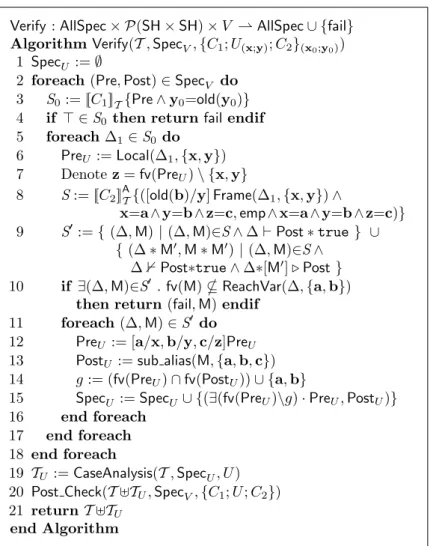
1. Main algorithm.Our verification algorithm given in Figure 3 attempts to verify the body of the current procedure (the third input, comprising an unknown command U) against the given specifications (the second input). The first input gives a set of known procedure specifications, which are necessary as the current procedure may invoke known procedures apart from unknown ones. If the verification succeeds, it returns specifications that are expected for all unknown procedures invoked withinU for the whole verification to succeed. If it fails, we know that the current procedure cannot meet one or more given specifications, no matter what specifications are given to the invoked unknown procedures. Returned specifications will be expressed using special variablesa,b, etc. as in the earlier example.
For each specification (Pre,Post) to verify against (line 2), the algorithm works in three steps. Based on the underlying semantics mentioned earlier, it first computes the post-states ofC1 (i.e.S0) fromPre (line 3), from which it extracts the preconditions for
U(x;y)using the functionLocal. Intuitively, it extracts the part of each ∆1reachable from the variables that may be accessed byU, namely,xandy(line 6). Herefv(∆) stands for all free (program and logical) variables occurring in ∆. The function Local(Π∧Σ,{x}) is defined as follows:
Local(Π∧Σ,{x}) =df ∃fv(Π∧Σ)\ReachVar(Π∧Σ,{x})·
Π∗ReachHeap(Π∧Σ,{x})
whereReachVar(Π∧Σ,{x}) is the minimal set of variables reachable from {x}: {x} ∪ {z2| ∃z1,Π1·z1∈ReachVar(Π∧Σ,{x})∧Π=(z1=z2)∧Π1} ∪
{z2| ∃z1,Σ1·z1∈ReachVar(Π∧Σ,{x})∧Σ=B(z1, z2)∗Σ1} ⊆ReachVar(Π∧Σ,{x}) whereB(z1, z2) stands for eitherz17→z2 orls(z1, z2). And the formulaReachHeap(Π∧Σ, {x}) denotes the part of Σ reachable from{x}and is formally defined as the∗-conjunction of the following set of formulae:
{Σ1| ∃z1, z2,Σ2·z1∈ReachVar(Π∧Σ,{x})∧Σ=Σ1∗Σ2∧Σ1=B(z1, z2)}
The second step is to symbolically execute C2, using the abstract semantics with abduction, to discover the postconditions forU(x;y)(lines 8–10). At line 8, since we know nothing aboutU, we takeempas the post-state ofU. Therefore, the initial state for the symbolic execution ofC2is simply the frame part of state not touched byU. HereFrame is formally defined as
Frame(Π∧Σ,{x}) =df Π∧UnreachHeap(Π∧Σ,{x})
whereUnreachHeap(Π∧Σ,{x}) is the formula consisting of all∗-conjuncts from Σ which are not inReachHeap(Π∧Σ,{x}).
Note thatx=a∧y=b∧z=c are used to record the snapshot of variables associated with U using the special variables a,b and c. The symbolic execution of C2 at line 8
Verify:AllSpec× P(SH×SH)×V *AllSpec∪ {fail} AlgorithmVerify(T,SpecV,{C1;U(x;y);C2}(x0;y0))
1 SpecU :=∅
2 foreach(Pre,Post)∈SpecV do
3 S0:=|[C1]|T{Pre∧y0=old(y0)}
4 if > ∈S0 then returnfailendif 5 foreach∆1∈S0do
6 PreU :=Local(∆1,{x,y})
7 Denotez=fv(PreU)\ {x,y}
8 S:=|[C2]|AT{([old(b)/y]Frame(∆1,{x,y})∧
x=a∧y=b∧z=c,emp∧x=a∧y=b∧z=c)} 9 S0 :={(∆,M)|(∆,M)∈S∧∆`Post∗true } ∪
{(∆∗M0,M∗M0)|(∆,M)∈S∧
∆0Post∗true∧∆∗[M0].Post}
10 if ∃(∆,M)∈S0 .fv(M)*ReachVar(∆,{a,b}) then return(fail,M)endif
11 foreach(∆,M)∈S0 do 12 PreU := [a/x,b/y,c/z]PreU
13 PostU :=sub alias(M,{a,b,c})
14 g:= (fv(PreU)∩fv(PostU))∪ {a,b}
15 SpecU :=SpecU ∪ {(∃(fv(PreU)\g)·PreU,PostU)}
16 end foreach
17 end foreach 18 end foreach
19 TU :=CaseAnalysis(T,SpecU, U)
20 Post Check(T ]TU,SpecV,{C1;U;C2}) 21 returnT ]TU
end Algorithm
Fig. 3. The main verification algorithm.
returns a set S of pairs (∆,M) where ∆ is a possible post state of C2 and M records the discovered effect of U. At line 9, we check whether or not each ∆ can establish the postconditionPost for the whole procedure. If not, another abduction ∆∗[M0].Post is
invoked to discover further effectM0 which is then added intoM.
There can be some complication here. Note that there can be a potential bug in the program, or the given specification is not sufficient. As a consequence of that, the result Mreturned by our abductor may contain more information than what can be expected fromU, in which case we cannot simply regard the whole Mas the postcondition of U. For example, consider the code fragmentunknown(x); z:=y.nextwith the precondition
x7→null. Before the second instruction (dereference of y.next) we use abduction to get
y6=null. However, noting the facty /∈ReachVar(∆,{x}) where ∆ =emp∧y6=null is the state immediately after the unknown call plus the abduction result, we know that from the unknown call’s parameters (x),y is not reachable, and hence the unknown call will never establish a state where y6=null. In that case we are assured that the procedure being verified cannot meet the specification.
To detect such a situation, we introduce the check in line 10. It tests whether the whole abduction result is reachable from variables accessed byU. If not, then the unreachable part cannot be expected fromU, which indicates a possible bug in the program or some inconsistency between the program and its specification. In such cases, the algorithm returns an additional formula that can be used by a further analysis to either identify the bug or strengthen the specification. Recall the example presented in the previous paragraph: sincey6=nullcannot be established by the unknown call, if we add it to the precondition of the code fragment (to form a new preconditionx7→null∧y6=null), then the verification with the new specification can move on and will potentially succeed. We will exemplify this later with experimental results.
The third step (lines 11–16) is to form the derived specifications for U in terms of variables a,band g, where g denotes logical variables not directly accessed by U, but occurring in both pre- and postconditions. The formulasub alias(M,{a,b,c}) is obtained fromMby replacing all variables with their aliases in {a,b,c}. It is defined as
sub alias(M,{x}) =df ({[x/x0]|x∈{x} ∧x0∈aliases(M, x)} M)∧ V
{x=x0 |x, x0∈{x} ∧x0∈aliases(M, x)}
where a set of substitutions before a formulaM denotes the result of applying all those substitutions toM, and aliases(M, x) returns all the aliases ofxin M.
Finally, at line 19, the obtained specifications SpecU for U are passed to the case
analysis algorithm (given in Figure 4) to derive the specifications of unknown procedures invoked inU. At line 20, we conduct a post analysis for soundness purpose.
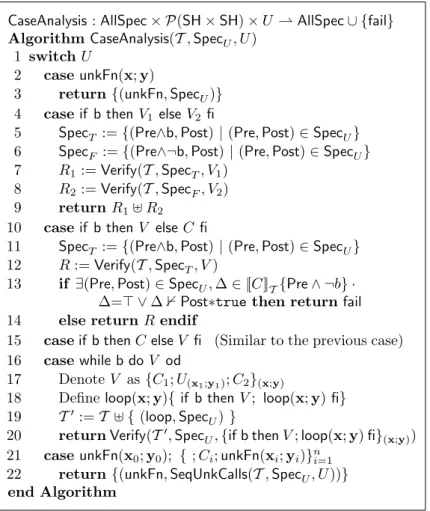
2. Case analysis algorithm.In order to discover specifications for unknown procedures invoked inU, the algorithm in Figure 4 conducts a case analysis according to the structure ofU. In the first case (line 2),U is simply an unknown call. In this situation, the algorithm simply returns all the pre-/postcondition pairs fromSpecU as the unknown procedure’s
specifications.
In the second case (line 4),U is anifconstruct and each branch contains an unknown block. The algorithm uses the main algorithm to verify the two branches separately with preconditions Pre∧b and Pre∧¬b respectively, wherePre is one of the preconditions of the wholeif. The results obtained from the two branches are then combined using the] operator:
R1]R2=df {(f,Refine(Spec1f ∪Spec2f))|(f,Spec1f)∈R1∧(f,Spec2f)∈R2} whereRefineis defined as
Refine (∅) =df ∅
Refine ({(Pre,Post)} ∪Spec) =df if ∃(Pre0,Post0)∈Spec·Pre0¹Pre∧Post¹Post0
thenRefine(Spec)
else {(Pre,Post)} ∪Refine(Spec)
The intuition of Refine is to eliminate any specification (Pre0,Post0) from a set if there exists a “stronger” one (Pre,Post) such thatPre¹Pre0 andPost0¹Post.]is to refine the union of two specification sets.
CaseAnalysis:AllSpec× P(SH×SH)×U *AllSpec∪ {fail} AlgorithmCaseAnalysis(T,SpecU, U)
1 switchU
2 caseunkFn(x;y)
3 return{(unkFn,SpecU)}
4 caseif b thenV1elseV2fi
5 SpecT :={(Pre∧b,Post)| (Pre,Post)∈SpecU}
6 SpecF :={(Pre∧¬b,Post)|(Pre,Post)∈SpecU} 7 R1:=Verify(T,SpecT, V1)
8 R2:=Verify(T,SpecF, V2)
9 returnR1]R2 10 caseif b thenV elseC fi
11 SpecT :={(Pre∧b,Post)| (Pre,Post)∈SpecU}
12 R:=Verify(T,SpecT, V)
13 if ∃(Pre,Post)∈SpecU,∆∈ |[C]|T{Pre∧ ¬b} · ∆=> ∨∆0Post∗truethen return fail 14 else returnRendif
15 caseif b thenCelseV fi (Similar to the previous case) 16 casewhile b doV od
17 DenoteV as{C1;U(x1;y1);C2}(x;y)
18 Defineloop(x;y){ if b thenV; loop(x;y)fi} 19 T0:=T ] {(loop,Spec
U)}
20 returnVerify(T0,Spec
U,{if b thenV;loop(x;y)fi}(x;y)) 21 caseunkFn(x0;y0); {;Ci;unkFn(xi;yi)}ni=1
22 return{(unkFn,SeqUnkCalls(T,SpecU, U))}
end Algorithm
Fig. 4. The case analysis algorithm.
The third and fourth cases (line 10 and 15) are for if constructs which contain one unknown block in one branch. This is handled in a similar way as in the second case. The only difference is that, for the branch without unknown blocks, we need to verify it with the underlying semantics (line 13).
The fifth case is the while loop. In the motivating example in Section 2, we have shown that our approach is able to handle the verification of a tail-recursive function provided with both pre- and postconditions, our solution here is to translate the while loop into a tail-recursive function to verify it. As can be seen in lines 16 – 20, the algorithm generates a new functionloopfor the while loop, and takes the variables accessed byV to be its parameters. Note that the read-only variables (x) become call-by-value parameters and other possibly mutable ones (y) become call-by-reference parameters (which is one reason for us to introduce call-by-reference parameters in our language). The algorithm then adds the specifications found for the while loop asloop’s specifications into tableT, verifying it, and at the same time obtaining specifications for the unknown procedure in the while loop, using the main algorithmVerify.
In the last case (line 21), where U consists of multiple unknown procedure calls in sequence, the algorithm invokes another algorithm,SeqUnkCalls, to deal with it.
3. Verifying sequential unknown calls. To handle the most complicated case, un-known procedure calls in sequence, we still need the SeqUnkCalls algorithm. First we illustrate the brief idea using two sequential unknown procedure calls as an example, followed by the general algorithm.
Suppose we have
{Pre} {unkFn1(x0;y0);C;unkFn2(x1;y1)} {Post}
whereCis the only known code fragment within the block. Our current solution attempts to find a common specification to capture both unknown procedures’ behaviors.
The algorithm works in three steps. In the first step, it extracts the precondition for the first procedure, sayPreU, from the given precondition Preby extracting the part of
heap that may be accessed by the call viax0 andy0, which is similar to the first step of the main algorithm Verify. Aiming at a general specification for both unknown calls, it then assumes that the second procedure has a similar preconditionPreU. In the second
step, it symbolically executes the code fragment C with the help of the abductor, to discover a crude postcondition, sayPost0U, expected from the first unknown call. This is
similar to the second step of the main algorithmVerify, except that the postcondition for C is now assumed to be PreU. In the third step, the algorithm takes Post0U (with
appropriate variable substitutions) as the postcondition of the second unknown call, and checks whether or not the derived post (Post0U) satisfiesPost. If not, it invokes another abduction to strengthenPost0
U to obtain the final postconditionPostU for the unknown
procedures. Note that this strengthening does not affect soundness: the strengthened PostU can still be used as a general postcondition for both unknown procedures.
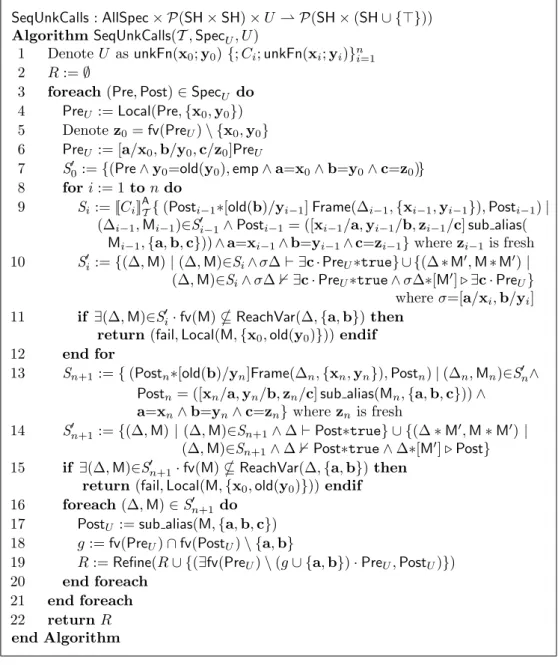
Figure 5 presents the algorithm to infer specifications forn(n≥2) unknown calls in se-quence. As aforementioned, given a block of (n+1) unknown procedure calls withnpieces of known code blocks sandwiched among them (unkFn(x0;y0){;Ci;unkFn(xi;yi)}ni=1in line 1), and the specification (Pre,Post) (line 3) for such a block, our approach generally works in three steps: first, to compute a precondition for the unknown calls; second, to verify each code fragmentCi(i= 1, ..., n) with abduction to collect expected behavior of
the unknown calls (as part of their postcondition); third, to guarantee that the collected postcondition satisfies Post. If not, then another abduction is conducted to strengthen the gained postcondition to ensure this.
The first step is completed by lines 4 to 6. The local part of Pre is extracted w.r.t. the first unknown call’s parametersx0and y0. Other free variables are distinguished as z0, which may be ghost variables. Finally the precondition is found in terms of special logical variablesa,bandc.
The second step is performed over eachCi;unkFn(xi;yi). Its main idea is to take the
postcondition generated for the last unknown call (Posti−1), plus the frame part during
the entailment check againstPrei−1, as the post-state of unkFn(xi−1;yi−1), and try to
verify Ci beginning with such a state, using abduction when necessary (line 9). After
the verification we get Si containing abstract states before unkFn(xi;yi), and we want
those states to satisfy its preconditionPreU subject to substitution. Note that during the
verification ofCi and the last satisfaction checking we may use abduction to strengthen
the program state, whose results reflect the expected behavior ofunkFn(xi−1;yi−1) and
are accumulated as its expected postcondition. Hence we achieve a sufficiently strong postcondition for each unknown call.
SeqUnkCalls:AllSpec× P(SH×SH)×U *P(SH×(SH∪ {>})) AlgorithmSeqUnkCalls(T,SpecU, U)
1 DenoteU as unkFn(x0;y0){;Ci;unkFn(xi;yi)}ni=1 2 R:=∅
3 foreach(Pre,Post)∈SpecU do
4 PreU :=Local(Pre,{x0,y0})
5 Denotez0=fv(PreU)\ {x0,y0}
6 PreU := [a/x0,b/y0,c/z0]PreU
7 S0
0:={(Pre∧y0=old(y0),emp∧a=x0∧b=y0∧c=z0)} 8 fori:= 1 tondo
9 Si :=|[Ci]|TA{(Posti−1∗[old(b)/yi−1]Frame(∆i−1,{xi−1,yi−1}),Posti−1)|
(∆i−1,Mi−1)∈S0i−1∧Posti−1= ([xi−1/a,yi−1/b,zi−1/c]sub alias( Mi−1,{a,b,c}))∧a=xi−1∧b=yi−1∧c=zi−1}wherezi−1is fresh 10 S0i :={(∆,M)|(∆,M)∈Si∧σ∆` ∃c·PreU∗true} ∪ {(∆∗M0,M∗M0)|
(∆,M)∈Si∧σ∆0∃c·PreU∗true∧σ∆∗[M0].∃c·PreU}
whereσ=[a/xi,b/yi]
11 if ∃(∆,M)∈S0i·fv(M)*ReachVar(∆,{a,b})then return(fail,Local(M,{x0,old(y0)}))endif
12 end for
13 Sn+1:={(Postn∗[old(b)/yn]Frame(∆n,{xn,yn}),Postn)|(∆n,Mn)∈S0n∧
Postn= ([xn/a,yn/b,zn/c]sub alias(Mn,{a,b,c}))∧
a=xn∧b=yn∧c=zn}wherezn is fresh
14 S0n+1:={(∆,M)|(∆,M)∈Sn+1∧∆`Post∗true} ∪ {(∆∗M0,M∗M0)| (∆,M)∈Sn+1∧∆0Post∗true∧∆∗[M0].Post} 15 if ∃(∆,M)∈S0n+1·fv(M)*ReachVar(∆,{a,b})then
return(fail,Local(M,{x0,old(y0)}))endif 16 foreach(∆,M)∈S0n+1 do
17 PostU :=sub alias(M,{a,b,c})
18 g:=fv(PreU)∩fv(PostU)\ {a,b}
19 R:=Refine(R∪ {(∃fv(PreU)\(g∪ {a,b})·PreU,PostU)})
20 end foreach
21 end foreach
22 returnR
end Algorithm
Fig. 5. Algorithm for sequential unknown calls.
The third step is similar to the first algorithm: it checks whether the final abstract state entails the postcondition of the whole block, and strengthens the final abstract state with abduction if it cannot. Then the ghost variables are recognized and processed analogously to the first algorithm. Finally the strongest specifications discovered for those unknown procedures are returned.
Note that our current solution tries to find a common specification (Pre,Post) suitable for all the unknown procedures. Generally we may allow the unknown procedures to have different specifications. In theory, this can be achieved by a more in-depth analysis