Published in: Journal of Engineering Education
A Competency-Based Educational Model in a
Chemical Engineering School
byHans-Jörg Witt,1 Joan R. Alabart, Francesc Giralt*, Joan Herrero, Lluís Vernis,2 and magda medir
Departament d’Enginyeria Química Universitat Rovira i Virgili
Av. Països Catalans 26
43007 Tarragona, Catalunya, Spain. E-mail: [email protected]
1 President of Witt & Partner, Germany
2 Dow Chemical Ibérica, Ctra. de Salou, s/n, 43006 Tarragona, Catalunya, Spain * Corresponding author
Abstract
An educational model has been designed and implemented at the School of Chemical Engineering (ETSEQ) at Tarragona, Spain, to enable ChE students to acquire and integrate technical and scientific knowledge through the simultaneous and gradual development of competencies encompassing social and management skills. This model is based on the large-scale deployment of a project-based cooperative learning approach throughout the ChE curriculum. This extensive deployment can only be effective if it is supported by experts in change management and the systematic development of student teams which, in turn, requires that individual students develop key social and management skills. To this end, a partnership between the ETSEQ and Dow Chemical Ibérica was established in 1997. The expertise of Dow Chemical in team development and change management methodologies, gained from nearly a decade of implementation work, has complemented the practice of the ETSEQ with experiential learning methodologies. A set of external training interventions has been designed to support the development of competencies by students. In the new educational system student teams grow from leader-directed teams in the first semester of the first academic year to self-directed or empowered teams in the fifth year of the curriculum. In this empowerment journey, fourth-year students play a key role as they act as facilitative leaders of first-year and second-year project teams, adjusting their facilitative leadership role according to the team development stage. The core of the competency-based educational model is client orientation. The need to satisfy clients and to adapt to their changing needs triggers the development of competencies related to the transformation of the individual students (versatility, entrepreneurship and innovation, systemic thinking, etc.), of the organization (facilitative leadership, teamwork and cooperation), and of the institution (organizational development and performance, and organizational leadership). Preliminary results show that student attendance has increased, that drop out has decreased, that more professors act as facilitators in the classroom, and that active-oriented and student-centred educational methodologies are increasingly applied. In addition, the number of internships and first-job hiring at Dow has increased by nearly tenfold and threefold, respectively, since the first students educated under the new system graduated.
Introduction
Industry has repeatedly and clearly demanded to higher education institutions to explicitly broaden the scope of undergraduate engineering education objectives [1-3]. The globalization process has intensified this trend and corporations currently consider social and management skills such as client orientation, teamwork, and leadership, as valuable as technical expertise and know-how in first job hiring for engineers. The profile of an engineer in the fast growing technology market is also evolving towards that of an entrepreneur and, as a consequence, basic management skills are essential for the engineering profession.
The ABET’s Engineering Criteria 2000 [4], the U.S. standard for accreditation, explicitly requires that engineering programmes demonstrate that their graduates possess communication, multidisciplinary teamwork, and lifelong learning skills. The Industrial Research and Development Advisory Committee (IRDAC) has adopted a similar stand when advising the European Commission about the revision of higher education European programs; the Bologna Process specifically calls for a greater investment in new basic skills such as digital literacy, learning to learn, social skills, entrepreneurial skills, and language learning [5]. On the other hand, the concern at the university level is how can engineering curricula accommodate all these additional learning requirements without extending studies or losing depth? [6] The task at hand is to vigorously and comprehensively reform the curricula and overcome the Taylorist paradigm [7] of fragmented curricula, organised around disciplinary boundaries. The challenge is to re-engineer programmes, including the teaching processes, in such a way that scientific and engineering knowledge and skills can be acquired together with social and management skills.The purpose of this paper is to describe the competency-based educational model that is being field-tested and implemented at the ETSEQ. The background, underlying hypotheses and framework that support the competency model are presented in Section I. This section also defines and provides the rationale for the ten competencies, embracing social and management skills, which have been selected as key enablers to learn science and engineering, and for the successful operation of the educational model. Section II describes the three basic components of the competency-based educational model: The experiential learning approach, including the integrated design projects, the competency-oriented courses and interventions, and the competency assessment process. Section III deals with the implementation journey and the corresponding change management effort done so far at the ETSEQ with the facilitation of professional consultants from Dow Chemical Ibérica (from now on Dow). Moreover, a preliminary evaluation of the competency profile of our graduating students carried out by Dow is presented. Finally, the concluding remarks are presented in Section IV.
I. The Educational model
I.a. BackgroundThe ETSEQ has a long-standing experience with student-centred instructional approaches [8-10] as a result of the project-based cooperative learning methodologies applied since the earlier 80’s, as summarized in Figure 1. The new five year chemical engineering undergraduate programme implemented in 1994 at Tarragona was established in close collaboration with most of the best ranked chemical manufacturers worldwide. The contributions from these stakeholders and clients focussed on the definition of the profile for a global chemical engineer. Figure 2 illustrates in a brief and comprehensive manner the abilities that best described then a global engineer, classified in term of technical foundation, business competence and social skills. The challenge was to embed into the chemical engineering curriculum the competencies given in Figure 2. Project-based and co-operative learning methodologies were both considered since they would enable students to acquire technical and scientific knowledge and to simultaneously develop the social and management skills needed in real-life work settings [1], i.e., while solving real-life problems in collaboration with others. During the first semester of the 1995-96 academic year, the so-called integrated design project (IDP) was tested in the first year of the ChE programme [11]. This approach combined the two learning methodologies mentioned above with the particularity that the first year students worked in teams led by fourth year students enrolled in a project design practice course (PDP), which meant an indirect way of integrating knowledge and processes vertically. Initially the IDP integrated horizontally only two first-year engineering science subjects and was very restricted in scope.
The success of this initial test of horizontal and vertical integration of knowledge and resources led to the current IDP scheme depicted in Figure 3. The fact that the IDP approach started at the first year of the ChE programme brought forward the opportunity to reinforce the continuous practice, feedback, and positive reinforcement of competencies stemming from social and management skills development throughout the curriculum, and to consider the possibility of minimising other less active methodologies such as lecturing and demonstrations [12]. It also posed interesting questions such as can these competencies enable or enhance technical and scientific competences? What were the competencies most relevant to this purpose and for a professionally successful chemical engineering career? Was it possible to disseminate the IDP across the curricula with a consistent deployment of team organizations leading to the empowerment of individual students and teams? How could we involve instructors and professors in the application of the integrated design project approach? Did we have the necessary knowledge, educational technologies and resources in our own organization to undergo such a drastic change or did we need help from experts outside of the university system? Was it possible to design a model that could incorporate most of these challenging and innovative ideas? The outcome was to set up a list of hypotheses and requirements for the educational model. While past successful experiences in instructional development programs and engineering faculty development at the ETSEQ [10] and elsewhere [13] provided the necessary solid ground for model building, a
partnership with Dow Chemical Ibérica was established to obtain expertise in change management as well as human and technical resources. The advantages of the synergistic interaction between industry and academia have been already demonstrated in many engineering clinics (see for example references [14] and [15]).
I.b. Hypothesis
There are numerous indirect evidences in the history of humankind, i.e., in prehistory, evolutionary anthropology and psychology, that communication of information and learning among hominids takes place through social development [16]. In fact, both technical and natural selection played a role in the evolution of the genus homo over the past 2,500,000 years. Social learning and social cognition theories provide direct evidence that learning through the consequences of one's actions, which is a tedious and hazardous process of trial and error, can be shortened through social modelling of knowledge and competencies, which has a prominent role of in human motivation, thought, and action [17-19]. Also, self-efficacy or the beliefs of one’s capabilities to organize and execute the courses of action required to manage prospective situations is key to develop self-regulatory strategies, motivation and achievement (in academic settings) [20].
Consequently, the first hypothesis was that the development of competencies related to social an management skills should (not compete with but) enhance the construction of scientific knowledge and the acquisition of technical competence even over the short time-scale of the duration of undergraduate education if consistently and experimentally worked out all the way through the curriculum. This could be accomplished smoothly with IDPs carried out with students working in teams, as indicated by our own experiences [8-11]. The preliminary results of the engineering clinic carried out at Rowan University to introduce students to formal engineering design techniques while providing them with the necessary communication skills already showed an increase in student’s confidence in both technical and writing skills [21].
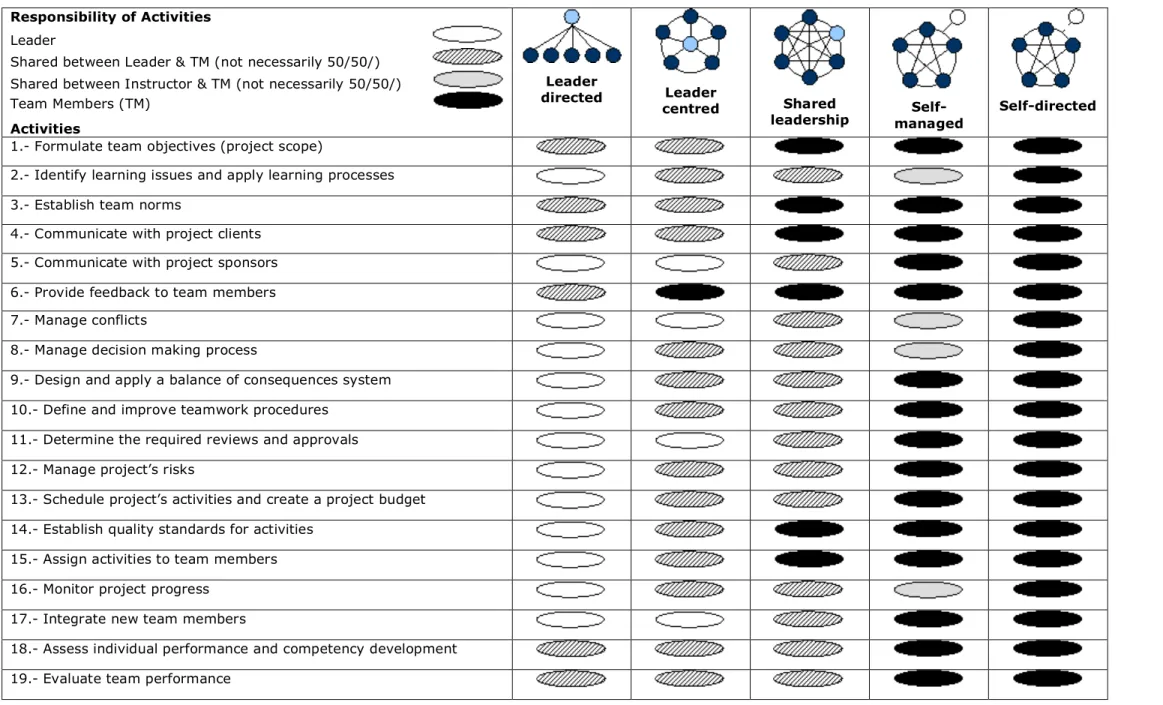
The second hypothesis was that empowerment of individual students and teams could be accomplished simultaneously within the social learning environment if the model to be implemented would consider the appropriate evolution of team organizational stages, from an initial leader directed and leader centred scheme in the first year to a self-managed or self-directed organization just before graduation at the fifth year of studies. Table 1 describes these team organizations in terms of responsibilities and activities of team members that has been adopted at the ETSEQ and which has been inspired by the team organizations considered at Dow. The 19 activities listed in Table 1 are exhaustive and fit very well those typically needed to carry out the design projects at the ETSEQ. Within the self-managed and self-directed team organizations, deployed at the 3rd and 5th years respectively, students become progressively empowered since
they are given the right to make decisions and take actions on their own without previous approval by instructors. This authority to act encourages students to further assume responsibility for their actions, which also results in an improvement of the model.
The third hypothesis was that the progressive deployment of the IDP approach, with team organizations matching student’s skills and needs (see Table 1), should facilitate the adoption of a competency-based educational model. In the context of the current study, a competency is a combination of tangible (skills and knowledge) and intangible (social role, self-concept, traits and motives) underlying characteristics of an individual that is causally related to criterion-referenced effective and/or superior performance in a job situation [22].
The fourth and last hypothesis was that faculty and the school system would accept that the educational system did not possess the know-how to manage the cultural change [23] involved in the shift towards the competency-based educational model referred to in the previous two hypotheses and would, thus, be willing to work in partnership with a chemical manufacturer, such as Dow. The fact that Dow was willing in 1997 to establish a partnership (see Fig. 1) and to facilitate this process by providing expertise and technologies, such as workshops, on (i) team development, (ii) knowledge/awareness of critical competencies, and (iii) methodologies to manage change, were assumed to be a sufficient incentive to facilitate and sustain the required change. The workshop materials should support or facilitate the development of competencies and taught as compulsory external interventions initially by consultants and human resource personnel from Dow and later on by previously trained faculty. An external intervention is an extra-curriculum activity which is carried out at especially allocated hours in the academic timetable.
I.c. Framework
The four hypotheses stated in the previous subsection led to the educational model depicted schematically in Figure 3. The model framework spans dynamically over the five years of studies both in the cognitive domain pertaining to science and engineering contents and processes, according to Bloom’s taxonomy [24], and over different team organization stages towards empowerment. In the context of the current work, Bloom’s taxonomy has to be understood as expanding over engineering objectives, i.e., beyond the integrated set of the formal operations that any adult, educated person performs in real life. The ticks in Figure 3 indicate the current level of implementation, from fully operational (bold tick), under field testing (grey) to pending (no ticks).
The model is based on integrated projects in the 1st, 2nd and 4th years and in projects
carried out by self-managed and self-directed teams in the 3rd and 5th years, to assure the right
setup and environment for the development of social and professional competencies. Activities carried out during project development and project closing, which are listed in Table 1, require that students clearly identify project clients (mainly activities 1 and 4 in Table 1). Thus, client orientation is central in the competency structure adopted, with the rest of nine competencies emerging as correlative concentric skins characterised by “need to do actions” to attain client satisfaction. This is schematised in Figure 4 in terms of competencies, with the required individual, organisational and institutional transformations identified by the increasingly lighter levels of grey. The inner circles of competencies in Figure 4 pertain more to individuals working in teams and imply the transformation of both individuals (four inner circles with darker grey) and of the organisation (three intermediate grey circles). The two outer circles of competencies (lighter grey)
concern more the role of individuals at the institutional level, where student’s empowerment can more effectively evolve and be valued, and all changes institutionalised. Clearly, client orientation (black central target in Figure 4) first requires that any individual should adapt to client’s changes, i.e., be versatile, and subsequently find creative solutions to these new challenges, i.e., be entrepreneur and innovative. This in turn raises the need for system thinking and so on in the concentric structure depicted in Figure 4, which is self-explanatory.
Since current competencies have to grow from a client orientation perspective and be developed by team members simultaneously and in conjunction with regular academic activities, such as lectures, laboratories, seminars, etc., the educational and competency models shown in Figures 3 and 4 respectively are supported by the set of five hands-on, external interventions stated in Figure 3. These interventions have been conceived and designed to be delivered by professionals in the field and/or faculty previously trained in the respective topics and on the educational technologies used. The topics of the five external interventions, briefly described in Table 2, match both the team organizational stages planned for each of the five years of studies and the client oriented competency model of Figure 4. The following subsection presents and discusses the ten competencies that have been adopted at the ETSEQ, which are summarised in the concentric model depicted in Figure 4.
I.d. Competencies and rationale
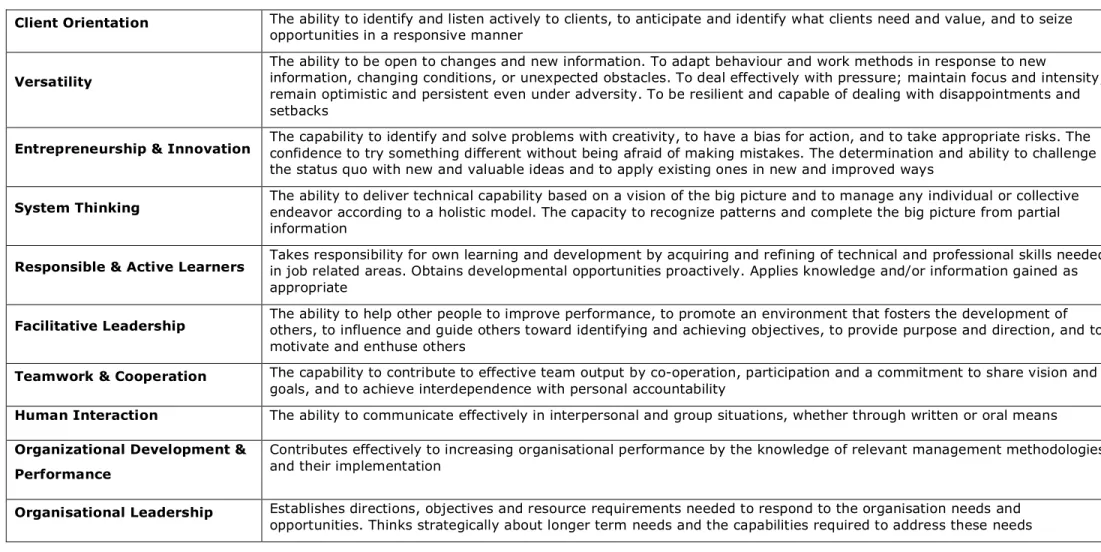
Table 3 lists the ten key competencies, together with their operational definitions, that have been identified at the ETSEQ, and that should also be enablers for technical competence as stated in the hypothesis subsection I.b. The current selection is consistent with the extensive research reported on the trends and changes that influence the economic and social environment in which industry is operating [25-28] and with the experience gained with the implementation and continuous refining of the first-fourth year IDP at the ETSEQ [11, 29]. Dow and other chemical corporations have also identified these or equivalent competencies as critical components in their recruiting processes. Finally, the set of competencies listed in Table 3 is in accordance with the opinion of other educators and policy-maker institutions [2, 4, 5].
The know-how developed by Dow on planned organisational change [30] suggests that the set of competencies of Table 3 constitutes a valid and consistent starting point to implement an effective and sustainable organizational change. Figure 4 illustrates the dynamics of this organisational transformation when it is unambiguously aimed at achieving client satisfaction through client orientation. Every significant change in clients’ needs stated in Figure 4 prompts three waves of transformation involving the individual, the organisation and the institution. Research supports the assumption that the only relevant component that should be moulded (changed) in an organisation is person’s habits, i.e., the attitudes and perspectives of each individual [30, 31]. Change always starts at the individual level. The change of individuals brings about organisational transformation. Once organisational transformation has taken place, the new way of working has to be institutionalised in order to ensure that the changes are sustained and
that no significant erosion takes place. Erosion would be detrimental as the organisation would gradually slide back to the status quo or the starting point of the change initiative.
Table 3 summarises the operational definitions of the competencies adopted at the ETSEQ. Figure 4 arranges these competencies in “need to do activities” consistent with client orientation. The central competence of Figure 4 and the first in Table 3 is client orientation, the one that triggers individual transformation. An individual within a client serving organisation must be able to perceive a shift in clients’ needs and to change accordingly. Productive performance during change requires versatility, since the individual is likely to be catapulted out of his/her comfort zone. To cope with inflicted stress, a high degree of versatility is needed as one has to adapt by changing one’s views, perspectives, assumptions and behaviours. The next competency under scrutiny is
entrepreneurship and innovation. Versatility has brought about capacity to adapt to change. It now has to be followed up with creative ideas to respond to the new challenges posed by the client directly or indirectly through the organization. On an institutional level, entrepreneurship will aid to translate creative ideas into tangible business opportunities. The next layer of the concentric model in Figure 4 is system thinking. Business opportunities have to be put into perspective, i.e., the whole system of individual and organisational interactions has to be re-considered. Critical reflection of one’s position in relation to the new system will consequently trigger new learning. It is most likely that a number of competencies will become obsolete and will have to be replaced by new ones. The skill transformation calls for the responsible and active learners competency or else no change will happen. The issue of “life-long learning” emerges clearly on the business horizon [32]. This notion is quite a challenge in itself as it conflicts with traditional way of looking at education. The perception that after graduation there is “only work to be done” is changing rapidly. The last circle of individual transformation, facilitative leadership, leads to the sphere of organisational transformation. Facilitative leadership is a pivotal point whereby the impact evolves from individual into collective scale. At this point, the individuals affected have completed the personal transformation cycle and are now skilled and ready to spark and facilitate changes in others. The fourth-year students acting as leaders and facilitators in first and second-year teams respectively assume this pivotal role of facilitation in the current model, as shown in Figure 3.
Organisational transformation initially starts within the smallest nucleus of the organisation, which typically happens to be a team or a small group. The team reinforces the changes via co-operation and the collective analyses of client needs. This is reflected in the team work and cooperation competency. When several teams or small groups interact, the level of complexity increases exponentially [33]. This calls for a higher competency level of human interaction. As change grows, the likelihood of miss-communication and errors by default is usual. A good skill-set of human interaction aids to minimise these side effects of change. When individuals communicate and interact well with each other challenges and barriers become opportunities for everybody in the organization, and the number and effects of conflicts decrease. This concludes the intermediate three circles of competencies involved in the transformation of the organisation, as depicted in Figure 4.
Now that the individuals and the organisation are mutually aligned to cope with the new scenario of client needs, the changes attained have to be institutionalised. This happens when the individuals acquire the two outer competencies in Figure 4: Organizational development and performance, and organizational leadership. In our educational organization, work and process management competencies have both been integrated into the competency organisational development and performance, which characterises individuals that can plan, implement, and evaluate any action within the organization or in smaller empowered teams of people, as stated in Table 3. This ultimately implies continuously updating and disseminating the relevant procedures and system documentation across the organisation. In addition, the interaction across the organisation has to be reflected in business and work processes that are aimed at satisfying client needs [34]. The last competency of organisational leadership, both in Figure 4 and Table 3, is characteristic of senior managers, i.e., senior students in our case. It ensures that the transformation is complete and yields the expected results. They have to initiate an appropriate evaluation cycle to validate the degree of transformation implied in Figure 4 in relation to client satisfaction.
II. The Key Competency Model Components
II.a. Integrative and ExperientialThe experiential learning approach applied at the ETSEQ, which is illustrated in Figure 3 and has been described in section I, is the so-called Integrated Design Project (IDP). It is based on a combination of project-based learning [35] and co-operative learning methodologies [36]. Both methodologies are well suited for engineering education because project management and teamwork are key enablers for any design activity, which is the essence of engineering [37]. Issues related to the adoption of design strategies that foster effective and natural interactions in design teams have been presented and discussed elsewhere [38].A detailed description of the approach as applied to the first year of the ChE programme at the ETSEQ has been presented elsewhere [11, 29].This subsection focuses on those characteristics of the approach that generate the dynamic concentric transformation wave depicted in grey levels in Figure 4, as explained in the caption.
Since client satisfaction plays a pivotal role in Figure 4, it became apparent from the beginning that project clients should be real and accessible to students. Professors responsible for the different courses that participate in the IDP act as the project’s clients and are, consequently, the driving force for the transformations of Figure 4. The IDP is not a standing-alone course. It is a teaching and learning approach that is horizontally implemented in the regular class hours of the existing courses. At the beginning of each semester, professors that teach courses in the first three years of the ChE programme select a set of engineering and project oriented instructional objectives in the cognitive domain from their corresponding syllabuses and hands them out to the project teams. The objective is that students achieve the handed-out engineering objectives by themselves through the project and, consequently, begin to take on responsibility for their own
learning. The level of these objectives varies depending on the year in the ChE programme according to Bloom’s taxonomy (knowledge, comprehension, application, analysis, synthesis, and evaluation) [24]. While it is expected that first-year students achieve objectives up to the application level in relation to engineering practice, for example process design, fourth-year students should be able to formulate design problems, evaluate the learning approach itself, etc., i.e., to reach up to the highest level of Bloom’s taxonomy in relation to engineering practice. The increase of complexity in the level of instructional engineering objectives over the ChE programme is shown on the left side of Figure 3. Together with the set of objectives, instructors allocate 25% of their regular class hours to project design and team work. As a result, students work an average of 5 hours per week on the design project.
As in any real-world experience, students enrolled in the first three years of the ChE programme soon realise that each professor/client is a universe by itself. Some professors know very well in advance which results they want to get from a particular project while others keep constantly changing their instructional objectives, even when the project is already approaching the closed-out phase. This dynamic and real environment forces our students to put in place effective communication processes with clients, i.e., to develop the client orientation competency repeatedly demanded by chemical manufacturers [25]. It also fosters preventive thinking and triggers the preparation of contingency plans.
The model in Figure 4 also implies a learning/working environment that facilitates the development of competencies by daily hands-on practice, with coaching support in terms of positive reinforcement and feedback. It is very difficult, if not impossible, to develop a competency up to a professional level only by attending a traditional single-discipline course. Hence the need to deploy extensively the integrated design project structure over the ChE programme. It is noteworthy to realise that this constant simulation of engineering practice makes the competency-based educational model also an excellent approach to cope with criterion 4 of the ABET 2000 Criteria standard: Professional Component [4].
This gradual growth of competencies is exemplified by the systematic development of project teams throughout the programme, as illustrated on the right side of Figure 3. The experience accumulated during the last decade by the Dow Chemical Company in the development of empowered teams recommends a progressive transition from leader-directed student teams in the first semester of the first year to self-managed teams in the third year of the ChE programme. Each of the stages in this empowerment journey entails that students are ready to take on additional responsibility for managing the IDP approach and, eventually, for their own learning. Table 1 shows in detail which specific activities are taken on by students as they progress through the different stages towards a self-directed or empowered team. This team development structure represents an organisational transformation that has to be necessarily underpinned by the appropriate individual transformation. For example, at the heart of the shift from the traditional single-discipline lecturing format to a team-based learning approach lies the need that students
realise, and hopefully begin to assume personal responsibility and voluntary commitment for their own learning.
One key success factor in this empowerment journey is team leadership, particularly for the leader-directed, leader-centred, and shared-leadership stages. Leadership is a critical component for the success of any team [29]. In addition, any effective organisational transformation requires that facilitative leadership competencies be in place, as indicated in Figure 4. Consequently, it was thought that fourth-year students, who had already endured a deep individual transformation, could act as facilitative leaders of project teams formed either by first-year or second-year students. The participation of fourth-year students as facilitative leaders of first and second-year project teams is in accordance with social learning theory [18] and self-directed change research’s findings [39]. The former holds that people learn interpersonal skills from “behaviour role modelling.” This social modelling of knowledge and competencies can be best realised in teams of peers because of the prominent role that human motivation, thought and action play in this process. The latter shows that people are open to develop a new competency only when they realise that it is important to do their jobs well and that there exist a discrepancy between the current and the ideal level of competence. Therefore, fourth-year students act as role models of the competencies to be developed by first and second-year students and trigger their motivation to work hard to develop such competencies. Furthermore, fourth-year students are in a better position than instructors to create a socially “safe” and supportive environment in which to learn, experiment with, and practice new learning methodologies and behaviours. This is a basic feature of the model since self-directed behaviour change research strongly suggest that students need to experience high psychological safety to assimilate effectively the integrated design project approach and not to see it as a threat. In addition, first and second-year students see fourth year students as fellows who have already passed successfully through the project experience and that can provide valuable support and coaching, raising their expectations of success [40]. The leadership-role responsibilities also vary depending on the development stage of the team, as shown in Table 1. Finally, it is expected that all third-year project teams will reach the self-managed stage where all activities related to the management of the integrated design project approach are carried out by third-year students exclusively. This outcome should emerge from the experiencing of the earlier team organizations stages shown in Figure 3 by themselves and as a result of the specific courses and external interventions expressly designed and delivered with this purpose.
II.b. Specific Courses and Interventions
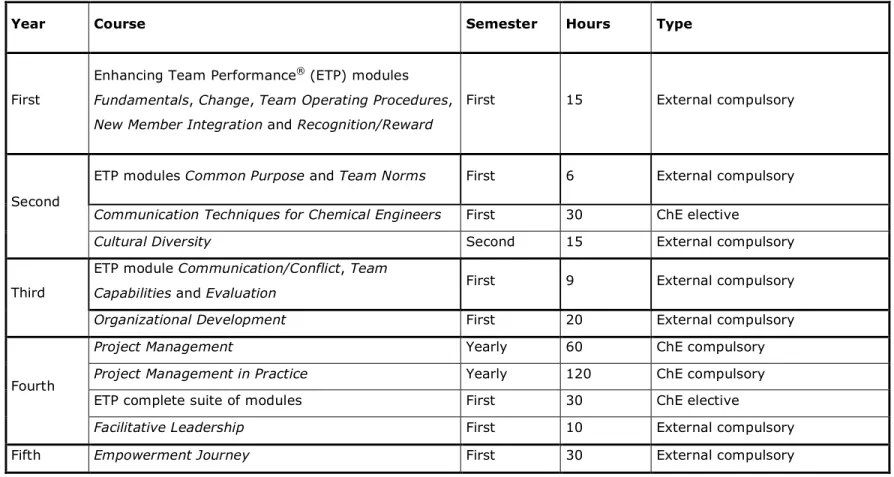
Table 2 describes the external interventions that support the educational model and the competency structure presented in Figures 3 and 4, respectively. Table 4 extends this information by including the elective and compulsory courses that sustain the whole system from within. As it has been explained in the previous subsection II.a, teams are the basic organisational unit where students learn and develop competencies emerging from social and management skills. Therefore,
the development of the teamwork and cooperation competency, even though located at the concentric skin no. 7 from client orientation in Figure 4, is a priority and had to be strategically planned and supported by appropriate training interventions from the first year of studies.
The Enhancing Team Performance© (ETP) methodology developed by The Tracom-Reeds
Business Group [41] was selected in the late 1998 and fully implemented among professors and first year students in 2000 as the external intervention to support teamwork and cooperation in the ChE programme, as highlighted in Figure 1. Dow suggested and offered this resource to the ETSEQ since the ETP is widely used in companies and has a long-standing record of success. It has a modular form and is taught by certified trainers and coaches according to the standards of the vendor. The learning resource is comprised out of an introduction module, called “Fundamentals”, followed by the following nine additional modules: “Common Purpose,” “Team Capabilities,” “Change,” “Team Norms,” “Communication/Conflict,” “Recognition/Reward,” “Team Operating Procedures,” “New Member Integration,” and “Evaluation.” The ten modules are currently delivered by previously trained faculty members, together with Dow employees.
First-year students are currently trained in the ETP modules “Fundamentals,” “Change,” “Team Operating Procedures,” “New Member Integration” and “Recognition/Reward,” as shown in Table 4. Students start working in project teams’ right at the second week of the first semester of their studies and they have to be acquainted with the critical components which contribute to optimum team performance. The “Fundamentals” module shows, in a workshop format, that leadership, relationships and methods are critical components of optimum performance teams. Each of these components contributes with three characteristics: Common purpose, team capabilities and change for leadership; team norms, communication/conflict and recognition/reward for relationships; team operating procedures, new member integration and evaluations for methods. The roles of the team leader, members and organization, together with the balances for leadership (guidance-freedom), relationships (support-candour), and methods (consistency-flexibility) are then analysed, as well as the phases of team formation, solidification and optimum performance. Finally, the cementing of the three components, nine characteristics and balances by trust yields the outcomes of focus in the leadership component, interdependence in the relationships, and innovation in the methods. The module on “Fundamentals“ increases the ability of students to adapt to the new environment and to decrease drop-out. The module on “Change” deals with the nature of change, how humans react to change, and how change interacts with leadership, relationships and methods in a team. The process of change management is also analysed, considering the five stages of problem/opportunity recognition, agreement on destination, agreement on course of action, action, and evaluation. The leader and member roles are finally reanalysed. The “Change” module helps students to understand the nature of change and the human reaction to it, and stresses the importance of flexibility and adaptability as competencies that help to cope with change. The “Change” module is imparted in a very practical way since it is applied to manage the change that first-year students are undergoing. The ETP
modules dealing with “Team Operating Procedures,” “New Member Integration” and “Recognition/Reward,” respectively expose first year students to procedures needed for successful problem solving activities and team meetings, for excluding or integrating members, and for establishing a reward system to recognise accomplishments. This first year external training intervention is fully implemented as indicated in Figure 3 by a bold tick.
Second-year project teams start with a shared-leadership team organisation in the first semester, which evolves into a self-managed stage during the second semester, according to the model in Figure 3. This means that the responsibilities of the four-year students leading teams at the second year of IDP shift with respect to those at fist year in line with Table 1. The ETP “Common Purpose” module helps second-year students to establish their team’s vision, mission, objectives and action plans for the team and individual members. It also helps them differentiate between commitment and compliance. The second ETP module “Team Norms” reinforces the need for norms (initially ground rules) and values within a framework of behavioural expectations. Students become fully aware that they belong to an educational organization that has the purpose to operate as a whole in a similar way and that has values, since they receive every year at registration a complete set of information concerning these matters. Their team’s norms and values have to align with those adopted by the school:
(i) We are a team where people are the most important part;
(ii) A commitment to serve the community beyond the expectations of stakeholders; (iii) Efficiency, reliability and responsibility;
(iv) Excellence in the generation and dissemination of knowledge; (v) Entrepreneurship, initiative, dynamism, versatility and adaptability.
In addition to these two ETP modules on team common purpose and norms, which have been already field tested and are fully operational, the external intervention “Cultural Diversity” described in Table 2 is also in the process to be delivered to second year students as a workshop to gain insight about the relationship between cultural patterns and behaviours and actions. The workshop is based on the resource “Managing Across Cultures” from Dow Chemical. The field testing situation of this external intervention is the reason why the second year external interventions are labelled with a tick in grey in Figure 3. Finally, the elective course “Communication Techniques for Chemical Engineers” is an additional and optional resource that has been available since the early years of implementation of the ChE programme to help students in their oral, written and multimedia presentation skills. Students are also introduced to the process of improvisation.
Third-year project teams reach the self-managed organisational stage. As shown in Figure 3, third-year students are on their own to work as a team after two years of facilitation from fourth-year students. With this critical team organizational change in mind, two types of external
interventions have been selected. The first incorporates the modules of ETP that deal with the remaining three characteristics of “Team Capabilities,” “Communication/Conflict,” and “Evaluation” pertaining to the critical team performance components of leadership, relationships and methods, respectively. The second external intervention “Organizational Development” is complementary to the above and focuses on client orientation and system thinking as mentioned in Table 2. Together with organisational design, strategy development and implementation, and business processes, this external intervention also introduces students to different management models such as the EFQM Excellence Model, the ISO 9001:2000 standard, and the ABET 2000 Engineering criteria so that they can evaluate the competency-based educational model and identify their strengths and areas of improvement. The ETP “Team Capabilities” module shows how to capitalise on team skills, knowledge, experience and individual differences. The “Communication/Conflict” module analyses the communication loop, the causes of team tension and conflict, and the standard responses to conflict. The “Evaluation” module is critical in the concentric competency model of Figure 4 since it considers the three levels of team evaluation: Customer satisfaction, team performance and individual member performance. It is not surprising that the above three ETP modules are highly valued by the third year students as they have to overcome the organizational barrier of self-management as a team. These three modules of ETP have been successfully tested with professors and students in general and are currently in the field testing stage in the third year of the ChE programme as indicated in Figure 3.
The ChE programme offers to fourth year students, which are the agents that retro-feed into the system the social learning component by acting as leaders and facilitators of first and second year teams (Figure 3), two yearly compulsory courses in project management: Project Management (PM) and Project Management in Practice (PMP). The PM course introduces fourth-year students to the basic managerial methodologies and competencies such as project management and facilitative leadership [29], while the PMP course, accounts for the hours that they dedicate to lead and facilitate first and second year teams. Since the PM course and the previous experiences accumulated by fourth-year students in previous ChE classes do not assure the smooth development of the PMP course, two types of training interventions are in the process of being field tested. The first is the complete set of ETP modules offered as a ChE elective with the purpose of revisiting the critical components and characteristics of an optimum performing team. The fact that students are credited for this elective course makes this offer very attractive. The second is the external compulsory intervention “Facilitative Leadership” described in Table 2 and which is currently at a pre-field testing stage.
Finally, the fifth-year external intervention “Empowerment Journey” has been adopted to cope with the outer competencies in the concentric model of Figure 4. These management competencies should enable students to develop, implement and improve continuously the management system of any organisation. If students have to close their learning process cicle, it is required that they reflect both on the results achieved through the competency-based educational
model and on the way that these have been reached. In order to reflect on the latter, it is essential that students can understand the management system of the educational model itself. Only in this way, they will be ready to help assess and review the educational model and complete their empowerment journey, sharing the ownership of the School with faculty and staff. The “Empowerment Journey” course has been designed from the materials of the workshop on “Global Empowerment Assessment” by Dow, as indicated in Table 2.
II.c. Assessment Process
The assessment process has only started at the 1st-4th and 2nd-4th integrated design project
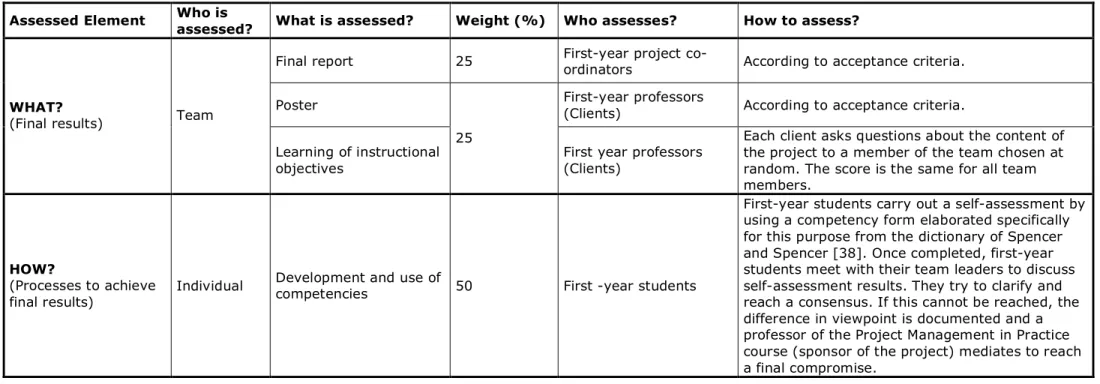
(IDP) stages of the model. The initial approach focuses both on “what” work is done and on “how” that work is done by individual students acting in the team organizations depicted in Figure 3 and Table 2, and in accordance with the practices of Performance Management [42]. The “what” element encompasses the engineering deliverables typical of design projects, which are handed out in the formats of a final report and of a public presentation of results to clients, sponsors and social stakeholders in a poster session. The more technically oriented components of the “what” element of the assessment process are evaluated during the closeout phases of the project, one per semester. This evaluation gives rise to a score or mark that is common to and shared by all team members. The “how” element of the assessment encompasses the development and use of the competencies shown in Figure 4 and Table 3. This element is continuously evaluated through all of the phases of the project, from planning to closeout, being the individual student who is appraised in this case. Table 5 describes in detail how both elements, the “what” and the “how”, are evaluated for the specific case of first-year students participating in the first-fourth year IDP. It can be seen that in this case both elements have the same weight, indicating that achieving good technical deliverables as a team is as important as the way followed by the individual team members to accomplish them.
The use and development of competencies have been so far evaluated at first year by applying the procedure sketched in Figure 5. This procedure is largely inspired on the findings of self-directed behaviour change research [39]. In essence, it states that the more the students control their change process, from the initial goal setting stage to the point where his/her progress toward the goal is evaluated, the higher the likelihood is that they will eventually take on personal responsibility and voluntary commitment to change and to achieve their change goals. Again, it has to be emphasised that self-efficacy or the beliefs of one’s capabilities to organise and execute courses of action required to manage prospective situations is key to develop self-regulatory strategies, motivation and achievement in our academic setting [20]. Therefore, the IDP is a convenient social environment to learn and develop competencies.
During the planning phase of the project, team leaders facilitate the assignment of work objectives to team members and also help them to understand the competencies that will support the achievement of the work objectives. In doing so, team leaders make use of a competency form, in the format of a 10+ pages long questionnaire available upon request to the authors, that
collects definitions plus behavioural indicators clustered in different levels of competency mastery for all the competencies described in Table 3. This competency form is largely based on generic competency dictionaries such as that proposed by Spencer and Spencer [43]. Students are trained in the use of the competency form and in the overall assessment process right at the beginning of the integrated project. This competency form constitutes a conceptual framework for students to think about their behaviours and become aware of the deviations that may exist between one’s current level of competence and the desired one. Finally, the competency form facilitates the provision of feedback and recognition by team leaders, team-mates, and professors during the execution phases of the project.
During the closeout phases of the project, each team member holds a meeting with the team leader to reach a consensus about competency evaluation (development and use). Team members, first-year students, bring to this meeting a self-assessment based on the competency form. This self-assessment constitutes the basis for discussion with the team leader who, in turn, uses all data about team members recorded during the planning and execution phases of the project. In this meeting, the team leader and the team member work to reach consensus on the self-assessment, i.e., on the actual level of competency achieved. They also discuss the developmental goals that are reasonable to consider for the next stage of studies. If consensus is not reached, a professor of the PDP course (sponsor) mediates to search for a final compromise.
III. Deployment and Preliminary Evaluation of the Model at ETSEQ
The ETSEQ had to undergo the concentric transformation waves shown in Figure 4 for the competency-based education model described in Figure 3 to be effectively implemented. An organisational change initiative like this one poses a colossal challenge that requires a large amount of effort and long term planning. In addition, if this change has to be implemented at a research-oriented university, where the recognition and reward processes are not fully aligned to foster improvements in teaching, the endeavour becomes even more challenging [6]. Ultimately, the whole university system should also undergo the above mentioned transformation waves. In spite of these unfavourable conditions, the ETSEQ has progressed along individual and organisational transformation waves over the past ten years. Figure 1 highlights the milestones of the competency-based education model implementation process at the ETSEQ. Basically, there are two key success factors that have driven, facilitated and sustained such a change.
The first key factor was the strong determination and leadership of a group of professors, about 25% of the total faculty, actively involved in promoting effective teaching methodologies [10]. The second key success factor was the ETSEQ/Dow Chemical Company partnership that was established in 1997, following the model of industry/university interactions adopted in engineering clinics [14, 15] and further expanding it into the form of a partnership. As a result of this partnership Dow provided professional change management consultants and methodologies to
facilitate the organisational change needed at the ETSEQ to deploy effectively the competency-based educational model. A series of workshops were organised in order to create a common vision for the ETSEQ, develop key elements to reach that vision, establish change readiness, and develop change leadership. Most of ETSEQ’s professors and staff participated in these workshops and realised how much of a change the competency-based education model would mean to the way of teaching. Dow has also provided expertise on team management and team development, and has facilitated the access to several learning resources. For example, the ETSEQ obtained from Dow licenses to use the Enhancing Team Performance® workshop materials [41] described previously
and instructors to teach this and other competency related topics as external interventions (extra-curriculum activities).
The IDP and the rest of project-based cooperative learning approaches were institutionalised by the ETSEQ’s dean after approval by the governing council at the end of the 2000-01 academic year. The deployment of the approach over the first four years of the ChE programme has just been completed this year 2005 due to resistances to change encountered at the second year of the programme. The approach followed to overcome this difficulty has been to involve professors into the new system rather than imposing the new system onto them. As a result, we expect that transformations undergone by the ETSEQ, which follow the model in Figure 4 inside-out, will be more enduring than if they had started as an institutional initiative and from that rank reached the individuals as an outside-in wave in Figure 4. The current approach of client-oriented, breakthrough changes is more likely to generate commitment and a sense of ownership among faculty, students and staff.
The backbone of the model in terms of the project-oriented cooperative learning approach (central right column in Figure 3) is currently (year 2005) in place and operational. The deployment of external training interventions (left column in Figure 3) is complete in first year and at the field-testing stage in 2nd, 3rd and 4th years. The workshop Enhancing Team Performance®, which has
been adopted to train both students and professors about the key components necessary to build a performing team, has enhanced the overall acceptance of the educational model in Figures 3 and 4 and Table 1. It also accelerates the formation of teams and accelerates the perception among students that working in teams is an advantage in engineering practice. Breaking this barrier or cultural shift from individual to teamwork has in turn facilitated the social modelling of knowledge and competencies that are inherent in the proposed model.
“Empowerment Journey” is the only external intervention that is currently pending. According to Figure 3 and Table 2, this intervention, which is planned for the last year of studies and has a workshop format, should make pre-graduating students aware of the processes and methods available to develop, implement, evaluate and improve continuously the management system of any organization. To reinforce in these students the corresponding two competencies of “organizational development and performance” and “organizational leadership” (see Table 3 and the two outer-circles in Figure 4), “Empowerment Journey” should include in the allocated 30 h of
workshop (Table 4), several mini-projects carried out by teams of 5th year students to self-assess
the whole organization. These mini-projects should be designed so that they can be carried out in close collaboration with the 4th year students acting as leaders and facilitators of IDP. Also, they
should emerge from within the EFQM’s cyclic RADAR methodology [44], which involves the phases
of Results, Approach, Development, Assessment and Review, shown in Figure 6. At the core and
sustaining this cycle are the needs to INTEGRATE all enabling agents (leadership and processes affecting people, policies and strategies, alliances and resources, and operational processes) and to MEASURE all results. The enabling agents are well taken into account by the model itself and by the partnership with Dow. The components of RADAR that are totally or partially missing currently are those related to MEASURE (perception measures and indicators), both in the assessment and review, and in the results steps of Figure 6.
The assessment and review together with the analysis of results of the competency-based educational model that fifth-year students will carry out should close their own learning process loop and contribute to the institutional transformation wave of Figure 4, which is a key area of improvement at the ETSEQ itself. Many procedures have been developed and documented throughout the years and the educational model has continuously been improved. However, there is not in place an accepted process management system along with its associated process indicators that could be used to assess comprehensively and quantitatively the model and, eventually, identify, prioritise, plan and implement improvements. Probably, it is necessary that the ETSEQ goes first through this institutional transformation wave, which can be facilitated by the ABET and other regional and national accreditation processes in which the ETSEQ is immersed, before the self-assessment related competencies can be developed by senior students. The successful implementation of the last intervention on empowerment is a key factor for the ongoing completion of the last two steps Assessment & Review and Results of the RADAR cycle (Figure 6) and for the continuous improvement of the current educational model.
The fact that most measures of the assessment currently available are of a qualitative nature does not impede to clearly perceive that classes are overwhelmingly attended, that drop out has decreased to background noise levels, that more professors act as facilitators in the classroom, and that teaching methods are more active and student centred every day. Since the proposed educational system is client oriented, it is worth stating the opinion of our industrial partner. Dow has felt the positive impact of the competency-based education model of the ETSEQ when selecting chemical engineering students for internships or graduates for new jobs. The first indicator that shows a positive tendency is the number of fifth-year students who carry out their industrial internship at Dow Chemical Ibérica. Placements of ETSEQ students as a percentage of total student internships has increased tenfold, from 5-7% in the late 90’s to an average of 50% in the new century. Dow tutors highlight the fact that ETSEQ students are not only technically well prepared, but also they are highly valued for their ability to overcome difficulties by searching effectively alternative solutions with initiative and teamwork capabilities. Another indicator that shows a
positive tendency is the percentage of ETSEQ chemical engineers hired annually by Dow, which has increased by a factor of nearly three over the same period. It should be noted that Dow follows a competency-based interview scheme for recruiting purposes. The scorings of ETSEQ chemical engineers showed that (i) they possess the technical knowledge required for the job, (ii) they are open to new challenges, and (iii) they are willing to stretch goals through effective communication, teamwork and joint development.
These preliminary but qualitatively conclusive results (evidence) show that the competency model works and that it has the correct effects on student education. These trends are an encouraging early sign that the four hypotheses stated in subsection I.b. are consistent with the scope of the current endeavour. It remains to measure how much this effect is in every competency and to define improvement actions. In doing so, each competency will be divided into measurable components or characteristics. For example, client orientation can be broken down and measured as: (i) Gives a quick and adequate response to (responds to demands, questions, complaints and requests made by) clients; (ii) shares information (keeps communication open) with clients; (iii) finds solutions to and reaches consensus about (commits to solving) client’s problems; (iv) involves others (works) to improve service; (v) adds value (economical, environmental, health and safety, etc.) to clients beyond expectations; etc. The process of defining indicators for every competency is the next step in the assessment and review step that fifth-year students will carry out according to the RADAR methodology depicted in Figure 6.
IV. Concluding Remarks
The initiative of a team of professors compromised with active teaching methodologies, together with the pressures from ABET and other European accreditation boards, led to the adoption of a competency-based educational model at the ETSEQ. To support the change from a conventional educational organization to a competency-based system with empowered students, a partnership with Dow Chemical Ibérica was established. This partnership facilitated the implementation of a project-based cooperative learning structure and the weakening of resistances opposing change. Key for the success of the implementation have been the adequate selection of ten competencies (client orientation, versatility, entrepreneurship and innovation, systemic thinking, responsible and active learners, facilitative leadership, teamwork and cooperation, human interaction, organizational development and performance, and organizational leadership), the implementation of a team organization coherent with the model, from leader centred to a self-directed empowered teams, and the delivery of appropriate external training interventions, designed to foster the development of the above competencies. Preliminary results show that students have developed technical, social and management skills to the point of being offered significantly more internships and permanent positions by the partner chemical manufacturer.
References
[1] German Federal Ministry of Education and Research, New Approaches to the Education and Qualification of Engineers: Challenges and Solutions from a Transatlantic Perspective, Report on Two Conferences: Objectives, Results, Guidelines, Prospects, Bonn (1999).
[2] A. Rugarcia, R. M. Felder, D. R. Woods, and J. E. Stice, The Future of Engineering Education: Part 1, a Vision for a New Century. Chemical Engineering Education, 16-25 Winter (2000). [3] M. Molzahn and K. Wittstock, Chemical Engineers for the 21st Century: Challenges for
University Education. Chemical Engineering Technology 25(3), 231-235 (2002).
[4] Accreditation Board for Engineering and Technology, http://www.abet.org, accessed June 30th, 2004.
[5] Investing Efficiently in Education and Training: an Imperative for Europe. Communication from the European Commission, COM(2002) 779 final.
[6] R. M. Felder, J. E. Stice, and A. Rugarcia, The Future of Engineering Education: Part 6, Making Reform Happen. Chemical Engineering Education, 208-215 Summer (2000).
[7] A. Verma, Emerging HRM Paradigms for a Knowledge Economy. HRM Research Quarterly 5(3), 1-6 (2001).
[8] F. Giralt, M. Medir, H. Thier, and F.X. Grau, A Holistic Approach to ChE Education: Part 1, Professional and Issue-Oriented Approach. Chemical Engineering Education, 122-127 Spring (1994).
[9] F. Giralt, A. Fabregat, X. Farriol, F.X. Grau, J. Giralt, and M. Medir, A Holistic Approach to ChE Education: Part 2, Approach at the Introductory Level. Chemical Engineering Education, 204-213 Summer (1994).
[10] F. Giralt, J. Herrero, M. Medir, F.X. Grau, and J. R. Alabart, How to Involve Faculty in Effective Teaching. Chemical Engineering Education, 244-249 Summer (1999).
[11] F. Giralt, J. Herrero, F.X. Grau, J.R. Alabart, and M. Medir, Horizontal and Vertical Integration of Education into a Human-Centered Engineering Practice in Design Processes. Journal of Engineering Education, 219-229 April (2000).
[12] D. A. Kolb, Experiential Learning: Experience as the Source of Learning and Development, Prentice Hall, Englewood cliffs, NJ (1984).
[13] R. Brent and R.M. Felder, A Model for Engineering Faculty Development, International Journal of Engineering Education, 19(2), 234-240 (2003)
[14] J.R. Phillips and A. Bright, The Harvey Mudd Engineering Clinic: Past, Present and Future, Journal of Engineering Education, 88(2), 189-194 (1999)
[15] S. Farrell, R.P. Hesketh, J.A. Newell, M.J. Savelski, and C.S. Slater, A Model for Synergistic Interaction between Industry and Universities with Focus on Undergraduate Education, in Innovation 2004: World Innovation in Engineering Education and Research, Eds. W. Aung, R. Altenkirch, T. Cormak, R.W. King, L.M. Sanchez Ruiz, pp. 355-364, Begell House Publishing, Arlington (VA) (2004)
[16] J. Henrich, and R. McElreath, The Evolution of Cultural Evolution, Evolutionary Anthropology, 12, 123-135 (2003).
[17] A. Bandura, Social Foundations of Thought and Action: A Social Cognitive Theory, Prentice-Hall, Englewood Cliffs, NJ (1986).
[18] A. Bandura, Social Learning Theory, Prentice-Hall, Englewood Cliffs, NJ (1977). [19] A. Bandura, Self-efficacy: The Exercise of Control, Freeman, New York (1997)
[20] F. Pajares, Sel-efficacy Beliefs in Academic Settings. Review of Educational Research 66(4), 543-578 (1996).
[21] J.A. Newell, A.J. Marchese, R.P. Ramachandran, B. Sukumaran, and R. Harvey, Multidisciplinary Design and Communication: a Pedagogical Vision, International Journal of Engineering Education, 15(5), 376-382 (1999).
[22] D.C. McClelland, Testing for Competence rather than Intelligence. American Psychologist 28, 1-24 (1973)
[23] J. W. Prados and S. I. Proctor, What will it Take to Reform Engineering Education, Chemical Engineering Progress 96(3), 91-96 (2000).
[24] B. S. Bloom, Taxonomy of Educational Objectives. 1. Cognitive Domain, Longman, New York (1984).
[25] G. J. Huysse, From the Classroom to the Boardroom. Quality Progress, 81-82 November (1997).
[26] R. A. Buonopane, Engineering Education for the 21st Century: Listen to Industry!. Chemical
Engineering Education 30(3), 166-167 (1997).
[27] S. Wearne, Management Skills: not Just for the Boss. The Chemical Engineers, 26-27 August (2003).
[28] J. V. Farr and D. N. Merino, Education Entry-Level Engineers: Are Broad-Based Business/Managerial Skills a Key to Sustaining the US Innovation-Based Economy?. International Journal of Engineering Education 19(2), 252-259 (2003).
[29] H. J. Witt, J. R. Alabart, F. Giralt, J. Herrero, M. Medir, and A. Fabregat, Development of Coaching Competencies in Students through a Project-based Cooperative Learning Approach, 32nd ASEE/IEEE Frontiers in Education Conference, Boston, November 2002. Proceedings – Frontiers in Education Conference, 2, F2A/1- 6, IEEE cat. no. 02CH37251 (2002).
[30] Implementing Change Effectively. Leaders Guide, The Dow Chemical Company, Midland (MI), October (2001).
[31] D. Conner and D. R. Conner, Managing at the Speed of Change, Villard Books, 1st edition,
New York (1993).
[32] P. M. Senge, The Fifth Discipline: The Art and Practice of the Learning Organization, Currency Doubleday, Century Business (1990).
[33] W. Grunwald, Psychologische Gesetzmäßigkeiten der Gruppenarbeit. Personalführung, 740-750 September (1996)
[34] G. A. Rummler, A. P. Brache, Improving Performance: How to Manage the White Space on the Organization Chart, Jossey Bass Inc. Publishers, 2nd Edition, San Francisco (1995).
[35] D. R. Woods, R. M. Felder, A. Rugarcia, J. E. Stice, The Future of Engineering Education. Part 3. Developing Critical Skills. Chemical Engineering Education, 108-117 Spring (2000).
[36] R. M. Felder, D. R. Woods, J. E. Stice, A. Rugarcia, The Future of Engineering Education. Part 2. Teaching Methods that Work. Chemical Engineering Education, 26-39 Winter (2000). [37] K. A. Smith, Project Management and Teamwork, McGraw-Hill Higher Education, (2000). [38] W.H. Wood, Integrating Social Issues into Design Theory, International Journal of
Engineering Education, 19(1), 35-40 (2003)
[39] D. A. Kolb and R. E.Boyatzis, Goal-Setting and Self-Directed Behavior Change. Human Relations 23(5), 439-457 (1967).
[40] D. C. McClelland, Toward a Theory of Motive Acquisition. American Psycologist 20, 321-333 (1965).
[41] Enhancing Team Performance©, A Process and Tools for Developing Teams, Facilitators’
Guide, The TRACOM-REEDS Group, The TRACOM Corporation, 1990-1995.
[42] J. Rollo, Performance Management, GOAL/QPC and Competitive Advantage Consultans Inc., Salem NH (2001).
[43] L. M. Spencer and S. M. Spencer, Competence at Work: Models for Superior Performance, John Wiley & Sons, New York (1993).
Table 1. Team organisations defined according to responsibilities and activities of team members (see Figure 3) Responsibility of Activities
Leader
Shared between Leader & TM (not necessarily 50/50/) Shared between Instructor & TM (not necessarily 50/50/) Team Members (TM)
Activities
Leader
directed Leader
centred Shared
leadership managedSelf- Self-directed
1.- Formulate team objectives (project scope)
2.- Identify learning issues and apply learning processes 3.- Establish team norms
4.- Communicate with project clients 5.- Communicate with project sponsors 6.- Provide feedback to team members 7.- Manage conflicts
8.- Manage decision making process
9.- Design and apply a balance of consequences system 10.- Define and improve teamwork procedures
11.- Determine the required reviews and approvals 12.- Manage project’s risks
13.- Schedule project’s activities and create a project budget 14.- Establish quality standards for activities
15.- Assign activities to team members 16.- Monitor project progress