QUALITY FUNCTION DEPLOYMENT TO ACHIEVE OPTIMUM DESIGN
SOLUTION FOR TRANSMISSION LINE PROJECTS
MARIATUL QIBTIYAH BINTI AHMAD KHALID
A project report submitted in partial fulfillment of the
requirements for the award of the degree
Master of Science (Construction Management)
Faculty of Civil Engineering
Universiti Teknologi Malaysia
ACKNOWLEDGEMENT
Alhamdulillah, finally my project report entitled “Quality Function Deployment As Optimum Design Solution for Transmission Line Project” is
complete. Millions of gratitude to my Master Project Supervisor, Associate Professor Dr. Mohamad Ibrahim Mohamad for his patient, advice and assistance throughout the process of the project period..
Thank you to all course mates for lending hands, tips, advice, time and the friendship. The support all of you gave I shall always remember. Appreciation also for all my respondents especially my client TNB for giving inputs that was vital for this project and to the expert panel who are all willing to spend time to share their engineering expertise and experiences..
ABSTRACT
Transmission line transmits electricity from power stations to substations. It is a multi-engineering disciplines project that has many stakeholders‟ requirements. Every stakeholders have their needs and requirement towards the project. As a result the designer faced a lot of challenges to incorporate these requirements for the projects. Therefore, it is crucial to develop a strategy to address the stakeholder‟s requirements. This study has been developed in the aim to optimize the design solution for transmission line projects by capturing all stakeholders‟ requirement by
ABSTRAK
C H A P T E R 1
INT RODU CT ION
1.1 Introduction
Transmission lines are electricity transmission network. Malaysia‟s transmission network is known National Grid, operates by Tenaga Nasional Berhad (TNB). With upcoming 308km transmission line, the National Grid has networks to Thailand‟s transmission system in the north and to Singapore‟s transmission system
in the south. Most transmission line project in Malaysia is done through turnkey contract where main contractor is responsible to come out design that fulfil client‟s requirement and at the same time need to adopt an economical designs to construct the design. Generally there are two main stakeholders in transmission line projects which are TNB and Turnkey Contractor. Each of these stakeholders have vast requirements to the project. Disputes and problems occur when requirements not considered during design stage. This study focuses on the transmission line project problems around Klang Valley and the process to prioritise all stakeholders‟
1.2 Research Background
Transmission line projects are specialize engineering projects which comprise of designs of the transmission line route, tower designs, foundation design, construction of foundation, erection of tower, stringing or dismantling conductor and commissioning of the transmission line. These tasks involved many subtasks and each of these subtasks requires different aspect of engineering field and demands from each project stakeholders. Previous study mostly related to the technical aspect of transmission line such as the foundation design and electrical design of the transmission line. In the other hand, there are studies on implementation of QFD in manufacturing sector, transportation project and also construction. This study introduces the usage of QFD to prioritise stakeholders‟ requirements. QFD which
was introduced by Joji Akao is a detailed system that assists the designer to convert stakeholder needs into technical requirement for product or services. There are also development of QFD matrix for transmission line project which accommodate requirements from TNB and contractor.
1.3 Problem Statement
design that fulfilled each stakeholders‟ needs and requirements as well as able to yield the priority of project element to be considered during design stage. Voice of Customer always refers to the in depth process to capturing stakeholders‟ requirements. One of Tools under this process is Quality Function Deployment (QFD), which focus not only on the stakeholders‟ requirements but also priority of
the requirements.
1.4 Aim and Objectives
The aim of the study is to optimize the design solution for transmission line projects by capturing all stakeholders‟ requirement by using Quality Function Deployment matrix approach. To achieve this aim, the following objectives have been used for the study:
i. To evaluate current problem to transmission tower design.
ii. To evaluate the potential of using Quality function deployment as a tool to achieve optimum design solution.
iii. Development of Quality Function deployment for transmission tower design solution.
1.5 Scope and Limitation of Study
There are limitations of this study. The followings are the limitation:
The study studied on the present transmission line project.
The transmission line project that has been covered for this study
The stakeholders introduced in the study are limited to Tenaga
Nasional Berhad and Contractor.
All data collected are generated from TNB personnel within Klang
Valley only.
All project considered in this study only involved turnkey procurement system only.
The study also focuses on alignment and tower design of the
transmission line but limited to transmission line 132kV and 275kV only. Though stakeholders‟ requirements are also referring to Voice of Customer, the study shall use Quality Function Deployment as tools to resolve disputes issues and prioritise the stakeholders‟ requirements.
The type of matrix used in QFD is Kano Model. This model is used
to understand the importance of a requirement to customer.
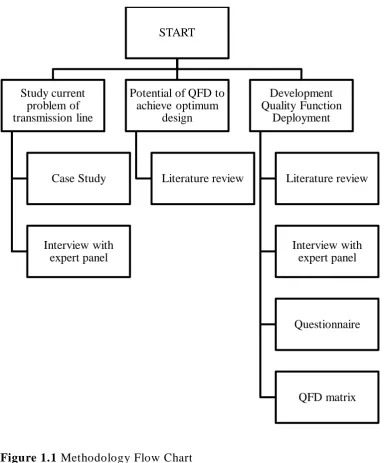
1.6 Brief Methodology
Figure 1.1 Methodology Flow Chart START
Study current problem of transmission line
Case Study
Interview with expert panel
Potential of QFD to achieve optimum
design
Literature review
Development Quality Function
Deployment
Literature review
Interview with expert panel
Questionnaire
REFERENCE
About TNB-History. (2012, Mac 2012). (Tenaga Nasional Berhad) Retrieved from
Tenaga Nasional Berhad: www.tnb.com.my
AMI4900: Engineering Design. (n.d.). Retrieved from Quality Functional
Deployment-Structured approaches to problem solving and process
improvement: Department, T. N. (2011, May ). Minutes of Progress Meeting . Kuala Lumpur.
Gin, D., & Zairi, M. (2005). The Role of QFD in Capturing the Voice of Customers. Volume 2 (Issue 2 Special Edition).
Kivinen, T. (2008). Applying QFD to Improve the Requirements and Project Management in Small Scale Project. University of Tampere.
LePrevost, J., & Mazur, G. (2003). Quality Infrastructure Improvement: Using QFD to Manage Project Priorities and Project Management Resource.
Mazur, G. H., & H, T. H. (2007). International Symposium on QFD
2007-Williamsburg. QFD Institute (p. Context Sensitive Solution: The Application of QFD for Developing Public Transportation Projects in the U.S).
Williamsburg, VA: QFD Institute.
Shillito, M. L. (1994). Advanced QFD Linking Technology To Market and Company Needs. Rochester, New York: Wiley Inter Science.
Suruhanjaya Tenaga Malaysia. (2010). The Malaysian Grid Code. Kuala Lumpur: Suruhanjaya Tenaga Malaysia.
Suruhanjaya Tenaga Malaysia. (2012). Wayleave for Electricity Supply Lines Your Right Your Safety. Kuala Lumpur: Suruhanjaya Tenaga Malaysia.
Tenaga Nasional Berhad. (2011). Switch On The Future. Kuala Lumpur: Tenaga Nasional Berhad.
Terninko, J. (1997). Step by Step QFD Customer Driven Product Design. Boca Raton, Florida: St. Lucie Press
TABLE OF CONTENT
CHAPTER TITLE PAGE
DECLARATION ii
DEDICATION iii
ACKNOWLEDGEMENTS iv
ABSTRACT v
ABSTRAK vi
TABLE OF CONTENTS vii
LIST OF TABLES x
LIST OF FIGURES xi
LIST OF ABBREVIATIONS xiii
LIST OF APPENDIX xiv
1 INTRODUCTION 1
1.1 Introduction 1
1.2 Research Background 2
1.3 Problem Statement 2
1.4 Aim and Objective 3
1.5 Scope and Limitation 3
1.6 Brief Methodology 4
2 TRANSMISSION LINE 6
2.1 Introduction 6
2.2 Working Clearance 9
2.3 Land Wayleave 10
2.4 Transmission Tower 12
CHAPTER TITLE PAGE
2.5.1 Survey work 16
2.5.2 Route Clearing 18
2.5.3 Soil Investigation 19
2.5.4 Foundation Construction 20
2.5.5 Tower Earthing 22
2.5.6 Tower Erection 22
2.5.7 Tower Inspection 25
2.5.8 Tower Painting 26
2.5.9 Stringing Works 27
2.5.10 TNB Inspection 27
2.6 Transmission Line Project Problems 28
3 THE CONCEPT OF QUALITY FUNCTION DEPLOYMENT 31
3.1 Introduction 31
3.2 Quality Function Deployment Basic Concept 33
3.3 House of Quality 34
3.4 The Potential Of Using Quality Function Deployment As A
Tool To Achieve Optimum Design Solution
36
4 RESEARCH METHODOLOGY 43
4.1 Introduction 43
4.2 Literature Review 44
4.3 Case Study 44
4.4 Interview with Expert Panel 44
4.5 Questionnaire Survey 45
4.6 Development of Transmission Line QFD Matrix 46
5 DATA COLLECTION AND ANALYSIS 48
5.1 Introduction 48
5.2 Case Study 49
5.2.1 LILO 275/132kV Subang Jaya Town Center 49
5.2.2 LILO 132kV Pudu Ulu 52
5.2.3 275/132kV Mahkota Cheras 56
5.4 Interview with Expert Panel 61
5.5 Questionnaire Survey 64
5.6 Development of QFD Matrix for Transmission Line Projects 67
6 DISCUSSION OF RESULT 75
6.1 Introduction 75
6.2 Problem in Transmission Project 75
6.3 Quality Function Deployment of Transmission Project 77
6.3.1 Potential of QFD 78
6.3.1 The Development of QFD Matrix for
Transmission Line Project
78
7 CONCLUSION 80
7.1 Introduction 81
7.2 Conclusion 81
7.3 Proposal for Future Study 8
REFERENCES
LIST OF TABLES
TABLE NO. TITLE PAGE
2.1 Minimum Clearance from Ground 10
2.2 Tower Deviation Angle 13
2.3 Categories of Tower 15
5.1 Tower Type and Span Details LILO Subang Jaya 45
5.2 LILO Subang project problems 47
5.3 Tower Types and Span LILO 132kV Pudu Ulu 50 5.4 List of Problem at LILO 132kV Pudu Ulu 51 5.5 List Of Problem Project Transmission Mahkota Cheras 55
5.6 Respondents Background 56
5.7 Content Analysis related to common transmission 57 line project problems.
5.8 Content Analysis of question related to stakeholder 62 requirement and needs
LIST OF FIGURES
FIGURE NO. TITLE PAGE
2.1 Power System 8
2.2 Land Clearance from Transmission Line 9
2.3 Lattice Tower 13
2.4 Monopole Tower 11
2.5 Dual Circuit of Single Voltage Tower 14
2.6 Transmission Line Work Process 15
2.7 Torque Wrench 25
2.8 Target Network on Central Area 29
2.9 Transmission Line Project Problem 30 2.5 Dual Circuit of Single Voltage Tower 14
2.6 Transmission Line Work Progress 15
2.7 Torque Wrench 25
2.8 Target Network in Central Area 29 2.9 Transmission Line Project Problems 30
3.1 QFD Process 34
3.2 Element of House of Quality 35
3.3 Basic of House of Quality 36
3.4 Traditional vs. QFD Process 39
3.5 HOQ Transportation Project 40
3.6 Small Project HOQ 41
4.1 Steps of HOQ 46
5.1 Land Jurisdiction of the Transmission Line 50
5.3 Distance Between Piling Rig and Conductor is Less 54 Than Minimum Safe Clearance of 4.57m
5.4 Piling Works at One Side of Transmission Line 55
5.5 The Alignment 57
5.6 Pasar Malam and Monsoon Drain at Tower Location 58
5.7 Erected Monopole at the Area 59
5.8 Division of Respondent Based On Organisation 64 5.9 Division of Respondent Designation 65 5.10 Step by Step of HOQ Development 67 5.11 Correlation Symbol and Numeric Values 71
5.12 Technical Feature Comparison 72
LIST OF ABBREVIATION
TNB Tenaga Nasional Berhad NLDC National Load Dispatch Centre QFD Quality Function Deployment IPP Independent Power Provider
IEEE Institute of Electrical and Electronics Engineers BS British Standard
QA Quality Acceptance QC Quality Control
MPSJ Majlis Perbandaran Subang Jaya PLUS Projek Lebuhraya Utara Selatan HOQ House of Quality
LIST OF APPENDIX
APPENDIX TITLE PAGE