University of Windsor University of Windsor
Scholarship at UWindsor
Scholarship at UWindsor
Electronic Theses and Dissertations Theses, Dissertations, and Major Papers
2013
A role-based access control schema for materialized views
A role-based access control schema for materialized views
Hassaan Yousafi University of Windsor
Follow this and additional works at: https://scholar.uwindsor.ca/etd
Recommended Citation Recommended Citation
Yousafi, Hassaan, "A role-based access control schema for materialized views" (2013). Electronic Theses and Dissertations. 4895.
https://scholar.uwindsor.ca/etd/4895
This online database contains the full-text of PhD dissertations and Masters’ theses of University of Windsor students from 1954 forward. These documents are made available for personal study and research purposes only, in accordance with the Canadian Copyright Act and the Creative Commons license—CC BY-NC-ND (Attribution, Non-Commercial, No Derivative Works). Under this license, works must always be attributed to the copyright holder (original author), cannot be used for any commercial purposes, and may not be altered. Any other use would require the permission of the copyright holder. Students may inquire about withdrawing their dissertation and/or thesis from this database. For additional inquiries, please contact the repository administrator via email
A ROLE-BASED ACCESS CONTROL SCHEMA FOR MATERIALIZED VIEWS
By
Hassaan Yousafi
A Thesis
Submitted to the Faculty of Graduate Studies Through the School of Computer Science
in Partial Fulfillment of the Requirements for the Degree of Master of Science
at the University of Windsor
Windsor, Ontario, Canada
2013
ii
A ROLE-BASED ACCESS CONTROL SCHEMA FOR MATERIALIZED VIEWS
by
Hassaan Yousafi
APPROVED BY:
______________________________________________ Kemal Tepe
Department of Electrical Engineering
______________________________________________ Dan Wu
School of Computer Science
______________________________________________ Robert D. Kent, Advisor
School of Computer Science
iii
DECLARATION OF ORIGINALITY
I hereby certify that I am the sole author of this thesis and that no part of this thesis has been published or submitted for publication.
I certify that, to the best of my knowledge, my thesis does not infringe upon anyone’s copyright nor violate any proprietary rights and that any ideas, techniques, quotations, or any other material from the work of other people included in my thesis, published or otherwise, are fully acknowledged in accordance with the standard referencing practices. Furthermore, to the extent that I have included copyrighted material that surpasses the bounds of fair dealing within the meaning of the Canada Copyright Act, I certify that I have obtained a written permission from the copyright owner(s) to include such material(s) in my thesis and have included copies of such copyright clearances to my appendix.
iv
ABSTRACT
This thesis research presents a framework that enhances security at the level of materialized views. Materialized views can be used for performance reasons in very large systems such as data warehouses or distributed systems, or for providing a filtered selection of data from a more general database. Existing proposed techniques provide rule-based access control for materialized views, however, the administration of such systems is time consuming and cumbersome in a large environment. This thesis presents a role-based access control schema for materialized views in which data authorization rules are associated with roles and defined in Datalog syntax in plain text files, a column level restriction is imposed on a materialized view based on a user assigned role, and a role conflict strategy is defined in which priority is given to each conflicting role in order to resolve role conflicts if a user is gaining authorization for permissions associated with conflicting roles at the same time.
KEYWORDS
v
DEDICATION
vi
ACKNOWLEDGEMENTS
I would like to thank all the people who have helped me during my thesis research. Special thanks to my supervisor Dr. Robert D. Kent for his immense support and guidance throughout my master’s degree.
My sincere appreciation goes to my parents for their unconditional support, and also to my wife Mariam for her encouragement and support in all these years.
I express my deep appreciation to my elder sister Munazza for standing by me during these years.
I would also like to thank Dr. Dan Wu and Dr. Kamal Tepe for serving in my thesis committee.
vii
TABLE OF CONTENTS
DECLARATION OF ORIGINALITY ... iii
ABSTRACT ... iv
DEDICATION ... v
ACKNOWLEDGEMENTS ... vi
LIST OF TABLES ... ix
LIST OF FIGURES ... x
CHAPTER I ... 1
INTRODUCTION... 1
1.1 - Data Access Control Methods ... 2
1.1.1 - Mandatory Access Control (MAC) ... 2
1.1.2 - Discretionary Access Control (DAC) ... 2
1.1.3 - Role-based Access Control (RBAC) ... 3
1.2 - Materialized View ... 6
1.3 - Authorization View ... 9
1.4 - Query Rewriting ... 11
1.5 - Problem Statement ... 12
1.6 - Thesis Contribution ... 13
1.7 - Organization of thesis ... 13
CHAPTER II ... 14
RELATED WORK ... 14
2.1 - Context Based Access Control (CBAC) ... 14
2.2 - Attribute Based Access Control (ABAC) ... 15
2.3 - XML Based Access Control ... 16
2.4 - Access Authorization for Relational Database ... 18
2.5 - Fine-grained Authorization Policies ... 19
2.6 - Authorization Views and Conditional Query Containment ... 20
viii
2.8 - Comparison of Various Research Works ... 24
CHAPTER III ... 25
PROPOSED FRAMEWORK ... 25
3.1 - Data Access Control to Materialized Views ... 25
3.2 - Proposed Role-Based Framework ... 26
3.2.1 - Role Assignment ... 28
3.2.2 - Role-Based Authorizations ... 30
3.2.3 - Session Roles ... 32
3.2.4 - Role Conflicts ... 33
CHAPTER IV ... 36
IMPLEMENTATION AND VERIFICATION ... 36
4.1 - Background ... 36
4.2 - Implementation ... 36
4.2.1 - Role Assignment Module ... 37
4.2.2 - Request Handler Module ... 38
4.3 - Verification ... 41
4.3.1 - Basic Requirements ... 42
4.3.2 - Additional Functions ... 46
4.4 - Scalability Test Results ... 49
4.5 - Summary Comments ... 49
CHAPTER V ... 50
CONCLUSION AND FUTURE WORK ... 50
5.1 - Conclusion ... 50
5.2 - Future Work ... 51
5.2.1 - Role Automation ... 51
5.2.2 - Workflow Management in RBAC ... 51
5.2.3 - Global vs. Local Authorizations ... 52
BIBLIOGRAPHY ... 53
ix
LIST OF TABLES
2.1 - Comparison of various researches works………. 24
x
LIST OF FIGURES
1.1 - RBAC Architecture (NIST solution)……….. 4
1.2 - RBAC Hierarchal Structure (NIST solution)………. 5
1.3 - RBAC Separation of Duties (NIST solution)………. 5
1.4 - RBAC Elements (NIST solution)………... 6
1.5 - Materialized view site architecture………. 7
2.1 - XACML data flow……… 17
2.2 - RBAC Model and X-RBAC Policy Components……… 17
2.3 - Authorization policies for materialized views……….. 22
3.1 - Proposed RBAC Architecture for Materialized Views……… 27
3.2 - Workflow of Role Assignment process……… 28
3.3 - Architecture of Role-Based Authorization………... 30
3.4 - Role and Authorization Views………. 32
3.5 - Role Conflict Strategies……… 34
4.1 - Proposed Architecture……….. 36
4.2 - Role Assignment module pseudo code……… 37
4.3 - Active Sessions pseudo code……… 38
4.4 - View Selection pseudo code………. 40
4.5 - Query Construction………... 41
4.6 - Login page……… 42
xi
4.8 - Simple query execution and results……….. 44
4.9 - Authorization Views………. 44
4.10 - Conflict Strategy………. 45
4.11 - Role conflict detected………. 45
4.12 - Additional SQL statement clauses……….. 46
4.13 - Query Generation using SQL statement clauses……… 47
4.14 - Results of query with additional SQL clauses……….47
4.15 - Query Generation using Display None function……… 48
1
CHAPTER I
INTRODUCTION
Data Access Control has been considered a major issue in the information technology community. The main focus of researcher is to provide a mechanism to secure data, and provide the access of data based on identity and attributes of a known users or a process by using a reference monitor and specialized authorization rules.
The authorization policies are defined to limit the access of data based on user attributes or role. Several different approaches have been proposed based on the requirements of different domains. There are some research works which are generic, and can be applied to any domain. Role-Based Access Control (RBAC) [24] is the leading access control model due to its flexible nature and ease of maintenance.
Currently, data amount and availability is increasing rapidly; much of the data is stored on remote file systems. Materialized Views is another addition in Relational Database Management Systems. A materialized view takes a different approach in which the query result is cached as a concrete table that may be updated from the original base tables from time to time. This enables much more efficient access of data. It may be a local copy of data located remotely or a subset of the rows or columns of a table or join result, or may be a summary based on aggregations of a table’s data.
Existing proposed techniques provide rule-based access control for materialized views [2][3], but to the best of our knowledge, the administration of such systems is time consuming and cumbersome in a large environment as administrators define rules for each user to control the access to materialized views.
2
1.1
- Data Access Control Methods
Several Data Access Control methods have been introduced by keeping in view the requirements of an organization, and the sensitivity of the data. In this section, we discuss different data access control methods.
1.1.1 - Mandatory Access Control (MAC)
Mandatory Access Control utilizes hard coded security rules. Rules are coded into an application or operating system. The security policy is centrally administered and can be override by the users, and it is applied to various resources, objects, and applications. The data classification of MAC security policy begins with sensitive, secret, and confidential, and next the classification of resources that will be making requests for data. MAC concept is incorporated mostly in military and governmental applications where high level security is required.
The benefit of this model is that the rules are hard coded into software so there are very less chances of an administrative error or social engineering.
The shortcoming of this model is that the rules are hard coded so it takes time to review and modify the rules as the requirements are changed. MAC is best suited for a group of users with similar needs.
1.1.2 - Discretionary Access Control (DAC)
Discretionary Access Control can be utilized as a centralized and distributed model. DAC centralized model is administered by an administrator or a team of administrators, who are responsible to make security policies and assign privileges as per policy, but this approach is time consuming, especially if the administrator is off or outsourced. In distributed approach, the data access is distributed to some responsible personnel such as managers, supervisors, or team.
3
The shortcoming of this model is that the uniformity of data access for end-user with same job functions can be diminished as access of data is distributed at the discretion of the owner.
1.1.3 - Role-based Access Control (RBAC)
In this competitive environment, the risk of losing information is more for leading organization. MAC and DAC model secure data, but they have limitations. To overcome their shortcomings, RBAC has been proposed [24]. As Role Based Access controls are in existence in last 20 years, especially in UNIX and mainframe environments, but they lack some standards as each system use its own propriety elements. There was a need to design such a system which is standardized, scalable, logical in design, and non-system dependent.
National Institute of Standards and Technology (NIST) started a project for unified standards of RBAC by integrating the existing model.
In 1992 a model was introduced by David Ferraiolo and Rick Kuhn that attempted to meet the requirements of the scope and created a full-fledged RBAC solution.
RBAC0 is the first proposed method in this series, this model consist of separation of duties and providing minimum privileges to each role. It doesn't have the hierarchy mechanism so the permissions were assigned directly to the users within a certain role or function.
By considering the need of hierarchy as it exists in any organization such as Manager, Supervisor, and team members RBAC1 is introduced based on RBAC0. It provides a natural distribution of responsibilities within an organization that is usually layered as senior and junior roles. This layered security distribution method is suitable for large environments.
4
if an organization wants to give administrative rights to one user or role, the constraints ensures that only one user has the system administration rights.
Another purpose of constraints is to regulate the access by ensuring certain criteria is met. For instance, to gain the permissions of Senior Analyst role one must have the memberships of Junior Analyst role.
Finally, constraints serve the purpose of separation of duties by limiting the users in a certain domain.
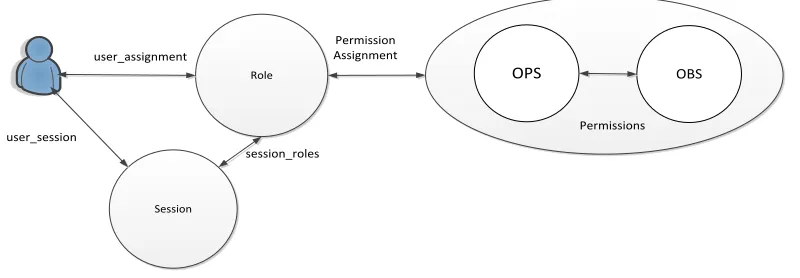
RBAC3 is complete model of RBAC, and it consists of both hierarchy and constraints. Figure 1.1 represents RBAC architecture.
Role
Session
session_roles user_session
user_assignment
Permission Assignment
OPS OBS
Permissions
Fig 1.1: RBAC Architecture (NIST solution)
5 User 1 IT Programmer User 2 IT Programmer User 3 IT Programmer SR. ADMIN ROLE JR. ADMIN ROLE TECH ROLE NOT NOT Sr. Admin Inherits Jr. Admin capabilities
Jr. Admin Inherits Tech capabilities
Fig 1.2: RBAC Hierarchal Structure (NIST solution)
Another benefit is the multiple roles which are associated with each other and provide better functionality to the users. RBAC3 constraints enforce separation of duties; it restricts the users to perform other tasks which are not in his job function. Figure 1.3 represents RBAC Separation of Duties (SoD).
Billing System Payment System Finance Billing Finance Payment User2 Finance User1 Finance NOT NOT
Fig 1.3: RBAC Separation of Duties (NIST solution)
In Figure 1.3, ‘NOT’ represents that both the roles cannot be activated at the same time by the same user.
6
RBAC3 provides all functionalities that a large organization requires, but implementation is complex due to its structure. Before implementing RBAC3, the organizational structure or roles must be well documented, otherwise, it can turn into a nightmare for an organization.
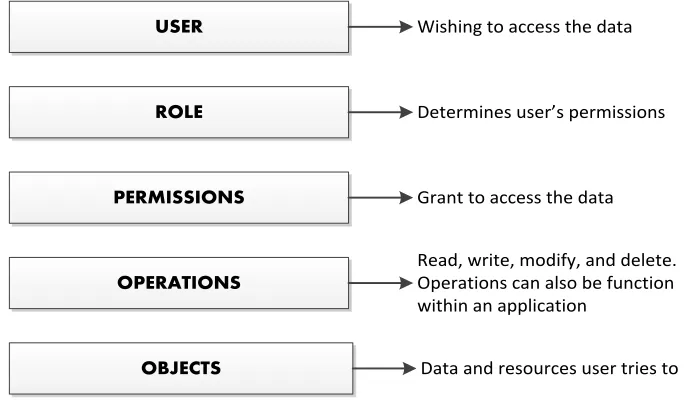
RBAC3 has five elements as represented in Figure 1.4; they are related to each other in order to create level of permissions and constraints.
USER
ROLE
PERMISSIONS
OPERATIONS
OBJECTS
Wishing to access the data
Determines user’s permissions
Grant to access the data
Read, write, modify, and delete. Operations can also be function within an application
Data and resources user tries to access
Fig 1.4: RBAC Elements (NIST solution)
1.2
- Materialized View
7
Master Site Master Site
Master Site Materialized
View Site
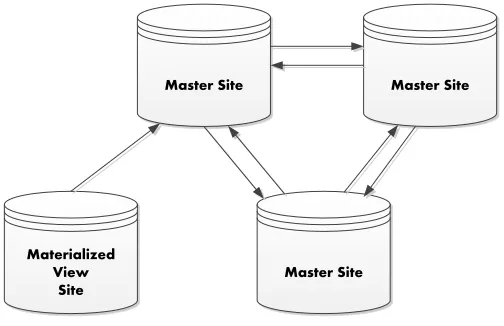
Fig 1.5: Materialized view site architecture http://docs.oracle.com
Materialized views can increase query execution performance in the following ways:
Pre-computed aggregations can be created to minimize expensive computations during query executions.
Tables can be pre-joined and resulting data can be stored in a materialized view.
Combinations of joins and aggregations can be stored for analysis purpose.
Application that benefits from the creation/deployment of the materialized views:
Decision Support Systems
Data Marts
Data Warehouses
Online Analytical Processing (OLAP)
Data Mining Workloads
A view is a temporary table that is created during run time, and discarded when the session is closed. A materialized view is a physical table that is stored in a database such as the traditional database tables. The creation process of the materialized view is different in each Database Management System (DBMS).
8
Oracle offers several different types of materialized views in order to meet the different replication situation.
a) Primary Key Materialized Views b) Object Materialized Views c) ROWID Materialized Views d) Complex Materialized Views
a. Primary Key Materialized Views
Primary Key Materialized Views are the default type materialized views. They are updatable and created as part of a materialized view group. The updatable materialized views must reside in a different database instead of the master replication group. Changes are occurred at row level as identified by the primary key value of the row.
b. Object Materialized Views
Object Materialized View is based on the object table and created using OF type clause. The structure is same as the object table and composed of row objects, and each row object is identified by the object identifier (OID) column.
c. ROWID Materialized Views
A ROWID materialized view is based on the physical row identifiers (rowids) of the rows in a master table. They are used with Oracle7 database.
d. Complex Materialized Views
There are certain restrictions which need to be observed during the creation of a materialized view, and if these restrictions are not followed then a materialized view is considered a complex materialized view, and it cannot be fast refreshed.
9
In open source database systems such as MySQL that doesn’t provide materialized view by itself. But it is easy to build materialized views manually or using some available APIs such as flexviews [28] which helps to create the materialized views and refresh them.
1.3
- Authorization View
Authorization view is a well-known database technique that provides a fine-grained access control [2][3][20]. It provides a way to restrict users to view only authorized data which is specified in the available authorization views for that particular user. Authorization views are logical tables that don’t contain any records. The structure of these views consists of the table name and the number of columns which are mentioned during the authorized view creation process.
There are different approaches to define an authorization view. Motro [15] proposed a model in which database access is specified in terms of views. According to the authors, “a set of views is defined, and each user is granted permission to access one or more views”. Users query the database and database system derives views of the request that are views of the views to which the user has access permission, and then presents the available views.
Motro [15] defines a view creation in following way:
view ELP (EMPLOYEE.NAME, EMPLOYEE.TITLE,
PROJECT.NUMBER, PROJECT.BUDGET)
where EMPLOYEE.NAME = ASSIGNMENT.E_NAME And PROJECT.NUMBER = ASSIGNMENT.P_NO
And PROJECT.BUDGET ≥ 250,000
10
parameterized views are like the normal views, but there are some additional parameters such as user-id, time and user-location appearing in its definition.
Rizvi et al. [20] defines a view creation in the following way:
create authorization view Co-studentGrades as
select Grades.*
from Grades, Registered
where Registered.student-id = $user-id
and Grades.course-id = Registered.course-id
Bahloul et al. [3] proposed an inference-based approach in order to control the access of Materialized Views. According to Bahloul et al. [3], their approach “facilitates the administration of access control rules to ensure the confidentiality of data at the level of materialized views”. The authors use authorization views to provide a fine-grained access control over the materialized views. In this approach, the authors propose the use of
Datalog as a formal framework for expressing the access control rules. Datalog is a declarative programming language that is syntactically a subset of Prolog. It is used as a query language for deductive databases. Datalog is more expressive than SQL; it can perform multi-database queries with a cleaner syntax, and it facilitates re-use of SQL code snippets for frequent joins and formulas. In recent years, Datalog is used for data integration, data extraction, cloud computing, data analysis, and security.
The authors [3] assume the existence of three types of symbols: variables, constants and predicate names. p(t1….tn) is a literal where p is a predicate name with arity n and each ti
for 1≤ i ≤ n is either a constant or a variable.
According to the authors, the logical sentence associated with the Datalog rule P(u) ← q1(u1),…,qn(un) is:
∀x1.. xn(p(u1) ← q1(u1) ^…^ qn(un)).
11
Info-Doc (Id-D, Dname, Dfname, Dspeciality) ←
doctor (Id-D, Dname, Dfname, Dadr, Dphone, Dspeciality,
Dsalary)
is a rule that defines the (intentional) Info-Doc relation in terms of the (extensional) doctor relation.
In the above example, the user is allowed to view doctor ID, last-name, first-name, and
specialty from the available materialized view.
1.4
- Query Rewriting
The problem of answering queries using the views has recently received a significant attention due to data management problems. In order to solve such problems, query rewriting algorithms has been introduced. These algorithms rewrite the user query using the defined authorization views which are associated with traditional database tables or materialized views. A query is rewritten to take best advantage of summaries, joins or aggregations of base table that are found in materialized views
There are several proposed query rewriting algorithms, we discuss Bucket algorithm [18] to understand the query rewriting process in the following paragraph.
Bucket algorithm creates subgoal g in the original query, and then each subgoal g
contains the views that include subgoals to which g can be mapped in a rewriting of the query. In second step, the algorithm consider conjunctive query rewriting, each consists of one conjunct from every bucket. The algorithm further checks whether it is contained or can be made to be contained with join predicates in the query. The result of the Bucket algorithm is the result of conjunctive query rewritings.
Example:
create authorization view MyGrades as
select * from Grades where student-id = $user-id
12
q: select avg(grade) from Grades
The system-modified query
qʹ: select avg(grade) from MyGrades
1.5
- Problem Statement
In distributed environment, materialized views can be used to replicate data at distributed sites. Materialized views provide local access to data instead of accessing data from remote sites.
In large organizations, materialized view site are created at remote destinations in order to reduce the network load and the load from the main database server. A user query is sent to the local materialized view database instead of main database server. Existing proposed techniques provide rule-based access control for materialized views; however, the administration of such systems is time consuming and cumbersome in a large environment where administrators define rules for each user to control the access to materialized views.
In order to control the access of materialized view, we need a framework which provides a fine-grained access control to materialized view using the authorization view [3], and provides a Role-Based access instead of defining policies for each user. In our thesis research, we identified the problem of assigning authorization views to roles instead of defining for each user. We also noticed that if our framework allows the users to activate multiple roles in same session with different permissions, then we need to provide a strategy to resolve role conflicts that occur if a user is gaining authorization for permissions associated with conflicting roles at the same time. In our thesis research, we have identified the following problems:
• How can we assign the authorization views to roles?
13
• How can we avoid role conflicts if user is gaining authorization for permissions associated with conflicting roles?
1.6
- Thesis Contribution
My contributions in this thesis are:
• A fine-grained access control framework to prevent unauthorized access of materialized views
• Users are assigned to roles, and users acquire permissions through authorization views
• Provides a column level restriction based on an assigned role
• Enforces constraints to avoid role conflicts
• The proposed framework can be implemented for materialized view sites in distributed environments and for data warehouses
1.7
- Organization of thesis
14
CHAPTER II
RELATED WORK
In this chapter, we will discuss about the approaches and models proposed to control the access of data. In first three sections, we discuss some existing access control models which are the extension of Role-Based Access Control (RBAC). In next three sections, we discuss the proposed techniques to build authorization views at the database level instead of specifying the authorization policies in the application code, which has numerous drawbacks. In the last section, we discuss recent papers [2][3] which introduce
Datalog based syntax to build the authorization views to control the access of materialized views.
2.1 - Context Based Access Control (CBAC)
RBAC grants access on the basis of the role regardless of the context of the request. In CBAC the request is granted by verifying the context of the request.
Toninelli et al. [22] propose a “Semantic Context-Aware Access Control Policy Model”. The authors state that they adopt a resource-centric approach to context modeling; contexts are associated with resources to be controlled and represent only those conditions that enable access to the resources. According to the authors, access control policies define for each context how to operate on the associated resource. The authors describe that the context consist of characterization information which is considered relevant for access control such as load, the entity operation on the resource, roles, identities and security credentials, and surrounding environment conditions, such as time, location, and other available resources.
15
the application is deployed and executed. A person's context is defined in terms of his/her current physical location, devices being used, network on which the devices are connected, and the activities in which the user is currently engaged.
Feng et al. [8] propose TCAC “A Trust and Context based Access Control Model for open and distributed systems”. According to the authors, role assignment is based on the trustworthiness and context information of the requestors. The authors state that if the trust value is not less than the set threshold value defined by the system policies, and the user context information satisfies the context constrains, the user is assigned a role and can perform the operations associated with assigned role. The authors state that context constraints which are considered in their model such as time and location of the user.
2.2 - Attribute Based Access Control (ABAC)
In ABAC, data access is granted on the basis of three attributes: Subject Attributes, Resource Attributes, and Environment Attributes.
Cruz et al. [5] propose “A Location Aware Role and Attribute Based Access Control System” by extending the role-based access control (RBAC) model for the dynamic association of roles with users. The authors state that in their framework privileges associated with resources are assigned depending on the attribute values of the resources, attribute values associated with the users determine the association of users with privileges, and a location mapping function between physical and logical locations allows to enable/disable roles depending on the logical location of the users and thus preserve the privacy of the location. The authors define their Access Model in which constraints can be defined on the attribute values of resources or users.
16
represented by OWL class hierarchies, member get more privileges as one moves up the hierarchy, while in class hierarchies, classes get more attributes as user move down. The authors state that access constraints are based on general attributes of an action, including constraints on its subject and object. The authors further state that this provides general support to a more general model of attribute-based access control.
2.3 - XML Based Access Control
EXtensible Access Control Markup Language (XACML) is one of the well know XML formats for Access control. XACML is a general purpose access control policy language, and it provides syntax to enforce access control policies which help in managing authorization decisions. The policies defined by XACML decide whether to authorize access to data and at what extend. In addition, it provides an architecture that supports the services with the help of two enforcement entities or modules: Policy Enforcement Point (PEP) and Policy Decision Point (PDP).
17
Fig 2.1: XACML data flow (http://www.informit.com)
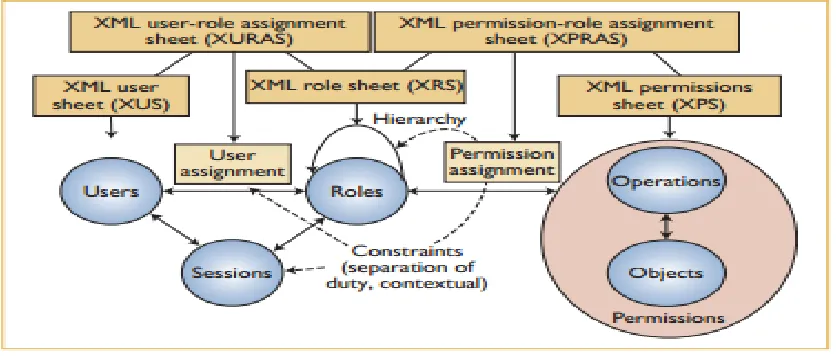
Joshi et al. [10] propose a framework X-RBAC “an XML-based access control policy specification language” that extends NIST RBAC, and it provides a framework for specifying mediation policies in a multi-domain environment and extends RBAC with temporal constraints, role attributes, contextual conditions, a notion of role states, and preconditions of state transitions. According to the authors, X-RBAC provides a wide range of protection granularity for protected data and supports policy mapping in multi-domain environments. Figure 2.2 represents X-RBAC model.
18
2.4 - Access Authorization for Relational Database
Motro [15] proposed a model for relational database. According to author, “in this model access permissions are a form of database knowledge, from which access permissions that apply to specific requests are inferred”. There are three basic principles of this model:
1) Database access is specified in terms of views: a set of authorization views are defined in order to control the access of data, and each user is granted permissions based on the available views.
2) A user queries sends to the actual database, not at any particular view.
3) When the request is sent to the database system, the system checks the available views of the request that could be the views of views which the user has access permissions.
According to the author, the model represents the definition of views in special “meta-relations”, and extents algebraic operators to these relations.
Example of the authorization process of the proposed model,
Assume a user sends a request to retrieve the names and sponsors of large projects:
retrieve(PROJECT.NUMBER, PROJECT.SPONSOR)
where PROJECT.BUDGET ≥ 250,000
Implementation of the above query with the following sequence of algebraic operations:
1. A ← ϭ(BUDGET ≥ 250,000)(PROJECT)
2. A ← ΠNUMBER,SPONSOR(A)
PROJECTʹ includes only tuples of views that Brown is authorized to access as defined in the following relation:
PROJECTʹ
VIEW NUMBER SPONSOR BUDGET
19
Now the same operations that are applied to the database relations are applied to their meta-relation:
1. Aʹ ← ϭ(BUDGET ≥ 250,000)(PROJECTʹ )
2. Aʹ ← ΠNUMBER,SPONSOR(Aʹ )
The selection retains only those view tuple which are unmodified, and the final projection is:
Aʹ
NUMBER SPONSOR
* Acme*
The above mask indicates that the user is restricted to projects sponsored by Acme, and following view definition will inform the user that permission exists only for SPONSOR = Acme.
permit (NUMBER, SPONSOR)
where SPONSOR = Acme
2.5 - Fine-grained Authorization Policies
Rizvi et al. [20] proposed a fine-grained access control model based on authorization views that allow “authorization-transparent” querying in which queries can be written against the database relation without referring to the authorization views. According to the authors, in their approach user queries can be written in terms of database relation, and the query is valid only if it can be answered using the available authorization views. The authors state that they have introduced a new notion of validity and conditional validity check in their proposed framework.
According to the authors, their model is based on six key features as follows:
20
authorization view is like the normal view, but there are some additional parameters such as user-id, time and user-location appearing in its definition.
create authorization view MyGrades as
Select * from Grades where student-id = $user-id
2. Queries can be written in an authorization-transparent manner against the database relations without having referred to the authorization views.
3. A query q is unconditionally valid if there is an equivalent query qʹ and both the queries give the same result of all database states.
4. Certain queries can be answered using the available set of authorization views, even if they cannot be rewritten using the views.
5. Conditionally valid queries that can be answered using the information contained in a set of authorization views in a given database state.
6. Set of powerful inference rules which check the unconditional and conditional validity of queries.
2.6 - Authorization Views and Conditional Query Containment
Zhang et al. [25] proposed an algorithm that tests conditional containment of conjunctive queries respect to a set of materialized conjunctive views. According the authors, they
identified the problem of ∏ .The authors state that based on their algorithm, they test if the query is conditionally authorized given a set of materialized authorization views.
According to the authors, they adopt the definition of Rizvi et al. [20]: a query is conditionally valid to a set of views V and a set of materialized views MV for all database states where the values of the views V agree with MV, q agrees with qʹ.
The authors define the conditionally contained query, conditionally empty query, and conditionally authorized query in the following definitions:
Definition 1 - For any two queries Q1 and Q2,
21
denoted by Q1⊆V, MV Q2, if for every d in D, Q1(d) ⊆Q2(d).
Q1 is said to be conditionally equivalent to Q2 with respect to V and MV, denoted by Q1≡V, MV Q2, if Q1⊆V, MV Q2 and Q2⊆V, MV Q1.
Definition 2 - A query Q is conditionally empty with respect to V and MV if Q(d) us empty for every d in D.
Zhang et al. [25] states that their approach first initiates the parameterized views by extracting the parameter values associated with the user and the session, before declaring whether a query should be conditionally authorized
Definition 3 - A query Q is conditionally authorized with respect to authorization views V and materialized views MV, if there is a query Qr, that is written using only the views
in V, and that is conditionally equivalent to Q.
2.7 - Access Control to Materialized Views
22 Authorization views on DB
Authorization views on MVs
DB
MVs
Inference
Views Definition
Query Evaluation Query
Fig 2.3: Authorization policies for materialized views ( Bahloul et al. [2])
The authors propose the use of Datalog syntax for defining the access control rules. The authors assume the existence of three types of symbols: variables, constants and predicate names. p(t1….tn) is a literal where p is a predicate name with arity n and each ti for 1≤ i ≤
n is either a constant or a variable.
According to the authors, the logical sentence associated with the Datalog rule P(u) ← q1(u1),…,qn(un) is:
∀x1..xn(p(u1) ← q1(u1) ^…^ qn(un)).
Bahloul et al. [3] states that the relations defined by deductive rules are called intentional relations. For example,
Info-Doc (Id-D, Dname, Dfname, Dspeciality) ←
doctor (Id-D, Dname, Dfname, Dadr, Dphone, Dspeciality,
Dsalary)
is a rule that defines the (intentional) Info-Doc relation in terms of the (extensional) doctor relation.
23
Hospital database:
doctor (IdD, Dname, Dfname, Dadr, Dphone, Dspecialty, Dsalary).
nurse (IdI, Snum, Nname, Nfname, Nadr, Nphone, Nsalary).
Authorization views:
av1 (IdD, Dname, Dfname, Dspecialty) ← doctor (IdD, Dname, Dfname, Dadr, Dphone, Dspecialty, Dsalary)
av2(IdI, Snum, Nname, Nfname) ← nurse (IdI, Snum, Nname, Nfname, Nadr, Nphone, Nsalary)
In order to determine what data are accessible for each intentional relation mv in MV, the first step is authorization view selection. According to the authors, they utilize a query rewriting technique build on the Bucket algorithm that rewrites user query based on the available authorization views.
The authors state that they modified the original Bucket algorithm [18] as if they utilize the original algorithm then the authorization view will be considered irrelevant. For example, (1) shown below is a materialized view definition. The authorization view (2) defines the tuples x, y which a user has right to access.
mv(x,y,z) ← r(x,y,z)(1)
av(x,y) ← r(x,y,z)(2)
In the original Bucket algorithm, the attribute ‘z’ appears in the sub-goal of the query and also in the head of the query, then it must also be in the head of the view. According to the authors, it is too strict as one can project out ‘z’ by generating the appropriate authorization view on mv.
24
2.8 - Comparison of Various Research Works
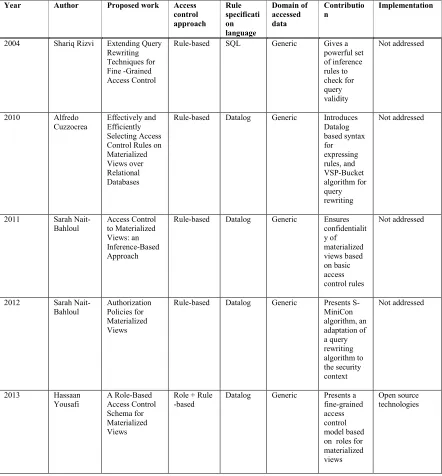
Year Author Proposed work Access control approach Rule specificati on language Domain of accessed data Contributio n Implementation
2004 Shariq Rizvi Extending Query Rewriting Techniques for Fine -Grained Access Control
Rule-based SQL Generic Gives a powerful set of inference rules to check for query validity Not addressed
2010 Alfredo Cuzzocrea
Effectively and Efficiently Selecting Access Control Rules on Materialized Views over Relational Databases
Rule-based Datalog Generic Introduces Datalog based syntax for expressing rules, and VSP-Bucket algorithm for query rewriting Not addressed
2011 Sarah Nait-Bahloul Access Control to Materialized Views: an Inference-Based Approach
Rule-based Datalog Generic Ensures confidentialit y of materialized views based on basic access control rules Not addressed
2012 Sarah Nait-Bahloul
Authorization Policies for Materialized Views
Rule-based Datalog Generic Presents S-MiniCon algorithm, an adaptation of a query rewriting algorithm to the security context Not addressed
2013 Hassaan Yousafi A Role-Based Access Control Schema for Materialized Views
Role + Rule -based
Datalog Generic Presents a fine-grained access control model based on roles for materialized views
Open source technologies
25
CHAPTER III
PROPOSED FRAMEWORK
In this chapter, we present the details of our proposed framework “A Role-Based Access Control Schema for Materialized Views”. We present an architecture that enables organizations to define and manage data access control authorizations for materialized views based on roles. This thesis introduces a role-based access control schema for materialized views in which rules are associated with roles, a column level restriction is imposed on a materialized view based on a user assigned role, and a role conflicting strategy is defined if the user is gaining authorization for permissions associated with conflicting roles. In this proposed framework, we focus on open source Database Management Systems such as MySQL and PostgreSQL as the open source databases don’t provide any automated process to enforce authorizations on Materialized Views. The proposed framework can also be applied to other relation databases as authorization views are defined by keeping in view the structure of materialized view tables defined in relational databases.
3.1 - Data Access Control to Materialized Views
26
In this thesis, we extend the earlier work proposed by Bahloul et al. [3] that defines authorization policies in Datalog as a formal framework for expressing the access control rules (Abiteboul et al. [1]). In this thesis research, we define the authorization policies for roles instead of defining these policies for individuals. In second chapter, we discuss the details of related works which defines data authorization policies at the database level such as parameterized authorization views (Rizvi et al. [20]), and we have also discussed the recent work of Bahloul et al. [3] that defines authorization views in Datalog syntax.
3.2 - Proposed Role-Based Framework
The proposed architecture presents a new approach to define data access control authorizations for Materialized Views. We have identified the administrative problems of defining and modifying the data access control rules for materialized views in large organizations where thousands of employees perform their duties. Existing proposed techniques provide rule-based access control for materialized views; however, the administration of such systems is time consuming and cumbersome in a large environment where administrators define rules for each user to control the access to materialized views.
In our approach, we utilize the existing Role-Based Access Control (RBAC) [24] model that is proposed by National Institute of Standards and Technology (NIST) in 1992. The RBAC model is currently the widely used model among all other existing models due to its dynamic nature and ease of administration.
In RBAC, the access to organizational resources is granted on the bases of the user assigned role. When a role is assigned to a user, all the privileges associated with that role are also granted to the user. In the first chapter, we have discussed RBAC in detail.
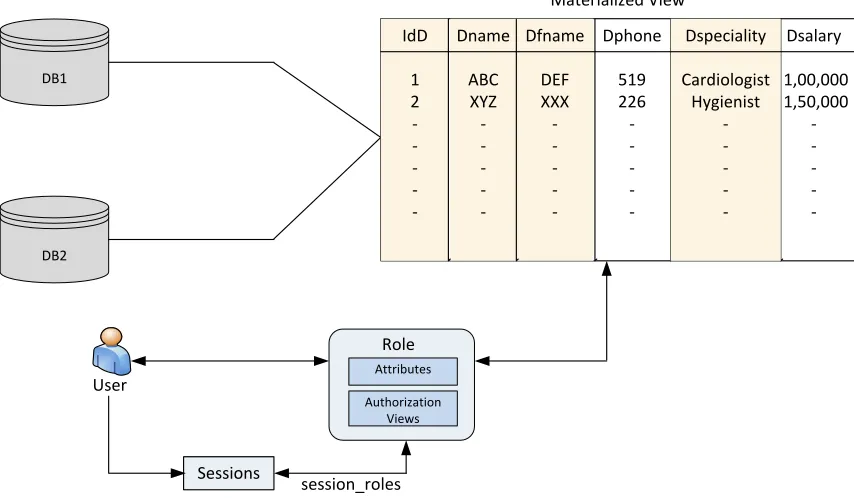
27 DB1 DB2 IdD 1 2 -Dname ABC XYZ -Dfname DEF XXX -Dphone 519 226 -Dspeciality Cardiologist Hygienist -Dsalary 1,00,000 1,50,000 -Materialized View Authorization Views Role Attributes User Sessions session_roles
Fig 3.1: Proposed RBAC Architecture for Materialized Views
In figure 3.1, a materialized view is created by joining two tables from two different databases, and the view is deployed in a local database on a distributed site. As the proposed architecture depicts, the authorization views are associated with user assigned role, and the user profile attributes are extracted during the role assignment process. These attributes are extracted from database table where user profile attributes such as
username, department name, userrole, and other attributes are stored. The attributes are used for authentication and role assignment.
In our proposed framework, we also maintain the session_roles, as we have noticed during our thesis research that a user can be assigned multiple roles such as a Project Manager can also work as a Programmer same time. So keeping in view the multiple role assignment, we allow a user to open multiple session_roles. We provide the detail of the
session_roles in section 3.2.3.
28
3.2.1 - Role Assignment
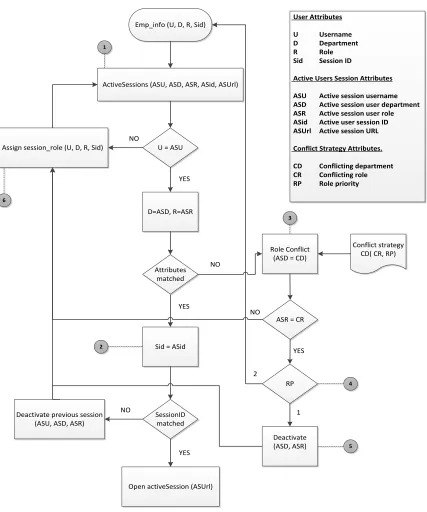
The Role Assignment process starts after the authentication process, if the user credentials such as Username and Password are valid then the process proceeds further. Figure 3.2 represents the work flow of role assignment process.
Emp_info (U, D, R, Sid)
U = ASU
ActiveSessions (ASU, ASD, ASR, ASid, ASUrl)
Role Conflict (ASD = CD)
ASR = CR
Open activeSession (ASUrl)
Conflict strategy CD( CR, RP)
Deactivate (ASD, ASR) D=ASD, R=ASR
Attributes matched
Sid = ASid Assign session_role (U, D, R, Sid)
NO YES NO YES 1 2 SessionID matched NO YES RP NO YES
Deactivate previous session (ASU, ASD, ASR)
User Attributes
U Username
D Department
R Role
Sid Session ID
Active Users Session Attributes
ASU Active session username ASD Active session user department ASR Active session user role ASid Active user session ID ASUrl Active session URL
Conflict Strategy Attributes.
CD Conflicting department CR Conflicting role RP Role priority 1 2 3 4 5 6
29
Once the user credentials are verified then the process checks the already active sessions. Active Session is a table where all active user sessions’ information is stored.
We describe the above workflow in the following six steps as represented in figure 3.2:
1. The process checks if the user information already exists in the active_session
table. If the user information doesn’t exist in the active_session table then the user information (i.e. username, department, and role) that is extracted from database based on user credentials (i.e. username, password) is sent to role assignment module where the role is assigned to the user. Otherwise, if the user session information exists then the user attributes are matched with the already existing user session attributes. If the attributes are matched with one of already active sessions then it is considered that the user is already an active user with the same role.
2. If the user is already an active user, then the user session ID is checked, if the session ID is matched with active role session ID then the user is redirected to the same session, otherwise, if the session ID is different, the process deactivates already active session and proceeds to the role assignment process.
3. If the user session attributes are not matched with already active user session except the username as described in step 1, then it is considered that the user is an active user with a different role. In this case, role conflict is checked by extracting the attributes defined in role conflict strategy with already active user sessions’ attributes.
30
5. After deactivating the conflicting session_role, the user can proceed to role assignment process as represented in figure 3.2.
6. If the role conflict doesn’t exist as described in step 4, then the user is assigned a role that is based on user credentials.
3.2.2 - Role-Based Authorizations
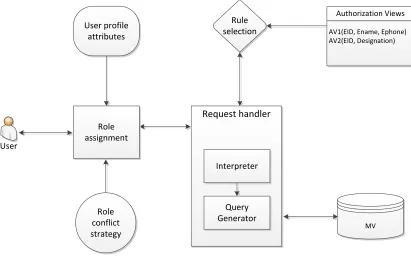
In our proposed framework, the authorization to access a materialized view is based on user role. Figure 3.3 represents Role-Based Authorization architecture.
Request handler
Role conflict strategy
Authorization Views
AV1(EID, Ename, Ephone) AV2(EID, Designation)
User profile attributes
Role assignment
Rule selection
Interpreter
Query Generator User
MV
Fig 3.3: Architecture of Role-Based Authorization
31
Example:
Once a user is assigned a role after going through the Role Assignment process as discussed in previous section, the user query is sent to the Request Handler.
The Request Handler sends the materialized view name as mentioned in the user query to the Rule Selection module.
The Rule Selection module searches for the given materialize view name in the associated authorization views file of user assigned role. If the materialized view name is found in the list of authorized views, the Rule Selection process extracts the authorized view information and returns it to the Request Handler.
The Request Handler sends the authorized view to the Interpreter.
The Interpreter extracts the column names from the given authorized view and sends it to the Query Generator.
The Query Generator module generates the query on the basis of the provided column names and materialized view name, and returns it to the Request Handler.
The Request Handler further sends the query to database system and returns the results to user.
We use an existing approach to define authorization views proposed by Bahloul et al. [3]. In the following example, the authors define the authorization views to control the access of hospital database.
Example:
Hospital database:
doctor (IdD, Dname, Dfname, Dadr, Dphone, Dspecialty, Dsalary).
32
Authorization views:
av1 (IdD, Dname, Dfname, Dspecialty) ← doctor (IdD, Dname, Dfname, Dadr, Dphone, Dspecialty, Dsalary)
av2(IdI, Snum, Nname, Nfname) ← nurse (IdI, Snum, Nname, Nfname, Nadr, Nphone, Nsalary)
In the above example, there are two parts of authorization view. The left hand side defines the body of an authorization view, and the right hand side defines a complete definition of a materialized view from which an authorization view is derived. The body of an authorization view is used to define the authorizations for a particular user. In our proposed framework, we define the authorization views for roles as represented in figure 3.4.
User
Authorization Views
AV1(EID, Ename, Ephone) AV2(EID, Designation)
Role
Fig 3.4: Role and Authorization Views
3.2.3 - Session Roles
In our proposed framework, we use Role-Based Access Control (RBAC) model proposed by NIST. RBAC is used by majority of organizations due to its dynamic nature and ease of administration. Three primary rules are defined for RBAC:
1. Role assignment: A user can access the resources only if he/she has selected or been assigned a role.
2. Role authorization: User active role must be authorized to the user.
3. Permission authorization: A user can access the resources only if the permission is authorized to the user’s active role.
RBAC specifications:
33
Permission Assignment = PA ⊆ PREMS X ROLES, a many-to-many mapping permission to role assignment relation.
session_users (s: SESSIONS)→ USERS, the mapping of session s onto the corresponding user.
session_roles (s: SESSIONS) → 2ROLES, the mapping of session s onto a set of roles.
A user may open multiple simultaneous sessions with different roles and permissions. In our proposed framework, we follow the above rules and also allow user to open multiple simultaneous sessions. A user can open multiple sessions with different role, and each concurrent session authorizes a user to access the views based on an assigned role. Each session extracts user attributes (i.e. username, department, and role) that are passed through a generic URL to the Request Handler after Role Assignment. When a user sends a query, the Request Handler extracts the attributes and authorizes the user to view the records of a requested materialized view based on the available authorization view that is defined in authorized views file associated with user role within a particular department.
3.2.4 - Role Conflicts
In previous section, we discuss multiple simultaneous sessions which allow users to open multiple sessions with different roles and permissions. But we also need to restrict users to avoid role conflicts. Role conflict defines that no individual can assume the power of two or more conflicting roles at the same time. Role conflicts occur when individuals have various conflicting responsibilities
RBAC introduces Separation of Duties (SoD) that restricts users to perform duties in confliction roles at the same time by enforcing the constraints.
34
In our proposed framework, we introduce Conflict Strategies which are associated with user role same as the authorization views to avoid any role conflict. In our proposed conflict strategy, we introduce role priority.
If a role conflict occurs during the role assignment process, the system checks the priority of the role that is defined in the conflict strategy by the administrator. We describe the conflict strategy as follows.
After identifying the role conflict between two roles, the conflict strategy is defined in the following manner.
Department (Role, Priority)
The conflict strategy is defined in a text file associated with each role. During the Role Assignment process as we discuss in previous section. The Request Handler checks already activated session_roles of the same user with different roles. It extracts the attributes of the active session_roles one by one, and matches with the attributes defined in conflict strategy (i.e. department, role). If the attributes are matched then it is considered a role conflict. In this case, the Request Handler checks for the role priority defined in the conflict strategy. If the priority is ‘1’ then the system activates the new
session_role and deactivates the previous session. If the priority is ‘2’ then the system sends a notification with the conflicting role attributes, and the user can activate the new
session_role after deactivating the already active session_role.
In the following example, we define conflict strategies for Finance Billing and Finance Paying roles which belong to Finance department.
Username: Facello Department: Finance Role: Finance Billing
Username: Facello Department: Finance Role: Finance Paying
Finance (Finance Paying, 1)
Finance (Finance Billing, 2)
35
36
CHAPTER IV
IMPLEMENTATION AND VERIFICATION
4.1 - Background
The main objective of this thesis research is to provide architecture to control the access of Materialized Views based on user roles. The case study is built on top of research done at the University of Windsor (Kent et al. [11] and Kobti et al. [12]) towards the creation of automated tools to conduct healthcare surveys, decision support system, and real-time data management system. In this research work, we identified the need of securing sensitive healthcare data. In our proposed framework, we present a Role-Based Access Control architecture in which authorizations are associated with user roles. Moreover, we introduce a mechanism to resolve role conflicts by defining role priorities in role conflict strategies which are also associated with user role same as authorization views.
4.2 - Implementation
In previous chapter, we discuss the steps involved in authentication, role assignment, and user authorizations in our proposed framework. In this section, we provide the details of implementation of our proposed framework.
Request handler
Role conflict strategy
Authorization Views
AV1(EID, Ename, Ephone) AV2(EID, Designation) User profile
attributes
Role assignment
Rule selection
Interpreter
Query Generator User
MV
37
In the proposed framework, we focus on open source Database Management Systems (DBMS) as the open source DBMS doesn’t provide any automated process to regulate the access of Materialized Views. In the implementation of our proposed framework, we use MySQL database, the internal structure of our application is developed in PHP, and the User Interface (UI) is developed in HTML and CSS.
4.2.1 - Role Assignment Module
Role Assignment is a process to assign a role to the user based on the credentials that a user provides during the authentication process. Before a role is assigned, a user has to pass few checks in order to avoid any role conflicts and duplication of session_roles. In previous chapter, we explain a complete workflow of Role Assignment module. In this section we provide pseudo code of this module.
Role Assignment Module
CHECK if the user is already an active user IF user exists in Actives_Sessions
EXTRACT user Active_Sessions attributes
IF user attributes match with any Active_Sessions CHECK for SessionID
IF SessionID match with current user SessionID REDIRECT user to same Session_Role ELSE
Deactivate ActiveSession role Activate new Session_Role BREAK
CHECK Role Conflict with existing Session_Roles in ActiveSessions
EXTRACT attributes of ActiveSessions EXTRACT Conflict_Strategy of current role
IF any of ActiveSessions role match with role defined in Conflict_Strategy for current user CHECK for the role priority defined in Conflict_Strategy
IF Priority is 1
Deactivate ActiveSession role Activate current role
IF Priority is 2
Send an alert with conflicting role information BREAK
38
4.2.1.1 - Active Sessions
In Active Sessions table, we store user information (i.e. username, role, department, sessionID, and session URL) whenever a user login to the system. The information available in this table is extracted during the role assignment process in order to match user active roles and current role attributes to avoid any role conflict and duplication of
session_roles. The session ID is stored in order to prevent a user to activate multiple sessions for same session_role from different system. A user cannot open a session_role
from two different session IDs at the same time. If a user tries to activate a session_role
which is already in active session list then the system deactivates the existing
session_role, and creates a new entry in active sessions with new Session ID. In this way, we can track user’s activities.
We extract user’s active session’s information by calling activeSession function.
Active Sessions
function activeSession (username) {
EXTRACT username, role, department, session_id, url from active_sessions WHERE username == username
IF found
Store user ActiveSessions attributes in an ARRAY Return ARRAY
ELSE
Return NULL }
Fig 4.3: Active Sessions pseudo code
4.2.2 - Request Handler Module
39
request, otherwise, it deactivates user session_role and redirects the user to the login page. The Request Handler operates by the following steps:
1. The Request Handler receives a user query, extracts the requested Materialized View name from the query, and sends it to the View Selection module.
2. The View Selection module search for the requested Materialized View name in Authorization Views file that is associated with the user’s role.
3. The View Selection module returns the Authorization View information to the Request Handler.
4. The Request Handler sends the authorized view information to the Interpreter. 5. The Interpreter extracts authorized column names from the authorization view and
sends it to the Request Handler.
6. The Request Handler sends the view name and the authorized columns name to the Query Generator.
7. The Query Generator generates the query in SQL based on the provided information from the Request Handler, and sends the query to a database.
8. The Request Handler receives the records from the Query Generator, and returns it to the user.
4.2.2.1 - View Selection
40
View Selection
function ViewSelection (MaterializedView Name, Department Name, Role) {
Path to user Auhtorization Views file = "AuthorizationViews/department_name/role" LOOP Search for MaterializedView in defined Authorization Views
IF found
Store AuthorizationView body information in an ARRAY Return AuthorizationView
ELSE
Return NULL }
Fig 4.4: View Selection pseudo code
4.2.2.2 - Interpreter
The Interpreter translates an Authorization View in SQL syntax. The Request Handler sends authorization view information that is returned by the View Selection module to the Interpreter. The authorization view is received in the following format.
av1(emp_no, first_name, last_name)
The Interpreter removes the view name and the brackets that contain authorized column names from the given Authorization View, and returns the column names to the Request Handler in order to send it to the Query Generation module.
emp_no, first_name, last_name
4.2.2.3 - Query Generation
41
View Selection
Request Handler
User
MV Name
MV Name MV(emp_no, last_name, first_name)
Interpreter
MV(emp_no, last_name, first_name)
emp_no, last_name, first_name
Query Generator
MV Name
emp_no, last_name, first_name SELECT emp_no, last_name, first_name from MV_Name
Step 1
Ste
p 2
Step 3
Fig 4.5: Query Construction
In figure 4.5, the Query Generation module receives the materialized view name and column names from the Request Handler. The materialized view name and column names are assigned to the dynamic variables which are declared in Request Handler. The Request Handler passes the variables to Query Generator in order to construct a complete query. SQL SELECT and FROM clause is statically defined in query syntax and the dynamic variables are placed for column names and a view name. There are some other clauses that are used in SQL SELECT statement such as WHERE, GROUP BY, ORDER BY, and LIMIT which can be defined by the user through the options available in the user interface. The values of these additional SELECT clauses are also assigned to dynamic variables which are declared in Request Handler, and the Request Handler passes these values to the Query Generator along with MV name and column names.
4.3 - Verification
42
section where we define steps that each module performs. In this section, we examine our application that we have developed to test and verify our proposed approach.
4.3.1 - Basic Requirements
The verification of basic requirements is to test the core elements of the application. In our thesis research, we are focused on providing architecture to authorize users to access the data based on their role. The Role Assignment process starts after the authentication process. A user needs to provide a valid username and password for authentication. Figure 4.6 represents login page.
Fig 4.6: Login page
43
Fig 4.7: Homepage
Username, department, and the role of the user appear on the top right of the header section as in figure 4.7. There is a logout button available that deactivates user session and redirects user to the login page. The left panel down to the header is used to place Query Generator. A user can generate a query using the features available in Query Generator. There is a dropdown list available to select a materialized view. This dropdown list contains only those authorized views which are defined in authorization view file that is associated with user assigned role. There are some check boxes which are used to enable and disable additional SQL statement clauses, and ‘Display None’ feature is used for analysis purposes.
44
Fig 4.8: Simple query execution and results
In figure 4.8, user Facello selects a view emp_info from the dropdown list of views and executes the query without adding any additional clauses. The system returns only those columns information which the user authorized to view as defined for users’ assigned role in its associated authorization views file as below.
Fig 4.9: Authorization Views
In figure 4.9, the complete view definition is defined at the right side that contains six columns, but the user is not authorized to view the information of two columns (i.e.
birth_date and hire_date) as defined at the left side. In Fig 4.8, the system returns the results based on the defined authorization view.
45
roles as the conflicting roles cannot be activated at the same time by same user. In our proposed framework, we assign priorities to conflicting roles. The conflict strategy is associated with roles same as the authorization views.
In chapter 3, we discuss role conflicts in detail with an example. In order to validate this requirement, we define role conflict strategy for ‘Finance Paying’ and ‘Finance Billing’ role in Finance department, and we assign both the roles to same user. The strategies are defined in following manner.
Fig 4.10: Conflict Strategy
In figure 4.10, a conflict strategy is defined for ‘Finance Billing’ and ‘Finance Paying’ roles in their associated role files as both the roles cannot be activated at the same time. The ‘Finance Billing’ role is given first priority and ‘Finance Paying’ role is at second priority. The user activates ‘Finance Billing’ role and at the same time the user wants to activate ‘Finance Paying’ role. As the ‘Finance Billing’ role is given first priority, therefore, the user gets the following message during the role assignment process and redirected to the Login page as represented in figure 4.11.

![Fig 2.3: Authorization policies for materialized views ( Bahloul et al. [2])](https://thumb-us.123doks.com/thumbv2/123dok_us/1426691.1175168/34.612.112.542.70.250/fig-authorization-policies-materialized-views-bahloul-et-al.webp)