University of Windsor University of Windsor
Scholarship at UWindsor
Scholarship at UWindsor
Electronic Theses and Dissertations Theses, Dissertations, and Major Papers
9-19-2019
Rape Acknowledgement in the Context of the #MeToo Movement
Rape Acknowledgement in the Context of the #MeToo Movement
Brandin Glos University of Windsor
Follow this and additional works at: https://scholar.uwindsor.ca/etd
Recommended Citation Recommended Citation
Glos, Brandin, "Rape Acknowledgement in the Context of the #MeToo Movement" (2019). Electronic Theses and Dissertations. 7809.
https://scholar.uwindsor.ca/etd/7809
This online database contains the full-text of PhD dissertations and Masters’ theses of University of Windsor students from 1954 forward. These documents are made available for personal study and research purposes only, in accordance with the Canadian Copyright Act and the Creative Commons license—CC BY-NC-ND (Attribution, Non-Commercial, No Derivative Works). Under this license, works must always be attributed to the copyright holder (original author), cannot be used for any commercial purposes, and may not be altered. Any other use would require the permission of the copyright holder. Students may inquire about withdrawing their dissertation and/or thesis from this database. For additional inquiries, please contact the repository administrator via email
Rape Acknowledgement in the Context of the #MeToo Movement
By
Brandin Glos
A Thesis
Submitted to the Faculty of Graduate Studies through the Department of Psychology in Partial Fulfillment of the Requirements for
the Degree of Master of Arts at the University of Windsor
Windsor, Ontario, Canada
2019
Rape Acknowledgement in the Context of the #MeToo Movement
by
Brandin Glos
APPROVED BY:
______________________________________________ J. Grant
School of Social Work
______________________________________________ C. Thomas
Department of Psychology
______________________________________________ P. Timmons Fritz, Advisor
Department Psychology
iii
DECLARATION OF ORIGINALITY
I hereby certify that I am the sole author of this thesis and that no part of this thesis has
been published or submitted for publication.
I certify that, to the best of my knowledge, my thesis does not infringe upon anyone’s
copyright nor violate any proprietary rights and that any ideas, techniques, quotations, or any other
material from the work of other people included in my thesis, published or otherwise, are fully
acknowledged in accordance with the standard referencing practices. Furthermore, to the extent
that I have included copyrighted material that surpasses the bounds of fair dealing within the
meaning of the Canada Copyright Act, I certify that I have obtained a written permission from the
copyright owner(s) to include such material(s) in my thesis and have included copies of such
copyright clearances to my Appendix.
I declare that this is a true copy of my thesis, including any final revisions, as approved by
my thesis committee and the Graduate Studies office, and that this thesis has not been submitted
iv
ABSTRACT
Sexual violence perpetrated by men against women is a pervasive social issue that affects
women around the world. Sexual violence has taken place in what has been termed “rape culture,”
or a culture in which sexual violence is normalized, minimized, or tacitly condoned. In October
2017, #MeToo gained global attention when numerous women began sharing experiences of male
perpetrated sexual violence via social media. The recent attention given to issues of sexual
violence has included little discussion about the issues facing women who have not acknowledged,
or women who report male perpetrated coercive experiences that fall within the legal definition of
rape, but who do not identify a perpetrator’s actions as “rape” or “sexual assault.” The present
study recruited women ages 18 years and older who reported an experience meeting the legal
definition of rape or sexual assault but who did not identify with those labels. This study used
qualitative methods to explore the impact of #MeToo from the perspective of women who have
not acknowledged. Themes derived in the present study suggested that #MeToo raised
participants’ awareness that unwanted and/or coercive sexual experiences are “not unique” and
that survivors are “not alone,” encouraged openness about survivors’ experiences, and validated
that these experiences are problematic. Contradictions were also found across participants’
writing. Overall, #MeToo was described as having a positive emotional impact for women
participating in this study without necessarily changing their own ambivalence or the external
v
TABLE OF CONTENTS
DECLARATION OF ORIGINALITY ... iii
ABSTRACT ... iv
LIST OF TABLES ... vii
LIST OF FIGURES ... viii
LIST OF APPENDICES ... ix
CHAPTER 1 INTRODUCTION ... 1
Rape Acknowledgement Research ... 4
The #MeToo Movement ... 9
Rape Culture ... 10
Rape Scripts ... 14
Narrative Development and Construction of Meaning ... 17
Current Study ... 21
CHAPTER 2 METHODS ... 22
Participants ... 22
Recruitment for Part 1 ... 23
Participant Pool Recruitment ... 23
University of Windsor Mass Email Recruitment ... 24
University of Windsor Department Secretary Email Requests ... 24
Kjiji Advertisement ... 24
Screening (Part 1) Sample Description ... 25
Recruitment for Part 2 ... 25
Procedure ... 27
Procedure for Part 1 ... 27
Procedure for Part 2 ... 28
Measures ... 29
Demographics Information ... 29
Modified Sexual Experiences Survey ... 30
Mood Neutralizing Items ... 31
Qualitative Questionairre ... 31
Data Analysis ... 33
CHAPTER 3 RESULTS ... 35
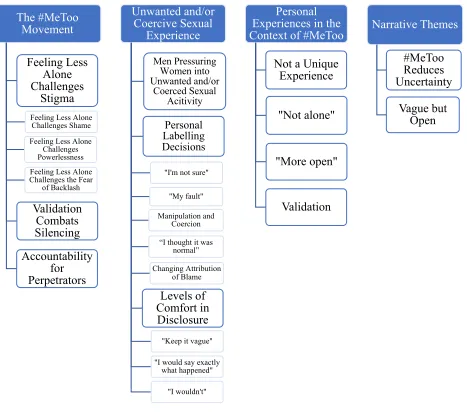
The #MeToo Movement ... 35
Feeling Less Alone Challenges Stigma ... 36
Feeling Less Alone Challenges Shame ... 36
Feeling Less Alone Challenges Powerlessness ... 37
Feeling Less Alone Challenges the Fear of Backlash ... 39
Validation Combats Silencing ... 39
Accountability for Perpetrators ... 41
Unwanted and/or Coercive Sexual Experience ... 41
Men Pressuring Women into unwanted and/or Coerced Sexual Activity ... 42
vi
"I'm not sure" ... 43
"My fault" ... 44
Manipulaiton and Coercion ... 46
"I thought it was normal" ... 46
Changing Attribution of Blame ... 47
Levels of Comofort in Disclosure ... 49
"Keep it vague" ... 49
"I would say exactly what happened" ... 50
"I wouldn't" ... 50
Personal Experience in the Context of #MeToo ... 51
Not a Unique Experience ... 51
"Not alone" ... 52
"More open" ... 53
Validation ... 54
Narrative Themes ... 56
#MeToo Reduces Uncertainty ... 56
Vague but Open ... 59
CHAPTER 4 DISCUSSION ... 61
The #MeToo Movement ... 62
Unwanted and/or Coercive Sexual Experience ... 64
Personal Experience in the Context of #MeToo ... 68
Narrative Themes ... 71
Limitations ... 73
Clinical Implications and Future Directions ... 74
Conclusion ... 75
REFERENCES ... 77
vii
LIST OF TABLES
viii
LIST OF FIGURES
ix
LIST OF APPENDICES
APPENDIX A Participant Pool Study Description (Part 1) ... 91
APPENDIX B Participant Pool Recruitment Email (Part 1) ... 92
APPENDIX C Mass Email and Kijiji Recruitment Email (Part 1) ... 94
APPENDIX D Email Request to University of Windsor Department/Programme Secretaries . 95 APPENDIX E Recruitment Email Forwarded by University of Windsor Department/Programme Secretaries (Part 1) ... 96
APPENDIX F Kijiji Advertisement and Study Description (Part 1) ... 98
APPENDIX G Participant Pool Consent (Part 1) ... 99
APPENDIX H Mass Email and Kijiji Consent Form (Part 1) ... 102
APPENDIX I Modified Sexual Experiences Survey ... 105
APPENDIX J #Metoo and/or “Me Too” Familiarity ... 107
APPENDIX K Demographics Questionairre ... 108
APPENDIX L Mood Neutralizing Questions (Part 1) ... 111
APPENDIX M Post-Study Information (Part 1) ... 112
APPENDIX N Community Resources ... 113
APPENDIX O Clear Browser History ... 115
APPENDIX P Participant Pool Re-Contact Permission Form ... 116
APPENDIX Q Mass Email and Kjiji Re-Contact Permission Form ... 117
APPENDIX R Recruitment Email (Part 2) ... 118
APPENDIX S Current Enrollment Status (Part 2) ... 120
APPENDIX T Mood Neutralizing Questions (Part 2) ... 121
APPENDIX U Post-Study Information (Part 2) ... 122
APPENDIX V Main Qualitative Study Questions ... ... 123
1
CHAPTER 1
Introduction
The #MeToo Movement gained global attention in October 2017 when women began
sharing experiences of male perpetrated sexual violence via social media (Burke, 2017; Garcia,
2017). #MeToo draws upon traditional and social media to facilitate an open discussion about
sexual violence (Garcia, 2017). #MeToo also seeks to challenge rape culture, or a culture that
tacitly condones sexual violence (Buckwald, Fletcher, & Roth, 1993; Gavey, 2005), by
encouraging a new cultural conversation led by the survivors of sexual violence. However, the
recent attention given to issues of sexual violence has included little discussion about the issues
facing women who report male perpetrated coercive experiences that fall within the legal definition
of rape, but who do not identify a perpetrator’s actions as “rape” or “sexual assault” (Koss, 1985).
This has been termed “rape acknowledgement” in research literature, a phenomenon that
represents the pervasiveness of sexual violence in the lives of women (Johnstone, 2013). The
present study sought to examine the perspectives of women who have not acknowledged in relation
to #MeToo. The #MeToo Movement and the common abbreviation #MeToo will be used
interchangeably throughout this thesis.
Given the nature of this research, several important considerations need to be addressed at
the outset. First, this research was undertaken from a feminist research perspective. A concern
facing feminist research has been approaching research in ways that do not recreate the power
imbalances found in society at large (Naples & Gurr, 2014). As such, it is important to reflect
upon my own cultural identities as a White, cis-gender, middleclass, university educated man and
the inherent paradox of my researching the male-dominated power structures that oppress women.
2
Initiative at the University of Windsor (Senn & Forrest, 2016) beginning in the Fall of 2015. Bring
in the Bystander courses train students to facilitate workshops for undergraduate students on topics
pertaining to rape culture, sexual violence on college campuses, and how individuals can intervene
to effect social change. This experience prompted a strong personal reaction and incited my
interest in pursuing an undergraduate thesis aimed at increasing our understanding of women who
have not acknowledged (Glos, Fritz, Johnstone, & Wilson, 2018). Moreover, during my graduate
training, I have had the opportunity to be a member of the Healthy Relationships Research Group
and the Healthy Research Centre for Violence Against Women which have further developed my
research goals.
Despite my intention to pursue social justice through research, I recognize that my identity
affords me with cultural privilege that creates barriers to effective research outcomes. Male
“allyship” has historically been used to cover malintent (Filiopovic, 2018; Maqsood, 2019),
meaning that my male identity will inevitably be met with skepticism and suspicion. Some suggest
that masculinity and the male identity is antithetical to feminism whereas others promote a
reformulation of normative masculinity that uniquely challenges male dominated power structures
(Almassi, 2015; Brod & Kaufman, 1994; hooks, 1984; Kimmel, 1996). As Ravarino (2013) writes:
“Feminism teaches men something that patriarchy ultimately ignores; that when others are
oppressed, no one is free” (p. 156).
Although efforts have been made to reduce bias in this research, I fully recognize that my
white male privilege cannot be entirely removed from the interpretation of this study. For instance,
the recruitment of participants could have been shaped by my name being attached to the study.
Moreover, the framing of the data analysis cannot be completely free of male-centric bias. This
3
goal for this research. To address male-centric bias, a female-identified coder independently coded
and reviewed the my thematic and narrative analyses. The second coder reviewed the relevant
themes to protect against bias during the interpretation of the qualitative data.
Next, it is important to state that the term “rape acknowledgement” adopted by this field
of research poses the problematic paradox of labelling experiences that are, by definition,
unlabelled. Johnstone (2013) used the person-first language of “women who have not
acknowledged” (p. 2) to balance respect for women’s authority over their experience and the need
for new language to refer to a complex phenomenon of research interest. For similar reasons, the
present study adopts the person-first language of “women who have not acknowledged.” The term
was chosen merely as a way of identifying a population and a topic of research focus and was not
meant to impose a label on women’s experiences. The guiding methodology underlying this
research approaches women’s personal narratives of unwanted and/or coercive experiences as
valid. The primary issue posed by the study of “unacknowledgement” is not women’s decision to
label or not to label a perpetrator’s actions as rape, but rather to remedy the barriers to health
services facing many women who have not acknowledged (Conoscenti & McNally, 2006). This
research also sought to identify whether new barriers exist for women who have not acknowledged
within the context of #MeToo.
This study takes a critical realist and feminist standpoint approach to data and what they
represent about the world. According to critical realism, an objective world exists, but it can only
be understood by examining the subjective lens through which individuals make sense of it
(Braune & Clarke, 2013). In the case of acknowledgement research, critical realism encourages
the narratives of women who have not acknowledged to be viewed as the only valid source of data
4
feminist standpoint theory views the experiences of women within their personal social contexts
as valid data for understanding the issues directly impacting them (Devault, 1999). Feminist
standpoint theory is an approach to research that challenges the general methods of inquiry (Naples
& Gurr, 2014) that “hide the personal and particular” (Devault, 1999, p. 105) by grounding
research within women's direct interpretations of experience (Janck, 1997). In the present study,
feminist standpoint theory was present in the collection and analysis of the narratives of women
who have not acknowledged.
Finally, it should be noted that researchers in the area of “rape acknowledgement” have
used the terms rape, sexual assault, or both to define the term “acknowledgement.” Many studies
use definitions of rape that includes penile and nonpenile penetration and the inability to consent
due to intoxication. Other research includes the term sexual assault in addition to rape based on
the common understanding and use of the term “sexual assault” as well as this term’s prevalence
across different legal definitions (Johnstone, 2013). The present study included the terms rape and
sexual assault to encompass a broad range of sexually violent behaviour that best reflects Canadian
legal definitions (Criminal Code, 1985), other legal system definitions, and the behaviours
challenged by the #MeToo.
Rape Acknowledgement Research
Male perpetrated rape and sexual assault is a pervasive social issue that impacts women
around the world (World Health Organization [WHO], 2013). According to the National Intimate
Partner and Sexual Violence Survey, male perpetrated rape has been reported by an estimated
19.3% of U.S. women during their lifetime, in addition to 43.9% of women who reported having
experienced another form of sexual violence (Briedling et al., 2015). In 2016, there were 21,000
5
survivors (Keighley, 2017). Furthermore, social science research shows that one in five female
college students report having been sexually assaulted on college campuses (Muehlenhard,
Peterson, Humphreys, & Jozkowski, 2017).
Potential psychological health outcomes for survivors of sexual violence include
posttraumatic stress disorder (PTSD), chronic anxiety, depression, and lowered self-esteem
(Centres for Disease Control and Prevention [CDC], 2018; World Health Organization [WHO],
2013). Physical health complications can include chronic pain, sexually transmitted infections,
genital injuries as well as increased likelihood for developing high risk behaviours such as
substance abuse and unsafe sexual behaviours (CDC, 2018; Martin & Macy, 2009; WHO, 2013).
Based on the prevalence and the wide-reaching impact of sexual violence, an exploration into the
experiences of survivors is warranted.
Despite the prevalence and the devastating impact for survivors, sexual violence remains
one of the most underreported crimes in Canada and the United States (Benoit, Shumka, Phillips,
Kennedy, & Belle-Isle, 2015; Fisher, Daigle, Cullen, & Turner, 2003; Langton, Berzofsky, Krebs,
& Smiley-McDonald, 2012; Luce, Schrager, & Gilchrist, 2010; Keighley, 2017; Tjaden &
Thoennes, 2000). At the forefront of underreporting is a rape culture that is hostile toward
survivors of sexual violence (Buckwald, Fletcher, & Roth, 1993). Rape culture shapes biased
scripts that influence underreporting in a number of ways. For example, underreporting can
sometimes be based on survivors’ perceptions of reactions to their disclosure. Ullman (2010)
writes about the silencing of survivors before and after disclosures, both in the anticipation of and
actual experience with negative reactions to sharing their experience with others. Furthermore,
Fisher, Daigle, and Cullen (2003) identified both the “believability” of an assault and the presence
6
“Believable” assaults were those in which the perpetrator used a high degree of force, used a
weapon, and/or was unknown to the survivor. Moreover, the presence of alcohol and drugs served
to blame survivors for a perpetrator’s actions and to mitigate perpetrator culpability. Studies have
also found that women were less likely to identify an unwanted or coercive sexual experience as
“rape” or “sexual assault” if it matched their personally held beliefs about what is considered a
“legitimate” form of sexual violence (Kahn, Jackson, Kully, Badger, & Halvorsen, 2003; Peterson
& Muehlenhard, 2004).
During the early 1970s, research began to shift focus away from the perpetrators of sexual
violence and toward survivor recovery (Gavey, 2005). During this time, research also began to
address the underreporting of sexual violence. The term “hidden rape victim” was first used by
Koss (1985) after discovering that 43% of women in her study did not identify with the term
“rape.” These findings conflicted with the fact that participants disclosed unwanted and/or
coercive sexual experiences that could be legally defined as “rape.” The term “hidden rape victim”
was originally used to reflect the underreporting and underrepresentation of women who label
unwanted and/or coercive sexual experiences in ways that fall outside of legal frameworks for
understanding sexual violence (Koss, 1985). “Unacknowledged” took the place of “hidden rape”
as a result of the growing understanding that sexual violence is comprised of varied and distinct
perpetrator actions and survivor experiences (e.g., marital rape, date rape; Johnstone, 2013). The
person-first term “women who have not acknowledgement” adds a new dimension to the
understanding of sexual violence by accounting for women who do not identify with the label of
rape (Johnstone, 2013).
After Koss’ (1985) initial study, additional research was conducted on “rape
7
regarding unwanted sexual experiences are fluid and complex (Harned, 2005; Johnstone, 2013;
Kahn & Mathie, 2000; Wilson, Miller, Leheny, Ballman, & Scarpa, 2017). A recent meta-analysis
found more than half of women who had experienced the legal definition of rape (60.4%) did not
identify their experience as such (Wilson & Miller, 2015). These findings show that the
acknowledgement and underreporting of rape and sexual assault continue to be prevalent issues.
Quantitative research has explored factors predicting women’s “acknowledgment status.”
Notably, situational factors surrounding rape victimization have been researched in relation to
whether or not women label an unwanted and/or coercive sexual experience as rape or sexual
assault (Bondurant, 2001; Botta & Pingree, 1997; Cleere & Lynn, 2013; Turchik, Probst, Irvin,
Chau, & Gidycz, 2010). For instance, research has found that women are less likely to identify an
experience as rape or sexual assault when they know or are familiar with the perpetrator and when
the perpetrator uses low levels of force (Jaffe, Steel, DiLillo, Messman-Moore, & Gratz, 2017;
Kahn, Mathie, & Torgler, 1994; Littleton, Rhatigan, & Axsom, 2007; Orchowski, Untied, &
Gidycz, 2016). Moreover, myths for culturally prescribed “legitimate rape” have been a focus of
research. For example, the common stereotype in which rape is thought to be primarily perpetrated
by strangers using high levels of force has been termed “blitz-rape scripts” (Parrot, 1991). The
widespread nature of blitz-rape scripts limits the definition of rape to strict and infrequent
circumstances that serve to delegitimize survivor experiences and minimize perpetrator actions
outside of blitz-rape parameters (Gavey, 2005; Littleton & Henderson, 2009). In fact, research
shows that men are more likely to assault women they know than strangers (Keighley, 2017;
Sinozich & Langton, 2014).
Acknowledgment research has also explored post-assault differences between groups
8
such as re-victimization risk (Littleton, Grills, Layh, & Rudolph, 2017), body image (Merwin &
Osman, 2017), posttraumatic stress disorder (PTSD; Cohn, Zinzow, Resnick, & Kilpatrick, 2013;
Layman, Gidycz, & Lynn, 1996; Littleton & Henderson, 2009), and other health outcomes
(Littleton, Axsom, Breitkopf, & Berenson, 2006). Few studies have reached a consensus on
differential post-assault experiences for women who do not label an unwanted and/or coercive
sexual experience as rape or sexual assault compared to women who do identify with these labels.
Although some researchers have found “acknowledged” groups to be more likely to develop
posttraumatic stress disorder (Cohn, Zinzow, Resnick, & Kilpatric, 2013; Conoscenti & McNally,
2006; Littleton & Henderson, 2009), others have found no difference between “acknowledged”
and “unacknowledged” groups (Clements & Ogle, 2009; Layman et al., 1996). Furthermore, some
studies have found acknowledgement status irrelevant when assessing health outcomes (Harned,
2004). Although differences may not be clear in terms of health outcomes, distinctions exist
according to women’s access to health services and general help seeking behavior. Specifically,
women who do not acknowledge are less likely to seek and/or receive support services due to their
marginalized cultural position (Conoscenti & McNally, 2006).
“Women who have not acknowledged” reflects what Johnstone (2013) referred to as a
liminal space, or a position between two conflicting understandings of an unwanted and/or
coercive sexual experience. This liminal space encompasses experiences that are simultaneously
understood as rape and something other than rape. A woman’s understanding of an unwanted
and/or coercive sexual experience becomes an active process of navigating the conflicting
9
The #MeToo Movement
The term “Me Too” was coined by civil rights activist Tarana Burke in 2006. In October
of 2017, actress Alyssa Milano appealed to the public via the Twitter #MeToo to support the
women who accused film producer Harvey Weinstein of sexual assault (Garcia, 2017). Since this
initial call to action, many survivors have shared experiences of sexual violence and harassment
via traditional and social media platforms. This mass disclosure of coercive and unwanted sexual
experiences has sparked a global phenomenon.
#MeToo draws upon traditional and social media’s strength in numbers to facilitate the
open sharing of experience, promote healing, and incite meaningful social change (Garcia, 2017).
#MeToo encourages survivors of sexual violence to share experiences of sexual victimization with
the implied assurance of a changing and supportive culture. This movement seeks to combat a
longstanding rape culture that serves to isolate, silence, and delegitimize women’s voices. This
goal is sought through the networking of individuals willing to support and validate survivors.
However, #MeToo presents potential risks for women who conceptualize unwanted and/or
coercive sexual experiences in ways that do not conform with mainstream understandings of sexual
violence. This potential risk underscores the complex nature of this social movement, namely the
interplay between public and private constructions of meaning. Specifically, it involves the
interplay between how women derive meaning from unwanted and/or coercive sexual experiences
and how culture views that same experience (Hermans, 1996). Therefore, when women’s personal
understandings of unwanted and/or coercive sexual experiences do not align with the cultural
framework for sexual violence, there is a potential pressure to either conform to culture or to stay
10
Tarana Burke (2017) has spoken openly about concerns regarding the public stage upon
which women are now sharing their stories:
At first I thought ‘oh my god. This is mass disclosure across the internet and there’s no
after care. Who’s going to have the discussion of what #metoo is really about?’ […] The
next step in the movement will be helping women navigate what happens after they
disclose an experience (para. 2).
Burke followed this concern with the potential directions for the movement:
I’m driven by the gaps, the things that are missing, the areas where marginalized people
exist — and where the least resources are available for them […] Because, the power of
#MeToo isn't just naming it. Naming it is just the beginning of the journey (para. 5).
A legacy of silencing and devaluing women’s voices leaves lasting implications for the
understanding of unwanted and/or coercive sexual experiences. This study explored how women
who have not acknowledged perceive #MeToo. This study also examined whether or not #MeToo
influences the understandings of women who have not acknowledged regarding unwanted and/or
coercive sexual experiences.
Rape Culture
One of the roles occupied by #MeToo has been to combat the influence of rape culture,
defined as a culture that blames women for being raped, mitigates and ignores the actions of
perpetrators, and provides no support to women after an assault (Buckwald, Fletcher, & Roth,
1993). Gavey (2005) credits feminist theory for recognizing the dominance-submissive dynamics
of common heterosexual scripts. This means that violence and everyday sexual scripts are not
categorically different but fall along a continuum. Moreover, social scripts normalize sexual
11
This perspective underscores the contention that “violence and coercion are not inherently absent
from sex” (p. 33). #MeToo’s efforts toward cultural change potentially threatens existing,
male-dominated power structures that create barriers for women in both the labelling of their lived
experience and in having their voices heard in a public space. These cultural barriers are supported
by cultural rape scripts that limit the range of experiences considered valid forms of sexual
violence and victimization. These scripts also frame sexual violence through the use of
male-dominated language. #MeToo attempts to construct new cultural scripts based on the narratives
of women who share their experiences publicly.
Rape culture influences the everyday language employed in conversations about sexual
violence. Based on interviews with men who were violent toward women, Adams, Towns, and
Gavey (1995) identified common conversational patterns used when discussing topics such as
women’s rights and romantic relationships. The identified patterns included men intimidating
female partners in ways not obviously threatening or violent from the perspective of a third party
(e.g., leaving presents on the doorstep of an ex-partner is not considered intimidating without the
context of the partner being frightened for their safety); the use of metaphor in order to establish
power dynamics (e.g., “king of the castle” in describing the male role in the household);
synecdoche, or the devaluing of women by referring to them by parts of their bodies; and
metonymy, or the indirect expression of male superiority via substituted objects (e.g., “who wears
the pants in the family?”). Adams et al.’s (1995) research highlights how violent men use
normalized cultural strategies to make their behaviour seem acceptable and as a part of regular,
everyday life. Cultures that accept such language and/or ways of describing these male-female
12
Such rhetorical strategies are theorized to be normalized within culture and to stem from male
antagonism toward women.
Moreover, Peterson and Muehlenhard (2007) identify another aspect of language that
facilitates rape culture: the lack of distinction between wantedness and consent. Consent refers to
explicit verbal permission whereas sexual wanting refers to the inner desire to engage in sexual
activity. Self-blame was found to arise in instances where there was a discrepancy between
wantedness and consent (commonly considered as a unitary concept in Western society).
Specifically, self-blame was more likely to occur in the presence of a woman’s own sexual wanting
and the absence of verbal consent or in the presence of pressured consent and the absence of sexual
wanting. Peterson and Muehlenhard’s (2007) work highlights two important tenants of rape
culture. First, rape culture facilitates perpetrators’ manipulation of a common societal belief that
consent is the same as wantedness. Second, overarching heterosexual scripts place the
responsibility upon women to navigate this discrepancy rather than upon the male perpetrators
using these cultural beliefs to disguise their behaviour.
A third way that language facilitates the development and the maintenance of rape culture
in that language itself alters women’s ability to describe their experiences in their own terms. This
form of silencing underscores the insidious nature of a culture that allows women to speak but that
values the voices of women far less than those of men (Devault, 1999; Spender, 1980). Available
language engrained within male dominated scripts becomes the means by which women are forced
to conceptualize and communicate their lived experience. This linguistic bias limits the utility of
language in communicating personal experience by inevitably filtering women’s communicative
power through language geared toward male experience (Devault, 1999). These limitations of
13
narratives as valid constructions of meaning. Specifically, linguistic bias can be overcome by (a)
approaching women’s linguistic representations of their experience as the core data by which a
study’s research questions are answered, and (b) accepting constructions of meaning that fall
outside of mainstream linguistic parameters (Devault, 1999). Therefore, “acknowledgement” and
“unacknowledgement” become loose conceptual frameworks for approaching women’s fluid
understandings of unwanted and/or coercive sexual experiences. The authentic understanding of
experience exists within nuanced narrative descriptions rather than within the prescribed categories
of “acknowledged” and “unacknowledged.”
It is evident that cultural and linguistic framing continues to shape conversation about
sexual violence, reinforce male dominance, and frame responsibility as belonging to survivors of
sexual violence rather than to perpetrators. This conversation manifests itself across social
spheres, including but not limited to college and university campuses (Herman, 1989;
Muehlenhard, Humphreys, Jozkowski, & Peterson, 2017), the entertainment industry (Mendes,
Ringrose, & Keller, 2018), and gaming and other online communities (Massanari, 2015). Rape
culture serves to construct “gray areas,” or cultural scripts in which sexually predatory behaviour
is excused or tacitly condoned within society (Gavey, 2005). These destructive cultural scripts
marginalize women based on biased and stereotyped societal values.
The cultural context within which women who have not acknowledged label and
understand experiences is comprised of a conflict between an emergent #MeToo culture and
longstanding rape culture. Specifically, the normalization of sexual violence is challenged by
#MeToo merely through the open discussion of issues relevant to survivors’ experiences. The
cultural atmosphere created by #MeToo points to a new friction between public accounts of sexual
14
create pressure for women who have not acknowledged to change their understanding of an
unwanted and/or coercive experience. Conversely, #MeToo may provide women who have not
acknowledged with an opportunity to pursue a new and equally authentic understanding of their
experience that was not present in the context of rape culture. Furthermore, #MeToo may have no
impact on women’s labelling decisions at all. The aim of this study was to qualitatively examine
the potential impact of #MeToo on women who have not acknowledged, their understanding of
past unwanted and/or coercive sexual experiences, and their views of #MeToo.
Rape Scripts
Cultural scripts are templates for understanding the world that often rely on cultural biases
(Goddard & Wierzbicka, 2004). Cultural rape scripts form the foundation for rape culture by
shaping the cultural narrative for how sexual violence is defined (Gavey, 2005). Rape myth
acceptance was found to mediate courtroom jurors’ assignment of blame toward survivors, with
greater rape myth acceptance increasing the likelihood of victim-blame (Hammond, Barry, &
Rodriguez, 2011). One common way in which rape cultural normalizes victim-blame is the myth
of miscommunication (Gavey, 2005). The myth of miscommunication depicts men as confused
by women’s expressions of consent or lack of consent and insinuates that many acts of sexual
violence are “accidents” (Gavey, 2005). Specifically, men are viewed as possessing poor receptive
communication skills regarding women’s consent. These assumptions have not been supported
by research, with studies finding that men and women share a clear understanding of the methods
by which consent is and is not expressed (Beres, 2010; Gavey, 2005). The myth of
miscommunication underscores how rape culture permits victim-blaming attitudes by normalizing
15
The myth of miscommunication has been found to be especially pervasive in the context
of alcohol consumption. Alcohol-based rape myths promote victim-blaming attitudes by attaching
blame to the behaviours of survivors rather than those of perpetrators. In a study of alcohol-based
rape scripts, participants considered rape in the context of a woman being drugged by an assailant
to be more “legitimate” than after a woman’s voluntary consumption of drugs or alcohol (Littleton,
Tabernik, Canales, & Backstrom, 2009). Moreover, women have been found to be more likely to
label unwanted and/or coercive sexual experiences as “a miscommunication” if they had consumed
alcohol before the assault (Glos, Johnstone, Fritz, & Wilson, 2018; Dardis, Kraft, & Gidycz, 2017).
Alcohol-related myths facilitate the cultural belief that women who voluntarily consume alcohol
are responsible for being victimized whereas perpetrators’ intoxication serves as mitigating
circumstances for predatory behaviour. These scripts obscure the picture of alcohol consumption
in the context of sex to lessen the culpability of men and provide the opportunity for perpetrators
to hide behind normalized scripts for “healthy sexual interactions.”
Another script that has been studied in relation to rape and sexual assault has been
“hook-up culture.” Hook-“hook-ups have been defined as “spontaneous sexual encounter[s] (that may or may
not involve sexual intercourse) between two people who are brief acquaintances or strangers,
usually lasting one night without the expectation of developing a romantic relationship” (Paul &
Hayes, 2002, p. 640). Littleton et al. (2009) explored whether college students perceived sexual
violence as a risk within hook-up situations. Participant responses regarding “bad hook-up”
scenarios clustered into three themes: alcohol-facilitated hookup, hook-up as a result of
manipulation, and date hook-up. Each of these themes were consistent with previously studied
16
2009). Despite representing a marked change in traditional cultural scripts for dating, hook-up
scripts contain many myth-laden notions synonymous with victim-blame.
Another script depicts sexual violence as being more commonly perpetrated by strangers
than by acquaintances – referred to as blitz-rape scripts (Bondurant, 2001). Research indicates
that men are more likely to assault women they know than they are to target strangers (Keighley,
2017; Sinozich & Langton, 2014). Research also indicates that sexual violence perpetrated by
men known to women carries a higher sense of guilt and self-blame in addition to the trauma of
the assault (Bowie, Silverman, Kalick, & Edbril, 1990). Despite this research, acquaintance and
date rape scenarios are often viewed as less “legitimate” than violent stranger attacks (Gavey,
2005; Littleton & Henderson, 2009; McDaniel & Rodriguez, 2017). Peterson and Muehlenhard
(2011) found that the motivation for not labelling a partner’s coercive sexual behaviour as rape
was discomfort with labelling their partner as a rapist. Further research has reached similar
findings (Koss, 2011) that show how normalized rape scripts and the frequency rape perpetrated
by acquaintances as opposed to strangers obscures acts of sexual violence and redirects blame
toward women.
Research has also explored the personal belief in rape myths held by women who have not
acknowledged. Harned (2005) conducted a mixed method study exploring how women label
unwanted and/or coercive experiences with dating partners. Many women provided reasons that
aligned with common rape myths surrounding victim-blame and the normalization of violence
within sexual interactions. These findings link labelling decisions to the culture in which these
experiences occur and are assigned personal meaning. The reasons for not labelling unwanted
sexual experiences as rape aligned with wide-spread myths directing blame toward survivors for
17
Other studies have found similar links between women’s labelling of unwanted and/or coercive
sexual experiences and personal beliefs in blitz-rape scripts (Bondurant, 2001; Kahn, Jackson,
Kully, Badger, & Halvorsen, 2003; Kahn, Mathie, & Torgler, 1994), hostile and benevolent sexism
(Wilson, Miller, Leheney, Ballman, & Scarpa, 2017), and- intoxication of either themselves or the
perpetrator as mitigating factors (Glos et al., 2018; Kahn, Jackson, Kully, Badger, & Halvorsen,
2003; Dardis, Kraft, & Gidycz, 2017). This literature underscores how rape culture influences
how society views survivors of sexual violence and how survivors of sexual violence understand
and label unwanted and/or coercive sexual experiences.
Narrative Development and the Construction of Meaning
The purpose of this study is to understand the interaction between rape culture, the culture
of #MeToo, and women who have not acknowledged. Research in the field of rape
acknowledgement has focused on labelling in the context of dominant rape culture. #MeToo
represents a potential shift within this dominant culture. Research had not, as of this study,
adequately examined how this modern cultural shift has impacted survivors of sexual violence or
women who have not acknowledged.
The potential influence of culture upon the individual is addressed by narrative psychology.
Narrative psychology approaches the understanding of self-experience and identity construction
through the individual process of organizing experience according to time, place, and self
(Vassilieva, 2016). Hermans, Kempen, and van Loon (1992) and Hermans (1996) discuss “the
self” as a dialogical narrator. The theory of the “dialogical self” puts forth that an individual
possesses a multitude of imagined perspectives engaged in constant communication (or dialogue).
Similar to how a novel is comprised of multiple characters with independent perspectives and
18
upon similarly imagined and independent “I positions.” For example, “it was rape” and “society
does not view this experience as rape” form a conflictual narrative interaction. “I positions” can
agree, disagree, or even ridicule other “I positions.” In this sense, strong emotional dynamics play
out between different positions for one person (Hermans et al., 1992). Individuals derive their
understanding of experiences from a variety of sources, including cultural stories both past and
present. Rape scripts, as discussed above, are examples of cultural stories that shape the rape
culture in which individuals understand experiences. A single individual can take on a multitude
of perspectives based on their experiences within their social context. Therefore, “I positions” are
derived from the interaction between personal experience and cultural influence (Hermans et al.,
1992).
Moreover, like characters in a story, “I positions” interact to continually change an
individual’s overarching narrative of experience. Personal narratives are constructed from the
interactions between “I positions.” For instance, in resolving a personal dilemma, individuals refer
to numerous internalized perspectives, such as family, friends, or media figures, that exchange
information in order to arrive at some form of resolution. At any given time during this process,
conflicts may arise between different “I positions” resulting in some positions gaining dominance
over others (Hermans et al., 1992). Hermans et al.’s (1992) dialogical “I positions,” shaped by
culture and individual perception, are a means for understanding the self within the world.
The construction of meaning in the presence of cognitive dissonance becomes relevant in
approaching the dynamics between women who have not acknowledged and their perception of
the society in which they live. Johnstone (2013) used analysis of narratives to identify
contradictory voices that uniquely blend to construct labels for unwanted and/or coercive sexual
19
Ambivalence. These contradictory positions represent contrapuntal voices (Gilligan, Spencer,
Weinberg, & Bertzch, 2003), or the presence of contradictory perspectives that fuse to produce an
overarching narrative (Johnstone, 2013, p. 51). The Not Knowing Voice encompassed the
understanding or perspective that an unwanted and/or coercive sexual experience was not rape by
women who had not acknowledged. The Knowing Voice represented the determination that an
unwanted and/or coercive sexual experience was harmful in some way as well as the tentative
appraisal of the labels “rape” and “sexual assault” by women who had not acknowledged. Finally,
the Ambivalent Voice blended both the Knowing and Not Knowing voices and highlights the
cognitive dissonance inherent in the equal weighting of contradictory positions (Johnstone, 2013).
That is, the Ambivalent Voice represented the understanding that an experience (or perhaps
various aspects of an experience) was both rape and not rape.
The theory of cognitive dissonance represents an individual’s tendency toward consistency
in the presence of dissonance, or the simultaneous presence of contradictory information
(Festinger, 1957). Peng and Nisbett (1999) theorize psychological responses of individuals when
faced with dissonance between two competing thoughts. Peng and Nisbett (1999) theorize that
there are four potential psychological responses, including denial, discounting, differentiation, and
dialectical thinking. Denial is a strategy for responding to cognitive dissonance by denying the
presence of contradiction altogether. Discounting is another response in which the presence of
contradiction leads an individual to determine that both pieces of information are false.
Differentiation is a response in which a person reduces cognitive dissonance by coming to a
definitive conclusion about which piece of information is true and which is false. Finally,
dialectical thinking accepts the contradiction and determines both pieces of information to be
20
that Western cultures promote resolution through differentiation whereas Eastern cultures are more
likely to encourage dialectical thinking.
Labelling decisions are represented by a fluid blend of conflicting “I positions” (Hermans
et al., 1992). An individual’s overarching narrative voice is derived from the quality of interactions
between “I positions.” When an individual gives one voice dominance over another, the narrative
is altered (Hermans et al., 1992). Moreover, Johnstone (2013) speculated that the Western societal
tendency toward differentiation likely contributes to heightened discomfort with ambivalence in
the labelling of unwanted and/or coercive experiences. This indicates a Western preference for
more definitive understandings of experience over the acceptance of ambiguity. An individual’s
preference for resolving dissonance is another component that shapes the dynamics of personal
narratives. For example, the competing positions of “society views this experience as rape” and
“I don’t feel that this experience was rape” could lead to differentiation (selecting of one statement
as true and the other as untrue) or dialectical thinking (determining there is truth in both
statements).
This study explored what, if any, influence #MeToo has had on women who have not
acknowledged. Specifically, it examined how #MeToo has affected the internal “I positions” that
shape personal narratives as well as the dissonance between internal positions (Hermans et al.,
1992; Peng & Nesbitt, 1999). The introduction of #MeToo represents a potential for altered
dialogical relationships between the personal and cultural “I positions” of women who have not
acknowledged (Hermans, et al., 1992). For women who have not acknowledged, the shifting
dialogical relationship between personal and cultural voices holds the potential to: (a) change
21
regarding the labelling of experience and construction of meaning, or (c) have no impact on
personal constructions of meaning.
Hermans’ (1996) “I voices” represent a theory for explaining how individuals make sense
of their complex social experiences. “I voices” (Hermans, 1996) are present in the interpretation
of social experiences by both men and women. Hermans (1996) theory states that culture is
represented by “I positions” that participate in the process of deriving meaning from experience.
As has been outlined in this literature review, men and women experience rape culture very
differently. Specifically, rape culture serves to devalue women’s experiences while
simultaneously privileging the voices of men.
Critical realism and feminist standpoint theory require that this research accept
responsibility for prioritizing participating women’s understandings of reality and the narratives
regarding their experience. This study approached labelling decisions of women who have not
acknowledged as valid constructions of the objective world in the pursuit of answers to the present
research questions. Furthermore, this study sought to shed light on how “I voices,” derived from
personal experience, #MeToo, and rape culture, interact to shape individual narratives of
experience. This requires going beyond research derived categories of “acknowledgement” and
“unacknowledgement” and finding commonalities among the idiosyncratic constructions of
experience presented by each woman participating in this study.
Current Study
Two year after #MeToo entered public consciousness (Garcia, 2017), little empirical
research has been conducted to address women’s thoughts, feelings, and understandings of this
social movement. Furthermore, no known research to date has explored the perspectives of women
22
#MeToo has the potential to alter the relationship between the competing “I positions”
within the narratives of women who have not acknowledged (Hermans et al., 1992). This study
examined whether there were unique consequences for women who have not acknowledged
resulting from #MeToo. Specifically, the study explored the impact of a #MeToo “I position”
from the perspective of women who have not acknowledged. This research goal was achieved by
using narrative and thematic analytical approaches.
#MeToo is a movement in which substantive change is being sought regarding cultural
attitudes toward survivors of sexual violence and perpetrator behaviour. Women who have not
acknowledged face barriers for seeking and receiving supports designed for support and healing
(Conoscenti & McNally, 2006). By reaching out to women who have not acknowledged, this
study endeavored to better understand the changing cultural voices represented by the #MeToo
and the impact of this change on women who have not acknowledged.
CHAPTER 2
Method
Participants
To be eligible for the main portion of the current study, participants needed to meet the
following inclusion criteria: (a) identified as female, (b) were 18 years of age or older, (c) reported
having experienced at least one unwanted and/or coercive experience perpetrated by a man that
met the legal definition of rape or sexual assault on the Modified SES (Koss & Oros, 1982), (d)
labelled this experience as something other than rape or sexual assault on the Modified SES (Koss
& Oros, 1982), and (e) indicated that they had some familiarity with the #MeToo. This research
only focused on women who reported sexually coercive and unwanted experiences perpetrated by
23
women (Briedling et al., 2015; Keighley, 2017; Muehlenhard et al., 2017). Although sexual
violence perpetrated against men is a serious social issue leading to numerous negative
consequences for survivors (Lowe & Rogers, 2017), differences exist between male and female
victimization that make it important for researchers to distinguish between these groups. Notably,
differences exist in the barriers and outcomes faced by male and female survivors seeking help
and support (Donne et al., 2018; Hammond & Fewster, 2017). Moreover, survivors of same-sex
rape and sexual assault face unique sequelae that warrant focused research attention (Javaid, 2017;
Twinley, 2017).
In order to identify participants for the main portion of the study, a set of screening
procedures was used (Part 1 of the study). Thus, this study was comprised of two parts. Part 1
consisted of a screening survey to determine participants’ eligibility for Part 2, which contained
the open-ended qualitative items prompting text responses for qualitative analysis. Eligible
participants who provided their permission to be re-contacted at the end of Part 1 were sent a
recruitment email with a link directing them to Part 2 of the study. Research ethics clearance and
permission was obtained for all recruitment procedures.
Recruitment for Part 1. Four recruitment methods were used for Part 1: (a) the University
of Windsor Participant Pool, (b) a mass Email sent to all undergraduate students at the University
of Windsor by university administration, (c) a recruitment email that was sent to University of
Windsor department secretaries, requesting that the secretaries forward the recruitment email to
undergraduate students in their department, and (d) an online Kijiji classified advertisement.
Participant pool recruitment. The first recruitment method was conducted through the
University of Windsor Psychology Department Participant Pool, which is a group of students
24
through the Participant Pool took place during the Intersession and Summer semesters of 2019.
An online Participant Pool advertisement for Part 1 (Appendix A) was visible to undergraduate
students enrolled in the Participant Pool who were 18 years of age or older and who identified as
cis-female. Participants who signed up for a timeslot were sent an email (Appendix B) inviting
them to complete Part 1. In this email, participants were provided with the URL for the online
survey and a unique (i.e., person-specific) ID code to use when completing the survey.
Investigators invited 39 women in the Participant Pool to complete Part 1 of the study.
University of Windsor mass email recruitment. The second method of recruitment for
Part 1 consisted of a mass email (Appendix C) sent out to all University of Windsor undergraduate
students via a mass email system available through the University of Windsor. The mass
recruitment email (a) explicitly stated the study’s eligibility requirements (undergraduate students
who identified as women and were 18 years of age or older), and (b) included the URL for Part
1’s online screening survey.
University of Windsor department secretary email requests. The third recruitment method
for Part 1 consisted of email requests (Appendix D) sent to undergraduate departmental secretaries
of various University of Windsor departments/programmes asking them to forward a recruitment
email (Appendix E) to their students. The recruitment email (a) explicitly stated the study’s
eligibility requirements (undergraduate students who identified as women and were age 18 years
or older), and (b) included the URL for Part 1’s online screening survey.
Kijiji advertisement. The fourth recruitment procedure involved posting an advertisement
for Part 1 on kijiji.ca. Kijiji.ca is a Canadian classifieds site with live ads for a wide variety of
products and services. Potential participants were provided with a detailed study advertisement
25
Screening (Part 1) sample description. A total of 350 women completed Part 1 of the
study (the online screener survey). However, given that all participants were provided with the
same study URL across all recruitment sources, I was not able to determine how many participants
were recruited from each of the recruitment sources, except from the Participant Pool. The
majority of participants were recruited through the mass emails and kijiji.ca (see Table 2). The
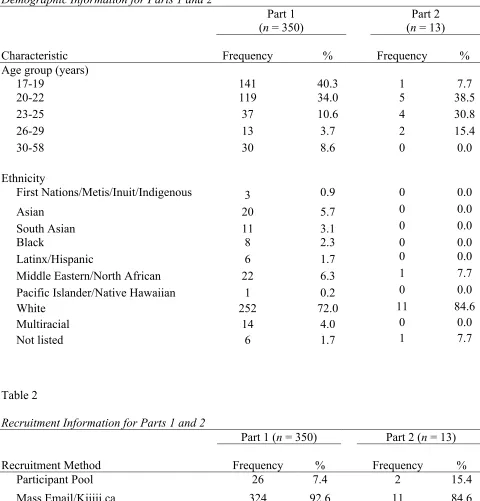
women participating in Part 1 were between the ages of 17 and 58 (M = 22; see Table 1) years and
primarily White.
Recruitment for Part 2. Participants eligible for Part 2 (a) completed Part 1, (b) identified
as female, (c) were 18 years of age or older, (d) reported having experienced at least one unwanted
and/or coercive experience perpetrated by a man that met the legal definition of rape or sexual
assault on the Modified SES (Koss & Oros, 1982), (e) labelled this experience as something other
than rape or sexual assault on the Modified SES (Koss & Oros, 1982), and (f) indicated that they
had had some familiarity with the #MeToo. No upper limit was set regarding the age at which
women could participate in this study.
A recruitment email (Appendix R) was sent to eligible participants (N = 39) who provided
permission to be further contacted by researchers. The Part 2 recruitment email included a unique
(i.e., person-specific) ID code that differed from ID codes used in Part 1 of the study. A list of
psychological and medical community resources (see Appendix N) was provided as an attachment
to the recruitment email itself. A link to Part 2 of this study was provided in the recruitment email
for those interested in further participation. Of the 39 email invitations sent, 13 women completed
Part 2 of the study (33% response rate). The women participating in Part 2 were between the ages
26
Table 1
Demographic Information for Parts 1 and 2
Part 1
(n = 350) (nPart 2 = 13)
Characteristic Frequency % Frequency %
Age group (years)
17-19 141 40.3 1 7.7
20-22 119 34.0 5 38.5
23-25 37 10.6 4 30.8
26-29 13 3.7 2 15.4
30-58 30 8.6 0 0.0
Ethnicity
First Nations/Metis/Inuit/Indigenous 3 0.9 0 0.0
Asian 20 5.7 0 0.0
South Asian 11 3.1 0 0.0
Black 8 2.3 0 0.0
Latinx/Hispanic 6 1.7 0 0.0
Middle Eastern/North African 22 6.3 1 7.7
Pacific Islander/Native Hawaiian 1 0.2 0 0.0
White 252 72.0 11 84.6
Multiracial 14 4.0 0 0.0
Not listed 6 1.7 1 7.7
Table 2
Recruitment Information for Parts 1 and 2
Part 1 (n = 350) Part 2 (n = 13)
Recruitment Method Frequency % Frequency %
Participant Pool 26 7.4 2 15.4
27
Procedure
Procedure for Part 1. Participants were provided one of two consent forms depending on
their recruitment via the Participant Pool (Appendix G) or mass email and kijiji.ca (Appendix H).
Both consent forms outlined the study’s purpose, its potential risks and benefits, issues related to
confidentiality, information about compensation, and links to download instructions for clearing
their browser history and accessing community resources. Participants then completed a brief
online survey that determined their eligibility for Part 2 of this research project. Specifically, they
completed, in the following order: (a) the Modified Sexual Experiences Survey (SES; Koss &
Oros, 1982; see Appendix I), (b) a question about familiarity with #MeToo (see Appendix J), (c)
a demographics questionnaire (see Appendix K), and (d) two qualitative mood neutralizing items
(asking participants to describe their happiest childhood memory and an activity that they do for
fun; see Appendix L). The Modified SES, #MeToo familiarity questions, and age and gender
questions within the demographic questionnaire served as pre-screen questions to identify
individuals eligible for participation in Part 2 of this study.
At the end of Part 1, participants who were ineligible for participation in Part 2 received
post-study information for Part 1 (Appendix M), a list of community resources (Appendix N), and
a link containing instructions for clearing their browser history should they wish to ensure that
others would not be able to see that they visited the survey URL (see Appendix O). Participants
eligible for Part 2 were automatically presented with a form asking for their permission to be
contacted by researchers via email. The recontact permission form differed depending on
participants’ recruitment through the Participant Pool (Appendix P) or mass email and kijiji.ca
(Appendix Q). Eligible participants provided their permission to be re-contacted by clicking a
28
that their identifying information would be held confidential and used only for the purposes of
re-contacting them (with their permission) and assigning compensation. They were also informed
that their information would not be linked to their online survey data.
Part 1 took participants no more than 30 minutes to complete. Participants who completed
Part 1 and were enrolled in the Participant Pool were awarded 0.5 bonus points toward an eligible
course. Participants who completed Part 1 and were not enrolled in the Participant Pool were
entered into a raffle for the opportunity to receive one of two $25 Amazon eGift Cards. A separate
Qualtrics survey link and platform was used to collect participant emails for purposes of
compensation. This was done to ensure that researchers were removed from at least one aspect of
linking up contact information with participants’ sensitive data.
Procedure for Part 2. Eligible women who provided permission to be contacted for Part
2 were sent a recruitment email directing them to a second online survey platform. On the first
page of the second survey platform, participants were asked if they were currently enrolled in the
Psychology Department Participant Pool (Appendix S). Using Qualtrics branch logic, participants
were then provided with one of two versions of the Part 2 consent form based on their recruitment
through the Participant Pool (n = 26) or mass email and kijiji.ca (n = 350) (Appendix G and
Appendix H, respectively). They were then invited to consent to or decline further participation
by clicking a relevant button. Links to download instructions for clearing their browser history
and accessing a community resource list were also attached to the consent form in the event that
participants closed their browser immediately after deciding not to participate.
Participants who clicked the button indicating consent to participate in the main study
completed the Modified SES (Appendix I) and the demographics questionnaire (Appendix K) for
29
an unwanted and/or coercive sexual experience and that their acknowledgement statuses had not
changed since completing Part 1 of the study. In the event that participants were no longer eligible
for Part 2, participants were directed to qualitative mood neutralizing items (asking them to
describe the best thing that happened to them last month and something they are most looking
forward to next year; [Appendix T]), a post-study information page (Appendix U), a list of
community resources (Appendix N), and a link with information for clearing browser history
(Appendix O).
Eligible participants were directed to a page with a number of open-ended items prompting
written (i.e., typed) responses about their understandings of the #MeToo, their reported unwanted
and/or coercive experiences, and these experiences in the context of #MeToo (see Appendix V).
This questionnaire was followed by two qualitative mood neutralizing items (Appendix S),
post-study information for Part 2 (Appendix T), a list of psychological and medical community
resources (see Appendix N), and a link containing instructions for clearing their browser history
(Appendix O).
Part 2 took participants no more than 60 minutes to complete. Participants enrolled in the
Participant Pool earned one bonus point for an eligible undergraduate course and participants
recruited from sources other than the Participant Pool earned a $25 Amazon eGift Card as
compensation for participation in Part 2 of this study.
Measures
Demographic information.The demographic questionnaire was presented to participants
after the consent form (Appendix K) in Part 1 and after the Modified SES (Koss & Oros, 1982)
was completed in Part 2 (Appendix I). It asked participants to provide their age, gender, sexuality,