Exploratory Testing and Coordinated:
A Structure for Viable, Proficient and
Time-delicate Testing
Saritha Narahari
Masters Student, Dept. of Computer Science, California State University, Sacramento, Folsom, CA-95630
ABSTRACT: Exploratory programming testing is a remarkable technique where test outline and execution are done in
the meantime. This technique esteems the analyzer as an indispensable piece of the test procedure and depends vigorously on the analyzer's imagination. The Nimble programming improvement technique centers around colleague commitments, responsiveness to new information and versatility to nonstop change. These two strategies share a few standards which make them perfect. We propose an incorporated procedure that consolidates Exploratory testing and Lithe to enhance programming quality.
I. INTRODUCTION
Exploratory Programming Testing (ET) is "a style of programming testing that accentuates the individual opportunity and duty of the individual analyzer to persistently streamline the estimation of her work by treating test-related learning, test outline and test execution as commonly steady exercises that keep running in parallel all through the project."[1] rather than scripted testing where the analyzer takes after predefined steps, an ET analyzer practices finish flexibility in picking how to practice the framework. This flexibility of investigation enables the analyzer to all the more intently reenact the heap of ways that genuine clients will associate with the framework. This can prompt the revelation of more deformities. Exploratory testing likewise requires less in advance time than scripted testing since the greater part of the testing exercises are done in the meantime.
Light-footed is a product improvement lifecycle show, first presented in 2001, that has increased far reaching use after some time. Deft places high an incentive on people and communications, working programming, joint effort and persistent reaction to change. Nimble spots bring down an incentive on procedures and devices, extensive documentation, contracts and following an arrangement. Despite the fact that the Dexterous SDLC may start with an abnormal state plan (e.g. Emphasis Zero), most of the necessities, outline, coding, and testing work is done in progressive short cycles.
II. LITERATURE SURVEY
James Bach credits the "internal structure" of ET as its most vital component. This inward structure requires an analyzer to practice cautious perception, basic reasoning, various thoughts and sharp explanatory abilities. It is a technique for testing that is exceedingly needy upon the characteristics and aptitudes of the individual analyzer and qualities the decent variety of these abilities in a gathering of analyzers to deliver better test thoughts. [2]
In [4] the creators talk about the utilization of ET, among other testing strategies. They noticed that ET is sufficiently adaptable to be utilized in all test levels, exercises, and stages. Likewise, ET was powerful in discovering more basic bugs in a brief span length. They additionally deduced that ET analyzers must have a decent comprehension of the application before thinking of test situations. They found that one of the drawbacks in ET is the absence of direction.
Beni Suranto likewise talks about the absence of direction inborn in ET while as yet adulating it as a feasible technique to use in Nimble in view of Dexterous' short advancement cycles and quickly rising highlights. These short, quick cycles leave brief period for formal content creation and upkeep.[5] Suranto denounced the sat around idly that can happen with
ET due to an absence of "planning, structure, and direction" however examined the utilization of Session-Based Test Management(SBTM) as a technique to moderate for the absence of direction.
J. Itkonen and M Mantyla found that ET was similarly as successful at experiment based testing (TCT) in discovering programming surrenders. In any case, ET was more effective in light of the fact that it required less outline exertion though TCT required broad forthright work to plan and execute test cases.[6] Another astonishing finding was that the quantity of false positive reports for TCT was altogether higher than that for ET. This examination additionally discovered issues with ET that should have been additionally tended to. Issues were: logging trying and making experiments. Likewise, ET analyzers griped about their absence of framework information rather than TCT where learning was increased through making experiments. Itkonen et. al. suggested that there be some preliminary exercises for analyzers when utilizing ET with the goal that they could acquire more prominent framework and space information.
Space involvement of the analyzer turned out to be a vital factor in the execution of ET as uncovered in an examination by C. Gebizliet.al.[3] Their examination demonstrated that the quantity of found imperfections was higher and the proficiency more noteworthy with analyzers who had an unrivaled level of area encounter. They likewise recognized a bigger number of imperfections of a basic sort than did less experienced analyzers.
III. PROPOSED METHODOLOGY AND DISCUSSION
Fusing Exploratory Testing into Dexterous Cycles
1. Necessities Stage
In this stage, analyzers meet with the partners, venture proprietors, and advancement staff as an indispensable piece of the Light-footed group. Amid the prerequisites stage, client stories are made by the partners and Nimble group. Exploratory testing is used to survey that the necessities characterized by the client stories are finished and compact at the level of reflection regularly display amid this stage.
The analyzer additionally takes an interest in the necessities stage by working together with the group to plainly comprehend the prerequisites of the customers. Notwithstanding helping test the culmination of client stories, the analyzer is additionally expanding space learning and picking up the clients' and additionally partners' viewpoint. Expanded area information will add to more viable Exploratory Testing amid the testing stage. Partner point of view helps in the plan stage when ET is utilized to test the outline against prerequisites. This point of view additionally serves to center sanctions and Session-Based Test Administration created amid the outline and coding stages so they intently line up with what the clients or potentially partners are anticipating.
After every emphasis, space information has been expanded. This expanded area learning adds to better testing of new prerequisites characterized in consequent emphasis. The analyzer is continually settling on choices about what to test straightaway and where to spend the (restricted) time in arranging testing exercises amid the following period of every emphasis. Being associated with the prerequisites starts the way toward testing at the soonest conceivable period of the
2. Configuration Stage
In this stage, as a major aspect of the proposed system, utilize cases are gotten from client stories. With these determined utilize cases, the analyzer approves the plan models against prerequisites to guarantee that the outline is finished and brief. They test intelligent stream of the framework and search for the holes amongst necessities and the outline. In light of the analyzer's involvement, NFRs are likewise revealed and tried while testing the sensible stream. The disclosure of vital NFRs remains as valuable info while actualizing modules in future emphases. Alongside this, in view of area ability, analyzers additionally give recommendation to the designers which can prompt significant execution. Deformities experienced amid testing of utilization case models can be settled in configuration stage subsequently lessening the cost for settling it at a later stage. Since Light-footed emphases are of brief term, one of the aptitudes analyzers needs to ace is the capacity to deal with the extent of testing, so the product is tried completely in a brief span. As a feature of the proposed arrangement, amid the outline stage, aside from testing coherent stream according to necessity, analyzers additionally characterize the extent of exploratory testing utilizing an idea called a "contract". A sanction does not determine how the framework is to be tried, it just characterizes what parts of the framework are to be tried. At that point, utilizing background and information, the exploratory analyzer recognizes how the testing will be performed to reveal basic deformities. As Nimble philosophy is of shorter term, Exploratory Testing spares time by utilizing the mastery of the analyzer as opposed to characterizing precisely how the framework will be tried likewise with experiment-based testing. While outlining contracts in this stage, analyzers will acquire clearness about the framework, basic modules which requires more scope and to what extent an analyzer ought to spend inspecting any part of the framework. ET amid the plan stage furnishes subtle elements of how modules cooperate with another and their interrelation. It likewise gives looks of code stream which will demonstrate supportive while making testing input information in a later stage. Along these lines, yield determined in the outline stage reveals plan and intelligent mistakes which can be costly to settle amid the later stage and gives understanding into innovative approaches to test. Ultimately, sanctions composed here will demonstrate as a fundamental contribution to additionally phases of the testing system.
3. Coding Phase
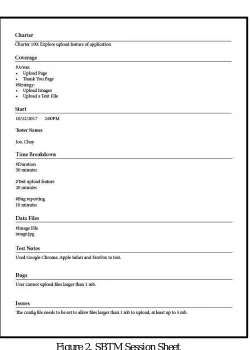
While the improvement group is coding, the analyzer is getting ready for the testing stage. They use the client stories, utilize cases, contracts and configuration notes obtained in the earlier stages to make guides for Session-Based Test Management (SBTM).
Figure 2. SBTM Session Sheet
Toward the finish of the coding stage, input information and SBTM log sheets have been arranged, gathered and are prepared to give the engaged direction required to execute proficient and powerful ET amid the up and coming short testing stage.
4. Testing Stage
While some Deft executions may have an accentuation on unit testing or may utilize computerized testing to guarantee fundamental coordination of new usefulness, manual framework testing through devoted analyzers is regularly shunned amid the Nimble SDLC in view of the measure of time required for conventional Experiment Based Testing.
Notwithstanding, if a Light-footed group has used the proposed structure amid the past stages, exploratory testing can be productively joined into the Lithe SDLC. ET will give powerful framework testing given a short measure of time because of the ET arrangement that has just been performed. The analyzer has obtained more noteworthy space
Amid Exploratory testing, the SBTM session sheets, time-boxes and input information that were set up in the coding stage are put to utilize. The analyzer leads their exploratory tests and records the consequences of each contract with surrenders, issues, and so forth. The analyzer at that point utilizes the finished session sheet(s) to direct a questioning with select individuals from the Spry group before client acknowledgment testing. The session sheets likewise fill in as a lasting log of the testing that was done and the deformities found.
Deformities found amid this stage are added to the build-up or next emphasis. Moreover, the whole group is better arranged for issues that might be found by clients amid Client Acknowledgment Testing. This enables the group to start anticipating how to address these issues in the following cycle. Finally, with each progressive emphasis, the analyzer is in a superior position to contribute their developing space information and experience toward refining necessities, approving the outline and directing proficient ET.
IV. CONCLUSION
The past examinations illustrated in 'Related Works' have demonstrated how ET can be used generally successfully. With the end goal for ET to be best, analyzers need great area learning, sufficient arrangement and direction and a characterized technique to lead and record the aftereffects of testing. Our proposed structure joins these prescribed procedures keeping in mind the end goal to make ET a proficient strategy for leading testing amid the quick paced, iterative nature of Coordinated improvement.
The system consolidates ET in the prerequisites stage to guarantee that the client stories are all around characterized. In the plan stage, client stories are separated into utilization cases that all the more completely diagram necessities. Exploratory testing is utilized to approve that the plan meets the necessities previously coding starts. The coding time frame fills in as a period of planning to alter contracts, accumulate input information and make SBTM sheets for directing testing and logging results. The aftereffects of Exploratory testing are recorded on the SBTM session sheets and investigated with the whole Deft group before Client Acknowledgment Testing. This model of leading Exploratory Testing is iterative and self-making strides.
This model of directing ET with Lithe matches well on the grounds that:
1. Agile can take into consideration a brief time of testing time amid an emphasis; ET is successful given a brief timeframe span [4].
2. Testers utilizing ET find more basic imperfections and are more proficient when they have an unrivaled level of space understanding. More prominent levels of space encounter are picked up when the analyzer is associated with the necessities and configuration periods of the Spry SDLC. Moreover, as progressive emphasess are finished, the analyzer develops with more understanding and area information each time[6].
3. Defects in necessities and configuration are found before coding when the analyzer uses Exploratory Testing in the prerequisites and configuration stages.
4. The ET analyzer picks up direction amid the prerequisites and configuration stages in regards to which modules to center SBTM sanction around. Arrangement and structure[5] are set up simultaneous to the coding stage, empowering the analyzer to be prepared to direct more effective Exploratory Testing.
V. FUTURE WORK
particularly named stages and traditions that may require tweaked alterations of the model with a specific end goal to be joined. Future work could take a gander at specific Lithe varieties like TDD, XP, SCRUM and perceive how the proposed ET model could be all the more particularly consolidated into every one.
REFERENCES
[1] CemKaner. Exploratory Testing After 23 Years. Keynote at the Conference of the Association for Software Testing, June 6, 2006. [2] James Bach. Exploratory Testing Explained v.1.2 4/16/03. Excerpt appeared in The Testing Practitioner, 2002, Eric van Veenandaal. [3] C. Ş. Gebizli and H. Sözer, "Impact of Education and Experience Level on the Effectiveness of Exploratory
Testing: An Industrial Case Study," 2017 IEEE International Conference on Software Testing, Verification andValidation Workshops (ICSTW), Tokyo, 2017, pp. 23-28.
doi: 10.1109/ICSTW.2017.8
[4] MururaganThangiah and ShuibBasri. A Preliminary Analysis of Various Testing Techniques in Agile Development. 2016 3rd International Conference On Computer And Information Sciences.2016.
[5] Beni Suranto. Exploratory Software Testing in Agile Project. 2015 IEEE International Conference on Computer, Communication, and Control Technology.2015.