EARLY, MORGAN LEIGH. Engineering Professors’ Preferences for the Learning of Differential Equations. (Under the direction of Dr. Karen Allen Keene.)
A first semester course in ordinary differential equations is often described as a
service course to engineering and hard science majors; how engineering professors
envision the course content and tools is important. Additionally, reform efforts in
differential equations courses have focused on enhancing students’ conceptual
understanding of the material. To this end, mathematicians and mathematics
educators have developed the notion of relational understanding, which connects
procedural and conceptual knowledge. This study reports the results of a
nationwide survey of engineering professors who articulate their opinions on the
topics in the differential equations curricula, the relational understanding of
differential equations students, and how technological advances have impacted the
study of differential equations.
Engineering Professors' Preferences for the Learning of Differential Equations
by Morgan Early
A thesis submitted to the Graduate Faculty of North Carolina State University
In partial fulfillment of the Requirements for the degree of
Master of Science
Mathematics Education
Raleigh, North Carolina
2010
APPROVED BY:
____________________ ______________________ Robert H. Martin Allison W. McCulloch
______________________________ Karen A. Keene
DEDICATION
I dedicate this thesis to my parents. Throughout my life, you have provided
the consistency and motivation that I needed to continue to work diligently as unto
our Lord Jesus Christ. You two provided excellent examples of a hard work ethic,
and constantly supported my academic efforts in every way. Thank you for helping
me to remember that this work is not about my accomplishments, but that I am first
and foremost a servant to our King. I love you more than you know.
BIOGRAPHY
Morgan Leigh Early was born and raised in Marion, North Carolina by her
parents Steve and Miriam Early. She graduated from McDowell High School in the
spring of 2004 and began her undergraduate work in both communication and
mathematics at North Carolina State in the fall of 2004.
During her time as an undergraduate, Morgan began to work part‐time as a
teaching assistant for the Mathematics department. She began to feel called to a
teaching career during this time. After completing her undergraduate degrees, she
continued her educational career as a master’s student at North Carolina State,
pursuing a degree in Mathematics Education. Upon completion of her Master of
Science degree in Mathematics Education, Morgan will begin teaching at Millbrook
High School in Raleigh, NC and hopes to one day pursue a PhD.
ACKNOWLEDGEMENTS
My peers, colleagues, and friends: thank you for listening to me talk about
differential equations and engineering, even if you were only listening out of
support. To my favorite peer, my sister—bouncing ideas off of you is always a
pleasure. I would like to thank Dr. Karen Keene for providing wisdom and insight
throughout this process. You have taught me how to be a researcher and how to
enjoy the process instead of just the final product. Thank you so much for becoming
a great mentor and friend.
LIST OF TABLES
Table 1: Number of Respondents in Each Engineering Field………..31
Table 2: Number of Respondents for Each Age Bracket……….32
Table 3 Number of Respondents for Each Category of Teaching Experience…………33
Table 4 Number of Respondents for Each Category of Career Experience……….33
Table 5 Comparison of Analytic Technique Preferences with Engineering
Field………...39
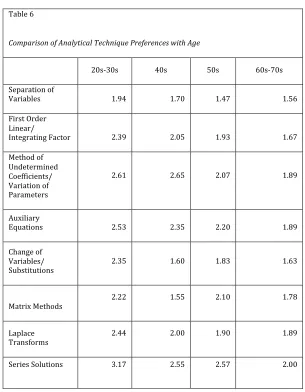
Table 6 Comparison of Analytic Technique Preferences with Age………..…….43
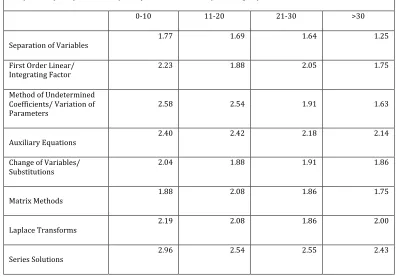
Table 7 Comparison of Analytic Technique Preferences with Years of Teaching Experience………...…………..44
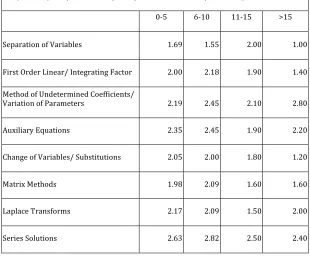
Table 8 Comparison of Analytic Technique Preferences with Years of Career
Experience……….………..45
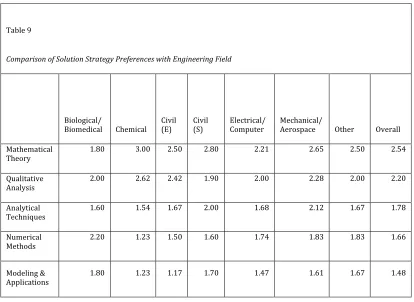
Table 9 Comparison of Solution Strategy Preferences with Engineering Field.……...46
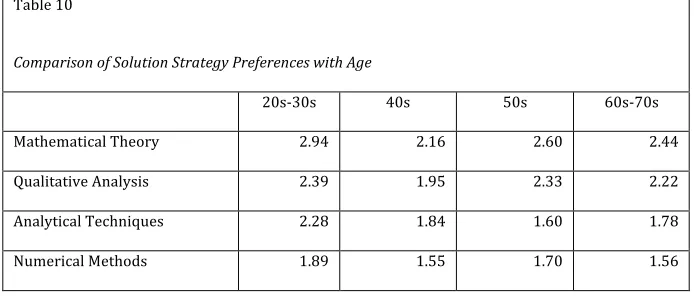
Table 10 Comparison of Solution Strategy Preferences with Age……….49
Table 11 Comparison of Solution Strategy Preferences with Years of Teaching
Experience………...………51
Table 12 Comparison of Solution Strategy Preferences with Years of Career
Experience………...………51
Table 13 Comparison of Misconception 1 Importance by Engineering Field………….55
Table 14 Comparison of Misconception 1 Importance by Age...……….57
Table 15 Comparison of Misconception 1 Importance by Teaching Experience……..57
Table 16 Comparison of Misconception 1 Importance by Career Experience...………58
Table 18 Comparison of Misconception 3 Importance by Engineering Field………….64
Table 19 Comparison of Misconception 3 Importance by Age.………...……67
Table 20 Comparison of Misconception 3 Importance by Teaching Experience……..67
Table 21 Comparison of Misconception 3 Importance by Career Experience...………68
Table 22 Comparison of Misconception 4 Importance by Engineering Field………….69
Table 23 Comparison of Misconception 4 Importance by Age...……….70
Table 24 Comparison of Misconception 4 Importance by Career Experience...………71
Table 25 Number of Respondents Preferring Understanding to Correctness...………73
Table 26 Comparison of Preference for Understanding/Correctness with Age…...…74
Table 27 Comparison of Preference for Understanding/Correctness with Career Experience………..………75
Table 28 Number of Respondents Noting Software...………76
Chapter 1 Introduction
Mathematics departments provide a service to many science and engineering
fields by teaching prerequisite mathematics courses for these areas. Some of the
major participants of mathematics courses are engineering students (Ahmad et. al,
2001, Committee of the MAA, 1967). If we seek to improve the value of engineering
students’ education, we inevitably must seek to improve their mathematics
education. Mathematics professors and engineering professors must work together
to meet the needs of engineering students’ mathematical understanding, in order to
make them more effective learners of engineering.
More specifically, differential equations present themselves very useful for
solving different types of systems in various types of engineering. In many cases, a
strong understanding of differential equations will also provide students a gateway
to avoid rote memorization. One dynamics professor notes that in “most dynamics
books all of the equations that are used in dynamics books come from 2 or 3
governing differential equations” (personal communication). He goes on to describe
that his students “don’t understand the differential equations well enough [and if
they try to] memorize all this stuff, they just get balled up…when all they really need
to do is understand how to take, for example, F=ma, express it as a differential
communication). He suggested that his students do not derive solutions because
they did not have a strong enough understanding of differential equations.
Since mathematics courses serve a wide variety of science and engineering
majors, the demands upon those teaching these courses often change with other
fields, and is not limited to the trends in mathematics and mathematics education.
With the onslaught of technology in engineering (Boyce, 1994), there have been
several shifts in the way one can approach a differential equations problem. Many
engineering departments are changing their coursework, as there is “a shift in
emphasis from teaching focused on knowledge . . . toward teaching about the
process of engineering” (Kent and Noss, 2003, p. 19). In some cases, engineering
mathematics is beginning to be taught in engineering departments (Ahmad et. al,
1967).
The process of engineering makes problem solving skills and analysis more
critical for today’s students than ever before. Thus, since differential equations
services many engineering students and the engineering education needs seem to
be changing, there is also a need for differential equations curriculum evaluation to
see if this course is helping students with the process of engineering. This study
incorporates Skemp’s (1976) “relational understanding” notion to apply to not only
understanding concepts, but also using these concepts in conjunction with other
concepts and procedures. Engineers must take knowledge from many areas and
strong need for relational understanding among engineers, and this study will seek
to explore the opinions of engineering professors about students’ relational
understanding of differential equations.
We know that engineers need to understand mathematical concepts for
modeling purposes so that they may connect those models to their science courses
(Blockley, 2002). However, we do not know which topics in ordinary differential
equations that are essential to these engineers with the onslaught of new
technology. Do engineers need to have relational understanding of science but only
procedural or instrumental understanding of ordinary differential equations? This
study seeks to identify prevalent opinions of various engineering professors at
different universities in order to interpret the most important curriculum topics, the
depth of student understanding that engineering students need to grasp in a first
year course in differential equations, as well as discuss the importance of
technology to engineering students in differential equations.
The content of the first semester course in differential equations must be re‐
assessed to best meet the needs of our students. To do so, we must assess students’
current understandings (see Rasmussen, 2001; Keene, Early, and Gonzalez, in
preparation for examples of this), what they need to understand, and how best to
teach what they do need to know with the tools at hand in light of the engineering
the future needs of engineering students in an ordinary differential equations
course:
• According to engineering educators, what topics in differential equations are
most crucial for engineering education and practical engineering?
• What types of relational understanding do engineering educators wish to see
in their students’ differential equations classes?
• According to engineering educators, how should technology be used in the
mathematical education (especially the differential equations education) of
engineers?
Once we better understanding the directions that engineering professors
desire, we can use their ideas to help see what topics to cover in differential
equations and how we should present this information for engineers to be able
to utilize the topics in their future courses and careers. We can then design a
more effective differential equations curriculum, or if necessary, different
curricula for various majors.
Chapter 2 Literature Review
Differential equations courses serve many different types of engineering
fields (see Chapter 1 for further detail). In this chapter, I will seek to review the
literature discussing the mathematics content which best serves students in
engineering, as well as discuss the work that has been done on students’ conceptual
understanding of mathematics at the undergraduate level. The last several decades
have altered the day‐to‐day operations of an engineer due to the available
technologies of our current culture. I will also discuss the known benefits and
concerns that have risen from the introduction of new technologies in
undergraduate mathematics, specifically the benefits and concerns of technology to
the first course in differential equations.
University Mathematics Content for Engineers
Curriculum content should continually be assessed for any mathematics
course at the university level to ensure that it is best serving the students who are to
benefit from the material. One issue directly related to curriculum development for
engineering is that new technologies are being introduced into the engineering
workforce. This bears the question of whether or not mathematics curricula are
best serving 21st century engineering students. In 1962, the committee on the
undergraduate program in mathematics of the Mathematical Association of America
They revised their work, and in 1967, they included the following topics as being
important to the first course in differential equations: “linear differential equations
with constant coefficients and first order linear systems—linear algebra (including
eigenvalue theory) should be used to treat both homogeneous and nonhomogenous
problems; first order linear and nonlinear equations with Picard’s method and an
introduction to numerical techniques” (p.7). They placed transform methods in a
course they entitled “functions of a complex variable,” (p. 32) and also in the partial
differential equations course, (p.34) which was separate from the first course in
calculus and differential equations. They also included a more extensive study of
numerical methods in the partial differential equations course, where students
would learn the “replacement of differential equations by difference equations;
iterative methods; the method of characteristics [as well as] convergence and error
analysis” (p. 35).
Differential equations courses serve many different types of engineering, all
of which need to be able to apply these mathematical concepts. In 2003, Kent and
Noss were commissioned by the Ove Arup foundation to examine the mathematics
being taught to engineers, specifically civil engineers. They noted that while there is
a shift in university engineering education, the mathematics courses for these
engineers are not necessarily following suit. They note that “engineering
mathematics curricula often contain topics that are present for historical reasons,
36). They suggest more open dialogue between mathematics and engineering
faculty in order to address content as well as pedagogical methodology. Thus, the
focus for mathematics instructors at the university level should be how to shift our
teaching as well from just focusing on knowledge to focusing on collaborating with
engineering professors to enhance learning of the problem‐solving process.
A working group of the Undergraduate Mathematics Teaching Conference
discussed that, as mathematicians, we must note that the goals of the engineering
community are different than the goals of the mathematics community (Ahmad et.
al, 2001). This working group suggests that if mathematicians teach engineering
mathematics, then they “should encourage understanding and thoughtful use, and
may communicate…the generality and power of the subject, the range of methods
available, and links to other subjects within and outside engineering” (p. 38).
However, if engineers teach the mathematics content, the committee suggests that
they “allow sufficient time for methods to be understood…ensure pre‐requisites are
covered, [and should] avoid using [computer] packages as a ‘quick fix’” (p. 39). In
both cases, they note that engineering professors and mathematics professors must
work together to best achieve the usefulness of the mathematics and the
understanding of the content being used.
While we often think of engineers as being strong math students who are
confident enough in mathematics to go into the engineering field, Kent and Noss
backgrounds, and this may be largely due to their lack of “symbol sense,” (Arcavi,
2005) or their conceptual understanding of symbols. Even strong students have to
struggle through learning mathematics, and thus, research should continue to
explore the need for understanding common pitfalls for these engineering students.
If mathematicians and engineering professors work together to meet
curriculum needs, hopefully the mathematics coursework of engineers will align
more closely with the mathematics they will eventually use in the workforce.
Engineers often proceed into careers that typically use mathematics differently than
the way they learned to use mathematics in the classroom. In 2007, the disposition
of structural engineers was analyzed at one particular engineering firm. The
researcher observed engineers at work and found that they adhere to the rules of
the industry, prefer more supporting elements in their buildings/structures.
Expertise often meant the ability to make judgment calls, not perform mathematics.
Engineering solutions do not have one “right” solution, and many cannot be
deductively proven. Sometimes deductively sound arguments were rejected
because they were impractical. The author suggests allowing students to reason
with elements of a certain context and uncover the mathematics problem
(Gainsburg, 2007).
In engineering education at the undergraduate level, there is a growing
emphasis on problem‐based and project‐based learning (Mills and Treagust, 2003),
difference between these two approaches is whether or not professors are looking
at short‐term or long‐term goals. Problem‐based learning focuses on the acquisition
of knowledge and is a short‐term problem presented to a class. This may be an
activity or problem that takes students a day or two to complete on their own in
class.
Project‐based learning focuses on students’ application of the knowledge
they have learned. This type of learning is usually presented as a long term
assignment, such as a senior design project, where students have more time to
demonstrate knowledge acquired, but must manage their time wisely as they will in
their careers. Also, students often have an opportunity to demonstrate knowledge
gained in a variety of their different engineering courses when they are assigned
project‐based learning activities. At least one university is implementing project‐
based learning in a freshman‐level course. An upperclassman works as a project
supervisor, but he underclassmen form a team to complete the class. The
researchers have found that this course is beneficial to preparing students for later
tasks since “70% [of students] thought that the project introduced them to real‐
world engineering issues [and] 60% of the students taking the course in fall 2007
said they felt more comfortable doing engineering design as a result of the project”
Even if students do not spend the whole semester on one project,
engineering courses often offer problem‐based learning initiatives. Problem‐based
learning “promotes students active engagement with learning [and its] main goal is
to apply knowledge, not just acquire it” (Brodeur, Young, and Blair, 2002, p.2). The
problem that students are given is encountered first, learning as they work through
the problem. The problems are typically described as lecture substitutes, and may
be worked “independently or as part of a group” (Brown and Brown, 2004, p.11).
Engineering educators ask for mathematicians to also incorporate these
problem‐based and project‐based methods into their classrooms. Mills and Treagust
(2003) claim that engineers need more teamwork and communication experience,
and that engineering professors lack background experience in careers outside of
academia. They claim that problem‐based learning may be insufficient for students
because they do not include a wide range of activities. They instead advocate for
teachers to use more project‐based learning because they can see a more holistic
view of the students’ capabilities.
Teaching differential equations to engineers.
Engineering educators have been discussing the importance of various topics
in differential equations for years. Engineering departments have often disagreed
with each other on the importance of certain differential equations topics because of
specific differential equations topic that creates differing view amongst engineering
professors—the Laplace transform. Holmberg and Berhnhard (2008) interviewed
22 professors from 5 universities concerning their opinions about the difficulty of
the Laplace transform in differential equations. They split teachers into three
categories—those who consider the topic difficult for students to learn, teachers
that say it may or may not be too difficult for students to learn, and teachers that
consider that the transform is not difficult for students to learn. They found
teachers in all 3 categories and found that there is no unified view about the student
difficulties with the transform or the importance of the Laplace transform to their
students’ education. They also found that these teachers have different opinions
about the links between mathematics, physics, and technology.
While there are differing opinions about the Laplace transform, there seems
to be common opinion about approximation methods. For some engineers,
nonlinear differential equations have shown to be more common mathematical
objects in their engineering work than linear differential equations. A Boston
University project sought to embrace the “nonlinear revolution” in engineering—
which seeks to “present nonlinear systems on the same footing as linear systems”
(Blanchard, 1992, p. 1). Blanchard and associates developed a new textbook,
focusing on a wider variety of topics. They sought to “balance between analytic,
numeric, and graphical techniques [and] stress qualitative theory” (p. 2). They hope
needs of the engineering community that uses more nonlinear equations than linear
ones. These reform efforts in differential equations have started to take hold in
many American universities. The reform effort in differential equations is showing
to be beneficial to students’ conceptual understanding of rate (Rasmussen and King,
2000).
Students’ Relational Understanding of Mathematics Content
Differential equations courses traditionally focus on procedures. Students
are shown different types of differential equations, and then shown how to solve
them (Boyce, 1994). The ways in which we solve these differential equations are
referred to as analytic methods. These methods provide exact solutions to
differential equations. While these analytic solutions are important, by focusing our
attention solely on these many analytical methods without visualization and
discussion about function behavior, students are often losing conceptual
understanding of many of these topics (Rasmussen and Whitehead, 2003).
As we look to make the differential equations curriculum more applicable to
the engineering community, we must also consider if these engineering students
correctly understand these new applications. There has been an ongoing discussion
over the importance of conceptual versus procedural understanding in the
mathematics education community for several years (Thompson and Thompson,
important to this conversation, as many professors who traditionally teach
differential equations only present analytical procedures.
Several researchers have also created new interpretations of student
understanding. Donovan (2008) expanded Sfard’s (1991, 1992) dichotomy of
structural and pseudo‐structural understanding. A pseudo‐object is an object that
can be manipulated, but is not fully connected to a compact whole notion. Donovan
used this dichotomy to describe two interviewed students who were given
differential equations tasks and asked to work back and forth between function
graphs and analytical differential equations. He described three essential elements,
according to Sfard, that would describe a student with structural understanding.
First, the student with structural understand can recognize the same concept in
different situations. Second, he can provide different representations of the same
object, and finally, the student with structural understanding will be able to
recognize basic ideas or concepts at a glance without a need for solving a procedure.
Donovan found that he was able to classify differential equations students with this
dichotomy. While both worked back and forth between graphs and equations, the
student that he classified as having pseudo‐structural understanding was unable to
formulate different representations of the concept and had to perform procedures
Hasenbank and Hodgson (2007) showed in their algebra study that their
students needed to connect conceptual ideas to procedural ideas. Instead of
promoting conceptual or procedural understanding, they worked under the premise
of students developing deep procedural knowledge and developed a framework that
assesses a student’s deep procedural knowledge. The framework shows that a
student with deep procedural knowledge understands the goal/outcome of the
procedure and is able to execute procedures that would elicit a solution. The
framework also mentions that students with deep procedural understanding will be
able to assess the validity of the procedure, compare it to other procedures, and
explain where you can use certain procedures and when these procedures are best
to utilize.
Similar to deep procedural knowledge, Skemp (1976) also noted that there
was an inevitable connection between concepts and procedures in mathematics.
Instead of discussing deep procedural understanding, he instead presented a new
dichotomy of student understanding of mathematical concepts—instrumental and
relational understanding. He notes in his article that loosely using the term
“understanding,” may imply different meanings in the mathematics community.
Instrumental understanding is loosely related to procedural understanding.
Typically, instrumental understanding refers to the implementation of a few
procedure, but is unsure of where this procedure applies and where it does not
apply.
Relational understanding requires students to make connections between
different mathematical schemas. This understanding is not fully void of the need for
procedures. A student in differential equations will need to learn some procedures,
and understand how to do these rightly in order to correctly solve engineering
problems. Relational understanding involves rich connections among different
concepts, and involves students not only understanding procedures, but also
understanding why these procedures are necessary and how they were derived.
Students with relational understanding of differential equations will be able to work
different types of analytical techniques, but will also be able to compare and
contrast these different techniques, explaining why differential equations are
classified as they are, and why certain procedures work for certain types of
equations. Skemp proposes that if students and teachers are mismatched based on
their preferences for instrumental or relational understanding, there will be
temporary or long‐term disappointment for one or both parties. Thus, if relational
understanding is a teaching goal for the differential equations course, we must find
if the instructors are also interested in presenting differential equations in a way
Others agree that students will understand mathematics better if concepts
are part of an internal network of connections. Educational psychologists have
found that networks are built gradually and tighten over time. Students have to
develop their own understanding and once a student does understand a concept,
there is a reduction in the amount that must be remembered. In his review of
literature, Hiebert (1992) impressed that students should be taught meaning first
before practicing execution. He also suggests that teachers note connections among
different representations. Otherwise, misconceptions will exist despite
understanding properties because students will separate those incorrect notions
into separate islands of knowledge. If teachers make connections clear and help
students separate incorrect notions, hopefully students will leave a course with
more relational understanding.
Conceptions and Misconceptions in ordinary differential equations.
Any curriculum change is unsuccessful unless it offers a way for students to
understand the material presented. Habre (2000) noted that “assessing the success
of the new ODE curriculum is incomplete if not complemented by research into
student thinking” (p. 456). In order to better assist his students’ understanding of
the behavior of the solutions to differential equations, Habre conducted a course in
which he focused on qualitative approaches to solutions. At the end of the semester,
different problems. He found that even with qualitative tools in their minds, most of
them had the tendency to try analytic solutions first. Some of the students noted
that the graphs did not seem as sufficient as the analytic solutions. Habre also found
that students had a difficult time working fluidly with both types of representations,
and did not think about the other representation when working with one.
Rasmussen (2001) interviewed 6 students and developed a framework that
shows where students in differential equations need assistance. He found that
students need assistance with developing the notion of functions being solutions to
differential equations. He also found that students need stronger intuitions and
images of differential equations. In his framework, students’ understanding of
functions as solutions to differential equations includes interpreting solutions as
being functions instead of having “mindless graphical manipulation” of symbols. His
framework also discusses interpreting equilibrium solutions as being constant
solutions that may or may not be found by substituting a “0” into the equation for y
and dy/dt. Instead, he says students should focus on equilibrium solutions being
seen as quantities. Students’ were found to have some intuitions concerning
equilibrium solutions, numerical approximations, and stability. However,
developing stronger schemas of differential equation solutions and visualization
Keene, Early, and Gonzalez also (in progress) found several student
misconceptions. Similar to Rasmussen’s findings, they found that some students
were unaware that functions were solutions for all differential equations. Some felt
that “equation” was a better answer for solutions to ODEs. The students in this study
had a poor understanding of equilibrium solutions as well. Many students did not
even have a working definition of an equilibrium solution. Beyond having a weak
understanding of the algebraic creation of an equilibrium solution, students did not
recognize or acknowledge that equilibrium solutions were specific to separable
differential equations because of the division action in the method.
The same researchers also investigated students’ understandings of the
derivative. In separation of variables, as often presented in textbooks, students can
simply separate the derivative into two differentials, and then integrate both sides
of the equation with respect to two different variables. This method is accurate
because of the justification of the chain rule, although in general, integrating with
respect to one variable is not an equal operation as integrating with respect to
another variable. When examining the separation of variables method, most
students had some concern with integrating with respect to 2 different variables,
but some of them said that they just accepted it because the teacher taught them to
solve the problems this shortcut way. Students accepted what they had been told,
even though they always thought it odd or “didn’t see clear justification” of the
These researchers also investigated students’ understandings of Euler’s
method. When investigating numerical methods, few students in this study knew
whether there would be an over or underestimate depending on the concavity of the
actual function. Artigue (1992) and Rasmussen (2001) both found evidence that
some students see Euler’s method as a “track” of the exact solution curve. Thus,
there is a possibility that some students will be unaware of the error created from
numerical approximations.
There is limited research concerning misconceptions in differential
equations. The common misconceptions that we do know exist may or may not be
of importance to engineers. Thus, this study seeks to address which, if any, of these
known misconceptions cause major roadblocks in later engineering courses. Once
we identify more misconceptions, we also need to focus on how to best address
them. Habre (2002) built on research that has shown benefit in writing in calculus
classes and examined the effects of writing in an ordinary differential equations
course. Students were asked to justify their answers and discuss effects of changing
parameters. By the end of the writing‐centered course, students widely agreed that
writing was essential to the course and that “writing complements the geometrical
approach” (p. 7). This survey’s aim was to identify the most important
misconceptions to the engineering academic community so that we could then later
look into efforts other than writing that might be helpful for teaching the relational
Technological Effects on Engineering Students’ Mathematical Understanding
Differential equations research has become more popular in the past couple
of decades with the onslaught of technologies such as Maple, Mathematica, and
MATLAB. Students’ understandings of differential equations may be enriched by the
use of various technologies at our disposal (Kallaher, 1999). In their literature
review on the learning and teaching of ordinary differential equations, Rasmussen
and Whitehead (2003) noted that “students’ visual understanding of phase
portraits, slope fields, and solutions of differential equations is an area where we
might consider integrating technology into students’ experiences in the classroom”
(p. 7).
Beyond visualization, Boyce (1994) noted that technology called for
differential equations students to have 3 kinds of experiences: “conceptualization,
exploration, and higher‐level problem solving” (p. 364). Boyce notes that
technology keeps students from thinking about rote action, and instead they have
more opportunity to focus on the conceptual understanding, since they don’t have to
worry as much with manipulative skills. Technology aids in students’ explorations
as they manipulate to experience the effects of different parameters in systems of
differential equations (i.e. determining crucial values). He notes that computer
programs can also be used as a reference to discover new mathematical concepts
also offer students a chance to model mathematically. This requires higher‐level
problem solving and is more directly applicable to engineering than other
mathematics topics. Modeling practice increases the higher‐order thinking skills of
engineers, and preparing them for applying mathematics is the goal of an
engineering student’s university education. He concluded that technology “will not
change the need for men and women who can think clearly, critically, constructively,
and creatively about the problems of the day” (p. 371).
While technology seems to have benefits, there may also be drawbacks to the
use of technology in the undergraduate classroom. Kent and Noss (2003) note that
the increased availability of technology may actually be a detriment to students in
engineering. Engineering educators agree that students in their courses graduate
“with good knowledge of fundamental engineering science and computer literacy,
but they don’t know how to apply that in practice” (Mills and Treagust, 2003, p.3).
Puga (2001) investigated the use of several software packages and computer
algebra systems in a differential equations course and its effect on modeling. Puga
suggests that students could be introduced to modeling differential equations in
calculus by using certain software packages. He thinks that this discovery learning
could then be continued in a differential equations course. Overall, the students’
consensus about using the software was positive. They claimed that it increased
that using the technology introduced. In population modeling, the students
continued working despite having negative or non‐whole numbers for population.
Technology has shown to be important for the visualization of students in
differential equations and is usually well‐received by the students. However, we
must also be careful how we implement technology into the classroom so that its
purpose is aid instead of crutch.
Summary of Literature
Engineering students need to be able to perform procedures in differential
equations, but they also need to be able to connect concepts together in order to
have a more tightly defined schema of ideas. Skemp (1976) refers to this connection
among procedures and concepts as relational understanding.
Engineering educators have shown a need for more opportunities for their
students to explore and create their own mathematical models. They want them to
be able to bridge various different concepts from different engineering courses.
However, little is known about engineering professors’ opinions on how students’
bridge mathematical understanding with their engineering knowledge. There is no
research to indicate whether or not relational understanding of differential
equations content is of importance to these engineering professors. Thus, we need
knowledge to the engineering community, especially in differential equations, since
Chapter 3 Methodology
This study is structured to address the research questions. In this chapter, I
describe the construction of the survey, including the decisions I made on what
questions to ask and how I chose participants. I then discuss data collection and
data analysis.
Survey Construction
I designed a cross‐sectional survey that was a comparative analysis among
engineering professors (Creswell, 2009). I formed a stratified sample in order to
compare various demographics associated with engineering professors. By using
this strategy, I was able to analyze engineering professors’ overall responses about
curriculum, student understanding, and technology, but I was also able to determine
if a specific demographic would tend to lend itself to a particular response about any
of these three areas of interest.
I also wanted to elicit the curriculum preferences for the professors, so I
decided to blend traditional topics and reform topics in the survey. In order to
objectively present this information, I studied both a reform text, Differential
Equations (Blanchard, Devaney, and Hall, 2002) and a traditional text, Fundamentals
of Differential Equations and Boundary Value Problems (Nagle, Saff, and Snider,
survey with the help of a research advisor. The analytical techniques that I chose to
include are based on the types of differential equations that a student might
encounter.
Both of these textbooks introduce the separation of variables method and
first order linear equations before the other topics. Separation of variables is used
for differential equations of the form dy
dt = p(y)⋅f(t), where p(y) is a function of y
and f(t) is a function of t. First Order linear equations must be able to be written in
the form of dy
dt +P(t)y=Q(t), where P(t) and Q(t) are functions of t. In general, P(t)
and Q(t) are different functions.
The method of undetermined coefficients and variation of parameters are
both used for nonhomogeneous differential equations, while auxiliary equations are
used for homogeneous equations. Homogeneous equations that can be solved with
auxiliary equations are written in the form ay’’+by’+cy=0, while nonhomogeneous
equations that are solved with the other methods take the form ay’’ + by’ +cy = f(t).
Substitution methods are often used for differential equations that are nonlinear.
Matrix methods are widely used in order to solve large dynamical systems of
linear differential equations. Scientists may need several differential equations to
depict the model of their physical situation. Matrices handle large amounts of data
Laplace transforms map functions from one domain into another domain
that is simpler algebraically. They are often desired more than other methods for
nonhomogenous differential equations because you are not required to find a
general and particular solution. Instead, using transforms, one may find the
solutions quickly. They may also be used to solve homogeneous differential
equations, but usually this method is not preferred over auxiliary equations.
Finally, series solutions are helpful for solving linear differential equations
with non‐constant coefficients. One may use numerical approximations of the series
portions of these solutions to approximate the entire solution to the differential
equation.
I decided that to best understand the differential equations curriculum, I
should separate the analytical techniques from other types of approaches. I split
the rankings into two categories: one where professors rank analytical techniques,
and another where professors rank types of approaches to solving and analyzing
differential equations.
The second research question aims to determine if research professors’
prefer a relational understanding of differential equations, a procedural
understanding, or a conceptual understanding. Professors were asked to determine
if misconceptions posed problems for them in their engineering curricula. The four
student pitfalls in differential equations (Rasmussen, 2001; Keene, et. al, in
progress). I also asked about professors’ own preferences concerning student
understanding by using the following question:
Which of the following would you prefer?
1. A student who can’t remember the formula for a numerical technique, but has a general idea of why that technique works. This student has an
incorrect solution.
2. A student who remembers the formula for the technique, but does not know why this method works. This student has a correct solution.
Finally, I wanted to explore the effects of technology to the learning of
differential equations for engineering situations. This led to questions designed,
with the help of an advisor, to elicit responses about the changes in engineering for
the professors and their students due to the technology that is readily available. See
Appendix B for the full survey.
Data Collection
I submitted an application to the institutional review board for an exemption
to proceed with the research study and was approved for this exemption (See
Appendix G). I proceeded to contact professors once I gained this approval.
I first began to contact professors at my own university through personal
contacts. Some engineering departments became aware that I was conducting this
survey by word of mouth or email from colleagues. The pilot survey included 9
clarification purposes, and several items that provided unnecessary results were
omitted from the final survey. This pilot survey was closed before I began the actual
survey.
Engineering professors from across the United States were contacted to be a
part of the data collection online survey. I wanted a wide base of engineering types
and engineering schools. I searched for schools with high‐ranking engineering
programs in both the public and private sectors. High‐ranking engineering
programs were found through various news sources such as U.S. News and World
Report in the last several years. I compiled a list of at least one school from every
state that had an engineering program. I used public access emails that were
available on the universities’ websites in order to contact a wide range of professors
from various departments. The specifics of the demographic layouts of these
professors may be found in data analysis below.
More than one thousand professors were contacted by email either through
the recommendation of other professors or through public access contact
information available on university websites. Each professor was emailed
individually with a personal address. The email asked them to complete the survey
if desired on a volunteer basis. The survey was made available online at the
following address using a survey builder created by NC State University’s college of
http://ceres.cals.ncsu.edu/surveybuilder/Form.cfm?TestID=8762
I collected data over a three‐month period. Afterwards, I closed the survey.
Eighty‐three engineering professors completed the survey, yielding a 7.59% return
rate. This low return was most likely caused because I only sent one email to each
professor chosen. There were no follow‐up emails reminding the professors about
the survey.
Professors who did complete the survey and gave permission and contact
information were contacted for follow up questions about some of the items. I only
emailed those professors that indicated in the first survey that they were willing to
be contacted with follow‐up questions about their responses. I structured the
follow‐up protocols in such a way that I might gain more insight into the reasons
that some of my results had risen. Five professors completed the follow‐up survey
and 2 of these professors also volunteered to participate in a phone interview.
In the follow‐up interviews, I hoped to gain even more information about
these same issues. As part of the follow‐up survey, I asked for professors who were
willing to conduct a phone semi‐structured interview to note this on their follow‐up
survey. Two professors left their information and I conducted 45‐minute interviews
with both professors at their convenience. Since there had been several months
between their original survey and the follow‐up survey, I reminded them of some of
up interviews because of their varying responses. These protocols may be found in
Appendices E and F.
Information is available concerning the two interviewees—one of these
professors is a mechanical engineering professor at a private institution, while the
other professor is a civil engineering professor at a public institution. Both
participants had many years of teaching experience, and the civil engineering
professor also had experience working with industries as a consultant.
Data Analysis
The data was analyzed as a whole and also separated and analyzed based on
the following demographics: type of engineering field, public or private university
teacher, age, years of experience teaching engineering, and years of experience as a
career engineer. These demographics were chosen with the help of an advisor. I
hypothesized that these demographics would be significant factors that would cause
engineering professors to think differently than their peers about the learning of
differential equations. My research advisor also helped me to determine the
categories for each of the demographics that follow.
The different types of engineering are as follows: biological/biomedical,
chemical, civil (environmental), civil (structural), electrical/computer,
mechanical/aerospace, and miscellaneous/other. These groups were determined
suggested which professors taught similar concepts and applications of differential
equations. There were a large number of civil engineering responses, but the main
deciding factor to split this group was this qualitative analysis of the types of
concepts taught by these professors. While they will most certainly have some
overlap in their coursework, we found the responses of “What courses do you
teach?” and “Where do you use differential equations in your coursework?” to be
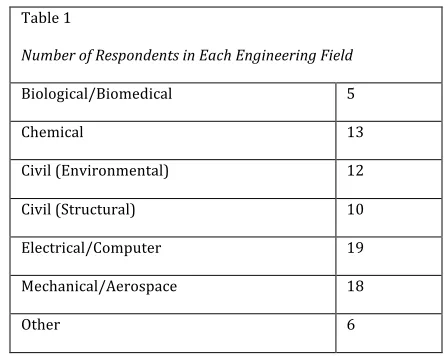
different enough to warrant separating the groups. The numbers of respondents in
each category were as follows:
Table 1
Number of Respondents in Each Engineering Field
Biological/Biomedical
5
Chemical
13
Civil (Environmental)
12
Civil (Structural)
10
Electrical/Computer
19
Mechanical/Aerospace
18
Other
6
Twenty of the professors are from private schools, and sixty‐three of
professors are from public institutions. While I did analyze this data, I had no
rationale or consistency amongst the data to draw conclusions. Thus, no
information will be reported in the results concerning this demographic.
The age groups of the professors were separated as follows: 20s‐30s, 40s,
find few professors in the 20s or 70s age groups in the university. Thus, we decided
to have more data in the high end and low end of age range data. Some respondents
chose not to enter their age. These respondents were not included in the analysis.
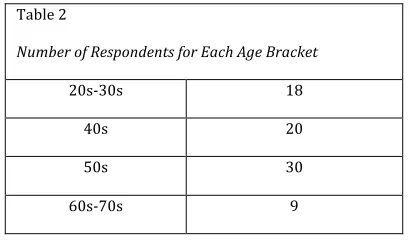
The number of respondents in each category were as follows:
Table 2
Number of Respondents for Each Age Bracket
20s‐30s
18
40s
20
50s
30
60s‐70s
9
The years of experience teaching engineering were determined in 10‐year
intervals and the years of experience as a career engineer was separated out in 5‐
year intervals. I anticipated that more professors would have more experience
teaching than working in an engineering field. Thus, I decided to have wider
intervals for academic experience than field experience. Specifically, the years of
experience teaching engineering were separated out from 0‐10 years, 11‐20 years,
21‐30 years, and greater than 30 years. The years of experience as a career
engineer were separated out 0‐5 years, 6‐10 years, 11‐15 years, and greater than 15
years.
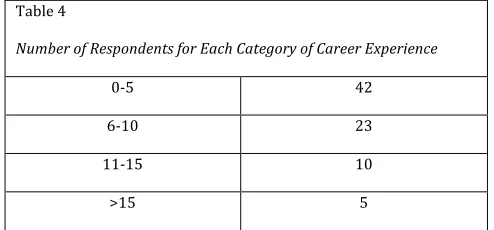
The numbers of respondents with the respective years of experience
importance to their coursework. I chose this 4‐point scale because I did not wish to
have an option that was undecided or neutral. I believed that a 4‐point scale would
create a clear separation of “yes” and “no” responses of significance. For each of the
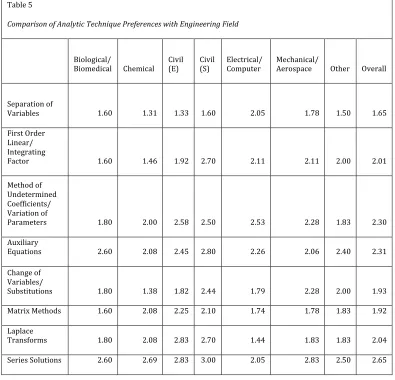
categories/questions, the results were averaged in order to rank the importance of
the topic or misconception to that particular group. Once all of the topics were
averaged, the topics were arranged in order from greatest importance (which
corresponded to the lowest score) to the least importance (which corresponded to
the highest score).
The survey questions about misconceptions being important to engineering
curricula were asked as “yes” versus “no” questions. The null hypothesis was that
the number of yes responses would equal the number of no responses. Then tests of
significance were performed to determine if the number of “yes” responses was
significantly lower than the number of “no” responses at the α =.05 significance
level.
The question that asked professors about a preference for correctness versus
student understanding was analyzed in a similar fashion as the misconception
questions. Instead of “yes” or “no,” they chose whether they preferred a correct
answer without understanding or incorrect answer with understanding. I noted in
these in my spreadsheet as “correct” and “incorrect,” and had each Excel
demographic spreadsheet count the number of “correct” and “incorrect” responses