Video Deblurring via Direct Patch Method
Keerthi G B1, Vijayakumar R2,
M.Tech. Student, Dept. of CSE, New Horizon College of Engineering, Bengaluru, India
Assistant Professor, Dept of CSE, New Horizon College of Engineering, Bengaluru, India
ABTRACT:Motion blur from camera shake is a major problem in videos captured by hand held devices. Shakycameras
often capture videos with motion blurs, especially when the light is insufficient. Unlike single image de-blurring, video based approaches can take advantage of the abundant information that exists across neighboring frames. In this paper, we present a framework that can restore blurry frames effectively by synthesizing the details from sharp frames. Our method compares a blur patch directly against sharp candidates, in which the nearest neighbor matches can be recovered with sufficient accuracy for the de-blurring. Moreover, to restore one blurry frame, instead of searching over a number of nearby sharp frames, we only search from a synthesized sharp frame that is merged by different regions from different sharp frames via an MRF-based region selection. This method achieves a very good quality with an improved efficiency and robustness.
KEYWORDS:Video de-blurring, blur patch, patch match, synthesis, nearest neighbors.
I. INTRODUCTION
Handheld video capture devices are now commonplace As a result, video stabilization has become an essential step in video capture pipelines, often performed automatically at capture time (e.g., iPhone, Google Pixel), or as a service on sharing platforms (e.g., YouTube, Facebook). While stabilization techniques have improved dramatically, the remaining motion blur is a major problem with all stabilization techniques. This is because the blur becomes obvious when there is no motion to accompany it, yielding highly visible “jumping” artifacts. In the end, the remaining camera shake motion blur limits the amount of stabilization that can be applied before these artifacts become too apparent. The most successful video de-blurring approaches use information from neighboring friends to sharpen blurry frames, taking advantage of the fact that most handshake motion blur is both short and temporally uncorrelated. By borrowing “sharp” pixels from nearby frames, it is possible to reconstruct a high quality output.
One of the main challenges associated with aggregating information across multiple video frames is that the differently blurred frames must be aligned. This can either be done, for example, by nearest neighbor patch lookup [4], or optical flow [6].
Video frames usually contain complementary information that can be exploited for de-blurring [2, 3, 17, 18, 19]. Cho et. al. [3] presented a framework that transfers sharp details to blurry frames by patch synthesis. Zhang et. al. [18] jointly estimated motion and blur across multiple frames, yielding de-blurred frames together with optical flows. Kim et. al. [19] focused on dynamic objects. However, all these methods estimate blur kernels and rely on them heavily for de-blurring, while the blur kernel estimation on casually captured videos is often challenging due to depth variations, noises, and moving objects.
The nearest neighbor match between image patches, referred to as “patch match” (PM) [20, 21, 22], finds the most similar patch for a given patch in a different image region. In our context, we divide a blurry frame into regular blur patches. For each blur patch, we find the most likely sharp patches in sharp frames to replace it. Therefore, the quality of de-blurring is dominated by the accuracy of PM. Traditional approaches [2, 3] estimate the blur kernel from the blurry frame and use it to convolve the sharp frames before PM. We refer this process as “convolutional patch match” (CPM).
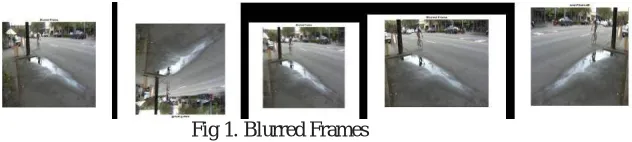
Fig 1. Blurred Frames
The thumbnail of 5 frames selected for experiment. The figure shows the blurred frames that we have got after video to image conversion. We are using these image frames as input frames. We will apply Magnitude Gradient Method and then find sharpness of the image which follows color wrapping. In summary, our contributions are:
• We propose to use DPM for a synthesis-based video de-blurring, which is free from the challenges of blur kernel
estimations and image deconvolutions.
• With pre-alignment and region selection, we only search in a limited search space, which highly accelerates the
whole system.
• We show that the pre-alignment not only reduces the search space, but also increases the accuracy of DPM.
II.LITERATURE SURVEY
Literature survey is the most important step in software development process. Before developing the tool it is necessary to determine the time factor, economy n company strength. Once these things r satisfied, ten next step is to determine which operating system and language can be used for developing the tool. Once the programmers start building the tool the programmers need lot of external support. This support can be obtained from senior programmers, from book or from websites. Before building the system the above consideration r taken into account for developing the proposed system.
1. Full-Frame Video Stabilization with Motion Inpainting:[1]
Matsushita et. all propose a practical and robust approach of videos stabilization that produces full frame stabilized videos with good visual quality. To achieve this, Motion Inpainting is used to enforce spatial and temporal consistency of the completion in both static and dynamic image areas. In addition, the image quality in the stabilized video is enhanced by a new practical deblurring algorithm.
2. Video Completion with Motion Inpainting:
The idea of motion Inpainting is propagating local motion, instead of color/intensity as in image Inpainting into the missing image areas. The propagated motion field is then used to naturally fill up missing image areas even for scene regions that are non-planar and dynamic.
Here, they propose a method to transfer the sharper pixels to the blurry pixels to increase the sharpness. It transfers pixels and replaces them by weighted interpolation. Thus it doesn’t increase the resolution of the frames but restores the resolution of the blurry frames.
3 Inter-Frame Information Transfer via Projection Onto Convex Set for Video Deblurring: [10]
In this work, Yizhen Huang and Na Fan propose a new method that projects the resulting image onto two convex sets: an observed constraint set in the spatial domain and a detail constraint set in the wavelet domain. This is a software-only solution widely applicable for and requiring no hardware change on the commercially available cameras. The method of Projection onto convex set (POCS): The main idea of POCS is to find an element of feasible set defined by their intersection of some convex constraints starting from an infeasible sub-optimal element. An advantage of POCS is its guaranteed convergence. POCS has a very successful application in the problem of demosaicking.
III. PROPOSED SYSTEM
A synthesis-based approach that neither estimates kernels nor performs deconvolutions. Specifically, first step is to locate all blurry frames in a video. For every blurry frame, we find the nearby sharp frames. To deblur one frame, we adopt a process of pre-alignment that roughly aligns all sharp frames to the target blurry frame before the DPM searching. Moreover, instead of search over all sharp frames, we only search over a synthesized sharp frame that is fused from different regions of sharp frames through an “Markov random field” (MRF) region selection that ensures the spatial and temporal coherence. Each blur patch will find one sharp patch, which is used to synthesize the deblurred frame. Notably, the key differences between our method and is that we do not estimate blur kernels and only search inmerged sharp frames. In summary, our contributions are:
• We propose to use DPM for a synthesis-based video deblurring, which is free from the challenges of blur kernel estimations and image deconvolutions.
•With pre-alignment and region selection, we only search in a limited search space, which highly accelerates the whole system.
•We show that the pre-alignment not only reduces the search space, but also increases the accuracy of DPM.
IV. IMPLEMENTATION
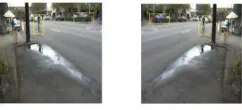
We first conduct an experiment to show the difference between CPM and DPM, both visually and numerically. In P-M, the “sum of squared differences” (SSD) is the commonly adopted metric in evaluating patch distances. We adopt this metric in our evaluation. We collect 5 blurry frames as well as their neighboring sharp frames from 5 videos, covering static/dynamic scenes, planar/variation depths. Fig. 1 shows the blurry and Fig. 2 shows the sharp frames. We collect
patches with size 6 × 6 for every two pixel in the blurry frame and assign the search region of 12 × 12 in the
corresponding position at the target sharp frame. We conduct the nearest neighbor search and record the best match index for both methods.
4.1 Pre-alignment
4.2 Feature extraction
In this step we are going to find sharpness of an image by gradient magnitude method and then we apply color wrapping for the sharp frame.
Fig 2. Sharp Frames
Sharpness of an image is obtained as follows:
1.Resize the input image 2.Input or read the image
3.Sharpness is obtained by following: i). Apply Gx & Gy
ii). Sobel Algorithm
iii). Edge or Corner detection iv). Sharpness is obtained
If the sharpness of the frame obtained is less than 5 then it is considered as a blur frame else it is a de-blur frame.
4.3 Direct Patch Method
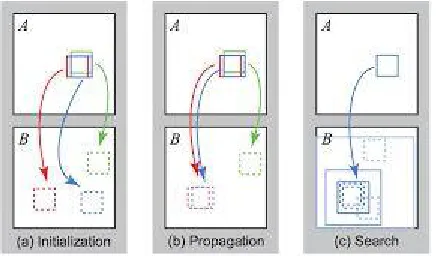
We apply Patch Match (PM) Algorithm to obtain de-blurred frame. The goal of the algorithm is to find the patch correspondence by defining a nearest-neighbor field (NNF) as a function of offsets, which is over all possible matches of patch (location of patch centers) in image A, for some distance function of two patches D. So, for a given patch coordinate a in image A and its corresponding nearest neighbor b in image B, f(a) is simply b-a. However, if we search for every point in image B, the work will be too hard to complete. So the following algorithm is done in a randomized approach in order to accelerate the calculation speed. The algorithm has three main components. Initially, the nearest-neighbor field is filled with either random offsets or some prior information. Next, an iterative update process is applied to the NNF, in which good patch offsets are propagated to adjacent pixels, followed by random search in the neighborhood of the best offset found so far. Independent of these three components, the algorithm also use a coarse-to-fine approach by building an image pyramid to obtain the better result.
For each blur patch, the L2 distance is calculated between indexes obtained by two methods. We further record the
averaged patch SSD. While the DPM method produces a larger SSD as compared with CPM in all examples, the index difference remains small. In fact, all we want are the correct indexes, instead of the actual SSD. Therefore, we adopt
DPM in our system as follows:
DPM:
1.Detect blurred frame based on sharpness
3.Average the area with the same pixel of previous and after frames
4.De-blurred Frame is obtained
Fig 3. Patch Match
4.4 Performance Analysis:
PSNR=10.log10 (MAX/MSE)
As Quality decreases, PSNR value decreases Where
MAX= Maximum Possible Pixel value of image
MSE= Mean squared error
Where MxN is Monochrome Image Noise Approximation is K
Fig 4. Performance Analysis
V. RESULTS
In fig1 given below shows the comparison of blurred frame, sharp frame and deblurred frame.
Blurred frame are obtained from the input video after converting to image frames so we can even call blurred
frame as input frame.
Deblurred frame is the output frame we get after applying direct patch method.
Fig 1: Comparison of Blurred frame, sharp frame and deblurred frame.
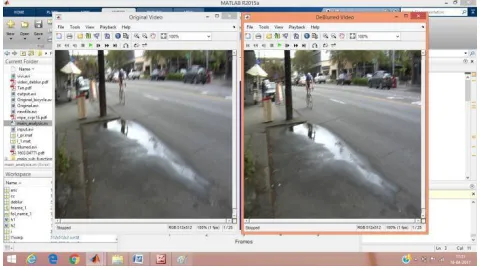
Fig 2 shows the difference between original video and deblurred video after implementing direct patch method .
Fig 2: original vedio and deblurred vedio
VI. CONCLUSION
We have implemented a Direct-patch method based video de-blurring frame-work that restores blurry frames from nearby sharp frames. We found that our proposed DPM can successfully approximate CPM and works well in practice. Without forward convolution or deconvolution, our method is simple yet effective. We use the pre-alignment and the sharp map to reduce the search space, which not only increase the efficiency but also improve the accuracy of DPM. Moreover, the proposed method is scalable for parallel computing. Its robustness has been tested over various challenging videos.
REFERENCES
[1] Y. Matsushita, E. Ofek, W. Ge, X. Tang, and H. Shum, “Full-frame video stabilization with motion inpainting,” IEEE PAMI, vol. 28, pp. 1150– 1163, 2006.
[2] Y. Huang and N. Fan, “Inter-frame information transfer via projection onto convex set for video deblurring,”IEEE J. of Selected Topics in Signal Processing, vol. 2, no. 5, pp. 275–284, 2011.
[4] S. Cho and S. Lee, “Fast motion deblurring,” in ACM TOG, 2009, vol. 28, p. 145.
[5] R. Fergus, B. Singh, A. Hertzmann, S. Roweis, and W. Freeman, “Removing camera shake from a single photograph,” ACM TOG, vol. 25, no. 3, pp. 787–794, 2006.
[6] Q. Shan, J. Jia, and A. Agarwala, “High-quality motion deblurring from a single image,” ACM TOG, vol. 27, no. 3, pp. 73, 2008. [7] L. Xu and J. Jia, “Two-phase kernel estimation for robust motion deblurring,” in ECCV, pp. 157–170. 2010.
[8] O. Whyte, J. Sivic, A. Zisserman, and J. Ponce, “Non-uniform deblurring for shaken images,” IJCV, vol. 98, no. 2, pp. 168–186, 2012. [9] M. Hirsch, C. J Schuler, S. Harmeling, and B. Scholkopf,¨“Fast removal of non-uniform cam-era shake,” in ICCV, 2011, pp. 463–470.
[10] S. Cho, Y. Matsushita, and S. Lee, “Removing non-uniform motion blur from images,” in ICCV, 2007, pp. 1–8.
[11] Z. Hu and M.-H. Yang, “Fast non-uniform deblurring using constrained camera pose subspace.,” in BMVC, 2012, pp. 1–11. [12] L. Xu, S. Zheng, and J. Jia, “Unnatural l0 sparse representation for natural image deblurring,” in CVPR, 2013, pp. 1107–1114. [13] H. Zhang and D. Wipf, “Non-uniform camera shake removal using a spatially-adaptive sparse penalty,” in NIPS., 2013, pp. 1556–1564. [14] S. Su and W. Heidrich, “Rolling shutter motion deblurring,” in CVPR, 2015, pp. 1529–1537.
[15] A. Levin, Y. Weiss, F. Durand, and W. Freeman, “Efficient marginal likelihood optimization in blind deconvolution,” in CVPR. IEEE, 2011, pp.2657–2664.
[16] L. Yuan, J. Sun, L. Quan, and H. Shum, “Progressive inter-scale and intra-scale non-blind image deconvolution,” ACM TOG, vol. 27, no. 3, pp.74, 2008.
[17]K. Sunkavalli, N. Joshi, S.B. Kang, M. Cohen, and H. P fister, “Video snapshots: Creating high-quality images from video clips,” IEEE TVCG, vol. 18, no. 11, pp. 1868–1879, 2012.
[18] H. Zhang and J. Yang, “Intra-frame deblurring by leveraging inter-frame camera motion,” in CVPR, 2015, pp. 4036–4044. [19] T. Kim and K. Lee, “Generalized video deblurring for dynamic scenes,” in CVPR, 2015, pp. 5426–5434.
[20] C. Barnes, E. Shechtman, A. Finkelstein, and D. Gold-man, “Patchmatch: A randomized correspondence algorithm for structural image editing,”
ACM TOG, vol. 28, no. 3, pp. 24, 2009.
BIOGRAPHY
Ms Keerthi G B. M.Tech Student, Dept of Computer Science and Engineering in New Horizon College of Engineering, which is located in Outer Ring Road, Panathur Post, Kadubisanahalli, Bangalore – 560087.
Mr. Vijayakumar R. Assistant professor, Dept. of Computer Science and Engineering in New Horizon College of Engineering, which is located in Outer Ring Road, Panathur Post, Kadubisanahalli, Bangalore – 560087.