ABSTRACT
MISHRA, SHOBHIT. Design and Implementation of Process Migration and Cloning in BLCR. (Under the direction of Frank Mueller.)
The reliability of a high performance computing (HPC) environment deteriorates with
an increase in the number of nodes. For large applications, a failure results in the loss
of several hours of execution time. Today, we use application checkpointing to deal with intermittent failures. Applications are restarted from the last checkpoint if a failure
occurs. However, checkpoint/restart (C/R) is a reactive approach of fault tolerance and
results in high overheads for a large application.
We suggest a proactive approach of fault tolerance by migrating a process from a failing
node to a healthy node. We describe two different mechanisms to move a process from
one physical node to another. In first approach, we halt the process at the failing node
and transfer it to the destination node via sockets. This approach is known as frozen
migration. The second approach, known as live migration, allows the process to run while
the migration is being carried out. We can allow the process to run at the source node as well as the destination node thus creating a process clone. We rely on an external
agent to detect any imminent failure and trigger the migration process. We use a small
kernel patch to keep track of modified pages. The work is carried out within the latest
release of the Berkley Labs Checkpoint Restart (BLCR) code. The migration utilities
will be integrated into BLCR in future releases. Experimental results demonstrate the
significance of these proactive fault tolerance techniques to improve the reliability in HPC
c
Copyright 2011 by Shobhit Mishra
Design and Implementation of Process Migration and Cloning in BLCR
by Shobhit Mishra
A thesis submitted to the Graduate Faculty of North Carolina State University
in partial fulfillment of the requirements for the Degree of
Master of Science
Computer Science
Raleigh, North Carolina
2011
APPROVED BY:
Xiaohui (Helen) Gu Steffen Heber
Frank Mueller
DEDICATION
BIOGRAPHY
Shobhit Mishra was born in Ghazipur, a small town in the state of Uttar Pradesh in
India. He did his schooling in Ghazipur and went to Indian Institute of Information
Technlogy Allahabad for his B.Tech in Information Technology. He joined CSC India Pvt. Ltd. as a System Administrator and worked there for three years. He came to NC
State in Fall 2009 as a Master’s student in the department of Computer Science. He has
ACKNOWLEDGEMENTS
This work would not have been possible without the collective effort of a lot of people.
First and foremost, I would like to thank my advisor Dr. Frank Mueller for showing
confidence in me and giving me the opportunity to work on this project. His guidance and feedback put me on the right track from time to time. I would like to thank Paul
H. Hargrove at Lawrence Berkley National Laboratory for acting as my mentor. He was
always there to help me when I hit an impasse. I am thankful to Dr. Helen Gu and
Dr. Steffen Heber to serve on my committee. I would also like to thank Chao Wang and
Manav Vasavada for their foundation work on this project. Lastly, I would like to thank
TABLE OF CONTENTS
List of Figures . . . vii
Chapter 1 Introduction . . . 1
1.1 High Performance Computing (HPC) . . . 1
1.2 Fault Tolerance . . . 2
1.3 Berkley Labs Checkpoint Restart (BLCR) . . . 2
1.4 MPI . . . 4
1.5 Extensions to BLCR . . . 4
Chapter 2 Motivation, Hypothesis and Contribution . . . 6
2.1 Motivation . . . 6
2.2 Hypothesis . . . 7
2.3 Contribution . . . 7
Chapter 3 Design . . . 8
3.1 Added Utilities . . . 8
3.2 Steps of Migration . . . 9
Chapter 4 Implementation . . . 12
4.1 Initialization and Restoration: . . . 12
4.2 Memory Precopy: . . . 16
4.3 Stop-and-Copy: . . . 18
Chapter 5 Experiments . . . 23
5.1 Framework . . . 23
5.2 Experiments . . . 23
5.2.1 Instrumentation Techniques . . . 23
5.2.2 Memory Tests . . . 24
5.2.3 Other Tests . . . 26
Chapter 6 Related Work . . . 28
Chapter 7 Conclusion and Future Work . . . 30
7.1 Conclusion . . . 30
7.2 Future Work . . . 30
7.2.1 Integration with OpenMPI . . . 31
7.2.2 Cloning . . . 31
7.2.3 Using WB Approach . . . 31
LIST OF FIGURES
Figure 1.1 Application running with and without checkpointing . . . 3
Figure 3.1 Overall flow of the process migration . . . 11
Figure 4.1 Overall flow of the cr restore utility . . . 13
Figure 4.2 Dirty bit tracking scheme . . . 17
Figure 4.3 Migration with precopy . . . 19
Figure 4.4 Migration without precopy . . . 20
Figure 4.5 Sequence of data sent during precopy . . . 22
Figure 4.6 Sequence of data sent during stop-and-copy . . . 22
Figure 5.1 Stop-and-Copy Timings with a Stride of One . . . 25
Figure 5.2 Stop-and-Copy Timings with a Stride of Ten . . . 25
Chapter 1
Introduction
1.1
High Performance Computing (HPC)
HPC uses several parallel processing techniques to solve advanced computational prob-lems quickly and reliably. HPC is widely used in scientific computing applications like
weather forecasting, molecular modeling, complex system simulations, etc. Traditional
supercomputers are custom made and very expensive. A cluster, on the other hand,
consists of loosely coupled off-the-shelf components.
Special programming techniques are required to exploit HPC capabilities. The most
common programming paradigm in such machines is message passing. Each node is
al-located a small part of the overall problem and they communicate through coordinated
message passing. Message Passing Interface (MPI) implementations provide
scalabil-ity and portabilscalabil-ity without compromising performance and is the de-facto standard for
HPC applications. There are several MPI implementations available today. OpenMPI [13], MPICH [3], and WINMPICH [19] are some of the most common implementations.
Since the frequency scaling in a uniprocessor system has hit a wall, more and more
researchers are turning to HPC for scientific computations. As of June 2011, ten
su-percomputers have crossed the Petaflop barrier in max performance and thirteen have
crossed in peak performance [1]. Development of parallel applications, however, is
sig-nificantly different from sequential programming. More and more applications are being
1.2
Fault Tolerance
A fault may be defined as a deviation from normal or expected behavior such that it
causes an application failure. A fault marks an underlying inconsistency in the hardware
or software. Software faults are caused by application or operating system bugs.
Hard-ware faults may occur because of the hardHard-ware component failure or due to hardHard-ware
limitations. Such faults include but not limited to I/O error, faulty RAM, network
fail-ure, disk corruption, and machine overheating. In our work, we mainly focus on fail-stop hardware failures that can be detected by an external monitoring agent.
Since the advent of Supercomputers, the number of cores in HPC machines has
bur-geoned into hundreds of thousands of cores. Huge scientific applications like climate
modeling and molecular modeling with highly parallelized algorithms can take several
hours to complete. A number of HPC clusters use off-the-shelf components to achieve
this massive computational power. Reliability data of contemporary machines indicates
the frequency of failure in large installations. The mean time between failure (MTBF) is
in the range of 6.5 to 40 hours [16]. This points to the high probability of a job failure due
to hardware/software failures during execution. For large processes, a job failure may lead to restarting the process from the beginning and thus wasting a significant amount
of processing time. In addition to processing delays, this would also result in excessive
use of power for duplicate computation.
Fault tolerance may be defined as the ability of a system to complete the designated task
in the presence of hardware and software failures. It also includes graceful degradation
and sensible program termination. It involves detecting the error and taking appropriate
measures to handle it. There may be several fault tolerance actions like exiting the
pro-gram and error reporting or continuing the execution on a different node. An efficient
fault tolerance policy can save significant execution time and drastically reduce the power
consumption.
1.3
Berkley Labs Checkpoint Restart (BLCR)
There are many approaches to enable fault tolerance in an HPC environment. One of the
widely used methods is Checkpoint/Restart (C/R). C/R involves saving the context of a
job/application at regular intervals and restarting the application from a saved context
the job from scratch.
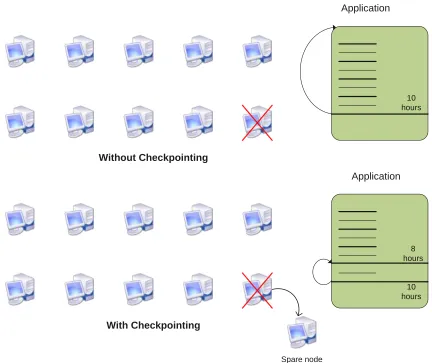
For example, consider an application with 10 nodes and 15 hours of execution time.
Further assume a checkpoint scheme to save the application context every hour. If the
application fails after 10 hours then we restart the application from the last checkpoint
instead of running it again from the beginning. See figure 1.1.
10 hours
Application
Without Checkpointing
10 hours
Application
With Checkpointing
Spare node
8 hours
Figure 1.1: Application running with and without checkpointing
the Future Technologies Group at Lawrence Berkley National Laboratory (LBNL). It is a
robust, production-quality implementation that checkpoints a wide range of applications.
It does not require any change in the application source code and works for several
architectures and Linux distributions. BLCR has been integrated with a number of
MPI implantations namely LAM/MPI, OpenMPI and MPICH to checkpoint and restart
parallel applications running on multiple nodes. Researchers at North Carolina State
University have been working on various extensions of BLCR [33] [34] [35].
1.4
MPI
The Message Passing Interface (MPI) is an application programming interface (API) that
allows processes to communicate with each other by passing messages. It is widely used
in the HPC environment and is a de-facto standard for parallel programming in computer
clusters and supercomputers. In the MPI programming model, a computation comprises
one or more processes that communicate by sending and receiving messages. Processes
can use point-to-point or collective communication operations to send a message. MPI
also has message probe routines to support asynchronous communication. In most MPI
implementations, a fixed number of processes are created at program initialization. All these programs together are referred as a job in a cluster. MPI uses language independent
specifications for calls and language bindings.
1.5
Extensions to BLCR
Checkpoint and restart of a parallel application has its own overheads. These overheads
are directly proportional to the number of nodes involved. They also depend on disk I/O
speed, network bandwidth and the size of the application. The size of the checkpoint file depends on the size of the application and the frequency of checkpoints. Large
applications tend to have a higher checkpoint frequency that results in considerable disk
and bandwidth overhead.
To reduce the checkpoint/restart overhead, several extensions are designed for BLCR at
the NCSU systems research group. The first extension is an in-place rollback feature in
BLCR to reduce the overhead by reusing existing resources at the time of restart. The
by saving only the modified pages. The third extension is live migration of a process
from one node to another using network sockets. This extension works via node-to-node
transfer i.e. there is no need to save the context file on a disk. Instead of checkpointing
the complete job, it moves a single process from a node to another node thus saving the
disk usage and bandwidth. We shall look at this extension in later sections.
In this thesis, we propose two different methods of moving a process from one physical
node to another node. We propose an approach to stop a process at one node and migrate
it to the other node. We use several BLCR library functions and techniques to do so.
We also propose an alternative approach to allow the process to run at the source node
while it is being migrated to the destination node. We can choose to kill the process at the source node once migration is complete or to let it run on the source as well as
the destination node. The second method is also known as cloning. We also propose a
modular approach for the implementation of the two approaches that would allow the
Chapter 2
Motivation, Hypothesis and
Contribution
2.1
Motivation
We have worked on several extensions of BLCR. The first extension was an in-place
process rollback. On any failure, BLCR kills all the processes and moves the checkpoint
image of the failing process to a spare node and restarts the application from the previous
checkpoint. Since we kill even the healthy processes and resubmit the entire MPI
appli-cation again, this method has a significant overhead in terms of time because other jobs
in the queue will be executed before this resubmitted job gets a time slice. The second
extension was incremental checkpointing. Incremental checkpointing checkpoints only the modified pages since the last checkpoint. It only stores the difference between two
checkpoints instead of two full fledged checkpoint files. Incremental checkpointing helps
in saving disk space and optimizes I/O bandwidth. There are two methods to identify
the modified pages name by the dirty bit approach and the write bit approach. The dirty
bit approach requires a small kernel patch to access the dirty bit information maintained
by kernel. The write bit approach uses page protection mechanisms to trigger a signal
when a page is modified.
Although these two approaches have several advantages compared to a na¨ıve approach,
they still are a reactive approach of fault tolerance. They help in application recovery once the fault has already occurred. The third extension to BLCR is frozen/live
fault prediction agent to detect deteriorating health of a node and to then trigger the
migration process. We assume that the agent is able to predict the failure of the node and
to subsequently take proactive measures such as process migration. The idea is to move
the process from the bad node to a healthy node via network sockets without creating any
checkpoint file. This significantly reduces disk space requirement and avoids slow disk
access for large network files. Instead of saving the process data on a disk and restoring
it, we do the restoration on the fly. In fact, the application stops just for a fraction of
a second before resuming execution instead of coming to a complete halt before
resum-ing the execution from a checkpoint file. We have implemented two different flavors of
migration, namely frozen and live migration. Frozen migration stops the process at the source node and transfers all the process-related information in one pass. Live migration,
on the other hand, transfers the memory pages to the destination node before stopping
the process and saving the rest of the process control block. In live migration, memory
pages are transferred iteratively. In each iteration, only modified pages since the last
iteration are transferred to the destination node. We identify dirty pages using the dirty
bit approach as mentioned above. We will discuss the design and implementation details
in the following sections.
2.2
Hypothesis
We hypothesize that we can migrate a process from one physical node to another node
via sockets while the application is running, which has the potential to result in lower
overall runtime than stopping an application before migrating it. We can also create a
copy of the process on two nodes thus creating a process clone. These mechanisms, once
integrated with MPI run time, can aid the traditional C/R approach to provide proactive
fault tolerance mechanisms.
2.3
Contribution
We present the design and implementation of a process migration scheme at the kernel
level which does not require any application-level modifications. We use the dirty bit
scheme to track modified pages. It requires a small kernel patch to access the dirty bit
Chapter 3
Design
This section describes the design details of migration in BLCR. One of the basic design
principles is to integrate the migration utility with BLCR with minimal changes in the
original source code. We have reused a significant amount of BLCR functionality and
modified it for better suitability on the migration utility. The BLCR C/R utilities are
completely independent of the migration utility. They should work seamlessly when integrated with live/frozen migration in the upcoming release.
3.1
Added Utilities
We have added the following user- level utilities in BLCR:
• cr migrate: This utility is invoked at the source node to start the live migration of a process. It takes the PID of the process and the destination node as input. It is invoked only if we want to trigger a live migration of the process.
• cr restore: This utility is invoked at the destination node. It has to be running on the destination node before any migration utility is invoked at the source node. A switch decides if the restore corresponds to live migration or frozen migration.
• cr stop: This utility is invoked at the source node in two cases. It is invoked when the cr migrate utility returns or when we choose frozen migration instead of live migration. It takes the pid, a destination node and a live switch as arguments.
of the process at the destination node. This utility also takes the pid, a destination
node and a live switch as arguments.
These utilities are developed independently of the cr checkpoint, cr restart and cr run
utilities of BLCR. The cr migrate and cr stop utilities are very similar to cr checkpoint.
Yet, instead of writing to the checkpoint file, they write to a socket connected to the
destination node. One of the main design aspects is to keep the code modular and
provide sufficient entry points to call MPI-related functions in the overall execution. We
have to provide synchronization in both the kernel module and at the MPI level.
Once we determine that a node is failing, we need to find a spare node to which the process can migrate. If there is not a spare node then we can overload the least overloaded
machine/node by migrating the process to it.
3.2
Steps of Migration
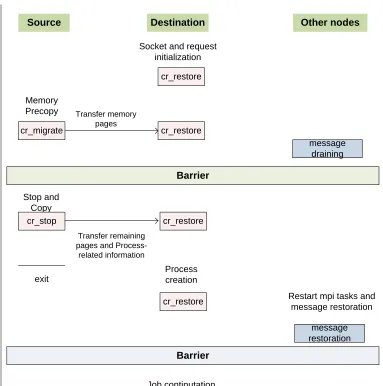
Initialization at the Destination Node: Once a destination node is identified, an external
scheduler invokes the restoration utility. We assume that we have enough spare nodes
in the cluster that can be used as a default destination during process migration. This can be ensured by over provisioning of nodes at the time of job submission. If no spare
node is available then the least loaded node can be chosen as the destination node. The
restoration utility allocates the data structure for process restoration and establishes a
socket communication with the source node. This utility should be invoked at the
desti-nation node before invoking any migration command at the source node.
Memory Precopy: Once a destination node is identified and the socket commu-nication is established, we can start the transfer of pages to the destination node. The
objective of the memory precopy is to transfer a memory snapshot of the process to the
spare node while allowing the application to run. The memory transfer occurs at page granularity. Memory pages are sent to the destination node iteratively until we reach a
steady state. In the first iteration, all non-zero pages are sent to the destination node.
In every subsequent iteration, only the modified pages since the last iteration are sent to
the destination node. The loop terminates when the change in the number of modified
pages between consecutive iterations drops below a threshold level or there are no more
section of memory precopy. This step is carried out by the cr migrate utility.
Message Draining: Once the precopy step is complete, we have to stop the process at the source node and transfer the last pages and other process-related information to
the destination node. But before doing that, all MPI tasks need to reach a consistent
global state. We need to drain all in-flight messages, and all MPI tasks should stop at
a barrier. Message draining and other MPI-level synchronization are independent of the
BLCR and implemented by the MPI library. A corresponding handler is invoked from
all nodes once cr migrate returns. This capability is yet to be integrated.
Stop-and-Copy: Once all MPI tasks hit the barrier, the process on the source node suspends the application execution and copies the remaining pages, the process state,
de-scriptors of open files, linkage information, pipes and other process-related information
to the destination node. All MPI tasks are suspended until stop-and-copy is finished.
The process keeps running at the source node if cloning is enabled or exits if cloning is
disabled. This task is accomplished by the cr stop utility at the source node. If the live
migration switch is on then cr stop is preceded by a cr migrate invocation otherwise, it
runs alone after the message draining stage has completed.
Process Restart and Job Continuation: The process is reconstructed at the destination node. Linkage structure, open files and pipes are restored. This is the last
step of process migration followed by the restoration of communication channels and
drained messages. This task is accomplished by the cr restore utility at the destination
node. This utility works similarly to the cr restart with the exception of the use of
sockets instead of a file descriptor to read/receive a process image. There is no deliberate
synchronization between cr migrate, cr stop and cr restore. The cr restore command
recreates the process and returns. Restored process execution is separate from the cr
-restore context. When the process is ready on the destination node, it reestablishes the communication channel with all other MPI tasks. Subsequently, the drained in-flight
messages are restored and the job continues. We shall have two copies of the process if
clowning is enabled. In that case, we need to take care of the redundancy as MPI cannot
accommodate two processes with the same signature.
Source Destination Other nodes
Socket and request initialization
cr_restore
Memory Precopy
cr_migrate
Transfer memory pages
message draining
Barrier
Stop and Copy cr_stop
Transfer remaining pages and Process-related information
exit
Process creation
Restart mpi tasks and message restoration
message restoration
Barrier
Job continutation
Timeline
cr_restore
cr_restore
cr_restore
Chapter 4
Implementation
This section describes the implementation details of different utilities referenced in the
previous section. We depict the code flow of these utilities and describe the user-level
and kernel-level interaction. We also mention the code changes in the standard BLCR
library. We tried to keep changes to the existing code to a minimum. We added several
new structures, e.g., ioctl macros and functions, to the BLCR library.
4.1
Initialization and Restoration:
The cr restore utility performs the initialization at the destination node. A switch decides
if the restore corresponds to live migration or frozen migration. The cr restore is a user
level utility that interacts with BLCR via the ioctl interface. We added ioctl macros for
restore calls in blcr ioctl.h. blcr ioctl.h consists of all the ioctl macros corresponding to
the commands of user level utilities. The cr restore performs the following operations at
the user level:
1. It builds the user level restore request by populating the cr restore arguments
struc-ture. It connects to the kernel and issues the restoration request using cri syscall
function as cri syscall(CR OP RESTORE REQ, (uintptr t)&req).
2. The cr restore utility then performs a fork and the child process calls the restore
-child main function. The parent process, however, waits for the restoration to
3. The parent process then fills in the signal structure and performs a reap on the
restoration request. The child process issues the RESTORE CLONE and
RE-STORE CHILD request via the ioctl interface before exiting.
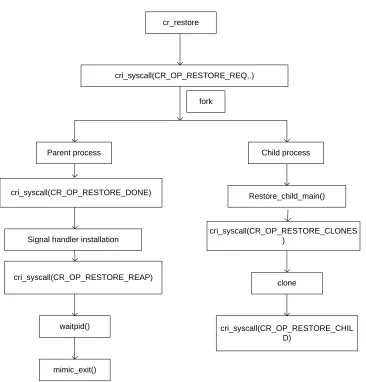
These functions are invoked at the user level. They, in turn, call their kernel level counterparts. The overall flow of cr restore is depicted in Figure 4.1.
cr_restore
cri_syscall(CR_OP_RESTORE_REQ,.)
Parent process Child process fork
cri_syscall(CR_OP_RESTORE_DONE) Restore_child_main()
Signal handler installation
cri_syscall(CR_OP_RESTORE_REAP)
cri_syscall(CR_OP_RESTORE_CLONES )
clone
cri_syscall(CR_OP_RESTORE_CHIL D)
waitpid()
mimic_exit()
cri syscall(CR OP RESTORE REQ, (uintptr t)&req) sends a restore request to the
kernel module. Every ioctl request is intercepted by ctrl ioctl function defined in cr
-fops.c. The ctrl ioctl function matches the ioctl request with the corresponding function.
It calls the cr restore request function at CR OP RESTORE REQ ioctl call. The cr
-restore request function initializes the kernel level -restore request and creates a socket.
It issues a series of blocking read calls to receive the data from the source node. It
first reads the number of threads in the migrated process, then copies this value in the
restore request and returns. The restore child main function performs the task of thread
creation by invoking the clone system call. It calls the cri syscall(CR OP RESTORE
CLONES) function in a loop to create the required number of threads. The cr restore -clones function decrements the clone needed variable and allocates a one page stack
to every cloned process. The restore child main function then calls the cr restore child
function, which populates the remaining fields of restore request and calls cr start self
function. Subsequent process restoration is performed by the cr start self function in the
following steps:
1. The cr start self function reads the linkage structure sent by the source node and
allocates the memory for linkage structure. The linkage structure of a process
consists of pid, ppid, session information, group leader information and process
group information.
2. It then reserves the pid, tgid and session ids to create the process. BLCR tries to
create the process with same pid and tgid if possible. If the requested pid and tgid
is not available, then it fails with an error message.
3. The third step is to restore the credentials of the process. Credentials include
userid and group id. The userid and groupid are received from the source node and
the exact same values are used for calls to the sys setresuid and the sys setresgid
functions.
4. The fourth step is to restore the register values and map the received pages into the
process address space. This is achieved by the virtual memory area dumper
(vmad-ump) interface integrated in the BLCR. Vmadump assumes that it is operating on
the thread-specific requirement from the process wide requirement. The mechanism
of register restoration and page mapping involves the following steps:
(a) The ’cpu registers’ restoration is triggered by the start vmadump thaw threads
function. This function is called by all the threads in the process. All the threads but one wait at the barrier while one thread performs the actual
restoration and page mapping.
(b) The thaw threads function calls the start vmadump thaw proc function, which
receives the pages from the source node and maps them to the current process.
(c) The thaw proc function then calls the start vmadump restore cpu function,
which restores the register values. This function is highly dependent on the
architecture. We provide two versions of this function corresponding to the
i386 and the x86 64 architectures.
5. The cr start self function then tries to restore the linkage information of the
pro-cess. This is one of the most crucial steps for the restoration of a multi-threaded
application. This part of the code is susceptible to kernel changes. This task is
carried out by the cr start restore linkage function in the following way:
(a) It stops the process at a barrier so that none of the threads try to execute
until the process linkage is restored.
(b) It iterates through the task list of the restore request and manually restores
the parent and real parent values.
(c) It then restores the group leader value for every task.
(d) It removes the process linkage of the thread group leader by unhashing it. It
then attaches the pid and tgid value of the task. Subsequently, the process
group and session leader information is restored. We finally restore the self
-exec id and parent -exec id.
(e) The pid, tgid and exec ids are restored for the non-group leader tasks.
6. The sixth step is to restore the fs struct of the migrated process. The cr start
-restore fs struct function -restores the umask, reads the current working directory
7. Open files are restored at last by the cr start restore all files function. This function
loads the file structure by reading from the socket. It uses this information to
retrieve the file type. It then tries to restore open file, open directory, open link,
open socket, open fifo, open chr, open blk and open dup.
4.2
Memory Precopy:
Memory precopy is performed at the source node by the cr migrate utility. Memory pages
constitute the maximum amount of the process related data. The idea is to transfer the memory pages to the destination node while the process is still running at the source node.
The cr migrate utility connects to the kernel and issues a migration request invoking the
cr migrate req function. The cr migrate req function builds the migration request and
raises a signal indicating a migration request. This signal is then caught and handled in
the user space by the cri sig handler function defined in cr core.c. The cri sig handler
calls a handler corresponding to the request. For a migration request, it calls the do
-create manager thread function. This function -creates the precopy thread to transfer the
memory pages to the destination node. The precopy thread performs the following tasks:
1. The precopy thread creates a socket and connects to the destination node.
2. It then issues an ioctl call to access the number of threads associated with the
process and writes this information to the socket.
3. It counts the number of memory maps by issuing another ioctl call and sends it to the destination node.
4. The precopy thread then starts sending the memory pages in an iterative manner.
In the first iteration, it sends all the pages to the destination node and clears the
dirty bit.
5. In every subsequent iteration, it sends only the modified pages since the last
iter-ation to the destiniter-ation node and clears the dirty bit. It keeps iterating until the
dirty page count and the difference between the dirty page count in two subsequent
iterations is greater than 256.
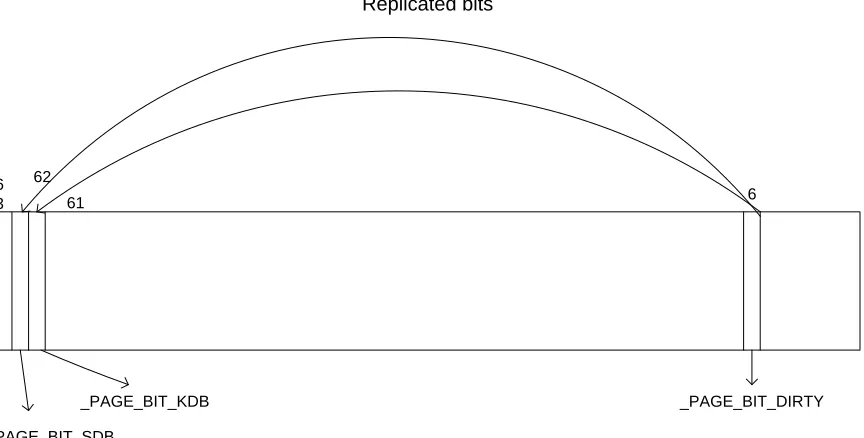
We use the dirty bit approach to keep track of dirty pages. It uses a kernel patch to
copy the dirty bit maintained by the kernel to the user space [27]. The kernel uses the
dirty bit to keep track of modified pages. The patch uses the free bits in the page table
entry (PTE) to maintain the status of the dirty bit for a given page.
Replicated bits
6 61
6 3
62
_PAGE_BIT_DIRTY _PAGE_BIT_SDB
_PAGE_BIT_KDB
Figure 4.2: Dirty bit tracking scheme
As shown in Figure 4.2, Linux uses a bit to keep track of modified pages. The patch
replicates this bit into two unused bits of the page table entry. The PAGE BIT KDB
maintains the kernel state of the dirty bit while PAGE BIT SDB maintains the user
state of the dirty bit. The kernel bit maintains the consistency of the dirty bit and
returns its value for the last access. The user bit, however, maintains the state of the
dirty bit between two function calls. This patch provides the DB test and clear macro
to test the dirty bit of a page and reset it. We use this macro in the is dirty function to
4.3
Stop-and-Copy:
Once all the MPI tasks reach a consistent global state, the process on the source node
freezes, sends the remaining pages, the process state, descriptors of open files, linkage
information, pipes and other process-related information to the destination node. The
cr stop utility signals the process on the source node to freeze the execution. Threads
of the process subsequently copy their state information to the destination node. This
task is performed inside the kernel. We can invoke the cr stop utility without the prior invocation of cr migrate on the source node thus avoiding the memory precopy phase.
However, there are tradeoffs between frozen migration and the alternative live migration,
which allows precopy with continued application progress. Live migration comes at the
expense of background network activity although it may result in an overall shorter
application downtime. There is also a high probability of repeated transmission of dirty
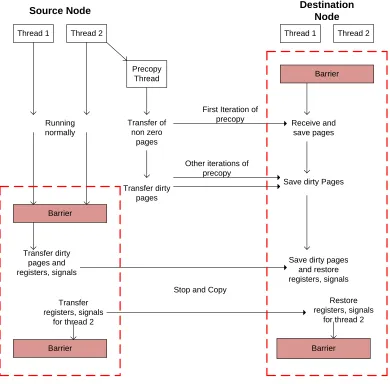
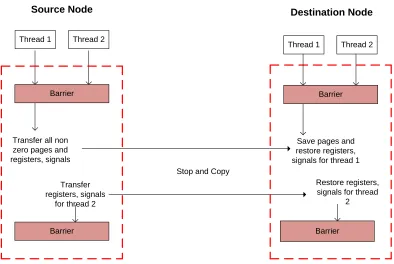
pages. Figures 4.3 and 4.4 show the steps in live and frozen (without memory precopy)
migration.
The cr stop command signals the process on the source node to stop the execution
and send the dirtied pages in the last iteration of the precopy step to the destination node. Threads of the process then take turns to send their state information. These tasks
are performed inside the Linux kernel. The lower half of the Figure 4.3 illustrates these
steps. The cr stop issues the stop request via an ioctl call and waits until it is complete.
The stop request triggers the following actions:
1. It allocates a task request, builds a task list and calls the cr trigger stop1 function.
The stop request is handled by the cr stop req function defined in cr stop req.c.
2. The trigger function populates a siginfo structure to uniquely identify the stop
request and raises the signal. We use the si uid field in the siginfo structure to
identify different types of requests. For example, the si uid value of the stop request
is 936316 while the si uid value of the migrate request is 936315.
3. The signal is caught and handled by the cri sig handler function defined in cr core.c.
The handler function calls the do stop function for a stop request. Since the handler
executes in user space, do stop issues another ioctl call to make the transition to
the kernel space. The do stop function calls the cri syscall(CR OP HAND STOP,
flags) function, which in turn invokes the cr stop and copy self function defined in
Source Node Destination Node
Thread 1 Thread 2
Precopy Thread
Transfer of non zero
pages
Thread 1 Thread 2
Barrier
Receive and save pages
Transfer dirty pages
Save dirty Pages First Iteration of
precopy
Other iterations of precopy Running normally Barrier Transfer dirty pages and registers, signals
Save dirty pages and restore registers, signals
Transfer registers, signals
for thread 2
Restore registers, signals
for thread 2
Barrier Barrier
Stop and Copy
Kernel Mode in Dotted Frame
Figure 4.3: Migration with precopy
4. The cr stop and copy self function locates the current process to find the matching
stop request. The process then hits the predump barrier and calls the cr do stop
-vmadump function.
step-by-Source Node Destination Node
Thread 1 Thread 2
Thread 1 Thread 2
Barrier Barrier
Transfer all non zero pages and registers, signals
Save pages and restore registers, signals for thread 1
Transfer registers, signals
for thread 2
Restore registers, signals for thread
2
Barrier Barrier
Stop and Copy
Kernel Mode in Dotted Frame
Figure 4.4: Migration without precopy
step manner. It first calls the cr stop save linkage function, which connects to
the destination node and writes the process linkage structure. The process linkage
includes the parent, real parent, group leader, session, leader, pid, tgid, pgrp, exit
-signal and the file pointer associated with the stop request. If the stop request is
not preceded by the memory precopy step then it sends the task count to the
destination node before sending other process-related information. The task count
is equal to the number of threads in the process.
6. We send the credential information to the destination node once the save linkage function returns. The credential information includes uid, euid, suid, gid, egid and
sgid. We use the cr context creds structure defined in BLCR to store these fields.
7. The stop vmadump function then calls the stop vmadump freeze threads function,
which is similar to the vmadump freeze threads function in the standard BLCR
code. The stop version of this function works on a socket instead of a file descriptor.
8. The freeze thread function calls the stop vmadump freeze proc function, which
stops the process execution, writes the memory info to the socket and starts
copy-ing pages to the destination node. The page copycopy-ing process is very similar to
the memory precopy stage but instead of performing it iteratively, we copy all the
pages in one pass.
9. The next step is to copy the register information. This task is carried out by stop vmadump store cpu function. We have two different versions of the store cpu
function. One version is for i386 architecture while the other version handles the
dumping request for x86 64 architecture.
10. The freeze proc function then writes the signal information and other miscellaneous
information to the socket and returns.
11. The freeze threads function return value indicates the completion of register and
signal writing to the socket. The next function is stop cr save fs struct to save the
umask and current working directory of the current process.
12. The next step is to save all open files. This step is carried out by the stop cr
-save all files function. This function iterates through all file descriptors held by
the process, saves the corresponding file header and file info. It then calls different
functions based on the file information. In the current version of BLCR, we save
open files, directories, fifo and pipes.
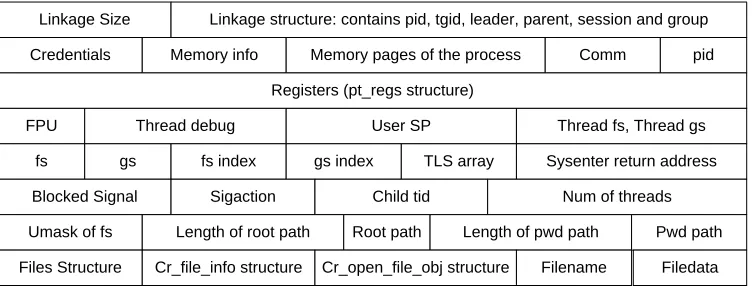
Saving the file information completes the dumping process. The stop and copy
func-tion then sends the saved signals to the current process and returns. The complete format
Thread Count Maps Count Send Maps Send Maps Send Maps….
First Run, send all pages to the destination node
Write ~0UL to indicate the completion of first run Maps Count for iterative run
Iterative Runs, send all pages to the destination node
Write ~0UL to indicate the completion of other runs
Figure 4.5: Sequence of data sent during precopy
Linkage Size Linkage structure: contains pid, tgid, leader, parent, session and group
Credentials Memory info Memory pages of the process Comm pid Registers (pt_regs structure)
FPU Thread debug User SP Thread fs, Thread gs
fs gs fs index gs index TLS array Sysenter return address Blocked Signal Sigaction Child tid Num of threads
Umask of fs Length of root path Root path Length of pwd path Pwd path Files Structure Cr_file_info structure Cr_open_file_obj structure Filename Filedata
Chapter 5
Experiments
5.1
Framework
We conducted our experiments on the local Opt cluster. This cluster has 18 nodes running Fedora Core 13 Linux x86-64 connected by two Gigabit switches. Each node is
equipped with 2-way SMPs with dual-core AMD Opteron 265 processors. It has a 750
GB RAID5 array to provide storage through NFS and a local disk. We conducted timing
measurements in user space for live and frozen migration.
5.2
Experiments
We use three BLCR test codes to test the functionality of migration utilities. These test
codes include a single-threaded counting application, a multi-threaded counting appli-cation and a file counting appliappli-cation. In addition to these tests, we also developed a
micro benchmark to assess the overhead of different approaches of migration. The
ex-periments are designed to test the functionality of the migration utilities and to analyze
their performance for applications of different sizes.
5.2.1
Instrumentation Techniques
We augmented the timing measurements with migration utilities at the user level. We
used the timing utilities provided by Linux to measure the time at a micro second
and determine the difference. We then send the data over a network via sockets. Hence,
network fluctuation can result in varied timings for different runs. To mitigate these
local effects, we perform the experiments when the cluster is least used and determine
the average over four samples per experiment. We observe a variation of 7% in timing
measurements for large applications. We observe large variations in timings for small
ap-plications, which can be attributed to small execution times. For memory experiments,
we used large size applications to get a consistent pattern.
5.2.2
Memory Tests
The memory test is to assess the overhead associated with an application migration.
We take separate timings for the memory precopy and the stop-and-copy phases of live
migration. We designed a micro benchmark that allocates a large number of pages and dirties those pages in an iterative manner. We also defined a stride for dirtying pages.
The test was conducted on a large data set to mitigate the effect of external factors. We
observe that the migration time is directly proportional to the number of pages allocated
to the application, which in turn defines the application size. The number of pages
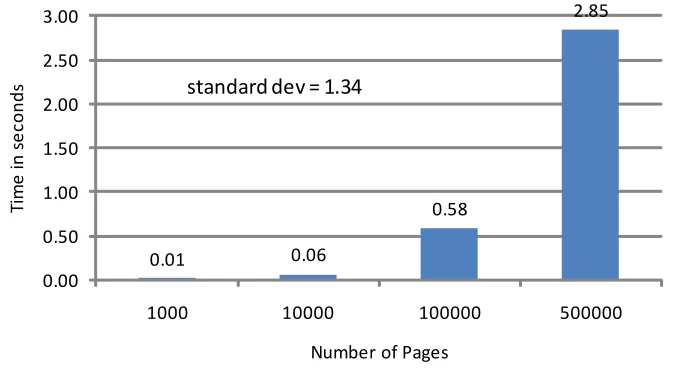
allocated for the following experiment are 1000, 10000, 100000, and 500000. The results
are presented in Figures 5.1 and 5.2 for strides one and ten, respectively.
We observe that migration time increases with an increase in the number of pages of
the application. The increase in time is almost linear. We also measured the time for live
and frozen migration combined (precopy + stop-and-copy) and compared it with frozen migration (only stop-and-copy) alone. As we discussed in the previous sections, there
is a tradeoff between live and frozen migration. Live migration takes a longer time to
complete but it lets the application run while the memory pages are being transferred to
the destination node. Precopy is immediately followed by a stop-and-copy which takes
less time than the stand-alone frozen migration. These results are depicted in Figure 5.3.
We observe that precopy migration takes more time than stop-and-copy and frozen
migration. In the precopy phase, we keep iterating until we reach a steady state. In each
iteration, we only send the modified pages since the last iteration. For a large application,
each iteration can take a significant amount of time. However, the application keeps running in the precopy phase. We also observe that stop-and-copy takes less time than
frozen migration although they involve same steps. Stop-and-copy sends only those pages
0.08 0.53 4.46 20.07 0.00 5.00 10.00 15.00 20.00 25.00
1000 10000 100000 500000
Tim e in S e co n d s
Number of Pages standard dev = 9.39
Figure 5.1: Stop-and-Copy Timings with a Stride of One
0.01 0.06 0.58 2.85 0.00 0.50 1.00 1.50 2.00 2.50 3.00
1000 10000 100000 500000
Tim e in s e co n d s
Number of Pages standard dev = 1.34
0.00 5.00 10.00 15.00 20.00 25.00 30.00
200000 300000 400000 500000
Tim e in s e co n d s
Number of Pages
Precopy time
Stop and Copy time
Frozen Migration only
Figure 5.3: Timings for Live and Frozen Migration
migration, on the other hand, essentially sends all non-zero pages to the destination node.
Therefore, the application down time is less in live migration than frozen migration at
the cost of higher network activity.
5.2.3
Other Tests
We ran several other tests to verify the functional integrity of the migration utilities.
These tests involve different types of applications. Some of the important tests are
described below:
1. We tried to migrate a multi-threaded application using the standard BLCR code. This program creates three threads and increments a global counter in a loop. Each
thread takes turns to increment the counter. Multithreaded applications are tricky
to migrate because we have to keep track of thread group leader and synchronize
the threads at the destination node. The linkage restoration function ensures that
each thread has the correct group leader associated with it. We are able to migrate
the signal handling of the migrated process at the destination node and it works
fine. We ran these tests with and without cloning.
2. We migrated a file counting application successfully to the destination node. This
application opens a file and starts writing to it. The migrated process restores the
file at the destination node and starts writing at current file pointer. We used a
network file for this test. This test, however, works only in absence of cloning. If
we enable cloning, then two processes would try to write into the file at the same
time and the process would fail after cloning.
Besides these test cases, we tried to migrate several variations of counting and memory mapped applications. There is still room to add other test cases for different scenarios.
Some of the more sophisticated test cases can be designed more easily once the migration
Chapter 6
Related Work
This thesis aims to present a fault tolerance technique to aid the conventional C/R
method for a HPC application. In this chapter, we talk about the research related to
fault tolerance in MPI jobs and migration approaches in general.
The feasibility of proactive fault tolerance has been demonstrated at the job
schedul-ing level [23], within OS virtualization [31] and in Adaptive MPI [26, 5, 4] usschedul-ing object virtualization and message logging [12] for Charm++ applications. Our fault tolerance
approach, however, is at the process level and independent of the MPI runtime layer. Our
approach encapsulates most of the process control block, including open file descriptors,
pipes and sockets.
There are two aspects of proactive fault tolerance techniques. The first aspect is failure
prediction and there are a number of research efforts put in this direction [25, 14, 15].
These papers report high failure prediction accuracy with a warning window, which is the
premise for our proposed process migration mechanism. The second aspect of proactive
fault tolerance is the migration mechanism adopted for a particular environment. Various
migration techniques have been developed in the past [21, 24, 29, 18, 2, 7, 11]. MPI-Mitten [10], an MPI library between the MPI and application layer, provides proactive
fault tolerance to MPI applications. It uses HPCM [8] as a middleware to support
user-level heterogeneous process migration. In [30], the authors provide a generic framework
based on a modular architecture to implement a proactive fault tolerance mechanism.
An agent-oriented framework [17] was developed for grid computing environments. In
this framework, agents monitor classes or subclasses of faults and either tolerate them or
FENCE [28], to increase the accuracy of fault prediction and improve system resilience to
failures with different fault management mechanisms including process migration. They
also model the migration cost and introduce a suitable scheduling mechanism [9]. These
prior works with their fault models, mechanisms and their evaluation schemes assert
that process migration is a suitable approach for proactive fault tolerance. It involves
less overhead than operating system (OS) virtualization, which reinforces the significance
of our approach.
Our proactive live migration solution provides new BLCR capabilities and supports
con-tinued execution of applications during migration. It parallels live migration at the OS
virtualization layer [6], which has been studied in the context of proactive fault tolerance of MPI applications [22], an approach that supports health monitoring and live migration
over Xen guests. We contribute process-level migration and demonstrate its efficiency.
In HPC, process-level solutions are more widely accepted than OS virtualization because
of its simplicity and less overhead. Hence, our contribution has significant potential to
Chapter 7
Conclusion and Future Work
7.1
Conclusion
We present two different approaches for migration, namely live and frozen migration. We also present a mechanism to clone the process. They complement reactive fault-tolerant
mechanisms, such as checkpointing, resulting in a reduction in the number of required
checkpoints. Checkpoint/restart can be deployed together with incremental
checkpoint-ing and live migration (1) to handle the faults proactively, (2) to reduce the number of
required full checkpoints, (3) to reduce the checkpoint overhead and, (4) to clone the
process thus providing redundancy. We compared the performance of two approaches
and showed the tradeoff between continued execution and application downtime. We
presented the results of both approaches for a variety of process migration scenarios and
for a memory benchmark. Overall, this confirms our hypothesis that we can migrate a
process from one node to another node via sockets, reduce overheads and create process clones.
7.2
Future Work
There is a lot of scope for future work related to this thesis. Some of them are discussed
7.2.1
Integration with OpenMPI
The migration techniques are designed to work with multi-node processes. As of now,
any single-node, multi-threaded process can be migrated to a physical node using the
migration commands. However, we have to integrate the migration code, e.g., with
the OpenMPI run time layer to migrate an MPI process. The implementation would be
very similar to the cr checkpoint integration with OpenMPI. We need to define a suitable interface for the MPI run time layer to execute migration commands and define call-backs
to return from BLCR code to OpenMPI process execution. We also have to synchronize
the processes at different stages of migration. For example, once the migrating process
returns from cr migrate, all the MPI processes should hit a barrier before the
stop-and-copy phase can be started. Figure 3.1 depicts the required steps.
7.2.2
Cloning
Process cloning can be supported as follows: In our cloning mechanism, we do not kill
the process at the source node once migration is complete. We do it using the cr clone
utility. This utility works similar to cr stop utility but it allows the process to run at
the source node thus creating a clone. Cloning works fine in single process environment because these two processes are independent of each other. In the MPI environment,
however, two processes with the same signature cannot co-exist. We need to modify
MPI run time layer to make sure these processes do not conflict each other and only one
process is active in MPI environment at a time.
7.2.3
Using WB Approach
As explained in Chapter 4, we use the dirty bit approach to keep track of the modified
pages. The dirty bit approach requires a small kernel patch. Although the dirty bit
approach is very efficient, it is not always viable to apply the dirty bit patch due to
security reasons or insufficient privileges. Sometimes, the patches are dependent on
other patches and we may need to apply a lot of other patches before the dirty bit patch
can be applied.
There is another approach to track modified pages, namely the write bit approach. This
approach uses the page protection mechanism to lock a page for writing. When a page
The write bit approach does not require any kernel modification. Vasavada et al. used
the write bit approach for incremental checkpointing [32].
7.2.4
Using File Descriptors
As of now, we send and receive the process date via network sockets. Most of the BLCR
utilities, however, work on a file descriptor. We would like to tweak the code to use a
file pointer instead of sockets to make the design more general. Moreover, most of the
BLCR functions are specific to checkpoint and restart requests, which limit the code
re-usability. We would like to change the functions to make them independent of request
types.
As part of the future work, we would like to test the live migration utility on bigger systems in an MPI environment. We would like to test it for a wide variety of applications
on different architectures. We would also like to make the code more robust by adding
error handling and testing corner cases. We have developed the migration utility within
the latest BLCR release and would like to test the migration utility in co-ordination with
REFERENCES
[1] Top 500 supercomputers list. http://www.top500.org/list/2011/06/100.
[2] Amnon Barak and Richard Wheeler. Mobility. chapter MOSIX: an integrated mul-tiprocessor UNIX, pages 41–53. ACM Press/Addison-Wesley Publishing Co., New York, NY, USA, 1999.
[3] George Bosilca, Aurelien Bouteiller, Franck Cappello, Samir Djilali, Gilles Fedak, Cecile Germain, Thomas Herault, Pierre Lemarinier, Oleg Lodygensky, Frederic Magniette, Vincent Neri, and Anton Selikhov. Mpich-v: toward a scalable fault tolerant mpi for volatile nodes. In Proceedings of the 2002 ACM/IEEE conference on Supercomputing, Supercomputing ’02, pages 1–18, Los Alamitos, CA, USA, 2002. IEEE Computer Society Press.
[4] Sayantan Chakravorty and L. V. Kale. A fault tolerance protocol with fast fault recovery. In Proceedings of the 21st IEEE International Parallel and Distributed Processing Symposium. IEEE Press, 2007.
[5] Sayantan Chakravorty, Celso L. Mendes, and Laxmikant V. Kal´e. Proactive fault tolerance in mpi applications via task migration. In HiPC, volume 4297 of Lecture Notes in Computer Science, pages 485–496. Springer, 2006.
[6] Christopher Clark, Keir Fraser, Steven Hand, Jacob Gorm Hansen, Eric Jul, Chris-tian Limpach, Ian Pratt, and Andrew Warfield. Live migration of virtual machines. In Proceedings of the 2nd conference on Symposium on Networked Systems Design & Implementation - Volume 2, NSDI’05, pages 273–286, Berkeley, CA, USA, 2005. USENIX Association.
[7] Fred Douglis and John Ousterhout. Transparent process migration: Design alterna-tives and the sprite implementation.Software - Practice and Experience, 21:757–785, 1991.
[8] Cong Du and Xian he Sun. Hpcm: A precompiler aided middleware for the mobility of legacy code. In in Proc. IEEE Cluster Computing Conference, Hong Kong, 2003.
[9] Cong Du, Xian-He Sun, and Ming Wu. Dynamic scheduling with process migration. In Proceedings of the Seventh IEEE International Symposium on Cluster Comput-ing and the Grid, CCGRID ’07, pages 92–99, WashComput-ington, DC, USA, 2007. IEEE Computer Society.
[11] Jason Duell. The design and implementation of berkeley labs linux check-point/restart. Technical report, 2003.
[12] E.N. Elnozahy and W. Zwaenepoel. Manetho: transparent roll back-recovery with low overhead, limited rollback, and fast output commit. Computers, IEEE Trans-actions on, 41(5):526 –531, may 1992.
[13] Edgar Gabriel, Graham E. Fagg, George Bosilca, Thara Angskun, Jack J. Dongarra, Jeffrey M. Squyres, Vishal Sahay, Prabhanjan Kambadur, Brian Barrett, Andrew Lumsdaine, Ralph H. Castain, David J. Daniel, Richard L. Graham, and Timothy S. Woodall. Open MPI: Goals, concept, and design of a next generation MPI imple-mentation. In Proceedings, 11th European PVM/MPI Users’ Group Meeting, pages 97–104, Budapest, Hungary, September 2004.
[14] Xiaohui Gu, Spiros Papadimitriou, Philip S. Yu, and Shu-Ping Chang. Toward pre-dictive failure management for distributed stream processing systems. InProceedings of the 2008 The 28th International Conference on Distributed Computing Systems, ICDCS ’08, pages 825–832, Washington, DC, USA, 2008. IEEE Computer Society.
[15] Prashasta Gujrati, Yawei Li, Zhiling Lan, Rajeev Thakur, and John White. A meta-learning failure predictor for blue gene/l systems. In Proceedings of the 2007 International Conference on Parallel Processing, ICPP ’07, pages 40–, Washington, DC, USA, 2007. IEEE Computer Society.
[16] Chung-hsing Hsu and Wu-chun Feng. A power-aware run-time system for high-performance computing. In Proceedings of the 2005 ACM/IEEE conference on Su-percomputing, SC ’05, pages 1–, Washington, DC, USA, 2005. IEEE Computer So-ciety.
[17] Mohammad Tanvir Huda, Heinz W. Schmidt, and Ian D. Peake. An agent oriented proactive fault-tolerant framework for grid computing. In Proceedings of the first International Conference on e-Science and Grid Computing, pages 304–311, Wash-ington, DC, USA, 2005. IEEE Computer Society.
[18] Eric Jul, Henry Levy, Norman Hutchinson, and Andrew Black. Fine-grained mobility in the emerald system. ACM Trans. Comput. Syst., 6:109–133, February 1988.
[20] Yawei Li, P. Gujrati, Zhiling Lan, and Xian he Sun. Fault-driven re-scheduling for improving system-level fault resilience. In Parallel Processing, 2007. ICPP 2007. International Conference on, page 39, sept. 2007.
[21] Dejan S. Milo´iˇci´c, Fred Douglis, Yves Paindaveine, Richard Wheeler, and Songnian Zhou. Process migration. ACM Comput. Surv., 32:241–299, September 2000.
[22] Arun Babu Nagarajan, Frank Mueller, Christian Engelmann, and Stephen L. Scott. Proactive fault tolerance for hpc with xen virtualization. In Proceedings of the 21st annual international conference on Supercomputing, ICS ’07, pages 23–32, New York, NY, USA, 2007. ACM.
[23] A. J. Oliner, R. K. Sahoo, J. E. Moreira, M. Gupta, and A. Sivasubramaniam. Fault-aware job scheduling for bluegene/l systems. In In IEEE IPDPS, Intl. Parallel and Distributed Processing Symposium, pages 64–73, 2004.
[24] Michael L. Powell and Barton P. Miller. Process migration in demos/mp. In Pro-ceedings of the ninth ACM symposium on Operating systems principles, SOSP ’83, pages 110–119, New York, NY, USA, 1983. ACM.
[25] R. K. Sahoo, A. J. Oliner, I. Rish, M. Gupta, J. E. Moreira, S. Ma, R. Vilalta, and A. Sivasubramaniam. Critical event prediction for proactive management in large-scale computer clusters. In Proceedings of the ninth ACM SIGKDD international conference on Knowledge discovery and data mining, KDD ’03, pages 426–435, New York, NY, USA, 2003. ACM.
[26] Sayantan Chakravorty, Celso Mendes and L. V. Kale. Proactive fault tolerance in large systems. In HPCRI Workshop in conjunction with HPCA 2005, 2005.
[27] Luciano A. Stertz. Readable dirty-bits for ia64 linux. Internal requirement specifi-cation. Hewlett-Packard, 2003.
[28] Xian-He Sun, Zhiling Lan, Yawei Li, Hui Jin, and Ziming Zheng. Towards a fault-aware computing environment. In HAPCW, March 2008.
[29] Marvin M. Theimer, Keith A. Lantz, and David R. Cheriton. Preemptable remote execution facilities for the v-system. In Proceedings of the tenth ACM symposium on Operating systems principles, SOSP ’85, pages 2–12, New York, NY, USA, 1985. ACM.
[31] Jyothish Varma, Chao Wang, Frank Mueller, Christian Engelmann, and Stephen L. Scott. Scalable, fault tolerant membership for mpi tasks on hpc systems. In Proceed-ings of the 20th annual international conference on Supercomputing, ICS ’06, pages 219–228, New York, NY, USA, 2006. ACM.
[32] Manav M Vasavada. Innovative Schemes to Support Incremental Checkpointing. PhD thesis, North Carolina State University, 2009.
[33] Chao Wang, F. Mueller, C. Engelmann, and S.L. Scott. Hybrid checkpointing for mpi jobs in hpc environments. InParallel and Distributed Systems (ICPADS), 2010 IEEE 16th International Conference on, pages 524 –533, dec. 2010.
[34] Chao Wang, Frank Mueller, Christian Engelmann, and Stephen L. Scott. A job pause service under lam/mpi+blcr for transparent fault tolerance. Parallel and Distributed Processing Symposium, International, 0:117, 2007.