NRE-AODV Routing Protocol to Maximize
Network Lifetime of MANET Based on AODV
K.Mariappan1, Dr.M.Karnan2
Assistant Professor, Dept. of CSE, Aringer Anna College of Engineering and Technology, Palani, Tamilnadu, India1
Professor and Principal, Aringer Anna College of Engineering and technology, Palani, Dindigul, India2
ABSTRACT: Mobile ad hoc network (MANET) is a special type of wireless network in which a collection of wireless mobile devices (called also nodes) dynamically forming a temporary network without the need of any pre-existing network infrastructure or centralized administration. In MANETs, there is no pre-established infrastructure to facilitate the routing activity and hence communication between mobile nodes can be achieved through the mobile nodes using multi hop wireless technique. However, wireless network devices, especially in ad hoc networks, are typically battery-powered. Thus, energy efficiency is a critical issue for battery-powered mobile devices in ad hoc networks. This is due to the fact that failure of node or link allows re-routing and establishing a new path from source to destination which creates extra energy consumption of nodes and sparse network connectivity, leading to a more likelihood occurrences of network partition. Routing based on energy related parameters is one of the important solutions to extend the lifetime of the node and reduce energy consumption of the network. In this paper, we presented a novel energy aware routing protocols called Node Residual Energy Adhoc On Demand Distance Vector (NRE-AODV in short) which uses residual energy and hop count as a cost metric to minimize energy consumption, maximize network lifetime and distribute usage of energy among mobile nodes of Mobile Ad hoc Network (MANET). The new protocols, which are referred to NRE-AODV is simulated using Network Simulator-2.35 and comparisons are made to analyze, its performance based on network lifetime, delivery ratio, normalized routing overhead, average collision rate, normalized energy consumption, standard deviation of residual energy of all Nodes and average end to end delay for different network scenarios. The simulation results reveal that the proposed energy aware routing protocols make the network active for longer interval of time once it is established by minimizing energy and distributing energy consumption across mobile nodes on the network at the trade off a small amount of end to end delay.
KEYWORDS: - NRE-AODV (Node Residual Energy Adhoc On Demand Distance Vector; AODV(ad -hoc on demand distance vector);MANET(Mobile ad-hoc network);NS-2.35
I.INTRODUCTION
MOBILE ad hoc network (MANET) [1], [2], [10]is a self-organizing and self-configuring multihop wireless network, which is composed of a set of mobile hosts (MHs) that can move around freely and cooperate in relaying packets on behalf of one anot her. MANET supports robust and efficient operations by incorporating the routing functionality into MHs. In MANETs, the unicast routing establishes a multihop forwarding path for two nodes beyond the direct wireless communication range. Routing protocols also maintain connectivity when links on these paths break due to effects such as node movement, battery drainage, radio propagation, and wireless interference
(NRE-AODV) based on AODV is introduced. The new approach maximizes network lifetime and distributes energy consumption of mobile ad hoc networks by choosing an energy efficient path which consists of mobile nodes having an ample amount of energy capacity. This is achieved by integrating residual energy and hop count metrics during route discovery and route selection process. The remaining part of this paper is organized as follows. In section II we describe MANET routing protocol andwe review some of the proposed energy aware routing protocols for MANETs. In section III, we describe modification of the route discovery process in AODV, mathematical model and algorithm of NRE-AODV routing protocol. Section 4 discusses the analytical comparison of routing protocols (AODV, ALMEL-AODV and NRE-ALMEL-AODV) and the selection of optimal value of Energy Threshold for the proposed routing protocol. Finally section 5 describes the simulation environment and the performance results of NRE-AODV against two existing MANET routing protocols, namely AODV and ALMEL-AODV
II. MANET ROUTING PROTOCOLS
In MANET routing protocols mainly classified into two: Proactive(table-driven) and reactive (on-demand) Proactive protocols exchange routing information periodically and find routes continuously between any nodes in the network, regardless of using the routes or not. This means a lot of network resources such as node battery energy and network bandwidth may be wasted, which is not desirable in MANETs where the resources are constrained. On the other hand, reactive routing protocols do not exchange routing information periodically and they discover a route only when it is needed .Proactive protocols consume more energy than the Reactive ones; hence most of the research works involve modifications to reactive protocols.
Among reactive protocols, AODV is considered potentially the most energy efficient routing protocol. Hence many research studies have focused on making AODV routing protocol more energy efficient.
Ad hoc On-demand Distance Vector (AODV)
AODV is a reactive routing protocol that establishes a route to a destination based on a needed basis, i.e. a route is established only when a source node needs to communicate with another one for which it has no valid routing information in its table[4]. Furthermore, optimal route among possible routes is selected based on the shortest path between source and destination pairs. This is useful for mobile environments such as MANETs since it minimizes communication overhead and battery consumption compared to the traditional wired routing protocols. Routing in AODV consists of two phases; route discovery and route maintenance.
Route Discovery
When a source node wishes to send data, but does not have a valid route information to the destination, it initiates a route discovery process to find the destination node. Path discovery process is initiated by generating and broadcasting route request (RREQ) message to its neighbors that in turn forward this RREQ packet to their neighbors and so on, until the destination node is received or an intermediate node that knows the destination is encountered. If a node could receive a RREQ more than once, it simply drops the redundant ones.
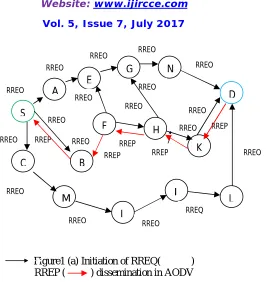
Figure1 (a) Initiation of RREQ( ) RREP ( ) dissemination in AODV
While the RREP traverses along the reverse route, the intermediate nodes along the route has also recorded the address of the neighbor from which they receive the RREP, just like the intermediate nodes do with the RREQ, thus setting up the forward route.
When the RREP reaches its destination, a forward and a reverse path are built between the source and the destination of the RREQ. Finally, each node along the established route is not required to have knowledge of other intermediate nodes on the path other than the next hop
Figure 1: Illustration of the route discovery and route maintenance processes in AODV between Source node S and Destination node D.As can be seen from Figure 1(a), let us assume that there are fifteen nodes in the network. The source node S initiates a route discovery process using an RREQ packet and floods it in the network to find a route for destination node D. When node S broadcasts a RREQ, nodes A, B and C receive the RREQ packet. Accordingly, nodes
RREQ
RREQ
RREQ RREQ
RREQ
RREQ
RREQ
RREQ RREQ RREQ
S
A E
G N
D
H
K F
C B
J L
M
I
RREQ
RREQ
RREQ RREQ
RREQ RREP
RREQ RREP
RREP RREP
A, B and C record node S on the routing table as a reverse path for node S. After this, nodes A, B and C rebroadcast the RREQ packet as it is assumed that they do not have a valid route to node D. Nodes E, F and M receive the RREQ from nodes A, B and C, respectively. Hence, nodes E, F and M record nodes A, B and C on the routing table as a reverse path for S respectively. Then E, F and M rebroadcast the RREQ packets. When node F rebroadcasts, node E receives the duplicated RREQ packet. Nodes E simply discard the duplicated RREQ from node F. The process will continue till the RREQ reaches destination node D. Finally, When the RREQ packet reaches the destination node D, node D prepares an RREP packet and sends it back to node S along the reverse route having minimum hop count.
Route Maintenance
The next phase of the routing process is the route maintenance procedure which is initiated during broken link due to nodes movement or battery failure. After the route discovery process, the intermediate nodes along an active route keep its connectivity by means of a periodic exchange of “hello” packets to its 1-hop neighbors. If local Hello messages stop arriving from a neighbor beyond some time threshold, the connection is assumed to be stale or expires. When a node detects that a route to a neighbor node is no longer valid it removes the routing entry and sends back a route error (RERR) message towards the affected source nodes. A source node receiving an RERR can initiate a new route discovery if the route is still needed [4]
Figure 1 (b) shows the maintenance procedure due to link failure. When a link fails, the source and destination nodes notified. For example, when the link between node H and K is failed, both nodes generate RERR packets to inform the source, the intermediate nodes along the route and the destination node about the broken link. When the nodes receive RRER packets, they delete the corresponding entries from their routing tables. Then the source node can reinitiate a new RREQ packet containing a new broadcast id and the previous destination sequence number if the route is needed.
Related work
The main goal of energy-aware routing protocols is to minimize the energy consumed by mobile nodes, increasing the network lifetimes and/or distribute loads among mobile entities. In the recent past years energy efficient routing in Ad hoc network was proposed by many research works. The majority of energy efficient routing protocols for MANET tried to reduce energy consumption by means of an energy efficient routing metric instead of the minimum-hop metric. Each and every protocol has its own advantages and shortcomings. None of them can perform better in every condition. This section documents some of the many energy efficient schemes developed by researchers in the field along with their shortcomings.
The minimum total power routing (MTPR) proposed in [21-23, 45-47] uses the transmission power as the cost metric. The cost function is defined as follows.
= ( )
Where PT(i) is the transmission power of node i and CR is the total transmission power for route R. Then, the MTPR
In [24], Jin-Man Kim and Jong-Wook Jang proposed an enhanced AODV routing protocol to maximize networks lifetime in MANET using an Energy Mean Value algorithms. Here, energy remaining of each node in the path between source and destination is accumulated and delivered to the destination by adding a field on a RREQ message. Then the destination node adds the accumulated residual energy of each path and divides by the number of hops along the paths to obtain the mean energy of network. When a new path is explored, the mean energy stored in each node is compared with the energy remaining in the node. The drawback of the scheme is twofold; first, flooding is used as a route discovery strategy. Second mean energy, which is difficult to obtain an average of the residual energy of all nodes on the network, is used as a cost metric instead of residual energy of each node which decreases the lifetime of the network.
In [48]; K.Woo, C.Yu, H.Y.Youn, and B.Lee proposed Local Energy-Aware Routing. When a node received a RREQ message at time t, it compared its current remaining energy capacity with the predefined threshold value or computed value. If the residual energy is less than the threshold or computed value, the RREQ message is dropped. Otherwise, the message is processed and forwarded. However in this scheme, the destination will receive a route request message when all intermediate nodes along the route have enough battery levels. If all the paths to destination node have less residual energy than the threshold, the RREQ message will not be reached at the destination.
In [5]; T.H.Tie, C.E.Tan, and S.P.Lau;proposed Alternate Link Maximum Energy Level (ALMEL-AODV) which considers node remaining energy as a routing metric to balance and extend the life time of the nodes in the network. The proposed algorithm adds a field, which keeps the sum of residual energy of the route, on RREQ packets. The destination node chooses two highest summations of residual energy paths for data transmission and sends back to the source node. The second path will be used as a backup if the first path fails. Although the metric used is important, a node which has very low residual energy might be selected for data transmission as they consider the maximum summation of remaining energy. Furthermore, flooding is used as a route discovery mechanism, leading to exhaustion of each mobile node battery. Finally, the second path, which will be used later for data transmission if the first one fails, could not be an active path at the required moment due to the mobility of nodes in MANETs.
In [7]; Z.Zhaoxiao, P.Tingrui,and Z.Wenli to mitigate the energy saving problem, an energy-aware routing for Ad Hoc networks is proposed. The algorithm selects routing according to the dynamic priority-weight (β) and takes the hop count as optimization condition. The dynamic priority weight is determined using the square of the ratio of residual battery energy(R) and consumed energy(C) of a node at time t as shown below
( ) =
( ) ( )
The destination node selects two maximum summation of priority-weight which spends less energy and owns larger capacity based on synthetic analysis among possible routes and propagates the route reply (RREP) messages to the source node. The second path will be used when the primary path fails. Since the work considered the summation of priority-weight without a threshold, the selected path for data transmission might contain a node which has less remaining energy. Moreover the second path, which will be used later for data transmission if the first one fails, could not be an active path at the required moment due to the mobility of nodes in MANETs
forward the RREQ packet until the load is reduced. The metric value of load balance at the i th node is calculated as follows:
mi = bi x li ; bi is the percentage of usable energy of node li is the length of the waiting or used queue
Based on the product of usable energy and load value of node, each node in the network has three states as follow: Paralysis: m >= a; Congestion: b <= m <= a; Normal: m < b; Where a, b are a predetermined congestion factor. Using the above metric each intermediate node decides whether a received RREQ packet is forwarded or not. When a node is in a "paralyzed" condition, it will drop all received RREQ. When a node is in "congestion" condition, it will reply an RREP only if there is an existing route in the routing table otherwise the RREQ packets will be dropped. When a node is in “normal" condition, it compares the value m in the RREQ and the metric value of the node itself. Then, the maximum value of m is recorded on the routing table before forwarding. For duplicate RREQ packets, a node will compare the value of m on the RREQ with mt in the routing table. If the value of m is smaller than the value of mt on the routing table, a node drops the RREQ packet otherwise it will update the value of mt in the routing table and sent node pointer back to the previous hop. Furthermore to minimize congestion, RREQ is not forwarded. When a destination node receives the first RREQ, it waits for some time to obtain more routes, then choose the route having the minimum value of m and reply a RREP packet back to the source node. Since the technique considers the product of queue and energy as a cost metric, there is a high probability of choosing a node having less energy with smaller queue load. Hence the product metric could not give guarantee to protect nodes with little battery capacity which affects network life time. Furthermore if the intermediate nodes are in a paralyzed or congestion state no routing packet reaches to destination node. The update mechanism of the approach during normal state for duplicate packets is also not effective as congested node on the route replaces the node on the route having relatively less congested.
Kumar and Banu [30] present an energy Efficient Ad hoc on Demand Vector (E2AODV) scheme to balance load distribution of nodes. A threshold value is used to judge if intermediate node was overloaded or not. Here, an intermediate node receiving the RREQ will compare its current queue length with its threshold before rebroadcasting it. If queue length is greater than the threshold, the RREQ will be dropped. Otherwise, the node will broadcast it. In their scheme, the threshold value plays the key role in selecting nodes whether or not to forward RREQ. Every time an intermediate node receives a RREQ, it will recalculate the threshold according to the average queue length of all the nodes along the path to the node itself. Therefore, the threshold is variable and changing adaptively with the current load status of network. However the scheme did not consider residual energy as a cost metric which causes frequent broken link and retransmission of routing packet leading to energy consumption.
The authors in [31] proposed an energy based AODV (EBAODV) protocol. In EBAODV, when a source node transmits a route request packet it specify the amount of energy that each intermediate node should have during the transmission of data packets. When the intermediate node receives a RREQ packet, first it checks if it has enough available residual energy for the request. A node which does not satisfy the energy constraint will avoid retransmitting of RREQ packet. The approach entirely related to the amount of energy required by the source node to transmit its data packet. Therefore the path which consists of small amount of node battery level could be selected. For instance, if the source node requires a small amount of energy to transmit its data packets, the minimum residual energy node might be part of the route for data transmission which minimizes network lifetime leading to frequent broken link and node failure. The route discovery process could be flooding if the source node assigns small amount of residual energy as most of intermediate nodes’ residual energy is expected above it. Furthermore the source node should know the amount of transmitting data ahead.
The approach proposed in [32] referred as EA-AODV classified nodes into the following three energy zones based on their remaining energy capacity:
Warning Zone: The remaining energy capacity of a node is between 10% and 20% of its initial value.
Danger Zone: The remaining energy capacity of a node is below 10% of its initial value.
The cost function is defined as:
= ( );
C(i) represents the cost of node vi and C(i) could be C normal , C warning or C danger , which is calculated based on the energy zones defined above. C normal , C warning or C danger are predefined values such that Cnormal < Cwarning < Cdanger . In addition to the residual energy, the authors also consider number of neighbors during calculating cost function when a node is either in warning or danger state. The cost function of node vi is calculated as: C(i) = kiCnormal , ki C warning or ki C danger : where ki is proportional to the number of neighbors of node vi , i.e. the number of neighbors divided by five.
The destination node selects a route having minimum value of CR from the possible routes. In the scheme, even though
a node is in the Warning or Danger Zone, it can still be chosen on a route due to the summation cost metric used by the scheme. Hence frequent link failure might be occurred due to the selection of energy incapable nodes, leading to reduction of network lifetime and depletion of node energy. Furthermore flooding is used to discover route between source and destination during route discovery process.
III. THE PROPOSED WORK
In AODV, route request (RREQ) packets are disseminated throughout the entire network in search of an intended destination. In particular, each node retransmits any newly received RREQ packet until a destination is encountered or an intermediate node that knows the destination is received. When the destination node or an intermediate node that knows the destination receives the first RREQ, the node generates and sends back a route reply (RREP) packet to the source host through the route having minimum hop count between source and destination. Since minimum hop count is used as a cost metric in AODV during route selection, a node having small residual energy could be included on the path. This may create a frequent broken link due to an early exhaustion of node’s battery. As a result, frequent broken link creates unnecessary broadcast transmission, reduces network lifetime, consumes significant amount of energy and finally leading to network partition [6] [9]. In order to alleviate these problems due to node’s battery failure, the routing metric used during route selection should also consider the battery capacity of each node beyond hop count. Therefore, the main objective of this paper is to develop a routing protocol that increase the life time of network and fairly distribute an energy consumption of hosts in MANET. The protocol which we develop combine summation of residual energy, minimum residual energy and hop count as a cost metric and integrates these metrics into AODV in an efficient way. These metrics ensure that all the nodes in the network remain up and running together for as long as possible. The modified energy aware routing protocol is named as Node Residual Energy Ad-Hoc On Demand Distance Vector (NRE-AODV)
and described in the following sub section.
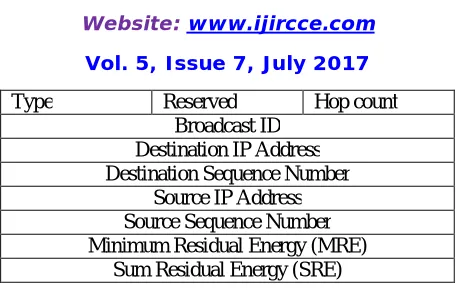
Modification on RREQ Packet of NRE-AODV)
Type Reserved Hop count Broadcast ID
Destination IP Address Destination Sequence Number
Source IP Address Source Sequence Number Minimum Residual Energy (MRE)
Sum Residual Energy (SRE)
Figure 3.1: Modified RREQ Packet format
In NRE-AODV, when all nodes in some possible routes between a source-destination pair have large remaining energy than the threshold then a route having maximum of the difference of average sum of residual energy and threshold among the possible routes is selected. Otherwise the maximum difference of the average minimum residual energy and threshold among the routes is selected. Furthermore, the route with the shortest hop number will be chosen if there are multiple paths having the same cost metric.
Mathematical Model of NRE-AODV
If we consider a generic route rj = n0, n1 , n2 , … , nd, where n0 is the source node and n1 is the destination node , h is the
number of hop between n0 and nd and a function r(ni) denotes the residual energy of node ni then the average minimum
residual energy(AMRE) and average summation of residual energy(ASRE) for the route rj is calculated as:
= min
∀ ∈ ( ) /ℎ
= ( )
∀ ∈
/ℎ
The NRE-AODV algorithm selects an optimal route Ok(D) which verifies the following condition:
If (there exists a path having minimum residual energy greater than or equal to the
ℎ ℎ : ∈ ∗ ℎ ≥ ℎ
Choose a route having maximum of the difference of average residual summation and threshold i.e.
( ) = max
Else
Choose a route having maximum difference of average minimum residual energy and threshold i.e.
( ) = max
∈ − ℎ
Where A is the set of all routes under consideration and Th is a predefined energy threshold.
Algorithm for RREQ handling in NRE-AODV
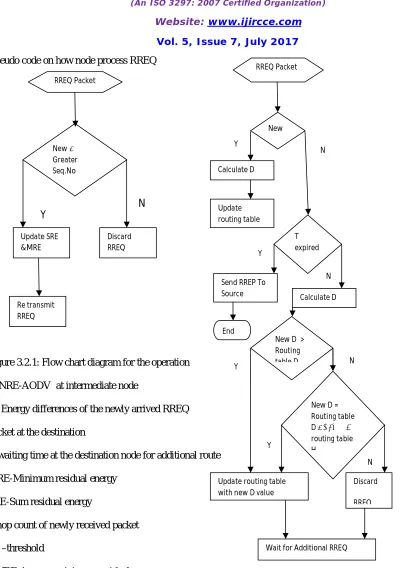
The pseudo code shows the algorithm used to search for the desired path at the intermediate and destination nodes in NRE-AODV protocol whereas Figure 3.2 illustrates the generic flow chart of the proposed NRE-AODV protocol. The intermediate nodes process each receiving RREQ routing packet as follows:
Step 1: On receiving a RREQ packet, a node checks whether the RREQ packet is new by looking up the source node id and broadcast ID in a routing table
Step 2: If the RREQ packet is the first or duplicate but having greater Sequence Number, a node updates MRE and SRE fields of RREQ as shown below and then retransmits the RREQ packet. Where, MRE is the minimum residual energy and SRE is the sum of residual energy.
MRE=min (residual energy of current node, MRE of RREQ received) SRE= (residual energy of current node + SRE of RREQ received)
Step 3: If RREQ routing packet is not the first or Sequence Number is not greater than the sequence number received before in the routing table, then the coming RREQ packet is discarded.
The destination node processes each receiving RREQ routing packet as follows:
Step 1: The node checks whether a RREQ routing packet is arrived for the first time or not by looking up the source node id and broadcast ID in a routing table.
Step 2: If the RREQ is the first packet, it calculates an Energy Difference (D) or routing cost and keeps the value on the routing table. Then, the node waits δ waiting time for another redundant RREQ’s routing packet.
Let the threshold (Th) be some constant energy E If (MRE >= Th)
D= ((SRE/hop count) - Th) Else
D= ((MRE/hop count) - Th)
Step 3: If RREQ routing packet is not the first, then the node checks its waiting time T.
Step 4: If RREQ waiting time is not expired, then the algorithm calculates an energy Difference (routing cost) for the newly received RREQ and compares it with an Energy Difference value which has been recorded on the routing table. If the route cost (D) of the newly arrived RREQ is greater or equal but with smaller hop count than an Energy Difference (D) in the routing table, then the destination node replaces the routing table entry of an existing RREQ by the incoming copies of RREQ otherwise the incoming RREQ is discarded.
Pseudo code on how node process RREQ
Figure 3.2.1: Flow chart diagram for the operation
of NRE-AODV at intermediate node
D- Energy differences of the newly arrived RREQ
packet at the destination
T-waiting time at the destination node for additional route
MRE-Minimum residual energy
SRE-Sum residual energy
h-hop count of newly received packet
Th –threshold
AMRE-Average minimum residual energy
ASRE-Average sum residual energy Fig 3.2.2: Flow chart diagram for the destination node
Figure 3.2: Flow chart diagram for the operation of NRE-AODV
RREQ Packet
New ǁ
Greater Seq.No
Update SRE &MRE
Re transmit RREQ
Discard RREQ
Y N
Calculate D
RREQ Packet
New
Update routing table
Y
T expired
Send RREP To Source
N
Y
Calculate D
New D > Routing table D
Update routing table with new D value
New D = Routing table D ǁ New H <
routing table H
Wait for Additional RREQ Discard
RREQ N
Y
Y
N
IV. COMPARISONS OF ROUTING PROTOCOLS
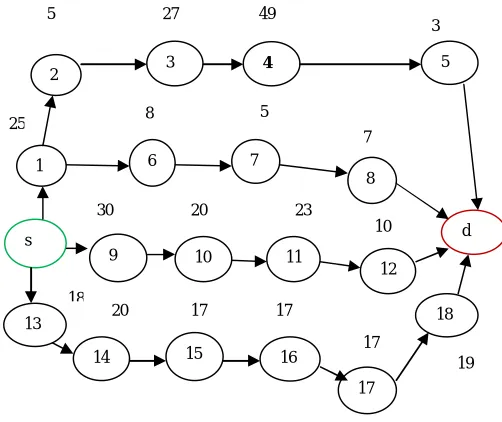
In this sub-section we illustrate the working of our proposed NRE-AODV scheme through an example and analytically compare it with two existing routing protocols of MANETs namely AODV and ALMEL-AODV. To initiate the route discovery process, a source node generates and broadcasts a RREQ packet. The RREQ packet carries information such as: source-id, destination-id, sequence number, minimum residual energy, sum residual energy etc. We consider Figure 4.1 to illustrate how the route discovery process in NRE-AODV is handled. Let us assume that S is the source nodes and D is the destination node. Source S broadcasts a RREQ packet. In Figure 4.1 we have shown node-id inside the circle and remaining energy of the node above the circle. An intermediate node on receiving the RREQ packet, first compute its minimum residual energy and sum residual energy from source to the node itself. Then the node updates the minimum residual energy and sum residual energy in RREQ packet .Let us assume that the residual energy value of nodes 1 and 2 be 25 and 5 joule respectively as shown in Figure 3.1 Hence the minimum residual energy at node 2 is 5 because node 2’s residual energy is less than the value of the minimum residual on the RREQ packet received from
node 1 which is 25. Therefore, node 2 updates the minimum residual field with its own residual energy and the sum residual energy field with the sum of node 1 and node 2, which is 30, and then retransmits the RREQ packet. No change is made in the minimum residual energy field if the residual energy value at a node is equal to or greater than the value in the RREQ packet. For example, the minimum residual energy of node 7 is 5, which is greater than the value in the minimum residual energy on the RREQ packet receiving from node 6. Therefore, no change is made in the minimum residual energy field of RREQ packet at node 7 the above process continues until the RREQ packet reaches at the destination node. When the first RREQ packet reaches at the destination node, the destination node starts a timer and waits for duplicate RREQ message. After the expiry of the timer the destination node sends a RREP packet back to the source node through an optimal path i.e. through the route having maximum value of Energy Difference.
To understand the operations of the proposed protocol, we compare the aforementioned three routing protocol based on Figure 3.1 with an assumption of 8 joule as an energy threshold for the network.
v
Figure 4.1: The flow chart of RREQ handling by NRE-AODV
Case 1: Choose a route with minimum hop count between source and destination, AODV routing protocol. Since route < S-6-7-8-D > has the smallest hop count of 4, AODV selects route < S-6-7-8-D > for data packet transmission from the possible routes.
7
27 49
5
3
8 5
25
10 23
20 30
17 17
17 20
18
19 1
2 3 4 5
s d
6 7
8
9 10 11
12
13
14 15 16
17
Case 2: Choose a route with largest Summation of residual energy (ALMEL-AODV) routing protocol. The cost function of ALMEL-AODV for path S-1-2-3-4-5-D, S-6-7-8-D, S-9-10-11-12-D and S-13-14-15-16-17-18-D is 109, 45, 83 and 108 respectively. Hence, route <S-1-2-3-4-5-D> has the largest summation of among the possible routes received by the destination node. Therefore, the ALMEL-AODV algorithm selects route <S-1-2-3-4-5-D> for data packet transmission.
Case 3: Choose a route with large summation of residual energy and less hop count if possible; otherwise choose a route with largest minimum residual energy and less hop count (our proposed routing protocol i.e. NRE-AODV). Our proposed algorithm selects a route with largest value of Energy Difference (D). The cost function (D) of NRE-AODV for path S-1-2-3-4-5-D, S-6-7-8-D, S-9-10-11-12-D and S-13-14-15-16-17-18-D is -9, -9.25, 6.6 and 5.4 respectively. Hence NRE-AODV selects path S-9-10-11-12-D, which is the largest value of D i.e. 6.6, for data transmissions. Case 1 selects the shortest path without considering residual energy of nodes. Thus, case 1 does not give guarantee for long network lifetime and balanced energy usage among mobile nodes. Case 2 selects a route with largest summation of residual energy but it has serious problem in terms of lifetime and hop count as it may still choose a route having nodes containing small remaining battery capacity as shown in Figure 4.1 Case-3 improves the drawbacks of Case 1 and Case-2 by considering both residual energy and hop count as a cost metric. Hence, the proposed algorithm always chooses a route which extends network lifetime by taking energy capable nodes and distributes load among mobile nodes using either large summation of residual energy or maximum residual energy.
Selection of Optimal value of Energy Threshold D
The goal of this section is to select an optimal value of energy threshold for our proposed energy efficient routing protocol named as NRE-AODV. In order to obtain an optimal energy threshold D value for the proposed NRE-AODV which maximizes network lifetime and distributes energy usage across mobile nodes, we have conducted an extensive NS-2 simulations [40, 41] by varying an energy threshold value from 0% of initial energy to 100% of initial energy in a step of 10%.
The performance metrics that have been used to select an optimal Energy threshold value include the network lifetime and standard deviation of residual energy of all nodes. We choose these metrics because the metrics guarantee the efficiency of a routing protocol in terms of load distribution and network lifetime.
Therefore, the simulation scenario is designed to assess the impact of energy threshold on the performance of network lifetime and load distributions of nodes. In this study 100 nodes are deployed over an area of 1500mx1500m with each node moving according to the random waypoint mobility model [42,43,44]with a maximum node speed of 20m/s. For each simulation, identical movement and traffic scenarios are used across different value of energy threshold. The initial energy of each node was randomly set between 60 and 200 Joules and all the simulation experiments were run for a period of 1000sec. The expiration time of D at the destination routing table is set to 0.1sec and 9 source-destination numbers of connections is used.
Impact of energy threshold on network lifetime
Figure 4.2: The impact of energy threshold on network lifetime.
Impact of energy threshold on distribution of energy usage across mobile nodes
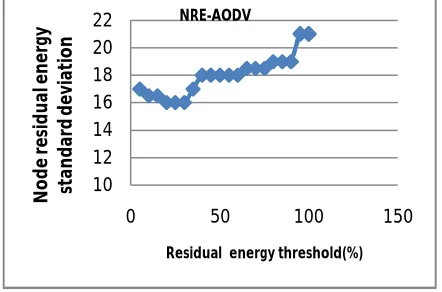
The result in Figure 4.3 shows the impacts of energy threshold on energy usage across mobile nodes in MANETs. Figure 4.3 reveals that as the percentage of energy threshold increases from 0% to 30% the standard deviation of energy of all nodes slightly decreases however when the percentage of energy threshold values keeps on increasing the value of standard deviation increases. From the result we can reveal that when the energy threshold value is around 30% of the initial node energy almost all nodes are running up together. Hence the energy consumption across mobile nodes on the network is fairly distributed. This is due to the fact that as the percentage increases, the sum of each node residual energy metric of NRE-AODV scheme has less impact on the selection of the route and hence the selection of an optimal route depends on the minimum residual energy of a node metric. Consequently a large capacity of energy nodes could be excluded being part of the route during route selection which results an increase in standard deviation.
Figure 4.3: The impact of energy threshold on distribution of mobile node’s energy usage
From Figure 4.2and Figure 4.3 we can see that the performance of both network lifetime and distribution of energy usage of nodes is optimal at the energy threshold value of around 30% of the initial energy of nodes. Hence we are selecting an optimal energy threshold value of 30% for the NRE-AODV routing protocol.
500 520 540 560 580
0 50 100 150
N
et
w
o
rk
li
fe
t
im
e
(S
e
c)
Residual energy threshold(%)
NRE-AODV
10 12 14 16 18 20 22
0 50 100 150
N
o
d
e
re
si
d
u
a
l e
n
e
rg
y
st
an
d
ar
d
d
e
vi
a
ti
o
n
V. PERFORMANCE ANALYSIS
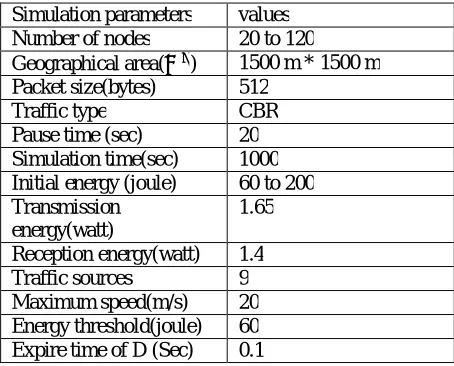
The goal of the following simulation experiment is to evaluate the performance of NRE-AODV routing protocol against AODV and ALMEL-AODV routing protocols under various network density. Each mobile nodes in our scenarios moves according to random way mobility model [42-44] deployed in a topology of 1500m x 1500m area with different number of nodes ranging from 20 to 120 for each simulation. All the simulation experiments were run for a period of 1000sec. In the simulation the Propagation model is Free Space Propagation Model, Queuing model is Drop Tail/Priority Queue, and MAC protocol is 802.11. Each packet starts travelling from a random location to a random destination with a randomly chosen speed. When a node reaches a destination, it moves to another randomly chosen destination after a pause time. To emulate the dynamic environment, all nodes move around in the entire region with maximum speed of 20m/sec. Constant Bit Rate (CBR) traffic source with packet size of 512 bytes is used. Traffic scenarios with 9 source-destination pairs were used to establish the routes. The initial energy of each node was set randomly between 60 and 200 Joules with transmission and reception power of 1.65 W and 1.4 W respectively. The Energy threshold value for the simulation is set to 60 Joule and the expiration time of D at the destination routing table is set to 0.1sec. Identical movement and traffic scenarios are used across the considered routing protocols. Each data point for each routing protocols represents an average of twenty randomly generated traffic scenario files. The parameters used in the simulation are summarized in Table 1
Table 1: Simulation Parameters
Simulation parameters values Number of nodes 20 to 120 Geographical area( ) 1500 m * 1500 m Packet size(bytes) 512
Traffic type CBR Pause time (sec) 20 Simulation time(sec) 1000 Initial energy (joule) 60 to 200 Transmission
energy(watt)
1.65
Reception energy(watt) 1.4 Traffic sources 9 Maximum speed(m/s) 20 Energy threshold(joule) 60 Expire time of D (Sec) 0.1
PERFORMANCE EVALUATION
To evaluate the performance of the new Node Residual Energy AODV (NRE-AODV), the implementation of the AODV routing protocol in NS-2 simulator [40,41] has been modified to incorporate the functionality of NRE-AODV routing algorithms i.e. minimum residual energy, sum residual energy value and energy difference. The simulation results of NRE-AODV are compared against the Ad hoc Distance Vector (AODV), and Alternate Link Maximum Energy Level Ad Hoc Distance Vector Scheme (ALMEL-AODV).
Impact of Network Density
This section shows the impact of network density on the performance of the three protocols namely; AODV, ALMEL-AODV and NRE-ALMEL-AODV. The network density has been varied by changing the number of nodes from 20 to 120 nodes for each scenario. In the figures presented below, the x-axis shows the variations of network density, while the y-axis shows the corresponding results of the performance metric of interest.
Normalized Routing Overhead
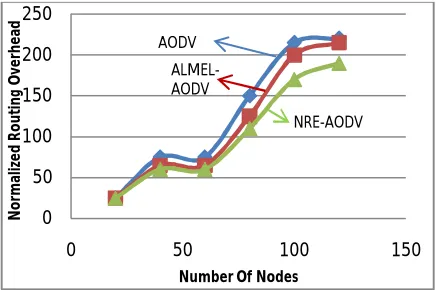
Figure 5.1 depicts the performance of the three routing protocols, namely AODV, NRE-AODV and ALMEL-AODV, in terms of normalized routing overhead versus network density. As shown in the figure, the normalized routing overhead generated by each of the considered routing protocols increases almost linearly as the network density increases. This is due to the fact that the larger network density in a network the more RREQ packets generated and retransmitted. The results also reveal that for a given network density, the normalized routing overhead generated by NRE-AODV is lower compared to both AODV and ALMEL-AODV routing protocols. For instance, compared with the AODV and ALMEL-AODV routing protocols, the generated routing overhead in NRE-AODV can be reduced by approximately 30.77% and 12.7% respectively when the nodes are relatively medium (e.g. 80 nodes). The good performance behavior of NRE-AODV is due to the fact that the scheme integrates energy capacity of each node and hops count as a cost metric unlike AODV and ALMEL-AODV and hence minimizes frequent broken link due to node’s battery failure. However, the performance advantage of NRE-AODV over AODV and ALMEL-AODV is getting decreased as the network becomes dense. For example, in figure 5.1 , when the nodes increased to 120 nodes, the performance advantage of normalized routing overhead in NRE-AODV reduced by approximately 14.63% and 12.34% compared to AODV and ALMEL-AODV respectively. The performance reduction can be explained by the fact that when the nodes increase, there is no means of controlling the routing overhead in any of the routing protocols. General speaking, NRE-AODV reduces the normalized routing overheads by an average percentage of 20.43% than AODV and 8.56% than ALMEL-AODV.
Figure 5.1: Normalized routing overhead with number of nodes
Average collision rate:
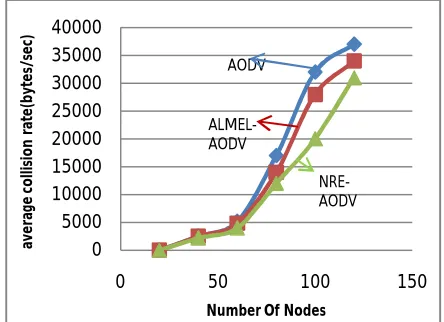
Figure 5.2 shows the average collision rate at the MAC layer versus the network density. When the network density is increased, the collision rate for each of the three routing protocols is increased. For instance when the network density
0 50 100 150 200 250
0 50 100 150
N
o
rm
al
iz
e
d
R
o
u
ti
n
g
O
ve
rh
e
ad
Number Of Nodes
AODV ALMEL-AODV
is relatively low (e.g. 40 nodes), NRE-AODV performed about 12.76% better than AODV and ALMEL-AODV. However, in a relatively medium network, NRE-AODV has a clear performance advantage over the AODV and ALMEL-AODV by 34.48% and 15.38% respectively. When the network is getting dense, the performance advantage decreased to 17.65% and 9.23% compared to AODV and ALMEL-AODV routing protocols. This is because in MANETs, the transmission of RREQ packet is not in accordance with the request-to-send and clear-to-send protocol of the MAC layer, rather each node transmits only when the communication medium has been sensed idle [1]. As a result, when the number of nodes increases, the probability of nodes transmitting at the same time becomes increase, leading to an increase in packet collisions. In general, NRE-AODV reduces the collision rate by an average of 21.53% and 13.35 % compared to AODV and ALMEL-AODV respectively.
Figure 5.2: Average collision rate with Number of nodes
Delivery ratio
Figure 5.3 shows the delivery ratio against the network density. The figure shows that the percentage of packets delivered for each of the routing protocols decreases when the network density is set high (e.g. 120 nodes) and low (e.g. 20 nodes). Specifically, NRE-AODV, AODV and ALMEL-AODV performs maximum delivery ratio of 89%, 85% and 86% respectively.
The minimum packet delivery ratio of NRE-AODV, AODV and ALMEL-AODV are 77%, 73%, and 74% respectively. This is because, in a dense network there is an excessive redundant retransmissions of control packets (e.g. RREQ packets) due to channel contention and packet collisions, thereby lowering the available bandwidth for data transmission whereas in sparse network, the route request packets fail to reach to destination nodes due to poor connectivity i.e. finding a route between source and destination of nodes is difficult in sparse networks. As shown in Figure 5.3 NRE-AODV outperforms AODV and ALMEL-AODV when the network is relatively medium. Generally, we see an average increment of 5.22% and 3.72% in the percentage of packets delivered by NRE-AODV than AODV and ALMEL-AODV respectively. For medium network the improvement reaches to 8.57% and 6.06 % than both AODV and ALMEL-AODV respectively. The improvement of NRE-AODV in a medium network is due to the fact that a destination node has received several energy efficient candidates’ routes to select the best energy capable route with relatively fair amount of routing overhead. Furthermore the selected energy efficient route for data transmission spans longer period of time there by reduces the retransmissions of RREQ packets due to node’s battery failure. As a result, the NRE-AODV protocol minimizes routing overhead, channel contention and packet collision as shown in
0 5000 10000 15000 20000 25000 30000 35000 40000
0 50 100 150
av
e
ra
ge
c
o
lli
si
o
n
r
at
e
(b
yt
e
s/
se
c)
Number Of Nodes
AODV
ALMEL-AODV
Figure 5.2 and Figure 5.3. Consequently, our developed routing protocol increased the available bandwidth for data transmission and hence delivered more data packets during the entire simulation time.
Figure 5.3: Delivery ratio with Number of nodes
Normalized energy consumption
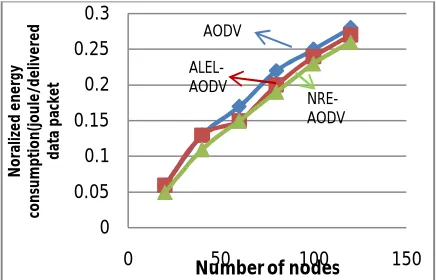
The results in Figure 5.4 depict the normalized energy consumption versus network density. The results in Figure 5.4 reveal that NRE-AODV has less energy consumption per delivered packet than the other routing protocols in each of the network density. As shown in Figure 5.4 NRE-AODV routing protocol reduces energy consumption per delivered packet by an average percentage of 12.90% than AODV and 7.94% than ALMEL-AODV. This is due to the fact that NRE-AODV uses an energy efficient path for data communication so that an established route could still wait for longer period of time without node’s battery failure than the other routing protocols and thereby reduces frequent re-initiation of route discovery process. Hence our proposed routing protocol reduced an energy requirement for redundant routing packets. Furthermore, the proposed protocol has also increased the data packets delivered to the intended destination nodes as shown in figure 5.3. As a result, reduction of routing packets and more delivered packets contribute a reduction in energy consumption per delivered data packets in NRE-AODV routing protocol compared to the considered routing protocols.
Figure 5.4: Normalized energy consumption with Number of nodes
70 75 80 85 90
0 50 100 150
D e liv e ry r at io (% )
Number Of Nodes
NRE-AODV ALMEL-AODV AO DV 0 0.05 0.1 0.15 0.2 0.25 0.3
0 50 100 150
N o ra liz e d e n e rg y co n su m p ti o n (j o u le /d e liv e re d d at a p ac ke t
Number of nodes AODV
ALEL-AODV
Network lifetime
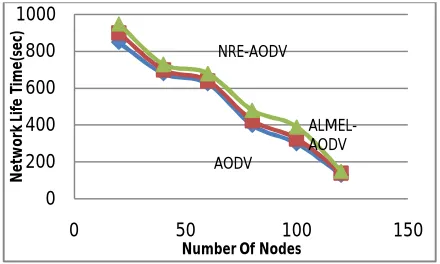
The results illustrated in Figure 5.5 show the network lifetime under varying number of network density. In the figure when the number of node increases the network lifetime in all the routing schemes decrease. This is because as the number of node increases, the routing packets generated and disseminated through the network increases. As a result, a considerable amount of node’s energy is consumed by each node’s of the network, leading to a decrease in the network lifetime. Figure 5.5shows that NRE-AODV routing protocol outperforms both AODV and ALMEL-AODV by successfully runs the network for a longer duration of time before the first node exhausts its energy.
In a simulation scenario of 1000 sec, the minimum network lifetime is 150 sec in NRE-AODV where as 140.01 sec and 129.65 sec for AODV and ALMEL-AODV routing protocols respectively when the number of nodes in the network is 120. Generally NRE-AODV improves the network lifetime by an average of 12.41% compared to AODV, while an average of 7.60 % compared to ALMEL-AODV. The performance improvement in network life time is due to the fact that our enhanced energy aware AODV prevents small residual energy nodes as a relay node during route selection and hence the time when the first node exhausts it’s battery spans longer duration of time. Furthermore, the protocol will also conserve node energy consumption by reducing the number of routing packets, leading to an increase network lifetime
Figure 5.5: Network life time with different number of nodes
Standard deviation of residual energy of all Nodes
Figure 5.6 shows that the standard deviation of remaining energy of all mobile nodes at the end of the simulation for each of the three routing protocols as the number of node increases. In NRE-AODV as the value of residual energy of each node on the route is above the threshold, maximum summation of energy path with less hop count will be used. This made energy capable nodes become part of the route for data transmission during route establishment and hence loads are distributed along energy efficient nodes. As a result less energy capable nodes are not penalized and hence nodes on the network are running up together. Therefore, the deviation of residual energy of all nodes becomes smaller in NRE-AODV than both AODV and ALMEL-AODV. For instance as shown in figure 4.6, NRE_AODV minimizes standard deviation of remaining energy by an average of 23.8% and 14.3% compared to AODV and ALMEL-AODV routing protocols respectively.
0 200 400 600 800 1000
0 50 100 150
N
e
tw
o
rk
L
if
e
T
im
e
(s
e
c)
Number Of Nodes
NRE-AODV
Figure 5.6: Standard deviation of residual energy of all nodes with different number of nodes
Average End to End Delay:
Figure 5.7 plots the impact of network density on the performance of the three routing protocols in terms of end-to-end delay. The figure shows that the end-to-end delay for each of the routing protocols increases for both sparse and dense networks. This is due to the fact that in dense network more number of routing packets is generated and transmitted and hence the interference between neighbor nodes, packet collisions and channel contention increases. Therefore, the time required to reach to destination increases. On the other hand when the network is sparse, due to poor connectivity the routing packets fail to reach to destination nodes and thus increase the end to end latency.
In Figure 5.7, we observe that the average end to end delay of AODV is smaller than both NRE-AODV and ALMEL-AODV. For instance, the average end-to-end delay of AODV is less than that of NRE-AODV and ALMEL-AODV by approximately 4.84% and 12.97% respectively. The reason is that AODV only finds shorter routes during route discovery irrespective of other parameters. Furthermore, the average end to end delay of ALMEL-AODV is higher than NRE-AODV. This is because ALMEL-AODV does not consider hop count as a cost metric. As a result, a path which has more hops could be selected for data transmission during route discovery which results an increase in end to end delay.
Figure5.7: Average end to end delay with number of nodes
VI. CONCLUSION
This paper has proposed a new energy aware routing approach which combines the minimum residual energy, sum residual energy and hop count as a cost metric. The approach utilizes minimum residual energy, sum residual energy
0 10 20 30 40
0 50 100 150
N o d e s re si d u al e n e rg y st an d ar d d e vi at io n
Number of nodes
AODV ALMEL -AODV NRE-AODV 0 200 400 600 800 1000
0 50 100 150
Av e ra ge e n d t o e n d d e la y( m se c)
Number of nodes
and hop count to select an energy efficient route that maximize network lifetime and distribute loads among the mobile nodes. The Ns-2 implementation of the AODV routing protocol has been modified to incorporate the new energy efficient routing protocols which has been referred as the Node Residual Energy AODV routing protocols (NRE-AODV,) Several simulation runs have been conducted on the NRE-AODV routing protocol and the performance results have been compared with the traditional AODV and its energy aware variant of AODV, namely ALMEL-AODV. The performance analysis has been conducted in terms of normalized routing overhead, average collision rate, delivery ratio, normalized energy consumption, network lifetime, standard deviation of residual energy, and average end to end delay.
The performance analysis results have shown that in terms of normalized routing overhead, average collision rate, delivery ratio, normalized energy consumption, network lifetime and standard deviation of residual energy of all nodes, the new Node Residual Energy AODV routing protocol, (NRE-AODV) achieves relatively better performance than both AODV and ALMEL-AODV at the expenses of higher end to end delay. Furthermore NRE-AODV still uses flooding as method for route discovery process. However flooding technique consumes energy and other resources of MANETs .Further future research can be done for an energy efficient based protocol for MANETs that alleviate the shortcomings of NRE-AODV flooding method of route discovery.
REFERENCES
[1] M.Frodigh,P.Johansson, and P.Larsson, “Wireless ad hoc networking: The art of networking without a network”, Ericsson Rev. 4, pp. 248-263, 2000.
[2]S.Basagni,M.Conti,S.Giordano,I.Stojmenovic, Second Edition,“MOBILE AD HOCNETWORKING Cutting Edge Directions,” John Wiley & Sons, Inc., 2013.
[3] C. Liu, and J. Kaiser, “A Survey of Mobile Ad Hoc network Routing Protocols”, Technical report, the University of Ulm , No. 2003-2008, 2005. [4] C. E. Perkins, E. M. Belding-Royer, and S. Das, “Ad hoc on-demand distance vector (AODV) routing”, Network Working Group, RFC 3561, 2003.
[5] T.H.Tie, C.E.Tan, and S.P.Lau, “Alternate Link Maximum Energy Level Ad Hoc Distance Vector Scheme for Energy Efficient AdHoc Networks Routing,” IEEE International Conference on Computer and [6] Y. C. Tseng, S. Y. Ni, Y. S. Chen, and J. P. Sheu, “The broadcast storm problem in a mobile ad hoc network”, Wireless Networks 8, pp. 153-167,2002
[7] Z.Zhaoxiao, P.Tingrui,and Z.Wenli, “Modified Energy-Aware AODV Routing for Ad hoc Networks”,IEEE Global Congress on Intelligent Systems, pp. 338-342,2009.Communication Engineering, 2010
[8] A.P.Patil, K. R. kanth , B.Sharanya, M P D. Kumar,and Malavika J, “Design of an Energy Efficient Routing Protocol for MANETs based on AODV”,IJCSI International Journal of Computer Science Issues, Vol. 8, Issue 4, No 1, pp. 215-220, 2011.
. [9] S. Y. Ni, Y. C. Tseng, Y. S. Chen, and J. P. Sheu, "The Broadcast Storm Problem in a Mobile A Hoc Network,in Proc. 5th Annu. ACM/IEEE Int. Conf.on Mobile Computing and Networking,Seattle, WA, USA, Aug. pp. 151-162, 1999 .[10] C. S. R. Murphy and B. S. Manoj, “Ad Hoc Wireless Networks: Architectures and Protocols”. New Jersey: Prentice Hall PTR, 2004.
[11] G Anastasi, M. Conti, and E. Gregori. IEEE 802.11 in ad hoc networks: Protocols, performance and open issues.Chapter 3.In Mobile Ad Hoc Networking, IEEE Press and John Wiley & Sons, New York, 2004.
[12] N.Vassileva and F. Barcelo-Arroyo.A Survey of Routing Protocols for Maximizing the Lifetime of Ad Hoc Wireless Networks. International Journal of Software Engineering and Its Applications, 2(3): pp. 77–90, July 2008
[13] Liqiang Zhao,Kun Yang and Guogang Zhao, “Energy Efficient Fundamental Theory and Technical Approach,” Energy Management in Wireless Cellular and Ad-hoc Networks, Studies in Systems, Decision and Control, pp. 189-213, 2016.
[14] A.M.Akhtar and X.Wang, “Cross-Layer Designs for Energy-Efficient Wireless Ad-hoc Networks,” Energy Management in Wireless Cellular and Ad-hoc Networks, Studies in Systems, Decision and Control, pp. 147-168, 2016.
[15] J. Zhu and X. Wang, “PEER: A Progressive Energy Efficient Routing Protocol for Wireless Ad Hoc Networks,” INFOCOM’05,24th Annual Joint Conference of the IEEE Computer and Communications Societies Proceedings,vol3, pp. 1887-1896, 2005.
[16] S.-M. Senouci and M. Naimi, “New routing for balanced energy consumption in mobile ad hoc networks,” ACM in PE-WASUN ’05: Proceedings of the 2nd ACM international workshop on Performance evaluation of wireless ad hoc, sensor, and ubiquitous networks, pp. 238–241, 2005
[17] P.Aggarwal and H.Aggarwal, “Energy-Efficiency based Analysis of Routing Protocols in Mobile Ad-Hoc Networks (MANETs)”, International Journal of Computer Applications, 2014.
[18] H. Y. Bohari, & S.O.Khanna,” Energy Efficient Power Aware Routing Algorithm (EEPARA) For Mobile Ad Hoc Network (MANET)”, International Journal of Engineering, 2013.
[19]D.Mathews,S.Kannan,andS.Karthik,“A Performance Analysis of Energy Aware and Link Stability based Routing Protocols for MANET”, International Journal of Advanced Research in Computer Engineering & Technology, 2012.
[21] A. Srinivas and E. Modiano, “Minimum energy disjoint path routing in wireless ad-hoc networks,” ACM in MobiCom ’03: Proceedings of the 9th annual international conference on Mobile computing and networking, p[150] S. Doshi, S. Bhandare, and T. X Brown, “An On-demand Minimum Energy Routing Protocol for a Wireless Ad Hoc Network”, ACM Mobile Computing and Communications Review, vol. 6, no. 3 , 2002. [22] S. Doshi, S. Bhandare, and T. X Brown, “An On-demand Minimum Energy Routing Protocol for a Wireless Ad Hoc Network”,ACM Mobile Computing and Communications Review, vol. 6, no. 3 , 2002.
[23] V. Rodoplu and T. Meng, “Minimum Energy MobileWirelessNetworks”,IEEE Journal on Selected Areas on Communications, vol. 17, 1999 [24] J.M. Kim and J.W. Jang, “AODV based Energy Efficient Routing Protocol for Maximum Lifetime in MANET”, IEEE Proceedings of the Advanced International Conference on Telecommunications and International Conference on Internet and Web Applications and Services, 2006. [25] X. Wang, L. Li, and C. Ran, “An energy-aware probability routing in Manets,” in IEEE Workshop on IP Operations and Management, pp. 146– 151 ,2004.
[26] A.G.Malek, C.LI, Z. Yang, A.H.N.Hasan, and X.Zhang, “ Improved the Energy of Ad hoc On- Demand Distance Vector Routing Protocol”, International Conference on Future Computer Supported Education, Published by Elsevier, IERI, PP-.355-361, 2012.
[27] Z.Zhaoxiao, P.Tingrui,and Z.Wenli, “Modified Energy-Aware AODV Routing for Ad hoc Networks,” IEEE Global Congress on Intelligent Systems, pp 338-342, 2009.
[27] T.Jie, W.Yu, and L.Jianxing, “Researching on AODV and PS-AODV Routing Protocols of Ad Hoc Network for Streaming Media,” CSAM The 2nd International Conference on Computer Application and System Modeling, 2012.
[28] Q.Lei and W.Xiaoqing, “Improved energy-aware AODV routing protocol”,IEEE WASE International Conference on Information Engineering ,pp 18-21, 2009.
[29] A.P.Patil, K. R. kanth , B.Sharanya, M P D. Kumar, and J . Malavika, “Design of an Energy Efficient Routing Protocol for MANETs based on AODV”,IJCSI International Journal of Computer Science Issues, Vol. 8, Issue 4, No 1, pp 215-220, 2011.
[30] R.V.Kumar, and R.S.D.W.Banu, “E2AODV: Protocol for Load Balancing in Ad-Hoc Networks,” Journal of Computer Science 8 (7), pp.1198-1204, 2012.
[31] A.V.Biradar, S.R.Tandle, V.G.Kasabegoudar, “Detailed Performance Analysis of Energy based AODV Protocol in Comparison with
Conventional AODV, and DSDV Protocols in MANET,” International Journal of Computer Applications, Vol.49 , pp.49-58, 2012.
[32] N.Gupta and S.R.Das,“Energy-aware on-demand routing for mobile ad hoc networks,” in IWDC’02: Proceedings of the 4th International Workshop on Distributed Computing, Mobile and Wireless Computing, pp. 164–173, 2002.
[33] S.Taneja, A. Kush, A.Makkar and B.Bhushan “Power Management in Mobile Ad hoc Network,” International Transaction Journal of Engineering, Management, & Applied Sciences & Technologies, pp. 215-225, 2011.
[34] I.Stojmenovic, and X. Lin, “Power-Aware Localized Routing in Wireless Networks,” IEEE Trans.Parallel and Distributed Systems, pp.1122-1133, 2001.
[35] B.Chen, K.Jamieson, R.Morris, H.Balakrisnan, “Span: An Energy-Efficient Coordination Algorithm for Topology Maintenance in Ad Hoc Wireless Networks,” Proceedings of Int’l Conf. on Mobile Computing and Networking (MobiCom), 2001.
[36] Y.Xu, J.Heidemann, D.Estrin, “Geography-informed Energy Conservation for Ad Hoc Routing,” Proceedings of Int’l Conf. on Mobile Computing and Networking (MobiCom’), 2001.
[37] B.R.Chen and C.H.Chang, “Mobility impact on energy conservation of ad hoc routing protocols,” SSGRR , pp. 1-7, 2003.
[38] L.Hogie, P.Bouvry, and F.Guinand, “An Overview of MANETs Simulation,” Electronic Notes in Theoretical Computer Science 150 , pp. 81– 101, 2006
[39] S. Kurkowski, T. Camp, and M. Colagrosso, "MANET simulation studies: the incredibles," ACM SIGMOBILE Mobile Computing and Communications Review, vol. 9, pp. 50-61, October 2005.
[40]NetworkSimulatorns-http://www.isi.edu/nsnam/-ns/.
[41] I. Svilen, H. Andre and L. Georg, “Experimental Validation of the ns-2 Wireless Model using Simulation, emulation, and Real Network,” proceedings of communication in Distributed Systems (KiVS), 2007.
[42] T. Camp , J. Boleng and V. Davies "A Survey of Mobility Models for Ad hoc Network Research," Wireless Communications and Mobile Computing, vol. 2, no. 5, pp. 483 - 502, 2002
[43] G.Lin, G.Noubir, and R.Rajamaran, "Mobility Models for Ad hoc Network Simulation," Proceedings of 23rd Conference of the IEEE Communications Society (INFOCOM), vol. 1, pp. 454-463, 2004
[44] W. Navidi and T. Camp, "Stationary distributions for the random waypoint mobility model," IEEE Transactions on Mobile Computing, vol.3,pp.99-108,2004.
[45] J.Gomez and A. Campbell.Power-aware routing optimization for wireless ad hoc networks.In High Speed Networks Workshop (HSN), 2001. [46] J.Gomez, A. Campbell, M. Naghshineh, and C. Bisdikian.Conserving transmission power in wireless ad hoc networks.In Proceedings of International Conference on Networking Protocols, 2001.