University of Windsor University of Windsor
Scholarship at UWindsor
Scholarship at UWindsor
Electronic Theses and Dissertations Theses, Dissertations, and Major Papers
12-16-2015
From Participation to Differentiation: A Framework for
From Participation to Differentiation: A Framework for
Re-Designing a Socio-Technical System
Designing a Socio-Technical System
Victoria Townsend University of Windsor
Follow this and additional works at: https://scholar.uwindsor.ca/etd
Recommended Citation Recommended Citation
Townsend, Victoria, "From Participation to Differentiation: A Framework for Re-Designing a Socio-Technical System" (2015). Electronic Theses and Dissertations. 5671.
https://scholar.uwindsor.ca/etd/5671
This online database contains the full-text of PhD dissertations and Masters’ theses of University of Windsor students from 1954 forward. These documents are made available for personal study and research purposes only, in accordance with the Canadian Copyright Act and the Creative Commons license—CC BY-NC-ND (Attribution, Non-Commercial, No Derivative Works). Under this license, works must always be attributed to the copyright holder (original author), cannot be used for any commercial purposes, and may not be altered. Any other use would require the permission of the copyright holder. Students may inquire about withdrawing their dissertation and/or thesis from this database. For additional inquiries, please contact the repository administrator via email
From Participation to Differentiation:
A Framework for Re-Designing a Socio-Technical System
by
Victoria Townsend
A Dissertation
Submitted to the Faculty of Graduate Studies
through Industrial and Manufacturing Systems Engineering
in Partial Fulfillment of the Requirements for
the Degree of Doctor of Philosophy at the
University of Windsor
Windsor, Ontario, Canada
From Participation to Differentiation:
A Framework for Re-Designing a Socio-Technical System
by
Victoria Townsend
APPROVED BY:
______________________________________________
Dr. Luciënne Blessing, External Examiner
Université du Luxembourg
______________________________________________ Dr. Pierre Boulos
Department of Philosophy and Centre for Teaching and Learning
______________________________________________ Dr. Zbigniew Pasek
Department of Industrial and Manufacturing Systems Engineering
______________________________________________ Dr. Waguih ElMaraghy
Department of Industrial and Manufacturing Systems Engineering
______________________________________________ Dr. R. Jill Urbanic, Advisor
Department of Mechanical, Automotive, and Materials Engineering
Declaration of co-‐authorship / previous publication
Co-authorship declaration
I hereby declare that this dissertation incorporates material thatis result of joint
research, as follows. This dissertation includes three publications that represent joint research undertaken with Dr. Jill Urbanic (Advisor), including one publication with Dr. Pierre Boulos (Outside Program Reader). These publications are outlined in further detail in the subsequent section, “Declaration of previous publication.” In all cases, the key ideas, primary contributions, experimental designs, data analysis, and interpretation were performed by me, and the contribution of the co-authors was primarily through the provision of supervising on the above work, offering suggestions and feedback to
improve the above work, and reviewing the above work. This is demonstrated in my first
authorship of these publications.
I am aware of the University of Windsor Senate Policy on Authorship and I certify that I have properly acknowledged the contribution of other researchers to my dissertation, and have obtained written permission from each of the co-authors to include the above materials in my dissertation (as per the Approval page on the previous page).
I certify that, with the above qualification, this dissertation, and the research to which it refers, is the product of my own work.
Declaration of previous publication
Dissertation
chapter Publication citation
Publication status
Chapter 4 2014, Townsend, V., P. Boulos, and J. Urbanic, “An
Ethical Roadmap for Engineering Participatory Design and Sociotechnical Participation: A Manufacturing Case Study.” American Society of Mechanical Engineers 2014 International Mechanical Engineering Congress
Proceedings, Montreal, QC, November 14-20, 1-8.
Published
Chapter 5 2014, Townsend, V. and J. Urbanic, “Complexity
Analysis for Problem Definition in an Assemble-to-Order
Process: Engaging Emic and Etic Perspectives.” Procedia
CIRP (The International Academy for Production
Engineering), 17: 201-206.
Published
Chapter 9 2015, Townsend, V. and J. Urbanic, “A Case Study
Measuring the Impact of a Participatory Design
Intervention on System Complexity and Cycle Time in an
Assemble-to-Order System,” Procedia Manufacturing, 1:
134-145.
Published
I certify that I have obtained a written permission from the copyright owners to include the above-published materials in my dissertation (included in Appendix N). I certify that the above material describes work completed during my registration as graduate student at the University of Windsor.
I declare that, to the best of my knowledge, my dissertation does not infringe upon anyone’s copyright nor violate any proprietary rights and that any ideas, techniques, quotations, or any other material from the work of other people included in my dissertation, published or otherwise, are fully acknowledged in accordance with the standard referencing practices. Furthermore, to the extent that I have included
copyrighted material that surpasses the bounds of fair dealing within the meaning of the Canada Copyright Act, I certify that I have obtained a written permission from the copyright owners to include such materials in my dissertation.
Abstract
Engineers are responsible for re-designing socio-technical systems (STSs). At the same time, the current literature on engineering re-design methodology is predominantly oriented towards technical artefacts. This methodology is not directly transferable to STSs, since STSs differ in the role of workers operating the system in collective activity. Accordingly, the central question of this dissertation is: How can engaging STS
operators as participants in re-designing an assembly production system develop an approach for re-designing STSs that operationalizes human value and potential?
To this aim, this dissertation develops a framework for re-designing a STS. This framework is developed with design research methodology and grounded theory,
modeling the re-design of an industrial assemble-to-order production system (a socio-technical system archetype) with 32 participants. The model consists of seven steps – ethical considerations for participation, emic problem analysis, emic system modeling, collective creativity, differentiated designs, emic problem evaluation, and emic system evaluation. The model and its supporting mechanisms make the following research contributions. (1) A developed roadmap of ethical considerations invites STS operators to take part in re-design with a basis of trust between researchers/engineers/designers and participants. (2) The developed investigative approaches for STS problem analysis and system modeling engage participants to define reference models and success criteria that guide the re-design process, including re-design foci. The reference models and success criteria before vs. after the design intervention are also compared to evaluate the re-design impact and experience, informing future re-re-design. (3) The developed model of OPEN collective creativity, from a co-design activity, engages participants in
Dedication
This work is dedicated to my husband Paul Mourad
Acknowledgements
Thank you to my dissertation committee – Dr. Luciënne Blessing, Dr. Waguih
ElMaraghy, Dr. Zbigniew Pasek, Dr. Pierre Boulos, and Dr. Jill Urbanic. Thank you, Dr.
Blessing, for your thorough and thoughtful feedback; it is an honour to have you as an
external examiner, and I am very grateful. Thank you, Dr. Waguih, for our meetings and
for your help in relating this research to engineering design and systems design research
and practices, such as Dr. Blessing’s DRM book. Thank you, Dr. Pasek, for our meetings
and for encouraging me to dedicate significant time to my dissertation research, along
with offering helpful references such as Vermaas et al.’s text. Thank you, Dr. Boulos,
for our meetings and for teaching me about research ethics and learning, and for sitting
with me when times were tough. Thank you, Dr. Urbanic, for believing in this research
from the very beginning and for your encouragement and support; I am very grateful.
I owe particular gratitude to all of the participants in this research study who
co-developed this research through their participation. Each participant has shaped this
research and made it possible, and I am so grateful for all that you have shared and taught
me. Correspondingly, I also owe a debt of gratitude to the industrial partner and, in
particular, the manager with whom I worked, whose commitment to this research project
and patience has been a great blessing and from whom I have learned a great deal about
leadership. Although I can’t name names, due to confidentiality, you know who you are.
I am also grateful to all of the kind-hearted people in manufacturing with whom I have
worked, who have taught me so much.
This research has been funded by the Natural Sciences and Engineering Research
reviewers, thank you for believing in this project. I have also been fortunate to receive
funding through the Ontario Graduate Scholarship program, and I am very thankful to the
government for providing this assistance, which has made pursuing a PhD possible for
me.
A special thanks to all of the people at the University of Windsor who have
helped me out of their generous nature, I am truly grateful. Thank you to Dr. Chris
Teplovs who taught me participatory design through hands-on participation and to Ms.
Bev Hamilton for introducing us. Thank you to Dr. McMurphy who sat with me to
discuss this research and picture it, and who helped me to learn the qualitative side of
research. Thank you to the Centre for Teaching and Learning -- Dr. Pierre Boulos, Dr.
Erika Kustra, and Prof. Michael Potter -- who opened my eyes to a new world of
learning, and who helped me to discover a love of inquiry.
Thank you to my fellow classmates, colleagues, and friends. I am especially
grateful to you – Renata Kobe, Majeed, Jameela, and the Khan family, Corey and Lena
Walsh, Sarrah Beemer, Melissa Figueroa, Victoria and Jennifer Collis, Holly Lafontaine,
Kirby Wilkerson, Sandy Marshall, and so many others.
Thank you to my family. Thank you, Dad, for your encouragement and support.
Thank you, Louis, for sharing your wisdom on writing and perseverance and for being
such a wonderful friend. Thank you to the Mourad family as well, for all of your support
and all of your nourishing Sunday dinners.
Last but not least, I owe a debt of gratitude to my husband, Paul Mourad. You
have been the most supportive, patient partner through all of this work and you have
Table of contents
Declaration of co-‐authorship / previous publication ... iii
Abstract ... v
Dedication ... vi
Acknowledgements ... vii
List of tables ... xiv
List of figures ... xviii
List of abbreviations and symbols ... xxiv
List of terms ... xxviii
Prologue ... xxxvii
1 Introduction ... 1
1.1 Design research problem, approach, and questions ... 6
1.2 Dissertation contributions ... 8
1.3 Dissertation outline ... 10
2 Literature review ... 13
2.1 Engineering re-design approaches ... 14
2.2 Socio-technical systems and engineering design methodology ... 16
2.3 Socio-technical systems theory and manufacturing designs ... 18
2.4 Manufacturing design and re-design techniques and approaches ... 19
2.5 Design methods that operationalize human value ... 22
2.6 Socio-technical systems theory ... 24
2.7 Detailed design research problem, approach, questions, and contributions informed by the literature review ... 29
3 Research methodology ... 34
3.1 Design research methodology ... 34
3.2 Qualitative methodology ... 36
3.2.2 The participant (emic) orientation of qualitative methodology ... 39
3.2.3 The grounded theory approach to qualitative research ... 39
3.3 Research and design methods ... 42
3.3.1 Participatory design ... 43
3.4 Industrial context and participants ... 46
3.5 Overview of the dissertation research design ... 54
4 A roadmap of ethical considerations for participation in socio-‐technical system re-‐ design ... 63
4.1 Research ethics ... 65
4.2 Operationalized research ethics in the industrial re-design project ... 67
4.2.1 Respect for persons: Voluntary, informed, and ongoing Consent ... 67
4.2.2 Concern for welfare: Risks vs. benefits, privacy, and confidentiality ... 69
4.2.3 Justice: Inclusion vs. exclusion, recruitment, and results dissemination ... 72
4.3 Professional engineering ethics ... 74
4.4 Synthesizing the ethical roadmap: Aligning research, professional, and participatory design ethics into ethical considerations ... 75
4.5 Discussion and conclusions ... 77
5 Emic problem analysis in socio-‐technical system re-‐design ... 80
5.1 The emic and etic problem analysis investigative approaches ... 81
5.2 Results ... 83
5.2.1 Results of the etic investigative approach for problem analysis ... 83
5.2.2 Results of the emic investigative approach for problem analysis ... 86
5.3 Discussion and conclusion ... 91
6 Emic system modeling in socio-‐technical system re-‐design ... 94
6.1 Relating a socio-technical system to the system design model ... 95
6.2 The emic STS modeling investigative approach ... 99
6.2.1 Data collection methods ... 100
6.2.2 Fuzzy cognitive mapping (FCM) ... 101
6.3 Results ... 114
6.3.2 FCM from observations ... 119
6.3.3 FCM from interviews integrated with observations ... 122
6.4 Analysis ... 126
6.5 Discussion ... 129
6.5.1 Overall cause concepts in the STS model – inputs, constraints, principles 131 6.5.2 Overall effect concepts in the STS model – outputs and function ... 132
6.5.3 Overall central concepts in the STS model – operations and constraints ... 133
6.5.4 Socio-technical system re-design foci and clauses ... 135
6.6 Conclusion ... 136
7 Collective creativity in socio-‐technical system re-‐design ... 139
7.1 The participant action model investigative approach ... 141
7.1.1 Co-design events and data collection ... 142
7.1.2 Fuzzy cognitive mapping ... 147
7.2 Results ... 154
7.3 Analysis ... 157
7.3.1 FCM analysis ... 157
7.3.2 Visualizing action occurrence with linkages and time ... 164
7.4 The participants’ action model of OPEN collective creativity ... 166
7.5 Discussion ... 167
7.6 Conclusion ... 174
8 Differentiated designs in socio-‐technical system re-‐design ... 177
8.1 A re-designed assembly process featuring two builder roles ... 178
8.2 A re-designed layout supporting builder roles ... 183
8.3 A new quality “double-check” tool ... 186
8.4 A new training checklist ... 190
9 Emic system evaluation in socio-‐technical system re-‐design ... 195
9.1 The emic system model evaluation investigative process ... 196
9.2 Results and analysis ... 197
9.2.1 Observation data and elementary units ... 197
9.2.3 Comparing before vs. after designs: Testing correlation between cycle time
and the complexity ratio ... 204
9.2.4 Comparing before vs. after designs: Testing pairwise comparison ... 205
9.3 Conclusion ... 207
10 Emic problem and re-‐design experience evaluation in socio-‐technical system re-‐ design ... 211
10.1 Participant evaluations of the re-designs ... 212
10.1.1 Participant evaluations of the importance of the re-design ideas ... 212
10.1.2 Participant evaluations of re-design impact with success criteria ... 213
10.1.3 Participant evaluations of future improvements to the re-designs ... 219
10.1.4 Participant evaluations of a good design ... 219
10.2 Participant evaluations of the re-design experience ... 221
10.2.1 Participant reflections on the co-design events ... 221
10.2.2 Participant evaluations on the re-design experience as a whole ... 222
10.2.3 Participant evaluations on the extension of the re-design approach ... 224
10.3 Conclusion ... 225
11 Discussion aligning the research questions and findings ... 228
11.1 The developed STS re-design approach – questions and problems ... 228
11.2 The developed STS re-design approach – the model as demonstrated ... 229
11.3 The developed STS re-design approach – inputs, outputs, constraints, and mechanisms in the model ... 231
11.4 The developed STS re-design approach – relating to the literature ... 236
11.5 The developed STS re-design approach – trustworthiness and validation ... 244
11.5.1 Truth value in the research and the STS re-design approach ... 245
11.5.2 Transferability in the research and the STS re-design approach ... 246
11.5.3 Dependability in the research and the STS re-design approach ... 248
11.5.4 Confirmability in the research and the STS re-design approach ... 249
12 Conclusions, limitations, and future work ... 251
12.1 Limitations and future work ... 252
References ... 260
Appendices ... 282
Appendix A Recruitment script ... 282
Appendix B Consent form ... 284
Appendix C Letter of information ... 286
Appendix D Consent for audio taping ... 288
Appendix E Tri-council research ethics certificate ... 289
Appendix F Demographic questionnaire ... 290
Appendix G Pre-interview ... 292
Appendix H Observation ... 293
Appendix I Participatory design activity 1 (process design) ... 294
Appendix J Participatory design activity 2 (layout/space design) ... 297
Appendix K Participatory design activity 3 (training design) ... 300
Appendix L Participatory design activity 3 (training design) revised ... 303
Appendix M Post-survey ... 306
Appendix N Copyright forms ... 311
Appendix O Demonstrating the fuzzy cognitive mapping procedure ... 325
Appendix P Participant descriptions of their PD experience ... 331
Vita auctoris ... 332
List of tables
Table 1: Research question 1 ... 7
Table 2: Research question 2 ... 8
Table 3: Research question 3 ... 8
Table 4: Summary of literature on re-design approaches ... 14
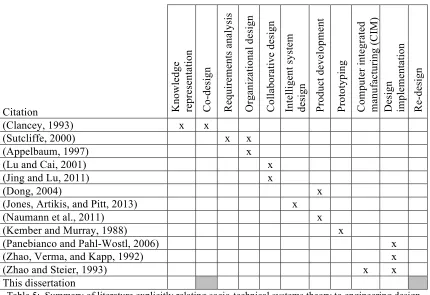
Table 5: Summary of literature explicitly relating socio-technical systems theory to engineering design methodology ... 17
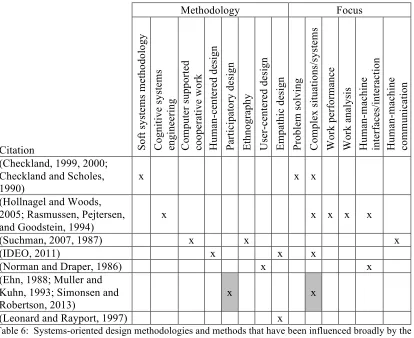
Table 6: Systems-oriented design methodologies and methods that have been influenced broadly by the socio-technical systems movement (after (Baxter and Sommerville, 2011)) ... 18
Table 7: Socio-technical systems theory explicitly applied to manufacturing and assembly-related designs ... 19
Table 8: Major design techniques related to manufacturing ... 20
Table 9: Summary of Muller and Kuhn's (1993) participatory design method comparison ... 45
Table 10: Final assembly component variants and precedence (from the pre- and post-observation) ... 47
Table 11: Research actions and foci of Chapters 4 to 12 ... 61
Table 12: Risk assessment (study) ... 70
Table 13: Aligning core principles of participation from research to practice ... 74
Table 14: Aligned ethical considerations for participation in research, engineering practice, and participatory design ... 77
Table 16: ANOVA Table on cycle time vs. product platform ... 85
Table 17: Fuzzy cognitive map linkage values and meanings (linkages based on Wrightson (1976) and fuzzy logic values based on (Kosko 1986)) ... 104
Table 18: Sample of FCM coding (in interview 5) ... 115
Table 19: Integrated interviews and FCM plot overview ... 118
Table 20: Cause concepts, effect concepts, and linkages for DR variable for the observation ... 120
Table 21: Linkages between the collective interview FCM and observation FCM ... 124
Table 22: Collective interviews FCM analysis (Ainterview(all)) ... 126
Table 23: Observation FCM analysis (Aobservation) ... 127
Table 24: Integrated collective interview and observation FCM analysis (Ainterview(all)&observation) ... 128
Table 25: FCM adjacency matrix analysis (interviews, observation, and integrated) ... 129
Table 26: Overall cause concepts in the FCM analyses ... 131
Table 27: Overall effect concepts in the FCM analyses ... 132
Table 28: Overall central concepts in the FCM analyses ... 134
Table 29: Re-design foci and clauses ... 136
Table 30: Motivation, goals, and critical questions for the process co-design foci ... 143
Table 31: Motivation, goals, and critical questions for the layout co-design foci ... 144
Table 32: Motivation, goals, and critical questions for the training co-design foci ... 145
Table 33: Co-design event materials ... 147
Table 35: Concept action coding examples ... 151
Table 36: Detail action coding examples ... 151
Table 37: Problem action coding examples ... 152
Table 38: Question/enquiry action coding examples ... 152
Table 39: Need action coding examples ... 152
Table 40: Opportunity action coding examples ... 153
Table 41: Out-degree, in-degree, and centrality for variables in the PD1&2 FCM ... 158
Table 42: Out-degree, in-degree, and centrality for variables in the PD3 FCM ... 158
Table 43: Out-degree, in-degree, and centrality for variables in the PDtotal FCM ... 158
Table 44: Chain of inter-related actions involving a conflict and constraint ... 171
Table 45: The participants' major differentiated designs ... 177
Table 46: Final assembly component variants and precedence (from the pre- and post-observation) ... 178
Table 47: Task division for the new picker and assembler builder roles ... 181
Table 48: The [emic system model evaluation] investigative process (B-before, A-after) ... 196
Table 49: Elementary unit groups and sample size (n) ... 199
Table 50: Calculating the values for the pallet count, PC, variable ... 202
Table 51: Observation complexity variable values and corresponding mean cycle time ... 203
Table 52: Theoretical complexity variable values and associated mean cycle time ... 206
Table 54: Participant evaluations of the most and least important re-designs ... 212
Table 55: Average score with the improvement statements (1=strongly disagree; 5=strongly agree; n=sample size) ... 215
Table 56: Success criteria: Alignment between pre-interview emic code and post-survey statements ... 216
Table 57: Success criteria values before and after re-design ... 217
Table 58: Participant evaluations of a good design ... 220
Table 59: Participant co-design reflections after the second co-design event (PD3) ... 221
Table 60: Participant reflections on likes and dislikes in the research study ... 222
Table 61: Average score with the participation statements (1=strongly disagree; 5=strongly agree) ... 223
Table 62: Research questions and their corresponding discussion section ... 228
Table 63: Alignment of the chapters, problems, and questions that arose in the re-design project ... 229
Table 64: IDEF0 model summary for each chapter (step in the developed participatory approach for re-designing a STS) ... 230
Table 65: Summary of inputs, outputs, and outcomes in the model for re-designing a STS ... 233
Table 66: Summary of the mechanisms and constraints in the re-design approach ... 234
Table 67: Trustworthiness criteria (based on (Krefting, 1991; Shenton, 2004)) ... 245
Table 68: Assumptions in the developed investigative approaches, models, and framework ... 247
List of figures
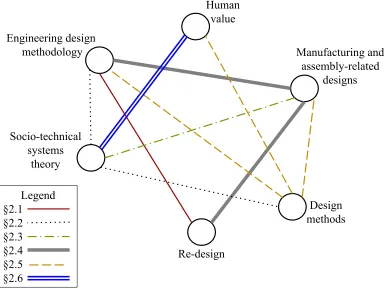
Figure 1: Relationships between the main topics in the dissertation and the literature
review sections ... 13
Figure 2: Classification of participatory design, human factors, and collaboration in engineering ... 23
Figure 3: Emery's three core principles for re-envisioning assembly STSs (after (Emery, 1989b)) ... 28
Figure 4: Contributions of the dissertation in relation to the body of literature reviewed32 Figure 5: Added connections of the dissertation in relation to the body of literature reviewed ... 33
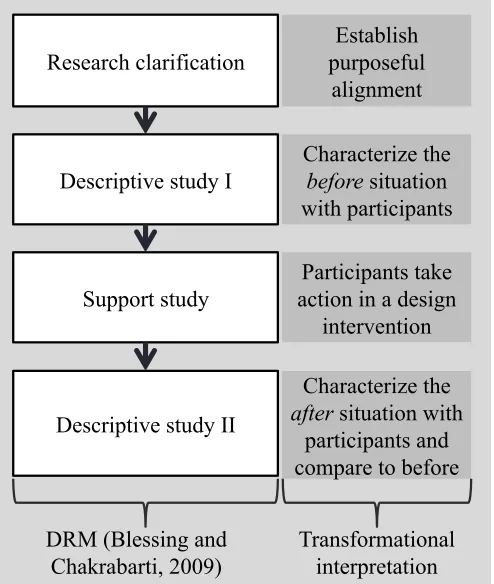
Figure 6: Design Research Methodology phases (Blessing and Chakrabarti, 2009) with a transformational interpretation ... 34
Figure 7: Inquiry methodology (after (Hudspith and Jenkins, 2001)) ... 37
Figure 8: Overview of research and design methods utilized in the dissertation in relation to DRM and qualitative methodology ... 42
Figure 9: Fixed product layout (from the pre-observation) ... 47
Figure 10: Socio-technical system operator roles ... 48
Figure 11: The initial assembly process and work (from the pre-interview, n=8) ... 49
Figure 12: Pre-interview participant quotes on pre-disposition to experimenting (n=8) . 50 Figure 13: Age demographics of the 2011 Canadian Household Survey and research study participants (n=27, questionnaire) ... 51
Figure 15: Visible minority demographics in the 2011 Canadian Household Survey and
research study participants (n=27, questionnaire) ... 52
Figure 16: Education demographics of the 2011 Canadian Household Survey and research study participants (n=27, questionnaire) ... 53
Figure 17: IDEF0 model format ... 54
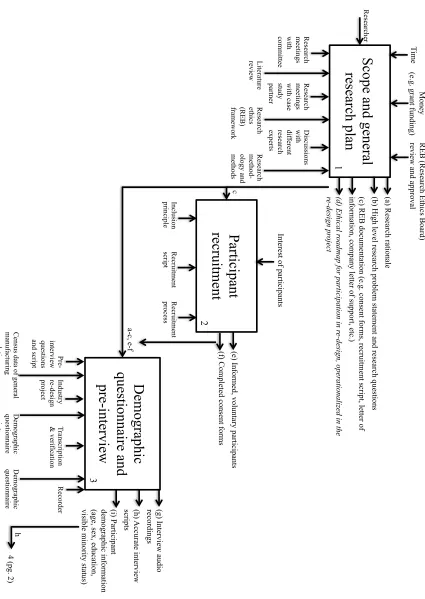
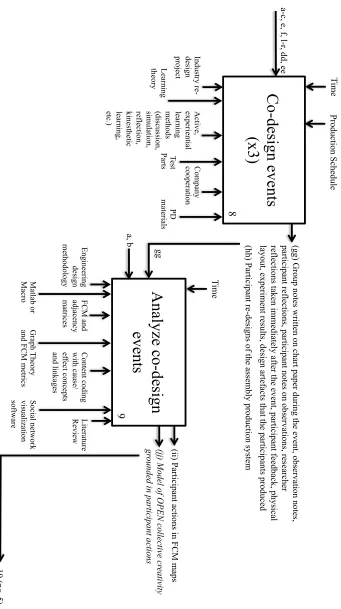
Figure 18: IDEF0 of research design (page 1) ... 55
Figure 19: IDEF0 of research design (page 2) ... 56
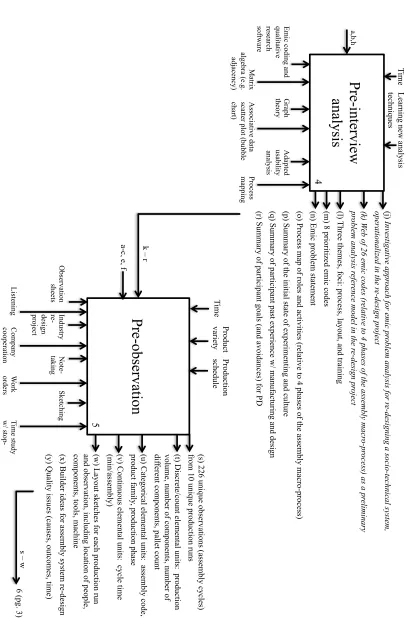
Figure 20: IDEF0 of research design (page 3) ... 57
Figure 21: IDEF0 of research design (page 4) ... 58
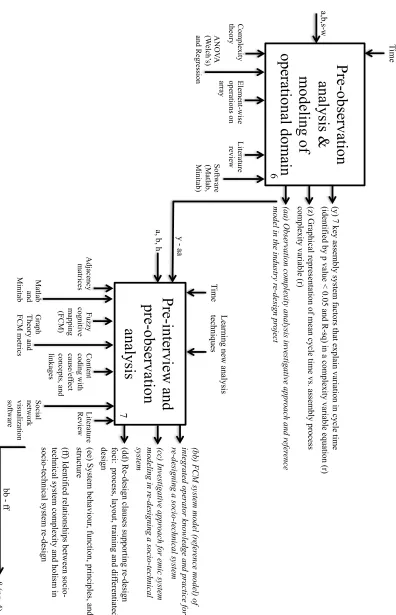
Figure 22: IDEF0 of research design (page 5) ... 59
Figure 23: IDEF0 of research design (page 6) ... 60
Figure 24: The developed model for re-designing a socio-technical system ... 62
Figure 25: Matrix of research ethics principles and operationalization ... 66
Figure 26: [Participant] recruitment process (study) ... 68
Figure 27: Data management process (study) ... 71
Figure 28: Participatory inclusion principle for the assembly process (study) ... 72
Figure 29: Ethical considerations IDEF0 ... 79
Figure 30: Ethical considerations in the developed model for re-designing a socio-technical system ... 79
Figure 31: The investigative approach for emic problem analysis ... 82
Figure 32: The investigative approach for etic problem analysis ... 83
Figure 34: ANOVA boxplot on cycle time vs. product platform ... 85
Figure 35: Map of emic coding to the four main phases of the assembly process (colour adaptation of (Townsend and Urbanic, 2014)) ... 88
Figure 36: Adjacency matrix (Aij) for the graph in Figure 35 ... 89
Figure 37: Magnitude matrix, weighted adjacency matrix, and critical codes ... 90
Figure 38: Critical codes, weighted adjacency vs. magnitude occurrence and code’s primary relation to P-Process, L-Layout, or T-Training (colour adaptation of (Townsend and Urbanic, 2014)) ... 90
Figure 39: Emic problem analysis IDEF0 ... 93
Figure 40: Emic problem analysis in the developed model for re-designing a socio-technical system ... 93
Figure 41: A technical system design model (after (Zhang, Lin, and Sinha, 2011)) ... 96
Figure 42: A STS design model in relation to Zhang, Lin, and Sinha's (2011) design model ... 98
Figure 43: Simple fuzzy cognitive map ... 102
Figure 44: The emic system modeling investigative approach ... 113
Figure 45: Adjacency matrix for interview5 (Ainterview5) ... 115
Figure 46: FCM plot for interview5 (from Ainterview5) ... 116
Figure 47: Adjacency matrix for interview7 (Ainterview7) ... 116
Figure 48: FCM plot for interview7 (from Ainterview7) ... 117
Figure 49: FCM plot for integrated interviews 1, 2, and 3 (from Ainterview1-3) ... 118
Figure 50: FCM plot of the collective interview ... 119
Figure 52: FCM plot for the observation (from Aobservation) ... 122
Figure 53: FCM plot for observation (from Aobservation) with collective interview linkages
from Table 21 ... 125
Figure 54: FCM plot for the integrated collective interview and observation
(Ainterview(all)&observation) ... 125
Figure 55: Emic system modeling IDEF0 ... 138
Figure 56: Emic system modeling in the developed model for re-designing a
socio-technical system ... 138
Figure 57: The participant action model investigative approach ... 141
Figure 58: Coding process for the co-design event data ... 150
Figure 59: Excerpt of coding from PD1&2 event (in the production area, end) ... 155
Figure 60: Excerpt of coding from PD3 event (in the meeting room) ... 155
Figure 61: PD1&2 adjacency matrix (A1&2) ... 156
Figure 62: PD3 adjacency matrix (A3) ... 156
Figure 63: PDtotal adjacency matrix (Atotal) ... 156
Figure 64: FCM for Atotal ... 157
Figure 65: Variable centrality in the PDtotal FCM ... 160
Figure 66: PDtotal FCM – detailed view of the concept variable and its linkages ... 162
Figure 67: PDtotal FCM - detailed view of the detail variable and its linkages ... 163
Figure 68: PDtotal FCM - detailed view of the OPEN variables and their linkages ... 164
Figure 69: PD1&2 time-plotted variable and linkage visualization (beginning, in
Figure 70: PD3 time-plotted variable and linkage visualization (midpoint, beginning in
meeting room) ... 166
Figure 71: The participants’ action model of OPEN collective creativity ... 167
Figure 72: Collective creativity IDEF0 ... 175
Figure 73: Collective creativity in the developed model for re-designing a
socio-technical system ... 176
Figure 74: Participant prototype of a description of the new process ... 179
Figure 75: Participant prototype of a checklist of tasks for the new builder assembler and
picker roles ... 180
Figure 76: Fixed product layout (from the pre-observation) ... 184
Figure 77: Re-designed layout sketch ... 185
Figure 78: The re-designed layout ... 186
Figure 79: The participants' "double-check" grid ... 187
Figure 80: Assembler and picker use of the "double-check" tool ... 188
Figure 81: The participants' description of their prototype labeling system for the
"double-check" grid ... 189
Figure 82: Illustrating the labeling system for the "double-check" tool ... 189
Figure 83: The participants’ training checklist outline ... 191
Figure 84: The new training checklist structure ... 191
Figure 85: The new demonstration checklist for training ... 192
Figure 86: Differentiated designs IDEF0 ... 194
Figure 87: Differentiated designs in the developed model for re-designing a
Figure 88: Flow of the observation investigative process steps ... 197
Figure 89: Welch’s ANOVA results, testing correlation between elementary units and
cycle time ... 199
Figure 90: Mean cycle time vs. complexity ratio (before and after) ... 204
Figure 91: Complexity variables for theoretical and observation calculations, before and
after ... 205
Figure 92: Paired t-test histogram of differences, after - before mean cycle time ... 207
Figure 93: Emic system evaluation IDEF0 ... 209
Figure 94: Emic system evaluation in the developed model for re-designing a
socio-technical system ... 210
Figure 95: Agreement scale ... 214
Figure 96: Before (SCb) versus after (SCa) problem space in relation to the success
criteria (SC) ... 218
Figure 97: Agreement scale ... 223
Figure 98: Emic problem evaluation IDEF0 ... 227
Figure 99: Emic problem evaluation in the developed model for re-designing a
socio-technical system ... 227
Figure 100: The developed model for re-designing a socio-technical system ... 231
Figure 101: Cognitive map relating the literature and research findings, theoretical reference model (black nodes – from the literature; white nodes – from the IDEF0
models) ... 239
List of abbreviations and symbols
§ Section
Aij Adjacency matrix (other versions -- Ainterview, Ainterview(all), Aobservation, etc.)
A After (the design intervention)
AA Number of assembling tasks builder A performs
AB Number of assembling tasks builder B performs
AR Distribution of work ratio related to the number of assembling tasks
AT Number of assembling tasks for the final product assembly
ANOVA Analysis of Variance
AP Assembly process
B Before (the design intervention)
c(vi) Centrality (of a node in a FCM)
C Concept
cf. Compare with (Latin confer)
D Density in a FCM
Dl Detail
DA Number of different components that builder A handles
DB Number of different components that builder B handles
DR Distribution of work ratio related to the number of different components
DT Number of different components in the final product assembly
DFA Design for assembly
DFM Design for manufacture
DRM Design research methodology
E Enquiry or question
e.g. For example
F-value F-value or F-statistic (signal to noise ratio)
FCM Fuzzy cognitive map
G Graph (in graph theory)
Ho Null hypothesis
IA Impact average agreement
id(vi) In-degree (of a node in a FCM)
i.e. In other words
L Number of Linkages in a FCM
Mji Magnitude matrix
MS Mean squares
N Number of nodes in a graph (in graph theory)
n Sample size
NAICS North American Industry Classification System
Nd Need
O Opportunity
p-value P-value or probability value
P Problem
PA Number of picking tasks that builder A performs
PB Number of picking tasks that builder B performs
PC Pallet count variable
PR Distribution of work ratio related to the number of picking tasks
PT Number of picking tasks for the final product assembly
PD Participatory design
r Complexity ratio
REB Research ethics board
RQ Research question
RQ (DRM) Research question in design research methodology phrasing
RQ (Eng) Research question in engineering phrasing
RQ (Soc) Research question in social science human participant research phrasing
RSA Royal Society for the Encouragement of Arts, Manufactures, and
Commerce
R-Sq R-squared value (% of variation in Y explained by X)
S Start of a production run
SCa Value of the success criteria after the re-design
SCb Value of the success criteria before the re-design
STS Socio-technical system
SS Sum of squares
TA Number of total components that builder A handles (for one final product
assembly)
TB Number of total components that builder A handles (for one final product
assembly)
TR Distribution of work ratio related to the total number of components
TT Number of total components in the final product assembly
T-value Test statistic for t-test
µ Mean cycle time of archived population [minutes/assembly]
V Number of edges (in graph theory) in Chapter 5
V Production phase variable in Chapter 6 and Chapter 9
Volmax Maximum production volume observed
Wji Weighted adjacency row matrix
X-barCT Mean cycle time in observation set
Note: any numeric codes used within a chapter are defined within that chapter.
List of terms
Assembly “The aggregation of all processes by which various parts and
sub-assemblies are built together to form a complete,
geometrically designed assembly or product (such as a machine or an electronic circuit) either by an individual batch or a continuous process” (Nof, Wilhelm, and Warnecke, 1997, p. 2).
Design Engineering design
“Design: An ability to design solutions for complex, open-ended engineering problems and to design systems,
components, or processes that meet specified needs with appropriate attention to health and safety risks, applicable standards, and economic, environmental, cultural and societal considerations” (Engineers Canada, 2014, p. 13).
Design for manufacture
Design for manufacture (DFM) is “a methodology that
simultaneously considers all of the design goals and constraints for products that will be manufactured… Other aspects include all the other ‘design fors’ or ‘abilities,’ for example, design for testability, quality, reliability, serviceability, style, appearance, shipping, etc. These are sometimes referred to as ‘design for X’ (DFX)” (Rufe, 2002, p. 159).
Design for assembly
Design innovation (from industrial design)
“The design innovation process starts with the real – we observe and learn from the tangible factors from real-world situations. Then we try to get a full understanding of the real world by creating abstractions and conceptual models to reframe the problem in new ways. Only then do we explore new concepts in abstract terms before we evaluate them and implement them for their acceptance into the real world. This requires fluidity in our thinking between the real and the abstract” (Kumar, 2012, pp. 8–9).
“Design” in this dissertation
In general, in this dissertation, when the word “design” is used it is used with respect to the engineering design definition above. Since this dissertation extends beyond objects, to a system perspective, system’s design (definition below) is also relevant to the engineering design terminology use. Since the primary concern of this dissertation is re-design, re-design (definition below) is considered in relation to the engineering design terminology and in relation to the broader sense of design innovation (design innovation definition above), which provides further context given the inter-disciplinary nature of this dissertation. When DFM or DFA are referred to in this dissertation, they are addressed by these terms. When
participatory design is referred to in this dissertation (below), it is referred to specifically.
Design method “A design method is a procedure or prescription for how to
Design model “The phrase ‘models of design’ can be interpreted in two different ways: models that are used in designing, such as scale models, CAD models, sketches etc.—this is henceforth referred to as ‘models in design’; and models that are used to describe or prescribe how design is or should be (carried out)—this is henceforth referred to as ‘models of design’” (Chakrabarti and Blessing, 2014b, pp. 10, 11).
Though there are many definitions for a design model, as collected and analyzed by Chakrabarti and Blessing (2014), the following definition of a design model is utilized here for its succinctness and for its ability to distinguish between design theories and models: “Sonalkar et al. (2014) follow the distinction made by Dörner (1994) who succinctly describes a theory as ‘a formulation that explains a phenomenon’, and a model as ‘an abstraction that simulates a phenomenon’” (Chakrabarti and Blessing, 2014b, p. 13).
Design theory Design theory “is an attempt to systematically bind together the
knowledge we have of experiences of design practices”
(Chakrabarti and Blessing, 2014a, p. 9; Vermaas, 2014, p. 48).
Emic vs. Etic “In qualitative research, the goal is to understand the situation
under investigation primarily from the participants’, not the
researcher’s, perspective. This is called the emic, or insider’s
perspective, as opposed to the etic, or outsider’s, perspective”
(Hancock and Algozzine, 2011, p. 8).
Engineering The “practice of professional engineering means any act of
planning, designing, composing, evaluating, advising,
of engineering principles and concerns the safeguarding of life, health, property, economic interests, the public welfare or the environment, or the managing of any such act” (PEO, 2011, p. 4).
Industrial engineering
Industrial engineering is “concerned with the design,
improvement and installation of integrated systems of people,
materials, information, equipment and energy. It draws upon specialized knowledge and skill in the mathematical, physical,
and social sciences together with the principles and methods of
engineering analysis and design, to specify, predict, and
evaluate the results to be obtained from such systems” (“About IIE,” 2015).
Framework A framework is a basic supporting structure of something,
inclusive of a set of ideas or facts (“Definition of framework by Merriam-Webster,” 2015). Further defined, it is a “broad overview, outline, or skeleton of interlinked items which supports a particular approach to a specific objective, and serves as a guide that can be modified as required by adding or deleting items” (“What is framework?,” 2015). For the purpose of this research, a framework is considered a supporting
structure of interlinked methods, models, theories, tools, etc. that serve as a guide for re-designing a socio-technical system here.
Fuzzy cognitive mapping
data is coded to identify relationships in the form of cause concept/linkage/effect concept. Fuzzy logic is then integrated by giving the linkage between a cause and effect a value between -1 and 1, making FCMs both qualitative and
quantitative in nature. The coding is then transferred into an adjacency matrix composed of causes (rows), effects (columns), and corresponding linkage values. This adjacency matrix is then plotted as a di-graph (the visual representation of the fuzzy cognitive map), where the linkages are shown as vectors
leading to and from concept (cause and effect) nodes.
Grounded theory
A specific methodology developed by Glaser and Strauss (1967) “for the purpose of building theory from data” (Corbin and Strauss, 2008, p. 1).
Manufacturing “There is unfortunate confusion created by different uses of the
word ‘manufacturing.’ Sometimes the word is used to refer to the entire product realization process; that is, to the entire spectrum of product-related activities in a firm that makes products for sale, including marketing (e.g. customer desires), design, production, sales, etc. This entire process is sometimes referred to as ‘Big-M manufacturing.’ But the word
manufacturing is also used as a synonym for production; that is, to refer only to the portion of the product realization process that involves the actual physical realization process that involves the actual physical processing of materials and the assembly of parts. This is sometimes referred to as ‘Little-m manufacturing’” (Dixon and Poli, 1995, pp. I–8). This dissertation focuses on production.
(Corbin and Strauss, 2008, p. 1). E.g. an interview. In PD, Kensing and Blomberg (1998) state that, “Mathiassen (1981) has introduced useful distinctions between methods, tools, and techniques in his work on theories and methods for systems
development. For Mathiassen a method has limited application
areasdepending on, for example, the type of organizational and
technological change desired or the number of people involved.
A method also provides a particular perspectiveon a
phenomena (e.g. an organization and its needs for computer support) and is composed of a coherent collection of tools, techniques, and principles of organization” (p. 8).
Methodology In engineering design, “A methodology is a method generally
applicable to a number of problem types.” (Dixon and Poli, 1995, p 1–9). A methodology is “A way of thinking about and studying social phenomena” (Corbin and Strauss, 2008, p. 2). Qualitative methodology is based on Chicago Interactionism and Pragmatism, where “knowledge arises through (note the verbs) acting and interacting of self-reflective beings” (Corbin and Strauss, 2008, p. 2).
In general, a methodology is broader in meaning and
application than a method. The latter part of the word, “logos” is from the Greek for ‘logic of;’ therefore, a research/design methodology relates to the logic associated with understanding the way in which the aims of the research/design can be
researched/designed (e.g. the appropriate methods and what makes them appropriate).
Participation Genuine participation is described in the PD literature as “the
informants to being legitimate and acknowledged participants in the design process… inviting users to such collective discussions and reflections requires a trustful and confiding relationship between all participants” (Robertson and
Simonsen, 2013, p. 5). Additionally, a research participant is “an individual whose data, or responses to interventions,
stimuli, or questions by a researcher are relevant to answering a research question” (Government of Canada, 2010, p. Glossary).
Participatory design
Participatory design (PD) regards human potential highly in social interaction and engagement (Robertson and Simonsen, 2013, p. 3) and develops it through mutual learning (Robertson and Simonsen, 2013, p. 6). In participatory design, human value is operationalized by system operators in relation to the socio-technical system and with designers who facilitate the method.
Different methods of PD are classified by Muller and Kuhn (1993) in terms of the degree of participant involvement. Co-design is utilized in this dissertation research, which
involves socio-technical system operators directly participating
in design activities and early in the development cycle (Muller
and Kuhn, 1993). Please see Chapters 1, 3, and 7 for more information.
Qualitative analysis
Qualitative analysis is “a process of examining and interpreting data in order to elicit meaning, gain understanding, and develop empirical knowledge” (Corbin and Strauss, 2008, p. 1).
Qualitative methodology
of [the] study participants, and understand the meanings and interpretations that they give to behaviour, events or objects” (Hennink, Hutter, and Bailey, 2010, p. 8).
Re-design Re-design is generally defined in relation to products. Dixon
and Colton (2000) define re-design as a common design
scenario “characterized by the re-working or re-use of whole or parts of previous design solutions to generate new product designs” (p. 159). Further, Deneux and Wang (2000) define re-design in terms of products that are “based on standard
elements or well-mastered technology” (p. 85).
In this dissertation, this definition of re-design is interpreted in a socio-technical system context with the following perspective on technology. Technology “entails far more than its individual material components. Technology involves organization, procedures, symbols, new words, equations, and most of all, a mindset” (Franklin, 1999, p. 3). As Franklin states, “The web of technology can indeed be woven differently, but even to discuss such intentional changes of pattern requires an examination of the features of the current pattern and an understanding of the origins and the purpose of the present design” (Franklin, 1999, p. 52).
Research “An undertaking intended to extend knowledge through a
disciplined inquiry or systematic investigation” (Government of Canada, 2010).
Socio-technical systems
social conditions of work, in such a way that efficiency and humanity would not contradict each other any longer” (Ropohl, 1999, p. 1). Socio-technical systems (STSs) have a hybrid character (Vermaas et al., 2011, p. 70). Compared to a technical artefact (e.g. a product), not only do socio-technical systems have a hybrid nature “What makes socio-technical systems special is, first of all, that they have many users at any one moment, and secondly, that they involve people in two different ways, namely, not only in the role of user of the system but also in the role of operator” (Vermaas et al., 2011, p. 70). Please see Chapters 1 and 2 for more information.
Systems analysis
“A problem-solving technique that decomposes a system into its components pieces for the purpose of studying how well those component parts work and interact to accomplish their purpose” (Whitten and Bentley, 2007, p. 160)
Systems synthesis
“A complementary problem-solving technique (to systems analysis) that reassembles a system’s component pieces back into a complete system – hopefully, an improved system. This may involve adding, deleting, and changing pieces relative to the original system” (Whitten and Bentley, 2007, p. 160)
Note: this dissertation’s perspective on system re-design includes both systems analysis and systems synthesis.
Prologue
“The influence of a vital person vitalizes, there’s no doubt about it. The world without spirit is a wasteland. People have the notion of saving the world by shifting things around, changing the rules, and who’s on top, and so forth. No, no! Any world is a valid world if it’s alive. The thing to do is to bring life to it, and the only way to do that is to find in your own case where the life is and become alive yourself.”
- Joseph Campbell (Campbell and Moyers, 1988, p. 149)
The pursuit of discovering what it means to bring the human side of engineering design and manufacturing systems to life makes me feel alive.
1
Introduction
Engineering re-design is a design practice that is generally defined in relation to products. Deneux and Wang (2000) define re-design in terms of products that are “based on standard elements or well-mastered technology” (p. 85). Dixon and Colton (2000) define re-design as a common design scenario “characterized by the re-working or re-use of whole or parts of previous design solutions to generate new product designs” (p. 159). These definitions align with a retrieval-based approach to design synthesis, which
involves re-designing a technical artefact by “building on an existing design” versus “composition from scratch” (Chakrabarti, 2002, p. xiii). Though generally defined in relation to products (technical artefacts), re-design is not necessarily limited to a technical artefact domain.
Indeed, engineering re-design is also needed in the domain of socio-technical systems (STSs) -- for two primary reasons.
(1) Engineers are responsible for designing socio-technical systems and seeing the designs through over time into subsequent designs. This responsibility is
described by Vermaas et al. (2011) who state: “Even though it is eminently this hybrid character – the presence of components requiring a physical description and components requiring a social description – that characterizes socio-technical systems, the designing, implementing, and maintaining of these systems remains predominantly in the hands of engineers” (p. 70).
(2) Any subsequent design to a socio-technical system occurs in relation to the existing system (present design solution), since the social aspects (e.g. learning, work culture, etc.) and integrated socio-technical aspects (e.g. work practices) make it a living system that transcends from design to design. To reject this reality in a subsequent design is to reject the significance of the social and integrated aspects of the socio-technical system; to accept this reality in a
subsequent design is to accept that designing from scratch is not appropriate. To regard the socio-technical system as a living system, therefore, involves
build in relation tothe existing socio-technical system. These two primary reasons establish that the practice of re-designing socio-technical systems is an
engineering responsibility that ought to be intentionally considered for each
subsequent design of a socio-technical system.
These two primary reasons are also integral to the practice of industrial
engineering. The Institute of Industrial Engineers states that, “Industrial engineering is
concerned with the design, improvement and installation of integrated systems of people,
materials, information, equipment and energy. It draws upon specialized knowledge and
skill in the mathematical, physical, and social sciences together with the principles and
methods of engineering analysis and design, to specify, predict, and evaluate the results to be obtained from such systems” (“About IIE,” 2015). This inter-disciplinary and integrated characterization of systems, and of industrial engineering practice to design and improve these systems, directly correlates to re-designing socio-technical systems.
At the same time, in order to re-design a socio-technical system, the practice of re-design that has been generally defined in relation to technical artefacts cannot simply be transferred to socio-technical systems – it must be re-envisioned. Engineers are faced with unique challenges and opportunities when re-designing socio-technical systems in comparison to technical artefacts:
… the designing, implementing, and maintaining of these [socio-technical] systems remains predominantly in the hands of engineers, who have been educated in predominantly natural-scientific ways. That is why these systems constitute a major challenge for the engineering sciences. All kinds of traditional notions about what constitutes the designing of a technical artefact, how the design process should be structured, what kind of knowledge is required and how one should assess the functioning of a designed artefact, become very problematic whenever they are literally transplanted to the context of designing
socio-technical systems… The designers of such systems are confronted with the numerous aspects that are not easily or not at all describable within the
traditional engineering approach, which is overwhelmingly oriented towards the natural sciences. This traditional approach and the accompanying conceptual frameworks, models and theories therefore need to be enriched with the
knowledge that has been and is being developed within the domain of the social
In order to re-design socio-technical systems, the practice of re-design needs to at least be enriched with knowledge of socio-technical systems and at best socio-technical (inter-disciplinary) acumen.
A socio-technical system is more than just a hybrid mix of social and technical aspects. A technical artefact, e.g. a product, can be said to have a dual technical and social nature. Technical artefacts are often designed for various social and human purposes and concern people in terms of usability. In a technical system, a user may provide an input or they may be recipients of an output. In an interactive technical system, the person gives an input to the technical system and receives an output and this cycle repeats itself, even frequently. In a socio-technical system, people are entities within the system making its design deeply indebted to social and human involvement. Compared to a technical artefact, “What makes socio-technical systems special is, first of all, that they have many users at any one moment, and secondly, that they involve people in two different ways, namely, not only in the role of user of the system but also in the role of operator” (Vermaas et al., 2011, p. 70). The impact that a socio-technical system design has on the people operating it is immediate, and the impact that people within a socio-technical system have on the design and its operation is also immediate. People not only interact with the system, they fundamentally make it function from within. People are not peripheral to the system, they are inter-connected within it and to each other. Any attempt to divide people from the socio-technical system – its design, its operation, and its re-design – contradicts the socio-technical nature of fundamental interdependence between people and technology.
xi). The same robust design argument is also made in participatory design: “Mutual learning supports the design of technology based on the logic of the practice it is intended to support. This makes the solution more robust and sustainable” (Bjerknes and
Bratteteig, 1988; Robertson and Simonsen, 2013, p. 6). Mutual learning is developed in participatory design through social interaction and engagement (Robertson and
Simonsen, 2013, p. 3), which also brings human values to bear on the design process and its outcomes (a concern and driver for participatory design (Iversen, Halskov, and Leong, 2012)). Democratic decision-making is another benefit of participatory design in relation to human value, a practice that has been advocated in engineering design for some time, e.g. in the Design Research Society’s 1971 conference wherein Cross (1972) urged for greater participatory decision making. An appreciation for socio-technical operators and their experience can, hence, be operationalized in the re-design of socio-technical
systems directly through operator participation.
Participatory design (PD) is particularly appropriate for re-designing socio-technical systems because it shares a foundation of human value and addresses complex systems broadly. Both participatory design and socio-technical systems theory are closely related through action research. Socio-technical systems theory was developed through action research, e.g. (Cherns, 1989). Participatory design was derived from action research (Spinuzzi, 2005, p. 166). In this connection, both are strongly committed to humanizing workers in design practice and its outcomes through democratic worker involvement. This is critical to the future development of socio-technical systems since Mumford (2006) identifies, in reviewing the evolution of socio-technical systems, that moving forward “The most important thing that socio-technical design can contribute is its value system. This tells us that although technology and organizational structures may change, the rights and needs of the employee must be given as high a priority as those of the non-human parts of the system” (p. 338). Participatory design provides an
opportunity to mobilize human value and potential in developing a re-design approach for socio-technical systems.
participatory design. Different methods of participatory design are classified by Muller and Kuhn (1993) in terms of the degree of participant involvement. Within this
classification, and in relation to technical systems, co-design involves
socio-technical system operators directly participating in design activities and early in the
development cycle (Muller and Kuhn, 1993). Co-design provides broad freedom and influence in decision-making to further develop human value through direct stakeholder participation in the practice and outcomes of design, for the purposes of re-designing a socio-technical system in this research. Accordingly, this research develops re-design activities with participants through re-design practice (in participation and co-design) in a socio-technical system archetype – a manufacturing system, specifically an assembly production system.
In a non-autonomous manufacturing production system, multiple workers operate the system simultaneously – the function of the system is reliant upon collective human activity. This reality is what gave rise to the foundational body of work on socio-technical systems theory, which was developed through action research performed with the British coalmines, e.g. (Cherns, 1989). This critical relationship between socio-technical systems and manufacturing production systems has endured and is expressed in the recent manufacturing literature, e.g. managing complex socio-technical systems is said to “contribute tangibly to the sustainable development of manufacturing”
(ElMaraghy, 2011). For these reasons, the manufacturing production system can be viewed as a socio-technical system archetype, which also means that re-designing it as a socio-technical system requires consideration for the critical significance of operators and collective human activity.
realities converge into the present need to re-design assembly production systems, especially assemble-to-order systems, as socio-technical systems that fully recognize human value and manifest this potential with operators in collective human activity.
By grounding the development of a design approach in the practice of re-designing an assembly production system through participation, the re-design approach is grounded in human potential. This grounded theory (Glaser and Strauss, 1967),
qualitative methodological approach is developed in conjunction with design research methodology (Blessing and Chakrabarti, 2009) to provide an inter-disciplinary
perspective with systematic rigor. This research approach also conducts its inquiry through the emic (insider) perspective – the socio-technical system operator perspective. This aligns re-design practice and knowledge into co-developing a re-design approach for socio-technical systems that is grounded in the most salient feature of socio-technical systems; in doing so, the re-design approach for socio-technical systems is distinguished from the re-design of technical artefacts.
1.1 Design research problem, approach, and questions
Engineers are responsible for re-designing socio-technical systems, which ought to be intentionally considered for each subsequent design of a socio-technical system. The re-design of socio-technical systems is also central to the practice of industrial engineering. Engineering re-design approaches that have been developed for technical artefacts are not directly transferrable to socio-technical systems, due to the unique role of workers in socio-technical systems. In socio-technical systems, workers operate the system in collective activity. This is especially true for assembly production systems, which involve numerous operators working in sync and who play a critical role in managing variety in assemble-to-order systems. An approach for re-designing socio-technical systems, especially assembly production systems, needs to be developed to consider the critical significance of operators in collective human activity and operationalize human value.
operationalization of human value and potential requires sense-making, taking care to mindfully integrate social and technical aspects. This sense-making involves situational awareness in relating theory and practice, which is why the empirical study of re-design in relation to an assembly production system provides a much needed basis for
developing a re-design approach for socio-technical systems. This inter-connected transition from one re-design activity to the next also develops a holistic and emic (insider/participant/socio-technical system operator) view in relation to the experience of re-design with a socio-technical archetype. Through action and reflection in this
experience, inter-disciplinary knowledge and practice is developed and integrated in various forms and in tandem with participation (e.g. design models, design theories, engineering design methodology, socio-technical system theory, etc.). As elaborated in subsequent chapters, these considerations are cultivated in relation to participation, problem analysis, system modeling, creativity (including collective conceptual and detail ideation in an activity), and design evaluation (problem and system analysis through reflective practice) in re-designing a socio-technical system.
In alignment with this central design research problem and approach, this dissertation research focuses on the following research questions:
Social science phrasing
(human participant research) Engineering phrasing
Design research methodology phrasing 1. How can engaging
socio-technical system operators as participants in re-designing an assembly production system develop an approach for re-designing socio-technical systems that operationalizes human value and potential?
1. What is the re-design model to re-design an assembly production (socio-technical) system with stakeholder
participation, human value, and human potential?
1. How can the practice of re-designing a socio-technical system with operator participation be demonstrated and defined?
Table 1: Research question 1
Social science phrasing
(human participant research) Engineering phrasing
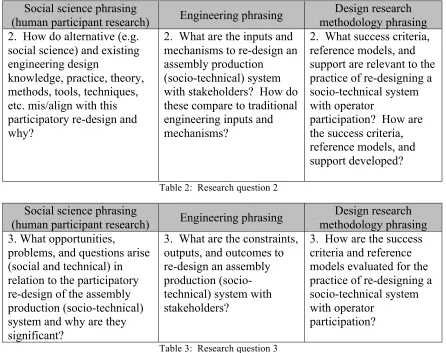
Design research methodology phrasing 2. How do alternative (e.g.
social science) and existing engineering design
knowledge, practice, theory, methods, tools, techniques, etc. mis/align with this participatory re-design and why?
2. What are the inputs and mechanisms to re-design an assembly production
(socio-technical) system with stakeholders? How do these compare to traditional engineering inputs and mechanisms?
2. What success criteria, reference models, and support are relevant to the practice of re-designing a socio-technical system with operator
participation? How are the success criteria, reference models, and support developed?
Table 2: Research question 2
Social science phrasing
(human participant research) Engineering phrasing methodology phrasing Design research
3. What opportunities,
problems, and questions arise (social and technical) in relation to the participatory re-design of the assembly production (socio-technical) system and why are they significant?
3. What are the constraints, outputs, and outcomes to re-design an assembly production (socio-technical) system with stakeholders?
3. How are the success criteria and reference models evaluated for the practice of re-designing a socio-technical system with operator
participation?
Table 3: Research question 3
In examining these research questions, the dissertation makes the following research contributions.
1.2 Dissertation contributions
This dissertation contributes to developing an approach for re-designing a socio-technical system with an integrated framework, which consists of new investigative approaches for building reference models of a socio-technical system and a model of collective creativity in re-design that is informed, and evaluated, by the reference models. The contributions are categorized into three areas:
I. Novel investigative approaches for building reference models of the
socio-technical system for re-design from an emic perspective through