FRAMEWORK TO REDUCE VARIATION PROCESSING TIME IN PUBLIC PROJECTS
MUNIRAH BINTI ABDUL KADIR
FRAMEWORK TO REDUCE VARIATION PROCESSING TIME IN PUBLIC PROJECTS
MUNIRAH BINTI ABDUL KADIR
A thesis submitted in partial fulfillment of the Requirement for the award of the degree of Master of Science (Construction Contract Management)
Faculty of Built Environment Universiti Teknologi Malaysia
vi
DEDICATION
ACKNOWLEDGEMENT
First and foremost, thanks to Allah for the blessings, health and opportunity given to me to complete this research. I would like to express my gratitude to my dedicated supervisor, Dr. Norazam bin Othman for his guidance, patience and understanding throughout the journey to complete this study. I am also indebted to Public Service Department for the scholarship to pursue this study.
I would like to express my gratitude to my “bonda” for her prayer, support, understanding and patience towards me throughout my journey as a student. To my ‘great’ colleagues, Afiz, Kamarul, Ezlin, KakAida, million thanks for the endless motivations, continuous encouragement and support. Not to forget, to my dearest course mates, Zahier, Siha, Kerk, Zi Yee, Iman and Dayah, thank you for the friendship and assistance throughout my journey back as a student again.
viii
ABSTRACT
ABSTRAK
x
TABLE OF CONTENTS
CHAPTER TITLE PAGES
DECLARATION ii
DEDICATION iii
ACKNOWLEDGEMENT iv
ABSTRACT v
ABSTRAK vi
TABLE OF CONTENTS vii
LIST OF TABLES x
LIST OF FIGURES xi
LIST OF ABBREVIATIONS xii
1.0 INTRODUCTION
1.1 Background of Study 1
1.2 Problem Statements 3
1.3 Research Question 7
1.4 Research Aim and Objective 7
1.5 Scope of Study 7
1.6 Significant of Study 8
1.7 Research Methodology 8
1.8 Organization of Chapters 11
2.0 VARIATION IN CONSTRUCTION INDUSTRY
2.1 Introduction 13
2.2 Overview of Variation in Construction Project
2.2.1 Introduction 14
2.2.2 Variation Definition 15
2.2.3 Variation Orders in Construction Projects 17 2.2.4 Causes and Impacts of Variation 19 2.2.5 Provisions of Variation in Government Contract 22 2.2.6 Duties of Contract Administrator in
Administering the Variation 28
2.2.7 Issues in Variation Process and
Administration 31
2.3 Management of Variation
2.3.1 The Overview of Variation Management 34 2.3.2 The Fundamentals of Managing Variations 37 2.3.3 Framework for Managing Variation 37 a) What is Framework?
b) Benefits of Applying Framework
2.3.4 Variation Management Process 41
a) Identify b) Evaluate c) Approve d) Implement
e) Review and lesson learnt
2.3.5 Variation Procedure in Public Projects 43 a) Standard Forms and Documentation
b) Government Circulars and Instructions c) Delegation of Powers During Approval Stage d) General Procedures of Variation Administration 2.3.6 Underlaying Factors Affecting Time in
Processing Variation 51
xii
3.0 RESEARCH METHODOLOGY
3.1 Introduction 57
3.2 Research Design 57
3.3 The Process of Developing Framework 58
3.4 Data Collection Method 59
3.4.1 Documentary Analysis 3.4.2 Interview
3.5 Data Analysis 63
3.6 Summary 64
4.0 RESEARCH ANALYSIS AND DISCUSSION
4.1 Introduction 65
4.2 The Preliminary Framework 66
4.3 Analysis of Interviews 70
4.3.1 Question 1 4.3.2 Question 2 4.3.3 Question 3 4.3.4 Question 4 4.3.5 Question 5 4.3.6 Question 6
4.4 Discussion on Final Framework 85
4.5 Summary 90
5.0 CONCLUSION AND RECOMMENDATIONS
5.1 Introduction 91
5.2 Research Findings 91
5.3 Conclusion 94
5.4 Problem Encountered During Research 94
5.5 Recommendations for Future Research 95
LIST OF TABLES
TABLE NO. TITLE PAGE
2.1 Delegation of Power During Approval Stage in
Government Practice 48
3.1 Profiles of interviewees 62
4.1 Responses to Question No 1 72
4.2 Responses to Question No 2 75
4.3 Responses to Question No 3 77
4.4 Responses to Question No 4 80
4.5 Responses to Question No 5 81
xiv
LIST OF FIGURES
FIGURE NO. TITLE PAGE
1.1 Research Methodology Flowchart 10
2.1 The links of the contractual provisions for
variation procedure under PWD Form 203A 26
2.2 Variation Management Process 42
3.1 Interview analysis of the study 64
4.1 The preliminary framework to reduce variation
processing time in public projects 67
4.2 The proposed framework to reduce variation
LIST OF ABBREVIATIONS
PWD - Public Works Department S.O - Superintending Officer
S.O Rep. - Superintending Officer Representatives HODT - Head of Design Team
HOPT - Head of Project Team KPK - Kelulusan Perubahan kerja APK - Arahan Perubahan Kerja PHK - Pelarasan Harga Kontrak AP - Arahan Perbendaharaan
CIPAA - Construction Industry Payment Adjudication Act CII - Construction Industry Institution
CIRIA - Construction Industry Research and Information Association CKUB - Cawangan Kontrak dan Ukur Bahan
ATDA - As Tendered Detailed Abstract QS - Quantity Surveyor
CHAPTER 1
INTRODUCTION
1.1 Background of Study
In construction practice, variation frequently encountered in all type of construction projects (Arain and Low, 2005; Oladapo, 2007). It is difficult for the client and his team to foresee every possibility of the project. Besides, it is almost impossible to construct the project that is totally identical to the original design used for tender even if the project that are carefully planned in their initial stage (Moghaddam, 2012). This is because the construction process was influenced by many factors. Those factors including the performance of the contractual parties, different stages of work and complex operations which cannot be accurately determined in advance (Nachatar et al., 2010; Sutrisna and Potts, 2002). Therefore, variation works has become almost unavoidable in many construction projects (Du et al., 2016).
previously in variation order is in the manner it is proposed, submitted and resolved which can be very complex and contentious as it involve many processes and parties that is usually resulted to additional cost and times in most of construction projects (Sidney, 2006).
In the context of construction industry, the frequency of variation is varied from one project to another (Arain and Low, 2005). Variation may occur from different sources, at any stage and may have some considerable effects. It is accepted that whenever work varies, there will be financial or time implications or a combination of both (Rajoo and Harbans, 2012). In a construction contract, variations are also known as the common source of disputes among contractual parties especially the client and contractor (Kumaraswamy and Yogeswaran 1998). Usually, these disputes occur when variation orders are not being managed carefully (Charoenngam, et al., 2003).
The variation order process can be one of the most difficult aspects of the entire construction undertaking. It is time consuming and if not organized or streamlined, it may result in delay (Fisk, 2005). Due to this, the inefficient stages during the approval process should be taken out in processing the variations to optimize the variation processing time (Terwiesch and Loch, 1999). The procedure must also make clear to all parties during the early stage of the construction to avoid any conflicts (Mokhtar, 2000). Sun et al. (2006) mentioned in their study that at present, there is a lack of industrial standards for project variation management procedures in construction practice. They further added that this situation often results in variations being poorly managed by project teams during execution of the construction projects.
3
variation, but rather, if variation orders were resolved in a timely manner and gives benefit to all the construction parties and the project in term of cost and time (Arain and Low, 2005). Due to this, the key to the successful management of variation is to provide a simplified procedure in a systematic way to improve the management of variations in construction projects.
1.2 Problem Statements
Variation to client requirements are a constant source of problems. They are one of the most frequent causes of claims and will often lead to litigious disputes (Murdoch and Hughes, 2006). Employer must accept that no construction is to be free from variation. This is because variation will occur in most of the projects due to the uncertainty and the inherent nature of construction projects (Al-Suliman, 2014). It had become the greatest problem in contract administration (Hibberd, 1986). One of the problem resulted from the variation is the disputes between the contractual parties due to the delay in processing the variation works (Mechanda, 2005; Randa et al., 2009; Ndihokubwayo and Haupt, 2009; Kwok, 2009; Zakaria, 2014; Nayan et al., 2017).
construction (Harbans and Kandan, 2004).
According to Charoenngam et al. (2003), an effective variation order management can be developed by understanding the variation order process or workflow. The time periods for response by the Superintendent and the Contractor are a critical part of effective management of variations. In a study conducted by Al-Suliman (2014) indicated that the process of initiating a variation order takes a substantial amount of time before getting approval due to the correspondence between the construction parties involved in the project.
In the context of Malaysian construction industry, a study by Aftab et al. (2014) found that variations are also a norm in any public projects. In 2016, it was being recorded in SKALA (Project Monitoring System of the Public Works Department of Malaysia) that most of the projects appear to have variations. The occurrence of the variation often led to many issues and dissatisfactions among the parties involved in construction projects including issues of delay in processing the varied works (Nayan et al., 2017).
5
The Auditor General Report by National Audit Department has also identified the weakness of variation administration in the public projects. They have found out that a total of 61 out of 122 variation applications with addition in value worth RM5.44 million were submitted to the Ministry between 41 days to 550 days after the Certificate of Practical Completion (CPC) issued and the total of 81 out of 122 variation orders with addition in value worth RM9.29 million were approved by the Variation Order Technical Committee between 11 to 1,100 days from the date of application. This situation shows that there is a weakness in administering and managing the variation in public projects. Due to this, the audits had suggested that the current practice of variation administration to be improved.
According to the foregoing discussion, the main issue that is pointed out is on the delay in evaluation and processing of the variation order and a necessary improvement should take place to address the issue effectively. As mentioned above, this issue had affected the contractor in many ways. Although this issue was highlighted in many studies, there is not much effort made to improve and streamline the current practice of variation administration in public projects. On top of that, there was not many attempt have been made to map a process, analyse it and redefine it using the conclusions from the previous audit reports.
of variation in the educational building (Arain, 2007). Following the similar line of thought, Othman (2015) has developed a framework for decision making process for variation works to analyse impacts caused by factors influencing decisions.
All this research is beneficial in order to improve the identification, controlling and the evaluation of project changes. However, neither of these previous studies paid attention in improving the current variation management process that is able to reduce time in processing variation. On top of that, all these studies were lacks of features which highlight the current workflow of variation process that can be adapted in the context of Malaysia public projects.
7
1.3 Research Question
The discussion and statement of problem above highlighted the important question read as follow:
How to improve the variation administration in public projects that is able to reduce its processing time?
1.4 Research Aim and Objective
To develop a framework to reduce the variation processing time in public projects.
1.5 Scope of Study
The scope of this study will be confined to the following areas:
a) Standard form of contract is limited to PWD Form203A (Rev. 1/2010).
Currently there is no formalised approach to reduce the process time of variation in Malaysian public projects. Through this study, the researcher has attempt to develop a framework that serves as the guideline to all the parties in administering the variations. This framework is developed to improve the current practice of variation administration in government projects. Besides that, this study will provide the solution which aims to reduce the processing time of variation orders in public projects in a form of the framework. The framework is selected because it is the best technique to link the sequence of works in a more simplified way. The outcome from this study would provide the guidelines for the best practice in managing the variation process in public projects.
1.7 Research Methodology
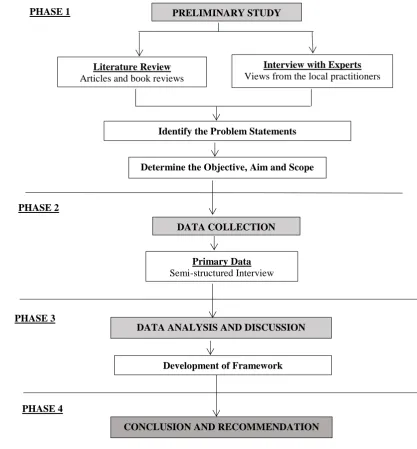
The outline of research methodology for this study is divided into four (4) different phase which is the preliminary study, data collection, data analysis and lastly on the conclusion and recommendations. The brief explanation on the outline of the research design for this study is as follows:
a) Phase One: Preliminary Study and Research Proposal
9
scope of this study were determined after the problem statements and issues in the research area is identified.
b) Phase Two: Data Collection
The main source of the data collection for this study is by conducting the semi-structured interviews in the field studies with the local practitioners that involved directly with the variation administration in public projects.
c) Phase Three: Data Analysis
All the data collected in second phase will be analyse using qualitative analysis to form a framework.
d) Phase Four: Conclusion and Recommendations
Figure 1.1: Research Methodology Flowchart Literature Review
Articles and book reviews
Interview with Experts Views from the local practitioners
Determine the Objective, Aim and Scope
DATA COLLECTION Identify the Problem Statements
Primary Data Semi-structured Interview
DATA ANALYSIS AND DISCUSSION
CONCLUSION AND RECOMMENDATION PRELIMINARY STUDY
Development of Framework PHASE 1
PHASE 2
PHASE 3
11
1.8 Research Structure
This thesis consists of five (5) chapters. The brief introduction for each chapter are discussed as follows:
a) Chapter One: Introduction
The chapter provides general information about the research. This chapter contains on the research proposal for this study. It explained on the background of the study, problem statement, research aim and question, the objective of the research, scope and limitation of the research, significance of the research and the research structure of this study. This chapter also highlighted on the issue of delay in administering the variations process in public projects.
b) Chapter Two: Variation in Construction Industry
This chapter provides the literature review on the variation in construction industry. It explained on the terminologies of variations, causes, impacts and duties of contract administrator in administering the variation. In addition, this chapter also explained on the variation management process in construction and the standard process of variation administration that is carry out in public projects. Issues affecting the delay in variation process were also presented in this chapter.
c) Chapter Three: Research Methodology
This chapter will be concentrating on the data analysis and will discuss on the findings from this study. All the data obtained from the semi-structured interviews with the local practitioners that involved in the variation administration were analyse in this chapter. These analyse data is use to develop the framework to reduce the variation order processing time in public projects as the end result for this study.
e) Chapter Five: Conclusion and Recommendations
This chapter will draw relevant conclusion from the findings as its relate to the objectives of this study. It also presents necessary recommendations for further studies. This chapter will also highlight the limitation of the study, which may affect the outcome of this research.
1.9 Summary
96
REFERENCES
Aftab, H.M., Rahman, H. & Faris, A.H. (2014). Significant Causes and Effects of Variation Orders in Construction Projects, Research Journal of Applied Sciences, Engineering and Technology 7(21): 4494-4502
Al-suliman, J.A. (2014). Effective Stakeholder Engagement in Variation Order Management at the Design Stage of Public Sector Construction Projects in Saudi Arabia. Doctor of Philosophy. School of the Built Environment. Heriot-Watt University. London
Arain, F.M. and Low, S. P. (2005). The Potential Effects of Variation Orders on Institutional Building Projects. Journal of Facilities, 23(11), 496-510.
Arain, F.M. and Low, S. P. (2006) A framework for developing a knowledge-based decision support system for management of variation orders for institutional buildings, ITcon Journal of Information Technology in Construction, 11, 285- 308.
Alnuaimi, A.S., Taha, R.A., Al Mohsin, M., Al-Harthi, A.S., (2010). Causes, effects, benefits, and remedies of change orders on public construction projects in Oman. International Journal Project Management, 136, 615–622
Application for Managing Change Orders in Construction Projects, Construction Innovation, Vol. 3 Issue: 4, pp.197-215
Creswell, J.W. (2014). Research Design: Qualitative, Quantitative, and Mixed Method Approaches. 4th ed. California: Sage Publications, Inc.
Cox I. D., Morris J. P., Rogerson J. H., Jared G. E. (1999). A quantitative study of post contract award design changes in construction, Construction Management and Economics, 17 (4), 427-439
Cunningham, T. (2014). The Role of the Contract Administrator under the Principal Irish Standard Forms of Building Contract, Dublin Institute of Technology
Du, J., Mohamed, E-G., Zhao D (2016). Optimization of Change Order Management Process with Object-Oriented Discrete Event Simulation: Case Study. Journal of Construction Engineering and Management, Volume 142. Issue 4- April 2016
Eshtehardiana, E. and Saeed, K. (2016). Analytical Survey of Construction Change Systems: Gaps & Opportunities, Procedia Engineering, (161)944 – 949
Fisk E. R (2005), Construction Project Administration. 8th Edition. Prentice Hall
Hao, Q., Shen, W., Neelamkavil, J., Thomas, R. (2008). Change Management in Construction Projects. Proceedings of International Conference on Information Technology in Construction, Santiago, Chile.
98
Harbans Singh, K.S. (2003). Engineering and Construction Contracts Management: Post- Commencement Practice. Singapore: Lexis Nexis
Harbans Singh, K.S. and Kandan (2004). Variation Claims- Pitfalls and Pratfalls. Engineering and Law (Bulletin Ingenieur): 36-42.
Hibberd R. (1986). Variations in construction contracts. Collins, London.
Ibbs C. W, Wong, C. K, and Kwak, Y.H. (2001). Project Change Management System, Journal of Management in Engineering, ASCE, Vol. 17 (3) pp. 59 - 165
Judi, S.S, Mustaffa N. E, Nayan R (2017), A Framework for Combating Payment-Related Issues (Pri) In the Malaysian Construction Industry. Journal of Built Environment, Technology and Engineering, Vol. 2 (March) ISSN 0128-1003
Kasen, B., Oblas, V. (1996). Thinking Ahead with Forward Pricing. Journal of Management in Engineering. March-April 1996.
Kumaraswamy, M., & Yogeswaran, K. (1998). Significant sources of construction claims. International Construction Law Review, 15 (1), 144-16
Lazarus, D., Clifton, R. (2001). Managing Project Change; A Best Practice Guide. United Kingdom. Construction Industry Research and Information Association
Oaks: Sage Publication: London
Mechanda, P. (2005). A framework for reducing change order processing time in university construction projects. Master’s thesis, School of Planning, Design and Construction, Michigan State University, East Lansing, MI.
Mokhtar A., C. Bedard and P. Fazio, (2000). Collaborative Planning and Scheduling of Interrelated Design Changes. Journal of Architectural Engineering, 6 (2)66-75
Moghaddam, G. (2012), Change Management and Change Process Model for the Iranian Construction Industry. International Journal Management Business Resources, 2 (2), 85- 94, Spring 2012
Motawa, I.A. (2005). A Systematic Approach to Modelling Change Processes in Construction Projects. Australian Journal of Construction Economics and Building, 5 (1). pp. 23-31. ISSN 1445-2634
Motawa, I.A., Anumba, C.J., Lee, S., Peña-Mora, F., (2007). An integrated system for change management in construction. Automatic Construction. (16)368–377
Muhammad, N. Z., Keyvanfar, A., Majid, M. Z. A., Shafaghat, A., Magana, A. M. & Dankaka, N. S. (2015). Causes of Variation Orders in Building and Civil Engineering Project. Jurnal Teknologi. 77, 16, p. 91-97 7 p.
100
National Audit Department (2013). Auditor General Report, Malaysia
Ndihokubwayo, R. and Haupt, T. (2009). Variation Orders on Construction Projects: Value Adding or Waste? International Journal of Construction Project Management, 1(2), 1-17. Nova Science Publisher
Nachatar, J. S., Abdul Aziz, H., & Abdelnaser, O. (2010). Variations in Government Contract in Malaysia. Information Management-No 12 , 40-53.
Naoum, S. (2007). Dissertation Research & Writing for Construction Students. 2nd Edition. London: Butterworth-Heinemann.
Nik Din, N.M.D & Ismail, Z. (2014). CIPAA: Remedying the Payment Issues: CIDB G7 Contractor Perspective. Journal of Technology Management and Business, 2014
O’Brien, J.J. (1998), Construction Change Orders, New York, NY: McGraw Hill.
Oladapo, A. A. (2007) A Quantitative Assessment of the Cost and Time Impact of Variation Orders on Construction Projects. Journal of Engineering, Design and Technology, 5(1), 35-48.
Ong, S.L (2005). Avoidance and Management of construction Disputes- Enhancement of QS Role. QS National Convention 2005. 10-11 August 2005. Hilton, Kuala Lumpur, p 2
Environment.
Osman, Z., Omran AR., Foo, C.K. (2009). The Potential Effects of Variation Orders in Construction Projects, Journals of Engineering (ISSN 1584 – 2665)
Parisa, A. (2014). Theoretical Analysis of Contract Change in Construction Projects. PHd Thesis, School of Engineering, Department of Urban Management, Kyoto University. Japan.
Patton, M.Q. (1990). Qualitative Evaluation and Research Methods. 2nd Edition. Newbury Park, CA: Sage Publication
Powell-Smith, V., Chappel, D. and Simmonds, D., (1989). An Engineering Contract Dictionary, Legal Studies and Services (Publishing) Ltd.
PWD Form 203/203A (Rev. 1/2010).
PWD’s Director General Instruction Letter Ref. 12/2017
PWD’s Director General Instruction Letter Ref. 5/2008.
Rahman, H. A., & Ye, K. M. (2010). Risk of Late Payment in Malaysian Construction Industry. World Academy of Science, Engineering and Technology, 4(5) 2010
Rajoo, S. & Harbans Singh K.S. (2012), Construction Law in Malaysia, Sweet and Maxwell Asia
102
Sidney, M.L (2006). Project Management in Construction. 5th Ed. Mc-Graw Hill. New York
Sikam, H. (1999). Variation Orders in Construction Contract, Jilid 02,1 Mei 1999 Silverman, D. (2001) Interpreting Qualitative Data: Methods for Analysing Talk, Text and Interactions. 2nd Edition. London: SAGE Publication
Sunday, O. A. (2010). Impact of Variation Orders on Public Construction Projects. In: Egbu, C. (Ed) Procs 26th Annual ARCOM Conference, 6-8 September 2010, Leeds, UK, Association of Researchers in Construction Management, 101-110.
Sun, M., Fleming, A., Senaratne, S., Motawa, I.A. & Yeoh, M. L (2006): A Change Management Toolkit for Construction Projects, Architectural Engineering and Design Management, 2:4, 261-271
Sun, M. & Meng, X., (2009). Taxonomy for Change Causes and Effects in Construction Projects. International Journal Project Management. 27, 560–572.
Sutrisna M. & Potts K. (2002). Analysing typical factors for the early prediction of variations. In: Greenwood, D (Ed.), 18th Annual ARCOM Conference, 2-4 September 2002, University of Northumbria. Association of Researchers in Construction Management, Vol. 1, 391-40
strategies for reducing design errors and omissions in university construction projects. M.S.c Thesis, Construction Management program. School of Planning Design and Construction. Michigan State University, Michigan
Yusof, S. & Aspinwall, E., (2000). Total Quality Management Implementation Frameworks: Comparison and Review. Total Quality Management, 11(3), 281-294
Uff, J. (2009). Construction Law. 10th Edition. London: Sweet and Maxwell
Umi Kalsom Z. (2008) Termination of Architect’s Engagement. Master thesis, Universiti Teknologi Malaysia, Faculty of Built Environment. Unpublished
Zakaria, Z., Ismail, S., and Md.Yusof, A. (2013). An Overview of Comparison between
Construction Contracts in Malaysia: The Roles and Responsibilities of Contract Administrator in Achieving Final Account Closing Success, Proceedings of the 2013 International Conference on Education and Educational Technologies