INTRODUCTION
1.1 Introduction
Cons tru ctio n Indu str y in Mal aysi a lik e in any oth er cou ntr y is an imp orta nt sect or in the economic growth of the country. Construction project on the other hand involved a complex process. Many different parties involved in construction. The se parti es are the clien t, consu ltant s, contr actor s, sub -contr actor s, proje ct manag er, trans porte rs, machine operators , vendors, local authoriti es, government agencies and many more. The scop e of work in cons truc tion busi ness i s very wide and hund reds of vari ous kinds of professionals, sub-professionals and workers required in the implementation. Construction industry is the backbone that supports the growth of other industry like transportation, tourism, and manufacturing. Therefore it is critical for the construction to deliver the project on time and within the expected quality to ensure the constructed facilities will not impede the other industry’s business process.
In this regar ds, fail ure to comp lete and impl emen t cons tr ucti on proje cts on time will create havoc and chaos to the public and community indirectly. In order to properly implement of a project, proper management and planning is required. One of the imp ort ant too ls in pla nni ng is pro jec t sch edu le. Scheduling is the process of breaking down the project into smaller manageable package of work, assigning the logical relationship between the project tasks to facilitate the process of monitoring, control, costing and reporting for the project. It is not an easy task and requires a lot of consideration before it can be practically implement at site.
or client but rather a to be used to coordinate the project task across the functional boundary of the project participants. Therefore it is crit ical to have a stan dard form at, codi ng syst em and typic al acti viti es break down as a reference that will support the planning works and making parties involved in construction have the same objectives and same basis for reference. Therefore it is very critical to have a standard guideline to be used by parties that involved in developing project schedule. Currently no such guideline ever exists in Malaysia.
1.2 Aim and Objectives
The main aim of this research is toward developing a standard guideline for managing the construction schedule for construction.
To achieve this aim several objectives have been developed for the research as follows:
1. To determine the basic underlying principles of using project schedule in project monitoring
2. To evaluate the principles needed to regulate the related team members in preparing the project schedule.
3. To proposed the basic principles of regulating the submission and evaluation process of project schedule
1.3 Research Scope and Limitation
the guideline should also guide the client and the contractor in the process of using the schedule to update and monitor the of work progress. The developments of the guidelines in this research are based on the industry wide opinion and agreement based on the respondents experience and need. The data for the study collected within Malaysia. Due to cost constraint the data collected mainly from the Johor Bahru and Klang valley area. The guideline will cover the as aspect mentioned in the objective only: the process of preparing the schedule, submission and acceptance procedure and schedule updating process. It is also emphasis during the construction phase of the project life cycle where the schedule will be prepared by the client.
1.4 Brief Research Methodology
Due the cost constraint the methodology of the study has to be limited. The initial request for fund for the project was RM28,000. However only RM11,500 were allocated. This little amount really put a lot of constraint for the study. Therefore decision has to be made to suit methodology used with the budget allocated.
Considering the above mentioned factor the following methodology has been adopted for the research:
1. Literature review was done to collect information related to the project planning and scheduling
2. Face to face interviews was conducted with the industry professionals to validate the idea of the limitation of the current state of art of the practice in project schedule preparation, submission and application. The interview also has established from the viewpoint of the experts for the need to regulate the scheduling process.
This brief methodology of the study is graphically displayed in Figure 1.1
Figure 1.1 Brief methodology of the research DEVELOPMENT OF
RESEARCH SCOPE AND OBJECTIVES
LITERATURE REVIEW
INTERVIEW WITH INDUSTRY EXPERTS
INDUSTRY WIDE QUESTIONNAIRE SURVEY
DATA ANALYSIS
DEVELOPMENT OF THE GUIDELINES AND
PROJECT SCHEDULING AND CONTROL PROCESS
2.1 Introduction
The successful or failure of the construction project often associated with its management creditability. Management can be defines as the process undertaken by one or more individuals to coordinate the activities of other to achieve results not achievable by one individual acting alone (Donelly et al. 1992). Indeed there are many other definition of management and their focus keep transforming from “an art of getting work done through others” as describe by Mary Parker Folliet to a more contemporary one which emphasis on teamwork. However the basic process of management as define by Henry Fayol has not change where fundamentally it is consist of four basic function: planning, organizing, controlling, and leading.
Pr oj ec t Pl an ni ng is one of th e cr it ic al com po ne nt s of th e pr oj ec t ma na gem en t pr oc es se s. Pr oj ec t managem ent process es can be organ ized into five groups of one or more proce sses each (PMI, 2000):
(i) Initiating Process – authorizing the project or phase. (ii) Planning processes – defining and refining objectives and
selecting the best of the alternative courses of action to attain the objectives that the project was undertaken to address.
(iii) Executing processes – coordinating people and other resources to carry out the plan
(iv) Co nt ro ll in g pr oc es se s – en su ri n g pr oj ec t ob je ct iv es ar e me t by moni tori ng and meas urin g prog ress regu larl y to iden tif y vari ance s from plan so that corrective action can be taken when necessary. (v) Closing processes – formalizing acceptance of the project
2.2 The Importance of Planning in Construction
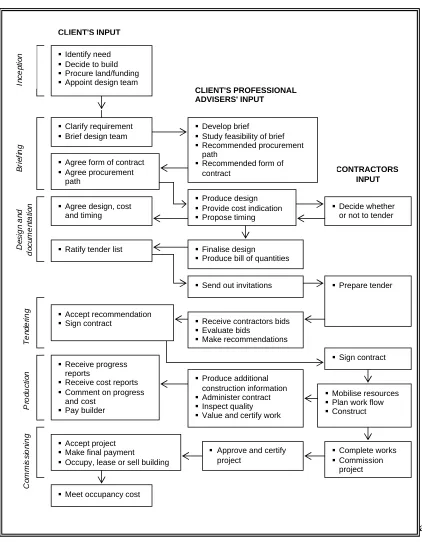
Construction projects are normally complex. The project process consists of the following stages as shown in figure 2.1 (Kwakye 1997).
2.3 Common Scheduling Technique
2.3.1 Gantt Chart
2.3.2 Networking Technique
2.3.2.1 Acivity on Arrow
2.3.2.2 Activity on Node
2.3.2.3 The Importance of Networking Technique
2.3.3 Line of Balance
2.4 Project Progress and Control
2.4.1 The Importance of Project Control
2.4.2 Project Control Technique
It involved transient workforce and many unrelated organization to accomplish a Figure 2.1common task of delivery a construction project.
Identify need Decide to build Procure land/funding Appoint design team
Clarify requirement Brief design team
Agree form of contract Agree procurement
path
Agree design, cost and timing
Accept recommendation Sign contract
Receive progress reports
Receive cost reports Comment on progress
and cost Pay builder
Accept project Make final payment
Occupy, lease or sell building
Meet occupancy cost
Develop brief
Study feasibility of brief Recommended procurement
path
Recommended form of contract
Produce design Provide cost indication Propose timing
Ratify tender list Finalise design
Produce bill of quantities
Send out invitations
Receive contractors bids Evaluate bids
Make recommendations
Produce additional construction information Administer contract Inspect quality Value and certify work
Approve and certify project
Decide whether or not to tender
Prepare tender
Sign contract
These complicated stages require careful planning for its implementation to avoid any possible conflicts between the responsible parties to carry out the different task at site. The project planning provides a clear roadmap for all team members about the path they should follow. The main constraints of construction are time, cost and quality. Meeting these three constraints at every stage of the project process would result in a smooth uninterrupted work progress at site. Otherwise should there be any interruption to the project plan would seriously wound the original plan of completion time. Work may be temporarily stop at site for corrective measure, reorganizing the schedule, resolving the conflict and many other undesirable consequences that eventually may lead to project delay and even claim and litigation.
Therefore the need for proper project planning is upmost important to ensure all the task required for the accomplishment of the project will have adequate resources, logically oraginised in relation with their predecessors task, and adequate time allocated for their completion. Scheduling is one the most important tool to support the planning process. In the past most of the scheduling task is manually done without the aid of computer software. Some project do not have a proper written schedule and very much rely on the experience of the constructors and project manager. Due to the lack of computational facilities most of the schedule developed in the past is quite simple based on Gantt Chart technique and the process of tracking and monitoring is quite difficult. Often the process of forecasting of the project achievement very much depends on the one’s experience and wisdom. Most of the time there is lack of warning for the potential of project delay. The following section describes the common scheduling technique used in construction to schedule and control the project.
2.3 Progress Monitoring Process
smaller one with few hundred activities. Therefore the practical way of updating the schedule must be done using computer. Manual updating should be a matter of past as the computer facilities is easily available today.
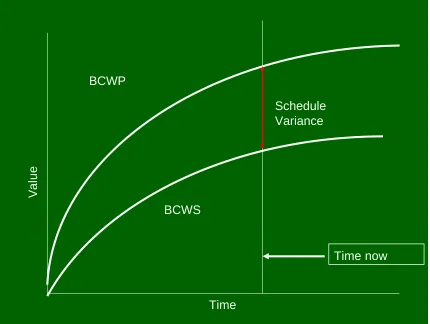
In general principles tool like progress curves, also called S-Curves is very popular method of displaying project progress. S-Curve is graphically plot some measure of cumulative progress on the vertical axis against time on the
horizontal axis. Progress can be measured in terms of money expended, quantity surveys of work in place, man-hours expended, or any other measure which makes sense. Any of these can be expressed either in terms of actual units (dollars, cubic meters, etc.) or as a percentage of the estimated total quantity to be measured. The shape of a typical S-Curve results from integrating progress per unit of time (day, week, month, etc.) in order to obtain cumulative progress. On most projects, expenditures of resources per unit time tend to start slowly, build up to a peak, and then taper off near the end. This causes the slope of the cumulative curve to start low, increase during the middle, and then flatten near the top.
Planning and reporting progress like Bar Charts, progress curves can express some aspects of project plans. Once the project is underway, actual progress can be plotted and compared with that which was planned. It is then possible to make projections based on the slope of the actual progress curve. Such projections,
Figure 2.2 Typical S-Curve and Earn Value concept
2.4 The Importance of Using Planning Software
With the advancement of the computer technology the process project planning has become much more easier compared to the past. Various type of project planning software are available in the market such as Primavera Project Planner, Microsoft Project, Sure track, and Artemis to name a few are available in the market. Some are quite cheap to acquire like Microsoft Project but some are quite expensive and suitable for major construction project with big budget.
Scheduling of the construction project with the aid of the software has many advantages to it. Some of these advantages are:
Time now BCWP
BCWS
Schedule Variance
V
a
lu
e
a. The tedious calculation process can be simplified b. The network diagram is automatically drawn
c. The process of updating the schedule can be done without worrying the effect of changes as it is will be automatically calculated
d. The schedule can be loaded with the required resources for each task and this will be take into consideration in schedule calculation
e. The critical path for the schedule can be automatically traced f. The schedule can be track against the baselines.
g. Changes can be made on the schedule without any difficulties
2.5 Scheduling Using Microsoft Project
"Microsoft Project is a scheduling and planning tool for project manager, providing easy-to-use tools for putting together a project schedule and assigning responsibilities and it also gives him powerful tools to carry him through to the end of the project ( Pyron, 2000)". Microsoft Project software had developed more then a decade ago, but until now its application is quite limited to basic scheduling need of preparing the network diagram only. Recently it is being used for actual purposes such to generate project reports as a basic for the evaluating the claim. This is happen because the project managers have limited of knowledge of knowing Microsoft Project.
DATA COLLECTION AND ANALYSIS
3.1 Introduction
The methodology for this study was divided into three stages. First stage involved literature review to develop understanding on the aspect related to scheduling practices and limitation of its application. Second stage involved interviews with the selected industry experts to validate the validated the findings from literature about state of arts of current scheduling practices in Malaysia. Face to face interviews were conducted with personnel from both the construction industry. 'Qualitative content analysis' method (Fellows and Liu 1997) was used to analyse the responses from these interviews.
The last stage involves industry wide questionnaire survey. In this survey the investigation on the issue related on the current practice of project scheduling for construction project has been further investigated and important elements for the development of the guidelines for the preparation, submission and updating of the schedule has been determined. The final stage involved preparation of this report and submission. The following sections describe the results of data collection, their analysis and the inferences that can be made from them.
3.2 Analysis of the face to face Interviews with Industry Experts
interviews were carried out at different times and places. The set of questions to be asked were prepared as a guideline prior to the interview session which normally lasted around one hour. However during the actual session, a different sequence of presenting the questions was used to allow more flexibility in the discussion. In general the questions presented in the interviews fell into these common themes:
Their experience related to managing project scheduling
Problems and the need for regulating the scheduling process
Basic concept of the guideline
Table 3.1 shows the content analysis of the interview with the expert panels. The discussions of the
3.2.1 Panelist Experience related to Managing Project Scheduling
In general all panelists have experience in some form of scheduling techniques used in the project associated to them. They have indicated the used of CPM technique and Gantt Chart which is actually two common technique used throughout the construction project in Malaysia.
With regard to the preparation of the schedule it is found that 60% of the interviewees claimed prepared by the contractor but the rest prepared by the consultant. This is quite confusing as the schedule must be prepared by the contractor as the contractor is responsible to carry out the construction task. However they may refer to the different arrangement of project delivery systems for example in the Design and Build whereby the consultant team up with the contractor. On the other hand the consulting taking the role roles of project manager representing the client may developed the general work schedule for the client to monitor the project progress.
With regard to the preparation of the schedule it was found that there is still lacking in term of the application of the planning software. Despite using computer but not all schedule developed using planning software. Computer generated schedule using planning software such as MS Project and Primavera Project Planner have able to generate the scheduling information automatically which include analysis and reporting functions. The interviews indicate that the use of planning software is quite common as it should be. The software is easily available and the price for some of them is quite reasonable.
updating of the schedule. Most of the interviewees indicated that contractors take the initiatives to maintain and update the schedule and does not signify the role of the client in this process. This is a common scenario in our construction industry whereby the client and contractor maintain a different set of schedule for their own purpose of application. They do not share or use the same schedule collaboratively. One of the interviewees even indicated that the client have different type of schedule compared to the one maintain by the contractor.
In correspond to a more general question on their feeling on the current process in project scheduling most of the interviewees consensually indicated that there is a need for improvement and need to be regulated in a systematic way. Other issue raised by them includes the need for standardization, lack of training and the need for industry to be more serious in addressing the issue related to the project scheduling.
3.2.3 Problems and the need for Regulating the Scheduling Process
The second main issue raised in the interviews was about the need for regulating the scheduling process. All interviewees agreed to such need but one of them raised the concern about fairness. It is a reasonable to raise such concern as the justification for the development of such guideline must take into account that the basic fundamental purpose of scheduling is to support collaborative working environment of the project.
3.3 Analysis of the Questionnaire Survey
This section reports the analysis of the data gathered from the industry wide postal questionnaire survey. The questionnaire was designed to evaluate further the current practice of project scheduling and justification of the elements that important toward developing the guideline. This questionnaire consists of three major parts:
Part A : Background of the respondent
Part B: Investigation of the state of Art of the Project Schedule Application
Part C: The basic necessary elements in the development of the guidelines
The questionnaire was analysed using simple frequency analysis statistic. Question are given in two mode. First mode requires the respondent to ‘tick’ the given choice of answer for them to respond. The calculation is made by counting the number of ‘tick’ for each question. The percentage is calculated based over 52 respondents.
The second type of question (used for Part B and C) require the respondents to state their level of agreement for a given statement. The level of agreement is given on five ordinals Likert Scale from 1 to 5. The description of each level of agreement is as follows:
1 – Most Disagree 2 – Disagree 3- Neutral 4- Agree
5 – Most Agreed
and 2. On the other hand the summation of the frequency of the respond for 4 and 5 are calculated together as the ‘Agreed’ group. The respond for ‘3’ is not counted as they represent the ‘neutral’ or undecided respond. As for the guideline development Agreed Group percentage (over 52 respondents) are compared against the Disagreed Group for evaluation and acceptance or rejection of the idea.
The findings from each section are being discussed in the following sections.
3.4 Background of the respondent
A total of 100 set of questionnaires were distributed for this research using postal services. About 30% of the questionnaires are being distributed by hand. In general the respondents were randomly selected from personal or organization within Malaysian construction industry. They consist of consultant, contractors and project manager that are directly involved in this industry. Only 58 sets of questionnaires were returned and 52 fully answered all questioned and considered in the analysis. This represent 52% rate of return which not too bad for this kind of research.
The distribution of the respondents in accordance to their organisation in this industry as shown in the Table 3.2
Table 3.2 The distribution of the respondents group.
Respondent Group Number Percentage
Government Agency 10 19.2%
Contractors 22 42.3%
Consultants 16 30.8%
Project Manager 4 7.7%
On the other hand the number of years of their experience in this industry is tabulated in the following Table 3.3:
Table 3.3Years of Experience in Construction industry
Years of Experience in Construction industry
Number Percentage
Less than 5 years 12 23%
Between 5-10 years 16 30.8%
More than 10 years 24 46.2%
Total 52 100%
The above table indicates that more than 75% of the respondent are indeed well experience in this industry.
Majority of the respondents also involved in medium to large scale of project as shown in Table 3.3
Table 3.3 Value of project involved by respondents
Value of project Number Percentage
Less than RM500,000 12 23.1%
RM500,000 - RM5mil 16 30.8%
RM5mil – RM20mil 18 34.6%
More than 20mil 6 11.5%
Total 52 100%
.
3.5 Common Type of Project Schedule Used
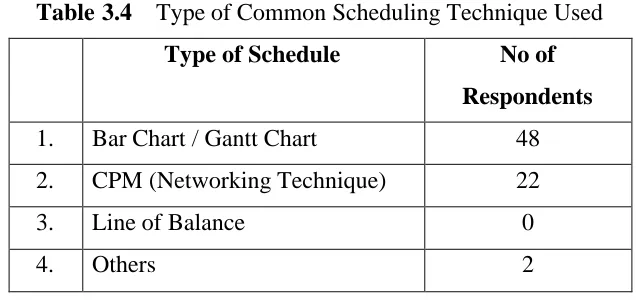
The purpose of this inquiry is to be make observation on the common type of project schedule used in our construction industry. The respondent were asked to tick the common scheduling technique that they experienced (used) with for the last three projects that they involved. Each respondent may have involved in more than one type of schedule. The tabulation of the result for this question is as shown in the following table:
Table 3.4 Type of Common Scheduling Technique Used
Type of Schedule No of
Respondents
1. Bar Chart / Gantt Chart 48
2. CPM (Networking Technique) 22
3. Line of Balance 0
4. Others 2
The result shows that most popular scheduling technique used is the Gantt Chart followed by the Networking technique. However it should be noted here that most of the computer generated schedule used lime MS Project and Primavera has the capability of displaying both CPM and Gantt Chart view. Indeed most of the time the users are more comfortable to display their schedule in this Gantt Chart view and this may give the wrong impression those who are not familiar or quite with the network approach to consider this schedule as CPM. According to this result CPM are the second most common technique used.
3.6 Common Type of Software Used to Develop the Schedule
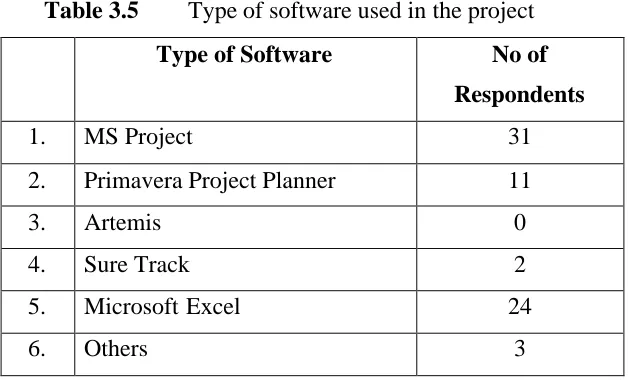
The questionnaires also investigate the common type of project schedule used to develop the schedule. The same rule applies as to the previous section whereby the respondent can select more than one answer as the question are referring to the three last projects they involved. The result of the responses is shown the following table.
Table 3.5 Type of software used in the project
Type of Software No of
Respondents
1. MS Project 31
2. Primavera Project Planner 11
3. Artemis 0
4. Sure Track 2
5. Microsoft Excel 24
6. Others 3
As expected MS Project represent the most common type scheduling (planning) software used with 31 respond. It is also expected that there will be a significant respond for Microsoft Excel it is not dedicated scheduling software. The reason it is being included in this questionnaire is just to see if it can attract any responds. However this objective might not be true if the respondents genuinely tick the MS Excel as despite the software can be used to develop the Gantt Chart manually and has powerful spreadsheet capability to perform basic computation required for a schedule.
3.7 Malaysian Experience in Scheduling Process
This part of the questionnaire aim to investigate the state of art of scheduling practices in based on the experience and feedback of the respondents. Eighteen (18) questions has been presented in this part of questionnaires. Important issues raised include:
Application of the scheduling software
Problems in software application
Limitation of network technique
Each of the above themes is discussed the following sections:
3.7.1 Application of the scheduling software
Table 3.6 State of arts of scheduling process
Disagreed Agreed
1+2 4+5
At the end of the project the schedule always being
disregard 2% 88%
The initial schedule is rarely being update 10% 81%
Usage limited to monitoring of cash flow and progress 13% 77%
The information of project schedule must be transparent 10% 60% Mostly using Bar Chart/Gantt Chart 48% 52%
The schedule should be used as a tool to support
collaborative working 33% 48%
Project schedule based on CPM is more effective than
Bar Chart 52% 42%
The client and contractor normally has different set of
schedule to suit their own need 15% 35%
Client only interested in major milestone of the project
completion not day today activity completion 15% 35%
Most schedule is not that practical compared to
experience as far as work process concern 58% 27%
Other factors being investigated are the type of the schedules used and the purpose of scheduling. About 52% agreed that bar Chart is commonly used. This moderate level of agreement indicate wide acceptance of other technique particularly CPM. The moderate agreement on effectiveness of CPM (42%) shows lack of understanding toward CPM benefits. This is also indicate the level of application and acceptance of CPM is still quite moderate in Malaysia.
With respect to the purpose of the schedule the respondent agreed that mainly is use to update progress and cashflow. Other than that the respondent does not quite believe that schedule can help to promote collaborative working (48%). So they did not quite agree that the information on the project schedule must be transparent (60%). This contrary to the true spirit of purpose of scheduling. This reflect the moderate level of knowledge and awareness about scheduling in our construction industry.
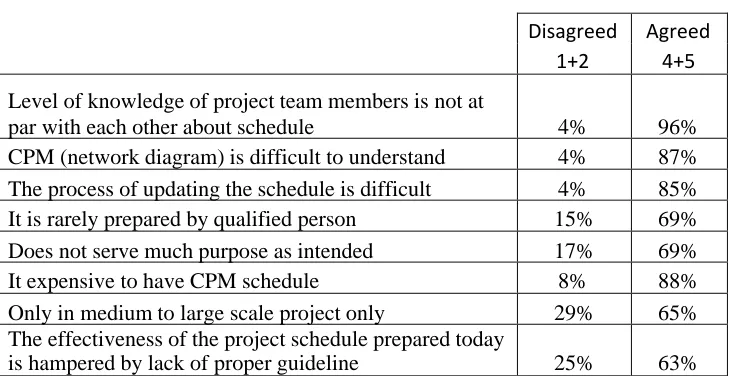
3.7.2 Problems and limitation in scheduling
In this study eight (8) typical problem and limitation have been posted in the questionnaire survey. These problems are shown in table 3.7
Table 3.7 Problems and limitation in scheduling
Disagreed Agreed 1+2 4+5
Level of knowledge of project team members is not at
par with each other about schedule 4% 96% CPM (network diagram) is difficult to understand 4% 87% The process of updating the schedule is difficult 4% 85% It is rarely prepared by qualified person 15% 69% Does not serve much purpose as intended 17% 69% It expensive to have CPM schedule 8% 88% Only in medium to large scale project only 29% 65% The effectiveness of the project schedule prepared today
All problems posted have received a high level of agreement more than 60%. One of the major problems with regard to the application of the project process is the significant different level of knowledge between the project members on it. This is not surprising as it is our practice to assignment the task of scheduling to specific project personnel only. Furthermore CPM schedule is considered as quite difficult to understand (87% agreement) and the process of updating is also considered complicated. Therefore in respond to this there is a serious need for our Malaysian construction industry to provide more training effort to all parties in this industry. Without appropriate skill in scheduling process it is very difficult to support the objective to use the schedule as a tool to promote collaborative working environment.
Other associated problems as agreed by the respondent are the high price to have the CPM (network) schedule for the project. It is quite difficult to justify this issue because the basic price of some of the software is quite reasonable. Probably the users failed to quantify the potential benefit of the schedule to the project compared to the additional cost of the schedule. Other reason is the user might not able to full reap the benefit of networking schedule particularly using software due to their lack of experience or knowledge in its application. However it is interesting to note that the level of agreement toward the fact that the schedule is suitable for medium to large project is only 63%. It can deduce that the respondent did consider the importance of scheduling to small project as well.
3.8 Important Elements in Development of Guideline
This part of the questionnaire aim to evaluate the level of agreement of respondents toward important factors (elements) that to be considered in the development of the guideline in this research. The proposed guideline in this research is divided into several major sections as follows:
1. Preparation the project schedule.
2. Submission
3. Evaluation process of project progress
In the evaluation process the research has adopted an approach whereby any factor that received less that 50% agreement will not be included or being consider for inclusion with modification to suit the opposite respondent view of the respondents. Other suitable clauses which are seem to be consistent with the opinion of the respondent but not directly included in the questionnaires will be considered as well. A set of guidelines is presented in the following chapter.
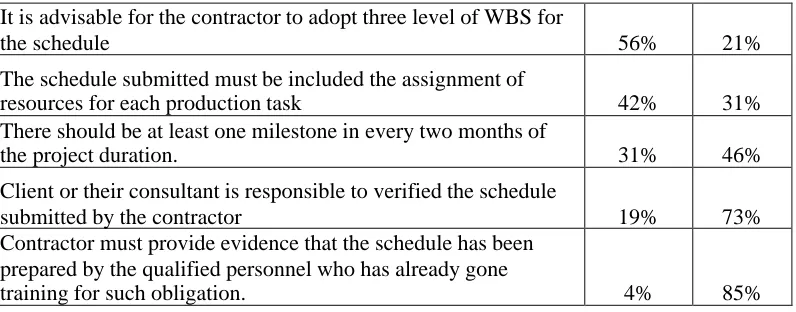
3.8.1 Preparation the project schedule.
Table 3.8 Item Related to the Preparation of Project Schedule It is advisable for the contractor to adopt three level of WBS for
the schedule 56% 21%
The schedule submitted must be included the assignment of
resources for each production task 42% 31% There should be at least one milestone in every two months of
the project duration. 31% 46%
Client or their consultant is responsible to verified the schedule
submitted by the contractor 19% 73%
Contractor must provide evidence that the schedule has been prepared by the qualified personnel who has already gone
training for such obligation. 4% 85%
Based on the data analysed from the above table two factors received strong endorsement from the respondents with more than 70% agreement. They are the requirement for the qualified personnel to prepare the schedule and the client responsibility to verify the schedule submitted. However the other three factors related to Work Breakdown Structure, the inclusion for the resource constraint schedule and milestone for the schedule does not received strong agreement. This probably due to the need for simple approach in the initial stage of the guideline’s introduction. The WBS and the milestone are quite subjective issue as well. They are quite flexible and can be tailored to suit the actual individual project requirement.
3.8.2 Submission and approval procedure of Project Schedule
The following issue that this research seeks the agreement from the respondent is related to submission and approval process of the project schedule. The result of the questionnaire survey analysis is shown in the following table.
and contractor need longer time to prepare. With regard disagreement of the idea to ‘make the schedule as a contractually bind and client to be the keeper of the schedule’ is probably because nobody really want to be committed for something new like this. The effort to introduction of this guideline is still new and the industry is not familiar with the benefit, problem and risk associated to it. So rationally it is quite a fair evaluation by the respondents.
Table 3.9 Submission and approval process
Submission of the initial schedule by the contractor must be made two weeks after the official date of the Letter of
Acceptance 67% 12%
Upon acceptance by the client the schedule shall be consider as
part of the contract agreement and keep in the client position. 50% 21%
The software used by the contractor for the preparation of the
project schedule must be approved by the client 27% 56% Contractor is responsible to advise the client on any query raised
from the first submission of the schedule and make any changes as advised by the client if agreeable to both the client and contractor. Otherwise further consultation is necessary between
both parties until agreement is reached. 17% 63%
General work schedule using Gantt Chart should be prepared by
the client for traditional contract 15% 63%
The used of CPM (Network Technique) must be mandatory for
all projects worth more than RM1mil. 8% 81% The used of Bar Chart should be limited to small project only 6% 83%
Contractor must be responsible for the preparation of project
CPM schedule for construction phase 4% 83%
The schedule submitted by the contractor must be in the form of
soft copy and hard copy format. 4% 85% Consent for the acceptance of the schedule submitted by the
contractor must be made by the client prior to the start date of
the project. 6% 88%
The detail information displayed for each of the activities in the schedule should have the necessary information to facilitate the
process of project monitoring and tracking. 4% 88% The schedule submitted must have one critical path only. 0% 96%
The schedule duration must not exceed the total duration of the
project in accordance to the contract agreement. 0% 100%
the suitable scheduling technique in relation to the project magnitude
Reviewing process of the submitted schedule
Responsibility to prepare the general wok schedule and detail work schedule
Format of schedule submission by the contractor
Client responsibility for approval of the schedule
The detail information of the project’s activities to facilitate the process of monitoring and tracking
The limit of project duration
The limit of critical path
3.8.3 Process of Updating and Evaluation Progress
Table 3.10 Process of Updating and Evaluation Progress
Elements Disagreed Agreed
Contractor is fully responsible for the duration for each task in
the schedule. 37% 50%
The client must organized a weekly face to face meeting or in virtual environment meeting to review and update the project progress where changes will be track using the approve schedule
27% 50%
The baseline can only be updated by the client. 33% 50%
Any application for the extension of time must be made with
the justification using the project schedule. 42% 52% There should not be any discrepancies between both schedules.
Should there be any discrepancies the contractor is obliged to commit to the original project schedule.
27% 60%
Any extension of time granted must be represented by the
adjustment of the schedule baseline. 12% 65% Should there be any dispute between the client and contractor
with regard to process of project progress tracking a qualified third party must be consulted to resolve the disagreement immediately.
25% 69%
Contractor can updated the schedule on daily basis but using a second copy of the original schedule where all the progress will be informed and updated to the client during the weekly
meeting.
2% 77%
Once accepted by the client the date for the execution of all tasks in the schedule will be deemed considered as baseline of the schedule.
10% 79%
The schedule once accepted for the project cannot be adjusted by the contractor without the consent of the client to ensure its validity
2% 83%
Any changes or updating of the schedule can only be made in
with the consent of client 13% 83%
The client and contractor must enter into prior agreement either to use the schedule milestone, progress on critical path for the purpose of the payment. If no prior agreement is made it is assume that the traditional method of disbursing the payment will be adopted. The schedule will be solely used for the purpose of tracking the project progress and claim evaluation.
0% 90%
The basis for the estimation of the percentage of the overall progress of the project must be agreed by the client and contractor.
0% 90%
The calendar used for the project as a basis for schedule including the holiday, must be mutually by the client and the contractor
The other elements that have received considerable agreement are related to:
The use of project schedule for application of the extension time
Duplication of project schedule client and contractor
Consistency of the information in the project schedule
Using schedule as a guide to make interim progress payment
Procedure for estimating the project progress
Process of estimating project progress
DEVELOPMENT OF GUIDELINE FOR PROJECT SCHEDULING
4.1 Introduction
The guidelines develop here is based on the findings from the data collected from the study. Initial data collected from the in the interviews with the professional involved in construction industry. Even though the aim of the interview is more of exploratory inquisitive nature but some findings from content analysis is important toward the development of the guidelines. The main source of data for guideline generated from the analysis made in the questionnaire survey. Based on the data collected the research has established list of elements that will be considered critical toward its development.
GUIDELINES
FOR
MANAGING CONSTRUCTION
SECTION I : General Application of this Guideline
1. This guideline is develop for the application for medium to large project 2. It is intended to be used for traditional design – bid-build contractor.
3. As for other type of contract some amendments must be made first to suit the nature of contractual arrangement.
4. It is an option for the client to adopt this guideline as part of the contract agreement or not.
SE CT IO N II : Procedure o f Preparation and Submission
1) The client is responsible to prepare the major work schedule and the contractor is responsible to prepare and submit the detail work schedule for construction phase
2) The duration of the schedule must be within the stipulated date of contract agreement.
3) The used of CPM (Network Technique) must be mandatory for all projects worth more than RM1mil.
4) The project schedule must be prepared by qualified personnel that have undergone training or courses provided by a recognized institutions 5) The contractor must get the consent of the client for the software to be
used for the schedule.
6) The schedule submitted by the contractor must be in the form of soft copy and hard copy format.
7) Th e cl ie nt is re sp on si bl e to re vi ew th e pr oj ec t sc he du le su bm it te d by th e co nt ra ct or as so o n as pos si bl e an d gi ve th e fe ed ba ck fo r im pr ov eme nt if ne ce ss ar y.
9) Consent for the acceptance of the schedule submitted by the contractor must be made by the client prior to the start date of the project.
10) The schedule submitted must have one critical path only.
11) The detail information displayed for each of the activities in the schedule should have the necessary information to facilitate the process of project monitoring and tracking.
12) All cost of preparation should be included in the tender document and reviewed by the client.
SECTION III – PROCEDURE FOR UPDATING AND MONITORING THE SCHEDULE
1. Contractor is fully responsible for the duration for each task in the schedule unless change made upon the client request.
2. The calendar used by the contractor for developing the schedule must be approved by the client.
3. All the holiday other than standard public holiday such as during the Hari Raya and Chineese New Year that is common to this country must be established in the schedule calendar and endorsed by the client. However these holidays cannot be use as any basis for claim for any kind of compensation and must fit within contract standard project duration. 4. Once accepted by the client the date for the execution of all tasks in the
schedule will be deemed considered as baseline of the schedule. 5. The schedule once accepted for the project cannot be adjusted by the
contractor without the consent of the client to ensure its validity 6. Any changes or updating of the schedule can only be made in with the
consent of client
7. The client and contractor must enter into prior agreement either to use the schedule milestone, progress on critical path for the purpose of the
8. If no prior agreement is made it is assume that the traditional method of disbursing the payment will be adopted.
9. The schedule will be solely used for the purpose of tracking the project progress and claim evaluation.
10. The client must organized a weekly face to face meeting or in virtual environment meeting to review and update the project progress where changes will be track.
11. Contractor can maintain a copy of original schedule.
12. Contractor can update the schedule on daily basis but using a second copy of the original schedule where all the progress will be informed and updated to the client during the weekly meeting.
13. The baseline can only be updated by the client.
14. Any application for the extension of time must be made with the justification using the project schedule.
15. There should not be any discrepancies between both schedules. Should there be any discrepancies the contractor is obliged to commit to the original project schedule maintain by the client as a basic for any claim and payment.
16. Any extension of time granted must be represented by the adjustment of the schedule baseline.
17. Should there be any dispute between the client and contractor with regard to process of project progress tracking a qualified third party must be consulted to resolve the disagreement immediately.
18. The basis for the estimation of the percentage of the overall progress of the project must be agreed by the client and contractor.
Ashworth, A. (1996) Contractual Procedures in the Construction Industry (3rd ed.) Longman, Malaysia,
Baker, B. (1997) Cost/Time Trade-Off Analysis for the Critical Path Method: A
Derivation of the Network Flow Approach,Journal of the Operational Research Society,Vol. 48, (12), pp241-4.
Bramble, B.B, D'Onofio, M.F, and Stetson, J.B., (1990) Avoiding and Resolving Construction Claims,R.S. Means Company Inc. USA.
Callahan, M. T., (1992), Construction Project Scheduling, New York : McGraw-Hill.
Clark, J.R., (1990) Practical Specifications for Project Scheduling, Cost Engineering Journal, Vol.32, No.6, pp. 17-20.
Clark, J.R., (1990) Substantiation and Use of the Planned Schedule in a Delay Analysis", Cost Engineering Journal, Vol.32, No.2, pp. 12-16.
Construction?Proceeding Sixth Annual Conference of International Group of Lean Construction,(IGLC-7). Guaruja, Brazil
Donelly, Jr J.H., Gibson, J.L. and Ivancevich, J.M. (1992) Fundamentals of Management. 8th ed., Irwin, IL.
Dreger, J. B., (1992),Project Management : Effective Scheduling, New York: Van Nostrand Reinhold
Fisk, R.E. (1992).Construction Project Administration 4thed. Prentice Hall.
Hawker, G. (1986), The Institution Of Civil Engineer's: Arbitration Practice, London : Thomas Telford.
Hinze, J and Tracey, A (1994) The Contractor-Subcontractor Relationship: The Subcontractor's View. Journal of Construction Engineering and Management, Vol.120(2), pp 274-287.
Hinze, J.W, (1998) Construction Planning and Scheduling, Florida US: Prentice Hall Ltd.
Hunt, M. (1995) Introduction to The Design of Questionnaires. Computing Services, Loughborough University of Technology.
James P.L. (2000),Project Planning Scheduling and Control.A Hands-On Guide to Bringing Projects In On Time and On Budget,McGraw-Hill Third Edition. Jellinger, T. C. (1981) Construction Contract Documents And Specifications,
Reading, Mass.: Addison-Wesley.
Kerzner, H., (2001) Project Management: A Systems Approach to Planning, Scheduling, and Controlling, Canada: John Wiley & Son Inc.
Kwak Y.H., Clark A., Grilo A., Betts M. and Ibbs C.W. (1995) Contemporary Strategic Tools and Applications for Construction Managers in Proceedings of First International Conference on Construction Project Management, (editor) Yeo, K.T. Singapore. pp25-40.
Kwong, C. H. (1984), Arbitration In Malaysia's Building Industry ,Journal of Building technologist. Vol .10, pp115-119.
Latham, M. (1994) Constructing the Team: Final report of the Government/Industry Review of Procurement and Contractual Arrangements in the UK Construction
Industry HMSO, London.
Lewis, J. P., (1991) Project Planning Scheduling & Control : A Hands-On Guide to Bringing Projects In On Time And On Budget, Chicago, Ill. : Probus.
Lewis, J.P., (1998) The Project Manager's Desk Reference : A Comprehensive Guide To Project Planning, Scheduling, Evaluation, Control And Systems, Kuala Lumpur : Golden Books Centre.
QUESTIONS Interviewee #1 Interviewee #2 Interviewee #3 Interviewee #4 Interviewee # What is the common
scheduling technique used in the project that you involved recently?
Bar Chart Network Technique (CPM) Network Technique (CPM) Network Technique (CPM) Bar Chart
Who prepare the schedule? Contractor Contractor Consultant Contractor prepare and
review by consultant Prepared by the consultantfor the client Did the schedule used for the
project developed using any specific planning software?
No. Just a computer printed bar Chart probably using Microsoft Excel
Computer generated schedule. Software is not MS Project
Developed using software probably Microsoft Project
Using Primavera Computer printed using some common software
Did you satisfied with such
schedule? Ok acceptable to me as theproject size is moderate Acceptable Not sure, it is maintain bycontractor. Nobody really used it as the contractor was experience enough
Yes Not so, quite confusing. I don’t like it!! There must be a better way of doing it.
Did the software being updated during the course of project progress
Yes. They plot S-Curve on it. Yes, done by the contractor. No idea. But the client maintain a Gantt Chart to track the project progress
Yes, it is being updated by the contractor and printed out.
Yes, S-Curve being shown.
Did the client give any particular guideline for the contractor in preparing the schedule?
No No No No No
Do you think there is enough collaboration between client and contractor in sharing the information on of the schedule
No No, most of the initiative done by the contractor. The schedule is for their own used. The client just interested in monthly work progress.
Not really Not really, client were being brief during meeting . they don’t really interested to analyse the schedule. Probably they don’t really know how.
regulate the way the schedule is being prepared and used for the project?
be fair serious
Who should produce the guideline?
CIDB Client Client Professional body Client
Do you agree that lack of guideline impede the effective application of the project schedule for the client and contractor?
Depend on the purpose of
the schedule Agreed there is a need forcommon understanding govern by the standard rule
Agreed, commitment
sometime need to be force!!! Agreed Current scheduling mainserve the contractor need and the client is not that serious so there is a need for regulation
How do you describe the current state of arts of project scheduling effort for
construction project?
So much reliance on experience
Lack of standard procedure depend on individual capability
OK, the trend toward doing it professionally is growing
Lack of training hampered the common understanding. Normally dominate by one side only.
OK but still lot of room for improvement. Standard guideline maybe helpful but requires seriousness.
Who should promote the used of standard guideline if exist?
Client CIDB CIDB Client There is a need for
ON
PROJECT SCHEDULING IN MALAYSIAN CONSTRUCTION INDUSTRY:
CURRENT STATE OF ARTS OF ITS APPLICATION
AND
THE DEVELOPMENT OF THE GUIDELINES
A STUDY CONDUCTED BY:
CONSTRUCTION TECHNOLOGY AND MANAGEMENT CENTRE FACULTY OF CIVIL ENGINEERING
UNIVERSITI TEKNOLOGI MALAYSIA SKUDAI, JOHOR.
Pl an ni ng an d sc he du li ng ha s be en a ve ry im po rt an t pa rt of a pr oj ec t man agem ent . A pro per pla nni ng and a pro per ly pla nne d sch edul e coul d help in creating a good management of a project. Thus it is seen essential that the schedule be included in the contract document as a legal document.
Th e re as on of in cl us io n is no t on ly to fa ci li ta te th e mo ni to ri ng an d management of the project, but to help in resolving dispute that occurs later in the project. In many cases, whereby dispute has to be taken into court, proper schedule has been the key evidence in solving the dispute.
Schedule which usually is used for monitoring of work only can also be usedto monitor time, cost, resources and even quality. This shows the vast amount of usefulness of a schedule and thus the inclusion of it into the contract document isessential.
This questionnaire is part of the research initiatives done by Construction Technology and Management Centre as a fundamental research effort for the creation of a guidelinefo r th e in cl us io n of pr oj ec t sc he du le as a co nt ra ct do cu me nt fo r Mal ays ia 's construction industry.
This questionnaire consistsof three major part: Part A : Background of the respondent
Part B: Investigation of the state of Art of the Project Schedule Application Part C: The basic necessary element in the development of the guideline
Through this questionnaire, we are hoping to create a major guideline that can be use in the industry to properly include the project schedule as a part of a contract document. With this guideline, it is hope that the responsibilities of parties involvedand usage of the project schedule can be established.
All the information provided by the respondentwill treated with strictestconfidentially and no name or any kind of information about the respondent identity will be published or provided to any other parties within or outside UTM. Should there be any question pertaining to this questionnaire do not hesitate to contact me at contact number given below. Your cooperation is highly appreciated.
Thank You
Dr MOHAMAD IBRAHIM MOHAMAD Associate Professor / Manager
Construction Technology and Management Centre
Tick the appropriate box in corresponding to each question:
1. Type of Organisation that you represent
Government Agency/ Client Consultant
Contractor Project Manager
Others (Please indicate) : ……….
2. Years of involvement in construction industry
Less than 5 years Between 5 to 10 years More than 10 years
3. Size of project that your organization involved
Less than RM500,000 RM500,000 – RM5mil RM5mil – RM10mil
More than RM10mil
PART B : PROJECT SCHEDULE APPLICATION
4. Indicate which type of scheduling techniques that being used in the last three projects that you involved? (you may tick more that one box if necessary)
Bar Chart / Gantt Chart
CPM (Network Technique
Line of Balance (LOB)
Microsoft Project
Primavera Project Planner
Artemis
Sure Track
Microsoft Excell
Others please specified : ……….
6. Which party prepared the project schedule in the above case?
Contractor Client Consultant Project Management Consultant
Please circle in the appropriate number indicating your level of agreement toward each of the following statement based on the following scale:
1. Str ong ly Dis agr ee d 2. Dis agr ee d 3 – Neu tra l
4. Agr ee d 5. Str ong ly Agree
7. The application of the scheduling process in Malaysian construction industry today is
(a) Only in medium to large scale project only 1 2 3 4 5
(b) Usage limited to monitoring of cash flow and
progress 1 2 3 4 5
(c) Mostly using Bar Chart/Gantt Chart 1 2 3 4 5
(d) Level of knowledge of project team members is not
at par with each other about schedule 1 2 3 4 5
(e) It is rarely prepared by qualified person 1 2 3 4 5
(h) The process of updating the schedule is difficult 1 2 3 4 5
(i) Most schedule is not that practical compared to
experience as far as work process concern 1 2 3 4 5
(j) The client and contractor normally has different set
of schedule to suit their own need 1 2 3 4 5
(k) It expensive to have CPM schedule 1 2 3 4 5
(l) The initial schedule is rarely being update 1 2 3 4 5
(m) At the end of the project the schedule always being
disregard 1 2 3 4 5
(n) Client only interested in major milestone of the
project completion not day today activity completion 1 2 3 4 5
(o) The effectiveness of the project schedule prepared
today is hampered by lack of proper guideline 1 2 3 4 5
(p) The schedule should be used as a tool to support
collaborative working 1 2 3 4 5
(q) The information of project schedule must be
transparent 1 2 3 4 5
(r) Project schedule based on CPM is more effective
than Bar Chart 1 2 3 4 5
The possible benefits that can be gain from the guideline
(a) A more reliable and consistence schedule for
application 1 2 3 4 5
(b) Possible source of information to solve dispute 1 2 3 4 5
(c) More systematic evaluation of percentage of work
done 1 2 3 4 5
(d) Fair and justice prevailed in win-win situation for all
parties involved 1 2 3 4 5
(e) Having schedule as a legal document that can be
used for litigation purposes 1 2 3 4 5
(f) Proper guidance for contractor lessen their burden 1 2 3 4 5
This part aims to generate feedback and agreement related to the preparation, submission and the application of the schedule in monitoring and controlling of project progress.
Please circle in the appropriate number indicating your level of agreement toward each of the following statement based on the following scale:
2. Str ong ly Dis agr ee d 2. Dis agr ee d 3 – Neu tra l
4. Agr ee d 5. Str ong ly Agree
A. Preparation of the project schedule
1. The used of Bar Chart should be limited to small
project only 1 2 3 4 5
2. The used of CPM (Network Technique) must be
mandatory for all projects worth more than RM1mil. 1 2 3 4 5
3. Contractor must be responsible for the preparation
of project CPM schedule for construction phase 1 2 3 4 5
4. Contractor must provide evidence that the schedule has been prepared by the qualified personnel who
has already gone training for such obligation. 1 2 3 4 5
5. General work schedule using Gantt Chart should be
prepared by the client for traditional contract 1 2 3 4 5
6.
Client or their consultant is responsible
to verified the schedule submitted by the contractor
1 2 3 4 5
7. Consent for the acceptance of the schedule submitted by the contractor must be made by the
client prior to the start date of the project. 1 2 3 4 5
8. Contractor is responsible to advise the client on any query raised from the first submission of the schedule and make any changes as advised by the client if agreeable to both the client and contractor. Otherwise further consultation is necessary
between both parties until agreement is reached.
10. Submission of the initial schedule by the contractor must be made two weeks after the official date of
the Letter of Acceptance 1 2 3 4 5
11. Upon accep tanc e by the clien t the sched ule shall be cons ider as part of the contr act
agre ement and keep in the clie nt posit ion.
1 2 3 4 5
12. Ther e shou ld be at leas t one mile stone in every
two mont hs of the proje ct durat ion. 1 2 3 4 5
13. The soft ware used by the contr actor for the prep arat ion of the proj ect sched ule must be appr oved by the clie nt
1 2 3 4 5
14. The sche dule submi tted by the contr actor must
be in the form of soft copy and hard copy form at.
1 2 3 4 5
15. The deta il info rmat ion disp layed for each of the acti vitie s in the Gant t Ch art shou ld have the
nece ssar y info rmati on to faci litat e the proce ss of proj ect monit oring and trac king .
1 2 3 4 5
16. The sche dule submi tted must be inclu de the
assi gnme nt of resou rces for each produ ctio n task
1 2 3 4 5
17. Cont ract or is full y respo nsib le for the durat ion
for each task in the sche dule. 1 2 3 4 5
18. The cale ndar used for the proj ect as a basi s for
sche dule inclu ding the holi day, must be mutually by the clie nt and the contract or
1 2 3 4 5
19. The sche dule submi tted must have one crit ic al
path only . 1 2 3 4 5
20. The sche dule durat ion must not exce ed the tota l
durat ion of the proj ect in accor dance to the contr act agree ment .
deem ed cons idere d as base line of the sche dule.
B. Updating and Evaluation of project Progress
1. None of any part icula r of the sched ule accep ted
for the proj ect can be adjus ted with out the cons ent of the clie nt
1 2 3 4 5
2. Any chang es or updat ing of the sche dule can
only be made in with the cons ent of S.O. 1 2 3 4 5
3. The S.O. or his/h er repre senta tive must orga nize d a weekl y face to face meet ing or in
virt ual envi ronm ent meet ing to revi ew and
upda te the proj ect progr ess where chang es will be track using the appro ve sched ule
1 2 3 4 5
4. Cont ract or can updat ed the sche dule on dail y basi s but usin g a seco nd copy of the orig inal
sche dule where all the prog ress will be infor med and updat ed to the clien t duri ng the week ly
meet ing.
1 2 3 4 5
5. There shou ld not be any discr epan cies betwe en
both sche dules . Shou ld there be any disc repa ncie s the contr actor is oblig ed to
comm it to the orig inal proj ect sche dule.
1 2 3 4 5
6.
The base line can only be updat ed by the clie nt. 1 2 3 4 5 7. Any appl icati on for the exte nsio n of time must
be made with the just ific atio n usin g the proje ct sche dule.
1 2 3 4 5
8. Any exten sion of time grant ed must be
repr esent ed by the adjus tmen t of the sche dule
prog ress track ing a qual ifie d third part y must be cons ulte d to reso lve the disag reeme nt
imme diate ly.
1 2 3 4 5
10. The clien t and contr actor must enter into prior agre ement eith er to use the sched ule milest one, prog ress on crit ical path for the purp ose of the
paym ent. If no prio r agre ement is made it is assu me that the trad ition al meth od of disb ursin g
the paym ent will be adopt ed. The sche dule will be sole ly used for the purpo se of track ing the
proj ect progr ess and claim eval uati on.
1 2 3 4 5
12. The basi s for the estim atio n of the perce ntage of the over all progr ess of the proj ect must be
agre ed by the clie nt and contr actor .
1 2 3 4 5