REAL TIME MOBILE INFORMATION SYSTEM FOR CONSTRUCTION
PROGRAMME MANAGEMENT
Mohamad Syazli Fathi
1, Chimay Anumba
2, Patricia Carrillo
3and Mohd Zulakhmar
Zakiyudin
41
Department of Civil Engineering, College of Science and Technology, UTM International Campus, Jalan Semarak, 54100 Kuala Lumpur, Malaysia
2
Department of Architectural Engineering, The Pennsylvania State University, University Park, PA 16802, USA 3
Department of Civil and Building Engineering, Loughborough University, LE11 3TU, United Kingdom 4
Lecturer, Faculty of Architecture and Built Environment, International University College of Twintech, Bandar Sri Damansara, 52200 Kuala Lumpur, Malaysia
ABSTRACT
The complexity and information-intensive nature of construction programmes require Programme Managers to access construction information in real-time and when needed. The increasing use of mobile devices, such as PDAs, offers an opportunity to meet this need. However, access to information and services on mobile devices is often limited by their capability and the network coverage and bandwidth. This creates problems in accessing the right information at the right time, especially when spontaneous and/or urgent decision-making is needed. Decision-making can be improved by delivering information and services to Programme Managers via their mobile devices in real-time and based on their context.
This paper reviews the challenges and issues in the delivery of information in construction programme management and explores how context-aware computing can help in managing information and services in a construction programme. The key issues in context-awareness in construction programme management are discussed and the enabling information and communication technologies described. The context of a user (such as role, location, time, preference, etc) can be utilised to provide personalised information. Wireless communication technologies allow computing and communication devices to be used virtually anywhere in delivering information and services. The discussion in the paper focuses on the potential application of context-aware computing in construction programme management using wireless devices. Conclusions are drawn about the possible implementation of these emerging context-aware computing technologies for Construction Programme Managers in Malaysia.
Keywords: Mobile Information Systems, Context-Aware Information Delivery, Construction Programme
Management, Wireless Communication,
1. INTRODUCTION
Construction is an information intensive industry (Anumba et al., 2008), and as such, information delivery is the key to better management, survival and success. Researchers have estimated that if this information could be managed effectively then savings of up to 25% in the construction cost could be achieved (Baldwin et al., 1999). Furthermore, construction activities are widely dispersed and site locations are frequently changed (Magdic et al., 2002) complicating the management of the multiple-projects. Modern project management methods and tools have evolved tremendously in order to overcome problems in construction management. The use of project management tools in construction management has been widely known (Milosevic, 2003). However, with the growing complexity of single and multi-construction
projects, the traditional methods of construction management need to be revised by using construction programme management. Construction programme management deals with the integration and management of multiple-construction projects and complex resources utilisation with the intent of achieving benefits that would not be realised if they were managed separately.
It has been suggested by researchers (Aziz et al., 2006) that by using wireless communication technologies, the information, communication and services delivery between project team members in the field and the office can be enhanced to be in real time. Thus rapid decisions can be made by the construction programme manager. The primary goal of the construction programme manager is overall control of all aspects of the construction programme. This includes the pre-design planning, programming of requirements, pre-design budgeting, design, construction, equipping, furnishing, commissioning, occupancy and close-out of the project.
Researchers (May et al., 2005, Aziz et al., 2006) however claimed that the existing mobile applications in the construction industry only support the communication of static information (such as project data, plans, drawings, etc.), and are unable to take into account the construction worker’s changing context and the dynamic project conditions. Similarly, most of the commercially available mobile applications for construction management are designed primarily to deliver pre-programmed project management tools without any consideration of the Construction Programme Manager’s context. This often leads to irrelevant and inadequate information supplied to the Construction Programme Manager.
Context-aware computing is an intelligent system that uses environmental characteristics such as contextual elements of a user's location, time, identity, and activity to inform the computing device of its current context (Burrell and Gay, 2001). Context-aware computing applications examine and react to a user’s changing context in order to help promote and mediate people’s interactions with each other and their environment (Schilit et al., 2002). In addition, some have the ability to provide highly specific data and services by intelligent interpretation of their context (Aziz et al., 2006). It is suggested that awareness of a user’s context (such as user role, task, preferences, location, site conditions, etc.) in mobile construction applications will enhance the effectiveness of programme delivery by providing information and services relevant to a particular context.
Firstly, this paper reviews the key issues in construction programme management. Secondly, it explores how context-aware computing can help construction programme managers in managing construction projects more effectively. It also discusses the enabling information and communication technologies. Thirdly, the prototype application development are then presented and discussed. Finally, a number of conclusions are drawn.
2. CONSTRUCTION PROGRAMME MANAGEMENT
A construction programme usually requires an expanded scope of construction management services, which is commonly referred to as construction programme management. Construction programme management services normally focus on managing the planning, design and construction of a building programme involving multiple projects and multiple phases on either a single site or on multiple sites. The Construction Programme Manager (CPM) is responsible for the overall projects (within the programme), including awarding contracts, procuring materials, monitoring costs and schedules and managing the necessary reporting and communications.
Construction project and programme management have been used to build some of the greatest engineering achievements, from the Petronas twin tower to complex structures such as Beijing Olympic Stadium. In part, this success can be attributed to the construction project managers’ focus and discipline inherent in project management, and the integration and coordination of such complex initiatives facilitated by the construction programme manager in a programme management framework.
vested interests and cultural diversity. From a strategic management perspective, an organisation requires flexibility to shape and respond to its own environment.
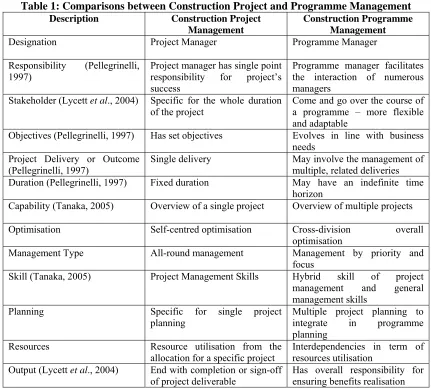
There are several reasons why project management tools are inappropriate to the current context of construction programme management. The management of a multi-construction project and that of a construction programme differ in the following areas (Table 1): -
Table 1: Comparisons between Construction Project and Programme Management
Description Construction Project
Management
Construction Programme Management
Designation Project Manager Programme Manager
Responsibility (Pellegrinelli,
1997) Project manager has single point responsibility for project’s
success
Programme manager facilitates the interaction of numerous managers
Stakeholder (Lycett et al., 2004) Specific for the whole duration
of the project Come and go over the course of a programme – more flexible and adaptable
Objectives (Pellegrinelli, 1997) Has set objectives Evolves in line with business
needs Project Delivery or Outcome
(Pellegrinelli, 1997)
Single delivery May involve the management of
multiple, related deliveries
Duration (Pellegrinelli, 1997) Fixed duration May have an indefinite time
horizon
Capability (Tanaka, 2005) Overview of a single project Overview of multiple projects
Optimisation Self-centred optimisation Cross-division overall
optimisation
Management Type All-round management Management by priority and
focus
Skill (Tanaka, 2005) Project Management Skills Hybrid skill of project
management and general management skills
Planning Specific for single project
planning Multiple project planning to integrate in programme
planning
Resources Resource utilisation from the
allocation for a specific project Interdependencies in term of resources utilisation
Output (Lycett et al., 2004) End with completion or sign-off
of project deliverable Has overall responsibility for ensuring benefits realisation
The fact is that today’s construction programme manager must execute a programme effectively with two drivers that are in a constant state of change: (1) people; and (2) technology.
• People (for a variety of reasons), come and go in today’s business or construction environment. Therefore, the organisation must have the ability to expand and contract on a rapid basis and react to changes in the marketplace. The ability to acquire people rapidly and to enable them to make a valuable contribution quickly is a necessity for survival in today’s marketplace (Brown, 2008).
• Technology that changes rapidly. The programme manager must also deal with constant changes in technology. As technology changes, every company has opportunities to improve operations (Archibald, 2003).
system that have the capabilities in the supplying and managing large amounts of information, so decision makers can make informed decisions based on the most important facts.
3. MOBILE INFORMATION SYSTEMS
A mobile information system is one in which access to information resources and services are gained through end-user terminals that are easily movable in space, operable no matter what the location and, typically, provided with wireless connections (Pernici, 2006).
Currently, mobile devices are used to access all sorts of information and are becoming a major means of accessing information and services, either client or web-based applications. The widespread use of mobile devices, in domains like mobile work, mobile learning and the emergency services envisions a growing market for new applications (Thurnher et al., 2006). Mobile devices and wireless technology are
also being upgraded and are thus providing applications with a variety of functionalities along with better levels ofservice.
The concept of using mobile applications and applying Wireless Local Area Network (WLAN) technology to the construction site is not new. Mobile applications and WLAN technology were identified by many researchers (Garzaa and Howitt, 1998, Aziz et al., 2005, Bowden et al., 2006, Chen and Kamara, 2008, Šuman and Pšunder, 2008) as a viable solution to the problem of real-time data capture on construction sites. They cited the main advantages as being the mobility and value added (no service provider charge and higher data transfer rates than other technologies). Magdic et al. (2002) and Pernici (2006) also agreed that the advantages of mobile information systems are not just their ability to provide cost-effective services but also new value-added services owing to their mobility and flexibility (with respect to the context of use). The rapid developments in mobile and wireless ICT and mobile devices have now enabled the new possibilities of portability and on-demand access to information systems and communication tools that construction organisations are requesting (Löfgren, 2007).
The construction programme manager typically moves between physically different locations, further complicating the accessibility and transmission of critical project and programme information. It is well understood that the use of mobile information and communication technologies (ICT) is critical in managing construction projects as the right information needs to be delivered to the right person, at the right time and at the right place (Bowden et al., 2006). However, the existing mobile applications in
construction programme management only support the delivery of static modes of information such as project data, technical drawings, risk assessment etc, they are pre-programmed and thus not able to take into account the workers’ changing context and the dynamic project conditions (Aziz, 2005).
This research focuses on a new interaction paradigm for a construction programme manager by supplying specific information to a specific individual at a specific time and at a specific place.
4. CONTEXT-AWARE COMPUTING
Context is a powerful and longstanding concept in human-computer interaction. Human-computer interaction is a discipline concerned with the design, evaluation and implementation of interactive computing systems for human use in a social context, and with the study of major phenomena surrounding them (Ghaoui, 2006). Interaction with computation is by explicit acts of communication (e.g., pointing to a menu item) and the context is understood (e.g., default settings). Context can be used to interpret explicit acts, making communication much more efficient (Ghaoui, 2006).
It is important to note that mobile context-aware application is also gaining interest in the architecture, engineering and construction (AEC) industries. Many potential applications have been demonstrated for the construction industry, such as resources requirements at the construction site (Singhvi et al., 2003), disaster management system (Zreik and Parfouru, 2005), collaboration at the construction site (Aziz et al., 2006), information delivery for construction site workers (Aziz, 2005, Behzadan et al., 2008), and information delivery for construction management (Fathi et al., 2006). Several models and system
architectures for context-aware computing in Architecture, Engineering and Construction (AEC) have also been developed and reported (Singhvi et al., 2003).
One of the most important dimensions and commonly used context attributes in context-aware computing is based on location. According to Smailagic et al. (2001), many frameworks have been developed utilising the location context. In published mobile computing research (Pagonis and Dixon, 2004, Pashtan, 2005), the location parameter is most often used to approximate the context and to implement context-aware applications. Mobile computing applications characterised by devices that are operational and operated while on the move (e.g. PDA-phones, mobile phones), can significantly benefit from a context location. This section presents, classifies and reviews the enabling technologies to determine the context location. It also compares location tracking technologies to determine their applicability to the research.
According to Bonsor (2001), a location-based service system will use a combination of Geographic Information Systems (GIS) with any location-tracking technology such as Global Positioning System (GPS), Radio Frequency Identification (RFID) and Wireless Local Area Network (WLAN) technologies. Geographic data is an important aspect of any location system. Geographic Information Systems (GIS) provide the tools to provision and administer base-map data such as manmade structures (streets, buildings) and terrain (mountains, rivers). GIS is also used to manage point-of-interest data such as location of petrol stations, restaurants, hotels, etc. GIS information also includes information about the radio frequency characteristics of the mobile network. This allows the system to determine the serving cell site of the user.
A variety of different location tracking technologies can be found with significantly different characteristics, usage, infrastructure and device requirements. Location-tracking technologies can be classified as micro (location-tracking in an indoor environment), macro (location-tracking in an outdoor environment) and hybrid (a combination of micro- and macro-location-tracking technologies). The competing location tracking technologies are briefly reviewed in Table 2.
Table 2: Location Tracking Technologies
Technology Brief Description
Wireless Local Area
Network (WLAN) Network of devices that connect via radio frequency, such as 802.11b. These devices pass data over radio waves and provide users with a network with a range of 70 to 300 feet (21.3 to 91.4 meters).
Global Positioning System (GPS) (Oloufa et al., 2003)
Global Positioning System (GPS) receives signals from multiple satellites and employs a triangulation process to determine physical locations with an accuracy of approximately 0.5 - 5m (commercial use). However, GPS is inefficient for indoor use or in urban areas where high buildings shield the satellite signals.
Time Difference of Arrival (TDOA) (Aatique, 1997)
The Time Difference of Arrival (TDOA) technique is one of the position location techniques for cellular-type wireless communication systems. TDOA techniques are based on estimating the difference in the arrival times of the signal from the source at multiple receivers.
Active Badge Infrared
(Want et al., 1992) An Active-Badge system uses infrared emissions from a small infrared badge, carried by the object of interest. A centralised server receives the emitted signals and provides the location information.
Radio Frequency Identification (RFID) (Bahl and
Padmanabhan, 2000)
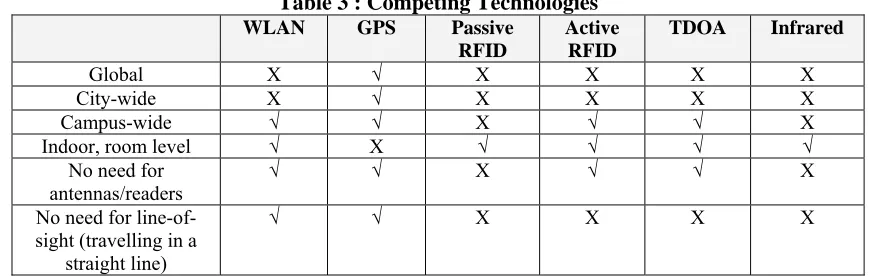
Table 3 shows the advantages and disadvantages of the technologies in terms of the coverage area and availability for use in developing an application. This comparison also shows that GPS and WLAN technologies have better features and have great potential for combining the technologies for mobile-application development. This is due to the coverage area and enabling features such as there being no need for either an antenna or line-of-sight (which the signal is not required to travel in a straight line to function), which is important for mobile applications where users are moving back and forth from an indoor to an outdoor environment.
Table 3 : Competing Technologies
WLAN GPS Passive
RFID
Active RFID
TDOA Infrared
Global X √ X X X X
City-wide X √ X X X X
Campus-wide √ √ X √ √ X
Indoor, room level √ X √ √ √ √
No need for
antennas/readers √ √ X √ √ X
No need for line-of-sight (travelling in a
straight line)
√ √ X X X X
5. PROTOTYPE DEVELOPMENT
The concept of supplying specific information and services to the construction programme manager has become technically and financially feasible because of the capability of integrating mobile devices, context-awareness, data, voice and positioning technologies. Although on a small scale, research works by Aziz et al.,(2006) and Fathi et al.,(2006) proved that the concept was achievable and functioning in real-time.
5.1 System Architecture of the Prototype Application
Based on the literature (Imielinski and Viswanathan, 1994, Voelker and Bershad, 1994, Abowd et al., 1997, Brown et al., 1997), design goals and users requirements identified, the researcher developed a system architecture for the design of context-aware information and services tool for the Construction Programme Manager as shown in Figure 1.
The context-aware information system (C-aIS) architecture consists basically of four main components: -
1. The Positioning System – using GPS and WLAN for the determination of the current location;
2. The Mobile Client – a mobile device that is able to received location coordinates from GPS and
WLAN, transmit location coordinates to the application server, receive information or data from the server and the CAIS application that is able to process the selection between GPS and WLAN location information (C-aIS Client Engine);
3. The Context Information Network System – the wireless network environment for transmitting
contextual information and data to the users; and
4. The Server System – the context-aware server engine that is able to process location data
WLAN NETWORK
INTERNET (Wireless) GPS
Data
PDA (GPS & WLAN
Capability) Data
Loca tion C
oordi nates
GIS Database Server Programme Management
Server
Database Server
CAIS Server Engine
SERVER SYSTEM (Database & Map) MOBILE CLIENT
(Users & Tracked Objects)
Programme Manager
CAIS Client Engine
NETWORK SYSTEM (Wireless) LOCATION SYSTEM
(GPS & WLAN)
Figure 1 : Context-Aware Information System (C-aIS) Architecture
Having context-aware applications (such as the location and activity context) allows the application to present information and services that are relevant to the Construction Programme Manager’s current position, especially when the Programme Manager makes multiple site visits. The context-aware application supplies information and services based on the Construction Programme Manager’s current location by using the Global Positioning System (GPS) for the outdoor location coordinates and a Wireless Local Area Network (WLAN) for the indoor location coordinates. The location coordinates (latitude, longitude and altitude) are then transmitted from the mobile client (PDA-Phone with GPS and WLAN capabilities) to the C-aIS application server through a wireless network.
The C-aIS application server registers the query issued by the mobile client and then performs the following operations until the query is active:
1. Retrieve information associated with the current context together with its scope and load information to the user’s device (based on selected context information); and
2. Periodically monitor the current user’s context and check whether it belongs to the current information scope. If an out-of-scope condition is detected, the service manager restarts from step 1.
The C-aIS application server will process the coordinates received based on the context defined (such as location, time, activity, task and project). This process will involve the programme management servers, database servers and GIS servers, so that it can be programme to automatically send specific information and services to the Construction Programme Manager (such as the project information required, issues to be resolved at the project site, advice, coordination or overall overview of the project) based on the context information. This flow of project information and services can be utilised by the Construction Programme Manager to monitor a programme’s performance, progress reports and efficiently manage a multiple-project environment.
5.2 Features of the Prototype Application
Figure 2: Features in the prototype application
The management of a programme (or multiple projects) presents challenges that are different from those of single-project management. The situations are complex (unpredictable and non-linear) (Aritua et al.,
2009) and information requirements are huge (to cover the macro- and micro-levels) (Fathi et al., 2007).
Thus, designing and developing mobile context-aware construction programme management applications is challenging and demanding. The technology itself is rather complex and involves several fields and technologies that contribute to the final outcome (such as integration, system architecture and interaction design).
The concept delivers benefits to the organisation through a new way of managing projects and programmes, which in turn delivers to the construction programme management the benefits of high efficiency, good visibility and good governance. Context-specific information and service delivery should be supplied not just to the construction programme manager, but also to other project team leaders so that they are able to make informed decisions.
6. CONCLUSIONS
This paper has given an overview of the mobile information systems which are supported by a broad range of computing and communication technologies, including context-aware computing and location-tracking technologies (such as GPS, WLAN). The review also shows the potential of real time mobile information system for construction programme managers. This paper shows that, to develop mobile context-aware application for construction programme managers, the system should be able to integrate multiple technologies such as context-aware computing, mobile device, GPS, WLAN and enterprise project management system in real time. These technologies will be taken forward in this research.
Technology itself would not guarantee success if the system was unable to meet the needs of the user. Therefore, it is important to understand the relationship and interaction between the user (human) and the application (computer) before developing any computer application. The success of the application depends on the right research philosophy, methodology and techniques. This will be the focus of the other research papers.
ACKNOWLEDGEMENT
The authors would like to thank Universiti Teknologi Malaysia and the Ministry of Higher Education, Malaysia for sponsoring this research.
REFERENCES
Aatique, M. (1997) Evaluation of TDOA Techniques for Position Location In CDMA Systems. Master of
Science In Electrical Engineering, Faculty of the Electrical Engineering, Virginia Polytechnic Institute and State University
Abowd, G. D., Atkeson, C. G., Hong, J., Long, S., Kooper, R. and Pinkerton, M. (1997) Cyberguide: A Mobile Context-Aware Tour Guide. ACM Wireless Networks, 3 (5), pp.421-433.
Anumba, C. J., Pan, J., Issa, R. R. A. and Mutis, I. (2008) Collaborative Project Information Management In A Semantic Web Environment. Engineering, Construction and Architectural Management (ECAM), 15 (1), pp.78 - 94.
Archibald, R. D. (2003) Managing High-Technology Programs and Projects. 3rd ed.: John Wiley and
Sons
Aritua, B., Smith, N. J. and Bower, D. (2009) Construction Client Multi-Projects - A Complex Adaptive Systems Perspective. International Journal of Project Management, 27 (1), pp.72-79.
Aziz, Z. (2005) Context-Aware Information Delivery for Mobile Construction Workers. PhD Thesis, Civil
and Building Engineering, Loughborough University
Aziz, Z., Anumba, C. and Law, K. (2006) Using Context-Awareness and Web-Services to Enhance Construction Collaboration, In: Rivard, H., Melhem, H. & Miresco, E.(Eds.), Joint International Conference on Computing and Decision Making in Civil and Building Engineering. ASCE,14-16
June, In Rivard H., Melhem H. & Edmond Miresco (Eds.), 14-16 June 2006a, Montreal, Canada. pp.3010-3019.
Aziz, Z., Anumba, C. J., Ruikar, D., Carrillo, P. M. and Bouchlaghem, N. M. (2005) Context Aware Information Delivery for On-Site Construction Operations, 22nd CIB-W78 Conference on Information Technology in Construction. Institute for Construction Informatics, 19-21 July,
Technische Universitat Dresden, Germany. pp.321-327.
Bahl, P. and Padmanabhan, V. N. (2000) RADAR: An in-Building RF-Based User Location and Tracking System, In Proceedings of the IEEE Infocom 2000. 26-30 March, Tel-Aviv, Israel. pp.775--784.
Baldwin, A. N., Thorpe, A. and Carter, C. (1999) The Use of Electronic Information Exchange on Construction Alliance Projects. Automation in Construction, 8 (6), pp.651-662.
Behzadan, A. H., Aziz, Z., Anumba, C. J. and Kamat, V. R. (2008) Ubiquitous Location Tracking for Context-Specific Information Delivery on Construction Sites. Automation in Construction, 17 (6),
pp.737-748.
Bonsor, K. (2001) How Location Tracking Works. [online] Atlanta, GA: HowStuffWorks.com Available
from http://people.howstuffworks.com/location-tracking.htm/printable [Accessed 25th January 2009]
Bowden, S., Dorr, A., Thorpe, T. and Anumba, C. (2006) Mobile ICT Support for Construction Process Improvement. Automation in Construction, 15 (5), pp.664-676.
Brown, J. T. (2008) The Handbook of Program Management: How to Facilitate Project Succss with Optimal Program Managment New York: McGraw-Hill Professional
Brown, P. J., Bovey, J. D. and Chen, X. (1997) Context-Aware Applications: From the Laboratory to The Marketplace. IEEE Personal Communications, 4 (5), pp.58-64.
Burrell, J. and Gay, G. K. (2001) Collectively Defining Context in a Mobile, Networked Computing Environment. CHI '01 Extended Abstracts on Human Factors in Computing Systems. Seattle,
Washington, ACM Press.
Chen, Y. and Kamara, J. M. (2008) Using Mobile Computing for Construction Site Information Management. Engineering, Construction and Architectural Management (ECAM), 15 (1), pp.7 -
20.
Fathi, M. S., Anumba, C. J. and Carrillo, P. (2006) Context Awareness in Construction Management - Key Issues & Enabling Technologies, In: Dulaimi, M.(Ed.), The Joint International Conference on Construction Culture, Innovation and Management (CCIM). British University,26-29 November,
Fathi, M. S., Anumba, C. J., Carrillo, P. and Aziz, Z. (2007) Construction Programme Management - Current Context, In: Garvin, M., Edum-Fotwe, F. & Chinowsky, P.(Eds.), Proceedings of the 2007 ASCE/CIB Construction Research Congress. Academic Event Planners, 6-8 May, Grand
Bahama Island. pp.8.
Garzaa, J. M. d. l. and Howitt, I. (1998) Wireless Communication and Computing at The Construction Jobsite. Automation in Construction, 7 (4), pp.327-347.
Ghaoui, C. (2006) Encyclopaedia of Human Computer Interaction. Covent Garden, London: Idea Group
Reference
Imielinski, T. and Viswanathan, S. (1994) Adaptive Wireless Information Systems, Proceedings of Special Interest Group in Database Systems (SIGDBS). Tokyo, Japan. pp.19-51.
Löfgren, A. (2007) Mobility In-site: Implementing Mobile Computing in a Construction Enterprise. The Communications of the Association for Information Systems, 20 (37), pp.1-12.
Lycett, M., Rassau, A. and Danson, J. (2004) Programme Management: A Critical Review. International Journal of Project Management, 22, pp.289-299.
Magdic, A., Rebolj, D., Cuš-Babic, N. and Radosavljevic, M. (2002) Mobile Computing in Construction, In: Agger, K.(Ed.), Proceedings of International Council for Research and Innovation in Building and Construction (CIB W78 Conference). 12 – 14 June 2002, In Agger K. (Ed.), 12 – 14 June
2002, Aarhus School of Architecture, Denmark. pp.1-8.
May, A., Mitchell, V., Bowden, S. and Thorpe, T. (2005) Opportunities and Challenges for Location Aware Computing in the Construction Industry, Mobile HCI 2005. ACM,19-22 September 2005,
Salzburg, Austria. pp.255-258.
Milosevic, D. Z. (2003) Project Management ToolBox: Tools and Techniques for the Practicing Project Manager New Jersey: John Wiley & Sons
Oloufa, A. A., Ikeda, M. and Oda, H. (2003) Situational Awareness of Construction Equipment Using GPS, Wireless and Web Technologies. Automation in Construction, 12 (6), pp.737-748.
Pagonis, J. and Dixon, J. (2004) Location Awareness and Location Based Services - Part 1 Positioning
and Terminology. [online] Symbian Ltd. Available from
http://developer.symbian.com/main/downloads/papers/messaging/LocalAwareness_LBS_01.pdf
[Accessed 18 August 2008]
Pashtan, A. (2005) Mobile Web Services. Cambridge: Cambridge University Press
Pellegrinelli, S. (1997) Programme Management: Organising Project-Based Change. International Journal of Project Management, 15 (3), pp.141-149.
Pellegrinelli, S. (2002) Shaping context: the role and challenge for programmes. International Journal of Project Management, 20 (3), pp.229-233.
Pernici, B. (2006) Mobile Information System: Infrastructure and Design for Adaptivity and Flexibility.
Heidelberg, Germany: Springer
Schilit, B. N., Hilbert, D. M. and Trevor, J. (2002) Context-Aware Communication. IEEE Wireless Communications, 9 (5), pp.46-54.
Singhvi, V., Fish, W. and Terk, M. (2003) Context-Aware Information System for Construction Site Applications, In: Molenaar, K. R. & Chinowsky, P. S.(Eds.), Proceedings of the Construction Research Congress. ASCE,19-21 March, Honolulu, Hawaii, USA. pp.115-115.
Smailagic, A., Siewiorek, D. P., Anhalt, J., Kogan, D. and Wang, Y. (2001) Location Sensing and Privacy In a Context-Aware Computing Environment IEEE Wireless Communications 9(5), pp.10-17.
Šuman, N. and Pšunder, M. (2008) Mobile Computing Changing the Traditional Ways of Organizing the Construction Company. American Journal of Applied Sciences, 5 (1), pp.42-47.
Tanaka, H. (2005) Multi Project Management (MPM) at Project-based Companies. [online] PM Forum
Available from
http://www.pmforum.org/library/papers/2005/Multi_Project_Management_Hiroshi_Tanaka.pdf
[Accessed 23 April 2009]
Voelker, G. M. and Bershad, B. N. (1994) Mobisaic: An Information System for a Mobile Wireless Computing Environment, In: Cabrera, L.-F. & Satyanarayanan, M.(Eds.), First Workshop on Mobile Computing Systems and Applications. IEEE Computer Society, 8-9 December, Santa
Cruz, California. pp.185-191.
Want, R., Hopper, A., Falcão, V. and Gibbons, J. (1992) The Active Badge Location System. ACM Transactions on Information Systems, 10 (1), pp.91-102.
Zreik, K. and Parfouru, S. (2005) A Context Driven Information Retrieval for Online Urban Disaster Management System, In: Sariyildiz, S. & Tuncer, B.(Eds.), The 3rd International Conference on Innovation in Architecture Engineering and Construction (AEC 2005). Delft University of