Performance Evaluation of FLAP Protocol in
WLAN (IEEE 802.11i) Handoff Process
Nirmal Kaur1, Dr. Supreet kaur2, Manpreet Kaur
M. Tech scholar (CSE), Punjabi University Regional Centre for IT and Management, Mohali, India1
Assistant Professor, Punjabi University Regional Centre for IT and Management, Mohali, India2
ABSTRACT: IEEE 802.11 based Wireless LAN is the most amazingly cost-efficient wireless network due to the explosive growth of mobile data traffic and nodes are covered by the Access Points in these networks. As the mobile user moves their device needs to handover between the Access Points and introduces large delay occurs during handoff process. Handoff management plays an imperative part in next generation wireless networks for providing the QoS for the mobile users. A great deal of research has been done in most recent years to reduce the handoff delay occurs in the distinctive level of wireless communication. In this paper, we propose a FLAP, to further evaluate its performance using WLAN Handoff process, which realizes the authentication and key distribution through two roundtrip messages. Comparisons between moving nodes for different speed is shown through Ns3 simulation by using parameters delay time, throughput and Packet Delivery Ratio and compare with another handoff techniques. Performance evaluation shows that the FLAP protocol can achieve low handoff delay time.
KEYWORDS: WLAN (IEEE 802.11i), FLAP Protocol, Handoff, Access Point, Authentication Delay
I. INTRODUCTION
A Wireless Local Area Network (WLAN) is one of the most likely understood wireless access technology based on IEEE 802.11i standards has gained a lot of popularity due to its good mobility, high transmission limit and unwavering quality in short distances these days [1]. None of the 802.11 standards have provides a seamless mobile service. Nowadays, deployment of multiple APs is an effective way to improve the performance of 802.11 standards and deployed in public venues to provide wireless networking to large area. When a mobile node (MN) moves from the coverage area of one AP to other APs, it needs to perform handoff process [2]. This handoff procedure requires some time to complete its process and during this period called handoff delay, a no. of management frames are exchanged among these nodes. For seamless mobility handoff delay need to be small as possible. Some application can tolerate amount of delay depend upon their behavior. Real time applications suffer from the handoff delay when mobile user roams between different WLANs. Efforts have been made to develop faster handoff mechanism in order to reduce handoff delay. To improve the handoff latency, many existing handoff schemes [3][4][5][6] have been proposed.
In this paper a new protocol known as FLAP is proposed for handoff, that is an efficient and fast access authentication protocol, it gives authentication to a new client within only two roundtrip messages. Because of its fast speed we can use the FLAP protocol in the wireless LANs for the handoff process so that we can reduce the handoff delay while the mobile node moves from the range of one AP to another AP. Thus we use the FLAP also to improve the throughput of the networks. By simulation results, we concluded that FLAP is the efficient protocol for the handoff process.
Whatever remains of this paper is organized as follows. Section II presents the required background and discussion of related work. A detailed explanation of proposed scheme is presented in section III. Section IV describe the simulation results and provide discussion on its performance, followed by the conclusion in section V.
II. BACKGROUND AND RELATED WORK
A. IEEE 802.11 Handoff Procedure:
Discovery PhaseDiscovery phase is the process of finding the neighbouring AP(s) that offers the best RSS. To accomplish this, MS scans the entire prospective channel that the neighbouring APs can operate on. The scanning can be either active or passive. In passive scanning, the MS switches to each channel and wait for the beacon signal. The current APs have a default beacon interval of 100 ms. The ms needs to wait passively full beacon interval and can’t stop scanning passively if it receive one beacon frame as there might be more than one AP operations on any channel. The passive scanning has the advantages of saving power and bandwidth.
In active scanning, the MS switches to each channel, transmits the probe request channel and wait for probe response(s). The total delay involves in scanning a channel can be divided into two delays. CS&T and probe wait delay. CS&T is a time to switch and transmit on a channel and prove wait delay is the time to spend on the channel to gather all the prove response form AP on the channel. The standard defines two parameters to be set while scanning,
MinChannelTime and MaxChannelTime. Active scan reduce the time taken to scan but increase the traffic load and also increase the power consumption.
Fig.1 Handoff scenario in IEEE 802.11 WLAN
Re-authentication PhaseOnce the MS finds the following best AP, it starts the re-authentication phase. The re-authentication phase comprises of two sub phases:-authentication and re-association. For confirmation MS sends the authentication request to the chosen new AP and it sends the validation response to the MS, on the off chance that reaction is not got by MS then, STA could not re-partner to the new AP. The complete procedure is done by 802.1x and EAP-TLS as described in IEEE 802.11i standard. Re-association is the process of transferring the state information from old-AP to the new-AP.
B. Related Work:
A great deal of research has been dedicated to improve the performance of handoff in IEEE 802.11 based wireless networks by proposing new protocol and schemes. Most of them have focused on reducing the total handoff delay in the
from the mobile node to bypass the main processes and hence reduce the latency. Hexadecimal cell is used to accelerate the handoff process. Sarma et al [5] have presented a handoff mechanism where scanning is interleaved with data communication before actual handoff. A zone based handoff scheme is simulated in qualnet 4.5 simulator.
Purushothaman et al. [6] demonstrates the scheme for voice over IEEE 802.11 WLANs systems, are known as FastScan
handoff scheme that uses a client based database for decreasing the scanning delay by decreasing the number of channels and APs to scan on these channels. In this scheme handoff delay is decreased for IEEE 802.11b networks as low as 25 ms. Zhenxia et al.[7] presented a distributed handoff scheme, to output all the accessible channels, a mobile node chooses a few neighboring nodes before it begins starting the MAC layer handoff process. In this paper a novel MAC layer handoff protocol used for large scale Wi-Fi based wireless networks to support seamless real time applications. In this three Received Signal Strength thresholds are used to trigger handoff and simulation results show that handoff latency can be reduced to 50 ms or less [15].
Zhang et al. [8] proposed a Neighbor list proactive (NLP) based handoff scheme that used all the channels to look an
objective AP in view of received RSSI values. During the testing of one channel that includes sending and accepting of probing packets over channel this procedure takes 15 ms and delay of channel switching is around 10 ms. This scheme exploits the active scan taking into account data of neighbor APs, variable bitrate video coding (VBR) and received signal strength indicator (RSSI) to decrease handoff delay and service interference. Youchan et al [9] presents a scheme to manage seamless mobility between access points and to decrease the handoff delay. In [10], authors proposed a scheme where the MN finds information about a set of APs which are in the direction of its motion, from a location server. The MN can now skip the discovery phase. The scheme requires a separate location server. Proactive context caching method was proposed in [11] to reduce the re-association delay. These schemes alone are not sufficient to reduce the handoff latency significantly as the probe delay is the most significant part of the handoff delay.
Debrata et al [12] proposed a technique that utilized the neighbor graph and scan the channel taking into account speed, position and direction of the station. For fast handoff it eliminates the overpriced checking operation by constructing a wise speculation about the list of APs on specific channel [13].
III.PROPOSED SCHEME
FLAP is an efficient and fast authentication protocol for wireless LANs, it was proposed in February 2014. As the number of wireless LAN enabled mobile users increasing day by day and 802.11 fails to provide as such authentication to those users so there is a need of FLAP which can authenticate a new user only with two roundtrip messages [14]. The authentication process is as follow in fig.2.
1) Through the proactive scan, the STA obtain the WLAN data which contain the basic service set identity, the
identity of the AS and the security capability of the network.
2) The first authentication message {SNonce, User-ID, AS-ID, F, t} is sent to the AP from the STA, among which t is
a counter and its initial value is set as 1. The STA increase the counter by one once sending such a message. SNonce is the random value generated by STA. User-ID is the user’s identity, while AS-ID is the identity of the AS. F = f (k, t || SNonce || User-ID || AS-ID), where f is a hash function and || presents the concatenation.
3) AP sends the fast access authentication request message {SNonce, User-ID, AS-ID, F, t} to the AS for verification.
4)
A counter is also set in the AS for each user and its underlying quality 1 also set. After accepting the quick accessauthentication request message, the AS gets its present t value as per the User-ID and contrasts it and got one. In the event that got t quality is less than the t value protected by the AS, the authentication of the STA comes up short and the current t estimation of the AS will keep unaltered; something else, the AS further verify F as indicated by the got t and the key k. Thereafter, the AS computes the (Pairwise master key) PMK = h(k, “FLAP_PMK”||t||User-ID||AS-ID), where h is a hash function and “FLAP_PMK” is a constant string.
5) The AS replies to the AP with the authentication response message {SNonce, User-ID, AS-ID, E, t, PMK}, where
E = f (k, t || SNonce || AS-ID || User-ID).
6)
After receiving the another message, the AP generates its own random value ANonce and PTK is computed. PTKconstant string. The derivation of the PTK here is exactly similar as that of 802.11i. If the AS coexists with the AP, no message interactions between AS and AP, and the other related operations are per-formed by the AP.
7) The AP sends the second authentication message {ANonce, User-ID, AS-ID, E, t, MIC1}, where MIC1 is the
message authentication code computed on this message by the AP that utilizing the PTK, and t is the current value of the AS.
8) On receiving 2nd authentication message, the STA will compare the got t value with its present t value, and if equal
the STA will accept E. if correct, the validation of the AS will pass. Thereafter, the STA will create the PMK and
PTK, utilizing the same method as that of the AS and AP. At the same time, the STA will confirm the MIC1 taking
utilization of the PTK. If comfirmed, the STA authenticates the AP successfully.
9) The STA send the 3rd authentication message {User-ID, SNonce, MIC2}, where MIC2 is the message
authentication cod computed on this message by the STA using the PTK. Meanwhile, the STA also indicates that whether the group temporal key (GTK) is required or not. Furthermore, this message carries the necessary RSN IE (information element) parameters to complete the association.
Fig.2 Authentication Process of proposed scheme
10) After receiving the 3rd authentication message, the AP verifies the MIC2. If correct, it means that the STA
11) The AP sends the STA the 4th authentication message {GTK, MIC3}, where the GTK is encrypted using the PTK.
On receiving this message, the STA verifies the MIC3. If correct, the STA decrypts and gets the GTK and other
related information. At the same time, the STA installs the PTK and GTK.
The fundamental advantages of using the FLAP protocol in Wireless LAN areas, FLAP protocol is perfect with the current 802.11i so there is no compelling reason to replace the Existing networks. As it uses only two messages to
authenticate the new user so that they can connect to any access point quickly and reduce the delay time.
IV.SIMULATION RESULTS AND DISCUSSION
The proposed protocol is simulated in NS3 network simulator. NS3 has altered to execute the proposed scheme. In this section, simulation result is presented to demonstrate the performance of the proposed schemes. To begin with we clarify the situations then the results are shown by discussion.
1. Simulation Scenario
This scenario describes the Wi-Fi network, to obtain the statistical result assume that three APS are taken, especially AP1, AP2, and AP3, also have taken MN, to be specified mn1. The mn1 is related to AP1 and assumed that the mobile node is moving far from AP1 towards the coverage area of AP3 along a direct path. The length of each block is assumed to be d.
Fig.3 experiment scenario
As appeared in figure.3, the movements of MN are characterized using irregular way-points and at the time of handoff the MNs are moved with the different speeds. When handoff occurs the MN is closer to AP1 and is additionally inside the coverage area of AP3. An Ethernet connects AP1, AP2 and AP3. The simulation is done at three different speeds of nodes 20, 40 and 70 m/s. and simulation time is taken to be 60ms.
A. Effect of Transmission level on delay of FLAP
Fig.4 FLAP Delay Analysis under various Transmission levels
From the above fig. it is clear that the authentication delay in FLAP for high speed has the lowest value as compared to all others. The simulated values for the authentication delay of FLAP are taken with the help of NS3 simulator and
these values are as shown below in table.
B. Effect of Transmission level on throughput of FLAP
Throughput is a measure of how many units of information a protocol can pass in a given amount of time.
Fig.5 FLAP Throughput Analysis under various transmission levels
For evaluation of throughput of FLAP under different transmission levels, we took simulation time on the x-axis and throughput taken into kbps on Y-axis. From the above fig. it is clear that the throughput of FLAP for high speed is lowest (1250 kbps) as compared to all others.
C. Effect of Transmission level on Packet Delivery Ratio of FLAP
Fig.6 FLAP PDR Analysis under various transmission levels
TABLE I. COMPARATIVE STUDY OF PARAMETERS USING DIFFERENT SPEED
Simulation Scenario
performance metrics
Speed of MNs
20 40 70
1 2 3
Delay Throughput
PDR
.01174 2304
99
.01010 908 90.4
.0956 595 81.2
The above fig. discuss about the comparative study of parameter using different speed of nodes. Three parameters handoff delay, throughput and PDR are taken and compare the average value for speed 20, 40 and 70 ms. It shows that for the highest speed of node the delay are taken to be small and same process is followed by other parameters.
D. Comparison of Handoff delay
In this paper, firstly investigated how the speed of mobile node will affect the handoff delay. Fig.3 shows the relation of handoff delay and speed of MNs. Figure shows that the higher the speed of MN will reduce the handoff latency.
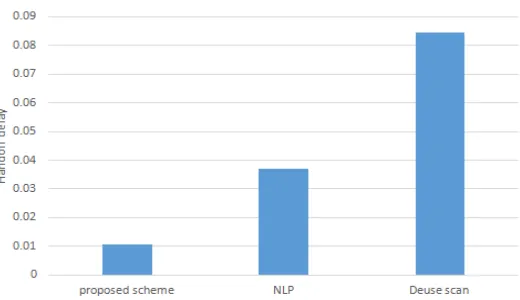
In the fig. 7 compare the delay time of the proposed scheme with the other handoff scheme deuce scan and NLP based handoff scheme. It shows that the handoff delay of the deuce scan is large that of the NPL based scheme. Although deuce scan and NLP both adopt pre-scan, the time of the scan cycle of the deuce scan is longer than that of the NLP and this leads the handoff latency of NLP scan. While FLAP authenticate with the EAP-TLS key so it provide more security than another techniques and it presents the lowest handoff delay compare to other.
V. CONCLUSION AND FUTURE WORK
This paper presents a Frame Layer Protocol (FLAP) to evaluate its performance and support seamless mobility without any requirements on the mobile node side in wireless handoff process. In the research enhancement are made on the base of handoff techniques in WLAN after drawing out the comparative study of existing techniques. FLAP takes only two roundtrip messages between MS, AP and AS. In this, we checked the performance of FLAP by using parameters Packet Delivery Ratio, throughput and authentication delay. Three speeds 20, 40, and 70 have been considered for nodes and compare the performance of proposed scheme with different speeds of node. Based on the simulation analysis compare the performance of proposed work with the other handoff techniques and the results indicate that the QoS base FLAP protocol can provide low handoff delay and packet loss ratio.
REFERENCES
1. IEEE 802.11, “Information Technology-Telecommunications and Information Exchange between Systems-Local and Metropolitan Area Networks-Specific Requirements-Part 11: Wireless LAN Medium Access Control and Physical Layer Specifications,” IEEE Standard, 2007. 2. Pawar, Ms Madhuri R., and Santosh Sheshrao Sambare. "A Brief Review of Handover schemes in Wireless communication”, vol. 3, no. 1, pp.
3269-3278,2012.
3. Bhuvaneswari, A. "Survey On Handoff Techniques." Journal of Global Research in Computer Science 2, no. 6 (2011): 140-144.
4. Sarddar, Debabrata, Joydeep Banerjee, Tathagata Chakraborti, Abhronil Sengupta, M. K. Naskar, Tapas Jana, and Utpal Biswas. "Fast handoff implementation using distance measurements between mobile station and APs." In Students' Technology Symposium (TechSym), 2011 IEEE, pp. 81-86. IEEE, 2011.
5. Sarma, Abhijit, Rajat Kumar Gupta, and Sukumar Nandi. "A zone based interleaved scanning technique for fast handoff in IEEE 802.11 wireless networks." In 2009 10th International Symposium on Pervasive Systems, Algorithms, and Networks, pp. 232-237. IEEE, 2009.
6. Purushothaman, Ilango, and Sumit Roy. "FastScan: a handoff scheme for voice over IEEE 802.11 WLANs." Wireless Networks 16.7 (2010): 2049-2063.
7. Zhang, Zhenxia, W. Pazzi Richard, and Azzedine Boukerche. "A fast MAC layer handoff protocol for WiFi-based wireless networks." In Local computer networks (LCN), 2010 IEEE 35th conference on, pp. 684-690. IEEE, 2010.
8. Zhang, Hongchun, Zhaoming Lu, Xiangming Wen, and Zhiqun Hu. "QoE-Based Reduction of Handover Delay for Multimedia Application in IEEE 802.11 Networks." Communications Letters, IEEE 19, no. 11 (2015): 1873-1876.
9. Jeon, Youchan, Myeongyu Kim, Sangwon Park, and Jinwoo Park. "Rotation multiple-channel allocation scheme for seamless handoff in IEEE 802.11 WLANs." In Consumer Electronics (ICCE), 2013 IEEE International Conference on, pp. 665-666. IEEE, 2013.
10. Manodham, Thavisak, Mitsuo Hayasaka, and Tetsuya Miki. "A Novel Handover Scheme for Improving the Performance of WLANs based on IEEE802. 11." In Communications, 2006. APCC'06. Asia-Pacific Conference on, pp. 1-5. IEEE, 2006
11. Velayos, Héctor, and Gunnar Karlsson. Techniques to reduce IEEE 802.11 b MAC layer handover time. Vol. 3. TRITA-IMIT-LCN, 2003.
12. Sarddar, Debabrata, Tapas Jana, Tarasankar Patra, Utpal Biswas, and M. K. Naskar. "Fast handoff mechanism in WLANs based on neighbor graph information." In Parallel Distributed and Grid Computing (PDGC), 2010 1st International Conference on, pp. 334-338. IEEE, 2010.
13. Sarddar, Debabrata, Papri Mani, Utpal Biswas, and M. K. Naskar. "Fast Handoff Mechanism in Wireless Local Area Networks (WLAN) using Neighbor Graph Algorithm." International Journal of Computer Applications 25, no. 9 (2011): 36-40.
14. Li, Xinghua, Fenye Bao, Shuxin Li, and Jianfeng Ma. "FLAP: An efficient WLAN initial access authentication protocol." Parallel and Distributed Systems, IEEE Transactions on 25, no. 2 (2014): 488-497.