Genetic Algorithm for Localization in WSN
Abhinav Dhiman1, Nishant2
M.Tech Student, Dept. of EEE, Arni University, Kathgarh, Indora, Himachal Pradesh, India1 Head of Department, Dept. of EEE, Arni University, Kathgarh, Indora, Himachal Pradesh, India2
ABSTRACT: The sensor nodes that are present in the wireless sensor network are used for the transmitting the data from source to the destination. As the data send or receive by the node is important in same way the location of the nodes is essential. Localization is the technique for obtaining the information about the location of the nodes present in the network. Various localization methods have been proposed but still some limitations were there. The localization mechanism for the wireless sensor network should have low cost designing, scalable and efficient. So in this paper the Concentration is on the distance between sensor and node in the network, this optimization algorithm is used for resolving the localization problem. Genetic algorithm is used that will give the best optimized results. From the results obtained it is concluded that this method is efficient and better than the traditional methods of localization.
KEYWORDS: localization, Genetic Algorithm, Wireless Sensor Network
I. INTRODUCTION
Wireless Sensor Network(WSN) have experienced noticeable growth over the past decade due to their adaptability and rapid advances in Technology[1].The Wireless sensor network is the network in which the communication is done with the help of small device termed as nodes without any physical link between them. These sensor nodes will transfer the data from the transmitter to the receiver In wireless sensor network large numbers of nodes are employed .These nodes are capable of sensing the data, communication etc. These sensor nodes comprised of a transducers, transceiver, power source etc.[2].The Data has no value without the location Information. The location Information can be used by routing and other protocols, algorithms and services [3].
LOCALIZATION
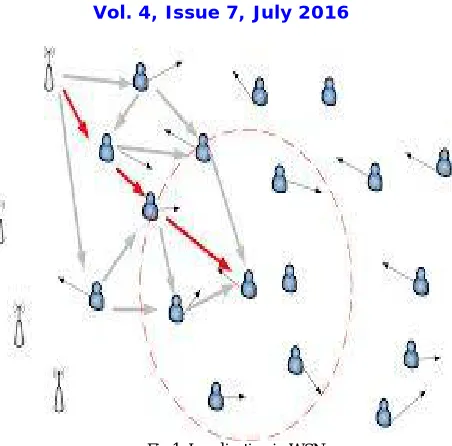
Fig.1 shows the localization inWSN. Localization is defined as the process of the determining the position of the nodes in the network. Since most applications depend on a successful localization [4], i.e. to compute their positions in some fixed coordinate system, it is of great importance to design efficient localization algorithms. In case of static network the nodes are deployed once the network is setup [5], in case of the mobile nodes the location of nodes change continuously. Localization is estimated through communication between localized and un-localized node for determining their geometrical position, location is determined by means of distance and angle between nodes [6].The deployment is either deterministic or self-organizing. In deterministic situations, the sensors are manually placed and data is routed through pre-determined paths, [2] where as in self-organizing systems, the sensor nodes are scattered randomly creating an infrastructure in an ad hoc manner.WSN issues such as node deployment, localization, energy aware clustering and data aggregation are often formulated as optimization problems [7].
Fig 1: Localization in WSN
Genetic Algorithm
Genetic algorithm is used natural selection process for recognition. This algorithm is an optimization problem based loosely on the Drawinian principle of biological evolution, reproduction and “The survival of the fittest” [13]. This algorithm works in the process such as selection, crossover, and mutation. Algorithm provides an optimal solution of the problem by applying crossover and mutation on the problem.The population size depends on the nature of the problem, but typically contains several hundreds or thousands of possible solutions. Often, the initial population is generated randomly, allowing the entire range of possible solutions (the search space). Occasionally, the solutions may
be "seeded" in areas where optimal solutions are likely to be found [14].During each iteration step (generation) three
genetic operators (selection, crossover and mutation) are performing to generate new populations [2]. From the given population, first the fitness value is calculated and then results are obtained [3]. The provided fitness value is used with crossover on the initial population. Output obtained is the new population i.e. created by interchanging the bits of the selected population. Further results are calculated. After the crossover, mutation is applied on the initial population. Output is obtained by swapping of bits and new population is generated. At the end all results are compared. Result that is up-to-mark is saved. Thus, Genetic Algorithm (GA) provides best results for any problem. GA has various applications in wireless sensor network. It can use in obtaining optimal path in routing. It helps to improve the efficiency and lifetime of the network [15].
II. RELATED WORK
There are many Techniques are used for localization in WSN usingPSO, BBO. Some of them are discussed below:
1. Satvir Singh, Shivangna, Shelja Tayal (2013) “Analysis of Different Ranges for Wireless Sensor Node
Localization using PSO and BBO and its variants” [9]: In a Wireless Sensor Network (WSN) accurate location
performance of PSO and different migration variants of BBO in terms of number of Nodes localized, localization accuracy and computation time is presented.
2. Sujatha S.R . Dr. M Sidappa], “A Study On Efficient Localization Methods Using Swarm Intelligence”[10]:
Wireless sensor network (WSN) refers to a group of spatially dispersed and dedicated sensors for monitoring and recording the physical conditions of the environment and organizing the collected data at a central location. Localization is a fundamental challenge in WSN. Optimization technique is used to obtain the best solution for localization. The two optimization are used best solution for improving of localization problems in wireless sensor networks namely, Ant Colony Optimization (ACO) and particle swarm Optimization (PSO). Both are natural inspired phenomena which are based on swarm intelligence. In this paper, we describe the main concepts of swarm intelligence and comparison between two optimization techniques, their basic ideas, advantages, disadvantages, applications and energy efficient distributed localization technique is proposed. Distributive localization is addressed using Particle Swarm Optimization.
III. PROPOSED METHODOLOGY
In this proposed work a new method is proposed for the deployment of the sensor nodes in the network. In this Genetic algorithm is used for optimizing the results.
Step I Initially the parameters of the network are initialized. The area of the network, number of nodes, etc is defined.
Step II After the network is initialized, the next step is to deploy the nodes in the network, that means substitute the nodes in the area. These nodes are used for the communication.
Step III Next step after the deployment of node is to initialize the location of sensor/BTS. In this step the BTS is localized randomly in the particular area, and then after the location of BTs is defined the node in the network will send data to the BTs for the communication.
Step IV After the location of BTS is assigned in the Network, the clustering is done. The network is divided into clusters, Clustering contain the no. of nodes in the Network. After the clustering is performed the data is send to the BTS from each cluster present in the network for the communication.
Step V In this step the Genetic Algorithm is applied. This is main step of GA, in this step further no. of steps are performed named selection, Crossover and Mutation. And hence after this the new values are finding and then obtain updated QOS fitness values. In this Algorithm we are focusing on the distance factor, less distance will helps to increase the Fitness Value of the Sensor.
The Whole Methodology discussed above is shown in the fig.2
Fig.2 Proposed Methodology
IV. SIMULATION RESULTS
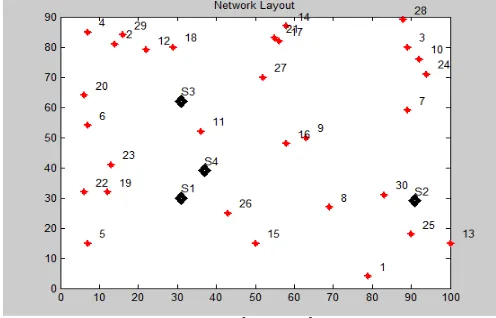
In this section there is discussion about the results of proposed method of localization in the wireless sensor network. In this paper Genetic algorithm is used for solving the localization problem in the wireless sensor network. By using the genetic algorithm the optimized results are obtained. The graph given below depicts the comparisons between the proposed and the traditional algorithm. Here the No. of BTS is 4 Where as No. of Nodes is equal to 30 as shown in Fig. 3.
Network parameter initialization
Deploy Nodes in the Network
Initialize the location of Sensor/BTS
Evaluate the clustering
Calculate the initial Fitness
Update population by GA for enhance Fitness of N/W
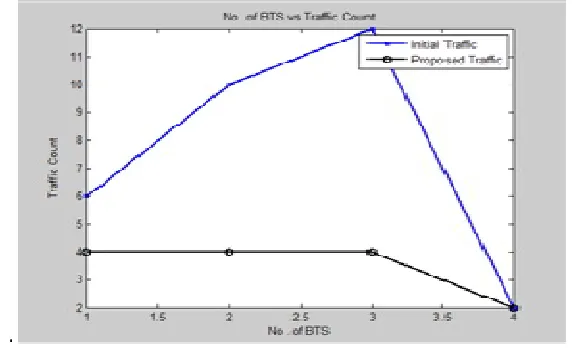
Fig. 4 shows the graph between traffic count vs. no. of BTS in network The proposed technique is considered to be efficient than the traditional approach. All these Nodes are initially randomly localized, Then using GA proper position of nodes can be obtain and then.Fig.4 shows how the traffic count increase rapidly in traditionally approach where as for the optimized approach it doesn’t increases too much. For e.g. the value of traffic count for the third BTS is of 4 units using GA, where as in the initially the value of traffic count in the initial traffic is of 12 units, Which is quite high as compared to the proposed traffic Which is merit for the GA.
.
Fig. 4Comparsion graph on the basis on the Traffice count wr.t to the number of base stations .
Next topic is to discuss the fitness of the all sensor. Fitness can be finding out by using the formula: Fitness= 1 / path loss * attenuation * distance
Since in this thesis we’re focusing on the distance factor, and hence GA helps to decrease the distance between BTS and nodes, then greater will be the fitness of Whole Network, since fitness factor is inversely proportional to the distance.
The Fig 5.1 represent the comparison graph between the traditional and proposed approach on the basis of the initial and the final value of all sensors present in the network, initially the distance between sensor and node is greater than the new distance after the GA applied. Hence on decreasing the distance will helps to increase the fitness of sensor. Initial fitness is of 1.5* 10-6 units and after the GA applied the fitness function of sensor 1 is increases and becomes 7*10-6.
Fig. 5.2 represents the comparison of fitness of the 2nd sensor in the Network.Initially the fitness of Sensor 2 is of 0.7*10-6 and when new algorithm is applied the fitness of sensor is increased and becomes 10-6 units, which is merit of improved algorithm.
Fig. 5.2 Fitness Comparison for Sensor 2
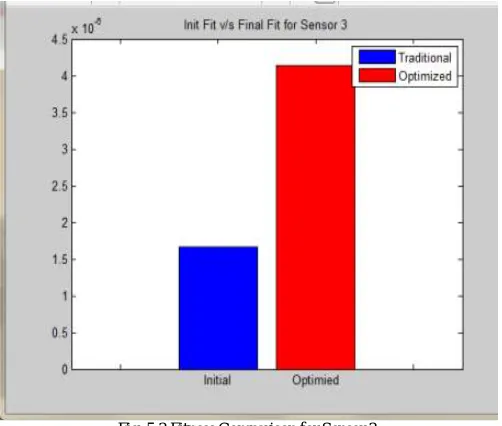
Fig. 5.3 represents the comparison of fitness of the 3rd sensor in the Network.Initially the fitness of Sensor 3 is of 1.6*10-6 and when new algorithm is applied the fitness of sensor is increased and becomes 4.2*10-6 units, and hence GA algorithm helps to increase the fitness of the sensor.
Fig. 5.3 Fitness Comparison for Sensor 3
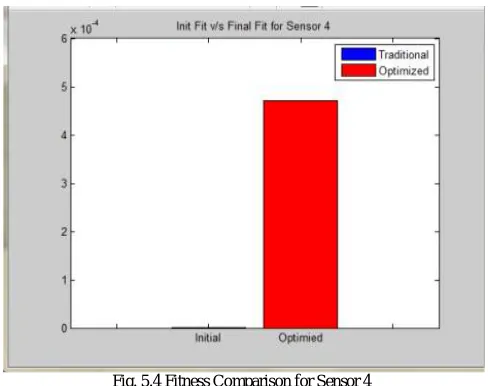
Fig. 5.4 Fitness Comparison for Sensor 4
V. CONCLUSION AND FUTURE SCOPE
Localization is one of the major challenges in the wireless sensor network. Localization is the method of determining the position of the node in the network. In this paper a new technique for the localization is proposed. In this an efficient Swarm intelligence technique is used for the obtaining the best optimized location of the nodes in the network. Genetic algorithm is effective and efficient in solving the optimization sensor location problem in coverage area. From the results obtained it is concluded that this method is efficient and better than the traditional methods as this efficient to locate the best position. As the proposed algorithm is better than the traditional algorithm with respect to the fitness value and traffic in the network .In future this technique can be enhanced by using some trending optimization algorithm so that the more optimized results are obtained. In the future more work can be done to find the efficiency and to improve the fitness function.
REFRENCES
[1] Morteza M.Zanjirch and Hadi Larijani , “A survey on centralised and distribution clustering Routing algorithm for Wireless Sensor
Networks”,VTC Spring , vol.9, pp 1-6,2014.
[2] Almuzaini, K.K. , “Localization in Wireless Networks Using Decision Trees and K-Means Clustering”, IEEE,PP 1-5,2012.
[3] Kapil Uraiya,Dilip Kumar Gandhi, “Genetic Algorithm for Wireless Sensor Network With Localization Based Technique.” , Volume 4, Issue 9,
September 2014.
[4] K. Muthukrishnan, M. Lijding, and P. Havinga, “Towards smart surroundings: Enabling techniques and technologies for localization”, in Proc.
of the Int. Workshop on location and context awareness, volume 24,2005.
[5] Guangjie Han, “Localization algorithms of Wireless Sensor Networks: a survey” Springer , Volume 52, Issue 4, pp 2419-2436, April 2013..
[6] Nabil Ali Alrajeh, Maryam Bashir and Bilan Shams, “ Localization Techniques in WSN”,Volume2013,Hindawi,pp 1-9,2013.
[7] Raghavendra V,Kulkarni and Ganesh Kumar Venayagamoorthy, “Computational intelligenceinWSN”,IEEE, Anna Forster, Senior Member,
IEEE.volume13,issue 1 ,2011.
[8] \Guangjie Han, “Localization Algorithm of WSN : A survey” Springer,Volume 52,Issue 4,pp 2419-2436,April2013.
[9] Azzedine Boukerche, “ Localization System For WSN”, IEEE, pp 9-11,2007..
[10] Amitangshu Pal , ”Localization Algorithms in Wireless Sensor Networks: Current Approaches and Future Challenges “Network Protocols and
Algorithms, Vol. 2, No. 1,Pp 45-73,2010.
[11] Pooja Nagchoudhury, “Classification of Swarm Intelligence based Clustering Methods “International Journal of Computer
Applications,Volume 91 ,Pp28-33, April 2014
[12] Mirshekarian, S; Süer, G."Experimental study of seeding in genetic algorithms with non-binary genetic representati",volume 12,pp 1-3,2016.
BIOGRAPHY
ABHINAV DHIMAN is a student of M.Tech, EEE from Arni University Indora. He received Bachelor of Technology degree ECE in 2014 from Arni University, Kathgarh, Indora, H.P., India. His research interests are in Digital Signal Processing, control system.
NISHANT is Head of department of EEE at Arni University. He received Master of Technology degree in 2012 from