Secured Data Aggregation in Wireless Sensor
Networks using Red Black Tree
Arati S. Patil, Dr. Santosh L. Deshpande
Department P.G. Studies in Computer Network and Engineering, Visvesvaraya Technological University, Belagavi,
Karnataka, India
Professor, Department P.G Studies in Computer Network and Engineering, Visvesvaraya Technological University,
Belagavi, Karnataka, India
ABSTRACT: Existing methods for aggregation of data in wireless sensor networks (WSNs) normally employ one channel which causes long latency due to high interference. To overcome this constraint, red black tree based data aggregation technique is proposed in this paper. All the nodes in the network are arranged using red black tree considering validity of nodes. The data from all the leaf nodes are aggregated and checked for redundancy. Redundant information is eliminated and the remaining data is passed to the higher layer of tree. Further the data is transmitted to higher layer where the data is encrypted and is finally passed to sink node. The performance of the presented methodology is compared with LEACH protocol.
KEYWORDS: Wireless Sensor Networks (WSN), Data Aggregation, Red Black Tree, Redundant information, LEACH protocol.
I.INTRODUCTION
Generally Wireless sensor networks (WSNs) are employed in security areas or unattended environments. Thus they are more prone to security attacks. Also WSNs have numerous problems that influence their design and performance such as energy consumption, calibration, localization, deployment, security, synchronization, etc. Energy consumption of sensors is one of the critical issues among these parameters, since sensors are resource constrained in battery power. In WSNs, due to the employment of many sensor nodes, there will be sensing and transmission of similar data, which is because of intersecting range of neighbor nodes. This results in increased amount of bandwidth and energy consumption. Data aggregation is one of the solutions to this result.
Data aggregation, a main technique in WSNs aids in decreasing the amount of energy utilization, communication overheads and also decreases the issue of localized congestion. Its main objective is to collect data from all the sensor nodes and important data is summarized, so that the amount of data to be transmitted to sink node, is minimized. Here, the data from the target area is collected by a group of sensor nodes. When the network is interrogated by the base station, rather than sending every sensor node’s information to base station, the data is collected from the neighboring nodes of a sensor node, known as data aggregator. Further, the aggregated data is sent to sink node over a multi-hop path.
WSN is broadly classified into 3 types of nodes: normal sensor nodes, aggregators and Base station/ Sink node. The aggregators collect data from a subset of the network, an appropriate aggregation function is used to aggregate the data. Further aggregated data is transmitted, to next layer aggregator or to the sink node which queries the network. The sink node will process the obtained sensor data and extracts useful data which illustrates the events in the target field.
II.LITERATURESURVEY
Based on the network structures, the routing protocols can be classified as following approaches:
Cluster based data aggregation: this approach comes into picture when the energy constrained network is huge, where the sensors are less efficient to transmit the data directly to the base station. In this approach, the entire network is divided into many clusters and each cluster’s members will select a cluster head. The job of cluster head is to aggregate the information got from cluster members locally and the send the resulting data to sink node.
Dnyaneshwar et.al., suggested Bandwidth Efficient Cluster-based Data Aggregation (BECDA) technique [02]. This provides a solution for efficient data aggregation with in-network aggregation. This technique, gathers the data packet by considering the network with heterogeneous nodes in terms of energy and mobile sink. Randomly distributed nodes with variable data generation rate undergoes inter and intra clustering, thereby optimising the approach. BECDA has achieved appreciable improvement in PDR (67.44%) and throughput (41.25%).
Centralized data aggregation: This technique takes the assistance of shortest path using a multi-hop wireless protocol aggregating data at the centre node. The centre node known as leader aggregates the data packets, which may be queried. A huge number of data packets are to be transmitted to a query node, since every intermediate has to pass the packets to leader (query node) from its child nodes. The data packets may be same as the sum of external path lengths for each node, in the best case. For example, SPIN and DD.
Direct Diffusion (DD) senses information with aid of attribute value pairs namely geographical area, duration and interval. Hence it is rightly called data-centric protocol [03]. Sensor Protocol for Information via Negotiation (SPIN) uses high level descriptors or meta-data. Before transmitting the meta-data, they are interchanged among sensors via data advertisement technique [04].
Multi-path Approach: In this type every node will transmit data packets to all its neighbours. Further the data aggregators pass the aggregated data partially, over multiple paths, to the parent node. This enables aggregation in every intermediate node. This technique is efficient in avoiding loss of packet which is implemented by smart caching of information at sensor nodes.
Milton et. al., have presented an efficient multi-hop based approach for data aggregation, where the redundant aggregated data is sent along different paths [05]. This allows reconstruction of data, provided that there is at least single accessible path.
Tree based data aggregation: This type of data aggregation technique will have sink node considered as root node (Base station). The remaining nodes are considered as leaves. The flow of information of data moves up the tree, i.e., from leaf nodes to sink node. This technique is relevant for developing optimal aggregation techniques.
Data centric protocol also called Tiny aggregation (TAG) is proposed by Maden et.al., in his paper [06]. The methodology comprises of two phases: distributed phase and collection phase. This approach enables users to declare simple queries and also them spread and executed efficiently in low power wireless sensor networks.
Hybrid approach for data aggregation: This approach follows tree based, cluster based and multipath scheme in a combined manner. It allows the network structure to aggregate data in an adaptively depending on the specific network situation [07].
In this paper, an efficient method for tree based approach for data aggregation using red black tree is presented. Here there is a sink node which is considered as base station. The immediate next level nodes (children of sink node) encrypt the data to be passed to sink node. The following level nodes, called as data aggregators, aggregate data from all the leaf nodes and checks for the redundancy of data.
III.PROPOSEDSYSTEM
The system presented is efficient for data aggregation, providing end-to-end security and confidentiality. The methodology presented is tree based data aggregation which makes use of red black tree. A schematic of the system flow is as shown in Figure 1.
Red-black tree
Another form of binary search tree is red-black tree. It has the below mentioned properties:
Each node is either black or red
Every ‘null’ also called leaf node is black
The number of black nodes along the path from a node to a descendent leaf is same.
A tree is built in the initial stage of the network, and the transmission path is chosen using the hybrid parameters.
Figure 1: Block Diagram of Proposed Work
Any additional data found after the data is aggregated by all the nodes in the network, is removed. This result in increasing the life span of the network and also certain amount of power will be saved.
As shown in the figure, after the 1st level that is data aggregation comes checking for redundant data. The nodes present in the higher layer of data aggregators, check for the redundant data in the aggregated data and eliminates if found any. The next level takes care of securing the data. The data free from redundancy will be encrypted before transmitting it to sink node or base station. This ensures the security of data against attacks.
IV.EXPERIMENTAL RESULT
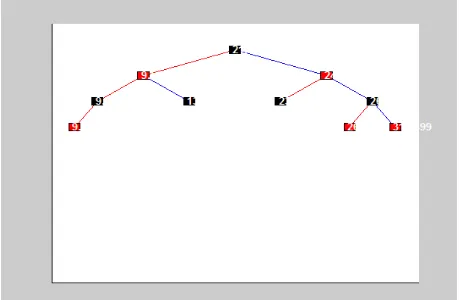
In these section results of our proposed system is showed in figure below: In figure 2 shows the network initialization, Figure 3, 4 &5 shows the construction steps for red and black tree.
As the next part of results performance of our proposed system are analysis and compared with the existing methods.
Energy Dissipation is defined as the sum of energy for the transmission and reception. Figure 6 shows the graph for energy dissipation vs no.of .nodes.
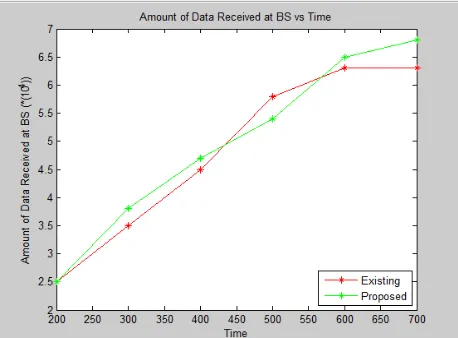
In figure 7 shows the graph for the amount of data received at the base station measured with respect to time and compared with existing approached.
Figure 3: Shows red and black tree construction at level one.
Figure 4: Shows red and black tree construction at level two
Figure 6: Shows the graph for energy dissipation vs No.of Nodes.
Figure 7: Shows the graph for amount of data received at BS
V.CONCLUSION
Data aggregation provides energy conservation and also removes redundant data during the transmission and provides required data only. In this paper we have proposed Tree Based Data Aggregation in WSN
Advantages of Tree Based Data Aggregation:
Ability to tolerate disconnection and loss
Simple in nature.
Easy to implement.
Find the optimal tree with shortest path.
Shorter delay
As the performance evaluation we have compared our proposed method to LEACH protocol results in better performance of our proposed system.
REFERENCES
1. S. Ozdemir, Y. Xio, “Secure Data Aggregation in Wireless Sensor Networks: A Comprehensive Overview”, in Journal of Computer Networks, Elsevier, Volume 53, Issue 12, 13 August 2009, pp. 2022–2037.
3. Vaibhav Pandey, Amarjeet Kaur, Narottam Chand, “A review on data aggregation techniques in wireless sensor”,JEEE, 2010
4. Geetu, Sonia Juneja, “Performance Analysis of SPIN and LEACH Routing Protocol in WSN”, IJCER, 2012
5. Milton Armando Cunguara, Tomas Antonio and Paulo Bacelar, “On Multi-Path Aggregation of Duplicate-Sensitive Functions”, 2010.
6. S. Madden et al., “TAG: a Tiny Aggregation Service for Adhoc Sensor Networks,” OSDI 2002, Boston, MA, Dec. 2002 7. Kiran Maraiya, Kamal Kant, Nitin Gupta, “Wireless Sensor Network: A Review on Data