Scholarship at UWindsor
Scholarship at UWindsor
Electronic Theses and Dissertations Theses, Dissertations, and Major Papers
2011
Emotion based Facial Animation using Four Contextual Control
Emotion based Facial Animation using Four Contextual Control
Modes
Modes
Rajkumar Vijayarangan University of Windsor
Follow this and additional works at: https://scholar.uwindsor.ca/etd
Recommended Citation Recommended Citation
Vijayarangan, Rajkumar, "Emotion based Facial Animation using Four Contextual Control Modes" (2011). Electronic Theses and Dissertations. 343.
https://scholar.uwindsor.ca/etd/343
by
Rajkumar Vijayarangan
A Thesis
Submitted to the Faculty of Graduate Studies through Computer Science
in Partial Fulfillment of the Requirements for the Degree of Master of Science at the
University of Windsor
Windsor, Ontario, Canada
2011
by
Rajkumar Vijayarangan
APPROVED BY:
______________________________________________ Dr. Guoqing Zhang
Faculty of Engineering
______________________________________________ Dr. Robin Gras
School of Computer Science
______________________________________________ Dr. Xiaobu Yuan, Advisor
School of Computer Science
______________________________________________ Dr. Dan Wu, Chair of Defense
School of Computer Science
iii
DECLARATION OF ORIGINALITY
I hereby certify that I am the sole author of this thesis and that no part of this
thesis has been published or submitted for publication.
I certify that, to the best of my knowledge, my thesis does not infringe upon
anyone‟s copyright nor violate any proprietary rights and that any ideas,
techniques, quotations, or any other material from the work of other people
included in my thesis, published or otherwise, are fully acknowledged in
accordance with the standard referencing practices. Furthermore, to the extent that
I have included copyrighted material that surpasses the bounds of fair dealing
within the meaning of the Canada Copyright Act, I certify that I have obtained a
written permission from the copyright owner(s) to include such material(s) in my
thesis and have included copies of such copyright clearances to my appendix.
I declare that this is a true copy of my thesis, including any final revisions, as
approved by my thesis committee and the Graduate Studies office, and that this
thesis has not been submitted for a higher degree to any other University or
iv
ABSTRACT
An Embodied Conversational Agent (ECA) is an intelligent agent that interacts
with users through verbal and nonverbal expressions. When used as the interface
of software applications, the presence of these agents creates a positive impact on
user experience. Due to their potential in providing online assistance in areas such
as E-Commerce, there is an increasing need to make ECAs more believable for
the user, which has been achieved mainly by using realistic facial animation and
emotions.
This thesis presents a new approach of ECA modeling that empowers intelligent
agents with synthesized emotions. This approach applies the Contextual Control
Model for the construction of an emotion generator that uses information obtained
from dialogue to select one of the four modes for the emotion, i.e., Scrambled,
Opportunistic, Tactical, and Strategic mode. The emotions are produced in format
DEDICATION
ACKNOWLEDGEMENTS
I would like to take this opportunity to thank my supervisor Dr. Xiaobu Yuan,
IEESM, Associate Professor, School of Computer Science, University of Windsor, ON,
Canada for his continuous encouragement and support in presenting this thesis. Deep
Appreciation and gratitude goes to him for contributing his suggestions and ideas during
my research.
I would also like to thank my thesis committee members Dr. Robin Gras, Dr. Guoqing
Zhang and Dr. Dan Wu for spending their valuable time providing feedback about thesis
throughout my proposal and defence.
Finally, I would like to thank my friends/colleagues Mr. Johnny Kapps and Ms. Sathulla
TABLE OF CONTENTS
DECLARATION OF ORIGINALITY ... iii
ABSTRACT ... iv
DEDICATION ... v
ACKNOWLEDGEMENTS ... vi
LIST OF TABLES ... x
LIST OF FIGURES ... 11
CHAPTER I. INTRODUCTION 1.1 Introduction to Human Computer Interaction ... 13
1.2 Overview of Embodied Conversational Agents ... 14
1.3 Motivation ... 15
1.4 Problem Statement ... 16
1.5 Thesis Structure ... 16
II. REVIEW OF LITERATURE 2.1 Embodied Conversational Agents: Overview of Architecture ... 17
2.2 Facial Animation Techniques ... 19
2.2.1 Interpolation ... 21
2.2.2 Parameterization ... 21
2.2.3 Image Morphing ... 22
2.2.4 Physics based Muscle Model... 23
2.2.6 Pseudo Muscle Model ... 25
2.2.7 MPEG4 Facial Animation ... 26
2.3 Modelling emotions ... 29
2.3.1 Plutchik‟s wheel of Emotions ... 29
2.3.2 Ortony Clore and Collin‟s model for Emotions (OCC Model) . 31 2.4 Dialogue Management Systems: An overview ... 35
2.5 Dialogue Management Techniques ... 36
2.5.1 Partially Observable Markov Decision Process (POMDP)... 37
2.5.2 Hollnagel‟s Contextual Control Model (COCOM) ... 39
2.5.3 Modified Partially Observable Markov Decision Process ... 40
2.7 Review of Existing Embodied Conversational Agents... 43
2.7.1 Microsoft Agents ... 43
2.7.2 Emotional Chinese Talking Head ... 44
2.7.3 LUCIA... 46
2.7.4 Emotion based Tutor ... 47
2.7.5 GRETA ... 47
2.7.6 Chatter bots ... 49
2.8 Conclusion ... 53
III. DESIGN AND METHODOLOGY 3.1 Proposed Architecture: An Overview ... 56
3.2 Proposed Architecture: An Overview ... 56
3.3 OCC model and Four Contextual Control Modes for Emotion Generation ... 60
3.4 Emotion Generator... 62
3.5 Algorithm for the Proposed Method ... 66
3.6 Creating a 3D Emotional Talking Head ... 67
3.6.1 Creating a 3D model ... 68
3.6.2 Emotion ... 69
3.6.3 Visemes ... 71
3.6.4 Modifier ... 73
3.6.5 Applying MPEG4 Facial Animation ... 74
3.6.6 Blending and Synchronization ... 77
3.6.7 Interpolation ... 77
3.7 SMIL Scripting Language ... 78
3.8 Animation Playback. ... 80
3.9 Conclusion ... 81
IV. ANALYSIS OF RESULTS 4.1 Theoretical Analysis ... 82
4.2 Quantitative Analysis ... 84
4.2.1 Test Case: 1 ... 86
4.2.2 Test Case 2 ... 89
4.2.3 Test Case 3 ... 93
4.2.4 Test Case 4 ... 96
4.2.5 Test Case 5 ... 100
4.3 Discussion ... 104
V. CONCLUSIONS AND RECOMMENDATIONS
5.1 Conclusions ... 107
5.2 Future Work ... 108
APPENDICES Test Case 1 ... 107
Test Case 2 ... 116
Test Case 3 ... 123
Test Case 4 ... 130
Test Case 5 ... 138
REFERENCES ... 158
LIST OF TABLES
TABLE 3.1:ALGORITHM FOR THE PROPOSED METHOD ... 67
TABLE 4.1:COMPARISON BETWEEN DIFFERENT ECA‟S AGAINST THE PROPOSED METHOD . 83 TABLE 4.2:COMPARISON OF CONFIDENCE SCORES FOR TEST CASE 1 ... 84
TABLE 4.3:COMPARISON OF CONFIDENCE SCORES FOR TEST CASE 2 ... 87
TABLE 4.4:COMPARISON OF CONFIDENCE SCORES FOR TEST CASE 3 ... 90
TABLE 4.5:COMPARISON OF CONFIDENCE SCORES FOR TEST CASE 4 ... 94
LIST OF FIGURES
FIGURE 2.1:GENERAL ARCHITECTURE OF AN EMBODIED CONVERSATIONAL AGENT ... 19
FIGURE 2.2:CLASSIFICATION OF FACIAL ANIMATION TECHNIQUES ... 20
FIGURE 2.3:THREE VECTORS IN A VECTOR MUSCLE MODEL [WATERS91] ... 24
FIGURE 2.4:SPLINE BASED MUSCLE MODEL.(A)DEMONSTRATES A 16 PATCH SURFACE WITH 49 CONTROL POINTS AND (B) DEMONSTRATES 4 PATCHES REFINED TO 16 PATCHES [JUN07] ... 26
FIGURE 2.5:FEATURE POINTS AFFECTED BY FAPS AND OTHER FEATURE POINTS [KORAY04] ... 27
FIGURE 2.6:MPEG4FAPU ... 28
FIGURE 2.7:PLUTCHIK‟S WHEEL OF EMOTION [PLUTCHIK91] ... 30
FIGURE 2.8:THE OCC MODEL FOR EMOTIONS [ORTONY88] ... 32
FIGURE 2.9:THE OCC CLASSIFICATION OF THE EMOTION „FEAR‟[ORTONY88] ... 34
FIGURE 2.10:THE OCC TYPE SPECIFICATIONS OF 22 EMOTIONS [ORTONY88] ... 34
FIGURE 2.11:FLOW OF THE FOUR CONTEXTUAL CONTROL MODES (COCOM) [STANTON01] ... 40
FIGURE 2.12:ALICE AND JOHN ARE TWO DIFFERENT SYNTHETIC AGENTS WITH DIFFERENT PERFORMANCE PARAMETERS [ELENA05] ... 43
FIGURE 2.13:EXAMPLE OF A MICROSOFT AGENT -PEEDY ... 44
FIGURE 2.14:EMOTIONAL CHINESE TALKING HEAD [TAO04] ... 46
FIGURE 2.15:ARCHITECTURE OF LUCIA[PIERO08] ... 47
FIGURE 2.16:GRETA[STEFANO08] ... 49
FIGURE 2.18:AN EXAMPLE OF A CLEVERBOT CONVERSATION WITH A HUMAN
[CLEVERBOT10] ... 51
FIGURE 2.19:AARON FROM FUTURE SHOP‟S WEBSITE [FUTURESHOP11] ... 52
FIGURE 2.20:IKEA‟S ANNA [IKEA99] ... 53
FIGURE 3.1:THE PROPOSED ARCHITECTURE OF OUR SYSTEM ... 57
FIGURE 3.2:A SUBSET OF THE EMOTIONS FROM THE OCC MODEL USED FOR OUR THESIS [ORTONY88]... 63
FIGURE 3.3:INTEGRATION OF FOUR CONTEXTUAL MODES WITH OCCMODEL FOR EMOTIONS ... 65
FIGURE 3.4PROPOSED NEW 3D MODEL ... 69
FIGURE 3.5:THE EMOTIONS FROM THE TOP LEFT HAND CORNER ARE:NEUTRAL,RELIEF, PLEASED, AND FEAR.THE EMOTIONS FROM THE BOTTOM LEFT HAND CORNER ARE: DISPLEASED,HOPE AND SAD... 71
FIGURE 3.6:VISEMES FOR THE CREATED 3D MODEL... 73
FIGURE 3.7:MODIFIERS FOR THE CREATED 3D MODEL ... 74
FIGURE 3.8:SETTING THE FAPU FOR THE CREATED 3D MODEL ... 75
FIGURE 3.9:SETTING THE WEIGHTS AND DEFORMATION FUNCTIONS FOR THE CREATED 3D MODEL ... 76
FIGURE 4.1TEST CASE 1 ... 83
FIGURE 4.2:TEST CASE 2... 86
FIGURE 4.3:TEST CASE 3... 89
FIGURE 4.4:TEST CASE 4... 91
CHAPTER I
INTRODUCTION
1.1 Introduction to Human Computer Interaction
Human Computer Interaction, also known as HCI, is one of the most renowned
areas of research. It defines the rules for interaction between human and the computer by
combining different sciences, psychological and cognitive factors. The goal of Human
Computer Interaction is to make a positive impact on the user experience when they
interact with computers. The success criteria are mainly determined by how well the
machines can understand humans and vice versa. This field of research led to the
evolution of different software and hardware that we use in our day to day life. Extensive
research in this field has bridged the gap between the humans and computers in the recent
past. The evolution of hardware such as mice, keyboards, web camera, microphone and
software like word processors, CAD, CAM are considered to be milestones in the field of
human computer interaction.
Since the early 1990‟s researchers have laid their focus in developing avatars or
embodied conversational agents for interactions with humans in social situations. The
introduction of these avatars or human like characters created a ripple effect in several
fields such as filming and animation. Creation of interactive graphical user interfaces has
been one of the long term goals in this area of research. Nevertheless this became one of
1.2 Overview of Embodied Conversational Agents
The embodied conversational agents are being used in different fields such as:
Interactive e-learning environments for students through artificial tutors
Healthcare systems for providing assistance to immobile patients
e-retail applications for providing customer service
Non Player Characters (NPC) in gaming environments
In the recent past, the Embodied Conversational Agents (ECA) have gained wide
acceptance in the field of Human-Computer Interaction. These agents wear a realistic
human face and communicate with users in social situations such as an e-learning system,
healthcare system, e-retail environments and games. These agents usually have an
interface which is backed up by a suitable dialogue manager and knowledge base. The
characters of the ECAs are capable of using voice; animated speech with lip and facial
expressions; eye, head and body movements to realize gestures; express emotions; and
perform actions or display listening or thinking postures [CemKeskin07].The presence of
these agents has made a positive impact on user experience as reported from the previous
work of [Cassell00] and [Rickenberg00].
The efficacy of an agent banks on a major factor which is credibility. Embodied
Conversational Agents have been made more believable by incorporating emotions. It is
very important for these agents to have emotions because they will absolutely increase
the user understanding and experience. The agents should not be considered as an
individual modality but as the synergic contribution of different communication channels
that, properly synchronized, generate an overall communication performance
market was the Microsoft Agent which was introduced to help the users of Microsoft
products. They used simple 2D cartoon characters called as Merlin, Peedy, Genie and
Robby. They were simple conversational characters with a Speech API (SAPI) text to
speech engine.
1.3 Motivation
Over the years, significant research in Human Computer Interaction has led to the
emergence of different techniques for creating Embodied Conversational Agents. The
research on ECA‟s can be subdivided into the following:
Research on realistic 3D facial animation techniques
Research on the construction of effective cognitive models for the
generation of emotions
Research on spoken dialogue systems
After extensive research from the literature we were unable to find a system in
existence which combined the three research categories of ECAs into a current and
state-of-the-art design. There is definitely a need to create a robust system that combines the
above categories together which could be used in any domain, such as in the customer
service based pizza ordering domain.
The goal of this system will be to provide customer service by understanding the
customer needs and intentions. The creation of such a system with a 3D talking head
driven by emotions will make it more engaging to the end user. This motivated us to
create a system that combines the current state-of-the-art 3D facial animation and spoken
dialogue systems, along with a new cognitive model for generating emotions by merging
1.4 Problem Statement
This thesis will demonstrate different methodologies adopted for creating a new
cognitive model of emotion generation which will overcome the limitations of existing
models. We have created a new cognitive model for emotions by combining the Four
Contextual Control Modes and OCC model for emotions. The developed system will
have a 3D talking head with realistic facial animation driven by the new cognitive model
for emotion generation along with a powerful dialogue manager known as Partially
Observable Markov Decision Process (POMDP) for a Pizza-Ordering domain.
1.5 Thesis Structure
The rest of the thesis is organized as follows. Chapter II provides a deep insight of
the existing techniques and methodologies available for the creation of a 3D talking head,
highlighting its pros and cons. We also review some of the most popular ECAs available
in the market. Chapter III explains the proposed framework in detail highlighting the new
approach for modelling emotions, by combining the Four Contextual Control Modes and
OCC model for emotions. We also explain the design tools involved that enable the
creation of an ECA that displays emotions towards the end of Chapter III. Chapter IV
reviews the qualitative and quantitative experimental results, and performance analysis of
the proposed method. Chapter V will conclude this thesis with some recommendations
CHAPTER II
REVIEW OF LITERATURE
Embodied Conversational Agents comprise of a 3D talking head, cognitive model for
emotion generation and a dialogue management system which is responsible for
generating responses to resolve user‟s queries by understanding the user‟s intentions.
This chapter will review all three components of an ECA from the literature stating its
advantages and limitations. Towards the end of this chapter we will also review some of
the existing embodied conversational agents and their limitations, which became a huge
motivation for us to address those limitations in this thesis.
2.1 Embodied Conversational Agents: Overview of Architecture
The architecture of an ECA is similar to a human. Humans can analyze the
outside environment by means of the five senses: sight, hearing, touch, smell and taste.
The verbal expressions in humans are conveyed by means of a voice generated from the
vocal cords. The dialogue conversations in humans are steered by the brain. The non
verbal expressions in humans are conveyed through their facial features. Given a
situation, the decision making ability of a human depends on a vital physical organ called
the brain. Humans have the ability to forecast some of the outcomes of their decisions.
Similarly, the ECAs are able to analyze their environment by using different
peripheral devices such as cameras, text input, and voice. ECAs convey their verbal
Engine (TTS). The dialogue conversations in ECAs are steered with the help of a
dialogue manager and knowledge base. The knowledge base of the virtual agent can be
large in size but the knowledge base should be very sensible, extensible and should be the
core for the decision taking abilities of the agents. The ECAs convey non verbal
expressions through realistic facial animation. Like a human, given a situation the ECA
will react and make its decisions based on a knowledge base and artificial intelligence.
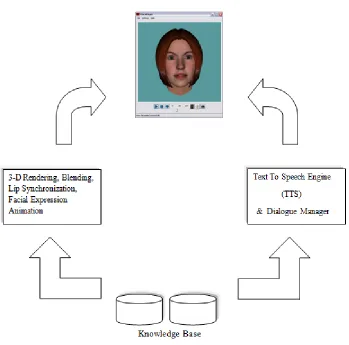
The figure shown below describes the generic architecture of an Embodied
Conversational Agent. The agent is driven by animation, a TTS, and dialogue manger
Figure 2.1: General Architecture of an Embodied Conversational Agent
We will now discuss the various components of the Embodied Conversational
Agent by introducing various animation techniques available.
2.2 Facial Animation Techniques
Facial animation is a major area of research in Computer Graphics. The
introduction of 3D virtual agents and the necessity to create realistic facial animation has
enabled this area of research to be a vital part of Human Computer Interaction. Different
techniques have emerged addressing the major concerns since Frederic I. Parke
[Frederic72] took the lead in 1972. Some of the major concerns in facial animation will
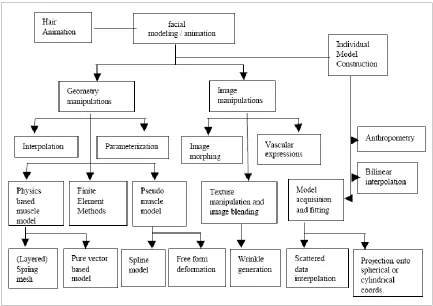
Facial animation can be classified into two categories [Jun07]:
Geometric based manipulations
Image based manipulations
Each category includes a large selection of animation techniques.
The figure shown below provides an outline of the different facial animation
techniques available. The subsequent sections will briefly talk about the pros and cons
involved with a few of these techniques and finally we will discuss the animation
technique adopted for this research.
Figure 2.2: Classification of Facial animation techniques
We will begin the discussion on interpolation and parameterization methods, briefly
2.2.1 Interpolation
Interpolation is one of the most common techniques used for facial animation. It
is the rendition of images transitioning from one key-frame to another over a specified
period of time. The transitioning leads to a smooth facial animation. There are two
common types of interpolation techniques used in facial animation:
Linear Interpolation
Bi-linear Interpolation
Linear interpolation is the most basic interpolation process. Linear interpolation
could be made more realistic by choosing an appropriate interpolation function, such as
the cosine interpolation function, which can create smooth transitioning from one
key-frame to another. Bi-Linear interpolation can be used for complex facial animation when
there are more than just two key-frames.
Interpolations are significantly faster and easier to generate basic animations than
most other animation techniques. However, it might be really difficult to create complex
facial animation using linear or Bi-Linear interpolation techniques. Interpolation is
definitely a good method to produce small set of animations from a few key frames
[Jun07]. The interpolation technique is still widely used to generate vivid facial
animation. To create a realistic facial animation we have combined the Linear and Cubic
interpolation techniques from [Koray04] using XfaceEd, which does not suffer from any
limitations as compared to the Linear or Bi-Linear interpolation techniques.
2.2.2 Parameterization
A second facial animation technique, called parameterization, evolved to
the creator can specify and control different regions of the face through parameter values
[Jun07]. Parameterization provides explicit control of creating realistic facial animations
by applying proper deformations to different areas of a facial region. One of the
limitations with this technique is that [Jun07] were not able to generate generic facial
models with standard parameters to control the deformations. Therefore, they have to
specify different parameters for different facial models. For example, a character with a
long face has different parameters compared to a character with round face. The
complexity of establishing parameters for different facial models is one of the limitations
of parameterization.
2.2.3 Image Morphing
A third animation technique called morphing effects a metamorphosis between
two target images or models. A 2D image morph consists of a warp between
corresponding points in the target images and a simultaneous cross dissolve [Jun07].
Warping is the process of mapping an image onto a regular shape such as a plane or
cylinder. Cross dissolving is the process where one image is faded out while another is
simultaneously faded in. 2D morphing is one the first morphing techniques that came into
existence but suffered from the complexity of requiring manual tuning up the parameters,
such as color balancing correspondence selection and tuning of the warp and dissolve
parameters.
3D morphing technique evolved to overcome the limitations of the 2D morphing.
The 3D morphing created a sense of more realistic facial animation. However, this
technique suffered from certain limitations similar to the Linear and Bi-Linear
2.2.4 Physics based Muscle Model
Physics based modelling can be classified into three different categories:
Mass spring systems
Vector representations
Layered spring meshes
The work on spring mesh muscle model was first pioneered by Platt and Badler
[Platt81] where they proposed that a force is applied to an elastic mesh through muscle
arcs will generate realistic facial animation. Platt proposed another model [Platt85] later
which consisted of 38 regional muscle blocks interconnected by a spring network.
Alternatively, the work on the vector muscle model was pioneered by Waters
[Waters91]. He proposed that a muscle definition consisted of three different elements,
such as the vector field direction, an origin and an insertion point. The three vectors are
Figure 2.3: Three vectors in a Vector Muscle Model [Waters91]
The vector muscle model was one of the popular models for generating realistic
facial animation for different emotions such as anger, fear, joy, surprise, disgust and
happiness. The complexity involved in creating such a model was always tedious because
we have to position the vector muscles in anatomically correct positions. There are no
other ways to automate this process and was always time consuming because we cannot
have a generic facial mesh for all models.
The last category of physics based models, the layered spring mesh muscles
model, was proposed by Terzopoulos and Waters [Terzopoulos91]. They proposed that
the face is made of three layers of deformable meshes that correspond to skin, fatty tissue
and muscle tied to bone. The model generated with this technique simulated a true sense
of realistic facial animation, but it required extensive computation. The computation time
As discussed, the physics based muscle model can model facial animation well
but are often complex and suffered in computation speed. An alternative modeling
method, the pseudo muscle model, attempts to lessen the drawbacks of the physics based
muscle model.
2.2.6 Pseudo Muscle Model
The pseudo muscle model is classified based on the types of muscle forces.
Spline Model
Free Form Deformations
Free form deformation (FFD) deforms volumetric objects by manipulating control
points arranged in a three-dimensional cubic lattice [Sederberg96]. There are different
types of FFD‟s such as the Extended Free Form Deformation (EFFD) and Rational Free
Form Deformation (RFFD).
RFFD does not provide precise simulation of the actual muscle nor the skin
behaviour so it fails to model furrows, bulges, and wrinkles in the skin. Furthermore,
since RFFD is based upon surface deformation, volumetric changes occurring in the
physical muscle is not accounted for. [Jun07]
On the other hand, the spline based muscle models provided a solution for
supporting smooth and flexible deformations. They are defined by a set of specific
control points instead of animating the whole mesh itself. The detail of the transformation
Figure 2.4: Spline based muscle model. (a) Demonstrates a 16 patch surface with 49
control points and (b) demonstrates 4 patches refined to 16 patches [Jun07]
2.2.7 MPEG4 Facial Animation
The last modelling technique that we will discuss is the MPEG4 facial animation
technique. MPEG refers to Moving Pictures Experts Group. The MPEG standards focus
on integrating natural or synthetic audio with video. The latest release of the MPEG
standards is the MPEG4 which focuses specifically on the integration of multimedia
content. They have set the standards for creating and driving the animation of an
embodied conversational agent. MPEG4 involves the following parameters which help in
the creation and animation of an ECA:
Feature Points (FP)
Facial Animation Parameters (FAP)
Facial Animation Parameter Units (FAPU)
Feature points are the standard parameters defined for a standard face by MPEG4.
They have to be defined for every single face model so that they can calibrate to work on
Figure 2.5: Feature points affected by FAPs and other Feature points [Koray04]
According to the MPEG4 standard there are 68 values that define the deformation
between two frames of animation. There are two high level parameters representing
visemes and emotions. Visemes can be defined as the combination of visuals with
speech. We can drive the animation using only the first two FAPs, but the animation will
be better if we make use of the low level parameters as well. The standard defines 66 low
level parameters that can be used to provide vivid animation. These 66 points refer to
specific regions on the face such the right corner lip, chin, and cheeks. Some FAPs
correspond to an FP and define translation or rotation of that FP along an axis in three
of the major reasons why the FAPs have to be calibrated prior to use on the face model.
[Koray04]
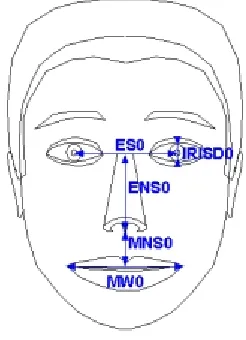
Facial Animation Parameter Units (FAPU) are unit-less values independent of
model geometry, which means they can drive different facial models regardless of
geometry [Koray04]. FAPU can be defined as the fractions of distances between the key
facial features. The figure shows the key facial features that are taken into account.
Figure 2.6: MPEG4 FAPU
One of the greatest advantages of coding a face model using FPs and FAPU is
that unlike previous animation techniques, we can swap the face models without the
problem of calibration and parameterization for animation. Due to the flexibility of
MPEG4 coding we have used the MPEG4 facial animation standards to create our 3D
talking head.
Having discussed the various animation modeling techniques available we will
now discuss the application of emotion modeling on the 3D talking head to simulate
2.3 Modelling emotions
Emotions can be defined as the internal state of mind that could be affected by
any external stimuli. For example: sad emotions arise in a situation when the user is not
able to fulfill his/her goals. Emotions are very complex to model. There are few models
for emotions that have proven to be effective when dealing with machines. Those
emotional models have been created based on the psychological theories of humans.
Some of the famous models for emotions are:
Plutchik‟s wheel of emotions
Ortony Clore and Collins Model for emotions (OCC)
2.3.1 Plutchik‟s wheel of Emotions
Robert Plutchik was an ancient physician who constructed and classified emotions
based on certain hypothetical postulates. He established the Plutchik‟s wheel of emotions
in the year 1960. It can be treated as one of the first models of emotions that came into
existence, even before the OCC model for emotions.
Plutchik proposed some basic postulates for his emotional theory [Plutchik91]:
There are a small number of pure or primary emotions.
All other emotions are mixed that is, they can be synchronized by various
combinations of the primary emotions.
Primary emotions differ from each other with regard to both physiology
and behaviour.
Primary emotions in their pure form are hypothetical constructs or
idealized states whose properties can only be inferred from various kinds
Primary emotions may be conceptualized in terms of pairs of polar
opposites.
Each emotion can exist in varying degrees of intensity or levels of arousal.
The figure shown below explains the Plutchik‟s wheel of emotions. It also shows
that how the primary emotions are combined together to get a new emotion.
Figure 2.7: Plutchik‟s Wheel of Emotion [Plutchik91]
Even though Plutchik‟s emotional theory has been one of the oldest and well
known models for emotional theory, it has not found its application in embodied
conversational agents. The model classified the emotions as a combination of different
primary emotions but never explained how it can be applied to generic computational
models that can acquire emotions. Plutchik‟s emotional theory was a research on the
models. Therefore, it‟s more convenient to use an emotional model that can be applied to
embodied conversational agents. In contrast to Plutchik‟s model, the OCC model came
into existence so that it could be applied to different computational models.
2.3.2 Ortony Clore and Collin‟s model for Emotions (OCC Model)
OCC model for emotions is one of the most renowned models for emotions. This
model was published in 1988 by Ortony, Clore and Collins in their book “The Cognitive
Structure of Emotions”. The OCC model was one of the first models for emotions that
could be applied to machines and embodied conversational agents. It was constructed
based on the psychological theories of humans. They classified 22 types of emotions as
Figure 2.8: The OCC model for emotions [Ortony88]
The 22 types of emotions are:
Pleased
Displeased
Happy-for
Gloating
Pity
Satisfaction
Disappointment
Joy
Distress
Pride
Shame
Admiration
Reproach
Gratification
Remorse
Gratitude
Anger
Love
Hate
Ortony, Clore and Collins classified emotion on the following variables:
Type specification
Tokens
Variables affecting intensity
Ortony, Clore and Collins further classified emotions based on their valanced
reaction to three factors:
Consequences of events
Action of agents
The classification of one of the emotions „Fear‟ using the above mentioned three
factors is shown below:
Figure 2.9: The OCC classification of the emotion „Fear‟ [Ortony88]
The figure shown below represents the emotion type specifictions for all 22
emotions in the OCC model.
Figure 2.10: The OCC type specifications of 22 emotions [Ortony88]
The OCC model has been integrated into several embodied conversational agents.
three factors: consequences of events, action of agents, and aspects of objects. The model
has been proved to be successful when applied to embodied conversational agents in the
past [Zhen08]. This was one of the main reasons that motivated us to integrate the OCC
model to the proposed framework. Even though [Zhen08] established a firm cognitive
model for emotions they didn‟t explain how the emotions can be applied to an embodied
conversational agent and how the emotional state of these agents were affected after the
emotions were generated. Therefore, the main focus of this thesis is to generate emotions
based on the situational information calculating the current emotional state of the agent
which is backed up by the OCC model for emotions.
Having discussed the modeling of emotions we will now turn to a discussion of
dialogue management systems which drive the Embodied Conversational Agent.
2.4 Dialogue Management Systems: An overview
A dialogue management system is a system that processes the user‟s queries and
gives feedback based on its domain knowledge. Dialogue management systems play a
key role in customer service by processing user requests in several domains such as in a
flight reservation system. Dialogue management systems also maintain a dialogue history
which stores and updates the dialogue states, and finally decides the action taken so as to
control the flow of dialogue conversation between user and the machine. According to
[Trung06] the dialogue management system is classified into four different categories:
Finite state and frame based approach
Information state and probabilistic approach
Plan based approach
Finite state and frame based approaches are the most basic and simple approaches
to handle dialogues. It represents a state transition network with nodes that show the
system utterances and the system transition in the network to solve a problem.
The information state and probabilistic approaches were mostly used for
constructing multimodal dialogue systems, but unfortunately it was unable to handle to
handle high complexity dialogues.
The plan based approaches came into existence to replace the information and
probabilistic approaches due to the limitations in handling dialogue complexities.
Finally, the collaborative agent based approach was introduced to replace the plan
based approaches because they were able to capture the motivations and the mechanism
of the dialogue structure.
Given a specific category of system, various techniques and approaches to the
system‟s dialogue process exist. We will discuss these techniques in the next section.
2.5 Dialogue Management Techniques
Different dialogue management techniques have been introduced since the first
one that came into existence in 1999. Some of the popular dialogue management
techniques are:
Handcrafted Dialogue Managers
Bayesian Network for Dialogue Management
Supervised Learning and Markov Decision Process
Semi Markov Decision Process
The handcrafted dialogue management systems were one of the oldest techniques
that were introduced to handle dialogue conversations between a human and machine. It
was not the most efficient technique for creating dialogue management systems. They
were time consuming and failed to work properly in complex situations. The greatest
advantage of this technique was its simplicity in construction and handling. [Sabiha10]
The Bayesian network was another variant of the of the handcrafted dialogue
management systems. It was introduced to replace the legacy handcrafted dialogue
managers, but it suffered from processing the sub goals for a system based on different
multimodal information sources. [Prodanov04]
The Supervised Learning and Markov Decision Process proved to be better than
the existing handcrafted dialogue management systems such as the Bayesian network. It
maintained a single dialogue and the actions were learnt from the corpus [Sabiha10].
Even though maintaining a single state was considered to be more effective in
comparison to the handcrafted dialogue managers, the Supervised Learning and Markov
Decision Process suffered from limitations such as creating a dialogue policy.
The Semi Markov Decision Process was first proposed by [Cuayahuitl09] and the
main goal of the system was to choose the best action which resulted in the change of
dialogue states. The Semi Markov Decision Process was later replaced by the Partially
Observable Markov Decision Process, which we will now focus our discussion on.
2.5.1 Partially Observable Markov Decision Process (POMDP)
According to [Jason05] the POMDP is defined as a tuple, ,
may take; T defines a transition probability ; R defines the expected
(immediate, real-valued) reward ; O is a set of observations that the agent can
receive about the world; and Z defines an observation probability, ; λ is a
geometric discount factor and b0 is an initial belief state b0(s). For any given
belief state we have the following equation:
[Jason05] proved that the POMDP is completely robust and can handle the
uncertainty caused by the speech recognition errors by comparing it with existing
techniques. One of the first applications of POMDP in dialogue management was the
nursing home robot application proposed by Roy, et al. [Roy20]. Since then, POMDP
found its applications in several spoken dialogue management systems. The POMDP
approach was later replaced by a Modified POMDP model by [Sabiha10].
Contextual dialogue control of the system utilizes the Hollnagel‟s Contextual
2.5.2 Hollnagel‟s Contextual Control Model (COCOM)
In 1993 Eric Hollnagel introduced the contextual control model to assess team
behaviour based on the time available. The main contribution was that the system decided
the actions based on the context of the situation and available time. He categorized team
behaviour into four different modes:
Scrambled Mode
Opportunistic Mode
Tactical Mode
Strategic Mode
Hollnagel‟s COCOM was put to test by Stanton, et al. [Stanton01] where they
created 24 groups of people with 4 people in each group. There were 74 males and 22
females of the age between 19 and 55. They made six groups of four people in each
group work on balancing a simulated gas network system. As an outcome of this
experimentation they reliably categorized the four control modes and showed that the
progression between control modes conformed to a linear progression.
The figure below shows the COCOM model, detailing the movements available
between the different control modes. We have applied the same COCOM to the proposed
Figure 2.11: Flow of the Four Contextual Control Modes (COCOM) [Stanton01]
2.5.3 Modified Partially Observable Markov Decision Process
The Modified POMDP model was established to overcome the limitations of the
existing POMDP approaches. According to [Sabiha10] the existing POMDP approaches
considered the world to be static and always made its decisions based on the current
belief state. The author also pointed out how the existing POMDP approaches ignored the
dialogue history to make decisions effectively. They created a new POMDP approach
known as the Modified Partially Observable Markov Decision Process which combined
Hollnagel‟s Contextual Control Model for decision making based on user input [Kim06].
The dialogue manager switches from one mode to another for processing user
queries. For example if the dialogue manager is not able to understand the user request it
switches to the scrambled mode where panic sets in. The dialogue manager will attempt
managers try to repeat the same question again and again until the user comes up with the
right answer.
The dialogue manager achieves the goal by transitioning from mode to another
mode using forward planning. The lowest level of control will be the scrambled control
mode where the system does not have a proper understanding of the user‟s queries and
the most desirable level of control mode will be strategic mode where the system has a
clear understanding of the user‟s queries. The system chooses the best action based on
the context of the dialogue conversation and transitions between the modes depending on
the dialogue states, current action, context of the situation and available time. The system
proved to be effective in handling the uncertainty caused by speech recognition errors
and performed much better at handling conflicts in comparison to the existing POMDP
approaches.
Having discussed the dialogue management system we will now turn our focus on
the realization of the Embodied Conversational Agent. We start with an overview of a
scripting language that is used for animation and speech synthesis of our agent.
2.6 SMIL Agent Scripting Language: An Overview
The Synchronized Multimedia Integration Language script, or SMIL, is used to
create interactive audio/visual presentations. SMIL 1.0 is the new standard for driving the
facial animation of MPEG4 3D talking heads. Some of the other languages used for
driving MPEG4 3D talking heads include:
APML
MPML
CML
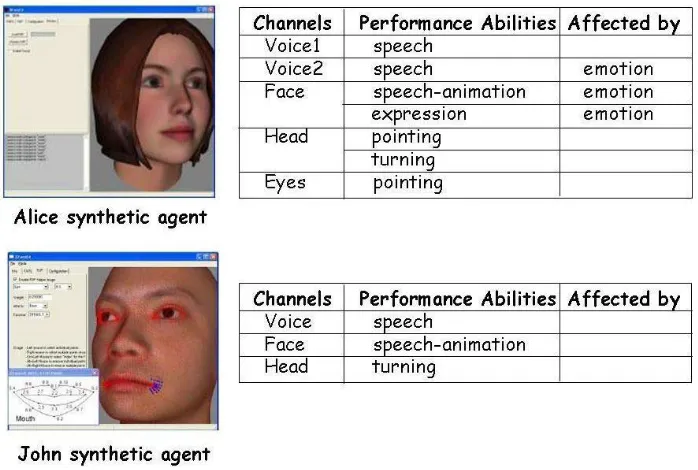
According to Elena, et al. [Elena05] the above mentioned languages lack
independence from communication context, independence from specific character,
channel independence, adaptability, standardization, and extendibility. These scripting
languages are strictly coupled with the applications and cannot be reused for another
application. They are also coupled to the performance parameters of a specific agent. The
previous scripting languages lacked the flexibility to be reused with other agents.
On the other hand, SMIL focuses on conveying message to the users through
different communication channels such as speech animation, voice, and facial animation.
Since it handles different channels for communication at once the users experience a
much better interactive environment than before. The script does not carry any
information that is specific to the domain and hence, it is very easy to reuse the talking
heads and the scripts for different purposes.
The 3D talking heads driven by the SMIL Agent script could be reused across
different domains because the script does not carry any information that is strictly
coupled to the domain itself. For example: The 3D talking head used in a healthcare
domain can also be used for a pizza ordering domain. The 3D talking heads driven by the
SMIL Agent script are completely flexible and adaptable.
Figure 2.12 illustrates two different 3D agents which could have different
performance parameters defined. The SMIL scripting language is capable of handling
both agents even though different parameters are present. Either agent can then be used a
Figure 2.12: Alice and John are two different synthetic agents with different performance
parameters [Elena05]
2.7 Review of Existing Embodied Conversational Agents
We will now critically review the state-of-the-art of embodied conversational
agents in this section. We will be reviewing some of the popular ECA‟s such as the
Microsoft agent, Chinese talking head, LUCIA and chatter bots.
2.7.1 Microsoft Agents
Microsoft Agents were one of the most primitive types of embodied
conversational agents. These agents created a new wave in the field of Human Computer
Interaction. Microsoft Agents 2.0 was developed to provide assistance to people
browsing web pages or even using specific programs on a computer such as Microsoft
Office. The characters were able to communicate with users through a text to speech
providing assistance to the users by reading their email aloud, or helping the users
navigate a web page.
Some of the famous characters that included in the package were:
Clipit (the paper clip)
The Dot (a shape-shifting and color-shifting smiley-faced red ball)
Hoverbot (a robot)
The Genius (a caricature of Albert Einstein)
Figure 2.13: Example of a Microsoft Agent - Peedy
With the recent developments in Human Computer Interaction the ECA‟s of
today have reached a different level of technology which is much better than the first set
of Microsoft Agents. The ECA‟s these days have much better interfaces; they have
Artificial Intelligence to a certain extent and also have emotions to improve the entire
communication experience for users. The following sections will overview some of the
state-of-the-art ECAs in research and commercial applications.
2.7.2 Emotional Chinese Talking Head
when the agents are able to express their emotions accompanied by the audio/video
displays. Tao, et al. [Tao04] created a similar emotional Chinese talking head system.
The talking head recognized the emotions from user text and attempted to produce an
emotional audio/video output.
Though the system is effective in terms of recognizing the emotions from text, it
lacked the visual display of emotions. The talking head was not realistic comparatively
because it did not use multiple channels to express emotions. Every single channel; such
as the voice, face, eyes, eyebrows, mouth, body, arms, and head; can realize the emotions
individually. The results confirmed that happiness and sadness were not distinguished
very effectively using merely facial features while their corresponding acoustic features
turned out well.
Happiness and sadness are the two extremes of emotions and it is very important
for the user to be able to differentiate between them from the agent. Figure 2.14 shows
an example of the talking head responding to user input.
As it turns out the paper laid more emphasis on emotion recognition than the
Figure 2.14: Emotional Chinese Talking Head [Tao04]
2.7.3 LUCIA
The LUCIA is an Italian emotional 3D talking head. They used INTERFACE to
create the 3D model and used Festival for Text to Speech conversion. LUCIA was able to
mimic human emotions by observing the human in front of the system as shown in Figure
2.15. It used an optoelectronic device that placed markers on the user‟s face. The
displacement of the facial muscles from the markers denoted a movement and the system
looked up a database to find the respective emotion of the user. LUCIA is still one of the
best emotional 3D talking heads that can track the human emotions and mimic them.
LUCIA basically mimics the human and does not engage in any type of interaction or
problem solving. [Piero08]
As a result, although LUCIA is exceptional at understanding the user and
generating various emotional responses, it fails at creating emotions based on its own
internal goals. The focus of this thesis is to create an emotional talking head that is aimed
Figure 2.15: Architecture of LUCIA [Piero08]
2.7.4 Emotion based Tutor
Adina, et al. [Adina05] embedded emotions in an artificial tutor based on a BDE
architecture. The tutor‟s emotions were also based on the OCC model and classified as
“Affective level” and “Cognitive level”. The emotions and attitude of the student played
a key role in the planning and decision making process of the tutor. The system aided in
stimulating the presence of an empathic learning companion, which encouraged the
student towards a faster progress to knowledge acquisition. However, the authors did not
discuss anything about an interface (facial animation) that could realize emotions and
details regarding the transition from one emotional state to another were unclear. The
system also failed to include the factor of emotional history which is important in
creating a continuous and believable conversation between user and agent.
2.7.5 GRETA
GRETA is a 3D embodied conversational agent that can interact with people by
means of verbal and non-verbal behaviours. GRETA still plays a major role in some of
HUMAINE – a community that carried out their research on Embodied
Conversational Agents. GRETA was an active part of the HUMAINE
community .
SEMAINE – aimed at developing a multimodal architecture with SAL
(Sensitive Artificial Listener). It is evident from the video hosted on their
website that GRETA is able to communicate with an anonymous user on
the other end, using verbal and non verbal behaviours. GRETA is able to
display continuous head nods while she is listening to the user and can
also gaze when needed. [Semaineu]
CALLAS – standing for Conveying Affectiveness in Leading-edge Living
Adaptive Systems, is an integrated project funded by the European
Commission under FP6. The project has been named in the honour of
Maria Callas who was a great singer. The project is aimed at developing a
system or framework that can bridge the gap between conveying
emotional aspects and multimodal inputs. [Callas06]
The 3D model for GRETA was created under the MPEG4 Facial Animation
standard. Even though GRETA has found its applications in different projects it is
nothing more than a virtual entity that can display emotions. GRETA does not have an
emotional model for generating those emotions. In other words GRETA can display
Figure 2.16: GRETA [Stefano08]
2.7.6 Chatter bots
Chatter bots are virtual entities that can communicate with users via text, facial
animation, voice and emotional displays. There is not much difference between chatter
bots and embodied conversational agents. Chatter bots can be thought of as the primitive,
or basic, version of the embodied conversational agents. In general, ECAs have more
capabilities compared to chatter bots. There are several chatter bots that are still being
used over thousands of websites. We will review a few chatter bots that can be
comparable to our proposed ECA:
Verbots [Verbots04] – can be added to your existing web pages for providing
virtual assistance to the user. They have an interface that comes with a variety of talking
heads which are designed using Flash scripts.
Most of their characters are 2 Dimensional agents and absolutely lack the realism
frowning. Therefore, they also lack in displaying true emotions. The Verbots lack proper
lip synchronization with the audio and assist the user based on their knowledge base and
there is little Artificial Intelligence involved.
The Verbots communicate with the users via text and voice and serve as basic
ECA‟s for any website. The figure shown below is an actual Verbot initiating a
conversation with the user. The Verbot‟s knowledge base did not have any information
about greeting the user and henceforth it was not able to recognize the user input.
Another drawback of the knowledge based design is that developers have to create a large
knowledge base if they wanted the 3D talking head to recognize every single user
utterance properly.
Figure 2.17: An example of a Verbot conversation with a human [Verbots04]
Cleverbot – is a virtual entity that has been hosted online on a server. Users can
interact with the Cleverbot by asking questions. The intelligence of the Cleverbot is quite
significant in comparison to other chatter bots available. The Cleverbot learns from the
users and also from the internet [Cleverbot10]. They communicate with users through
text and have no interface. The figure shown below is an actual snapshot taken from the
Cleverbot web page. The Cleverbot maintains a knowledge base like any other chatter
Figure 2.18: An example of a Cleverbot conversation with a human [Cleverbot10]
Aaron- is a virtual agent for Futures Shop, Canada [Futureshop11]. He tries to
answer users‟ queries by performing keyword based searches on the Future Shop website.
He has a photorealistic face but does not have any real-time emotions.
The interface basically plays an animation from a repository of pre-recorded
animations based on the keywords typed by the user. There are several agents that are
being used today in hundreds of websites that just play back a pre-recorded animation
from a database of videos like Aaron. They might look realistic in the beginning but as
the user continues to use the website he/she will find out that the agent is a pre-recorded
animation. The agent can be annoying sometimes because it becomes repetitive with
Figure 2.19: Aaron from Future Shop‟s website [Futureshop11]
Anna – is a representative for the IKEA products on IKEA‟s web page [Ikea99].
She is a 2-Dimensional cartoon character who provides assistance for the online
shoppers. She communicates with the users through text. Like Aaron, she does not have
any emotions and has limited user interaction. Her knowledgebase is limited and cannot
handle uncertainty. She retrieves the information about the products using the keyword
based content retrieval technique. The agent could be annoying at situations where the
user mistyped a word or if the user asked something about the website that was not a part
Figure 2.20: IKEA‟s Anna [Ikea99]
2.8 Conclusion
We have reviewed different areas of research such as facial animation, emotion
modelling, POMDP dialogue management system, scripting languages for driving facial
animation, and some existing embodied conversational agents. Most of the existing 3D
talking heads laid more emphasis on individual areas of research, such as capturing user
emotion or creating realistic looking emotional output, rather than combining everything
together to create a system that can process user requests and interact with them through
different communication channels such as voice and facial expressions.
Integration of a powerful dialogue manager such as the Modified POMDP
dialogue manager with an effective emotional ECA was never accomplished in the past.
facial animation; a dialogue manager, especially the Modified POMDP dialogue
manager, backed up by a responsive emotional model; that combines the OCC model and
Four Contextual Control Modes are evident from the literature review.
In the next chapter we discuss the methodology and design specifics which realise
an integrated dialogue management system which will enhance the user interaction
CHAPTER III
DESIGN AND METHODOLOGY
This chapter will provide a deep insight about the proposed architecture. The beginning
of this chapter will discuss the techniques involved in creating an emotional model using
OCC model for emotions and Four Contextual Control Modes. Towards the end of this
chapter we will also explained the steps involved in creating a 3D talking head with
different types of emotions, how the SMIL Agent scripting language drives facial
animation via control of all communication channels individually, and the integration of
Modified POMDP dialogue manager to the entire system. This chapter will also overview
the tools involved in the creation of an embodied conversational agent, explaining its
significance and henceforth justifying the reason for choosing those tools. Before we
proceed further, we would like to highlight our main contributions towards this thesis
work:
Creation of a 3-Dimensional Emotional Embodied Conversational Agent that
expresses it emotions through different animation channels, such as eyes and
lips, using MPEG4 Facial Animation
Creation of SMIL Script Generator that drives the MPEG4 facial animation
with speech
Proposal of a new model for Emotion Generation combining the OCC model
for emotions and the Four Contextual Control Model (COCOM)
The proposed framework will adhere to the Four Contextual Control Modes
Integration of Modified POMDP Dialogue Manager with the proposed
framework and test the functionality of the system in a Pizza Ordering
Domain
Extending the Modified POMDP Dialogue Manager to handle special user
requests which were not implemented previously
Modifying the existing model to fit the proposed emotional model; generating
better confidence scores and rewards
3.1 Proposed Architecture: An Overview
The figure shown below is the proposed architecture of our system. This section
will give an overview of the new architecture and the consecutive sections will review all
the components in detail. The core components of the new framework are:
Modified POMDP dialogue Manager
Emotion Generator
SMIL Agent to FAP converter
Text to speech engine
Figure 21: The proposed architecture of our system
The Modified POMDP dialogue manager is responsible of processing the user
requests. The dialogue manager processes the queries by switching between the four
modes such as Scrambled mode, Opportunistic Mode, Tactical Mode and Strategic Mode.
The dialogue manager switches between the modes based on the confidence score
obtained for the dialogue state.
The confidence score is a numerical representation of how much the system
system did not understand all the user utterances. If the confidence score is high then it
means that the system was able to understand most of the user utterances.
For example, if the confidence score is low for the current conversation then the
system is in Scrambled Mode where panic sets in because the system has lost its control
over the dialogue. The system tries get out of the Scrambled control mode by making a
random decision. The random decision might help the system to proceed to the next
mode or even fall back to Scrambled Mode. In other words, the random decision might
be something that the user actually wanted. In that case the system proceeds further and
steps up to the next control mode.
On the other hand, the random decision might not be something that the user
actually wanted. In that case, the system falls back to the Scrambled Mode and tries to get
more information about the situation. If the user did not provide any information or
enough information, then the system steps up to the Opportunistic Mode and tries to give
a set of options to the user instead of throwing errors or repeating the same query.
The emotion generator keeps track of the current mode and previous mode, and
will generate the appropriate emotion. The rules for generating the emotion is based on a
combination of OCC model for emotions and the Contextual Control Modes used by the
Modified POMDP dialogue manager. The emotion generated will be transformed into
SMIL Agent Script with appropriate parameters for eye movement, blinking, and text to
be animated. The text to be animated will be generated by the modified POMDP dialogue
manager.
Once the SMIL Agent Script is generated it is processed at the second level which
the client for processing for SMIL Agent Scripts for the Xface player, which is an
MPEG4 Facial Animation player. The Xface player acts as the server and plays the
animation. The Client processes the script from time to time and sends it to the server as a
“Task” for playing back the animation with appropriate emotions. The text to be
animated is converted to speech using MSSAPI 1.5 text to speech engine. The Xface
player will playback the animation (FAP) synchronized together with the audio (WAV)
file.
We will now explain every individual components of our system in more detail in
the following sections.
3.2 Modified POMDP Dialogue Manager
The Modified POMDP dialogue manager evolved to replace the POMDP
dialogue manager. The Modified POMDP dialogue manager was obtained from
modifying the POMDP model by incorporating the Four Contextual Control Modes.
Unlike MDP and POMDP the Modified POMDP model is able to handle uncertainty. The
Modified POMDP also uses dialogue history to make dynamic decisions and handle
conflicts. The Modified POMDP model is the best dialogue manager available till date
that makes use of the situational information to make decisions. The proposed emotional
model requires situational information and henceforth the Modified POMDP model is
found to be suitable for that purpose. The Modified POMDP model has its own
limitations such as handling text and speech errors. If the dialogue manager was not able
to understand any of the user utterances it moves to scrambled control mode and make a
random decision or move to tactical mode and give the user a set of options to choose
errors. The proposed emotional model always tries to cope up with its positive emotions
and stay happy. The emotion switches to negative emotions when it doesn‟t understand
the user. But the agent heavily tries to avoid the negative emotions by communicating
with the Modified POMDP dialogue manager and the dialogue manager tries to clarify
anything that it did not understand during the conversation. Therefore, when the agent
does not understand any or some of the user utterances then the emotional model instructs
the Modified POMDP dialogue manager to compare the strings input by the user to the
keywords from the knowledgebase. It is done using the „Jaro Winkler‟ algorithm
proposed by Winkler in the year of 1990. Java allows you to use the Jaro Winkler library
directly. According the Jaro Winkler algorithm calculates the similarity between two
given strings and normalizes the value to 0 or 1. If the algorithm generates a „0‟ then it‟s
not a match and if it generates a „1‟ then it‟s a perfect hit. We have used the algorithm to
help the Modified POMDP dialogue manager handle the text, speech errors and generate
better confidence scores.
3.3 OCC model and Four Contextual Control Modes for Emotion Generation
In this section we will elaborate about the methodology adopted for generating
emotions. The OCC model for emotions has been combined with Hollnagel‟s Four
Contextual Control Modes to generate emotions [Stanton01]. The OCC model clearly
reviewed a cognitive model for classifying 22 different types of emotions. They have
classified emotions based on three factors:
Consequences of events
Action of agents
As mentioned in Chapter II even though this model served as a baseline for
classifying emotions the authors did not mention specific details on how to implement the
emotional model in a software setting. The OCC model also did not specify possible
causes for triggering such an emotion. We answered those questions by integrating
Hollnagel‟s Four Contextual Control Modes to the OCC model. According to our new
proposed framework, the emotions are definitely an outcome of external stimuli.
The emotions of this 3D talking head are triggered based on the four modes which
updates it with situational information. For example, if the agent is in Scramble Mode it
means that the agent did not understand some or most of the user utterances. The agent, a
goal based or task oriented agent, is in a panic situation where it is not able to process the
user requests. The agent‟s emotional stability tends to vary based on whether it is
progressing or regressing from the goal.
A real life situation will draw a clear picture about our proposed emotional
framework. For instance, let us assume a situation where a student has to score 75% or
above to pass the course and proceed to the final year of his school. Any situations such
as the student falling sick during the study holidays, family emergency, etc will definitely
affect his emotional stability because it might hold him back from achieving his goal,
which is pass the course with 75% or above, and proceed to the final year of his school.
The same logic can be applied to our agent who processes user requests in a pizza
ordering domain. The agent switches between the four modes to achieve an optimal goal.
The transition between the four modes clearly states the agent‟s situation and updates the
The previous emotional models generated emotions based on fuzzy theories;
multimodal input such as camera, microphone, or text; and most of these models were
focussed on emotion detection rather than emotion generation. We have established an
emotional model for a goal based agent whose emotional stability varies based on
whether the agent progresses or regresses from the agent‟s goal.
3.4 Emotion Generator
The flowchart shown below illustrates the OCC model. The highlighted area
denotes that we have used only those emotions from the OCC model that will be
appropriate for a goal based agent. The goal based agent is completely different from an
empathic agent which focuses on both Consequences for Other (the user) and
Consequences for Self (the agent). Instead it will focus only on the Consequences for
Figure 22: A subset of the emotions from the OCC model used for our thesis [Ortony88]
As we mentioned earlier, Hollnagel‟s Contextual Control Model for studying
team behaviour is based on the Four Contextual Control Modes. Stanton explained the
modes as follows [Stanton01]:
Scrambled Control - is characterised by a completely unpredictable
situation where the operator has no control and has to act in an unplanned
manner, as a matter of urgency. An example of this may be where there is
a sudden accident or emergency, where the operator is unfamiliar with the
situation and/or lacks experience in what to do - the engineer‟s behaviour
may be impulsive or even panicky. Consequently this is the mode where
![Figure 2.3: Three vectors in a Vector Muscle Model [Waters91]](https://thumb-us.123doks.com/thumbv2/123dok_us/1448996.1177525/25.612.244.414.108.297/figure-vectors-vector-muscle-model-waters.webp)
![Figure 2.5: Feature points affected by FAPs and other Feature points [Koray04]](https://thumb-us.123doks.com/thumbv2/123dok_us/1448996.1177525/28.612.237.448.74.431/figure-feature-points-affected-faps-feature-points-koray.webp)
![Figure 2.7: Plutchik‟s Wheel of Emotion [Plutchik91]](https://thumb-us.123doks.com/thumbv2/123dok_us/1448996.1177525/31.612.212.474.222.500/figure-plutchik-s-wheel-of-emotion-plutchik.webp)
![Figure 2.8: The OCC model for emotions [Ortony88]](https://thumb-us.123doks.com/thumbv2/123dok_us/1448996.1177525/33.612.154.531.79.435/figure-occ-model-emotions-ortony.webp)
![Figure 2.11: Flow of the Four Contextual Control Modes (COCOM) [Stanton01]](https://thumb-us.123doks.com/thumbv2/123dok_us/1448996.1177525/41.612.234.451.74.321/figure-flow-contextual-control-modes-cocom-stanton.webp)